INCIDENT
COMMAND
SYSTEM
-
SIX-STEP
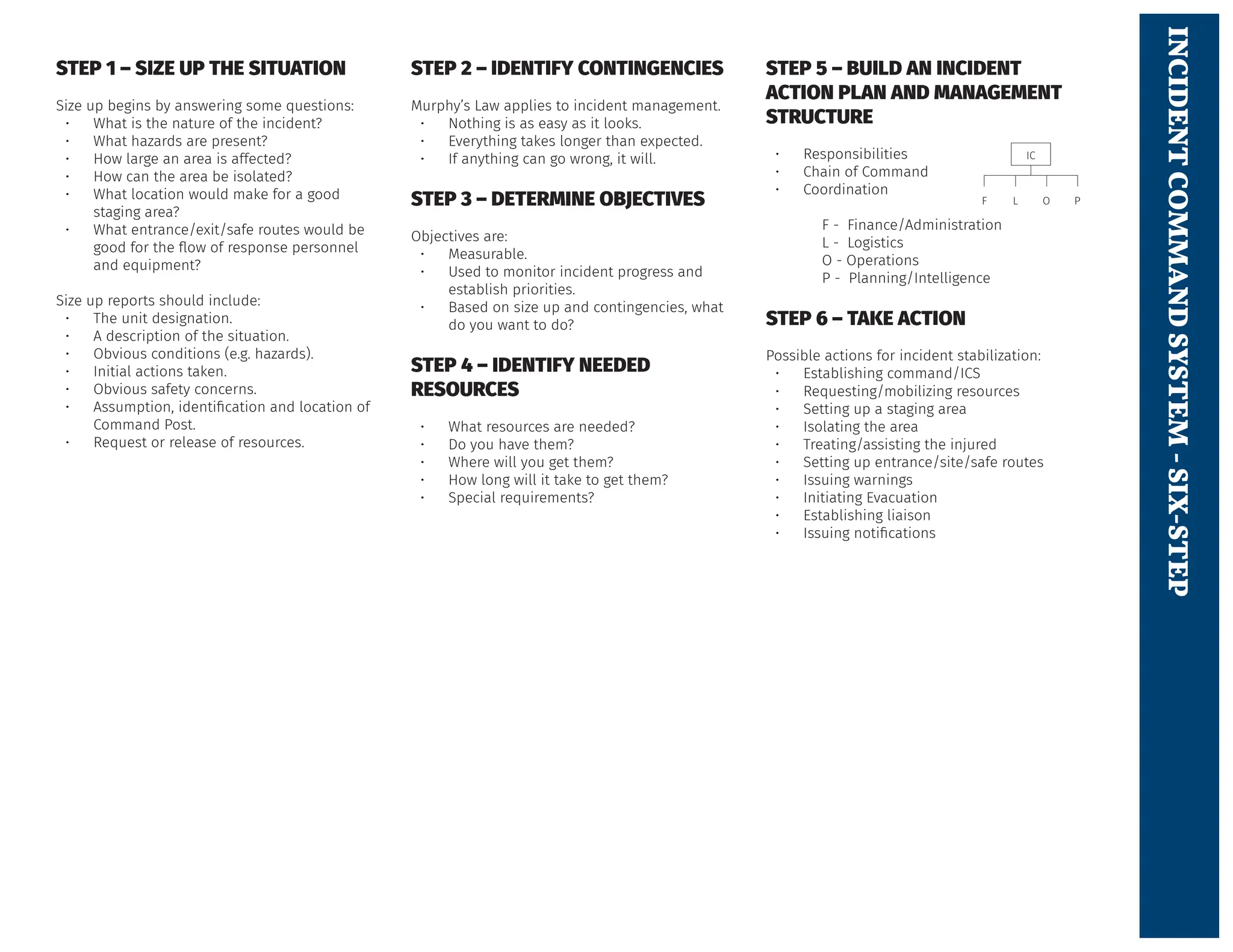
STEP 1 – SIZE UP THE SITUATION
Size up begins by answering some questions:
• What is the nature of the incident?
• What hazards are present?
• How large an area is affected?
• How can the area be isolated?
• What location would make for a good
staging area?
• What entrance/exit/safe routes would be
good for the flow of response personnel
and equipment?
Size up reports should include:
• The unit designation.
• A description of the situation.
• Obvious conditions (e.g. hazards).
• Initial actions taken.
• Obvious safety concerns.
• Assumption, identification and location of
Command Post.
• Request or release of resources.
STEP 2 – IDENTIFY CONTINGENCIES
Murphy’s Law applies to incident management.
• Nothing is as easy as it looks.
• Everything takes longer than expected.
• If anything can go wrong, it will.
STEP 3 – DETERMINE OBJECTIVES
Objectives are:
• Measurable.
• Used to monitor incident progress and
establish priorities.
• Based on size up and contingencies, what
do you want to do?
STEP 4 – IDENTIFY NEEDED
RESOURCES
• What resources are needed?
• Do you have them?
• Where will you get them?
• How long will it take to get them?
• Special requirements?
STEP 5 – BUILD AN INCIDENT
ACTION PLAN AND MANAGEMENT
STRUCTURE
• Responsibilities
• Chain of Command
• Coordination
F - Finance/Administration
L - Logistics
O - Operations
P - Planning/Intelligence
STEP 6 – TAKE ACTION
Possible actions for incident stabilization:
• Establishing command/ICS
• Requesting/mobilizing resources
• Setting up a staging area
• Isolating the area
• Treating/assisting the injured
• Setting up entrance/site/safe routes
• Issuing warnings
• Initiating Evacuation
• Establishing liaison
• Issuing notifications
F L O P
IC
INCIDENT
COMMAND
SYSTEM
&
CRISIS
RESPONSE
TEAM
INCIDENT COMMAND SYSTEM
The Incident Command System (ICS) is a nationally-
recognized emergency management methodology used
by public safety agencies, schools and businesses. ICS
provides an organized approach to managing emergencies
from time of discovery to stabilization and termination,
all the way through to recovery and resuming full school
operations. ICS incorporates an organizational structure
that provides for role assignment and decision-making
while planning for and responding to critical incidents
of all types and sizes. ICS allows for all school personnel
to know their area of responsibility during a crisis and
establishes a “Unified Command Structure” to partner the
School’s Incident Commander (IC) with the Public Safety
Incident Commander. This provides an effective team that
will work together to manage the emergency and recover
as quickly as possible.
Under ICS, tasks are delegated to members of the Crisis
Response Team (CRT) to successfully handle critical
incidents. The CRT member is then responsible for the
task assigned and serves as the manager of the task.
This type of delegation allows each team member to
focus on just one or two aspects of the incident. These
team members then provide information to the Incident
Commander and assist them in making informed
decisions. Using the organizational system during a critical
incident creates clear communication channels that will
reduce the amount of confusion and chaos. Permanently
assigning specific areas of responsibility to members of
the Crisis Response Team provides each member with the
opportunity to specialize in the management of his/her
area.
The Incident Command System serves as the nucleus of
crisis and emergency management contingency planning
and should be incorporated into the school’s crisis
management plan.
The ICS can also address the uncertainty of exactly
who will be in the building during an emergency. When
assigning the management of critical roles in ICS, assign
an alternate for each role to assure coverage at all times.
This may require some individuals to be responsible for
more than one task if the primary team member is out
of the building. While ICS identifies roles for members
of the Crisis Response Team, all school faculty members
should know their specific functions during an emergency.
Teachers and students in class will have specific functions
as will teachers not assigned a class when an emergency
occurs.
Using ICS to manage emergency events enables schools to
work more efficiently with local response agencies.
INCIDENT COMMAND STRUCTURE
CRISIS RESPONSE TEAM
INCIDENT
COMMANDER
PRINCIPAL
PUBLIC INFORMATION
OFFICER
FINANCE
ADMINISTRATION
BOE/PIO
EVACUATION
COORDINATOR
TIMEKEEPING
TIMEKEEPING
LOGISTICS
ASST. PRINCIPAL OR
LEAD TEACHER
REUNIFICATION
COORDINATOR
SUPPLIES/FACILITIES
STAFFING
COMMUNICATIONS
OPERATIONS
SRO
SCHOOL NURSE OR
MAIN SECRETARY
SCHOOL COUNSELOR
OR MHCTM
SITE FACILITY CHECKS
SECURITY
SEARCH & RESCUE
MEDICAL
STUDENT CARE
STUDENT RELEASE
PLANNING
INTELLIGENCE
HEAD CUSTODIAN
ASSIGNED CRT
MEMBER(S)
DOCUMENTATION
SITUATION ANALYSIS
SAFETY OFFICER
LIAISON OFFICER
Assign according to need and staff availability. Do
not activate the Finance/Administration section
unless directed by the BOE.

Incident-Command-System-and-Response-Team.pdf

  • 1.
    INCIDENT COMMAND SYSTEM - SIX-STEP STEP 1 –SIZE UP THE SITUATION Size up begins by answering some questions: • What is the nature of the incident? • What hazards are present? • How large an area is affected? • How can the area be isolated? • What location would make for a good staging area? • What entrance/exit/safe routes would be good for the flow of response personnel and equipment? Size up reports should include: • The unit designation. • A description of the situation. • Obvious conditions (e.g. hazards). • Initial actions taken. • Obvious safety concerns. • Assumption, identification and location of Command Post. • Request or release of resources. STEP 2 – IDENTIFY CONTINGENCIES Murphy’s Law applies to incident management. • Nothing is as easy as it looks. • Everything takes longer than expected. • If anything can go wrong, it will. STEP 3 – DETERMINE OBJECTIVES Objectives are: • Measurable. • Used to monitor incident progress and establish priorities. • Based on size up and contingencies, what do you want to do? STEP 4 – IDENTIFY NEEDED RESOURCES • What resources are needed? • Do you have them? • Where will you get them? • How long will it take to get them? • Special requirements? STEP 5 – BUILD AN INCIDENT ACTION PLAN AND MANAGEMENT STRUCTURE • Responsibilities • Chain of Command • Coordination F - Finance/Administration L - Logistics O - Operations P - Planning/Intelligence STEP 6 – TAKE ACTION Possible actions for incident stabilization: • Establishing command/ICS • Requesting/mobilizing resources • Setting up a staging area • Isolating the area • Treating/assisting the injured • Setting up entrance/site/safe routes • Issuing warnings • Initiating Evacuation • Establishing liaison • Issuing notifications F L O P IC
  • 2.
    INCIDENT COMMAND SYSTEM & CRISIS RESPONSE TEAM INCIDENT COMMAND SYSTEM TheIncident Command System (ICS) is a nationally- recognized emergency management methodology used by public safety agencies, schools and businesses. ICS provides an organized approach to managing emergencies from time of discovery to stabilization and termination, all the way through to recovery and resuming full school operations. ICS incorporates an organizational structure that provides for role assignment and decision-making while planning for and responding to critical incidents of all types and sizes. ICS allows for all school personnel to know their area of responsibility during a crisis and establishes a “Unified Command Structure” to partner the School’s Incident Commander (IC) with the Public Safety Incident Commander. This provides an effective team that will work together to manage the emergency and recover as quickly as possible. Under ICS, tasks are delegated to members of the Crisis Response Team (CRT) to successfully handle critical incidents. The CRT member is then responsible for the task assigned and serves as the manager of the task. This type of delegation allows each team member to focus on just one or two aspects of the incident. These team members then provide information to the Incident Commander and assist them in making informed decisions. Using the organizational system during a critical incident creates clear communication channels that will reduce the amount of confusion and chaos. Permanently assigning specific areas of responsibility to members of the Crisis Response Team provides each member with the opportunity to specialize in the management of his/her area. The Incident Command System serves as the nucleus of crisis and emergency management contingency planning and should be incorporated into the school’s crisis management plan. The ICS can also address the uncertainty of exactly who will be in the building during an emergency. When assigning the management of critical roles in ICS, assign an alternate for each role to assure coverage at all times. This may require some individuals to be responsible for more than one task if the primary team member is out of the building. While ICS identifies roles for members of the Crisis Response Team, all school faculty members should know their specific functions during an emergency. Teachers and students in class will have specific functions as will teachers not assigned a class when an emergency occurs. Using ICS to manage emergency events enables schools to work more efficiently with local response agencies. INCIDENT COMMAND STRUCTURE CRISIS RESPONSE TEAM INCIDENT COMMANDER PRINCIPAL PUBLIC INFORMATION OFFICER FINANCE ADMINISTRATION BOE/PIO EVACUATION COORDINATOR TIMEKEEPING TIMEKEEPING LOGISTICS ASST. PRINCIPAL OR LEAD TEACHER REUNIFICATION COORDINATOR SUPPLIES/FACILITIES STAFFING COMMUNICATIONS OPERATIONS SRO SCHOOL NURSE OR MAIN SECRETARY SCHOOL COUNSELOR OR MHCTM SITE FACILITY CHECKS SECURITY SEARCH & RESCUE MEDICAL STUDENT CARE STUDENT RELEASE PLANNING INTELLIGENCE HEAD CUSTODIAN ASSIGNED CRT MEMBER(S) DOCUMENTATION SITUATION ANALYSIS SAFETY OFFICER LIAISON OFFICER Assign according to need and staff availability. Do not activate the Finance/Administration section unless directed by the BOE.