INCIDENT COMMAND
SYSTEM ICS-100
INTRODUCTION TO THE INCIDENT
COMMAND SYSTEM FOR
FEDERAL WORKERS
ICS-100 Objectives
At the end of this lesson, you should
be able to:
 Provide examples of how ICS is
interdisciplinary and organizationally flexible.
 Describe how ICS became the standard for
emergency management across the country.
 Identify five major management functions.
 Determine whether the principle of span of
control has been applied properly in a
scenario.
ICS-100 Objectives (cont.)
 Describe the purpose of unique position
titles in ICS.
 Determine the roles and responsibilities of the
Incident Commander and Command Staff.
 Describe the roles and responsibilities of the
General Staff.
 Determine, when it is appropriate to expand
and contract the ICS organization.
 Identify the facilities used in ICS.
Types of Incidents
 Planned events
 Fire, both structural and
wildfire
 Hazardous materials incidents
 Search and rescue missions
 Oil spills
 Natural disasters
 Terrorist/WMD events
What Is ICS?
 Standardized, on-scene, all-hazard incident
management concept.
 Allows its users to adopt an integrated
organizational structure.
 Has considerable internal flexibility.
 A proven management system based on
successful business practices.
 The result of decades of lessons learned in
the organization and management of
emergency incidents.
Weaknesses Addressed by
ICS
 Lack of accountability, including unclear chain of
command and supervision.
 Poor communication, including system and
terminology problems.
 Lack of an orderly, systematic planning process.
 No common, flexible, predesigned management
structure.
 No predefined methods to integrate interagency
requirements into the management structure and
planning process.
What ICS Is Designed To Do
 Meet the needs of incidents of any kind or size.
 Allow personnel from a variety of agencies to meld
rapidly into a common management structure.
 Provide logistical and administrative support to
operational staff.
 Be cost effective by avoiding duplication of efforts.
 ICS has been tested in more than 30 years of
emergency and non-emergency applications, by all
levels of government and in the private sector.
ICS Features
ICS
ICS
Organization
Common
Responsibilities
Span of
Control
Incident
Action Plan
Incident
Facilities
Five Major Management
Functions
Logistics
Section
Finance/
Administration
Section
Operations
Section
Planning
Section
Incident
Command
ICS Span of Control
Supervisor
Resource 1 Resource 3
Resource 2
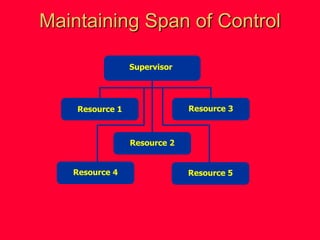
Maintaining Span of Control
Supervisor
Resource 1 Resource 3
Resource 2
Resource 4 Resource 5
ICS Position Titles
 Provide a common
standard for all users.
 Distinct titles allow
for filling positions
with the most
qualified individuals.
 Useful when
requesting personnel.
ICS Organizational Components
 Section
 Division
 Group
 Branch
 Task Force
 Strike Team
 Single Resource
Maintaining Span of Control
 Divisions: Divide incident geographically,
led by a Supervisor.
 Groups: Describe functional areas of
operation, led by a Supervisor.
 Branches: Used when the number of
Divisions or Groups exceeds the span of
control and can be either geographical or
functional, led by a Director.
Maintaining Span of Control
 Task Forces: Mixed resources with common
communications reporting to a Leader.
 Strike Teams: A set number of resources of the
same kind and type with common communications
reporting to a Leader.
 Single Resources: Individuals, a piece of
equipment and its personnel complement, or a
crew or team of individuals.
Incident Commander’s Role
 Has overall responsibility for managing the
incident.
 Must be fully briefed, and should have a
written delegation of authority.
 Personnel assigned by the Incident
Commander have the delegated authority of
their assigned positions.
 Only position that is always filled.
Incident Commander
Responsibilities
 Overall command and control.
 Ensures incident responder safety.
 Protects health and safety of the general
public and the environment.
 Provides information to internal and
external stakeholders.
 Maintains liaison with other agencies.
Expanding the Organization
Logistics
Section
Finance/
Administration
Section
Operations
Section
Planning
Section
Incident
Command
Public
Information
Officer
Safety
Officer
Liaison
Officer
Command Staff:
The Command Staff
provide Information,
Safety, and Liaison
services for the
entire organization.
General Staff:
The General Staff are
assigned functional
authority for Operations,
Planning, Logistics, and
Finance/Administration.
Command Staff
 Public Information
Officer
 Safety Officer
 Liaison Officer
PIO Responsibilities
 Advise the Incident Commander on information
dissemination and media relations.
 Serve as the primary contact for anyone who wants
information.
 Serve external audience and internal audience.
 Obtain information from the Planning Section.
 Coordinate with other public information staff.
 Obtain information from the community, the media,
and others.
Safety Officer Responsibilities
 Ensures responder
safety.
 Advises Incident
Command on safety
issues.
 Minimizes employee
risk.
Liaison Officer Responsibilities
 Gathers information
about support
agencies.
 Coordinates for
agencies not in
command structure.
 Provides briefings and
answers questions.
Understanding the General
Staff
Logistics
Section
Finance/
Administration
Section
Operations
Section
Planning
Section
Incident
Command
ICS Section Chiefs and Deputies
Team
Leader
Individual
Resource
Deputy Deputy
Section
Chief
Operations Section Chief Role
 Develop and manage the Operations
Section.
 Develops and implements strategies and
tactics.
 Work very closely with other members of
the Command and General Staff to
coordinate tactical activities.
Operations Section Expanding
Mass Care
Specialist
Fire Strike
Team Leader
Transportation
Specialist
Engineering
Specialist
Operations
Section Chief
Planning Section Chief Roles
 Gathers and analyzes information.
 Gathers, analyzes, and disseminate intelligence
and information.
 Manages the planning process.
 Compiles and develops the Incident Action Plan.
 Manages the activities of Technical Specialists.
 Works closely with the Incident Commander and
General Staff.
Incident Action Plan Elements
What, Where, When, Who, How?
 What do we want to do?
 Where do we stage?
 When are we going to do it?
 Who is responsible for doing it?
 How do we communicate with each other?
 What is the procedure if someone is injured?
Logistics Section Chief: Role
 Provides resources and
services to support the
incident.
 Develops portions of
the IAP.
 Contracts for goods
and services.
Finance/Administration Section
Chief: Role
 Negotiate contracts.
 Time keeping for personnel and equipment.
 Documenting and processing claims.
 Tracking costs.
Communications within ICS
 The ability to communicate with ICS is
critical.
 Use standard, common terminology.
 Avoid jargon.
 Use standard ICS position titles and facility
names.
 Develop a communications plan and
protocols specific to the incident.
 Determine flow path for communications.
Communications Discipline
 Observe strict radio/telephone procedures.
 Use plain English in all communications.
 Limit radio and telephone traffic to essential
information only.
 Follow procedures for secure communications
as required.
Incident Facilities
 Incident Command Post (ICP): Where the Incident
Commander oversees the incident.
 Staging Areas: Where resources are kept while waiting
to be assigned.
 Base: Where primary logistics functions are
coordinated and administered.
 Camps: Where resources may be kept.
 Helibase/Helispot: The area from which helicopter
operations are conducted.
Roles and Authorities
 Review assignment.
 Establish a clear understanding of your
decisionmaking authority.
 Determine procedures for contacting your
headquarters or home office (if necessary).
 Identify purchasing authority and procedures.
 Determine how food and lodging will be provided.
Check-In at the Incident
 Ensure personnel accountability.
 Track resources.
 Prepare personnel for assignments and
reassignments.
 Locate personnel in case of an emergency.
 Establish personnel time records and payroll.
 Plan for releasing personnel.
 Organize the demobilization process.
Initial Incident Briefing
Briefings received and given should include:
 Situation assessment.
 Specific job responsibilities.
 Coworkers.
 Work area.
 Eating and sleeping arrangements.
 Instructions for obtaining additional supplies, services,
and personnel.
 Operational periods/work shifts.
 Required safety procedures and PPE.
Incident Recordkeeping
 Print or type all entries.
 Enter dates by month/day/year format.
 Enter date and time on all forms and
records. Use local time.
 Fill in all blanks. Use N/A as appropriate.
 Use military 24-hour time.
 Section Chiefs and above should assign a
log keeper (scribe).
Incident Demobilization
 Complete work assignments.
 Brief replacements, subordinates, and supervisor.
 Follow check-out procedures.
 Provide follow-up contact information.
 Return incident-issued equipment.
 Complete post-incident reports, critiques,
evaluations, and medical follow-up.
 Resolve payment and/or payroll issues.
Objective Review
 Describe how ICS became the standard for
emergency management across the country.
 Provide examples of how ICS is
interdisciplinary and organizationally flexible.
 Identify five major management functions.
 Determine whether the principle of span of
control has been applied properly in a scenario.
 Describe the purpose of unique position titles
in ICS.
Objective Review (cont.)
 Determine the roles and responsibilities of the
Incident Commander and Command Staff.
 Describe the roles and responsibilities of the
General Staff.
 Determine, when it is appropriate to expand
and contract the ICS organization.
 Identify the facilities used in ICS.

ics100 (1).pptxhdfdfdfdffdfgdfffdgdfgfff

  • 1.
    INCIDENT COMMAND SYSTEM ICS-100 INTRODUCTIONTO THE INCIDENT COMMAND SYSTEM FOR FEDERAL WORKERS
  • 2.
    ICS-100 Objectives At theend of this lesson, you should be able to:  Provide examples of how ICS is interdisciplinary and organizationally flexible.  Describe how ICS became the standard for emergency management across the country.  Identify five major management functions.  Determine whether the principle of span of control has been applied properly in a scenario.
  • 3.
    ICS-100 Objectives (cont.) Describe the purpose of unique position titles in ICS.  Determine the roles and responsibilities of the Incident Commander and Command Staff.  Describe the roles and responsibilities of the General Staff.  Determine, when it is appropriate to expand and contract the ICS organization.  Identify the facilities used in ICS.
  • 4.
    Types of Incidents Planned events  Fire, both structural and wildfire  Hazardous materials incidents  Search and rescue missions  Oil spills  Natural disasters  Terrorist/WMD events
  • 5.
    What Is ICS? Standardized, on-scene, all-hazard incident management concept.  Allows its users to adopt an integrated organizational structure.  Has considerable internal flexibility.  A proven management system based on successful business practices.  The result of decades of lessons learned in the organization and management of emergency incidents.
  • 6.
    Weaknesses Addressed by ICS Lack of accountability, including unclear chain of command and supervision.  Poor communication, including system and terminology problems.  Lack of an orderly, systematic planning process.  No common, flexible, predesigned management structure.  No predefined methods to integrate interagency requirements into the management structure and planning process.
  • 7.
    What ICS IsDesigned To Do  Meet the needs of incidents of any kind or size.  Allow personnel from a variety of agencies to meld rapidly into a common management structure.  Provide logistical and administrative support to operational staff.  Be cost effective by avoiding duplication of efforts.  ICS has been tested in more than 30 years of emergency and non-emergency applications, by all levels of government and in the private sector.
  • 8.
  • 9.
  • 10.
    ICS Span ofControl Supervisor Resource 1 Resource 3 Resource 2
  • 11.
    Maintaining Span ofControl Supervisor Resource 1 Resource 3 Resource 2 Resource 4 Resource 5
  • 12.
    ICS Position Titles Provide a common standard for all users.  Distinct titles allow for filling positions with the most qualified individuals.  Useful when requesting personnel.
  • 13.
    ICS Organizational Components Section  Division  Group  Branch  Task Force  Strike Team  Single Resource
  • 14.
    Maintaining Span ofControl  Divisions: Divide incident geographically, led by a Supervisor.  Groups: Describe functional areas of operation, led by a Supervisor.  Branches: Used when the number of Divisions or Groups exceeds the span of control and can be either geographical or functional, led by a Director.
  • 15.
    Maintaining Span ofControl  Task Forces: Mixed resources with common communications reporting to a Leader.  Strike Teams: A set number of resources of the same kind and type with common communications reporting to a Leader.  Single Resources: Individuals, a piece of equipment and its personnel complement, or a crew or team of individuals.
  • 16.
    Incident Commander’s Role Has overall responsibility for managing the incident.  Must be fully briefed, and should have a written delegation of authority.  Personnel assigned by the Incident Commander have the delegated authority of their assigned positions.  Only position that is always filled.
  • 17.
    Incident Commander Responsibilities  Overallcommand and control.  Ensures incident responder safety.  Protects health and safety of the general public and the environment.  Provides information to internal and external stakeholders.  Maintains liaison with other agencies.
  • 18.
    Expanding the Organization Logistics Section Finance/ Administration Section Operations Section Planning Section Incident Command Public Information Officer Safety Officer Liaison Officer CommandStaff: The Command Staff provide Information, Safety, and Liaison services for the entire organization. General Staff: The General Staff are assigned functional authority for Operations, Planning, Logistics, and Finance/Administration.
  • 19.
    Command Staff  PublicInformation Officer  Safety Officer  Liaison Officer
  • 20.
    PIO Responsibilities  Advisethe Incident Commander on information dissemination and media relations.  Serve as the primary contact for anyone who wants information.  Serve external audience and internal audience.  Obtain information from the Planning Section.  Coordinate with other public information staff.  Obtain information from the community, the media, and others.
  • 21.
    Safety Officer Responsibilities Ensures responder safety.  Advises Incident Command on safety issues.  Minimizes employee risk.
  • 22.
    Liaison Officer Responsibilities Gathers information about support agencies.  Coordinates for agencies not in command structure.  Provides briefings and answers questions.
  • 23.
  • 24.
    ICS Section Chiefsand Deputies Team Leader Individual Resource Deputy Deputy Section Chief
  • 25.
    Operations Section ChiefRole  Develop and manage the Operations Section.  Develops and implements strategies and tactics.  Work very closely with other members of the Command and General Staff to coordinate tactical activities.
  • 26.
    Operations Section Expanding MassCare Specialist Fire Strike Team Leader Transportation Specialist Engineering Specialist Operations Section Chief
  • 27.
    Planning Section ChiefRoles  Gathers and analyzes information.  Gathers, analyzes, and disseminate intelligence and information.  Manages the planning process.  Compiles and develops the Incident Action Plan.  Manages the activities of Technical Specialists.  Works closely with the Incident Commander and General Staff.
  • 28.
    Incident Action PlanElements What, Where, When, Who, How?  What do we want to do?  Where do we stage?  When are we going to do it?  Who is responsible for doing it?  How do we communicate with each other?  What is the procedure if someone is injured?
  • 29.
    Logistics Section Chief:Role  Provides resources and services to support the incident.  Develops portions of the IAP.  Contracts for goods and services.
  • 30.
    Finance/Administration Section Chief: Role Negotiate contracts.  Time keeping for personnel and equipment.  Documenting and processing claims.  Tracking costs.
  • 31.
    Communications within ICS The ability to communicate with ICS is critical.  Use standard, common terminology.  Avoid jargon.  Use standard ICS position titles and facility names.  Develop a communications plan and protocols specific to the incident.  Determine flow path for communications.
  • 32.
    Communications Discipline  Observestrict radio/telephone procedures.  Use plain English in all communications.  Limit radio and telephone traffic to essential information only.  Follow procedures for secure communications as required.
  • 33.
    Incident Facilities  IncidentCommand Post (ICP): Where the Incident Commander oversees the incident.  Staging Areas: Where resources are kept while waiting to be assigned.  Base: Where primary logistics functions are coordinated and administered.  Camps: Where resources may be kept.  Helibase/Helispot: The area from which helicopter operations are conducted.
  • 34.
    Roles and Authorities Review assignment.  Establish a clear understanding of your decisionmaking authority.  Determine procedures for contacting your headquarters or home office (if necessary).  Identify purchasing authority and procedures.  Determine how food and lodging will be provided.
  • 35.
    Check-In at theIncident  Ensure personnel accountability.  Track resources.  Prepare personnel for assignments and reassignments.  Locate personnel in case of an emergency.  Establish personnel time records and payroll.  Plan for releasing personnel.  Organize the demobilization process.
  • 36.
    Initial Incident Briefing Briefingsreceived and given should include:  Situation assessment.  Specific job responsibilities.  Coworkers.  Work area.  Eating and sleeping arrangements.  Instructions for obtaining additional supplies, services, and personnel.  Operational periods/work shifts.  Required safety procedures and PPE.
  • 37.
    Incident Recordkeeping  Printor type all entries.  Enter dates by month/day/year format.  Enter date and time on all forms and records. Use local time.  Fill in all blanks. Use N/A as appropriate.  Use military 24-hour time.  Section Chiefs and above should assign a log keeper (scribe).
  • 38.
    Incident Demobilization  Completework assignments.  Brief replacements, subordinates, and supervisor.  Follow check-out procedures.  Provide follow-up contact information.  Return incident-issued equipment.  Complete post-incident reports, critiques, evaluations, and medical follow-up.  Resolve payment and/or payroll issues.
  • 39.
    Objective Review  Describehow ICS became the standard for emergency management across the country.  Provide examples of how ICS is interdisciplinary and organizationally flexible.  Identify five major management functions.  Determine whether the principle of span of control has been applied properly in a scenario.  Describe the purpose of unique position titles in ICS.
  • 40.
    Objective Review (cont.) Determine the roles and responsibilities of the Incident Commander and Command Staff.  Describe the roles and responsibilities of the General Staff.  Determine, when it is appropriate to expand and contract the ICS organization.  Identify the facilities used in ICS.