2023-2025
I. Introduction
A. School External Context
The school is in a densely populated area confined in a place
with total land area of 8,984 square meters . Students at the school
come from neighboring towns and barangays. The school can be
reached by jeepneys, tricycles, and motorcycles, from different
barangay terminals near the area, and private vehicles from respective
residential places.
It is categorized as large school situated in Green Valley, San
Nicholas III, Bacoor City, Cavite. The school is accessible to most of
the students coming from the private and public schools in the City.
B. School Current Situation
At the onset of the Senior High School operation in 2016, the Senior High School in San
Nicolas offered GAS,TVL Technical – Vocational Livelihood and HUMSS Strands. It is classified a
large stand – alone Senior High School.
Currently, the school is managed by a full- fledged principal, 6 Master Teachers , one
Administrative Officer, ninety Teachers ,two (2) ADAS II and three (3) LSB School Guards and
four (4) Utility Personnel. Different programs, projects, and activities are given priority based on
the alarming data on the Key Performance Indicators and undertaken to improve students’
academic performance and school’s processes and operations. Further, the school strives to
meet the targets set by the Division Office in the different Key Result Areas.
Thus, the School Planning Team concentrates primarily in the baseline of school data
from three (3) years back that were retrieved and became the bases of performance indicators.
Other school data were also used to illustrate the school’s scenario and to ensure that specific
programs, projects, and activities will be conceptualized strategically to bridge the gaps to
achieve the desired results.
II. Four Pillars
2.a Access to Quality Basic Education for All
SHS in San Nicholas III enrollment has been increasing. Currently, the school has a
total of 2,850 enrolled students for SY 2022-2023. It increases by 7.17% compared to that of
last SY 2021-2022 (2,814). It is higher by 10.39% of the total enrolment in SY 2020-2021
(2,732) and higher by 50.35% of the total enrolment in SY 2019-2020 (2,006).
The drop-out rate in SY 2019-2020 was 2.19% (44 learners) of the total enrolment. For SY
2020-2021, the drop-out rate was 4.80% (131 learners) of the total enrolment. While for SY
2021-2022, the drop-out rate was 0.46% (13 learners) of the total enrolment. SY 2020-2021
has the highest drop-out rate. The main reason for this high drop-out rate during SY 2020-
2021 is the height of pandemic ; thus, key issues resulted from it like health concerns ,
family problems, financial problems, early employment, early marital engagement or
pregnancy. Timely intervention was undertaken for the identified students at-risk of
dropping out (SARDO). One of the school’s mechanism in addressing this issue is home
visitation through the Project DALAW.
On the other hand, this is the completion rate for 3 consecutive years, for SY 2019-
2020, it was 98.65%. While for SY 2020-2021 it was 97.64% and SY 2021-2022 was 96.70%.
2.b Equity for Children, Youths, and Adults in Disadvantage
Situation)
The current enrolment of ALS for SY 2022-2023 is 184. Due to the
pandemic situation, it decreased by 38.25% for SY 2021-2022 (298) and
decreased by 40.06% for SY 2020-2021 (307), but compared to SY 2019-
2020, it increased by 22.67% (150).
The ALS Accreditation and Equivalency (A&E) Assessment and
Certification is a process to measure the competencies acquired by ALS
learners. Thus, the result of the A&E Assessment was commendable during
SY 2019-2020 because we have a 100% passing rate. As the pandemic
greatly affects the marginalized during SY 2020-2021 and SY 2021-2022 this
resulted in a low number of enrolment, completers, and A&E takers/passers.
2.c Quality of Basic Education Provision and Learning
Outcomes Academic Performance
The achievement level of the learners across all
TRACKS offered by the school was 85.45 % during SY 2021-
2022. The Grade 11 average grades per track across all
disciplines are as follows: HUMSS Strand (85.15%) , GAS Strand
(84.39%), ICT Strand (83.51), HE Strand (83.39%). On the other
hand, the Grade 12 got higher average grade in HUMSS Strand
(88.94%), GAS Strand (87.6%), ICT (85.25%), and HE (85.4%) .
2.d Learners Well-Being and Resilience
Vaccination Status
SHS in San Nicholas III
recorded 100% vaccination for
teaching and non-teaching
personnel. While the
percentage of vaccination for
learners is 54.92% (Grade 11)
and 70.94% (Grade 12). On the
overall enrolment, 62.93% of
the learners are vaccinated.
100%
62.93%
Teachers
Students
Nutritional Status
Out of 2,850 learners, there
were 79 learners fall out of the
normal health status. For Grade
11, there are 57 learners (1.95%)
fall outside the normal health
status. On the other hand, Grade
12 only has 22 learners (0.75%)
who fall outside the normal health
status.
School Safety Seal (Compliance to the
guidelines of the RSSAT)
SHS in San Nicholas III, Bacoor City has applied
for the certification and now safety seal certified which
means we are fully compliant with School Safety
Assessment Tool (SSAT) and we strictly follow the
minimum public health standards set by the
government against COVID-19. This will also provide an
assurance to the stakeholders and general public of the
school’s compliance to the health and safety protocols
on holding face-to-face classes.
III. Enabling Mechanism
3.a EDUCATION LEADERSHIP
SHS in San Nicholas III adheres to the standard of DepEd that no child shall be
left behind. We believe that working together can provide our learners with the quality
education they need.
Our school, since 2016, has continuously in doing its best to maintain quality in
terms of its curricular and co-curricular offerings and service. However, education is fluid,
so results vary annually but constantly improve.
For SY 2019-2020, the school’s SBM level was evaluated as Maturing, 2.41; During
that time, there were factors in Principle 4, Management of Resources which need to be
improved. For SY 2020-2021, the school was able to be in the Advance Level, precisely
2.50; However, for SY 2021-2022, the school landed back to Maturing level, 2.47, since
there was a retooling in the standard.
Our school will not stop improving its quality offerings; however, there are times
that we fall from the standard, which wakes us up to move up again.
3.b HUMAN RESOURCE MANAGEMENT
Teaching and Non-teaching Personnel
The total number of teaching personnel increases
every school year. The demand for additional teaching staff
could be attributed to the continuous increase of enrolment
per academic year. For SY 2019-2020 there is fifty-three (53)
teaching staff, SY 2020-2021 there is seventy (70) teaching
staff, SY 2021-2022 there are eighty-four (84) teaching staff,
and currently for SY 2022-2023 there are ninety (90) teaching
staff. On the other hand, non-teaching personnel remains the
same with a total number of twelve (12).
Performance Rating
The school workforce Performance Rating in the last
three (3) school years remains consistent. For SY 2021-2022, the
teachers’ average rating was 4.54 (Outstanding); SY 2020-2021,
our rating was 4.61 (Outstanding); SY 2019-2020 our rating was
4.65 (Outstanding). This shows that the school teaching and non-
teaching staff have demonstrated commendable performance in
assuming their jobs in the fields. In addition, the school head’s
OPCR Rating too remains consistent as Outstanding.
Training Programs
The Faculty Development
Program of the school has been
continuously undertaken. All Teachers
have given the opportunity to attend
varied seminars, workshops for
professional growth and development
organized by the school through the
School-based Learning Action Cell,
(SLAC),and In-Service Training (INSET)
initiated by the Division, Regional and
National Office to address the
teachers needs for much improved
teaching performance and to increase
the academic achievement of the
learners.
52
31
70
75
Number of Teaching Personnel who
attended training
National Level
Regional Level
Division Level
4
2
6
6
Non-teaching who attended trainings
National Level
Regional Level
Division Level
School-based Level
(See, Annex E)
Teachers
Non-
Teaching
Research
There were six (6) completed action
research on SY 2019-2020, seven (7) complete
action research on SY 2020-2021, and nine (9)
ongoing research for SY 2021-2022. There is a
need for full implementation of the result of
the completed action research for the benefit
of the learners. (See, Annex I)
3.c LEARNING ENVIRONMENT & RESOURCES
One important factor that helps in students’ academic
development is the presence of the learning materials. The SHS in San
Nicholas III, Bacoor City, as the largest public senior high school in
the city of Bacoor, is continuously improving its quality of education
by providing safe and environment-friendly facilities to learners,
teachers, parents, and other stakeholders.
The improvement of school facilities, laboratories, and
ancillary services has been prioritized in the last school year. Through
Building partnerships with various stakeholders both from the public
and private sectors, additional resources were given. An improved
learning environment was imminent and improved the quality of the
teaching and learning process.
Based on the record of the school, the presence of
technology-aided materials such as flat-screen televisions per
classroom and tablets is imminent in the school as well as modules
and reference books in the library. The school TVL-ICT and TVL-HE
Laboratories has been improved and added machines and equipment.
Our school’s total land area is 8,984 sq. m. There are six (6)
buildings, and forty-two (42) classrooms. But still, due to large
number of enrolment, shortage of classrooms is still a problem that
affects learners and teachers. As the full implementation of face-to-
face classes starts, the school implement double shifting to
accommodate all learners. Grade 11 will be morning shift while Grade
12 will be on the afternoon shift.
Inventory of resources and Equipment (see Annex F)
Inventory of classrooms and ancillary services (see Annex G)
3.d SCHOOL SYSTEMS & PROCESSES
List of Technical Assistance Provided
Technical assistance was conducted by Master Teachers and
School Head to provide timely feedback for efficient and effective
delivery of instruction and quality services to the growing clientele.
List of Research conducted
During the school year 2021-2022, the school had 4 researches
completed and had submitted 6 action research proposals.
3.e BASIC EDUCATION STAKEHOLDERS
A. Data on resources generated through Brigada Eskwela
The school generated cash and in-kind donations from various
stakeholders.
B. Other Donations
These goods donations comprises of cleaning materials/construction
materials , health kit and school supplies.
C. List of Stakeholders
INTERNAL STAKEHOLDERS EXTERNAL STAKEHOLDERS
Faculty, Parents , Students Local Government Units, Barangay
Officials ,Alumni
IV. List of Priority
Improvement Areas
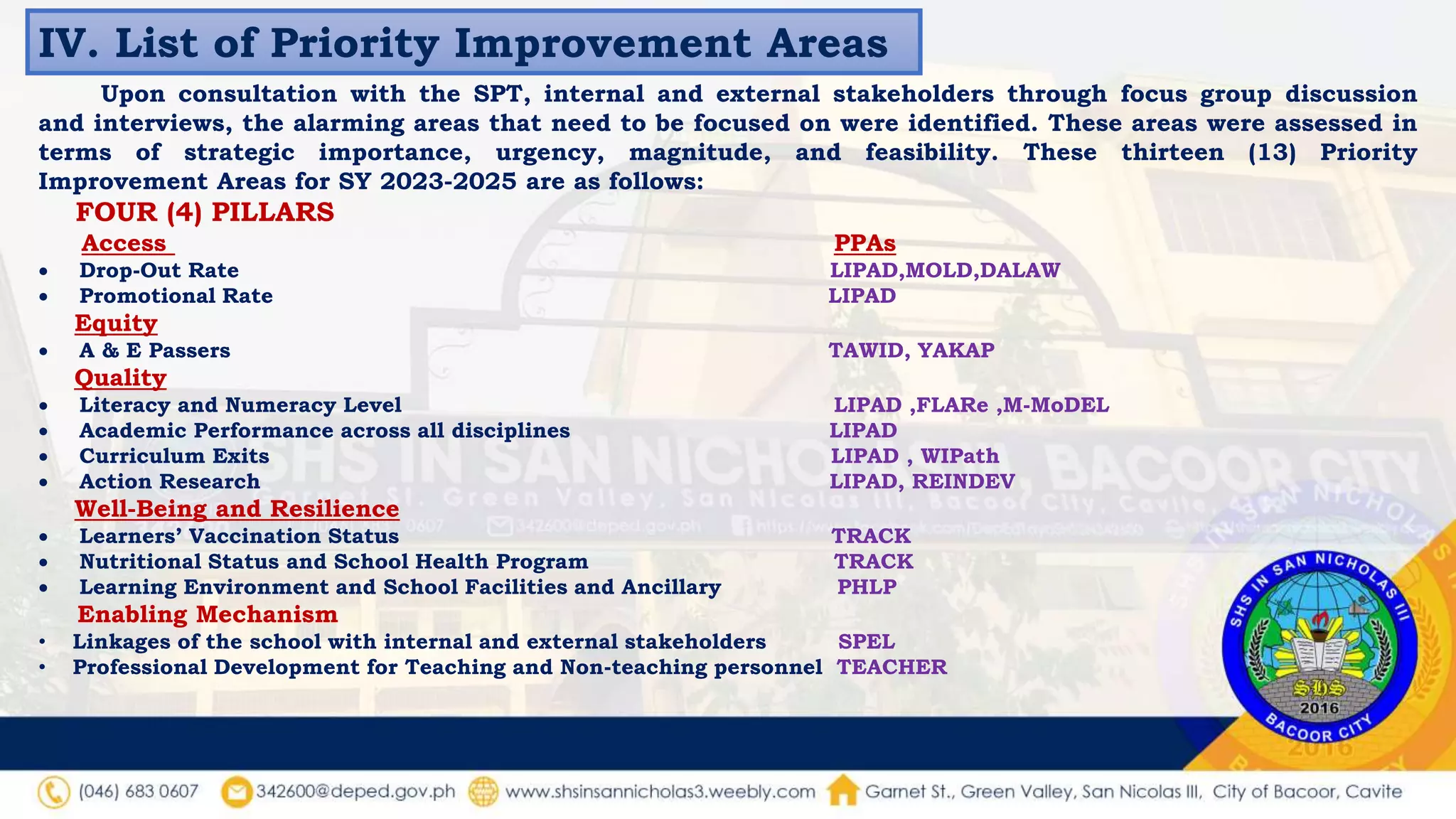
IV. List of Priority Improvement Areas
Upon consultation with the SPT, internal and external stakeholders through focus group discussion
and interviews, the alarming areas that need to be focused on were identified. These areas were assessed in
terms of strategic importance, urgency, magnitude, and feasibility. These thirteen (13) Priority
Improvement Areas for SY 2023-2025 are as follows:
FOUR (4) PILLARS
Access PPAs
 Drop-Out Rate LIPAD,MOLD,DALAW
 Promotional Rate LIPAD
Equity
 A & E Passers TAWID, YAKAP
Quality
 Literacy and Numeracy Level LIPAD ,FLARe ,M-MoDEL
 Academic Performance across all disciplines LIPAD
 Curriculum Exits LIPAD , WIPath
 Action Research LIPAD, REINDEV
Well-Being and Resilience
 Learners’ Vaccination Status TRACK
 Nutritional Status and School Health Program TRACK
 Learning Environment and School Facilities and Ancillary PHLP
Enabling Mechanism
• Linkages of the school with internal and external stakeholders SPEL
• Professional Development for Teaching and Non-teaching personnel TEACHER
V. Project Work Plan
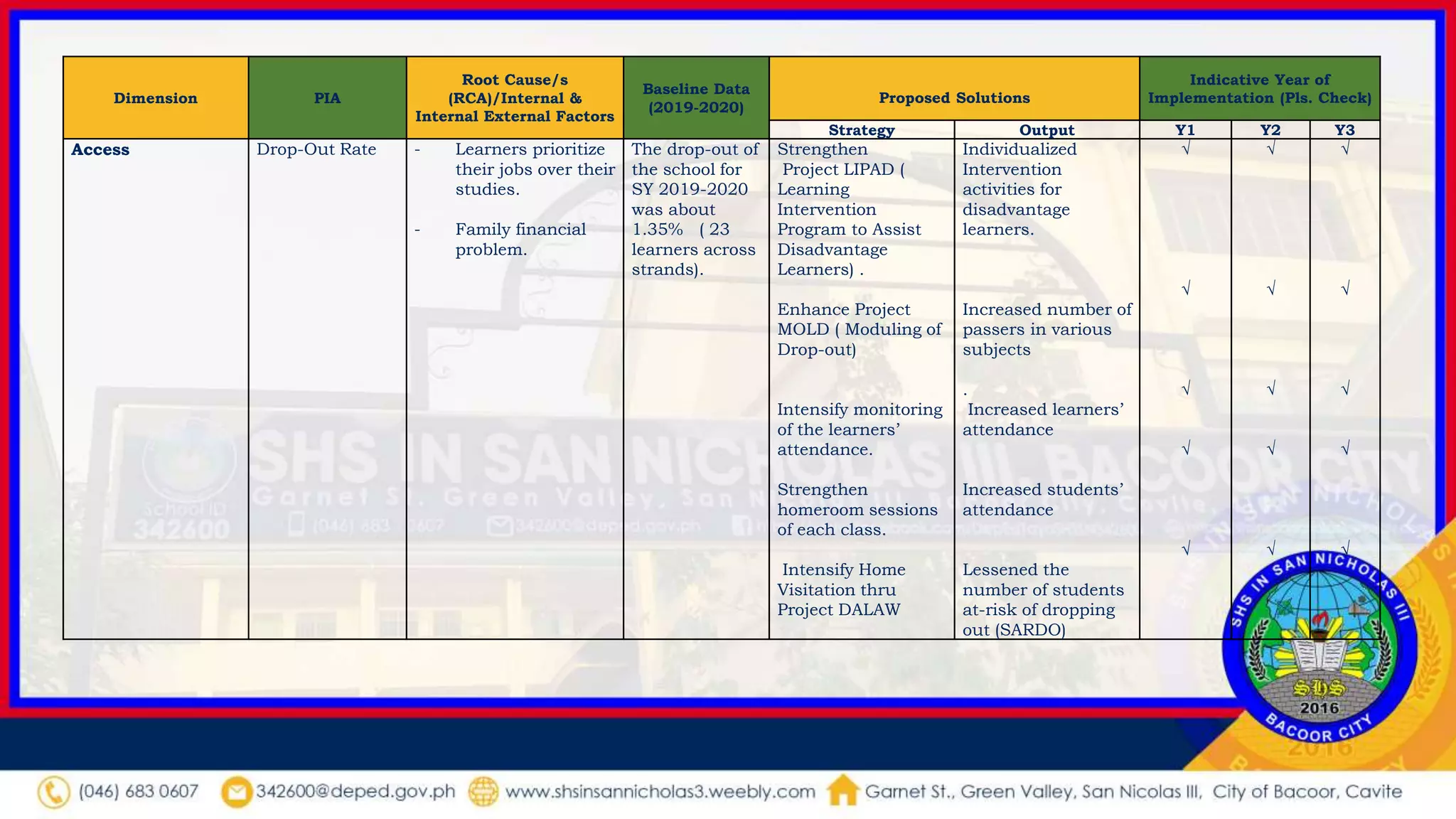
Dimension PIA
Root Cause/s
(RCA)/Internal &
Internal External Factors
Baseline Data
(2019-2020)
Proposed Solutions
Indicative Year of
Implementation (Pls. Check)
Strategy Output Y1 Y2 Y3
Access Drop-Out Rate - Learners prioritize
their jobs over their
studies.
- Family financial
problem.
The drop-out of
the school for
SY 2019-2020
was about
1.35% ( 23
learners across
strands).
Strengthen
Project LIPAD (
Learning
Intervention
Program to Assist
Disadvantage
Learners) .
Enhance Project
MOLD ( Moduling of
Drop-out)
Intensify monitoring
of the learners’
attendance.
Strengthen
homeroom sessions
of each class.
Intensify Home
Visitation thru
Project DALAW
Individualized
Intervention
activities for
disadvantage
learners.
Increased number of
passers in various
subjects
.
Increased learners’
attendance
Increased students’
attendance
Lessened the
number of students
at-risk of dropping
out (SARDO)
√
√
√
√
√
√
√
√
√
√
√
√
√
√
√
Dimension PIA
Root Cause/s
(RCA)/Internal &
Internal External
Factors
Baseline Data
(2019-2020)
Proposed Solutions
Indicative Year of
Implementation (Pls.
Check)
Strategy Output Y1 Y2 Y3
Promotional
Rate
- Change of
residence
- Early pregnancy
- Job opportunities
- Failure to meet the
passing standard.
The
promotional
rate for SY
2019-2020 was
97.03%
(Out of 1,079
Grade 11, 32
learners were
not promoted
to Grade 12)
Strengthen
Project LIPAD (
Learning
Intervention
Program to Assist
Disadvantage
Learners) .
Intensify the
enrolment campaign
for second semester
Provide counseling
program to
identified SARDO
Individualized
Intervention
activities for
disadvantage
learners.
Increased enrolment
in all Grade levels
Increased number
of learners that
provided counselling
√
√
√
√
√
√
√
√
√
Dimension PIA
Root Cause/s
(RCA)/Internal &
Internal External
Factors
Baseline Data
(2019-2020)
Proposed Solutions
Indicative Year of
Implementation (Pls.
Check)
Strategy Output Y1 Y2 Y3
Equity A & E Passers - Learners cannot
concentrate on their
studies due to their
work to support their
own family.
-Learners was affected
during pandemic
On SY 2019-
2020, we have
100%
completer and
A&E passer.
But on the
following two
consecutive
years the total
number of
completer and
passers
decreased by
45.12%.
Provide individual
assistance for
learners.
Orient Special
Education Program
for our working,
pregnant and with
legal concern
learners to
survive/continue
his/her education.
Strengthen
partnership to
stakeholders in
order to provide and
support the needs of
learners.
Intensify the
implementation of
Project YAKAP
Increase number of
completers and A&E
Passers
√ √ √
Dimension PIA
Root Cause/s
(RCA)/Internal &
Internal External
Factors
Baseline Data
(2019-2020)
Proposed Solutions
Indicative Year of
Implementation (Pls.
Check)
Strategy Output Y1 Y2 Y3
Quality Literacy and
Numeracy Level
Low Reading
Comprehension
Lack of Readiness in
Advanced Mathematical
Operation
Out of 313
learners
participated in
FLARe
Program, 191
fell under
Instructional
level and 77 fell
under the
frustration level
using the
reading
assessment
tool
The
percentage of
Math
Proficiency
Level of
learners for SY
2019-2020 was
83.71% .
Continuous
Implementation of
FLARe Program.
Enrichment
Program to increase
vocabulary words of
learners, integrated
to all English
Subjects
Remediation,
Intervention
Program like Video
Lessons in Math
thru the online
platform “MATHuto
sa Sipnayan, mga
Nicholasian” FB
Page and “SHS SN3
Mathlete” website
Number of learners
that improve the
reading
comprehension from
frustration
/Instructional Level
to Independent
level.
Increased by 5% in
Math Proficiency
Level
√
√
√
√
√
√
Dimension PIA
Root Cause/s
(RCA)/Internal &
Internal External
Factors
Baseline Data
(2019-2020)
Proposed Solutions
Indicative Year of
Implementation (Pls.
Check)
Strategy Output Y1 Y2 Y3
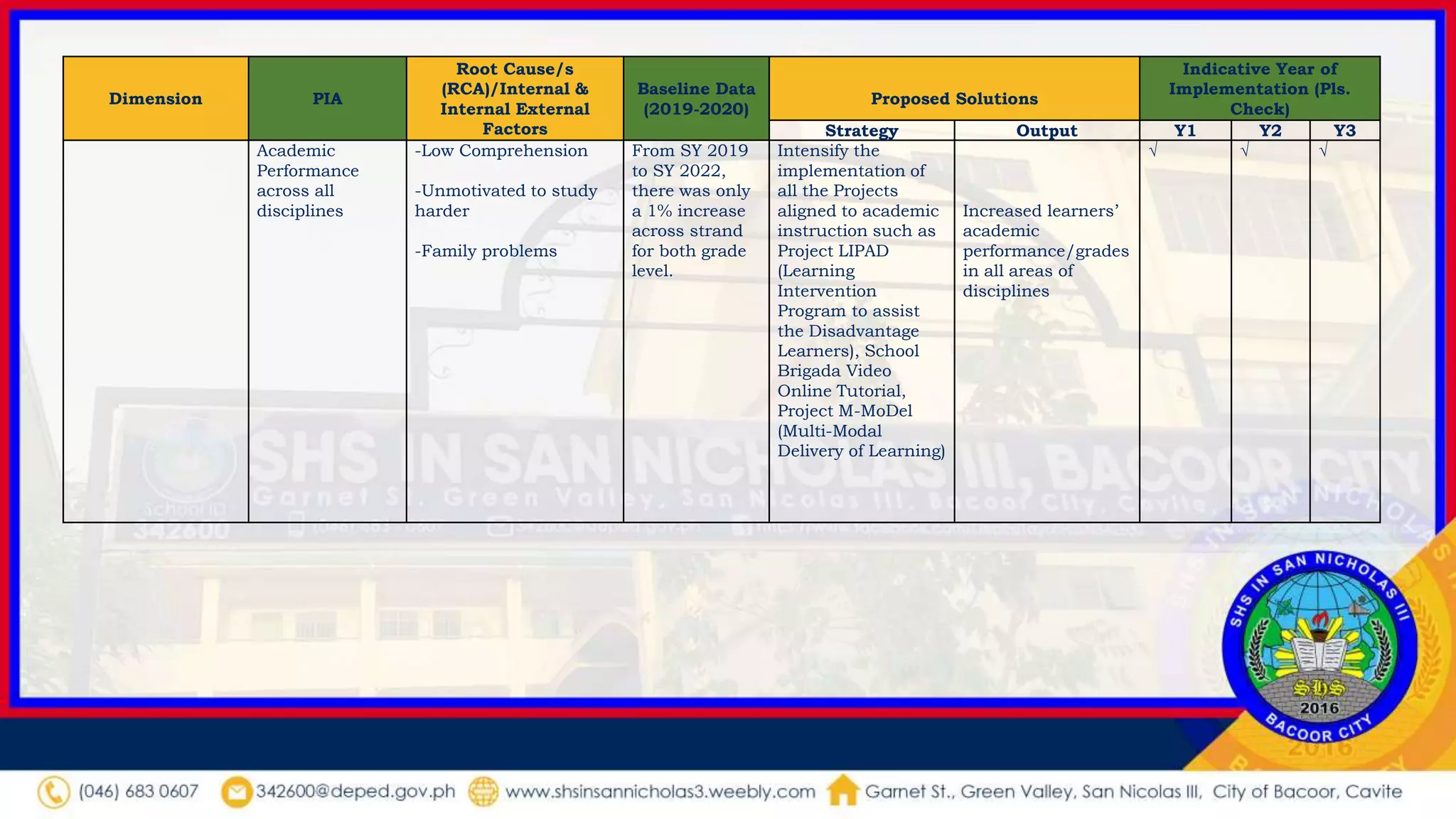
Academic
Performance
across all
disciplines
-Low Comprehension
-Unmotivated to study
harder
-Family problems
From SY 2019
to SY 2022,
there was only
a 1% increase
across strand
for both grade
level.
Intensify the
implementation of
all the Projects
aligned to academic
instruction such as
Project LIPAD
(Learning
Intervention
Program to assist
the Disadvantage
Learners), School
Brigada Video
Online Tutorial,
Project M-MoDel
(Multi-Modal
Delivery of Learning)
Increased learners’
academic
performance/grades
in all areas of
disciplines
√ √ √
Dimension PIA
Root Cause/s
(RCA)/Internal &
Internal External
Factors
Baseline Data
(2019-2020)
Proposed Solutions
Indicative Year of
Implementation (Pls.
Check)
Strategy Output Y1 Y2 Y3
Learner’s Well-
Being & Resilience
Learners
vaccination
Status
-Personal reasons
-Fear of vaccination
There are only
62.93%
vaccinated
learners
Intensify classroom
campaign by headed
by the School
Organizations, clinic
teachers and school
nurse
Increased number
of vaccinated
learners
/ / /
Dimension PIA
Root Cause/s
(RCA)/Internal &
Internal External
Factors
Baseline Data
(2019-2020)
Proposed Solutions
Indicative Year of
Implementation (Pls.
Check)
Strategy Output Y1 Y2 Y3
Nutritional
Status and
School Health
Program
-Poor Healthy Habits
and Healthy lifestyle of
the learners
Out of 3,448
learners, there
were 79
learners fall out
of the normal
health status.
For Grade 11,
there are 57
learners
(2.75%) fall
outside the
normal health
status. On the
other hand,
Grade 12 only
has 22 learners
(1.60%) who
fall outside the
normal health
status.
-Implement the
School Health
Program
“Nicholasians
Healthy Ka!”
-Conduct Feeding
Program
-
Construction/install
ation school health
facilities such as
Handwashing,
Toilets and others
-Intensify the
implementation of
WINs Program
-Continuous
Implementation of
Project PHLP
(Paaralang Handa
Laban sa
Pandemya)
Improved health
conditions of the
students
Lessened the
number wasted and
severely wasted
students.
√ √ √
Dimension PIA
Root Cause/s
(RCA)/Internal &
Internal External
Factors
Baseline Data
(2019-2020)
Proposed Solutions
Indicative Year of
Implementation (Pls.
Check)
Strategy Output Y1 Y2 Y3
Enabling Mechanism Learning
Environment and
Resources
-School
Laboratories
-School Facilities
and Ancillary
Financial need and Budget
Acquisition to meet the
standard laid down by the
DepEd and TESDA
Standards
Financial need for the
improvement of school
facilities
75%
accomplished to
meet the
standard laid by
DepEd and
TESDA
Standards
75%
accomplished in
improvement of
school facilities
for the last 3
years
-Proper Budget
Allocation
-Procurement of
equipments
-Improve structuring
of laboratories based
on DepEd and TESDA
Standards
-Tap partners and
stakeholders to
support the
improvement of school
laboratories
-Proper Budget
Allocation
-Procurement of
equipments
-Improvement of all
school facilities
-Tap partners and
stakeholders to
support the school
facilities improvement
School Laboratories
are at par to DepEd
and TESDA Standards
100% improvement in
school facilities
√
√
√
√ √
Dimension PIA
Root Cause/s
(RCA)/Internal &
Internal External
Factors
Baseline Data
(2019-2020)
Proposed Solutions
Indicative Year of
Implementation (Pls.
Check)
Strategy Output Y1 Y2 Y3
Action Research Result of action
research was not fully
implemented
6 action
research was
conducted
Continuous
Implementation of
Project REINDEV
(Research and
Innovation and
Development)
100% Master
Teachers and 15%
of teachers
conducted action
research and fully
implement the
action research on
time
√ √ √
Dimension PIA
Root Cause/s
(RCA)/Internal &
Internal External
Factors
Baseline Data
(2019-2020)
Proposed Solutions
Indicative Year of
Implementation (Pls.
Check)
Strategy Output Y1 Y2 Y3
Low number of
linkages of the
school with
internal and
external
stakeholders
Increasing number of
learners in immersion
but limited partners
There were only
7 immersion
partners on SY
2019-2020
Implementation of
SPEL (School
Partnership
Enhanced Linkages)
100% target
stakeholders involve
and participate in
addressing concerns
on learner
development and
school community
development
√ √ √
Dimension PIA
Root Cause/s
(RCA)/Internal &
Internal External
Factors
Baseline Data
(2019-2020)
Proposed Solutions
Indicative Year of
Implementation (Pls.
Check)
Strategy Output Y1 Y2 Y3
Lack of
Professional
Development for
Teaching and
Non-teaching
personnel
There is still a need to
capacitate the teaching
and non-teaching
personnel
80% of the
teaching and
non-teaching
personnel
attended
Trainings,
Seminars,
SLAC, LAC,
PPST, Teaching
Strategies,
Homeroom
Guidance
Program
Continuous
implementation of
TEACHER (Training
Educators Abilities
and Competencies
Handling effective
Research-Based
Classroom)
Project SILIP
(Supervision of
Instruction and
Learning Program)
100% capacitated
teaching and non-
teaching personnel
based on training
needs assessment
through SLAC,
INSET/Workshops/
Seminars
√ √ √
VI. Monitoring and Evaluation
M & E Initiatives Purpose of M&E Initiatives
Key Data and Information
needed
Person/s Involved
Timeline
(Year and Quarter/Month)
1. Baselining and Data Collection To know and update the
status of the program
Data on Project
Implemented
School Head
Project Proponent
Teachers
Quarterly
2. Assessment and Provision of
Technical Assistance (TA) to
teaching and non-teaching
personnel and learners’
performances
To identify if it is for
improvement and
adjustment
Result of assessment for
technical assistance
School Head
Teachers
School Planning Team
School Governing
Council
Quarterly
3. Evaluation of PPAs cum Plan
Adjustments
To know if the
implementation of program
is successful and to be
sustained, engineered or
killed
Result of evaluation and
plan adjustments
School Head
Teachers
School Planning Team
School Governing
Council
Yearly
RONALD R. DRIO
Principal II
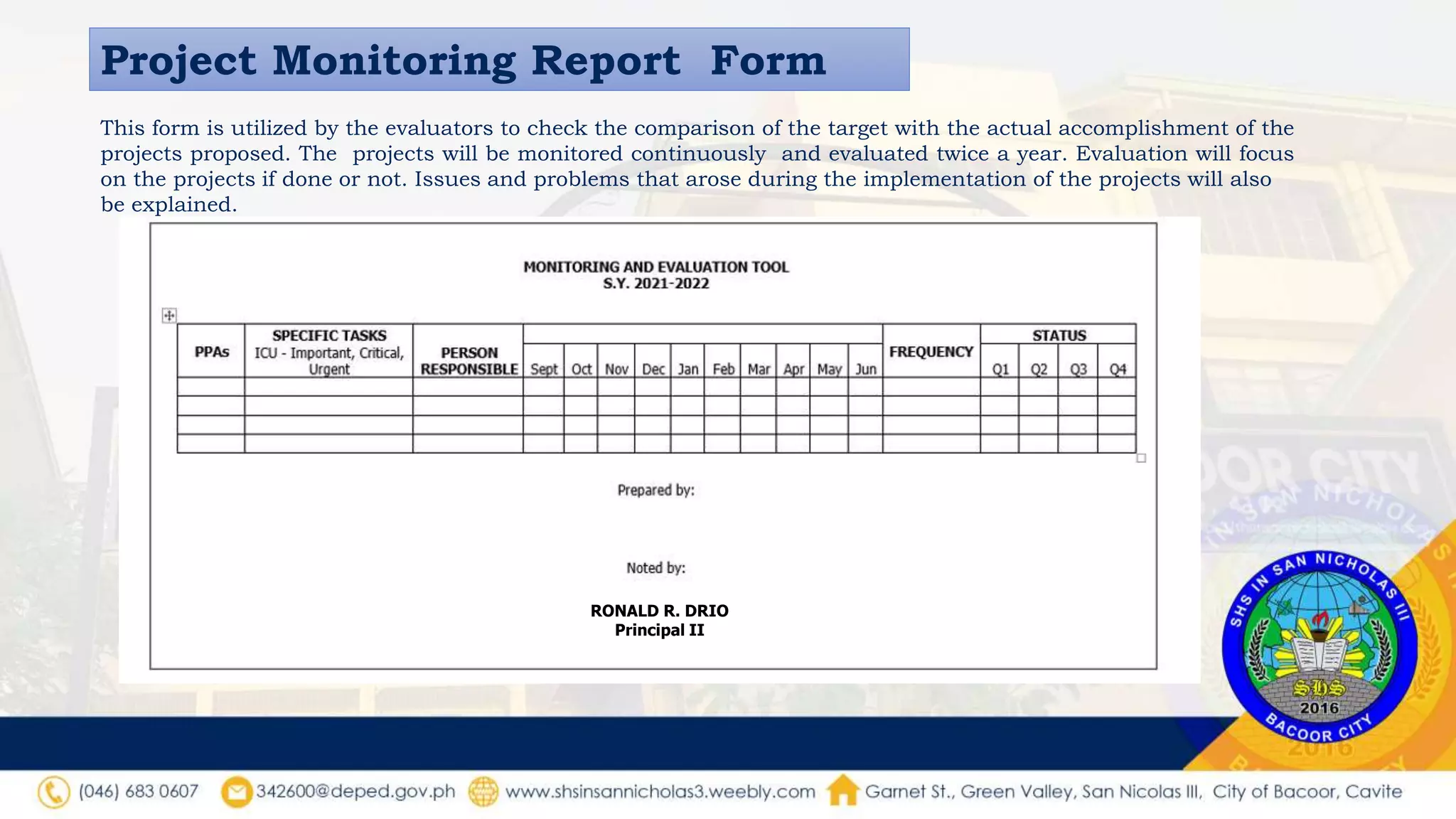
This form is utilized by the evaluators to check the comparison of the target with the actual accomplishment of the
projects proposed. The projects will be monitored continuously and evaluated twice a year. Evaluation will focus
on the projects if done or not. Issues and problems that arose during the implementation of the projects will also
be explained.
Project Monitoring Report Form
VII. Implementation Plan
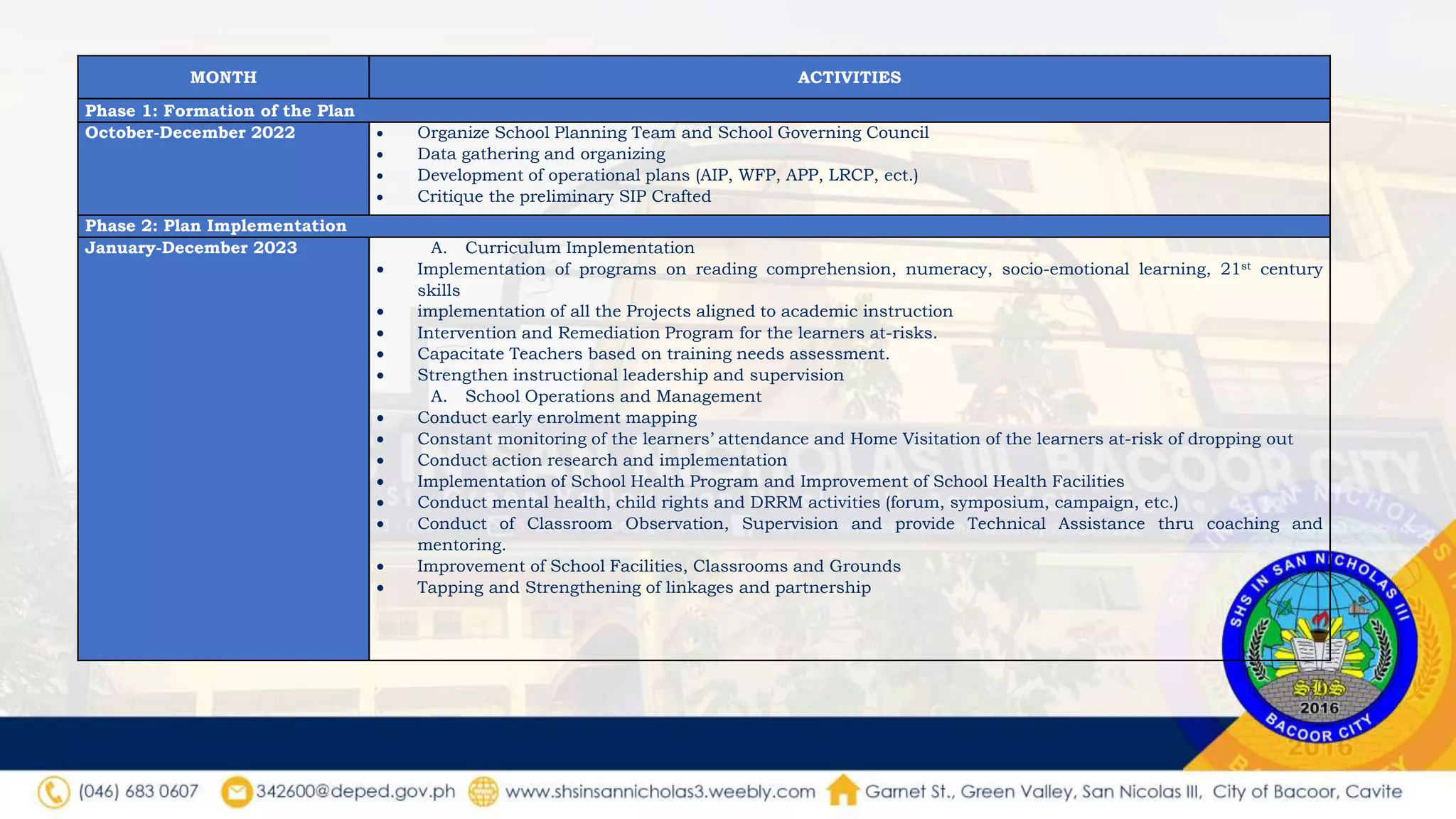
MONTH ACTIVITIES
Phase 1: Formation of the Plan
October-December 2022  Organize School Planning Team and School Governing Council
 Data gathering and organizing
 Development of operational plans (AIP, WFP, APP, LRCP, ect.)
 Critique the preliminary SIP Crafted
Phase 2: Plan Implementation
January-December 2023 A. Curriculum Implementation
 Implementation of programs on reading comprehension, numeracy, socio-emotional learning, 21st century
skills
 implementation of all the Projects aligned to academic instruction
 Intervention and Remediation Program for the learners at-risks.
 Capacitate Teachers based on training needs assessment.
 Strengthen instructional leadership and supervision
A. School Operations and Management
 Conduct early enrolment mapping
 Constant monitoring of the learners’ attendance and Home Visitation of the learners at-risk of dropping out
 Conduct action research and implementation
 Implementation of School Health Program and Improvement of School Health Facilities
 Conduct mental health, child rights and DRRM activities (forum, symposium, campaign, etc.)
 Conduct of Classroom Observation, Supervision and provide Technical Assistance thru coaching and
mentoring.
 Improvement of School Facilities, Classrooms and Grounds
 Tapping and Strengthening of linkages and partnership
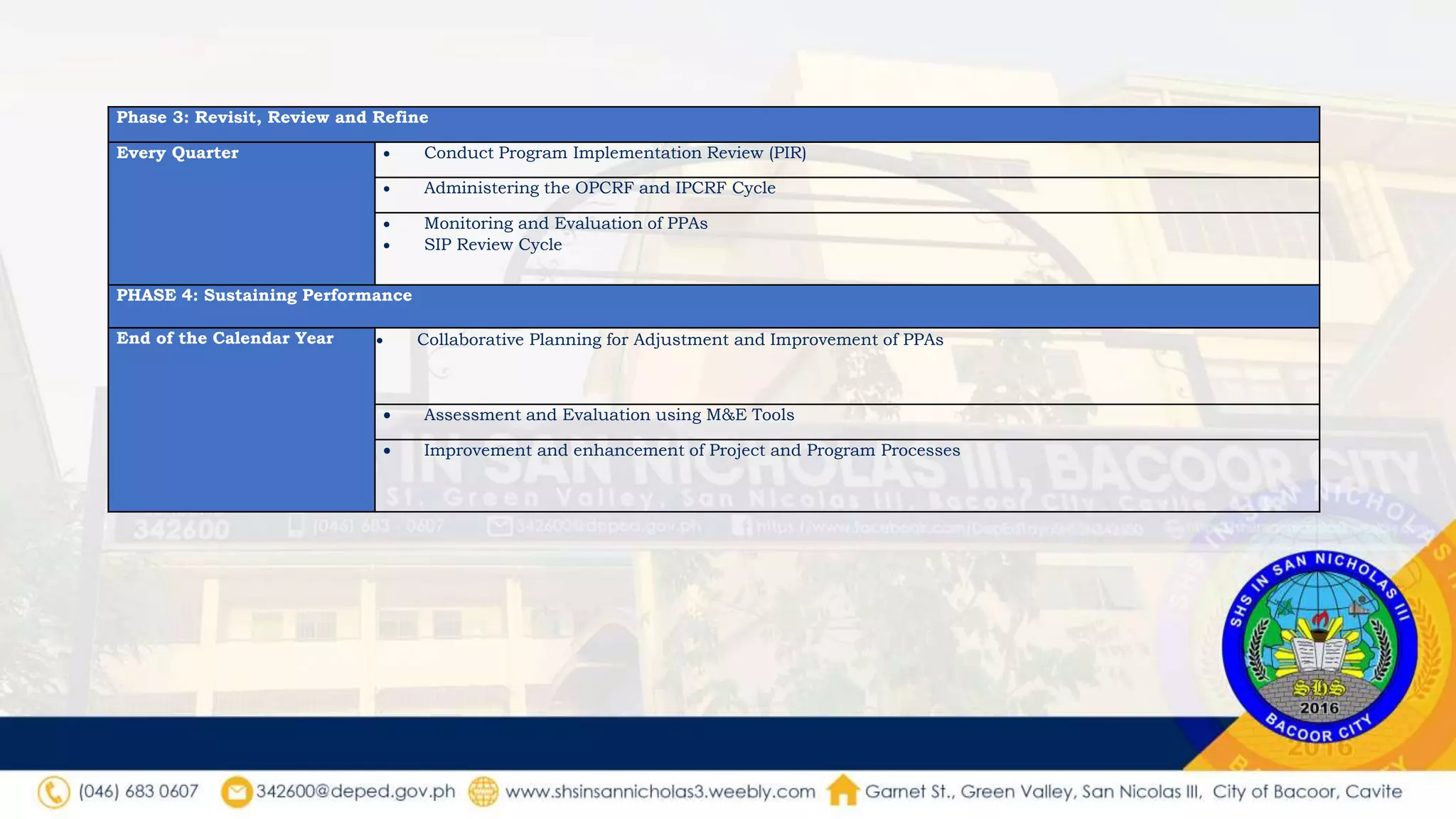
Phase 3: Revisit, Review and Refine
Every Quarter  Conduct Program Implementation Review (PIR)
 Administering the OPCRF and IPCRF Cycle
 Monitoring and Evaluation of PPAs
 SIP Review Cycle
PHASE 4: Sustaining Performance
End of the Calendar Year  Collaborative Planning for Adjustment and Improvement of PPAs
 Assessment and Evaluation using M&E Tools
 Improvement and enhancement of Project and Program Processes
VIII. Communication Plan
Objectives Activity Key Player/Stakeholder
Communication
Strategy/Platform
Timeline
To share the school SIP to
different internal
stakeholders
Classroom-based Parent-
Teacher-Learner Orientation
and Presentation of School PPAs
School Head
School PPAs Focal Person
Teacher
Parent
Learner
Face-to-Face Orientation January 2023
To share the school SIP to
different internal
stakeholders using
different communication
platforms
Advertisement thru
correspondent and information
materials about school program,
projects and activities
School PPAs Focal Persons Printed and Online Platforms January 2023
Conducting of Parent-Teachers
Day
Teachers
Parents
Face-to-Face discussion Every Quarter
Disseminate thru issuance of
school memos, letters, primers
School Head
Non-teaching staff
Teachers
Posting on School Official
Pages and Group Chats
Distribute Printed Materials
All year round
IX. Risk Management
Risk Description Risk Causes and Consequences
Risk Treatment
Action/Response Person Responsible Timeline
Project Implementation Delay of Project Implementation Time Management Project Proponent
SPT Team
As needed
Stakeholders Involvement Lack of support from stakeholders
Time constraint
Clearly disseminate, deliver and
explain the objectives and goals
of school program, projects and
activities to the stakeholders
Time Management
School Head
Project Proponent
SPT Team
Stakeholders
As needed
Financial Obligation Inappropriate Budget Allocation Proper funding on different
school programs, projects and
activities
School Head
MOOE Focal Person
Project Proponent
As needed
THANK YOU!!! RONALD R. DRIO
Principal II
“ Our goals can only be
reached through a vehicle of a
PLAN, in which we must
fervently believe, and upon
which we vigorously act. There
is no other route to
SUCCESS.”
-Pablo Picasso

SIP-2023-2025-SHS-SN-Final.pptx

  • 1.
  • 2.
  • 3.
    A. School ExternalContext The school is in a densely populated area confined in a place with total land area of 8,984 square meters . Students at the school come from neighboring towns and barangays. The school can be reached by jeepneys, tricycles, and motorcycles, from different barangay terminals near the area, and private vehicles from respective residential places. It is categorized as large school situated in Green Valley, San Nicholas III, Bacoor City, Cavite. The school is accessible to most of the students coming from the private and public schools in the City.
  • 4.
    B. School CurrentSituation At the onset of the Senior High School operation in 2016, the Senior High School in San Nicolas offered GAS,TVL Technical – Vocational Livelihood and HUMSS Strands. It is classified a large stand – alone Senior High School. Currently, the school is managed by a full- fledged principal, 6 Master Teachers , one Administrative Officer, ninety Teachers ,two (2) ADAS II and three (3) LSB School Guards and four (4) Utility Personnel. Different programs, projects, and activities are given priority based on the alarming data on the Key Performance Indicators and undertaken to improve students’ academic performance and school’s processes and operations. Further, the school strives to meet the targets set by the Division Office in the different Key Result Areas. Thus, the School Planning Team concentrates primarily in the baseline of school data from three (3) years back that were retrieved and became the bases of performance indicators. Other school data were also used to illustrate the school’s scenario and to ensure that specific programs, projects, and activities will be conceptualized strategically to bridge the gaps to achieve the desired results.
  • 5.
  • 6.
    2.a Access toQuality Basic Education for All SHS in San Nicholas III enrollment has been increasing. Currently, the school has a total of 2,850 enrolled students for SY 2022-2023. It increases by 7.17% compared to that of last SY 2021-2022 (2,814). It is higher by 10.39% of the total enrolment in SY 2020-2021 (2,732) and higher by 50.35% of the total enrolment in SY 2019-2020 (2,006). The drop-out rate in SY 2019-2020 was 2.19% (44 learners) of the total enrolment. For SY 2020-2021, the drop-out rate was 4.80% (131 learners) of the total enrolment. While for SY 2021-2022, the drop-out rate was 0.46% (13 learners) of the total enrolment. SY 2020-2021 has the highest drop-out rate. The main reason for this high drop-out rate during SY 2020- 2021 is the height of pandemic ; thus, key issues resulted from it like health concerns , family problems, financial problems, early employment, early marital engagement or pregnancy. Timely intervention was undertaken for the identified students at-risk of dropping out (SARDO). One of the school’s mechanism in addressing this issue is home visitation through the Project DALAW. On the other hand, this is the completion rate for 3 consecutive years, for SY 2019- 2020, it was 98.65%. While for SY 2020-2021 it was 97.64% and SY 2021-2022 was 96.70%.
  • 7.
    2.b Equity forChildren, Youths, and Adults in Disadvantage Situation) The current enrolment of ALS for SY 2022-2023 is 184. Due to the pandemic situation, it decreased by 38.25% for SY 2021-2022 (298) and decreased by 40.06% for SY 2020-2021 (307), but compared to SY 2019- 2020, it increased by 22.67% (150). The ALS Accreditation and Equivalency (A&E) Assessment and Certification is a process to measure the competencies acquired by ALS learners. Thus, the result of the A&E Assessment was commendable during SY 2019-2020 because we have a 100% passing rate. As the pandemic greatly affects the marginalized during SY 2020-2021 and SY 2021-2022 this resulted in a low number of enrolment, completers, and A&E takers/passers.
  • 8.
    2.c Quality ofBasic Education Provision and Learning Outcomes Academic Performance The achievement level of the learners across all TRACKS offered by the school was 85.45 % during SY 2021- 2022. The Grade 11 average grades per track across all disciplines are as follows: HUMSS Strand (85.15%) , GAS Strand (84.39%), ICT Strand (83.51), HE Strand (83.39%). On the other hand, the Grade 12 got higher average grade in HUMSS Strand (88.94%), GAS Strand (87.6%), ICT (85.25%), and HE (85.4%) .
  • 9.
    2.d Learners Well-Beingand Resilience Vaccination Status SHS in San Nicholas III recorded 100% vaccination for teaching and non-teaching personnel. While the percentage of vaccination for learners is 54.92% (Grade 11) and 70.94% (Grade 12). On the overall enrolment, 62.93% of the learners are vaccinated. 100% 62.93% Teachers Students
  • 10.
    Nutritional Status Out of2,850 learners, there were 79 learners fall out of the normal health status. For Grade 11, there are 57 learners (1.95%) fall outside the normal health status. On the other hand, Grade 12 only has 22 learners (0.75%) who fall outside the normal health status.
  • 11.
    School Safety Seal(Compliance to the guidelines of the RSSAT) SHS in San Nicholas III, Bacoor City has applied for the certification and now safety seal certified which means we are fully compliant with School Safety Assessment Tool (SSAT) and we strictly follow the minimum public health standards set by the government against COVID-19. This will also provide an assurance to the stakeholders and general public of the school’s compliance to the health and safety protocols on holding face-to-face classes.
  • 12.
  • 13.
    3.a EDUCATION LEADERSHIP SHSin San Nicholas III adheres to the standard of DepEd that no child shall be left behind. We believe that working together can provide our learners with the quality education they need. Our school, since 2016, has continuously in doing its best to maintain quality in terms of its curricular and co-curricular offerings and service. However, education is fluid, so results vary annually but constantly improve. For SY 2019-2020, the school’s SBM level was evaluated as Maturing, 2.41; During that time, there were factors in Principle 4, Management of Resources which need to be improved. For SY 2020-2021, the school was able to be in the Advance Level, precisely 2.50; However, for SY 2021-2022, the school landed back to Maturing level, 2.47, since there was a retooling in the standard. Our school will not stop improving its quality offerings; however, there are times that we fall from the standard, which wakes us up to move up again.
  • 14.
    3.b HUMAN RESOURCEMANAGEMENT Teaching and Non-teaching Personnel The total number of teaching personnel increases every school year. The demand for additional teaching staff could be attributed to the continuous increase of enrolment per academic year. For SY 2019-2020 there is fifty-three (53) teaching staff, SY 2020-2021 there is seventy (70) teaching staff, SY 2021-2022 there are eighty-four (84) teaching staff, and currently for SY 2022-2023 there are ninety (90) teaching staff. On the other hand, non-teaching personnel remains the same with a total number of twelve (12).
  • 15.
    Performance Rating The schoolworkforce Performance Rating in the last three (3) school years remains consistent. For SY 2021-2022, the teachers’ average rating was 4.54 (Outstanding); SY 2020-2021, our rating was 4.61 (Outstanding); SY 2019-2020 our rating was 4.65 (Outstanding). This shows that the school teaching and non- teaching staff have demonstrated commendable performance in assuming their jobs in the fields. In addition, the school head’s OPCR Rating too remains consistent as Outstanding.
  • 16.
    Training Programs The FacultyDevelopment Program of the school has been continuously undertaken. All Teachers have given the opportunity to attend varied seminars, workshops for professional growth and development organized by the school through the School-based Learning Action Cell, (SLAC),and In-Service Training (INSET) initiated by the Division, Regional and National Office to address the teachers needs for much improved teaching performance and to increase the academic achievement of the learners. 52 31 70 75 Number of Teaching Personnel who attended training National Level Regional Level Division Level 4 2 6 6 Non-teaching who attended trainings National Level Regional Level Division Level School-based Level (See, Annex E) Teachers Non- Teaching
  • 17.
    Research There were six(6) completed action research on SY 2019-2020, seven (7) complete action research on SY 2020-2021, and nine (9) ongoing research for SY 2021-2022. There is a need for full implementation of the result of the completed action research for the benefit of the learners. (See, Annex I)
  • 18.
    3.c LEARNING ENVIRONMENT& RESOURCES One important factor that helps in students’ academic development is the presence of the learning materials. The SHS in San Nicholas III, Bacoor City, as the largest public senior high school in the city of Bacoor, is continuously improving its quality of education by providing safe and environment-friendly facilities to learners, teachers, parents, and other stakeholders. The improvement of school facilities, laboratories, and ancillary services has been prioritized in the last school year. Through Building partnerships with various stakeholders both from the public and private sectors, additional resources were given. An improved learning environment was imminent and improved the quality of the teaching and learning process.
  • 19.
    Based on therecord of the school, the presence of technology-aided materials such as flat-screen televisions per classroom and tablets is imminent in the school as well as modules and reference books in the library. The school TVL-ICT and TVL-HE Laboratories has been improved and added machines and equipment. Our school’s total land area is 8,984 sq. m. There are six (6) buildings, and forty-two (42) classrooms. But still, due to large number of enrolment, shortage of classrooms is still a problem that affects learners and teachers. As the full implementation of face-to- face classes starts, the school implement double shifting to accommodate all learners. Grade 11 will be morning shift while Grade 12 will be on the afternoon shift. Inventory of resources and Equipment (see Annex F) Inventory of classrooms and ancillary services (see Annex G)
  • 20.
    3.d SCHOOL SYSTEMS& PROCESSES List of Technical Assistance Provided Technical assistance was conducted by Master Teachers and School Head to provide timely feedback for efficient and effective delivery of instruction and quality services to the growing clientele. List of Research conducted During the school year 2021-2022, the school had 4 researches completed and had submitted 6 action research proposals.
  • 21.
    3.e BASIC EDUCATIONSTAKEHOLDERS A. Data on resources generated through Brigada Eskwela The school generated cash and in-kind donations from various stakeholders. B. Other Donations These goods donations comprises of cleaning materials/construction materials , health kit and school supplies. C. List of Stakeholders INTERNAL STAKEHOLDERS EXTERNAL STAKEHOLDERS Faculty, Parents , Students Local Government Units, Barangay Officials ,Alumni
  • 22.
    IV. List ofPriority Improvement Areas
  • 23.
    IV. List ofPriority Improvement Areas Upon consultation with the SPT, internal and external stakeholders through focus group discussion and interviews, the alarming areas that need to be focused on were identified. These areas were assessed in terms of strategic importance, urgency, magnitude, and feasibility. These thirteen (13) Priority Improvement Areas for SY 2023-2025 are as follows: FOUR (4) PILLARS Access PPAs  Drop-Out Rate LIPAD,MOLD,DALAW  Promotional Rate LIPAD Equity  A & E Passers TAWID, YAKAP Quality  Literacy and Numeracy Level LIPAD ,FLARe ,M-MoDEL  Academic Performance across all disciplines LIPAD  Curriculum Exits LIPAD , WIPath  Action Research LIPAD, REINDEV Well-Being and Resilience  Learners’ Vaccination Status TRACK  Nutritional Status and School Health Program TRACK  Learning Environment and School Facilities and Ancillary PHLP Enabling Mechanism • Linkages of the school with internal and external stakeholders SPEL • Professional Development for Teaching and Non-teaching personnel TEACHER
  • 24.
  • 25.
    Dimension PIA Root Cause/s (RCA)/Internal& Internal External Factors Baseline Data (2019-2020) Proposed Solutions Indicative Year of Implementation (Pls. Check) Strategy Output Y1 Y2 Y3 Access Drop-Out Rate - Learners prioritize their jobs over their studies. - Family financial problem. The drop-out of the school for SY 2019-2020 was about 1.35% ( 23 learners across strands). Strengthen Project LIPAD ( Learning Intervention Program to Assist Disadvantage Learners) . Enhance Project MOLD ( Moduling of Drop-out) Intensify monitoring of the learners’ attendance. Strengthen homeroom sessions of each class. Intensify Home Visitation thru Project DALAW Individualized Intervention activities for disadvantage learners. Increased number of passers in various subjects . Increased learners’ attendance Increased students’ attendance Lessened the number of students at-risk of dropping out (SARDO) √ √ √ √ √ √ √ √ √ √ √ √ √ √ √
  • 26.
    Dimension PIA Root Cause/s (RCA)/Internal& Internal External Factors Baseline Data (2019-2020) Proposed Solutions Indicative Year of Implementation (Pls. Check) Strategy Output Y1 Y2 Y3 Promotional Rate - Change of residence - Early pregnancy - Job opportunities - Failure to meet the passing standard. The promotional rate for SY 2019-2020 was 97.03% (Out of 1,079 Grade 11, 32 learners were not promoted to Grade 12) Strengthen Project LIPAD ( Learning Intervention Program to Assist Disadvantage Learners) . Intensify the enrolment campaign for second semester Provide counseling program to identified SARDO Individualized Intervention activities for disadvantage learners. Increased enrolment in all Grade levels Increased number of learners that provided counselling √ √ √ √ √ √ √ √ √
  • 27.
    Dimension PIA Root Cause/s (RCA)/Internal& Internal External Factors Baseline Data (2019-2020) Proposed Solutions Indicative Year of Implementation (Pls. Check) Strategy Output Y1 Y2 Y3 Equity A & E Passers - Learners cannot concentrate on their studies due to their work to support their own family. -Learners was affected during pandemic On SY 2019- 2020, we have 100% completer and A&E passer. But on the following two consecutive years the total number of completer and passers decreased by 45.12%. Provide individual assistance for learners. Orient Special Education Program for our working, pregnant and with legal concern learners to survive/continue his/her education. Strengthen partnership to stakeholders in order to provide and support the needs of learners. Intensify the implementation of Project YAKAP Increase number of completers and A&E Passers √ √ √
  • 28.
    Dimension PIA Root Cause/s (RCA)/Internal& Internal External Factors Baseline Data (2019-2020) Proposed Solutions Indicative Year of Implementation (Pls. Check) Strategy Output Y1 Y2 Y3 Quality Literacy and Numeracy Level Low Reading Comprehension Lack of Readiness in Advanced Mathematical Operation Out of 313 learners participated in FLARe Program, 191 fell under Instructional level and 77 fell under the frustration level using the reading assessment tool The percentage of Math Proficiency Level of learners for SY 2019-2020 was 83.71% . Continuous Implementation of FLARe Program. Enrichment Program to increase vocabulary words of learners, integrated to all English Subjects Remediation, Intervention Program like Video Lessons in Math thru the online platform “MATHuto sa Sipnayan, mga Nicholasian” FB Page and “SHS SN3 Mathlete” website Number of learners that improve the reading comprehension from frustration /Instructional Level to Independent level. Increased by 5% in Math Proficiency Level √ √ √ √ √ √
  • 29.
    Dimension PIA Root Cause/s (RCA)/Internal& Internal External Factors Baseline Data (2019-2020) Proposed Solutions Indicative Year of Implementation (Pls. Check) Strategy Output Y1 Y2 Y3 Academic Performance across all disciplines -Low Comprehension -Unmotivated to study harder -Family problems From SY 2019 to SY 2022, there was only a 1% increase across strand for both grade level. Intensify the implementation of all the Projects aligned to academic instruction such as Project LIPAD (Learning Intervention Program to assist the Disadvantage Learners), School Brigada Video Online Tutorial, Project M-MoDel (Multi-Modal Delivery of Learning) Increased learners’ academic performance/grades in all areas of disciplines √ √ √
  • 30.
    Dimension PIA Root Cause/s (RCA)/Internal& Internal External Factors Baseline Data (2019-2020) Proposed Solutions Indicative Year of Implementation (Pls. Check) Strategy Output Y1 Y2 Y3 Learner’s Well- Being & Resilience Learners vaccination Status -Personal reasons -Fear of vaccination There are only 62.93% vaccinated learners Intensify classroom campaign by headed by the School Organizations, clinic teachers and school nurse Increased number of vaccinated learners / / /
  • 31.
    Dimension PIA Root Cause/s (RCA)/Internal& Internal External Factors Baseline Data (2019-2020) Proposed Solutions Indicative Year of Implementation (Pls. Check) Strategy Output Y1 Y2 Y3 Nutritional Status and School Health Program -Poor Healthy Habits and Healthy lifestyle of the learners Out of 3,448 learners, there were 79 learners fall out of the normal health status. For Grade 11, there are 57 learners (2.75%) fall outside the normal health status. On the other hand, Grade 12 only has 22 learners (1.60%) who fall outside the normal health status. -Implement the School Health Program “Nicholasians Healthy Ka!” -Conduct Feeding Program - Construction/install ation school health facilities such as Handwashing, Toilets and others -Intensify the implementation of WINs Program -Continuous Implementation of Project PHLP (Paaralang Handa Laban sa Pandemya) Improved health conditions of the students Lessened the number wasted and severely wasted students. √ √ √
  • 32.
    Dimension PIA Root Cause/s (RCA)/Internal& Internal External Factors Baseline Data (2019-2020) Proposed Solutions Indicative Year of Implementation (Pls. Check) Strategy Output Y1 Y2 Y3 Enabling Mechanism Learning Environment and Resources -School Laboratories -School Facilities and Ancillary Financial need and Budget Acquisition to meet the standard laid down by the DepEd and TESDA Standards Financial need for the improvement of school facilities 75% accomplished to meet the standard laid by DepEd and TESDA Standards 75% accomplished in improvement of school facilities for the last 3 years -Proper Budget Allocation -Procurement of equipments -Improve structuring of laboratories based on DepEd and TESDA Standards -Tap partners and stakeholders to support the improvement of school laboratories -Proper Budget Allocation -Procurement of equipments -Improvement of all school facilities -Tap partners and stakeholders to support the school facilities improvement School Laboratories are at par to DepEd and TESDA Standards 100% improvement in school facilities √ √ √ √ √
  • 33.
    Dimension PIA Root Cause/s (RCA)/Internal& Internal External Factors Baseline Data (2019-2020) Proposed Solutions Indicative Year of Implementation (Pls. Check) Strategy Output Y1 Y2 Y3 Action Research Result of action research was not fully implemented 6 action research was conducted Continuous Implementation of Project REINDEV (Research and Innovation and Development) 100% Master Teachers and 15% of teachers conducted action research and fully implement the action research on time √ √ √
  • 34.
    Dimension PIA Root Cause/s (RCA)/Internal& Internal External Factors Baseline Data (2019-2020) Proposed Solutions Indicative Year of Implementation (Pls. Check) Strategy Output Y1 Y2 Y3 Low number of linkages of the school with internal and external stakeholders Increasing number of learners in immersion but limited partners There were only 7 immersion partners on SY 2019-2020 Implementation of SPEL (School Partnership Enhanced Linkages) 100% target stakeholders involve and participate in addressing concerns on learner development and school community development √ √ √
  • 35.
    Dimension PIA Root Cause/s (RCA)/Internal& Internal External Factors Baseline Data (2019-2020) Proposed Solutions Indicative Year of Implementation (Pls. Check) Strategy Output Y1 Y2 Y3 Lack of Professional Development for Teaching and Non-teaching personnel There is still a need to capacitate the teaching and non-teaching personnel 80% of the teaching and non-teaching personnel attended Trainings, Seminars, SLAC, LAC, PPST, Teaching Strategies, Homeroom Guidance Program Continuous implementation of TEACHER (Training Educators Abilities and Competencies Handling effective Research-Based Classroom) Project SILIP (Supervision of Instruction and Learning Program) 100% capacitated teaching and non- teaching personnel based on training needs assessment through SLAC, INSET/Workshops/ Seminars √ √ √
  • 36.
  • 37.
    M & EInitiatives Purpose of M&E Initiatives Key Data and Information needed Person/s Involved Timeline (Year and Quarter/Month) 1. Baselining and Data Collection To know and update the status of the program Data on Project Implemented School Head Project Proponent Teachers Quarterly 2. Assessment and Provision of Technical Assistance (TA) to teaching and non-teaching personnel and learners’ performances To identify if it is for improvement and adjustment Result of assessment for technical assistance School Head Teachers School Planning Team School Governing Council Quarterly 3. Evaluation of PPAs cum Plan Adjustments To know if the implementation of program is successful and to be sustained, engineered or killed Result of evaluation and plan adjustments School Head Teachers School Planning Team School Governing Council Yearly
  • 38.
    RONALD R. DRIO PrincipalII This form is utilized by the evaluators to check the comparison of the target with the actual accomplishment of the projects proposed. The projects will be monitored continuously and evaluated twice a year. Evaluation will focus on the projects if done or not. Issues and problems that arose during the implementation of the projects will also be explained. Project Monitoring Report Form
  • 39.
  • 40.
    MONTH ACTIVITIES Phase 1:Formation of the Plan October-December 2022  Organize School Planning Team and School Governing Council  Data gathering and organizing  Development of operational plans (AIP, WFP, APP, LRCP, ect.)  Critique the preliminary SIP Crafted Phase 2: Plan Implementation January-December 2023 A. Curriculum Implementation  Implementation of programs on reading comprehension, numeracy, socio-emotional learning, 21st century skills  implementation of all the Projects aligned to academic instruction  Intervention and Remediation Program for the learners at-risks.  Capacitate Teachers based on training needs assessment.  Strengthen instructional leadership and supervision A. School Operations and Management  Conduct early enrolment mapping  Constant monitoring of the learners’ attendance and Home Visitation of the learners at-risk of dropping out  Conduct action research and implementation  Implementation of School Health Program and Improvement of School Health Facilities  Conduct mental health, child rights and DRRM activities (forum, symposium, campaign, etc.)  Conduct of Classroom Observation, Supervision and provide Technical Assistance thru coaching and mentoring.  Improvement of School Facilities, Classrooms and Grounds  Tapping and Strengthening of linkages and partnership
  • 41.
    Phase 3: Revisit,Review and Refine Every Quarter  Conduct Program Implementation Review (PIR)  Administering the OPCRF and IPCRF Cycle  Monitoring and Evaluation of PPAs  SIP Review Cycle PHASE 4: Sustaining Performance End of the Calendar Year  Collaborative Planning for Adjustment and Improvement of PPAs  Assessment and Evaluation using M&E Tools  Improvement and enhancement of Project and Program Processes
  • 42.
  • 43.
    Objectives Activity KeyPlayer/Stakeholder Communication Strategy/Platform Timeline To share the school SIP to different internal stakeholders Classroom-based Parent- Teacher-Learner Orientation and Presentation of School PPAs School Head School PPAs Focal Person Teacher Parent Learner Face-to-Face Orientation January 2023 To share the school SIP to different internal stakeholders using different communication platforms Advertisement thru correspondent and information materials about school program, projects and activities School PPAs Focal Persons Printed and Online Platforms January 2023 Conducting of Parent-Teachers Day Teachers Parents Face-to-Face discussion Every Quarter Disseminate thru issuance of school memos, letters, primers School Head Non-teaching staff Teachers Posting on School Official Pages and Group Chats Distribute Printed Materials All year round
  • 44.
  • 45.
    Risk Description RiskCauses and Consequences Risk Treatment Action/Response Person Responsible Timeline Project Implementation Delay of Project Implementation Time Management Project Proponent SPT Team As needed Stakeholders Involvement Lack of support from stakeholders Time constraint Clearly disseminate, deliver and explain the objectives and goals of school program, projects and activities to the stakeholders Time Management School Head Project Proponent SPT Team Stakeholders As needed Financial Obligation Inappropriate Budget Allocation Proper funding on different school programs, projects and activities School Head MOOE Focal Person Project Proponent As needed
  • 46.
    THANK YOU!!! RONALDR. DRIO Principal II “ Our goals can only be reached through a vehicle of a PLAN, in which we must fervently believe, and upon which we vigorously act. There is no other route to SUCCESS.” -Pablo Picasso

Editor's Notes

  • #2 Good morning, everyone!!! I am humbled and honored in presenting the SCHOOL IMPROVEMENT PLAN for 2023-2025. A product of the SPT’s concrete plan to be undertaken within three years of school’s operations.
  • #3 We are inspired by this quote by Pablo Picasso…
  • #4 Concerning the School Context, it is situated in a densely populated area and accessed using the different modes of transportation. It is classified as a large school-the biggest SHS in SDO Bacoor City.
  • #5 Regarding the School Current Situation, it offers the following STRANDS like: GAS,TVL ( Home Economics ,Bread and Pastry and ICT), HUMSS. Currently managed by SH 2,6 Master Teachers ,90 Teachers,1 AO,2 ADAS II; 3 Security Guards,4 Utility Personnel. PPAs are given priority Based on the gaps identified in the KPIs to improve teaching performance, learning outcomes and school processes and operations. Strategic planning was undertaken to bridge the gaps and achieve the desired results.
  • #6 The 4 Pillars of education….
  • #7 As to ACCESS to Quality of Basic Education for All, SHS in San Nicolas opens its door to any types of students. The number of enrollees every year has been increasing. Though, we recorded an alarming DROP-OUT rate, The school has crafted a project to address the SARDO. On the other hand, the school’s Completion Rate is very high.
  • #8 About EQUITY, the school also offers ALS. The school recorded 100% passing rate when the students took Accreditation & Equivalency (A&E) assessment during the School Year 2019-2020.
  • #9 As to the QUALITY of Basic Education Provision & Learning Outcomes Academic Performance, the school attained 85.45 Achievement Level during the School Year 2021-2022.
  • #10 When it comes to LEARNERS WELL-BEING & RESILIENCE, majority of the students are vaccinated, As expected , all the school workforce are vaccinated. This only means it reduces chance of getting diseases.
  • #11 As for the students NUTRITIONAL STATUS, out of 2,850 students of SHS SN 2.70% or 79% of them are identified as wasted and severely wasted. These students Are considered beneficiaries of SBFP.
  • #12 Since the school offered F2F classes , this indicates that it is SSAT Compliant.
  • #13 Moving on ..on ENABLING MECHANISM…
  • #14 The school has been waiting for the conferment of the Regional FTAD as SBM LEVEL 3 practitioner As this would further its bid as a performing school in SDO Bacoor.
  • #15 The number of the school workforce has been increasing. At present ,it has 90 mentors and 12 non-teaching personnel.
  • #16 Majority of the teachers were recipients of OUTSTANDING RATING Posted an average Rating of 4.54 during the School Year 2021-2022.
  • #17 This slide deck presents the level of seminars/trainings Attended by the teachers ,along with the non-teaching personnel.
  • #18 The school has been blessed with research enthusiasts. Many of the teachers managed to present RESEARCHES and qualified In CBER etc. Teachers are advised that AR must be concentrated On the four corners of the classrooms to bridge the gap and improve learning outcomes.
  • #19 School resources have been allocated judiciously provide sufficient learning materials and create a safe and child-friendly learning environment to Students,teachers and stakeholders. Building partnership paved the way to gather additional resources For learners and teachers use.
  • #20 Teachers were provided of laptop; students have Tablets issued by LGU. The school facilities and laboratories have been improved To meet the standard features. Every classroom or laboratory is equipped with tools, devices and equipment for teaching.
  • #21 SH & MT provided Technical Assistance to teachers thru: Coaching and mentoring to teachers, intensifying, and strengthening the intervention and remediation program to academically challenged learners. Last School Year ,the school recorded 4 completed AR. While 6 AR proposals had been submitted.
  • #22 On matters concerning Basic Education Stakeholders, the school generated additional resources from various stakeholders. in the forms of Cash In-kind from various stakeholders. Proper documentation and recording have been observed and stakeholders were given recognition
  • #24 The SPT had undergone root cause analysis and consultation with stakeholders in crafting the PPAs as the thrust of SHARED GOVERNANCE that would address to the alarming data as reflected in the KPIs. 13 PIAs to improve the delivery of basic education services and school processes and operations.
  • #26 The succeeding slide decks feature the PIA/PPAs concentrated on the 4 Pillars of Education Involving ACCESS,EQUITY, QUALITY ,LEARNERS WELL_BEING & RESILIENCE and…ENABLING MECHANISM.
  • #38 We also undertake the M & E Initiatives focused on gathering Baseline & Data Collection; Assessment & Provision of TA in teaching; Quarterly Evaluation of School PPA’s and Adjustments.
  • #39 The school utilized the M&E tool to check the comparison of target with the actual accomplishments of the project implemented.
  • #40 In the next slide decks,
  • #41 As regards to the IMPLEMENTATION PLAN, we lay down the timetable of the activities to be undertaken.
  • #44 The school ensures that all school’s PPAS were properly communicated to all stakeholders using the various means of communication.
  • #46 Finally, the team PLAN OF ACTION if PPAs are not properly implemented, If STAKEHOLDERS show lack of support and the school suffers from financial constraints