PRESENTED BY :-
PATEL PRITESH D
M.Sc.in Mental Health
Nursing
What is schizophrenia ?
 Schizophrenia is a chronic & severs
mental illness characterized by
disordered thoughts , abnormal behaviors
, and anti – social behaviors and person
with schizophrenia dose not identify with
reality at times .
DEFINITIOIN
Schizophrenia is any Group of severe mental
Disorder manifested by fundamental disturbance
or dis-orientations in thinking ,mood ,and
behavior ,last for at least a month of active phase
symptoms like delusion ,hallucination
,disorganized speech and affected mood .
Epidemiology
 Schizophrenia is the most common of all
psychiatric disorder and is prevalent in all
cultures across the world .
 About 15 % of new admissions in mental hospital
are shizophrenic patients.
 About three to four per 1000 in every community
suffer from schizophrenia .
 The disease is more common in lower socio –
economic groups.
ETIOLOGY /CAUSES
A. Genetic factors :
B. Psychosocial factors
 Impaired ego functioning
 pathological communication
 pathogenic family interaction
C. Social cultural factors
D. Organic theory
E. Vitamin deficiency theory
A. Genetic factors : studies have revealed
that monozygotic twins have four time higher
chances of developing schizophrenia.
Approximately 40% of children born to the
schizophrenia both the schizophrenic parents
will be affected .
If only one parent either mother or father is
schizophrenia ,10 % of the children will be
psychotic .
B ]. Psychosocial factor s:
 1 impaired ego functioning :
reality testing and judgement is affected .the intensity
of schizophrenia will depend up on the intense
impairment of ego function .
 2 pathological communication :
it has a significant role to play in a child whether to
withdraw from the communication
for example. In double bound communication the child
is not able to discriminate the short of message is ,”Go
out and play ,but see that you don’t fight with anyone
“
CON ..
In fact , the other message is ,”it is better if you stay
inside only ,”but it is not said . so the child is not
able to decide .if he dose not go out ,the mother will
get angry ,if he goes out and has a fight with
someone ,even than the mother would get angry ,so
the child withdraws gradually .
 pathogenic family interaction :
parents may be maintaining superficial
relationship ,children coming from broken
home and continuous stress
CON ..
c] social cultural factors : person who live
in low socio –economic families are suffer
to schizophrenia . exp :A child at a very
young age goes for work .
D] organic theory : theorists believe that
schizophrenia is caused due to infection
,poison ,trauma or metabolic disorders.
E] a patient with vitamin B1 ,B6,B12
vitamin c deficiency may become
schizophrenic.
Type of schizophrenia:
 Simple type of schizophrenia :
- the onset is extremely gradual . Marked disturbances of
interest in human relation ,emotion and activity . -
hallucinations and delusions and associative looseness is
present .
- the prognosis is very poor .
 Paranoid schizophrenia :paranoid schizophrenia is at present
the most common from of schizophrenia .
-prominent hallucination and / delusion .
- see more in male s than females .
- disorganization of speech and thought
-May develop at a age of 30 year
- at risk for suicidal of violent behavior under influence
delusions . violent ,suicidal behavior – high risk
Ex:- patient images that someone is trying to harm him.
CON…
 Hebephrenic schizophrenia :
- it occur around the age of 20 -25 year .
- thinking disturbance is most marked.
- Behavior is disorganised and without purpose
thought are disorganised difficult to understand by
other .
- other oddities of behavior include senseless giggling .
- incoherent speech /thought .
- hallucination & delusion present .
Con ..
 Catatonic schizophrenia :
catatonic schizophrenia is characterized by
marked disturbance of motor behavior.
it occur around the age of 15 -25 year .
1 - catatonic excited
increase in psychomotor activity
increase in speech production
loosening of associations
flight of ideas.
hallucination and sleeplessness are present .
the pt may suddenly attack to anybody and
distroy articles ,tear clothes .
Con…
2 - catatonic stupor
- absence of speech ,rigid posture ,negativism,
does not react to his surroundings .
- mute , stupors .
- involuntary passes urine and stool in the bed .
- rigidity .
- echolalia .
- echopraxia .
- absence of speech .
 Residual schizophrenia : residual schizophrenia
when a person has a past history of at least one
episode of schizophrenia .
no motivation or interest in life .
symptoms like iliogical thinking and social
withdrawal .
 Undifferentiated schizophrenia :
this category is diagnosed either when features
of no subtype are fully present or features of more
than one subtype are exhibited, absence of mental
activity .lack of emotion .mixture of symptoms .
Symptoms of schizophrenia
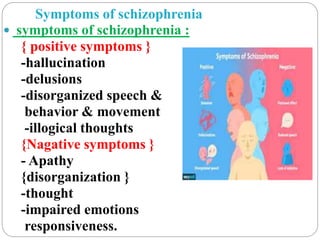
 symptoms of schizophrenia :
{ positive symptoms }
-hallucination
-delusions
-disorganized speech &
behavior & movement
-illogical thoughts
{Nagative symptoms }
- Apathy
{disorganization }
-thought
-impaired emotions
responsiveness.
Con ….
- loss of motivation & interest
- social withdrawal
-
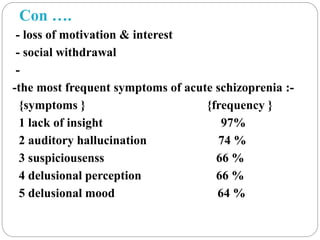
-the most frequent symptoms of acute schizoprenia :-
{symptoms } {frequency }
1 lack of insight 97%
2 auditory hallucination 74 %
3 suspiciousenss 66 %
4 delusional perception 66 %
5 delusional mood 64 %
Con…
thought and SpeechDisorders
• Autistic thinking .
• Loosening of associations .
• Thought blocking (a sudden interruption inthe thought process).
• Neologism (aword newly coined, or an everydayword used in a
special way, not readilyunderstood by others).
• Poverty of speech (decreased speech production).
• Echolalia .
Disorders of Perception
• Auditory hallucinations
• Visual hallucinations may sometimes occur
along with auditory hallucinations; tactile, gustatory and
olfactory types are far less common.
Con …
Disorders of Affect
 These include apathy, emotional blunting, emotional shallowness,
 anhedonia (inability to feel pleasure in normally pleasurabel
activities).
Disorders of Motor Behavior
 There can be either an increase or a decrease in psychomotor
activity. Mannerisms, grimacing, stereotypes, decreased self-care
and poor.
Other Features
 Decreased functioning in work, social relations and self-care, as
compared to earlier life.
 Loss of ego boundaries.
 Loss of insight.
 Poor judgment.
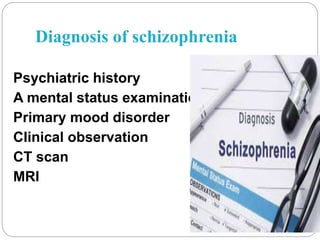
Diagnosis of schizophrenia
Psychiatric history
A mental status examination
Primary mood disorder
Clinical observation
CT scan
MRI
1.Prevention of schizophrenia : keeping in mind
the etiological factors or causes, the effort be
made to prevent or reduce the number of
schizophrenic condition
2. Intensive psychotherapy :- individual , group,
behavioral ,supportive and family therapy
may be used .
3. Therapeutic community :- therapy will
minimize the maladaptive learning in the
patient ,environmental and physical stress will
be reduced to meet his need.
CON ….
4.Chemotherapy :- antipsychotic drugs
may be prescribed .the type of drug ,dose
and duration depends on the symptoms
also .
5.Electro –convulsive therapy :- the
treatment is used for patient with sever
schizophrenia .drugs and psychotherapy
are to be continued.
CON ..
 Pharmecologycal :
1 antipsychotic medication
-olanzapine
-risperidone
2 mood stabilizers
-lithium
-carbamazepine
3 antidepresssants
- citalopram
- bupropion
CON….
 Anxiolytic drugs :-
-DIAZEPAM
LORAZEPAM
 Psychological therapy :-
PSYCHOTHERAPY
GROUP THERAPY
BEHAVIOR THERAPY
SOCIAL SKILL TRAINING
FAMILY THERAPY .
NURSING INTERVENTION
 Observe behavior pettern,posturing
,appearance, psychomotor , disturbance ,
hygiene
 Identify the type of disturbance the patient
is experiencing .
 Ask the patient about feeling while thought
alterations are evident .
 Assess the speech patterns associated with
the delusion
 Assess the ability to perform self care
activity
NURSING DIAGNOSIS
 Disturbed thought process related to inability to
trust ,panic anxiety , biochemical factors
evidenced by delusional thinking ,extreme
suspiciousness of other.
 Ineffective health maintenance related to inability
to trust , extreme suspiciousness evidenced by
poor diet intake , inadeqate food & fluid intake.
 Self care deficit related to withdrawal ,regression
,panic anxiety as evidenced by difficulty in
carrying out tasks associated with hygiene ,
dressing ,eating ,sleeping and toileting .
CON …
 Disturbed sensory – perception related to panic
anxiety possible hereditary or biochemical
factors evidanced by inappropriate responses
,disorder thought , poor concentration
,withdrwal behavior .
Schizophrenia,pritesh mhn

Schizophrenia,pritesh mhn

  • 1.
    PRESENTED BY :- PATELPRITESH D M.Sc.in Mental Health Nursing
  • 2.
    What is schizophrenia?  Schizophrenia is a chronic & severs mental illness characterized by disordered thoughts , abnormal behaviors , and anti – social behaviors and person with schizophrenia dose not identify with reality at times .
  • 3.
    DEFINITIOIN Schizophrenia is anyGroup of severe mental Disorder manifested by fundamental disturbance or dis-orientations in thinking ,mood ,and behavior ,last for at least a month of active phase symptoms like delusion ,hallucination ,disorganized speech and affected mood .
  • 4.
    Epidemiology  Schizophrenia isthe most common of all psychiatric disorder and is prevalent in all cultures across the world .  About 15 % of new admissions in mental hospital are shizophrenic patients.  About three to four per 1000 in every community suffer from schizophrenia .  The disease is more common in lower socio – economic groups.
  • 5.
    ETIOLOGY /CAUSES A. Geneticfactors : B. Psychosocial factors  Impaired ego functioning  pathological communication  pathogenic family interaction C. Social cultural factors D. Organic theory E. Vitamin deficiency theory
  • 6.
    A. Genetic factors: studies have revealed that monozygotic twins have four time higher chances of developing schizophrenia. Approximately 40% of children born to the schizophrenia both the schizophrenic parents will be affected . If only one parent either mother or father is schizophrenia ,10 % of the children will be psychotic .
  • 7.
    B ]. Psychosocialfactor s:  1 impaired ego functioning : reality testing and judgement is affected .the intensity of schizophrenia will depend up on the intense impairment of ego function .  2 pathological communication : it has a significant role to play in a child whether to withdraw from the communication for example. In double bound communication the child is not able to discriminate the short of message is ,”Go out and play ,but see that you don’t fight with anyone “
  • 8.
    CON .. In fact, the other message is ,”it is better if you stay inside only ,”but it is not said . so the child is not able to decide .if he dose not go out ,the mother will get angry ,if he goes out and has a fight with someone ,even than the mother would get angry ,so the child withdraws gradually .  pathogenic family interaction : parents may be maintaining superficial relationship ,children coming from broken home and continuous stress
  • 9.
    CON .. c] socialcultural factors : person who live in low socio –economic families are suffer to schizophrenia . exp :A child at a very young age goes for work . D] organic theory : theorists believe that schizophrenia is caused due to infection ,poison ,trauma or metabolic disorders. E] a patient with vitamin B1 ,B6,B12 vitamin c deficiency may become schizophrenic.
  • 10.
    Type of schizophrenia: Simple type of schizophrenia : - the onset is extremely gradual . Marked disturbances of interest in human relation ,emotion and activity . - hallucinations and delusions and associative looseness is present . - the prognosis is very poor .  Paranoid schizophrenia :paranoid schizophrenia is at present the most common from of schizophrenia . -prominent hallucination and / delusion . - see more in male s than females . - disorganization of speech and thought -May develop at a age of 30 year - at risk for suicidal of violent behavior under influence delusions . violent ,suicidal behavior – high risk Ex:- patient images that someone is trying to harm him.
  • 11.
    CON…  Hebephrenic schizophrenia: - it occur around the age of 20 -25 year . - thinking disturbance is most marked. - Behavior is disorganised and without purpose thought are disorganised difficult to understand by other . - other oddities of behavior include senseless giggling . - incoherent speech /thought . - hallucination & delusion present .
  • 12.
    Con ..  Catatonicschizophrenia : catatonic schizophrenia is characterized by marked disturbance of motor behavior. it occur around the age of 15 -25 year . 1 - catatonic excited increase in psychomotor activity increase in speech production loosening of associations flight of ideas. hallucination and sleeplessness are present . the pt may suddenly attack to anybody and distroy articles ,tear clothes .
  • 13.
    Con… 2 - catatonicstupor - absence of speech ,rigid posture ,negativism, does not react to his surroundings . - mute , stupors . - involuntary passes urine and stool in the bed . - rigidity . - echolalia . - echopraxia . - absence of speech .
  • 14.
     Residual schizophrenia: residual schizophrenia when a person has a past history of at least one episode of schizophrenia . no motivation or interest in life . symptoms like iliogical thinking and social withdrawal .  Undifferentiated schizophrenia : this category is diagnosed either when features of no subtype are fully present or features of more than one subtype are exhibited, absence of mental activity .lack of emotion .mixture of symptoms .
  • 15.
    Symptoms of schizophrenia symptoms of schizophrenia : { positive symptoms } -hallucination -delusions -disorganized speech & behavior & movement -illogical thoughts {Nagative symptoms } - Apathy {disorganization } -thought -impaired emotions responsiveness.
  • 16.
    Con …. - lossof motivation & interest - social withdrawal - -the most frequent symptoms of acute schizoprenia :- {symptoms } {frequency } 1 lack of insight 97% 2 auditory hallucination 74 % 3 suspiciousenss 66 % 4 delusional perception 66 % 5 delusional mood 64 %
  • 17.
    Con… thought and SpeechDisorders •Autistic thinking . • Loosening of associations . • Thought blocking (a sudden interruption inthe thought process). • Neologism (aword newly coined, or an everydayword used in a special way, not readilyunderstood by others). • Poverty of speech (decreased speech production). • Echolalia . Disorders of Perception • Auditory hallucinations • Visual hallucinations may sometimes occur along with auditory hallucinations; tactile, gustatory and olfactory types are far less common.
  • 18.
    Con … Disorders ofAffect  These include apathy, emotional blunting, emotional shallowness,  anhedonia (inability to feel pleasure in normally pleasurabel activities). Disorders of Motor Behavior  There can be either an increase or a decrease in psychomotor activity. Mannerisms, grimacing, stereotypes, decreased self-care and poor. Other Features  Decreased functioning in work, social relations and self-care, as compared to earlier life.  Loss of ego boundaries.  Loss of insight.  Poor judgment.
  • 19.
    Diagnosis of schizophrenia Psychiatrichistory A mental status examination Primary mood disorder Clinical observation CT scan MRI
  • 20.
    1.Prevention of schizophrenia: keeping in mind the etiological factors or causes, the effort be made to prevent or reduce the number of schizophrenic condition 2. Intensive psychotherapy :- individual , group, behavioral ,supportive and family therapy may be used . 3. Therapeutic community :- therapy will minimize the maladaptive learning in the patient ,environmental and physical stress will be reduced to meet his need.
  • 21.
    CON …. 4.Chemotherapy :-antipsychotic drugs may be prescribed .the type of drug ,dose and duration depends on the symptoms also . 5.Electro –convulsive therapy :- the treatment is used for patient with sever schizophrenia .drugs and psychotherapy are to be continued.
  • 22.
    CON ..  Pharmecologycal: 1 antipsychotic medication -olanzapine -risperidone 2 mood stabilizers -lithium -carbamazepine 3 antidepresssants - citalopram - bupropion
  • 23.
    CON….  Anxiolytic drugs:- -DIAZEPAM LORAZEPAM  Psychological therapy :- PSYCHOTHERAPY GROUP THERAPY BEHAVIOR THERAPY SOCIAL SKILL TRAINING FAMILY THERAPY .
  • 24.
    NURSING INTERVENTION  Observebehavior pettern,posturing ,appearance, psychomotor , disturbance , hygiene  Identify the type of disturbance the patient is experiencing .  Ask the patient about feeling while thought alterations are evident .  Assess the speech patterns associated with the delusion  Assess the ability to perform self care activity
  • 25.
    NURSING DIAGNOSIS  Disturbedthought process related to inability to trust ,panic anxiety , biochemical factors evidenced by delusional thinking ,extreme suspiciousness of other.  Ineffective health maintenance related to inability to trust , extreme suspiciousness evidenced by poor diet intake , inadeqate food & fluid intake.  Self care deficit related to withdrawal ,regression ,panic anxiety as evidenced by difficulty in carrying out tasks associated with hygiene , dressing ,eating ,sleeping and toileting .
  • 26.
    CON …  Disturbedsensory – perception related to panic anxiety possible hereditary or biochemical factors evidanced by inappropriate responses ,disorder thought , poor concentration ,withdrwal behavior .