PEOPLE’S COLLEGE OF NURSING
AND
RESEARCH CENTRE BHANPUR BHOPAL
SEMINAR PRESENTATION
ON
SCHIZOPHRENIA
PRESENTED BY PRESENTED TO
SHAHID SHABIR MISS YASHRAJ ANAND
B.Sc. Nursing 3rd Year TUTOR
PCN&RC PCN&RC
LEARNING OBJECTIVES
• INTRODUCTION
• DEFINITION
• ETIOLOGY
• TYPES
• SYMPTOMS
• DIAGNOSIS
• MANAGEMENT
• PROGNOSIS
• COCLUSION
• SUMMARY
INTRODUCTION
• The word “SCHIZOPHRENIA” was coined by the Swiss Psychiatrist
Eugen Bleular in 1908. It is derived from Greek word schizo(split)
and phrenia(mind.). Schizophrenia is a serious mental disorder in
which people interpret reality abnormally. Schizophrenia may
result in some combination of hallucinations, delusions, and
extremely disordered thinking and behavior that impairs daily
functioning, and can be disabling.
DEFINITION
• Schizophrenia is a psychotic condition
characterized by a disturbance in thinking,
emotions, volitions and faculties in the
presence of clear consciousness, which usually
leads to social withdrawal.
ETIOLOGY
• No one knows the exact causes of Schizophrenia, but multiple possible factors have
been discovered.These factors include:
• 1. Genetics
• 2. Brain chemical imbalance
• 3. Environmental factors
• 4. Family history
1.GENETIC THEORY:
• A strong genetic link exists for the development of schizophrenia.
• Occurs in 1% of general population, however this increases to 10% if a 1st
degree relative has a history of schizophrenia.
• Risk of developing schizophrenia further increases to 40% when both parents
have a history of schizophrenia.
• Monozygotic twins have demonstrated a 48% risk of developing
schizophrenia if one twin has the disease.
• Studies are going to locate specific genes to the development of
schizophrenia.
2.DOPAMINE THEORY:
• The dopamine hyperactivity in the brain is responsible for psychotic symptoms
present in schizophrenia.
• While dopamine hyperactivity is present in mesolimbic pathway, other areas of the
brain such as the prefrontal, frontal and temporal cortices have decrease activity
during acute psychosis.
• Other neurotransmitters thought to be involved in schizophrenia include 5-HT,
glutamate.The role of glutamate is also being evaluated because one of its major
functions is to regulate dopamine activity. Glutamate deficiency has be en found to
cause similar effects to that of dopamine hyperactivity.
3.NEURODEVELOPMENTAL THEORY:
Schizophrenia occurs as a result of an inutero disturbance
during pregnancy. Potential causes of this disturbance include
upper respiratory infection, obstetric complication and
neonatal hypoxia.
4.PSYCHOSOCIAL THEORIES
• These theories propose that situation such as stress, poor
interpersonal skills ,conflicting family, communication and
various socioeconomic influences are linked to development
of schizophrenia
TYPES
1.Paranoid schizophrenia
• Common form of schizophrenia
• Prominent hallucinations and/or delusions.
• May develop at a later age than other types of schizophrenia.
• Speech and emotions may be unaffected.
• At risk for suicidal or violent behavior under influence of delusions.
2.Hebephrenic / Disorganized schizophrenia
• Behavior is disorganized and without purpose.
• Thoughts are disorganized , difficult to understand by others.
• Pranks, giggling, health complaints, grimacing and mannerisms are common.
• Delusions and hallucinations are fleeting.
• Usually develops between 15-25
CONTINUE…
3.Catatonic schizophrenia
• Rarer than other types.
• At risk for malnutrition, exhaustion or self-injury.
• Unusual movements, often switching between extremes of over-activity and stillness.
• Unable to talk (Catatonia)
4 Undifferentiated schizophrenia
• Somecharacteristicsofparanoid,hebephrenicorcatatonicschizophrenia, but does not
obviously fit one of these types•
5.Residual schizophrenia
• Past History of psychosis but only having negative symptoms
SIGNS AND SYMPTOMS
Positive Symptoms
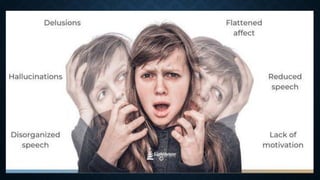
• DELUSION : False beliefs that are not based in reality.
• HALLUCINATION : Involving seeing or hearing things that don't exist.
• DISORGANIZED SPEECH & THINKING : Effective communication can be impaired
and answers to questions may be partially or completely unrelated.
• CATATONIA behavior: Purposeless abnormal motor activity or aggressive.
Cognitive Symptoms
• POOR EXECUTIVE FUNCTIONING : Unability to understand information to make
decisions.
• POOR WORKING MEMORY : Unability to use information immediately after learning
CONTINUE…
• Negative Symptoms
• FLAT EFFECT : Reduced expression of emotions via facial expression orvoice tone.
• ALOGIA : Reduced speech.
• VOLITION : Inability to begin & sustain activities.
• ANHEDONIA : Inability to experience pleasure.
• ASOCIALITY :Withdrawal from social contacts.
• Reluctance to perform everyday tasks
DIAGNOSIS
• DIAGNOSTIC CRITERIA FOR SCHIZOPHRENIA : It includes the criteria in
the Diagnostic and Statistical Manual of Mental Disorders (DSM-IV),published
by the American Psychiatric Association.
• MEDICAL HISTORY: A thorough medical history is the first step in the
diagnosis of schizophrenia.This may be done to find other problems that could
be causing symptoms and to check for any related complications.
• BLOOD TESTS & IMAGING : A Complete Blood Count (CBC) test is helpful to
monitor general health and rule out other conditions that may have been
responsible for the symptoms. A blood test can provide accurate information
about the involvement of recreational drugs. In some cases, certain imaging
techniques such as Magnetic Resonance Imaging (MRI) or Computed
Tomography (CT) scan may aid in the diagnosis.
CONTINUE…
PSYCHIATRIC EVALUATION : A doctor or mental health professionalchecks
mental status by observing appearance, demeanor and askingabout thoughts, moods
and awareness. A person may be diagnosed itthey have at least 2 of the following
symptoms usually over a month :
• Delusions.
• Hallucinations.
• Disorganised behaviour
• Disorganised speech and thought processes.
• Catatonic behaviour, presenting as strong daze or hyperactivity
• Negative symptoms, impaired normal function
MANAGEMENT
• HOSPITALIZATION• During crisis periods or times of severe symptoms,
hospitalization may be necessary to ensure safety, proper nutrition, adequate sleep
and basic hygiene.
• PSYCHOSOCIAL INTERVENTIONS
• Individual therapy: Psychotherapy may help to normalize thought patterns . Also,
learning to cope with stress and identify early warning signs of relapse can help
people to manage their illness.
• Social skills training: This focuses on improving communication, social interactions
and improving the ability to participate in daily activities.
• Family therapy : This provides support and education to patient families
• Vocational rehabilitation and supported employment: This focuses on helping
people with schizophrenia prepare for, find and keep jobs.
CONTINUE….
ELECTROCONVULSIVE THERAPY
• For adults with schizophrenia who do not respond to drug therapy , electroconvulsive
therapy (ECT) may be considered. ECT may be helpful for someone who also has
depression.
• The indications for ECT in schizophrenia are :
• Catatonic stupor & uncontrolled catatonic excitement.
• Acute exacerbations not controlled with drugs•
• Risk of suicide, homicide or danger of physical assault.
COGNITIVE BEHAVIORAL THERAPY
• CBT aims to help to identify the thinking patterns that are causing to have unwanted
feelings & behavior and learn to replace this thinking with more realistic and useful
thoughts.
• Most people require between 8 and 20 sessions of CBT over the space of 6 to 12 months.
CBT sessions usually last for about an hour.
PROGNOSIS
• There is no known cure for Schizophrenia. Fortunately,there are effective treatments
that can reduce symptoms, decrease the likelihood that new episodes of psychosis
will occur, shorten the duration of psychotic episodes, and in general, offer the
majority of people the possibility of living more productive and satisfying lives.
• With the proper medications and supportive counseling, the ability of schizophrenic
persons to live and function relatively well in society is excellent.
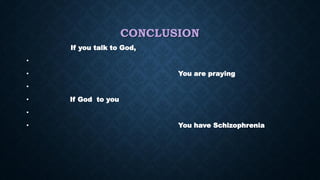
CONCLUSION
If you talk to God,
•
• You are praying
•
• If God to you
•
• You have Schizophrenia
SUMMARY
• Schizophrenia is a serious brain illness. People who have it may hear
voices that aren't there. They may think other people are trying to hurt
them. Sometimes they don't make sense when they talk. Symptoms of
schizophrenia usually start between ages 16 and 30. People usually do
not get schizophrenia after age 45..
Schizophrenia

Schizophrenia

  • 1.
    PEOPLE’S COLLEGE OFNURSING AND RESEARCH CENTRE BHANPUR BHOPAL SEMINAR PRESENTATION ON SCHIZOPHRENIA PRESENTED BY PRESENTED TO SHAHID SHABIR MISS YASHRAJ ANAND B.Sc. Nursing 3rd Year TUTOR PCN&RC PCN&RC
  • 2.
    LEARNING OBJECTIVES • INTRODUCTION •DEFINITION • ETIOLOGY • TYPES • SYMPTOMS • DIAGNOSIS • MANAGEMENT • PROGNOSIS • COCLUSION • SUMMARY
  • 4.
    INTRODUCTION • The word“SCHIZOPHRENIA” was coined by the Swiss Psychiatrist Eugen Bleular in 1908. It is derived from Greek word schizo(split) and phrenia(mind.). Schizophrenia is a serious mental disorder in which people interpret reality abnormally. Schizophrenia may result in some combination of hallucinations, delusions, and extremely disordered thinking and behavior that impairs daily functioning, and can be disabling.
  • 5.
    DEFINITION • Schizophrenia isa psychotic condition characterized by a disturbance in thinking, emotions, volitions and faculties in the presence of clear consciousness, which usually leads to social withdrawal.
  • 6.
    ETIOLOGY • No oneknows the exact causes of Schizophrenia, but multiple possible factors have been discovered.These factors include: • 1. Genetics • 2. Brain chemical imbalance • 3. Environmental factors • 4. Family history
  • 7.
    1.GENETIC THEORY: • Astrong genetic link exists for the development of schizophrenia. • Occurs in 1% of general population, however this increases to 10% if a 1st degree relative has a history of schizophrenia. • Risk of developing schizophrenia further increases to 40% when both parents have a history of schizophrenia. • Monozygotic twins have demonstrated a 48% risk of developing schizophrenia if one twin has the disease. • Studies are going to locate specific genes to the development of schizophrenia.
  • 8.
    2.DOPAMINE THEORY: • Thedopamine hyperactivity in the brain is responsible for psychotic symptoms present in schizophrenia. • While dopamine hyperactivity is present in mesolimbic pathway, other areas of the brain such as the prefrontal, frontal and temporal cortices have decrease activity during acute psychosis. • Other neurotransmitters thought to be involved in schizophrenia include 5-HT, glutamate.The role of glutamate is also being evaluated because one of its major functions is to regulate dopamine activity. Glutamate deficiency has be en found to cause similar effects to that of dopamine hyperactivity.
  • 9.
    3.NEURODEVELOPMENTAL THEORY: Schizophrenia occursas a result of an inutero disturbance during pregnancy. Potential causes of this disturbance include upper respiratory infection, obstetric complication and neonatal hypoxia.
  • 10.
    4.PSYCHOSOCIAL THEORIES • Thesetheories propose that situation such as stress, poor interpersonal skills ,conflicting family, communication and various socioeconomic influences are linked to development of schizophrenia
  • 11.
    TYPES 1.Paranoid schizophrenia • Commonform of schizophrenia • Prominent hallucinations and/or delusions. • May develop at a later age than other types of schizophrenia. • Speech and emotions may be unaffected. • At risk for suicidal or violent behavior under influence of delusions. 2.Hebephrenic / Disorganized schizophrenia • Behavior is disorganized and without purpose. • Thoughts are disorganized , difficult to understand by others. • Pranks, giggling, health complaints, grimacing and mannerisms are common. • Delusions and hallucinations are fleeting. • Usually develops between 15-25
  • 12.
    CONTINUE… 3.Catatonic schizophrenia • Rarerthan other types. • At risk for malnutrition, exhaustion or self-injury. • Unusual movements, often switching between extremes of over-activity and stillness. • Unable to talk (Catatonia) 4 Undifferentiated schizophrenia • Somecharacteristicsofparanoid,hebephrenicorcatatonicschizophrenia, but does not obviously fit one of these types• 5.Residual schizophrenia • Past History of psychosis but only having negative symptoms
  • 13.
    SIGNS AND SYMPTOMS PositiveSymptoms • DELUSION : False beliefs that are not based in reality. • HALLUCINATION : Involving seeing or hearing things that don't exist. • DISORGANIZED SPEECH & THINKING : Effective communication can be impaired and answers to questions may be partially or completely unrelated. • CATATONIA behavior: Purposeless abnormal motor activity or aggressive. Cognitive Symptoms • POOR EXECUTIVE FUNCTIONING : Unability to understand information to make decisions. • POOR WORKING MEMORY : Unability to use information immediately after learning
  • 14.
    CONTINUE… • Negative Symptoms •FLAT EFFECT : Reduced expression of emotions via facial expression orvoice tone. • ALOGIA : Reduced speech. • VOLITION : Inability to begin & sustain activities. • ANHEDONIA : Inability to experience pleasure. • ASOCIALITY :Withdrawal from social contacts. • Reluctance to perform everyday tasks
  • 16.
    DIAGNOSIS • DIAGNOSTIC CRITERIAFOR SCHIZOPHRENIA : It includes the criteria in the Diagnostic and Statistical Manual of Mental Disorders (DSM-IV),published by the American Psychiatric Association. • MEDICAL HISTORY: A thorough medical history is the first step in the diagnosis of schizophrenia.This may be done to find other problems that could be causing symptoms and to check for any related complications. • BLOOD TESTS & IMAGING : A Complete Blood Count (CBC) test is helpful to monitor general health and rule out other conditions that may have been responsible for the symptoms. A blood test can provide accurate information about the involvement of recreational drugs. In some cases, certain imaging techniques such as Magnetic Resonance Imaging (MRI) or Computed Tomography (CT) scan may aid in the diagnosis.
  • 17.
    CONTINUE… PSYCHIATRIC EVALUATION :A doctor or mental health professionalchecks mental status by observing appearance, demeanor and askingabout thoughts, moods and awareness. A person may be diagnosed itthey have at least 2 of the following symptoms usually over a month : • Delusions. • Hallucinations. • Disorganised behaviour • Disorganised speech and thought processes. • Catatonic behaviour, presenting as strong daze or hyperactivity • Negative symptoms, impaired normal function
  • 18.
    MANAGEMENT • HOSPITALIZATION• Duringcrisis periods or times of severe symptoms, hospitalization may be necessary to ensure safety, proper nutrition, adequate sleep and basic hygiene. • PSYCHOSOCIAL INTERVENTIONS • Individual therapy: Psychotherapy may help to normalize thought patterns . Also, learning to cope with stress and identify early warning signs of relapse can help people to manage their illness. • Social skills training: This focuses on improving communication, social interactions and improving the ability to participate in daily activities. • Family therapy : This provides support and education to patient families • Vocational rehabilitation and supported employment: This focuses on helping people with schizophrenia prepare for, find and keep jobs.
  • 19.
    CONTINUE…. ELECTROCONVULSIVE THERAPY • Foradults with schizophrenia who do not respond to drug therapy , electroconvulsive therapy (ECT) may be considered. ECT may be helpful for someone who also has depression. • The indications for ECT in schizophrenia are : • Catatonic stupor & uncontrolled catatonic excitement. • Acute exacerbations not controlled with drugs• • Risk of suicide, homicide or danger of physical assault. COGNITIVE BEHAVIORAL THERAPY • CBT aims to help to identify the thinking patterns that are causing to have unwanted feelings & behavior and learn to replace this thinking with more realistic and useful thoughts. • Most people require between 8 and 20 sessions of CBT over the space of 6 to 12 months. CBT sessions usually last for about an hour.
  • 20.
    PROGNOSIS • There isno known cure for Schizophrenia. Fortunately,there are effective treatments that can reduce symptoms, decrease the likelihood that new episodes of psychosis will occur, shorten the duration of psychotic episodes, and in general, offer the majority of people the possibility of living more productive and satisfying lives. • With the proper medications and supportive counseling, the ability of schizophrenic persons to live and function relatively well in society is excellent.
  • 21.
    CONCLUSION If you talkto God, • • You are praying • • If God to you • • You have Schizophrenia
  • 22.
    SUMMARY • Schizophrenia isa serious brain illness. People who have it may hear voices that aren't there. They may think other people are trying to hurt them. Sometimes they don't make sense when they talk. Symptoms of schizophrenia usually start between ages 16 and 30. People usually do not get schizophrenia after age 45..