PRESENTED BY :-
PATEL PRITESH D
M.Sc.in Mental Health Nursing
(THERAPEUTIC NURSE-
PATIENT RELATIONSHIP )
THERAPEUTIC NURSE- PATIENT
RELATIONSHIP
 INTRODUCING THE CHAPTER :-
 Therapeutic nurse patient relationship :
definition ,components and phases, importance
, impasses.
 Communication skills :-
definition, elements , type , factor influencing
communication , barriers
 Therapeutic nurse patient relationship :-
it is an interaction process in which the nurse
fulfils her role by using her professional
knowledge and skill in such way that she is
able to help the patient physically , socially
and emotionally .
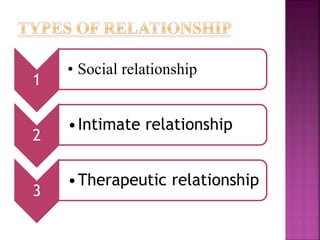
1
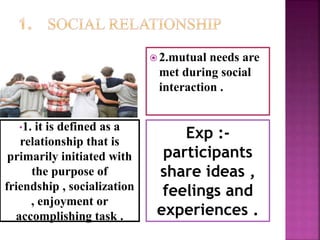
• Social relationship
2
•Intimate relationship
3
•Therapeutic relationship
•1. it is defined as a
relationship that is
primarily initiated with
the purpose of
friendship , socialization
, enjoyment or
accomplishing task .
Exp :-
participants
share ideas ,
feelings and
experiences .
 2.mutual needs are
met during social
interaction .
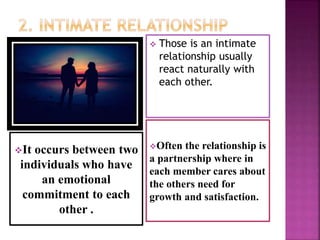
It occurs between two
individuals who have
an emotional
commitment to each
other .
Often the relationship is
a partnership where in
each member cares about
the others need for
growth and satisfaction.
 Those is an intimate
relationship usually
react naturally with
each other.
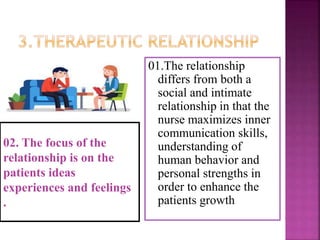
02. The focus of the
relationship is on the
patients ideas
experiences and feelings
.
01.The relationship
differs from both a
social and intimate
relationship in that the
nurse maximizes inner
communication skills,
understanding of
human behavior and
personal strengths in
order to enhance the
patients growth
 Facilitating
communication of
distressing thought
and feeling
 Helping client
examine self –
defeating Behavior
and test -alternatives
 Assisting client with
problem solving .
 Promoting self –care
and independence .
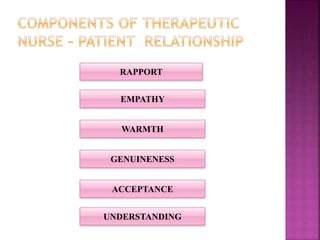
EMPATHY
RAPPORT
WARMTH
GENUINENESS
ACCEPTANCE
UNDERSTANDING
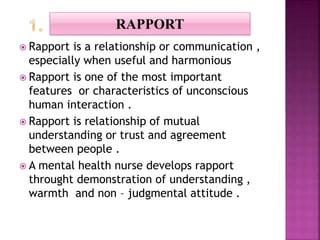
 Rapport is a relationship or communication ,
especially when useful and harmonious
 Rapport is one of the most important
features or characteristics of unconscious
human interaction .
 Rapport is relationship of mutual
understanding or trust and agreement
between people .
 A mental health nurse develops rapport
throught demonstration of understanding ,
warmth and non – judgmental attitude .
RAPPORT
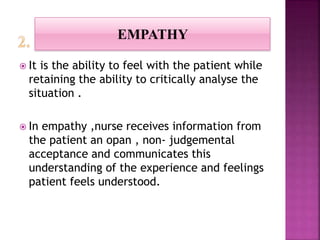
 It is the ability to feel with the patient while
retaining the ability to critically analyse the
situation .
 In empathy ,nurse receives information from
the patient an opan , non- judgemental
acceptance and communicates this
understanding of the experience and feelings
patient feels understood.
EMPATHY
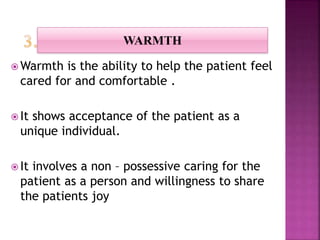
 Warmth is the ability to help the patient feel
cared for and comfortable .
 It shows acceptance of the patient as a
unique individual.
 It involves a non – possessive caring for the
patient as a person and willingness to share
the patients joy
WARMTH
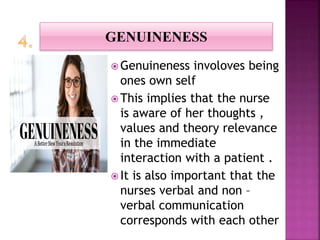
 Genuineness involoves being
ones own self
 This implies that the nurse
is aware of her thoughts ,
values and theory relevance
in the immediate
interaction with a patient .
 It is also important that the
nurses verbal and non –
verbal communication
corresponds with each other
GENUINENESS
 The nurse who does not become upset or
respond negatively to a clients anger , or
acting out conveys acceptance to the
client .
 Avoiding judgments of the person no
matter what the behavior ,is acceptance .
ACCEPTANCE
The relationship was significant to
the extent that he feel a continuing
desire to understand a sensitive
empathy with each of the client
feelings and communication ,as they
seen to him at that movement .
UNDERSTANDING
Give
by
peplau
1.pre-interaction
2.Orientation
or
Introductory
3.Working
4.
Termination
 The pre – interaction
phase begins before the
nurses first contact with
the patient .
tasks:-
 Nurse explores own fears
and anxieties
 Analyze own professinal
strenghths and
limitations
 Plan for first meeting
with patient
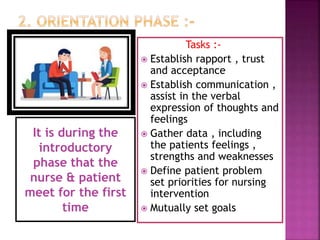
It is during the
introductory
phase that the
nurse & patient
meet for the first
time
Tasks :-
 Establish rapport , trust
and acceptance
 Establish communication ,
assist in the verbal
expression of thoughts and
feelings
 Gather data , including
the patients feelings ,
strengths and weaknesses
 Define patient problem
set priorities for nursing
intervention
 Mutually set goals
MOST OF THE THERAPEUTIC WORK
IS CARRIED OUT DURING THE
WORKING PHASE .
THE NURSE & THE PATIENT
EXPLORE RELEVANT STRESSORS
&PROMOTE THE DEVELOPMENT OF
INSIGHT IN THE PATIENT
TASKS :-
 collection of data from
patient , source files
 helps patient identify his
problems
 helps patient to
communicate
 helps patient to socialize
 to understand his active
participation in the
experience
 to find out alternative
solution
 to try out new behaviors
IT IS MOST DIFFICULT BUT MOST
IMPORTANT PHASE OF THERAPEUTIC
RELATIONSHIP .
IT IS A TIME TO EXCHANGE FEELING
AND MEMORIES AND TO EVALUATE
MUTUALLY REFLECTING THE
QUALITY OF THE RELATIONSHIP BY
BOTH THE NURSE AND THE PATIENT.
TASKS:-
 Establish reality of
separation
 Mutually explore
feelings of rejection ,
loss ,sedness,anger and
related behavior
 Review progress of
therapy and attainment
goals
 Formulate plans for
meeting future therapy
needs
 Resistance = resistance is the patients
attempt to remain unaware of anxiety
producing aspect with in the self.
 Transference =Is an unconscious response of
the client in which he / she experiences
feelings and attitudes towards the nurse that
were originally associated with significant
figures, in his / her early life.
Eg : A client perceives the nurse as acting the
way that his/her Mother did, regardless of
how the nurse is truly acting.
 Countertransference =Refers to a specific
emotional response by the nurse towards the
patient that is in appropriate to the content
and context of the therapeutic relationship or
inappropriate in its emotional intensity.
 Boundary violation . =It occurs when a nurse
goes outside the boundaries of the therapeutic
relationship and establishesa social , economic
relationship with a client.
 It is helpful in communicating of disease
 stressing thoughts &feelings of a client
 It facilitates communication process.
 It is also important is assisting the client in
solving the problems in their day to day life
 It is useful in helping the clients to examine self
– defeating behaviors & test alterrnatives for the
behaviour
 It promotes self –care and independence in the
client
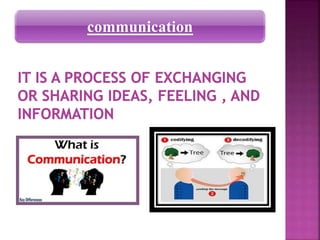
communication
 It is a originator of the message . To be an
effective communicator , he must know – his
objectives clearly defined ,
 The sender purpose must be translated into
a code, this is done with language or
nonverbal signals , such as gestures , facial
expressions ,
 A message is the information which the
communicator transmits to the receiver , to
receive ,understand , accept and act upon .
It may be in the form of words , pictures
 A good message must be meaningful , need ,
clear and understandable , specific and
accurate ,audience interesting ,culturally
and socially appropriate .
 The receiver is the target of the
communication and must be able to
understand the message
 This can be singal person or group .
 By channel is implied the ‘ physical bridges ‘
or the media of communication between the
sender and receiver .
o interpersonal communication
o mass media
o Folk dance
 Feedback means that the sender and
receiver use one anothers reaction to
produce further messages .it is the flow of
information from the audience to the sender
 If the message is not clear or otherwise not
acceptable the audience may reject .
1. Verbal communication :-
verbal communication refers to the form of
communication in which message is
transmitted verbally ,communication is
done by word ,mouth and a piece of
writing.
2. Non – verbal
non – verbal communication includes action
, such as gesture , vocalization , facial
expression and other behavior .
 Formal communication :-
formal communication includes all the
instances where communication has to occur
in a set formal format .
the style of communication in this form is
very formal and official . Official
conferences , meetings and written memos
and corporate letters and used for
communication
 Informal communication :-
informal communication includes instances of
free unrestrained communication between
people who share a casual rapport with each
other .
informal communication dose not have any
rigid rules and guidelines .
 Written communication :-
written communication is writing the words
which you want to communicate .
good written communication is essential for
business purposes.
written communication is practiced in many
different languages ,E-mails, reports ,
articles are some of the ways of using
written communication in business.
 Visual communication :-
the last type of communication out of the
four types of communication is the visual
communication .
visual communication is visual display of
information like photography ,signs ,symbols
and designs . Television and vedio clips are
the visual communication
 Therapeutic communication is defined as the
face to face process of interesting that
focuses on advancing the physical and
emotional well-being of a patient .
Definition
1. listening :- listening is an active process of
receiving information and examining reaction to
the messages received .
2. Broad openings :-here the nurse is encouraging
the patient to select topics for discussion.
Patient should be welcomed to the
communication with warmth and respect
.patient should feel that nurse is ready to listen
.
3. Questioning :- the nurse skilfully asks open –
ended question during the initial admission
.interviewing skills are necessary to avoid asking
too many personal questions in one session .
4.Restating :- repeating the main thought
expressed by the patient .
for exp :-you say that your mother left you
when you were 5 year old ?.
5.Clarification :-here , the nurse makes
specific questions to help clear up a specific
point patient makes by attempting to put in
to words vague ideas of the patient .
e.g :- I am not sure what you mean . Could do
tell me about it again ?
6. Reflection :- Directing Break the patients ideas
,feelings , questions and content .
for exp :- “ you are feeling tense and anxious
and it is related to a conversation you had with
your husband last night .”
7. Focusing :- focusing helps the patient expand a
topic of importance and also helps in analyzing
in detail .it helps the patient talk about life
experiences or problem area and accepts the
responsibility for improving them .
8. Sharing perception :- it involves asking the
patient to verify the nurses understanding of
what the patient is thinking or feeling .
9. informing :- informing or giving information
is nurse shares simple fact whith the patient
.this skill is use in patient education like
when to take medication
10. Suggestion :-suggestion is the presentation
of altemate idea. As a therpeutic technique
.it is useful intervention in the working phase
of the relationship .
1.Language:- the most prominent communication
barrier is languange many clients speak engalish as
a second language ,and a smaller proportion are
hearing impaired or deal .
2.age and developmental level :- age differences
may pose communication problems . With aging can
come loss of hearing ,eyesight ,or cognition . In
addition the elderly hold values that may be
different than those of yonger people .
3. level of health :- an individu with depression
may speak little because of the level of illness. And
imitiating and maintaining communication may be
difficult . Those with mania may have unusual
speech patterns.
4. Knowledge level:- communication is
affected by the amount and kinds of facts
the client has at hand . The nurse assesses
the client fund of knowledge and educational
background at the time of admission.
5. Time :- counseling takes time , and the need
to hurry blocks communication . Therefore ,
plan to interview .hectic time time to avoid
include changes of shift , visitations , doctors
rounds or when other appointment are
pending .
6. The nurses or clients feelings :-
whenever the nurses or client becomes
anxious communication changes . Talking
about or listening to disturbing experiences
or information is uncomfortable .
7. Unhelpful communication techniques :-
nurses overcome responses that
communication by being aware of statements
that change the focus ,finalize the interview
.
Therapeutic nurse pt relationship.docx

Therapeutic nurse pt relationship.docx

  • 1.
    PRESENTED BY :- PATELPRITESH D M.Sc.in Mental Health Nursing (THERAPEUTIC NURSE- PATIENT RELATIONSHIP )
  • 2.
    THERAPEUTIC NURSE- PATIENT RELATIONSHIP INTRODUCING THE CHAPTER :-  Therapeutic nurse patient relationship : definition ,components and phases, importance , impasses.  Communication skills :- definition, elements , type , factor influencing communication , barriers
  • 3.
     Therapeutic nursepatient relationship :- it is an interaction process in which the nurse fulfils her role by using her professional knowledge and skill in such way that she is able to help the patient physically , socially and emotionally .
  • 4.
    1 • Social relationship 2 •Intimaterelationship 3 •Therapeutic relationship
  • 5.
    •1. it isdefined as a relationship that is primarily initiated with the purpose of friendship , socialization , enjoyment or accomplishing task . Exp :- participants share ideas , feelings and experiences .  2.mutual needs are met during social interaction .
  • 6.
    It occurs betweentwo individuals who have an emotional commitment to each other . Often the relationship is a partnership where in each member cares about the others need for growth and satisfaction.  Those is an intimate relationship usually react naturally with each other.
  • 7.
    02. The focusof the relationship is on the patients ideas experiences and feelings . 01.The relationship differs from both a social and intimate relationship in that the nurse maximizes inner communication skills, understanding of human behavior and personal strengths in order to enhance the patients growth
  • 8.
     Facilitating communication of distressingthought and feeling  Helping client examine self – defeating Behavior and test -alternatives  Assisting client with problem solving .  Promoting self –care and independence .
  • 9.
  • 10.
     Rapport isa relationship or communication , especially when useful and harmonious  Rapport is one of the most important features or characteristics of unconscious human interaction .  Rapport is relationship of mutual understanding or trust and agreement between people .  A mental health nurse develops rapport throught demonstration of understanding , warmth and non – judgmental attitude . RAPPORT
  • 11.
     It isthe ability to feel with the patient while retaining the ability to critically analyse the situation .  In empathy ,nurse receives information from the patient an opan , non- judgemental acceptance and communicates this understanding of the experience and feelings patient feels understood. EMPATHY
  • 12.
     Warmth isthe ability to help the patient feel cared for and comfortable .  It shows acceptance of the patient as a unique individual.  It involves a non – possessive caring for the patient as a person and willingness to share the patients joy WARMTH
  • 13.
     Genuineness involovesbeing ones own self  This implies that the nurse is aware of her thoughts , values and theory relevance in the immediate interaction with a patient .  It is also important that the nurses verbal and non – verbal communication corresponds with each other GENUINENESS
  • 14.
     The nursewho does not become upset or respond negatively to a clients anger , or acting out conveys acceptance to the client .  Avoiding judgments of the person no matter what the behavior ,is acceptance . ACCEPTANCE
  • 15.
    The relationship wassignificant to the extent that he feel a continuing desire to understand a sensitive empathy with each of the client feelings and communication ,as they seen to him at that movement . UNDERSTANDING
  • 16.
  • 17.
     The pre– interaction phase begins before the nurses first contact with the patient . tasks:-  Nurse explores own fears and anxieties  Analyze own professinal strenghths and limitations  Plan for first meeting with patient
  • 18.
    It is duringthe introductory phase that the nurse & patient meet for the first time Tasks :-  Establish rapport , trust and acceptance  Establish communication , assist in the verbal expression of thoughts and feelings  Gather data , including the patients feelings , strengths and weaknesses  Define patient problem set priorities for nursing intervention  Mutually set goals
  • 19.
    MOST OF THETHERAPEUTIC WORK IS CARRIED OUT DURING THE WORKING PHASE . THE NURSE & THE PATIENT EXPLORE RELEVANT STRESSORS &PROMOTE THE DEVELOPMENT OF INSIGHT IN THE PATIENT TASKS :-  collection of data from patient , source files  helps patient identify his problems  helps patient to communicate  helps patient to socialize  to understand his active participation in the experience  to find out alternative solution  to try out new behaviors
  • 20.
    IT IS MOSTDIFFICULT BUT MOST IMPORTANT PHASE OF THERAPEUTIC RELATIONSHIP . IT IS A TIME TO EXCHANGE FEELING AND MEMORIES AND TO EVALUATE MUTUALLY REFLECTING THE QUALITY OF THE RELATIONSHIP BY BOTH THE NURSE AND THE PATIENT. TASKS:-  Establish reality of separation  Mutually explore feelings of rejection , loss ,sedness,anger and related behavior  Review progress of therapy and attainment goals  Formulate plans for meeting future therapy needs
  • 21.
     Resistance =resistance is the patients attempt to remain unaware of anxiety producing aspect with in the self.  Transference =Is an unconscious response of the client in which he / she experiences feelings and attitudes towards the nurse that were originally associated with significant figures, in his / her early life. Eg : A client perceives the nurse as acting the way that his/her Mother did, regardless of how the nurse is truly acting.
  • 22.
     Countertransference =Refersto a specific emotional response by the nurse towards the patient that is in appropriate to the content and context of the therapeutic relationship or inappropriate in its emotional intensity.  Boundary violation . =It occurs when a nurse goes outside the boundaries of the therapeutic relationship and establishesa social , economic relationship with a client.
  • 23.
     It ishelpful in communicating of disease  stressing thoughts &feelings of a client  It facilitates communication process.  It is also important is assisting the client in solving the problems in their day to day life  It is useful in helping the clients to examine self – defeating behaviors & test alterrnatives for the behaviour  It promotes self –care and independence in the client
  • 24.
  • 26.
     It isa originator of the message . To be an effective communicator , he must know – his objectives clearly defined ,  The sender purpose must be translated into a code, this is done with language or nonverbal signals , such as gestures , facial expressions ,
  • 27.
     A messageis the information which the communicator transmits to the receiver , to receive ,understand , accept and act upon . It may be in the form of words , pictures  A good message must be meaningful , need , clear and understandable , specific and accurate ,audience interesting ,culturally and socially appropriate .
  • 28.
     The receiveris the target of the communication and must be able to understand the message  This can be singal person or group .
  • 29.
     By channelis implied the ‘ physical bridges ‘ or the media of communication between the sender and receiver . o interpersonal communication o mass media o Folk dance
  • 30.
     Feedback meansthat the sender and receiver use one anothers reaction to produce further messages .it is the flow of information from the audience to the sender  If the message is not clear or otherwise not acceptable the audience may reject .
  • 31.
    1. Verbal communication:- verbal communication refers to the form of communication in which message is transmitted verbally ,communication is done by word ,mouth and a piece of writing. 2. Non – verbal non – verbal communication includes action , such as gesture , vocalization , facial expression and other behavior .
  • 32.
     Formal communication:- formal communication includes all the instances where communication has to occur in a set formal format . the style of communication in this form is very formal and official . Official conferences , meetings and written memos and corporate letters and used for communication
  • 33.
     Informal communication:- informal communication includes instances of free unrestrained communication between people who share a casual rapport with each other . informal communication dose not have any rigid rules and guidelines .
  • 34.
     Written communication:- written communication is writing the words which you want to communicate . good written communication is essential for business purposes. written communication is practiced in many different languages ,E-mails, reports , articles are some of the ways of using written communication in business.
  • 35.
     Visual communication:- the last type of communication out of the four types of communication is the visual communication . visual communication is visual display of information like photography ,signs ,symbols and designs . Television and vedio clips are the visual communication
  • 36.
     Therapeutic communicationis defined as the face to face process of interesting that focuses on advancing the physical and emotional well-being of a patient . Definition
  • 37.
    1. listening :-listening is an active process of receiving information and examining reaction to the messages received . 2. Broad openings :-here the nurse is encouraging the patient to select topics for discussion. Patient should be welcomed to the communication with warmth and respect .patient should feel that nurse is ready to listen . 3. Questioning :- the nurse skilfully asks open – ended question during the initial admission .interviewing skills are necessary to avoid asking too many personal questions in one session .
  • 38.
    4.Restating :- repeatingthe main thought expressed by the patient . for exp :-you say that your mother left you when you were 5 year old ?. 5.Clarification :-here , the nurse makes specific questions to help clear up a specific point patient makes by attempting to put in to words vague ideas of the patient . e.g :- I am not sure what you mean . Could do tell me about it again ?
  • 39.
    6. Reflection :-Directing Break the patients ideas ,feelings , questions and content . for exp :- “ you are feeling tense and anxious and it is related to a conversation you had with your husband last night .” 7. Focusing :- focusing helps the patient expand a topic of importance and also helps in analyzing in detail .it helps the patient talk about life experiences or problem area and accepts the responsibility for improving them . 8. Sharing perception :- it involves asking the patient to verify the nurses understanding of what the patient is thinking or feeling .
  • 40.
    9. informing :-informing or giving information is nurse shares simple fact whith the patient .this skill is use in patient education like when to take medication 10. Suggestion :-suggestion is the presentation of altemate idea. As a therpeutic technique .it is useful intervention in the working phase of the relationship .
  • 41.
    1.Language:- the mostprominent communication barrier is languange many clients speak engalish as a second language ,and a smaller proportion are hearing impaired or deal . 2.age and developmental level :- age differences may pose communication problems . With aging can come loss of hearing ,eyesight ,or cognition . In addition the elderly hold values that may be different than those of yonger people . 3. level of health :- an individu with depression may speak little because of the level of illness. And imitiating and maintaining communication may be difficult . Those with mania may have unusual speech patterns.
  • 42.
    4. Knowledge level:-communication is affected by the amount and kinds of facts the client has at hand . The nurse assesses the client fund of knowledge and educational background at the time of admission. 5. Time :- counseling takes time , and the need to hurry blocks communication . Therefore , plan to interview .hectic time time to avoid include changes of shift , visitations , doctors rounds or when other appointment are pending .
  • 43.
    6. The nursesor clients feelings :- whenever the nurses or client becomes anxious communication changes . Talking about or listening to disturbing experiences or information is uncomfortable . 7. Unhelpful communication techniques :- nurses overcome responses that communication by being aware of statements that change the focus ,finalize the interview .