SCHISTOSOMIASIS
Facilitator : prof Mazigo (parasitology department)
DR.HAMISI MKINDI,MD.
TO DOWNLOAD CONTACT: hermyc@live.com
TABLE OF CONTENTS
1. PARASITOLOGY (SCHISTOSOMES)
2. EPIDEMIOLOGY OF SCHISTOMIASIS
3. PATHOGENESIS AND IMMUNOLOGY
4. ACUTE AND CHRONIC PATHOLOGY
5. MORBIDITIES RELATED TO SCHISTOSOMIASIS
6. FEMALE GENITAL SCHISTOSOMIASIS
7. DIAGNOSIS
8. MANAGEMENT
9. PREVENTION AND CONTROL
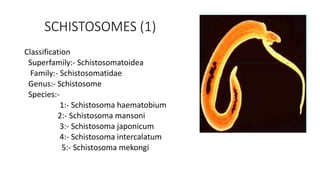
SCHISTOSOMES (1)
Classification
Superfamily:- Schistosomatoidea
Family:- Schistosomatidae
Genus:- Schistosome
Species:-
1:- Schistosoma haematobium
2:- Schistosoma mansoni
3:- Schistosoma japonicum
4:- Schistosoma intercalatum
5:- Schistosoma mekongi
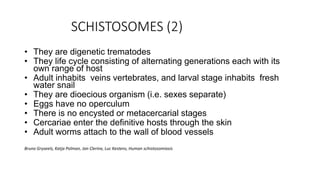
SCHISTOSOMES (2)
• They are digenetic trematodes
• They life cycle consisting of alternating generations each with its
own range of host
• Adult inhabits veins vertebrates, and larval stage inhabits fresh
water snail
• They are dioecious organism (i.e. sexes separate)
• Eggs have no operculum
• There is no encysted or metacercarial stages
• Cercariae enter the definitive hosts through the skin
• Adult worms attach to the wall of blood vessels
Bruno Gryseels, Katja Polman, Jan Clerinx, Luc Kestens, Human schistosomiasis
SCHISTOSOMES (3)
• Oral sucker surrounds the mouth and is prehensile
• Ventral suckers (acetabulum) is more posterior on the ventral
• Mouth is near the anterior extremity
• They have no anus
• Alimentary system consists of an oral cavity leading to the
oesophagus and hence the gut
• Excretory system: consist of 2 longitudinal canals opening posteriorly
and feed by collecting tubules
Bruno Gryseels, Katja Polman, Jan Clerinx, Luc Kestens, Human schistosomiasis
SCHISTOSOMES (4)
• Male reproductive organs consist of testes dorsal to and posterior to
the ventral suckers
• Male worms is flat and leaf – like but is folded to form the
GYNAECOPHORIC CANAL, enfolding the very slander female for
almost its entire length.
• Female reproductive system consists of an elongated ovary in the
posterior half
• Female is longer and slender than the male
• The female is carried in a ventral groove, the GYNAECOPHORIC, of the
male
Bruno Gryseels, Katja Polman, Jan Clerinx, Luc Kestens, Human schistosomiasis
EGG MORPHOLOGY
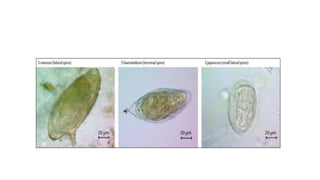
• S. mansoni: – Eggs have a lateral spines
• S. japonicum and S. mekongi :- Eggs are smaller, round or ovoid with a
rudimentary spine
• S. heamtobium and S. intercalatum :- Eggs have a terminal spine
• Eggs contains embryo, the miracidium
• Eggs are passed through the walls of the bladder, the urogenital or
the colon to excreted in urine or faeces and some are retained in the
tissues.
Bruno Gryseels, Katja Polman, Jan Clerinx, Luc Kestens, Human schistosomiasis
INTERMEDIATE HOST (1)
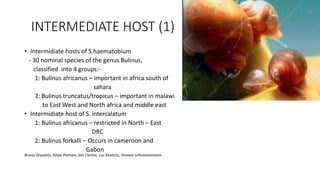
• Intermidiate hosts of S.haematobium
- 30 nominal species of the genus Bulinus,
classified into 4 groups:-
1: Bulinus africanus – important in africa south of
sahara
2: Bulinus truncatus/tropicus – important in malawi
to East West and North africa and middle east
• Intermidiate host of S. intercalatum
1: Bulinus africanus – restricted in North – East
DRC
2: Bulinus forkalli – Occurs in cameroon and
Gabon
Bruno Gryseels, Katja Polman, Jan Clerinx, Luc Kestens, Human schistosomiasis
INTERMEDIATE HOST (2)
• Intermidiate host of S. mansoni
- Genus Biophalaria:- Biophalaria alexandria and Biophalaria glabrata
- Distributed in Africa, the Nile valley and Arabian peninsula, USA, Carribean
islands, Brazil, Venezuela
• Intermidiate host of S. japonicum
- Genus Oncomelania:- Oncomelania hupensis in china, Oncomelania
quadrasi in Philipines, Oncomelania hupensis nosophora in Japan,
O.hupensis lindoensis in Indonesia and Oncomelania hupensis chiui in
Taiwan
• Intermidiate host of S. mekongi
- Genus Tricula aperta
Bruno Gryseels, Katja Polman, Jan Clerinx, Luc Kestens, Human schistosomiasis
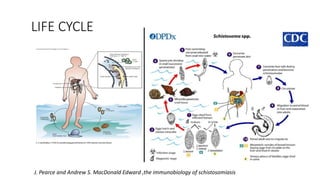
LIFE CYCLE (1)
• Adult live in as a pair within capillary blood vessels, female held in
gynaecophoric canals, copulate and female lay eggs in the peripheral
of branches of the capillary venulles
• Eggs are passed out in faeces or urine and reach the enviroments
• Viable eggs in water sources hatches, the larvum ,the miracidium
emerges and infect intermidiate host, snails
• In the snails:- miracidium developd into mother sporocyst and then,
cercaria escape from the daughter sporocyst from the snail
Bruno Gryseels, Katja Polman, Jan Clerinx, Luc Kestens, Human schistosomiasis
LIFE CYCLE (2)
• Folk- tailed cercarie penetrate human skin when a person is exposed
to infected water
• After passage as Schistosomula through the tissue, lymphatics and
venules will develop into a male or female schistosome
• Pairing of male and female schistosomes takes place on sexual
maturity with subsequent migration to the preffered sites for egg
depositions
Bruno Gryseels, Katja Polman, Jan Clerinx, Luc Kestens, Human schistosomiasis
• S. mansoni, S. japonicum and S. mekongi :-Inhabits the pericolonic venules
within the distribution of the portal venous system
• S. haematobium:- inhabits the terminal venules and in the wall of the
bladder, the genitourinary system and the pelvic plexus within the
distribution of the inferior vena cava
Bruno Gryseels, Katja Polman, Jan Clerinx, Luc Kestens, Human schistosomiasis
LIFE CYCLE
J. Pearce and Andrew S. MacDonald Edward ,the immunobiology of schistosomiasis
EPIDEMIOLOGY (1)
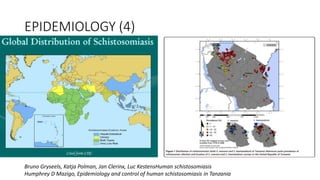
• Human schistosomiasis is second only to malaria in Subsaharan Africa (SSA)
for causing severe morbidities. Of the world's 207 million estimated cases
of schistosomiasis.
• 93% occur in SSA and the United Republic of Tanzania is the second
country that has the highest burden of schistosomiasis in the region,
Nigeria being the first.
• In Tanzania, the first cases of schistosomiasis were reported in the early
19th century. Since then, various studies have reported prevalences of up
to 100% in some areas.
Ross AGP, Bartley PB, Sleigh AC, Olds R, Li Y, Williams GM, McManus DP: Schistosomiasis. New Eng J Med 2002, 346(16):1212–1220.
Steinmann P, Keiser J, Bos R, Tanner M, Utzinger J: Schistosomiasis and water resources development: systematic review, meta-analysis, and estimates of people at risk. Lancet Infect
Dis 2006, 6(7):411–425
EPIDEMIOLOGY (2)
• In Tanzania, both urogenital schistosomiasis (S. haematobium) and
intestinal schistosomiasis (S. mansoni) are endemic throughout the
country, S mansoni being highly prevalent around the Lake Zone(
prevalence of up to 100% have been reported).
• In Tanzania, the use of mass praziquantel treatments as preventive
chemotherapy was initiated in 2004–2005 and is the main strategy for
schistosomiasis prevention and control targeting school-aged children.
• By 2016, Tanzania had reached 100% geographical coverage in terms of
praziquantel mass drug administration targeting school-aged children.
Mazigo HD, Nuwaha F, Kinung’hi SM, Morona D, Pinot de Moira A, Wilson S, et al. Epidemiology and control of human schistosomiasis in Tanzania.
EPIDEMIOLOGY (3)
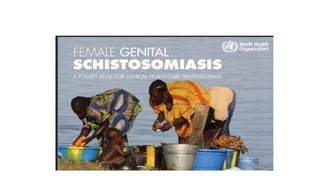
• Contact with infested water bodies during daily activities such
agriculture, fishing, swimming and washing clothes or utensil
predisposes individuals to Schistosoma infection.
• Inadequate hygiene and contact with infected water make children
especially vulnerable to infection
Kaizilege GK, Female Genital Schistosomiasis, a Neglected Differential of Cervical Precancerous and Cancerous Lesion: a Wakeup Call
for on-Job Training for Healthcare Workers in Endemic Areas
World Health Organization. Female genital schistosomiasis. A pocket atlas for clinical health-care professionals
EPIDEMIOLOGY (4)
Bruno Gryseels, Katja Polman, Jan Clerinx, Luc KestensHuman schistosomiasis
Humphrey D Mazigo, Epidemiology and control of human schistosomiasis in Tanzania
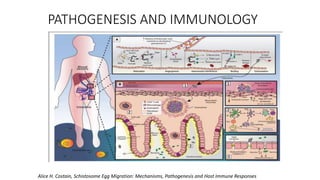
PATHOGENESIS AND IMMUNOLOGY
Alice H. Costain, Schistosome Egg Migration: Mechanisms, Pathogenesis and Host Immune Responses
ACUTE PATHOLOGY
• The percutanous penetration of cercariae can provoke a temporary
urticarial rash that sometimes persists for days as papulopruriginous
lesions, especially after primary infections such as occur in tourists
and migrants.
• Swimmers’ itch caused by cercariae of animal trematodes in
temperate climate zones.
• Cercarial dermatitis often goes unrecognised in endemic areas.
• Acute schistosomiasis (Katayama fever) is a systemic hypersensitivity
reaction against the migrating schistosomulae
Bruno Gryseels, Katja Polman, Jan Clerinx, Luc Kestens, Human schistosomiasis
Gryseels B, Polderman AM. Morbidity, due to schistosomiasis mansoni, and its control in Subsaharan Africa
CHRONIC PATHOLOGY
• The lesions and chronic infection are due to eggs that are trapped in
the tissues during the perivesical or periintestinal migration or after
embolisation in the liver, spleen, lungs, or cerebrospinal system.
• The eggs secrete proteolytic enzymes that provoke typical
eosinophilic inflammatory and granulomatous reactions, which are
progressively replaced by fibrotic deposits
• The severity of the symptoms depends on the intensity of infection
and individual immune responses.
Bruno Gryseels, Katja Polman, Jan Clerinx, Luc Kestens, Human schistosomiasis
Gryseels B, Polderman AM. Morbidity, due to schistosomiasis mansoni, and its control in Subsaharan Africa
MORBIDITIES RELATED TO SCHISTOSOMIASIS (1)
Urinary schistosomiasis
• The eggs of S haematobium provoke granulomatous infl ammation,
ulceration, and pseudopolyposis of the vesical and ureteral walls.
• Early signs include dysuria, proteinuria, and especially haematuria.In
endemic areas, haematuria is the red flag of schistosomiasis in children
aged 5–10 years.
• Chronic lesions can evolve to fi brosis or calcifi cation of the bladder and
lower ureters, resulting in hydroureter, hydronephrosis and kidney failure.
• Chronic urinary schistosomiasis is epidemiologically associated with
squamous bladder cancer.
Bruno Gryseels, Katja Polman, Jan Clerinx, Luc Kestens, Human schistosomiasis
Gryseels B, Polderman AM. Morbidity, due to schistosomiasis mansoni, and its control in Subsaharan Africa
MORBIDITIES RELATED TO SCHISTOSOMIASIS (2)
Intestinal schistosomiasis
• Schistosome eggs migrating through the intestinal wall provoke
mucosal granulomatous infl ammation, pseudopolyposis,
microulcerations, and superfi cial bleeding.
• Most lesions are situated in the large bowel and rectum.
• The most common symptoms and signs are chronic or intermittent
abdominal pain and discomfort, loss of appetite, and diarrhoea with
or without blood.
Gryseels B, Polderman AM. Morbidity, due to schistosomiasis mansoni, and its control in Subsaharan Africa
MORBIDITIES RELATED TO SCHISTOSOMIASIS (3)
Hepatic schistosomiasis
• Inflammatory reaction is due to ova trapped in the presinusoidal
periportal spaces of the liver; it is the main cause of schistosomal
hepatomegaly in children and adolescents.
• Features include sharp-edged enlargement of the left liver lobe and
nodular splenomegaly
Gryseels B, Polderman AM. Morbidity, due to schistosomiasis mansoni, and its control in Subsaharan Africa
MORBIDITIES RELATED TO SCHISTOSOMIASIS (4)
Pulmonary schistosomiasis
• Due to portal-caval shunting, allowing ova to leak into the
perialveolar capillary beds.
• The ensuing granulomas can give rise to bronchial symptoms and
later to fibrosis complicated by pulmonary hypertension and cor
pulmonale.
Bruno Gryseels, Katja Polman, Jan Clerinx, Luc Kestens, Human schistosomiasis
Gryseels B, Polderman AM. Morbidity, due to schistosomiasis mansoni, and its control in Subsaharan Africa
MORBIDITIES RELATED TO SCHISTOSOMIASIS (5)
Genital schistosomiasis
• Due to eggs of S haematobium and S mansoni in the reproductive
organs
• Symptoms in female patients include hypertrophic and ulcerative
lesions of the vulva, vagina, and cervix
• Lesions of the ovaries and the fallopian tubes can lead to infertility.
• In men, the epididymis, testicles, spermatic chord, and prostate can
be affected; haemospermia is a common symptom.
Bruno Gryseels, Katja Polman, Jan Clerinx, Luc Kestens, Human schistosomiasis
Gryseels B, Polderman AM. Morbidity, due to schistosomiasis mansoni, and its control in Subsaharan Africa
MORBIDITIES RELATED TO SCHISTOSOMIASIS (6)
Neuroschistosomiasis
• Caused by inflammation around ectopic worms or eggs in the
cerebral or spinal venous plexus, which can evolve to irreversible fi
brotic scars if left untreated.
• S japonicum cause transverse myelitis, cerebral granulomatous
lesions, which can lead to epileptic, paralytic, and
meningoencephalitic symptoms.
Bruno Gryseels, Katja Polman, Jan Clerinx, Luc Kestens, Human schistosomiasis
Gryseels B, Polderman AM. Morbidity, due to schistosomiasis mansoni, and its control in Subsaharan Africa
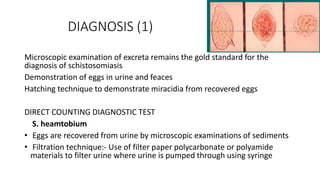
DIAGNOSIS (1)
Microscopic examination of excreta remains the gold standard for the
diagnosis of schistosomiasis
Demonstration of eggs in urine and feaces
Hatching technique to demonstrate miracidia from recovered eggs
DIRECT COUNTING DIAGNOSTIC TEST
S. heamtobium
• Eggs are recovered from urine by microscopic examinations of sediments
• Filtration technique:- Use of filter paper polycarbonate or polyamide
materials to filter urine where urine is pumped through using syringe
DIAGNOSIS (2)
Intestinal dwelling schistosomes ( S.mansoni, S. japonicum, S.menkongi and
S. intercalatum)
Eggs are excreted in the faeces, Methods:
1: Simple comminution of the stool and sedimentation before
microscopic examination
2: Concentration techniques involved removal of fat, faecal debris and
mucus
3: Cellophane thick faecal smear (The Kato tech) becomes a standard
techniques
4: Semi – concentration clearing staining process
Bruno Gryseels, Katja Polman, Jan Clerinx, Luc Kestens, Human schistosomiasis
Gryseels B, Polderman AM. Morbidity, due to schistosomiasis mansoni, and its control in Subsaharan Africa
DIAGNOSIS (3)
• Miracidials hatching tech :- most sensitive
• Rectal biopsy : Small specimens of mucosa are soaked in water and
examined microscopically as a crush preparations
INDIRECT DIAGNOSTIC TECHNIQUES
• Chemical reagent techniques:- detect RBC and Hg in urine
• Immunodiagnosis: detection of either specific Ab or genus specific Ag
 ELISA, RIA, IFAT, gel precipitation tech, Latex agglutination test
• Laparoscopy and wedge biopsy can reveal the macroscopic and histological
appearance of granulomatous inflammation or periportal fibrosis
Bruno Gryseels, Katja Polman, Jan Clerinx, Luc Kestens, Human schistosomiasis
Gryseels B, Polderman AM. Morbidity, due to schistosomiasis mansoni, and its control in Subsaharan Africa
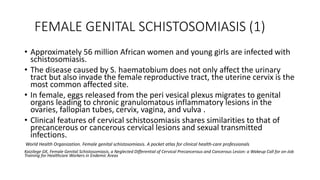
FEMALE GENITAL SCHISTOSOMIASIS (1)
• Approximately 56 million African women and young girls are infected with
schistosomiasis.
• The disease caused by S. haematobium does not only affect the urinary
tract but also invade the female reproductive tract, the uterine cervix is the
most common affected site.
• In female, eggs released from the peri vesical plexus migrates to genital
organs leading to chronic granulomatous inflammatory lesions in the
ovaries, fallopian tubes, cervix, vagina, and vulva .
• Clinical features of cervical schistosomiasis shares similarities to that of
precancerous or cancerous cervical lesions and sexual transmitted
infections.
World Health Organization. Female genital schistosomiasis. A pocket atlas for clinical health-care professionals
Kaizilege GK, Female Genital Schistosomiasis, a Neglected Differential of Cervical Precancerous and Cancerous Lesion: a Wakeup Call for on-Job
Training for Healthcare Workers in Endemic Areas
FEMALE GENITAL SCHISTOSOMIASIS (2)
• Clinical features include dysmenorrhea, menorrhagia, abnormal vaginal
discharge, lower abdominal pain, post-coital bleeding, dyspareunia, and
inter-menstrual bleeding and genital itching or burning sensation
• Complications includes chronic pelvic pain, infertility, spontaneous
abortion or ectopic pregnancy, stress urinary incontinency and genital
ulcers which may increase a woman’s risk for acquisition and transmission
of HIV.
• Female genital schistosomiasis has been linked to early onset cervical
cancer
Kaizilege GK, Female Genital Schistosomiasis, a Neglected Differential of Cervical Precancerous and Cancerous Lesion: a Wakeup Call for on-Job
Training for Healthcare Workers in Endemic Areas
World Health Organization. Female genital schistosomiasis. A pocket atlas for clinical health-care professionals
FEMALE GENITAL SCHISTOSOMIASIS (3)
Diagnosis
• PCR cervical-vaginal lavage has a low sensitivity of 53%
• Wet smears and Pap smears has a sensitivity of 15%
• Histological examination of the tissue biopsy (Tissue biopsy from the
affected area has been used as a confirmatory test for the presence of
Schistosoma egg )
Poggensee G, et al. Diagnosis of genital cervical schistosomiasis: comparison of cytological, histopathological and parasitological examination
MANAGEMENT
Treatment
• Praziquantel
• Oxammiquine – effective only for S.mansoni
Bruno Gryseels, Katja Polman, Jan Clerinx, Luc Kestens, Human schistosomiasis
Gryseels B, Polderman AM. Morbidity, due to schistosomiasis mansoni, and its control in Subsaharan Africa
PREVENTION AND CONTROL (1)
1. Safe water supply
2. Sanitation
3. Snail control
• Chemical
• Molluscicides
• Biological control
4. Health education
• Advertising campaigns through mass media
• Effects of infection and availability of diagnosis and treatment
• Public health educations : use of toilet, early treatment
Bruno Gryseels, Katja Polman, Jan Clerinx, Luc Kestens, Human schistosomiasis
Gryseels B, Polderman AM. Morbidity, due to schistosomiasis mansoni, and its control in Subsaharan Africa
PREVENTION AND CONTROL (2)
WHO recommendation
• Population-based treatment with praziquantel is now the main
component of most national control programmes
• Mass treatment
• Active case finding, and
• Treatment of particular risk groups such as school-aged children.
Bruno Gryseels, Katja Polman, Jan Clerinx, Luc Kestens, Human schistosomiasis
Gryseels B, Polderman AM. Morbidity, due to schistosomiasis mansoni, and its control in Subsaharan Africa
SCHISTOSOMIASIS.pptx

SCHISTOSOMIASIS.pptx

  • 1.
    SCHISTOSOMIASIS Facilitator : profMazigo (parasitology department) DR.HAMISI MKINDI,MD. TO DOWNLOAD CONTACT: hermyc@live.com
  • 2.
    TABLE OF CONTENTS 1.PARASITOLOGY (SCHISTOSOMES) 2. EPIDEMIOLOGY OF SCHISTOMIASIS 3. PATHOGENESIS AND IMMUNOLOGY 4. ACUTE AND CHRONIC PATHOLOGY 5. MORBIDITIES RELATED TO SCHISTOSOMIASIS 6. FEMALE GENITAL SCHISTOSOMIASIS 7. DIAGNOSIS 8. MANAGEMENT 9. PREVENTION AND CONTROL
  • 3.
    SCHISTOSOMES (1) Classification Superfamily:- Schistosomatoidea Family:-Schistosomatidae Genus:- Schistosome Species:- 1:- Schistosoma haematobium 2:- Schistosoma mansoni 3:- Schistosoma japonicum 4:- Schistosoma intercalatum 5:- Schistosoma mekongi
  • 4.
    SCHISTOSOMES (2) • Theyare digenetic trematodes • They life cycle consisting of alternating generations each with its own range of host • Adult inhabits veins vertebrates, and larval stage inhabits fresh water snail • They are dioecious organism (i.e. sexes separate) • Eggs have no operculum • There is no encysted or metacercarial stages • Cercariae enter the definitive hosts through the skin • Adult worms attach to the wall of blood vessels Bruno Gryseels, Katja Polman, Jan Clerinx, Luc Kestens, Human schistosomiasis
  • 5.
    SCHISTOSOMES (3) • Oralsucker surrounds the mouth and is prehensile • Ventral suckers (acetabulum) is more posterior on the ventral • Mouth is near the anterior extremity • They have no anus • Alimentary system consists of an oral cavity leading to the oesophagus and hence the gut • Excretory system: consist of 2 longitudinal canals opening posteriorly and feed by collecting tubules Bruno Gryseels, Katja Polman, Jan Clerinx, Luc Kestens, Human schistosomiasis
  • 6.
    SCHISTOSOMES (4) • Malereproductive organs consist of testes dorsal to and posterior to the ventral suckers • Male worms is flat and leaf – like but is folded to form the GYNAECOPHORIC CANAL, enfolding the very slander female for almost its entire length. • Female reproductive system consists of an elongated ovary in the posterior half • Female is longer and slender than the male • The female is carried in a ventral groove, the GYNAECOPHORIC, of the male Bruno Gryseels, Katja Polman, Jan Clerinx, Luc Kestens, Human schistosomiasis
  • 7.
    EGG MORPHOLOGY • S.mansoni: – Eggs have a lateral spines • S. japonicum and S. mekongi :- Eggs are smaller, round or ovoid with a rudimentary spine • S. heamtobium and S. intercalatum :- Eggs have a terminal spine • Eggs contains embryo, the miracidium • Eggs are passed through the walls of the bladder, the urogenital or the colon to excreted in urine or faeces and some are retained in the tissues. Bruno Gryseels, Katja Polman, Jan Clerinx, Luc Kestens, Human schistosomiasis
  • 9.
    INTERMEDIATE HOST (1) •Intermidiate hosts of S.haematobium - 30 nominal species of the genus Bulinus, classified into 4 groups:- 1: Bulinus africanus – important in africa south of sahara 2: Bulinus truncatus/tropicus – important in malawi to East West and North africa and middle east • Intermidiate host of S. intercalatum 1: Bulinus africanus – restricted in North – East DRC 2: Bulinus forkalli – Occurs in cameroon and Gabon Bruno Gryseels, Katja Polman, Jan Clerinx, Luc Kestens, Human schistosomiasis
  • 10.
    INTERMEDIATE HOST (2) •Intermidiate host of S. mansoni - Genus Biophalaria:- Biophalaria alexandria and Biophalaria glabrata - Distributed in Africa, the Nile valley and Arabian peninsula, USA, Carribean islands, Brazil, Venezuela • Intermidiate host of S. japonicum - Genus Oncomelania:- Oncomelania hupensis in china, Oncomelania quadrasi in Philipines, Oncomelania hupensis nosophora in Japan, O.hupensis lindoensis in Indonesia and Oncomelania hupensis chiui in Taiwan • Intermidiate host of S. mekongi - Genus Tricula aperta Bruno Gryseels, Katja Polman, Jan Clerinx, Luc Kestens, Human schistosomiasis
  • 11.
    LIFE CYCLE (1) •Adult live in as a pair within capillary blood vessels, female held in gynaecophoric canals, copulate and female lay eggs in the peripheral of branches of the capillary venulles • Eggs are passed out in faeces or urine and reach the enviroments • Viable eggs in water sources hatches, the larvum ,the miracidium emerges and infect intermidiate host, snails • In the snails:- miracidium developd into mother sporocyst and then, cercaria escape from the daughter sporocyst from the snail Bruno Gryseels, Katja Polman, Jan Clerinx, Luc Kestens, Human schistosomiasis
  • 12.
    LIFE CYCLE (2) •Folk- tailed cercarie penetrate human skin when a person is exposed to infected water • After passage as Schistosomula through the tissue, lymphatics and venules will develop into a male or female schistosome • Pairing of male and female schistosomes takes place on sexual maturity with subsequent migration to the preffered sites for egg depositions Bruno Gryseels, Katja Polman, Jan Clerinx, Luc Kestens, Human schistosomiasis
  • 13.
    • S. mansoni,S. japonicum and S. mekongi :-Inhabits the pericolonic venules within the distribution of the portal venous system • S. haematobium:- inhabits the terminal venules and in the wall of the bladder, the genitourinary system and the pelvic plexus within the distribution of the inferior vena cava Bruno Gryseels, Katja Polman, Jan Clerinx, Luc Kestens, Human schistosomiasis
  • 14.
    LIFE CYCLE J. Pearceand Andrew S. MacDonald Edward ,the immunobiology of schistosomiasis
  • 15.
    EPIDEMIOLOGY (1) • Humanschistosomiasis is second only to malaria in Subsaharan Africa (SSA) for causing severe morbidities. Of the world's 207 million estimated cases of schistosomiasis. • 93% occur in SSA and the United Republic of Tanzania is the second country that has the highest burden of schistosomiasis in the region, Nigeria being the first. • In Tanzania, the first cases of schistosomiasis were reported in the early 19th century. Since then, various studies have reported prevalences of up to 100% in some areas. Ross AGP, Bartley PB, Sleigh AC, Olds R, Li Y, Williams GM, McManus DP: Schistosomiasis. New Eng J Med 2002, 346(16):1212–1220. Steinmann P, Keiser J, Bos R, Tanner M, Utzinger J: Schistosomiasis and water resources development: systematic review, meta-analysis, and estimates of people at risk. Lancet Infect Dis 2006, 6(7):411–425
  • 16.
    EPIDEMIOLOGY (2) • InTanzania, both urogenital schistosomiasis (S. haematobium) and intestinal schistosomiasis (S. mansoni) are endemic throughout the country, S mansoni being highly prevalent around the Lake Zone( prevalence of up to 100% have been reported). • In Tanzania, the use of mass praziquantel treatments as preventive chemotherapy was initiated in 2004–2005 and is the main strategy for schistosomiasis prevention and control targeting school-aged children. • By 2016, Tanzania had reached 100% geographical coverage in terms of praziquantel mass drug administration targeting school-aged children. Mazigo HD, Nuwaha F, Kinung’hi SM, Morona D, Pinot de Moira A, Wilson S, et al. Epidemiology and control of human schistosomiasis in Tanzania.
  • 17.
    EPIDEMIOLOGY (3) • Contactwith infested water bodies during daily activities such agriculture, fishing, swimming and washing clothes or utensil predisposes individuals to Schistosoma infection. • Inadequate hygiene and contact with infected water make children especially vulnerable to infection Kaizilege GK, Female Genital Schistosomiasis, a Neglected Differential of Cervical Precancerous and Cancerous Lesion: a Wakeup Call for on-Job Training for Healthcare Workers in Endemic Areas World Health Organization. Female genital schistosomiasis. A pocket atlas for clinical health-care professionals
  • 18.
    EPIDEMIOLOGY (4) Bruno Gryseels,Katja Polman, Jan Clerinx, Luc KestensHuman schistosomiasis Humphrey D Mazigo, Epidemiology and control of human schistosomiasis in Tanzania
  • 19.
    PATHOGENESIS AND IMMUNOLOGY AliceH. Costain, Schistosome Egg Migration: Mechanisms, Pathogenesis and Host Immune Responses
  • 20.
    ACUTE PATHOLOGY • Thepercutanous penetration of cercariae can provoke a temporary urticarial rash that sometimes persists for days as papulopruriginous lesions, especially after primary infections such as occur in tourists and migrants. • Swimmers’ itch caused by cercariae of animal trematodes in temperate climate zones. • Cercarial dermatitis often goes unrecognised in endemic areas. • Acute schistosomiasis (Katayama fever) is a systemic hypersensitivity reaction against the migrating schistosomulae Bruno Gryseels, Katja Polman, Jan Clerinx, Luc Kestens, Human schistosomiasis Gryseels B, Polderman AM. Morbidity, due to schistosomiasis mansoni, and its control in Subsaharan Africa
  • 21.
    CHRONIC PATHOLOGY • Thelesions and chronic infection are due to eggs that are trapped in the tissues during the perivesical or periintestinal migration or after embolisation in the liver, spleen, lungs, or cerebrospinal system. • The eggs secrete proteolytic enzymes that provoke typical eosinophilic inflammatory and granulomatous reactions, which are progressively replaced by fibrotic deposits • The severity of the symptoms depends on the intensity of infection and individual immune responses. Bruno Gryseels, Katja Polman, Jan Clerinx, Luc Kestens, Human schistosomiasis Gryseels B, Polderman AM. Morbidity, due to schistosomiasis mansoni, and its control in Subsaharan Africa
  • 22.
    MORBIDITIES RELATED TOSCHISTOSOMIASIS (1) Urinary schistosomiasis • The eggs of S haematobium provoke granulomatous infl ammation, ulceration, and pseudopolyposis of the vesical and ureteral walls. • Early signs include dysuria, proteinuria, and especially haematuria.In endemic areas, haematuria is the red flag of schistosomiasis in children aged 5–10 years. • Chronic lesions can evolve to fi brosis or calcifi cation of the bladder and lower ureters, resulting in hydroureter, hydronephrosis and kidney failure. • Chronic urinary schistosomiasis is epidemiologically associated with squamous bladder cancer. Bruno Gryseels, Katja Polman, Jan Clerinx, Luc Kestens, Human schistosomiasis Gryseels B, Polderman AM. Morbidity, due to schistosomiasis mansoni, and its control in Subsaharan Africa
  • 23.
    MORBIDITIES RELATED TOSCHISTOSOMIASIS (2) Intestinal schistosomiasis • Schistosome eggs migrating through the intestinal wall provoke mucosal granulomatous infl ammation, pseudopolyposis, microulcerations, and superfi cial bleeding. • Most lesions are situated in the large bowel and rectum. • The most common symptoms and signs are chronic or intermittent abdominal pain and discomfort, loss of appetite, and diarrhoea with or without blood. Gryseels B, Polderman AM. Morbidity, due to schistosomiasis mansoni, and its control in Subsaharan Africa
  • 24.
    MORBIDITIES RELATED TOSCHISTOSOMIASIS (3) Hepatic schistosomiasis • Inflammatory reaction is due to ova trapped in the presinusoidal periportal spaces of the liver; it is the main cause of schistosomal hepatomegaly in children and adolescents. • Features include sharp-edged enlargement of the left liver lobe and nodular splenomegaly Gryseels B, Polderman AM. Morbidity, due to schistosomiasis mansoni, and its control in Subsaharan Africa
  • 25.
    MORBIDITIES RELATED TOSCHISTOSOMIASIS (4) Pulmonary schistosomiasis • Due to portal-caval shunting, allowing ova to leak into the perialveolar capillary beds. • The ensuing granulomas can give rise to bronchial symptoms and later to fibrosis complicated by pulmonary hypertension and cor pulmonale. Bruno Gryseels, Katja Polman, Jan Clerinx, Luc Kestens, Human schistosomiasis Gryseels B, Polderman AM. Morbidity, due to schistosomiasis mansoni, and its control in Subsaharan Africa
  • 26.
    MORBIDITIES RELATED TOSCHISTOSOMIASIS (5) Genital schistosomiasis • Due to eggs of S haematobium and S mansoni in the reproductive organs • Symptoms in female patients include hypertrophic and ulcerative lesions of the vulva, vagina, and cervix • Lesions of the ovaries and the fallopian tubes can lead to infertility. • In men, the epididymis, testicles, spermatic chord, and prostate can be affected; haemospermia is a common symptom. Bruno Gryseels, Katja Polman, Jan Clerinx, Luc Kestens, Human schistosomiasis Gryseels B, Polderman AM. Morbidity, due to schistosomiasis mansoni, and its control in Subsaharan Africa
  • 27.
    MORBIDITIES RELATED TOSCHISTOSOMIASIS (6) Neuroschistosomiasis • Caused by inflammation around ectopic worms or eggs in the cerebral or spinal venous plexus, which can evolve to irreversible fi brotic scars if left untreated. • S japonicum cause transverse myelitis, cerebral granulomatous lesions, which can lead to epileptic, paralytic, and meningoencephalitic symptoms. Bruno Gryseels, Katja Polman, Jan Clerinx, Luc Kestens, Human schistosomiasis Gryseels B, Polderman AM. Morbidity, due to schistosomiasis mansoni, and its control in Subsaharan Africa
  • 28.
    DIAGNOSIS (1) Microscopic examinationof excreta remains the gold standard for the diagnosis of schistosomiasis Demonstration of eggs in urine and feaces Hatching technique to demonstrate miracidia from recovered eggs DIRECT COUNTING DIAGNOSTIC TEST S. heamtobium • Eggs are recovered from urine by microscopic examinations of sediments • Filtration technique:- Use of filter paper polycarbonate or polyamide materials to filter urine where urine is pumped through using syringe
  • 29.
    DIAGNOSIS (2) Intestinal dwellingschistosomes ( S.mansoni, S. japonicum, S.menkongi and S. intercalatum) Eggs are excreted in the faeces, Methods: 1: Simple comminution of the stool and sedimentation before microscopic examination 2: Concentration techniques involved removal of fat, faecal debris and mucus 3: Cellophane thick faecal smear (The Kato tech) becomes a standard techniques 4: Semi – concentration clearing staining process Bruno Gryseels, Katja Polman, Jan Clerinx, Luc Kestens, Human schistosomiasis Gryseels B, Polderman AM. Morbidity, due to schistosomiasis mansoni, and its control in Subsaharan Africa
  • 30.
    DIAGNOSIS (3) • Miracidialshatching tech :- most sensitive • Rectal biopsy : Small specimens of mucosa are soaked in water and examined microscopically as a crush preparations INDIRECT DIAGNOSTIC TECHNIQUES • Chemical reagent techniques:- detect RBC and Hg in urine • Immunodiagnosis: detection of either specific Ab or genus specific Ag  ELISA, RIA, IFAT, gel precipitation tech, Latex agglutination test • Laparoscopy and wedge biopsy can reveal the macroscopic and histological appearance of granulomatous inflammation or periportal fibrosis Bruno Gryseels, Katja Polman, Jan Clerinx, Luc Kestens, Human schistosomiasis Gryseels B, Polderman AM. Morbidity, due to schistosomiasis mansoni, and its control in Subsaharan Africa
  • 32.
    FEMALE GENITAL SCHISTOSOMIASIS(1) • Approximately 56 million African women and young girls are infected with schistosomiasis. • The disease caused by S. haematobium does not only affect the urinary tract but also invade the female reproductive tract, the uterine cervix is the most common affected site. • In female, eggs released from the peri vesical plexus migrates to genital organs leading to chronic granulomatous inflammatory lesions in the ovaries, fallopian tubes, cervix, vagina, and vulva . • Clinical features of cervical schistosomiasis shares similarities to that of precancerous or cancerous cervical lesions and sexual transmitted infections. World Health Organization. Female genital schistosomiasis. A pocket atlas for clinical health-care professionals Kaizilege GK, Female Genital Schistosomiasis, a Neglected Differential of Cervical Precancerous and Cancerous Lesion: a Wakeup Call for on-Job Training for Healthcare Workers in Endemic Areas
  • 33.
    FEMALE GENITAL SCHISTOSOMIASIS(2) • Clinical features include dysmenorrhea, menorrhagia, abnormal vaginal discharge, lower abdominal pain, post-coital bleeding, dyspareunia, and inter-menstrual bleeding and genital itching or burning sensation • Complications includes chronic pelvic pain, infertility, spontaneous abortion or ectopic pregnancy, stress urinary incontinency and genital ulcers which may increase a woman’s risk for acquisition and transmission of HIV. • Female genital schistosomiasis has been linked to early onset cervical cancer Kaizilege GK, Female Genital Schistosomiasis, a Neglected Differential of Cervical Precancerous and Cancerous Lesion: a Wakeup Call for on-Job Training for Healthcare Workers in Endemic Areas World Health Organization. Female genital schistosomiasis. A pocket atlas for clinical health-care professionals
  • 34.
    FEMALE GENITAL SCHISTOSOMIASIS(3) Diagnosis • PCR cervical-vaginal lavage has a low sensitivity of 53% • Wet smears and Pap smears has a sensitivity of 15% • Histological examination of the tissue biopsy (Tissue biopsy from the affected area has been used as a confirmatory test for the presence of Schistosoma egg ) Poggensee G, et al. Diagnosis of genital cervical schistosomiasis: comparison of cytological, histopathological and parasitological examination
  • 35.
    MANAGEMENT Treatment • Praziquantel • Oxammiquine– effective only for S.mansoni Bruno Gryseels, Katja Polman, Jan Clerinx, Luc Kestens, Human schistosomiasis Gryseels B, Polderman AM. Morbidity, due to schistosomiasis mansoni, and its control in Subsaharan Africa
  • 36.
    PREVENTION AND CONTROL(1) 1. Safe water supply 2. Sanitation 3. Snail control • Chemical • Molluscicides • Biological control 4. Health education • Advertising campaigns through mass media • Effects of infection and availability of diagnosis and treatment • Public health educations : use of toilet, early treatment Bruno Gryseels, Katja Polman, Jan Clerinx, Luc Kestens, Human schistosomiasis Gryseels B, Polderman AM. Morbidity, due to schistosomiasis mansoni, and its control in Subsaharan Africa
  • 37.
    PREVENTION AND CONTROL(2) WHO recommendation • Population-based treatment with praziquantel is now the main component of most national control programmes • Mass treatment • Active case finding, and • Treatment of particular risk groups such as school-aged children. Bruno Gryseels, Katja Polman, Jan Clerinx, Luc Kestens, Human schistosomiasis Gryseels B, Polderman AM. Morbidity, due to schistosomiasis mansoni, and its control in Subsaharan Africa