Schistosomiasis
Introduction
♦ Schitosoma japonicum inhabits in the portal
venous system
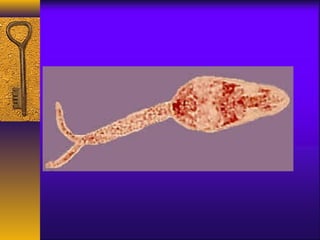
♦ Skin contact with water contaminated by
cercaria
♦ The basic pathologic lesion is the egg
granuloma in the liver and colon
♦ Acute schitosomiasis:fever,enlargement and
tenderness of the liver,eosinophilia,and
dysentery
♦ Chronic schitosomiasis : fibro-obstructive
lesion around the portal vessels
♦ Late stage: giant spleen, ascites, hypertension
of portal venous system
Etiology
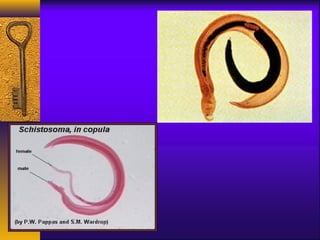
♦ Mature worms: Dioecious
Female :long and thin.
Male:short and thick
♦ Eggs: miracidia in it
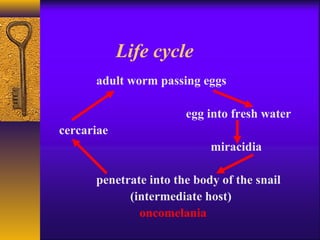
Life cycle
adult worm passing eggs
egg into fresh water
cercariae
miracidia
penetrate into the body of the snail
(intermediate host)
oncomelania
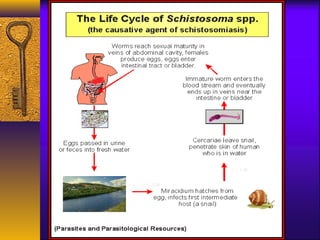
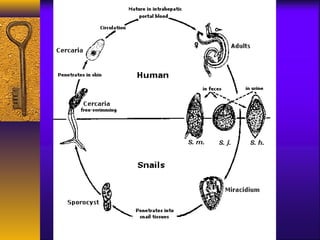
Life Cycle of Schistosoma spp.
25 - 30℃ 毛蚴
7 - 8 周
Epidemiology
♦ Source of infection: humans and mammals
(especially cattle) infected by schistosome
♦ Route of transmission: three major
factors* are responsible for the occurrence
of schistosomiasis
♦ Susceptibility : everyone is susceptive.
Especially peasant and fisherman
Three Major Factors
♦ The method of disposal of human
excreta
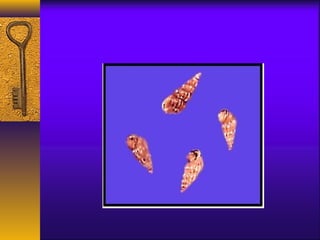
♦ The presence of the snail
intermediate host
♦ The contact with cercaria-infected
water
Pathogenesis
♦ It belong to a kind of allergic
reaction(rapid & delayed)
♦ Formation of granuloma produced by
eggs (Hoeplli sign)
♦ Concomitant immunity
♦ Ectopic lesion (lung & brain)
Pathology
♦ Colon: acute -mucosa congestion,
edema and egg granuloma
chronic-fibro obstructive lesion
♦ Liver: acute -enlargement of the liver
and egg granuloma on it
chronic-portal liver cirrhosis
♦ Other organs: lung and brain, etc
♦ Systemic symptoms:
Clinical
Manifestations
Acute Schistosomiasis
♦ Mainly occurs during July to September
♦ The history of contact with schistosome-
infected water.
♦ Schistosome dermatitis
♦ Incubation period: 23-73 days, average 1
month
Acute Schistosomiasis
♦ Clinical manifestations come out after 4 to 8
weeks of infection, similar to the time from egg
to adult worm (40 days)
♦ Fever: intermittent, maintain weeks to months
♦ Allergic reaction:urticaria, angioneuroedema,
enlargement of lymph nodes and eosinophilia
♦ Digestive syndromes: abdominal pain, diarrhea
with pus and blood, constipation or diarrhea
♦ Hepatosplenomegaly
Chronic Schistosomiasis
♦ Asymptomatic: most person are
asymptomatic
♦ Symptomatic: the most common syndrome
is abdominal pain with intermittent diarrhea.
hepatosplenomegaly
Terminal stage of schistosomiasis
♦ Liver cirrhosis is the prominent syndrome
of this stage
♦ According to the manifestations , it can be
divided into three types:
The type of giant spleen
The type of ascites
The type of dwarf
Ectopic Lesion
♦ Schistosomiasis in lungs:
found in acute schistosomiasis, by egg
deposition. Symptoms are light and signs
are not clear
♦ Schistosomiasis in brain:
Acute type: encephalomeningitis
Chronic type: focal epilepsy
Laboratory Findings
Blood Routine Test
♦ Acute stage :eosinophilia is characteristic
change.WBC raise to 10-30G/L
♦ Chronic stage:eosinophil slightly or
moderate rise
♦ Terminal stage: WBC and platelets are
lower
Liver Function Test
♦ Acute stage: serum globulin rise, ALT
slightly rise
♦ Chronic stage: most patients have a normal
liver function, especially asymptomatic
♦ Terminal stage: serum ALB descend
caused by liver cirrhosis
Stool Test
♦ The discovery of eggs in stool is the evidence of
diagnosis by direct smear or other methods
Imaging test
♦ B-ultrasound: the degree of liver cirrhosis
♦ CT: the image of liver and brain
♦ X-ray: chest; esophagus; and gastrointestinal
tract
Biopsy by Rectal Endoscope
Immunological Test
♦ Intracutaneous test
♦ Circumoval precipition test
♦ ELISA and IHA etc.
♦ Monoclonal antibody technique
Complications
Complications of Liver
Cirrhosis
♦ Varicosity of esophagus-fundus-stomach
♦ Hemorrhage of upper gastrointestinal tract
♦ Hepatic encephalopathy (HE)
♦ Spontaneous bacteria peritonitis (SBP)
Complications of intestinal tract
♦ Appendicitis
♦ Intestinal obstruction and cancroid change
Diagnosis
♦ Epidemiologic date: occupation, history of
travel to endemic area, contact with infected
water
♦ Clinical date:
Acute stage; chronic stage; terminal stage
♦ Laboratory findings:
Blood Rt; characteristic eggs in feces;
biopsy; positive immunological test
Differential Diagnosis
♦ Acute schistosomiasis: typhoid fever; amebic
liver abscess; tubercular peritonitis; miliary
tuberculosis; bacillary dysentery; malaria;etc.
etiology test and X-ray of chest are diagnostic.
♦ Chronic schistosomiasis:anicteric viral
hepatitis;amebic dysentery; chronic bacillary
dysentery;
♦ Terminal schistosomiasis: portal liver cirrhosis
and necrosis liver cirrhosis
Prognosis
♦ Factors affect the prognosis:
The continuance of infection
The last of pathogenesis
The age of the patients
The complications
Treatment
Pathogenic Treatment
♦ Praziquantel is the best choice of drug for the
therapy of schistosomiasis
♦ Dose:
chronic schistosomiasis
10mg/kg, tid. Po, for 2 days, total 60mg/kg
Acute schistosomiasis
10mg/kg,tid. po,for 4 days, total 120mg/kg
♦ Vice reaction: slight and short.
Heteropathy
♦ Acute schistosomiasis: rest, nutrition, and
supportive theraphy. Cortical hormone can
be used in minidose for severe toxic
symptoms.
♦ Terminal schistosomiasis: treated as liver
cirrhosis, and treat for complications
Prevention
♦ Control of the source of infection:
Treat the patients and domestic animal at
the same time.
♦ Cut off the route of transmission:
Snail control
Sanitary disposal of human excreta
♦ Protect of susceptive people:avoid the
contact with schistosome-infected water

Schistosomiasis

  • 1.
  • 2.
    Introduction ♦ Schitosoma japonicuminhabits in the portal venous system ♦ Skin contact with water contaminated by cercaria ♦ The basic pathologic lesion is the egg granuloma in the liver and colon ♦ Acute schitosomiasis:fever,enlargement and tenderness of the liver,eosinophilia,and dysentery ♦ Chronic schitosomiasis : fibro-obstructive lesion around the portal vessels ♦ Late stage: giant spleen, ascites, hypertension of portal venous system
  • 3.
    Etiology ♦ Mature worms:Dioecious Female :long and thin. Male:short and thick ♦ Eggs: miracidia in it
  • 6.
    Life cycle adult wormpassing eggs egg into fresh water cercariae miracidia penetrate into the body of the snail (intermediate host) oncomelania
  • 7.
    Life Cycle ofSchistosoma spp. 25 - 30℃ 毛蚴 7 - 8 周
  • 9.
    Epidemiology ♦ Source ofinfection: humans and mammals (especially cattle) infected by schistosome ♦ Route of transmission: three major factors* are responsible for the occurrence of schistosomiasis ♦ Susceptibility : everyone is susceptive. Especially peasant and fisherman
  • 10.
    Three Major Factors ♦The method of disposal of human excreta ♦ The presence of the snail intermediate host ♦ The contact with cercaria-infected water
  • 12.
    Pathogenesis ♦ It belongto a kind of allergic reaction(rapid & delayed) ♦ Formation of granuloma produced by eggs (Hoeplli sign) ♦ Concomitant immunity ♦ Ectopic lesion (lung & brain)
  • 13.
    Pathology ♦ Colon: acute-mucosa congestion, edema and egg granuloma chronic-fibro obstructive lesion ♦ Liver: acute -enlargement of the liver and egg granuloma on it chronic-portal liver cirrhosis ♦ Other organs: lung and brain, etc ♦ Systemic symptoms:
  • 14.
  • 15.
    Acute Schistosomiasis ♦ Mainlyoccurs during July to September ♦ The history of contact with schistosome- infected water. ♦ Schistosome dermatitis ♦ Incubation period: 23-73 days, average 1 month
  • 16.
    Acute Schistosomiasis ♦ Clinicalmanifestations come out after 4 to 8 weeks of infection, similar to the time from egg to adult worm (40 days) ♦ Fever: intermittent, maintain weeks to months ♦ Allergic reaction:urticaria, angioneuroedema, enlargement of lymph nodes and eosinophilia ♦ Digestive syndromes: abdominal pain, diarrhea with pus and blood, constipation or diarrhea ♦ Hepatosplenomegaly
  • 17.
    Chronic Schistosomiasis ♦ Asymptomatic:most person are asymptomatic ♦ Symptomatic: the most common syndrome is abdominal pain with intermittent diarrhea. hepatosplenomegaly
  • 18.
    Terminal stage ofschistosomiasis ♦ Liver cirrhosis is the prominent syndrome of this stage ♦ According to the manifestations , it can be divided into three types: The type of giant spleen The type of ascites The type of dwarf
  • 19.
    Ectopic Lesion ♦ Schistosomiasisin lungs: found in acute schistosomiasis, by egg deposition. Symptoms are light and signs are not clear ♦ Schistosomiasis in brain: Acute type: encephalomeningitis Chronic type: focal epilepsy
  • 20.
  • 21.
    Blood Routine Test ♦Acute stage :eosinophilia is characteristic change.WBC raise to 10-30G/L ♦ Chronic stage:eosinophil slightly or moderate rise ♦ Terminal stage: WBC and platelets are lower
  • 22.
    Liver Function Test ♦Acute stage: serum globulin rise, ALT slightly rise ♦ Chronic stage: most patients have a normal liver function, especially asymptomatic ♦ Terminal stage: serum ALB descend caused by liver cirrhosis
  • 23.
    Stool Test ♦ Thediscovery of eggs in stool is the evidence of diagnosis by direct smear or other methods Imaging test ♦ B-ultrasound: the degree of liver cirrhosis ♦ CT: the image of liver and brain ♦ X-ray: chest; esophagus; and gastrointestinal tract
  • 24.
    Biopsy by RectalEndoscope Immunological Test ♦ Intracutaneous test ♦ Circumoval precipition test ♦ ELISA and IHA etc. ♦ Monoclonal antibody technique
  • 25.
  • 26.
    Complications of Liver Cirrhosis ♦Varicosity of esophagus-fundus-stomach ♦ Hemorrhage of upper gastrointestinal tract ♦ Hepatic encephalopathy (HE) ♦ Spontaneous bacteria peritonitis (SBP) Complications of intestinal tract ♦ Appendicitis ♦ Intestinal obstruction and cancroid change
  • 27.
    Diagnosis ♦ Epidemiologic date:occupation, history of travel to endemic area, contact with infected water ♦ Clinical date: Acute stage; chronic stage; terminal stage ♦ Laboratory findings: Blood Rt; characteristic eggs in feces; biopsy; positive immunological test
  • 28.
    Differential Diagnosis ♦ Acuteschistosomiasis: typhoid fever; amebic liver abscess; tubercular peritonitis; miliary tuberculosis; bacillary dysentery; malaria;etc. etiology test and X-ray of chest are diagnostic. ♦ Chronic schistosomiasis:anicteric viral hepatitis;amebic dysentery; chronic bacillary dysentery; ♦ Terminal schistosomiasis: portal liver cirrhosis and necrosis liver cirrhosis
  • 29.
    Prognosis ♦ Factors affectthe prognosis: The continuance of infection The last of pathogenesis The age of the patients The complications
  • 30.
  • 31.
    Pathogenic Treatment ♦ Praziquantelis the best choice of drug for the therapy of schistosomiasis ♦ Dose: chronic schistosomiasis 10mg/kg, tid. Po, for 2 days, total 60mg/kg Acute schistosomiasis 10mg/kg,tid. po,for 4 days, total 120mg/kg ♦ Vice reaction: slight and short.
  • 32.
    Heteropathy ♦ Acute schistosomiasis:rest, nutrition, and supportive theraphy. Cortical hormone can be used in minidose for severe toxic symptoms. ♦ Terminal schistosomiasis: treated as liver cirrhosis, and treat for complications
  • 33.
    Prevention ♦ Control ofthe source of infection: Treat the patients and domestic animal at the same time. ♦ Cut off the route of transmission: Snail control Sanitary disposal of human excreta ♦ Protect of susceptive people:avoid the contact with schistosome-infected water