Precision Agriculture 
Past - - - 
- - - Present - - - 
- - - Future 
Dr. Jim Schepers or 
Dr. Dennis Francis 
USDA-Agricultural Research Service 
( both happily retired )
Thanks - - for the invitation to the 2014 
Precision Agriculture National Symposium 
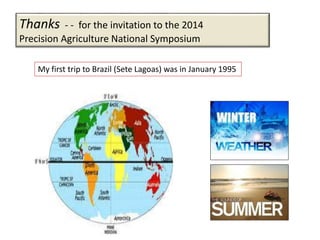
My first trip to Brazil (Sete Lagoas) was in January 1995
Nebraska 
Corn Soybean 
Wheat
Farmers are great observers ! 
BUT 
May not be able to explain 
their observations 
AS SUCH 
Producers welcome scientific information and are eager 
to learn from the discussion
Initial precision agricultural efforts were driven by industry 
Outcome: Spatial variability in crop vigor and yield was only partially removed 
Need: Technologies to quantify yield variability 
• Variable-rate multi-nutrient applications were based on soil testing data 
• GPS was not available 
Six nutrients
Soil Survey 
Bare Soil Image 
Grid Soil Sampling 
(34 samples / ha) 
Computer Generated Management Zones
EM-38 (electro-magnetic induction) 
Proxy for soil electrical conductivity
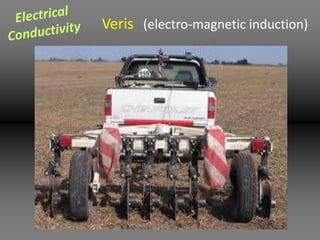
Veris (electro-magnetic induction)
Soil Survey Yield Map 
Electrical 
Conductivity 
2000
Computer Generated Management Zones 
Incorporating. . . 
Bare Soil Image 
Elevation 
Slope 
EM-38
First yield-monitor combines were tested in 1992 
Situation: Required three computers 
• Grain flow 
• Grain moisture 
• GPS (initially scrambled) 
• Yield-monitors are common on new combines 
• Grain protein content monitors are now available 
• Yield maps are not fully utilized
Crop canopy sensor research was initiated in 1993 
Situation: Chlorophyll meters worked well for 
research purposes, but are not practical for 
commercial fields 
Therefore: Need for mobile devices to provide 
information related to crop biomass (size of the 
factory) and canopy chlorophyll content 
(photosynthesis) 
First crop canopy sensors used natural lighting (known as passive sensors) 
Active sensor research initiated in 1999 
Introduced in 1990 
Problems: clouds 
shadows 
changes in brightness during the day 
Attributes: generated modulated light 
no affect of shadows 
operational any time of the day 
can be used to facilitate “on-the-go” nutrient applications
Most individuals agree that - - “seeing is believing”, 
AND 
the human eye is especially sensitive to green colors 
Ultraviolet (UV) Near Infrared (NIR) 
BUT 
Humans cannot see near infrared light, which is reflected by 
living vegetation (also called biomass) 
AS SUCH 
Farmers largely base their assessment of crop vigor on 
“greenness” (related to chlorophyll content and nitrogen status)
Remember - - - - 
Canopy sensors respond to “living biomass” 
and “chlorophyll content” 
Treatments / N-rates 
N Status 
Similar 
Canopy sensors can not quantify excess N 
AND 
Soil background reduces sensitivity
Sensors can be designed to be sensitive to Greenness - 
(i.e., chlorophyll and nitrogen status in most cases) 
AND TO 
near infrared (NIR) light - (“living vegetation” called biomass) 
BASICALLY 
NIR - size of the factory (cumulative indicator of canopy size ) 
(number and size of leaves) 
Chlorophyll - output potential of leaves via photosynthesis 
RESULTING IN 
Yield and potential profitability 
- - - - This why we need to measure chlorophyll and biomass
Crop Circle ACS-430 
or 
AgLeader OptRx
Mexico - White Corn, 2010
Irrigated Corn - Nebraska 
Drop 
Nozzles
Variable-Rate N Injection
Precision Agriculture (Site-Specific Management) is 
not a “one-size-fits-all” proposition or universal 
solution to address spatial variability 
• Different field sizes 
• Different crops 
• Different soils 
• Uncertainty about climate and water availability 
• Spatial variability in nutrient status 
• Availability of field equipment is important 
• Implementation might require technical assistance 
High yields may not be highly correlated with profitability 
Sustainability requires a multi-year analysis
Perceptions - may not be true, but they are “REAL” 
in the minds of individuals 
• I’m too old to learn 
• Too expensive 
• My fields are uniform 
• I’m still farming, so my operation must be sustainable 
• Too much risk 
• I already demonstrate environmental stewardship 
• Technical assistance is not available or is unreliable
Original 4-Rs 
Applied at the field scale - - delineates management zones 
RIGHT - Place 
Rate 
Time 
Form 
How to create a better environment for plants ? 
Consider: compaction 
nutrient placement 
plant competition 
weeds
Proactive - Plan ahead and lock-in decisions 
based on: soil texture and water holding capacity 
nutrient information 
anticipated weather 
yield goal 
Reactive - Monitor weather and crop vigor to make in-season 
adjustments (also called “adaptive management”) 
according to: available soil water 
anticipated weather 
estimated nutrient losses thus far in the season 
crop vigor (sensors or remote sensing) 
changes in yield potential
Potentially 
Useful 
Technologies 
United 
States Brazil 
Variable-rate planting moderate _____ 
Multiple-cultivar planting low _____ 
Variable-rate lime high _____ 
Variable-rate nutrients moderate _____ 
Yield mapping high _____ 
Crop canopy sensors moderate _____ 
Remote sensing moderate _____ 
Climate & growth models ??? _____ 
High-clearance applicators moderate _____ 
Crop consultants moderate ++ _____ 
Auto-guidance high _____
Harnessing Precision Agriculture information is like 
making sausage ! 
Needs multiple ingredients in the right proportions
Precision Agriculture is about innovation and 
thinking outside the box 
How would you connect these nine points with four continuous lines ? 
1 
2 
3 
4 
Think outside the box !
Soil 
Texture 
Landscape 
Position 
Slope 
Soil 
Color 
Elevation 
Productivity
So Much for the Concept of Precision Agriculture 
How did the Embrapa / USDA-ARS partnership come to be ? 
The relationship started in January 1995 - A friend, Walter 
Baethgen, from Uruguay put me in contact with Goncalo 
Franca with Embrapa at Sete Lagoas. 
A graduate student, scientist with Li-Cor, and Jim Schepers tested prototype passive 
sensors with the assistance of Goncalo Franca and Evandro Mantovani (also hosted 
by Bob Schaffert, Antonio Bahia, and Mauricio Lopes). 
Morethson Resende (water management) and Derli Santana (soil classification) 
traveled to Nebraska while on sabbatical leave (1995-1997). 
A team of nine USDA-ARS scientists visited five Embrapa locations in 1996. Precision 
agriculture was identified as a discipline of interest for scientific exchanges. This was 
the beginning of the LABEX program.
LABEX Friends who spent time in Nebraska 
Ariovaldo 
Luchiari 
Moresthon 
Resende 
Ricardo 
Inamasu 
Evandro 
Mantovani 
Others without Pictures 
Scientists Graduate Students 
Goncalo Franca Antonio Coehlo 
Derli Santana Jaoa Camargo Neto 
Frederico Duraes Luciano Shiratsuchi 
Jose Molin Lucas Amaral
Field Researchers - 2000
Ricardo Inamasu 
Examples of imagination, innovation, determination and execution
“It’ cold - like hell - in Nebraska” 
Jim Schepers 
402-310-6150 
james.schepers@gmail.com
Optimizing In-season Nitrogen 
Management 
Dennis D. Francis and James S. Schepers
Early 
Growth 
Rapid 
Growth Maturing 
Late 
Loss 
100 
75 
50 
25 
0 
40% of requirement after silking 
May June July Aug Sept 
Seasonal Nitrogen Uptake, % 
70-80% of requirement after V8 - 10
Early N 
Planting 
In-season N 
V6 V9 Tasseling 
When? 
How much? 
How much early? 
In season? 
Sensor based 
N uptake
Photosynthesis 
Biomass 
Near Infrared 
Wavebands 
(NIR) 
Sensors Measure 
● Disappearance of red light 
● Abundance of reflected NIR 
Chlorophyll 
Chlorophyll captures BLUE and RED light 
Reflects NIR 
Visible 
Wavebands
Normalize Vegetation Index Values to 
remove “field effects” 
Compare all data to “Healthy Plants” that have the same: 
Growth stage 
Cultivar (variety) 
Previous crop 
Water management 
Soil properties - - - except nutrients 
If one assumes all nutrients are adequate except for N, for example : 
---------------------------- 
- Differences in crop vigor are probably related to plant N status -
Common Vegetation Indices 
NDVI = 
NDRE = 
Chl Index = 
Visible / NIR = 
(NIR – Red) 
---------------------------------- 
(NIR + Red) 
(NIR – Red Edge) 
-------------------------------------------------- 
(NIR + Red Edge) 
(NIR – Red) 
----------------------------------------------- 
(Red Edge – Red) 
(Red) 
---------------- 
(NIR) 
(NIR) 
OR - 1 
------------------------------ 
(Red Edge)
Sensors only Measure Bulk Reflectance 
N 
P 
Fe 
- Many factors can influence leaf chlorophyll content -
Algorithm Comparison 
“Why not compare nitrogen recommendations 
using a common data set ?” 
Algorithms have been developed using specific sensors 
that are associated with recommended agronomic 
practices 
• Wave-band differences 
• Reference Strategy (normalization) 
• Opportunity for producer input 
• Preplant N differences 
• Yield (relative, predicted, not used) 
• NUE input 
patents
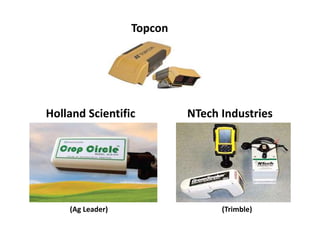
Topcon 
Holland Scientific NTech Industries 
(Ag Leader) (Trimble)
Topcon 
Crop Spec 
Foot-print 
changes 
with plant 
height
Modulation/Demodulation Using 
Polychromatic LEDs 
LED 
TARGET 
PD1 
User Selected 
SENSOR 
PD2 
Filters 
ACS-470 
PD3
Relative “Vigor” 
(i.e., 92% adequate) 
“ Target “ 
Reference “Happy Crop” 
“Managed Crop” = = S I 
• N-rich (highest 3 consecutive seconds) GreenSeeker 
• N-rich (average) Missouri 
• Virtual reference from field with modest preplant N Holland
Reference Value Determination 
Not used “Walk in the field” 
“…we filter off values from an N-rich area that would represent poor 
or no stand and then take the mean of what remained”. (Newell 
Kitchen) 
German 
Missouri 
Oklahoma 
Holland 
“Reference values are tied to the readings we collect from the N-rich 
strip (producers and research). “ (Bill Raun) 
Earlier used highest 3-consecutive second value (30-point running average) 
“Virtual reference” - 95-percentile value (2 Std. Dev. units above 
the mean) for histogram of vegetation index values from field strip 
receiving modest preplant N application. (~1/3 recommended rate) 
“Drive-and-Apply” - Automatically updated virtual reference when starting 
in average to above-average part of the field.
N Credits 
Preplant N 
EONR 
Producer Optimum 
N Accumulation 
(based on growth stage) 
Sufficiency Index 
Back-Off Strategy 
SI to start cutback 
SI to cut-off 
Algorithm 
Spatial 
Soil / Topography 
Adjustment 
14 
12 
10 
8 
6 
4 
2 
0 
0 50 100 150 200 250 300 
Fertilizer N Rate, kg/ha 
Yield, Mg/ha 
Field 
Reference
German Algorithm 
• Producer identifies poor part of the field and assigns the 
desired N rate. 
• Similarly, the producer identifies a good part of the field and 
assigns the preferred N rate. 
• Sensor readings are taken from each area. 
• Linear regression algorithm is developed for variable rate 
application. 
Developed for small grains with multiple applications.
Oklahoma Algorithm 
Assess crop growth and vigor via sensor readings: 
• Record growing degree days (GDD) since planting 
• Calculate potential yield based on NDVI / GDD data vs. yields 
from past years and locations 
• Back calculate the difference in grain N content between 
reference and target plants 
• Adjust for NUE 
New Approach 
• Use reference NDVI and yield data from multiple locations and 
years to generate sigmoid-shaped growth function 
• Predict yield potential from NDVI using sigmoid function
Missouri Algorithm 
Crop Sensor Stage Missouri N rate equation 
Corn GreenSeeker V6-7 (12" to knee high) (220 x ratio*) - 170 
Corn GreenSeeker V8-10 (waist high) (170 x ratio) - 120 
Corn GreenSeeker V11+ (chest high or taller) (160 x ratio) - 130 
Corn Crop Circle 210 V6-7 (330 x ratio) - 270 
Corn Crop Circle 210 V8-10 (250 x ratio) - 200 
Corn Crop Circle 210 V11+ (240 x ratio) - 210 
-------------------- 
*Ratio = (Target visible/near-infrared) / (High-N visible/near-infrared) 
• Calibrated using field studies 
• Minimum N-rate of 30 – 60 lb/acre regardless of sensor reading 
Source: “Managing Nitrogen with Crop Sensors: WHY and HOW” (Scharf) 
“ SI “
Holland / Schepers Algorithm 
Based on the mathematical derivation from an 
N-rate vs. yield response function (quadratic 
component) 
-------------------- 
ΔSI √ Farmer’s optimum rate 
N Rec = (Nopt – Ncredits) x (1 - SI) 
or EONR 
Source: “Derivation of a Variable Rate Nitrogen Application Model for In-Season 
Fertilization of Corn” (Holland and Schepers, Agron. J. 102:1415–1424 (2010)
*Holland-Schepers Generalized N-Rate Model: 
1  
APP i OPT CRD N - N 
S 
N MZ 
I 
S 
I 
   
  
 
 
 
 
 
  
Management Inputs and Credits Sensor Data 
Zone Scaling 
*Reference 
Holland, K. H., & Schepers, J. S. (2010). Derivation of a variable rate nitrogen application model for in-season fertilization of corn. 
Agronomy Journal 102:1415-1424.
Other Features 
German 
Missouri 
Oklahoma 
Holland 
N Cut-Back Yield Management Genetic 
Credits Feature Prediction Zones Potential 
No No No No No 
No No No No No 
No Yes / No Yes No No 
Yes Yes No Yes Yes
Precision Agriculture; Past, present and future

Precision Agriculture; Past, present and future

  • 1.
    Precision Agriculture Past- - - - - - Present - - - - - - Future Dr. Jim Schepers or Dr. Dennis Francis USDA-Agricultural Research Service ( both happily retired )
  • 2.
    Thanks - -for the invitation to the 2014 Precision Agriculture National Symposium My first trip to Brazil (Sete Lagoas) was in January 1995
  • 3.
  • 4.
    Farmers are greatobservers ! BUT May not be able to explain their observations AS SUCH Producers welcome scientific information and are eager to learn from the discussion
  • 5.
    Initial precision agriculturalefforts were driven by industry Outcome: Spatial variability in crop vigor and yield was only partially removed Need: Technologies to quantify yield variability • Variable-rate multi-nutrient applications were based on soil testing data • GPS was not available Six nutrients
  • 6.
    Soil Survey BareSoil Image Grid Soil Sampling (34 samples / ha) Computer Generated Management Zones
  • 7.
    EM-38 (electro-magnetic induction) Proxy for soil electrical conductivity
  • 8.
  • 9.
    Soil Survey YieldMap Electrical Conductivity 2000
  • 10.
    Computer Generated ManagementZones Incorporating. . . Bare Soil Image Elevation Slope EM-38
  • 11.
    First yield-monitor combineswere tested in 1992 Situation: Required three computers • Grain flow • Grain moisture • GPS (initially scrambled) • Yield-monitors are common on new combines • Grain protein content monitors are now available • Yield maps are not fully utilized
  • 12.
    Crop canopy sensorresearch was initiated in 1993 Situation: Chlorophyll meters worked well for research purposes, but are not practical for commercial fields Therefore: Need for mobile devices to provide information related to crop biomass (size of the factory) and canopy chlorophyll content (photosynthesis) First crop canopy sensors used natural lighting (known as passive sensors) Active sensor research initiated in 1999 Introduced in 1990 Problems: clouds shadows changes in brightness during the day Attributes: generated modulated light no affect of shadows operational any time of the day can be used to facilitate “on-the-go” nutrient applications
  • 13.
    Most individuals agreethat - - “seeing is believing”, AND the human eye is especially sensitive to green colors Ultraviolet (UV) Near Infrared (NIR) BUT Humans cannot see near infrared light, which is reflected by living vegetation (also called biomass) AS SUCH Farmers largely base their assessment of crop vigor on “greenness” (related to chlorophyll content and nitrogen status)
  • 14.
    Remember - -- - Canopy sensors respond to “living biomass” and “chlorophyll content” Treatments / N-rates N Status Similar Canopy sensors can not quantify excess N AND Soil background reduces sensitivity
  • 15.
    Sensors can bedesigned to be sensitive to Greenness - (i.e., chlorophyll and nitrogen status in most cases) AND TO near infrared (NIR) light - (“living vegetation” called biomass) BASICALLY NIR - size of the factory (cumulative indicator of canopy size ) (number and size of leaves) Chlorophyll - output potential of leaves via photosynthesis RESULTING IN Yield and potential profitability - - - - This why we need to measure chlorophyll and biomass
  • 16.
    Crop Circle ACS-430 or AgLeader OptRx
  • 17.
    Mexico - WhiteCorn, 2010
  • 18.
    Irrigated Corn -Nebraska Drop Nozzles
  • 19.
  • 20.
    Precision Agriculture (Site-SpecificManagement) is not a “one-size-fits-all” proposition or universal solution to address spatial variability • Different field sizes • Different crops • Different soils • Uncertainty about climate and water availability • Spatial variability in nutrient status • Availability of field equipment is important • Implementation might require technical assistance High yields may not be highly correlated with profitability Sustainability requires a multi-year analysis
  • 21.
    Perceptions - maynot be true, but they are “REAL” in the minds of individuals • I’m too old to learn • Too expensive • My fields are uniform • I’m still farming, so my operation must be sustainable • Too much risk • I already demonstrate environmental stewardship • Technical assistance is not available or is unreliable
  • 22.
    Original 4-Rs Appliedat the field scale - - delineates management zones RIGHT - Place Rate Time Form How to create a better environment for plants ? Consider: compaction nutrient placement plant competition weeds
  • 23.
    Proactive - Planahead and lock-in decisions based on: soil texture and water holding capacity nutrient information anticipated weather yield goal Reactive - Monitor weather and crop vigor to make in-season adjustments (also called “adaptive management”) according to: available soil water anticipated weather estimated nutrient losses thus far in the season crop vigor (sensors or remote sensing) changes in yield potential
  • 24.
    Potentially Useful Technologies United States Brazil Variable-rate planting moderate _____ Multiple-cultivar planting low _____ Variable-rate lime high _____ Variable-rate nutrients moderate _____ Yield mapping high _____ Crop canopy sensors moderate _____ Remote sensing moderate _____ Climate & growth models ??? _____ High-clearance applicators moderate _____ Crop consultants moderate ++ _____ Auto-guidance high _____
  • 25.
    Harnessing Precision Agricultureinformation is like making sausage ! Needs multiple ingredients in the right proportions
  • 26.
    Precision Agriculture isabout innovation and thinking outside the box How would you connect these nine points with four continuous lines ? 1 2 3 4 Think outside the box !
  • 27.
    Soil Texture Landscape Position Slope Soil Color Elevation Productivity
  • 28.
    So Much forthe Concept of Precision Agriculture How did the Embrapa / USDA-ARS partnership come to be ? The relationship started in January 1995 - A friend, Walter Baethgen, from Uruguay put me in contact with Goncalo Franca with Embrapa at Sete Lagoas. A graduate student, scientist with Li-Cor, and Jim Schepers tested prototype passive sensors with the assistance of Goncalo Franca and Evandro Mantovani (also hosted by Bob Schaffert, Antonio Bahia, and Mauricio Lopes). Morethson Resende (water management) and Derli Santana (soil classification) traveled to Nebraska while on sabbatical leave (1995-1997). A team of nine USDA-ARS scientists visited five Embrapa locations in 1996. Precision agriculture was identified as a discipline of interest for scientific exchanges. This was the beginning of the LABEX program.
  • 29.
    LABEX Friends whospent time in Nebraska Ariovaldo Luchiari Moresthon Resende Ricardo Inamasu Evandro Mantovani Others without Pictures Scientists Graduate Students Goncalo Franca Antonio Coehlo Derli Santana Jaoa Camargo Neto Frederico Duraes Luciano Shiratsuchi Jose Molin Lucas Amaral
  • 30.
  • 31.
    Ricardo Inamasu Examplesof imagination, innovation, determination and execution
  • 32.
    “It’ cold -like hell - in Nebraska” Jim Schepers 402-310-6150 james.schepers@gmail.com
  • 33.
    Optimizing In-season Nitrogen Management Dennis D. Francis and James S. Schepers
  • 34.
    Early Growth Rapid Growth Maturing Late Loss 100 75 50 25 0 40% of requirement after silking May June July Aug Sept Seasonal Nitrogen Uptake, % 70-80% of requirement after V8 - 10
  • 35.
    Early N Planting In-season N V6 V9 Tasseling When? How much? How much early? In season? Sensor based N uptake
  • 36.
    Photosynthesis Biomass NearInfrared Wavebands (NIR) Sensors Measure ● Disappearance of red light ● Abundance of reflected NIR Chlorophyll Chlorophyll captures BLUE and RED light Reflects NIR Visible Wavebands
  • 37.
    Normalize Vegetation IndexValues to remove “field effects” Compare all data to “Healthy Plants” that have the same: Growth stage Cultivar (variety) Previous crop Water management Soil properties - - - except nutrients If one assumes all nutrients are adequate except for N, for example : ---------------------------- - Differences in crop vigor are probably related to plant N status -
  • 38.
    Common Vegetation Indices NDVI = NDRE = Chl Index = Visible / NIR = (NIR – Red) ---------------------------------- (NIR + Red) (NIR – Red Edge) -------------------------------------------------- (NIR + Red Edge) (NIR – Red) ----------------------------------------------- (Red Edge – Red) (Red) ---------------- (NIR) (NIR) OR - 1 ------------------------------ (Red Edge)
  • 39.
    Sensors only MeasureBulk Reflectance N P Fe - Many factors can influence leaf chlorophyll content -
  • 40.
    Algorithm Comparison “Whynot compare nitrogen recommendations using a common data set ?” Algorithms have been developed using specific sensors that are associated with recommended agronomic practices • Wave-band differences • Reference Strategy (normalization) • Opportunity for producer input • Preplant N differences • Yield (relative, predicted, not used) • NUE input patents
  • 41.
    Topcon Holland ScientificNTech Industries (Ag Leader) (Trimble)
  • 42.
    Topcon Crop Spec Foot-print changes with plant height
  • 43.
    Modulation/Demodulation Using PolychromaticLEDs LED TARGET PD1 User Selected SENSOR PD2 Filters ACS-470 PD3
  • 44.
    Relative “Vigor” (i.e.,92% adequate) “ Target “ Reference “Happy Crop” “Managed Crop” = = S I • N-rich (highest 3 consecutive seconds) GreenSeeker • N-rich (average) Missouri • Virtual reference from field with modest preplant N Holland
  • 45.
    Reference Value Determination Not used “Walk in the field” “…we filter off values from an N-rich area that would represent poor or no stand and then take the mean of what remained”. (Newell Kitchen) German Missouri Oklahoma Holland “Reference values are tied to the readings we collect from the N-rich strip (producers and research). “ (Bill Raun) Earlier used highest 3-consecutive second value (30-point running average) “Virtual reference” - 95-percentile value (2 Std. Dev. units above the mean) for histogram of vegetation index values from field strip receiving modest preplant N application. (~1/3 recommended rate) “Drive-and-Apply” - Automatically updated virtual reference when starting in average to above-average part of the field.
  • 47.
    N Credits PreplantN EONR Producer Optimum N Accumulation (based on growth stage) Sufficiency Index Back-Off Strategy SI to start cutback SI to cut-off Algorithm Spatial Soil / Topography Adjustment 14 12 10 8 6 4 2 0 0 50 100 150 200 250 300 Fertilizer N Rate, kg/ha Yield, Mg/ha Field Reference
  • 48.
    German Algorithm •Producer identifies poor part of the field and assigns the desired N rate. • Similarly, the producer identifies a good part of the field and assigns the preferred N rate. • Sensor readings are taken from each area. • Linear regression algorithm is developed for variable rate application. Developed for small grains with multiple applications.
  • 49.
    Oklahoma Algorithm Assesscrop growth and vigor via sensor readings: • Record growing degree days (GDD) since planting • Calculate potential yield based on NDVI / GDD data vs. yields from past years and locations • Back calculate the difference in grain N content between reference and target plants • Adjust for NUE New Approach • Use reference NDVI and yield data from multiple locations and years to generate sigmoid-shaped growth function • Predict yield potential from NDVI using sigmoid function
  • 50.
    Missouri Algorithm CropSensor Stage Missouri N rate equation Corn GreenSeeker V6-7 (12" to knee high) (220 x ratio*) - 170 Corn GreenSeeker V8-10 (waist high) (170 x ratio) - 120 Corn GreenSeeker V11+ (chest high or taller) (160 x ratio) - 130 Corn Crop Circle 210 V6-7 (330 x ratio) - 270 Corn Crop Circle 210 V8-10 (250 x ratio) - 200 Corn Crop Circle 210 V11+ (240 x ratio) - 210 -------------------- *Ratio = (Target visible/near-infrared) / (High-N visible/near-infrared) • Calibrated using field studies • Minimum N-rate of 30 – 60 lb/acre regardless of sensor reading Source: “Managing Nitrogen with Crop Sensors: WHY and HOW” (Scharf) “ SI “
  • 51.
    Holland / SchepersAlgorithm Based on the mathematical derivation from an N-rate vs. yield response function (quadratic component) -------------------- ΔSI √ Farmer’s optimum rate N Rec = (Nopt – Ncredits) x (1 - SI) or EONR Source: “Derivation of a Variable Rate Nitrogen Application Model for In-Season Fertilization of Corn” (Holland and Schepers, Agron. J. 102:1415–1424 (2010)
  • 52.
    *Holland-Schepers Generalized N-RateModel: 1  APP i OPT CRD N - N S N MZ I S I             Management Inputs and Credits Sensor Data Zone Scaling *Reference Holland, K. H., & Schepers, J. S. (2010). Derivation of a variable rate nitrogen application model for in-season fertilization of corn. Agronomy Journal 102:1415-1424.
  • 53.
    Other Features German Missouri Oklahoma Holland N Cut-Back Yield Management Genetic Credits Feature Prediction Zones Potential No No No No No No No No No No No Yes / No Yes No No Yes Yes No Yes Yes