Mitglied der Helmholtz-Gemeinschaft 
Institute of Bio- und Geosciences 
IBG-2: Plant Sciences 
Plant Phenotyping 
-a new scientific discipline to quantify plant traits- 
Anke Schickling a.schickling@fz-juelich.de 
November 18, 2014
Forschungszentrum Jülich
Forschungszentrum Jülich 
Budget: 380 Mio. € 
Third party funding: 95 Mio. € (16 Mio. Industry) 
Employees: 4.300 
Scientists: 1.500 
+ 900 guest 
scientists per year 
8.500 patents
Forschungszentrum Jülich 
IBG-2 Plant Sciences 
www.fz-juelich.de/ibg/ibg-2 
150 Employees ● 45 Scientists ● 25 
PhD students 
• Bioeconomy 
• Plant Phenotyping 
• Adaptation to Climate Change 
• Sustainable Bioproduction 
• From basic research to application
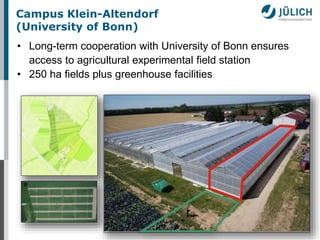
Campus Klein-Altendorf 
(University of Bonn) 
• Long-term cooperation with University of Bonn ensures 
access to agricultural experimental field station 
• 250 ha fields plus greenhouse facilities
Mitglied der Helmholtz-Gemeinschaft 
Phenotyping: 
Why? 
Emerging discipline & 
Scientific challenge
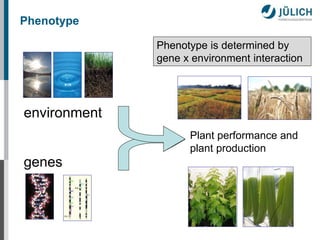
environment 
Plant performance and 
plant production 
genes 
Phenotype is determined by 
gene x environment interaction 
Phenotype
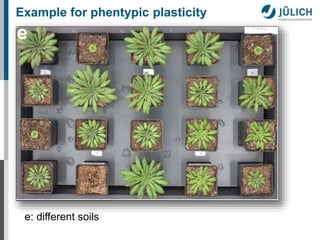
Example for phenotypic plasticity 
a: medium light, moderate water 
b: low light, moderate water 
c: medium light, well watered 
d: low light, well watered
Example for phentypic plasticity 
e: different soils
Example for phentypic plasticity 
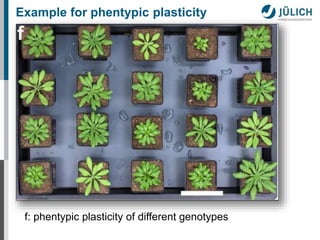
f: phentypic plasticity of different genotypes
Example for phentypic plasticity 
a: medium light, moderate water 
b: low light, moderate water 
c: medium light, well watered 
d: low light, well watered 
e: different soils 
f: different genotypes 
Complex interactions of various 
environmental factors and genetic 
plasticity requires large numbers of 
measurements to understand gene x 
environment interaction 
 Automisation of measurements
Phenotyping: 
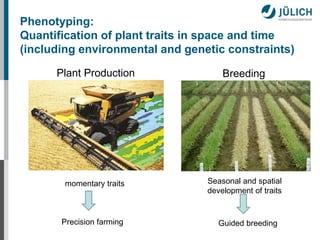
Quantification of plant traits in space and time 
(including environmental and genetic constraints) 
Plant Production 
momentary traits 
Precision farming 
Breeding 
Seasonal and spatial 
development of traits 
Guided breeding
Studying genotype x environment 
interactions: from vision to practice
Quantitative measurement of shoot traits 
Parameters Method Resolution Pros Cons 
Shoot biomass, seedling vigor, color, shape 
RGB Whole organs or 
Rapid measurements, 
descriptors, root architecture, seed morphology 
organ parts; 
affordable solutions 
and surface features, leaf disease assessments 
minutes/days 
Limited physiological 
information 
PSII status, disease severity Fluorescence Whole shoot/ 
leaf tissue; 
minutes /days 
Probe of PSII 
photochemistry in vivo 
Only for rosettes; 
pre-acclimation 
conditions 
Surface temperature Thermal Whole shoot, or 
leaf tissue; time 
series 
minutes/days 
Rapid, potential 
information about leaf 
and canopy 
transpiration 
Sound bio-physical 
interpretation 
required 
Water content, seed composition NIR, 
multispectral 
Time series or 
single time point 
analyses of 
shoots and 
canopies; single 
seeds 
Estimates of biomass 
composition by 
chemometric methods 
Extensive calibration 
required 
Biomass, leaf and canopy water status, disease 
severity, pigment composition 
NIR, multi-hyperspectralt 
hermal 
Vegetation cycles 
outdoor/indoor 
Large amount of 
information 
Cost; illumination 
conditions; large 
image datasets; 
complex data 
interpretation 
Shoot structure , leaf angles distribution, 
canopy structure 
Stereo camera 
systems 
Whole shoots time 
series at various 
resolutions 
High 3D accuracy; shoot 
and canopy models 
Complex data 
reconstruction
Mitglied der Helmholtz-Gemeinschaft 
Automated measurements 
for fast screening: 
Example 1: Automated mapping of rosette 
fluorescence from A. thaliana to better understand 
adaptation of light reactions of photosynthesis
Automation of fluorescence imaging 
technique 
Jansen et al. (2009) Functional Plant 
Biology, 36, 902–914
Automation of fluorescence imaging 
technique 
Automation for fast 
measurement of large 
numbers of phenotypic 
data 
Jansen et al. (2009) Functional Plant 
Biology, 36, 902–914 
Extraction of 
quantitative plant traits: 
‘not only colorful 
pictures’
Automation of fluorescence imaging 
technique 
Three advantages of quantitative phenotyping 
 Extraction of quantitative traits 
 Temporal and spatial dynamics 
 Large number of standardized measurements 
Rascher et al. (2011) Functional Plant 
Biology, 38, 968–983
Automation of fluorescence imaging 
technique
Mitglied der Helmholtz-Gemeinschaft 
Automated measurements 
for fast screening: 
Example 2: Measuring the roots
Phenotyping of roots and shoots 
Shoot traits 
Root traits
GROWSCREEN-RHIZO: a new automated 
system for 2D imaging of roots and shoots 
Nagel et al. Funct Plant Biol (2012)
Measuring the roots
Mitglied der Helmholtz-Gemeinschaft 
Bringing Phenotyping to the 
Field 
Plant Phenotyping where it really matters – 
field / production conditions
Field Phenotyping at Campus Klein- 
Altendorf (University of Bonn) 
 Long-term cooperation with University of Bonn ensures 
access to agricultural experimental field station 
 250 ha fields plus greenhouse facilities
Mini plots for greenhouse and field 
• Large (1 x 0.8 x 0.6 m), mobile pots to cultivate crops under 
controlled and field conditions 
• Greenhouse and outdoor area 
• Automated sensor positioning system 
• RGB-camera, thermography camera, NIR-camera and laser scanner
FieldLift: mobile plattform to lift 
people and sensors 
• Mobile platform with integrated environmental monitoring module 
• Span 8 m – height 1 to 12 m 
• Autonomous electrical power supply
Mitglied der Helmholtz-Gemeinschaft 
Field Phenotyping: 
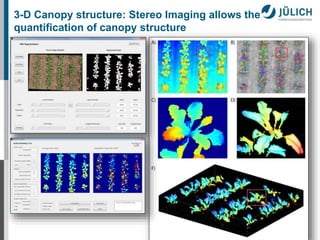
3-D canopy reconstruction to better understand 
the influence of species and nitrogen availability 
on leaf display
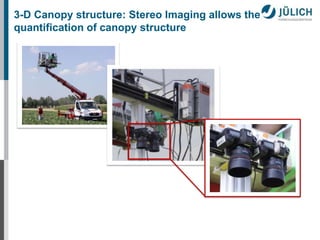
3-D Canopy structure: Stereo Imaging allows the 
quantification of canopy structure
3-D Canopy structure: Stereo Imaging allows the 
quantification of canopy structure
3-D Canopy structure: Stereo Imaging allows the 
quantification of canopy structure 
 Zenith and azimuth of leaves can be quantified. 
 Method is parameterized and established for 
Arabidopsis, sugar beet, barley and apple trees 
Biskup et al. (2007) Plant, Cell & Environ. 30, 1299-1308 
Rascher et al. (2010) Photosynthesis Research 105, 15-25 
Müller-Linow & Rascher (to be submitted) BMC
3-D Canopy structure: Stereo Imaging allows the 
quantification of canopy structure 
 4 varieties of sugar beet show different leaf orientation 
 No nitrogen effect on leaf display
Mitglied der Helmholtz-Gemeinschaft 
Field Phenotyping: 
from airborne platforms
Flying platforms 
Zeppelin 
• Payload up to 5 kg 
• long flying time 
• RGB-camera, thermography 
camera, stereo camera setup and 
hyperspectral camera 
• Sensitive to wind 
Octocopter 
• Payload up to 1 kg 
• 20 min flying time 
• RGB-camera, thermography 
camera, and high-performance 
spectrometer 
• Highly flexible
Field: Phenotyping from flying platforms 
Octocopter 
• Payload up to 1 kg; 20 minutes flying time 
• Different sensors: RGB-camera, thermography camera, and high-performance 
spectrometer 
Burkart et al. (2013) IEEE – Sensors, Sensors-8468-2013.
Time series from experimental plots 
recorded in one vegetation period 
16 m
Optical remote sensing of plants and 
vegetation 
Absorption, transmission 
and reflection of photons is 
primarily determined by 
plant pigments and 
constituents
Field: Phenotyping from flying platforms 
 HyPlant: a novel high performance spectrometer to 
measure sun-induced chlorophyll fluorescence 
First flight campaign 
of HyPlant in 
September 2012. 
Flight data after 3 
years of development
Field: Phenotyping from flying platforms 
Flight of HyPlant in June 2014: 
Different barley varieties in the same 
environmental conditions
Field phenotyping within LABEX-GIB 
LABEX contract signed October 2012 
Topics 
• Bioeconomy 
• Adaptation to Climate Change 
• Integrated Systems of Bioproduction 
• Sustainable use of resources in agro-systems 
• Phenotyping 
• Bioinformatics 
Specific projects 
• Field Phenotyping including campaign activities – a large 
international airborne campaign 2015/2016 
• Development of IPPN with Brazil as partner
Mitglied der Helmholtz-Gemeinschaft 
Thank you for your attention!

Plant Phenotyping, a new scientific discipline to quantify plant traits

  • 1.
    Mitglied der Helmholtz-Gemeinschaft Institute of Bio- und Geosciences IBG-2: Plant Sciences Plant Phenotyping -a new scientific discipline to quantify plant traits- Anke Schickling a.schickling@fz-juelich.de November 18, 2014
  • 2.
  • 3.
    Forschungszentrum Jülich Budget:380 Mio. € Third party funding: 95 Mio. € (16 Mio. Industry) Employees: 4.300 Scientists: 1.500 + 900 guest scientists per year 8.500 patents
  • 4.
    Forschungszentrum Jülich IBG-2Plant Sciences www.fz-juelich.de/ibg/ibg-2 150 Employees ● 45 Scientists ● 25 PhD students • Bioeconomy • Plant Phenotyping • Adaptation to Climate Change • Sustainable Bioproduction • From basic research to application
  • 5.
    Campus Klein-Altendorf (Universityof Bonn) • Long-term cooperation with University of Bonn ensures access to agricultural experimental field station • 250 ha fields plus greenhouse facilities
  • 6.
    Mitglied der Helmholtz-Gemeinschaft Phenotyping: Why? Emerging discipline & Scientific challenge
  • 7.
    environment Plant performanceand plant production genes Phenotype is determined by gene x environment interaction Phenotype
  • 8.
    Example for phenotypicplasticity a: medium light, moderate water b: low light, moderate water c: medium light, well watered d: low light, well watered
  • 9.
    Example for phentypicplasticity e: different soils
  • 10.
    Example for phentypicplasticity f: phentypic plasticity of different genotypes
  • 11.
    Example for phentypicplasticity a: medium light, moderate water b: low light, moderate water c: medium light, well watered d: low light, well watered e: different soils f: different genotypes Complex interactions of various environmental factors and genetic plasticity requires large numbers of measurements to understand gene x environment interaction  Automisation of measurements
  • 12.
    Phenotyping: Quantification ofplant traits in space and time (including environmental and genetic constraints) Plant Production momentary traits Precision farming Breeding Seasonal and spatial development of traits Guided breeding
  • 13.
    Studying genotype xenvironment interactions: from vision to practice
  • 14.
    Quantitative measurement ofshoot traits Parameters Method Resolution Pros Cons Shoot biomass, seedling vigor, color, shape RGB Whole organs or Rapid measurements, descriptors, root architecture, seed morphology organ parts; affordable solutions and surface features, leaf disease assessments minutes/days Limited physiological information PSII status, disease severity Fluorescence Whole shoot/ leaf tissue; minutes /days Probe of PSII photochemistry in vivo Only for rosettes; pre-acclimation conditions Surface temperature Thermal Whole shoot, or leaf tissue; time series minutes/days Rapid, potential information about leaf and canopy transpiration Sound bio-physical interpretation required Water content, seed composition NIR, multispectral Time series or single time point analyses of shoots and canopies; single seeds Estimates of biomass composition by chemometric methods Extensive calibration required Biomass, leaf and canopy water status, disease severity, pigment composition NIR, multi-hyperspectralt hermal Vegetation cycles outdoor/indoor Large amount of information Cost; illumination conditions; large image datasets; complex data interpretation Shoot structure , leaf angles distribution, canopy structure Stereo camera systems Whole shoots time series at various resolutions High 3D accuracy; shoot and canopy models Complex data reconstruction
  • 15.
    Mitglied der Helmholtz-Gemeinschaft Automated measurements for fast screening: Example 1: Automated mapping of rosette fluorescence from A. thaliana to better understand adaptation of light reactions of photosynthesis
  • 16.
    Automation of fluorescenceimaging technique Jansen et al. (2009) Functional Plant Biology, 36, 902–914
  • 17.
    Automation of fluorescenceimaging technique Automation for fast measurement of large numbers of phenotypic data Jansen et al. (2009) Functional Plant Biology, 36, 902–914 Extraction of quantitative plant traits: ‘not only colorful pictures’
  • 18.
    Automation of fluorescenceimaging technique Three advantages of quantitative phenotyping  Extraction of quantitative traits  Temporal and spatial dynamics  Large number of standardized measurements Rascher et al. (2011) Functional Plant Biology, 38, 968–983
  • 19.
    Automation of fluorescenceimaging technique
  • 20.
    Mitglied der Helmholtz-Gemeinschaft Automated measurements for fast screening: Example 2: Measuring the roots
  • 21.
    Phenotyping of rootsand shoots Shoot traits Root traits
  • 22.
    GROWSCREEN-RHIZO: a newautomated system for 2D imaging of roots and shoots Nagel et al. Funct Plant Biol (2012)
  • 23.
  • 24.
    Mitglied der Helmholtz-Gemeinschaft Bringing Phenotyping to the Field Plant Phenotyping where it really matters – field / production conditions
  • 25.
    Field Phenotyping atCampus Klein- Altendorf (University of Bonn)  Long-term cooperation with University of Bonn ensures access to agricultural experimental field station  250 ha fields plus greenhouse facilities
  • 26.
    Mini plots forgreenhouse and field • Large (1 x 0.8 x 0.6 m), mobile pots to cultivate crops under controlled and field conditions • Greenhouse and outdoor area • Automated sensor positioning system • RGB-camera, thermography camera, NIR-camera and laser scanner
  • 27.
    FieldLift: mobile plattformto lift people and sensors • Mobile platform with integrated environmental monitoring module • Span 8 m – height 1 to 12 m • Autonomous electrical power supply
  • 28.
    Mitglied der Helmholtz-Gemeinschaft Field Phenotyping: 3-D canopy reconstruction to better understand the influence of species and nitrogen availability on leaf display
  • 29.
    3-D Canopy structure:Stereo Imaging allows the quantification of canopy structure
  • 30.
    3-D Canopy structure:Stereo Imaging allows the quantification of canopy structure
  • 31.
    3-D Canopy structure:Stereo Imaging allows the quantification of canopy structure  Zenith and azimuth of leaves can be quantified.  Method is parameterized and established for Arabidopsis, sugar beet, barley and apple trees Biskup et al. (2007) Plant, Cell & Environ. 30, 1299-1308 Rascher et al. (2010) Photosynthesis Research 105, 15-25 Müller-Linow & Rascher (to be submitted) BMC
  • 32.
    3-D Canopy structure:Stereo Imaging allows the quantification of canopy structure  4 varieties of sugar beet show different leaf orientation  No nitrogen effect on leaf display
  • 33.
    Mitglied der Helmholtz-Gemeinschaft Field Phenotyping: from airborne platforms
  • 34.
    Flying platforms Zeppelin • Payload up to 5 kg • long flying time • RGB-camera, thermography camera, stereo camera setup and hyperspectral camera • Sensitive to wind Octocopter • Payload up to 1 kg • 20 min flying time • RGB-camera, thermography camera, and high-performance spectrometer • Highly flexible
  • 35.
    Field: Phenotyping fromflying platforms Octocopter • Payload up to 1 kg; 20 minutes flying time • Different sensors: RGB-camera, thermography camera, and high-performance spectrometer Burkart et al. (2013) IEEE – Sensors, Sensors-8468-2013.
  • 36.
    Time series fromexperimental plots recorded in one vegetation period 16 m
  • 38.
    Optical remote sensingof plants and vegetation Absorption, transmission and reflection of photons is primarily determined by plant pigments and constituents
  • 39.
    Field: Phenotyping fromflying platforms  HyPlant: a novel high performance spectrometer to measure sun-induced chlorophyll fluorescence First flight campaign of HyPlant in September 2012. Flight data after 3 years of development
  • 40.
    Field: Phenotyping fromflying platforms Flight of HyPlant in June 2014: Different barley varieties in the same environmental conditions
  • 41.
    Field phenotyping withinLABEX-GIB LABEX contract signed October 2012 Topics • Bioeconomy • Adaptation to Climate Change • Integrated Systems of Bioproduction • Sustainable use of resources in agro-systems • Phenotyping • Bioinformatics Specific projects • Field Phenotyping including campaign activities – a large international airborne campaign 2015/2016 • Development of IPPN with Brazil as partner
  • 42.
    Mitglied der Helmholtz-Gemeinschaft Thank you for your attention!