Measuring and Estimating N
Levels in the Crop Canopy
Olga Walsh, PhD
Cropping Systems Agronomist & Extension Specialist
University of Idaho, Parma Research & Extension Center
FWAA Winter Conference, Boise, ID
January 12, 2017
BS Soil Sci: St Petersburg Russia – 1997; MS Soil Sci – 2007 and
PhD Soil Sci- 2009, OSU, Stillwater, OK;
Soil Nutrient Management - Montana State Univ - 2010 – 2014
Cropping Systems Agronomist, Univ Idaho – from 2014
Presentation Outline:
1. Nitrogen (N) role in plants
2. Plant N content
4. Measurement vs estimation
5. Measuring N: plant tissue testing
6. Estimating N: chlorophyll meters &
charts
7. Estimating N: crop sensors
8. Using UAVs (Drones)
Nitrogen role in plants
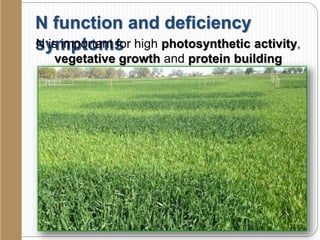
N function and deficiency
symptomsN is important for high photosynthetic activity,
vegetative growth and protein building
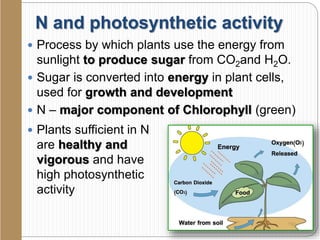
N and photosynthetic activity
 Process by which plants use the energy from
sunlight to produce sugar from CO2and H2O.
 Sugar is converted into energy in plant cells,
used for growth and development
 N – major component of Chlorophyll (green)
 Plants sufficient in N
are healthy and
vigorous and have
high photosynthetic
activity
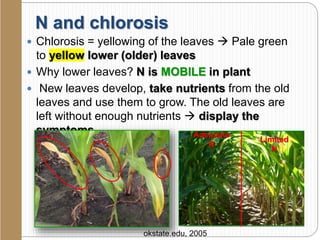
 Chlorosis = yellowing of the leaves  Pale green
to yellow lower (older) leaves
 Why lower leaves? N is MOBILE in plant
 New leaves develop, take nutrients from the old
leaves and use them to grow. The old leaves are
left without enough nutrients  display the
symptoms.
N and chlorosis
Adequate
N
Limited
N
okstate.edu, 2005
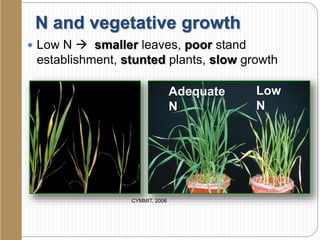
N and vegetative growth
 Low N  smaller leaves, poor stand
establishment, stunted plants, slow growth
CYMMIT, 2006
Low
N
Adequate
N
N and vegetative growth
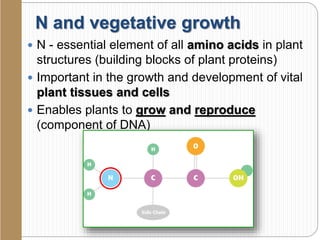
 N - essential element of all amino acids in plant
structures (building blocks of plant proteins)
 Important in the growth and development of vital
plant tissues and cells
 Enables plants to grow and reproduce
(component of DNA)
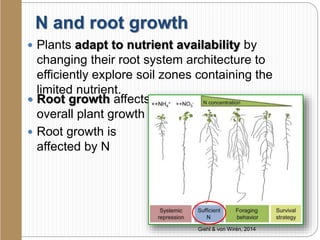
N and root growth
 Plants adapt to nutrient availability by
changing their root system architecture to
efficiently explore soil zones containing the
limited nutrient.
 Root growth affects
overall plant growth
 Root growth is
affected by N
Giehl & von Wirén, 2014
Plant N content
Plant N content
 Healthy plants often contain 3 to 4 % of N in
above-ground tissues.
 This is a much higher concentration compared
to other nutrients.
 N content is an important characteristic often
used for evaluation of crop health and nutrient
status.
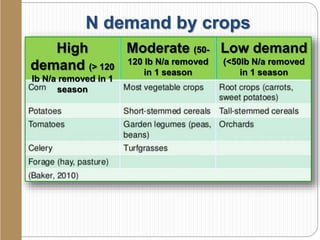
N demand by crops
High
demand (> 120
lb N/a removed in 1
season
Moderate (50-
120 lb N/a removed
in 1 season
Low demand
(<50lb N/a removed
in 1 season
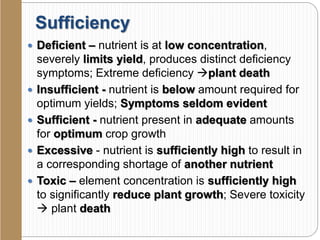
Sufficiency
 Deficient – nutrient is at low concentration,
severely limits yield, produces distinct deficiency
symptoms; Extreme deficiency plant death
 Insufficient - nutrient is below amount required for
optimum yields; Symptoms seldom evident
 Sufficient - nutrient present in adequate amounts
for optimum crop growth
 Excessive - nutrient is sufficiently high to result in
a corresponding shortage of another nutrient
 Toxic – element concentration is sufficiently high
to significantly reduce plant growth; Severe toxicity
 plant death
Measuring vs estimation
Measurement vs Estimation
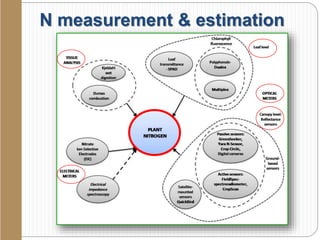
 Several methods are available for direct
measurement and indirect estimation of N
content in plant biomass.
 Direct = measuring exactly the thing that
you're looking to measure
 Indirect = measuring something by
measuring something else
N measurement & estimation
Measuring N:
Plant tissue analysis
(potato petioles)
Plant tissue analysis
 Directly measures nutrient levels in the plant
 The supply of available nutrients is reflected in plant
nutrient content
 Use of plant tissue analysis allows producers to
evaluate the effectiveness of fertilizer
management
 N taken up by potatoes can be detected in petiole
nitrate analysis within 3-4 days after fertilizer
application
 Indicates the N status of the plant in the past 2-3
days, very good tool for in- season N decisions
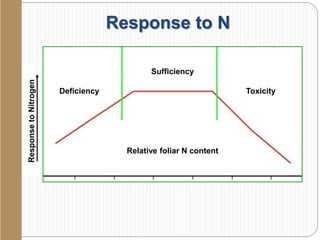
Response to NResponsetoNitrogen
Deficiency
Sufficiency
Toxicity
Relative foliar N content
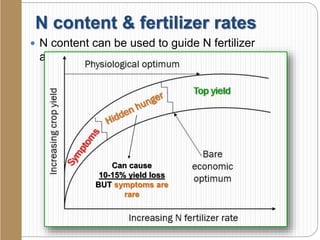
N content & fertilizer rates
 N content can be used to guide N fertilizer
applications
Increasing N fertilizer rate
Increasingcropyield Physiological optimum
Top yield
Bare
economic
optimum
Can cause
10-15% yield loss
BUT symptoms are
rare
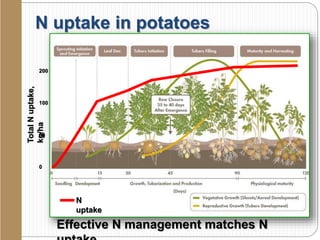
N uptake in potatoesTotalNuptake,
kg/ha
200
100
50
0
N
uptake
Effective N management matches N
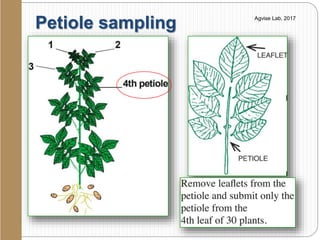
Petiole sampling Agvise Lab, 2017
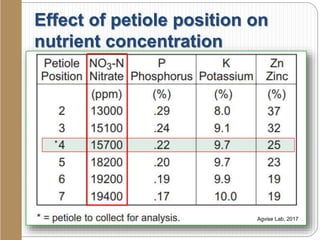
Effect of petiole position on
nutrient concentration
Agvise Lab, 2017
Petiole N – lab test
• Petiole samples tested each week help
determine the current nitrogen status of the
potato crop
• N in the form of nitrate (NO3-N) is extracted
from potato leaf petioles with 2% acetic acid
(at room temperature) and analyzed by flow
injection
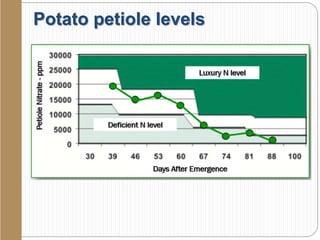
Potato petiole levels
Potato petiole sampling
 Early in the season - petiole nitrate levels are
expected to be high (20,000 - 30,000 ppm)
 During rapid vegetative growth & beginning of
tuber bulking - petiole levels are expected to
drop
 If temp warms up quickly after cool period –
explosive rapid vine growth  drop in petiole N
levels to 5000 ppm or lower = dilution of the
nitrate in the potato petiole, BUT the canopy
can look lush and green
 Apply more N? - If the total soil N >60 lb/a  No
need to additional N fertilizer
Estimating N:
Chlorophyll meters &
Leaf color charts
Chlorophyll & Plant N
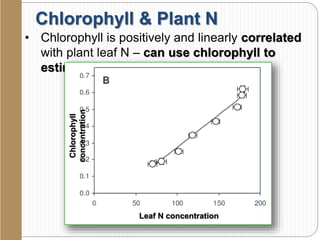
• Chlorophyll is positively and linearly correlated
with plant leaf N – can use chlorophyll to
estimate NChlorophyll
concentration
Leaf N concentration
How Chlorophyll meters work
 The meter measures the ratio of radiation
transmittance from two wavelengths:
 red……..strongly absorbed by chlorophyll,
and
 near infrared……..not absorbed by
chlorophyll
 Meters expose a portion of a leaf to
abundant light and measure how much was
NOT captured by chlorophyll in the
photosynthetic process
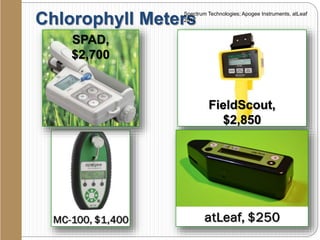
Chlorophyll Meters
FieldScout,
$2,850
Spectrum Technologies; Apogee Instruments, atLeaf
2017
SPAD,
$2,700
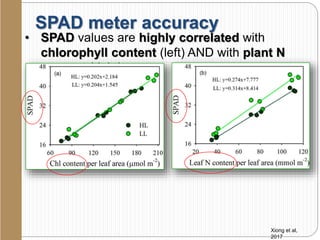
SPAD meter accuracy
Xiong et al,
2017
• SPAD values are highly correlated with
chlorophyll content (left) AND with plant N
content (right)
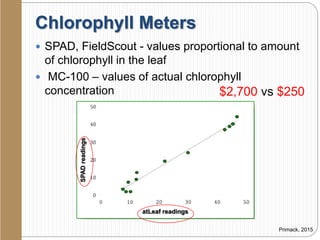
Chlorophyll Meters
 SPAD, FieldScout - values proportional to amount
of chlorophyll in the leaf
 MC-100 – values of actual chlorophyll
concentration
Primack, 2015
atLeaf readings
SPADreadings
$2,700 vs $250
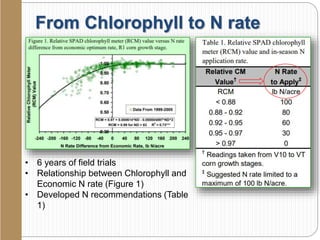
From Chlorophyll to N rate
• 6 years of field trials
• Relationship between Chlorophyll and
Economic N rate (Figure 1)
• Developed N recommendations (Table
1)
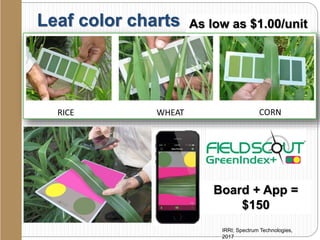
Leaf color charts
Board + App =
$150
IRRI; Spectrum Technologies,
2017
As low as $1.00/unit
Estimating N:
Crop Sensors
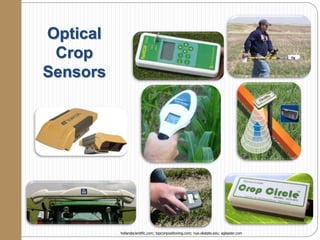
Optical
Crop
Sensors
hollandscientific.com; topconpositioning.com; nue.okstate.edu; agleader.com
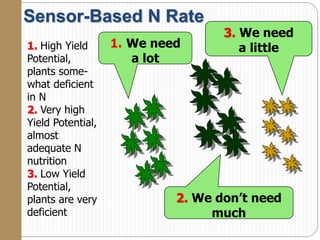
Sensor-Based N Rate
1. We need
a lot
2. We don’t need
much
3. We need
a little1. High Yield
Potential,
plants some-
what deficient
in N
2. Very high
Yield Potential,
almost
adequate N
nutrition
3. Low Yield
Potential,
plants are very
deficient
Sensor Basics
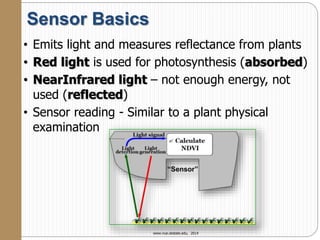
• Emits light and measures reflectance from plants
• Red light is used for photosynthesis (absorbed)
• NearInfrared light – not enough energy, not
used (reflected)
• Sensor reading - Similar to a plant physical
examination
www.nue.okstate.edu, 2014
Sensor Basics
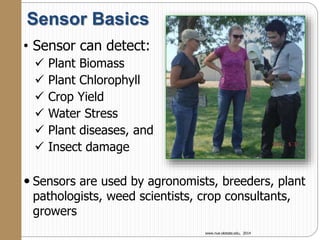
• Sensor can detect:
 Plant Biomass
 Plant Chlorophyll
 Crop Yield
 Water Stress
 Plant diseases, and
 Insect damage
 Sensors are used by agronomists, breeders, plant
pathologists, weed scientists, crop consultants,
growers
www.nue.okstate.edu, 2014
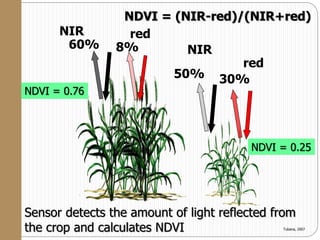
red
redNIR
NIR
30%50%
60% 8%
NDVI = (NIR-red)/(NIR+red)
Sensor detects the amount of light reflected from
the crop and calculates NDVI Tubana, 2007
NDVI = 0.76
NDVI = 0.25
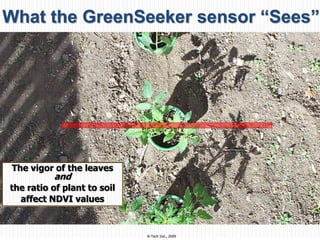
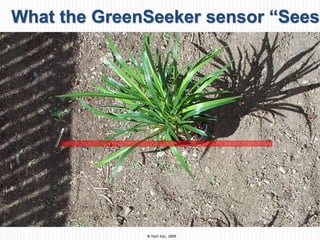
What the GreenSeeker sensor “Sees”
The vigor of the leaves
and
the ratio of plant to soil
affect NDVI values
N-Tech Ind., 2009
N-Tech Ind., 2009
What the GreenSeeker sensor “Sees”
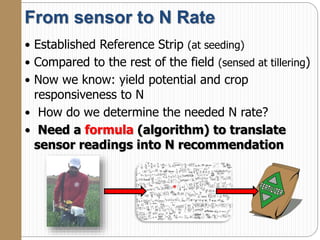
From sensor to N Rate
 Established Reference Strip (at seeding)
 Compared to the rest of the field (sensed at tillering)
 Now we know: yield potential and crop
responsiveness to N
 How do we determine the needed N rate?
 Need a formula (algorithm) to translate
sensor readings into N recommendation
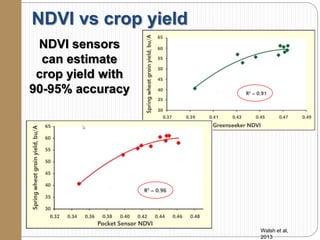
NDVI vs crop yield
NDVI sensors
can estimate
crop yield with
90-95% accuracy
Walsh et al,
2013
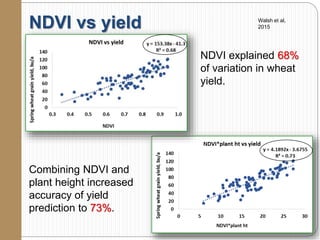
NDVI vs yield
NDVI explained 68%
of variation in wheat
yield.
Combining NDVI and
plant height increased
accuracy of yield
prediction to 73%.
Walsh et al,
2015
Using UAVs (Drones)
DRONE STUDY - Objectives
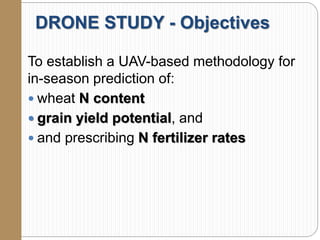
To establish a UAV-based methodology for
in-season prediction of:
 wheat N content
 grain yield potential, and
 and prescribing N fertilizer rates
Drone Study
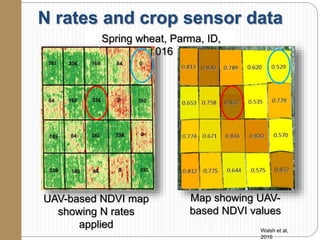
N rates and crop sensor data
UAV-based NDVI map
showing N rates
applied
Map showing UAV-
based NDVI values
Walsh et al,
2016
Spring wheat, Parma, ID,
2016
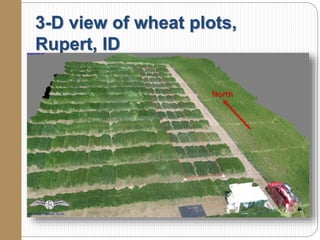
3-D view of wheat plots,
Rupert, ID
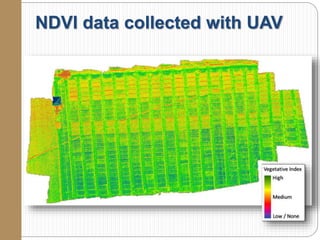
NDVI data collected with UAV
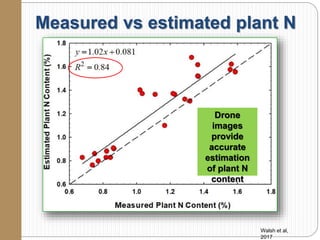
Measured vs estimated plant N
Walsh et al,
2017
Drone
images
provide
accurate
estimation
of plant N
content
Thank you!
Questions?
Olga Walsh
owalsh@uidaho.edu
University of Idaho, Parma R&E Center
Tel: (208)722-6701
Web: IDCrops
(http://idcrops.blogspot.com/) Twitter:
@IDCrops

Fwaa jan 12 2017 n content

  • 1.
    Measuring and EstimatingN Levels in the Crop Canopy Olga Walsh, PhD Cropping Systems Agronomist & Extension Specialist University of Idaho, Parma Research & Extension Center FWAA Winter Conference, Boise, ID January 12, 2017
  • 2.
    BS Soil Sci:St Petersburg Russia – 1997; MS Soil Sci – 2007 and PhD Soil Sci- 2009, OSU, Stillwater, OK; Soil Nutrient Management - Montana State Univ - 2010 – 2014 Cropping Systems Agronomist, Univ Idaho – from 2014
  • 3.
    Presentation Outline: 1. Nitrogen(N) role in plants 2. Plant N content 4. Measurement vs estimation 5. Measuring N: plant tissue testing 6. Estimating N: chlorophyll meters & charts 7. Estimating N: crop sensors 8. Using UAVs (Drones)
  • 4.
  • 5.
    N function anddeficiency symptomsN is important for high photosynthetic activity, vegetative growth and protein building
  • 6.
    N and photosyntheticactivity  Process by which plants use the energy from sunlight to produce sugar from CO2and H2O.  Sugar is converted into energy in plant cells, used for growth and development  N – major component of Chlorophyll (green)  Plants sufficient in N are healthy and vigorous and have high photosynthetic activity
  • 7.
     Chlorosis =yellowing of the leaves  Pale green to yellow lower (older) leaves  Why lower leaves? N is MOBILE in plant  New leaves develop, take nutrients from the old leaves and use them to grow. The old leaves are left without enough nutrients  display the symptoms. N and chlorosis Adequate N Limited N okstate.edu, 2005
  • 8.
    N and vegetativegrowth  Low N  smaller leaves, poor stand establishment, stunted plants, slow growth CYMMIT, 2006 Low N Adequate N
  • 9.
    N and vegetativegrowth  N - essential element of all amino acids in plant structures (building blocks of plant proteins)  Important in the growth and development of vital plant tissues and cells  Enables plants to grow and reproduce (component of DNA)
  • 10.
    N and rootgrowth  Plants adapt to nutrient availability by changing their root system architecture to efficiently explore soil zones containing the limited nutrient.  Root growth affects overall plant growth  Root growth is affected by N Giehl & von Wirén, 2014
  • 11.
  • 12.
    Plant N content Healthy plants often contain 3 to 4 % of N in above-ground tissues.  This is a much higher concentration compared to other nutrients.  N content is an important characteristic often used for evaluation of crop health and nutrient status.
  • 13.
    N demand bycrops High demand (> 120 lb N/a removed in 1 season Moderate (50- 120 lb N/a removed in 1 season Low demand (<50lb N/a removed in 1 season
  • 14.
    Sufficiency  Deficient –nutrient is at low concentration, severely limits yield, produces distinct deficiency symptoms; Extreme deficiency plant death  Insufficient - nutrient is below amount required for optimum yields; Symptoms seldom evident  Sufficient - nutrient present in adequate amounts for optimum crop growth  Excessive - nutrient is sufficiently high to result in a corresponding shortage of another nutrient  Toxic – element concentration is sufficiently high to significantly reduce plant growth; Severe toxicity  plant death
  • 15.
  • 16.
    Measurement vs Estimation Several methods are available for direct measurement and indirect estimation of N content in plant biomass.  Direct = measuring exactly the thing that you're looking to measure  Indirect = measuring something by measuring something else
  • 17.
    N measurement &estimation
  • 18.
    Measuring N: Plant tissueanalysis (potato petioles)
  • 19.
    Plant tissue analysis Directly measures nutrient levels in the plant  The supply of available nutrients is reflected in plant nutrient content  Use of plant tissue analysis allows producers to evaluate the effectiveness of fertilizer management  N taken up by potatoes can be detected in petiole nitrate analysis within 3-4 days after fertilizer application  Indicates the N status of the plant in the past 2-3 days, very good tool for in- season N decisions
  • 20.
  • 21.
    N content &fertilizer rates  N content can be used to guide N fertilizer applications Increasing N fertilizer rate Increasingcropyield Physiological optimum Top yield Bare economic optimum Can cause 10-15% yield loss BUT symptoms are rare
  • 22.
    N uptake inpotatoesTotalNuptake, kg/ha 200 100 50 0 N uptake Effective N management matches N
  • 23.
  • 24.
    Effect of petioleposition on nutrient concentration Agvise Lab, 2017
  • 25.
    Petiole N –lab test • Petiole samples tested each week help determine the current nitrogen status of the potato crop • N in the form of nitrate (NO3-N) is extracted from potato leaf petioles with 2% acetic acid (at room temperature) and analyzed by flow injection
  • 27.
  • 28.
    Potato petiole sampling Early in the season - petiole nitrate levels are expected to be high (20,000 - 30,000 ppm)  During rapid vegetative growth & beginning of tuber bulking - petiole levels are expected to drop  If temp warms up quickly after cool period – explosive rapid vine growth  drop in petiole N levels to 5000 ppm or lower = dilution of the nitrate in the potato petiole, BUT the canopy can look lush and green  Apply more N? - If the total soil N >60 lb/a  No need to additional N fertilizer
  • 29.
  • 30.
    Chlorophyll & PlantN • Chlorophyll is positively and linearly correlated with plant leaf N – can use chlorophyll to estimate NChlorophyll concentration Leaf N concentration
  • 31.
    How Chlorophyll meterswork  The meter measures the ratio of radiation transmittance from two wavelengths:  red……..strongly absorbed by chlorophyll, and  near infrared……..not absorbed by chlorophyll  Meters expose a portion of a leaf to abundant light and measure how much was NOT captured by chlorophyll in the photosynthetic process
  • 32.
    Chlorophyll Meters FieldScout, $2,850 Spectrum Technologies;Apogee Instruments, atLeaf 2017 SPAD, $2,700
  • 33.
    SPAD meter accuracy Xionget al, 2017 • SPAD values are highly correlated with chlorophyll content (left) AND with plant N content (right)
  • 34.
    Chlorophyll Meters  SPAD,FieldScout - values proportional to amount of chlorophyll in the leaf  MC-100 – values of actual chlorophyll concentration Primack, 2015 atLeaf readings SPADreadings $2,700 vs $250
  • 35.
    From Chlorophyll toN rate • 6 years of field trials • Relationship between Chlorophyll and Economic N rate (Figure 1) • Developed N recommendations (Table 1)
  • 36.
    Leaf color charts Board+ App = $150 IRRI; Spectrum Technologies, 2017 As low as $1.00/unit
  • 37.
  • 38.
  • 39.
    Sensor-Based N Rate 1.We need a lot 2. We don’t need much 3. We need a little1. High Yield Potential, plants some- what deficient in N 2. Very high Yield Potential, almost adequate N nutrition 3. Low Yield Potential, plants are very deficient
  • 40.
    Sensor Basics • Emitslight and measures reflectance from plants • Red light is used for photosynthesis (absorbed) • NearInfrared light – not enough energy, not used (reflected) • Sensor reading - Similar to a plant physical examination www.nue.okstate.edu, 2014
  • 41.
    Sensor Basics • Sensorcan detect:  Plant Biomass  Plant Chlorophyll  Crop Yield  Water Stress  Plant diseases, and  Insect damage  Sensors are used by agronomists, breeders, plant pathologists, weed scientists, crop consultants, growers www.nue.okstate.edu, 2014
  • 42.
    red redNIR NIR 30%50% 60% 8% NDVI =(NIR-red)/(NIR+red) Sensor detects the amount of light reflected from the crop and calculates NDVI Tubana, 2007 NDVI = 0.76 NDVI = 0.25
  • 43.
    What the GreenSeekersensor “Sees” The vigor of the leaves and the ratio of plant to soil affect NDVI values N-Tech Ind., 2009
  • 44.
    N-Tech Ind., 2009 Whatthe GreenSeeker sensor “Sees”
  • 45.
    From sensor toN Rate  Established Reference Strip (at seeding)  Compared to the rest of the field (sensed at tillering)  Now we know: yield potential and crop responsiveness to N  How do we determine the needed N rate?  Need a formula (algorithm) to translate sensor readings into N recommendation
  • 46.
    NDVI vs cropyield NDVI sensors can estimate crop yield with 90-95% accuracy Walsh et al, 2013
  • 47.
    NDVI vs yield NDVIexplained 68% of variation in wheat yield. Combining NDVI and plant height increased accuracy of yield prediction to 73%. Walsh et al, 2015
  • 48.
  • 49.
    DRONE STUDY -Objectives To establish a UAV-based methodology for in-season prediction of:  wheat N content  grain yield potential, and  and prescribing N fertilizer rates
  • 50.
  • 51.
    N rates andcrop sensor data UAV-based NDVI map showing N rates applied Map showing UAV- based NDVI values Walsh et al, 2016 Spring wheat, Parma, ID, 2016
  • 52.
    3-D view ofwheat plots, Rupert, ID
  • 53.
  • 54.
    Measured vs estimatedplant N Walsh et al, 2017 Drone images provide accurate estimation of plant N content
  • 55.
    Thank you! Questions? Olga Walsh owalsh@uidaho.edu Universityof Idaho, Parma R&E Center Tel: (208)722-6701 Web: IDCrops (http://idcrops.blogspot.com/) Twitter: @IDCrops