Welcome
PRECISION FARMING
ARUN KUMAR ,M . R.
PAMM 1014
M.Sc. Agri (Agronomy)
Presentation
on
University of Agricultural Sciences, Bangalore
Flow of Presentation
 Introduction
 Components of Precision farming
 Importance of Precision farming
 Conclusion
PRECISION FARMING
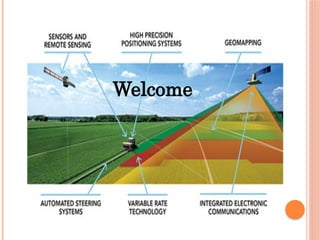
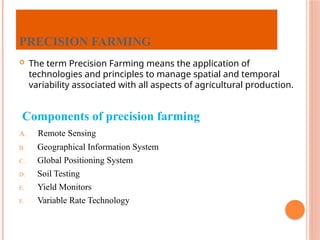
 The term Precision Farming means the application of
technologies and principles to manage spatial and temporal
variability associated with all aspects of agricultural production.
Components of precision farming
A. Remote Sensing
B. Geographical Information System
C. Global Positioning System
D. Soil Testing
E. Yield Monitors
F. Variable Rate Technology
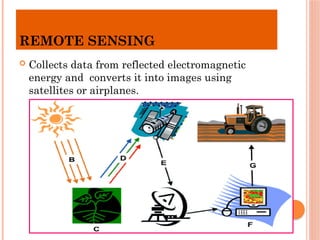
REMOTE SENSING
 Collects data from reflected electromagnetic
energy and converts it into images using
satellites or airplanes.
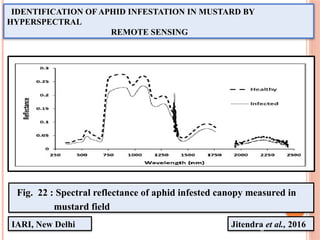
IDENTIFICATION OF APHID INFESTATION IN MUSTARD BY
HYPERSPECTRAL
REMOTE SENSING
Jitendra et al., 2016
IARI, New Delhi
Fig. 22 : Spectral reflectance of aphid infested canopy measured in
mustard field
6
GEOGRAPHIC INFORMATION
SYSTEMSYSTEM
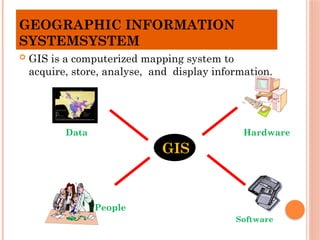
 GIS is a computerized mapping system to
acquire, store, analyse, and display information.
Data
GIS
Hardware
People
Software
GLOBAL POSITIONING SYSTEM
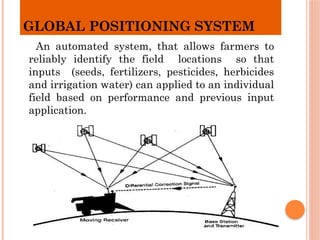
An automated system, that allows farmers to
reliably identify the field locations so that
inputs (seeds, fertilizers, pesticides, herbicides
and irrigation water) can applied to an individual
field based on performance and previous input
application.
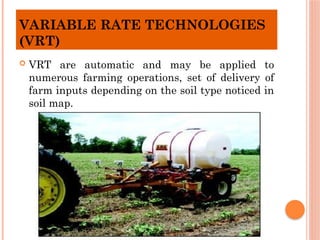
VARIABLE RATE TECHNOLOGIES
(VRT)
 VRT are automatic and may be applied to
numerous farming operations, set of delivery of
farm inputs depending on the soil type noticed in
soil map.
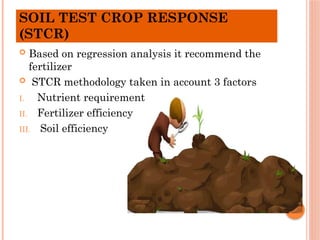
SOIL TEST CROP RESPONSE
(STCR)
 Based on regression analysis it recommend the
fertilizer
 STCR methodology taken in account 3 factors
I. Nutrient requirement
II. Fertilizer efficiency
III. Soil efficiency
Precision nutrient management
Precision nutrient management is a precise method of application of
nutrients, based on the variability in soil and micro-climate condition that
occur within the field. The scale of nutrient management recommendation
domains change ]from larger regions to farms, single fields or even single
parcel within a large field . It may also be referred to as site specific
nutrient management (SNNM).
Principles of SSNM
 Principles of SSNM are generic and applicable to other
crops.
 SSNM provides an approach for feeding crops with
nutrients as and when needed.
 Optimal use of existing indigenous nutrient sources,
including crop residues and manures.
 Timely application of fertilizers at optimal rates to meet
the deficit between the nutrient needs of a high-yielding
crop and the indigenous nutrient supply.
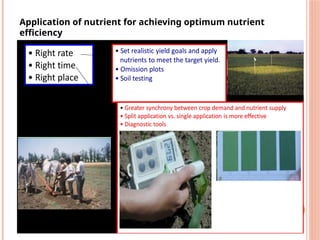
Application of nutrient for achieving optimum nutrient
efficiency
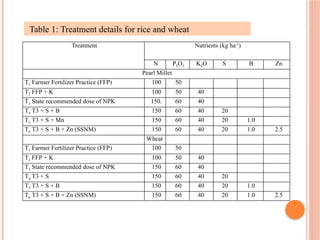
Table 1: Treatment details for rice and wheat
Treatment Nutrients (kg ha-1
)
N P2O5 K2O S B Zn
Pearl Millet
T1 Farmer Fertilizer Practice (FFP) 100 50
T2 FFP + K 100 50 40
T3 State recommended dose of NPK 150. 60 40
T4 T3 + S + B 150 60 40 20
T5 T3 + S + Mn 150 60 40 20 1.0
T6 T3 + S + B + Zn (SSNM) 150 60 40 20 1.0 2.5
Wheat
T1 Farmer Fertilizer Practice (FFP) 100 50
T2 FFP + K 100 50 40
T3 State recommended dose of NPK 150 60 40
T4 T3 + S 150 60 40 20
T5 T3 + S + B 150 60 40 20 1.0
T6 T3 + S + B + Zn (SSNM) 150 60 40 20 1.0 2.5
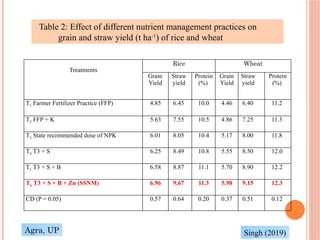
Table 2: Effect of different nutrient management practices on
grain and straw yield (t ha-1
) of rice and wheat
Treatments
Rice Wheat
Grain
Yield
Straw
yield
Protein
(%)
Grain
Yield
Straw
yield
Protein
(%)
T1 Farmer Fertilizer Practice (FFP) 4.85 6.45 10.0 4.46 6.40 11.2
T2 FFP + K 5.63 7.55 10.5 4.86 7.25 11.3
T3 State recommended dose of NPK 6.01 8.05 10.4 5.17 8.00 11.8
T4 T3 + S 6.25 8.49 10.8 5.55 8.50 12.0
T5 T3 + S + B 6.58 8.87 11.1 5.70 8.90 12.2
T6 T3 + S + B + Zn (SSNM) 6.96 9.67 11.3 5.98 9.15 12.3
CD (P = 0.05) 0.57 0.64 0.20 0.37 0.51 0.12
Singh (2019)
Agra, UP
LEAF COLOUR CHART (LCC)
 Furuya (1987) reported the use of LCC technology in
Japan.
 Improved version of LCC had been developed by
IRRI
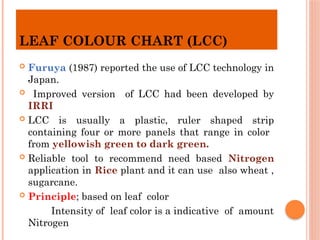
 LCC is usually a plastic, ruler shaped strip
containing four or more panels that range in color
from yellowish green to dark green.
 Reliable tool to recommend need based Nitrogen
application in Rice plant and it can use also wheat ,
sugarcane.
 Principle; based on leaf color
Intensity of leaf color is a indicative of amount
Nitrogen
HOW TO USE LCC
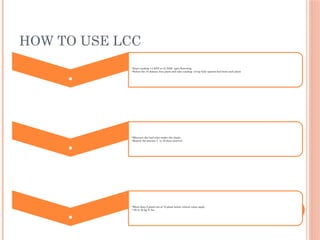
. •Start reading 14 DAT or 21 DAS upto flowering
•Select the 10 disease free plant and take reading of top fully opened leaf from each plant
. •Measure the leaf color under the shade.
•Repeat the process 7 to 10 days interval
. •More than 5 plant out of 10 plant below critical value apply
• 25 to 30 kg N /ha
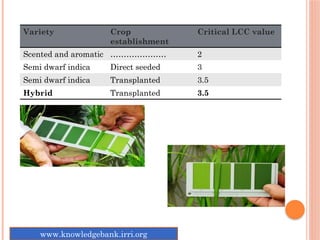
Variety Crop
establishment
Critical LCC value
Scented and aromatic ………………… 2
Semi dwarf indica Direct seeded 3
Semi dwarf indica Transplanted 3.5
Hybrid Transplanted 3.5
www.knowledgebank.irri.org
ADVANTAGES OF LCC
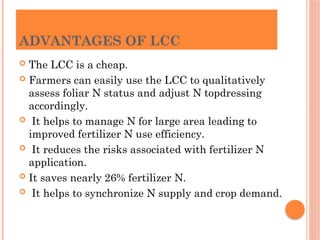
 The LCC is a cheap.
 Farmers can easily use the LCC to qualitatively
assess foliar N status and adjust N topdressing
accordingly.
 It helps to manage N for large area leading to
improved fertilizer N use efficiency.
 It reduces the risks associated with fertilizer N
application.
 It saves nearly 26% fertilizer N.
 It helps to synchronize N supply and crop demand.
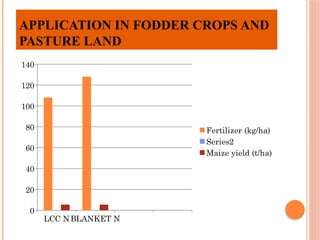
APPLICATION IN FODDER CROPS AND
PASTURE LAND
LCC NBLANKET N
0
20
40
60
80
100
120
140
Fertilizer (kg/ha)
Series2
Maize yield (t/ha)
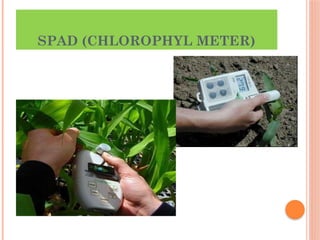
SPAD (CHLOROPHYL METER)
SPAD METER (SOIL-PLANT
ANALYSIS DEVELOPMENT)
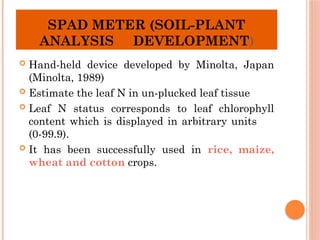
 Hand-held device developed by Minolta, Japan
(Minolta, 1989)
 Estimate the leaf N in un-plucked leaf tissue
 Leaf N status corresponds to leaf chlorophyll
content which is displayed in arbitrary units
(0-99.9).
 It has been successfully used in rice, maize,
wheat and cotton crops.
Nitrogen application
rate (t/ha)
Grain yield
(t/ha)
Stover yield
(t/ha)
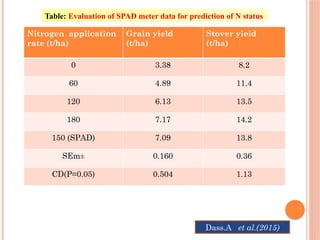
0 3.38 8.2
60 4.89 11.4
120 6.13 13.5
180 7.17 14.2
150 (SPAD) 7.09 13.8
SEm± 0.160 0.36
CD(P=0.05) 0.504 1.13
Dass.A et al.(2015)
Table: Evaluation of SPAD meter data for prediction of N status
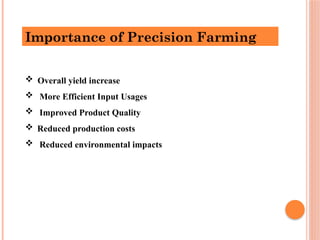
 Overall yield increase
 More Efficient Input Usages
 Improved Product Quality
 Reduced production costs
 Reduced environmental impacts
Importance of Precision Farming
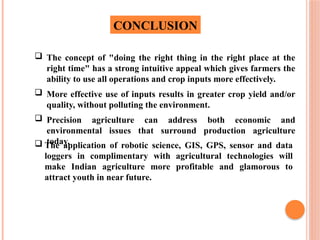
 The concept of "doing the right thing in the right place at the
right time" has a strong intuitive appeal which gives farmers the
ability to use all operations and crop inputs more effectively.
 More effective use of inputs results in greater crop yield and/or
quality, without polluting the environment.
 Precision agriculture can address both economic and
environmental issues that surround production agriculture
today.
CONCLUSION
 The application of robotic science, GIS, GPS, sensor and data
loggers in complimentary with agricultural technologies will
make Indian agriculture more profitable and glamorous to
attract youth in near future.
Thank You…

Precision Farming and Importance....pptx

  • 1.
  • 2.
    PRECISION FARMING ARUN KUMAR,M . R. PAMM 1014 M.Sc. Agri (Agronomy) Presentation on University of Agricultural Sciences, Bangalore
  • 3.
    Flow of Presentation Introduction  Components of Precision farming  Importance of Precision farming  Conclusion
  • 4.
    PRECISION FARMING  Theterm Precision Farming means the application of technologies and principles to manage spatial and temporal variability associated with all aspects of agricultural production. Components of precision farming A. Remote Sensing B. Geographical Information System C. Global Positioning System D. Soil Testing E. Yield Monitors F. Variable Rate Technology
  • 5.
    REMOTE SENSING  Collectsdata from reflected electromagnetic energy and converts it into images using satellites or airplanes.
  • 6.
    IDENTIFICATION OF APHIDINFESTATION IN MUSTARD BY HYPERSPECTRAL REMOTE SENSING Jitendra et al., 2016 IARI, New Delhi Fig. 22 : Spectral reflectance of aphid infested canopy measured in mustard field 6
  • 7.
    GEOGRAPHIC INFORMATION SYSTEMSYSTEM  GISis a computerized mapping system to acquire, store, analyse, and display information. Data GIS Hardware People Software
  • 8.
    GLOBAL POSITIONING SYSTEM Anautomated system, that allows farmers to reliably identify the field locations so that inputs (seeds, fertilizers, pesticides, herbicides and irrigation water) can applied to an individual field based on performance and previous input application.
  • 9.
    VARIABLE RATE TECHNOLOGIES (VRT) VRT are automatic and may be applied to numerous farming operations, set of delivery of farm inputs depending on the soil type noticed in soil map.
  • 10.
    SOIL TEST CROPRESPONSE (STCR)  Based on regression analysis it recommend the fertilizer  STCR methodology taken in account 3 factors I. Nutrient requirement II. Fertilizer efficiency III. Soil efficiency
  • 11.
    Precision nutrient management Precisionnutrient management is a precise method of application of nutrients, based on the variability in soil and micro-climate condition that occur within the field. The scale of nutrient management recommendation domains change ]from larger regions to farms, single fields or even single parcel within a large field . It may also be referred to as site specific nutrient management (SNNM).
  • 12.
    Principles of SSNM Principles of SSNM are generic and applicable to other crops.  SSNM provides an approach for feeding crops with nutrients as and when needed.  Optimal use of existing indigenous nutrient sources, including crop residues and manures.  Timely application of fertilizers at optimal rates to meet the deficit between the nutrient needs of a high-yielding crop and the indigenous nutrient supply.
  • 13.
    Application of nutrientfor achieving optimum nutrient efficiency
  • 14.
    Table 1: Treatmentdetails for rice and wheat Treatment Nutrients (kg ha-1 ) N P2O5 K2O S B Zn Pearl Millet T1 Farmer Fertilizer Practice (FFP) 100 50 T2 FFP + K 100 50 40 T3 State recommended dose of NPK 150. 60 40 T4 T3 + S + B 150 60 40 20 T5 T3 + S + Mn 150 60 40 20 1.0 T6 T3 + S + B + Zn (SSNM) 150 60 40 20 1.0 2.5 Wheat T1 Farmer Fertilizer Practice (FFP) 100 50 T2 FFP + K 100 50 40 T3 State recommended dose of NPK 150 60 40 T4 T3 + S 150 60 40 20 T5 T3 + S + B 150 60 40 20 1.0 T6 T3 + S + B + Zn (SSNM) 150 60 40 20 1.0 2.5
  • 15.
    Table 2: Effectof different nutrient management practices on grain and straw yield (t ha-1 ) of rice and wheat Treatments Rice Wheat Grain Yield Straw yield Protein (%) Grain Yield Straw yield Protein (%) T1 Farmer Fertilizer Practice (FFP) 4.85 6.45 10.0 4.46 6.40 11.2 T2 FFP + K 5.63 7.55 10.5 4.86 7.25 11.3 T3 State recommended dose of NPK 6.01 8.05 10.4 5.17 8.00 11.8 T4 T3 + S 6.25 8.49 10.8 5.55 8.50 12.0 T5 T3 + S + B 6.58 8.87 11.1 5.70 8.90 12.2 T6 T3 + S + B + Zn (SSNM) 6.96 9.67 11.3 5.98 9.15 12.3 CD (P = 0.05) 0.57 0.64 0.20 0.37 0.51 0.12 Singh (2019) Agra, UP
  • 16.
    LEAF COLOUR CHART(LCC)  Furuya (1987) reported the use of LCC technology in Japan.  Improved version of LCC had been developed by IRRI  LCC is usually a plastic, ruler shaped strip containing four or more panels that range in color from yellowish green to dark green.  Reliable tool to recommend need based Nitrogen application in Rice plant and it can use also wheat , sugarcane.  Principle; based on leaf color Intensity of leaf color is a indicative of amount Nitrogen
  • 17.
    HOW TO USELCC . •Start reading 14 DAT or 21 DAS upto flowering •Select the 10 disease free plant and take reading of top fully opened leaf from each plant . •Measure the leaf color under the shade. •Repeat the process 7 to 10 days interval . •More than 5 plant out of 10 plant below critical value apply • 25 to 30 kg N /ha
  • 18.
    Variety Crop establishment Critical LCCvalue Scented and aromatic ………………… 2 Semi dwarf indica Direct seeded 3 Semi dwarf indica Transplanted 3.5 Hybrid Transplanted 3.5 www.knowledgebank.irri.org
  • 19.
    ADVANTAGES OF LCC The LCC is a cheap.  Farmers can easily use the LCC to qualitatively assess foliar N status and adjust N topdressing accordingly.  It helps to manage N for large area leading to improved fertilizer N use efficiency.  It reduces the risks associated with fertilizer N application.  It saves nearly 26% fertilizer N.  It helps to synchronize N supply and crop demand.
  • 20.
    APPLICATION IN FODDERCROPS AND PASTURE LAND LCC NBLANKET N 0 20 40 60 80 100 120 140 Fertilizer (kg/ha) Series2 Maize yield (t/ha)
  • 21.
  • 22.
    SPAD METER (SOIL-PLANT ANALYSISDEVELOPMENT)  Hand-held device developed by Minolta, Japan (Minolta, 1989)  Estimate the leaf N in un-plucked leaf tissue  Leaf N status corresponds to leaf chlorophyll content which is displayed in arbitrary units (0-99.9).  It has been successfully used in rice, maize, wheat and cotton crops.
  • 23.
    Nitrogen application rate (t/ha) Grainyield (t/ha) Stover yield (t/ha) 0 3.38 8.2 60 4.89 11.4 120 6.13 13.5 180 7.17 14.2 150 (SPAD) 7.09 13.8 SEm± 0.160 0.36 CD(P=0.05) 0.504 1.13 Dass.A et al.(2015) Table: Evaluation of SPAD meter data for prediction of N status
  • 24.
     Overall yieldincrease  More Efficient Input Usages  Improved Product Quality  Reduced production costs  Reduced environmental impacts Importance of Precision Farming
  • 25.
     The conceptof "doing the right thing in the right place at the right time" has a strong intuitive appeal which gives farmers the ability to use all operations and crop inputs more effectively.  More effective use of inputs results in greater crop yield and/or quality, without polluting the environment.  Precision agriculture can address both economic and environmental issues that surround production agriculture today. CONCLUSION  The application of robotic science, GIS, GPS, sensor and data loggers in complimentary with agricultural technologies will make Indian agriculture more profitable and glamorous to attract youth in near future.
  • 26.