2
Presenting by :
Dumasia Yazad 140420107015
Gajjar Karan 140420107016
Computer
(Shift-1)
3rd year
Semester 5th
3
Crimes are not to be measured by the
issue of events, but by the bad
intensions of person.
The greatest crimes do not arise from a
want of feeling for others but from an
over sensibility for ourselves and an
Why Should we know about Cyber-Crime?
 In this Tech-savvy world of 21st Century every one is engaged with internet,
through WhatsApp, twitter, Facebook, net-banking & lots of other platforms
are there.
 And some criminal minded persons commit crimes here, which is included under
cyber-crime.
 So we should be aware about crimes happening around in the cyber-space.
4
5
A combining form meaning “computer,” “computer network,” or “virtual
reality,” used in the formation of compound words (cyber-talk; cyber-
art; cyberspace) and by extension meaning “expressing visions of the
future” (cyber-fashion).
Meaning of cyber
Origin of cyber word : Cybernetics
The study of human control functions and of mechanical and electronic
systems designed to replace them, involving the application of
statistical mechanics to communication engineering.
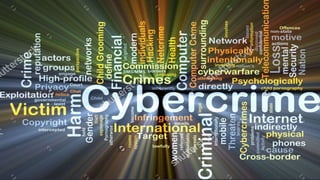
Cyber Crime is a term used to broadly describe criminal activity in which computers or
computer networks are a tool, a target, or a place of criminal activity and include everything
from electronic cracking to denial of service attacks. It is also used to include traditional
crimes in which computers or networks are used to enable the illicit activity.
Computer crime mainly consists of unauthorized access to computer systems data
alteration, data destruction, theft of intellectual property. Cyber crime in the context of
national security may involve hacking, traditional espionage, or information warfare and
related activities.
Threatening Email, Assuming someone's Identity, Sexual Harassment, Defamation, Spam
and Phishing are some examples where computers are used to commit crime, whereas
Viruses, Worms and Industrial Espionage, Software Piracy and Hacking are examples where
computers become target of crime.
6
7History
 The first recorded cyber crime took place in the year 1820 That is not surprising
considering the fact that the abacus, which is thought to be the earliest form of a
computer, has been around since 3500 B.C.
 Then era begin from1903 Magician and inventor Nevil Maskelyne disrupts John
Ambrose Fleming's public demonstration of Guglielmo Marconi's purportedly
secure wireless telegraphy technology, sending insulting Morse code messages
through the auditorium's projector.
 Rest is history after 9/11 attack best cyber attack against American military
defense.
 ISIS biggest issue who use internet as weapon to increase there strength.
8
Types of Cyber attacks are juggernaut by percentage
(source- FBI)
 Financial fraud: 11%
 Sabotage of data/networks: 17%
 Theft of proprietary information: 20%
 System penetration from the outside: 25%
 Denial of service: 27%
 Unauthorized access by insiders: 71%
 Employee abuse of internet privileges 79%
 Viruses: 85%
 “ If you experienced computer system intrusions by
someone from outside your organization, indicate the
type of activity performed by the intruder.”
 Manipulate data integrity 6.8%
 Installed a sniffer 6.6%
 Stole password files 5.6%
 Proving/scanning systems 14.6%
 Trojan logons 5.8%
 IP spoofing 4.8%
 Introduced virus 10.6%
 Denied use of services 6.3%
9
IndianCrimeScene
The major Cyber Crimes reported, in India, are
Denial of Services, Defacement of Websites, Spam, Computer
Virus and Worms, Pornography, Cyber Squatting, Cyber
Stalking and Phishing.
Given the fact that nearly $ 120 million worth of Mobiles are
being lost or stolen in the country every year, the users have to
protect Information, Contact details and Telephone numbers
as these could be misused. Nearly 69 per cent of information
theft is carried out by current and ex-employees and 31 per cent
by hackers. India has to go a long way in protecting the vital
information.
[3 The Hindu, Saturday, Oct 27, 2007].
10
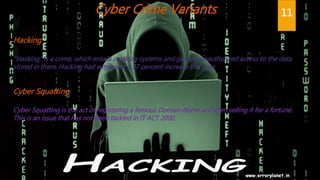
11Cyber Crime Variants
Hacking
"Hacking" is a crime, which entails cracking systems and gaining unauthorized access to the data
stored in them. Hacking had witnessed a 37 percent increase this year.
Cyber Squatting
Cyber Squatting is the act of registering a famous Domain Name and then selling it for a fortune.
This is an issue that has not been tackled in IT ACT 2000.
11
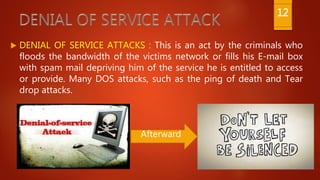
 DENIAL OF SERVICE ATTACKS : This is an act by the criminals who
floods the bandwidth of the victims network or fills his E-mail box
with spam mail depriving him of the service he is entitled to access
or provide. Many DOS attacks, such as the ping of death and Tear
drop attacks.
Afterward
12
 Malicious software that attaches itself to other software or computer
system and then propagates itself to other computers via networks or
disks. (virus, worms, Trojan Horse, web jacking, e-mail bombing etc.
13
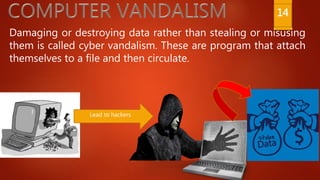
Damaging or destroying data rather than stealing or misusing
them is called cyber vandalism. These are program that attach
themselves to a file and then circulate.
Lead to hackers
14
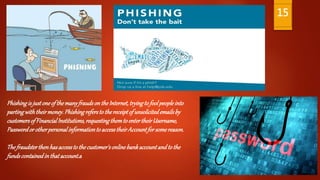
Phishingisjustoneof themanyfraudsontheInternet,tryingto foolpeopleinto
partingwiththeirmoney.Phishingrefersto thereceiptofunsolicitedemailsby
customersofFinancialInstitutions,requestingthemtoentertheirUsername,
Passwordor otherpersonalinformationto accesstheirAccountforsomereason.
Thefraudsterthenhasaccessto thecustomer'sonlinebankaccountandtothe
fundscontainedinthataccount.a
15
Vishing is the criminal practice of using social
engineering and Voice over IP (VoIP) to gain
access to private personal and financial
information from the public for the purpose of
financial reward. The term is a combination of
“Voice" and phishing. Vishing exploits the
public's trust in landline telephone services.
Vishing is typically used to steal credit card
numbers or other information used in identity
theft schemes from individuals.
16
Terrorist attacks on the Internet is by distributed
denial of service attacks, hate websites and hate
emails, attacks on sensitive computer networks,
etc. Technology savvy terrorists are using 512-bit
encryption, which is impossible to decrypt.
17
18
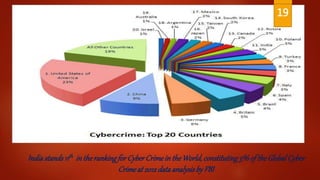
Indiastands11th intherankingforCyberCrimeintheWorld,constituting3%of theGlobalCyber
Crimeat 2012dataanalysisby FBI
19
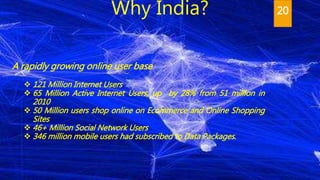
Why India?
A rapidly growing online user base
 121 Million Internet Users
 65 Million Active Internet Users, up by 28% from 51 million in
2010
 50 Million users shop online on Ecommerce and Online Shopping
Sites
 46+ Million Social Network Users
 346 million mobile users had subscribed to Data Packages.
20
CyberCrime InIndia
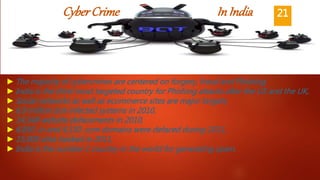
►The majority of cybercrimes are centered on forgery, fraud and Phishing,
►India is the third-most targeted country for Phishing attacks after the US and the UK,
►Social networks as well as ecommerce sites are major targets,
►6.9 million bot-infected systems in 2010,
►14,348 website defacements in 2010,
►6,850 .in and 4,150 .com domains were defaced during 2011,
►15,000 sites hacked in 2011,
►India is the number 1 country in the world for generating spam.
21
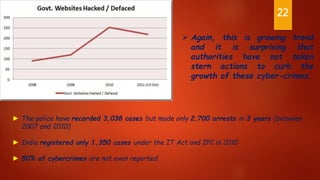
 Again, this is growing trend
and it is surprising that
authorities have not taken
stern actions to curb the
growth of these cyber-crimes.
► The police have recorded 3,038 cases but made only 2,700 arrests in 3 years (between
2007 and 2010)
► India registered only 1,350 cases under the IT Act and IPC in 2010
► 50% of cybercrimes are not even reported.
22
Geographic breakdown of cases reported:
o 153 from Karnataka,
o 148 from Kerala
o 142 from Maharashtra
o 105 Andhra Pradesh
o 52 Rajasthan
o 52 Punjab
233 persons were arrested in 2010
33% of the cases registered were related to
hacking
Source: National Crime Records Bureau
23
Conclusion…
“Indian Laws are well drafted and are capable of handling all kinds of challenges as
posed by cyber criminals. However, the enforcement agencies are required to be well
versedwiththechangingtechnologiesandLaws.”
"Asinternettechnologyadvancessodoesthethreatofcybercrime.Intimeslikethesewe
must protect ourselves from cyber crime. Anti-virus software, firewalls and security
patches are just the beginning. Never open suspicious e-mails and only navigate to
trustedsites.”
24
THANK YOU!!
AGAINST CYBER CRIME,FIGHT AGAINST THEM

Cyber crime

  • 2.
    2 Presenting by : DumasiaYazad 140420107015 Gajjar Karan 140420107016 Computer (Shift-1) 3rd year Semester 5th
  • 3.
    3 Crimes are notto be measured by the issue of events, but by the bad intensions of person. The greatest crimes do not arise from a want of feeling for others but from an over sensibility for ourselves and an
  • 4.
    Why Should weknow about Cyber-Crime?  In this Tech-savvy world of 21st Century every one is engaged with internet, through WhatsApp, twitter, Facebook, net-banking & lots of other platforms are there.  And some criminal minded persons commit crimes here, which is included under cyber-crime.  So we should be aware about crimes happening around in the cyber-space. 4
  • 5.
    5 A combining formmeaning “computer,” “computer network,” or “virtual reality,” used in the formation of compound words (cyber-talk; cyber- art; cyberspace) and by extension meaning “expressing visions of the future” (cyber-fashion). Meaning of cyber Origin of cyber word : Cybernetics The study of human control functions and of mechanical and electronic systems designed to replace them, involving the application of statistical mechanics to communication engineering.
  • 6.
    Cyber Crime isa term used to broadly describe criminal activity in which computers or computer networks are a tool, a target, or a place of criminal activity and include everything from electronic cracking to denial of service attacks. It is also used to include traditional crimes in which computers or networks are used to enable the illicit activity. Computer crime mainly consists of unauthorized access to computer systems data alteration, data destruction, theft of intellectual property. Cyber crime in the context of national security may involve hacking, traditional espionage, or information warfare and related activities. Threatening Email, Assuming someone's Identity, Sexual Harassment, Defamation, Spam and Phishing are some examples where computers are used to commit crime, whereas Viruses, Worms and Industrial Espionage, Software Piracy and Hacking are examples where computers become target of crime. 6
  • 7.
    7History  The firstrecorded cyber crime took place in the year 1820 That is not surprising considering the fact that the abacus, which is thought to be the earliest form of a computer, has been around since 3500 B.C.  Then era begin from1903 Magician and inventor Nevil Maskelyne disrupts John Ambrose Fleming's public demonstration of Guglielmo Marconi's purportedly secure wireless telegraphy technology, sending insulting Morse code messages through the auditorium's projector.  Rest is history after 9/11 attack best cyber attack against American military defense.  ISIS biggest issue who use internet as weapon to increase there strength.
  • 8.
    8 Types of Cyberattacks are juggernaut by percentage (source- FBI)  Financial fraud: 11%  Sabotage of data/networks: 17%  Theft of proprietary information: 20%  System penetration from the outside: 25%  Denial of service: 27%  Unauthorized access by insiders: 71%  Employee abuse of internet privileges 79%  Viruses: 85%
  • 9.
     “ Ifyou experienced computer system intrusions by someone from outside your organization, indicate the type of activity performed by the intruder.”  Manipulate data integrity 6.8%  Installed a sniffer 6.6%  Stole password files 5.6%  Proving/scanning systems 14.6%  Trojan logons 5.8%  IP spoofing 4.8%  Introduced virus 10.6%  Denied use of services 6.3% 9
  • 10.
    IndianCrimeScene The major CyberCrimes reported, in India, are Denial of Services, Defacement of Websites, Spam, Computer Virus and Worms, Pornography, Cyber Squatting, Cyber Stalking and Phishing. Given the fact that nearly $ 120 million worth of Mobiles are being lost or stolen in the country every year, the users have to protect Information, Contact details and Telephone numbers as these could be misused. Nearly 69 per cent of information theft is carried out by current and ex-employees and 31 per cent by hackers. India has to go a long way in protecting the vital information. [3 The Hindu, Saturday, Oct 27, 2007]. 10
  • 11.
    11Cyber Crime Variants Hacking "Hacking"is a crime, which entails cracking systems and gaining unauthorized access to the data stored in them. Hacking had witnessed a 37 percent increase this year. Cyber Squatting Cyber Squatting is the act of registering a famous Domain Name and then selling it for a fortune. This is an issue that has not been tackled in IT ACT 2000. 11
  • 12.
     DENIAL OFSERVICE ATTACKS : This is an act by the criminals who floods the bandwidth of the victims network or fills his E-mail box with spam mail depriving him of the service he is entitled to access or provide. Many DOS attacks, such as the ping of death and Tear drop attacks. Afterward 12
  • 13.
     Malicious softwarethat attaches itself to other software or computer system and then propagates itself to other computers via networks or disks. (virus, worms, Trojan Horse, web jacking, e-mail bombing etc. 13
  • 14.
    Damaging or destroyingdata rather than stealing or misusing them is called cyber vandalism. These are program that attach themselves to a file and then circulate. Lead to hackers 14
  • 15.
    Phishingisjustoneof themanyfraudsontheInternet,tryingto foolpeopleinto partingwiththeirmoney.Phishingreferstothereceiptofunsolicitedemailsby customersofFinancialInstitutions,requestingthemtoentertheirUsername, Passwordor otherpersonalinformationto accesstheirAccountforsomereason. Thefraudsterthenhasaccessto thecustomer'sonlinebankaccountandtothe fundscontainedinthataccount.a 15
  • 16.
    Vishing is thecriminal practice of using social engineering and Voice over IP (VoIP) to gain access to private personal and financial information from the public for the purpose of financial reward. The term is a combination of “Voice" and phishing. Vishing exploits the public's trust in landline telephone services. Vishing is typically used to steal credit card numbers or other information used in identity theft schemes from individuals. 16
  • 17.
    Terrorist attacks onthe Internet is by distributed denial of service attacks, hate websites and hate emails, attacks on sensitive computer networks, etc. Technology savvy terrorists are using 512-bit encryption, which is impossible to decrypt. 17
  • 18.
  • 19.
  • 20.
    Why India? A rapidlygrowing online user base  121 Million Internet Users  65 Million Active Internet Users, up by 28% from 51 million in 2010  50 Million users shop online on Ecommerce and Online Shopping Sites  46+ Million Social Network Users  346 million mobile users had subscribed to Data Packages. 20
  • 21.
    CyberCrime InIndia ►The majorityof cybercrimes are centered on forgery, fraud and Phishing, ►India is the third-most targeted country for Phishing attacks after the US and the UK, ►Social networks as well as ecommerce sites are major targets, ►6.9 million bot-infected systems in 2010, ►14,348 website defacements in 2010, ►6,850 .in and 4,150 .com domains were defaced during 2011, ►15,000 sites hacked in 2011, ►India is the number 1 country in the world for generating spam. 21
  • 22.
     Again, thisis growing trend and it is surprising that authorities have not taken stern actions to curb the growth of these cyber-crimes. ► The police have recorded 3,038 cases but made only 2,700 arrests in 3 years (between 2007 and 2010) ► India registered only 1,350 cases under the IT Act and IPC in 2010 ► 50% of cybercrimes are not even reported. 22
  • 23.
    Geographic breakdown ofcases reported: o 153 from Karnataka, o 148 from Kerala o 142 from Maharashtra o 105 Andhra Pradesh o 52 Rajasthan o 52 Punjab 233 persons were arrested in 2010 33% of the cases registered were related to hacking Source: National Crime Records Bureau 23
  • 24.
    Conclusion… “Indian Laws arewell drafted and are capable of handling all kinds of challenges as posed by cyber criminals. However, the enforcement agencies are required to be well versedwiththechangingtechnologiesandLaws.” "Asinternettechnologyadvancessodoesthethreatofcybercrime.Intimeslikethesewe must protect ourselves from cyber crime. Anti-virus software, firewalls and security patches are just the beginning. Never open suspicious e-mails and only navigate to trustedsites.” 24
  • 25.
    THANK YOU!! AGAINST CYBERCRIME,FIGHT AGAINST THEM