MULTIDIMENSIONAL DATA
MODEL
SUBMITTED BY-
JASBEER CHAUHAN,15071257
HARJINDER KHAN,15071258
SUBMITTED TO-
NEHA DOGRA
INTRODUCTION MDDM:-
• MDDM was Developed for implementing data
warehouse and data mart.
• It provide Both a mechanism to store Data and
a way for business analysis.
• It provide us interactive analysis of large
amount of data which help’s in decision
making process.
Why Multidimensional Database ?
Enables interactive analyses of large amounts
of data for decision-making purposes.
Rapidly process the data in the database so
that answers can be generated quickly.
Provides “just in time” information for
effective decision-making in a successful OLAP
application.
Enforces simplicity.
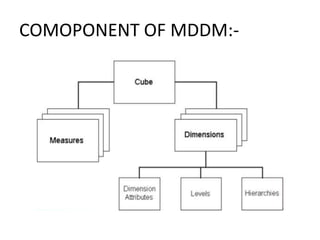
COMOPONENT OF MDDM:-
TYPES OF MDDM
• Data Cube Model
• Star Schema Model
• Snow flake Schema Model
• Fact constellations
Data Cube Dimensional
Model
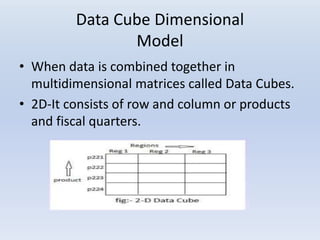
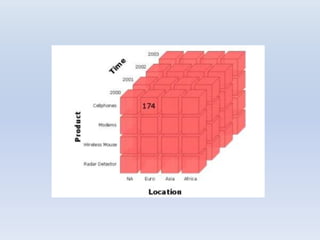
• When data is combined together in
multidimensional matrices called Data Cubes.
• 2D-It consists of row and column or products
and fiscal quarters.
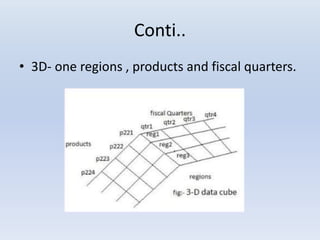
Conti..
• 3D- one regions , products and fiscal quarters.
Dimensions and measures
 Data cubes have categories of data called
dimensions and measures
 Measure- It represents some fact (number)
such as cost or units of service.
 Dimension- It represents descriptive
categories of data such as time or location.
Slicing, Dicing and Rotation
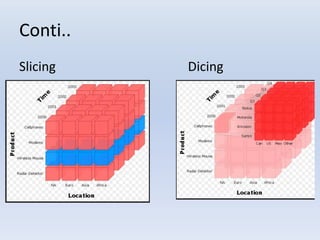
Slicing:
Refers to two – dimensional page selected
from the cube
Dicing :
Dicing provides you a smallest available slice.
It define a sub-cube of the original space.
Conti..
Slicing Dicing
Conti..
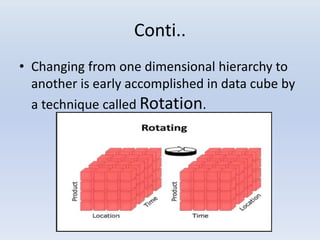
• Changing from one dimensional hierarchy to
another is early accomplished in data cube by
a technique called Rotation.
Conti..
• These types of models are applied to
hierarchical view such as Role up Display and
Drill Down Display.
Role up Display:-
 When role up operation is performed by dimension reduction
one or more dimension are remove from dimension cube.
 With role up capability user can zoom out to see a summarized level of
data.
 The navigation path is determined by hierarchy with in dimension,
Conti..
Drill-Down Display:-
 It is reverse of role up.
 it navigate from less detailed data to more detailed data.
 It can also be performs by adding new dimension to a cube.
STAR SCHEMA MODEL
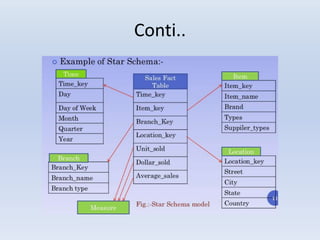
• It is also known as star join schema
• It is simplest style of data warehouse schema.
• It is called Star Schema because the entity relationship
diagram of this schema resembles a star , with points
radiating from central table.
• A star query is a join between a fact table and a no of
dimension table.
• Each dimension table is joined to the fact table using
primary key to foreign key but dimension table not
joined to each other.
• A typical fact table consist of key and measure.
Conti..
Conti..
Advantage of Star Schema Model :-
Provide highly optimized performance for
typical star queries.
Provide a direct and intuitive mapping
between the business entities being analyzed
by end users.
SNOW FLAKE SCHEMA
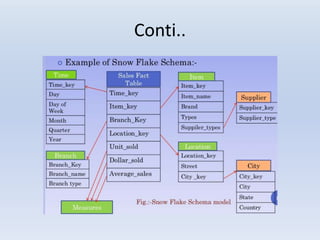
It is slightly different from a star schema in
which the dimensional tables from a star
schema are organized into a hierarchy by
normalizing them.
The snow flake schema is represented by
centralized fact table which are connected to
multiple dimensions.
The snow flake effecting only affecting the
dimension table not the fact tables.
Conti..
Conti..
Benefits of Snow Flaking:-
I. It is easier to implement a snow flak schema
when a multidimensional is added to the
typically normalized tables.
II. A snow flake schema can reflect the same
data to the database.
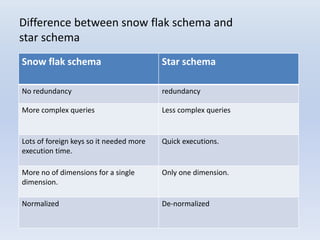
Difference between snow flak schema and
star schema
Snow flak schema Star schema
No redundancy redundancy
More complex queries Less complex queries
Lots of foreign keys so it needed more
execution time.
Quick executions.
More no of dimensions for a single
dimension.
Only one dimension.
Normalized De-normalized
FACT CONSTELLATIONS:-
For each schema it is possible to construct fact
constellation table.
It limits the possible Queries for the data
warehouse.
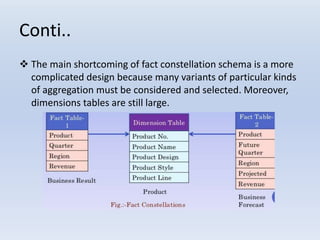
The fact constellation architecture contains
multiple fact tables that share many
dimensional tables.
Conti..
 The main shortcoming of fact constellation schema is a more
complicated design because many variants of particular kinds
of aggregation must be considered and selected. Moreover,
dimensions tables are still large.
THANK
YOU

MULTIMEDIA MODELING

  • 1.
    MULTIDIMENSIONAL DATA MODEL SUBMITTED BY- JASBEERCHAUHAN,15071257 HARJINDER KHAN,15071258 SUBMITTED TO- NEHA DOGRA
  • 2.
    INTRODUCTION MDDM:- • MDDMwas Developed for implementing data warehouse and data mart. • It provide Both a mechanism to store Data and a way for business analysis. • It provide us interactive analysis of large amount of data which help’s in decision making process.
  • 3.
    Why Multidimensional Database? Enables interactive analyses of large amounts of data for decision-making purposes. Rapidly process the data in the database so that answers can be generated quickly. Provides “just in time” information for effective decision-making in a successful OLAP application. Enforces simplicity.
  • 4.
  • 5.
    TYPES OF MDDM •Data Cube Model • Star Schema Model • Snow flake Schema Model • Fact constellations
  • 6.
    Data Cube Dimensional Model •When data is combined together in multidimensional matrices called Data Cubes. • 2D-It consists of row and column or products and fiscal quarters.
  • 7.
    Conti.. • 3D- oneregions , products and fiscal quarters.
  • 8.
    Dimensions and measures Data cubes have categories of data called dimensions and measures  Measure- It represents some fact (number) such as cost or units of service.  Dimension- It represents descriptive categories of data such as time or location.
  • 10.
    Slicing, Dicing andRotation Slicing: Refers to two – dimensional page selected from the cube Dicing : Dicing provides you a smallest available slice. It define a sub-cube of the original space.
  • 11.
  • 12.
    Conti.. • Changing fromone dimensional hierarchy to another is early accomplished in data cube by a technique called Rotation.
  • 13.
    Conti.. • These typesof models are applied to hierarchical view such as Role up Display and Drill Down Display. Role up Display:-  When role up operation is performed by dimension reduction one or more dimension are remove from dimension cube.  With role up capability user can zoom out to see a summarized level of data.  The navigation path is determined by hierarchy with in dimension,
  • 14.
    Conti.. Drill-Down Display:-  Itis reverse of role up.  it navigate from less detailed data to more detailed data.  It can also be performs by adding new dimension to a cube.
  • 15.
    STAR SCHEMA MODEL •It is also known as star join schema • It is simplest style of data warehouse schema. • It is called Star Schema because the entity relationship diagram of this schema resembles a star , with points radiating from central table. • A star query is a join between a fact table and a no of dimension table. • Each dimension table is joined to the fact table using primary key to foreign key but dimension table not joined to each other. • A typical fact table consist of key and measure.
  • 16.
  • 17.
    Conti.. Advantage of StarSchema Model :- Provide highly optimized performance for typical star queries. Provide a direct and intuitive mapping between the business entities being analyzed by end users.
  • 18.
    SNOW FLAKE SCHEMA Itis slightly different from a star schema in which the dimensional tables from a star schema are organized into a hierarchy by normalizing them. The snow flake schema is represented by centralized fact table which are connected to multiple dimensions. The snow flake effecting only affecting the dimension table not the fact tables.
  • 19.
  • 20.
    Conti.. Benefits of SnowFlaking:- I. It is easier to implement a snow flak schema when a multidimensional is added to the typically normalized tables. II. A snow flake schema can reflect the same data to the database.
  • 21.
    Difference between snowflak schema and star schema Snow flak schema Star schema No redundancy redundancy More complex queries Less complex queries Lots of foreign keys so it needed more execution time. Quick executions. More no of dimensions for a single dimension. Only one dimension. Normalized De-normalized
  • 22.
    FACT CONSTELLATIONS:- For eachschema it is possible to construct fact constellation table. It limits the possible Queries for the data warehouse. The fact constellation architecture contains multiple fact tables that share many dimensional tables.
  • 23.
    Conti..  The mainshortcoming of fact constellation schema is a more complicated design because many variants of particular kinds of aggregation must be considered and selected. Moreover, dimensions tables are still large.
  • 24.