Source: NoSQL Distilled
Prepared By. Dr. Dipali Meher
Schema Migrations
in NOSQL
Dr. Dipali Meher
MCS, M.Phil, NET, Ph.D
Assistant Professor
Modern College of Arts, Science and Commerce,
Ganeshkhind Pune 16
mailtomeher@gmail.com/dipalimeher@moderncollegegk.org
Source: NoSQL Distilled
Prepared By. Dr. Dipali Meher
2
Source: NoSQL Distilled
Prepared By. Dr. Dipali Meher
Agenda
 What are database schema?
 Schema changes
 Schema changes in RDBMS
 Schema change sin NOSQL Data
Store
Source: NoSQL Distilled
Prepared By. Dr. Dipali Meher
⊷ The database schema of a database system is its structure
described in a formal language supported by the database
management system (DBMS).
⊷ The term "schema" refers to the organization of data as a
blueprint of how the database is constructed (divided into
database tables in the case of relational databases).
⊷ The formal definition of a database schema is a set of
formulas (sentences) called integrity constraints imposed
on a database..
⊷ The database schema. This describes how real-world
entities are modeled in the database.
4
Database Schema
Source: NoSQL Distilled
Prepared By. Dr. Dipali Meher
In NOSQL….
⊷ Recent trends in NOSQL is now schemaless nature – This
allows developers to concentrate on domain design without
worrying about schema changes.
⊷ In case of agility- schema changes are important
⊷ Discussion with domain experts and product owners are
important to understand the data. Discussions should not
contains only the complexity of database schema.
⊷ In case of NOSQL schema changes will be done with least
amount of friction, improving developers productivity and
requires careful attention.
5
Source: NoSQL Distilled
Prepared By. Dr. Dipali Meher
Schema Changes in RDBMS
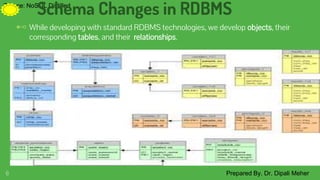
⊷ While developing with standard RDBMS technologies, we develop objects, their
corresponding tables, and their relationships.
6
Source: NoSQL Distilled
Prepared By. Dr. Dipali Meher
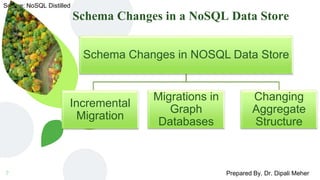
Schema Changes in a NoSQL Data Store
7
Schema Changes in NOSQL Data Store
Migrations in
Graph
Databases
Changing
Aggregate
Structure
Incremental
Migration
Source: NoSQL Distilled
Prepared by Dr. Dipali Meher
Schema Changes in NOSQL Data Store
⊷ An RDBMS database has to be changed
before the application is changed. This is
what the schemafree, or schemaless,
approach tries to avoid, aiming at flexibility
of schema changes per entity.
⊷ Frequent changes to the schema are needed
to react to frequent market changes and
product Innovations.
8
Source: NoSQL Distilled
Prepared by Dr. Dipali Meher
⊷ When developing with NoSQL databases, in some cases the
schema does not have to be thought about beforehand.
We still have to design and think about other aspects, such as
⊶ Types of relationships (with graph databases),
⊶ Names of the column families, rows, columns,
⊶ Order of columns (with column databases)
⊶ How are the keys assigned and what is the structure of the
data inside the value object (with key-value stores).
9
Source: NoSQL Distilled
Prepared by Dr. Dipali Meher
⊷ It is seen that it is applications responsibility to take care of
database schema and data is accepted through application
which is to be saved at database.( e.g. verification and
validation by an application while accepting data)
⊷ When data is not parsed to database by application then
database may throw an error which is to be encountered by an
application. So while designing schemaless databases,
applications and data which is to be stored both are taking
into consideration.
⊷ Schema changes especially matter when there is a deployed
application and existing production data.
10
Source: NoSQL Distilled
Prepared by Dr. Dipali Meher
Example of Mongodb
⊷ Consider data model as customer, order, orderItems as follows..
{ "_id": "
4BD8AE97C47016442AF4A580",
"customerid": 99999,
"name": "Foo Sushi Inc",
"since": "12/12/2012",
"order": {
"orderid": "4821-UXWE-122012","orderdate": "12/12/2001",
"orderItems": [{"product": "Fortune Cookies",
"price": 19.99}]
}
}
11
Source: NoSQL Distilled
Prepared by Dr. Dipali Meher
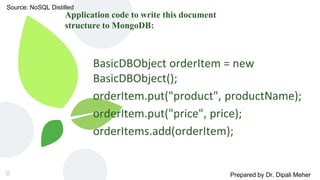
Application code to write this document
structure to MongoDB:
BasicDBObject orderItem = new
BasicDBObject();
orderItem.put("product", productName);
orderItem.put("price", price);
orderItems.add(orderItem);
12
Source: NoSQL Distilled
Prepared by Dr. Dipali Meher
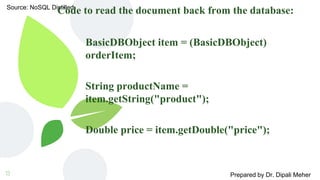
Code to read the document back from the database:
BasicDBObject item = (BasicDBObject)
orderItem;
String productName =
item.getString("product");
Double price = item.getDouble("price");
13
Source: NoSQL Distilled
Prepared by Dr. Dipali Meher
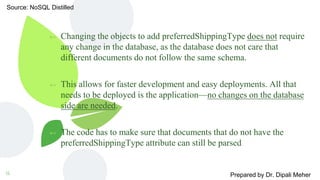
⊷ Changing the objects to add preferredShippingType does not require
any change in the database, as the database does not care that
different documents do not follow the same schema.
⊷ This allows for faster development and easy deployments. All that
needs to be deployed is the application—no changes on the database
side are needed.
⊷ The code has to make sure that documents that do not have the
preferredShippingType attribute can still be parsed
14
Source: NoSQL Distilled
Prepared by Dr. Dipali Meher
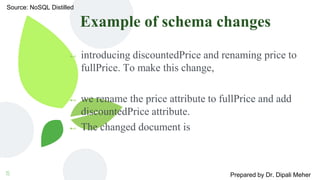
Example of schema changes
⊷ introducing discountedPrice and renaming price to
fullPrice. To make this change,
⊷ we rename the price attribute to fullPrice and add
discountedPrice attribute.
⊷ The changed document is
15
Source: NoSQL Distilled
Prepared by Dr. Dipali Meher
{ "_id": "
5BD8AE97C47016442AF4A580",
"customerid": 66778,
"name": "India House",
"since": "12/12/2012",
"order": {
"orderid": "4821-UXWE-222012",
"orderdate": "12/12/2001",
"orderItems": [{"product": "Chair Covers",
"fullPrice": 29.99,
"discountedPrice":26.99}]
}
}
16
Once we deploy this change, new customers and their orders can be saved and read back without
problems, but for existing orders the price of their product cannot be read, because now the code is
looking for fullPrice but the document has only price.
Source: NoSQL Distilled
Prepared by Dr. Dipali Meher
Incremental Migration
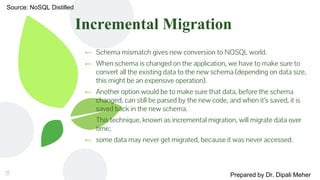
⊷ Schema mismatch gives new conversion to NOSQL world.
⊷ When schema is changed on the application, we have to make sure to
convert all the existing data to the new schema (depending on data size,
this might be an expensive operation).
⊷ Another option would be to make sure that data, before the schema
changed, can still be parsed by the new code, and when it’s saved, it is
saved back in the new schema.
⊷ This technique, known as incremental migration, will migrate data over
time;
⊷ some data may never get migrated, because it was never accessed.
17
Source: NoSQL Distilled
Prepared by Dr. Dipali Meher
Incremental Migration
The incremental migration technique can also be
implemented with a schema_version field on
the data, used by the application to choose the
correct code to parse the data into the objects.
When saving, the data is migrated to the latest
version and the schema_version is updated to
reflect that.
18
Source: NoSQL Distilled
Prepared by Dr. Dipali Meher
Incremental Migration
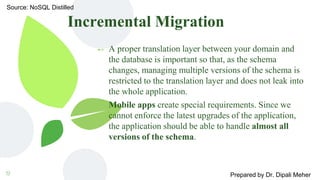
⊷ A proper translation layer between your domain and
the database is important so that, as the schema
changes, managing multiple versions of the schema is
restricted to the translation layer and does not leak into
the whole application.
⊷ Mobile apps create special requirements. Since we
cannot enforce the latest upgrades of the application,
the application should be able to handle almost all
versions of the schema.
19
Source: NoSQL Distilled
Prepared by Dr. Dipali Meher
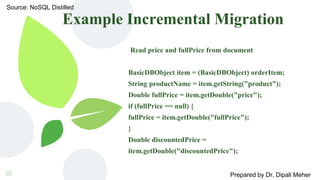
Example Incremental Migration
Read price and fullPrice from document
BasicDBObject item = (BasicDBObject) orderItem;
String productName = item.getString("product");
Double fullPrice = item.getDouble("price");
if (fullPrice == null) {
fullPrice = item.getDouble("fullPrice");
}
Double discountedPrice =
item.getDouble("discountedPrice");
20
Source: NoSQL Distilled
Prepared by Dr. Dipali Meher
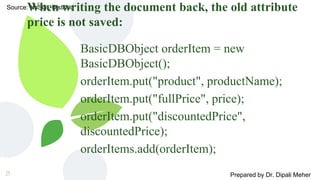
When writing the document back, the old attribute
price is not saved:
BasicDBObject orderItem = new
BasicDBObject();
orderItem.put("product", productName);
orderItem.put("fullPrice", price);
orderItem.put("discountedPrice",
discountedPrice);
orderItems.add(orderItem);
21
Source: NoSQL Distilled
Prepared by Dr. Dipali Meher
When using incremental migration, there
could be many versions of the object on
the application side that can translate the
old schema to the new schema; while
saving the object back, it is saved using
the new object. This gradual migration
of the data helps the application evolve
faster.
22
Source: NoSQL Distilled
Prepared by Dr. Dipali Meher
The incremental migration technique will
complicate the object design, especially as
new changes are being introduced yet old
changes are not being taken out.
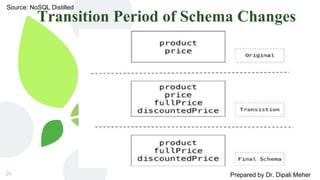
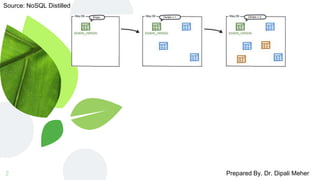
This period between the change deployment
and the last object in the database migrating
to the new schema is known as the transition
period
23
Source: NoSQL Distilled
Prepared by Dr. Dipali Meher
Transition Period of Schema Changes
24
Source: NoSQL Distilled
Prepared by Dr. Dipali Meher
Migrations in Graph Databases
⊷ Graph databases have edges that have types and properties.
If you change the type of these edges in the codebase, you
no longer can traverse the database, rendering it unusable.
⊷ To get around this, you can traverse all the edges and change
the type of each edge.
⊷ This operation can be expensive and requires you to write
code to migrate all the edges in the database.
25
Source: NoSQL Distilled
Prepared by Dr. Dipali Meher
Migrations in Graph Databases
⊷ If we need to maintain backward compatibility or do not
want to change the whole graph in one go, we can just
create new edges between the nodes; later when we are
comfortable about the change, the old edges can be
dropped.
⊷ We can use traversals with multiple edge types to traverse
the graph using the new and old edge types.
⊷ This technique may help a great deal with large databases,
especially if we want to maintain high availability.
26
Source: NoSQL Distilled
Prepared by Dr. Dipali Meher
Migrations in Graph Databases
⊷ If we have to change properties on all the nodes or edges, we
have to fetch all the nodes and change all the properties that
need to be changed.
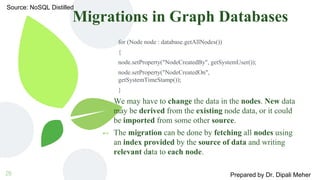
⊷ An example would be adding NodeCreatedBy and
NodeCreatedOn to all existing nodes to track the changes
being made to each node.
27
Source: NoSQL Distilled
Prepared by Dr. Dipali Meher
Migrations in Graph Databases
for (Node node : database.getAllNodes())
{
node.setProperty("NodeCreatedBy", getSystemUser());
node.setProperty("NodeCreatedOn",
getSystemTimeStamp());
}
⊷ We may have to change the data in the nodes. New data
may be derived from the existing node data, or it could
be imported from some other source.
⊷ The migration can be done by fetching all nodes using
an index provided by the source of data and writing
relevant data to each node.
28
Source: NoSQL Distilled
Prepared by Dr. Dipali Meher
Changing Aggregate Structure
⊷ Sometimes you need to change the schema design.
⊷ Example by splitting large objects into smaller ones that are stored
independently.
⊷ Suppose you have a customer aggregate that contains all the customers orders,
and you want to separate the customer and each of their orders into different
aggregate units.
⊷ You then have to ensure that the code can work with both versions of the
aggregates. If it does not find the old objects, it will look for the new
aggregates.
⊷ Code that runs in the background can read one aggregate at a time, make the
necessary change, and save the data back into different aggregates.
⊷ The advantage of operating on one aggregate at a time is that this way, you’re
not affecting data availability for the application.
29
Source: NoSQL Distilled
Prepared by Dr. Dipali Meher
30
Source: NoSQL Distilled
Prepared by Dr. Dipali Meher
Questions to be asked
⊷ Write a short note on Graph Databases.
⊷ What is transition period?
⊷ What is incremental migration?
⊷ Explain incremental migration with and example.
⊷ Write a short note on incremental migration.
⊷ How schema changes will take place in NOSQL data
store? Explain with an example.
⊷ How Schema changes will be done in RDBMS?
Explain with an example.
31

Schema migrations in no sql

  • 1.
    Source: NoSQL Distilled PreparedBy. Dr. Dipali Meher Schema Migrations in NOSQL Dr. Dipali Meher MCS, M.Phil, NET, Ph.D Assistant Professor Modern College of Arts, Science and Commerce, Ganeshkhind Pune 16 mailtomeher@gmail.com/dipalimeher@moderncollegegk.org
  • 2.
    Source: NoSQL Distilled PreparedBy. Dr. Dipali Meher 2
  • 3.
    Source: NoSQL Distilled PreparedBy. Dr. Dipali Meher Agenda  What are database schema?  Schema changes  Schema changes in RDBMS  Schema change sin NOSQL Data Store
  • 4.
    Source: NoSQL Distilled PreparedBy. Dr. Dipali Meher ⊷ The database schema of a database system is its structure described in a formal language supported by the database management system (DBMS). ⊷ The term "schema" refers to the organization of data as a blueprint of how the database is constructed (divided into database tables in the case of relational databases). ⊷ The formal definition of a database schema is a set of formulas (sentences) called integrity constraints imposed on a database.. ⊷ The database schema. This describes how real-world entities are modeled in the database. 4 Database Schema
  • 5.
    Source: NoSQL Distilled PreparedBy. Dr. Dipali Meher In NOSQL…. ⊷ Recent trends in NOSQL is now schemaless nature – This allows developers to concentrate on domain design without worrying about schema changes. ⊷ In case of agility- schema changes are important ⊷ Discussion with domain experts and product owners are important to understand the data. Discussions should not contains only the complexity of database schema. ⊷ In case of NOSQL schema changes will be done with least amount of friction, improving developers productivity and requires careful attention. 5
  • 6.
    Source: NoSQL Distilled PreparedBy. Dr. Dipali Meher Schema Changes in RDBMS ⊷ While developing with standard RDBMS technologies, we develop objects, their corresponding tables, and their relationships. 6
  • 7.
    Source: NoSQL Distilled PreparedBy. Dr. Dipali Meher Schema Changes in a NoSQL Data Store 7 Schema Changes in NOSQL Data Store Migrations in Graph Databases Changing Aggregate Structure Incremental Migration
  • 8.
    Source: NoSQL Distilled Preparedby Dr. Dipali Meher Schema Changes in NOSQL Data Store ⊷ An RDBMS database has to be changed before the application is changed. This is what the schemafree, or schemaless, approach tries to avoid, aiming at flexibility of schema changes per entity. ⊷ Frequent changes to the schema are needed to react to frequent market changes and product Innovations. 8
  • 9.
    Source: NoSQL Distilled Preparedby Dr. Dipali Meher ⊷ When developing with NoSQL databases, in some cases the schema does not have to be thought about beforehand. We still have to design and think about other aspects, such as ⊶ Types of relationships (with graph databases), ⊶ Names of the column families, rows, columns, ⊶ Order of columns (with column databases) ⊶ How are the keys assigned and what is the structure of the data inside the value object (with key-value stores). 9
  • 10.
    Source: NoSQL Distilled Preparedby Dr. Dipali Meher ⊷ It is seen that it is applications responsibility to take care of database schema and data is accepted through application which is to be saved at database.( e.g. verification and validation by an application while accepting data) ⊷ When data is not parsed to database by application then database may throw an error which is to be encountered by an application. So while designing schemaless databases, applications and data which is to be stored both are taking into consideration. ⊷ Schema changes especially matter when there is a deployed application and existing production data. 10
  • 11.
    Source: NoSQL Distilled Preparedby Dr. Dipali Meher Example of Mongodb ⊷ Consider data model as customer, order, orderItems as follows.. { "_id": " 4BD8AE97C47016442AF4A580", "customerid": 99999, "name": "Foo Sushi Inc", "since": "12/12/2012", "order": { "orderid": "4821-UXWE-122012","orderdate": "12/12/2001", "orderItems": [{"product": "Fortune Cookies", "price": 19.99}] } } 11
  • 12.
    Source: NoSQL Distilled Preparedby Dr. Dipali Meher Application code to write this document structure to MongoDB: BasicDBObject orderItem = new BasicDBObject(); orderItem.put("product", productName); orderItem.put("price", price); orderItems.add(orderItem); 12
  • 13.
    Source: NoSQL Distilled Preparedby Dr. Dipali Meher Code to read the document back from the database: BasicDBObject item = (BasicDBObject) orderItem; String productName = item.getString("product"); Double price = item.getDouble("price"); 13
  • 14.
    Source: NoSQL Distilled Preparedby Dr. Dipali Meher ⊷ Changing the objects to add preferredShippingType does not require any change in the database, as the database does not care that different documents do not follow the same schema. ⊷ This allows for faster development and easy deployments. All that needs to be deployed is the application—no changes on the database side are needed. ⊷ The code has to make sure that documents that do not have the preferredShippingType attribute can still be parsed 14
  • 15.
    Source: NoSQL Distilled Preparedby Dr. Dipali Meher Example of schema changes ⊷ introducing discountedPrice and renaming price to fullPrice. To make this change, ⊷ we rename the price attribute to fullPrice and add discountedPrice attribute. ⊷ The changed document is 15
  • 16.
    Source: NoSQL Distilled Preparedby Dr. Dipali Meher { "_id": " 5BD8AE97C47016442AF4A580", "customerid": 66778, "name": "India House", "since": "12/12/2012", "order": { "orderid": "4821-UXWE-222012", "orderdate": "12/12/2001", "orderItems": [{"product": "Chair Covers", "fullPrice": 29.99, "discountedPrice":26.99}] } } 16 Once we deploy this change, new customers and their orders can be saved and read back without problems, but for existing orders the price of their product cannot be read, because now the code is looking for fullPrice but the document has only price.
  • 17.
    Source: NoSQL Distilled Preparedby Dr. Dipali Meher Incremental Migration ⊷ Schema mismatch gives new conversion to NOSQL world. ⊷ When schema is changed on the application, we have to make sure to convert all the existing data to the new schema (depending on data size, this might be an expensive operation). ⊷ Another option would be to make sure that data, before the schema changed, can still be parsed by the new code, and when it’s saved, it is saved back in the new schema. ⊷ This technique, known as incremental migration, will migrate data over time; ⊷ some data may never get migrated, because it was never accessed. 17
  • 18.
    Source: NoSQL Distilled Preparedby Dr. Dipali Meher Incremental Migration The incremental migration technique can also be implemented with a schema_version field on the data, used by the application to choose the correct code to parse the data into the objects. When saving, the data is migrated to the latest version and the schema_version is updated to reflect that. 18
  • 19.
    Source: NoSQL Distilled Preparedby Dr. Dipali Meher Incremental Migration ⊷ A proper translation layer between your domain and the database is important so that, as the schema changes, managing multiple versions of the schema is restricted to the translation layer and does not leak into the whole application. ⊷ Mobile apps create special requirements. Since we cannot enforce the latest upgrades of the application, the application should be able to handle almost all versions of the schema. 19
  • 20.
    Source: NoSQL Distilled Preparedby Dr. Dipali Meher Example Incremental Migration Read price and fullPrice from document BasicDBObject item = (BasicDBObject) orderItem; String productName = item.getString("product"); Double fullPrice = item.getDouble("price"); if (fullPrice == null) { fullPrice = item.getDouble("fullPrice"); } Double discountedPrice = item.getDouble("discountedPrice"); 20
  • 21.
    Source: NoSQL Distilled Preparedby Dr. Dipali Meher When writing the document back, the old attribute price is not saved: BasicDBObject orderItem = new BasicDBObject(); orderItem.put("product", productName); orderItem.put("fullPrice", price); orderItem.put("discountedPrice", discountedPrice); orderItems.add(orderItem); 21
  • 22.
    Source: NoSQL Distilled Preparedby Dr. Dipali Meher When using incremental migration, there could be many versions of the object on the application side that can translate the old schema to the new schema; while saving the object back, it is saved using the new object. This gradual migration of the data helps the application evolve faster. 22
  • 23.
    Source: NoSQL Distilled Preparedby Dr. Dipali Meher The incremental migration technique will complicate the object design, especially as new changes are being introduced yet old changes are not being taken out. This period between the change deployment and the last object in the database migrating to the new schema is known as the transition period 23
  • 24.
    Source: NoSQL Distilled Preparedby Dr. Dipali Meher Transition Period of Schema Changes 24
  • 25.
    Source: NoSQL Distilled Preparedby Dr. Dipali Meher Migrations in Graph Databases ⊷ Graph databases have edges that have types and properties. If you change the type of these edges in the codebase, you no longer can traverse the database, rendering it unusable. ⊷ To get around this, you can traverse all the edges and change the type of each edge. ⊷ This operation can be expensive and requires you to write code to migrate all the edges in the database. 25
  • 26.
    Source: NoSQL Distilled Preparedby Dr. Dipali Meher Migrations in Graph Databases ⊷ If we need to maintain backward compatibility or do not want to change the whole graph in one go, we can just create new edges between the nodes; later when we are comfortable about the change, the old edges can be dropped. ⊷ We can use traversals with multiple edge types to traverse the graph using the new and old edge types. ⊷ This technique may help a great deal with large databases, especially if we want to maintain high availability. 26
  • 27.
    Source: NoSQL Distilled Preparedby Dr. Dipali Meher Migrations in Graph Databases ⊷ If we have to change properties on all the nodes or edges, we have to fetch all the nodes and change all the properties that need to be changed. ⊷ An example would be adding NodeCreatedBy and NodeCreatedOn to all existing nodes to track the changes being made to each node. 27
  • 28.
    Source: NoSQL Distilled Preparedby Dr. Dipali Meher Migrations in Graph Databases for (Node node : database.getAllNodes()) { node.setProperty("NodeCreatedBy", getSystemUser()); node.setProperty("NodeCreatedOn", getSystemTimeStamp()); } ⊷ We may have to change the data in the nodes. New data may be derived from the existing node data, or it could be imported from some other source. ⊷ The migration can be done by fetching all nodes using an index provided by the source of data and writing relevant data to each node. 28
  • 29.
    Source: NoSQL Distilled Preparedby Dr. Dipali Meher Changing Aggregate Structure ⊷ Sometimes you need to change the schema design. ⊷ Example by splitting large objects into smaller ones that are stored independently. ⊷ Suppose you have a customer aggregate that contains all the customers orders, and you want to separate the customer and each of their orders into different aggregate units. ⊷ You then have to ensure that the code can work with both versions of the aggregates. If it does not find the old objects, it will look for the new aggregates. ⊷ Code that runs in the background can read one aggregate at a time, make the necessary change, and save the data back into different aggregates. ⊷ The advantage of operating on one aggregate at a time is that this way, you’re not affecting data availability for the application. 29
  • 30.
    Source: NoSQL Distilled Preparedby Dr. Dipali Meher 30
  • 31.
    Source: NoSQL Distilled Preparedby Dr. Dipali Meher Questions to be asked ⊷ Write a short note on Graph Databases. ⊷ What is transition period? ⊷ What is incremental migration? ⊷ Explain incremental migration with and example. ⊷ Write a short note on incremental migration. ⊷ How schema changes will take place in NOSQL data store? Explain with an example. ⊷ How Schema changes will be done in RDBMS? Explain with an example. 31