SQLVS.
MONGODB
www.calltutors.com
Are you interested in knowing the differences between SQL vs.
Mongo DB?Would you like to know what drives the choice
between Mongo DB and SQL Database? If yes, then you have
come to the right place.
Whenever a system or application deals with large amounts of
data, it requires database support to manage all of the system’s
requirements.The SQL Database has long been a popular choice
for implementing many database applications that use Structured
Query Language, but it remains primarily focused on helpingWeb
databases perform well.
www.calltutors.com
Introduction to SQL
For the deployment of Cloud applications, SQL Databases are
typically used as Relational Databases. In addition to high-
performance analytics, they provide various features for
accessing, adding, managing, and processing data. It is a
Database System that is easy to use, contains robust classification
features, and offers uncomplicated reliability.
www.calltutors.com
History of SQL
The great computer scientist “E.F. Codd” published “A Relational Model of
Data for Large Shared Data Banks” in 1970.
To create the SEQUEL (Structured English Query Language), IBM
researchers Raymond Boyce and Donald Chamberlin learned about it in an
E.F. Codd paper. It was at IBM Corporation’s San Jose Research Laboratory
that they developed SQL in 1970.
www.calltutors.com
Features of SQL
In general, SQL functions offer many features.
• A SQL operation can easily be implemented using SQL procedural language
statements and features, which allow you to integrate control-flow logic into
conventional static and dynamic SQL statements.
• A SQL function is usually more reliable than an equivalent external function.
• Provide input parameters.
• Scalar SQL functions return numerical values.
• Provide a powerful but straightforward model for handling conditions and errors.
www.calltutors.com
Introduction to MongoDB
It’s an open-source, NoSQL document database. It is popularly used in
conjunction with AmazonWeb Services, Azure, and other data sources for
application development and ongoing operation.
In simple terms, MongoDB is a document-oriented database.This open-
source product is developed and supported by 10gen.
www.calltutors.com
History of MongoDB
Mongo DB was initially developed in 2007 as the company worked on a platform
as a service similar to Microsoft Azure.
Mongo DB was created by 10gen, an organization headquartered in NewYork
known as Mongo DB Inc.The platform was initially designed as a PAAS (Platform
as a Service).Towards the end of 2009, Mongo DB Inc. introduced it in the market
as an open-source database server.
www.calltutors.com
Features of MongoDB
There are the following features of MongoDB:
• There are multiple search options in MongoDB, including field, range, and
regular expression categories.
• Any area can index documents.
• A load balancing configuration is automatically implemented because the
data is split into shards.
• It provides tools for map reduction and aggregation.
• The code is written in JavaScript instead of Procedures
www.calltutors.com
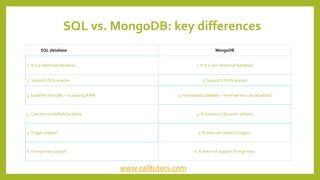
SQL vs. MongoDB: key differences
SQL database MongoDB
1. It is a relational database 1. It is a non-relational database
2. Supports SQL queries 2. Supports JSON queries
3. Scalable vertically – increasing RAM 3. Horizontal scalability – more servers can be added
4. Contains predefined schema 4. It contains a dynamic schema
5.Trigger support 5. It does not support triggers
6. Foreign key support 6. It does not support foreign keys
www.calltutors.com
Conclusion
In this article, we examined MongoDB and SQL Databases and the various factors that
influence both decisions.
As a result, it’s fair to say that SQL databases are more appropriate for businesses and
industries dealing with structured and relational data. High-traffic websites are
benefited from this tool, and a high-performance query engine is provided. SQL
Databases provide data insertions, custom web functions, quick processing, and fast
reliability.
www.calltutors.com
ThankYou
Social Media Links

SQL vs MongoDB

  • 1.
  • 2.
    Are you interestedin knowing the differences between SQL vs. Mongo DB?Would you like to know what drives the choice between Mongo DB and SQL Database? If yes, then you have come to the right place. Whenever a system or application deals with large amounts of data, it requires database support to manage all of the system’s requirements.The SQL Database has long been a popular choice for implementing many database applications that use Structured Query Language, but it remains primarily focused on helpingWeb databases perform well. www.calltutors.com
  • 3.
    Introduction to SQL Forthe deployment of Cloud applications, SQL Databases are typically used as Relational Databases. In addition to high- performance analytics, they provide various features for accessing, adding, managing, and processing data. It is a Database System that is easy to use, contains robust classification features, and offers uncomplicated reliability. www.calltutors.com
  • 4.
    History of SQL Thegreat computer scientist “E.F. Codd” published “A Relational Model of Data for Large Shared Data Banks” in 1970. To create the SEQUEL (Structured English Query Language), IBM researchers Raymond Boyce and Donald Chamberlin learned about it in an E.F. Codd paper. It was at IBM Corporation’s San Jose Research Laboratory that they developed SQL in 1970. www.calltutors.com
  • 5.
    Features of SQL Ingeneral, SQL functions offer many features. • A SQL operation can easily be implemented using SQL procedural language statements and features, which allow you to integrate control-flow logic into conventional static and dynamic SQL statements. • A SQL function is usually more reliable than an equivalent external function. • Provide input parameters. • Scalar SQL functions return numerical values. • Provide a powerful but straightforward model for handling conditions and errors. www.calltutors.com
  • 6.
    Introduction to MongoDB It’san open-source, NoSQL document database. It is popularly used in conjunction with AmazonWeb Services, Azure, and other data sources for application development and ongoing operation. In simple terms, MongoDB is a document-oriented database.This open- source product is developed and supported by 10gen. www.calltutors.com
  • 7.
    History of MongoDB MongoDB was initially developed in 2007 as the company worked on a platform as a service similar to Microsoft Azure. Mongo DB was created by 10gen, an organization headquartered in NewYork known as Mongo DB Inc.The platform was initially designed as a PAAS (Platform as a Service).Towards the end of 2009, Mongo DB Inc. introduced it in the market as an open-source database server. www.calltutors.com
  • 8.
    Features of MongoDB Thereare the following features of MongoDB: • There are multiple search options in MongoDB, including field, range, and regular expression categories. • Any area can index documents. • A load balancing configuration is automatically implemented because the data is split into shards. • It provides tools for map reduction and aggregation. • The code is written in JavaScript instead of Procedures www.calltutors.com
  • 9.
    SQL vs. MongoDB:key differences SQL database MongoDB 1. It is a relational database 1. It is a non-relational database 2. Supports SQL queries 2. Supports JSON queries 3. Scalable vertically – increasing RAM 3. Horizontal scalability – more servers can be added 4. Contains predefined schema 4. It contains a dynamic schema 5.Trigger support 5. It does not support triggers 6. Foreign key support 6. It does not support foreign keys www.calltutors.com
  • 10.
    Conclusion In this article,we examined MongoDB and SQL Databases and the various factors that influence both decisions. As a result, it’s fair to say that SQL databases are more appropriate for businesses and industries dealing with structured and relational data. High-traffic websites are benefited from this tool, and a high-performance query engine is provided. SQL Databases provide data insertions, custom web functions, quick processing, and fast reliability. www.calltutors.com
  • 11.