Operating
Systems
3-
Scheduling
1
3. Process Scheduling
Three Level
Scheduling
3-
Scheduling
2
Scheduling and Process
Transitions
3-
Scheduling
3
Long- and Medium-Term
Schedulers
• Long-term scheduler
– Determines which programs
are admitted to the system
 I.e., to become processes
– Requests can be denied
 E.g., in case of thrashing or
overload
• Medium-term scheduler
– Decides when/which processes
to suspend/resume
• Both control the degree
of multiprogramming
– More processes, smaller
percentage of time each process
is executed 3-
Scheduling
4
CPU–I/O Burst
Cycle
• Process execution consists of a cycle
of
– CPU execution and
– I/O wait
• A process may be
– CPU-bound : Long CPU bursts
– IO-bound : Short CPU bursts
3-
Scheduling
5
Short-Term Scheduler: Selection of a New
Process
Ne
w
Admi
t Runnin
g
Read
y
Dispatc
h
Time-
out
Blocke
d
Event
wait
1. Wait for I/O,
waitpid(),
semaphore
etc.
2. Interrupt occurs,
move from Running
to
Ready
Release
Exit
Event
occurs
3. Event I/O
Completion,
exit(0),
semaphore
acquire
4. A Process
terminates
• Four
cases
3-
Scheduling
6
Decision
Mode
3-
Scheduling
7
Non preemptive
• Once a process is in the running state, it will continue until it
terminates or blocks itself for I/O, child process, semaphore
etc.
Preemptive
• Currently running process may be interrupted
• Now transition from Running to Ready state possible
• Prevents a single process to monopolize the processor for
very long
Non Preemptive
Scheduling
• Only the case 1 and
4
Ne
w
Exi
t
Admi
t
Releas
e
Runnin
g
Read
y
Dispatc
h
Time-
out
Blocke
d
Event
occurs Event
wait
1. Wait for I/O,
waitpid(),
semaphore
etc.
4. A Process
terminates
3-
Scheduling
8
Preemptive
Scheduling
• All four cases
possible
Ne
w
Admi
t Runnin
g
Read
y
Dispatc
h
Time-
out
Blocke
d
Event
wait
1. Wait for I/O,
waitpid(),
semaphore
etc.
2. Interrupt occurs,
move from Running
to
Ready
Release
Exit
Event
occurs
3. Event I/O
Completion,
exit(0),
semaphore
acquire
4. A Process
terminates
3-
Scheduling
9
Preemptive
Scheduling
• In case of 2 and 3, there is a choice
– Whether to continue, with the same
process
– Or select a new one from the ready
queue
3-
Scheduling
10
Ne
w
Admi
t Runnin
g
Read
y
Dispatc
h
Time-
out
Blocke
d
Event
wait
2. Interrupt occurs,
move from Running
to
Ready
Release
Exit
Event
occurs
3. Event I/O
Completion,
exit(0),
semaphore
acquire
Short-Term
Scheduler
• Decides which process will
be dispatched
– Invoked upon Clock interrupts,
I/O interrupts, Operating
system calls, Signals
• Dispatch latency: Period of time
the dispatcher needs to stop
one process and start another
running
• Dominating factors
– Switching context
– Selecting a process to dispatch
• Arrival time: Time when a process
is admitted to the system
• Service Time: Period of time a
process executes in running
state
3-
Scheduling
11
Scheduling
Issues
3-
Scheduling
12
• Fairness
– Don’t starve process
• Priorities
– Most important first
• Deadlines
– Task X must be done by time t
• Optimization
– Throughput, response time
• Scheduler Efficiency
– Overhead, e.g., context switching, computing
priorities, …
• Reality - No universal scheduling policy
– Many models
Scheduling Criteria and Optimization
goals
3-
Scheduling
13
• CPU utilization
– Percentage of time CPU is busy
– Keep CPU as busy as possible
• Throughput
– No. of processes that complete their execution per time
unit
• Turnaround time (TAT)
– Amount of time to execute a particular process
– TAT = Time of completion – Arrival time
 Execution + all the waiting for resources including CPU
 Involves also the IO schedulers
– Not a good criteria for interactive systems
Scheduling Criteria and Optimization
goals
3-
Scheduling
14
• Waiting time
– Waiting Time = Sum of the periods spent waiting in the Ready
queue
– Scheduling Algorithm does not effect the waiting time in Block
queue
 Only effect the waiting time in the Ready queue
 Waiting time = turnaround time – burst time
• Response time
– Amount of time from submission of the request until first
response
– Response time = First response – Arrival time
 Execution + waiting time in ready queue
• Summary
– Maximize: CPU utilization, Throughput
– Minimize: Turnaround time, Waiting time, Response time
First-Come-First-Served
(FCFS)
• Wait time depends on arrival order
• Worst case: long job arrives first
• Example: Three processes with service times: A=100, B=1,
C=2
– Case 1: Processes arrive in the order A, B, C
A B C
time
100
101
1 03
Average Waiting Time = (0 + 100 + 101) / 3 = 67
– Case 2: Processes arrive in the order B, C, A
time
1
10
3
A
B C
3-
Scheduling
15
3
Average Waiting Time = (0 + 1 + 3) / 3 = 1.33
First-Come-First-Served
(FCFS)
• Non-preemptive
• Favors CPU-bound processes
• A short process may have to wait
very long before it can execute
• Convoy effect – Many I/O processes
may stuck behind CPU-bound process
0 5 10 15 20
A
B
C
D
E
Burst Time
3-
Scheduling
16
First-Come-First-Served (FCFS) – Convoy
Effect
3-
Scheduling
17
Consider one CPU-bound and many I/O-bound processes
1. The CPU intensive process blocks the CPU
2. A number of I/O intensive processes stuck behind this
process
– Leaving the I/O devices idle
– Low I/O device utilization
3. When the CPU-bound process finally issues I/O request
– I/O processes pass through the CPU quickly
– Leaving the CPU idle while everyone queues up for I/O
4. The cycle repeats itself when the CPU intensive process gets
back to the ready queue
Shortest Job First (SJF) – Non-
preemptive
• Associate with each process the
length of its next CPU burst
– Short process jumps ahead of
longer processes
• Avoid convoy effect
0 5 10 15 20
A
B
C
D
E
Burst Time
3-
Scheduling
18
SJF (Non-preemptive) –
Example
• Average waiting time = (3 + 16 + 9 + 0) / 4 = 7
Process Burst time
P1 6
P2 8
P3 7
P4 3
P4
P3
P1
3 16
0 9
3-
Scheduling
19
P2
24
SJF (Non-preemptive) –
Example
Process Arrival time Burst time
P1 0 7
P2 2 4
P3 4 1
P4 5 4
P1 P3 P2
16
0
3
• Average waiting time
– (0 + 6 + 3 + 7)/4 =
4
P4
7
8
12
3-
Scheduling
20
Shortest Remaining Time First –
Example
• Average waiting time
– (9 + 1 + 0 + 2)/4 =
3
Process Arrival time Burst time
P1 0 7
P2 2 4
P3 4 1
P4 5 4
P1 P3
P2
11
0
P4
2 4
5
7
P2 P1
16
3-
Scheduling
21
Shortest Remaining Time First –
Example
Process Arrival time Burst time
P1 0 8
P2 1 4
P3 2 9
P4 3 5
P1
P1
P2
17
3-
Scheduling
22
0
1 5 10
• Average waiting time
– [(10-1)+(1-1)+(17-2)+5-3)]/4 = 26/4
= 6.5
P3
26
P4
Performance of SJF
Scheduling
• Gives high throughput
• Gives minimum average waiting time for a given set of
processes
SJF:
P1:
P2:
P3:
Ru
n
R
FCFS:
P1:
P2:
P3:
I/O
Ru
n
Read
y
I/O
I/O
Read
y
Ru
n
Read
y
Read
y
Ru
n
R
I/O
Read
y
I/O I/O
Rd
Run
I/O Ru
n
Rd R
I/O
R
Tim
e
3-
Scheduling
23
Dispatcher Performance:
SJF
• Dispatcher utilizes heap operations
– Enqueue: insert_heap(Pi, ti )
– Dequeue: del_min()
– Decrease the priority dynamically
• Performance depends on
implementation
– Binary Heap
 Insert : O(log2 n)
 Dequeue: O(log2 n)
10
3-
Scheduling
24
20 30
25 45
Shortest Remaining Time
First
3-
Scheduling
25
• Shortest Job First (SJF) can be preemptive or non-
preemptive
– Preemptive SJF is also called Shortest Remaining Time First
Overall Idea
• While an existing process is executing
– A new process arrives at the ready queue
• Existing process is preemptive
– If the CPU burst of the newly arrived process is shorter than
the remaining execution time of existing process
Properties of
SJF
3-
Scheduling
26
• Possibility of starvation for longer processes
• Must estimate length of next CPU burst
– Need for an algorithm that adapts the estimate
dynamically
– Algorithm must deal with variable length of CPU bursts
 Exponential averaging
• What if estimates are not correct?
– Preemption by the operating system
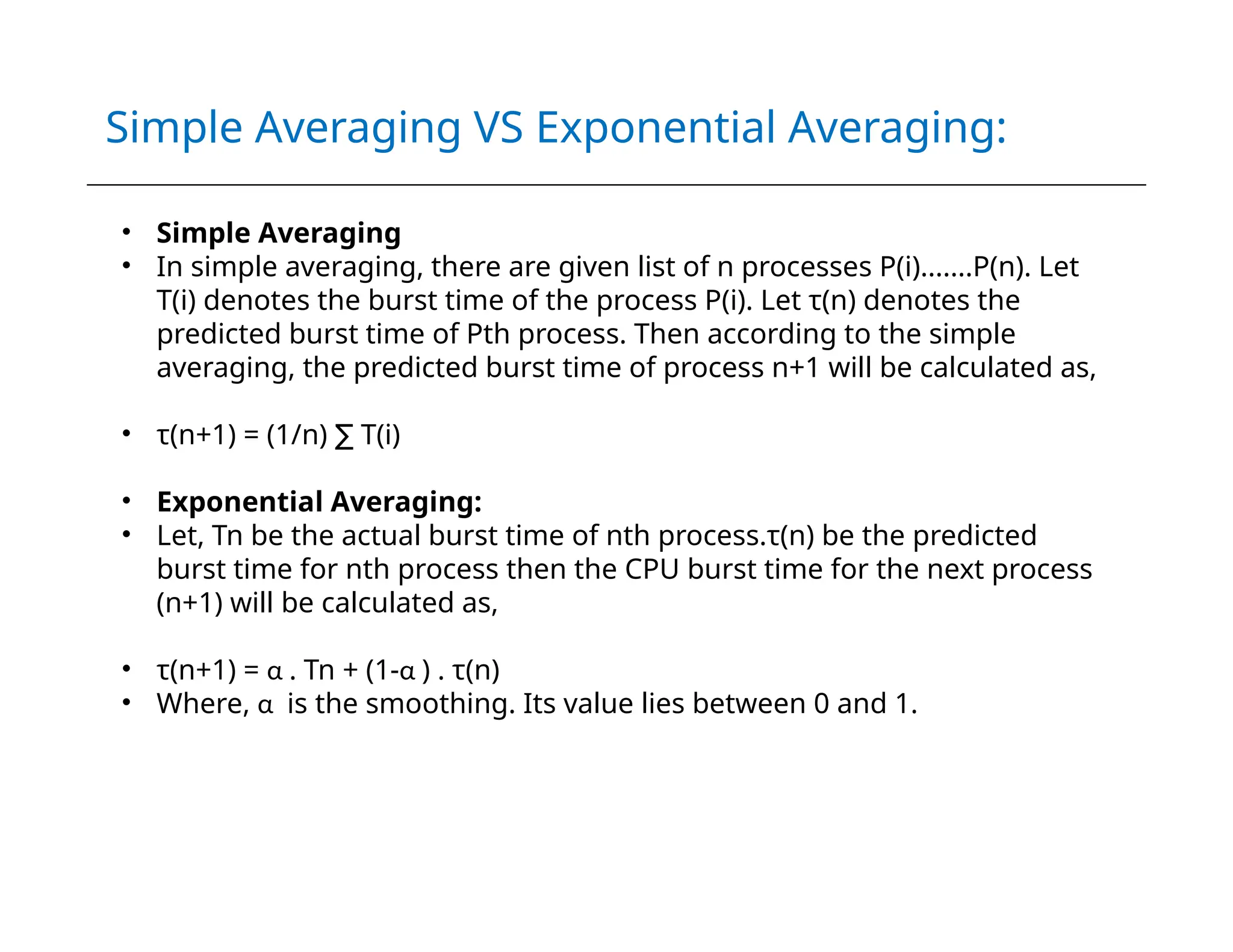
Simple Averaging VS Exponential Averaging:
• Simple Averaging
• In simple averaging, there are given list of n processes P(i).......P(n). Let
T(i) denotes the burst time of the process P(i). Let τ(n) denotes the
predicted burst time of Pth process. Then according to the simple
averaging, the predicted burst time of process n+1 will be calculated as,
• τ(n+1) = (1/n) T(i)
∑
• Exponential Averaging:
• Let, Tn be the actual burst time of nth process.τ(n) be the predicted
burst time for nth process then the CPU burst time for the next process
(n+1) will be calculated as,
• τ(n+1) = α . Tn + (1-α ) . τ(n)
• Where, α is the smoothing. Its value lies between 0 and 1.
Round Robin – Example with Time Quantum =
4
Process Burst time
P1 24
P2 3
P3 3
P1 P2 P3 P1 P1 P1 P1 P1
3-
Scheduling
28
0 4 7 10 14 18
22
2
6
3
0
• Process may have CPU burst of less than 1 time
quantum
– Process itself release the CPU voluntarily
– Dispatcher will proceed to the next process in ready
queue
Round
Robin
0 5 10 15 20
A
B
C
D
E
• Preemption based on clock (interrupts on
time slice or quantum -q- usually 10-100
msec)
• Fairness: for nprocesses, each gets 1/n of
the CPU time in chunks of at most q time
units
• Performance
– q large  FCFS
– q small  overhead can be high due
to context switches
Burst Time
3-
Scheduling
29
Time Quantum and Context Switch
Time
• Quantum –q- should be large compared to context switch
time
• Quantum –q- usually 10ms to 100ms, context switch < 10
usec
3-
Scheduling
30
Round
Robin
• Low average waiting time when job lengths vary
• Example: Three processes with service times: A=100, B=1,
C=2
1 2 3 4
5
10
3
time
• Average waiting time
– (3 + 1 + 3) / 3
• Average completion (Turn around time)
– (103 + 2 + 5) / 3
CP
U
A
B
C
A C
3-
Scheduling
31
A
Round Robin –
Disadvantage
• Good for Varying sized jobs
• But what about same-sized processes?
• Example: Two processes with same service time
=100
1 2 3 4 5
199
200
CP
U
A
B
A B
A B
A B
3-
Scheduling
32
A
time
• Average completion time, i.e., Turn Around Time (TAT)?
– (200 + 200) / 2 = 200
• How does this compare with FCFS for same two jobs?
– (100 + 200) / 2 = 150
Dispatcher Performance: Round Robin and
FCFS
• Maintain linked list
– Dequeue: Remove
head
– Enqueue: Append tail
• Cost
– Enqueue: O(1)
– Dequeue: O(1)
Pn P1
P2
Pn-1 …
3-
Scheduling
33
Priority
Scheduling
3-
Scheduling
34
Scheduler can choose a process of higher priority over one of
lower priority
• Can be preemptive or non-preemptive
• Priorities can be static or dynamic
• E.g., in SJF priority is the predicted next CPU burst time
Problem of priority based schemes: Danger for starvation
• Low priority processes may never execute
• E.g., process with a long CPU burst in SJF may never execute
A solution: Aging
• As time advances the priority of a process is increased
• Longest running processes eventually reaches highest
priority
Priority Scheduling –
Example
• Average waiting time =
8.2
Process Priority Burst time
P1 3 10
P2 1 1
P3 4 2
P4 5 1
P5 2 5
P2 P3
P5
1
3-
Scheduling
35
18
19
0 16
P4
6
P1
Priority
Scheduling
3-
Scheduling
36
• If processes have equal priority
– Round robin
– FCFS
• I/O Bound vs. CPU Bound
– Which type of processes should be given Higher Priority
– In order to keep I/O busy increase priority for jobs that often block
on I/O
Multilevel
Queue
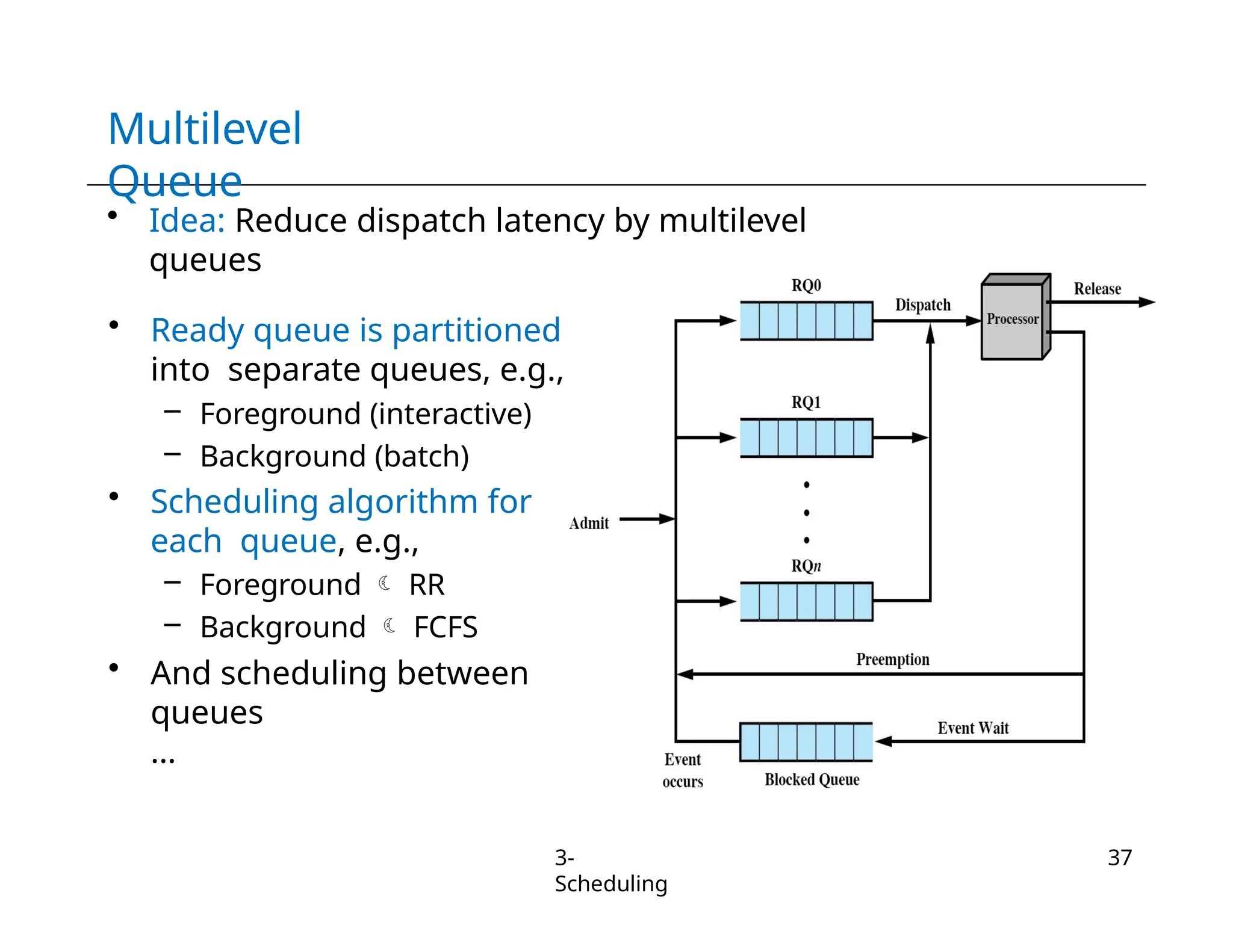
• Idea: Reduce dispatch latency by multilevel
queues
• Ready queue is partitioned
into separate queues, e.g.,
– Foreground (interactive)
– Background (batch)
• Scheduling algorithm for
each queue, e.g.,
– Foreground  RR
– Background  FCFS
• And scheduling between
queues
…
3-
Scheduling
37
Multilevel Queues: Scheduling Between the
Queues
Fixed order/priority e.g.,
• Serve all from foreground
then from background
• Possible starvation
Time slice
• Each queue gets a fraction
of CPU time to divide
amongst its processes, e.g.,
– 80% to foreground in RR
– 20% to background in FCFS
3-
Scheduling
38
Multilevel Queue Scheduling –
Example
39
Student
Processes
Highest Priority
System Processes
Interactive Processes
Interactive editing
Processes Batch
Processes
3-
Scheduling
39
Lowest
Priority
Multilevel Feedback
Queue
3-
Scheduling
40
• A process can move between the various
queues
– Aging can be implemented this way
• Scheduling parameters
– Number of queues
– Scheduling algorithms for
each queue
– Method to upgrade a
process
– Method to demote a process
– Method used to determine
which queue a process enters
first
Approximation of SJF: Multilevel Feedback
Queue
i
Admission of i:
• Assign process
to
Dispatch()
0
• Find smallest level
s.t.
level
j .dequeue(
)
• Set time slice to fit level of
process
Upon state change ( i)
• Running eady
,
level.enqueue( i)
• Dispatch()
Upon state change ( i)
• Running blocked
• Enqueue i to Event Queue
• Dispatch()
3-
Scheduling
41
Multilevel Feedback Queues –
Example
3-
Scheduling
42
• Three queues
– Q0 – RR with time quantum 8
ms
– Q1 – RR time quantum 16 ms
– Q2 – FCFS
• Scheduling
– A new process enters queue Q0
– When it gains CPU, process receives 8 ms
– If it does not finish in 8 ms, process is moved to queue Q1
– At Q1 process 16 additional ms
– If it still does not complete, it is preempted and moved to queue
Q2
Starvation is still possible
here!
Any Question So
Far?
3-
Scheduling
43

Chapter 3 - Operating System Scheduling.pptx

  • 1.
  • 2.
  • 3.
  • 4.
    Long- and Medium-Term Schedulers •Long-term scheduler – Determines which programs are admitted to the system  I.e., to become processes – Requests can be denied  E.g., in case of thrashing or overload • Medium-term scheduler – Decides when/which processes to suspend/resume • Both control the degree of multiprogramming – More processes, smaller percentage of time each process is executed 3- Scheduling 4
  • 5.
    CPU–I/O Burst Cycle • Processexecution consists of a cycle of – CPU execution and – I/O wait • A process may be – CPU-bound : Long CPU bursts – IO-bound : Short CPU bursts 3- Scheduling 5
  • 6.
    Short-Term Scheduler: Selectionof a New Process Ne w Admi t Runnin g Read y Dispatc h Time- out Blocke d Event wait 1. Wait for I/O, waitpid(), semaphore etc. 2. Interrupt occurs, move from Running to Ready Release Exit Event occurs 3. Event I/O Completion, exit(0), semaphore acquire 4. A Process terminates • Four cases 3- Scheduling 6
  • 7.
    Decision Mode 3- Scheduling 7 Non preemptive • Oncea process is in the running state, it will continue until it terminates or blocks itself for I/O, child process, semaphore etc. Preemptive • Currently running process may be interrupted • Now transition from Running to Ready state possible • Prevents a single process to monopolize the processor for very long
  • 8.
    Non Preemptive Scheduling • Onlythe case 1 and 4 Ne w Exi t Admi t Releas e Runnin g Read y Dispatc h Time- out Blocke d Event occurs Event wait 1. Wait for I/O, waitpid(), semaphore etc. 4. A Process terminates 3- Scheduling 8
  • 9.
    Preemptive Scheduling • All fourcases possible Ne w Admi t Runnin g Read y Dispatc h Time- out Blocke d Event wait 1. Wait for I/O, waitpid(), semaphore etc. 2. Interrupt occurs, move from Running to Ready Release Exit Event occurs 3. Event I/O Completion, exit(0), semaphore acquire 4. A Process terminates 3- Scheduling 9
  • 10.
    Preemptive Scheduling • In caseof 2 and 3, there is a choice – Whether to continue, with the same process – Or select a new one from the ready queue 3- Scheduling 10 Ne w Admi t Runnin g Read y Dispatc h Time- out Blocke d Event wait 2. Interrupt occurs, move from Running to Ready Release Exit Event occurs 3. Event I/O Completion, exit(0), semaphore acquire
  • 11.
    Short-Term Scheduler • Decides whichprocess will be dispatched – Invoked upon Clock interrupts, I/O interrupts, Operating system calls, Signals • Dispatch latency: Period of time the dispatcher needs to stop one process and start another running • Dominating factors – Switching context – Selecting a process to dispatch • Arrival time: Time when a process is admitted to the system • Service Time: Period of time a process executes in running state 3- Scheduling 11
  • 12.
    Scheduling Issues 3- Scheduling 12 • Fairness – Don’tstarve process • Priorities – Most important first • Deadlines – Task X must be done by time t • Optimization – Throughput, response time • Scheduler Efficiency – Overhead, e.g., context switching, computing priorities, … • Reality - No universal scheduling policy – Many models
  • 13.
    Scheduling Criteria andOptimization goals 3- Scheduling 13 • CPU utilization – Percentage of time CPU is busy – Keep CPU as busy as possible • Throughput – No. of processes that complete their execution per time unit • Turnaround time (TAT) – Amount of time to execute a particular process – TAT = Time of completion – Arrival time  Execution + all the waiting for resources including CPU  Involves also the IO schedulers – Not a good criteria for interactive systems
  • 14.
    Scheduling Criteria andOptimization goals 3- Scheduling 14 • Waiting time – Waiting Time = Sum of the periods spent waiting in the Ready queue – Scheduling Algorithm does not effect the waiting time in Block queue  Only effect the waiting time in the Ready queue  Waiting time = turnaround time – burst time • Response time – Amount of time from submission of the request until first response – Response time = First response – Arrival time  Execution + waiting time in ready queue • Summary – Maximize: CPU utilization, Throughput – Minimize: Turnaround time, Waiting time, Response time
  • 15.
    First-Come-First-Served (FCFS) • Wait timedepends on arrival order • Worst case: long job arrives first • Example: Three processes with service times: A=100, B=1, C=2 – Case 1: Processes arrive in the order A, B, C A B C time 100 101 1 03 Average Waiting Time = (0 + 100 + 101) / 3 = 67 – Case 2: Processes arrive in the order B, C, A time 1 10 3 A B C 3- Scheduling 15 3 Average Waiting Time = (0 + 1 + 3) / 3 = 1.33
  • 16.
    First-Come-First-Served (FCFS) • Non-preemptive • FavorsCPU-bound processes • A short process may have to wait very long before it can execute • Convoy effect – Many I/O processes may stuck behind CPU-bound process 0 5 10 15 20 A B C D E Burst Time 3- Scheduling 16
  • 17.
    First-Come-First-Served (FCFS) –Convoy Effect 3- Scheduling 17 Consider one CPU-bound and many I/O-bound processes 1. The CPU intensive process blocks the CPU 2. A number of I/O intensive processes stuck behind this process – Leaving the I/O devices idle – Low I/O device utilization 3. When the CPU-bound process finally issues I/O request – I/O processes pass through the CPU quickly – Leaving the CPU idle while everyone queues up for I/O 4. The cycle repeats itself when the CPU intensive process gets back to the ready queue
  • 18.
    Shortest Job First(SJF) – Non- preemptive • Associate with each process the length of its next CPU burst – Short process jumps ahead of longer processes • Avoid convoy effect 0 5 10 15 20 A B C D E Burst Time 3- Scheduling 18
  • 19.
    SJF (Non-preemptive) – Example •Average waiting time = (3 + 16 + 9 + 0) / 4 = 7 Process Burst time P1 6 P2 8 P3 7 P4 3 P4 P3 P1 3 16 0 9 3- Scheduling 19 P2 24
  • 20.
    SJF (Non-preemptive) – Example ProcessArrival time Burst time P1 0 7 P2 2 4 P3 4 1 P4 5 4 P1 P3 P2 16 0 3 • Average waiting time – (0 + 6 + 3 + 7)/4 = 4 P4 7 8 12 3- Scheduling 20
  • 21.
    Shortest Remaining TimeFirst – Example • Average waiting time – (9 + 1 + 0 + 2)/4 = 3 Process Arrival time Burst time P1 0 7 P2 2 4 P3 4 1 P4 5 4 P1 P3 P2 11 0 P4 2 4 5 7 P2 P1 16 3- Scheduling 21
  • 22.
    Shortest Remaining TimeFirst – Example Process Arrival time Burst time P1 0 8 P2 1 4 P3 2 9 P4 3 5 P1 P1 P2 17 3- Scheduling 22 0 1 5 10 • Average waiting time – [(10-1)+(1-1)+(17-2)+5-3)]/4 = 26/4 = 6.5 P3 26 P4
  • 23.
    Performance of SJF Scheduling •Gives high throughput • Gives minimum average waiting time for a given set of processes SJF: P1: P2: P3: Ru n R FCFS: P1: P2: P3: I/O Ru n Read y I/O I/O Read y Ru n Read y Read y Ru n R I/O Read y I/O I/O Rd Run I/O Ru n Rd R I/O R Tim e 3- Scheduling 23
  • 24.
    Dispatcher Performance: SJF • Dispatcherutilizes heap operations – Enqueue: insert_heap(Pi, ti ) – Dequeue: del_min() – Decrease the priority dynamically • Performance depends on implementation – Binary Heap  Insert : O(log2 n)  Dequeue: O(log2 n) 10 3- Scheduling 24 20 30 25 45
  • 25.
    Shortest Remaining Time First 3- Scheduling 25 •Shortest Job First (SJF) can be preemptive or non- preemptive – Preemptive SJF is also called Shortest Remaining Time First Overall Idea • While an existing process is executing – A new process arrives at the ready queue • Existing process is preemptive – If the CPU burst of the newly arrived process is shorter than the remaining execution time of existing process
  • 26.
    Properties of SJF 3- Scheduling 26 • Possibilityof starvation for longer processes • Must estimate length of next CPU burst – Need for an algorithm that adapts the estimate dynamically – Algorithm must deal with variable length of CPU bursts  Exponential averaging • What if estimates are not correct? – Preemption by the operating system
  • 27.
    Simple Averaging VSExponential Averaging: • Simple Averaging • In simple averaging, there are given list of n processes P(i).......P(n). Let T(i) denotes the burst time of the process P(i). Let τ(n) denotes the predicted burst time of Pth process. Then according to the simple averaging, the predicted burst time of process n+1 will be calculated as, • τ(n+1) = (1/n) T(i) ∑ • Exponential Averaging: • Let, Tn be the actual burst time of nth process.τ(n) be the predicted burst time for nth process then the CPU burst time for the next process (n+1) will be calculated as, • τ(n+1) = α . Tn + (1-α ) . τ(n) • Where, α is the smoothing. Its value lies between 0 and 1.
  • 28.
    Round Robin –Example with Time Quantum = 4 Process Burst time P1 24 P2 3 P3 3 P1 P2 P3 P1 P1 P1 P1 P1 3- Scheduling 28 0 4 7 10 14 18 22 2 6 3 0 • Process may have CPU burst of less than 1 time quantum – Process itself release the CPU voluntarily – Dispatcher will proceed to the next process in ready queue
  • 29.
    Round Robin 0 5 1015 20 A B C D E • Preemption based on clock (interrupts on time slice or quantum -q- usually 10-100 msec) • Fairness: for nprocesses, each gets 1/n of the CPU time in chunks of at most q time units • Performance – q large  FCFS – q small  overhead can be high due to context switches Burst Time 3- Scheduling 29
  • 30.
    Time Quantum andContext Switch Time • Quantum –q- should be large compared to context switch time • Quantum –q- usually 10ms to 100ms, context switch < 10 usec 3- Scheduling 30
  • 31.
    Round Robin • Low averagewaiting time when job lengths vary • Example: Three processes with service times: A=100, B=1, C=2 1 2 3 4 5 10 3 time • Average waiting time – (3 + 1 + 3) / 3 • Average completion (Turn around time) – (103 + 2 + 5) / 3 CP U A B C A C 3- Scheduling 31 A
  • 32.
    Round Robin – Disadvantage •Good for Varying sized jobs • But what about same-sized processes? • Example: Two processes with same service time =100 1 2 3 4 5 199 200 CP U A B A B A B A B 3- Scheduling 32 A time • Average completion time, i.e., Turn Around Time (TAT)? – (200 + 200) / 2 = 200 • How does this compare with FCFS for same two jobs? – (100 + 200) / 2 = 150
  • 33.
    Dispatcher Performance: RoundRobin and FCFS • Maintain linked list – Dequeue: Remove head – Enqueue: Append tail • Cost – Enqueue: O(1) – Dequeue: O(1) Pn P1 P2 Pn-1 … 3- Scheduling 33
  • 34.
    Priority Scheduling 3- Scheduling 34 Scheduler can choosea process of higher priority over one of lower priority • Can be preemptive or non-preemptive • Priorities can be static or dynamic • E.g., in SJF priority is the predicted next CPU burst time Problem of priority based schemes: Danger for starvation • Low priority processes may never execute • E.g., process with a long CPU burst in SJF may never execute A solution: Aging • As time advances the priority of a process is increased • Longest running processes eventually reaches highest priority
  • 35.
    Priority Scheduling – Example •Average waiting time = 8.2 Process Priority Burst time P1 3 10 P2 1 1 P3 4 2 P4 5 1 P5 2 5 P2 P3 P5 1 3- Scheduling 35 18 19 0 16 P4 6 P1
  • 36.
    Priority Scheduling 3- Scheduling 36 • If processeshave equal priority – Round robin – FCFS • I/O Bound vs. CPU Bound – Which type of processes should be given Higher Priority – In order to keep I/O busy increase priority for jobs that often block on I/O
  • 37.
    Multilevel Queue • Idea: Reducedispatch latency by multilevel queues • Ready queue is partitioned into separate queues, e.g., – Foreground (interactive) – Background (batch) • Scheduling algorithm for each queue, e.g., – Foreground  RR – Background  FCFS • And scheduling between queues … 3- Scheduling 37
  • 38.
    Multilevel Queues: SchedulingBetween the Queues Fixed order/priority e.g., • Serve all from foreground then from background • Possible starvation Time slice • Each queue gets a fraction of CPU time to divide amongst its processes, e.g., – 80% to foreground in RR – 20% to background in FCFS 3- Scheduling 38
  • 39.
    Multilevel Queue Scheduling– Example 39 Student Processes Highest Priority System Processes Interactive Processes Interactive editing Processes Batch Processes 3- Scheduling 39 Lowest Priority
  • 40.
    Multilevel Feedback Queue 3- Scheduling 40 • Aprocess can move between the various queues – Aging can be implemented this way • Scheduling parameters – Number of queues – Scheduling algorithms for each queue – Method to upgrade a process – Method to demote a process – Method used to determine which queue a process enters first
  • 41.
    Approximation of SJF:Multilevel Feedback Queue i Admission of i: • Assign process to Dispatch() 0 • Find smallest level s.t. level j .dequeue( ) • Set time slice to fit level of process Upon state change ( i) • Running eady , level.enqueue( i) • Dispatch() Upon state change ( i) • Running blocked • Enqueue i to Event Queue • Dispatch() 3- Scheduling 41
  • 42.
    Multilevel Feedback Queues– Example 3- Scheduling 42 • Three queues – Q0 – RR with time quantum 8 ms – Q1 – RR time quantum 16 ms – Q2 – FCFS • Scheduling – A new process enters queue Q0 – When it gains CPU, process receives 8 ms – If it does not finish in 8 ms, process is moved to queue Q1 – At Q1 process 16 additional ms – If it still does not complete, it is preempted and moved to queue Q2 Starvation is still possible here!
  • 43.