OPERATING SYSTEM
PRESENTATION ON CPU SCHEDULING ALGORITHMS IN OPERATING
SYSTEM
SUBMITTED TO : SUBMITTED BY:
MR. AKHAND PRATAP SINGH DEVANSHI CHOWDHARY
B.TECH ( CSE 3RD SEMESTER )
TABLE OF CONTENTS :
 Introduction
 Process states
 CPU scheduling criteria
 First come first serve
 Shortest job first
 Priority scheduling
 Round robin scheduling algorithm
 Analysis and results
INTRODUCTION :
The CPU scheduling is used to improve its efficiency .
It is used to allocate resources among competing processes .
Maximum CPU utilization is obtained with multi-programming .
 The processes which are to be executed are in ready queue .
 Every time the running process is blocked , the process in the
ready queue takes over the CPU .
A process may be :-
 I/0 BOUND : Involves more I/O operations . Example : reading from
disk.
 CPU BOUND : Involves more computation . Example : calculating
the sum of 2 numbers from the memory.
PROCESS STATES :
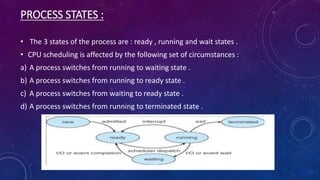
• The 3 states of the process are : ready , running and wait states .
• CPU scheduling is affected by the following set of circumstances :
a) A process switches from running to waiting state .
b) A process switches from running to ready state .
c) A process switches from waiting to ready state .
d) A process switches from running to terminated state .
CPU SCHEDULING CRITERIA :
CPU Utilization : Percent of time that the CPU is busy
executing a process .
Throughput : Number of processes executed per unit time .
Turnaround Time : The interval of time between submission
of process and its completion .
Waiting Time : The amount of time , the process spends in
the ready queue waiting for the CPU .
Response Time : The time between submission of requests
and first response to the request .
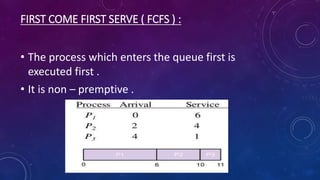
FIRST COME FIRST SERVE ( FCFS ) :
• The process which enters the queue first is
executed first .
• It is non – premptive .
FCFS :
• Advantages :
It is simple and easy to understand .
• Disadvantages :
The process with less execution time , suffers .
Favours CPU bound process then i/o bound process .
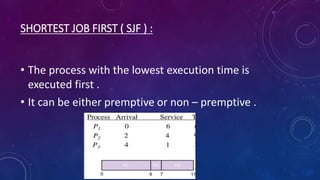
SHORTEST JOB FIRST ( SJF ) :
• The process with the lowest execution time is
executed first .
• It can be either premptive or non – premptive .
SJF :
• Advantages :
Shortest jobs are favoured .
• Disadvantages :
When there are more number of shorter jobs , longer
jobs starve .
PRIORITY SCHEDULING ( PS ) :
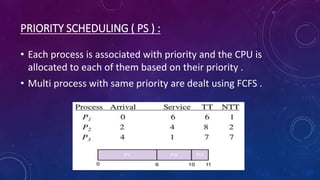
• Each process is associated with priority and the CPU is
allocated to each of them based on their priority .
• Multi process with same priority are dealt using FCFS .
PS :
• Advantages :
Priority scheduling provides a good mechanism where the relative
importance of each process may be precisely defined .
• Disadvantages :
If high priority processes use up a lot of CPU time , lower priority processes
may starve and may postponed indefinitely .
The situation where a process never gets scheduled to run is called
starvation .
Another problem with priority scheduling is deciding which process gets
which priority level assigned to it .
ROUND ROBIN ( RR ):
• Each process is allocated a time slot ( q ) . After this time has
elapsed , the process is prempted and added to the end of the
ready queue .
• Performance of the round – robin algorithm :
q is large -> FCFS
q is small -> q must be greater than the context switch time ;
otherwise , the overhead is too high .
RR :
• Advantages :
Round robin scheduling is fair in that every process gets an
equal share of the CPU .
• Disadvantages :
Setting the quantum too short , increases the overhead and
lowers the CPU efficiency , but setting it too long may cause
poor response to short processes .
ANALYSIS AND RESULT :
• Comparing the average turnaround time and waiting time , the
algorithms are ranked as SJF , FCFS , PS .
• Based on average CPU utilization , the algorithms are ranked as
FCFS , PS , SJF .
• In terms of execution speed , FCFS was found to be consistently
faster than PS and SJF .
Thus according to performance measure , the corresponding
scheduling algorithm is recommended to the CPU .
THANKYOU

Operating system

  • 1.
    OPERATING SYSTEM PRESENTATION ONCPU SCHEDULING ALGORITHMS IN OPERATING SYSTEM SUBMITTED TO : SUBMITTED BY: MR. AKHAND PRATAP SINGH DEVANSHI CHOWDHARY B.TECH ( CSE 3RD SEMESTER )
  • 2.
    TABLE OF CONTENTS:  Introduction  Process states  CPU scheduling criteria  First come first serve  Shortest job first  Priority scheduling  Round robin scheduling algorithm  Analysis and results
  • 3.
    INTRODUCTION : The CPUscheduling is used to improve its efficiency . It is used to allocate resources among competing processes . Maximum CPU utilization is obtained with multi-programming .  The processes which are to be executed are in ready queue .  Every time the running process is blocked , the process in the ready queue takes over the CPU . A process may be :-  I/0 BOUND : Involves more I/O operations . Example : reading from disk.  CPU BOUND : Involves more computation . Example : calculating the sum of 2 numbers from the memory.
  • 4.
    PROCESS STATES : •The 3 states of the process are : ready , running and wait states . • CPU scheduling is affected by the following set of circumstances : a) A process switches from running to waiting state . b) A process switches from running to ready state . c) A process switches from waiting to ready state . d) A process switches from running to terminated state .
  • 5.
    CPU SCHEDULING CRITERIA: CPU Utilization : Percent of time that the CPU is busy executing a process . Throughput : Number of processes executed per unit time . Turnaround Time : The interval of time between submission of process and its completion . Waiting Time : The amount of time , the process spends in the ready queue waiting for the CPU . Response Time : The time between submission of requests and first response to the request .
  • 6.
    FIRST COME FIRSTSERVE ( FCFS ) : • The process which enters the queue first is executed first . • It is non – premptive .
  • 7.
    FCFS : • Advantages: It is simple and easy to understand . • Disadvantages : The process with less execution time , suffers . Favours CPU bound process then i/o bound process .
  • 8.
    SHORTEST JOB FIRST( SJF ) : • The process with the lowest execution time is executed first . • It can be either premptive or non – premptive .
  • 9.
    SJF : • Advantages: Shortest jobs are favoured . • Disadvantages : When there are more number of shorter jobs , longer jobs starve .
  • 10.
    PRIORITY SCHEDULING (PS ) : • Each process is associated with priority and the CPU is allocated to each of them based on their priority . • Multi process with same priority are dealt using FCFS .
  • 11.
    PS : • Advantages: Priority scheduling provides a good mechanism where the relative importance of each process may be precisely defined . • Disadvantages : If high priority processes use up a lot of CPU time , lower priority processes may starve and may postponed indefinitely . The situation where a process never gets scheduled to run is called starvation . Another problem with priority scheduling is deciding which process gets which priority level assigned to it .
  • 12.
    ROUND ROBIN (RR ): • Each process is allocated a time slot ( q ) . After this time has elapsed , the process is prempted and added to the end of the ready queue . • Performance of the round – robin algorithm : q is large -> FCFS q is small -> q must be greater than the context switch time ; otherwise , the overhead is too high .
  • 13.
    RR : • Advantages: Round robin scheduling is fair in that every process gets an equal share of the CPU . • Disadvantages : Setting the quantum too short , increases the overhead and lowers the CPU efficiency , but setting it too long may cause poor response to short processes .
  • 14.
    ANALYSIS AND RESULT: • Comparing the average turnaround time and waiting time , the algorithms are ranked as SJF , FCFS , PS . • Based on average CPU utilization , the algorithms are ranked as FCFS , PS , SJF . • In terms of execution speed , FCFS was found to be consistently faster than PS and SJF . Thus according to performance measure , the corresponding scheduling algorithm is recommended to the CPU .
  • 15.