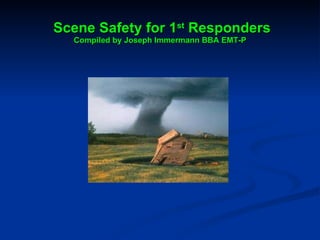
Scene Safety for 1 st  Responders Compiled by Joseph Immermann BBA EMT-P
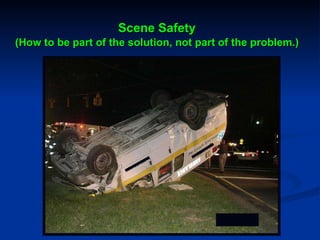
Scene Safety  (How to be part of the solution, not part of the problem.)
Why Be Safe? A responder casualty takes away from the overall response resources. A responder casualty adds to the response work load. A responder casualty has a very negative psychological impact on other responders potentially affecting the quality of their response.
Preparing to Respond Carry at least one light source, a compass, a mirror and/or a brightly colored kerchief, and a whistle. Other potentially useful items are a change of clothing (particularly socks), insect repellent, sunscreen, hat, energy bars, extra vinyl gloves, binoculars, rain gear, work gloves, eye protection, N95 mask, good boots, (make certain you are wearing clothing appropriate for the situation).  A fanny pack can hold many of these items conveniently.  Let other responders know if you have any special needs (allergies, diabetes, asthma, seizure disorder) in case they become important.
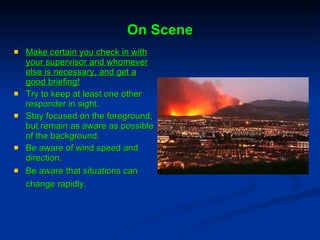
On Scene Make certain you check in with your supervisor and whomever else is necessary, and get a good briefing! Try to keep at least one other responder in sight.  Stay focused on the foreground, but remain as aware as possible of the background. Be aware of wind speed and direction. Be aware that situations can change rapidly.
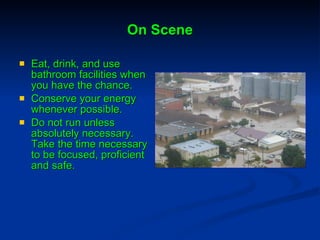
On Scene Eat, drink, and use bathroom facilities when you have the chance. Conserve your energy whenever possible. Do not run unless absolutely necessary. Take the time necessary to be focused, proficient and safe.
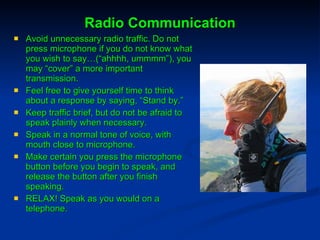
Radio Communication Avoid unnecessary radio traffic. Do not press microphone if you do not know what you wish to say…(“ahhhh, ummmm”), you may “cover” a more important transmission.  Feel free to give yourself time to think about a response by saying, “Stand by.”  Keep traffic brief, but do not be afraid to speak plainly when necessary.  Speak in a normal tone of voice, with mouth close to microphone.  Make certain you press the microphone button before you begin to speak, and release the button after you finish speaking.  RELAX! Speak as you would on a telephone.
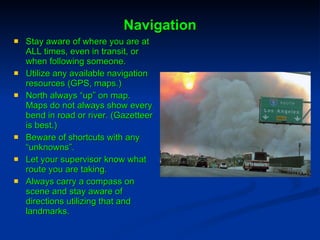
Navigation Stay aware of where you are at ALL times, even in transit, or when following someone. Utilize any available navigation resources (GPS, maps.) North always “up” on map. Maps do not always show every bend in road or river. (Gazetteer is best.) Beware of shortcuts with any “unknowns”. Let your supervisor know what route you are taking. Always carry a compass on scene and stay aware of directions utilizing that and landmarks.
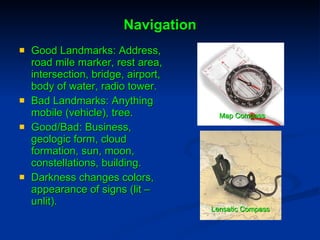
Navigation Good Landmarks: Address, road mile marker, rest area, intersection, bridge, airport, body of water, radio tower. Bad Landmarks: Anything mobile (vehicle), tree.  Good/Bad: Business, geologic form, cloud formation, sun, moon, constellations, building.  Darkness changes colors, appearance of signs (lit – unlit).  Map   Compass Lensatic Compass
I’m Lost – What Do I Do? STOP! (Don’t get even more lost! Work the problem safely and calmly.) Find good landmark and compare to map. Consider going back the way you came. When getting directions: write them down, avoid slang definitions or local names.
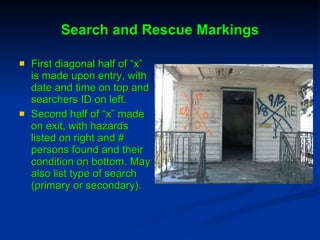
Search and Rescue Markings First diagonal half of “x” is made upon entry, with date and time on top and searchers ID on left. Second half of “x” made on exit, with hazards listed on right and # persons found and their condition on bottom. May also list type of search (primary or secondary).
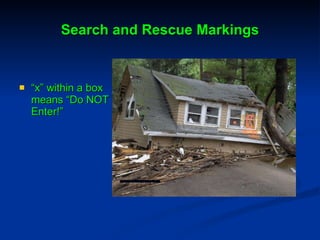
Search and Rescue Markings “ x” within a box means “Do NOT Enter!”
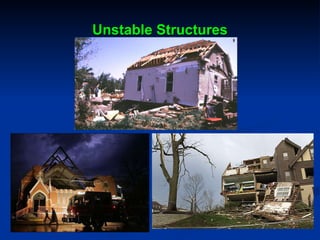
Unstable Structures
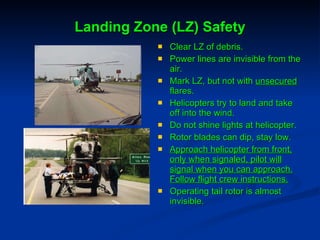
Landing Zone (LZ) Safety Clear LZ of debris. Power lines are invisible from the air.  Mark LZ, but not with  unsecured  flares. Helicopters try to land and take off into the wind. Do not shine lights at helicopter. Rotor blades can dip, stay low. Approach helicopter from front, only when signaled, pilot will signal when you can approach. Follow flight crew instructions. Operating tail rotor is almost invisible.
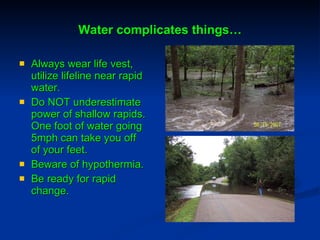
Water complicates things… Always wear life vest, utilize lifeline near rapid water. Do NOT underestimate power of shallow rapids. One foot of water going 5mph can take you off of your feet. Beware of hypothermia. Be ready for rapid change.
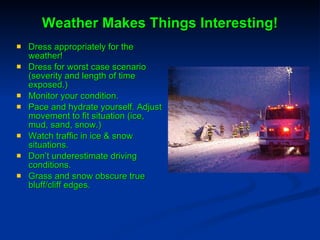
Weather Makes Things Interesting! Dress appropriately for the weather! Dress for worst case scenario (severity and length of time exposed.) Monitor your condition. Pace and hydrate yourself. Adjust movement to fit situation (ice, mud, sand, snow.) Watch traffic in ice & snow situations. Don’t underestimate driving conditions. Grass and snow obscure true bluff/cliff edges.
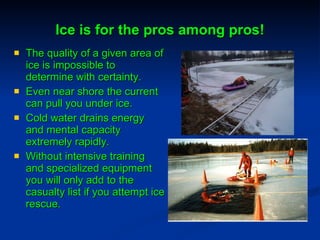
Ice is for the pros among pros! The quality of a given area of ice is impossible to determine with certainty. Even near shore the current can pull you under ice. Cold water drains energy and mental capacity extremely rapidly. Without intensive training and specialized equipment you will only add to the casualty list if you attempt ice rescue.
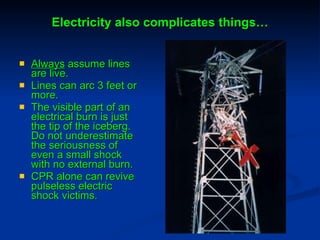
Electricity also complicates things… Always  assume lines are live. Lines can arc 3 feet or more. The visible part of an electrical burn is just the tip of the iceberg. Do not underestimate the seriousness of even a small shock with no external burn. CPR alone can revive pulseless electric shock victims.
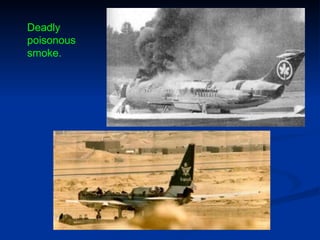
Deadly poisonous smoke.
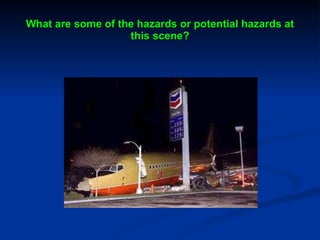
What are some of the hazards or potential hazards at this scene?
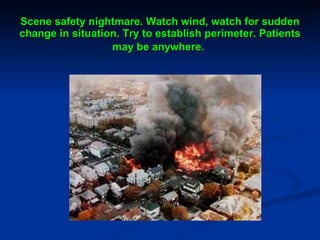
Scene safety nightmare. Watch wind, watch for sudden change in situation. Try to establish perimeter. Patients may be anywhere.
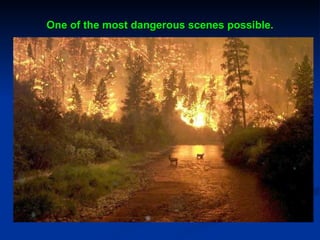
One of the most dangerous scenes possible.
Demobilizing Do not forget to check out with your supervisor and whomever else is necessary before you leave a scene! Debrief your relief, share any helpful information before you leave. Take advantage of any appropriate opportunity to share your experiences and feelings (other responders, Behavioral Health personnel, Pastoral Care.) Try not to miss out on the “Hot Wash”. Be prepared to clean response clothing at rescue station or laundromat before you take it home. (Bring simple change of clothes and monetary change for laundromat.)
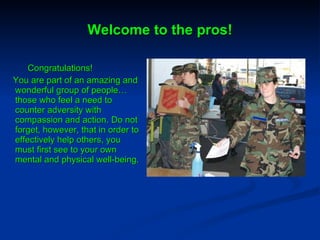
Welcome to the pros! Congratulations!  You are part of an amazing and wonderful group of people…those who feel a need to counter adversity with compassion and action. Do not forget, however, that in order to effectively help others, you must first see to your own mental and physical well-being.
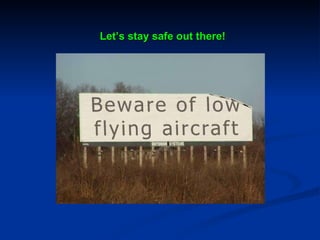
Let’s stay safe out there!

Scene Safety For 1st Responders

  • 1.
    Scene Safety for1 st Responders Compiled by Joseph Immermann BBA EMT-P
  • 2.
    Scene Safety (How to be part of the solution, not part of the problem.)
  • 3.
    Why Be Safe?A responder casualty takes away from the overall response resources. A responder casualty adds to the response work load. A responder casualty has a very negative psychological impact on other responders potentially affecting the quality of their response.
  • 4.
    Preparing to RespondCarry at least one light source, a compass, a mirror and/or a brightly colored kerchief, and a whistle. Other potentially useful items are a change of clothing (particularly socks), insect repellent, sunscreen, hat, energy bars, extra vinyl gloves, binoculars, rain gear, work gloves, eye protection, N95 mask, good boots, (make certain you are wearing clothing appropriate for the situation). A fanny pack can hold many of these items conveniently. Let other responders know if you have any special needs (allergies, diabetes, asthma, seizure disorder) in case they become important.
  • 5.
    On Scene Makecertain you check in with your supervisor and whomever else is necessary, and get a good briefing! Try to keep at least one other responder in sight. Stay focused on the foreground, but remain as aware as possible of the background. Be aware of wind speed and direction. Be aware that situations can change rapidly.
  • 6.
    On Scene Eat,drink, and use bathroom facilities when you have the chance. Conserve your energy whenever possible. Do not run unless absolutely necessary. Take the time necessary to be focused, proficient and safe.
  • 7.
    Radio Communication Avoidunnecessary radio traffic. Do not press microphone if you do not know what you wish to say…(“ahhhh, ummmm”), you may “cover” a more important transmission. Feel free to give yourself time to think about a response by saying, “Stand by.” Keep traffic brief, but do not be afraid to speak plainly when necessary. Speak in a normal tone of voice, with mouth close to microphone. Make certain you press the microphone button before you begin to speak, and release the button after you finish speaking. RELAX! Speak as you would on a telephone.
  • 8.
    Navigation Stay awareof where you are at ALL times, even in transit, or when following someone. Utilize any available navigation resources (GPS, maps.) North always “up” on map. Maps do not always show every bend in road or river. (Gazetteer is best.) Beware of shortcuts with any “unknowns”. Let your supervisor know what route you are taking. Always carry a compass on scene and stay aware of directions utilizing that and landmarks.
  • 9.
    Navigation Good Landmarks:Address, road mile marker, rest area, intersection, bridge, airport, body of water, radio tower. Bad Landmarks: Anything mobile (vehicle), tree. Good/Bad: Business, geologic form, cloud formation, sun, moon, constellations, building. Darkness changes colors, appearance of signs (lit – unlit). Map Compass Lensatic Compass
  • 10.
    I’m Lost –What Do I Do? STOP! (Don’t get even more lost! Work the problem safely and calmly.) Find good landmark and compare to map. Consider going back the way you came. When getting directions: write them down, avoid slang definitions or local names.
  • 11.
    Search and RescueMarkings First diagonal half of “x” is made upon entry, with date and time on top and searchers ID on left. Second half of “x” made on exit, with hazards listed on right and # persons found and their condition on bottom. May also list type of search (primary or secondary).
  • 12.
    Search and RescueMarkings “ x” within a box means “Do NOT Enter!”
  • 13.
  • 14.
    Landing Zone (LZ)Safety Clear LZ of debris. Power lines are invisible from the air. Mark LZ, but not with unsecured flares. Helicopters try to land and take off into the wind. Do not shine lights at helicopter. Rotor blades can dip, stay low. Approach helicopter from front, only when signaled, pilot will signal when you can approach. Follow flight crew instructions. Operating tail rotor is almost invisible.
  • 15.
    Water complicates things…Always wear life vest, utilize lifeline near rapid water. Do NOT underestimate power of shallow rapids. One foot of water going 5mph can take you off of your feet. Beware of hypothermia. Be ready for rapid change.
  • 16.
    Weather Makes ThingsInteresting! Dress appropriately for the weather! Dress for worst case scenario (severity and length of time exposed.) Monitor your condition. Pace and hydrate yourself. Adjust movement to fit situation (ice, mud, sand, snow.) Watch traffic in ice & snow situations. Don’t underestimate driving conditions. Grass and snow obscure true bluff/cliff edges.
  • 17.
    Ice is forthe pros among pros! The quality of a given area of ice is impossible to determine with certainty. Even near shore the current can pull you under ice. Cold water drains energy and mental capacity extremely rapidly. Without intensive training and specialized equipment you will only add to the casualty list if you attempt ice rescue.
  • 18.
    Electricity also complicatesthings… Always assume lines are live. Lines can arc 3 feet or more. The visible part of an electrical burn is just the tip of the iceberg. Do not underestimate the seriousness of even a small shock with no external burn. CPR alone can revive pulseless electric shock victims.
  • 19.
  • 20.
    What are someof the hazards or potential hazards at this scene?
  • 21.
    Scene safety nightmare.Watch wind, watch for sudden change in situation. Try to establish perimeter. Patients may be anywhere.
  • 22.
    One of themost dangerous scenes possible.
  • 23.
    Demobilizing Do notforget to check out with your supervisor and whomever else is necessary before you leave a scene! Debrief your relief, share any helpful information before you leave. Take advantage of any appropriate opportunity to share your experiences and feelings (other responders, Behavioral Health personnel, Pastoral Care.) Try not to miss out on the “Hot Wash”. Be prepared to clean response clothing at rescue station or laundromat before you take it home. (Bring simple change of clothes and monetary change for laundromat.)
  • 24.
    Welcome to thepros! Congratulations! You are part of an amazing and wonderful group of people…those who feel a need to counter adversity with compassion and action. Do not forget, however, that in order to effectively help others, you must first see to your own mental and physical well-being.
  • 25.

Editor's Notes

  • #4 Other than the obvious logistic impact of a responder casualty, there is a psychological impact upon the other responders that cannot be underestimated. The emotional impact creates a distraction that can reduce the productivity and safety of other responders.
  • #5 The items in the first bullet point refer to the importance of a responder being able to signal other responders, either because of impending danger, or because a responder has gotten lost themselves, which is something that can and does happen to the best of us. For that reason, the compass is a must have item. One should carry a light source as one never knows for certain how long one will be out. (Time flies, and circumstances as well as environments can change.)
  • #6 It is absolutely essential to check in properly to a scene. If those in command do not know you are there, then rescue for you if you get in trouble may be seriously delayed, or not come at all. If you do not have a radio or other means of direct contact with scene command, do your best to keep someone who does in sight so you will know if there are critical situational changes such as fire or flood waters changing direction or intensity, weather changes pending, human threats, et cetera.
  • #7 Disasters can be a marathon with an unknown finish line. Conserve energy because you do not know what the immediate future holds. Do not run except when obviously necessary for this reason, but also because it makes it more difficult for you to concentrate and assess the situation safely. Also running alarms others easily and looks unprofessional.
  • #8 Radio etiquette: radio mics pick up your voice well even with much background noise, if you shout into the mic you actually make your transmission harder to understand. There is a brief delay in transmission, if you do not “key” the mic a second before you talk and let it go a second after you talk your transmission will be cut off a little on each end. Think of what you need to say, then say it. Do not say “ahhhh” or “ummmm” when you have a brain freeze, just release the mic until you know what you need to say. We all have brain freezes, but you do not want to jam the air with “ahhhh” when someone else has something much more important to say.
  • #10 Mobile landmarks can go away, trees can be removed or destroyed. Businesses can be good landmark, but be aware that they can change appearance, go out of business, or be destroyed. Geologic forms can be good because they generally do not go away, but remember that a bluff or a mountain can look dramatically different depending upon what direction you are looking at them. Remember that although the sun, moon and stars can be excellent guides, they do move, and surprisingly quickly.
  • #14 Upper photo is F1 tornado which took house off of foundation. Bottom two photos are F2 which hit Iowa City. Unstable structures, varying levels of danger, but none safe for entry by personnel not trained in urban heavy rescue.
  • #15 Try to clear LZ of debris to protect engine intake. Protect yourself from rotor blast during landing…wind is appreciable. (Watch your hat and glasses.) Cover eyes or look away if close to helicopter as it lands. In most protocols, the pilot signals when it is OK to approach, particularly during a “hot” load or unload. Hot means while rotors are turning. The rear flight crew may signal you to approach, in which case follow their lead, but still approach from front so pilot knows what is going on.
  • #16 Water only one foot deep going 5mph (not all that fast) can sweep an adult off of their feet even when anticipating the impact. Being in water going the same speed prohibits one from being able to hold onto anything against the current for more than a moment or two. It is amazingly easy to underestimate the power of water and the danger it presents. Do not underestimate hypothermia. It is sneaky in its approach, but has a huge effect. Take good care of anyone who has gotten wet. One can get hypothermic in conditions that are perfectly comfortable to those who are dry and dressed. Adrenaline will make patients (and rescuers) unaware or disrespectful of their own hypothermia.
  • #17 Dressing appropriately, monitoring your condition, pacing and hydrating yourself are rules that apply equally in both hot and cold extremes of weather. Do NOT go out onto ice without specific training and equipment. Ice kills rescuers who are not prepared.
  • #18 The upper picture shows that even “pros” can do it wrong. The equipment they are using is helpful but not ideal…the ladder does not float if it breaks through the ice, the raft is not large enough to be truly stable if it breaks through the ice, and the firefighter is wearing heavy bunker gear and no visible floatation device. If he goes in the water he will likely sink before he can be rescued. The lower picture is that way it is done…specialized mobility equipment with waterproof flotation gear being worn that also provides some protection from the cold.
  • #19 If the voltage was sufficient to give the patient a visible burn, then the internal damage is much worse. If you see one visible electrical injury, there is probably another (entry and exit of electrical current. One wound will be the point of contact with the electrical source, the other will be the “grounding point” which may not necessarily be where the patient was touching the ground itself. Cardiac instability is one of the greatest dangers of an electrical burn, and can present hours or even a day later. If someone gets even a fairly minor shock, make certain they are seen by a physician. Cardiac arrest secondary to electrical shock is one of the few situations where the patient has a very good chance for survival with CPR, even when they are “flat line” on a cardiac monitor. Granted, their “down” time is still a critical factor in their resuscitation.
  • #20 Although modern household building and upholstery materials make the smoke from a house fire deadly, few fires produce more toxic fumes than aircraft fires. Even one inhalation of this smoke can be deadly poisonous. The upper picture is a happy ending story in which fire broke out on an Air Canada DC-9 while it was taxiing. Since it was on the ground and the fire was noticed quickly before it and its smoke spread, the aircraft was evacuated with no serious injuries. The Saudi Air L1011 in the bottom picture was an entirely different story. An improperly inflated tire burst on the take-off roll and caught fire as it was retracted back into its bay. It then started a fire in the bay which spread to the baggage compartment. The crew recognized they had a fire in the compartment and immediately initiated an emergency return to the airport they had just barely departed from. The flight crew was able to land successfully but by the time the aircraft rolled to a stop all aboard were dead from toxic smoke inhalation.
  • #21 Fuel from aircraft as well as gas station. Downed light fixtures and power lines. Unstable aircraft, (don’t walk underneath as it may collapse further.) Glass, sharp metal from aircraft or ground sources. Trench from impact is hazard and may have exposed other hazards such as buried gas lines, power lines, water lines. There could be HAZMAT exposed anywhere due to aircraft impact with unseen vehicle or storage tank or building. Chevron sign or lamppost could be unstable and fall over.
  • #22 This is the passenger jet that crashed into a Long Island neighborhood in late 2001. Very dynamic scene, moving fire, patients everywhere and anywhere, toxic smoke.
  • #23 Wild fires are easily the most dangerous situations possible. A simple grass fire in a ditch can turn into an unstoppable and unpredictable fast-moving inferno. Therefore do not underestimate the seriousness of any fire out doors, particularly with drought and wind as contributing factors. Wind can change strength and/or direction in seconds, making wild fires very dangerous even for seasoned professionals. Wild fires can be moving slowly, then an increase in wind strength can make them move as fast as a car and jump from one mountain top to another, effectively surrounding you in seconds. Do not go any where near a wild fire scene without at least transportation, communication, and guidance by a firefighting pro.
  • #24 Forgetting to check out is a common and understandable mistake, but it can cause serious headaches for scene command if things get bad suddenly and people need to be accounted for. It is profoundly frustrating to be searching for someone who is not there.
  • #25 Strangely enough, the best way for a humanitarian rescuer to save the world is for that rescuer to think of his or her safety first. An injured or dead rescuer is no longer part of the solution. Strangely enough, the best way for a humanitarian rescuer to save the world is for that rescuer to think of his or her safety first. An injured or dead rescuer is no longer part of the solution.