1
RESPIRATORY
PROTECTION TRAINING
Information from OSHA Standard
1910.134
And SCOTT 2.2 SCBA Manual
Lesson prepared by Scott Fitch 2/2003
2
OBJECTIVES
 Review Respiratory Protection
Standard
Explain:
 Why SCBA use is necessary,
 How improper fit/use can compromise
firefighter health and safety,
 Importance of maintenance of SCBA
3
OBJECTIVES continued
4. Review limitations of SCBA
And firefighter will be able to
demonstrate the following:
 How to properly Donn and Doff SCBA,
 How to properly inspect SCBA,
 How to check for face piece seal,
 Proper use in emergency situations
 Procedures for cleaning/disinfecting
4
OBJECTIVES continued
And will be able to describe:
 The medical signs and symptoms that
may limit or prevent use of SCBA,
 The general requirements of the revised
Respiratory Protection Standard
5
SCBA Evaluation process!
 Each firefighter will complete a written
evaluation on this subject.
 Each firefighter will demonstrate the
proper donning, doffing and emergency
procedures for the SCOTT Fifty SCBA
6
Program designed
To help you protect your
health and safety!
7
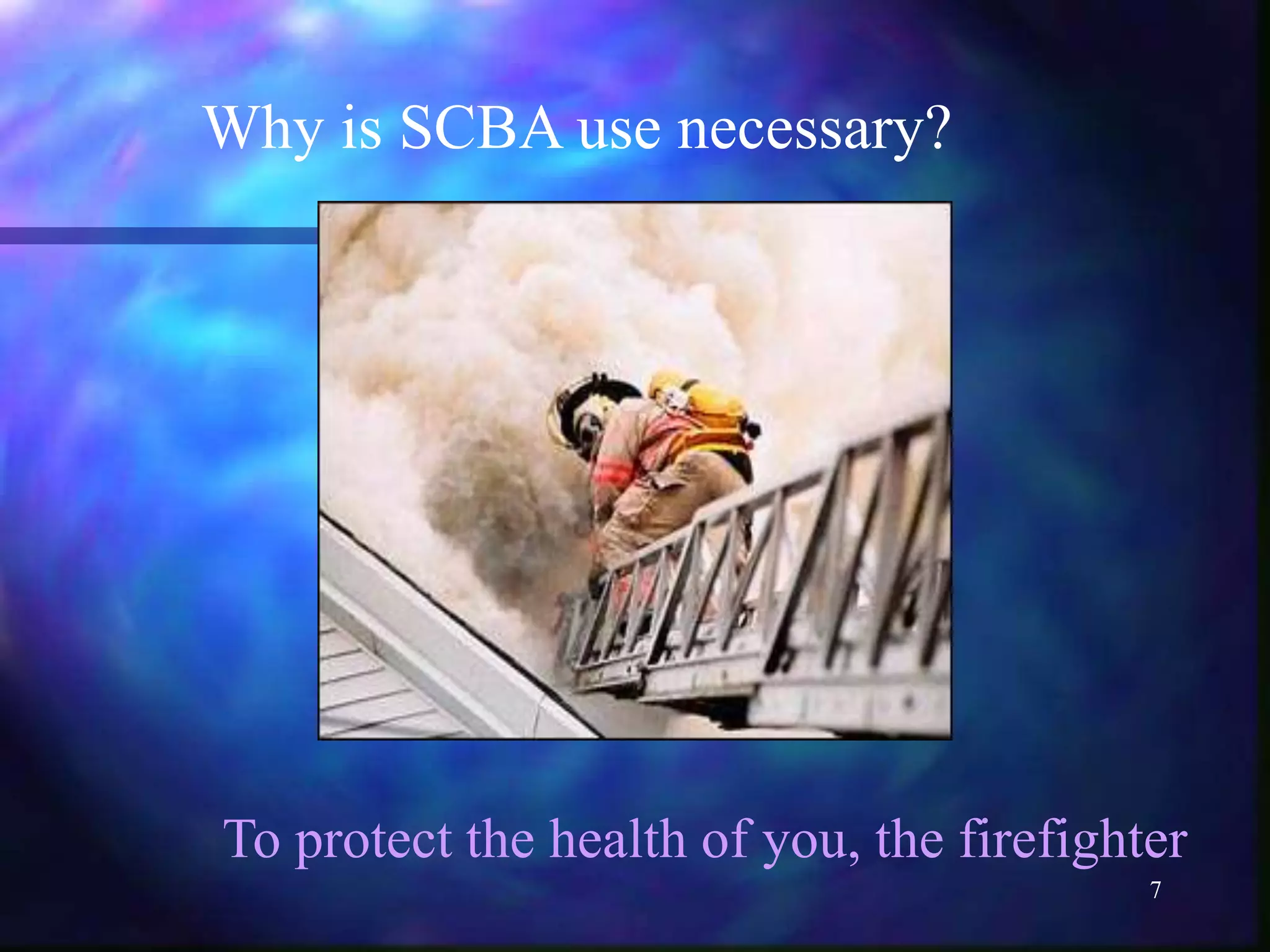
Why is SCBA use necessary?
To protect the health of you, the firefighter
8
Describe the products of combustion
9
Products of combustion:
 CO, CO2, hydrogen cyanide,
hydrogen chloride, phosgene,
nitrogen oxide, nitrogen dioxide,
particulate matter.
 Combustion results in oxygen
deficiency which alone is extremely
dangerous!
10
What are limitations of SCBA
Limit on air supply
Limit to firefighting
To be used in hazardous
materials situations, proper
protective envelope is needed!
11
Improper use of SCBA
 Through training, improper use can be
avoided!
 Tight face piece seal is vital to
preventing exposure to contaminants!
 A properly donned SCBA will minimize
stress to the back.
 SCBA is designed to protect lungs, not
as a wheel chock!
12
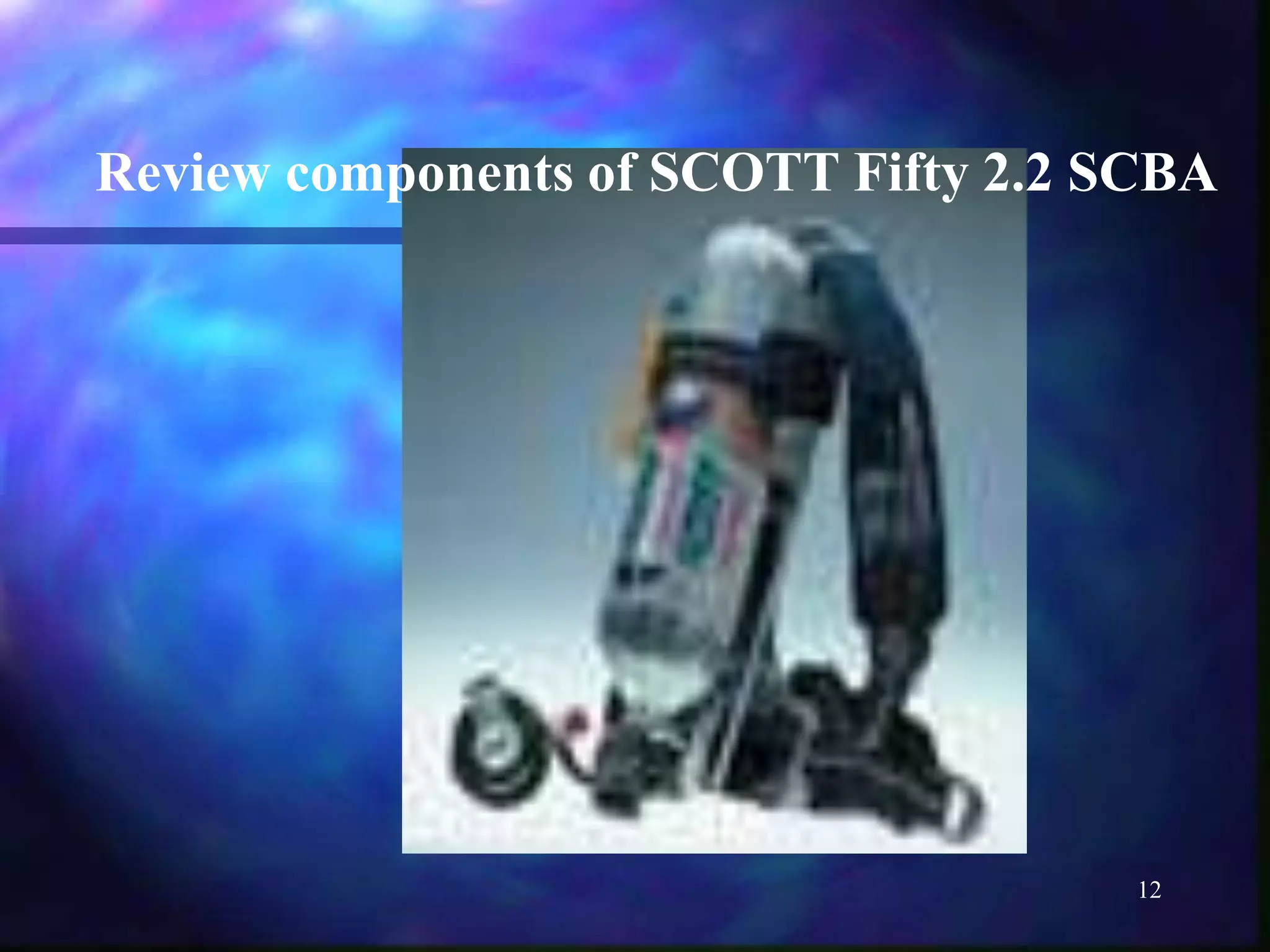
Review components of SCOTT Fifty 2.2 SCBA
13
Review operation of Pak-alert 1000
14
Review Bottle
Change Procedure
15
Emergency Operation of SCBA
 Per SCOTT, in the event of a
malfunction, or suspected malfunction
the following procedures should be
implemented:
16
Emergency Operation of SCBA
1.Should the Vibralert alarm actuate
during use and before the air supply is
depleted to about 25% of full capacity,
the primary reducer may have failed
(system automatically transfers to the
backup reducer).
Notify partner and leave
contaminated area immediately!
17
Emergency Operation of SCBA
2. Should the air supply be partially or
completely cut off during use, or if you
are unable to start the flow of air
automatically, fully open the purge
valve (red knob on regulator) by turning
it clockwise. Notify partner and
leave contaminated area
immediately!
18
Emergency Operation of SCBA
3. Should air flow freely into the face
piece, fully open the purge valve (red
knob on regulator), partially close the
cylinder valve by pushing in and
rotating clockwise to regulate flow to
satisfy user needs. Do not close
cylinder completely! Notify partner
and leave contaminated area
immediately!
19
Emergency Operation of SCBA
4. In the unlikely event of blockage of
airflow, or sudden complete loss of air
supply, Notify partner and leave
contaminated area immediately
using Emergency Egress procedure
set up by the FD (radio a mayday
to IC)!
20
Procedure following SCBA
failure:
 Remove SCBA in a safe area.
 Tag the SCBA out of service (include
date, problem encountered, and
individual/Group number reporting the
problem).
 Hold for service by an authorized
SCOTT dealer!
21
Cold weather operations
How does our SCBA hold up in sub freezing
temperatures?
22
Low temperature operational
concerns:
 Per manufacturer, SCBA stored in
temperatures above 32ºF.
 Regulator may freeze during operations
in sub-freezing temperatures (moisture
from exhalation, or previous cleaning).
 Place regulator inside turn out coat to
thaw!
23
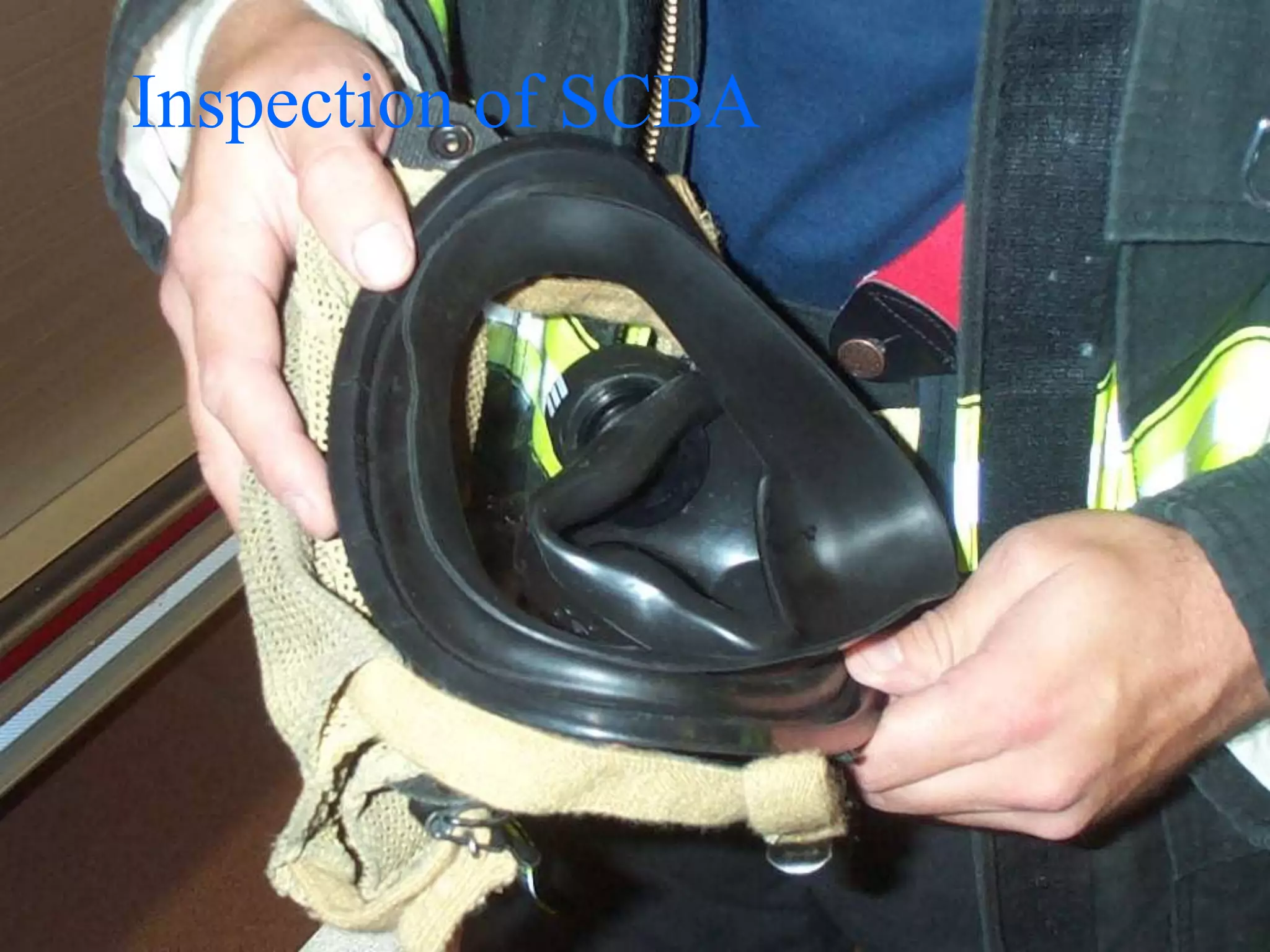
Inspection of SCBA
24
Inspection Procedure for SCBA
Inspect for worn, aging
rubber parts, fraying or wear
of harness webbing, or
damage to components
(regulator, face piece, Pak
Alert 1000)
25
Cleaning/Decontamination of
SCBA
 Following FD guideline using the SCOTT
Multi-wash solution:
 For face piece- 3 full pumps of solution on
regulator side, 3 full pumps on inside of
mask, wetting entire surface! Soak for 10
minutes and rinse with gentle, potable,
running water. Shake off excess water, dry
with lint free cloth.
26
Cleaning/Decontamination of
SCBA
 For the Regulator: 3 full pumps of the
SCOTT multi-wash solution into the
regulator opening. Let sit for 10
minutes. Rinse using small quantity of
clean, potable rinse water (very
gently!). Note- forceful water will
damage diaphragm on inside of
regulator. Shake out excess water, let
dry with room temp air via fan.
27
Cleaning of back pack:
Using warm water and a mild
detergent, sponge the backpack
off and rinse with low pressure
water. Let pack air dry.
28
Pak-Alert 1000 Inspection
Inspect for damage, wear or
cracks to enclosures, lenses and
wire conduits. If problems
found, tag and remove unit
from service for repair by
authorized SCOTT repair
service.
29
Pak-Alert 1000 Inspection
 Before pressurizing SCBA, check manual
alarm operation by pressing red button on
face of pak-alert, then reset.
 Open valve of cylinder, listen for 3 chirps and
check green light for operation.
 Check for pre-alert with SCBA pressurized and
depressed donning switch and leave SCBA
motionless
30
Pak-Alert 1000 Inspection
 Check pre-alert reset by moving SCBA.
 Check manual reset or pre-alarm
 Check full alarm reset
 Check continuing operation following
shut down of cylinder.
 Turn off unit following bleed down of
air.
31
Cleaning of Pak-Alert
 Exterior may be cleaned by wiping
with a damp sponge and
thoroughly wiping it dry. Clean
lense following each use to ensure
maximum brightness of warning
light. Note: Do not use solvent
for cleaning exterior surfaces of
this unit!
32
Pak-Alert Decontamination
 If suspected of contamination by a
hazardous substance, identify
contaminant and remove, or
contaminated component(s) must be
replaced before next use.
33
Medical Evaluation
 Confidential document that must be
completed and submitted to the FD
physician on an annual basis for each
firefighter.
 Used along with a physical by the FD
physician to determine the ability for a
firefighter to use an SCBA.
34
Medical limits for SCBA use:
 Conditions that may prevent you from
wearing SCBA at all.
 Conditions that may be temporary that
can affect your ability to safely use the
SCBA.
35
Medical limits for SCBA use:
 Should you experience any of the
following signs or symptoms while using
SCBA, notify your partner and
immediately leave the hazard area.
Seek immediate medical attention
36
Medical limitations for SCBA
use:
 Any respiratory
problem (I.e.
bronchitis, asthma,
respiratory infection,
etc)
 Heart conditions,
chest pains
 Back or shoulder
problems
 General weakness
due to illness,
fatigue.
 Diabetic problem
 Heat stress,
exhaustion
37
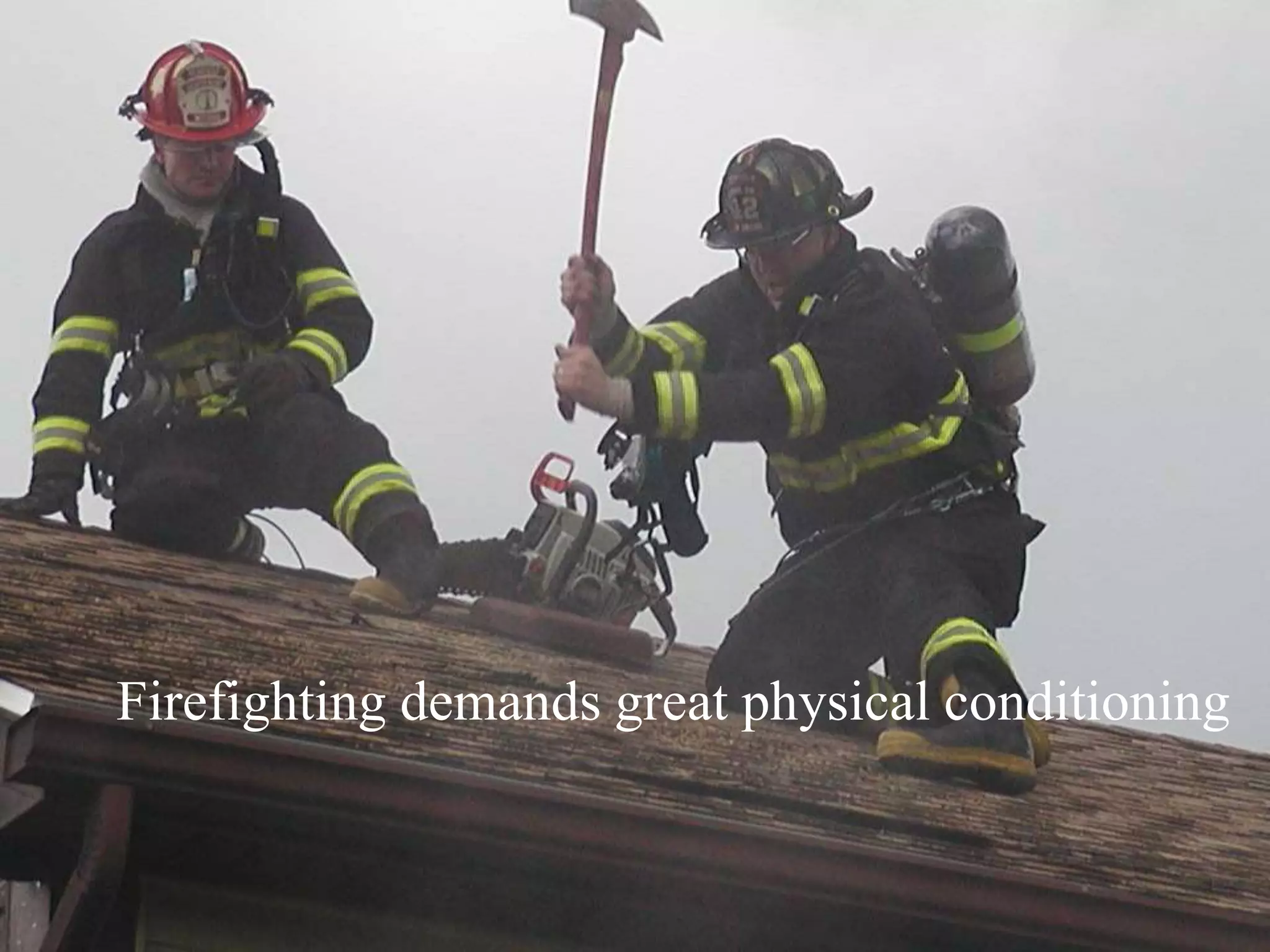
Firefighting demands great physical conditioning
38
Record keeping requirements
The Fire District must maintain records of
the following:
1. SCBA maintenance and operational
checks.
2. Training and evaluation of knowledge
of SCBA use by firefighters.
3. Annual fit testing of face piece.
4. Medical clearance to use SCBA
5. Breathing air quality certification
39
Review of OSHA 1910.134
general requirements
 Evaluation of work place hazards
 Medical evaluation with preliminary
questionnaire.
 Familiarization with SCBA design
and limitations
 Fit testing
40
Review of OSHA 1910.134
general requirements
 Training and evaluation of firefighter
ability to use SCBA
 Training on emergency procedures
 Cleaning, maintenance and storage
 Record keeping
41
Practical use evaluation
 Each firefighter will demonstrate the
proper donning, doffing and emergency
procedures for the SCOTT Fifty SCBA.
 Each firefighter will demonstrate the
proper bottle changing procedure for
the SCBA.
42
In summary
 OSHA 1910.134 implemented to
improve respiratory health of
firefighters.
 We’ve reviewed reason for use of SCBA
 We’ve reviewed proper donning/doffing
procedures
 Bottle changing, inspection and
cleaning procedures reviewed

SCBA

  • 1.
    1 RESPIRATORY PROTECTION TRAINING Information fromOSHA Standard 1910.134 And SCOTT 2.2 SCBA Manual Lesson prepared by Scott Fitch 2/2003
  • 2.
    2 OBJECTIVES  Review RespiratoryProtection Standard Explain:  Why SCBA use is necessary,  How improper fit/use can compromise firefighter health and safety,  Importance of maintenance of SCBA
  • 3.
    3 OBJECTIVES continued 4. Reviewlimitations of SCBA And firefighter will be able to demonstrate the following:  How to properly Donn and Doff SCBA,  How to properly inspect SCBA,  How to check for face piece seal,  Proper use in emergency situations  Procedures for cleaning/disinfecting
  • 4.
    4 OBJECTIVES continued And willbe able to describe:  The medical signs and symptoms that may limit or prevent use of SCBA,  The general requirements of the revised Respiratory Protection Standard
  • 5.
    5 SCBA Evaluation process! Each firefighter will complete a written evaluation on this subject.  Each firefighter will demonstrate the proper donning, doffing and emergency procedures for the SCOTT Fifty SCBA
  • 6.
    6 Program designed To helpyou protect your health and safety!
  • 7.
    7 Why is SCBAuse necessary? To protect the health of you, the firefighter
  • 8.
  • 9.
    9 Products of combustion: CO, CO2, hydrogen cyanide, hydrogen chloride, phosgene, nitrogen oxide, nitrogen dioxide, particulate matter.  Combustion results in oxygen deficiency which alone is extremely dangerous!
  • 10.
    10 What are limitationsof SCBA Limit on air supply Limit to firefighting To be used in hazardous materials situations, proper protective envelope is needed!
  • 11.
    11 Improper use ofSCBA  Through training, improper use can be avoided!  Tight face piece seal is vital to preventing exposure to contaminants!  A properly donned SCBA will minimize stress to the back.  SCBA is designed to protect lungs, not as a wheel chock!
  • 12.
    12 Review components ofSCOTT Fifty 2.2 SCBA
  • 13.
    13 Review operation ofPak-alert 1000
  • 14.
  • 15.
    15 Emergency Operation ofSCBA  Per SCOTT, in the event of a malfunction, or suspected malfunction the following procedures should be implemented:
  • 16.
    16 Emergency Operation ofSCBA 1.Should the Vibralert alarm actuate during use and before the air supply is depleted to about 25% of full capacity, the primary reducer may have failed (system automatically transfers to the backup reducer). Notify partner and leave contaminated area immediately!
  • 17.
    17 Emergency Operation ofSCBA 2. Should the air supply be partially or completely cut off during use, or if you are unable to start the flow of air automatically, fully open the purge valve (red knob on regulator) by turning it clockwise. Notify partner and leave contaminated area immediately!
  • 18.
    18 Emergency Operation ofSCBA 3. Should air flow freely into the face piece, fully open the purge valve (red knob on regulator), partially close the cylinder valve by pushing in and rotating clockwise to regulate flow to satisfy user needs. Do not close cylinder completely! Notify partner and leave contaminated area immediately!
  • 19.
    19 Emergency Operation ofSCBA 4. In the unlikely event of blockage of airflow, or sudden complete loss of air supply, Notify partner and leave contaminated area immediately using Emergency Egress procedure set up by the FD (radio a mayday to IC)!
  • 20.
    20 Procedure following SCBA failure: Remove SCBA in a safe area.  Tag the SCBA out of service (include date, problem encountered, and individual/Group number reporting the problem).  Hold for service by an authorized SCOTT dealer!
  • 21.
    21 Cold weather operations Howdoes our SCBA hold up in sub freezing temperatures?
  • 22.
    22 Low temperature operational concerns: Per manufacturer, SCBA stored in temperatures above 32ºF.  Regulator may freeze during operations in sub-freezing temperatures (moisture from exhalation, or previous cleaning).  Place regulator inside turn out coat to thaw!
  • 23.
  • 24.
    24 Inspection Procedure forSCBA Inspect for worn, aging rubber parts, fraying or wear of harness webbing, or damage to components (regulator, face piece, Pak Alert 1000)
  • 25.
    25 Cleaning/Decontamination of SCBA  FollowingFD guideline using the SCOTT Multi-wash solution:  For face piece- 3 full pumps of solution on regulator side, 3 full pumps on inside of mask, wetting entire surface! Soak for 10 minutes and rinse with gentle, potable, running water. Shake off excess water, dry with lint free cloth.
  • 26.
    26 Cleaning/Decontamination of SCBA  Forthe Regulator: 3 full pumps of the SCOTT multi-wash solution into the regulator opening. Let sit for 10 minutes. Rinse using small quantity of clean, potable rinse water (very gently!). Note- forceful water will damage diaphragm on inside of regulator. Shake out excess water, let dry with room temp air via fan.
  • 27.
    27 Cleaning of backpack: Using warm water and a mild detergent, sponge the backpack off and rinse with low pressure water. Let pack air dry.
  • 28.
    28 Pak-Alert 1000 Inspection Inspectfor damage, wear or cracks to enclosures, lenses and wire conduits. If problems found, tag and remove unit from service for repair by authorized SCOTT repair service.
  • 29.
    29 Pak-Alert 1000 Inspection Before pressurizing SCBA, check manual alarm operation by pressing red button on face of pak-alert, then reset.  Open valve of cylinder, listen for 3 chirps and check green light for operation.  Check for pre-alert with SCBA pressurized and depressed donning switch and leave SCBA motionless
  • 30.
    30 Pak-Alert 1000 Inspection Check pre-alert reset by moving SCBA.  Check manual reset or pre-alarm  Check full alarm reset  Check continuing operation following shut down of cylinder.  Turn off unit following bleed down of air.
  • 31.
    31 Cleaning of Pak-Alert Exterior may be cleaned by wiping with a damp sponge and thoroughly wiping it dry. Clean lense following each use to ensure maximum brightness of warning light. Note: Do not use solvent for cleaning exterior surfaces of this unit!
  • 32.
    32 Pak-Alert Decontamination  Ifsuspected of contamination by a hazardous substance, identify contaminant and remove, or contaminated component(s) must be replaced before next use.
  • 33.
    33 Medical Evaluation  Confidentialdocument that must be completed and submitted to the FD physician on an annual basis for each firefighter.  Used along with a physical by the FD physician to determine the ability for a firefighter to use an SCBA.
  • 34.
    34 Medical limits forSCBA use:  Conditions that may prevent you from wearing SCBA at all.  Conditions that may be temporary that can affect your ability to safely use the SCBA.
  • 35.
    35 Medical limits forSCBA use:  Should you experience any of the following signs or symptoms while using SCBA, notify your partner and immediately leave the hazard area. Seek immediate medical attention
  • 36.
    36 Medical limitations forSCBA use:  Any respiratory problem (I.e. bronchitis, asthma, respiratory infection, etc)  Heart conditions, chest pains  Back or shoulder problems  General weakness due to illness, fatigue.  Diabetic problem  Heat stress, exhaustion
  • 37.
    37 Firefighting demands greatphysical conditioning
  • 38.
    38 Record keeping requirements TheFire District must maintain records of the following: 1. SCBA maintenance and operational checks. 2. Training and evaluation of knowledge of SCBA use by firefighters. 3. Annual fit testing of face piece. 4. Medical clearance to use SCBA 5. Breathing air quality certification
  • 39.
    39 Review of OSHA1910.134 general requirements  Evaluation of work place hazards  Medical evaluation with preliminary questionnaire.  Familiarization with SCBA design and limitations  Fit testing
  • 40.
    40 Review of OSHA1910.134 general requirements  Training and evaluation of firefighter ability to use SCBA  Training on emergency procedures  Cleaning, maintenance and storage  Record keeping
  • 41.
    41 Practical use evaluation Each firefighter will demonstrate the proper donning, doffing and emergency procedures for the SCOTT Fifty SCBA.  Each firefighter will demonstrate the proper bottle changing procedure for the SCBA.
  • 42.
    42 In summary  OSHA1910.134 implemented to improve respiratory health of firefighters.  We’ve reviewed reason for use of SCBA  We’ve reviewed proper donning/doffing procedures  Bottle changing, inspection and cleaning procedures reviewed