Organizational Behavior Emerging Knowledge 5th
Edition McShane Solutions Manual pdf download
https://testbankdeal.com/product/organizational-behavior-
emerging-knowledge-5th-edition-mcshane-solutions-manual/
Download more testbank from https://testbankdeal.com
Instant digital products (PDF, ePub, MOBI) available
Download now and explore formats that suit you...
Organizational Behavior Emerging Knowledge 5th Edition
McShane Test Bank
https://testbankdeal.com/product/organizational-behavior-emerging-
knowledge-5th-edition-mcshane-test-bank/
testbankdeal.com
Organizational Behavior Emerging Knowledge Global Reality
6th Edition McShane Solutions Manual
https://testbankdeal.com/product/organizational-behavior-emerging-
knowledge-global-reality-6th-edition-mcshane-solutions-manual/
testbankdeal.com
Organizational Behavior Emerging Knowledge Global Reality
7th Edition McShane Solutions Manual
https://testbankdeal.com/product/organizational-behavior-emerging-
knowledge-global-reality-7th-edition-mcshane-solutions-manual/
testbankdeal.com
Operations and Supply Chain Management for MBAs 6th
Edition Meredith Test Bank
https://testbankdeal.com/product/operations-and-supply-chain-
management-for-mbas-6th-edition-meredith-test-bank/
testbankdeal.com
Foundations of Strategy 2nd Edition Grant Test Bank
https://testbankdeal.com/product/foundations-of-strategy-2nd-edition-
grant-test-bank/
testbankdeal.com
Macroeconomics Fourteenth Canadian Edition Canadian 14th
Edition Ragan Solutions Manual
https://testbankdeal.com/product/macroeconomics-fourteenth-canadian-
edition-canadian-14th-edition-ragan-solutions-manual/
testbankdeal.com
Law and Business Administration in Canada 11th Edition
Smyth Test Bank
https://testbankdeal.com/product/law-and-business-administration-in-
canada-11th-edition-smyth-test-bank/
testbankdeal.com
Human Physiology From Cells to Systems 7th Edition
Sherwood Test Bank Cells to Systems 7th Edition Sherwood
Test Bank
https://testbankdeal.com/product/human-physiology-from-cells-to-
systems-7th-edition-sherwood-test-bank-cells-to-systems-7th-edition-
sherwood-test-bank/
testbankdeal.com
South Western Federal Taxation 2019 Individual Income Taxe
42nd Edition Young Test Bank
https://testbankdeal.com/product/south-western-federal-
taxation-2019-individual-income-taxe-42nd-edition-young-test-bank/
testbankdeal.com
Microeconomics 3rd Edition Hubbard Solutions Manual
https://testbankdeal.com/product/microeconomics-3rd-edition-hubbard-
solutions-manual/
testbankdeal.com
Instructor’s Manual to Accompany
Organizational Behavior 5/e
emerging knowledge and practice for the real world
by Steven L. McShane and Mary Ann von Glinow
Chapter 11
Conflict and Negotiation in
the Workplace
Prepared by:
Steven L. McShane, University of Western Australia
This Instructor’s Manual 1ile is part of the Instructor’s Resource CD‐ROM for Organizational Behavior:
ctice for the Real World, 5th edition
Emerging Knowledge and Pra
10‐digit ISBN: 0073364347
13‐digit ISBN: 9780073364346
Published by McGraw‐Hill/Irwin, a business unit of The McGraw‐Hill Companies, Inc., 1221 Avenue of the Americas, New
York, NY, 10020. Copyright © 2010, 2008, 2005, 2003, 2000 by The McGraw‐Hill Companies, Inc. All rights reserved. No
part of this publication may be reproduced or distributed in any form or by any means, or stored in a database or retrieval
system, without the prior written consent of The McGraw‐Hill Companies, Inc., including, but not limited to, in any network
or other electronic storage or transmission, or broadcast for distance learning.
Some ancillaries, including electronic and print components, may not be available to customers outside the United States.
McGraw-Hill
Irwin
Chapter 11: Conflict and Negotiation in the Workplace
1 Conflict and Negotiation in
the Workplace
LEARNING OB
After reading this chapter
JECTIVES
, students should be able to:
1. Debate the positive and negative consequences of con1lict in the workplace.
2. Distinguish constructive con1lict from relationship con1lict.
ing relationship con1lict during constructive‐con1lict
3. Describe three strategies for minimiz
episodes.
4. Diagram the con1lict process model.
5. Identify six structural sources of con1lict in organizations.
mstances in which each would
6. Outline the 1ive con1lict‐handling styles and discuss the circu
on1lict.
be most appropriate.
7. Summarize six structural approaches to managing c
8. Outline four situational in1luences on negotiations.
9. Describe four skills of effective negotiators.
10.Compare and contrast the three types of third‐party dispute resolution.
CHAPTER GLOSSARY
alternative dispute resolution (ADR) ‐‐ an orderly
process of third‐party dispute resolution, typically
including mediation followed by arbitration.
con1lict ‐‐ is a process in which one party perceives that
y
its interests are being opposed or negatively affected b
another party.
constructive con1lict ‐‐ occurs when people focus their
discussion on the issue while maintaining respectfulness
for people having other points of view.
negotiation – the process whereby two or more
con1licting parties attempt to resolve their divergent
goals by rede1ining the terms of their interdependence
relationship con1lict ‐ occurs when people focus on
characteristics of other individuals rather than the
issues as the source of con1lict.
third‐party con1lict resolution ‐‐ any attempt by a
relatively neutral person to help the parties resolve their
differences.
win–lose orientation ‐‐ The belief that con1licting parties
are drawing from a 1ixed pie, so the more one party
receives, the less the other party will receive.
win–win orientation ‐‐ The belief that the parties will
1ind a mutually bene1icial solution to their disagreement.
Chapter 11: Conflict and Negotiation in the Workplace
CHAPTER SYNOPSIS
Con1lict is the process in which one party perceives that his or her interests are being opposed or negatively affected by
another party. For many years, con1lict was viewed as undesirable and counterproductive. There is evidence that
con1lict can produce undesirable outcomes such as lower job satisfaction, team cohesion, and knowledge sharing as
well as higher organizational politics and turnover. However, experts later formed the opinion that organizations suffer
.
from too little as well as too much con1lict. Research reports that moderate con1lict can improve decision making,
organizational responsiveness to the environment, and team cohesion (when con1lict is with sources outside the team)
The current perspective involves distinguishing constructive con1lict from relationship con1lict. The former focuses on
issues and a logical evaluation of ideas, whereas the latter pays attention to interpersonal incompatibilities and 1laws.
Although the ideal would be to encourage constructive con1lict and minimize relationship con1lict, relationship con1lict
when
tends to emerge in most constructive‐con1lict episodes. However, relationship con1lict is less likely to dominate
the parties are emotionally intelligent, have a cohesive team, and have supportive team norms.
The con1lict process model begins with the six structural sources of con1lict: incompatible goals, differentiation
(different values and beliefs), interdependence, scarce resources, ambiguous rules, and communication problems.
These sources lead one or more parties to perceive a con1lict and to experience con1lict emotions. This, in turn,
ugh
produces manifest con1lict, such as hostile behaviors toward the other side. The con1lict process often escalates thro
a series of episodes.
Organizational behavior experts have identi1ied several con1lict‐handling styles: problem solving, forcing, avoiding,
yielding, and compromising. People who use problem solving have a win‐win orientation. Other styles, particularly
forcing, assume a win‐lose orientation. In general, people gravitate toward one or two preferred con1lict‐handling styles
that match their personality, personal and cultural values, and past experience. However, the best style depends on
various characteristics of the situation.
Structural approaches to con1lict management include emphasizing superordinate goals, reducing differentiation,
improving communication and understanding, reducing interdependence, increasing resources, and clarifying rules and
procedures.
Negotiation occurs whenever two or more con1licting parties attempt to resolve their divergent goals by rede1ining the
terms of their interdependence. Negotiations are in1luenced by several situational factors, including location, physical
setting, time passage and deadlines, and audience. Important negotiator behaviors include preparation and goal setting,
gathering information, communicating effectively, and making concessions.
Third‐party con1lict resolution is any attempt by a relatively neutral person to help the parties resolve their differences.
The three main forms of third‐party dispute resolution are mediation, arbitration, and inquisition. Managers tend to use
an inquisition approach, although mediation and arbitration are more appropriate, depending on the situation.
Chapter 11: Conflict and Negotiation in the Workplace
POWERPOINT®
SLIDES
Organizational Behavior Fifth Edition includes a complete set of Microsoft PowerPoint® 1iles for each chapter. (Please
contact your McGraw‐Hill/Irwin representative to 1ind out how instructors can receive these 1iles.) In the lecture
outline that follows, a thumbnail illustration of each PowerPoint slide for this chapter is placed beside the
corresponding lecture material. The slide number helps you to see your location in the slide show sequence and to skip
slides that you don’t want to show to the class. (To jump ahead or back to a particular slide, just type the slide number
and hit the Enter or Return key.)
LECTURE OUTLINE (WITH
POWERPOINT® SLIDES)
Conflict and Negotiation in the Workplace
Conflict and Negotiation
in the Workplace
Slide 1
Generational Conflict at
Work
Slide 2
Conflict Defined
Slide 3
Is Conflict Good or
Bad?: Pre 1970s View
Slide 4
Generational Conflict at Work
To reward themselves for a job well done, Generation-Y
(Millennial) employees might throw a pizza party during office
hours, but this practice bothers older employees who have
different views about appropriateworkplace behavior.
Conflict Defined
The process in which one party perceives that its interests are
being opposed or negatively affected by another party
• Based on perceptions -- conflict is perceived to exist
Is Conflict Good or Bad?: Pre 1970s View
Historically, experts viewed conflict as dysfunctional
• Undermined relations
• Wasted human energy
• Results in job dissatisfaction, turnover, stress, lower productivity,
less information sharing
Chapter 11: Conflict and Negotiation in the Workplace
Is Conflict Good or
Bad?: 1970s-1990s View
Slide 5
Is Conflict Good or
Bad?: Emerging View
Slide 6
Is Conflict Good or
Bad?: Emerging View
Slide 7
Constructive
Confrontation at Intel
Slide 8
Is Conflict Good or Bad?: 1970s-1990s View
From 1970s to 1990s, experts believed there is an optimal level
of conflict
Dysfunctional to have too little and too much conflict
Some conflict is good because:
• Energizes people to debate issues
• Reexamine assumptions/logic of arguments
• Improves responsiveness to external environment
• Increases cohesion within the team
Is Conflict Good or Bad?: Emerging View
Two types of conflict
Constructive (task) conflict
• Conflict is aimed at issue, not parties
• Produces benefits of conflict
• However, likely an upper limit to any conflict, including
constructive
Relationship (socioemotional) conflict
• Aims conflict at the person (e.g. their competence), not the task
or issue
• Introduces perceptual biases
• Distorts information processing
Is Conflict Good or Bad?: Emerging View
Goal: encourage constructive conflict, minimize relationship
conflict
Problem: difficult to separate constructive from relationship
conflict
• Drive to defend naturallyactivated when ideas are critiqued
• The stronger the level of debate the more likely constructive
conflict will generate relationship conflict.
Constructive Confrontation at Intel
Intel employees learn to fully evaluate ideas through “constructive
confrontation.” The objective is to attack the problem, not the
employee, but some critics claim the process is a license for
some Intel staff to be bullies.
Chapter 11: Conflict and Negotiation in the Workplace
Minimizing Relationship
Conflict
Slide 9
The Conflict Process
Slide 10
Minimizing Relationship Conflict
Three conditions that minimize relationship conflict while
engaging in constructive conflict
1. Emotional intelligence – allows individuals to better control
their emotions during debates
2. Cohesive teams – members give each other more latitude
to disagree, and are less likely to interpret opposition as
personal
3. Supportive team norms – discourage negative reactions
toward co-workers during frank and open dialogue
The Conflict Process
Sources of conflict
• Conflict begins with the conditions that create conflict
• Includes incompatible goals, different values, tasks, resources,
rules, and communication
• Leads to conflict perceptions and emotions
• Leads to manifest conflict episodes (behavior)
‣ manifest conflict may affect conflict perceptions and emotions
(reverse arrows)
• Conflict outcomes
‣ conditions and relations after manifest conflict
Conflict escalation cycle -- a dynamic, interactive set of conflict
episodes
• Communication may control conflict, keeping it task-related, or
ambiguity may allow conflict to escalate into relationship conflict
• Process then adopts an ‘us-them’ frame of reference -- becomes
relationship conflict
Chapter 11: Conflict and Negotiation in the Workplace
Structural Sources of
Conflict
Slide 11
Structural Sources of
Conflict
Slide 12
Structural Sources of Conflict
1. Goal incompatibility
• Goals may conflict with others
• Reinforced by reward systems
• Divergent goals contribute to conflict
2. Different values and beliefs (Differentiation)
• People hold different values and beliefs due to unique
backgrounds, experiences, training
• Cultural differences -- result in misunderstanding
• Mergers – divergent corporate cultures explain conflict
• Cross-generational conflict due to younger and older employees
having different needs, expectations and values
3. Task interdependence
• Conflict increases when people share common inputs, have
interdependent processes, or receive outcomes partly determined
by performance of others
• Three levels (pooled is lowest)
‣ pooled interdependence -- work units rely on a common resource or
authority but do not work directly with each other
‣ sequential interdependence -- one person's output is next person's
input
‣ reciprocal interdependence -- output is exchanged – employees are
highly dependent on each other
Structural Sources of Conflict
4. Scarce resources
• Potential conflict increases as shared resources decrease
• Results in more competition for resources to fulfill goals
5. Ambiguous rules
• Ambiguous or lack of rules guiding relations between parties
• Encourages political tactics to intercept resources
• Ambiguity weakens coordination
• Threatens goal achievement because parties don't know what the
other will do
Chapter 11: Conflict and Negotiation in the Workplace
6. Communication problems
• Conflict due to lack of opportunity, ability, or motivation to
communicate effectively
• Lack of opportunity --reliance on stereotypes
• Lack of ability -- arrogant communication heightens conflict
perception
• Lack of motivation -- conflict causes lower motivation to
communicate, which increases stereotyping
Interpersonal Conflict
Handling Styles
Slide 13
Five Conflict Handling
Styles
Slide 14
Interpersonal Conflict Handling Styles
Two general orientations
•Win-win orientation
‣ believe parties will find a mutuallybeneficial solution to their
disagreement
‣ working together produces creative solution
•Win-lose orientation
‣ belief that the more one party receives, the less the other receives
‣ sometimes appropriate, but often creates unnecessary conflict
‣ tends to escalate conflict -- parties try to gain advantage
Five Conflict Handling Styles
Vary in degree of assertiveness (concern of one’s own interests)
and cooperativeness (concern for the party’s interests)
1. Problem-Solving
‣ Try to find a mutuallybeneficial solution
2. Forcing
‣ Try to win the conflict at the other’s expense -- strong win/lose
orientation
‣ Strongest win-lose orientation
‣ Relies on “hard” influence tactics, particularly assertiveness to get
one’s own way
3. Avoiding
‣ Smooth over or avoiding conflict
‣ Low concern for both self and the other party
‣ Suppresses thinking about the conflict
Chapter 11: Conflict and Negotiation in the Workplace
1. Yielding
‣ Give in to the other side’s wishes, little or no attention in one’s own
interests
‣ Make unilateral concessions, unconditional promises and/or offering
help with no expectation of reciprocal help
2. Compromising
‣ Reach a middle ground between the interests of the parties
‣ Look for a position in which your losses are offset by equally valued
gains
‣ Match the other party’s concessions making conditional promises or
threats
Conflict Handling Style Preferences
•People tend to prefer one or two styles compatible with their
personality, values, and self-concept
•Cultural and gender influences on use of conflict handling
styles
Conflict Handling Contingencies
Best conflict handlingstyle depends on the situation
Conflict Handling
Contingencies
Slide 15
Problem solving
Best when:
• interests are not perfectlyopposing
• parties have trust/openness
• issues are complex
Problems with problem solving style
• Sharing information that the other party might use to their
advantage
Chapter 11: Conflict and Negotiation in the Workplace
Forcing
Best when:
• you have a deep conviction about your position
• quick resolution required
• other party would take advantage of cooperation
Problems with forcing style
• Highest risk of relationship conflict
• May damage long-term relations, reducing future problem solving
Conflict Handling
Contingencies
Slide 16
Conflict Handling
Contingencies
Slide 17
Contingencies of Conflict Handling (con’t)
Avoiding
Best when:
• relationship conflict is high
• conflict resolution cost is higher than its benefits
Problems with avoiding style
• Doesn’t usually resolve the conflict
• May increase frustration for all parties
Yielding
Best when:
• other party has much more power
• issue is much less important to you than other party
• value/logic of your position is imperfect
Problem with yielding style
• Increases other party’s expectations in future conflict episodes
Compromising
Best when…
• parties have equal power
• quick solution is required
• parties lack trust/openness
Problem with compromising style
• Sub-optimal solution where mutual gains are possible
Chapter 11: Conflict and Negotiation in the Workplace
Structural Approaches to
Conflict Resolution
Slide 18
Structural Approaches to
Conflict Resolution
Slide 19
Structural Approaches to Conflict Resolution
1. Emphasizing superordinate goals
Superordinate goal – a goal that both conflicting parties value
and whose attainment is beyond the resources and effort of
either party alone.
• Emphasize common objective rather than conflicting sub-goals
• Reduces goal incompatibility and differentiation
2. Reducing differentiation
Remove sources of different values and beliefs
Ways to reduce differentiation
• Move employees around to different jobs, departments and
regions
• Common work experience
Structural Approaches to Conflict Resolution (con’t)
3. Improving communication and understanding
Employees understand and appreciate each other’s views
through communication
• Relates to contact hypothesis
• Two warnings:
‣ apply communication/understanding after reducing differentiation
‣ a Western strategy that may conflict with values/traditions in other
cultures
Chapter 11: Conflict and Negotiation in the Workplace
Structural Approaches to
Conflict Resolution
Slide 20
Resolving Conflict
Through Negotiation
Slide 21
Structural Approaches to Conflict Resolution (con’t)
4. Reduce Task Interdependence
Reducing interdependence an occur by:
• Dividing shared resources
• Combine tasks
• Use buffers -- inventory, intermediaries
5. Increase Resources
• Duplicate resources
6. Clarify Rules and Procedures
• Clarify resource distribution
• Change roles and responsibilities
Resolving Conflict Through Negotiation
Negotiation-- attempting to resolve divergent goals by redefining
terms of interdependence
• Everyone negotiates every day
Conflict handling style in negotiation
Win-lose style (forcing, yielding, etc) tends to produce
suboptimal result -- less information sharing
Win-win orientation (problem solving) is risky because other party
may use information to their advantage
Need to begin cautiously with problem-solving style
• share information slowly, determine whether the other side will
reciprocate
• try to establish trust
Shift to a win-lose style when:
1. situation does not seem to allow for mutual gains (i.e. no
win-win solution is possible)
2. other party won't reciprocate information sharing
Chapter 11: Conflict and Negotiation in the Workplace
Bargaining Zone Model
Slide 22
Situational Influences on
Negotiations
Slide 23
Bargaining Zone Model of Negotiations
Parties typically establish three key negotiating points:
1. Initial offer point
‣ your opening offer -- best expectation
2. Target point
‣ your realistic goal or expectation
3. Resistance point
‣ the point where you won’t make further concessions
In win-lose situations
• Parties begin with their initial offer point for each item on the
bargaining agenda
• Neither the target nor resistance points are revealed
• Each side tries to move other side’s resistance point closer to
their own initial offer
In purely win-win settings
• Try to find a creative solution -- keeps parties close to their initial
offer points
Situational Influences on Negotiations
1. Location
Advantages of ‘home turf’
• no travel-related stress, easier access to resources
Problems with home turf
• can't walk out
Negotiatorstry to choose a neutral site, but might try for their
own location if this does not threaten trust between the parties
No location
• Computer technologies (fax, e-mail, video-conferences) make
this possible
• But negotiators tend to prefer the media richness of face-to-face
meetings
Chapter 11: Conflict and Negotiation in the Workplace
2. Physical setting
Room, tables/chairs can affect negotiations
• face-to-face -- more win-lose orientation
• interspersed -- more win-win orientation
3. Time passage and deadlines
Time passage
• Increases escalation of commitment to completing negotiations
• May result in excessive concessions
Time deadlines
• Deadline goals motivate parties to reach timely resolution
• Liability when deadline is fixed and exceeding it is costly
‣ tendency to make more concessions
‣ less information sharing
4. Audience Characteristics
Audiences -- anyone with a vested interest in the negotiation
outcomes
When audience directly observes the negotiations:
• negotiators are more competitive (forcing) -- impression
management
• less willing to make concessions
• more likely to ‘save face’
• audience may be drawn in -- source of indirect appeals
Chapter 11: Conflict and Negotiation in the Workplace
Effective Negotiation
Behavior
Slide 24
Effective Negotiator Behavior
1. Preparation and goal setting
• Plan strategy, establish goals for initial offer, target, and
resistance points
• Consider alternative strategies
• Identify underlying assumptions, goals and values
• Research other party’s interests
2. Gathering information
• Listen and ask questions more than talk
• Specialize listening among team members
3. Communicating effectively
• Focus on issues rather than people
‣ task-oriented rather than relationship conflict
• Avoid irritating statements (e.g. “You’ll agree this is a generous
offer”)
• Use effective persuasion tactics by structuring the content of
messages – strive for acceptance
4. Making concessions
Concessions are important because they:
1. move parties toward the area of potential agreement,
2. symbolize motivation to bargain in good faith
3. communicate relative importance of items negotiated
Number of concessions depends on the other party’s
expectations and level of trust
Best strategy -- moderately tough, just enough concessions to
communicate sincerity and motivate other side to resolve the
conflict
• Need to carefully ‘read’ the situation and know when another
concession is required
Chapter 11: Conflict and Negotiation in the Workplace
Types of Third Party
Intervention
Slide 25
Choosing the Best 3rd
Party Strategy
Slide 26
Conflict and Negotiation
in the Workplace
Slide 27
Third Party Conflict Resolution
Any attempt by a relatively neutral person to help the parties
resolve their differences – classified by their level of control over
the process and their control over the decision
Types of Third Party Intervention
1. Arbitration
‣ third party makes a binding decision on the conflicting parties
‣ low process control, high decision control
‣ includes labour arbitration and increasingly non-union conflicts
2. Inquisition
‣ high process control, high outcome control
‣ controlling all discussion about the conflict, asking questions to the
disputing parties, and deciding which information to select or ignore
‣ common managerial intervention
3. Mediation
‣ manage the process and context of interaction between the disputing
parties
‣ high process control, low decision control
Choosing the Best 3rd Party Strategy
Managers prefer inquisitional strategy
‣ Provides consistency and control
‣ Problems: risk of poor decision and less perceived fairness
Best 3rd party strategy depends on situation, leader-follower
relations, cultural values
Mediation potentially offers highest satisfactionwith process and
outcomes
Use arbitration when mediation fails
Conflict and Negotiation in the Workplace
Chapter 11: Conflict and Negotiation in the Workplace
SOLUTIONS TO CRITICAL THINKING QUESTIONS
1. Distinguish constructive con1lict from relationship con1lict, and explain how to apply the former with
minimal levels of the latter.
The distinction between task‐related (constructive) and relationship con1lict is one of perceptions and emotions
toward the con1lict. Task‐related con1lict occurs when the parties view the con1lict experience as something
separate from them. Differences of opinion are viewed as constructive events in which the parties can learn
different perspectives and possibly develop new ideas.
Relationship con1lict, on the other hand, occurs when the parties view their differences as threatening personal
attacks. Rather than focusing on the issue, each party starts to see the other person as the problem. The discussion
ed.
becomes emotionally charged, so that perceptual biases are introduced and information processing is imped
One way to encourage constructive con1lict and minimize relationship con1lict is by keeping the participants
focussed on the issue and its resolution as opposed to individuals. With this in mind experts have identi1ied three
strategies:
Emotional intelligence. Participants are less likely to resort to personal attacks when they have high emotional
intelligence. Such individuals are known to have control over their emotions, and are better able to use the
emotions of others as information.
Cohesive teams. Members in such teams tend to be more forgiving of team mates with differing view points. This
allows them to avoid felling personally offended when others within the team voice opposing arguments.
Supportive team norms. If the team encourages frank and open debate while discouraging personal attacks, it can
help minimize if not avoid relationship con1lict. The norms may include an acceptance of appropriate humor to
maintain positive relations.
2. The chief executive of1icer of Creative Toys, Inc., read about cooperation in Japanese companies and vowed
to bring the same philosophy to the company. The goal is to avoid all con1lict so that employees will work
cooperatively and be happier at Creative Toys. Discuss the merits and limitations of the CEO’s policy.
This question addresses the idea that con1lict can be both good and bad for organizations. To effectively manage
con1lict, organizational leaders must 1ind interventions that alter the level and form of con1lict in ways that
maximize its bene1its and minimize its dysfunctional consequences.
Constructive controversy is a form of con1lict that bene1its decision making. This task‐related con1lict helps people
to recognize problems, to identify a variety of solutions, and to better understand the issues involved. Con1lict is
also a catalyst for change and improved decision making. It occurs when people raise new perspectives of issues
and these emerging views are debated. Under certain conditions, con1lict between work teams is bene1icial to the
extent that it builds commitment to the team.
Of course, not all con1lict is bene1icial. When managed poorly, con1lict encourages organizational politics by
motivating people to attack or undermine the activities of their adversaries. This relationship con1lict results in
frustration, job dissatisfaction, and stress. Unbridled con1lict may cause employees to escape from the situation
through turnover or absenteeism.
Chapter 11: Conflict and Negotiation in the Workplace
3. Con1lict among managers emerged soon after a French company acquired a Swedish 1irm. The Swedes
perceived the French management as hierarchical and arrogant, whereas the French thought the Swedes
were naive and cautious and lacked an achievement orientation. Describe ways to reduce dysfunctional
con1lict in this situation.
The most apparent process to minimize con1lict in this situation would be some form of structured dialogue.
Speci1ically, the Swedes and French managers need to diplomatically bring out their concerns and understand the
other party’s rationale for their behavior. We emphasize “structured” dialogue because informal dialogue (without
a facilitator) may increase the risk of con1lict escalation.
One dialogue‐type strategy is intergroup mirroring, which is described as a supplemental lecture later in this
instructor’s manual chapter. The process begins with a relationship audit in which consultants meet with
individuals and groups of employees to identify the employment‐connected relationships that have caused the
current disruption and disagreement
In this situation, relationship restructuring would involve interviews by consultants with representatives from the
Swedish company and French company. Information collected from the relationship audit is used to evaluate the
relationships, such as communication de1iciencies, misaligned expectations, corporate culture shifts, and so on.
This would identify the sources of the con1lict, which may be either structural problems or the way each side
communicates with the other side.
Although intergroup mirroring and other dialogue‐type interventions can reduce dysfunctional con1lict, students
should be able to think of factors in this situation that may interfere with the process. One problem might be that
either the Swedes or the French employees might be less willing to discuss the con1lict due to cultural values. Some
cultures discourage open discussion of con1lict, and this might occur here. Another problem may be that the
con1lict is due to fundamental differences between the parties, such as cultural differences in communication, or
stereotypes of each other. These are more dif1icult to change than are structural causes of con1lict.
tions: Post Merger Culture
NOTE: This incident is described in M. Raynaud and M. Teasdale, “Confusions and Acquisi
Shock and Some Remedies,” IABC Communication Journal, 9 (May‐June 1992), pp. 44‐45.
4. This chapter describes three levels of interdependence that exist in interpersonal and intergroup
relationships. Identify examples of each level in your work or school activities. How do these three levels
affect potential con1lict for you?
Task interdependence refers to the extent and form of the relationship between two people, teams, or
organizations. The three levels of interdependence are pooled, sequential, and reciprocal. Pooled interdependence
creates the lowest potential for con1lict (other than complete independence). This interdependence exists where
work units operate independently except for reliance on a common resource or authority. Several company
divisions depending on the same corporate pool of money to fund new capital projects is an example.
Sequential interdependence occurs where one person’s output is the direct input for another person or unit. This
interdependent linkage is found in manufacturing operations where the 1inal assembly team depends on
subassembly teams to maintain quality parts and suf1icient inventory.
The highest level of interdependence is reciprocal interdependence in which work output is exchanged back and
forth among individuals or work units. This relationship exists in work teams where work‐in‐progress is passed
back and forth several times before the 1inal service or product is completed.
Chapter 11: Conflict and Negotiation in the Workplace
5. Jane has just been appointed as purchasing manager of Tacoma Technologies Corp. The previous
purchasing manager, who recently retired, was known for his “winner­take­all” approach to suppliers. He
continually fought for more discounts and was skeptical about any special deals that suppliers would
propose. A few suppliers refused to do business with Tacoma Technologies, but senior management was
con1ident that the former purchasing manager's approach minimized the company's costs. Jane wants to
try a more collaborative approach to working with suppliers. Will her approach work? How should she
adopt a more collaborative approach in future negotiations with suppliers?
The best strategy when entering negotiations is to begin with a cautious win‐win orientation. This means that Jane
should enter the negotiations with a problem‐solving style by sharing information slowly. However, she should
carefully watch for evidence that the suppliers are responding with problem‐solving behaviors.
If suppliers do not reciprocate with a problem‐solving style, then Jane should retreat somewhat from the problem‐
solving approach, perhaps shifting to more of a compromising style. She should return to a more problem solving
approach later, again being cautious and watching for reciprocal behaviors from suppliers.
6. You are a special assistant to the commander­in­chief of a peacekeeping mission to a war­torn part of the
world. The unit consists of a few thousand peacekeeping troops from the United States, France, India, and
four other countries. The troops will work together for approximately one year. What strategies would you
recommend to improve mutual understanding and minimize con1lict among these troops?
Multicultural forces minimize con1lict by ensuring that troops eat and socialize together. Various social activities
can occur, such as mixed sports teams (although 1inding a common sport can be a problem!). Special dialogue
sessions can help troops overcome stereotypes of each other. In these sessions, people from each representative
country would discuss their backgrounds and how they think about their role in the peacekeeping activity. You will
also need to assess and address other issues that could potentially create con1lict e.g. need for resources, task
interdependence issues, ensuring roles and procedures are clear.
7. The chief operating of1icer (COO) has noticed that production employees in the company’s Mexican
manufacturing operations are unhappy with some of the production engineering decisions made by
engineers in the company’s headquarters in Chicago. At the same time, the engineers complain that
production employees aren’t applying their engineering speci1ications correctly and don’t understand why
those speci1ications were put in place. The COO believes that the best way to resolve this con1lict is to have
a frank and open discussion between some of the engineers and employees representing the Mexican
production crew. This open­dialogue approach worked well recently among managers in the company’s
Chicago headquarters, so it should work equally well between the engineers and production staff. On the
basis of your knowledge of communication and mutual understanding as a way to resolve con1lict, discuss
the COO’s proposal.
The chief operating of1icer (COO) should be very cautious about launching into an intervention to improve
communication and mutual understanding between these two groups. The problem is that, as the textbook warns,
communication and mutual understanding interventions may fail when the parties have high differentiation, as is
the case here. Furthermore, the Mexican culture has more con1lict avoidance than occurs in the Canada, which
could further aggravate the situation.
Instead, the COO should 1irst try to 1ind ways to reduce differentiation, such as by having both groups perform an
interesting task or teambuilding together (e.g. Habitat for Humanity volunteering day). Even if differentiation is
reduced, the national culture differences call for subtle forms of “getting to know you” events, such as social and
task‐related activities where each party comes to appreciate the uniqueness of the other group.
Chapter 11: Conflict and Negotiation in the Workplace
8. Describe the inquisitional approach to resolving disputes between employees or work units. Discuss its
appropriateness in organizational settings, including the suitability of its use with a multigenerational
workforce.
By applying the inquisitional approach, managers dominate the intervention process as well as make a binding
decision. Speci1ically, inquisitional managers control all discussion about the con1lict, ask questions to the disputing
parties, and decide which information to select or ignore.
The inquisitional approach is generally inappropriate in typical organizational settings. One problem is that
managers tend to collect limited information about the problem using this approach, so their imposed decision may
produce an ineffective solution to the con1lict. Another problem is that employees tend to think that the procedures
and outcomes of inquisitions are unfair because they have little control over this.
In an organizational setting with a multigenerational workforce, the inappropriateness of the inquisitional
approach is even more evident. In such a workforce there already exists some tension between young and older
workers, which has the potential to induce generational con1lict. Using the inquisitional approach with its inherent
lack of perceived fairness would exacerbate rather than mitigate con1lict. The inquisitional approach may be
successful in work environments where employees have a high power distance, and are more accepting of
autocratic management styles. However, younger employees in North America have different attitudes about work
and the role of their superiors, which generally favor participative and more egalitarian management styles.
Chapter 11: Conflict and Negotiation in the Workplace
CASE STUDY 11-1: TAMARACK INDUSTRIES
Case Synopsis
Tamarack Industries hires college students during summers to work on the production line. Regular employees
resented being split up to reform teams with some college students, so the foreman decided to allow the college
students to form their own team. Rivalry soon formed between members of the regular team and student team.
Eventually, this led to sabotage, which motivated the foreman to break up the teams.
Suggested Answers to Case Questions
What are the signs (symptoms) of con1lict in this case?
This case describes several symptoms from both parties (regular employees and students). In the past, the regular
employees “resented” working with the college students and “complained” about their work performance.
Although these con1licts did not exist this year, the regular employees resented comments about them from the
college students as well as their work on shorter production runs. The demeaning remarks by the college students
might also be considered symptoms of dysfunctional con1lict. The most overt symptoms of con1lict were the
sabotage of the other team’s work.
1.
2. Use the con1lict model to (a) identify the structural causes of con1lict and (b) discuss the escalation of
con1lict described in this case.
The main source of con1lict in this case is differentiation. The teams consisted of people with signi1icantly different
backgrounds, values, and beliefs (i.e. college vs regular staff). Some of the other sources of con1lict had minimal
relevance. For example, the teams had low (pooled) interdependence regarding task resources, their goals were
not incompatible, and they did not lack resources to perform their work.
However, there was ambiguity in rules of conduct. Also, the case suggests signi1icant communication problems in
the sense that the two teams did not talk to each other but formed stereotypes. The rivalry that formed between the
teams might suggest that there was a values scarce resource ‐‐ superior performance. Only on team could be the
best, which may have explained why the teams tried to undermine each other’s performance through sabotage.
Con1lict escalation: This case nicely illustrates the problem of escalating con1lict when the underlying sources of
con1lict are not identi1ied and resolved son enough. Initially, the con1lict was limited to verbal taunts by students
and complaints by the regular staff. Later, this con1lict escalated into sabo age of production output.
t
3. If you were Dan Jensen, what action would you take in this situation?
This question should generate considerable debate because the solution is not that simple.
To begin, the instructor might want to ask whether the foreman’s solution is the best option here. Most likely, the
foreman’s action will NOT work. On the one hand, mixing teams could improve relations among college students
and regular staff because they would now work together and have more opportunity to know and understand each
other (see the con1lict chapter on communication and mutual understanding as a solution to con1lict). However,
this con1lict management strategy works only if differentiation is suf1iciently low. If the two groups are quite
different, then mixing them together could, as predicted, spark resignations, or at least reduce organizational
commitment. There is also the problem that mixing teams with cause teams to revert to an earlier stage of team
development, which could hurt performance.
The alternative solution is to maintain the two teams, but introduce actions that minimize con1lict within the
existing structure. For the remainder of this year (until students return to school), this option may be better. What
actions can minimize con1lict and its dysfunctional consequences? First, the foreman needs to reinforce a set of
Chapter 11: Conflict and Negotiation in the Workplace
behavioral norms that includes respectful behavior. It is likely that clarifying the need to avoid verbal abuse will
help. Also, the foreman needs to be 1irm about the wrongdoing of sabotage. Although punishment should generally
be avoided, there are times when extreme behavior such as sabotage requires action. Another strategy is to
introduce a performance‐based reward that includes a 1inancial reward for the individual’s own team as well as the
other team. This might encourage cooperation or, at least, reduce attempts to undermine the other team’s
performance.
Additional Question on Team Dynamics
1. Diagnose the problems in this case using concepts and theories on team dynamics.
The main team dynamics concepts that apply to this case are team norms and cohesion. Both teams develop norms
of misbehavior toward the other team, even condoning or encouraging sabotage. The motivation for employees to
engage in this dysfunctional behavior was ampli1ied by team cohesion. both teams became highly cohesive, for
ve
se ral reasons:
a. Member similarity ‐‐ members of each team were similar to each other; college students or regular staff
b. Team size ‐‐ Not much information, but sounds like the teams are reasonably small
c. Member interaction ‐‐ members of each team seem to have a high degree of interaction with each other and
less with people on other teams
d. Somewhat dif1icult entry ‐‐ no evidence that this affected team cohesion
e. Team success ‐‐ this likely in1luenced cohesion, particularly on the college team due to its higher performance
and rapid development
f. External competition and challenge ‐‐ the other team became an external challenge
Together, the dysfunctional team norms and high team cohesion produced dysfunctional behavior in this case.
Chapter 11: Conflict and Negotiation in the Workplace
CASE STUDY 11-2: THE NEW HEAT AT
FORD
Case Synopsis
Soon after Alan Mulally became Ford Motor Co.’s new chief executive, he and two senior engineers endured a grueling
critique by Consumer Reports magazine's automobile testing staff of the company’s current line‐up of vehicles. After a
couple of hours on the 1iring line, Ford's engineers started interrupting the testers in attempts to defend their products.
Sensing the building con1lict, Mulally handed the two engineers pads and pens. “You know what? Let's just listen and
take notes,” he said. This episode, and many others, illustrated that Ford has become a troubled organization where
people are more focused on 1ighting each other rather than learning from disagreement. This BusinessWeek case study
describes several con1lict‐related events that Mulally has experienced or created since his arrival at Ford. It also
provides Ford’s history of generating or avoiding con1lict episodes.
Suggested Answers to Case Questions
1. Identify the main conditions at Ford described in this case study that seem to have generated dysfunctional
con1lict.
One condition that explains Ford’s dysfunctional con1lict is its hierarchical 1iefdom culture which has traditionally
encouraged internal competition. The hierarchical focus created a gladiator approach to promotion and corporate
success. The 1iefdoms that have been created around vehicle brands over several decades have generated a form of
differentiation among executives, thereby reducing cooperation and resource sharing. A second condition that
explains Ford’s dysfunctional con1lict is scarcity. The company and industry have been stagnating, so managers
have undermined each other and hoarded resources into 1iefdoms.
2. What has Mulally done to reduce or remove these sources of con1lict?In what ways has he encouraged or
created more con1lict?
The opening section of the case study illustrates that Mulally is encouraging and role modeling practices that
discourage con1lict and encourage cooperation. He advised engineers in the Consumer reports meeting to listen
rather than become defensive. In executive meetings, Mulally discourages defensiveness, including pretending to
have the answers when the person doesn’t have the answer.
3. The opening paragraphs of this case study describe a con1lict incident involving Consumer Reports staff
and two senior Ford engineers. Discuss this incident in terms of the con1lict model. Was Mulally’s
intervention in this incident a good idea? Why or why not?
This is a discussion question for students. The most common answer is that Mulally’s response was correct because
it suppressed dysfunctional con1lict and forced the engineers to learn rather than defend themselves. However, it is
equally possible that the meeting would have revealed more information and logical arguments if the engineers
could have entered the con1lict, as long as it remained constructive (focused on the issues, not the people). For
example, the Consumer Reports researchers might not have thought through their rationale for complaining as
much because they were not questioned on their thoughts. (Example: Their complaint about one feature might
t they had not considered the perspective of those consumers.) Thus,
g the merits of Mulally’s insistence that his engineers listen rather than
have been desirable to many consumers, bu
students could have a likely debate regardin
debate the Consumer Reports researchers.
Chapter 11: Conflict and Negotiation in the Workplace
TEAM EXERCISE 11-3: THE CONTINGENCIES
OF CONFLICT HANDLING
These exercise notes are derived from the original article by Gerard A. Callanan and David F. Perri, West Chester
University Of Pennsylvania. To get the full bene1it of this exercise, instructors should read the original article: G. A.
Callanan and D. F. Perri, “Teaching Con1lict Management Using a Scenario‐Based Approach,” Journal of Education for
Business, 81 (Jan/Feb 2006), pp. 131‐139.
Purpose
This exercise is designed to help you understand the contingencies of applying con1lict handling styles in organizational
settings.
Instructions
Step 1: Participants will read each of the 1ive scenarios presented below and select the most appropriate response from
among the 1ive alternatives. Each scenario has a situationally correct response.
Step 2 (Optional): The instructor may ask each student to complete the Dutch Test for con1lict handling self‐assessment
in this chapter (Self‐Assessment 13.5) or a similar instrument. This instrument will provide an estimate of your
preferred con1lict handling style.
Step 3: As a class, participants give their feedback on the responses to each of the scenarios, with the instructor guiding
discussion on the contextual factors embodied in each scenario. For each scenario, the class should identify the
nd
response selected by the majority. In addition, participants will discuss how they decided on the choices they made a
the contextual factors they took into account in making their selections.
Step 4: Students will compare their responses to the 1ive scenarios with their results from the con1lict handling self‐
assessment. Discussion will focus on the extent to which each person’s preferred con1lict handling style in1luenced their
alternatives in this activity, and the implications of this style preference for managing con1lict in organizations.
Suggested Solutions to Scenarios
re:
The authors present a model in which the three main contingencies a
1. Criticality – how important the issue is to you and the other party;
2. Status/power incongruity – the relative power of the two parties in the dispute
3. Perceived aggressiveness of the other party – the extent to which the other party appears to be assertive or
cooperative
Scenario 1
In this situation, the criticality of the central con1lict issue is moderate for both parties. Organizational power of the two
parties is moderate and perceived as equal. Further, there is no evidence of perceived aggressive intent on the part of
the other party. The combination of these contextual factors, as well as a time constraint for resolution of the
disagreement, makes compromise the appropriate choice of con1lict‐handling strategy.
Preferred alternative: #4 ‐‐ You decide to meet Kathy Gordon halfway in order to reach an agreement. You advise Jane to
pursue her MBA in accounting or 1inance, but also recommend she minor in organizational behavior by taking electives
in that 1ield.
Chapter 11: Conflict and Negotiation in the Workplace
Scenario 2
The central issue in this scenario is vital to both of the two parties in the con1lict, as well as the organization as a whole.
It can be inferred, based on position title, that both parties possess relatively high degrees of organizational power. The
other party displays a moderate degree of aggressive intent in the con1lict. The combined effect of these contextual
factors makes collaboration the most appropriate choice of con1lict‐ handling strategy.
Preferred alternative: #5 ‐‐ You try and reach a consensus that addresses each of your concerns. You agree to work
harder at hiring more minority applicants and request that the EEO of1icer agree to help 1ind the most quali1ied
minority candidates available.
Scenario 3
This scenario describes an issue with high criticality to the individual. Organizational power of the individual is
moderate to high, whereas the power of the opposing party is low to moderate. In addition, there is a clear indication of
aggressive intent on the part of the opposing party. All of these situational characteristics make competitiveness the
most suitable choice of con1lict‐ handling strategy.
Preferred alternative: #2 ‐‐ Tell Bill Jones that unless you have the data from his department on your desk by tomorrow
morning, you will be forced to go over his head to compel him to give you the numbers.
Scenario 4
In this incident, the central issue is highly critical to the other party, but is of little consequence to the individual. There
is no evidence of aggressive intent on the part of the other party, and the other party has a relatively higher degree of
ation the most appropriate choice
organizational power. The combination of these situational factors makes accommod
of con1lict‐handling strategy.
Preferred alternative: #1 ‐‐ Agree to accept the raw material in the different format.
Scenario 5
The central issue in this scenario is not critical to either party. Aggressive intent is not present, and the organizational
power of each of the par‐ ties is relatively low. Based on this combination of contextual factors, avoidance is the most
suitable choice of con1lict‐handling strategy.
Preferred alternative: #2 ‐‐ Tell Beth Hanson you will deal with the matter in a few days, after you have addressed the
more pressing issues.
Comments to Instructors
In addition to completing the 1ive scenarios, this exercise suggests that students complete the Dutch Test for Con1lict
Handling (also in this chapter). This instrument estimates the student’s preferred con1lict handling style. In the context
of this exercise, students can see how their choice of alternatives matches their preferred con1lict handling style. As part
of this process, the class may want to identify the con1lict handling style for each alternative of the 1ive scenarios. This
labeling would occur AFTER students have indicated their preferred solutions to the scenarios.
Chapter 11: Conflict and Negotiation in the Workplace
TEAM EXERCISE 11-4: UGLI ORANGE ROLE
PLAY
Purpose
This exercise is designed to help students understand the dynamics of interpersonal and intergroup con1lict as well as
the effectiveness of negotiation strategies under speci1ic conditions.
Instructions
Preparation. The instructor should make suf1icient copies of the role descriptions presented on the following pages.
Approximately 40% of the students are Dr. Roland, 40% are Dr. Jones, and 20% are observers. Students must not see
the other roles until the end of the role play. The location should have enough space for several concurrent negotiations
where the participants will not hear the others. The location should also allow each team to privately discuss pre‐
negotiation strategy.
In‐Class Instructions. The class is divided into an even number of teams. Each team has three members plus a fourth
person who serves as an observer (e.g., six observers if there are six teams). One‐half of the teams will take the role of
s,
Dr. Roland and the other half will be Dr. Jones. This exercise may also be conducted using individuals rather than team
but the process loses the interesting discussion of the pre‐negotiations.
After students have been assigned to a Dr. Roland team, a Dr. Jones team, or as an observer for one of these teams, the
instructor will read the following:
“I am Cardoza, the owner of the remaining Ugli Oranges. My fruit-exporting firm is
based in South America. My country does not have diplomatic relations with your
country, although we have strong trade relations. I understand that the Dr. Jones
and Dr. Roland teams will negotiate with each other before making an offer to me.
Members of each team are given ten minutes to learn their role and decide negotiating strategy. After reading their
each Dr. Jones team is matched with a Dr. Roland team to conduct negotiations.
roles and discussing strategy,
Negotiations should take place in a quiet area away from other negotiations. The instructor should set a time limit (e.g.
15 minutes for negotiations.)
At the end of the negotiations, the observers will describe the process and outcomes in their negotiating session. The
instructor will then invite other participants to describe their experiences and the implications for con1lict
management.
Chapter 11: Conflict and Negotiation in the Workplace
Discussion Issues
The Ugli Orange exercise provides a unique situation of nearly perfect win‐win bargaining because the Dr. Roland team
ithout
only wants the rind whereas the Dr. Jones team only wants the juice. In effect, both teams can get all they need w
signi1icantly interfering with the other party’s needs.
The speed of the negotiations depends on the extent that the parties are willing to share information. In practice,
students usually assume a win‐lose orientation and their negotiation strategies re1lect this approach. They try
persuasion (which side’s cause is more humanitarian) and power (who can pay more). The integrative relationship
.
tends to become apparent accidentally as one side says “We need the Ugli orange rinds because...”. The other side often
replies, “Oh, we only need the juice!”, and the negotiations turn to the easier task of determining a distribution schedule
However, I have witnessed several negotiations where the other party will not reveal the complementary nature of the
relationship and, instead, will use this information as a power base. For example, if the Dr. Jones team mentions it
requires the juice, the Dr. Roland team might not acknowledge that it needs the rind. Instead, it will reluctantly ‘give’ the
juice to the other side in return for a portion of Dr. Jones’s royalties or a cash payment. As part of the agreement for
being so generous, the Dr. Roland team asks for every other part of the orange so that they "may still get some value
if the
from the orange". This tactic is very effective for one‐time negotiations, but students should be aware of the risks
parties must negotiate in the future.
One way to start the post‐negotiation discussion is to have observers of the successful negotiations explain what
happened. Members of the failed negotiations (where the parties maintained a win‐lose orientation) are caught
completely off‐guard by the true situation. The discussion should then turn to preferred negotiation strategies, the
value and risks of information sharing, and the use of power in negotiations.
Chapter 11: Conflict and Negotiation in the Workplace
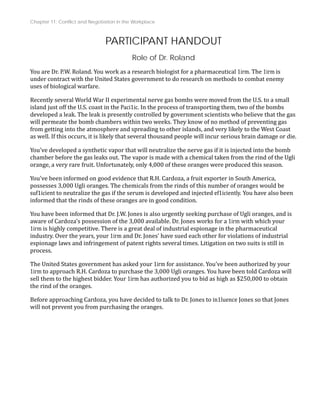
PARTICIPANT HANDOUT
Role of Dr. Roland
You are Dr. P.W. Roland. You work as a research biologist for a pharmaceutical 1irm. The 1irm is
under contract with the United States government to do research on methods to combat enemy
uses of biological warfare.
Recently several World War II experimental nerve gas bombs were moved from the U.S. to a small
island just off the U.S. coast in the Paci1ic. In the process of transporting them, two of the bombs
developed a leak. The leak is presently controlled by government scientists who believe that the gas
will permeate the bomb chambers within two weeks. They know of no method of preventing gas
from getting into the atmosphere and spreading to other islands, and very likely to the West Coast
e.
as well. If this occurs, it is likely that several thousand people will incur serious brain damage or di
You've developed a synthetic vapor that will neutralize the nerve gas if it is injected into the bomb
chamber before the gas leaks out. The vapor is made with a chemical taken from the rind of the Ugli
n.
orange, a very rare fruit. Unfortunately, only 4,000 of these oranges were produced this seaso
You've been informed on good evidence that R.H. Cardoza, a fruit exporter in South America,
possesses 3,000 Ugli oranges. The chemicals from the rinds of this number of oranges would be
suf1icient to neutralize the gas if the serum is developed and injected ef1iciently. You have also been
informed that the rinds of these oranges are in good condition.
nd is
You have been informed that Dr. J.W. Jones is also urgently seeking purchase of Ugli oranges, a
aware of Cardoza's possession of the 3,000 available. Dr. Jones works for a 1irm with which your
1irm is highly competitive. There is a great deal of industrial espionage in the pharmaceutical
industry. Over the years, your 1irm and Dr. Jones' have sued each other for violations of industrial
espionage laws and infringement of patent rights several times. Litigation on two suits is still in
process.
The United States government has asked your 1irm for assistance. You've been authorized by your
1irm to approach R.H. Cardoza to purchase the 3,000 Ugli oranges. You have been told Cardoza will
sell them to the highest bidder. Your 1irm has authorized you to bid as high as $250,000 to obtain
the rind of the oranges.
Before approaching Cardoza, you have decided to talk to Dr. Jones to in1luence Jones so that Jones
will not prevent you from purchasing the oranges.
Chapter 11: Conflict and Negotiation in the Workplace
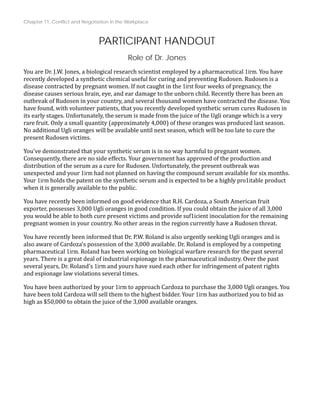
PARTICIPANT HANDOUT
Role of Dr. Jones
You are Dr. J.W. Jones, a biological research scientist employed by a pharmaceutical 1irm. You have
recently developed a synthetic chemical useful for curing and preventing Rudosen. Rudosen is a
disease contracted by pregnant women. If not caught in the 1irst four weeks of pregnancy, the
disease causes serious brain, eye, and ear damage to the unborn child. Recently there has been an
outbreak of Rudosen in your country, and several thousand women have contracted the disease. You
have found, with volunteer patients, that you recently developed synthetic serum cures Rudosen in
its early stages. Unfortunately, the serum is made from the juice of the Ugli orange which is a very
rare fruit. Only a small quantity (approximately 4,000) of these oranges was produced last season.
No additional Ugli oranges will be available until next season, which will be too late to cure the
present Rudosen victims.
You've demonstrated that your synthetic serum is in no way harmful to pregnant women.
Consequently, there are no side effects. Your government has approved of the production and
distribution of the serum as a cure for Rudosen. Unfortunately, the present outbreak was
unexpected and your 1irm had not planned on having the compound serum available for six months.
Your 1irm holds the patent on the synthetic serum and is expected to be a highly pro1itable product
when it is generally available to the public.
You have recently been informed on good evidence that R.H. Cardoza, a South American fruit
exporter, possesses 3,000 Ugli oranges in good condition. If you could obtain the juice of all 3,000
you would be able to both cure present victims and provide suf1icient inoculation for the remaining
pregnant women in your country. No other areas in the region currently have a Rudosen threat.
You have recently been informed that Dr. P.W. Roland is also urgently seeking Ugli oranges and is
also aware of Cardoza's possession of the 3,000 available. Dr. Roland is employed by a competing
pharmaceutical 1irm. Roland has been working on biological warfare research for the past several
years. There is a great deal of industrial espionage in the pharmaceutical industry. Over the past
several years, Dr. Roland's 1irm and yours have sued each other for infringement of patent rights
and espionage law violations several times.
You have been authorized by your 1irm to approach Cardoza to purchase the 3,000 Ugli oranges. You
have been told Cardoza will sell them to the highest bidder. Your 1irm has authorized you to bid as
high as $50,000 to obtain the juice of the 3,000 available oranges.
Chapter 11: Conflict and Negotiation in the Workplace
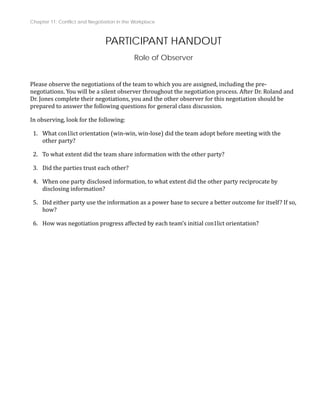
PARTICIPANT HANDOUT
Role of Observer
Please observe the negotiations of the team to which you are assigned, including the pre‐
negotiations. You will be a silent observer throughout the negotiation process. After Dr. Roland and
Dr. Jones complete their negotiations, you and the other observer for this negotiation should be
estions for general class discussion.
prepared to answer the following qu
In observing, look for the following:
1. What con1lict orientation (win‐win, win‐lose) did the team adopt before meeting with the
other party?
e information with the other party?
2. To what extent did the team shar
3. Did the parties trust each other?
4. When one party disclosed information, to what extent did the other party reciprocate by
disclosing information?
5. Did either party use the information as a power base to secure a better outcome for itself? If so,
how?
6. How was negotiation progress affected by each team’s initial con1lict orientation?
Chapter 11: Conflict and Negotiation in the Workplace
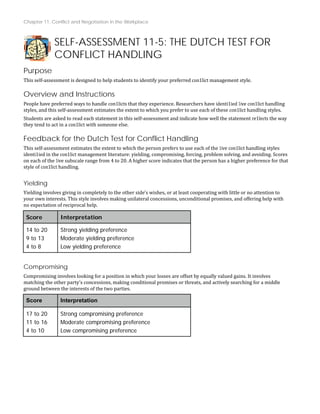
SELF-ASSESSMENT 11-5: THE DUTCH TEST FOR
CONFLICT HANDLING
Purpose
This self‐assessment is designed to help students to identify your preferred con1lict management style.
Overview and Instructions
People have preferred ways to handle con1licts that they experience. Researchers have identi1ied 1ive con1lict handling
styles, and this self‐assessment estimates the extent to which you prefer to use each of these con1lict handling styles.
Students are asked to read each statement in this self‐assessment and indicate how well the statement re1lects the way
they tend to act in a con1lict with someone else.
Feedback for the Dutch Test for Conflict Handling
This self‐assessment estimates the extent to which the person prefers to use each of the 1ive con1lict handling styles
identi1ied in the con1lict management literature: yielding, compromising, forcing, problem solving, and avoiding. Scores
on each of the 1ive subscale range from 4 to 20. A higher score indicates that the person has a higher preference for that
style of con1lict handling.
Yielding
Yielding involves giving in completely to the other side's wishes, or at least cooperating with little or no attention to
your own interests. This style involves making unilateral concessions, unconditional promises, and offering help with
no expectation of reciprocal help.
Score Interpretation
14 to 20
9 to 13
4 to 8
Strong yielding preference
Moderate yielding preference
Low yielding preference
Compromising
Compromising involves looking for a position in which your losses are offset by equally valued gains. It involves
matching the other party’s concessions, making conditional promises or threats, and actively searching for a middle
ground between the interests of the two parties.
Score Interpretation
17 to 20
11 to 16
4 to 10
Strong compromising preference
Moderate compromising preference
Low compromising preference
Chapter 11: Conflict and Negotiation in the Workplace
Forcing
Forcing tries to win the con1lict at the other's expense. It includes “ hard” in1luence tactics, particularly assertiveness, to
get one’s own way.
Score Interpretation
15 to 20
9 to 14
4 to 8
Strong forcing preference
Moderate forcing preference
Low forcing preference
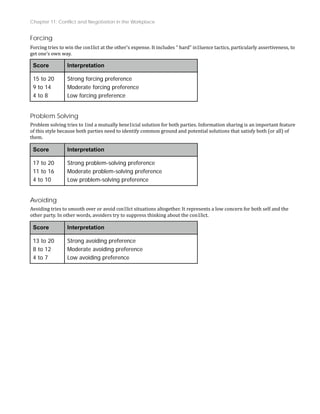
Problem Solving
Problem solving tries to 1ind a mutually bene1icial solution for both parties. Information sharing is an important feature
of this style because both parties need to identify common ground and potential solutions that satisfy both (or all) of
them.
Score Interpretation
17 to 20
11 to 16
4 to 10
Strong problem-solving preference
Moderate problem-solving preference
Low problem-solving preference
Avoiding
Avoiding tries to smooth over or avoid con1lict situations altogether. It represents a low concern for both self and the
other party. In other words, avoiders try to suppress thinking about the con1lict.
Score Interpretation
13 to 20
8 to 12
4 to 7
Strong avoiding preference
Moderate avoiding preference
Low avoiding preference
Another Random Scribd Document
with Unrelated Content
The Project Gutenberg eBook of A History of
Booksellers, the Old and the New
This ebook is for the use of anyone anywhere in the United
States and most other parts of the world at no cost and with
almost no restrictions whatsoever. You may copy it, give it away
or re-use it under the terms of the Project Gutenberg License
included with this ebook or online at www.gutenberg.org. If you
are not located in the United States, you will have to check the
laws of the country where you are located before using this
eBook.
Title: A History of Booksellers, the Old and the New
Author: Henry Curwen
Release date: June 18, 2016 [eBook #52362]
Most recently updated: October 23, 2024
Language: English
Credits: Produced by MWS, Charlie Howard, and the Online
Distributed
Proofreading Team at http://www.pgdp.net (This file
was
produced from images generously made available by
The
Internet Archive/American Libraries.)
*** START OF THE PROJECT GUTENBERG EBOOK A HISTORY OF
BOOKSELLERS, THE OLD AND THE NEW ***
A
HISTORY OF BOOKSELLERS,
THE OLD AND THE NEW.
By HENRY CURWEN.
“In these days, ten ordinary histories of kings and courtiers were well
exchanged
against the tenth part of one good History of Booksellers.”—Thomas Carlyle.
WITH PORTRAITS AND ILLUSTRATIONS.
London:
CHATTO AND WINDUS, PICCADILLY.
PREFACE.
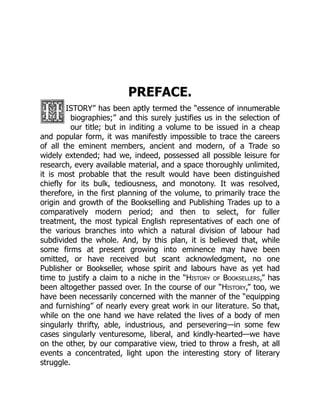
ISTORY” has been aptly termed the “essence of innumerable
biographies;” and this surely justifies us in the selection of
our title; but in inditing a volume to be issued in a cheap
and popular form, it was manifestly impossible to trace the careers
of all the eminent members, ancient and modern, of a Trade so
widely extended; had we, indeed, possessed all possible leisure for
research, every available material, and a space thoroughly unlimited,
it is most probable that the result would have been distinguished
chiefly for its bulk, tediousness, and monotony. It was resolved,
therefore, in the first planning of the volume, to primarily trace the
origin and growth of the Bookselling and Publishing Trades up to a
comparatively modern period; and then to select, for fuller
treatment, the most typical English representatives of each one of
the various branches into which a natural division of labour had
subdivided the whole. And, by this plan, it is believed that, while
some firms at present growing into eminence may have been
omitted, or have received but scant acknowledgment, no one
Publisher or Bookseller, whose spirit and labours have as yet had
time to justify a claim to a niche in the “History of Booksellers,” has
been altogether passed over. In the course of our “History,” too, we
have been necessarily concerned with the manner of the “equipping
and furnishing” of nearly every great work in our literature. So that,
while on the one hand we have related the lives of a body of men
singularly thrifty, able, industrious, and persevering—in some few
cases singularly venturesome, liberal, and kindly-hearted—we have
on the other, by our comparative view, tried to throw a fresh, at all
events a concentrated, light upon the interesting story of literary
struggle.
No work of the kind has ever previously been attempted, and
this fact must be an apology for some, at least, of our shortcomings.
H. C.
November, 1873.
CONTENTS.
PAGE
THE BOOKSELLERS OF OLDEN TIMES 9
THE LONGMAN FAMILY
Classical and Educational Literature.
79
CONSTABLE, CADELL, AND BLACK
The “Edinburgh Review,” “Waverley Novels,”
and “Encyclopædia Britannica.”
110
JOHN MURRAY
Belles-Lettres and Travels.
159
WILLIAM BLACKWOOD
“Blackwood’s Edinburgh Magazine.”
199
CHAMBERS, KNIGHT, AND CASSELL
Literature for the People.
234
HENRY COLBURN
Three-Volume Novels and Light Literature.
279
THE RIVINGTONS, THE PARKERS, AND JAMES
NISBET
Religious Literature.
296
BUTTERWORTH AND CHURCHILL
Technical Literature.
333
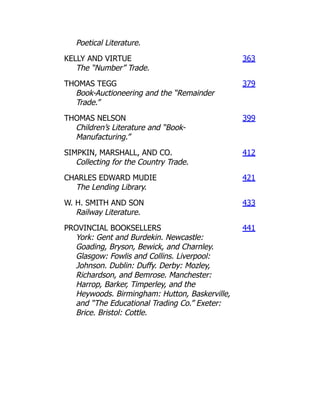
EDWARD MOXON 347
Poetical Literature.
KELLY AND VIRTUE
The “Number” Trade.
363
THOMAS TEGG
Book-Auctioneering and the “Remainder
Trade.”
379
THOMAS NELSON
Children’s Literature and “Book-
Manufacturing.”
399
SIMPKIN, MARSHALL, AND CO.
Collecting for the Country Trade.
412
CHARLES EDWARD MUDIE
The Lending Library.
421
W. H. SMITH AND SON
Railway Literature.
433
PROVINCIAL BOOKSELLERS
York: Gent and Burdekin. Newcastle:
Goading, Bryson, Bewick, and Charnley.
Glasgow: Fowlis and Collins. Liverpool:
Johnson. Dublin: Duffy. Derby: Mozley,
Richardson, and Bemrose. Manchester:
Harrop, Barker, Timperley, and the
Heywoods. Birmingham: Hutton, Baskerville,
and “The Educational Trading Co.” Exeter:
Brice. Bristol: Cottle.
441
L
THE BOOKSELLERS OF OLDEN
TIMES.
ONG ages before the European invention of the art of printing,
long even before the encroaching masses of Huns and
Visigoths rolled the wave of civilization backward for a
thousand years, the honourable trades, of which we aim to be in
some degree the chroniclers, had their representatives and their
patrons. Without going back to the libraries of Egypt—a subject
fertile enough in the pages of mythical history—or to the manuscript-
engrossers and sellers of Ancient Greece—though by their labours
much of the world’s best poetry, philosophy, and wit was garnered
for a dozen centuries, like wheat ears in a mummy’s tomb, to be
scattered to the four winds of heaven, when the Mahometans seized
upon Constantinople, thenceforth to fructify afresh, and, in
connection with the art of printing, as if the old world and the new
clasped hands upon promise of a better time, to be mainly
instrumental in the “revival of letters”—it will be sufficient for our
present purpose to know that there were in Rome, at the time of the
Empire, many publishing firms, who, if they could not altogether
rival the magnates of Albemarle Street and the “Row,” issued books
at least as good, and, paradoxical as it may seem, at least as
cheaply as their modern brethren.
To the sauntering Roman of the Augustan age literature was an
essential; never, probably, till quite modern times was education—
the education, at all events, that supplies a capability to read and
write—so widely spread. The taste thus created was gratified in
many ways. If the Romans had no Mudie, they possessed public
libraries, thrown freely open to all. They had public recitations, at
which unpublished and ambitious writers could find an audience;
over which, too, sometimes great emperors presided, while poets,
with a world-wide reputation, read aloud their favourite verses. They
had newspapers, the subject-matter of which was wonderfully like
our own. The principal journal, entitled Acta Diurna, was compiled
under the sanction of the government, and hung up in some place of
frequent resort for the benefit of the multitude, and was probably
copied for the private accommodation of the wealthy. All public
events of importance were chronicled here; the reporters, termed
actuarii, furnished abstracts of the proceedings in the law courts and
at public assemblies; there was a list of births, deaths, and
marriages; and we are informed that the one article of news in
which the Acta Diurna particularly abounded was that of reports of
trials for divorce. Juvenal tells us that the women were all agog for
deluges, earthquakes, and other horrors, and that the wine-
merchants and traders used to invent false news in order to affect
their various markets. But, in addition to all these means for
gratifying the Roman taste for reading, every respectable house
possessed a library, and among the better classes the slave-readers
(anagnostæ) and the slave-transcribers (librarii) were almost as
indispensable as cooks and scullions. At first we find that these
slaves were employed in making copies of celebrated books for their
masters; but gradually the natural division of labour produced a
separate class of publishers. Atticus, the Moxon of the period, and
an author of similar calibre, saw an opening for his energies in the
production of copies of favourite authors upon a large scale. He
employed a number of slaves to copy from dictation simultaneously,
and was thus able to multiply books as quickly as they were
demanded. His success speedily finding imitators, among whom
were Tryphon and Dorus, publishing became a recognized trade. The
public they appealed to was not a small one. Martial, Ovid, and
Propertius speak of their works as being known all the world over;
that young and old, women and girls, in Rome and in the provinces,
in Britain and in Gaul, read their verses. “Every one,” says Martial,
“has me in his pocket, every one has me in his hands.”
“Laudat, amat, cantat nostros mea Roma libellos:
Meque sinus omnis, me manus omnis habet.”
Horace speaks of the repugnance he felt at seeing his works in the
hands of the vulgar. And Pliny writes that Regulus is mourning
ostentatiously for the loss of his son, and no one weeps like him—
luget ut nemo. “He composes an oration which he is not content
with publicly reciting in Rome, but must needs enrich the provinces
with a thousand copies of it.”
School-books, too, an important item in publishing eyes, were in
demand at Rome: Juvenal says that “the verses which the boy has
just conned over at his desk he stands up to repeat,” and Persius
tells us that poets were ambitious to be read in the schools; while
Nero, in his vanity, gave special command that his verses should be
placed in the hands of the students.
Thus, altogether, there must have been a large book-buying
public, and this fact is still further strengthened by the cheapness of
the books produced. M. Geraud
1
concludes that the prices were
lower than in our own day. According to Martial the first book of his
Epigrams was to be bought, neatly bound, for five denarii (nearly
three shillings), but in a cheaper binding for the people it cost six to
ten sestertii (a shilling to eighteenpence); his thirteenth book of
Epigrams was sold for four sestertii (about eightpence), and half that
price would, he says, have left a fair profit (Epig. xiii. 3). He tells us,
moreover, that it would only require one hour to copy the whole of
the second book,
“Hæc una peragit librarius hora.”
This book contains five hundred and forty verses, and though he
may be speaking with poetical licence, the system of abbreviations
did undoubtedly considerably lessen the labour of transcribing, and it
would be quite possible, by employing a number of transcribers
simultaneously, to produce an edition of such a work in one day.
In Rome, therefore, we see that from the employment of slave
labour—and some thousands of slaves were engaged in this work of
transcribing—books were both plentiful and cheap.
2
William Caxton. The
first printer at
Westminster.
1410–1491.
Caxton’s Monogram.
(Facsimile from his Works.)
In the Middle Ages this state of things was entirely altered. Men
were too busy in giving and receiving blows, in oppressing and being
oppressed, to have the slightest leisure for book-learning. Slaves,
such as then existed, were valued for far different things than
reading and writing; and even their masters’ kings, princes, lords,
and other fighting dignitaries, would have regarded a quill-pen, in
their mail-gloved hands, as a very foolish and unmanly weapon.
There was absolutely no public to which bookmakers could have
appealed, and the art of transcribing was confined entirely to a few
monks, whose time hung heavily upon their hands; and, as a natural
result, writers became, as Odofredi says, “no longer writers but
painters,” and books were changed into elaborate works of art. Nor
was this luxurious illumination confined to Bibles and Missals; the
very law-books were resplendent, and a writer in the twelfth century
complains that in Paris the Professor of Jurisprudence required two
or three desks to support his copy of Ulpian, gorgeous with golden
letters. No wonder that Erasmus says of the Secunda Secundea that
“no man can carry it about, much less get it into his head.”
At first there was no trade whatever in books, but gradually a
system of barter sprung up between the monks of various
monasteries; and with the foundation of the Universities a regular
class of copyists was established to supply the wants of scholars and
professors, and this improvement was greatly fostered by the
invention of paper.
The booksellers of this period were called Stationarii, either from
the practice of stationing themselves at booths or stalls in the streets
(in contradistinction to the itinerant vendors) or from the other
meaning of the Latin term statio, which is, Crevier tells us, entrepôt
or depository, and he adds that the booksellers did little else than
furnish a place of deposit, where private persons could send their
manuscripts for sale. In addition to this, indeed as their chief trade,
they sent out books to be read, at exorbitant prices, not in volumes,
but in detached parts, according to the estimation in which the
authors were held.
In Paris, where the trade of these stationarii was best developed,
a statute regarding them was published in 1275, by which they were
compelled to take the oath of allegiance once a year, or, at most,
once every two years. They were forbidden by this same statute to
purchase the books placed in their hands until they had been
publicly exposed for sale for at least a month; the purchase money
was to be handed over direct to the proprietor, and the bookseller’s
commission was not to exceed one or two per cent. In addition to
the stationarii, there were in Paris several pedlars or stall-keepers,
also under University control, who were only permitted to exhibit
their wares under the free heavens, or beneath the porches of
churches where the schools were occasionally kept. The portal at the
north end of the cross aisle in Rouen Cathedral is still called le Portail
des Libraires.
Wynkyn de Worde. 1493–1534.
The second printer at
Westminster.
(From a drawing by Fathorne.)
Headpiece of William Caxton.
In England the first stationers were probably themselves the
engrossers of what they sold, when the learning and literature of the
country demanded as the chief food A B C’s and Paternosters, Aves
and Creeds, Graces and Amens. Such was the employment of our
earliest stationers, as the names of their favourite haunts—
Paternoster Row, Amen Corner, and Ave Maria Lane—bear ample
witness; while the term stationer soon became synonymous with
bookseller, and, in connection with the Stationers’ Company, of no
little importance, as we shall soon see, in our own bookselling
annals.
In 1292, the bookselling corporation of Paris consisted of twenty-
four copyists, seventeen bookbinders, nineteen parchment makers,
thirteen illuminators, and eight simple dealers in manuscripts. But at
the time when printing was first introduced upwards of six thousand
people are said to have subsisted by copying and illuminating
manuscripts—a fact that, even if exaggerated, says something for
the gradual advancement of learning.
The European invention of printing, which here can only be
mentioned; the diffusion of Greek manuscripts and the ancient
wisdom contained therein, consequent upon the capture of
Constantinople by the Turks; the discovery of America; and, finally,
the German and English religious Reformations, were so many rapid
and connected strides in favour of knowledge and progress. All
properly-constituted conservative minds were shocked that so many
new lights should be allowed to stream in upon the world, and every
conceivable let and hindrance was called up in opposition. Royal
prerogatives were exercised, Papal bulls were issued, and satirists
(soi-disant) were bitter. A French poet of this period, sneering at the
invention of printing, and the discovery of the New World by
Columbus, says of the press, in language conveyed by the following
doggerel:—

Organizational Behavior Emerging Knowledge 5th Edition McShane Solutions Manual

  • 1.
    Organizational Behavior EmergingKnowledge 5th Edition McShane Solutions Manual pdf download https://testbankdeal.com/product/organizational-behavior- emerging-knowledge-5th-edition-mcshane-solutions-manual/ Download more testbank from https://testbankdeal.com
  • 2.
    Instant digital products(PDF, ePub, MOBI) available Download now and explore formats that suit you... Organizational Behavior Emerging Knowledge 5th Edition McShane Test Bank https://testbankdeal.com/product/organizational-behavior-emerging- knowledge-5th-edition-mcshane-test-bank/ testbankdeal.com Organizational Behavior Emerging Knowledge Global Reality 6th Edition McShane Solutions Manual https://testbankdeal.com/product/organizational-behavior-emerging- knowledge-global-reality-6th-edition-mcshane-solutions-manual/ testbankdeal.com Organizational Behavior Emerging Knowledge Global Reality 7th Edition McShane Solutions Manual https://testbankdeal.com/product/organizational-behavior-emerging- knowledge-global-reality-7th-edition-mcshane-solutions-manual/ testbankdeal.com Operations and Supply Chain Management for MBAs 6th Edition Meredith Test Bank https://testbankdeal.com/product/operations-and-supply-chain- management-for-mbas-6th-edition-meredith-test-bank/ testbankdeal.com
  • 3.
    Foundations of Strategy2nd Edition Grant Test Bank https://testbankdeal.com/product/foundations-of-strategy-2nd-edition- grant-test-bank/ testbankdeal.com Macroeconomics Fourteenth Canadian Edition Canadian 14th Edition Ragan Solutions Manual https://testbankdeal.com/product/macroeconomics-fourteenth-canadian- edition-canadian-14th-edition-ragan-solutions-manual/ testbankdeal.com Law and Business Administration in Canada 11th Edition Smyth Test Bank https://testbankdeal.com/product/law-and-business-administration-in- canada-11th-edition-smyth-test-bank/ testbankdeal.com Human Physiology From Cells to Systems 7th Edition Sherwood Test Bank Cells to Systems 7th Edition Sherwood Test Bank https://testbankdeal.com/product/human-physiology-from-cells-to- systems-7th-edition-sherwood-test-bank-cells-to-systems-7th-edition- sherwood-test-bank/ testbankdeal.com South Western Federal Taxation 2019 Individual Income Taxe 42nd Edition Young Test Bank https://testbankdeal.com/product/south-western-federal- taxation-2019-individual-income-taxe-42nd-edition-young-test-bank/ testbankdeal.com
  • 4.
    Microeconomics 3rd EditionHubbard Solutions Manual https://testbankdeal.com/product/microeconomics-3rd-edition-hubbard- solutions-manual/ testbankdeal.com
  • 5.
    Instructor’s Manual toAccompany Organizational Behavior 5/e emerging knowledge and practice for the real world by Steven L. McShane and Mary Ann von Glinow Chapter 11 Conflict and Negotiation in the Workplace Prepared by: Steven L. McShane, University of Western Australia This Instructor’s Manual 1ile is part of the Instructor’s Resource CD‐ROM for Organizational Behavior: ctice for the Real World, 5th edition Emerging Knowledge and Pra 10‐digit ISBN: 0073364347 13‐digit ISBN: 9780073364346 Published by McGraw‐Hill/Irwin, a business unit of The McGraw‐Hill Companies, Inc., 1221 Avenue of the Americas, New York, NY, 10020. Copyright © 2010, 2008, 2005, 2003, 2000 by The McGraw‐Hill Companies, Inc. All rights reserved. No part of this publication may be reproduced or distributed in any form or by any means, or stored in a database or retrieval system, without the prior written consent of The McGraw‐Hill Companies, Inc., including, but not limited to, in any network or other electronic storage or transmission, or broadcast for distance learning. Some ancillaries, including electronic and print components, may not be available to customers outside the United States. McGraw-Hill Irwin
  • 6.
    Chapter 11: Conflictand Negotiation in the Workplace 1 Conflict and Negotiation in the Workplace LEARNING OB After reading this chapter JECTIVES , students should be able to: 1. Debate the positive and negative consequences of con1lict in the workplace. 2. Distinguish constructive con1lict from relationship con1lict. ing relationship con1lict during constructive‐con1lict 3. Describe three strategies for minimiz episodes. 4. Diagram the con1lict process model. 5. Identify six structural sources of con1lict in organizations. mstances in which each would 6. Outline the 1ive con1lict‐handling styles and discuss the circu on1lict. be most appropriate. 7. Summarize six structural approaches to managing c 8. Outline four situational in1luences on negotiations. 9. Describe four skills of effective negotiators. 10.Compare and contrast the three types of third‐party dispute resolution. CHAPTER GLOSSARY alternative dispute resolution (ADR) ‐‐ an orderly process of third‐party dispute resolution, typically including mediation followed by arbitration. con1lict ‐‐ is a process in which one party perceives that y its interests are being opposed or negatively affected b another party. constructive con1lict ‐‐ occurs when people focus their discussion on the issue while maintaining respectfulness for people having other points of view. negotiation – the process whereby two or more con1licting parties attempt to resolve their divergent goals by rede1ining the terms of their interdependence relationship con1lict ‐ occurs when people focus on characteristics of other individuals rather than the issues as the source of con1lict. third‐party con1lict resolution ‐‐ any attempt by a relatively neutral person to help the parties resolve their differences. win–lose orientation ‐‐ The belief that con1licting parties are drawing from a 1ixed pie, so the more one party receives, the less the other party will receive. win–win orientation ‐‐ The belief that the parties will 1ind a mutually bene1icial solution to their disagreement.
  • 7.
    Chapter 11: Conflictand Negotiation in the Workplace CHAPTER SYNOPSIS Con1lict is the process in which one party perceives that his or her interests are being opposed or negatively affected by another party. For many years, con1lict was viewed as undesirable and counterproductive. There is evidence that con1lict can produce undesirable outcomes such as lower job satisfaction, team cohesion, and knowledge sharing as well as higher organizational politics and turnover. However, experts later formed the opinion that organizations suffer . from too little as well as too much con1lict. Research reports that moderate con1lict can improve decision making, organizational responsiveness to the environment, and team cohesion (when con1lict is with sources outside the team) The current perspective involves distinguishing constructive con1lict from relationship con1lict. The former focuses on issues and a logical evaluation of ideas, whereas the latter pays attention to interpersonal incompatibilities and 1laws. Although the ideal would be to encourage constructive con1lict and minimize relationship con1lict, relationship con1lict when tends to emerge in most constructive‐con1lict episodes. However, relationship con1lict is less likely to dominate the parties are emotionally intelligent, have a cohesive team, and have supportive team norms. The con1lict process model begins with the six structural sources of con1lict: incompatible goals, differentiation (different values and beliefs), interdependence, scarce resources, ambiguous rules, and communication problems. These sources lead one or more parties to perceive a con1lict and to experience con1lict emotions. This, in turn, ugh produces manifest con1lict, such as hostile behaviors toward the other side. The con1lict process often escalates thro a series of episodes. Organizational behavior experts have identi1ied several con1lict‐handling styles: problem solving, forcing, avoiding, yielding, and compromising. People who use problem solving have a win‐win orientation. Other styles, particularly forcing, assume a win‐lose orientation. In general, people gravitate toward one or two preferred con1lict‐handling styles that match their personality, personal and cultural values, and past experience. However, the best style depends on various characteristics of the situation. Structural approaches to con1lict management include emphasizing superordinate goals, reducing differentiation, improving communication and understanding, reducing interdependence, increasing resources, and clarifying rules and procedures. Negotiation occurs whenever two or more con1licting parties attempt to resolve their divergent goals by rede1ining the terms of their interdependence. Negotiations are in1luenced by several situational factors, including location, physical setting, time passage and deadlines, and audience. Important negotiator behaviors include preparation and goal setting, gathering information, communicating effectively, and making concessions. Third‐party con1lict resolution is any attempt by a relatively neutral person to help the parties resolve their differences. The three main forms of third‐party dispute resolution are mediation, arbitration, and inquisition. Managers tend to use an inquisition approach, although mediation and arbitration are more appropriate, depending on the situation.
  • 8.
    Chapter 11: Conflictand Negotiation in the Workplace POWERPOINT® SLIDES Organizational Behavior Fifth Edition includes a complete set of Microsoft PowerPoint® 1iles for each chapter. (Please contact your McGraw‐Hill/Irwin representative to 1ind out how instructors can receive these 1iles.) In the lecture outline that follows, a thumbnail illustration of each PowerPoint slide for this chapter is placed beside the corresponding lecture material. The slide number helps you to see your location in the slide show sequence and to skip slides that you don’t want to show to the class. (To jump ahead or back to a particular slide, just type the slide number and hit the Enter or Return key.) LECTURE OUTLINE (WITH POWERPOINT® SLIDES) Conflict and Negotiation in the Workplace Conflict and Negotiation in the Workplace Slide 1 Generational Conflict at Work Slide 2 Conflict Defined Slide 3 Is Conflict Good or Bad?: Pre 1970s View Slide 4 Generational Conflict at Work To reward themselves for a job well done, Generation-Y (Millennial) employees might throw a pizza party during office hours, but this practice bothers older employees who have different views about appropriateworkplace behavior. Conflict Defined The process in which one party perceives that its interests are being opposed or negatively affected by another party • Based on perceptions -- conflict is perceived to exist Is Conflict Good or Bad?: Pre 1970s View Historically, experts viewed conflict as dysfunctional • Undermined relations • Wasted human energy • Results in job dissatisfaction, turnover, stress, lower productivity, less information sharing
  • 9.
    Chapter 11: Conflictand Negotiation in the Workplace Is Conflict Good or Bad?: 1970s-1990s View Slide 5 Is Conflict Good or Bad?: Emerging View Slide 6 Is Conflict Good or Bad?: Emerging View Slide 7 Constructive Confrontation at Intel Slide 8 Is Conflict Good or Bad?: 1970s-1990s View From 1970s to 1990s, experts believed there is an optimal level of conflict Dysfunctional to have too little and too much conflict Some conflict is good because: • Energizes people to debate issues • Reexamine assumptions/logic of arguments • Improves responsiveness to external environment • Increases cohesion within the team Is Conflict Good or Bad?: Emerging View Two types of conflict Constructive (task) conflict • Conflict is aimed at issue, not parties • Produces benefits of conflict • However, likely an upper limit to any conflict, including constructive Relationship (socioemotional) conflict • Aims conflict at the person (e.g. their competence), not the task or issue • Introduces perceptual biases • Distorts information processing Is Conflict Good or Bad?: Emerging View Goal: encourage constructive conflict, minimize relationship conflict Problem: difficult to separate constructive from relationship conflict • Drive to defend naturallyactivated when ideas are critiqued • The stronger the level of debate the more likely constructive conflict will generate relationship conflict. Constructive Confrontation at Intel Intel employees learn to fully evaluate ideas through “constructive confrontation.” The objective is to attack the problem, not the employee, but some critics claim the process is a license for some Intel staff to be bullies.
  • 10.
    Chapter 11: Conflictand Negotiation in the Workplace Minimizing Relationship Conflict Slide 9 The Conflict Process Slide 10 Minimizing Relationship Conflict Three conditions that minimize relationship conflict while engaging in constructive conflict 1. Emotional intelligence – allows individuals to better control their emotions during debates 2. Cohesive teams – members give each other more latitude to disagree, and are less likely to interpret opposition as personal 3. Supportive team norms – discourage negative reactions toward co-workers during frank and open dialogue The Conflict Process Sources of conflict • Conflict begins with the conditions that create conflict • Includes incompatible goals, different values, tasks, resources, rules, and communication • Leads to conflict perceptions and emotions • Leads to manifest conflict episodes (behavior) ‣ manifest conflict may affect conflict perceptions and emotions (reverse arrows) • Conflict outcomes ‣ conditions and relations after manifest conflict Conflict escalation cycle -- a dynamic, interactive set of conflict episodes • Communication may control conflict, keeping it task-related, or ambiguity may allow conflict to escalate into relationship conflict • Process then adopts an ‘us-them’ frame of reference -- becomes relationship conflict
  • 11.
    Chapter 11: Conflictand Negotiation in the Workplace Structural Sources of Conflict Slide 11 Structural Sources of Conflict Slide 12 Structural Sources of Conflict 1. Goal incompatibility • Goals may conflict with others • Reinforced by reward systems • Divergent goals contribute to conflict 2. Different values and beliefs (Differentiation) • People hold different values and beliefs due to unique backgrounds, experiences, training • Cultural differences -- result in misunderstanding • Mergers – divergent corporate cultures explain conflict • Cross-generational conflict due to younger and older employees having different needs, expectations and values 3. Task interdependence • Conflict increases when people share common inputs, have interdependent processes, or receive outcomes partly determined by performance of others • Three levels (pooled is lowest) ‣ pooled interdependence -- work units rely on a common resource or authority but do not work directly with each other ‣ sequential interdependence -- one person's output is next person's input ‣ reciprocal interdependence -- output is exchanged – employees are highly dependent on each other Structural Sources of Conflict 4. Scarce resources • Potential conflict increases as shared resources decrease • Results in more competition for resources to fulfill goals 5. Ambiguous rules • Ambiguous or lack of rules guiding relations between parties • Encourages political tactics to intercept resources • Ambiguity weakens coordination • Threatens goal achievement because parties don't know what the other will do
  • 12.
    Chapter 11: Conflictand Negotiation in the Workplace 6. Communication problems • Conflict due to lack of opportunity, ability, or motivation to communicate effectively • Lack of opportunity --reliance on stereotypes • Lack of ability -- arrogant communication heightens conflict perception • Lack of motivation -- conflict causes lower motivation to communicate, which increases stereotyping Interpersonal Conflict Handling Styles Slide 13 Five Conflict Handling Styles Slide 14 Interpersonal Conflict Handling Styles Two general orientations •Win-win orientation ‣ believe parties will find a mutuallybeneficial solution to their disagreement ‣ working together produces creative solution •Win-lose orientation ‣ belief that the more one party receives, the less the other receives ‣ sometimes appropriate, but often creates unnecessary conflict ‣ tends to escalate conflict -- parties try to gain advantage Five Conflict Handling Styles Vary in degree of assertiveness (concern of one’s own interests) and cooperativeness (concern for the party’s interests) 1. Problem-Solving ‣ Try to find a mutuallybeneficial solution 2. Forcing ‣ Try to win the conflict at the other’s expense -- strong win/lose orientation ‣ Strongest win-lose orientation ‣ Relies on “hard” influence tactics, particularly assertiveness to get one’s own way 3. Avoiding ‣ Smooth over or avoiding conflict ‣ Low concern for both self and the other party ‣ Suppresses thinking about the conflict
  • 13.
    Chapter 11: Conflictand Negotiation in the Workplace 1. Yielding ‣ Give in to the other side’s wishes, little or no attention in one’s own interests ‣ Make unilateral concessions, unconditional promises and/or offering help with no expectation of reciprocal help 2. Compromising ‣ Reach a middle ground between the interests of the parties ‣ Look for a position in which your losses are offset by equally valued gains ‣ Match the other party’s concessions making conditional promises or threats Conflict Handling Style Preferences •People tend to prefer one or two styles compatible with their personality, values, and self-concept •Cultural and gender influences on use of conflict handling styles Conflict Handling Contingencies Best conflict handlingstyle depends on the situation Conflict Handling Contingencies Slide 15 Problem solving Best when: • interests are not perfectlyopposing • parties have trust/openness • issues are complex Problems with problem solving style • Sharing information that the other party might use to their advantage
  • 14.
    Chapter 11: Conflictand Negotiation in the Workplace Forcing Best when: • you have a deep conviction about your position • quick resolution required • other party would take advantage of cooperation Problems with forcing style • Highest risk of relationship conflict • May damage long-term relations, reducing future problem solving Conflict Handling Contingencies Slide 16 Conflict Handling Contingencies Slide 17 Contingencies of Conflict Handling (con’t) Avoiding Best when: • relationship conflict is high • conflict resolution cost is higher than its benefits Problems with avoiding style • Doesn’t usually resolve the conflict • May increase frustration for all parties Yielding Best when: • other party has much more power • issue is much less important to you than other party • value/logic of your position is imperfect Problem with yielding style • Increases other party’s expectations in future conflict episodes Compromising Best when… • parties have equal power • quick solution is required • parties lack trust/openness Problem with compromising style • Sub-optimal solution where mutual gains are possible
  • 15.
    Chapter 11: Conflictand Negotiation in the Workplace Structural Approaches to Conflict Resolution Slide 18 Structural Approaches to Conflict Resolution Slide 19 Structural Approaches to Conflict Resolution 1. Emphasizing superordinate goals Superordinate goal – a goal that both conflicting parties value and whose attainment is beyond the resources and effort of either party alone. • Emphasize common objective rather than conflicting sub-goals • Reduces goal incompatibility and differentiation 2. Reducing differentiation Remove sources of different values and beliefs Ways to reduce differentiation • Move employees around to different jobs, departments and regions • Common work experience Structural Approaches to Conflict Resolution (con’t) 3. Improving communication and understanding Employees understand and appreciate each other’s views through communication • Relates to contact hypothesis • Two warnings: ‣ apply communication/understanding after reducing differentiation ‣ a Western strategy that may conflict with values/traditions in other cultures
  • 16.
    Chapter 11: Conflictand Negotiation in the Workplace Structural Approaches to Conflict Resolution Slide 20 Resolving Conflict Through Negotiation Slide 21 Structural Approaches to Conflict Resolution (con’t) 4. Reduce Task Interdependence Reducing interdependence an occur by: • Dividing shared resources • Combine tasks • Use buffers -- inventory, intermediaries 5. Increase Resources • Duplicate resources 6. Clarify Rules and Procedures • Clarify resource distribution • Change roles and responsibilities Resolving Conflict Through Negotiation Negotiation-- attempting to resolve divergent goals by redefining terms of interdependence • Everyone negotiates every day Conflict handling style in negotiation Win-lose style (forcing, yielding, etc) tends to produce suboptimal result -- less information sharing Win-win orientation (problem solving) is risky because other party may use information to their advantage Need to begin cautiously with problem-solving style • share information slowly, determine whether the other side will reciprocate • try to establish trust Shift to a win-lose style when: 1. situation does not seem to allow for mutual gains (i.e. no win-win solution is possible) 2. other party won't reciprocate information sharing
  • 17.
    Chapter 11: Conflictand Negotiation in the Workplace Bargaining Zone Model Slide 22 Situational Influences on Negotiations Slide 23 Bargaining Zone Model of Negotiations Parties typically establish three key negotiating points: 1. Initial offer point ‣ your opening offer -- best expectation 2. Target point ‣ your realistic goal or expectation 3. Resistance point ‣ the point where you won’t make further concessions In win-lose situations • Parties begin with their initial offer point for each item on the bargaining agenda • Neither the target nor resistance points are revealed • Each side tries to move other side’s resistance point closer to their own initial offer In purely win-win settings • Try to find a creative solution -- keeps parties close to their initial offer points Situational Influences on Negotiations 1. Location Advantages of ‘home turf’ • no travel-related stress, easier access to resources Problems with home turf • can't walk out Negotiatorstry to choose a neutral site, but might try for their own location if this does not threaten trust between the parties No location • Computer technologies (fax, e-mail, video-conferences) make this possible • But negotiators tend to prefer the media richness of face-to-face meetings
  • 18.
    Chapter 11: Conflictand Negotiation in the Workplace 2. Physical setting Room, tables/chairs can affect negotiations • face-to-face -- more win-lose orientation • interspersed -- more win-win orientation 3. Time passage and deadlines Time passage • Increases escalation of commitment to completing negotiations • May result in excessive concessions Time deadlines • Deadline goals motivate parties to reach timely resolution • Liability when deadline is fixed and exceeding it is costly ‣ tendency to make more concessions ‣ less information sharing 4. Audience Characteristics Audiences -- anyone with a vested interest in the negotiation outcomes When audience directly observes the negotiations: • negotiators are more competitive (forcing) -- impression management • less willing to make concessions • more likely to ‘save face’ • audience may be drawn in -- source of indirect appeals
  • 19.
    Chapter 11: Conflictand Negotiation in the Workplace Effective Negotiation Behavior Slide 24 Effective Negotiator Behavior 1. Preparation and goal setting • Plan strategy, establish goals for initial offer, target, and resistance points • Consider alternative strategies • Identify underlying assumptions, goals and values • Research other party’s interests 2. Gathering information • Listen and ask questions more than talk • Specialize listening among team members 3. Communicating effectively • Focus on issues rather than people ‣ task-oriented rather than relationship conflict • Avoid irritating statements (e.g. “You’ll agree this is a generous offer”) • Use effective persuasion tactics by structuring the content of messages – strive for acceptance 4. Making concessions Concessions are important because they: 1. move parties toward the area of potential agreement, 2. symbolize motivation to bargain in good faith 3. communicate relative importance of items negotiated Number of concessions depends on the other party’s expectations and level of trust Best strategy -- moderately tough, just enough concessions to communicate sincerity and motivate other side to resolve the conflict • Need to carefully ‘read’ the situation and know when another concession is required
  • 20.
    Chapter 11: Conflictand Negotiation in the Workplace Types of Third Party Intervention Slide 25 Choosing the Best 3rd Party Strategy Slide 26 Conflict and Negotiation in the Workplace Slide 27 Third Party Conflict Resolution Any attempt by a relatively neutral person to help the parties resolve their differences – classified by their level of control over the process and their control over the decision Types of Third Party Intervention 1. Arbitration ‣ third party makes a binding decision on the conflicting parties ‣ low process control, high decision control ‣ includes labour arbitration and increasingly non-union conflicts 2. Inquisition ‣ high process control, high outcome control ‣ controlling all discussion about the conflict, asking questions to the disputing parties, and deciding which information to select or ignore ‣ common managerial intervention 3. Mediation ‣ manage the process and context of interaction between the disputing parties ‣ high process control, low decision control Choosing the Best 3rd Party Strategy Managers prefer inquisitional strategy ‣ Provides consistency and control ‣ Problems: risk of poor decision and less perceived fairness Best 3rd party strategy depends on situation, leader-follower relations, cultural values Mediation potentially offers highest satisfactionwith process and outcomes Use arbitration when mediation fails Conflict and Negotiation in the Workplace
  • 21.
    Chapter 11: Conflictand Negotiation in the Workplace SOLUTIONS TO CRITICAL THINKING QUESTIONS 1. Distinguish constructive con1lict from relationship con1lict, and explain how to apply the former with minimal levels of the latter. The distinction between task‐related (constructive) and relationship con1lict is one of perceptions and emotions toward the con1lict. Task‐related con1lict occurs when the parties view the con1lict experience as something separate from them. Differences of opinion are viewed as constructive events in which the parties can learn different perspectives and possibly develop new ideas. Relationship con1lict, on the other hand, occurs when the parties view their differences as threatening personal attacks. Rather than focusing on the issue, each party starts to see the other person as the problem. The discussion ed. becomes emotionally charged, so that perceptual biases are introduced and information processing is imped One way to encourage constructive con1lict and minimize relationship con1lict is by keeping the participants focussed on the issue and its resolution as opposed to individuals. With this in mind experts have identi1ied three strategies: Emotional intelligence. Participants are less likely to resort to personal attacks when they have high emotional intelligence. Such individuals are known to have control over their emotions, and are better able to use the emotions of others as information. Cohesive teams. Members in such teams tend to be more forgiving of team mates with differing view points. This allows them to avoid felling personally offended when others within the team voice opposing arguments. Supportive team norms. If the team encourages frank and open debate while discouraging personal attacks, it can help minimize if not avoid relationship con1lict. The norms may include an acceptance of appropriate humor to maintain positive relations. 2. The chief executive of1icer of Creative Toys, Inc., read about cooperation in Japanese companies and vowed to bring the same philosophy to the company. The goal is to avoid all con1lict so that employees will work cooperatively and be happier at Creative Toys. Discuss the merits and limitations of the CEO’s policy. This question addresses the idea that con1lict can be both good and bad for organizations. To effectively manage con1lict, organizational leaders must 1ind interventions that alter the level and form of con1lict in ways that maximize its bene1its and minimize its dysfunctional consequences. Constructive controversy is a form of con1lict that bene1its decision making. This task‐related con1lict helps people to recognize problems, to identify a variety of solutions, and to better understand the issues involved. Con1lict is also a catalyst for change and improved decision making. It occurs when people raise new perspectives of issues and these emerging views are debated. Under certain conditions, con1lict between work teams is bene1icial to the extent that it builds commitment to the team. Of course, not all con1lict is bene1icial. When managed poorly, con1lict encourages organizational politics by motivating people to attack or undermine the activities of their adversaries. This relationship con1lict results in frustration, job dissatisfaction, and stress. Unbridled con1lict may cause employees to escape from the situation through turnover or absenteeism.
  • 22.
    Chapter 11: Conflictand Negotiation in the Workplace 3. Con1lict among managers emerged soon after a French company acquired a Swedish 1irm. The Swedes perceived the French management as hierarchical and arrogant, whereas the French thought the Swedes were naive and cautious and lacked an achievement orientation. Describe ways to reduce dysfunctional con1lict in this situation. The most apparent process to minimize con1lict in this situation would be some form of structured dialogue. Speci1ically, the Swedes and French managers need to diplomatically bring out their concerns and understand the other party’s rationale for their behavior. We emphasize “structured” dialogue because informal dialogue (without a facilitator) may increase the risk of con1lict escalation. One dialogue‐type strategy is intergroup mirroring, which is described as a supplemental lecture later in this instructor’s manual chapter. The process begins with a relationship audit in which consultants meet with individuals and groups of employees to identify the employment‐connected relationships that have caused the current disruption and disagreement In this situation, relationship restructuring would involve interviews by consultants with representatives from the Swedish company and French company. Information collected from the relationship audit is used to evaluate the relationships, such as communication de1iciencies, misaligned expectations, corporate culture shifts, and so on. This would identify the sources of the con1lict, which may be either structural problems or the way each side communicates with the other side. Although intergroup mirroring and other dialogue‐type interventions can reduce dysfunctional con1lict, students should be able to think of factors in this situation that may interfere with the process. One problem might be that either the Swedes or the French employees might be less willing to discuss the con1lict due to cultural values. Some cultures discourage open discussion of con1lict, and this might occur here. Another problem may be that the con1lict is due to fundamental differences between the parties, such as cultural differences in communication, or stereotypes of each other. These are more dif1icult to change than are structural causes of con1lict. tions: Post Merger Culture NOTE: This incident is described in M. Raynaud and M. Teasdale, “Confusions and Acquisi Shock and Some Remedies,” IABC Communication Journal, 9 (May‐June 1992), pp. 44‐45. 4. This chapter describes three levels of interdependence that exist in interpersonal and intergroup relationships. Identify examples of each level in your work or school activities. How do these three levels affect potential con1lict for you? Task interdependence refers to the extent and form of the relationship between two people, teams, or organizations. The three levels of interdependence are pooled, sequential, and reciprocal. Pooled interdependence creates the lowest potential for con1lict (other than complete independence). This interdependence exists where work units operate independently except for reliance on a common resource or authority. Several company divisions depending on the same corporate pool of money to fund new capital projects is an example. Sequential interdependence occurs where one person’s output is the direct input for another person or unit. This interdependent linkage is found in manufacturing operations where the 1inal assembly team depends on subassembly teams to maintain quality parts and suf1icient inventory. The highest level of interdependence is reciprocal interdependence in which work output is exchanged back and forth among individuals or work units. This relationship exists in work teams where work‐in‐progress is passed back and forth several times before the 1inal service or product is completed.
  • 23.
    Chapter 11: Conflictand Negotiation in the Workplace 5. Jane has just been appointed as purchasing manager of Tacoma Technologies Corp. The previous purchasing manager, who recently retired, was known for his “winner­take­all” approach to suppliers. He continually fought for more discounts and was skeptical about any special deals that suppliers would propose. A few suppliers refused to do business with Tacoma Technologies, but senior management was con1ident that the former purchasing manager's approach minimized the company's costs. Jane wants to try a more collaborative approach to working with suppliers. Will her approach work? How should she adopt a more collaborative approach in future negotiations with suppliers? The best strategy when entering negotiations is to begin with a cautious win‐win orientation. This means that Jane should enter the negotiations with a problem‐solving style by sharing information slowly. However, she should carefully watch for evidence that the suppliers are responding with problem‐solving behaviors. If suppliers do not reciprocate with a problem‐solving style, then Jane should retreat somewhat from the problem‐ solving approach, perhaps shifting to more of a compromising style. She should return to a more problem solving approach later, again being cautious and watching for reciprocal behaviors from suppliers. 6. You are a special assistant to the commander­in­chief of a peacekeeping mission to a war­torn part of the world. The unit consists of a few thousand peacekeeping troops from the United States, France, India, and four other countries. The troops will work together for approximately one year. What strategies would you recommend to improve mutual understanding and minimize con1lict among these troops? Multicultural forces minimize con1lict by ensuring that troops eat and socialize together. Various social activities can occur, such as mixed sports teams (although 1inding a common sport can be a problem!). Special dialogue sessions can help troops overcome stereotypes of each other. In these sessions, people from each representative country would discuss their backgrounds and how they think about their role in the peacekeeping activity. You will also need to assess and address other issues that could potentially create con1lict e.g. need for resources, task interdependence issues, ensuring roles and procedures are clear. 7. The chief operating of1icer (COO) has noticed that production employees in the company’s Mexican manufacturing operations are unhappy with some of the production engineering decisions made by engineers in the company’s headquarters in Chicago. At the same time, the engineers complain that production employees aren’t applying their engineering speci1ications correctly and don’t understand why those speci1ications were put in place. The COO believes that the best way to resolve this con1lict is to have a frank and open discussion between some of the engineers and employees representing the Mexican production crew. This open­dialogue approach worked well recently among managers in the company’s Chicago headquarters, so it should work equally well between the engineers and production staff. On the basis of your knowledge of communication and mutual understanding as a way to resolve con1lict, discuss the COO’s proposal. The chief operating of1icer (COO) should be very cautious about launching into an intervention to improve communication and mutual understanding between these two groups. The problem is that, as the textbook warns, communication and mutual understanding interventions may fail when the parties have high differentiation, as is the case here. Furthermore, the Mexican culture has more con1lict avoidance than occurs in the Canada, which could further aggravate the situation. Instead, the COO should 1irst try to 1ind ways to reduce differentiation, such as by having both groups perform an interesting task or teambuilding together (e.g. Habitat for Humanity volunteering day). Even if differentiation is reduced, the national culture differences call for subtle forms of “getting to know you” events, such as social and task‐related activities where each party comes to appreciate the uniqueness of the other group.
  • 24.
    Chapter 11: Conflictand Negotiation in the Workplace 8. Describe the inquisitional approach to resolving disputes between employees or work units. Discuss its appropriateness in organizational settings, including the suitability of its use with a multigenerational workforce. By applying the inquisitional approach, managers dominate the intervention process as well as make a binding decision. Speci1ically, inquisitional managers control all discussion about the con1lict, ask questions to the disputing parties, and decide which information to select or ignore. The inquisitional approach is generally inappropriate in typical organizational settings. One problem is that managers tend to collect limited information about the problem using this approach, so their imposed decision may produce an ineffective solution to the con1lict. Another problem is that employees tend to think that the procedures and outcomes of inquisitions are unfair because they have little control over this. In an organizational setting with a multigenerational workforce, the inappropriateness of the inquisitional approach is even more evident. In such a workforce there already exists some tension between young and older workers, which has the potential to induce generational con1lict. Using the inquisitional approach with its inherent lack of perceived fairness would exacerbate rather than mitigate con1lict. The inquisitional approach may be successful in work environments where employees have a high power distance, and are more accepting of autocratic management styles. However, younger employees in North America have different attitudes about work and the role of their superiors, which generally favor participative and more egalitarian management styles.
  • 25.
    Chapter 11: Conflictand Negotiation in the Workplace CASE STUDY 11-1: TAMARACK INDUSTRIES Case Synopsis Tamarack Industries hires college students during summers to work on the production line. Regular employees resented being split up to reform teams with some college students, so the foreman decided to allow the college students to form their own team. Rivalry soon formed between members of the regular team and student team. Eventually, this led to sabotage, which motivated the foreman to break up the teams. Suggested Answers to Case Questions What are the signs (symptoms) of con1lict in this case? This case describes several symptoms from both parties (regular employees and students). In the past, the regular employees “resented” working with the college students and “complained” about their work performance. Although these con1licts did not exist this year, the regular employees resented comments about them from the college students as well as their work on shorter production runs. The demeaning remarks by the college students might also be considered symptoms of dysfunctional con1lict. The most overt symptoms of con1lict were the sabotage of the other team’s work. 1. 2. Use the con1lict model to (a) identify the structural causes of con1lict and (b) discuss the escalation of con1lict described in this case. The main source of con1lict in this case is differentiation. The teams consisted of people with signi1icantly different backgrounds, values, and beliefs (i.e. college vs regular staff). Some of the other sources of con1lict had minimal relevance. For example, the teams had low (pooled) interdependence regarding task resources, their goals were not incompatible, and they did not lack resources to perform their work. However, there was ambiguity in rules of conduct. Also, the case suggests signi1icant communication problems in the sense that the two teams did not talk to each other but formed stereotypes. The rivalry that formed between the teams might suggest that there was a values scarce resource ‐‐ superior performance. Only on team could be the best, which may have explained why the teams tried to undermine each other’s performance through sabotage. Con1lict escalation: This case nicely illustrates the problem of escalating con1lict when the underlying sources of con1lict are not identi1ied and resolved son enough. Initially, the con1lict was limited to verbal taunts by students and complaints by the regular staff. Later, this con1lict escalated into sabo age of production output. t 3. If you were Dan Jensen, what action would you take in this situation? This question should generate considerable debate because the solution is not that simple. To begin, the instructor might want to ask whether the foreman’s solution is the best option here. Most likely, the foreman’s action will NOT work. On the one hand, mixing teams could improve relations among college students and regular staff because they would now work together and have more opportunity to know and understand each other (see the con1lict chapter on communication and mutual understanding as a solution to con1lict). However, this con1lict management strategy works only if differentiation is suf1iciently low. If the two groups are quite different, then mixing them together could, as predicted, spark resignations, or at least reduce organizational commitment. There is also the problem that mixing teams with cause teams to revert to an earlier stage of team development, which could hurt performance. The alternative solution is to maintain the two teams, but introduce actions that minimize con1lict within the existing structure. For the remainder of this year (until students return to school), this option may be better. What actions can minimize con1lict and its dysfunctional consequences? First, the foreman needs to reinforce a set of
  • 26.
    Chapter 11: Conflictand Negotiation in the Workplace behavioral norms that includes respectful behavior. It is likely that clarifying the need to avoid verbal abuse will help. Also, the foreman needs to be 1irm about the wrongdoing of sabotage. Although punishment should generally be avoided, there are times when extreme behavior such as sabotage requires action. Another strategy is to introduce a performance‐based reward that includes a 1inancial reward for the individual’s own team as well as the other team. This might encourage cooperation or, at least, reduce attempts to undermine the other team’s performance. Additional Question on Team Dynamics 1. Diagnose the problems in this case using concepts and theories on team dynamics. The main team dynamics concepts that apply to this case are team norms and cohesion. Both teams develop norms of misbehavior toward the other team, even condoning or encouraging sabotage. The motivation for employees to engage in this dysfunctional behavior was ampli1ied by team cohesion. both teams became highly cohesive, for ve se ral reasons: a. Member similarity ‐‐ members of each team were similar to each other; college students or regular staff b. Team size ‐‐ Not much information, but sounds like the teams are reasonably small c. Member interaction ‐‐ members of each team seem to have a high degree of interaction with each other and less with people on other teams d. Somewhat dif1icult entry ‐‐ no evidence that this affected team cohesion e. Team success ‐‐ this likely in1luenced cohesion, particularly on the college team due to its higher performance and rapid development f. External competition and challenge ‐‐ the other team became an external challenge Together, the dysfunctional team norms and high team cohesion produced dysfunctional behavior in this case.
  • 27.
    Chapter 11: Conflictand Negotiation in the Workplace CASE STUDY 11-2: THE NEW HEAT AT FORD Case Synopsis Soon after Alan Mulally became Ford Motor Co.’s new chief executive, he and two senior engineers endured a grueling critique by Consumer Reports magazine's automobile testing staff of the company’s current line‐up of vehicles. After a couple of hours on the 1iring line, Ford's engineers started interrupting the testers in attempts to defend their products. Sensing the building con1lict, Mulally handed the two engineers pads and pens. “You know what? Let's just listen and take notes,” he said. This episode, and many others, illustrated that Ford has become a troubled organization where people are more focused on 1ighting each other rather than learning from disagreement. This BusinessWeek case study describes several con1lict‐related events that Mulally has experienced or created since his arrival at Ford. It also provides Ford’s history of generating or avoiding con1lict episodes. Suggested Answers to Case Questions 1. Identify the main conditions at Ford described in this case study that seem to have generated dysfunctional con1lict. One condition that explains Ford’s dysfunctional con1lict is its hierarchical 1iefdom culture which has traditionally encouraged internal competition. The hierarchical focus created a gladiator approach to promotion and corporate success. The 1iefdoms that have been created around vehicle brands over several decades have generated a form of differentiation among executives, thereby reducing cooperation and resource sharing. A second condition that explains Ford’s dysfunctional con1lict is scarcity. The company and industry have been stagnating, so managers have undermined each other and hoarded resources into 1iefdoms. 2. What has Mulally done to reduce or remove these sources of con1lict?In what ways has he encouraged or created more con1lict? The opening section of the case study illustrates that Mulally is encouraging and role modeling practices that discourage con1lict and encourage cooperation. He advised engineers in the Consumer reports meeting to listen rather than become defensive. In executive meetings, Mulally discourages defensiveness, including pretending to have the answers when the person doesn’t have the answer. 3. The opening paragraphs of this case study describe a con1lict incident involving Consumer Reports staff and two senior Ford engineers. Discuss this incident in terms of the con1lict model. Was Mulally’s intervention in this incident a good idea? Why or why not? This is a discussion question for students. The most common answer is that Mulally’s response was correct because it suppressed dysfunctional con1lict and forced the engineers to learn rather than defend themselves. However, it is equally possible that the meeting would have revealed more information and logical arguments if the engineers could have entered the con1lict, as long as it remained constructive (focused on the issues, not the people). For example, the Consumer Reports researchers might not have thought through their rationale for complaining as much because they were not questioned on their thoughts. (Example: Their complaint about one feature might t they had not considered the perspective of those consumers.) Thus, g the merits of Mulally’s insistence that his engineers listen rather than have been desirable to many consumers, bu students could have a likely debate regardin debate the Consumer Reports researchers.
  • 28.
    Chapter 11: Conflictand Negotiation in the Workplace TEAM EXERCISE 11-3: THE CONTINGENCIES OF CONFLICT HANDLING These exercise notes are derived from the original article by Gerard A. Callanan and David F. Perri, West Chester University Of Pennsylvania. To get the full bene1it of this exercise, instructors should read the original article: G. A. Callanan and D. F. Perri, “Teaching Con1lict Management Using a Scenario‐Based Approach,” Journal of Education for Business, 81 (Jan/Feb 2006), pp. 131‐139. Purpose This exercise is designed to help you understand the contingencies of applying con1lict handling styles in organizational settings. Instructions Step 1: Participants will read each of the 1ive scenarios presented below and select the most appropriate response from among the 1ive alternatives. Each scenario has a situationally correct response. Step 2 (Optional): The instructor may ask each student to complete the Dutch Test for con1lict handling self‐assessment in this chapter (Self‐Assessment 13.5) or a similar instrument. This instrument will provide an estimate of your preferred con1lict handling style. Step 3: As a class, participants give their feedback on the responses to each of the scenarios, with the instructor guiding discussion on the contextual factors embodied in each scenario. For each scenario, the class should identify the nd response selected by the majority. In addition, participants will discuss how they decided on the choices they made a the contextual factors they took into account in making their selections. Step 4: Students will compare their responses to the 1ive scenarios with their results from the con1lict handling self‐ assessment. Discussion will focus on the extent to which each person’s preferred con1lict handling style in1luenced their alternatives in this activity, and the implications of this style preference for managing con1lict in organizations. Suggested Solutions to Scenarios re: The authors present a model in which the three main contingencies a 1. Criticality – how important the issue is to you and the other party; 2. Status/power incongruity – the relative power of the two parties in the dispute 3. Perceived aggressiveness of the other party – the extent to which the other party appears to be assertive or cooperative Scenario 1 In this situation, the criticality of the central con1lict issue is moderate for both parties. Organizational power of the two parties is moderate and perceived as equal. Further, there is no evidence of perceived aggressive intent on the part of the other party. The combination of these contextual factors, as well as a time constraint for resolution of the disagreement, makes compromise the appropriate choice of con1lict‐handling strategy. Preferred alternative: #4 ‐‐ You decide to meet Kathy Gordon halfway in order to reach an agreement. You advise Jane to pursue her MBA in accounting or 1inance, but also recommend she minor in organizational behavior by taking electives in that 1ield.
  • 29.
    Chapter 11: Conflictand Negotiation in the Workplace Scenario 2 The central issue in this scenario is vital to both of the two parties in the con1lict, as well as the organization as a whole. It can be inferred, based on position title, that both parties possess relatively high degrees of organizational power. The other party displays a moderate degree of aggressive intent in the con1lict. The combined effect of these contextual factors makes collaboration the most appropriate choice of con1lict‐ handling strategy. Preferred alternative: #5 ‐‐ You try and reach a consensus that addresses each of your concerns. You agree to work harder at hiring more minority applicants and request that the EEO of1icer agree to help 1ind the most quali1ied minority candidates available. Scenario 3 This scenario describes an issue with high criticality to the individual. Organizational power of the individual is moderate to high, whereas the power of the opposing party is low to moderate. In addition, there is a clear indication of aggressive intent on the part of the opposing party. All of these situational characteristics make competitiveness the most suitable choice of con1lict‐ handling strategy. Preferred alternative: #2 ‐‐ Tell Bill Jones that unless you have the data from his department on your desk by tomorrow morning, you will be forced to go over his head to compel him to give you the numbers. Scenario 4 In this incident, the central issue is highly critical to the other party, but is of little consequence to the individual. There is no evidence of aggressive intent on the part of the other party, and the other party has a relatively higher degree of ation the most appropriate choice organizational power. The combination of these situational factors makes accommod of con1lict‐handling strategy. Preferred alternative: #1 ‐‐ Agree to accept the raw material in the different format. Scenario 5 The central issue in this scenario is not critical to either party. Aggressive intent is not present, and the organizational power of each of the par‐ ties is relatively low. Based on this combination of contextual factors, avoidance is the most suitable choice of con1lict‐handling strategy. Preferred alternative: #2 ‐‐ Tell Beth Hanson you will deal with the matter in a few days, after you have addressed the more pressing issues. Comments to Instructors In addition to completing the 1ive scenarios, this exercise suggests that students complete the Dutch Test for Con1lict Handling (also in this chapter). This instrument estimates the student’s preferred con1lict handling style. In the context of this exercise, students can see how their choice of alternatives matches their preferred con1lict handling style. As part of this process, the class may want to identify the con1lict handling style for each alternative of the 1ive scenarios. This labeling would occur AFTER students have indicated their preferred solutions to the scenarios.
  • 30.
    Chapter 11: Conflictand Negotiation in the Workplace TEAM EXERCISE 11-4: UGLI ORANGE ROLE PLAY Purpose This exercise is designed to help students understand the dynamics of interpersonal and intergroup con1lict as well as the effectiveness of negotiation strategies under speci1ic conditions. Instructions Preparation. The instructor should make suf1icient copies of the role descriptions presented on the following pages. Approximately 40% of the students are Dr. Roland, 40% are Dr. Jones, and 20% are observers. Students must not see the other roles until the end of the role play. The location should have enough space for several concurrent negotiations where the participants will not hear the others. The location should also allow each team to privately discuss pre‐ negotiation strategy. In‐Class Instructions. The class is divided into an even number of teams. Each team has three members plus a fourth person who serves as an observer (e.g., six observers if there are six teams). One‐half of the teams will take the role of s, Dr. Roland and the other half will be Dr. Jones. This exercise may also be conducted using individuals rather than team but the process loses the interesting discussion of the pre‐negotiations. After students have been assigned to a Dr. Roland team, a Dr. Jones team, or as an observer for one of these teams, the instructor will read the following: “I am Cardoza, the owner of the remaining Ugli Oranges. My fruit-exporting firm is based in South America. My country does not have diplomatic relations with your country, although we have strong trade relations. I understand that the Dr. Jones and Dr. Roland teams will negotiate with each other before making an offer to me. Members of each team are given ten minutes to learn their role and decide negotiating strategy. After reading their each Dr. Jones team is matched with a Dr. Roland team to conduct negotiations. roles and discussing strategy, Negotiations should take place in a quiet area away from other negotiations. The instructor should set a time limit (e.g. 15 minutes for negotiations.) At the end of the negotiations, the observers will describe the process and outcomes in their negotiating session. The instructor will then invite other participants to describe their experiences and the implications for con1lict management.
  • 31.
    Chapter 11: Conflictand Negotiation in the Workplace Discussion Issues The Ugli Orange exercise provides a unique situation of nearly perfect win‐win bargaining because the Dr. Roland team ithout only wants the rind whereas the Dr. Jones team only wants the juice. In effect, both teams can get all they need w signi1icantly interfering with the other party’s needs. The speed of the negotiations depends on the extent that the parties are willing to share information. In practice, students usually assume a win‐lose orientation and their negotiation strategies re1lect this approach. They try persuasion (which side’s cause is more humanitarian) and power (who can pay more). The integrative relationship . tends to become apparent accidentally as one side says “We need the Ugli orange rinds because...”. The other side often replies, “Oh, we only need the juice!”, and the negotiations turn to the easier task of determining a distribution schedule However, I have witnessed several negotiations where the other party will not reveal the complementary nature of the relationship and, instead, will use this information as a power base. For example, if the Dr. Jones team mentions it requires the juice, the Dr. Roland team might not acknowledge that it needs the rind. Instead, it will reluctantly ‘give’ the juice to the other side in return for a portion of Dr. Jones’s royalties or a cash payment. As part of the agreement for being so generous, the Dr. Roland team asks for every other part of the orange so that they "may still get some value if the from the orange". This tactic is very effective for one‐time negotiations, but students should be aware of the risks parties must negotiate in the future. One way to start the post‐negotiation discussion is to have observers of the successful negotiations explain what happened. Members of the failed negotiations (where the parties maintained a win‐lose orientation) are caught completely off‐guard by the true situation. The discussion should then turn to preferred negotiation strategies, the value and risks of information sharing, and the use of power in negotiations.
  • 32.
    Chapter 11: Conflictand Negotiation in the Workplace PARTICIPANT HANDOUT Role of Dr. Roland You are Dr. P.W. Roland. You work as a research biologist for a pharmaceutical 1irm. The 1irm is under contract with the United States government to do research on methods to combat enemy uses of biological warfare. Recently several World War II experimental nerve gas bombs were moved from the U.S. to a small island just off the U.S. coast in the Paci1ic. In the process of transporting them, two of the bombs developed a leak. The leak is presently controlled by government scientists who believe that the gas will permeate the bomb chambers within two weeks. They know of no method of preventing gas from getting into the atmosphere and spreading to other islands, and very likely to the West Coast e. as well. If this occurs, it is likely that several thousand people will incur serious brain damage or di You've developed a synthetic vapor that will neutralize the nerve gas if it is injected into the bomb chamber before the gas leaks out. The vapor is made with a chemical taken from the rind of the Ugli n. orange, a very rare fruit. Unfortunately, only 4,000 of these oranges were produced this seaso You've been informed on good evidence that R.H. Cardoza, a fruit exporter in South America, possesses 3,000 Ugli oranges. The chemicals from the rinds of this number of oranges would be suf1icient to neutralize the gas if the serum is developed and injected ef1iciently. You have also been informed that the rinds of these oranges are in good condition. nd is You have been informed that Dr. J.W. Jones is also urgently seeking purchase of Ugli oranges, a aware of Cardoza's possession of the 3,000 available. Dr. Jones works for a 1irm with which your 1irm is highly competitive. There is a great deal of industrial espionage in the pharmaceutical industry. Over the years, your 1irm and Dr. Jones' have sued each other for violations of industrial espionage laws and infringement of patent rights several times. Litigation on two suits is still in process. The United States government has asked your 1irm for assistance. You've been authorized by your 1irm to approach R.H. Cardoza to purchase the 3,000 Ugli oranges. You have been told Cardoza will sell them to the highest bidder. Your 1irm has authorized you to bid as high as $250,000 to obtain the rind of the oranges. Before approaching Cardoza, you have decided to talk to Dr. Jones to in1luence Jones so that Jones will not prevent you from purchasing the oranges.
  • 33.
    Chapter 11: Conflictand Negotiation in the Workplace PARTICIPANT HANDOUT Role of Dr. Jones You are Dr. J.W. Jones, a biological research scientist employed by a pharmaceutical 1irm. You have recently developed a synthetic chemical useful for curing and preventing Rudosen. Rudosen is a disease contracted by pregnant women. If not caught in the 1irst four weeks of pregnancy, the disease causes serious brain, eye, and ear damage to the unborn child. Recently there has been an outbreak of Rudosen in your country, and several thousand women have contracted the disease. You have found, with volunteer patients, that you recently developed synthetic serum cures Rudosen in its early stages. Unfortunately, the serum is made from the juice of the Ugli orange which is a very rare fruit. Only a small quantity (approximately 4,000) of these oranges was produced last season. No additional Ugli oranges will be available until next season, which will be too late to cure the present Rudosen victims. You've demonstrated that your synthetic serum is in no way harmful to pregnant women. Consequently, there are no side effects. Your government has approved of the production and distribution of the serum as a cure for Rudosen. Unfortunately, the present outbreak was unexpected and your 1irm had not planned on having the compound serum available for six months. Your 1irm holds the patent on the synthetic serum and is expected to be a highly pro1itable product when it is generally available to the public. You have recently been informed on good evidence that R.H. Cardoza, a South American fruit exporter, possesses 3,000 Ugli oranges in good condition. If you could obtain the juice of all 3,000 you would be able to both cure present victims and provide suf1icient inoculation for the remaining pregnant women in your country. No other areas in the region currently have a Rudosen threat. You have recently been informed that Dr. P.W. Roland is also urgently seeking Ugli oranges and is also aware of Cardoza's possession of the 3,000 available. Dr. Roland is employed by a competing pharmaceutical 1irm. Roland has been working on biological warfare research for the past several years. There is a great deal of industrial espionage in the pharmaceutical industry. Over the past several years, Dr. Roland's 1irm and yours have sued each other for infringement of patent rights and espionage law violations several times. You have been authorized by your 1irm to approach Cardoza to purchase the 3,000 Ugli oranges. You have been told Cardoza will sell them to the highest bidder. Your 1irm has authorized you to bid as high as $50,000 to obtain the juice of the 3,000 available oranges.
  • 34.
    Chapter 11: Conflictand Negotiation in the Workplace PARTICIPANT HANDOUT Role of Observer Please observe the negotiations of the team to which you are assigned, including the pre‐ negotiations. You will be a silent observer throughout the negotiation process. After Dr. Roland and Dr. Jones complete their negotiations, you and the other observer for this negotiation should be estions for general class discussion. prepared to answer the following qu In observing, look for the following: 1. What con1lict orientation (win‐win, win‐lose) did the team adopt before meeting with the other party? e information with the other party? 2. To what extent did the team shar 3. Did the parties trust each other? 4. When one party disclosed information, to what extent did the other party reciprocate by disclosing information? 5. Did either party use the information as a power base to secure a better outcome for itself? If so, how? 6. How was negotiation progress affected by each team’s initial con1lict orientation?
  • 35.
    Chapter 11: Conflictand Negotiation in the Workplace SELF-ASSESSMENT 11-5: THE DUTCH TEST FOR CONFLICT HANDLING Purpose This self‐assessment is designed to help students to identify your preferred con1lict management style. Overview and Instructions People have preferred ways to handle con1licts that they experience. Researchers have identi1ied 1ive con1lict handling styles, and this self‐assessment estimates the extent to which you prefer to use each of these con1lict handling styles. Students are asked to read each statement in this self‐assessment and indicate how well the statement re1lects the way they tend to act in a con1lict with someone else. Feedback for the Dutch Test for Conflict Handling This self‐assessment estimates the extent to which the person prefers to use each of the 1ive con1lict handling styles identi1ied in the con1lict management literature: yielding, compromising, forcing, problem solving, and avoiding. Scores on each of the 1ive subscale range from 4 to 20. A higher score indicates that the person has a higher preference for that style of con1lict handling. Yielding Yielding involves giving in completely to the other side's wishes, or at least cooperating with little or no attention to your own interests. This style involves making unilateral concessions, unconditional promises, and offering help with no expectation of reciprocal help. Score Interpretation 14 to 20 9 to 13 4 to 8 Strong yielding preference Moderate yielding preference Low yielding preference Compromising Compromising involves looking for a position in which your losses are offset by equally valued gains. It involves matching the other party’s concessions, making conditional promises or threats, and actively searching for a middle ground between the interests of the two parties. Score Interpretation 17 to 20 11 to 16 4 to 10 Strong compromising preference Moderate compromising preference Low compromising preference
  • 36.
    Chapter 11: Conflictand Negotiation in the Workplace Forcing Forcing tries to win the con1lict at the other's expense. It includes “ hard” in1luence tactics, particularly assertiveness, to get one’s own way. Score Interpretation 15 to 20 9 to 14 4 to 8 Strong forcing preference Moderate forcing preference Low forcing preference Problem Solving Problem solving tries to 1ind a mutually bene1icial solution for both parties. Information sharing is an important feature of this style because both parties need to identify common ground and potential solutions that satisfy both (or all) of them. Score Interpretation 17 to 20 11 to 16 4 to 10 Strong problem-solving preference Moderate problem-solving preference Low problem-solving preference Avoiding Avoiding tries to smooth over or avoid con1lict situations altogether. It represents a low concern for both self and the other party. In other words, avoiders try to suppress thinking about the con1lict. Score Interpretation 13 to 20 8 to 12 4 to 7 Strong avoiding preference Moderate avoiding preference Low avoiding preference
  • 37.
    Another Random ScribdDocument with Unrelated Content
  • 41.
    The Project GutenbergeBook of A History of Booksellers, the Old and the New
  • 42.
    This ebook isfor the use of anyone anywhere in the United States and most other parts of the world at no cost and with almost no restrictions whatsoever. You may copy it, give it away or re-use it under the terms of the Project Gutenberg License included with this ebook or online at www.gutenberg.org. If you are not located in the United States, you will have to check the laws of the country where you are located before using this eBook. Title: A History of Booksellers, the Old and the New Author: Henry Curwen Release date: June 18, 2016 [eBook #52362] Most recently updated: October 23, 2024 Language: English Credits: Produced by MWS, Charlie Howard, and the Online Distributed Proofreading Team at http://www.pgdp.net (This file was produced from images generously made available by The Internet Archive/American Libraries.) *** START OF THE PROJECT GUTENBERG EBOOK A HISTORY OF BOOKSELLERS, THE OLD AND THE NEW ***
  • 43.
  • 44.
    By HENRY CURWEN. “Inthese days, ten ordinary histories of kings and courtiers were well exchanged against the tenth part of one good History of Booksellers.”—Thomas Carlyle. WITH PORTRAITS AND ILLUSTRATIONS. London: CHATTO AND WINDUS, PICCADILLY.
  • 46.
    PREFACE. ISTORY” has beenaptly termed the “essence of innumerable biographies;” and this surely justifies us in the selection of our title; but in inditing a volume to be issued in a cheap and popular form, it was manifestly impossible to trace the careers of all the eminent members, ancient and modern, of a Trade so widely extended; had we, indeed, possessed all possible leisure for research, every available material, and a space thoroughly unlimited, it is most probable that the result would have been distinguished chiefly for its bulk, tediousness, and monotony. It was resolved, therefore, in the first planning of the volume, to primarily trace the origin and growth of the Bookselling and Publishing Trades up to a comparatively modern period; and then to select, for fuller treatment, the most typical English representatives of each one of the various branches into which a natural division of labour had subdivided the whole. And, by this plan, it is believed that, while some firms at present growing into eminence may have been omitted, or have received but scant acknowledgment, no one Publisher or Bookseller, whose spirit and labours have as yet had time to justify a claim to a niche in the “History of Booksellers,” has been altogether passed over. In the course of our “History,” too, we have been necessarily concerned with the manner of the “equipping and furnishing” of nearly every great work in our literature. So that, while on the one hand we have related the lives of a body of men singularly thrifty, able, industrious, and persevering—in some few cases singularly venturesome, liberal, and kindly-hearted—we have on the other, by our comparative view, tried to throw a fresh, at all events a concentrated, light upon the interesting story of literary struggle.
  • 47.
    No work ofthe kind has ever previously been attempted, and this fact must be an apology for some, at least, of our shortcomings. H. C. November, 1873.
  • 49.
    CONTENTS. PAGE THE BOOKSELLERS OFOLDEN TIMES 9 THE LONGMAN FAMILY Classical and Educational Literature. 79 CONSTABLE, CADELL, AND BLACK The “Edinburgh Review,” “Waverley Novels,” and “Encyclopædia Britannica.” 110 JOHN MURRAY Belles-Lettres and Travels. 159 WILLIAM BLACKWOOD “Blackwood’s Edinburgh Magazine.” 199 CHAMBERS, KNIGHT, AND CASSELL Literature for the People. 234 HENRY COLBURN Three-Volume Novels and Light Literature. 279 THE RIVINGTONS, THE PARKERS, AND JAMES NISBET Religious Literature. 296 BUTTERWORTH AND CHURCHILL Technical Literature. 333 EDWARD MOXON 347
  • 50.
    Poetical Literature. KELLY ANDVIRTUE The “Number” Trade. 363 THOMAS TEGG Book-Auctioneering and the “Remainder Trade.” 379 THOMAS NELSON Children’s Literature and “Book- Manufacturing.” 399 SIMPKIN, MARSHALL, AND CO. Collecting for the Country Trade. 412 CHARLES EDWARD MUDIE The Lending Library. 421 W. H. SMITH AND SON Railway Literature. 433 PROVINCIAL BOOKSELLERS York: Gent and Burdekin. Newcastle: Goading, Bryson, Bewick, and Charnley. Glasgow: Fowlis and Collins. Liverpool: Johnson. Dublin: Duffy. Derby: Mozley, Richardson, and Bemrose. Manchester: Harrop, Barker, Timperley, and the Heywoods. Birmingham: Hutton, Baskerville, and “The Educational Trading Co.” Exeter: Brice. Bristol: Cottle. 441
  • 53.
    L THE BOOKSELLERS OFOLDEN TIMES. ONG ages before the European invention of the art of printing, long even before the encroaching masses of Huns and Visigoths rolled the wave of civilization backward for a thousand years, the honourable trades, of which we aim to be in some degree the chroniclers, had their representatives and their patrons. Without going back to the libraries of Egypt—a subject fertile enough in the pages of mythical history—or to the manuscript- engrossers and sellers of Ancient Greece—though by their labours much of the world’s best poetry, philosophy, and wit was garnered for a dozen centuries, like wheat ears in a mummy’s tomb, to be scattered to the four winds of heaven, when the Mahometans seized upon Constantinople, thenceforth to fructify afresh, and, in connection with the art of printing, as if the old world and the new clasped hands upon promise of a better time, to be mainly instrumental in the “revival of letters”—it will be sufficient for our present purpose to know that there were in Rome, at the time of the Empire, many publishing firms, who, if they could not altogether rival the magnates of Albemarle Street and the “Row,” issued books at least as good, and, paradoxical as it may seem, at least as cheaply as their modern brethren. To the sauntering Roman of the Augustan age literature was an essential; never, probably, till quite modern times was education— the education, at all events, that supplies a capability to read and write—so widely spread. The taste thus created was gratified in many ways. If the Romans had no Mudie, they possessed public libraries, thrown freely open to all. They had public recitations, at
  • 54.
    which unpublished andambitious writers could find an audience; over which, too, sometimes great emperors presided, while poets, with a world-wide reputation, read aloud their favourite verses. They had newspapers, the subject-matter of which was wonderfully like our own. The principal journal, entitled Acta Diurna, was compiled under the sanction of the government, and hung up in some place of frequent resort for the benefit of the multitude, and was probably copied for the private accommodation of the wealthy. All public events of importance were chronicled here; the reporters, termed actuarii, furnished abstracts of the proceedings in the law courts and at public assemblies; there was a list of births, deaths, and marriages; and we are informed that the one article of news in which the Acta Diurna particularly abounded was that of reports of trials for divorce. Juvenal tells us that the women were all agog for deluges, earthquakes, and other horrors, and that the wine- merchants and traders used to invent false news in order to affect their various markets. But, in addition to all these means for gratifying the Roman taste for reading, every respectable house possessed a library, and among the better classes the slave-readers (anagnostæ) and the slave-transcribers (librarii) were almost as indispensable as cooks and scullions. At first we find that these slaves were employed in making copies of celebrated books for their masters; but gradually the natural division of labour produced a separate class of publishers. Atticus, the Moxon of the period, and an author of similar calibre, saw an opening for his energies in the production of copies of favourite authors upon a large scale. He employed a number of slaves to copy from dictation simultaneously, and was thus able to multiply books as quickly as they were demanded. His success speedily finding imitators, among whom were Tryphon and Dorus, publishing became a recognized trade. The public they appealed to was not a small one. Martial, Ovid, and Propertius speak of their works as being known all the world over; that young and old, women and girls, in Rome and in the provinces, in Britain and in Gaul, read their verses. “Every one,” says Martial, “has me in his pocket, every one has me in his hands.”
  • 55.
    “Laudat, amat, cantatnostros mea Roma libellos: Meque sinus omnis, me manus omnis habet.” Horace speaks of the repugnance he felt at seeing his works in the hands of the vulgar. And Pliny writes that Regulus is mourning ostentatiously for the loss of his son, and no one weeps like him— luget ut nemo. “He composes an oration which he is not content with publicly reciting in Rome, but must needs enrich the provinces with a thousand copies of it.” School-books, too, an important item in publishing eyes, were in demand at Rome: Juvenal says that “the verses which the boy has just conned over at his desk he stands up to repeat,” and Persius tells us that poets were ambitious to be read in the schools; while Nero, in his vanity, gave special command that his verses should be placed in the hands of the students. Thus, altogether, there must have been a large book-buying public, and this fact is still further strengthened by the cheapness of the books produced. M. Geraud 1 concludes that the prices were lower than in our own day. According to Martial the first book of his Epigrams was to be bought, neatly bound, for five denarii (nearly three shillings), but in a cheaper binding for the people it cost six to ten sestertii (a shilling to eighteenpence); his thirteenth book of Epigrams was sold for four sestertii (about eightpence), and half that price would, he says, have left a fair profit (Epig. xiii. 3). He tells us, moreover, that it would only require one hour to copy the whole of the second book, “Hæc una peragit librarius hora.” This book contains five hundred and forty verses, and though he may be speaking with poetical licence, the system of abbreviations did undoubtedly considerably lessen the labour of transcribing, and it would be quite possible, by employing a number of transcribers simultaneously, to produce an edition of such a work in one day.
  • 56.
    In Rome, therefore,we see that from the employment of slave labour—and some thousands of slaves were engaged in this work of transcribing—books were both plentiful and cheap. 2 William Caxton. The first printer at Westminster. 1410–1491.
  • 57.
    Caxton’s Monogram. (Facsimile fromhis Works.) In the Middle Ages this state of things was entirely altered. Men were too busy in giving and receiving blows, in oppressing and being oppressed, to have the slightest leisure for book-learning. Slaves, such as then existed, were valued for far different things than reading and writing; and even their masters’ kings, princes, lords, and other fighting dignitaries, would have regarded a quill-pen, in their mail-gloved hands, as a very foolish and unmanly weapon. There was absolutely no public to which bookmakers could have appealed, and the art of transcribing was confined entirely to a few monks, whose time hung heavily upon their hands; and, as a natural result, writers became, as Odofredi says, “no longer writers but painters,” and books were changed into elaborate works of art. Nor was this luxurious illumination confined to Bibles and Missals; the very law-books were resplendent, and a writer in the twelfth century complains that in Paris the Professor of Jurisprudence required two or three desks to support his copy of Ulpian, gorgeous with golden
  • 58.
    letters. No wonderthat Erasmus says of the Secunda Secundea that “no man can carry it about, much less get it into his head.” At first there was no trade whatever in books, but gradually a system of barter sprung up between the monks of various monasteries; and with the foundation of the Universities a regular class of copyists was established to supply the wants of scholars and professors, and this improvement was greatly fostered by the invention of paper. The booksellers of this period were called Stationarii, either from the practice of stationing themselves at booths or stalls in the streets (in contradistinction to the itinerant vendors) or from the other meaning of the Latin term statio, which is, Crevier tells us, entrepôt or depository, and he adds that the booksellers did little else than furnish a place of deposit, where private persons could send their manuscripts for sale. In addition to this, indeed as their chief trade, they sent out books to be read, at exorbitant prices, not in volumes, but in detached parts, according to the estimation in which the authors were held. In Paris, where the trade of these stationarii was best developed, a statute regarding them was published in 1275, by which they were compelled to take the oath of allegiance once a year, or, at most, once every two years. They were forbidden by this same statute to purchase the books placed in their hands until they had been publicly exposed for sale for at least a month; the purchase money was to be handed over direct to the proprietor, and the bookseller’s commission was not to exceed one or two per cent. In addition to the stationarii, there were in Paris several pedlars or stall-keepers, also under University control, who were only permitted to exhibit their wares under the free heavens, or beneath the porches of churches where the schools were occasionally kept. The portal at the north end of the cross aisle in Rouen Cathedral is still called le Portail des Libraires.
  • 59.
    Wynkyn de Worde.1493–1534. The second printer at Westminster. (From a drawing by Fathorne.) Headpiece of William Caxton.
  • 60.
    In England thefirst stationers were probably themselves the engrossers of what they sold, when the learning and literature of the country demanded as the chief food A B C’s and Paternosters, Aves and Creeds, Graces and Amens. Such was the employment of our earliest stationers, as the names of their favourite haunts— Paternoster Row, Amen Corner, and Ave Maria Lane—bear ample witness; while the term stationer soon became synonymous with bookseller, and, in connection with the Stationers’ Company, of no little importance, as we shall soon see, in our own bookselling annals. In 1292, the bookselling corporation of Paris consisted of twenty- four copyists, seventeen bookbinders, nineteen parchment makers, thirteen illuminators, and eight simple dealers in manuscripts. But at the time when printing was first introduced upwards of six thousand people are said to have subsisted by copying and illuminating manuscripts—a fact that, even if exaggerated, says something for the gradual advancement of learning. The European invention of printing, which here can only be mentioned; the diffusion of Greek manuscripts and the ancient wisdom contained therein, consequent upon the capture of Constantinople by the Turks; the discovery of America; and, finally, the German and English religious Reformations, were so many rapid and connected strides in favour of knowledge and progress. All properly-constituted conservative minds were shocked that so many new lights should be allowed to stream in upon the world, and every conceivable let and hindrance was called up in opposition. Royal prerogatives were exercised, Papal bulls were issued, and satirists (soi-disant) were bitter. A French poet of this period, sneering at the invention of printing, and the discovery of the New World by Columbus, says of the press, in language conveyed by the following doggerel:—