
INTERORGANIZATIONAL CONFLICT
AND
NEGOTIATION STYLE
Manoj Kumar, Former Vice President
Tata Steel BSL Ltd.
Content:
 Introduction
 Effect of Conflict on Organizational Performance
 Types of Conflict
 Sources of Conflict
 sition or antagonistic interaction. The definition recognizes three basic types of conflict:
 Goal conflict is situation in which desired end states or preferred outcomes appear to be
incompatible.
 Cognitive Conflict is a situation in which ideas or thoughts are inconsistent
 Affective Conflict is a situation in which feelings or emotions are incompatible; that is, people
literally become angry with one another. Conflict is very common in organizational settings.
This is not necessarily a negative feature; the resolution of conflict often leads to constructive
problem solving.
Introduction to Conflict:
 The discord that arises when goals, interests or values of different individuals or groups are
incompatible and those people block or thwart each other’s efforts to achieve their
objectives The essence of conflict is disagreement, contradiction, or incompatibility.
 Conflict is inevitable given the wide range of goals for the different stakeholder in the organization
 CONFLICT refers to any situation in which there are incompatible Goals, Cognitions, or Emotions
within or between individuals or groups that lead to opposition or antagonistic interaction. The
definition recognizes three basic types of conflict:
 Goal conflict is situation in which desired end states or preferred outcomes appear to be
incompatible.
 Cognitive Conflict is a situation in which ideas or thoughts are inconsistent
 Affective Conflict is a situation in which feelings or emotions are incompatible; that is, people literally
become angry with one another. Conflict is very common in organizational settings. This is not
necessarily a negative feature; the resolution of conflict often leads to constructive problem solving.
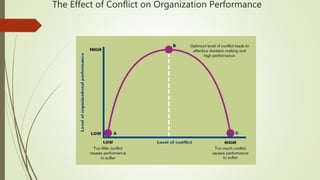
The Effect of Conflict on Organization Performance
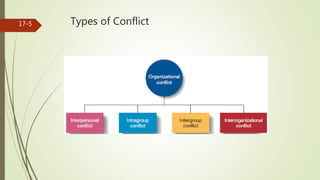
17-5 Types of Conflict
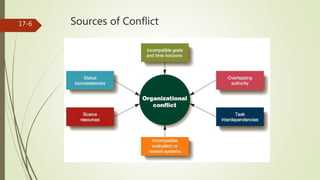
17-6 Sources of Conflict
What Is Inter-organizational Conflict?
 Conflict that is developed between organizations is named as Inter-organizational
conflict.
 High level of competition between two firms.
 Mergers, takeovers and acquisitions may also result in Inter-organizational conflict
(Likert and Likert 1976).
 The opposite attitudes and values of two different organizations can lead to high
level of inter-organizational conflict.
 Managers in one organization feel that other organization is not behaving
ethically and is frightening the well being of stakeholder groups.
 Pricing strategies formulated by enterprises may also cause inter organizational
conflicts.
 Majority of inter organizational conflicts result in the productivity of an
organization rather than deterioration in performance.
 Some level of inter-organizational conflict is essential for organizations to
compete in the market
How to handle Inter-organizational Conflict?
 Inter-organizational conflict must be handled in a positive way in order to make it
beneficial to the organization (Gross and Guerrero, 2000).
 Organizations must avoid adopting unethical practices to resolve such a conflict.
 Inter-organizational conflict can be resolved only in few situations. However, due
to varied culture, structure and policies existing in different organizations, Inter-
organizational conflicts remain unresolved most of the times.
Types of Inter-organizational Conflict
 Substantive
 Basic disagreement arises between the two organizations at a fundamental level.
For example, the People for the Ethical Treatment of Animals would have
substantive conflict with an organization that experiments on laboratory animals.
 Emotional
 When individuals between the organizations find themselves reacting on an
emotional level–out of fear, jealousy, envy or stubbornness.
 Cultural
 Occurs based on cultural needs and desires. These conflicts are often the result of
basic misinterpretation.
 Resolution
 Inter-organizational conflict sometimes can be resolved through mediation, open
dialogue or cultural understanding. In some cases, however, due to the very nature
of the various organizations, there can never be a resolution to the inter-
organizational conflict.
Genesis of Interorganizational Conflict
Conflicts often arise between organizations. After all, business entities often compete with
one another for customers and employees, engage in negotiations and collaborate with
one another on projects. It’s only natural that organizations that interact in the free market
will occasionally find conflict unavoidable.
 Customer Competition
 When companies compete with one another for customers, conflict almost always occurs.
While this type of competition can be friendly and professional, it can become destructive and
lead to the circulation of negative rumors about competing firms and unethical behavior to lure
customers away from rivals. Corporate espionage and copyright infringement are examples of
destructive interorganizational conflict that crosses the line of legality.
 Competition for Employees
 Companies that provide similar services often compete for employees. For example, when a
new manufacturing facility enters the market, that organization often sets wages higher than
the going rate for the area to lure the most skilled workers away from similar businesses. This
results in conflict between the new organization and the ones that are trying to retain their
valuable employees but may not be able to increase wages.
Example of Conflict
 The French food giant Groupe Danone has recently seen its market position
deteriorate.
 The reason: Danone’s strategic partnership with Hangzhou Wahaha Group Co.
Ltd. is breaking up.
 Wahaha became the dominant player in the Chinese bottled water and other non-
alcoholic beverage market through its 1996 alliance with Danone.
 But by 2007, Wahaha was blaming Danone for setting up competing joint ventures
with other local companies, such as Robust, Aquarius, Mengniu Dairy and Bright
Dairy & Food, while Danone was suing Wahaha for using the brand outside the
scope of their joint ventures.’ (National Post, 2010)
17-
12
Conflict Management Strategies
 Functional Conflict Resolution
 Handling conflict by compromise or collaboration between parties.
 Compromise
 each party is concerned about their goal accomplishment and is willing to engage in
give-and-take exchange to reach a reasonable solution.
 Collaboration
 parties try to handle the conflict without making concessions by coming up with a new
way to resolve their differences that leaves them both better off.
 Accommodation
 one party simply gives in to the other party
 Avoidance
 two parties try to ignore the problem and do nothing to resolve the disagreement
 Competition
 each party tries to maximize its own gain and has little interest in understanding the
other’s position
17-
13
Strategies Focused on Individuals
 Increasing awareness of the sources of conflict
 Increasing diversity awareness and skills
 Practicing job rotation
 Using permanent transfers or dismissals when necessary
17-14
Strategies Focused on the Whole Organization
 Changing an organization’s
structure or culture
 Altering the source of conflict
17-
15
Negotiation
 Negotiation
 Parties to a conflict try to come up with a solution acceptable to themselves by
considering various alternative ways to allocate resources to each other
 Third-party negotiator
 an impartial individual with expertise in handling conflicts
 helps parties in conflict reach an acceptable solution
17-
16
Third-party Negotiators
 Mediators
 facilitates negotiations but no authority to impose a solution
 Arbitrator
 can impose what he thinks is a fair solution to a conflict that both parties are
obligated to abide by
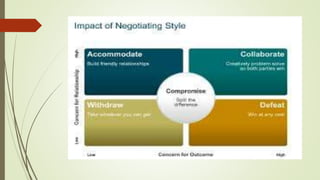
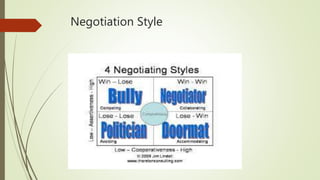
Five negotiation styles:
 Before we proceed to explain about the different negotiation styles it is important to
note two things. First, people tend to prefer a style. This does not mean that they can
use other styles. In fact, with practice people can effectively use all five negotiation
styles. Second, there is no universal best negotiation style. The best stlye to use differs
from negotiation to negotiation.
 Accommodating
 Individuals who negotiate with an accommodating style put great value and emphasis on
preserving the relationship. It is a great style when in negotiation with a recurring party (say a
recurring trade partner) however, it is less ideal to use when chances are high you will only
negotiation once with this party.
 Avoiding
 This style is used by parties who dislike negotiation and tend to avoid it. When trapped in a
negotiation, parties will tend to concede swiftly and have little initiative. This can be viewed as
diplomatic. The downside is that avoiding parties will not be very likely to obtain a satisfactory
result in the negotiation.
Five negotiation styles:
 Before we proceed to explain about the different negotiation styles it is important to note two things. First,
people tend to prefer a style. This does not mean that they can use other styles. In fact, with practice
people can effectively use all five negotiation styles. Second, there is no universal best negotiation style.
The best stlye to use differs from negotiation to negotiation.
 Collaborating
 Collaborating parties tend to enjoy coming to creative solutions during negotiation. This can potentially lead
to positive results or transform simple problems into difficult solutions. Either way, parties that prefer a
collaborating style make a real effort to understand the issues of the opposing party of the negotiation.
 Competing
 Individuals who prefer the competing style of negotiation see negotiation as a game that must be won at
any cost. It is an ideal style when dealing with negotiation where lasting relationships are not very
important. However, when preservation of the relationship is an issue, the competing style of negotiation is
less suited.
 Compromising
 Parties that value fair and equal deals in negotiation tend to prefer the compromising style. This style tends
to get fast results from a negotiation. A pitfall of this style is that concessions often come too fast, without
properly discovering the underlying issues.
Negotiation Style
THANK YOU

Inter Organization Conflict Management

  • 1.
    INTERORGANIZATIONAL CONFLICT AND NEGOTIATION STYLE ManojKumar, Former Vice President Tata Steel BSL Ltd.
  • 2.
    Content:  Introduction  Effectof Conflict on Organizational Performance  Types of Conflict  Sources of Conflict  sition or antagonistic interaction. The definition recognizes three basic types of conflict:  Goal conflict is situation in which desired end states or preferred outcomes appear to be incompatible.  Cognitive Conflict is a situation in which ideas or thoughts are inconsistent  Affective Conflict is a situation in which feelings or emotions are incompatible; that is, people literally become angry with one another. Conflict is very common in organizational settings. This is not necessarily a negative feature; the resolution of conflict often leads to constructive problem solving.
  • 3.
    Introduction to Conflict: The discord that arises when goals, interests or values of different individuals or groups are incompatible and those people block or thwart each other’s efforts to achieve their objectives The essence of conflict is disagreement, contradiction, or incompatibility.  Conflict is inevitable given the wide range of goals for the different stakeholder in the organization  CONFLICT refers to any situation in which there are incompatible Goals, Cognitions, or Emotions within or between individuals or groups that lead to opposition or antagonistic interaction. The definition recognizes three basic types of conflict:  Goal conflict is situation in which desired end states or preferred outcomes appear to be incompatible.  Cognitive Conflict is a situation in which ideas or thoughts are inconsistent  Affective Conflict is a situation in which feelings or emotions are incompatible; that is, people literally become angry with one another. Conflict is very common in organizational settings. This is not necessarily a negative feature; the resolution of conflict often leads to constructive problem solving.
  • 4.
    The Effect ofConflict on Organization Performance
  • 5.
    17-5 Types ofConflict
  • 6.
  • 7.
    What Is Inter-organizationalConflict?  Conflict that is developed between organizations is named as Inter-organizational conflict.  High level of competition between two firms.  Mergers, takeovers and acquisitions may also result in Inter-organizational conflict (Likert and Likert 1976).  The opposite attitudes and values of two different organizations can lead to high level of inter-organizational conflict.  Managers in one organization feel that other organization is not behaving ethically and is frightening the well being of stakeholder groups.  Pricing strategies formulated by enterprises may also cause inter organizational conflicts.  Majority of inter organizational conflicts result in the productivity of an organization rather than deterioration in performance.  Some level of inter-organizational conflict is essential for organizations to compete in the market
  • 8.
    How to handleInter-organizational Conflict?  Inter-organizational conflict must be handled in a positive way in order to make it beneficial to the organization (Gross and Guerrero, 2000).  Organizations must avoid adopting unethical practices to resolve such a conflict.  Inter-organizational conflict can be resolved only in few situations. However, due to varied culture, structure and policies existing in different organizations, Inter- organizational conflicts remain unresolved most of the times.
  • 9.
    Types of Inter-organizationalConflict  Substantive  Basic disagreement arises between the two organizations at a fundamental level. For example, the People for the Ethical Treatment of Animals would have substantive conflict with an organization that experiments on laboratory animals.  Emotional  When individuals between the organizations find themselves reacting on an emotional level–out of fear, jealousy, envy or stubbornness.  Cultural  Occurs based on cultural needs and desires. These conflicts are often the result of basic misinterpretation.  Resolution  Inter-organizational conflict sometimes can be resolved through mediation, open dialogue or cultural understanding. In some cases, however, due to the very nature of the various organizations, there can never be a resolution to the inter- organizational conflict.
  • 10.
    Genesis of InterorganizationalConflict Conflicts often arise between organizations. After all, business entities often compete with one another for customers and employees, engage in negotiations and collaborate with one another on projects. It’s only natural that organizations that interact in the free market will occasionally find conflict unavoidable.  Customer Competition  When companies compete with one another for customers, conflict almost always occurs. While this type of competition can be friendly and professional, it can become destructive and lead to the circulation of negative rumors about competing firms and unethical behavior to lure customers away from rivals. Corporate espionage and copyright infringement are examples of destructive interorganizational conflict that crosses the line of legality.  Competition for Employees  Companies that provide similar services often compete for employees. For example, when a new manufacturing facility enters the market, that organization often sets wages higher than the going rate for the area to lure the most skilled workers away from similar businesses. This results in conflict between the new organization and the ones that are trying to retain their valuable employees but may not be able to increase wages.
  • 11.
    Example of Conflict The French food giant Groupe Danone has recently seen its market position deteriorate.  The reason: Danone’s strategic partnership with Hangzhou Wahaha Group Co. Ltd. is breaking up.  Wahaha became the dominant player in the Chinese bottled water and other non- alcoholic beverage market through its 1996 alliance with Danone.  But by 2007, Wahaha was blaming Danone for setting up competing joint ventures with other local companies, such as Robust, Aquarius, Mengniu Dairy and Bright Dairy & Food, while Danone was suing Wahaha for using the brand outside the scope of their joint ventures.’ (National Post, 2010)
  • 12.
    17- 12 Conflict Management Strategies Functional Conflict Resolution  Handling conflict by compromise or collaboration between parties.  Compromise  each party is concerned about their goal accomplishment and is willing to engage in give-and-take exchange to reach a reasonable solution.  Collaboration  parties try to handle the conflict without making concessions by coming up with a new way to resolve their differences that leaves them both better off.  Accommodation  one party simply gives in to the other party  Avoidance  two parties try to ignore the problem and do nothing to resolve the disagreement  Competition  each party tries to maximize its own gain and has little interest in understanding the other’s position
  • 13.
    17- 13 Strategies Focused onIndividuals  Increasing awareness of the sources of conflict  Increasing diversity awareness and skills  Practicing job rotation  Using permanent transfers or dismissals when necessary
  • 14.
    17-14 Strategies Focused onthe Whole Organization  Changing an organization’s structure or culture  Altering the source of conflict
  • 15.
    17- 15 Negotiation  Negotiation  Partiesto a conflict try to come up with a solution acceptable to themselves by considering various alternative ways to allocate resources to each other  Third-party negotiator  an impartial individual with expertise in handling conflicts  helps parties in conflict reach an acceptable solution
  • 16.
    17- 16 Third-party Negotiators  Mediators facilitates negotiations but no authority to impose a solution  Arbitrator  can impose what he thinks is a fair solution to a conflict that both parties are obligated to abide by
  • 17.
    Five negotiation styles: Before we proceed to explain about the different negotiation styles it is important to note two things. First, people tend to prefer a style. This does not mean that they can use other styles. In fact, with practice people can effectively use all five negotiation styles. Second, there is no universal best negotiation style. The best stlye to use differs from negotiation to negotiation.  Accommodating  Individuals who negotiate with an accommodating style put great value and emphasis on preserving the relationship. It is a great style when in negotiation with a recurring party (say a recurring trade partner) however, it is less ideal to use when chances are high you will only negotiation once with this party.  Avoiding  This style is used by parties who dislike negotiation and tend to avoid it. When trapped in a negotiation, parties will tend to concede swiftly and have little initiative. This can be viewed as diplomatic. The downside is that avoiding parties will not be very likely to obtain a satisfactory result in the negotiation.
  • 18.
    Five negotiation styles: Before we proceed to explain about the different negotiation styles it is important to note two things. First, people tend to prefer a style. This does not mean that they can use other styles. In fact, with practice people can effectively use all five negotiation styles. Second, there is no universal best negotiation style. The best stlye to use differs from negotiation to negotiation.  Collaborating  Collaborating parties tend to enjoy coming to creative solutions during negotiation. This can potentially lead to positive results or transform simple problems into difficult solutions. Either way, parties that prefer a collaborating style make a real effort to understand the issues of the opposing party of the negotiation.  Competing  Individuals who prefer the competing style of negotiation see negotiation as a game that must be won at any cost. It is an ideal style when dealing with negotiation where lasting relationships are not very important. However, when preservation of the relationship is an issue, the competing style of negotiation is less suited.  Compromising  Parties that value fair and equal deals in negotiation tend to prefer the compromising style. This style tends to get fast results from a negotiation. A pitfall of this style is that concessions often come too fast, without properly discovering the underlying issues.
  • 20.
  • 21.