Downloaded 624 times
![An Intel Story - Operation Crush
• Intel 8086 v.s. Motorola 68000
• One terribly importance : the front
end sales felt they can speak their
minds without retribution.
• Andy: [ Bad companies are
destroyed by crisis, Good
companies survive them. Great
Companies are improved by them.]
11
3. Operation Crush: An Intel Story](https://image.slidesharecdn.com/okrstudyreport-en-191002092419/85/OKR-Measure-What-Matters-11-320.jpg)

![Baking Better Everyday:
• 2016, Zume Pizza opened for business. By now it has 180
Employees。Zume Pizza uses robots to take pizza to the
next level. The company has secured a patent on the
cooking of food during delivery,[9][10] which includes
predictive algorithms to anticipate customer choices, and
plans to partner with other businesses to also provide
other robot-prepared meal components, such as salads
and desserts. At least once each quarter, they make
contributors step back into a quiet place and consider how their
decisions align with the company. People start thinking in the macro.
You have to choose 3 to 5 things and exactly how they should be
measured.
• Most start-ups aren’t too eager to plunge into structured goal
setting: We don’t need that. We go super-fast. But Zume Pizza
thinks structured goal setting teaches people how to work within
constraints even as they push against them – an especially critical
lesson for smaller, scaling operations. OKRs and CFRs help
organizations improve each and every day, Leaders become better
communicators and motivators. Contributors grow into more
disciplined, rigorous thinkers.
• Example : A conversation together : who was responsible for Zume’s
revenue targets ? Marketing ? Product ? Finally Zume broke the
objective out into new revenue (marketing) and repeat revenue
(product), and the department heads drilled down from there.
26
17. Baking Better Everyday : The Zume Pizza Story
OBJECTIVE
Complete the Truck Delivery Fleet for 250 Polaris
(Mountain View HQ)
KEY RESULTS
1. Deliver 126 fully certified ovens by 11/30
2. Deliver 11 fully certified racks by 11/30
3. Deliver 2 fully certified full-format delivery vehicles by
11/30
Note: Zume Top Execuitves wrote the top company
OKRs, and the department heads converted some of
our key results into their own objectives.
OBJECTIVE
Delight customers.
KEY RESULTS
1. Net Promoter Score of 42 or
2. Order Rating of 4.6/5.0 or better。
3. 75% of customers prefer Zume to
competitor in blind taste test.。
p245](https://image.slidesharecdn.com/okrstudyreport-en-191002092419/85/OKR-Measure-What-Matters-26-320.jpg)
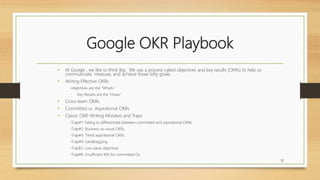

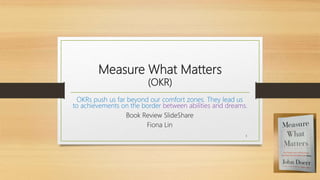
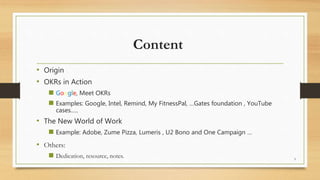
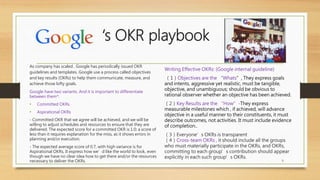
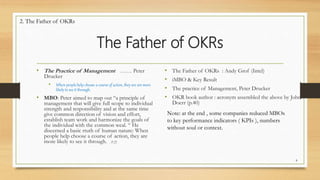
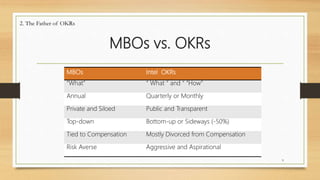
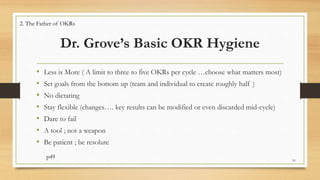
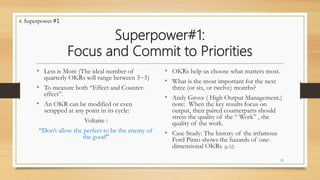
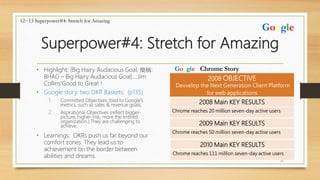
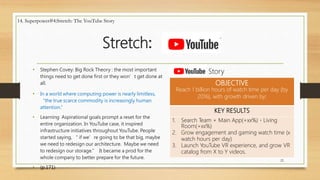
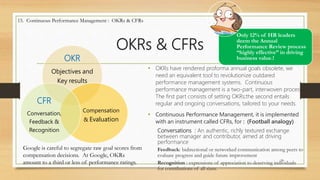
OKRs push organizations to achieve ambitious goals and coordinate efforts across teams. They provide transparency around priorities and allow for flexibility. Google uses OKRs to help communicate goals and measure progress. They distinguish between "committed" and "aspirational" OKRs, with committed OKRs expected to be fully achieved and aspirational OKRs having an expected average score of 0.7. OKRs originated from Peter Drucker's work on management by objectives (MBO) and were developed further at Intel by Andy Grove. OKRs improved on MBOs by including specific metrics ("key results") and making the process more transparent, bottom-up, and flexible.


