LEADERSHIP
          &
EMOTIONAL INTELLIGENCE


   ORGANIZATIONAL LEADERSHIP
            GROUP 4
          Presented by:
               Chandra Veer Singh Dulawat – 11BM60030
                              Partha Pratim – 11BM60041
                               Arun Kabra – 11BM60046
                            Sumit Pal Singh – 11BM60048
                          Rana Vishal Singh – 11BM60110
12% of effective management strategy is knowledge
and 88% is dealing appropriately with people.

                              - Stanford Research Institute
12% of effective management strategy is knowledge
and 88% is dealing appropriately with people.

                              - Stanford Research Institute
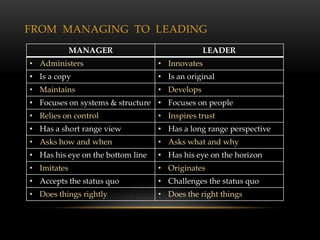
FROM MANAGING TO LEADING
             MANAGER                            LEADER
• Administers                      • Innovates
• Is a copy                        • Is an original
• Maintains                        • Develops
• Focuses on systems & structure • Focuses on people
• Relies on control                • Inspires trust
• Has a short range view           • Has a long range perspective
• Asks how and when                • Asks what and why
• Has his eye on the bottom line   • Has his eye on the horizon
• Imitates                         • Originates
• Accepts the status quo           • Challenges the status quo
• Does things rightly              • Does the right things
HOW TO BECOME A LEADER FROM A MANAGER
COURAGE is one of the most important attributes of a leader. It
encompasses the following:
•   Courage to think differently
•   Courage of conviction
•   Courage to speak your mind
•   Courage to overcome difficulties
•   Courage to stand by your people
•   Courage to admit mistakes
•   Courage to take unpleasant decisions
•   Courage to accept failure and try again
•   Courage to question status quo
MANAGING SELF

LEADING by example is all about managing self and self-leadership.
Managing self can be seen on eight dimensions:
•   Managing Health
•   Managing Self-Psychologically
•   Managing Emotions
•   Managing Time
•   Managing Stress
•   Managing Relationships
•   Managing Profession
•   Managing Change
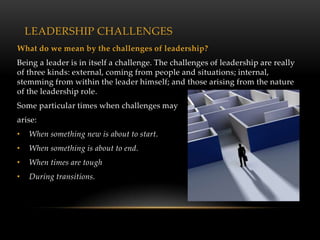
LEADERSHIP CHALLENGES
What do we mean by the challenges of leadership?
Being a leader is in itself a challenge. The challenges of leadership are really
of three kinds: external, coming from people and situations; internal,
stemming from within the leader himself; and those arising from the nature
of the leadership role.
Some particular times when challenges may
arise:
•   When something new is about to start.
•   When something is about to end.
•   When times are tough
•   During transitions.
EXTERNAL CHALLENGES
It's almost impossible to imagine a situation where a leader doesn't have to
cope with external challenges. In an organization, social, economic, and
political forces in the larger world can affect the organization.
•   Public criticism, especially uninformed criticism, of your group or mission.
•   Crises, which could be tied to finances, politics, public relations , legal
    concerns
•   Disasters. In a disaster, you're trying to deal with the worst in some way.
•   Opposition and/or hostility from powerful forces (business groups, local
    government, an influential organization, etc.)
•   A financial or political windfall. Sometimes an unexpected benefit can be
    harder to handle than a calamity.
•   Collaboration with another group or organization may call upon a leader to
    define clearly the boundaries within which he can operate, and to balance
    the needs of his own group with those of the collaborative initiative
HOW TO COPE WITH EXTERNAL CHALLENGES
Be proactive. Ensures that you are in control of the situation rather than allowing
the situation to take control over you.
Be creative. Try to think "outside the box," i.e. in unexpected but effective ways.
Don't just look at the obvious, but consider a situation from all perspectives, and
search for unusual ways to make things work.
Face conflict squarely. This doesn't mean come out fighting, but rather identify
and acknowledge the conflict, and work to resolve it. This is true both for conflict
within your group, and conflict between the group and others outside it.
Always look for common ground. If there's opposition to what you're doing, it
may only be to one specific part of it, or may be based on misunderstanding.
There are few groups or individuals who don't have some common interests. If
you can find those, you may have a basis for solving problems and making it
possible for people to work together.
Retain your objectivity. If you're mediating a conflict within the organization,
don't take sides, even if you think you know one side is right. That will come out
if you mediate objectively and well.
INTERNAL CHALLENGES
•   Insecurity. Many people feel, at least some of the time, that they're not up
    to the tasks they face. Insecurity of that sort keeps them from being
    proactive, from following their vision, from feeling like leaders.
•   Defensiveness. Also born of insecurity, defensiveness shows up most often
    as an inability to take criticism and continuing hostility to anyone
•   Lack of decisiveness. Sometimes it's hard to make a decision. The reality is
    that leaders are called on to make decisions all the time, often with very
    little time to consider them.
•   Inability to be direct when there's a problem. Many people want so badly to be
    liked, or are so afraid of hurting others, that they find it difficult to say
    anything negative.
•   Inability to be objective. The inability to accurately identify the positive and
    negative in any situation and react appropriately can create serious
    problems.
•   Impatience - with others and with situations.
HOW TO COPE WITH INTERNAL CHALLENGES
Listen. Listen to people's responses to your ideas, plans, and opinions. Listen
more than you talk. Listen to a broad range of people, not just to those who
agree with you.
Ask for 360-degree feedback...and use it. This is feedback (people's views of
you) from everyone around you -
staff, volunteers, Board, participants, people from other organizations or
groups yours works with - anyone you work with in any way.
Look at what's going on around you. Taking a look around will tell you a lot
about what - and how - you're doing as a leader., whether the people you
work with are happy and enthusiastic etc.
Reach out for help in facing internal challenges. Most of us find it difficult to
change entirely on our own. A psychotherapist, a good friend, a perceptive
colleague, or a trusted clergyman might be able to help you gain perspective
on issues that you find hard to face.
CONNECTING TO YOUR PEOPLE EMOTIONALLY:
THE EI FACTOR
•   Leaders should make people feel comfortable and develop a
    relationship in which they want to be close to the leader.
•   Emotional intelligent leader tend to make better team players, and
    they are more effective at motivating themselves and others.
•   EI is a form of social intelligence that involves the ability to monitor
    one’s own and others’ feelings and emotions to discriminate among
    them, and to use this information to guide ones thinking and action.
•   These EI competencies are not innate talents but learned abilities
    which has a unique contribution of making a leader more resonant
    and thus more effective.
•   Great leaders recognize intuition or the “gut feeling”.
CONNECTING TO YOUR PEOPLE EMOTIONALLY:
    THE EI FACTOR
•   Leadership is the ability to connect to your people emotionally and
    infusing them with your passion and purpose and infusing them towards
    achieving organization goals. For this leader should have high levels of
    EI.
•   EI encompasses qualities like initiative, team leadership, sensitivity,
    cooperativeness, flexibility, persuasiveness, optimism and resilience.
•   Human behavior is determined by interplay of cognitive mind and
    emotional mind. For an appropriate behavior a balance is sought which
    is achieved by applying EI i.e. applying emotions for intelligent decision
    making.
•   To be able to manage emotions effectively, it is desirable to avoid
    impulsive reactions to particular situation and adopt a constructive
    approach.
MEASURING EI - INTRAPERSONAL SKILL

•        Relates to Inner self.
•        Ability to be in touch with ones feelings, feel good about oneself, self
         acceptance, convey ideas and beliefs appropriately.
•        Indicates level of self confidence and ability to function independently
         without being unduly dependent on others.
•        Sub-dimensions of intrapersonal skill include:
     •       Emotional self-awareness
     •       Self regard
     •       Self-actualization
     •       Assertiveness
     •       Independence
MEASURING EI - INTERPERSONAL SKILL

•   Interpersonal skills help to understand, interact and relate with
    others.


•   Sub-dimensions of interpersonal skill include:
     • Empathy
     • Interpersonal relationship
     • Social responsibility


•   Ability to empathize with others and help them in resolving their
    problems would create an atmosphere of trust in organization leading
    to a high level of commitment from people.
MEASURING EI - ADAPTABILITY
•   Ability to adapt yourself to the organization and environment in
    which you are functioning.


•   Sub-dimensions of Adaptability include
     • Problem solving
     • Reality testing
     • Flexibility


•   Adaptability assess a leader on his ability to solve problems, be in
    touch with external day to day realities and finding ways & means of
    handling these in practical manner.
MEASURING EI – STRESS MANAGEMENT                                     &
    GENERAL MOOD/STATE OF MIND
•   Ability to withstand and manage stress and perform in adverse
    conditions.
•   Ability to be calm and composed in difficult situations and manage crisis
    is hallmark of great leaders.
•   Leaders in general display good mood by being happy about himself and
    life in general, outlook towards life and a feeling of contentment along
    with optimism in adversity and difficult situations.
•   Sub-dimensions of good mood include:
     • Happiness
     • Optimism
•   EI is about having a balancing rationality and emotionality and adopting
    the right behavior for a situation in decision making.
LEADING TEAMS:
DIFFERENT STROKE FOR
   DIFFERENT FOLKS
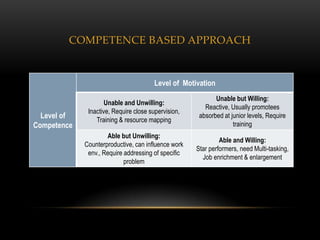
COMPETENCE BASED APPROACH


                                        Level of Motivation
                                                            Unable but Willing:
                     Unable and Unwilling:
                                                        Reactive, Usually promotees
              Inactive, Require close supervision,
  Level of       Training & resource mapping
                                                      absorbed at junior levels, Require
Competence                                                         training
                     Able but Unwilling:
                                                              Able and Willing:
             Counterproductive, can influence work
                                                     Star performers, need Multi-tasking,
              env., Require addressing of specific
                                                       Job enrichment & enlargement
                            problem
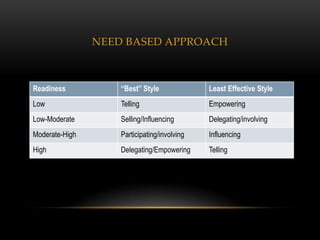
NEED BASED APPROACH


Readiness           “Best” Style              Least Effective Style
Low                 Telling                   Empowering
Low-Moderate        Selling/Influencing       Delegating/involving
Moderate-High       Participating/involving   Influencing
High                Delegating/Empowering     Telling
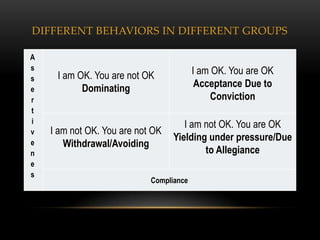
DIFFERENT BEHAVIORS IN DIFFERENT GROUPS

A s
s                                          I am OK. You are OK
s      I am OK. You are not OK
e            Dominating                     Acceptance Due to
r                                               Conviction
t
i                                      I am not OK. You are OK
v     I am not OK. You are not OK
                                    Yielding under pressure/Due
e        Withdrawal/Avoiding
n                                           to Allegiance
e
s
                              Compliance
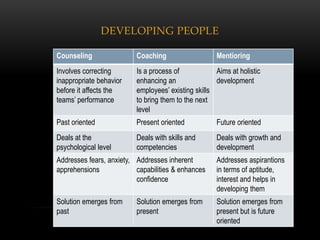
DEVELOPING PEOPLE

Counseling                Coaching                   Mentioring
Involves correcting       Is a process of            Aims at holistic
inappropriate behavior    enhancing an               development
before it affects the     employees’ existing skills
teams’ performance        to bring them to the next
                          level
Past oriented             Present oriented           Future oriented
Deals at the              Deals with skills and      Deals with growth and
psychological level       competencies               development
Addresses fears, anxiety, Addresses inherent         Addresses aspirantions
apprehensions             capabilities & enhances    in terms of aptitude,
                          confidence                 interest and helps in
                                                     developing them
Solution emerges from     Solution emerges from      Solution emerges from
past                      present                    present but is future
                                                     oriented
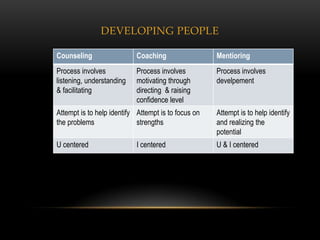
DEVELOPING PEOPLE

Counseling                 Coaching                  Mentioring
Process involves           Process involves          Process involves
listening, understanding   motivating through        develpement
& facilitating             directing & raising
                           confidence level
Attempt is to help identify Attempt is to focus on   Attempt is to help identify
the problems                strengths                and realizing the
                                                     potential
U centered                 I centered                U & I centered
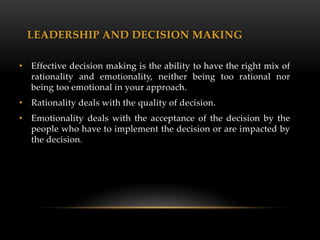
LEADERSHIP AND DECISION MAKING

• Effective decision making is the ability to have the right mix of
  rationality and emotionality, neither being too rational nor
  being too emotional in your approach.
• Rationality deals with the quality of decision.
• Emotionality deals with the acceptance of the decision by the
  people who have to implement the decision or are impacted by
  the decision.
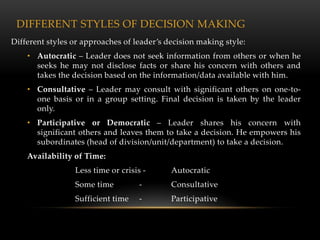
DIFFERENT STYLES OF DECISION MAKING
Different styles or approaches of leader’s decision making style:
    • Autocratic – Leader does not seek information from others or when he
      seeks he may not disclose facts or share his concern with others and
      takes the decision based on the information/data available with him.
    • Consultative – Leader may consult with significant others on one-to-
      one basis or in a group setting. Final decision is taken by the leader
      only.
    • Participative or Democratic – Leader shares his concern with
      significant others and leaves them to take a decision. He empowers his
      subordinates (head of division/unit/department) to take a decision.
    Availability of Time:
                 Less time or crisis -      Autocratic
                 Some time          -       Consultative
                 Sufficient time    -       Participative
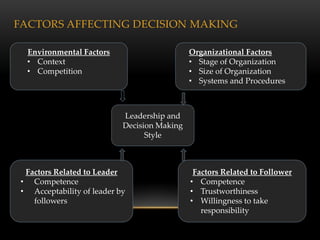
FACTORS AFFECTING DECISION MAKING

 Environmental Factors                       Organizational Factors
 • Context                                   • Stage of Organization
 • Competition                               • Size of Organization
                                             • Systems and Procedures


                           Leadership and
                           Decision Making
                                 Style


 Factors Related to Leader                    Factors Related to Follower
• Competence                                 • Competence
• Acceptability of leader by                 • Trustworthiness
   followers                                 • Willingness to take
                                                responsibility
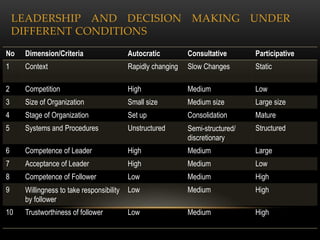
LEADERSHIP AND DECISION MAKING UNDER
    DIFFERENT CONDITIONS

No   Dimension/Criteria                   Autocratic         Consultative       Participative
1    Context                              Rapidly changing   Slow Changes       Static

2    Competition                          High               Medium             Low
3    Size of Organization                 Small size         Medium size        Large size
4    Stage of Organization                Set up             Consolidation      Mature
5    Systems and Procedures               Unstructured       Semi-structured/   Structured
                                                             discretionary
6    Competence of Leader                 High               Medium             Large
7    Acceptance of Leader                 High               Medium             Low
8    Competence of Follower               Low                Medium             High
9    Willingness to take responsibility   Low                Medium             High
     by follower
10   Trustworthiness of follower          Low                Medium             High
SIX HAT THINKING AND DECISION MAKING

• Aim of looking at the number of important, different perspectives
  and modify the decisions accordingly.
• Can be used individually or in a group.
• In case of group problem solving, one member can be assigned one
  role signifying one colored hat each.
• White Hat
   • Data hat, considering facts, figures and information, identify any gaps
     in your knowledge and either fill or acknowledge them.
   • Example – Using historical data or case studies to predict future
     behavior and likewise.
   • For high quality decision making, maximum information is required.
     But if not possible, then at least relevant information is obtained.
SIX HAT THINKING AND DECISION MAKING
• Red Hat
  • Emotional Hat, signifying feelings, hunches, and intuition.
  • Can express emotions and feelings and share tears, apprehensions, likes,
    and dislikes.
  • Facilitates the process of smooth implementation of the decisions taken
    logically and rationally.
• Black Hat
  • Negative, Pessimistic, Judgment Hat – the devil’s advocate or why
    something may not work.
  • Spot the difficulties and dangers; where things might go wrong.
  • Helps in anticipating problems and preparing contingency plans.
• Yellow Hat
  • Polar opposite of black hat, where optimism prevails.
  • Constructive and symbolizes brightness and optimism.
  • Covers a wide spectrum ranging from logical and practical on one end to
    dreams, vision and hopes at the other end.
  • Helps in putting our best efforts and giving our 100 %.
SIX HAT THINKING AND DECISION MAKING
• Green Hat
  •   Creativity Hat, focuses on creativity; the possibilities, alternatives and
      new ideas.
  •   Purpose is to go beyond the known, obvious, and just satisfactory.
  •   Encourages one to think beyond the usual pattern of thinking.

• Blue Hat
  • Control Hat, used to manage the thinking process.
  • Control mechanism that ensures the Six Thinking Hats guidelines are
    observed, i.e. thinking with the overall frame of reference.
  • Sets thinking in an organized manner.
  • Can be used once at the beginning to define the situation and organize the
    process, and finally to summarize, conclude, and plan for the action steps.
THANK YOU!

Leadership & emotional intelligence

  • 1.
    LEADERSHIP & EMOTIONAL INTELLIGENCE ORGANIZATIONAL LEADERSHIP GROUP 4 Presented by: Chandra Veer Singh Dulawat – 11BM60030 Partha Pratim – 11BM60041 Arun Kabra – 11BM60046 Sumit Pal Singh – 11BM60048 Rana Vishal Singh – 11BM60110
  • 2.
    12% of effectivemanagement strategy is knowledge and 88% is dealing appropriately with people. - Stanford Research Institute
  • 3.
    12% of effectivemanagement strategy is knowledge and 88% is dealing appropriately with people. - Stanford Research Institute
  • 4.
    FROM MANAGING TOLEADING MANAGER LEADER • Administers • Innovates • Is a copy • Is an original • Maintains • Develops • Focuses on systems & structure • Focuses on people • Relies on control • Inspires trust • Has a short range view • Has a long range perspective • Asks how and when • Asks what and why • Has his eye on the bottom line • Has his eye on the horizon • Imitates • Originates • Accepts the status quo • Challenges the status quo • Does things rightly • Does the right things
  • 5.
    HOW TO BECOMEA LEADER FROM A MANAGER COURAGE is one of the most important attributes of a leader. It encompasses the following: • Courage to think differently • Courage of conviction • Courage to speak your mind • Courage to overcome difficulties • Courage to stand by your people • Courage to admit mistakes • Courage to take unpleasant decisions • Courage to accept failure and try again • Courage to question status quo
  • 6.
    MANAGING SELF LEADING byexample is all about managing self and self-leadership. Managing self can be seen on eight dimensions: • Managing Health • Managing Self-Psychologically • Managing Emotions • Managing Time • Managing Stress • Managing Relationships • Managing Profession • Managing Change
  • 7.
    LEADERSHIP CHALLENGES What dowe mean by the challenges of leadership? Being a leader is in itself a challenge. The challenges of leadership are really of three kinds: external, coming from people and situations; internal, stemming from within the leader himself; and those arising from the nature of the leadership role. Some particular times when challenges may arise: • When something new is about to start. • When something is about to end. • When times are tough • During transitions.
  • 8.
    EXTERNAL CHALLENGES It's almostimpossible to imagine a situation where a leader doesn't have to cope with external challenges. In an organization, social, economic, and political forces in the larger world can affect the organization. • Public criticism, especially uninformed criticism, of your group or mission. • Crises, which could be tied to finances, politics, public relations , legal concerns • Disasters. In a disaster, you're trying to deal with the worst in some way. • Opposition and/or hostility from powerful forces (business groups, local government, an influential organization, etc.) • A financial or political windfall. Sometimes an unexpected benefit can be harder to handle than a calamity. • Collaboration with another group or organization may call upon a leader to define clearly the boundaries within which he can operate, and to balance the needs of his own group with those of the collaborative initiative
  • 9.
    HOW TO COPEWITH EXTERNAL CHALLENGES Be proactive. Ensures that you are in control of the situation rather than allowing the situation to take control over you. Be creative. Try to think "outside the box," i.e. in unexpected but effective ways. Don't just look at the obvious, but consider a situation from all perspectives, and search for unusual ways to make things work. Face conflict squarely. This doesn't mean come out fighting, but rather identify and acknowledge the conflict, and work to resolve it. This is true both for conflict within your group, and conflict between the group and others outside it. Always look for common ground. If there's opposition to what you're doing, it may only be to one specific part of it, or may be based on misunderstanding. There are few groups or individuals who don't have some common interests. If you can find those, you may have a basis for solving problems and making it possible for people to work together. Retain your objectivity. If you're mediating a conflict within the organization, don't take sides, even if you think you know one side is right. That will come out if you mediate objectively and well.
  • 10.
    INTERNAL CHALLENGES • Insecurity. Many people feel, at least some of the time, that they're not up to the tasks they face. Insecurity of that sort keeps them from being proactive, from following their vision, from feeling like leaders. • Defensiveness. Also born of insecurity, defensiveness shows up most often as an inability to take criticism and continuing hostility to anyone • Lack of decisiveness. Sometimes it's hard to make a decision. The reality is that leaders are called on to make decisions all the time, often with very little time to consider them. • Inability to be direct when there's a problem. Many people want so badly to be liked, or are so afraid of hurting others, that they find it difficult to say anything negative. • Inability to be objective. The inability to accurately identify the positive and negative in any situation and react appropriately can create serious problems. • Impatience - with others and with situations.
  • 11.
    HOW TO COPEWITH INTERNAL CHALLENGES Listen. Listen to people's responses to your ideas, plans, and opinions. Listen more than you talk. Listen to a broad range of people, not just to those who agree with you. Ask for 360-degree feedback...and use it. This is feedback (people's views of you) from everyone around you - staff, volunteers, Board, participants, people from other organizations or groups yours works with - anyone you work with in any way. Look at what's going on around you. Taking a look around will tell you a lot about what - and how - you're doing as a leader., whether the people you work with are happy and enthusiastic etc. Reach out for help in facing internal challenges. Most of us find it difficult to change entirely on our own. A psychotherapist, a good friend, a perceptive colleague, or a trusted clergyman might be able to help you gain perspective on issues that you find hard to face.
  • 12.
    CONNECTING TO YOURPEOPLE EMOTIONALLY: THE EI FACTOR • Leaders should make people feel comfortable and develop a relationship in which they want to be close to the leader. • Emotional intelligent leader tend to make better team players, and they are more effective at motivating themselves and others. • EI is a form of social intelligence that involves the ability to monitor one’s own and others’ feelings and emotions to discriminate among them, and to use this information to guide ones thinking and action. • These EI competencies are not innate talents but learned abilities which has a unique contribution of making a leader more resonant and thus more effective. • Great leaders recognize intuition or the “gut feeling”.
  • 13.
    CONNECTING TO YOURPEOPLE EMOTIONALLY: THE EI FACTOR • Leadership is the ability to connect to your people emotionally and infusing them with your passion and purpose and infusing them towards achieving organization goals. For this leader should have high levels of EI. • EI encompasses qualities like initiative, team leadership, sensitivity, cooperativeness, flexibility, persuasiveness, optimism and resilience. • Human behavior is determined by interplay of cognitive mind and emotional mind. For an appropriate behavior a balance is sought which is achieved by applying EI i.e. applying emotions for intelligent decision making. • To be able to manage emotions effectively, it is desirable to avoid impulsive reactions to particular situation and adopt a constructive approach.
  • 14.
    MEASURING EI -INTRAPERSONAL SKILL • Relates to Inner self. • Ability to be in touch with ones feelings, feel good about oneself, self acceptance, convey ideas and beliefs appropriately. • Indicates level of self confidence and ability to function independently without being unduly dependent on others. • Sub-dimensions of intrapersonal skill include: • Emotional self-awareness • Self regard • Self-actualization • Assertiveness • Independence
  • 15.
    MEASURING EI -INTERPERSONAL SKILL • Interpersonal skills help to understand, interact and relate with others. • Sub-dimensions of interpersonal skill include: • Empathy • Interpersonal relationship • Social responsibility • Ability to empathize with others and help them in resolving their problems would create an atmosphere of trust in organization leading to a high level of commitment from people.
  • 16.
    MEASURING EI -ADAPTABILITY • Ability to adapt yourself to the organization and environment in which you are functioning. • Sub-dimensions of Adaptability include • Problem solving • Reality testing • Flexibility • Adaptability assess a leader on his ability to solve problems, be in touch with external day to day realities and finding ways & means of handling these in practical manner.
  • 17.
    MEASURING EI –STRESS MANAGEMENT & GENERAL MOOD/STATE OF MIND • Ability to withstand and manage stress and perform in adverse conditions. • Ability to be calm and composed in difficult situations and manage crisis is hallmark of great leaders. • Leaders in general display good mood by being happy about himself and life in general, outlook towards life and a feeling of contentment along with optimism in adversity and difficult situations. • Sub-dimensions of good mood include: • Happiness • Optimism • EI is about having a balancing rationality and emotionality and adopting the right behavior for a situation in decision making.
  • 18.
  • 19.
    COMPETENCE BASED APPROACH Level of Motivation Unable but Willing: Unable and Unwilling: Reactive, Usually promotees Inactive, Require close supervision, Level of Training & resource mapping absorbed at junior levels, Require Competence training Able but Unwilling: Able and Willing: Counterproductive, can influence work Star performers, need Multi-tasking, env., Require addressing of specific Job enrichment & enlargement problem
  • 20.
    NEED BASED APPROACH Readiness “Best” Style Least Effective Style Low Telling Empowering Low-Moderate Selling/Influencing Delegating/involving Moderate-High Participating/involving Influencing High Delegating/Empowering Telling
  • 21.
    DIFFERENT BEHAVIORS INDIFFERENT GROUPS A s s I am OK. You are OK s I am OK. You are not OK e Dominating Acceptance Due to r Conviction t i I am not OK. You are OK v I am not OK. You are not OK Yielding under pressure/Due e Withdrawal/Avoiding n to Allegiance e s Compliance
  • 22.
    DEVELOPING PEOPLE Counseling Coaching Mentioring Involves correcting Is a process of Aims at holistic inappropriate behavior enhancing an development before it affects the employees’ existing skills teams’ performance to bring them to the next level Past oriented Present oriented Future oriented Deals at the Deals with skills and Deals with growth and psychological level competencies development Addresses fears, anxiety, Addresses inherent Addresses aspirantions apprehensions capabilities & enhances in terms of aptitude, confidence interest and helps in developing them Solution emerges from Solution emerges from Solution emerges from past present present but is future oriented
  • 23.
    DEVELOPING PEOPLE Counseling Coaching Mentioring Process involves Process involves Process involves listening, understanding motivating through develpement & facilitating directing & raising confidence level Attempt is to help identify Attempt is to focus on Attempt is to help identify the problems strengths and realizing the potential U centered I centered U & I centered
  • 24.
    LEADERSHIP AND DECISIONMAKING • Effective decision making is the ability to have the right mix of rationality and emotionality, neither being too rational nor being too emotional in your approach. • Rationality deals with the quality of decision. • Emotionality deals with the acceptance of the decision by the people who have to implement the decision or are impacted by the decision.
  • 25.
    DIFFERENT STYLES OFDECISION MAKING Different styles or approaches of leader’s decision making style: • Autocratic – Leader does not seek information from others or when he seeks he may not disclose facts or share his concern with others and takes the decision based on the information/data available with him. • Consultative – Leader may consult with significant others on one-to- one basis or in a group setting. Final decision is taken by the leader only. • Participative or Democratic – Leader shares his concern with significant others and leaves them to take a decision. He empowers his subordinates (head of division/unit/department) to take a decision. Availability of Time: Less time or crisis - Autocratic Some time - Consultative Sufficient time - Participative
  • 26.
    FACTORS AFFECTING DECISIONMAKING Environmental Factors Organizational Factors • Context • Stage of Organization • Competition • Size of Organization • Systems and Procedures Leadership and Decision Making Style Factors Related to Leader Factors Related to Follower • Competence • Competence • Acceptability of leader by • Trustworthiness followers • Willingness to take responsibility
  • 27.
    LEADERSHIP AND DECISIONMAKING UNDER DIFFERENT CONDITIONS No Dimension/Criteria Autocratic Consultative Participative 1 Context Rapidly changing Slow Changes Static 2 Competition High Medium Low 3 Size of Organization Small size Medium size Large size 4 Stage of Organization Set up Consolidation Mature 5 Systems and Procedures Unstructured Semi-structured/ Structured discretionary 6 Competence of Leader High Medium Large 7 Acceptance of Leader High Medium Low 8 Competence of Follower Low Medium High 9 Willingness to take responsibility Low Medium High by follower 10 Trustworthiness of follower Low Medium High
  • 28.
    SIX HAT THINKINGAND DECISION MAKING • Aim of looking at the number of important, different perspectives and modify the decisions accordingly. • Can be used individually or in a group. • In case of group problem solving, one member can be assigned one role signifying one colored hat each. • White Hat • Data hat, considering facts, figures and information, identify any gaps in your knowledge and either fill or acknowledge them. • Example – Using historical data or case studies to predict future behavior and likewise. • For high quality decision making, maximum information is required. But if not possible, then at least relevant information is obtained.
  • 29.
    SIX HAT THINKINGAND DECISION MAKING • Red Hat • Emotional Hat, signifying feelings, hunches, and intuition. • Can express emotions and feelings and share tears, apprehensions, likes, and dislikes. • Facilitates the process of smooth implementation of the decisions taken logically and rationally. • Black Hat • Negative, Pessimistic, Judgment Hat – the devil’s advocate or why something may not work. • Spot the difficulties and dangers; where things might go wrong. • Helps in anticipating problems and preparing contingency plans. • Yellow Hat • Polar opposite of black hat, where optimism prevails. • Constructive and symbolizes brightness and optimism. • Covers a wide spectrum ranging from logical and practical on one end to dreams, vision and hopes at the other end. • Helps in putting our best efforts and giving our 100 %.
  • 30.
    SIX HAT THINKINGAND DECISION MAKING • Green Hat • Creativity Hat, focuses on creativity; the possibilities, alternatives and new ideas. • Purpose is to go beyond the known, obvious, and just satisfactory. • Encourages one to think beyond the usual pattern of thinking. • Blue Hat • Control Hat, used to manage the thinking process. • Control mechanism that ensures the Six Thinking Hats guidelines are observed, i.e. thinking with the overall frame of reference. • Sets thinking in an organized manner. • Can be used once at the beginning to define the situation and organize the process, and finally to summarize, conclude, and plan for the action steps.
  • 31.