Seite 1
- Experiences with high shares of
fluctuating RE in electricity grids -
Granada, April 26, 2016
Jens Burgtorf
Head of Project ‚Technology Cooperation in the Energy Sector‘
Scaling-up Renewable Energies
Page 2
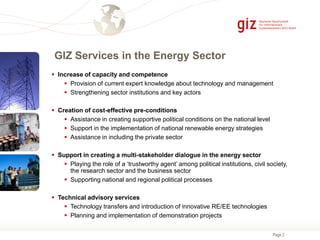
GIZ Services in the Energy Sector
 Increase of capacity and competence
 Provision of current expert knowledge about technology and management
 Strengthening sector institutions and key actors
 Creation of cost-effective pre-conditions
 Assistance in creating supportive political conditions on the national level
 Support in the implementation of national renewable energy strategies
 Assistance in including the private sector
 Support in creating a multi-stakeholder dialogue in the energy sector
 Playing the role of a ‘trustworthy agent’ among political institutions, civil society,
the research sector and the business sector
 Supporting national and regional political processes
 Technical advisory services
 Technology transfers and introduction of innovative RE/EE technologies
 Planning and implementation of demonstration projects
Page 3
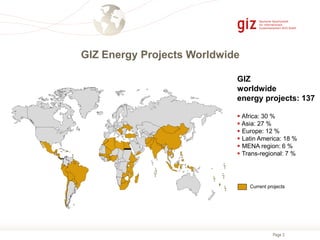
GIZ Energy Projects Worldwide
GIZ
worldwide
energy projects: 137
 Africa: 30 %
 Asia: 27 %
 Europe: 12 %
 Latin America: 18 %
 MENA region: 6 %
 Trans-regional: 7 %
Current projects
Page 4
Objectives of vRE development in emerging
and developing countries
 Security of supply e.g. by reducing import dependence
 Cost efficiency / economic benefits from vRE generation
 Grid stability
 Capacity expansion
 Energy access
 Climate change
 Industrial and innovation policies
Seite 5
Drivers and challenges for renewable energy
scale-up (RE)
Current state
 Strong demand growth
 Partially weak infrastructure
 Monopolistic market structure
 Striving for cost efficiency and co-benefits (jobs
etc.)
Drivers for renewable energies
 Strongly decreasing investment costs
 Historically low interest level
 Growing number of support initiatives
 Price parity in important market segments
(particularly PV ↔ diesel generators)
 etc.
Challenges for renewable energies
 Historically low fossil fuel prices
 Risk of geopolitical conflicts
 Partially high financing and transaction costs
 Lack of governmental guarantees
 Strong interest in rapid capacity deployment
 Uncertainty due to power market reforms
 Uncertain development of climate finance
Seite 6
 Global framework conditions for RE have changed in recent years
 Market transformation is disruptive and causes structural changes
 Developing & emerging economies are embarking on RE “take-off”
phases
 Mainstream concepts and methods used in 1st generation RE countries
(GER, ES, US) are no longer appropriate
 Sectors with – intended - high shares of vRE require a consistent focus on
 (i) Specific national challenges
 (ii) Changing international boundary conditions for RE
 (iii) Robust cost-benefit analysis for optimal, country specific RE
pathways
RE Outlook – 2016 and beyond
Seite 7
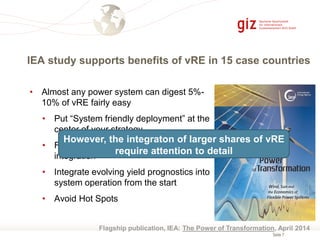
• Almost any power system can digest 5%-
10% of vRE fairly easy
• Put “System friendly deployment” at the
center of your strategy
• Follow a system-wide approach for
integration
• Integrate evolving yield prognostics into
system operation from the start
• Avoid Hot Spots
IEA study supports benefits of vRE in 15 case countries
Flagship publication, IEA: The Power of Transformation, April 2014
However, the integraton of larger shares of vRE
require attention to detail
Seite 8
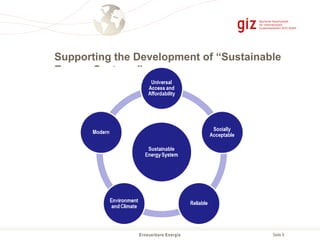
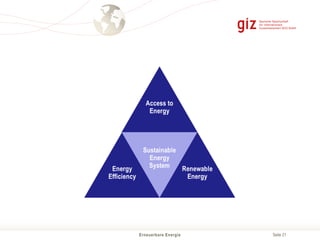
Supporting the Development of “Sustainable
Energy Systems”
Erneuerbare Energie
Seite 9
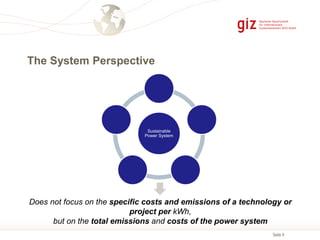
The System Perspective
Sustainable
Power System
Does not focus on the specific costs and emissions of a technology or
project per kWh,
but on the total emissions and costs of the power system
Seite 10
Boundary conditions for planning markets with
higher shares of vRE
• National Macro-economic perspective needed to guide discussion
• vRE to be integrated into historically grown systems and markets
• Paradigm: Generation is adapted to load -> Unit Comittment
• vRE intermittent & CAPEX dominated / Unit Commitment OPEX
oriented
• Technical Nature of vRE – high geospatial dependency
• Grid Integration a challenge
• Increased cycling from thermal generations [due to unit commitment
constraints] therefore needs attention to detail
Seite 11
Boundary condition for planning markets with
higher shares of vRE – cont‘d
• High CAPEX necesitates sound financing conditions
• Market integration a challenge – Regulations and Tariffs needed
• So far, only few tools and methods which can adequately handle the
intermittent nature of vRE
Page 12
A systematic approach to vRE assessments
25.04.2016
In order to maximize the Net Benefits of vRE in existing power systems, a
closer look on the following aspects is needed during the planning phase:
• vRE Generation Potential
• Local (regional) and aggregated vRE generation profiles
• Saisonalities of Load and Generation
• Grid Integration
• Grid infrastructure including automation and Grid Code Compliance
• Power Flow, Short Circuit and Stability considerations
• Spinning Reserve Requirements
• Local (regional) Load Profiles and aggregated Load
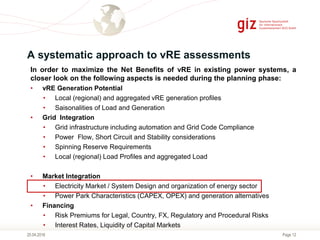
• Market Integration
• Electricity Market / System Design and organization of energy sector
• Power Park Characteristics (CAPEX, OPEX) and generation alternatives
• Financing
• Risk Premiums for Legal, Country, FX, Regulatory and Procedural Risks
• Interest Rates, Liquidity of Capital Markets
Page 13
25.04.2016
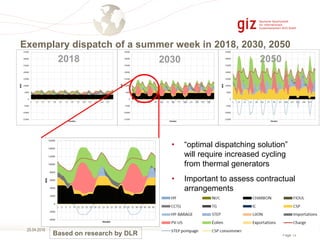
• “optimal dispatching solution”
will require increased cycling
from thermal generators
• Important to assess contractual
arrangements
Exemplary dispatch of a summer week in 2018, 2030, 2050
2018 2030 2050
Based on research by DLR
Seite 14
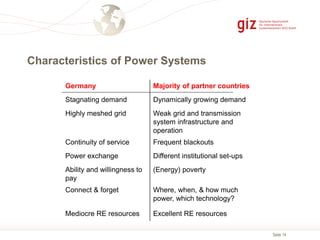
Characteristics of Power Systems
Germany Majority of partner countries
Stagnating demand Dynamically growing demand
Highly meshed grid Weak grid and transmission
system infrastructure and
operation
Continuity of service Frequent blackouts
Power exchange Different institutional set-ups
Ability and willingness to
pay
(Energy) poverty
Connect & forget Where, when, & how much
power, which technology?
Mediocre RE resources Excellent RE resources
Seite 15
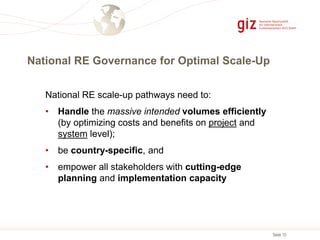
National RE Governance for Optimal Scale-Up
National RE scale-up pathways need to:
• Handle the massive intended volumes efficiently
(by optimizing costs and benefits on project and
system level);
• be country-specific, and
• empower all stakeholders with cutting-edge
planning and implementation capacity
Seite 16
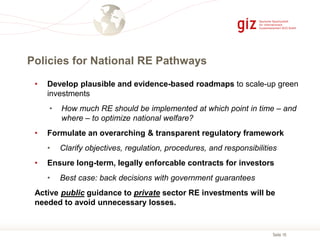
Policies for National RE Pathways
• Develop plausible and evidence-based roadmaps to scale-up green
investments
• How much RE should be implemented at which point in time – and
where – to optimize national welfare?
• Formulate an overarching & transparent regulatory framework
• Clarify objectives, regulation, procedures, and responsibilities
• Ensure long-term, legally enforcable contracts for investors
• Best case: back decisions with government guarantees
Active public guidance to private sector RE investments will be
needed to avoid unnecessary losses.
Seite 17
Why Policies Matter
Putting the value of RE to the system at the center of the
strategy will reduce (financial) costs:
• A plausible contribution of RE to the system‘s cost-
efficiency and stability will make future harmful changes less
likely, lowering politcal risk
• A plausible RE policy & deployment plan will assure a long-
term market volume for RE, thereby attracting investors
Seite 18
Contact:
Jens Burgtorf (jens.burgtorf@giz.de)
Head of Project ‚Technology Cooperation in the Energy Sector‘
Thank you for your attention
Seite 19
BACK-UP SLIDES
Erneuerbare Energie25.04.2016
Seite 20
Integration challenge for higher shares of vRE
The power system and power markets will need to cope with a highly
fluctuating power production from wind and solar [Case for Germany]
Seite 21Erneuerbare Energie
Seite 22
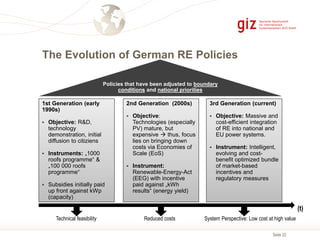
The Evolution of German RE Policies
1st Generation (early
1990s)
 Objective: R&D,
technology
demonstration, initial
diffusion to citiziens
 Instruments: „1000
roofs programme“ &
„100 000 roofs
programme“
 Subsidies initially paid
up front against kWp
(capacity)
2nd Generation (2000s)
 Objective:
Technologies (especially
PV) mature, but
expensive  thus, focus
lies on bringing down
costs via Economies of
Scale (EoS)
 Instrument:
Renewable-Energy-Act
(EEG) with incentive
paid against „kWh
results“ (energy yield)
3rd Generation (current)
 Objective: Massive and
cost-efficient integration
of RE into national and
EU power systems.
 Instrument: Intelligent,
evolving and cost-
benefit optimized bundle
of market-based
incentives and
regulatory measures
Policies that have been adjusted to boundary
conditions and national priorities
(t)
Technical feasibility Reduced costs System Perspective: Low cost at high value

Scaling up renewable energies

  • 1.
    Seite 1 - Experienceswith high shares of fluctuating RE in electricity grids - Granada, April 26, 2016 Jens Burgtorf Head of Project ‚Technology Cooperation in the Energy Sector‘ Scaling-up Renewable Energies
  • 2.
    Page 2 GIZ Servicesin the Energy Sector  Increase of capacity and competence  Provision of current expert knowledge about technology and management  Strengthening sector institutions and key actors  Creation of cost-effective pre-conditions  Assistance in creating supportive political conditions on the national level  Support in the implementation of national renewable energy strategies  Assistance in including the private sector  Support in creating a multi-stakeholder dialogue in the energy sector  Playing the role of a ‘trustworthy agent’ among political institutions, civil society, the research sector and the business sector  Supporting national and regional political processes  Technical advisory services  Technology transfers and introduction of innovative RE/EE technologies  Planning and implementation of demonstration projects
  • 3.
    Page 3 GIZ EnergyProjects Worldwide GIZ worldwide energy projects: 137  Africa: 30 %  Asia: 27 %  Europe: 12 %  Latin America: 18 %  MENA region: 6 %  Trans-regional: 7 % Current projects
  • 4.
    Page 4 Objectives ofvRE development in emerging and developing countries  Security of supply e.g. by reducing import dependence  Cost efficiency / economic benefits from vRE generation  Grid stability  Capacity expansion  Energy access  Climate change  Industrial and innovation policies
  • 5.
    Seite 5 Drivers andchallenges for renewable energy scale-up (RE) Current state  Strong demand growth  Partially weak infrastructure  Monopolistic market structure  Striving for cost efficiency and co-benefits (jobs etc.) Drivers for renewable energies  Strongly decreasing investment costs  Historically low interest level  Growing number of support initiatives  Price parity in important market segments (particularly PV ↔ diesel generators)  etc. Challenges for renewable energies  Historically low fossil fuel prices  Risk of geopolitical conflicts  Partially high financing and transaction costs  Lack of governmental guarantees  Strong interest in rapid capacity deployment  Uncertainty due to power market reforms  Uncertain development of climate finance
  • 6.
    Seite 6  Globalframework conditions for RE have changed in recent years  Market transformation is disruptive and causes structural changes  Developing & emerging economies are embarking on RE “take-off” phases  Mainstream concepts and methods used in 1st generation RE countries (GER, ES, US) are no longer appropriate  Sectors with – intended - high shares of vRE require a consistent focus on  (i) Specific national challenges  (ii) Changing international boundary conditions for RE  (iii) Robust cost-benefit analysis for optimal, country specific RE pathways RE Outlook – 2016 and beyond
  • 7.
    Seite 7 • Almostany power system can digest 5%- 10% of vRE fairly easy • Put “System friendly deployment” at the center of your strategy • Follow a system-wide approach for integration • Integrate evolving yield prognostics into system operation from the start • Avoid Hot Spots IEA study supports benefits of vRE in 15 case countries Flagship publication, IEA: The Power of Transformation, April 2014 However, the integraton of larger shares of vRE require attention to detail
  • 8.
    Seite 8 Supporting theDevelopment of “Sustainable Energy Systems” Erneuerbare Energie
  • 9.
    Seite 9 The SystemPerspective Sustainable Power System Does not focus on the specific costs and emissions of a technology or project per kWh, but on the total emissions and costs of the power system
  • 10.
    Seite 10 Boundary conditionsfor planning markets with higher shares of vRE • National Macro-economic perspective needed to guide discussion • vRE to be integrated into historically grown systems and markets • Paradigm: Generation is adapted to load -> Unit Comittment • vRE intermittent & CAPEX dominated / Unit Commitment OPEX oriented • Technical Nature of vRE – high geospatial dependency • Grid Integration a challenge • Increased cycling from thermal generations [due to unit commitment constraints] therefore needs attention to detail
  • 11.
    Seite 11 Boundary conditionfor planning markets with higher shares of vRE – cont‘d • High CAPEX necesitates sound financing conditions • Market integration a challenge – Regulations and Tariffs needed • So far, only few tools and methods which can adequately handle the intermittent nature of vRE
  • 12.
    Page 12 A systematicapproach to vRE assessments 25.04.2016 In order to maximize the Net Benefits of vRE in existing power systems, a closer look on the following aspects is needed during the planning phase: • vRE Generation Potential • Local (regional) and aggregated vRE generation profiles • Saisonalities of Load and Generation • Grid Integration • Grid infrastructure including automation and Grid Code Compliance • Power Flow, Short Circuit and Stability considerations • Spinning Reserve Requirements • Local (regional) Load Profiles and aggregated Load • Market Integration • Electricity Market / System Design and organization of energy sector • Power Park Characteristics (CAPEX, OPEX) and generation alternatives • Financing • Risk Premiums for Legal, Country, FX, Regulatory and Procedural Risks • Interest Rates, Liquidity of Capital Markets
  • 13.
    Page 13 25.04.2016 • “optimaldispatching solution” will require increased cycling from thermal generators • Important to assess contractual arrangements Exemplary dispatch of a summer week in 2018, 2030, 2050 2018 2030 2050 Based on research by DLR
  • 14.
    Seite 14 Characteristics ofPower Systems Germany Majority of partner countries Stagnating demand Dynamically growing demand Highly meshed grid Weak grid and transmission system infrastructure and operation Continuity of service Frequent blackouts Power exchange Different institutional set-ups Ability and willingness to pay (Energy) poverty Connect & forget Where, when, & how much power, which technology? Mediocre RE resources Excellent RE resources
  • 15.
    Seite 15 National REGovernance for Optimal Scale-Up National RE scale-up pathways need to: • Handle the massive intended volumes efficiently (by optimizing costs and benefits on project and system level); • be country-specific, and • empower all stakeholders with cutting-edge planning and implementation capacity
  • 16.
    Seite 16 Policies forNational RE Pathways • Develop plausible and evidence-based roadmaps to scale-up green investments • How much RE should be implemented at which point in time – and where – to optimize national welfare? • Formulate an overarching & transparent regulatory framework • Clarify objectives, regulation, procedures, and responsibilities • Ensure long-term, legally enforcable contracts for investors • Best case: back decisions with government guarantees Active public guidance to private sector RE investments will be needed to avoid unnecessary losses.
  • 17.
    Seite 17 Why PoliciesMatter Putting the value of RE to the system at the center of the strategy will reduce (financial) costs: • A plausible contribution of RE to the system‘s cost- efficiency and stability will make future harmful changes less likely, lowering politcal risk • A plausible RE policy & deployment plan will assure a long- term market volume for RE, thereby attracting investors
  • 18.
    Seite 18 Contact: Jens Burgtorf(jens.burgtorf@giz.de) Head of Project ‚Technology Cooperation in the Energy Sector‘ Thank you for your attention
  • 19.
  • 20.
    Seite 20 Integration challengefor higher shares of vRE The power system and power markets will need to cope with a highly fluctuating power production from wind and solar [Case for Germany]
  • 21.
  • 22.
    Seite 22 The Evolutionof German RE Policies 1st Generation (early 1990s)  Objective: R&D, technology demonstration, initial diffusion to citiziens  Instruments: „1000 roofs programme“ & „100 000 roofs programme“  Subsidies initially paid up front against kWp (capacity) 2nd Generation (2000s)  Objective: Technologies (especially PV) mature, but expensive  thus, focus lies on bringing down costs via Economies of Scale (EoS)  Instrument: Renewable-Energy-Act (EEG) with incentive paid against „kWh results“ (energy yield) 3rd Generation (current)  Objective: Massive and cost-efficient integration of RE into national and EU power systems.  Instrument: Intelligent, evolving and cost- benefit optimized bundle of market-based incentives and regulatory measures Policies that have been adjusted to boundary conditions and national priorities (t) Technical feasibility Reduced costs System Perspective: Low cost at high value