All Energy 2014 
Alternative business models & funding structures 
Engaging with merchant risk in a rapidly changing industry 
October 2014 
Stuart Anderson 
+61 419 135 065 (mob) 
+61 2 8264 2483 (tel) 
sanderson@sydneycapital.com.au 
Level 6, 2 Bulletin Pl 
Sydney NSW 2000 
Australia 
www.sydneycapital.com.au
Background 
15/10/2014 
2 
Situation 
Challenges 
Opportunities 
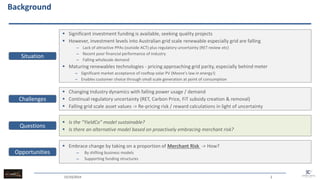
Significant investment funding is available, seeking quality projects 
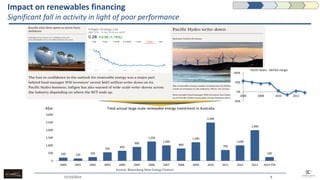
However, investment levels into Australian grid scale renewable especially grid are falling 
–Lack of attractive PPAs (outside ACT) plus regulatory uncertainty (RET review etc) 
–Recent poor financial performance of industry 
–Falling wholesale demand 
Maturing renewables technologies - pricing approaching grid parity, especially behind meter 
–Significant market acceptance of rooftop solar PV (Moore’s law in energy!) 
–Enables customer choice through small scale generation at point of consumption 
Changing Industry dynamics with falling power usage / demand 
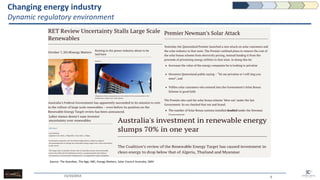
Continual regulatory uncertainty (RET, Carbon Price, FiT subsidy creation & removal) 
Falling grid scale asset values -> Re-pricing risk / reward calculations in light of uncertainty 
Embrace change by taking on a proportion of Merchant Risk -> How? 
–By shifting business models 
–Supporting funding structures 
Questions 
Is the “YieldCo” model sustainable? 
Is there an alternative model based on proactively embracing merchant risk?
Agenda 
15/10/2014 
3 
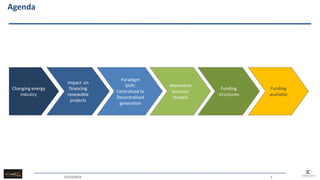
Changing energy industry 
Impact on financing renewable projects 
Paradigm Shift: Centralised to Decentralised generation 
Alternative business models 
Funding structures 
Funding available
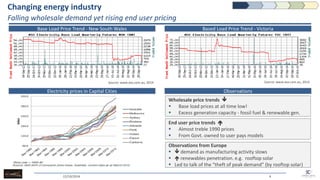
Changing energy industry Falling wholesale demand yet rising end user pricing 
15/10/2014 
4 
Base Load Price Trend - New South Wales 
Based Load Price Trend - Victoria 
Wholesale price trends  
Base load prices at all time low! 
Excess generation capacity - fossil fuel & renewable gen. 
Source: www.asx.com.au, 2014 
Observations from Europe 
 demand as manufacturing activity slows 
 renewables penetration. e.g. rooftop solar 
Led to talk of the “theft of peak demand” (by rooftop solar) 
End user price trends  
Almost treble 1990 prices 
From Govt. owned to user pays models 
Electricity prices in Capital Cities 
Observations
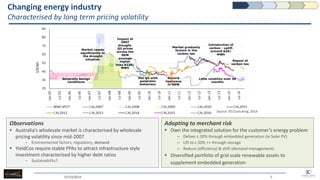
Changing energy industry Characterised by long term pricing volatility 
15/10/2014 
5 
Observations 
Australia’s wholesale market is characterised by wholesale pricing volatility since mid-2007 
-Environmental factors, regulatory, demand 
YieldCos require stable PPAs to attract infrastructure style investment characterised by higher debt ratios 
-Sustainability? 
Source: IES Consulting, 2014 
Adapting to merchant risk 
Own the integrated solution for the customer’s energy problem 
–Deliver c.30% through embedded generation (ie Solar PV) 
–Lift to c.50% ++ through storage 
–Reduce (efficiency) & shift (demand management) 
Diversified portfolio of grid scale renewable assets to supplement embedded generation
Changing energy industry Dynamic regulatory environment 
15/10/2014 
6 
Source: The Guardian, The Age, ABC, Energy Matters, Solar Council Australia, SMH
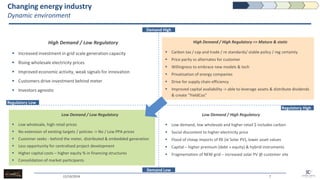
High Demand / Low Regulatory 
Increased investment in grid scale generation capacity 
Rising wholesale electricity prices 
Improved economic activity, weak signals for innovation 
Customers drive investment behind meter 
Investors agnostic 
Low Demand / Low Regulatory 
Low wholesale, high retail prices 
No extension of existing targets / policies -> No / Low PPA prices 
Customer seeks - behind the meter, distributed & embedded generation 
Less opportunity for centralised project development 
Higher capital costs – higher equity % in financing structures 
Consolidation of market participants 
Low Demand / High Regulatory 
Low demand, low wholesale and higher retail $ includes carbon 
Social discontent to higher electricity price 
Flood of cheap imports of RE (ie Solar PV), lower asset values 
Capital – higher premium (debt + equity) & hybrid instruments 
Fragmentation of NEM grid – increased solar PV @ customer site 
Demand Low 
Regulatory Low 
Demand High 
High Demand / High Regulatory => Mature & static 
Carbon tax / cap and trade / re standards/ stable policy / reg certainty 
Price parity vs alternates for customer 
Willingness to embrace new models & tech 
Privatisation of energy companies 
Drive for supply chain efficiency 
Improved capital availability -> able to leverage assets & distribute dividends & create “YieldCos” 
Changing energy industry Dynamic environment 
Regulatory High 
15/10/2014 
7
Impact on renewables financing Significant fall in activity in light of poor performance 
15/10/2014 
8 
200 
150 
240 
550 
650 
900 
1,250 
1,000 
800 
1,200 
2,490 
700 
1,000 
1,990 
240 
0 
500 
1,000 
1,500 
2,000 
2,500 
3,000 
2000 
2001 
2002 
2003 
2004 
2005 
2006 
2007 
2008 
2009 
2010 
2011 
2012 
2013 
2014 YTD 
A$m 
Total annual large-scale renewable energy investment in Australia 
-50% 
0% 
50% 
100% 
2006 
2008 
2010 
2012 
Pacific Hydro - EBITDA margin 
Source: Bloomberg New Energy Finance
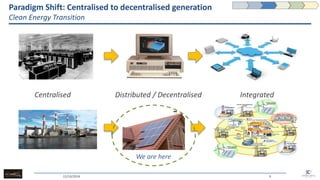
Centralised 
Distributed / Decentralised 
Integrated 
Paradigm Shift: Centralised to decentralised generation Clean Energy Transition 
We are here 
15/10/2014 
9
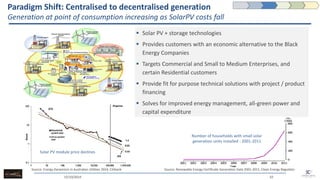
Paradigm Shift: Centralised to decentralised generation Generation at point of consumption increasing as SolarPV costs fall 
15/10/2014 
10 
Solar PV + storage technologies 
Provides customers with an economic alternative to the Black Energy Companies 
Targets Commercial and Small to Medium Enterprises, and certain Residential customers 
Provide fit for purpose technical solutions with project / product financing 
Solves for improved energy management, all-green power and capital expenditure 
Number of households with small solar generation units installed - 2001-2011 
Source: Renewable Energy Certificate Generation Data 2001-2011, Clean Energy Regulator 
Source: Energy Darwinism in Australian Utilities 2014, Citibank 
Solar PV module price declines
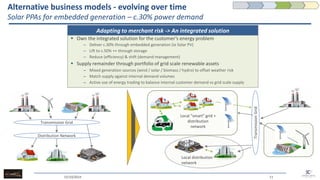
Alternative business models - evolving over time Solar PPAs for embedded generation – c.30% power demand 
15/10/2014 
11 
Transmission Grid 
Distribution Network 
Transmission Grid 
Local “smart” grid + distribution network 
Local distribution network 
Own the integrated solution for the customer’s energy problem 
–Deliver c.30% through embedded generation (ie Solar PV) 
–Lift to c.50% ++ through storage 
–Reduce (efficiency) & shift (demand management) 
Supply remainder through portfolio of grid scale renewable assets 
–Mixed generation sources (wind / solar / biomass / hydro) to offset weather risk 
–Match supply against internal demand volumes 
–Active use of energy trading to balance internal customer demand vs grid scale supply 
Adapting to merchant risk -> An integrated solution
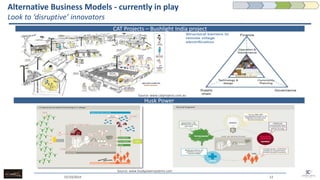
Alternative Business Models - currently in play Look to ‘disruptive’ innovators 
15/10/2014 
12 
CAT Projects – Bushlight India project 
Husk Power 
Source: www.catprojects.com.au 
Source: www.huskpowersystems.com
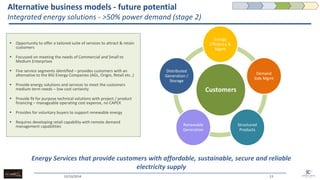
Alternative business models - future potential Integrated energy solutions - >50% power demand (stage 2) 
15/10/2014 
13 
Customers 
Energy Efficiency & Mgmt 
Demand Side Mgmt 
Structured Products 
Renewable Generation 
Distributed Generation / Storage 
Opportunity to offer a tailored suite of services to attract & retain customers 
Focussed on meeting the needs of Commercial and Small to Medium Enterprises 
Five service segments identified – provides customers with an alternative to the BIG Energy Companies (AGL, Origin, Retail etc..) 
Provide energy solutions and services to meet the customers medium term needs – low cost certainty 
Provide fit for purpose technical solutions with project / product financing – manageable operating cost expense, no CAPEX 
Provides for voluntary buyers to support renewable energy 
Requires developing retail capability with remote demand management capabilities 
Energy Services that provide customers with affordable, sustainable, secure and reliable electricity supply
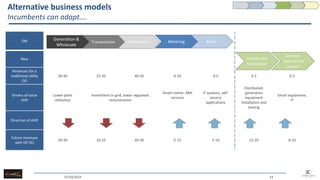
Alternative business models Incumbents can adapt…. 
Old 
New 
Revenues for a traditional utility (%) 
30-40 
15-20 
40-50 
0-10 
0-5 
0-2 
0-2 
Drivers of value shift 
Lower plant utilisation 
Investment in grid, lower regulated remuneration 
Smart-meter, AMI services 
IT systems, self- service applications 
Distributed- generation equipment installation and leasing 
Smart equipment, IT 
Direction of shift 
Future revenues with DE (%) 
20-30 
10-15 
20-30 
5-15 
5-10 
15-20 
0-10 
15/10/2014 
14 
Services “behind the meter” 
Distributed Generation 
Retail 
Metering 
Distribution 
Transmission 
Generation & Wholesale
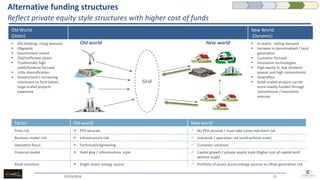
Alternative funding structures Reflect private equity style structures with higher cost of funds 
15/10/2014 
15 
Old World (Static) 
New World 
(Dynamic) 
Old thinking: rising demand 
Oligopoly 
Government reliant 
Old/inefficient plants 
Traditionally high yield/dividend focused 
Little diversification 
Government’s increasing reluctance to fund leaves large-scaled projects expensive 
In reality : falling demand 
Increase in decentralised / local generation 
Customer focused 
Innovative technologies 
High equity %, low dividend payout and high reinvestment 
Diversified 
Small-scaled projects can be more readily funded through conventional / innovative avenues 
Old world 
Grid 
New world 
Factor 
Old world 
New world 
Price risk 
PPA secured 
No PPA secured / must take some merchant risk 
Business model risk 
Infrastructure risk 
Industrial / operation risk (until achieve scale) 
Operation focus 
Technical/engineering 
Customer solutions 
Financial model 
Yield play / infrastructure style 
Capital growth / private equity style (higher cost of capital until achieve scale) 
Asset structure 
Single asset/ energy source 
Portfolio of assets across energy sources to offset generation risk
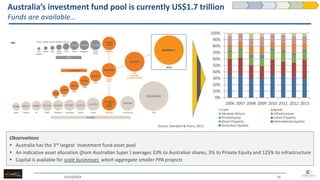
Australia’s investment fund pool is currently US$1.7 trillion Funds are available… 
16 
Observations 
Australia has the 3rd largest investment fund asset pool 
An indicative asset allocation (from Australian Super ) averages 33% to Australian shares, 3% to Private Equity and 12$% to infrastructure 
Capital is available for scale businesses which aggregate smaller PPA projects 
15/10/2014 
Source: Standard & Poors, 2013 
0% 
10% 
20% 
30% 
40% 
50% 
60% 
70% 
80% 
90% 
100% 
2006 
2007 
2008 
2009 
2010 
2011 
2012 
2013 
Cash 
Bonds 
Absolute Return 
Infrastructure 
PrivateEquity 
Listed Property 
Direct Property 
International Equities 
Australian Equities

Renewable Energy - Alternative business models & funding structures

  • 1.
    All Energy 2014 Alternative business models & funding structures Engaging with merchant risk in a rapidly changing industry October 2014 Stuart Anderson +61 419 135 065 (mob) +61 2 8264 2483 (tel) sanderson@sydneycapital.com.au Level 6, 2 Bulletin Pl Sydney NSW 2000 Australia www.sydneycapital.com.au
  • 2.
    Background 15/10/2014 2 Situation Challenges Opportunities Significant investment funding is available, seeking quality projects However, investment levels into Australian grid scale renewable especially grid are falling –Lack of attractive PPAs (outside ACT) plus regulatory uncertainty (RET review etc) –Recent poor financial performance of industry –Falling wholesale demand Maturing renewables technologies - pricing approaching grid parity, especially behind meter –Significant market acceptance of rooftop solar PV (Moore’s law in energy!) –Enables customer choice through small scale generation at point of consumption Changing Industry dynamics with falling power usage / demand Continual regulatory uncertainty (RET, Carbon Price, FiT subsidy creation & removal) Falling grid scale asset values -> Re-pricing risk / reward calculations in light of uncertainty Embrace change by taking on a proportion of Merchant Risk -> How? –By shifting business models –Supporting funding structures Questions Is the “YieldCo” model sustainable? Is there an alternative model based on proactively embracing merchant risk?
  • 3.
    Agenda 15/10/2014 3 Changing energy industry Impact on financing renewable projects Paradigm Shift: Centralised to Decentralised generation Alternative business models Funding structures Funding available
  • 4.
    Changing energy industryFalling wholesale demand yet rising end user pricing 15/10/2014 4 Base Load Price Trend - New South Wales Based Load Price Trend - Victoria Wholesale price trends  Base load prices at all time low! Excess generation capacity - fossil fuel & renewable gen. Source: www.asx.com.au, 2014 Source: www.asx.com.au, 2014 Observations from Europe  demand as manufacturing activity slows  renewables penetration. e.g. rooftop solar Led to talk of the “theft of peak demand” (by rooftop solar) End user price trends  Almost treble 1990 prices From Govt. owned to user pays models Electricity prices in Capital Cities Observations
  • 5.
    Changing energy industryCharacterised by long term pricing volatility 15/10/2014 5 Observations Australia’s wholesale market is characterised by wholesale pricing volatility since mid-2007 -Environmental factors, regulatory, demand YieldCos require stable PPAs to attract infrastructure style investment characterised by higher debt ratios -Sustainability? Source: IES Consulting, 2014 Adapting to merchant risk Own the integrated solution for the customer’s energy problem –Deliver c.30% through embedded generation (ie Solar PV) –Lift to c.50% ++ through storage –Reduce (efficiency) & shift (demand management) Diversified portfolio of grid scale renewable assets to supplement embedded generation
  • 6.
    Changing energy industryDynamic regulatory environment 15/10/2014 6 Source: The Guardian, The Age, ABC, Energy Matters, Solar Council Australia, SMH
  • 7.
    High Demand /Low Regulatory Increased investment in grid scale generation capacity Rising wholesale electricity prices Improved economic activity, weak signals for innovation Customers drive investment behind meter Investors agnostic Low Demand / Low Regulatory Low wholesale, high retail prices No extension of existing targets / policies -> No / Low PPA prices Customer seeks - behind the meter, distributed & embedded generation Less opportunity for centralised project development Higher capital costs – higher equity % in financing structures Consolidation of market participants Low Demand / High Regulatory Low demand, low wholesale and higher retail $ includes carbon Social discontent to higher electricity price Flood of cheap imports of RE (ie Solar PV), lower asset values Capital – higher premium (debt + equity) & hybrid instruments Fragmentation of NEM grid – increased solar PV @ customer site Demand Low Regulatory Low Demand High High Demand / High Regulatory => Mature & static Carbon tax / cap and trade / re standards/ stable policy / reg certainty Price parity vs alternates for customer Willingness to embrace new models & tech Privatisation of energy companies Drive for supply chain efficiency Improved capital availability -> able to leverage assets & distribute dividends & create “YieldCos” Changing energy industry Dynamic environment Regulatory High 15/10/2014 7
  • 8.
    Impact on renewablesfinancing Significant fall in activity in light of poor performance 15/10/2014 8 200 150 240 550 650 900 1,250 1,000 800 1,200 2,490 700 1,000 1,990 240 0 500 1,000 1,500 2,000 2,500 3,000 2000 2001 2002 2003 2004 2005 2006 2007 2008 2009 2010 2011 2012 2013 2014 YTD A$m Total annual large-scale renewable energy investment in Australia -50% 0% 50% 100% 2006 2008 2010 2012 Pacific Hydro - EBITDA margin Source: Bloomberg New Energy Finance
  • 9.
    Centralised Distributed /Decentralised Integrated Paradigm Shift: Centralised to decentralised generation Clean Energy Transition We are here 15/10/2014 9
  • 10.
    Paradigm Shift: Centralisedto decentralised generation Generation at point of consumption increasing as SolarPV costs fall 15/10/2014 10 Solar PV + storage technologies Provides customers with an economic alternative to the Black Energy Companies Targets Commercial and Small to Medium Enterprises, and certain Residential customers Provide fit for purpose technical solutions with project / product financing Solves for improved energy management, all-green power and capital expenditure Number of households with small solar generation units installed - 2001-2011 Source: Renewable Energy Certificate Generation Data 2001-2011, Clean Energy Regulator Source: Energy Darwinism in Australian Utilities 2014, Citibank Solar PV module price declines
  • 11.
    Alternative business models- evolving over time Solar PPAs for embedded generation – c.30% power demand 15/10/2014 11 Transmission Grid Distribution Network Transmission Grid Local “smart” grid + distribution network Local distribution network Own the integrated solution for the customer’s energy problem –Deliver c.30% through embedded generation (ie Solar PV) –Lift to c.50% ++ through storage –Reduce (efficiency) & shift (demand management) Supply remainder through portfolio of grid scale renewable assets –Mixed generation sources (wind / solar / biomass / hydro) to offset weather risk –Match supply against internal demand volumes –Active use of energy trading to balance internal customer demand vs grid scale supply Adapting to merchant risk -> An integrated solution
  • 12.
    Alternative Business Models- currently in play Look to ‘disruptive’ innovators 15/10/2014 12 CAT Projects – Bushlight India project Husk Power Source: www.catprojects.com.au Source: www.huskpowersystems.com
  • 13.
    Alternative business models- future potential Integrated energy solutions - >50% power demand (stage 2) 15/10/2014 13 Customers Energy Efficiency & Mgmt Demand Side Mgmt Structured Products Renewable Generation Distributed Generation / Storage Opportunity to offer a tailored suite of services to attract & retain customers Focussed on meeting the needs of Commercial and Small to Medium Enterprises Five service segments identified – provides customers with an alternative to the BIG Energy Companies (AGL, Origin, Retail etc..) Provide energy solutions and services to meet the customers medium term needs – low cost certainty Provide fit for purpose technical solutions with project / product financing – manageable operating cost expense, no CAPEX Provides for voluntary buyers to support renewable energy Requires developing retail capability with remote demand management capabilities Energy Services that provide customers with affordable, sustainable, secure and reliable electricity supply
  • 14.
    Alternative business modelsIncumbents can adapt…. Old New Revenues for a traditional utility (%) 30-40 15-20 40-50 0-10 0-5 0-2 0-2 Drivers of value shift Lower plant utilisation Investment in grid, lower regulated remuneration Smart-meter, AMI services IT systems, self- service applications Distributed- generation equipment installation and leasing Smart equipment, IT Direction of shift Future revenues with DE (%) 20-30 10-15 20-30 5-15 5-10 15-20 0-10 15/10/2014 14 Services “behind the meter” Distributed Generation Retail Metering Distribution Transmission Generation & Wholesale
  • 15.
    Alternative funding structuresReflect private equity style structures with higher cost of funds 15/10/2014 15 Old World (Static) New World (Dynamic) Old thinking: rising demand Oligopoly Government reliant Old/inefficient plants Traditionally high yield/dividend focused Little diversification Government’s increasing reluctance to fund leaves large-scaled projects expensive In reality : falling demand Increase in decentralised / local generation Customer focused Innovative technologies High equity %, low dividend payout and high reinvestment Diversified Small-scaled projects can be more readily funded through conventional / innovative avenues Old world Grid New world Factor Old world New world Price risk PPA secured No PPA secured / must take some merchant risk Business model risk Infrastructure risk Industrial / operation risk (until achieve scale) Operation focus Technical/engineering Customer solutions Financial model Yield play / infrastructure style Capital growth / private equity style (higher cost of capital until achieve scale) Asset structure Single asset/ energy source Portfolio of assets across energy sources to offset generation risk
  • 16.
    Australia’s investment fundpool is currently US$1.7 trillion Funds are available… 16 Observations Australia has the 3rd largest investment fund asset pool An indicative asset allocation (from Australian Super ) averages 33% to Australian shares, 3% to Private Equity and 12$% to infrastructure Capital is available for scale businesses which aggregate smaller PPA projects 15/10/2014 Source: Standard & Poors, 2013 0% 10% 20% 30% 40% 50% 60% 70% 80% 90% 100% 2006 2007 2008 2009 2010 2011 2012 2013 Cash Bonds Absolute Return Infrastructure PrivateEquity Listed Property Direct Property International Equities Australian Equities