Price Cap
The Good ,Bad and Ugly of Price Cap
Need , Impact and implementation
issues
Players
• Generator
• Trader
• Investors
• Discoms
• Consumers
• How to balance stakeholder ‘s benefit in a
group play.
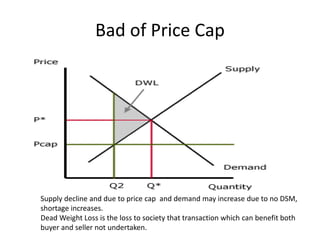
Bad of Price Cap
Supply decline and due to price cap and demand may increase due to no DSM,
shortage increases.
Dead Weight Loss is the loss to society that transaction which can benefit both
buyer and seller not undertaken.
Good of Price Cap
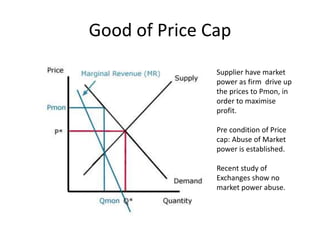
Supplier have market
power as firm drive up
the prices to Pmon, in
order to maximise
profit.
Pre condition of Price
cap: Abuse of Market
power is established.
Recent study of
Exchanges show no
market power abuse.
Good of Price Cap
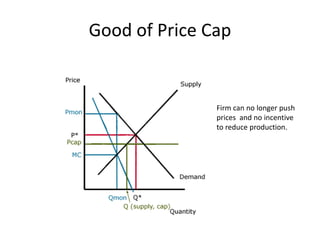
Firm can no longer push
prices and no incentive
to reduce production.
Timing /Horizon of decision
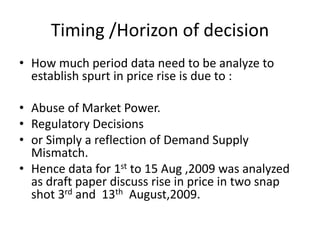
• How much period data need to be analyze to
establish spurt in price rise is due to :
• Abuse of Market Power.
• Regulatory Decisions
• or Simply a reflection of Demand Supply
Mismatch.
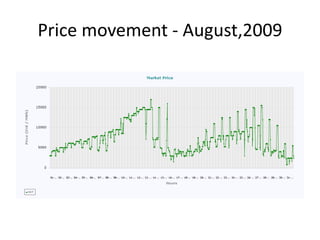
• Hence data for 1st to 15 Aug ,2009 was analyzed
as draft paper discuss rise in price in two snap
shot 3rd and 13th August,2009.
Movement of Prices
0
2000
4000
6000
8000
10000
12000
14000
16000
18000
-10000
0
10000
20000
30000
40000
50000
60000
70000
AvgandMaxMCPriceinRs/Mwh
Purchase&SaleQuantityinMWh
Purchase and Sale bid and Prices
Purchase Bid
Sell Bids
Diference
Unconstrained Volume
Avg Price
Max Price
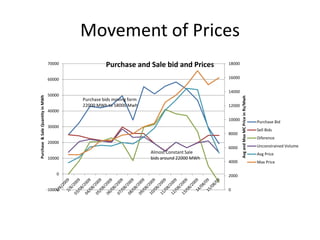
Almost Constant Sale
bids around 22000 MWh
Purchase bids moving form
22000 MWh to 58000 Mwh
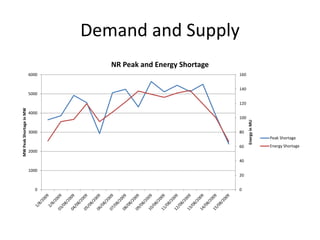
Demand and Supply
0
20
40
60
80
100
120
140
160
0
1000
2000
3000
4000
5000
6000
EnergyinMU
MWPeakShortageinMW
NR Peak and Energy Shortage
Peak Shortage
Energy Shortage
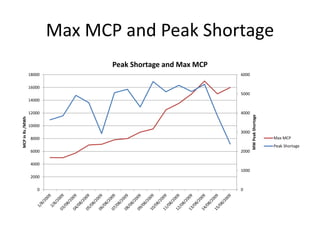
Max MCP and Peak Shortage
0
1000
2000
3000
4000
5000
6000
0
2000
4000
6000
8000
10000
12000
14000
16000
18000
MWPeakShortage
MCPinRs/MWh
Peak Shortage and Max MCP
Max MCP
Peak Shortage
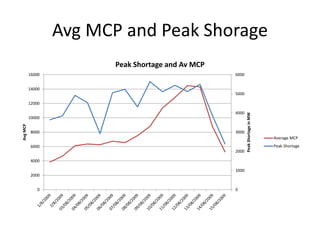
Avg MCP and Peak Shorage
0
1000
2000
3000
4000
5000
6000
0
2000
4000
6000
8000
10000
12000
14000
16000
PeakShortageinMW
AvgMCP
Peak Shortage and Av MCP
Average MCP
Peak Shortage
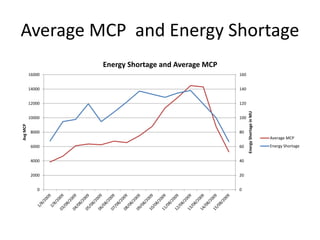
Average MCP and Energy Shortage
0
20
40
60
80
100
120
140
160
0
2000
4000
6000
8000
10000
12000
14000
16000
EnergyShortageinMU
AvgMCP
Energy Shortage and Average MCP
Average MCP
Energy Shortage
Impact/ effectiveness
Regulator interfere in market when its steps
would affect whole market not only a very
small portion of market ,which is 4.5% in
June,2009 and
prices in that small portion does not affect
whole market .( For exchange it is only 0.86%)
Compare it with Oil market and sugar market
where whole market have single price.
Price movement - August,2009
Congestion issue
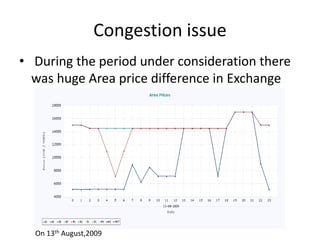
• During the period under consideration there
was huge Area price difference in Exchange
On 13th August,2009
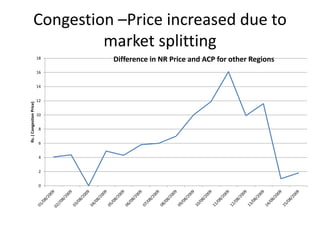
Congestion –Price increased due to
market splitting
0
2
4
6
8
10
12
14
16
18
Rs.(CongestionPrice)
Difference in NR Price and ACP for other Regions
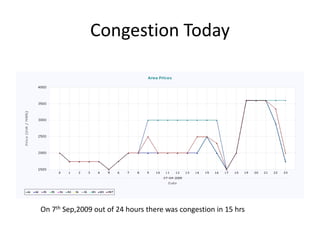
Congestion Today
On 7th Sep,2009 out of 24 hours there was congestion in 15 hrs
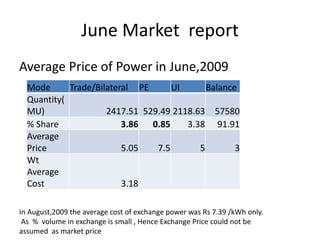
June Market report
Average Price of Power in June,2009
Mode Trade/Bilateral PE UI Balance
Quantity(
MU) 2417.51 529.49 2118.63 57580
% Share 3.86 0.85 3.38 91.91
Average
Price 5.05 7.5 5 3
Wt
Average
Cost 3.18
In August,2009 the average cost of exchange power was Rs 7.39 /kWh only.
As % volume in exchange is small , Hence Exchange Price could not be
assumed as market price
International experience
• The price cap was introduced in some markets
where the wholesale market price was
governed by Exchange prices.
• Price cap were generally introduced to combat
volatility or price spikes in short term market,
but these price spikes are investment signals
to PEAKER Power Station.
• Can Price cap is sufficient to cover AFC of
Peaker and bring it profit.
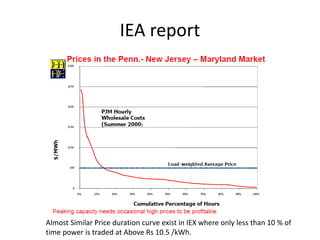
IEA report
• Volatile electricity prices encourage investment
in the different types of plants needed.
Investment strategies for different type of
plant:
• Baseload (continuous operation, average
• price)
• Midload (operate when prices favourable)
• Peakload (like midload but over small number of
Hours)
IEA report
Almost Similar Price duration curve exist in IEX where only less than 10 % of
time power is traded at Above Rs 10.5 /kWh.
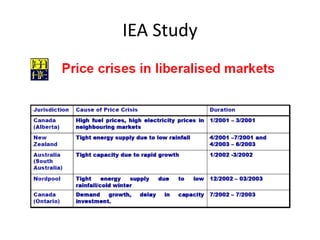
IEA Study
IEA Study
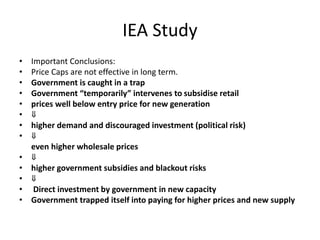
• Important Conclusions:
• Price Caps are not effective in long term.
• Government is caught in a trap
• Government “temporarily” intervenes to subsidise retail
• prices well below entry price for new generation
• ⇓
• higher demand and discouraged investment (political risk)
• ⇓
even higher wholesale prices
• ⇓
• higher government subsidies and blackout risks
• ⇓
• Direct investment by government in new capacity
• Government trapped itself into paying for higher prices and new supply
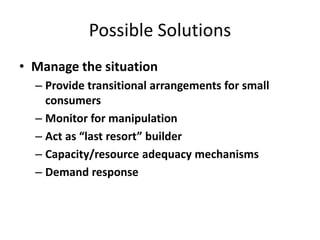
Possible Solutions
• Manage the situation
– Provide transitional arrangements for small
consumers
– Monitor for manipulation
– Act as “last resort” builder
– Capacity/resource adequacy mechanisms
– Demand response
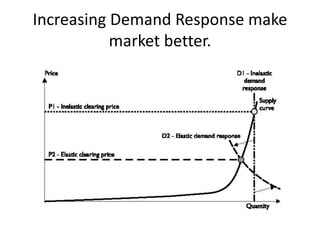
Demand Response
• Electricity prices are high and volatile because high spot
prices do not deter consumption
• While everyone wants some electricity at all times,
• certain uses are not critical and can be deferred.
Electric water heaters, cycling air conditioning
• Consumers with on-site power generation can turn it on
• during peak periods.
• A strong demand response would:
– Limit price rises
– Limit market power under tight conditions
– Lower costs a lot in the short term, more moderately in the
medium term
Increasing Demand Response make
market better.
Implementation Issues
• Whether bids would be limited / restricted at Rs 11
or
• when supply is less than demand, there are a lot of
demand customers who bid Rs 1000 / kWh (a very high price bid), knowing fully well that the
price cap is Rs. 11 / kWh?
• Will all these demand customers get the limited electricity available in a pro-rata manner?
• How market split case would be handled?
Time priority ,volume priority need to be used.
Now as price have gone down whether there exist need of Price Cap?
Once we enter into price cap all type of issues would crop up:
– Is it too low or too high
– It should be cost plus or VOLL based.
– In case of surplus , lower floor price would make generators bankrupt.
– What volatility level , regulator would enter as during 3-13 Aug,09 IEX Volatility was 44%
, in Brazil March,2007 volatility levels was 260% .
– How many days of sustained high prices would trigger regulator intervention.
– One year scenario indicate demand for lowering Price cap and fuel cost based capping
request .
Conclusion
• Unless abuse of Market Power is established , it would be better to refrain from
Intervention. Consumer need power and only sufficient availability would drive
down prices.
• Better regulatory mechanism at SREC level is available to manage ultimate cost to
consumer like % of short term power in portfolio of DISCOMs and let consumer
speak for themselves whether they are comfortable with slightly higher cost of
power ( due to low % short term volume of higher cost) or load shedding.
• Wartsila study : Cost of back up power : Rs 100,000 Crs with 1.98 m tonne of Co2
emission.PowerGrid Study VOLL +Rs 34 to Rs 112 per kWh.
• Value of lost opportunity Rs 289,000 Cr at lowest VoLL.
• So decide before leaping , whom we want to protect and at cost of whom, both
consumer and Generator would be at loss in long term , only inefficient Discom
are protected who fail to forecast and arrange his supplies in Long Term and
medium term and bidding aggressively in shot term either in desperation or under
pressure .
• There is no danger of California Crisis where Wholesale prices were market based
and retail prices were regulated. Here long term PPA constitute more than 85%
share in portfolio of DISCOMs./State Utilities.
• Short term short duration price spikes are there to stay due to weather beating
nature of load and hydrological risks.

Price Cap vijay presenation

  • 1.
    Price Cap The Good,Bad and Ugly of Price Cap Need , Impact and implementation issues
  • 2.
    Players • Generator • Trader •Investors • Discoms • Consumers • How to balance stakeholder ‘s benefit in a group play.
  • 3.
    Bad of PriceCap Supply decline and due to price cap and demand may increase due to no DSM, shortage increases. Dead Weight Loss is the loss to society that transaction which can benefit both buyer and seller not undertaken.
  • 4.
    Good of PriceCap Supplier have market power as firm drive up the prices to Pmon, in order to maximise profit. Pre condition of Price cap: Abuse of Market power is established. Recent study of Exchanges show no market power abuse.
  • 5.
    Good of PriceCap Firm can no longer push prices and no incentive to reduce production.
  • 6.
    Timing /Horizon ofdecision • How much period data need to be analyze to establish spurt in price rise is due to : • Abuse of Market Power. • Regulatory Decisions • or Simply a reflection of Demand Supply Mismatch. • Hence data for 1st to 15 Aug ,2009 was analyzed as draft paper discuss rise in price in two snap shot 3rd and 13th August,2009.
  • 7.
    Movement of Prices 0 2000 4000 6000 8000 10000 12000 14000 16000 18000 -10000 0 10000 20000 30000 40000 50000 60000 70000 AvgandMaxMCPriceinRs/Mwh Purchase&SaleQuantityinMWh Purchaseand Sale bid and Prices Purchase Bid Sell Bids Diference Unconstrained Volume Avg Price Max Price Almost Constant Sale bids around 22000 MWh Purchase bids moving form 22000 MWh to 58000 Mwh
  • 8.
  • 9.
    Max MCP andPeak Shortage 0 1000 2000 3000 4000 5000 6000 0 2000 4000 6000 8000 10000 12000 14000 16000 18000 MWPeakShortage MCPinRs/MWh Peak Shortage and Max MCP Max MCP Peak Shortage
  • 10.
    Avg MCP andPeak Shorage 0 1000 2000 3000 4000 5000 6000 0 2000 4000 6000 8000 10000 12000 14000 16000 PeakShortageinMW AvgMCP Peak Shortage and Av MCP Average MCP Peak Shortage
  • 11.
    Average MCP andEnergy Shortage 0 20 40 60 80 100 120 140 160 0 2000 4000 6000 8000 10000 12000 14000 16000 EnergyShortageinMU AvgMCP Energy Shortage and Average MCP Average MCP Energy Shortage
  • 12.
    Impact/ effectiveness Regulator interferein market when its steps would affect whole market not only a very small portion of market ,which is 4.5% in June,2009 and prices in that small portion does not affect whole market .( For exchange it is only 0.86%) Compare it with Oil market and sugar market where whole market have single price.
  • 13.
    Price movement -August,2009
  • 14.
    Congestion issue • Duringthe period under consideration there was huge Area price difference in Exchange On 13th August,2009
  • 15.
    Congestion –Price increaseddue to market splitting 0 2 4 6 8 10 12 14 16 18 Rs.(CongestionPrice) Difference in NR Price and ACP for other Regions
  • 16.
    Congestion Today On 7thSep,2009 out of 24 hours there was congestion in 15 hrs
  • 17.
    June Market report AveragePrice of Power in June,2009 Mode Trade/Bilateral PE UI Balance Quantity( MU) 2417.51 529.49 2118.63 57580 % Share 3.86 0.85 3.38 91.91 Average Price 5.05 7.5 5 3 Wt Average Cost 3.18 In August,2009 the average cost of exchange power was Rs 7.39 /kWh only. As % volume in exchange is small , Hence Exchange Price could not be assumed as market price
  • 18.
    International experience • Theprice cap was introduced in some markets where the wholesale market price was governed by Exchange prices. • Price cap were generally introduced to combat volatility or price spikes in short term market, but these price spikes are investment signals to PEAKER Power Station. • Can Price cap is sufficient to cover AFC of Peaker and bring it profit.
  • 19.
    IEA report • Volatileelectricity prices encourage investment in the different types of plants needed. Investment strategies for different type of plant: • Baseload (continuous operation, average • price) • Midload (operate when prices favourable) • Peakload (like midload but over small number of Hours)
  • 20.
    IEA report Almost SimilarPrice duration curve exist in IEX where only less than 10 % of time power is traded at Above Rs 10.5 /kWh.
  • 21.
  • 22.
    IEA Study • ImportantConclusions: • Price Caps are not effective in long term. • Government is caught in a trap • Government “temporarily” intervenes to subsidise retail • prices well below entry price for new generation • ⇓ • higher demand and discouraged investment (political risk) • ⇓ even higher wholesale prices • ⇓ • higher government subsidies and blackout risks • ⇓ • Direct investment by government in new capacity • Government trapped itself into paying for higher prices and new supply
  • 23.
    Possible Solutions • Managethe situation – Provide transitional arrangements for small consumers – Monitor for manipulation – Act as “last resort” builder – Capacity/resource adequacy mechanisms – Demand response
  • 24.
    Demand Response • Electricityprices are high and volatile because high spot prices do not deter consumption • While everyone wants some electricity at all times, • certain uses are not critical and can be deferred. Electric water heaters, cycling air conditioning • Consumers with on-site power generation can turn it on • during peak periods. • A strong demand response would: – Limit price rises – Limit market power under tight conditions – Lower costs a lot in the short term, more moderately in the medium term
  • 25.
    Increasing Demand Responsemake market better.
  • 26.
    Implementation Issues • Whetherbids would be limited / restricted at Rs 11 or • when supply is less than demand, there are a lot of demand customers who bid Rs 1000 / kWh (a very high price bid), knowing fully well that the price cap is Rs. 11 / kWh? • Will all these demand customers get the limited electricity available in a pro-rata manner? • How market split case would be handled? Time priority ,volume priority need to be used. Now as price have gone down whether there exist need of Price Cap? Once we enter into price cap all type of issues would crop up: – Is it too low or too high – It should be cost plus or VOLL based. – In case of surplus , lower floor price would make generators bankrupt. – What volatility level , regulator would enter as during 3-13 Aug,09 IEX Volatility was 44% , in Brazil March,2007 volatility levels was 260% . – How many days of sustained high prices would trigger regulator intervention. – One year scenario indicate demand for lowering Price cap and fuel cost based capping request .
  • 27.
    Conclusion • Unless abuseof Market Power is established , it would be better to refrain from Intervention. Consumer need power and only sufficient availability would drive down prices. • Better regulatory mechanism at SREC level is available to manage ultimate cost to consumer like % of short term power in portfolio of DISCOMs and let consumer speak for themselves whether they are comfortable with slightly higher cost of power ( due to low % short term volume of higher cost) or load shedding. • Wartsila study : Cost of back up power : Rs 100,000 Crs with 1.98 m tonne of Co2 emission.PowerGrid Study VOLL +Rs 34 to Rs 112 per kWh. • Value of lost opportunity Rs 289,000 Cr at lowest VoLL. • So decide before leaping , whom we want to protect and at cost of whom, both consumer and Generator would be at loss in long term , only inefficient Discom are protected who fail to forecast and arrange his supplies in Long Term and medium term and bidding aggressively in shot term either in desperation or under pressure . • There is no danger of California Crisis where Wholesale prices were market based and retail prices were regulated. Here long term PPA constitute more than 85% share in portfolio of DISCOMs./State Utilities. • Short term short duration price spikes are there to stay due to weather beating nature of load and hydrological risks.