World Energy
Perspectives
Renewables Integration | 2016
VARIABLE RENEWABLES
INTEGRATION IN ELECTRICITY
SYSTEMS: HOW TO GET IT RIGHT
ABOUT THE WORLD ENERGY COUNCIL
The World Energy Council is the principal
impartial network of energy leaders and
practitioners promoting an affordable, stable and
environmentally sensitive energy system for the
greatest benefit of all.
Formed in 1923, the Council is the UN-
accredited global energy body, representing the
entire energy spectrum, with over 3,000 member
organisations in over 90 countries, drawn from
governments, private and state corporations,
academia, NGOs and energy stakeholders. We
inform global, regional and national energy
strategies by hosting high-level events including
the World Energy Congress and publishing
authoritative studies, and work through our
extensive member network to facilitate the
world’s energy policy dialogue.
Further details at www.worldenergy.org
and @WECouncil
ABOUT THE WORLD ENERGY
PERSPECTIVES - VARIABLE RENEWABLES
INTEGRATION IN ELECTRICITY SYSTEMS:
HOW TO GET IT RIGHT
Renewable Energy Sources (RES) offer many
benefits, such as CO2 emissions mitigation, fossil
fuels import requirement reduction and new jobs
creation, just to name a few. At the same time, the
recent expansion of variable renewables-based
generation also poses certain challenges, both
technical and economic and they require short
and long-term solutions.
The study identifies these challenges and offers
some solutions based on the experience of the
industry operators around the world. The
conclusions of the study indicate that the
complexity and the overall impact of variable
renewables integration in national electricity
systems are often underestimated both by the
consumers and politicians.
Sharing information and experiences between
countries, both positive and negative, about
different ways to manage certain impacts of
variable RES will help ensure each country
maximises the benefits and minimises the
drawbacks of RES technologies. This has been
recognised by the electricity industry and
therefore, the World Energy Council established
this Knowledge Network (KN).
The work of the KN is supported by the Council’s
Global Partner CESI SpA, Italy, and the
Knowledge Network has 48 members
representing 32 different countries from five
continents
TABLE OF CONTENTS
EXECUTIVE SUMMARY 2
INTRODUCTION 8
1. CURRENT STATUS OF VRES 13
2. LESSONS LEARNED FROM THE CASE STUDIES 21
2.1 Power mix of the 32 country case studies 23
2.2 RES regulations, policies and economics 27
2.3 Impacts of VRES on the electrical power system 32
Impacts on traditional fleets 32
Impacts on the electricity market 35
Impacts on the transmission and distribution grid 37
Impacts on consumers 41
3. MEASURES FOR A SMOOTHER VRES INTEGRATION 44
Technologies 45
Market redesign 46
4. KEY MESSAGES 48
ANNEX 1 - EXAMPLES OF COSTS OF WIND AND SOLAR
PV SYSTEMS AND RESULTS OF RECENT AUCTIONS 51
ANNEX 2 - COUNTRY CASE STUDIES SUMMARIES 64
Figures and Tables 129
Glossary 131
Acknowledgements 132
Officers of the World Energy Council 135
Patrons of the World Energy Council 136
World Energy Council 138
WORLD ENERGY COUNCIL | PERSPECTIVES
22
EXECUTIVE SUMMARY
VARIABLE RENEWABLES
INTEGRATION IN ELECTRICITY SYSTEMS: HOW TO GET IT RIGHT
In the light of the growing importance of renewables and especially Variable Renewable
Energy Sources (VRES) all over the world, policymakers and the industry need to
address emerging issues to ensure continued growth of variable renewables and their
successful integration in electricity systems. Drawing on case studies from 32 countries
across five continents, the report Variable Renewables Integration in Electricity Systems:
How to get it right highlights lessons learnt, identifies critical success factors and
extracts practical solutions for success.
KEY FINDINGS
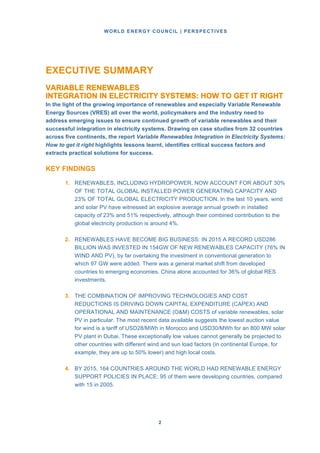
1. RENEWABLES, INCLUDING HYDROPOWER, NOW ACCOUNT FOR ABOUT 30%
OF THE TOTAL GLOBAL INSTALLED POWER GENERATING CAPACITY AND
23% OF TOTAL GLOBAL ELECTRICITY PRODUCTION. In the last 10 years, wind
and solar PV have witnessed an explosive average annual growth in installed
capacity of 23% and 51% respectively, although their combined contribution to the
global electricity production is around 4%.
2. RENEWABLES HAVE BECOME BIG BUSINESS: IN 2015 A RECORD USD286
BILLION WAS INVESTED IN 154GW OF NEW RENEWABLES CAPACITY (76% IN
WIND AND PV), by far overtaking the investment in conventional generation to
which 97 GW were added. There was a general market shift from developed
countries to emerging economies. China alone accounted for 36% of global RES
investments.
3. THE COMBINATION OF IMPROVING TECHNOLOGIES AND COST
REDUCTIONS IS DRIVING DOWN CAPITAL EXPENDITURE (CAPEX) AND
OPERATIONAL AND MAINTENANCE (O&M) COSTS of variable renewables, solar
PV in particular. The most recent data available suggests the lowest auction value
for wind is a tariff of USD28/MWh in Morocco and USD30/MWh for an 800 MW solar
PV plant in Dubai. These exceptionally low values cannot generally be projected to
other countries with different wind and sun load factors (in continental Europe, for
example, they are up to 50% lower) and high local costs.
4. BY 2015, 164 COUNTRIES AROUND THE WORLD HAD RENEWABLE ENERGY
SUPPORT POLICIES IN PLACE: 95 of them were developing countries, compared
with 15 in 2005.
VARIABLE RENEWABLES
INTEGRATION IN ELECTRICITY SYSTEMS: HOW TO GET IT RIGHT
3
5. THE EXAMPLE OF THE EUROPEAN UNION (EU) HIGHLIGHTS THE
CONSEQUENCES OF REDUCTIONS IN SUBSIDIES and other support schemes
for investment in renewables: as subsidies decreased, the EU’s share of global solar
PV installed capacity dropped over the past four years from 75% to 41%, the share
of wind from 41% to 33%.
6. A RIGHT LOCATION WITH HIGH WIND OR SOLAR LOAD FACTORS AND LOW
GRID CONNECTION COSTS is the key to success for new, large variable
renewables projects.
7. A REAL CHALLENGE FOR VARIABLE RENEWABLES INTEGRATION IS TO
RAPIDLY MANAGE THE IMPLICATIONS OF VARIABLE NATURE OF WIND AND
SUN.
RENEWABLES IN THE GLOBAL ENERGY SYSTEM
World global power capacity additions and energy production by source 2004-2014.
Source: CESI S.p.A., based on REN21 2015
Source Installed Capacity
2004 [GW] and
(%) share
Installed Capacity
2014 [GW] and
(%) share
Average
Annual
Growth
Rate (%)
2014 Production Average
[TWh] and (%) share Equivalent
Operating
Hours [h]
Hydro 715GW 18.8% 1,055 GW 17.1% 4% 3,898TWh 16.6% 3,694
Wind 48GW 1.3% 370GW 6.0% 23% 728TWh 3.1% 1,967
Biomass 39GW 1.0% 93GW 1.5% 9% 423TWh 1.8% 4,545
Solar 3GW 0.1% 181GW 2.9% 51% 211TWh 0.9% 1,168
Geothermal 9GW 0.2% 13GW 0.2% 4% 94TWh 0.4% 7,225
Total
Renewables
814GW 21.4% 1,712GW 27.7% 8% 5,353TWh 22.8% 3,127
Total Conventional
(Oil, Gas, Coal)
and Nuclear
2,986GW 78.6% 4,468GW 72.3% 4% 18,127TWh 77.2% 4,057
TOTAL 3,800GW 100% 6,180GW 100% 5% 23,480TWh 100% 3,799
WORLD ENERGY COUNCIL | PERSPECTIVES
44
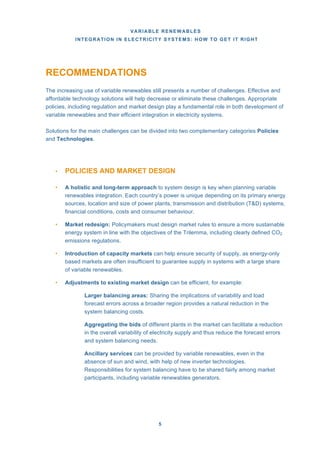
The graphs below illustrate the effects of wind variability in Ireland on the global wind fleet
power production and the variations of sun on a small PV installation in central Italy.
YEARLY AND DAILY VARIABILITY IN IRELAND OF GLOBAL WIND FLEET POWER
PRODUCTION
SEASONAL AND DAILY VARIATION OF THE POWER GENERATION FOR A SMALL PV
PLANT IN CENTRAL ITALY
Source: CESI S.p.A
P[MW]
P[MW]
YEARLY
1500
1000
500
DAILY
1875
1250
625
0
Jan Apr Jun Sept Dec
0
0:00 03:23 06:47 10:10 13:34 16:58 20:21 23:45
Actual Forecast
0 08:00 2 24:00 18:00 2
J
W[M]
YE
W[M]
RAYE LYYL
1500
1000
W]P[M]W
DAILY
1875
1250
PP
500
0
nJa rAp nJu
625
tpSe cDe
0
000: 2303: 06:4706: 1010: 3413: 5816: 2120: 4523:
Actual stcareoF
W
kWProduced
03:23 2
SEASONALITY
2500
1875
1250
625
0
DAILY
4
3
2
1
0
01:00 04:00 08:00 12:00 16:00 20:00 24:00 06:00 09:00 12:00 15:00 18:00 21:00
Source: CESI S.p.A
December July Cloudy Day Sunny Day
W
SEA
W
TYILANSOSEA
2500
1875
1250
kWdecudoPr
4
DAILYYL
3
2
625
0
0001: 0008:0004: 0012: 16:
Source: CESI Ap.S.
rebmceeD ulJ
1
0
0000 0020: 0024: 06: 0009:
Cloudyyul
0012: 0015: 0018: 0021:
Cloudy Day ynnSu Day
VARIABLE RENEWABLES
INTEGRATION IN ELECTRICITY SYSTEMS: HOW TO GET IT RIGHT
5
RECOMMENDATIONS
The increasing use of variable renewables still presents a number of challenges. Effective and
affordable technology solutions will help decrease or eliminate these challenges. Appropriate
policies, including regulation and market design play a fundamental role in both development of
variable renewables and their efficient integration in electricity systems.
Solutions for the main challenges can be divided into two complementary categories Policies
and Technologies.
• POLICIES AND MARKET DESIGN
• A holistic and long-term approach to system design is key when planning variable
renewables integration. Each country’s power is unique depending on its primary energy
sources, location and size of power plants, transmission and distribution (T&D) systems,
financial conditions, costs and consumer behaviour.
• Market redesign: Policymakers must design market rules to ensure a more sustainable
energy system in line with the objectives of the Trilemma, including clearly defined CO2
emissions regulations.
• Introduction of capacity markets can help ensure security of supply, as energy-only
based markets are often insufficient to guarantee supply in systems with a large share
of variable renewables.
• Adjustments to existing market design can be efficient, for example:
Larger balancing areas: Sharing the implications of variability and load
forecast errors across a broader region provides a natural reduction in the
system balancing costs.
Aggregating the bids of different plants in the market can facilitate a reduction
in the overall variability of electricity supply and thus reduce the forecast errors
and system balancing needs.
Ancillary services can be provided by variable renewables, even in the
absence of sun and wind, with help of new inverter technologies.
Responsibilities for system balancing have to be shared fairly among market
participants, including variable renewables generators.
WORLD ENERGY COUNCIL | PERSPECTIVES
66
Hourly and sub-hourly scheduling: Taking into account the technical
limitations of conventional plants for more efficient use of available transmission
and generation capacity.
Nodal pricing demonstrates the benefits of an appropriate selection of location
for renewables power plant and as a result, smoother integration of intermittent
renewable generation technologies.
• Looking at the costs: Policymakers and the industry are encouraged to conduct
thorough technical and economic analyses with comprehensive assessment which, in
addition to VRES CAPEX and O&M, include the associated costs for the complete
power system.
TECHNOLOGIES
• Improving weather forecasts: Weather forecasting methodologies need further
development to achieve better accuracy.
• Advanced operating procedures to optimise reserve capacity and flexibility of
conventional generation should be introduced to manage intermittency and variability.
• Demand response, i.e. the short-term adjustment of demand to address temporary
shortage or excess power from variable renewables, must be developed further.
• Energy storage technologies can be a game-changer and contribute to addressing
the intermittency challenge. See the Council’s 2016 report on E-storage
www.worldenergy.org/publications/2016/e-storage-shifting-from-cost-to-value-
2016
• An expansion of the transmission and distribution grids, including cross-border
interconnections, may be necessary together with an optimum operational cooperation
between TSO’s and DSO’s.
VARIABLE RENEWABLES
INTEGRATION IN ELECTRICITY SYSTEMS: HOW TO GET IT RIGHT
7
INTRODUCTION
Over two decades ago, the world’s electric power sector began its transformation from a highly
centralised and integrated industry that was mostly state-controlled towards a more efficient and
lean business model, including private ownership. This transformation has been driven by new
developments in regulation, profound structural changes in the market, shifts in the technology
mix and growing concerns about the environmental impacts of energy production and use.
Mounting concerns about global warming and the role of the energy sector require the industry
to adjust to the realities of operating in a new carbon-constrained world. The most significant
catalysts for the transformation of the electricity industry include:
• Ongoing market restructuring processes and evolving regulation around the world;
• Increased volatility of oil prices where an era of high oil prices over a longer period
of time was followed by a drastic collapse in 2014 which influenced all fossil fuel
prices;
• The shale gas revolution in the US which reduced coal demand for electricity
production and increased the use of gas leading to growing exports of US coal at
low prices;
• The Fukushima nuclear accident in Japan, which has practically stalled future
development of nuclear power in many countries;
• Increased tensions in the countries that are large exporters of oil and gas, including
the Middle East, Latin America and Russia.
However, first and foremost, it is increased concerns about global warming, the associated
environmental regulations and the growing awareness of environmental issues which drive the
development of power systems’ strategies and projects.
In many countries, this has resulted in new legislation providing support for the development of
Renewable Energy Sources (RES), especially wind and solar photovoltaic (PV) which have both
experienced a tremendous growth, particularly in the European Union (EU). This growth was
also underpinned by a significant reduction in the Capital Expenditure (CAPEX) for wind and
solar plant components and projects.
What about the weather? The weather factor plays a leading role in the availability of electricity
produced from renewables. Solar PV and wind have a high degree of variability because of the
constantly changing wind conditions and sun irradiation rates. This variability leads to seasonal,
WORLD ENERGY COUNCIL | PERSPECTIVES
88
weekly and daily fluctuations of power and can result in forecast errors in the supply of power to
the system.
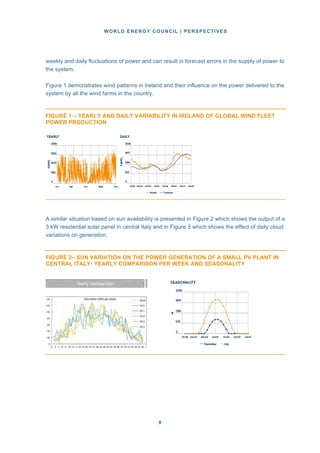
Figure 1 demonstrates wind patterns in Ireland and their influence on the power delivered to the
system by all the wind farms in the country.
FIGURE 1 – YEARLY AND DAILY VARIABILITY IN IRELAND OF GLOBAL WIND FLEET
POWER PRODUCTION.
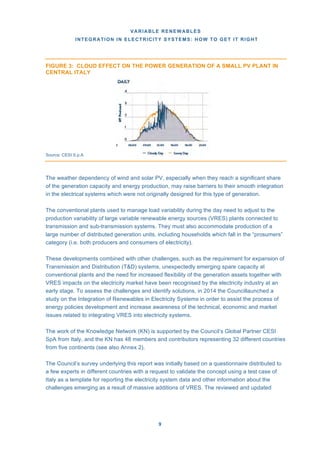
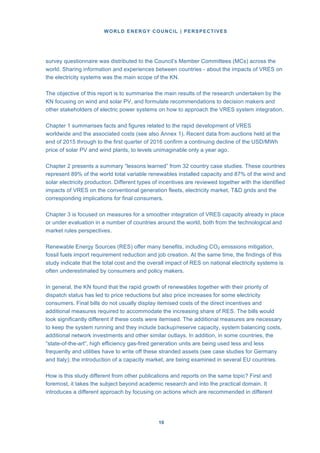
A similar situation based on sun availability is presented in Figure 2 which shows the output of a
3 kW residential solar panel in central Italy and in Figure 3 which shows the effect of daily cloud
variations on generation.
FIGURE 2– SUN VARIATION ON THE POWER GENERATION OF A SMALL PV PLANT IN
CENTRAL ITALY: YEARLY COMPARISON PER WEEK AND SEASONALITY
VARIABLE RENEWABLES
INTEGRATION IN ELECTRICITY SYSTEMS: HOW TO GET IT RIGHT
9
FIGURE 3: CLOUD EFFECT ON THE POWER GENERATION OF A SMALL PV PLANT IN
CENTRAL ITALY
Source: CESI S.p.A
The weather dependency of wind and solar PV, especially when they reach a significant share
of the generation capacity and energy production, may raise barriers to their smooth integration
in the electrical systems which were not originally designed for this type of generation.
The conventional plants used to manage load variability during the day need to adjust to the
production variability of large variable renewable energy sources (VRES) plants connected to
transmission and sub-transmission systems. They must also accommodate production of a
large number of distributed generation units, including households which fall in the “prosumers”
category (i.e. both producers and consumers of electricity).
These developments combined with other challenges, such as the requirement for expansion of
Transmission and Distribution (T&D) systems, unexpectedly emerging spare capacity at
conventional plants and the need for increased flexibility of the generation assets together with
VRES impacts on the electricity market have been recognised by the electricity industry at an
early stage. To assess the challenges and identify solutions, in 2014 the Councillaunched a
study on the Integration of Renewables in Electricity Systems in order to assist the process of
energy policies development and increase awareness of the technical, economic and market
issues related to integrating VRES into electricity systems.
The work of the Knowledge Network (KN) is supported by the Council’s Global Partner CESI
SpA from Italy, and the KN has 48 members and contributors representing 32 different countries
from five continents (see also Annex 2).
The Council’s survey underlying this report was initially based on a questionnaire distributed to
a few experts in different countries with a request to validate the concept using a test case of
Italy as a template for reporting the electricity system data and other information about the
challenges emerging as a result of massive additions of VRES. The reviewed and updated
WORLD ENERGY COUNCIL | PERSPECTIVES
1010
survey questionnaire was distributed to the Council’s Member Committees (MCs) across the
world. Sharing information and experiences between countries - about the impacts of VRES on
the electricity systems was the main scope of the KN.
The objective of this report is to summarise the main results of the research undertaken by the
KN focusing on wind and solar PV, and formulate recommendations to decision makers and
other stakeholders of electric power systems on how to approach the VRES system integration.
Chapter 1 summarises facts and figures related to the rapid development of VRES
worldwide and the associated costs (see also Annex 1). Recent data from auctions held at the
end of 2015 through to the first quarter of 2016 confirm a continuing decline of the USD/MWh
price of solar PV and wind plants, to levels unimaginable only a year ago.
Chapter 2 presents a summary “lessons learned” from 32 country case studies. These countries
represent 89% of the world total variable renewables installed capacity and 87% of the wind and
solar electricity production. Different types of incentives are reviewed together with the identified
impacts of VRES on the conventional generation fleets, electricity market, T&D grids and the
corresponding implications for final consumers.
Chapter 3 is focused on measures for a smoother integration of VRES capacity already in place
or under evaluation in a number of countries around the world, both from the technological and
market rules perspectives.
Renewable Energy Sources (RES) offer many benefits, including CO2 emissions mitigation,
fossil fuels import requirement reduction and job creation. At the same time, the findings of this
study indicate that the total cost and the overall impact of RES on national electricity systems is
often underestimated by consumers and policy makers.
In general, the KN found that the rapid growth of renewables together with their priority of
dispatch status has led to price reductions but also price increases for some electricity
consumers. Final bills do not usually display itemised costs of the direct incentives and
additional measures required to accommodate the increasing share of RES. The bills would
look significantly different if these costs were itemised. The additional measures are necessary
to keep the system running and they include backup/reserve capacity, system balancing costs,
additional network investments and other similar outlays. In addition, in some countries, the
“state-of-the-art”, high efficiency gas-fired generation units are being used less and less
frequently and utilities have to write off these stranded assets (see case studies for Germany
and Italy); the introduction of a capacity market, are being examined in several EU countries.
How is this study different from other publications and reports on the same topic? First and
foremost, it takes the subject beyond academic research and into the practical domain. It
introduces a different approach by focusing on actions which are recommended in different
VARIABLE RENEWABLES
INTEGRATION IN ELECTRICITY SYSTEMS: HOW TO GET IT RIGHT
11
conditions and can be used as a “guide book” listing recommendations to take into
consideration when evaluating future VRES projects, and the sources for additional information.
Every country’s power system has its specific features, such as type/size, siting of conventional
and RES plants, T&D system, consumer behaviour and other factors that make it difficult to
draw general conclusions.
Examples of the impacts on the electricity systems in different countries and the associated
lessons will be useful for new market entrants to avoid poorly planned VRES integration
projects, which could become a liability instead of an asset.
Technical details and cost information in this report are unique because they come directly from
the utilities and other relevant sources within each country. Conclusions of the study will help
decision makers to develop a better understanding of the complexity of the electricity system
setup and operation and suggest factors to be considered when formulating policies and
strategies for VRES development.
VARIABLE RENEWABLES
INTEGRATION IN ELECTRICITY SYSTEMS: HOW TO GET IT RIGHT
Chapter 1
Current Status
of VRES
VARIABLE RENEWABLES
INTEGRATION IN ELECTRICITY SYSTEMS: HOW TO GET IT RIGHT
13
By 2015, 164 out of 196 countries in the world had set renewable energy targets, and 138
countries had renewable energy support policies in place. The recent wave of energy
policies in support of RES has been led by 95 developing and emerging economies, an
increase from only 15 countries in 2005.
The global installed RES capacity has more than doubled over the past ten years, from
814GW in 2004 to 1,712GW by the end of 2014. As Graphic 1 shows, this growth was
mainly driven by wind and solar power which increased from 48 GW and 3 GW in 2004 to
370 GW of wind and 181 GW of solar power in 2014, with an average annual growth rate of
23% and 51.0%, respectively.
GRAPHIC 1 - WORLD GLOBAL POWER CAPACITY ADDITIONS AND ENERGY
PRODUCTION BY SOURCE 2004-2014
2004
INSTALLED
CAPACITY 2014
INSTALLED
CAPACITY
2004
INSTALLED
CAPACITY 2014
INSTALLED
CAPACITY
AVERAGE
ANNUAL
GW
GROWTH
RATE
2014
PRODUCTION
[TWh]
AND SHARE
OF TOTAL (%)
Conventional: 2,986 GW (78.6%)
(coal, gas, oil)
and nuclear
Renewables: 814 GW (21.4%)
Conventional: 4,468 GW (72.3%)
(coal, gas, oil)
and nuclear
Renewables: 1,712 GW (27.7%)
WIND: 48.0 GW
Share of total: 1.3%
SOLAR PV: 3.0 GW
Share of total: 0.1%
WIND: 370 GW
Share of total: 6.0%
SOLAR PV: 181 GW
Share of total: 2.9%
2004 – 2014
Total conventional: 4%
Total renewables: 8%
Wind: 23%
Solar PV: 51%
Conventional: 18,127 TWh (77.2%)
Renewables: 5,353 TWh (22.8%)*
Wind: 728 TWh (3.1%)
Solar PV: 211 TWh (0.8%)
TOTAL: 3,800 GW
TOTAL: 6,180 GW
Total wind & solar PV: 51.0GW
share of total: 1.4%
Total wind & solar PV: 551.0 GW
share of total: 8.9%
Total average annual growth: 5%
Total 23,480 TWh
*wind and solar pv are also included
Graphic Source: CESI S.p.A., based on REN21, 2015
WORLD ENERGY COUNCIL | PERSPECTIVES
1414
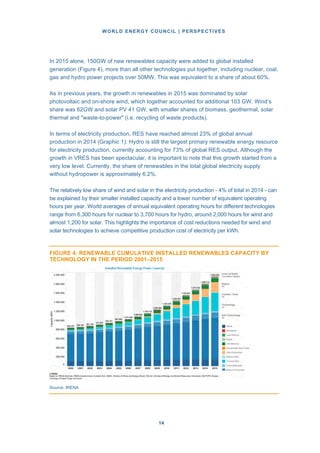
In 2015 alone, 150GW of new renewables capacity were added to global installed
generation (Figure 4), more than all other technologies put together, including nuclear, coal,
gas and hydro power projects over 50MW. This was equivalent to a share of about 60%.
As in previous years, the growth in renewables in 2015 was dominated by solar
photovoltaic and on-shore wind, which together accounted for additional 103 GW. Wind’s
share was 62GW and solar PV 41 GW, with smaller shares of biomass, geothermal, solar
thermal and "waste-to-power" (i.e. recycling of waste products).
In terms of electricity production, RES have reached almost 23% of global annual
production in 2014 (Graphic 1). Hydro is still the largest primary renewable energy resource
for electricity production, currently accounting for 73% of global RES output. Although the
growth in VRES has been spectacular, it is important to note that this growth started from a
very low level. Currently, the share of renewables in the total global electricity supply
without hydropower is approximately 6.2%.
The relatively low share of wind and solar in the electricity production - 4% of total in 2014 - can
be explained by their smaller installed capacity and a lower number of equivalent operating
hours per year. World averages of annual equivalent operating hours for different technologies
range from 6,300 hours for nuclear to 3,700 hours for hydro, around 2,000 hours for wind and
almost 1,200 for solar. This highlights the importance of cost reductions needed for wind and
solar technologies to achieve competitive production cost of electricity per kWh.
FIGURE 4: RENEWABLE CUMULATIVE INSTALLED RENEWABLES CAPACITY BY
TECHNOLOGY IN THE PERIOD 2001–2015
Source: IRENA
VARIABLE RENEWABLES
INTEGRATION IN ELECTRICITY SYSTEMS: HOW TO GET IT RIGHT
15
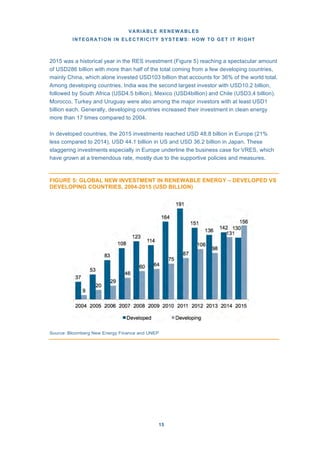
2015 was a historical year in the RES investment (Figure 5) reaching a spectacular amount
of USD286 billion with more than half of the total coming from a few developing countries,
mainly China, which alone invested USD103 billion that accounts for 36% of the world total.
Among developing countries, India was the second largest investor with USD10.2 billion,
followed by South Africa (USD4.5 billion), Mexico (USD4billion) and Chile (USD3.4 billion).
Morocco, Turkey and Uruguay were also among the major investors with at least USD1
billion each. Generally, developing countries increased their investment in clean energy
more than 17 times compared to 2004.
In developed countries, the 2015 investments reached USD 48.8 billion in Europe (21%
less compared to 2014), USD 44.1 billion in US and USD 36.2 billion in Japan. These
staggering investments especially in Europe underline the business case for VRES, which
have grown at a tremendous rate, mostly due to the supportive policies and measures.
FIGURE 5: GLOBAL NEW INVESTMENT IN RENEWABLE ENERGY – DEVELOPED VS
DEVELOPING COUNTRIES, 2004-2015 (USD BILLION)
Source: Bloomberg New Energy Finance and UNEP
WORLD ENERGY COUNCIL | PERSPECTIVES
1616
The downward trend observed over the past 3 years in part was a result of the revisions of
RES incentives programmes in a number of EU countries. This decrease was not fully
matched by increasing investment in developing countries. Another important factor
affecting the decreasing trend was the drop in the investment costs per kW, especially for
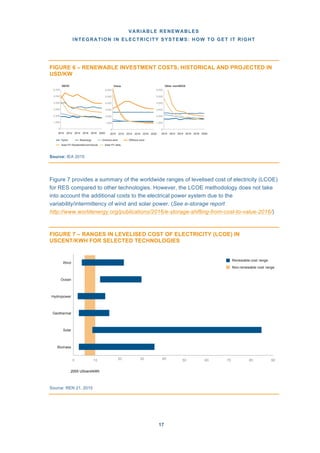
solar PV (Figure 6).
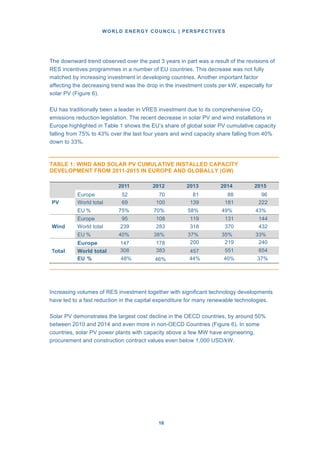
EU has traditionally been a leader in VRES investment due to its comprehensive CO2
emissions reduction legislation. The recent decrease in solar PV and wind installations in
Europe highlighted in Table 1 shows the EU’s share of global solar PV cumulative capacity
falling from 75% to 43% over the last four years and wind capacity share falling from 40%
down to 33%.
TABLE 1: WIND AND SOLAR PV CUMULATIVE INSTALLED CAPACITY
DEVELOPMENT FROM 2011-2015 IN EUROPE AND GLOBALLY (GW)
2011 2012 2013 2014 2015
Europe 52 70 81 88 96
PV World total 69 100 139 181 222
EU % 75% 70% 58% 49% 43%
Europe 95 108 119 131 144
Wind World total 239 283 318 370 432
EU % 40% 38% 37% 35% 33%
Europe 147 178 200 219 240
Total World total 308 383 457 551 654
EU % 48% 46% 44% 40% 37%
Increasing volumes of RES investment together with significant technology developments
have led to a fast reduction in the capital expenditure for many renewable technologies.
Solar PV demonstrates the largest cost decline in the OECD countries, by around 50%
between 2010 and 2014 and even more in non-OECD Countries (Figure 6). In some
countries, solar PV power plants with capacity above a few MW have engineering,
procurement and construction contract values even below 1,000 USD/kW.
VARIABLE RENEWABLES
INTEGRATION IN ELECTRICITY SYSTEMS: HOW TO GET IT RIGHT
17
FIGURE 6 – RENEWABLE INVESTMENT COSTS, HISTORICAL AND PROJECTED IN
USD/KW
Source: IEA 2015
Figure 7 provides a summary of the worldwide ranges of levelised cost of electricity (LCOE)
for RES compared to other technologies. However, the LCOE methodology does not take
into account the additional costs to the electrical power system due to the
variability/intermittency of wind and solar power. (See e-storage report
http://www.worldenergy.org/publications/2016/e-storage-shifting-from-cost-to-value-2016/)
FIGURE 7 – RANGES IN LEVELISED COST OF ELECTRICITY (LCOE) IN
USCENT/KWH FOR SELECTED TECHNOLOGIES
Source: REN 21, 2015
6,000
OECD
6,000
China
6,000
Other non-OECD
5,000 5,000 5,000
4,000 4,000 4,000
3,000 3,000 3,000
2,000 2,000 2,000
1,000
0
1,000
0
1,000
0
2010 2012 2014 2016 2018 2020 2010 2012 2014 2016 2018 2020 2010 2012 2014 2016 2018 2020
Hydro Bioenergy Onshore wind Offshore wind
Solar PV Residential/commercial Solar PV utility
Wind
Ocean
Hydropower
Geothermal
Solar
Biomass
Renewable cost range
Non-renewable cost range
0 10
2005 UScent/kWh
20 30 40
2
0
0
5
50 60 70 80 90
WORLD ENERGY COUNCIL | PERSPECTIVES
1818
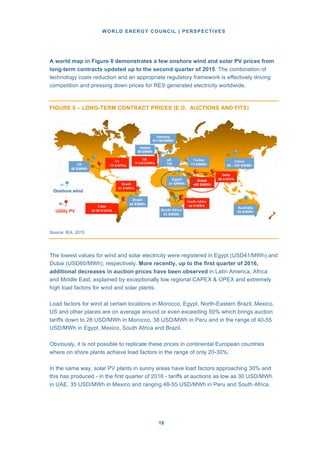
A world map in Figure 8 demonstrates a few onshore wind and solar PV prices from
long-term contracts updated up to the second quarter of 2015. The combination of
technology costs reduction and an appropriate regulatory framework is effectively driving
competition and pressing down prices for RES generated electricity worldwide.
FIGURE 8 – LONG-TERM CONTRACT PRICES (E.G. AUCTIONS AND FITS)
Source: IEA, 2015
The lowest values for wind and solar electricity were registered in Egypt (USD41/MWh) and
Dubai (USD60/MWh), respectively. More recently, up to the first quarter of 2016,
additional decreases in auction prices have been observed in Latin America, Africa
and Middle East, explained by exceptionally low regional CAPEX & OPEX and extremely
high load factors for wind and solar plants.
Load factors for wind at certain locations in Morocco, Egypt, North-Eastern Brazil, Mexico,
US and other places are on average around or even exceeding 50% which brings auction
tariffs down to 28 USD/MWh in Morocco, 38 USD/MWh in Peru and in the range of 40-55
USD/MWh in Egypt, Mexico, South Africa and Brazil.
Obviously, it is not possible to replicate these prices in continental European countries
where on shore plants achieve load factors in the range of only 20-30%.
In the same way, solar PV plants in sunny areas have load factors approaching 30% and
this has produced - in the first quarter of 2016 - tariffs at auctions as low as 30 USD/MWh
in UAE, 35 USD/MWh in Mexico and ranging 48-55 USD/MWh in Peru and South Africa.
VARIABLE RENEWABLES
INTEGRATION IN ELECTRICITY SYSTEMS: HOW TO GET IT RIGHT
19
This leads to a first general conclusion: to secure a short payback time and favourable
economics, new VRES projects should be located in places with high wind and/or
solar PV load factors and low grid connection costs. Annex 1 contains examples of
detailed economic information for solar PV and wind plants in a number of countries around
the world collected by KN.
VARIABLE RENEWABLES
INTEGRATION IN ELECTRICITY SYSTEMS: HOW TO GET IT RIGHT
Chapter 2
Lessons learned
from the Country
Case Studies
VARIABLE RENEWABLES
INTEGRATION IN ELECTRICITY SYSTEMS: HOW TO GET IT RIGHT
21
The summaries of the country case studies are included in Annex 2, and the complete
country case studies can be downloaded from World Energy Council’s website
http://www.worldenergy.org/publications/
These individual country reports outline specific implications of VRES developments for
their electricity systems. The country reports add their own flavour to the descriptions and
practical examples of technological and market developments related to VRES.
The main actions are recommended to help guide the developments based on reviews in
the country reports.
The case studies include the following countries:
1. Algeria 17. Korea
2. Brazil 18. Mexico
3. China 19. New Zealand
4. Colombia 20. Nigeria
5. Denmark 21. Philippines
6. Ecuador 22. Poland
7. Egypt 23.Portugal
8. France 24. Romania
9. Germany 25. Russia
10. India 26. South Africa
11. Indonesia 27. Spain
12. Ireland 28. Thailand
13. Italy 29. Tunisia
14. Japan 30. United Kingdom
15. Jordan 31. USA
16. Kazakhstan 32. Uruguay
WORLD ENERGY COUNCIL | PERSPECTIVES
2222
2.1 Power mix of the 32 country case studies
The Council’s Survey shows data for the 32 countries which accounted
worldwide for:
• 89% of total installed VRES generating capacity
• 87% of VRES electricity production
The data on the installed capacity for 2015 (Table 3) and electricity generation (Table 4)
using different energy sources were collected in each country to highlight VRES
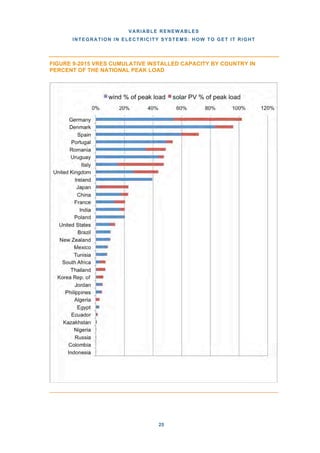
penetration including the incidence of VRES percentage on Country peak load (Figure 9).
The top four countries in the study with the highest absolute values of installed wind
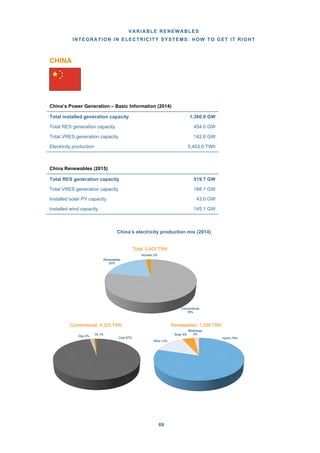
capacity at the end of 2015 were China (145 GW), US (73 GW), Germany (45 GW) and
India (25 GW).
For wind energy production in terms of the percentage of total national production,
Denmark is leading with 50%followed by Ireland 23%.
The top four countries in the study with the highest absolute values of solar PV installed
capacity at the end of 2015 were China (43 GW), Germany (40 GW), Japan (33 GW) and
the United States (26 GW).
For PV energy production in percentage terms of total national production, Italy is leading
with 9% followed by Germany 6%.
The top four countries in the combined absolute values of VRES - wind plus solar PV -
installed capacity were China (188 GW), US (98 GW), Germany (85 GW) and Japan (36
GW).
In terms of the percentage of total VRES national production, Denmark leads with 52%
followed by Portugal (24%).If one considers Denmark in 2015 has had a net import of
electricity larger than 20% of national production, the VRES reached about 42% of the total
electricity consumption.
The highest equivalent operating hours at peak power (total electricity production per year
divided by installed capacity) for wind plants were found in Denmark and UK with around
2,800 hours (load factor 32%), while for solar PV plants Spain has around 2,500 (load
factor 28%) equivalent operating hours.
With reference to the potential impact of VRES on the overall national electricity system
Germany and Denmark (Figure 9) have a VRES installed capacity practically equivalent to
100 % of the maximum peak demand, followed by Spain at 70% and by Portugal, Romania,
Uruguay and Italy close to about 50%. The situation can be even worse considering
periods of low demand.
VARIABLE RENEWABLES
INTEGRATION IN ELECTRICITY SYSTEMS: HOW TO GET IT RIGHT
23
TABLE 2 – 2015 INSTALLED CAPACITY BY COUNTRY AND BY RES AND VRES (GW)
Continent Country
Peak
Demand
[GW]
RES
installed
capacity
[GW]
VRES
installed
capacity
[GW]
Wind
installed
capacity
[GW]
Solar PV
installed
capacity
[GW]
AFRICA
Algeria 10.9 0.5 0.3 0.0 0.3
Egypt 26.1 3.5 0.6 0.6 0.0
Nigeria 4.5 2.1 0.0 0.0 0.0
South Africa 35.5 5.1 2.5 1.1 1.4
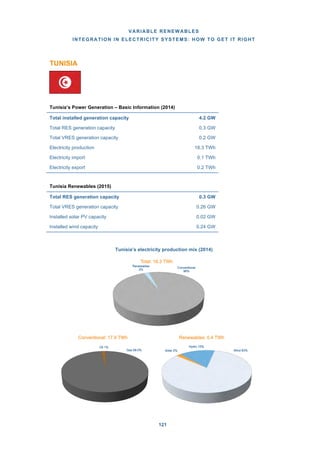
Tunisia 3.3 0.3 0.2 0.2 0.0
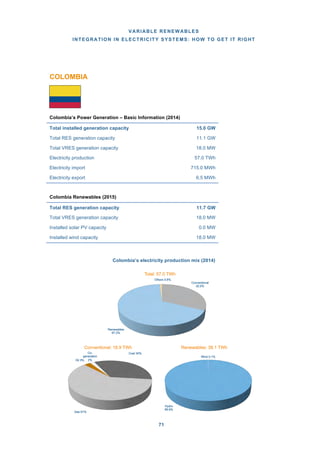
Colombia 9.6 11.7 0.0 0.0 0.0
AMERICA
Mexico 39.0 17.6 3.3 3.1 0.2
United States 723.0 219.3 98.1 72.6 25.5
Brazil 85.0 114.2 8.7 8.7 0.0
Ecuador 3.5 2.6 0.0 0.0 0.0
Uruguay 1.9 2.7 0.9 0.8 0.1
ASIA
China 830.0 519.7 188.2 145.1 43.1
India 148.2 82.1 30.1 25.1 5.0
Indonesia 53.8 8.3 0.0 0.0 0.0
Japan 159.1 90.1 36.3 3.0 33.3
Jordan 3.0 0.2 0.1 0.1 0.0
Kazakhstan 15.0 2.8 0.2 0.1 0.1
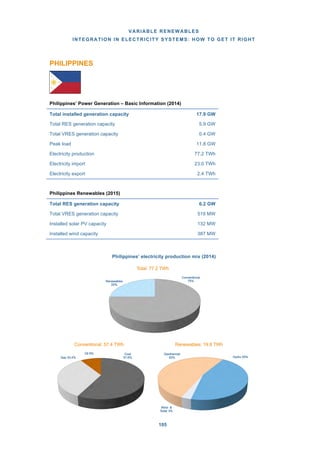
Philippines 11.8 6.2 0.5 0.4 0.1
Korea Rep. of 76.5 12.7 4.1 0.9 3.2
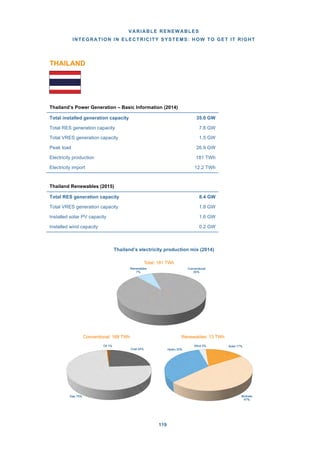
Thailand 26.9 8.4 1.8 0.2 1.6
EUROPE
Denmark 6.1 7.3 5.9 5.1 0.8
France 82.5 44.3 16.9 10.4 6.5
Germany 83.0 105.0 84.6 45.0 39.6
Ireland 6.3 3.1 2.5 2.5 0.0
Italy 59.0 54.8 28.0 9.1 18.9
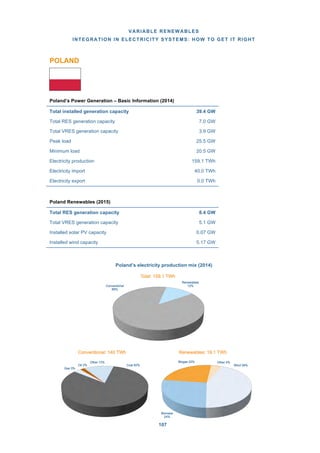
Poland 25.5 8.4 5.2 5.1 0.1
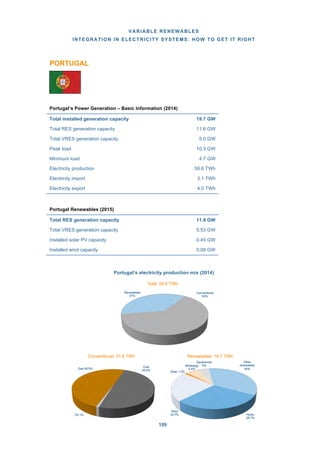
Portugal 10.3 11.9 5.6 5.1 0.5
Romania 9.3 11.3 4.5 3.2 1.3
Spain 38.7 51.5 27.8 23.0 4.8
United Kingdom 52.5 33.1 23.0 13.9 9.1
Russia 155.0 52.0 0.5 0.1 0.4
OCEANIA New Zealand 6.4 7.0 0.7 0.6 0.0
TOTAL 32 Countries 1,499.7 581.4 385.1 195.9
2015 TOTAL WORLD 1,985.1 654.3 431.9 222.4
% 32 Countries of TOTAL 76% 89% 89% 88%
Source: Country Cases and public sources
WORLD ENERGY COUNCIL | PERSPECTIVES
2424
TABLE 3 – 2015 ELECTRICITY NATIONAL PRODUCTION BY COUNTRY AND BY RES
AND VRES (TWH)
Continent Country
Total Gen
[TWh]
RES
gen
[TWh]
VRES
gen
[TWh]
Wind
generation
[TWh]
Solar
PV
gen
[TWh]
Ratio
VRES/Total
gen [%]
AFRICA
Algeria 68.5 0.2 0.1 0.0 0.1 0.1%
Egypt 180.6 14.6 1.6 1.5 0.1 0.9%
Nigeria
1
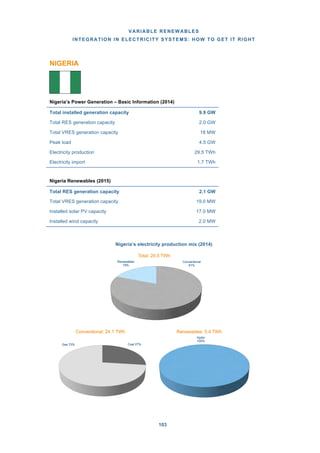
29.5 5.4 0.0 0.0 0.0 0.0%
South Africa 249.7 5.3 4.0 2.1 1.9 1.6%
Tunisia
1
18.3 0.4 0.4 0.4 0.0 2.3%
Colombia 77.0 46.3 0.1 0.1 0.0 0.1%
AMERICA
Mexico 306.7 45.6 8.2 7.9 0.3 2.7%
USA 4.303.0 570.8 231.9 192.9 39.0 5.4%
Brazil 579.8 432.8 21.7 21.7 0.0 3.7%
Ecuador 25.9 13.6 0.1 0.1 0.0 0.5%
Uruguay 12.1 11.2 1.9 1.8 0.0 15.4%
ASIA
China 5.810.6 1.403.6 224.3 185.1 39.2 3.9%
India 1.304.8 192.9 48.0 41.4 6.6 3.7%
Indonesia 234.7 26.5 0.0 0.0 0.0 0.0%
Japan 1.035.5 160.6 36.3 5.4 30.9 3.5%
Jordan
1
18.0 1.0 0.1 0.1 0.0 0.6%
Kazakhstan 91.1 8.0 0.1 0.1 0.0 0.1%
Philippines 82.6 21.7 0.7 0.6 0.1 0.8%
South Korea 522.3 16.0 5.4 1.6 3.8 1.0%
Thailand 177.8 13.7 2.8 0.4 2.4 1.6%
EUROPE
Denmark
2
28.7 18.9 14.9 14.3 0.6 51.8%
France 568.8 88.6 27.5 20.2 7.3 4.8%
Germany 647.1 195.9 126.4 88.0 38.4 19.5%
Ireland 28.7 7.8 6.6 6.6 0.0 22.9%
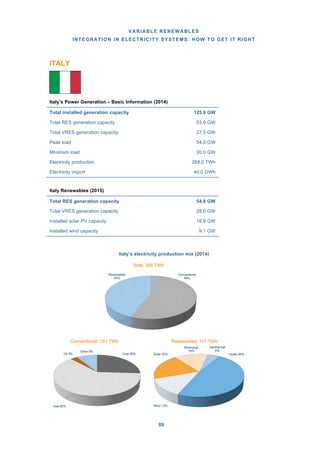
Italy 281.8 108.8 39.9 14.7 25.2 14.2%
Poland 164.7 22.2 10.9 10.8 0.1 6.6%
Portugal 51.9 24.2 12.4 11.6 0.8 23.9%
Romania 65.6 25.9 9.0 7.0 2.0 13.8%
Spain 278.5 95.8 63.2 49.3 13.9 22,7%
United Kingdom 337.7 83.3 48.0 40.4 7.6 14.2%
Russia 1,063.4 170.5 0.1 0.0 0.1 0.0%
OCEANIA New Zealand 44.3 35.3 2.2 2.2 0.0 5.1%
TOTAL 32 Countries 18.690 3.868 949 728 221 5.1%
2015 TOTAL WORLD 24.098 5.559 1.094 841 253 4.5%
% 32 Countries of TOTAL 78% 70% 87 % 87% 87%
1
2014 values
2
Net import represents more than 20% of its production TWh, the VRES reached 42% of the total
consumption in 2015.
1
2014 values
2
Net import represents more than 20% of its production TWh, the VRES reached 42% of
the total consumption in 2015.
Source: Country Cases and public sources
VARIABLE RENEWABLES
INTEGRATION IN ELECTRICITY SYSTEMS: HOW TO GET IT RIGHT
25
FIGURE 9-2015 VRES CUMULATIVE INSTALLED CAPACITY BY COUNTRY IN
PERCENT OF THE NATIONAL PEAK LOAD
WORLD ENERGY COUNCIL | PERSPECTIVES
2626
2.2 RES regulations, policies and economics
VRES regulation and policies present differences in the 32 Countries, but VRES enjoy
priority of dispatch in most of them.
The use of various support and incentive schemes has a strong impact on the VRES
development and success.
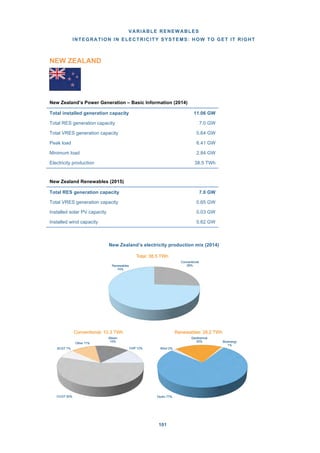
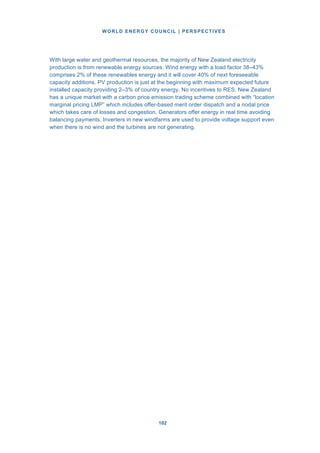
New Zealand is an exception, as it has a unique market arrangement based on a carbon
price which avoid incentives to RES, combined with a nodal price that takes into account
eventual additional costs on the T&D (e.g. losses and congestion) due to plants
localization.
Financial incentives have been widely used for promotion of VRES. The most popular form
is Feed in Tariffs (FIT) that are in used in many countries and are fixed for specified time
periods (e.g. 20 years in Germany and Italy). The costs incurred by this system are typically
passed on to the end-consumer. Some energy intensive businesses and production
processes are exempt from this levy.
Green Certificates have been or are presently used in a number of countries. The quantity
of green certificates is usually different for each type of RES technology, where electricity
suppliers must each year purchase a number of green certificates proportional to the
amount of electricity produced.
Tender auctions are becoming more widespread. Other incentives used include Feed-in-
Premiums, tax credits and a levy on fossil fuels (e.g. oil in Algeria and coal in India). India’s
coal tax charge is 1.10 USD/tonne of coal, equivalent to a tax of approximately 1 USD per
tonne of emitted CO2.
Below some key examples from Country Cases have been reported to provide a flavour on
different approaches.
Italy – Reduction and withdrawal of incentives
Incentives for VRES in Italy used to consider Green Certificates, FIT, FI premium tariff. PV
incentives introduced in 2005 amounted to 450 €/MWh and were among the highest in the
world and this resulted in an impressive growth in new installations over a few years. As
soon as the incentives were drastically reduced or withdrawn, the annual growth of VRES
slowed down from 10 GW in 2011 to around 0.5 GW of new capacity additions in 2015.Now
there are only auctions for very reduced global yearly capacity of large plants and tax
deductions for small plants.
VARIABLE RENEWABLES
INTEGRATION IN ELECTRICITY SYSTEMS: HOW TO GET IT RIGHT
27
Germany – Reduction in Feed-in-Tariffs-Introduction of auctions
The FIT has been the basic incentive. The reduction of PV-feed-in tariffs has been a
continuous instrument used by the German government and has resulted in reduced
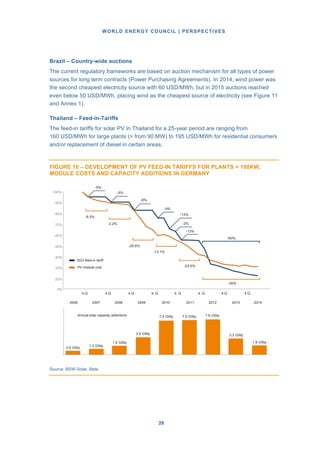
capacity additions in recent years (Figure 10). Moreover, a cap on the installed PV capacity
of 52 GW has been introduced. Once this cap is reached, new PV units will no longer be
supported by the EEG-feed-in tariff. In 2014 auctions for PV have been introduced for
plants above 6MW each (see recent results in Annexe 1); auctions also for wind plants will
be introduced in 2017.
Romania Green Certificates
Green certificates have been the basic type of incentive for the development of VRES-
Decrease of incentives has caused significant reduction in VRES additions.
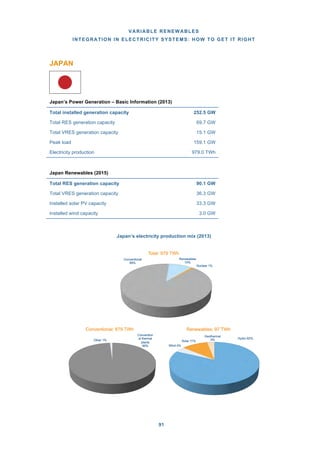
Japan – Feed-in-Tariffs
Feed in tariff for wind and solar falls in the range between 300–350 USD/MWh and now up
to 450 to push VRES development considering nuclear concern and strong reduction in its
production.
Korea-Green certificates and special incentives for Energy Storage Systems
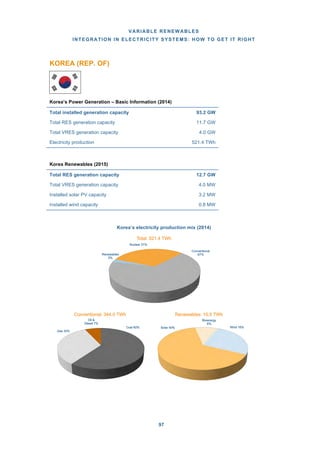
It is mandatory for power generators to produce each year 2% of their total production from
RES or buy from other generators Green Certificates-Additional certificates will be added to
utilities which install wind power plants combined with Energy Storage Systems; this to
support stable renewable supply systems, minimizing additional costs created by VRES.
Egypt-Bilateral agreements and tenders-Tax exemptions
Introduction of long term PPA’s and competitive auctions which have produced tariffs for
large wind plants in the range 38-45 USD/MWh (see Annexe 1). RES equipment and spare
parts are exempted from custom duties and sales taxes.
South Africa-Auctions for large PV and wind plants
The auction procedure started in 2010 and the 4th
series has been issued in 2015 (see
Annexe 1); continuous reduction of the tariffs of around 25% from one auction to the next
one.
USA-Differences for different utilities and regions
Policies for development of RES are Federal (Tax Credit and Production Tax Credit), State
(e.g. Net metering) and Local (rebate and financing options, green power rates)
WORLD ENERGY COUNCIL | PERSPECTIVES
2828
Brazil – Country-wide auctions
The current regulatory frameworks are based on auction mechanism for all types of power
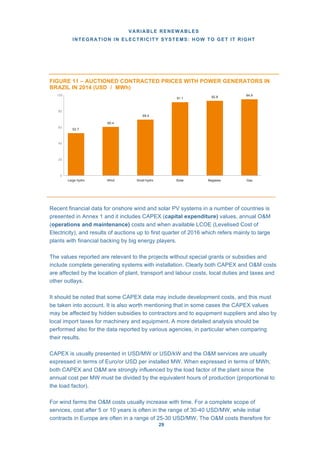
sources for long term contracts (Power Purchasing Agreements). In 2014, wind power was
the second cheapest electricity source with 60 USD/MWh, but in 2015 auctions reached
even below 50 USD/MWh, placing wind as the cheapest source of electricity (see Figure 11
and Annex 1).
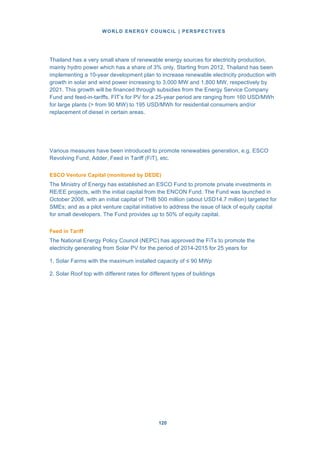
Thailand – Feed-in-Tariffs
The feed-in tariffs for solar PV in Thailand for a 25-year period are ranging from
160 USD/MWh for large plants (> from 90 MW) to 195 USD/MWh for residential consumers
and/or replacement of diesel in certain areas.
FIGURE 10 – DEVELOPMENT OF PV FEED-IN TARIFFS FOR PLANTS < 100KW,
MODULE COSTS AND CAPACITY ADDITIONS IN GERMANY
Source: BSW-Solar, Beta
100%
-5%
-5%
90%
80%
70%
60%
50%
40%
-9.3%
-3.2%
-25.6%
-8%
-9%
-13.1%
-13%
-3%
-13%
-60%
30%
EEG feed-in tariff
PV module cost -23.5%
20%
0%
4.Q 4.Q 4.Q 4. Q 4. Q 4. Q 4.Q
-30%
4.Q
2006 2007 2008 2009 2010 2011 2012 2013 2014
Annual solar capacity addictions 7.4 GWp 7.5 GWp 7.6 GWp
0.9 GWp
1.3 GWp
1.9 GWp
3.8 GWp 3.3 GWp
1.9 GWp
VARIABLE RENEWABLES
INTEGRATION IN ELECTRICITY SYSTEMS: HOW TO GET IT RIGHT
29
FIGURE 11 – AUCTIONED CONTRACTED PRICES WITH POWER GENERATORS IN
BRAZIL IN 2014 (USD / MWh)
Recent financial data for onshore wind and solar PV systems in a number of countries is
presented in Annex 1 and it includes CAPEX (capital expenditure) values, annual O&M
(operations and maintenance) costs and when available LCOE (Levelised Cost of
Electricity), and results of auctions up to first quarter of 2016 which refers mainly to large
plants with financial backing by big energy players.
The values reported are relevant to the projects without special grants or subsidies and
include complete generating systems with installation. Clearly both CAPEX and O&M costs
are affected by the location of plant, transport and labour costs, local duties and taxes and
other outlays.
It should be noted that some CAPEX data may include development costs, and this must
be taken into account. It is also worth mentioning that in some cases the CAPEX values
may be affected by hidden subsidies to contractors and to equipment suppliers and also by
local import taxes for machinery and equipment. A more detailed analysis should be
performed also for the data reported by various agencies, in particular when comparing
their results.
CAPEX is usually presented in USD/MW or USD/kW and the O&M services are usually
expressed in terms of Euro/or USD per installed MW. When expressed in terms of MWh,
both CAPEX and O&M are strongly influenced by the load factor of the plant since the
annual cost per MW must be divided by the equivalent hours of production (proportional to
the load factor).
For wind farms the O&M costs usually increase with time. For a complete scope of
services, cost after 5 or 10 years is often in the range of 30-40 USD/MW, while initial
contracts in Europe are often in a range of 25-30 USD/MW. The O&M costs therefore for
! !
100
91.1 92.8 94.9
80
69.4
60
52.7
60.4
40
20
0
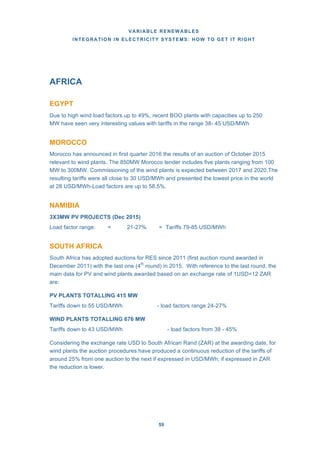
Large hydro Wind Small hydro Solar Bagasse Gas
T
WORLD ENERGY COUNCIL | PERSPECTIVES
3030
both wind and solar PV plants in locations with low load factors, may reach up to 15-20
USD/MWh for wind farms with 2,000 equivalent operating hours and close to 35 USD/MWh
for PV systems with 1,250 equivalent operating hours.
Prices at auctions in many countries around the world have collapsed over the past 1-2
years. Tariffs for both solar PV and wind plants compared to the usual FIT values adopted
to subsidise development of RES have decreased significantly. Africa, Latin America and
Middle East are the regions leading the price drop where the lowest values were recorded
at the end of 2015 and first quarter of 2016.
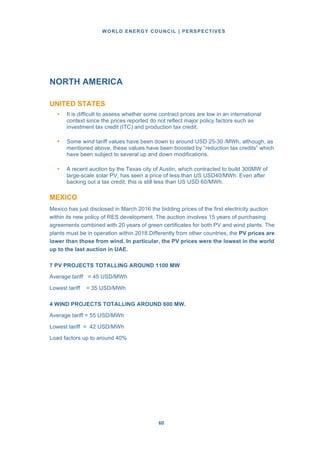
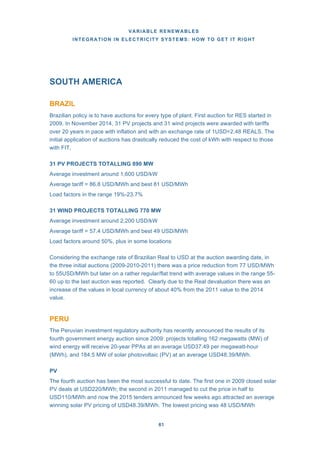
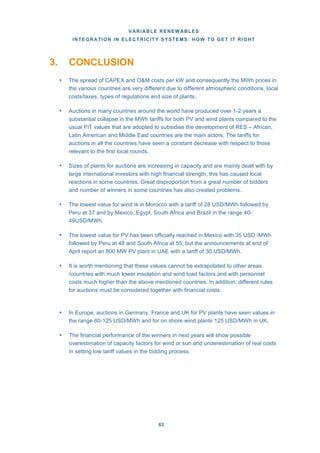
The lowest value for wind has been registered in Morocco with a tariff of 28 USD/MWh
followed by Peru at 37 USD/MWh and by Mexico, Egypt, South Africa and Brazil in the
range 40-49USD/MWh.
The lowest value for solar PV has been achieved in UAE 30 USD/MWh, followed by Mexico
with 35 USD/MWh followed by Peru at 48 USD/MWh and South Africa with 55 USD/MWh.
It should be noted that such low values cannot be projected to other areas/countries where
solar insolation and wind load factors are much lower and employment costs much higher
than in the above mentioned countries. Another factor affecting prices is different rules for
auctions in different countries and relevant penalties for not compliances in guaranteed
performances.
In Europe, for example, auctions in Germany, France and UK have reached 80-125
USD/MWh for solar PV and for onshore wind plants 125 USD/MWh. It will be interesting to
review in a few years the low values achieved at recent auctions and find out whether the
projected financial performance of the winning bidder was based on accurate estimates or
overestimates of load factors and underestimates of actual CAPEX and OPEX costs.
VARIABLE RENEWABLES
INTEGRATION IN ELECTRICITY SYSTEMS: HOW TO GET IT RIGHT
31
2.3 Impacts of VRES on the electrical power system
IMPACTS ON TRADITIONAL FLEETS
The growth of VRES systems has had a significant influence on the operation of traditional
electricity generation fleets (thermal, nuclear and hydro). Many efficient units built for base-
load operation are today being used inefficiently, since the dispatch priority is given to
VRES. As solar irradiation or wind speed vary, conventional generation units are required
to ramp up and down and in many cases, beyond their flexibility limits. The possible
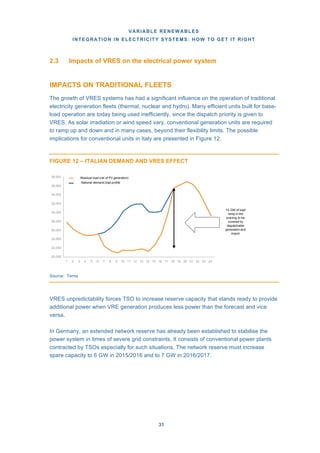
implications for conventional units in Italy are presented in Figure 12.
FIGURE 12 – ITALIAN DEMAND AND VRES EFFECT
Source: Terna
VRES unpredictability forces TSO to increase reserve capacity that stands ready to provide
additional power when VRE generation produces less power than the forecast and vice
versa.
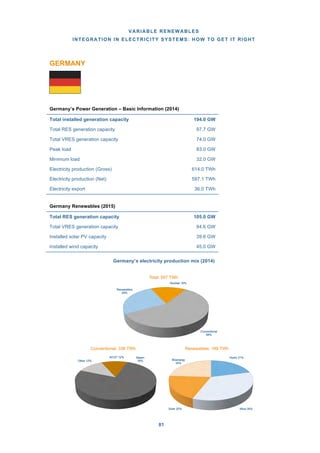
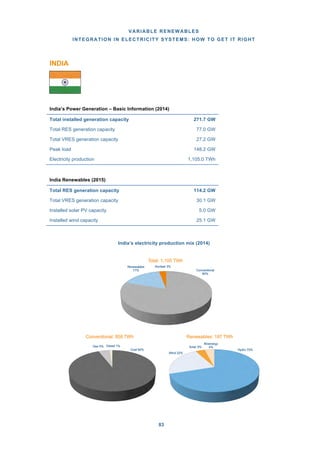
In Germany, an extended network reserve has already been established to stabilise the
power system in times of severe grid constraints. It consists of conventional power plants
contracted by TSOs especially for such situations. The network reserve must increase
spare capacity to 6 GW in 2015/2016 and to 7 GW in 2016/2017.
38,000 Residual load (net of PV generation)
National demand load profile
36,000
34,000
32,000
30,000
28,000
26,000
24,000
22,000
14 GW of load
ramp in the
evening to be
covered by
dispatchable
generation and
import
20,000
1 2 3 4 5 6 7 8 9 10 11 12 13 14 15 16 17 18 19 20 21 22 23 24
WORLD ENERGY COUNCIL | PERSPECTIVES
3232
Generation from wind is irregular, but also changing cloudy weather can result in the same
variability for PV with short time intervals. TSOs have to balance these variations through
automatic primary regulation and by adjusting secondary generation regulation to keep
frequency and voltage within a stable range.
Conventional power plants usually have installed primary frequency controllers and in order
to bring the system frequency back to the equilibrium (i.e. 60 Hz in the US and 50 Hz in
Europe) there is automatic control, while wind generators usually do not have the same
capabilities.
The requirement for flexible power supply has also affected combined heat and power
(CHP) associated with industrial and district heating uses. These technologies are
extensively used in Denmark, Romania, Austria and Russia. In particular, the reduction of
electricity generation due to unexpected VRES increase may pose limits to CHP electrical
flexibility and thus affect its output. More significantly, the overall efficient and reliable
performance of CHP plants may be jeopardised by excessive flexibility in the electricity
output which would impact the heating system.
As VRES capacity grows, the associated reduction of operating hours for conventional
power plants leads to insecurity in terms of new investments and operating costs as clearly
demonstrated in the country reports for Germany, Italy, Romania and Denmark.
Conventional power producers, the traditionally large investors in the electricity sector,
have been particularly affected because of simultaneously decreasing power prices and
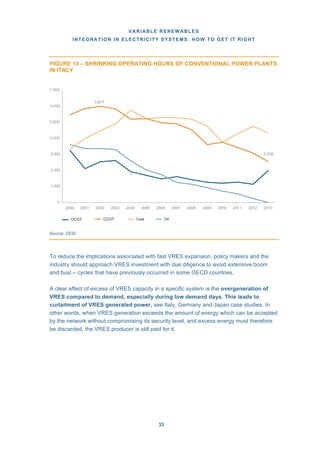
shrinking operating hours for supplying the residual load (Figure 13). Reduction in demand
has made the situation even worse, especially in some EU countries.
VARIABLE RENEWABLES
INTEGRATION IN ELECTRICITY SYSTEMS: HOW TO GET IT RIGHT
33
FIGURE 13 – SHRINKING OPERATING HOURS OF CONVENTIONAL POWER PLANTS
IN ITALY
Source: CESI
To reduce the implications associated with fast VRES expansion, policy makers and the
industry should approach VRES investment with due diligence to avoid extensive boom
and bust – cycles that have previously occurred in some OECD countries.
A clear effect of excess of VRES capacity in a specific system is the overgeneration of
VRES compared to demand, especially during low demand days. This leads to
curtailment of VRES generated power, see Italy, Germany and Japan case studies. In
other words, when VRES generation exceeds the amount of energy which can be accepted
by the network without compromising its security level, and excess energy must therefore
be discarded, the VRES producer is still paid for it.
7,000
6,000
5,877
5,000
4,000
3,000
2,000
1,000
2,536
0
2000 2001 2002 2003 2004 2005 2006 2007 2008 2009 2010 2011 2012 2013
OCGT CCGT Coal Oil
WORLD ENERGY COUNCIL | PERSPECTIVES
3434
IMPACTS ON THE ELECTRICITY MARKET
The growth of VRES has also had a strong influence on electricity markets in many
countries. For example, Italy, Germany and Japan have witnessed sudden and unexpected
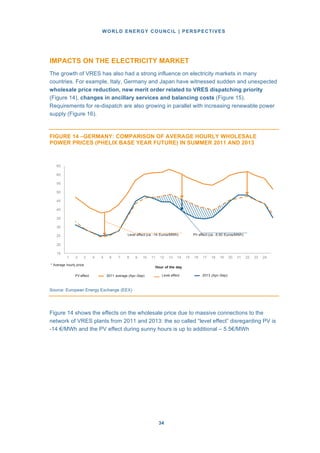
wholesale price reduction, new merit order related to VRES dispatching priority
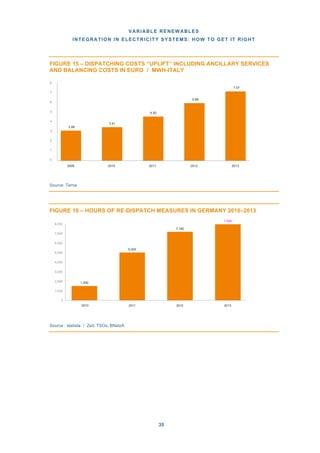
(Figure 14), changes in ancillary services and balancing costs (Figure 15).
Requirements for re-dispatch are also growing in parallel with increasing renewable power
supply (Figure 16).
FIGURE 14 –GERMANY: COMPARISON OF AVERAGE HOURLY WHOLESALE
POWER PRICES (PHELIX BASE YEAR FUTURE) IN SUMMER 2011 AND 2013
Source: European Energy Exchange (EEX)
Figure 14 shows the effects on the wholesale price due to massive connections to the
network of VRES plants from 2011 and 2013: the so called “level effect” disregarding PV is
-14 €/MWh and the PV effect during sunny hours is up to additional – 5.5€/MWh
65
60
55
50
45
40
35
30
25 Level effect (ca. -14 Euros/MWh) PV effect (ca. -5.50 Euros/MWh)
20
15
1 2 3 4 5 6 7 8 9 10 11 12 13 14 15 16 17 18 19 20 21 22 23 24
* Average hourly price
Hour of the day
PV effect 2011 average (Apr–Sep) Level effect 2013 (Apr–Sep)
VARIABLE RENEWABLES
INTEGRATION IN ELECTRICITY SYSTEMS: HOW TO GET IT RIGHT
35
FIGURE 15 – DISPATCHING COSTS “UPLIFT” INCLUDING ANCILLARY SERVICES
AND BALANCING COSTS IN EURO / MWH-ITALY
Source: Terna
FIGURE 16 – HOURS OF RE-DISPATCH MEASURES IN GERMANY 2010–2013
Source : statista / Zeit; TSOs, BNetzA
F
! !
8
7.07
7
5.86
6
5
4
3.06
3
3.41
4.50
2
1
0
2009 2010 2011 2012 2013
! !
2012 2
Impacts on the transmission and distribution grid
F
! !
2010 2011 2012 2
! !
8,000
7,000
7,160
7,956
6,000
5,000
5,000
4,000
3,000
2,000 1,500
1,000
0
2010 2011 2012 2013
Impacts on the transmission and distribution grid
WORLD ENERGY COUNCIL | PERSPECTIVES
3636
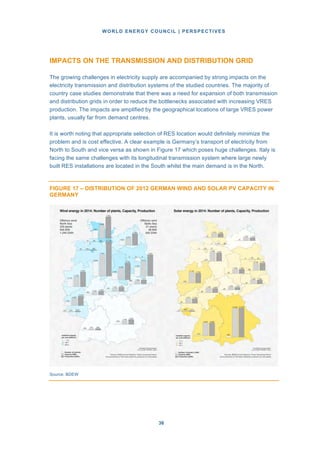
IMPACTS ON THE TRANSMISSION AND DISTRIBUTION GRID
The growing challenges in electricity supply are accompanied by strong impacts on the
electricity transmission and distribution systems of the studied countries. The majority of
country case studies demonstrate that there was a need for expansion of both transmission
and distribution grids in order to reduce the bottlenecks associated with increasing VRES
production. The impacts are amplified by the geographical locations of large VRES power
plants, usually far from demand centres.
It is worth noting that appropriate selection of RES location would definitely minimize the
problem and is cost effective. A clear example is Germany’s transport of electricity from
North to South and vice versa as shown in Figure 17 which poses huge challenges. Italy is
facing the same challenges with its longitudinal transmission system where large newly
built RES installations are located in the South whilst the main demand is in the North.
FIGURE 17 – DISTRIBUTION OF 2012 GERMAN WIND AND SOLAR PV CAPACITY IN
GERMANY
Source: BDEW
VARIABLE RENEWABLES
INTEGRATION IN ELECTRICITY SYSTEMS: HOW TO GET IT RIGHT
37
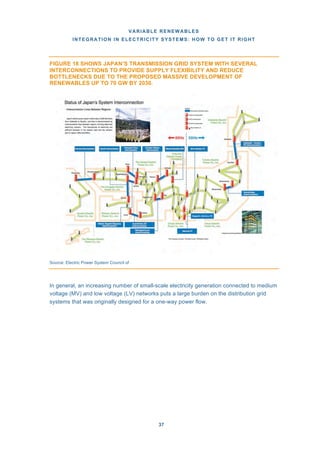
FIGURE 18 SHOWS JAPAN’S TRANSMISSION GRID SYSTEM WITH SEVERAL
INTERCONNECTIONS TO PROVIDE SUPPLY FLEXIBILITY AND REDUCE
BOTTLENECKS DUE TO THE PROPOSED MASSIVE DEVELOPMENT OF
RENEWABLES UP TO 70 GW BY 2030.
Source: Electric Power System Council of
In general, an increasing number of small-scale electricity generation connected to medium
voltage (MV) and low voltage (LV) networks puts a large burden on the distribution grid
systems that was originally designed for a one-way power flow.
WORLD ENERGY COUNCIL | PERSPECTIVES
3838
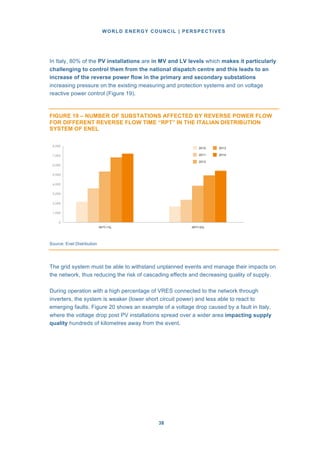
In Italy, 80% of the PV installations are in MV and LV levels which makes it particularly
challenging to control them from the national dispatch centre and this leads to an
increase of the reverse power flow in the primary and secondary substations
increasing pressure on the existing measuring and protection systems and on voltage
reactive power control (Figure 19).
FIGURE 19 – NUMBER OF SUBSTATIONS AFFECTED BY REVERSE POWER FLOW
FOR DIFFERENT REVERSE FLOW TIME “RPT” IN THE ITALIAN DISTRIBUTION
SYSTEM OF ENEL
Source: Enel Distribution
The grid system must be able to withstand unplanned events and manage their impacts on
the network, thus reducing the risk of cascading effects and decreasing quality of supply.
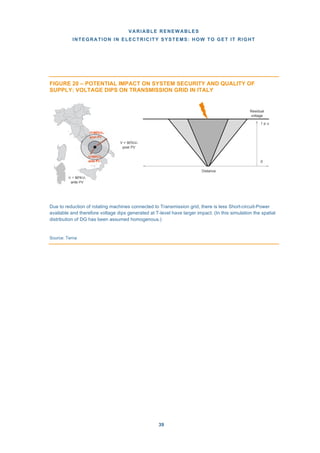
During operation with a high percentage of VRES connected to the network through
inverters, the system is weaker (lower short circuit power) and less able to react to
emerging faults. Figure 20 shows an example of a voltage drop caused by a fault in Italy,
where the voltage drop post PV installations spread over a wider area impacting supply
quality hundreds of kilometres away from the event.
8,000
7,000
6,000
2010
2011
2012
2013
2014
5,000
4,000
3,000
2,000
1,000
0
RPT>1% RPT>5%
8,000
7,000
6,000
5,000
4,000
3,000
2010
2011
2012
2013
2014
3,000
2,000
1,000
0
%>1PTR %>5PTR
VARIABLE RENEWABLES
INTEGRATION IN ELECTRICITY SYSTEMS: HOW TO GET IT RIGHT
39
FIGURE 20 – POTENTIAL IMPACT ON SYSTEM SECURITY AND QUALITY OF
SUPPLY: VOLTAGE DIPS ON TRANSMISSION GRID IN ITALY
Due to reduction of rotating machines connected to Transmission grid, there is less Short-circuit-Power
available and therefore voltage dips generated at T-level have larger impact. (In this simulation the spatial
distribution of DG has been assumed homogenous.)
Source: Terna
Residual
voltage
1 p u
V < 90%V0
post PV
0
V < 90%V0
ante PV
Distance
dsieR
agevolt
lau
age
1 p u
an
V < 90%V0
stop PV
nte PV
etancDis
0
WORLD ENERGY COUNCIL | PERSPECTIVES
4040
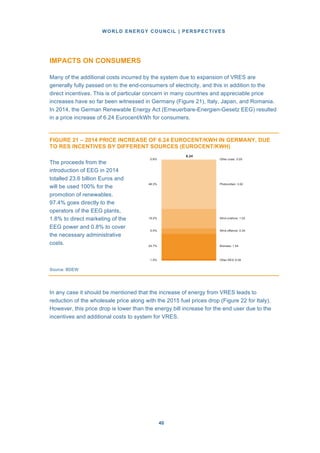
IMPACTS ON CONSUMERS
Many of the additional costs incurred by the system due to expansion of VRES are
generally fully passed on to the end-consumers of electricity, and this in addition to the
direct incentives. This is of particular concern in many countries and appreciable price
increases have so far been witnessed in Germany (Figure 21), Italy, Japan, and Romania.
In 2014, the German Renewable Energy Act (Erneuerbare-Energien-Gesetz EEG) resulted
in a price increase of 6.24 Eurocent/kWh for consumers.
FIGURE 21 – 2014 PRICE INCREASE OF 6.24 EUROCENT/KWH IN GERMANY, DUE
TO RES INCENTIVES BY DIFFERENT SOURCES (EUROCENT/KWH)
The proceeds from the
introduction of EEG in 2014
totalled 23.6 billion Euros and
will be used 100% for the
promotion of renewables.
97.4% goes directly to the
operators of the EEG plants,
1.8% to direct marketing of the
EEG power and 0.8% to cover
the necessary administrative
costs.
Source: BDEW
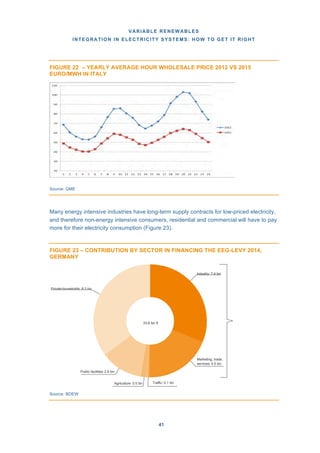
In any case it should be mentioned that the increase of energy from VRES leads to
reduction of the wholesale price along with the 2015 fuel prices drop (Figure 22 for Italy).
However, this price drop is lower than the energy bill increase for the end user due to the
incentives and additional costs to system for VRES.
0.8%
48.3%
19.2%
5.5%
24.7%
1.5%
6.24
Other costs: 0.05
Photovoltaic: 3.02
Wind onshore: 1.02
Wind offshore: 0.34
Biomass: 1.54
Other RES: 0.09
VARIABLE RENEWABLES
INTEGRATION IN ELECTRICITY SYSTEMS: HOW TO GET IT RIGHT
41
FIGURE 22 – YEARLY AVERAGE HOUR WHOLESALE PRICE 2012 VS 2015
EURO/MWH IN ITALY
Source: GME
Many energy intensive industries have long-term supply contracts for low-priced electricity,
and therefore non-energy intensive consumers, residential and commercial will have to pay
more for their electricity consumption (Figure 23).
FIGURE 23 – CONTRIBUTION BY SECTOR IN FINANCING THE EEG-LEVY 2014,
GERMANY
Source: BDEW
– Yearly Average hour wholesale price 2012 vs 2015 Euro/MWh in Italy (Source:
G
Industry: 7.4 bn
Private households: 8.3 bn
23.6 bn !
Marketing, trade,
services: 4.5 bn
Public facilities: 2.8 bn
Agriculture: 0.5 bn Traffic: 0.1 bn
eettaavvPriPri oohhseseuuoohh s:
23.6
s:ddll 8.38.3 bnbn
bn !
::ryryststuuddnnII 7.47.4 bnbn
ff
23.6 bn !
cilbPu s:eitilciaf 2.8 bn
:reutlcuriAg 0.5 bn c:iffraT
,gnitrkeaM ade,rt
s:ceirvse 4.5 bn
0.1 bn
WORLD ENERGY COUNCIL | PERSPECTIVES
4242
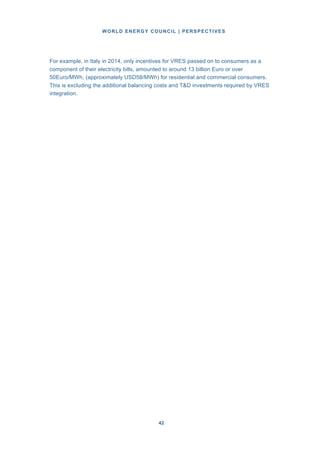
For example, in Italy in 2014, only incentives for VRES passed on to consumers as a
component of their electricity bills, amounted to around 13 billion Euro or over
50Euro/MWh, (approximately USD58/MWh) for residential and commercial consumers.
This is excluding the additional balancing costs and T&D investments required by VRES
integration.
VARIABLE RENEWABLES
INTEGRATION IN ELECTRICITY SYSTEMS: HOW TO GET IT RIGHT
Chapter 3
Measures for a
smoother VRES
integration
WORLD ENERGY COUNCIL | PERSPECTIVES
4444
Although VRES may still pose a number of challenges as highlighted in the previous
Chapter, affordable solutions will help to decrease or eliminate the challenges and solutions
can be divided in two categories: technologies and market redesign.
TECHNOLOGIES
The case studies demonstrate a number of “technological” solutions which have been
deployed to address the various challenges posed by the integration of VRES in the electric
power system. These solutions include:
1. Improved Forecasting: better forecasting accuracy can help minimize VRES
integration cost and allow grid operators to schedule VRES and reduce the need for
operating reserves and balancing costs. The cost of forecasting has dropped over
the last couple of years making it a popular and frequently used mitigation solution.
Forecasting accuracy can be further improved by other mitigation strategies, such
as faster scheduling and larger balancing areas.
2. Greater Flexibility of Generation: flexibility is needed for generation to respond
rapidly to the changing load conditions that has required short start-up and shut-
down times compared to steady base-load operation. The need for fast ramp up
and down mode imposes additional costs, including a quicker equipment wear and
increased fuel consumption, and thus higher overall emissions. This option may be
costlier compared to other options. Compensation and/or regulatory measures for
new generation are important for successful implementation of VRES.
3. Dynamic Transfers: to transfer electronically, in real-time, the control responsibility
for generation from the balancing area/country in which the generator physically
resides to another balancing area. However, available transmission capacity for the
amount of energy which can be transferred between balancing areas could be an
issue. Dynamic transfers can ease the integration of VRES, but can also provide
benefits to customers even without VRES. This option is used for ancillary services,
real-time and balancing energy dispatch.
4. Transmission Expansion: transmission expansion will provide access to more
geographically diverse resources which can help improve system flexibility.
Shortage of transmission capacity can be a significant impediment to new utility-
scale renewable energy plants. However, transmission can take a long time to
develop in many countries due to local opposition to new transmission
infrastructure. India, for example, is planning to realize green energy transmission
corridors, fairly remunerated, to transport massive RES.
5. Distribution expansion/modification: is needed to eliminate bottlenecks to
energy from RES connected to MV and LV and to counteract reverse power flows
due to increasing connection of distributed generation.
6. Increased visibility of Distributed Generation: Distributed generation (DG) is
usually “invisible” to system operators, as they do not receive dispatch commands.
DG is projected to grow rapidly in the coming years and this growth can cause
VARIABLE RENEWABLES
INTEGRATION IN ELECTRICITY SYSTEMS: HOW TO GET IT RIGHT
45
scheduling conflicts. Better coordination between DSOs and TSOs in liberalised
markets is mandatory.
7. Demand Response: i.e. the short-term adjustment of demand to address
temporary shortage or excess power from variable renewables, must be developed
further.
8. Energy Storage: The most established, although geographically limited, energy
storage technology is pumped hydro storage which requires transmission capacity
and takes a long time to build. There are many types of energy storage using
different technologies such as battery, flywheel or compressed air energy storage.
Energy storage can help to use load shifting, shorter-term balancing and fast-acting
instantaneous supply solutions. Type, characteristics and location of Battery
Electrical Storage Systems for instance depend on the type of service they are
required for and on the type and location of RES and conventional plants and
electricity transmission facilities to avoid T&D bottlenecks and up and down ramps
to conventional fleets.
MARKET REDESIGN
The market rules established before the large expansion of VRES now need to be
adjusted. The energy market alone does not provide price signals which are sufficiently
strong and effective for long-term planning and security of supply. Effective market
redesign practices until now have included the following:
1. Capacity payments: Capacity payments remunerate generators for being available to
participate in the energy markets. Capacity markets can take many forms, including
bilateral contracts and centralised auctions run by system operators who clear the
market. Capacity markets are needed to provide sufficient revenue and ensure
reliability where reliance on energy market revenues alone may not cover the long-term
cost of generation. This issue is the subject of great debates going on in Europe. In
general, an energy only based market is insufficient to ensure security of supply in the
systems with large VRES.
2. Emission Trading Scheme revision: an appropriate price for carbon emission would
support the deployment of low carbon technologies lowering the needs for generous
VRES incentives and priority of dispatching.
3. Faster scheduling of the electricity market: hourly and sub-hourly scheduling, with
due consideration to conventional plants limits, allows a more efficient use of available
transmission / generation capacity, lower reserve requirements thanks to a shorter and
more accurate forecast of VRES.
4. Negative market price: Negative prices are price signals on the wholesale power
market when highly inflexible power generation meets low demand. Inflexible power
WORLD ENERGY COUNCIL | PERSPECTIVES
4646
generating units cannot be shut down and restarted in a quick and cost-efficient
manner. In certain circumstances, negative prices indicate the advance of coming
sudden oversupply and the urgent need for the operators to deal with this oversupply of
energy by sending relevant market signals to reduce production. At this stage,
generators have to compare their costs of stopping and restarting their plants with the
costs of selling their energy at a negative price (which means paying instead of
receiving money). If their generation units are sufficiently flexible, they will stop
producing for a period of time which will prevent or buffer the negative price on the
wholesale market and ease the pressure on the grid. In France, Germany and Austria
this practice is already in place, thus the prices can fall below zero. An appropriate
adjustment of incentive to VRES should be re-analysed in this specific condition.
(Again, refer to e-storage report).
5. Nodal pricing: is a method of determining prices in which market clearing prices are
calculated for a number of locations on the transmission grid nodes. The price at each
node represents the local value of energy, which includes the cost of the energy, but
also the cost of delivering it, taking into account losses and congestions. The New
Zealand and US experiences with nodal pricing demonstrate the benefit of a better
location of RES power plants and the smooth integration of intermittent renewable
generation technologies. This is one of the incentive tools that can help select
appropriately RES location. The same could be applied to local auctions.
6. Larger balancing areas: Consolidating balancing areas and sharing the variability of
the VRES and load forecast errors across a broader region provides a natural
aggregation impact. There are strong benefits to consolidation/coordination even in the
absence of wind and solar.
7. Pooling: unlike wind variability, some aspects of solar variability are predictable (for
example, sunrise and sunset). Other aspects, such as intermittent cloud cover, are
much less so. However, aggregating the bids of different VRES plants on the electricity
market can lead to a reduction in overall variability and thus reduce the forecast error
and balancing costs.
8. Ancillary services: An important aspect of balancing is the approach to procuring
ancillary services. Ancillary services refer to a range of functions which TSOs contract
so that they can guarantee system security. These include black start capability (the
ability to restart a grid following a blackout); frequency response (to maintain system
frequency with automatic and very fast responses); fast reserve (which can provide
additional power when needed); the provision of reactive power and various other
services. VRES can provide some ancillary services such as voltage reactive power
regulation and using new inverters technology can provide services also in absence of
sun and wind, see for example, New Zealand. In any case balancing responsibilities
have to be shared fairly among market participants including VRES
VARIABLE RENEWABLES
INTEGRATION IN ELECTRICITY SYSTEMS: HOW TO GET IT RIGHT
47
VARIABLE RENEWABLES
INTEGRATION IN ELECTRICITY SYSTEMS: HOW TO GET IT RIGHT
Chapter 4
Key messages
VARIABLE RENEWABLES
INTEGRATION IN ELECTRICITY SYSTEMS: HOW TO GET IT RIGHT
49
• Renewable energy sources, in particular variable wind and solar PV have grown rapidly
over the past ten years and this growth is expected to continue.
• RES and especially wind and PV have become a big business overtaking investments
in conventional generating plants.
• Combination of technology improvements and increasing volumes are driving down
CAPEX and OPEX of variable VRES.
• Variability and average low equivalent hours of operation per year of PV and wind,
pose challenges to their large-scale development. This affects conventional power
generating equipment, T&D grids, electricity markets and economics of power supply
for consumers.
• The report identifies main solutions to overcome these challenges through technologies
and market redesign initiatives.
• A holistic approach to overall electrical system design is a key to success.
• Each country power system is unique, even if some general recommendations can be
drawn. Sophisticated technical, economic and regulatory analysis on a project basis
must be conducted over an adequate period of time.
• The implications of reduction in subsidies or other support schemes must be carefully
analysed to avoid a drastic reduction in VRES investment as result of incentive
reductions (e.g. some EU countries)
• The right location with high wind and solar load factors and low grid connection costs
for new large VRES projects is a key to success.
• Regulatory bodies have a fundamental role in both development of VRES and the
typology of measures to smooth their impact on the power system.
• VRES can serve as a pathway for climate change mitigation, but also as investments
that reduce dependence on imported fuel, improve air quality, increase energy access
and security of supply, promote economic development, and create jobs.
• In countries with electricity markets, VRES have contributed to the overall reduction of
wholesale price, but for most of customers this has not avoided significant increase of
their bills.
• It is misleading to project specific aspects of VRES operation to other countries, in
terms of auction prices for kWh or similar indicators as countries have the different
levels of wind and insolation and local costs.
WORLD ENERGY COUNCIL | PERSPECTIVES
5050
• Working together, the main energy stakeholders will be able to meet all current
challenges facing RES integration in electricity systems by learning from each other
about both positive and negative experiences in their countries.
VARIABLE RENEWABLES
INTEGRATION IN ELECTRICITY SYSTEMS: HOW TO GET IT RIGHT
Annex 1
Examples of
costs of wind
and solar PV
systems and
results of recent
auctions
WORLD ENERGY COUNCIL | PERSPECTIVES
5252
1 INTRODUCTION
It is difficult to get accurate financial data and detailed information about the conditions and
clauses relevant to actual PV and wind plants that are not published or available publically.
This data is considered to be commercially and politically sensitive in various countries,
which has limited the Knowledge Network (KN) enquiry.
This annex includes data relevant to new plants for onshore wind and solar PV systems in
different countries, in terms of:
• recent CAPEX values, yearly O&M costs and when available LCOE.
• results of auctions up to mid May 2016 based on power purchasing agreements
(PPAs).
The values reported are relevant to those projects which exclude possible special grants or
subsidies and comprise complete generating systems, including installation. Clearly both
CAPEX and O&M costs are affected by the location of plant, transport and labour costs,
local duties and taxes, plant power capacity, financial costs etc. and should be extrapolated
with caution.
Further caution is due with CAPEX data, since the reported values may or may not include
development costs. In some cases, the CAPEX values may be affected by hidden
subsidies to contractors and equipment suppliers and also by local import taxes for
machinery and equipment. We do not have access to this data so this should be
extrapolated with caution to other projects.
A deep analysis should be performed also in relation to the data reported by various
agencies and their possible comparisons.
CAPEX is usually given in USD/MW or USD/kW and the O&M services are typically
contracted in terms of EUR or USD per installed MW; when expressed in terms of
MWh, both CAPEX and O&M are strongly influenced by the Load Factor of the plant since
the yearly cost per MW must be divided by the equivalent hours of production (proportional
to the load factor).
VARIABLE RENEWABLES
INTEGRATION IN ELECTRICITY SYSTEMS: HOW TO GET IT RIGHT
53
For wind farms the O&M costs typically increase with the age of the windfarms: for a full
service scope, while initial contracts are typically in Europe in a 25-30 USD/MW range,
O&M contract renewals after 5 or 10 years are more in the 30-40 USD/MW range.
Therefore, O&M costs for both wind and PV plants in locations with low load factors and
high cost for personnel may have a significant value up to 15-20 USD/MWh for wind farms
with 2,000 equivalent operating hours and close to 35 USD/MWh for PV systems having
1,250 equivalent operating hours.
WORLD ENERGY COUNCIL | PERSPECTIVES
5454
2 DATA BY CONTINENTS
ASIA
JAPAN
The data provided is relevant both to small household (4 kW) PV systems and larger ones
(2 MW) and to wind farms of 20 MW. The LCOE has been computed with a life plant of 20
years, a discount rate of 3% and a decommissioning cost as specified for each example.
These figures are based on an exchange rate of 1.39 JPY =1 USD.
PV HOUSEHOLD OF 4kW
• Average Yearly Load Factor = 12% (1050 equivalent hours of operation per year)
• CAPEX = 3,345 USD/kW
• Decommissioning cost = 20% of CAPEX
• LCOE= 251 USD/MWh
PV 2 MW
• Average Yearly Load Factor = 14 % (1,225 equivalent hours of operation per year)
• CAPEX = 2,700 USD/kW
• O&M yearly cost = 1.26% of CAPEX (equivalent to around 28 USD/MWh)
• Decommissioning cost = 5 % of CAPEX
• LCOE = 192 USD/MWh
WIND FARM 20 MW
• Average Yearly Load Factor = 20% (1,750 equivalent hours of operation per year)
• CAPEX=2,600 USD/kW
• O&M yearly cost = 2.1% of CAPEX (equivalent to approx.32 USD/MWh)
• Decommissioning cost = 5.3% of CAPEX
• LCOE = 144 USD/MWh
VARIABLE RENEWABLES
INTEGRATION IN ELECTRICITY SYSTEMS: HOW TO GET IT RIGHT
55
INDIA
India has just awarded an auction for 500 MW PV plants with a tariff valid for 25 years and
the most significant results are:
23 MW PV PROJECT tariff 67 USD/MWh
2 X 75 MW PV PLANTS tariff 64 USD/kWh
100 MW PV PLANT tariff 70USD/MWh
JORDAN
An exchange rate of 1 JOD = 1.41 USD has been assumed for the data received relevant
to both household PV systems and to large PV and wind systems.
PV HOUSEHOLD SYSTEMS OF 3-15 kW - Average CAPEX = 1,400 USD/kW
3 PV PROJECTS TOTALLING 15 MW (just in service): results of auctions
• average declared CAPEX = 2,200 USD/kW
• average yearly Load Factor = approx. 20% - 25%
• BOO tariff = 78 USD/MWh
4 PV PROJECTS IN NEGOTIATION: preliminary data from auctions
• average yearly Load Factor = between 20% - 25%
• average declared CAPEX = 1,600 USD/kW
• BOO tariff = 61 USD/MWh - 77 USD/MWh
WIND PLANT 117 MW: result of auction
• average yearly Load Factor = 30%
• declared CAPEX = 2,010 USD/kW
• BOO tariff = 120 USD/MWh
WIND PLANT 80 MW (in operation in second half 2016: result of auction)
• average yearly Load Factor = 30%
• CAPEX = 1,875 USD/kW
• BOO tariff = 113 USD/MWh
WORLD ENERGY COUNCIL | PERSPECTIVES
5656
UNITED ARAB EMIRATES
PV 800 MW PLANT
According to May 2016 press releases the best tariff presented for the auction is 30
USD/MWh which is a world record for PV. It is worth mentioning the high local insolation
level, low costs for manpower and favourable financial support to local contractors.
EUROPE
ITALY
In Italy the Load Factor for PV plants in operation varies from around 10% in the extreme
North to around 17% in Sicily with a yearly average of 13.5%. For existing wind plants the
average Load Factor is between 19% and 25%. An exchange ratio of 1.13 USD = 1 EUR
has been used to convert local EUR into USD.
HOUSEHOLD PV ROOF TOP 3-10 kW
CAPEX ranging from around 2,000 USD/kW to 2,800 USD/kW depending on
location/difficulties for installation.
PV PLANTS WITH CAPACITY ABOVE 2 MW: latest plants
• CAPEX ranging from 1,000 to 1,200 USD/kW
• O&M costs in the range of 20-40 USD/MWh excluding taxes but including land rent
(when not included in CAPEX), preventive maintenance, insurances, guards, grass
cutting/panel cleaning, spare parts, quick interventions for repairs, administration of
plant production/energy sales etc. As already mentioned the value depends on solar
local radiation that varies from the South to the North of Italy as to local manpower
costs. A deep analysis performed (Energia Elettrica Vol 3, 2014) by companies
operating PV plants having an average capacity of 4 MW and 1,350 operating hours
have provided the following split of the total 45 USD/MWh, excluding taxes: 56%
O&M with spare parts,18% land rental,10% all-risks insurance,
TLC/monitoring/auxiliary services consumptions 9%, guards 7%.
WIND PLANTS WITH CAPACITY ABOVE 5 MW: latest plants
• Average Load Factor = 22% - 25%
• CAPEX = 1,350 – 1,600 USD/kW
• O&M costs in the range = 22-34 USD/MW = 10-17USD/MWh
VARIABLE RENEWABLES
INTEGRATION IN ELECTRICITY SYSTEMS: HOW TO GET IT RIGHT
57
POLAND
3 WIND PROJECTS TOTALLING APPROX. 80 MW: PRIVATE INVESTORS
• Average investment = 1,450 USD/kW
• Load factors = 23% - 28%
GERMANY
A Trial auction system was set by the government in 2014 and relevant to PV plants above
6 MW each and for around 500 MW to be allocated in 2015 -400 MW in 2016 and 300 MW
in 2017. In 2017 auctions should be applied also to wind plants. The first 4 subsequent
rounds for PV plants, with 2 different auction methods, have seen publications of winning
offers from February 2015 to April 2016. The main results are:
1st
round : tariff awarded to all winning offers at 91.7 €/MWh (103.5
USD/MWh)
2nd
round : auction (uniform pricing) with the highest awarded bid at
84.9 €/MWh
(96 USD/MWh) applied to all winning bids (the average of
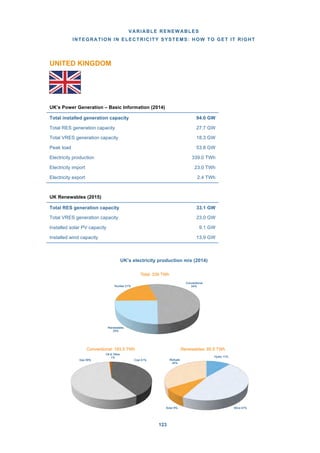
all winning bids was at 78.2 EUR/MWh).
3rd
round : also held with the uniform pricing with the highest winning
bid at 80 EUR/MWh
(90 USD/MWh) applied to all winning bids.
4th
round : the auctioning method was pay-as-bid. From preliminary
results, the average of all bids was 74.1EUR /MWh (83.5
USD/MWh), the lowest bid being 69.4 EUR/ MWh while the highest
at 109.8 EUR/MWh
FRANCE
• The French Ministry of Ecology, Sustainable Development and Energy (MEDDE)
announced at end 2015 the 212 winning projects from its 800MW solar energy
auction that followed the first auctions held 2 years ago. The capacity of projects
ranged from 0.4MW to 12MW and the main results are here below, assuming an
exchange rate of -1 EUR = 1.13 USD:
• The average tariff for large rooftop solar installations was EUR 129/MWh (USD 146),
down 18% from EUR 158/MWh in the previous auction.
• The average price for ground-mounted facilities was EUR 124 (USD 140), down
15% from EUR 146/MWh in the previous auction
WORLD ENERGY COUNCIL | PERSPECTIVES
5858
UK
1 WIND PROJECT 50 MW -PRIVATE INVESTORS
Average investment around 1,600 USD/kW
Load factor in the range 30%-34%
WIND AND PV PROJECTS IN FIRST ALLOCATION ROUND OF AUCTIONS
• Results published in February 2015 relevant to 15 years’ contracts for difference
(CFD) allocating:
15 wind projects totalling 750 MW
• Strike prices in the range 124- 128 USD/MWh (1 GBP=1.55 USD)
2 PV projects totalling 19+14 MW
• Strike price 77.7 USD/MWh
3 PV projects totalling 39 MW
• Strike price 123 USD/MWh
VARIABLE RENEWABLES
INTEGRATION IN ELECTRICITY SYSTEMS: HOW TO GET IT RIGHT
59
AFRICA
EGYPT
Due to high wind load factors up to 49%, recent BOO plants with capacities up to 250
MW have seen very interesting values with tariffs in the range 38- 45 USD/MWh
MOROCCO
Morocco has announced in first quarter 2016 the results of an auction of October 2015
relevant to wind plants. The 850MW Morocco tender includes five plants ranging from 100
MW to 300MW. Commissioning of the wind plants is expected between 2017 and 2020.The
resulting tariffs were all close to 30 USD/MWh and presented the lowest price in the world
at 28 USD/MWh-Load factors are up to 58.5%.
NAMIBIA
3X3MW PV PROJECTS (Dec 2015)
Load factor range: = 21-27% = Tariffs 79-85 USD/MWh
SOUTH AFRICA
South Africa has adopted auctions for RES since 2011 (first auction round awarded in
December 2011) with the last one (4th
round) in 2015. With reference to the last round, the
main data for PV and wind plants awarded based on an exchange rate of 1USD=12 ZAR
are:
PV PLANTS TOTALLING 415 MW
Tariffs down to 55 USD/MWh - load factors range 24-27%
WIND PLANTS TOTALLING 676 MW
Tariffs down to 43 USD/MWh - load factors from 38 - 45%
Considering the exchange rate USD to South African Rand (ZAR) at the awarding date, for
wind plants the auction procedures have produced a continuous reduction of the tariffs of
around 25% from one auction to the next if expressed in USD/MWh; if expressed in ZAR
the reduction is lower.
WORLD ENERGY COUNCIL | PERSPECTIVES
6060
NORTH AMERICA
UNITED STATES
• It is difficult to assess whether some contract prices are low in an international
context since the prices reported do not reflect major policy factors such as
investment tax credit (ITC) and production tax credit.
• Some wind tariff values have been down to around USD 25-30 /MWh, although, as
mentioned above, these values have been boosted by “reduction tax credits” which
have been subject to several up and down modifications.
• A recent auction by the Texas city of Austin, which contracted to build 300MW of
large-scale solar PV, has seen a price of less than US USD40/MWh. Even after
backing out a tax credit, this is still less than US USD 60/MWh.
MEXICO
Mexico has just disclosed in March 2016 the bidding prices of the first electricity auction
within its new policy of RES development. The auction involves 15 years of purchasing
agreements combined with 20 years of green certificates for both PV and wind plants. The
plants must be in operation within 2018.Differently from other countries, the PV prices are
lower than those from wind. In particular, the PV prices were the lowest in the world
up to the last auction in UAE.
7 PV PROJECTS TOTALLING AROUND 1100 MW
Average tariff = 45 USD/MWh
Lowest tariff = 35 USD/MWh
4 WIND PROJECTS TOTALLING AROUND 600 MW.
Average tariff = 55 USD/MWh
Lowest tariff = 42 USD/MWh
Load factors up to around 40%
VARIABLE RENEWABLES
INTEGRATION IN ELECTRICITY SYSTEMS: HOW TO GET IT RIGHT
61
SOUTH AMERICA
BRAZIL
Brazilian policy is to have auctions for every type of plant. First auction for RES started in
2009. In November 2014, 31 PV projects and 31 wind projects were awarded with tariffs
over 20 years in pace with inflation and with an exchange rate of 1USD=2.48 REALS. The
initial application of auctions has drastically reduced the cost of kWh with respect to those
with FIT,
31 PV PROJECTS TOTALLING 890 MW
Average investment around 1,600 USD/kW
Average tariff = 86.8 USD/MWh and best 81 USD/MWh
Load factors in the range 19%-23.7%
31 WIND PROJECTS TOTALLING 770 MW
Average investment around 2,200 USD/kW
Average tariff = 57.4 USD/MWh and best 49 USD/MWh
Load factors around 50%, plus in some locations
Considering the exchange rate of Brazilian Real to USD at the auction awarding date, in
the three initial auctions (2009-2010-2011) there was a price reduction from 77 USD/MWh
to 55USD/MWh but later on a rather regular/flat trend with average values in the range 55-
60 up to the last auction was reported. Clearly due to the Real devaluation there was an
increase of the values in local currency of about 40% from the 2011 value to the 2014
value.
PERU
The Peruvian investment regulatory authority has recently announced the results of its
fourth government energy auction since 2009: projects totalling 162 megawatts (MW) of
wind energy will receive 20-year PPAs at an average USD37.49 per megawatt-hour
(MWh), and 184.5 MW of solar photovoltaic (PV) at an average USD48.39/MWh.
PV
The fourth auction has been the most successful to date. The first one in 2009 closed solar
PV deals at USD220/MWh; the second in 2011 managed to cut the price in half to
USD110/MWh and now the 2015 tenders announced few weeks ago attracted an average
winning solar PV pricing of USD48.39/MWh. The lowest pricing was 48 USD/MWh
WORLD ENERGY COUNCIL | PERSPECTIVES
6262
WIND
The drop in wind prices from the first Peruvian wind auctions was equally strong. The 2009
auctions were won at USD89/MWh; the 2011 at USD87/MWh, but 2015 winning offers
were all under USD38/MWh.
In the first round of the fourth wind auction the largest project, at 126 MW, came in with the
lowest overall bid of USD 37.83/MWh.
The second round with two 18 MW projects, minimum offers were of USD 36.84/MWh and
USD 37.79/MW
CHILE
PV 55 MW AUCTION: lowest price 65 USD/MWh
VARIABLE RENEWABLES
INTEGRATION IN ELECTRICITY SYSTEMS: HOW TO GET IT RIGHT
63
3. CONCLUSION
• The spread of CAPEX and O&M costs per kW and consequently the MWh prices in
the various countries are very different due to different atmospheric conditions, local
costs/taxes, types of regulations and size of plants.
• Auctions in many countries around the world have produced over 1-2 years a
substantial collapse in the MWh tariffs for both PV and wind plants compared to the
usual FIT values that are adopted to subsidise the development of RES – African,
Latin American and Middle East countries are the main actors. The tariffs for
auctions in all the countries have seen a constant decrease with respect to those
relevant to the first local rounds.
• Sizes of plants for auctions are increasing in capacity and are mainly dealt with by
large international investors with high financial strength; this has caused local
reactions in some countries. Great disproportion from a great number of bidders
and number of winners in some countries has also created problems.
• The lowest value for wind is in Morocco with a tariff of 28 USD/MWh followed by
Peru at 37 and by Mexico, Egypt, South Africa and Brazil in the range 40-
49USD/MWh.
• The lowest value for PV has been officially reached in Mexico with 35 USD /MWh
followed by Peru at 48 and South Africa at 55; but the announcements at end of
April report an 800 MW PV plant in UAE with a tariff of 30 USD/MWh.
• It is worth mentioning that these values cannot be extrapolated to other areas
/countries with much lower insolation and wind load factors and with personnel
costs much higher than the above mentioned countries. In addition, different rules
for auctions must be considered together with financial costs.
• In Europe, auctions in Germany, France and UK for PV plants have seen values in
the range 80-125 USD/MWh and for on shore wind plants 125 USD/MWh in UK.
• The financial performance of the winners in next years will show possible
overestimation of capacity factors for wind or sun and underestimation of real costs
in setting low tariff values in the bidding process.
VARIABLE RENEWABLES
INTEGRATION IN ELECTRICITY SYSTEMS: HOW TO GET IT RIGHT
Annex 2
Country Case
Studies
Summaries
VARIABLE RENEWABLES
INTEGRATION IN ELECTRICITY SYSTEMS: HOW TO GET IT RIGHT
65
This annex includes key messages from each Country relevant to their situation on power
generation and VRES development and policies at the end of 2014 deducted from the
detailed case studies; a table has been added to each country with data about installed
RES and VRES capacity at end of 2015 (Source: IRENA, RENEWABLE CAPACITY
STATISTICS 2016 - Copyright © IRENA 2016).
The detailed case studies can be downloaded from the Council’s website
(www.worldenergy.org/publications).
1. Algeria 17. Korea (Rep. of)
2. Brazil 18. Mexico
3. China 19. New Zealand
4. Colombia 20. Nigeria
5. Denmark 21. Philippines
6. Ecuador 22. Poland
7. Egypt 23.Portugal
8. France 24. Romania
9. Germany 25. Russian Federation
10. India 26. South Africa
11. Indonesia 27. Spain
12. Ireland 28. Thailand
13. Italy 29. Tunisia
14. Japan 30. United Kingdom
15. Jordan 31. USA
16. Kazakhstan 32. Uruguay
WORLD ENERGY COUNCIL | PERSPECTIVES
6666
ALGERIA
Algeria’s Power Generation – Basic Information (2014)
Algeria Renewables (2015)
98% of Algeria’s electricity system is based on conventional, primarily fossil-fuelled
generation with an increasing percentage of natural gas. Algeria’s renewable electricity
portfolio includes some hydro and only small shares of variable RES. High installation
costs and the need for additional reserve capacity have been a barrier for large scale
development of solar or wind plants. In 2011, first solar facility was commissioned in a
hybrid 150 MW system (25 MW concentrated solar power and 125 MW gas-fired plant).
Large solar and wind power potential is in the Southern sparsely populated areas. Future
developments of RES are expected to reach up to 22 GW in 2030. Funding for RES
comes from a levy on oil tax.
Total installed generation capacity 16.00 GW
Total RES generation capacity 0.26 GW
Total VRES generation capacity 0.26 GW
Peak load (Northern interconnected network) 10.90 GW
Minimum load 10.90 GW
Electricity production 60.50 TWh
Electricity import 686.00 GWh
Electricity export 877.00 GWh
Total RES generation capacity 0.54 GW
Total VRES generation capacity 0.28 GW
Installed solar PV capacity 0.27 GW
Installed wind capacity 0.01 GW
VARIABLE RENEWABLES
INTEGRATION IN ELECTRICITY SYSTEMS: HOW TO GET IT RIGHT
67
BRAZIL
Brazil’s Power Generation – Basic Information (2014)
Brazil Renewables (2015)
Brazil’s electricity production mix (2014)
Hydro 81%
Bioenergy
11%
Wind 5%
Renewables: 432 TWh
Coal 20%
Gas 51%
Oil 12%
Other 17%
Conventional: 158 TWh
Conventional
27%
Renewables
73%
Total: 590 TWh
Total installed generation capacity 133.9 GW
Total RES generation capacity 106.4 GW
Total VRES generation capacity 5.9 GW
Peak load 85.0 GW
Minimum load 61.1 GW
Electricity production 590.5 TWh
Electricity import 33.8 GWh
Total RES generation capacity 114.2 GW
Total VRES generation capacity 8.7 GW
Installed solar PV capacity 0.021 GW
Installed wind capacity 8.7 GW
WORLD ENERGY COUNCIL | PERSPECTIVES
6868
73% of electricity production in Brazil is based on renewables (mainly hydro). Brazil
currently promotes affordable renewable energy at power auctions of different types of
supply options with 15 to 30 year contracts. Large-scale bioenergy production is a distinct
feature of the country’s energy system. Fast development of wind generation capacity has
resulted in its increase from 0.2 GW in 2007 to 5.9 GW in 2014, and a drop of auction
prices to USD 60/MWh making wind the second cheapest electric energy source after
large hydro. Even lower values have been achieved in 2015/2016 (see Annex 1). In 2014
wind accounted for 2% of total electricity production. By 2023 wind capacity is expected to
reach 23 GW and solar 4 GW. Seasonal nature of local renewables and further expansion
of hydro generation with no reservoirs requires further development of conventional
generating plants for security of supply.
VARIABLE RENEWABLES
INTEGRATION IN ELECTRICITY SYSTEMS: HOW TO GET IT RIGHT
69
CHINA
China’s Power Generation – Basic Information (2014)
China Renewables (2015)
China’s electricity production mix (2014)
Hydro 79%
Wind 13%
Solar 5%
Bioenergy
2%
Renewables: 1,038 TWh
Coal 97%
Gas 2%
Oil 1%
Conventional: 4,325 TWh
Conventional
78%
Renewables
20%
Nuclear 2%
Total: 5,403 TWh
Total installed generation capacity 1,360.0 GW
Total RES generation capacity 454.0 GW
Total VRES generation capacity 142.6 GW
Electricity production 5,403.0 TWh
Total RES generation capacity 519.7 GW
Total VRES generation capacity 188.1 GW
Installed solar PV capacity 43.0 GW
Installed wind capacity 145.1 GW
WORLD ENERGY COUNCIL | PERSPECTIVES
7070
China is the world leader in installed generation capacity (1,360 GW) and electricity
production (5,403 TWh). 78% of it comes from conventional power plants (mainly coal-
fired), while the renewable energy portfolio is dominated by hydropower. Wind and solar
PV have grown strongly in recent years reaching installed capacity of 114 GW and 28 GW,
respectively at the end of 2014. Wind currently accounts for 2% and solar PV for less than
0.5% of total electricity production, but both are growing quickly with the recent annual
capacity increases of 19.7% for wind and 17.1% for solar in 2014. Even if the share of
variable RES is still low in relative terms, their random fluctuations and lack of flexible
conventional power have resulted in significant changes in the power balancing capability
of power grid. China has six interconnected grids, and therefore certain consolidated data
is not available.
VARIABLE RENEWABLES
INTEGRATION IN ELECTRICITY SYSTEMS: HOW TO GET IT RIGHT
71
COLOMBIA
Colombia’s Power Generation – Basic Information (2014)
Colombia Renewables (2015)
Colombia’s electricity production mix (2014)
Hydro
99.9%
Wind 0.1%
Renewables: 38.1 TWh
Coal 34%
Gas 61%
Oil 3%
Co-
generation
2%
Conventional: 18.9 TWh
Conventional
32.0%
Renewables
67.2%
Others 0.8%
Total: 57.0 TWh
Total installed generation capacity 15.0 GW
Total RES generation capacity 11.1 GW
Total VRES generation capacity 18.0 MW
Electricity production 57.0 TWh
Electricity import 715.0 MWh
Electricity export 6.5 MWh
Total RES generation capacity 11.7 GW
Total VRES generation capacity 18.0 MW
Installed solar PV capacity 0.0 MW
Installed wind capacity 18.0 MW
WORLD ENERGY COUNCIL | PERSPECTIVES
7272
Colombia has a hydropower based electricity sector with a fairly insignificant share of
VRES, mainly wind. A number of laws and regulations have been introduced to facilitate
and accelerate development of VRES. For example, Law 1715 adopted in 2014 introduces
fiscal incentives for renewables, which include Income tax reduction to 50% of total
investment during 5 years, accelerated depreciation, reduction of the basic income tax for
unconventional energy projects, VAT exclusions for equipment and other discounts. There
are also specific tariffs in support for RES, such as “Derechos Arancelarios” tariff
exemption, and tariff exemption for machinery, equipment, materials and imports used for
unconventional energy projects.
VARIABLE RENEWABLES
INTEGRATION IN ELECTRICITY SYSTEMS: HOW TO GET IT RIGHT
73
DENMARK
Denmark’s Power Generation – Basic Information (2014)
Denmark Renewables (2015)
Denmark’s electricity production mix (2014)
Wind 71%
Bioenergy
25%
Solar 3% Hydro 1%
Renewables: 16 TWh
CHP 98%
Steam 1% Other 1%
Conventional: 19 TWh
Conventional
55%
Renewables
55%
Total: 35 TWh
Total installed generation capacity 13.60 GW
Total RES generation capacity 7.0 GW
Total VRES generation capacity 5.4 GW
Peak load 6.1 GW
Minimum load 2.3 GW
Electricity production 34.7 TWh
Electricity import 11.5 TWh
Total RES generation capacity 7.3 GW
Total VRES generation capacity 5.9 GW
Installed solar PV capacity 0.8 GW
Installed wind capacity 5.1GW
WORLD ENERGY COUNCIL | PERSPECTIVES
7474
Up to 35% of Denmark’s 35 TWh generation of electricity is produced with renewable
energy, with wind accounting for 71%. In total, 33% or 11.3 TWh of Denmark’s electricity
was produced from variable RES in 2014, achieving the highest VRE penetration in the
world in relative terms. At the same time, Denmark imported 11.5 TWh of electricity.
Dispatching priorities, feed-in-tariffs, and feed-in premiums for variable RES have been
driving growth in VRES. This large share of RES required significant changes to the
Danish energy system including interconnectors to neighbouring countries, back-up power
units, demand management and energy storage. The target for 2020 is to reach 50% of
electricity consumption supplied by wind without any use of coal in Danish plants and by
2050 the entire Danish energy consumption should be supplied by VRES technologies.
VARIABLE RENEWABLES
INTEGRATION IN ELECTRICITY SYSTEMS: HOW TO GET IT RIGHT
75
ECUADOR
Ecuador’s Power Generation – Basic Information (2014)
Ecuador Renewables (2015)
Ecuador’s electricity production mix (2014)
Hydro
92.0%
Wind 0.1%
Bioenergy
8%
Renewables: 14 TWh
Coal 40%
Gas 25%Oil 25%
Other 10%
Conventional: 6.6 TWh
Conventional
32.0%
Renewables
67.2%
Total: 20.6 TWh
Total installed generation capacity 5.3 GW
Total RES generation capacity 2.4 GW
Total VRES generation capacity 0.05 GW
Peak load 3.5 GW
Electricity production 20.6 TWh
Electricity import 0.90 TWh
Total RES generation capacity 2.6 GW
Total VRES generation capacity 0.05 GW
Installed solar PV capacity 0.02 GW
Installed wind capacity 0.03 GW
WORLD ENERGY COUNCIL | PERSPECTIVES
7676
Primarily hydropower and coal-fired power plants supply the Ecuadorian electricity
network. Ecuador’s 47.6 MW total installed capacity of VRES (26.4 MW PV and 21.2 MW
wind) are split between wind production in the Galapagos Islands and the Southern
regions, and PV solar electricity between production in the North and Central regions.
Feed in tariffs for the first 15 years have been in the range around 10 cents USD / kWh for
wind and 42 cents USD/kWh for PV. There are no major plans for future large
developments of VRES.
VARIABLE RENEWABLES
INTEGRATION IN ELECTRICITY SYSTEMS: HOW TO GET IT RIGHT
77
EGYPT
Egypt’s Power Generation – Basic Information (2014)
Egypt Renewables (2015)
Egypt’s electricity production mix (2014)
Hydro 86%
Wind 10%
Solar 1%
Renewables: 14 TWh
Coal
49.5%Gas 49.5%
Oil 1%
Conventional: 154 TWh
Conventional
& Nuclear
91%
Renewables
9%
Total: 168 TWh
Total installed generation capacity 32.0 GW
Total RES generation capacity 3.5 GW
Total VRES generation capacity 0.6 GW
Peak load 26.1 GW
Electricity production 168.0 TWh
Total RES generation capacity 3.51 GW
Total VRES generation capacity 0.64 GW
Installed solar PV capacity 0.03 GW
Installed wind capacity 0.61 GW
WORLD ENERGY COUNCIL | PERSPECTIVES
7878
The government strategy approved in February 2008 outlines the objective of RES
reaching a 20% share of the total electricity generation by the year 2020. The share of the
grid-connected wind power is today about 10% of the total electricity generation in Egypt.
It is planned to develop a broad private participation through both the competitive tender
and bilateral agreements. This will be supported by the introduction of long-term Power
Purchase Agreements. The Government of Egypt will guarantee all financial obligations
under the PPA. More than 7,600 square kilometres of desert lands have been allocated for
future projects Renewable energy equipment and spare parts are exempt from the
customs duties & Sales Taxes .Central Bank of Egypt guarantees all financial obligations
of EETC under the PPA. The results of recent auctions are presented in Annex 1.
VARIABLE RENEWABLES
INTEGRATION IN ELECTRICITY SYSTEMS: HOW TO GET IT RIGHT
79
FRANCE
Frances’s Power Generation – Basic Information (2014)
France Renewables (2015)
France’s electricity production mix (2014)
Hydro 71%
Wind 18%
Solar 6%
Other 5%
Renewables: 97.6 TWh
Coal 31%
Gas 53%
Oil 16%
Conventional: 27 TWh
Conventional
5%
Renewables
18%
Nuclear 77%
Total: 540.6 TWh
Total installed generation capacity 129.0 GW
Total RES generation capacity 41.8 GW
Total VRES generation capacity 14.5 GW
Peak load 82.5 GW
Minimum load 29.5 GW
Electricity production 540.6 TWh
Electricity export 92.4 TWh
Electricity import 27.3 TWh
Total RES generation capacity 44.2 GW
Total VRES generation capacity 16.9 GW
Installed solar PV capacity 6.6 GW
Installed wind capacity 10.3 GW
WORLD ENERGY COUNCIL | PERSPECTIVES
8080
In 2014, the production from all renewable energy sources provided 18% of French
electricity, a slight increase compared to 2013. Renewable energies continued their
development assisted by streamlining of the regulatory framework and more favourable
economic conditions. Wind and solar PV capacity increased by nearly 1.900 MW in 2014.
Currently, France has 9.100 MW of wind and 5.300 MW of solar generation capacity.
Electricity generated by renewable energies other than hydropower (28 TWh)
outperformed fossil fuel power generation for the first time in 2014. More than half was
generated by wind power, with the remainder split between solar PV and biomass.
Maximum wind power generation was reached on 27 December 2014 with output of
slightly over 7.000 MW, representing 80% of total installed wind power capacity. Maximum
photovoltaic power generation was reached at 13.30 on 17 May 2014 with output of 3.700
MW. Such levels had never been achieved before. In addition, hydro availability was
particularly high in that year, due to heavy rainfall. Output of hydropower at 68.2 TWh was
the second highest of the decade after 2013, when it was exceptionally high. All these
favourable conditions resulted in the highest level of generation by renewable energies
accounting for nearly 20% of French power production. This contributed to the reduction of
carbon emissions, already achieved by both energy consumption efficiency programmes
and nuclear power plants. Annex 1 presents some data from auctions of VRES.
VARIABLE RENEWABLES
INTEGRATION IN ELECTRICITY SYSTEMS: HOW TO GET IT RIGHT
81
GERMANY
Germany’s Power Generation – Basic Information (2014)
Germany Renewables (2015)
Germany’s electricity production mix (2014)
Hydro 21%
Wind 35%Solar 20%
Bioenergy
24%
Renewables: 169 TWh
Steam
76%Other 12%
SCGT 12%
Conventional: 336 TWh
Conventional
58%
Renewables
26%
Nuclear 16%
Total: 597 TWh
Total installed generation capacity 194.0 GW
Total RES generation capacity 97.7 GW
Total VRES generation capacity 74.0 GW
Peak load 83.0 GW
Minimum load 32.0 GW
Electricity production (Gross) 614.0 TWh
Electricity production (Net) 597.1 TWh
Electricity export 36.0 TWh
Total RES generation capacity 105.0 GW
Total VRES generation capacity 84.6 GW
Installed solar PV capacity 39.6 GW
Installed wind capacity 45.0 GW
WORLD ENERGY COUNCIL | PERSPECTIVES
8282
Germany has been a front runner in promoting RES development by introducing FIT’s with
a consequent sky rocketing increase of the share of wind and solar PV up to the present
38% of total installed capacity. The high RES growth has high associated costs. For
example, in 2014 alone, 24 billion euros for FIT’s (feed-in-tariffs) were passed on end
consumers (with exemption of energy intensive industries) accompanied by substantial
investments in T&D systems.
The reduction of FIT’s has caused a drastic reduction of new variable RES installations,
especially solar PV (new capacity additions dropped from 7.6 GW in 2012 to 1.9 GW in
2014). Introduction of pilot auctions will substitute in future FIT’s (see Annex 1).
Conventional power producers have been hit by the rise in the share of variable RES which
has resulted in a drop in both wholesale prices and operating hours of their plants used for
residual loads. Four German TSO’s, which are also expected to manage the phase out of
nuclear, are facing great challenges in transporting electricity from North to South and vice
versa. There is a clear need for market rules readjustments. Various technologies and
management investments (storage, demand side management etc.) are under
development. On the positive side, RES investments have created job opportunities and
have contributed to reduction of GHG emissions and fuel imports.
VARIABLE RENEWABLES
INTEGRATION IN ELECTRICITY SYSTEMS: HOW TO GET IT RIGHT
83
INDIA
India’s Power Generation – Basic Information (2014)
India Renewables (2015)
India’s electricity production mix (2014)
Hydro 70%
Wind 22%
Solar 4%
Bioenergy
4%
Renewables: 187 TWh
Coal 94%
Gas 5% Diesel 1%
Conventional: 858 TWh
Conventional
80%
Renewables
17%
Nuclear 3%
Total: 1,105 TWh
Total installed generation capacity 271.7 GW
Total RES generation capacity 77.0 GW
Total VRES generation capacity 27.2 GW
Peak load 148.2 GW
Electricity production 1,105.0 TWh
Total RES generation capacity 114.2 GW
Total VRES generation capacity 30.1 GW
Installed solar PV capacity 5.0 GW
Installed wind capacity 25.1 GW
WORLD ENERGY COUNCIL | PERSPECTIVES
8484
India is positioned well for large-scale renewable energy development due to its abundant
solar and wind resources which today account for approximately 3.5 % of total electricity
with installed wind capacity of 23.4 GW and solar PV of 3.7 GW. Wind has benefitted from
accelerated depreciation and generation based incentives. Solar PV enjoys direct capital
subsidy; FITs are around USD100/MWh and the allocation of solar PV projects has been
through auctions in the recent years. Net metering has been introduced by many states.
Several measures, including green corridors are being taken to address technical
challenges of increased variable RES with their intermittency. The 2022 targets envisage
an installed capacity of 100 GW for PV and 60 GW for wind.
VARIABLE RENEWABLES
INTEGRATION IN ELECTRICITY SYSTEMS: HOW TO GET IT RIGHT
85
INDONESIA
Indonesia’s Power Generation – Basic Information (2014)
Indonesia Renewables (2015)
Indonesia’s electricity production mix (2014)
Hydro 60%
Wind &
Solar 1.0%
Bioenergy
14% Geothermal
25%
Renewables: 28.5 TWh
Coal
29.0%
Gas 60.0%
Oil 11%
Conventional: 200 TWh
Conventional
88%
Renewables
12%
Total: 228.5 TWh
Total installed generation capacity 55.0 GW
Total RES generation capacity 8.30 GW
Total VRES generation capacity 0.01 GW
Peak load 53.8 GW
Electricity production 228.5 TWh
Total RES generation capacity 8.3 GW
Total VRES generation capacity 13.0 MW
Installed solar PV capacity 12.0 MW
Installed wind capacity 1.0 MW
WORLD ENERGY COUNCIL | PERSPECTIVES
8686
Today, renewable energy accounts for a small but growing portion of Indonesia’s electricity
portfolio. The Government of Indonesia (GoI) has announced a medium term target for
increasing the share of renewable energy in total energy mix to 25% by 2025. This means
that USD38 billion will be invested in the renewable energy sector. Current installed
capacity in Indonesia is mostly solar PV home systems. Wind energy development
programme in Indonesia up to 2020 amounts to 200MW which are currently still under
procurement. The government supports the projects to attract foreign solar cell
manufacturers to Indonesia to create jobs and increase the interest in RES.
VARIABLE RENEWABLES
INTEGRATION IN ELECTRICITY SYSTEMS: HOW TO GET IT RIGHT
87
IRELAND
Ireland’s Power Generation – Basic Information (2014)
Ireland Renewables (2015)
Ireland’s electricity production mix (2014)
Hydro 11%
Wind 88%
Solar 1%
Renewables: 5.5 TWh
Coal 19%
Gas 60%
Peat 11%
Other 10%
Conventional: 18.4 TWh
Conventional
77%
Renewables
23%
Total: 23.9 TWh
Total installed generation capacity 9.99 GW
Total RES generation capacity 3.1 GW
Total VRES generation capacity 2.3 GW
Peak load 6.3 GW
Electricity production (Gross) 23.9 TWh
Electricity export 1.8 TWh
Total RES generation capacity 3.1 GW
Total VRES generation capacity 2.5 GW
Installed solar PV capacity 1.0 MW
Installed wind capacity 2.5 GW
WORLD ENERGY COUNCIL | PERSPECTIVES
8888
Ireland has excellent renewable energy resources, which will be a critical and growing
component of Irish energy supply to 2020 and beyond. Indigenous renewable energy
already plays a vital role in domestic fuel mix. It also increases sustainability through the
use of clean power sources and enhances energy security by reducing Ireland’s
dependence on imported fuels. Wind and solar energy can yield additional opportunities for
suppliers and consumers alike. Under the 2009 Renewable Energy Directive, Ireland is
committed to produce at least 16% of all energy consumed from renewable sources by
2020. This will be met by 40% from renewable electricity, 12% from renewable heat and
10% from the renewable transport sector. The target to have 40% of electricity consumed
from renewable sources by 2020 is one of the most demanding in the world.
VARIABLE RENEWABLES
INTEGRATION IN ELECTRICITY SYSTEMS: HOW TO GET IT RIGHT
89
ITALY
Italy’s Power Generation – Basic Information (2014)
Italy Renewables (2015)
Italy’s electricity production mix (2014)
Hydro 48%
Wind 13%
Solar 20%
Bioenergy
14%
Geothermal
5%
Renewables: 117 TWh
Coal 26%
Gas 62%
Oil 3%
Other 9%
Conventional: 151 TWh
Conventional
56%
Renewables
44%
Total: 268 TWh
Total installed generation capacity 125.0 GW
Total RES generation capacity 53.9 GW
Total VRES generation capacity 27.5 GW
Peak load 54.0 GW
Minimum load 20.0 GW
Electricity production 268.0 TWh
Electricity import 40.0 GWh
Total RES generation capacity 54.8 GW
Total VRES generation capacity 28.0 GW
Installed solar PV capacity 18.9 GW
Installed wind capacity 9.1 GW
WORLD ENERGY COUNCIL | PERSPECTIVES
9090
Italy’s VRES production is high, 39 TWh (14.5% of the country’s electricity generation)
using 20 GW of PV and 9 GW of installed wind capacity. The PV production has reached
8% of the total generation (world record). Fast development of RES technologies has been
driven by a number of generous incentives such as green certificates and especially FI
premium tariffs. The incentives for PV were introduced in 2005 and amounted to
450€/MWh; but now the price is based only on auctions for large plants and tax deductions
for small installations. For wind there are currently only a few auctions operating at reduced
capacities. The sudden decrease of incentives has resulted in a drastic collapse of annual
additions to installed capacity of PV from 9 GW in 2011 to less than 1 GW in 2014 and for
wind from 1.2 to 0.3 GW.
A number of side effects related to RES integration have made an impact on the power
system and on the market behaviour, including drastic reduction of operating hours for the
high efficiency combined cycle fleet. Another contributing factor was strong reduction of
demand. Incentives for RES paid by consumers amount to around 13 billion Euros per
year, while 6 billion € will be invested into transmission improvements over the next 10
years. Ancillary services market costs are close to 2 billion €/year (doubled with RES
introduction). Pilot electrical storage systems both for TSO and DSO grids are already
installed or under installation. New market designs are being developed to provide further
opportunities for RES investments which in any case contributed to reduction of GHG
emissions and import of primary energies, and also created job opportunities. Annex 1
presents some details on recent costs for CAPEX and O&M of PV and Wind plants.
VARIABLE RENEWABLES
INTEGRATION IN ELECTRICITY SYSTEMS: HOW TO GET IT RIGHT
91
JAPAN
Japan’s Power Generation – Basic Information (2013)
Japan Renewables (2015)
Japan’s electricity production mix (2013)
Hydro 82%
Wind 4%
Solar 11%
Geothermal
3%
Renewables: 97 TWh
Convention
al thermal
plants
99%
Other 1%
Conventional: 879 TWh
Conventional
89%
Renewables
10%
Nuclear 1%
Total: 979 TWh
Total installed generation capacity 252.5 GW
Total RES generation capacity 69.7 GW
Total VRES generation capacity 15.1 GW
Peak load 159.1 GW
Electricity production 979.0 TWh
Total RES generation capacity 90.1 GW
Total VRES generation capacity 36.3 GW
Installed solar PV capacity 33.3 GW
Installed wind capacity 3.0 GW
WORLD ENERGY COUNCIL | PERSPECTIVES
9292
In 2010, before Fukushima, 30% of Japan’s electricity production was from nuclear plants
which are now shut down, anticipating new safety standards. With renewables contributing
only 10% of the country’s electricity production whereof 1% solar and 0.5% wind, there is a
pressing need to import considerably more fossil fuels and this places a large financial
burden on Japan’s economy. Therefore, the country is strongly promoting RES; and a FIT
premium scheme was introduced in 2012. PV, that had a tariff of 35 US cents/kWh in 2012
(now above 45), has got the highest increase of RES which have a target capacity of 70
GW. This requires significant investments in T&D systems and system balancing issues.
The acceptable supply targets for utilities generating power from PV are by far lower than
the approved limits for other technologies, and METI has established a Working Group of
independent experts to a study of variable RES integration. Financial details are presented
in Annex 1.
VARIABLE RENEWABLES
INTEGRATION IN ELECTRICITY SYSTEMS: HOW TO GET IT RIGHT
93
JORDAN
Jordan’s Power Generation – Basic Information (2014)
Jordan Renewables (2015)
Jordan’s electricity production mix (2014)
Hydro 80%
Wind 4%
Solar 7%
Bioenergy
9%
Renewables: <1 TWh
Steam
43%
CCGT 32%
SCGT 25%
Conventional: 17 TWh
Conventional
99%
Renewables
1%
Total: 18 TWh
Total installed generation capacity 4.0 GW
Total RES generation capacity 26.0 MW
Total VRES generation capacity 11.0 MW
Peak load 3.01 GW
Minimum load 1.2 GW
Electricity production 18.0 TWh
Total RES generation capacity 160.0 MW
Total VRES generation capacity 145 MW
Installed solar PV capacity 26.0 MW
Installed wind capacity 119.0 MW
WORLD ENERGY COUNCIL | PERSPECTIVES
9494
Given that RES account for less than 0.5% of RES electricity production, Jordan has made
minimal progress in its introduction of renewables. The shares of solar PV and wind energy
are 7% and 5% of Jordan’s total renewables production, even if in the Southern parts of the
country there are suitable sites for development of both wind and PV plants. With 96% of
fossil fuels being imported, Jordan plans to increase its RES capacity with the help of
generous feed-in-tariffs, with a goal of reaching 10% RE electricity production by
2020.Various wind and PV projects have been contracted with private investors and a
“green corridor” for grid support has been established. (See Annex 1 for cost details).
VARIABLE RENEWABLES
INTEGRATION IN ELECTRICITY SYSTEMS: HOW TO GET IT RIGHT
95
KAZAKHSTAN
Kazakhstan’s Power Generation – Basic Information (2014)
Kazakhstan Renewables (2015)
Kazakhstan’s electricity production mix (2014)
Hydro 94%
Bioenergy
6%
Renewables: 11 TWh
Coal
84.0%Gas 10.0%
Oil 6%
Conventional: 82.7 TWh
Conventional
88%
Renewables
12%
Total: 93.7 TWh
Total installed generation capacity 19.6 GW
Total RES generation capacity 2.8 GW
Total VRES generation capacity 0.1 GW
Electricity production 93.7 TWh
Total RES generation capacity 2.8 GW
Total VRES generation capacity 123 MW
Installed solar PV capacity 55 MW
Installed wind capacity 68 MW
WORLD ENERGY COUNCIL | PERSPECTIVES
9696
According to government’s strategy to 2050, 50% of the installed capacity in Kazakhstan
will use renewable energy sources. This is just one component of Kazakhstan’s
comprehensive initiative to transfer from one of the world’s premier hydrocarbon energy
producers to a model “green” economy. Wind power has the potential to produce 25 times
more energy in a year than Kazakhstan’s current production from hydrocarbons. It is
estimated that 10-15% of the land in Kazakhstan has average wind speeds of over 6 m/s.
Wind power will play a large part of the 2020 goal to expand the renewable energy
generating capacity to 1,040 megawatts from 110 megawatts last year. The 2020 goal is to
have four solar power plants in operation producing a total of 77MW of electricity. The
recently announced solar-power-generating complex in Kyzylorda Province will be
generating 65MWh of electricity per year. A major step forward in Kazakhstan’s timeline
was the opening of the Astana Solar LLP photovoltaic panel production plant in Astana in
2013 to meet Kazakhstan’s increasing demand for solar panels.
VARIABLE RENEWABLES
INTEGRATION IN ELECTRICITY SYSTEMS: HOW TO GET IT RIGHT
97
KOREA (REP. OF)
Korea’s Power Generation – Basic Information (2014)
Korea Renewables (2015)
Korea’s electricity production mix (2014)
Wind 16%Solar 40%
Bioenergy
6%
Renewables: 10.5 TWh
Coal 60%
Gas 33%
Oil &
Diesel 7%
Conventional: 344.0 TWh
Conventional
67%Renewables
2%
Nuclear 31%
Total: 521.4 TWh
Total installed generation capacity 93.2 GW
Total RES generation capacity 11.7 GW
Total VRES generation capacity 4.0 GW
Electricity production 521.4 TWh
Total RES generation capacity 12.7 GW
Total VRES generation capacity 4.0 MW
Installed solar PV capacity 3.2 MW
Installed wind capacity 0.8 MW
WORLD ENERGY COUNCIL | PERSPECTIVES
9898
According to the 4th
national plan for development and supply of renewable energy in
Korea, renewables will reach 13.4% of total installed power generation capacity by 2035
compared to 3.7% in 2012. Solar and wind are expected to increase from 0.5% in 2012 to
7.5% in 2035. Both the public and private sectors, invest actively in research and
development of “green” and smart technologies such as Energy Storage System (ESS),
smart and micro grids. Certain incentives have been introduced to support the private
sector investment in a stable renewable energy supply system. For example, additional
Renewable Energy Certificate (REC) points will be added to the utilities who install wind
power plants combined with Energy Storage System (ESS). These points can be sold in
the REC trading market, and this brings additional profits for renewable energy producers.
Korean government adopted the Renewable Portfolio Standards (RPS) in 2012, making it
mandatory for power generators to produce each year 2% of their electricity from
renewable energy sources. Utilities can run their own renewable energy power plants or
buy the points of REC from other generators to meet their annual 2% quota.
VARIABLE RENEWABLES
INTEGRATION IN ELECTRICITY SYSTEMS: HOW TO GET IT RIGHT
99
MEXICO
Mexico’s Power Generation – Basic Information (2014)
Mexico Renewables (2015)
Mexico’s electricity production mix (2014)
Coal 7%
SCGT 60%
CCGT 17%
Oil 13% Other 3%
Conventional: 248 TWh
Conventional
82%
Renewables
15% Nuclear 3%
Total: 303 TWh
Wind 15%
Solar 1.0%
Bioenergy
33%
Renewables: 45 TWh
Total installed generation capacity 65.4 GW
Total RES generation capacity 16.5 GW
Total VRES generation capacity 3.2 GW
Peak load 39.0 GW
Minimum load 17.1 GW
Electricity production 303 TWh
Total RES generation capacity 17.6 GW
Total VRES generation capacity 3.3 GW
Installed solar PV capacity 0.2 GW
Installed wind capacity 3.1 GW
WORLD ENERGY COUNCIL | PERSPECTIVES
100100
RES account for nearly 15% of electricity production in Mexico and wind is by far the most
developed VRES with a share of 2% of the country’s production and of installed capacity.
Wind resources are located mainly in the Southeast, while PV is in the Northern regions;
however, both are far from important load centres and require development of transmission
infrastructure. Average O&M costs are 9 USD/MWh for wind and 12 USD/MWh for PV.
Mexico is aiming to increase its renewable electricity production to 25% by 2025 and to
50% by 2050. It is planned to achieve these targets with clean energy certificates,
accelerated depreciation, preferential wheeling charges, net metering and other solutions.
Certain approaches that have been used to foster RES integration are transmission
reinforcement and there are plans for demand side management through smart grids
technologies. Annex 1 presents results of recent auctions.
VARIABLE RENEWABLES
INTEGRATION IN ELECTRICITY SYSTEMS: HOW TO GET IT RIGHT
101
NEW ZEALAND
New Zealand’s Power Generation – Basic Information (2014)
New Zealand Renewables (2015)
New Zealand’s electricity production mix (2014)
Hydro 77%
Wind 2%
Geothermal
20% Bioenergy
1%
Renewables: 28.2 TWh
Steam
15%
CHP 12%
CCGT 55%
SCGT 7%
Other 11%
Conventional: 10.3 TWh
Conventional
26%Renewables
74%
Total: 38.5 TWh
Total installed generation capacity 11.06 GW
Total RES generation capacity 7.0 GW
Total VRES generation capacity 0.64 GW
Peak load 6.41 GW
Minimum load 2.84 GW
Electricity production 38.5 TWh
Total RES generation capacity 7.0 GW
Total VRES generation capacity 0.65 GW
Installed solar PV capacity 0.03 GW
Installed wind capacity 0.62 GW
WORLD ENERGY COUNCIL | PERSPECTIVES
102102
With large water and geothermal resources, the majority of New Zealand electricity
production is from renewable energy sources. Wind energy with a load factor 38–43%
comprises 2% of these renewables energy and it will cover 40% of next foreseeable
capacity additions. PV production is just at the beginning with maximum expected future
installed capacity providing 2–3% of country energy. No incentives to RES. New Zealand
has a unique market with a carbon price emission trading scheme combined with “location
marginal pricing LMP” which includes offer-based merit order dispatch and a nodal price
which takes care of losses and congestion. Generators offer energy in real time avoiding
balancing payments. Inverters in new windfarms are used to provide voltage support even
when there is no wind and the turbines are not generating.
VARIABLE RENEWABLES
INTEGRATION IN ELECTRICITY SYSTEMS: HOW TO GET IT RIGHT
103
NIGERIA
Nigeria’s Power Generation – Basic Information (2014)
Nigeria Renewables (2015)
Nigeria’s electricity production mix (2014)
Hydro
100%
Renewables: 5.4 TWh
Coal 27%Gas 73%
Conventional: 24.1 TWh
Conventional
81%
Renewables
19%
Total: 29.5 TWh
Total installed generation capacity 9.9 GW
Total RES generation capacity 2.0 GW
Total VRES generation capacity 18 MW
Peak load 4.5 GW
Electricity production 29.5 TWh
Electricity import 1.7 TWh
Total RES generation capacity 2.1 GW
Total VRES generation capacity 19.0 MW
Installed solar PV capacity 17.0 MW
Installed wind capacity 2.0 MW
WORLD ENERGY COUNCIL | PERSPECTIVES
104104
The Nigerian electricity production mix does not include any variable RES technologies, as
all of the 22% of renewable electricity within the country is generated through hydropower.
Future VRES production is expected to be developed, through investment from the
privatization of the electricity industry. Reliability of both conventional and renewable
electricity supply will be ensured through the improvement of Nigeria’s deteriorated
electricity infrastructure and financial incentives through subsidies, grants, low interest
loans, and many others. Large obstacles for VRE investment lie in the absence of a
market, appropriate policy and regulation.
VARIABLE RENEWABLES
INTEGRATION IN ELECTRICITY SYSTEMS: HOW TO GET IT RIGHT
105
PHILIPPINES
Philippines’ Power Generation – Basic Information (2014)
Philippines Renewables (2015)
Philippines’ electricity production mix (2014)
Hydro 45%
Wind &
Solar 3%
Geothermal
52%
Renewables: 19.8 TWh
Coal
57.6%Gas 33.4%
Oil 9%
Conventional: 57.4 TWh
Conventional
75%Renewables
25%
Total: 77.2 TWh
Total installed generation capacity 17.9 GW
Total RES generation capacity 5.9 GW
Total VRES generation capacity 0.4 GW
Peak load 11.8 GW
Electricity production 77.2 TWh
Electricity import 23.0 TWh
Electricity export 2.4 TWh
Total RES generation capacity 6.2 GW
Total VRES generation capacity 519 MW
Installed solar PV capacity 132 MW
Installed wind capacity 387 MW
WORLD ENERGY COUNCIL | PERSPECTIVES
106106
It is the government's policy in the Philippines to facilitate the energy sector's transition to a
sustainable system with a dominant RES capacity. The shift from fossil fuel sources to
renewable forms of energy is a key strategy in ensuring the success of this transition.
Moreover, current initiatives in the pursuit of this policy are directed towards creating a
market-based environment that is conducive to private sector investment and participation
and encourages technology transfer and research and development. Thus, current fiscal
incentives provide for a preferential bias to RES technologies and projects which are
environmentally sound.
VARIABLE RENEWABLES
INTEGRATION IN ELECTRICITY SYSTEMS: HOW TO GET IT RIGHT
107
POLAND
Poland’s Power Generation – Basic Information (2014)
Poland Renewables (2015)
Poland’s electricity production mix (2014)
Wind 39%
Biomass
24%
Biogas 22% Other 4%
Renewables: 19.1 TWh
Coal 82%
Gas 3%
Oil 2%
Other 13%
Conventional: 140 TWh
Conventional
88%
Renewables
12%
Total: 159.1 TWh
Total installed generation capacity 39.4 GW
Total RES generation capacity 7.0 GW
Total VRES generation capacity 3.9 GW
Peak load 25.5 GW
Minimum load 20.5 GW
Electricity production 159.1 TWh
Electricity import 40.0 TWh
Electricity export 0.0 TWh
Total RES generation capacity 8.4 GW
Total VRES generation capacity 5.1 GW
Installed solar PV capacity 0.07 GW
Installed wind capacity 5.17 GW
WORLD ENERGY COUNCIL | PERSPECTIVES
108108
The Polish energy sector is historically based on the domestic abundant hard coal and
lignite, which are used to produce nearly 88% of Poland’s electricity. In the last five years,
the Polish power system has experienced rapid development of variable renewable energy
(VRES) generation capacity increased from 84 MW in 2005 to 3,863 MW in 2014 and 5,056
MW in 2015. Electricity production from these plants increased from 135.5 GWh in 2005 to
7,683 GWh in 2014. The development is driven by wind energy. At the end of June 2015,
there were 981 wind power plants in Poland with a total capacity of 4,117 MW.
Most wind farms are located in North-Western Poland and high potential wind onshore and
offshore sites are located in the Baltic Sea region. Polish public policy ensured the
achievement of the 20/20/20 objective under the EU climate and the third energy package
through generous incentives for VRES. According to the Energy Law Act, connecting to the
grid VRES plants with an installed capacity up to 5 MW requires only 50% of the fee,
calculated on the basis of actual costs of establishing the connection.
VARIABLE RENEWABLES
INTEGRATION IN ELECTRICITY SYSTEMS: HOW TO GET IT RIGHT
109
PORTUGAL
Portugal’s Power Generation – Basic Information (2014)
Portugal Renewables (2015)
Portugal’s electricity production mix (2014)
Coal
49.5%
Oil 1%
Gas 49.5%
Conventional: 31.9 TWh
Conventional
63%
Renewables
37%
Total: 50.6 TWh
Hydro
29.7%
Wind
23.7%
Solar 1.2%
Bioenergy
5.4%
Geothermal
5%
Other
renewables
35%
Renewables: 18.7 TWh
Total installed generation capacity 19.7 GW
Total RES generation capacity 11.6 GW
Total VRES generation capacity 5.0 GW
Peak load 10.3 GW
Minimum load 4.7 GW
Electricity production 50.6 TWh
Electricity import 3.1 TWh
Electricity export 4.0 TWh
Total RES generation capacity 11.9 GW
Total VRES generation capacity 5.53 GW
Installed solar PV capacity 0.45 GW
Installed wind capacity 5.08 GW
WORLD ENERGY COUNCIL | PERSPECTIVES
110110
At the end of 2014, RES represented 37% of electricity consumption in Portugal mainland,
a value above average mainly due to the high precipitation levels along the year. The
sector has an important impact on jobs creation and in the Portuguese GDP. Referring to
2014 the sector employed around 43 478 individuals (indirect and direct jobs) and
contributed with 2 902 M€ for the GDP. The RES directive 2001/77/CE, implemented
through the national decree-law n. º 339-C/2001, December 29th
, was the main precursor of
RES in Portugal.
In 2013, the Portuguese National Renewable Energy Action Plan (Plano Nacional de Ação
para as Energias Renováveis) in accordance with Directive 2009/28/EC on the promotion
of the use of energy from renewable sources, was published. This NREP was prepared in
accordance with the template published by the Commission, and provide detailed
roadmaps of how each Member State expects to reach its legally binding 2020 target for
the share of renewable energy in their final energy consumption.
VARIABLE RENEWABLES
INTEGRATION IN ELECTRICITY SYSTEMS: HOW TO GET IT RIGHT
111
ROMANIA
Romania’s Power Generation – Basic Information (2014)
Romania Renewables (2015)
Romania’s electricity production mix (2014)
Coal 69%
Gas 12%
Oil & other
19%
Conventional: 24 TWh
Conventional
38%
Renewables
44%
Nuclear 18%
Total: 60.7 TWh
Hydro 69%
Wind 10% Solar 3% Bioenergy
2%
Renewables: 26.7 TWh
Total installed generation capacity 24.0 GW
Total RES generation capacity 11.2 GW
Total VRES generation capacity 4.2 GW
Peak load 9.3 GW
Minimum load 4.1 GW
Electricity production 60.7 TWh
Total RES generation capacity 11.3 GW
Total VRES generation capacity 4.5 GW
Installed solar PV capacity 1.3 GW
Installed wind capacity 3.2 GW
WORLD ENERGY COUNCIL | PERSPECTIVES
112112
Given that 44% of electricity generated in Romania comes from renewables, more
electricity is produced from renewables than any other energy resource. Variable RES i.e.
wind and solar PV, account for 10.1% and 2.6% of country production, respectively. Most of
PV installations are connected to medium and low voltage networks, which makes
controlling them from dispatch centres fairly challenging. Fast and frequent wind power
fluctuations create problems for balancing of the system. Romanian RES production has
increased spectacularly because of generous incentives, mainly through tradable Green
Certificate Schemes, which are different for each RES technology. The decrease of
incentives has caused a significant reduction in annual additions to the installed RES
capacity. Future technical and economic policies are under development to ensure further
growth of variable RES – moreover, adjustment of the wholesale market is planned,
including a fair allocation of balancing responsibilities to all market participants.
VARIABLE RENEWABLES
INTEGRATION IN ELECTRICITY SYSTEMS: HOW TO GET IT RIGHT
113
RUSSIAN FEDERATION
Russia’s Power Generation – Basic Information (2014)
Russia Renewables (2015)
Russia’s electricity production mix (2014)
Hydro 98%
Bioenergy
1%
Geothermal
1%
Renewables: 190 TWh
Coal 23%
Gas 71%
Oil &
Diesel 4%
Conventional: 813 TWh
Conventional
77%
Renewables
18%
Nuclear 5%
Total: 1,057 TWh
Total installed generation capacity 240.0 GW
Total RES generation capacity 51.7 GW
Total VRES generation capacity 0.42 GW
Electricity production 1,057 TWh
Electricity import 4.5 TWh
Electricity export 17.5 TWh
Total RES generation capacity 52.0 GW
Total VRES generation capacity 0.50 GW
Installed solar PV capacity 0.40 GW
Installed wind capacity 0.10 GW
WORLD ENERGY COUNCIL | PERSPECTIVES
114114
Given its huge and diverse energy resource base there is little interest in developing
renewable energy sources in Russia. In terms of environment, the energy industry has
different serious issues with the aging conventional and nuclear plants. The previous
administration, with its active promotion of new technologies, was the first in modern Russia’s
history to set a non-binding renewable energy target of 4.5% of electricity production by 2020.
The provisional target of 2.5% by 2010 was however missed and there had been no
institutional developments in support of renewables, apart from the Ministry of Energy six-year
plan, which includes commissioning of 5.87GW of renewable energy capacity by 2020.
Adding to the confusion surrounding renewables in Russia, the plan stipulates that wind
energy should become the leading technology for new projects.
So far, out of the 3.6GW wind capacity planned to be installed by 2020, only 190 MW been
completed by 2016. Implementation of several renewable energy projects initiated in 2013-
2014 has been postponed, as the devaluation of the Russian ruble against hard currency
made the projects too expensive.
VARIABLE RENEWABLES
INTEGRATION IN ELECTRICITY SYSTEMS: HOW TO GET IT RIGHT
115
SOUTH AFRICA
South Africa’s Power Generation – Basic Information (2014)
South Africa Renewables (2015)
South Africa’s electricity production mix (2014)
Hydro 70%
Wind,&
Solar 30%
Renewables: 6 TWh
Coal 94%Gas 6%
Conventional: 212 TWh
Conventional
92%
Renewables
3%
Nuclear 5%
Total: 231.1 TWh
Total installed generation capacity 44.2 GW
Total RES generation capacity 4.0 GW
Total VRES generation capacity 1.5 GW
Peak load 35.5 GW
Electricity production 231.1 TWh
Electricity import 12.7 TWh
Total RES generation capacity 5.12 GW
Total VRES generation capacity 2.41 GW
Installed solar PV capacity 1.36 GW
Installed wind capacity 1.05 GW
WORLD ENERGY COUNCIL | PERSPECTIVES
116116
As a consequence of a readily available supply of low cost coal, South Africa’s energy is
predominantly coal-based powering a carbon intensive economy. As at 31 March 2014,
conventional power sources remain the primary source of energy, but investment in
renewable energy has rapidly accelerated as a result of a massive, utility scale, Renewable
Energy Independent Power Producer Programme (REIPPPP). Since its inception in 2011,
the REIPPPP has enabled rapid development of energy capacity and investment by the
private sector, growing South Africa’s share of installed RE generation capacity from
negligible in 2010 (0%, IRP 2010) to 2.43% in 2014. By March 2014, 21 Renewable
Energy-Independent Power Producer (RE-IPP) projects had been successfully connected
to the national power grid, contributing 1076 MW of installed capacity. At the end of 2014,
three new RE bid rounds were in various stages of completion.
As a result of the REIPPPP, major shifts have been achieved in the energy industry in an
exceptionally short space of time, demonstrating the country’s commitment to re-orientate
the economy towards a sustainable, low-carbon growth trajectory while securing an
inclusive and equitable society. Annex 1 presents results of the recent auctions.
VARIABLE RENEWABLES
INTEGRATION IN ELECTRICITY SYSTEMS: HOW TO GET IT RIGHT
117
SPAIN
Spain’s Power Generation – Basic Information (2014)
Spain Renewables (2015)
Spain’s electricity production mix (2014)
Hydro 38%
Wind 36%
Solar 12%
Bioenergy
4%
Renewables: 111.5 TWh
Conventional
37.7%
Renewables
41.7%
Nuclear 20.6%
Total: 266.9 TWh
Gas 6.2%
Coal 43.2%
CHP &
Waste 25.7%
CCG 24.9%
Conventional: 100.5 TWh
Total installed generation capacity 105.8 GW
Total RES generation capacity 50.4 GW
Total VRES generation capacity 27.7 GW
Peak load 38.7 GW
Minimum load 18.1 GW
Electricity production (Gross) 266.9 TWh
Electricity production (Net) 258.1 TWh
Electricity export (Net) 3.4 TWh
Total RES generation capacity 51.5 GW
Total VRES generation capacity 27.8 GW
Installed solar PV capacity 4.8 GW
Installed wind capacity 23.0 GW
WORLD ENERGY COUNCIL | PERSPECTIVES
118118
Spain holds a leading position within the EU in the renewable energies sector, and it is still
above its path of meeting the goals by 2020. The implementation of a FIT’s scheme and
the development of the power grid have contributed to a significant increasing of renewable
electricity generation, reaching 41.7% of total electricity demand in 2014. As a matter of
fact, both solar and wind technologies accounted for 28.3% of the overall installed electric
power by the end of that year.
Nevertheless, this intense growth entailed a significant extra cost associated with the
incentives involving these technologies (primes), contributing meaningfully to generate a
high tariff deficit on Spain’s electrical power grid, which threatened its sustainable
development. Until 2013, this cost reached an accumulated value of € 43,726 million. Since
mid-2013, a comprehensive reform of all regulated activities in the electricity system has
been carried out with the aim of correcting this imbalance. In particular, for renewable
energies, a new remuneration system has been introduced that guarantees a "reasonable
return" on investments for efficient and well-managed companies. Renewable electricity is
granted priority dispatch in the electricity markets by Law under equal economic conditions,
as well as priority to grid’s access and connection. Furthermore, in order to implement new
plants within the electric system at the lowest possible cost, a competitive auction system
has been launched too. The reform has allowed eliminating the tariff deficit along with a
progressive reduction of consumer prices. Since 2014 the electrical system is already in
surplus (+550.3 million € in 2014). The growth of renewable energies generation
contributes to improving self-supply, with the consequent decrease of fossil products
imports, and the reduction of greenhouse gas emissions. Likewise, based on lower
generation variable costs compared to plants based on conventional technologies, it
enables a reduction in the price within electricity production. But on the other hand, it’s
essential to increase the level of interconnection with the rest of Europe in order to
integrate Spain’s renewables output as well as to guarantee security of supply and maintain
the proper functioning of the system.
VARIABLE RENEWABLES
INTEGRATION IN ELECTRICITY SYSTEMS: HOW TO GET IT RIGHT
119
THAILAND
Thailand’s Power Generation – Basic Information (2014)
Thailand Renewables (2015)
Thailand’s electricity production mix (2014)
Coal 24%
Gas 75%
Oil 1%
Conventional: 168 TWh
Conventional
93%
Renewables
7%
Total: 181 TWh
Hydro 33%
Wind 3% Solar 17%
Biofuels
47%
Renewables: 13 TWh
Total installed generation capacity 35.0 GW
Total RES generation capacity 7.8 GW
Total VRES generation capacity 1.5 GW
Peak load 26.9 GW
Electricity production 181 TWh
Electricity import 12.2 TWh
Total RES generation capacity 8.4 GW
Total VRES generation capacity 1.8 GW
Installed solar PV capacity 1.6 GW
Installed wind capacity 0.2 GW
WORLD ENERGY COUNCIL | PERSPECTIVES
120120
Thailand has a very small share of renewable energy sources for electricity production,
mainly hydro power which has a share of 3% only. Starting from 2012, Thailand has been
implementing a 10-year development plan to increase renewable electricity production with
growth in solar and wind power increasing to 3,000 MW and 1,800 MW, respectively by
2021. This growth will be financed through subsidies from the Energy Service Company
Fund and feed-in-tariffs. FIT’s for PV for a 25-year period are ranging from 160 USD/MWh
for large plants (> from 90 MW) to 195 USD/MWh for residential consumers and/or
replacement of diesel in certain areas.
Various measures have been introduced to promote renewables generation, e.g. ESCO
Revolving Fund, Adder, Feed in Tariff (FiT), etc.
ESCO Venture Capital (monitored by DEDE)
The Ministry of Energy has established an ESCO Fund to promote private investments in
RE/EE projects, with the initial capital from the ENCON Fund. The Fund was launched in
October 2008, with an initial capital of THB 500 million (about USD14.7 million) targeted for
SMEs; and as a pilot venture capital initiative to address the issue of lack of equity capital
for small developers. The Fund provides up to 50% of equity capital.
Feed in Tariff
The National Energy Policy Council (NEPC) has approved the FiTs to promote the
electricity generating from Solar PV for the period of 2014-2015 for 25 years for
1. Solar Farms with the maximum installed capacity of ≤ 90 MWp
2. Solar Roof top with different rates for different types of buildings
VARIABLE RENEWABLES
INTEGRATION IN ELECTRICITY SYSTEMS: HOW TO GET IT RIGHT
121
TUNISIA
Tunisia’s Power Generation – Basic Information (2014)
Tunisia Renewables (2015)
Tunisia’s electricity production mix (2014)
Hydro 15%
Wind 83%Solar 2%
Renewables: 0.4 TWh
Gas 99.0%
Oil 1%
Conventional: 17.9 TWh
Conventional
98%
Renewables
2%
Total: 18.3 TWh
Total installed generation capacity 4.2 GW
Total RES generation capacity 0.3 GW
Total VRES generation capacity 0.2 GW
Electricity production 18.3 TWh
Electricity import 0.1 TWh
Electricity export 0.2 TWh
Total RES generation capacity 0.3 GW
Total VRES generation capacity 0.26 GW
Installed solar PV capacity 0.02 GW
Installed wind capacity 0.24 GW
WORLD ENERGY COUNCIL | PERSPECTIVES
122122
Reliance on fossil-fuels and a lack of political support has meant that, historically,
development of renewable energy has not been a high priority for Tunisia. However, the
rapid expansion of the global renewables market, recognition of the country’s significant
RES potential and a number of major international solar initiatives has resulted in a
strong commitment to diversify the country’s power generation portfolio, in particular
through investment in wind and solar power capacity. The share of electricity generated by
RES is around 1%; however, government targets aim to increase this to 25% by 2030.
Despite the relatively low levels of current installed RES capacity, it could be argued that
Tunisia has in fact spent the last 20 years preparing for the transformation of its
energy sector that is currently taking place.
Since 1985, Tunisia has pursued a “Rational Use of Energy” policy and has sought
to establish an appropriate institutional and legal framework and financial environment
conducive to energy conservation and management, including the development of the
National Fund for Energy Conservation (FNME) in 2005. It is obvious that political turmoil in
North Africa in recent months is likely to have an impact on the socio economic direction of
the region in the short term. Tunisia does not currently offer a specific incentive system
for renewable energy comparable to a FIT or REC scheme, but rather uses direct financial
and tax incentives to promote green energy. Capital subsidies, grants and rebates (one-off
payments by the Government or utility) are available, mainly for the purpose of energy
audits and implementation of energy efficiency measures. At present, direct financial
incentives are mainly aimed at water heating and small-scale energy substitution rather
than large-scale renewables. However, various tax incentives do exist for renewable
energy, such as the reduction of customs duty and VAT exemption on the import and local
manufacture of raw materials and equipment used for renewable energy generation.
VARIABLE RENEWABLES
INTEGRATION IN ELECTRICITY SYSTEMS: HOW TO GET IT RIGHT
123
UNITED KINGDOM
UK’s Power Generation – Basic Information (2014)
UK Renewables (2015)
UK’s electricity production mix (2014)
Conventional
54%
Renewables
25%
Nuclear 21%
Total: 339 TWh
Coal 41%Gas 58%
Oil & Other
1%
Conventional: 183.5 TWh
Hydro 11%
Wind 47%Solar 8%
Biofuels
34%
Renewables: 85.5 TWh
Total installed generation capacity 94.0 GW
Total RES generation capacity 27.7 GW
Total VRES generation capacity 18.3 GW
Peak load 53.8 GW
Electricity production 339.0 TWh
Electricity import 23.0 TWh
Electricity export 2.4 TWh
Total RES generation capacity 33.1 GW
Total VRES generation capacity 23.0 GW
Installed solar PV capacity 9.1 GW
Installed wind capacity 13.9 GW
WORLD ENERGY COUNCIL | PERSPECTIVES
124124
UK is among front runners in the developed energy markets moving towards a low carbon
economy. The electricity sector is undergoing rapid transition across the entire value chain.
Coal fired generation is decreasing, gas consumption increasing, renewable production
grows, with variable renewable technologies leading the growth. This development is driven
by the 5th Carbon Budget targets which are legally binding for the UK following from The
Climate Change Act announced in December 2015. This binds the UK to a target of 80%
reduction from 1990 levels by 2032. UK is on its way to meet the target of 15% renewable
generation by 2020, with 7% of its final energy consumption being achieved by electricity
sector alone.
The UK Transmission system and the regional electricity distribution systems which have
gone through a long period of incentive based regulatory comparative competition on the
RPI-X formula has now been adapted to meet the new emerging requirements of managing
for energy efficiency, low carbon distributed generation and low carbon foot print. This new
mechanism, called the RIIO Model incentivizes network operator Revenues based on
performance Incentives+Innovation and Output.
Revenues = Incentives + Innovation + Output is the new RIIO framework.
Mechanisms to connect distributed renewable generation at low voltage levels are being
introduced to be able to provide security of supply, optimal grid stabilization and greater
efficiencies. At the consumer end, energy efficiencies are evident: peak demand down from
60.11 GW in 2002 to 53.8 in 2014, mainly attributable to the overall slowdown in the
economy in recent years. In summary, the UK is in a state of very rapid transition and
issues relating to the management of variable renewable energy in power generation are
the centre stage. The biggest challenges for UK: to optimize its supply security, deliver low
energy costs to the consumer and ensure decarbonisation are going to be implemented
through appropriate management and integration of renewables into the changing energy
mix. Recent data on PV and solar is presented in Annex 1.
VARIABLE RENEWABLES
INTEGRATION IN ELECTRICITY SYSTEMS: HOW TO GET IT RIGHT
125
UNITED STATES OF AMERICA - USA
US’s Power Generation – Basic Information (2014)
US Renewables (2015)
US’s electricity production mix (2014)
Coal 58%
Gas 41%
Oil & other
1%
Conventional: 2,761 TWh
Conventional
68%Renewables
13%
Nuclear 19%
Total: 4,074 TWh
Hydro 51%Wind 32%
Solar 3%
Bioenergy
7% Geothermal
3%
MSW/LFG
4%
Renewables: 534 TWh
Total installed generation capacity 1,155 GW
Total RES generation capacity 203.5 GW
Total VRES generation capacity 84.0 GW
Net Electricity production 4,074.0 TWh
Electricity production (renewables) 534.0 TWh
Electricity import 15.5 TWh
Total RES generation capacity 219.3 GW
Total VRES generation capacity 98.1 GW
Installed solar PV capacity 25.5 GW
Installed wind capacity 72.6 GW
WORLD ENERGY COUNCIL | PERSPECTIVES
126126
In the last few years, renewable energy capacity in the United States power system has
increased by 40% from 2008, resulting in 13% of electricity production coming from
renewable energy sources. Variable RES accounted for the largest increase and their
share in the production of electricity is currently at 4% and 0.4% for wind and solar,
respectively. Installed wind capacity was 66 GW in 2014 and solar 18 GW. DOE goal for
wind is to reach 20% of country production by 2030. States with most wind capacity are
Texas, California and Iowa while most solar capacity is concentrated in California, Arizona
and New Jersey. RES penetration requires significant investments in T&D systems and
costs are different for different utilities and regions. Policies for development of RES are
Federal (Tax Credit and Production Tax Credit), State (Net metering) and Local (rebates
and financing options, green power rates).
Mitigation measures under implementation or emerging are: improved forecasting, faster
scheduling, reserve optimization, greater flexibility from generation, larger balancing areas,
transmission expansion, demand response, and energy storage solutions. Annex 1
presents recent data from auctions.
VARIABLE RENEWABLES
INTEGRATION IN ELECTRICITY SYSTEMS: HOW TO GET IT RIGHT
127
URUGUAY
Uruguay’s Power Generation – Basic Information (2014)
Uruguay Renewables (2015)
Uruguay’s electricity production mix (2014)
Hydro 79%
Bioenergy
14%
Wind 7%
Renewables: 11.7 TWh
Coal 31%
Gas 53%
Oil 16%
Conventional: 2.3 TWh
Conventional
18%
Renewables
73%
Total: 13 TWh
Total installed generation capacity 3.7 GW
Total RES generation capacity 2.3 GW
Total VRES generation capacity 0.57 GW
Peak load 1.92 GW
Minimum load 0.66 GW
Electricity production 12.9 TWh
Electricity import 0.0 TWh
Electricity export 1.27 TWh
Total RES generation capacity 2.7 GW
Total VRES generation capacity 913 MW
Installed solar PV capacity 68 MW
Installed wind capacity 845 MW
WORLD ENERGY COUNCIL | PERSPECTIVES
128128
Uruguay has a large share of production from renewable energy sources: 82% of total
electricity production in the country comes from renewable energy sources, mainly from
hydro. The majority of Uruguay’s hydropower has however no storage capacity and
production is variable dependent on the yearly and seasonal rainfall. The most important
new VARIABLE RES in the country is wind with presently installed capacity of 485 MW
(13% of total installed generating capacity) and a planned expansion in 2016 to 1,470 MW
(29% of total expected installed capacity) and to 2,300 MW in 2030.The development of
wind power is through auctions and at the 2011, the auction price was around 63
USD/MWh. Auctions for PV have shown values of 90 USD/MWh.
Further 200 MW of plant capacity are expected to come online in 2016. Main objectives for
the development and integration of wind in electricity systems are to provide flexibility to the
existing fleet, expansion of transmission systems and demand side management even if
currently Uruguay operate interconnections with Brazil and Argentina.
VARIABLE RENEWABLES
INTEGRATION IN ELECTRICITY SYSTEMS: HOW TO GET IT RIGHT
129
APPENDIX
LIST OF FIGURES AND TABLES
FIGURES
Figure 1 – Yearly and daily variability in Ireland of global wind fleet power production
Figure 2 – Sun variation on the power generation of a small PV plant in Central Italy: yearly
comparison per week and daily seasonality
Figure 3 – Cloud effect on the power generation of a small PV plant in Central Italy
Figure 4 – Cumulative installed renewables capacity by technology in the period 2001–2015
Figure 5 – Global new investment in renewable energy – Developed vs developing countries, 2004-
2015 (USD billion)
Figure 6 – Renewable investment costs, historical and projected in USD/kW
Figure 7 – Ranges in levelised cost of electricity (LCOE) in UScent/kWh for selected technologies
Figure 8 – Long-term contract prices (e.g. auctions and FITs)
Figure 9 – 2015 VRES cumulative installed capacity by country in percent of the national peak load
Figure 10 – Development of PV feed-in tariffs for plants < 100kW, module costs and capacity
additions in Germany
Figure 11 – Auctioned contracted prices with power generators in Brazil in 2014 (USD / MWh)
Figure 12 – Italian demand and VRES effect
Figure 13 – Shrinking operating hours of conventional power plants in Italy
Figure 14 – Germany: comparison of average hourly wholesale power prices (Phelix Base Year
Future) in summer 2011 and 2013
Figure 15 – Dispatching costs “uplift” including ancillary services and balancing costs in
Euro / MWh-Italy
Figure 16 – Hours of re-dispatch measures in Germany 2010–2013
Figure 17 – Distribution of 2012 German wind and solar PV capacity in German
Figure 18 – Japan’s power system
Figure 19 – Number of substations affected by reverse power flow for different reverse flow time
“RPT” in the Italian Distribution System of ENEL
Figure 20 – Potential impact on system security and quality of supply: voltage dips on Transmission
Grid in Italy
Figure 21 – 2014 price increase of 6.24 eurocent/kWh in Germany, due to RES incentives by
different sources (Eurocent/kWh)
Figure 22 – Yearly Average hour wholesale price 2012 vs 2015 Euro/MWh in Italy (Source: GME)
Figure 23 – Contribution by sector in financing the EEG-levy 2014, Germany
WORLD ENERGY COUNCIL | PERSPECTIVES
130130
GRAPHICS
Graphic 1 – World global power capacity additions and energy production by source 2004-2014
TABLES
Table 1 – Wind and solar PV cumulative installed capacity development from 2011-2015 in Europe
and globally (GW)
Table 2 – 2015 installed capacity by country and by RES and VRES (GW)
Table 3 – 2015 electricity national production by country and by RES and VRES
VARIABLE RENEWABLES
INTEGRATION IN ELECTRICITY SYSTEMS: HOW TO GET IT RIGHT
131
GLOSSARY
CCGT Combined cycle gas turbine
CO2 Carbon dioxide
EU European Union
EUR Euro
GHG Greenhouse gases
GW Gigawatt
LCOE Levelized cost of electricity
MW Megawatt
O&M Operation and Maintenance
OECD Organisation for Economic Cooperation and Development
PV Photovoltaic
RES Renewables
TWh Terawatt hours
USD US dollars
VRES Variable Renewables
WORLD ENERGY COUNCIL | PERSPECTIVES
132132
ACKNOWLEDGEMENTS
The project team would like to thank the individuals who informed the project’s approach, supplied
information, provided ideas, and reviewed drafts. Their support and insights have made a major
contribution to the development of the report.
WORLD ENERGY COUNCIL KNOWLEDGE NETWORK PROJECT
MANAGEMENT TEAM
Executive Chair
Alessandro Clerici, CESI SpA, Italy
Project Management
Daniele Daminelli, CESI SpA Italy
Elena Virkkala Nekhaev, World Energy Council
Matteo Turacchi, World Energy Council
PRINCIPAL CONTRIBUTORS AND CASE STUDY AUTHORS
Christian Panzer, Wien Energie GmbH, Austria
Todor Balabanov, Austria
Vinicius Pabon, Petrobras, Brazil
Stefan Ulreich, E.ON AS, Germany
Luis-Martin Krämer, Bofest Consul GmbH, Germany
Pradeep Chaturvedi, Association for the Advancement of Science, India
Antonelli Simone Diodato, Enel Group, Italy
Hisham Khatib, Jordan
Dariusz Gulczynski, EkoENERGIA Kogeneracja Sp. z o.o., Poland
Petru Emilian Miga-Papadopol, Transelectrica SA, Romania
Brian Day, IPP – Projects, South Africa
Marta Camacho, NMC, Spain
Suwit Auchariyamet, Institute of Scientific Research, Thailand
Parinya Eakponpisan, Electricity Generating Authority, Thailand
Ashutosh Shastri, EnerStrat Consulting, United Kingdom
María Virginia Echinope, Ministry of Industry, Energy and Mining, Uruguay
Scott J. Olson, Black & Veatch, United States
VARIABLE RENEWABLES
INTEGRATION IN ELECTRICITY SYSTEMS: HOW TO GET IT RIGHT
133
NATIONAL MEMBER COMMITTEES
IN THE FOLLOWING COUNTRIES
Algeria
Denmark
France
Korea (Rep. of)
Mexico
New Zealand
Portugal
Romania
KNOWLEDGE NETWORK MEMBERS
Jan-Horst Keppler, OECD
Julian Tuccillo, BoreasAustral, Argentina
Philipp Irschik, Energie-Control Austria, Austria
Johannes Liedler, Vienna University of Technology, Austria
Udo Bachhiesl, Graz University of Technology, Austria
Maria Popova, European Federation of Energy Traders (EFET), Bulgaria
Xu Dong, Guodian New Energy Technology Research (GNETRI), China
Johnny Posada, Universidad Autónoma de Occidente, Colombia
Juan Pablo Rojas Poveda, Enel Group, Colombia
Jairo León García, Colombia
Andreas Formosa, Tempus Energy, Cyprus
Saara Kujala, Wartsila Development, Finland
Karim Karoui, TRACTEBEL ENGINEERING, France
Patrick Canal, France
Richard Schomberg, EDF, France
Corinna Grajetzky, RWE AG, Germany
Jaroslav Snajdr, Schneider Electric, Germany
Alexander Peschl, Siemens AG, Germany
Christoph Sievering, Covestro Deutschland AG, Germany
Mohammad Eslami, Iranian Fuel Conservation Company, Iran
WORLD ENERGY COUNCIL | PERSPECTIVES
134134
Antonelli Simone Diodato, Enel Group, Italy
Driss Berraho, ACWA Power, Morocco
Andrew Millar, Ministry for Innovation and Employment, New Zealand
Maycoll Mendoza, Red Eléctrica del Sur S.A., Peru
Justyna Wardak-Bielenis, PKN ORLEN S.A., Poland
Adam Smoliński, Central Mining Institute, Poland
Nuno Silva, EFACEC Energy, Portugal
António Lopes, Alstom Portugal, Portugal
José Nunes, Regional Government of Azores, Portugal
Marian Dragomir, Transelectrica SA, Romania
Claudiu Butacu, Solar Decathlon Bucharest, Romania
Uros Simovic, Energoprojekt Entel, Serbia
Atanda Raji, Cape Peninsula University of Technology, South Africa
Wilas Chaloeysat, Metropolitan Electricity Authority, Thailand
Phuwanart Choonhapran, Energy Regulatory Commission, Thailand
Pradit Fuangfoo, Provincial Electricity Authority, Thailand
Servet Akgun, Statkraft Trading Ltd., Turkey
Vanessa O'Connell, DONG Energy A/S, United Kingdom
VARIABLE RENEWABLES
INTEGRATION IN ELECTRICITY SYSTEMS: HOW TO GET IT RIGHT
135
OFFICERS OF THE WORLD ENERGY COUNCIL
MARIE- JOSÉ NADEAU
Chair
YOUNGHOON DAVID KIM
Co-chair
MATAR AL NEYADI
Vice Chair – Special Responsibility
Gulf States/Middle East
NUER BAIKELI
Vice Chair – Asia
KLAUS-DIETER BARBKNECHT
Vice Chair – Finance
LEONHARD BIRNBAUM
Vice Chair – Europe
OLEG BUDARGIN
Vice Chair – Responsibility for Regional Development
JOSÉ DA COSTA CARVALHO NETO
Chair – Programme Committee
JEAN-MARIE DAUGER
Chair – Communications & Strategy Committee
HASAN MURAT MERCAN
Vice Chair – 2016 Congress, Istanbul
BONANG MOHALE
Vice Chair – Africa
SHIGERU MURAKI
Vice Chair – Asia Pacific/South Asia
O.H. (DEAN) OSKVIG
Vice Chair – North America
BRIAN A. STATHAM
Chair – Studies Committee
JOSÉ ANTONIO VARGAS LLERAS
Vice Chair – Latin America/Caribbean
-------------------------------
CHRISTOPH FREI
Secretary General
WORLD ENERGY COUNCIL | PERSPECTIVES
136136
PATRONS OF THE WORLD ENERGY COUNCIL
Accenture Strategy Marsh & McLennan Companies
Bloomberg New Energy Finance Masdar
Electricité de France Oliver Wyman
Emirates Nuclear Energy Corporation PricewaterhouseCoopers
ENGIE Siemens AG
GE Power Swiss Re Corporate Solutions
Hydro-Québec Tokyo Electric Power Co.
Korea Electric Power Corp. VNG – Verbundnetz Gas AG
World Energy Perspective – VARIABLE RENEWABLES INTEGRATION IN ELECTRICITY
SYSTEMS: HOW TO GET IT RIGHT published by the World Energy Council 2016 with
support from CESI SpA, Italy
Copyright © 2016 World Energy Council. All rights reserved. All or part of this publication
may be used or reproduced as long as the following citation is included on each copy or
transmission: ‘Used by permission of the World Energy Council’
World Energy Council, Company Limited by Guarantee No. 4184478
Registered in England and Wales
VAT Reg. No. GB 123 3802 4
Registered Office 62–64 Cornhill, London EC3V 3NH
www.worldenergy.org
ISBN: 978 0 946121 50 2
WORLD ENERGY COUNCIL | PERSPECTIVES
138138
WORLD ENERGY COUNCIL
Algeria
Argentina
Armenia
Austria
Bahrain
Belgium
Bolivia
Botswana
Brazil
Bulgaria
Cameroon
Canada
Chad
Chile
China
Colombia
Congo (Dem. Rep.)
Côte d’Ivoire
Croatia
Cyprus
Czech Republic
Denmark
Ecuador
Egypt (Arab Rep.)
Estonia
Ethiopia
Finland
France
Gabon
Germany
Ghana
Greece
Hong Kong, China
Iceland
India
Indonesia
Iran (Islamic Rep.)
Iraq
Ireland
Israel
Italy
Japan
Jordan
Kazakhstan
Kenya
Korea (Rep.)
Kuwait
Latvia
Lebanon
Libya
Lithuania
Luxembourg
Malaysia
Mexico
Monaco
Mongolia
Morocco
Namibia
Nepal
Netherlands
New Zealand
Niger
Nigeria
Pakistan
Paraguay
Peru
Philippines
Poland
Portugal
Qatar
Romania
Russian Federation
Saudi Arabia
Senegal
Serbia
Singapore
Slovakia
Slovenia
South Africa
Spain
Sri Lanka
Swaziland
Sweden
Switzerland
Syria (Arab Rep.)
Tanzania
Thailand
Trinidad & Tobago
Tunisia
Turkey
Ukraine
United Arab Emirates
United Kingdom
United States
Uruguay
Zimbabwe
62-64 Cornhill
London EC3V 3NH
United Kingdom
T +44 (0) 20 7734 5996
F +44 (0) 20 7734 5926
E info@worldenergy.org
www.worldenergy.org | @WECouncil

Renewablesfullreportsmcpack

  • 1.
    World Energy Perspectives Renewables Integration| 2016 VARIABLE RENEWABLES INTEGRATION IN ELECTRICITY SYSTEMS: HOW TO GET IT RIGHT
  • 2.
    ABOUT THE WORLDENERGY COUNCIL The World Energy Council is the principal impartial network of energy leaders and practitioners promoting an affordable, stable and environmentally sensitive energy system for the greatest benefit of all. Formed in 1923, the Council is the UN- accredited global energy body, representing the entire energy spectrum, with over 3,000 member organisations in over 90 countries, drawn from governments, private and state corporations, academia, NGOs and energy stakeholders. We inform global, regional and national energy strategies by hosting high-level events including the World Energy Congress and publishing authoritative studies, and work through our extensive member network to facilitate the world’s energy policy dialogue. Further details at www.worldenergy.org and @WECouncil ABOUT THE WORLD ENERGY PERSPECTIVES - VARIABLE RENEWABLES INTEGRATION IN ELECTRICITY SYSTEMS: HOW TO GET IT RIGHT Renewable Energy Sources (RES) offer many benefits, such as CO2 emissions mitigation, fossil fuels import requirement reduction and new jobs creation, just to name a few. At the same time, the recent expansion of variable renewables-based generation also poses certain challenges, both technical and economic and they require short and long-term solutions. The study identifies these challenges and offers some solutions based on the experience of the industry operators around the world. The conclusions of the study indicate that the complexity and the overall impact of variable renewables integration in national electricity systems are often underestimated both by the consumers and politicians. Sharing information and experiences between countries, both positive and negative, about different ways to manage certain impacts of variable RES will help ensure each country maximises the benefits and minimises the drawbacks of RES technologies. This has been recognised by the electricity industry and therefore, the World Energy Council established this Knowledge Network (KN). The work of the KN is supported by the Council’s Global Partner CESI SpA, Italy, and the Knowledge Network has 48 members representing 32 different countries from five continents
  • 3.
    TABLE OF CONTENTS EXECUTIVESUMMARY 2 INTRODUCTION 8 1. CURRENT STATUS OF VRES 13 2. LESSONS LEARNED FROM THE CASE STUDIES 21 2.1 Power mix of the 32 country case studies 23 2.2 RES regulations, policies and economics 27 2.3 Impacts of VRES on the electrical power system 32 Impacts on traditional fleets 32 Impacts on the electricity market 35 Impacts on the transmission and distribution grid 37 Impacts on consumers 41 3. MEASURES FOR A SMOOTHER VRES INTEGRATION 44 Technologies 45 Market redesign 46 4. KEY MESSAGES 48 ANNEX 1 - EXAMPLES OF COSTS OF WIND AND SOLAR PV SYSTEMS AND RESULTS OF RECENT AUCTIONS 51 ANNEX 2 - COUNTRY CASE STUDIES SUMMARIES 64 Figures and Tables 129 Glossary 131 Acknowledgements 132 Officers of the World Energy Council 135 Patrons of the World Energy Council 136 World Energy Council 138
  • 4.
    WORLD ENERGY COUNCIL| PERSPECTIVES 22 EXECUTIVE SUMMARY VARIABLE RENEWABLES INTEGRATION IN ELECTRICITY SYSTEMS: HOW TO GET IT RIGHT In the light of the growing importance of renewables and especially Variable Renewable Energy Sources (VRES) all over the world, policymakers and the industry need to address emerging issues to ensure continued growth of variable renewables and their successful integration in electricity systems. Drawing on case studies from 32 countries across five continents, the report Variable Renewables Integration in Electricity Systems: How to get it right highlights lessons learnt, identifies critical success factors and extracts practical solutions for success. KEY FINDINGS 1. RENEWABLES, INCLUDING HYDROPOWER, NOW ACCOUNT FOR ABOUT 30% OF THE TOTAL GLOBAL INSTALLED POWER GENERATING CAPACITY AND 23% OF TOTAL GLOBAL ELECTRICITY PRODUCTION. In the last 10 years, wind and solar PV have witnessed an explosive average annual growth in installed capacity of 23% and 51% respectively, although their combined contribution to the global electricity production is around 4%. 2. RENEWABLES HAVE BECOME BIG BUSINESS: IN 2015 A RECORD USD286 BILLION WAS INVESTED IN 154GW OF NEW RENEWABLES CAPACITY (76% IN WIND AND PV), by far overtaking the investment in conventional generation to which 97 GW were added. There was a general market shift from developed countries to emerging economies. China alone accounted for 36% of global RES investments. 3. THE COMBINATION OF IMPROVING TECHNOLOGIES AND COST REDUCTIONS IS DRIVING DOWN CAPITAL EXPENDITURE (CAPEX) AND OPERATIONAL AND MAINTENANCE (O&M) COSTS of variable renewables, solar PV in particular. The most recent data available suggests the lowest auction value for wind is a tariff of USD28/MWh in Morocco and USD30/MWh for an 800 MW solar PV plant in Dubai. These exceptionally low values cannot generally be projected to other countries with different wind and sun load factors (in continental Europe, for example, they are up to 50% lower) and high local costs. 4. BY 2015, 164 COUNTRIES AROUND THE WORLD HAD RENEWABLE ENERGY SUPPORT POLICIES IN PLACE: 95 of them were developing countries, compared with 15 in 2005.
  • 5.
    VARIABLE RENEWABLES INTEGRATION INELECTRICITY SYSTEMS: HOW TO GET IT RIGHT 3 5. THE EXAMPLE OF THE EUROPEAN UNION (EU) HIGHLIGHTS THE CONSEQUENCES OF REDUCTIONS IN SUBSIDIES and other support schemes for investment in renewables: as subsidies decreased, the EU’s share of global solar PV installed capacity dropped over the past four years from 75% to 41%, the share of wind from 41% to 33%. 6. A RIGHT LOCATION WITH HIGH WIND OR SOLAR LOAD FACTORS AND LOW GRID CONNECTION COSTS is the key to success for new, large variable renewables projects. 7. A REAL CHALLENGE FOR VARIABLE RENEWABLES INTEGRATION IS TO RAPIDLY MANAGE THE IMPLICATIONS OF VARIABLE NATURE OF WIND AND SUN. RENEWABLES IN THE GLOBAL ENERGY SYSTEM World global power capacity additions and energy production by source 2004-2014. Source: CESI S.p.A., based on REN21 2015 Source Installed Capacity 2004 [GW] and (%) share Installed Capacity 2014 [GW] and (%) share Average Annual Growth Rate (%) 2014 Production Average [TWh] and (%) share Equivalent Operating Hours [h] Hydro 715GW 18.8% 1,055 GW 17.1% 4% 3,898TWh 16.6% 3,694 Wind 48GW 1.3% 370GW 6.0% 23% 728TWh 3.1% 1,967 Biomass 39GW 1.0% 93GW 1.5% 9% 423TWh 1.8% 4,545 Solar 3GW 0.1% 181GW 2.9% 51% 211TWh 0.9% 1,168 Geothermal 9GW 0.2% 13GW 0.2% 4% 94TWh 0.4% 7,225 Total Renewables 814GW 21.4% 1,712GW 27.7% 8% 5,353TWh 22.8% 3,127 Total Conventional (Oil, Gas, Coal) and Nuclear 2,986GW 78.6% 4,468GW 72.3% 4% 18,127TWh 77.2% 4,057 TOTAL 3,800GW 100% 6,180GW 100% 5% 23,480TWh 100% 3,799
  • 6.
    WORLD ENERGY COUNCIL| PERSPECTIVES 44 The graphs below illustrate the effects of wind variability in Ireland on the global wind fleet power production and the variations of sun on a small PV installation in central Italy. YEARLY AND DAILY VARIABILITY IN IRELAND OF GLOBAL WIND FLEET POWER PRODUCTION SEASONAL AND DAILY VARIATION OF THE POWER GENERATION FOR A SMALL PV PLANT IN CENTRAL ITALY Source: CESI S.p.A P[MW] P[MW] YEARLY 1500 1000 500 DAILY 1875 1250 625 0 Jan Apr Jun Sept Dec 0 0:00 03:23 06:47 10:10 13:34 16:58 20:21 23:45 Actual Forecast 0 08:00 2 24:00 18:00 2 J W[M] YE W[M] RAYE LYYL 1500 1000 W]P[M]W DAILY 1875 1250 PP 500 0 nJa rAp nJu 625 tpSe cDe 0 000: 2303: 06:4706: 1010: 3413: 5816: 2120: 4523: Actual stcareoF W kWProduced 03:23 2 SEASONALITY 2500 1875 1250 625 0 DAILY 4 3 2 1 0 01:00 04:00 08:00 12:00 16:00 20:00 24:00 06:00 09:00 12:00 15:00 18:00 21:00 Source: CESI S.p.A December July Cloudy Day Sunny Day W SEA W TYILANSOSEA 2500 1875 1250 kWdecudoPr 4 DAILYYL 3 2 625 0 0001: 0008:0004: 0012: 16: Source: CESI Ap.S. rebmceeD ulJ 1 0 0000 0020: 0024: 06: 0009: Cloudyyul 0012: 0015: 0018: 0021: Cloudy Day ynnSu Day
  • 7.
    VARIABLE RENEWABLES INTEGRATION INELECTRICITY SYSTEMS: HOW TO GET IT RIGHT 5 RECOMMENDATIONS The increasing use of variable renewables still presents a number of challenges. Effective and affordable technology solutions will help decrease or eliminate these challenges. Appropriate policies, including regulation and market design play a fundamental role in both development of variable renewables and their efficient integration in electricity systems. Solutions for the main challenges can be divided into two complementary categories Policies and Technologies. • POLICIES AND MARKET DESIGN • A holistic and long-term approach to system design is key when planning variable renewables integration. Each country’s power is unique depending on its primary energy sources, location and size of power plants, transmission and distribution (T&D) systems, financial conditions, costs and consumer behaviour. • Market redesign: Policymakers must design market rules to ensure a more sustainable energy system in line with the objectives of the Trilemma, including clearly defined CO2 emissions regulations. • Introduction of capacity markets can help ensure security of supply, as energy-only based markets are often insufficient to guarantee supply in systems with a large share of variable renewables. • Adjustments to existing market design can be efficient, for example: Larger balancing areas: Sharing the implications of variability and load forecast errors across a broader region provides a natural reduction in the system balancing costs. Aggregating the bids of different plants in the market can facilitate a reduction in the overall variability of electricity supply and thus reduce the forecast errors and system balancing needs. Ancillary services can be provided by variable renewables, even in the absence of sun and wind, with help of new inverter technologies. Responsibilities for system balancing have to be shared fairly among market participants, including variable renewables generators.
  • 8.
    WORLD ENERGY COUNCIL| PERSPECTIVES 66 Hourly and sub-hourly scheduling: Taking into account the technical limitations of conventional plants for more efficient use of available transmission and generation capacity. Nodal pricing demonstrates the benefits of an appropriate selection of location for renewables power plant and as a result, smoother integration of intermittent renewable generation technologies. • Looking at the costs: Policymakers and the industry are encouraged to conduct thorough technical and economic analyses with comprehensive assessment which, in addition to VRES CAPEX and O&M, include the associated costs for the complete power system. TECHNOLOGIES • Improving weather forecasts: Weather forecasting methodologies need further development to achieve better accuracy. • Advanced operating procedures to optimise reserve capacity and flexibility of conventional generation should be introduced to manage intermittency and variability. • Demand response, i.e. the short-term adjustment of demand to address temporary shortage or excess power from variable renewables, must be developed further. • Energy storage technologies can be a game-changer and contribute to addressing the intermittency challenge. See the Council’s 2016 report on E-storage www.worldenergy.org/publications/2016/e-storage-shifting-from-cost-to-value- 2016 • An expansion of the transmission and distribution grids, including cross-border interconnections, may be necessary together with an optimum operational cooperation between TSO’s and DSO’s.
  • 9.
    VARIABLE RENEWABLES INTEGRATION INELECTRICITY SYSTEMS: HOW TO GET IT RIGHT 7 INTRODUCTION Over two decades ago, the world’s electric power sector began its transformation from a highly centralised and integrated industry that was mostly state-controlled towards a more efficient and lean business model, including private ownership. This transformation has been driven by new developments in regulation, profound structural changes in the market, shifts in the technology mix and growing concerns about the environmental impacts of energy production and use. Mounting concerns about global warming and the role of the energy sector require the industry to adjust to the realities of operating in a new carbon-constrained world. The most significant catalysts for the transformation of the electricity industry include: • Ongoing market restructuring processes and evolving regulation around the world; • Increased volatility of oil prices where an era of high oil prices over a longer period of time was followed by a drastic collapse in 2014 which influenced all fossil fuel prices; • The shale gas revolution in the US which reduced coal demand for electricity production and increased the use of gas leading to growing exports of US coal at low prices; • The Fukushima nuclear accident in Japan, which has practically stalled future development of nuclear power in many countries; • Increased tensions in the countries that are large exporters of oil and gas, including the Middle East, Latin America and Russia. However, first and foremost, it is increased concerns about global warming, the associated environmental regulations and the growing awareness of environmental issues which drive the development of power systems’ strategies and projects. In many countries, this has resulted in new legislation providing support for the development of Renewable Energy Sources (RES), especially wind and solar photovoltaic (PV) which have both experienced a tremendous growth, particularly in the European Union (EU). This growth was also underpinned by a significant reduction in the Capital Expenditure (CAPEX) for wind and solar plant components and projects. What about the weather? The weather factor plays a leading role in the availability of electricity produced from renewables. Solar PV and wind have a high degree of variability because of the constantly changing wind conditions and sun irradiation rates. This variability leads to seasonal,
  • 10.
    WORLD ENERGY COUNCIL| PERSPECTIVES 88 weekly and daily fluctuations of power and can result in forecast errors in the supply of power to the system. Figure 1 demonstrates wind patterns in Ireland and their influence on the power delivered to the system by all the wind farms in the country. FIGURE 1 – YEARLY AND DAILY VARIABILITY IN IRELAND OF GLOBAL WIND FLEET POWER PRODUCTION. A similar situation based on sun availability is presented in Figure 2 which shows the output of a 3 kW residential solar panel in central Italy and in Figure 3 which shows the effect of daily cloud variations on generation. FIGURE 2– SUN VARIATION ON THE POWER GENERATION OF A SMALL PV PLANT IN CENTRAL ITALY: YEARLY COMPARISON PER WEEK AND SEASONALITY
  • 11.
    VARIABLE RENEWABLES INTEGRATION INELECTRICITY SYSTEMS: HOW TO GET IT RIGHT 9 FIGURE 3: CLOUD EFFECT ON THE POWER GENERATION OF A SMALL PV PLANT IN CENTRAL ITALY Source: CESI S.p.A The weather dependency of wind and solar PV, especially when they reach a significant share of the generation capacity and energy production, may raise barriers to their smooth integration in the electrical systems which were not originally designed for this type of generation. The conventional plants used to manage load variability during the day need to adjust to the production variability of large variable renewable energy sources (VRES) plants connected to transmission and sub-transmission systems. They must also accommodate production of a large number of distributed generation units, including households which fall in the “prosumers” category (i.e. both producers and consumers of electricity). These developments combined with other challenges, such as the requirement for expansion of Transmission and Distribution (T&D) systems, unexpectedly emerging spare capacity at conventional plants and the need for increased flexibility of the generation assets together with VRES impacts on the electricity market have been recognised by the electricity industry at an early stage. To assess the challenges and identify solutions, in 2014 the Councillaunched a study on the Integration of Renewables in Electricity Systems in order to assist the process of energy policies development and increase awareness of the technical, economic and market issues related to integrating VRES into electricity systems. The work of the Knowledge Network (KN) is supported by the Council’s Global Partner CESI SpA from Italy, and the KN has 48 members and contributors representing 32 different countries from five continents (see also Annex 2). The Council’s survey underlying this report was initially based on a questionnaire distributed to a few experts in different countries with a request to validate the concept using a test case of Italy as a template for reporting the electricity system data and other information about the challenges emerging as a result of massive additions of VRES. The reviewed and updated
  • 12.
    WORLD ENERGY COUNCIL| PERSPECTIVES 1010 survey questionnaire was distributed to the Council’s Member Committees (MCs) across the world. Sharing information and experiences between countries - about the impacts of VRES on the electricity systems was the main scope of the KN. The objective of this report is to summarise the main results of the research undertaken by the KN focusing on wind and solar PV, and formulate recommendations to decision makers and other stakeholders of electric power systems on how to approach the VRES system integration. Chapter 1 summarises facts and figures related to the rapid development of VRES worldwide and the associated costs (see also Annex 1). Recent data from auctions held at the end of 2015 through to the first quarter of 2016 confirm a continuing decline of the USD/MWh price of solar PV and wind plants, to levels unimaginable only a year ago. Chapter 2 presents a summary “lessons learned” from 32 country case studies. These countries represent 89% of the world total variable renewables installed capacity and 87% of the wind and solar electricity production. Different types of incentives are reviewed together with the identified impacts of VRES on the conventional generation fleets, electricity market, T&D grids and the corresponding implications for final consumers. Chapter 3 is focused on measures for a smoother integration of VRES capacity already in place or under evaluation in a number of countries around the world, both from the technological and market rules perspectives. Renewable Energy Sources (RES) offer many benefits, including CO2 emissions mitigation, fossil fuels import requirement reduction and job creation. At the same time, the findings of this study indicate that the total cost and the overall impact of RES on national electricity systems is often underestimated by consumers and policy makers. In general, the KN found that the rapid growth of renewables together with their priority of dispatch status has led to price reductions but also price increases for some electricity consumers. Final bills do not usually display itemised costs of the direct incentives and additional measures required to accommodate the increasing share of RES. The bills would look significantly different if these costs were itemised. The additional measures are necessary to keep the system running and they include backup/reserve capacity, system balancing costs, additional network investments and other similar outlays. In addition, in some countries, the “state-of-the-art”, high efficiency gas-fired generation units are being used less and less frequently and utilities have to write off these stranded assets (see case studies for Germany and Italy); the introduction of a capacity market, are being examined in several EU countries. How is this study different from other publications and reports on the same topic? First and foremost, it takes the subject beyond academic research and into the practical domain. It introduces a different approach by focusing on actions which are recommended in different
  • 13.
    VARIABLE RENEWABLES INTEGRATION INELECTRICITY SYSTEMS: HOW TO GET IT RIGHT 11 conditions and can be used as a “guide book” listing recommendations to take into consideration when evaluating future VRES projects, and the sources for additional information. Every country’s power system has its specific features, such as type/size, siting of conventional and RES plants, T&D system, consumer behaviour and other factors that make it difficult to draw general conclusions. Examples of the impacts on the electricity systems in different countries and the associated lessons will be useful for new market entrants to avoid poorly planned VRES integration projects, which could become a liability instead of an asset. Technical details and cost information in this report are unique because they come directly from the utilities and other relevant sources within each country. Conclusions of the study will help decision makers to develop a better understanding of the complexity of the electricity system setup and operation and suggest factors to be considered when formulating policies and strategies for VRES development.
  • 14.
    VARIABLE RENEWABLES INTEGRATION INELECTRICITY SYSTEMS: HOW TO GET IT RIGHT Chapter 1 Current Status of VRES
  • 15.
    VARIABLE RENEWABLES INTEGRATION INELECTRICITY SYSTEMS: HOW TO GET IT RIGHT 13 By 2015, 164 out of 196 countries in the world had set renewable energy targets, and 138 countries had renewable energy support policies in place. The recent wave of energy policies in support of RES has been led by 95 developing and emerging economies, an increase from only 15 countries in 2005. The global installed RES capacity has more than doubled over the past ten years, from 814GW in 2004 to 1,712GW by the end of 2014. As Graphic 1 shows, this growth was mainly driven by wind and solar power which increased from 48 GW and 3 GW in 2004 to 370 GW of wind and 181 GW of solar power in 2014, with an average annual growth rate of 23% and 51.0%, respectively. GRAPHIC 1 - WORLD GLOBAL POWER CAPACITY ADDITIONS AND ENERGY PRODUCTION BY SOURCE 2004-2014 2004 INSTALLED CAPACITY 2014 INSTALLED CAPACITY 2004 INSTALLED CAPACITY 2014 INSTALLED CAPACITY AVERAGE ANNUAL GW GROWTH RATE 2014 PRODUCTION [TWh] AND SHARE OF TOTAL (%) Conventional: 2,986 GW (78.6%) (coal, gas, oil) and nuclear Renewables: 814 GW (21.4%) Conventional: 4,468 GW (72.3%) (coal, gas, oil) and nuclear Renewables: 1,712 GW (27.7%) WIND: 48.0 GW Share of total: 1.3% SOLAR PV: 3.0 GW Share of total: 0.1% WIND: 370 GW Share of total: 6.0% SOLAR PV: 181 GW Share of total: 2.9% 2004 – 2014 Total conventional: 4% Total renewables: 8% Wind: 23% Solar PV: 51% Conventional: 18,127 TWh (77.2%) Renewables: 5,353 TWh (22.8%)* Wind: 728 TWh (3.1%) Solar PV: 211 TWh (0.8%) TOTAL: 3,800 GW TOTAL: 6,180 GW Total wind & solar PV: 51.0GW share of total: 1.4% Total wind & solar PV: 551.0 GW share of total: 8.9% Total average annual growth: 5% Total 23,480 TWh *wind and solar pv are also included Graphic Source: CESI S.p.A., based on REN21, 2015
  • 16.
    WORLD ENERGY COUNCIL| PERSPECTIVES 1414 In 2015 alone, 150GW of new renewables capacity were added to global installed generation (Figure 4), more than all other technologies put together, including nuclear, coal, gas and hydro power projects over 50MW. This was equivalent to a share of about 60%. As in previous years, the growth in renewables in 2015 was dominated by solar photovoltaic and on-shore wind, which together accounted for additional 103 GW. Wind’s share was 62GW and solar PV 41 GW, with smaller shares of biomass, geothermal, solar thermal and "waste-to-power" (i.e. recycling of waste products). In terms of electricity production, RES have reached almost 23% of global annual production in 2014 (Graphic 1). Hydro is still the largest primary renewable energy resource for electricity production, currently accounting for 73% of global RES output. Although the growth in VRES has been spectacular, it is important to note that this growth started from a very low level. Currently, the share of renewables in the total global electricity supply without hydropower is approximately 6.2%. The relatively low share of wind and solar in the electricity production - 4% of total in 2014 - can be explained by their smaller installed capacity and a lower number of equivalent operating hours per year. World averages of annual equivalent operating hours for different technologies range from 6,300 hours for nuclear to 3,700 hours for hydro, around 2,000 hours for wind and almost 1,200 for solar. This highlights the importance of cost reductions needed for wind and solar technologies to achieve competitive production cost of electricity per kWh. FIGURE 4: RENEWABLE CUMULATIVE INSTALLED RENEWABLES CAPACITY BY TECHNOLOGY IN THE PERIOD 2001–2015 Source: IRENA
  • 17.
    VARIABLE RENEWABLES INTEGRATION INELECTRICITY SYSTEMS: HOW TO GET IT RIGHT 15 2015 was a historical year in the RES investment (Figure 5) reaching a spectacular amount of USD286 billion with more than half of the total coming from a few developing countries, mainly China, which alone invested USD103 billion that accounts for 36% of the world total. Among developing countries, India was the second largest investor with USD10.2 billion, followed by South Africa (USD4.5 billion), Mexico (USD4billion) and Chile (USD3.4 billion). Morocco, Turkey and Uruguay were also among the major investors with at least USD1 billion each. Generally, developing countries increased their investment in clean energy more than 17 times compared to 2004. In developed countries, the 2015 investments reached USD 48.8 billion in Europe (21% less compared to 2014), USD 44.1 billion in US and USD 36.2 billion in Japan. These staggering investments especially in Europe underline the business case for VRES, which have grown at a tremendous rate, mostly due to the supportive policies and measures. FIGURE 5: GLOBAL NEW INVESTMENT IN RENEWABLE ENERGY – DEVELOPED VS DEVELOPING COUNTRIES, 2004-2015 (USD BILLION) Source: Bloomberg New Energy Finance and UNEP
  • 18.
    WORLD ENERGY COUNCIL| PERSPECTIVES 1616 The downward trend observed over the past 3 years in part was a result of the revisions of RES incentives programmes in a number of EU countries. This decrease was not fully matched by increasing investment in developing countries. Another important factor affecting the decreasing trend was the drop in the investment costs per kW, especially for solar PV (Figure 6). EU has traditionally been a leader in VRES investment due to its comprehensive CO2 emissions reduction legislation. The recent decrease in solar PV and wind installations in Europe highlighted in Table 1 shows the EU’s share of global solar PV cumulative capacity falling from 75% to 43% over the last four years and wind capacity share falling from 40% down to 33%. TABLE 1: WIND AND SOLAR PV CUMULATIVE INSTALLED CAPACITY DEVELOPMENT FROM 2011-2015 IN EUROPE AND GLOBALLY (GW) 2011 2012 2013 2014 2015 Europe 52 70 81 88 96 PV World total 69 100 139 181 222 EU % 75% 70% 58% 49% 43% Europe 95 108 119 131 144 Wind World total 239 283 318 370 432 EU % 40% 38% 37% 35% 33% Europe 147 178 200 219 240 Total World total 308 383 457 551 654 EU % 48% 46% 44% 40% 37% Increasing volumes of RES investment together with significant technology developments have led to a fast reduction in the capital expenditure for many renewable technologies. Solar PV demonstrates the largest cost decline in the OECD countries, by around 50% between 2010 and 2014 and even more in non-OECD Countries (Figure 6). In some countries, solar PV power plants with capacity above a few MW have engineering, procurement and construction contract values even below 1,000 USD/kW.
  • 19.
    VARIABLE RENEWABLES INTEGRATION INELECTRICITY SYSTEMS: HOW TO GET IT RIGHT 17 FIGURE 6 – RENEWABLE INVESTMENT COSTS, HISTORICAL AND PROJECTED IN USD/KW Source: IEA 2015 Figure 7 provides a summary of the worldwide ranges of levelised cost of electricity (LCOE) for RES compared to other technologies. However, the LCOE methodology does not take into account the additional costs to the electrical power system due to the variability/intermittency of wind and solar power. (See e-storage report http://www.worldenergy.org/publications/2016/e-storage-shifting-from-cost-to-value-2016/) FIGURE 7 – RANGES IN LEVELISED COST OF ELECTRICITY (LCOE) IN USCENT/KWH FOR SELECTED TECHNOLOGIES Source: REN 21, 2015 6,000 OECD 6,000 China 6,000 Other non-OECD 5,000 5,000 5,000 4,000 4,000 4,000 3,000 3,000 3,000 2,000 2,000 2,000 1,000 0 1,000 0 1,000 0 2010 2012 2014 2016 2018 2020 2010 2012 2014 2016 2018 2020 2010 2012 2014 2016 2018 2020 Hydro Bioenergy Onshore wind Offshore wind Solar PV Residential/commercial Solar PV utility Wind Ocean Hydropower Geothermal Solar Biomass Renewable cost range Non-renewable cost range 0 10 2005 UScent/kWh 20 30 40 2 0 0 5 50 60 70 80 90
  • 20.
    WORLD ENERGY COUNCIL| PERSPECTIVES 1818 A world map in Figure 8 demonstrates a few onshore wind and solar PV prices from long-term contracts updated up to the second quarter of 2015. The combination of technology costs reduction and an appropriate regulatory framework is effectively driving competition and pressing down prices for RES generated electricity worldwide. FIGURE 8 – LONG-TERM CONTRACT PRICES (E.G. AUCTIONS AND FITS) Source: IEA, 2015 The lowest values for wind and solar electricity were registered in Egypt (USD41/MWh) and Dubai (USD60/MWh), respectively. More recently, up to the first quarter of 2016, additional decreases in auction prices have been observed in Latin America, Africa and Middle East, explained by exceptionally low regional CAPEX & OPEX and extremely high load factors for wind and solar plants. Load factors for wind at certain locations in Morocco, Egypt, North-Eastern Brazil, Mexico, US and other places are on average around or even exceeding 50% which brings auction tariffs down to 28 USD/MWh in Morocco, 38 USD/MWh in Peru and in the range of 40-55 USD/MWh in Egypt, Mexico, South Africa and Brazil. Obviously, it is not possible to replicate these prices in continental European countries where on shore plants achieve load factors in the range of only 20-30%. In the same way, solar PV plants in sunny areas have load factors approaching 30% and this has produced - in the first quarter of 2016 - tariffs at auctions as low as 30 USD/MWh in UAE, 35 USD/MWh in Mexico and ranging 48-55 USD/MWh in Peru and South Africa.
  • 21.
    VARIABLE RENEWABLES INTEGRATION INELECTRICITY SYSTEMS: HOW TO GET IT RIGHT 19 This leads to a first general conclusion: to secure a short payback time and favourable economics, new VRES projects should be located in places with high wind and/or solar PV load factors and low grid connection costs. Annex 1 contains examples of detailed economic information for solar PV and wind plants in a number of countries around the world collected by KN.
  • 22.
    VARIABLE RENEWABLES INTEGRATION INELECTRICITY SYSTEMS: HOW TO GET IT RIGHT Chapter 2 Lessons learned from the Country Case Studies
  • 23.
    VARIABLE RENEWABLES INTEGRATION INELECTRICITY SYSTEMS: HOW TO GET IT RIGHT 21 The summaries of the country case studies are included in Annex 2, and the complete country case studies can be downloaded from World Energy Council’s website http://www.worldenergy.org/publications/ These individual country reports outline specific implications of VRES developments for their electricity systems. The country reports add their own flavour to the descriptions and practical examples of technological and market developments related to VRES. The main actions are recommended to help guide the developments based on reviews in the country reports. The case studies include the following countries: 1. Algeria 17. Korea 2. Brazil 18. Mexico 3. China 19. New Zealand 4. Colombia 20. Nigeria 5. Denmark 21. Philippines 6. Ecuador 22. Poland 7. Egypt 23.Portugal 8. France 24. Romania 9. Germany 25. Russia 10. India 26. South Africa 11. Indonesia 27. Spain 12. Ireland 28. Thailand 13. Italy 29. Tunisia 14. Japan 30. United Kingdom 15. Jordan 31. USA 16. Kazakhstan 32. Uruguay
  • 24.
    WORLD ENERGY COUNCIL| PERSPECTIVES 2222 2.1 Power mix of the 32 country case studies The Council’s Survey shows data for the 32 countries which accounted worldwide for: • 89% of total installed VRES generating capacity • 87% of VRES electricity production The data on the installed capacity for 2015 (Table 3) and electricity generation (Table 4) using different energy sources were collected in each country to highlight VRES penetration including the incidence of VRES percentage on Country peak load (Figure 9). The top four countries in the study with the highest absolute values of installed wind capacity at the end of 2015 were China (145 GW), US (73 GW), Germany (45 GW) and India (25 GW). For wind energy production in terms of the percentage of total national production, Denmark is leading with 50%followed by Ireland 23%. The top four countries in the study with the highest absolute values of solar PV installed capacity at the end of 2015 were China (43 GW), Germany (40 GW), Japan (33 GW) and the United States (26 GW). For PV energy production in percentage terms of total national production, Italy is leading with 9% followed by Germany 6%. The top four countries in the combined absolute values of VRES - wind plus solar PV - installed capacity were China (188 GW), US (98 GW), Germany (85 GW) and Japan (36 GW). In terms of the percentage of total VRES national production, Denmark leads with 52% followed by Portugal (24%).If one considers Denmark in 2015 has had a net import of electricity larger than 20% of national production, the VRES reached about 42% of the total electricity consumption. The highest equivalent operating hours at peak power (total electricity production per year divided by installed capacity) for wind plants were found in Denmark and UK with around 2,800 hours (load factor 32%), while for solar PV plants Spain has around 2,500 (load factor 28%) equivalent operating hours. With reference to the potential impact of VRES on the overall national electricity system Germany and Denmark (Figure 9) have a VRES installed capacity practically equivalent to 100 % of the maximum peak demand, followed by Spain at 70% and by Portugal, Romania, Uruguay and Italy close to about 50%. The situation can be even worse considering periods of low demand.
  • 25.
    VARIABLE RENEWABLES INTEGRATION INELECTRICITY SYSTEMS: HOW TO GET IT RIGHT 23 TABLE 2 – 2015 INSTALLED CAPACITY BY COUNTRY AND BY RES AND VRES (GW) Continent Country Peak Demand [GW] RES installed capacity [GW] VRES installed capacity [GW] Wind installed capacity [GW] Solar PV installed capacity [GW] AFRICA Algeria 10.9 0.5 0.3 0.0 0.3 Egypt 26.1 3.5 0.6 0.6 0.0 Nigeria 4.5 2.1 0.0 0.0 0.0 South Africa 35.5 5.1 2.5 1.1 1.4 Tunisia 3.3 0.3 0.2 0.2 0.0 Colombia 9.6 11.7 0.0 0.0 0.0 AMERICA Mexico 39.0 17.6 3.3 3.1 0.2 United States 723.0 219.3 98.1 72.6 25.5 Brazil 85.0 114.2 8.7 8.7 0.0 Ecuador 3.5 2.6 0.0 0.0 0.0 Uruguay 1.9 2.7 0.9 0.8 0.1 ASIA China 830.0 519.7 188.2 145.1 43.1 India 148.2 82.1 30.1 25.1 5.0 Indonesia 53.8 8.3 0.0 0.0 0.0 Japan 159.1 90.1 36.3 3.0 33.3 Jordan 3.0 0.2 0.1 0.1 0.0 Kazakhstan 15.0 2.8 0.2 0.1 0.1 Philippines 11.8 6.2 0.5 0.4 0.1 Korea Rep. of 76.5 12.7 4.1 0.9 3.2 Thailand 26.9 8.4 1.8 0.2 1.6 EUROPE Denmark 6.1 7.3 5.9 5.1 0.8 France 82.5 44.3 16.9 10.4 6.5 Germany 83.0 105.0 84.6 45.0 39.6 Ireland 6.3 3.1 2.5 2.5 0.0 Italy 59.0 54.8 28.0 9.1 18.9 Poland 25.5 8.4 5.2 5.1 0.1 Portugal 10.3 11.9 5.6 5.1 0.5 Romania 9.3 11.3 4.5 3.2 1.3 Spain 38.7 51.5 27.8 23.0 4.8 United Kingdom 52.5 33.1 23.0 13.9 9.1 Russia 155.0 52.0 0.5 0.1 0.4 OCEANIA New Zealand 6.4 7.0 0.7 0.6 0.0 TOTAL 32 Countries 1,499.7 581.4 385.1 195.9 2015 TOTAL WORLD 1,985.1 654.3 431.9 222.4 % 32 Countries of TOTAL 76% 89% 89% 88% Source: Country Cases and public sources
  • 26.
    WORLD ENERGY COUNCIL| PERSPECTIVES 2424 TABLE 3 – 2015 ELECTRICITY NATIONAL PRODUCTION BY COUNTRY AND BY RES AND VRES (TWH) Continent Country Total Gen [TWh] RES gen [TWh] VRES gen [TWh] Wind generation [TWh] Solar PV gen [TWh] Ratio VRES/Total gen [%] AFRICA Algeria 68.5 0.2 0.1 0.0 0.1 0.1% Egypt 180.6 14.6 1.6 1.5 0.1 0.9% Nigeria 1 29.5 5.4 0.0 0.0 0.0 0.0% South Africa 249.7 5.3 4.0 2.1 1.9 1.6% Tunisia 1 18.3 0.4 0.4 0.4 0.0 2.3% Colombia 77.0 46.3 0.1 0.1 0.0 0.1% AMERICA Mexico 306.7 45.6 8.2 7.9 0.3 2.7% USA 4.303.0 570.8 231.9 192.9 39.0 5.4% Brazil 579.8 432.8 21.7 21.7 0.0 3.7% Ecuador 25.9 13.6 0.1 0.1 0.0 0.5% Uruguay 12.1 11.2 1.9 1.8 0.0 15.4% ASIA China 5.810.6 1.403.6 224.3 185.1 39.2 3.9% India 1.304.8 192.9 48.0 41.4 6.6 3.7% Indonesia 234.7 26.5 0.0 0.0 0.0 0.0% Japan 1.035.5 160.6 36.3 5.4 30.9 3.5% Jordan 1 18.0 1.0 0.1 0.1 0.0 0.6% Kazakhstan 91.1 8.0 0.1 0.1 0.0 0.1% Philippines 82.6 21.7 0.7 0.6 0.1 0.8% South Korea 522.3 16.0 5.4 1.6 3.8 1.0% Thailand 177.8 13.7 2.8 0.4 2.4 1.6% EUROPE Denmark 2 28.7 18.9 14.9 14.3 0.6 51.8% France 568.8 88.6 27.5 20.2 7.3 4.8% Germany 647.1 195.9 126.4 88.0 38.4 19.5% Ireland 28.7 7.8 6.6 6.6 0.0 22.9% Italy 281.8 108.8 39.9 14.7 25.2 14.2% Poland 164.7 22.2 10.9 10.8 0.1 6.6% Portugal 51.9 24.2 12.4 11.6 0.8 23.9% Romania 65.6 25.9 9.0 7.0 2.0 13.8% Spain 278.5 95.8 63.2 49.3 13.9 22,7% United Kingdom 337.7 83.3 48.0 40.4 7.6 14.2% Russia 1,063.4 170.5 0.1 0.0 0.1 0.0% OCEANIA New Zealand 44.3 35.3 2.2 2.2 0.0 5.1% TOTAL 32 Countries 18.690 3.868 949 728 221 5.1% 2015 TOTAL WORLD 24.098 5.559 1.094 841 253 4.5% % 32 Countries of TOTAL 78% 70% 87 % 87% 87% 1 2014 values 2 Net import represents more than 20% of its production TWh, the VRES reached 42% of the total consumption in 2015. 1 2014 values 2 Net import represents more than 20% of its production TWh, the VRES reached 42% of the total consumption in 2015. Source: Country Cases and public sources
  • 27.
    VARIABLE RENEWABLES INTEGRATION INELECTRICITY SYSTEMS: HOW TO GET IT RIGHT 25 FIGURE 9-2015 VRES CUMULATIVE INSTALLED CAPACITY BY COUNTRY IN PERCENT OF THE NATIONAL PEAK LOAD
  • 28.
    WORLD ENERGY COUNCIL| PERSPECTIVES 2626 2.2 RES regulations, policies and economics VRES regulation and policies present differences in the 32 Countries, but VRES enjoy priority of dispatch in most of them. The use of various support and incentive schemes has a strong impact on the VRES development and success. New Zealand is an exception, as it has a unique market arrangement based on a carbon price which avoid incentives to RES, combined with a nodal price that takes into account eventual additional costs on the T&D (e.g. losses and congestion) due to plants localization. Financial incentives have been widely used for promotion of VRES. The most popular form is Feed in Tariffs (FIT) that are in used in many countries and are fixed for specified time periods (e.g. 20 years in Germany and Italy). The costs incurred by this system are typically passed on to the end-consumer. Some energy intensive businesses and production processes are exempt from this levy. Green Certificates have been or are presently used in a number of countries. The quantity of green certificates is usually different for each type of RES technology, where electricity suppliers must each year purchase a number of green certificates proportional to the amount of electricity produced. Tender auctions are becoming more widespread. Other incentives used include Feed-in- Premiums, tax credits and a levy on fossil fuels (e.g. oil in Algeria and coal in India). India’s coal tax charge is 1.10 USD/tonne of coal, equivalent to a tax of approximately 1 USD per tonne of emitted CO2. Below some key examples from Country Cases have been reported to provide a flavour on different approaches. Italy – Reduction and withdrawal of incentives Incentives for VRES in Italy used to consider Green Certificates, FIT, FI premium tariff. PV incentives introduced in 2005 amounted to 450 €/MWh and were among the highest in the world and this resulted in an impressive growth in new installations over a few years. As soon as the incentives were drastically reduced or withdrawn, the annual growth of VRES slowed down from 10 GW in 2011 to around 0.5 GW of new capacity additions in 2015.Now there are only auctions for very reduced global yearly capacity of large plants and tax deductions for small plants.
  • 29.
    VARIABLE RENEWABLES INTEGRATION INELECTRICITY SYSTEMS: HOW TO GET IT RIGHT 27 Germany – Reduction in Feed-in-Tariffs-Introduction of auctions The FIT has been the basic incentive. The reduction of PV-feed-in tariffs has been a continuous instrument used by the German government and has resulted in reduced capacity additions in recent years (Figure 10). Moreover, a cap on the installed PV capacity of 52 GW has been introduced. Once this cap is reached, new PV units will no longer be supported by the EEG-feed-in tariff. In 2014 auctions for PV have been introduced for plants above 6MW each (see recent results in Annexe 1); auctions also for wind plants will be introduced in 2017. Romania Green Certificates Green certificates have been the basic type of incentive for the development of VRES- Decrease of incentives has caused significant reduction in VRES additions. Japan – Feed-in-Tariffs Feed in tariff for wind and solar falls in the range between 300–350 USD/MWh and now up to 450 to push VRES development considering nuclear concern and strong reduction in its production. Korea-Green certificates and special incentives for Energy Storage Systems It is mandatory for power generators to produce each year 2% of their total production from RES or buy from other generators Green Certificates-Additional certificates will be added to utilities which install wind power plants combined with Energy Storage Systems; this to support stable renewable supply systems, minimizing additional costs created by VRES. Egypt-Bilateral agreements and tenders-Tax exemptions Introduction of long term PPA’s and competitive auctions which have produced tariffs for large wind plants in the range 38-45 USD/MWh (see Annexe 1). RES equipment and spare parts are exempted from custom duties and sales taxes. South Africa-Auctions for large PV and wind plants The auction procedure started in 2010 and the 4th series has been issued in 2015 (see Annexe 1); continuous reduction of the tariffs of around 25% from one auction to the next one. USA-Differences for different utilities and regions Policies for development of RES are Federal (Tax Credit and Production Tax Credit), State (e.g. Net metering) and Local (rebate and financing options, green power rates)
  • 30.
    WORLD ENERGY COUNCIL| PERSPECTIVES 2828 Brazil – Country-wide auctions The current regulatory frameworks are based on auction mechanism for all types of power sources for long term contracts (Power Purchasing Agreements). In 2014, wind power was the second cheapest electricity source with 60 USD/MWh, but in 2015 auctions reached even below 50 USD/MWh, placing wind as the cheapest source of electricity (see Figure 11 and Annex 1). Thailand – Feed-in-Tariffs The feed-in tariffs for solar PV in Thailand for a 25-year period are ranging from 160 USD/MWh for large plants (> from 90 MW) to 195 USD/MWh for residential consumers and/or replacement of diesel in certain areas. FIGURE 10 – DEVELOPMENT OF PV FEED-IN TARIFFS FOR PLANTS < 100KW, MODULE COSTS AND CAPACITY ADDITIONS IN GERMANY Source: BSW-Solar, Beta 100% -5% -5% 90% 80% 70% 60% 50% 40% -9.3% -3.2% -25.6% -8% -9% -13.1% -13% -3% -13% -60% 30% EEG feed-in tariff PV module cost -23.5% 20% 0% 4.Q 4.Q 4.Q 4. Q 4. Q 4. Q 4.Q -30% 4.Q 2006 2007 2008 2009 2010 2011 2012 2013 2014 Annual solar capacity addictions 7.4 GWp 7.5 GWp 7.6 GWp 0.9 GWp 1.3 GWp 1.9 GWp 3.8 GWp 3.3 GWp 1.9 GWp
  • 31.
    VARIABLE RENEWABLES INTEGRATION INELECTRICITY SYSTEMS: HOW TO GET IT RIGHT 29 FIGURE 11 – AUCTIONED CONTRACTED PRICES WITH POWER GENERATORS IN BRAZIL IN 2014 (USD / MWh) Recent financial data for onshore wind and solar PV systems in a number of countries is presented in Annex 1 and it includes CAPEX (capital expenditure) values, annual O&M (operations and maintenance) costs and when available LCOE (Levelised Cost of Electricity), and results of auctions up to first quarter of 2016 which refers mainly to large plants with financial backing by big energy players. The values reported are relevant to the projects without special grants or subsidies and include complete generating systems with installation. Clearly both CAPEX and O&M costs are affected by the location of plant, transport and labour costs, local duties and taxes and other outlays. It should be noted that some CAPEX data may include development costs, and this must be taken into account. It is also worth mentioning that in some cases the CAPEX values may be affected by hidden subsidies to contractors and to equipment suppliers and also by local import taxes for machinery and equipment. A more detailed analysis should be performed also for the data reported by various agencies, in particular when comparing their results. CAPEX is usually presented in USD/MW or USD/kW and the O&M services are usually expressed in terms of Euro/or USD per installed MW. When expressed in terms of MWh, both CAPEX and O&M are strongly influenced by the load factor of the plant since the annual cost per MW must be divided by the equivalent hours of production (proportional to the load factor). For wind farms the O&M costs usually increase with time. For a complete scope of services, cost after 5 or 10 years is often in the range of 30-40 USD/MW, while initial contracts in Europe are often in a range of 25-30 USD/MW. The O&M costs therefore for ! ! 100 91.1 92.8 94.9 80 69.4 60 52.7 60.4 40 20 0 Large hydro Wind Small hydro Solar Bagasse Gas T
  • 32.
    WORLD ENERGY COUNCIL| PERSPECTIVES 3030 both wind and solar PV plants in locations with low load factors, may reach up to 15-20 USD/MWh for wind farms with 2,000 equivalent operating hours and close to 35 USD/MWh for PV systems with 1,250 equivalent operating hours. Prices at auctions in many countries around the world have collapsed over the past 1-2 years. Tariffs for both solar PV and wind plants compared to the usual FIT values adopted to subsidise development of RES have decreased significantly. Africa, Latin America and Middle East are the regions leading the price drop where the lowest values were recorded at the end of 2015 and first quarter of 2016. The lowest value for wind has been registered in Morocco with a tariff of 28 USD/MWh followed by Peru at 37 USD/MWh and by Mexico, Egypt, South Africa and Brazil in the range 40-49USD/MWh. The lowest value for solar PV has been achieved in UAE 30 USD/MWh, followed by Mexico with 35 USD/MWh followed by Peru at 48 USD/MWh and South Africa with 55 USD/MWh. It should be noted that such low values cannot be projected to other areas/countries where solar insolation and wind load factors are much lower and employment costs much higher than in the above mentioned countries. Another factor affecting prices is different rules for auctions in different countries and relevant penalties for not compliances in guaranteed performances. In Europe, for example, auctions in Germany, France and UK have reached 80-125 USD/MWh for solar PV and for onshore wind plants 125 USD/MWh. It will be interesting to review in a few years the low values achieved at recent auctions and find out whether the projected financial performance of the winning bidder was based on accurate estimates or overestimates of load factors and underestimates of actual CAPEX and OPEX costs.
  • 33.
    VARIABLE RENEWABLES INTEGRATION INELECTRICITY SYSTEMS: HOW TO GET IT RIGHT 31 2.3 Impacts of VRES on the electrical power system IMPACTS ON TRADITIONAL FLEETS The growth of VRES systems has had a significant influence on the operation of traditional electricity generation fleets (thermal, nuclear and hydro). Many efficient units built for base- load operation are today being used inefficiently, since the dispatch priority is given to VRES. As solar irradiation or wind speed vary, conventional generation units are required to ramp up and down and in many cases, beyond their flexibility limits. The possible implications for conventional units in Italy are presented in Figure 12. FIGURE 12 – ITALIAN DEMAND AND VRES EFFECT Source: Terna VRES unpredictability forces TSO to increase reserve capacity that stands ready to provide additional power when VRE generation produces less power than the forecast and vice versa. In Germany, an extended network reserve has already been established to stabilise the power system in times of severe grid constraints. It consists of conventional power plants contracted by TSOs especially for such situations. The network reserve must increase spare capacity to 6 GW in 2015/2016 and to 7 GW in 2016/2017. 38,000 Residual load (net of PV generation) National demand load profile 36,000 34,000 32,000 30,000 28,000 26,000 24,000 22,000 14 GW of load ramp in the evening to be covered by dispatchable generation and import 20,000 1 2 3 4 5 6 7 8 9 10 11 12 13 14 15 16 17 18 19 20 21 22 23 24
  • 34.
    WORLD ENERGY COUNCIL| PERSPECTIVES 3232 Generation from wind is irregular, but also changing cloudy weather can result in the same variability for PV with short time intervals. TSOs have to balance these variations through automatic primary regulation and by adjusting secondary generation regulation to keep frequency and voltage within a stable range. Conventional power plants usually have installed primary frequency controllers and in order to bring the system frequency back to the equilibrium (i.e. 60 Hz in the US and 50 Hz in Europe) there is automatic control, while wind generators usually do not have the same capabilities. The requirement for flexible power supply has also affected combined heat and power (CHP) associated with industrial and district heating uses. These technologies are extensively used in Denmark, Romania, Austria and Russia. In particular, the reduction of electricity generation due to unexpected VRES increase may pose limits to CHP electrical flexibility and thus affect its output. More significantly, the overall efficient and reliable performance of CHP plants may be jeopardised by excessive flexibility in the electricity output which would impact the heating system. As VRES capacity grows, the associated reduction of operating hours for conventional power plants leads to insecurity in terms of new investments and operating costs as clearly demonstrated in the country reports for Germany, Italy, Romania and Denmark. Conventional power producers, the traditionally large investors in the electricity sector, have been particularly affected because of simultaneously decreasing power prices and shrinking operating hours for supplying the residual load (Figure 13). Reduction in demand has made the situation even worse, especially in some EU countries.
  • 35.
    VARIABLE RENEWABLES INTEGRATION INELECTRICITY SYSTEMS: HOW TO GET IT RIGHT 33 FIGURE 13 – SHRINKING OPERATING HOURS OF CONVENTIONAL POWER PLANTS IN ITALY Source: CESI To reduce the implications associated with fast VRES expansion, policy makers and the industry should approach VRES investment with due diligence to avoid extensive boom and bust – cycles that have previously occurred in some OECD countries. A clear effect of excess of VRES capacity in a specific system is the overgeneration of VRES compared to demand, especially during low demand days. This leads to curtailment of VRES generated power, see Italy, Germany and Japan case studies. In other words, when VRES generation exceeds the amount of energy which can be accepted by the network without compromising its security level, and excess energy must therefore be discarded, the VRES producer is still paid for it. 7,000 6,000 5,877 5,000 4,000 3,000 2,000 1,000 2,536 0 2000 2001 2002 2003 2004 2005 2006 2007 2008 2009 2010 2011 2012 2013 OCGT CCGT Coal Oil
  • 36.
    WORLD ENERGY COUNCIL| PERSPECTIVES 3434 IMPACTS ON THE ELECTRICITY MARKET The growth of VRES has also had a strong influence on electricity markets in many countries. For example, Italy, Germany and Japan have witnessed sudden and unexpected wholesale price reduction, new merit order related to VRES dispatching priority (Figure 14), changes in ancillary services and balancing costs (Figure 15). Requirements for re-dispatch are also growing in parallel with increasing renewable power supply (Figure 16). FIGURE 14 –GERMANY: COMPARISON OF AVERAGE HOURLY WHOLESALE POWER PRICES (PHELIX BASE YEAR FUTURE) IN SUMMER 2011 AND 2013 Source: European Energy Exchange (EEX) Figure 14 shows the effects on the wholesale price due to massive connections to the network of VRES plants from 2011 and 2013: the so called “level effect” disregarding PV is -14 €/MWh and the PV effect during sunny hours is up to additional – 5.5€/MWh 65 60 55 50 45 40 35 30 25 Level effect (ca. -14 Euros/MWh) PV effect (ca. -5.50 Euros/MWh) 20 15 1 2 3 4 5 6 7 8 9 10 11 12 13 14 15 16 17 18 19 20 21 22 23 24 * Average hourly price Hour of the day PV effect 2011 average (Apr–Sep) Level effect 2013 (Apr–Sep)
  • 37.
    VARIABLE RENEWABLES INTEGRATION INELECTRICITY SYSTEMS: HOW TO GET IT RIGHT 35 FIGURE 15 – DISPATCHING COSTS “UPLIFT” INCLUDING ANCILLARY SERVICES AND BALANCING COSTS IN EURO / MWH-ITALY Source: Terna FIGURE 16 – HOURS OF RE-DISPATCH MEASURES IN GERMANY 2010–2013 Source : statista / Zeit; TSOs, BNetzA F ! ! 8 7.07 7 5.86 6 5 4 3.06 3 3.41 4.50 2 1 0 2009 2010 2011 2012 2013 ! ! 2012 2 Impacts on the transmission and distribution grid F ! ! 2010 2011 2012 2 ! ! 8,000 7,000 7,160 7,956 6,000 5,000 5,000 4,000 3,000 2,000 1,500 1,000 0 2010 2011 2012 2013 Impacts on the transmission and distribution grid
  • 38.
    WORLD ENERGY COUNCIL| PERSPECTIVES 3636 IMPACTS ON THE TRANSMISSION AND DISTRIBUTION GRID The growing challenges in electricity supply are accompanied by strong impacts on the electricity transmission and distribution systems of the studied countries. The majority of country case studies demonstrate that there was a need for expansion of both transmission and distribution grids in order to reduce the bottlenecks associated with increasing VRES production. The impacts are amplified by the geographical locations of large VRES power plants, usually far from demand centres. It is worth noting that appropriate selection of RES location would definitely minimize the problem and is cost effective. A clear example is Germany’s transport of electricity from North to South and vice versa as shown in Figure 17 which poses huge challenges. Italy is facing the same challenges with its longitudinal transmission system where large newly built RES installations are located in the South whilst the main demand is in the North. FIGURE 17 – DISTRIBUTION OF 2012 GERMAN WIND AND SOLAR PV CAPACITY IN GERMANY Source: BDEW
  • 39.
    VARIABLE RENEWABLES INTEGRATION INELECTRICITY SYSTEMS: HOW TO GET IT RIGHT 37 FIGURE 18 SHOWS JAPAN’S TRANSMISSION GRID SYSTEM WITH SEVERAL INTERCONNECTIONS TO PROVIDE SUPPLY FLEXIBILITY AND REDUCE BOTTLENECKS DUE TO THE PROPOSED MASSIVE DEVELOPMENT OF RENEWABLES UP TO 70 GW BY 2030. Source: Electric Power System Council of In general, an increasing number of small-scale electricity generation connected to medium voltage (MV) and low voltage (LV) networks puts a large burden on the distribution grid systems that was originally designed for a one-way power flow.
  • 40.
    WORLD ENERGY COUNCIL| PERSPECTIVES 3838 In Italy, 80% of the PV installations are in MV and LV levels which makes it particularly challenging to control them from the national dispatch centre and this leads to an increase of the reverse power flow in the primary and secondary substations increasing pressure on the existing measuring and protection systems and on voltage reactive power control (Figure 19). FIGURE 19 – NUMBER OF SUBSTATIONS AFFECTED BY REVERSE POWER FLOW FOR DIFFERENT REVERSE FLOW TIME “RPT” IN THE ITALIAN DISTRIBUTION SYSTEM OF ENEL Source: Enel Distribution The grid system must be able to withstand unplanned events and manage their impacts on the network, thus reducing the risk of cascading effects and decreasing quality of supply. During operation with a high percentage of VRES connected to the network through inverters, the system is weaker (lower short circuit power) and less able to react to emerging faults. Figure 20 shows an example of a voltage drop caused by a fault in Italy, where the voltage drop post PV installations spread over a wider area impacting supply quality hundreds of kilometres away from the event. 8,000 7,000 6,000 2010 2011 2012 2013 2014 5,000 4,000 3,000 2,000 1,000 0 RPT>1% RPT>5% 8,000 7,000 6,000 5,000 4,000 3,000 2010 2011 2012 2013 2014 3,000 2,000 1,000 0 %>1PTR %>5PTR
  • 41.
    VARIABLE RENEWABLES INTEGRATION INELECTRICITY SYSTEMS: HOW TO GET IT RIGHT 39 FIGURE 20 – POTENTIAL IMPACT ON SYSTEM SECURITY AND QUALITY OF SUPPLY: VOLTAGE DIPS ON TRANSMISSION GRID IN ITALY Due to reduction of rotating machines connected to Transmission grid, there is less Short-circuit-Power available and therefore voltage dips generated at T-level have larger impact. (In this simulation the spatial distribution of DG has been assumed homogenous.) Source: Terna Residual voltage 1 p u V < 90%V0 post PV 0 V < 90%V0 ante PV Distance dsieR agevolt lau age 1 p u an V < 90%V0 stop PV nte PV etancDis 0
  • 42.
    WORLD ENERGY COUNCIL| PERSPECTIVES 4040 IMPACTS ON CONSUMERS Many of the additional costs incurred by the system due to expansion of VRES are generally fully passed on to the end-consumers of electricity, and this in addition to the direct incentives. This is of particular concern in many countries and appreciable price increases have so far been witnessed in Germany (Figure 21), Italy, Japan, and Romania. In 2014, the German Renewable Energy Act (Erneuerbare-Energien-Gesetz EEG) resulted in a price increase of 6.24 Eurocent/kWh for consumers. FIGURE 21 – 2014 PRICE INCREASE OF 6.24 EUROCENT/KWH IN GERMANY, DUE TO RES INCENTIVES BY DIFFERENT SOURCES (EUROCENT/KWH) The proceeds from the introduction of EEG in 2014 totalled 23.6 billion Euros and will be used 100% for the promotion of renewables. 97.4% goes directly to the operators of the EEG plants, 1.8% to direct marketing of the EEG power and 0.8% to cover the necessary administrative costs. Source: BDEW In any case it should be mentioned that the increase of energy from VRES leads to reduction of the wholesale price along with the 2015 fuel prices drop (Figure 22 for Italy). However, this price drop is lower than the energy bill increase for the end user due to the incentives and additional costs to system for VRES. 0.8% 48.3% 19.2% 5.5% 24.7% 1.5% 6.24 Other costs: 0.05 Photovoltaic: 3.02 Wind onshore: 1.02 Wind offshore: 0.34 Biomass: 1.54 Other RES: 0.09
  • 43.
    VARIABLE RENEWABLES INTEGRATION INELECTRICITY SYSTEMS: HOW TO GET IT RIGHT 41 FIGURE 22 – YEARLY AVERAGE HOUR WHOLESALE PRICE 2012 VS 2015 EURO/MWH IN ITALY Source: GME Many energy intensive industries have long-term supply contracts for low-priced electricity, and therefore non-energy intensive consumers, residential and commercial will have to pay more for their electricity consumption (Figure 23). FIGURE 23 – CONTRIBUTION BY SECTOR IN FINANCING THE EEG-LEVY 2014, GERMANY Source: BDEW – Yearly Average hour wholesale price 2012 vs 2015 Euro/MWh in Italy (Source: G Industry: 7.4 bn Private households: 8.3 bn 23.6 bn ! Marketing, trade, services: 4.5 bn Public facilities: 2.8 bn Agriculture: 0.5 bn Traffic: 0.1 bn eettaavvPriPri oohhseseuuoohh s: 23.6 s:ddll 8.38.3 bnbn bn ! ::ryryststuuddnnII 7.47.4 bnbn ff 23.6 bn ! cilbPu s:eitilciaf 2.8 bn :reutlcuriAg 0.5 bn c:iffraT ,gnitrkeaM ade,rt s:ceirvse 4.5 bn 0.1 bn
  • 44.
    WORLD ENERGY COUNCIL| PERSPECTIVES 4242 For example, in Italy in 2014, only incentives for VRES passed on to consumers as a component of their electricity bills, amounted to around 13 billion Euro or over 50Euro/MWh, (approximately USD58/MWh) for residential and commercial consumers. This is excluding the additional balancing costs and T&D investments required by VRES integration.
  • 45.
    VARIABLE RENEWABLES INTEGRATION INELECTRICITY SYSTEMS: HOW TO GET IT RIGHT Chapter 3 Measures for a smoother VRES integration
  • 46.
    WORLD ENERGY COUNCIL| PERSPECTIVES 4444 Although VRES may still pose a number of challenges as highlighted in the previous Chapter, affordable solutions will help to decrease or eliminate the challenges and solutions can be divided in two categories: technologies and market redesign. TECHNOLOGIES The case studies demonstrate a number of “technological” solutions which have been deployed to address the various challenges posed by the integration of VRES in the electric power system. These solutions include: 1. Improved Forecasting: better forecasting accuracy can help minimize VRES integration cost and allow grid operators to schedule VRES and reduce the need for operating reserves and balancing costs. The cost of forecasting has dropped over the last couple of years making it a popular and frequently used mitigation solution. Forecasting accuracy can be further improved by other mitigation strategies, such as faster scheduling and larger balancing areas. 2. Greater Flexibility of Generation: flexibility is needed for generation to respond rapidly to the changing load conditions that has required short start-up and shut- down times compared to steady base-load operation. The need for fast ramp up and down mode imposes additional costs, including a quicker equipment wear and increased fuel consumption, and thus higher overall emissions. This option may be costlier compared to other options. Compensation and/or regulatory measures for new generation are important for successful implementation of VRES. 3. Dynamic Transfers: to transfer electronically, in real-time, the control responsibility for generation from the balancing area/country in which the generator physically resides to another balancing area. However, available transmission capacity for the amount of energy which can be transferred between balancing areas could be an issue. Dynamic transfers can ease the integration of VRES, but can also provide benefits to customers even without VRES. This option is used for ancillary services, real-time and balancing energy dispatch. 4. Transmission Expansion: transmission expansion will provide access to more geographically diverse resources which can help improve system flexibility. Shortage of transmission capacity can be a significant impediment to new utility- scale renewable energy plants. However, transmission can take a long time to develop in many countries due to local opposition to new transmission infrastructure. India, for example, is planning to realize green energy transmission corridors, fairly remunerated, to transport massive RES. 5. Distribution expansion/modification: is needed to eliminate bottlenecks to energy from RES connected to MV and LV and to counteract reverse power flows due to increasing connection of distributed generation. 6. Increased visibility of Distributed Generation: Distributed generation (DG) is usually “invisible” to system operators, as they do not receive dispatch commands. DG is projected to grow rapidly in the coming years and this growth can cause
  • 47.
    VARIABLE RENEWABLES INTEGRATION INELECTRICITY SYSTEMS: HOW TO GET IT RIGHT 45 scheduling conflicts. Better coordination between DSOs and TSOs in liberalised markets is mandatory. 7. Demand Response: i.e. the short-term adjustment of demand to address temporary shortage or excess power from variable renewables, must be developed further. 8. Energy Storage: The most established, although geographically limited, energy storage technology is pumped hydro storage which requires transmission capacity and takes a long time to build. There are many types of energy storage using different technologies such as battery, flywheel or compressed air energy storage. Energy storage can help to use load shifting, shorter-term balancing and fast-acting instantaneous supply solutions. Type, characteristics and location of Battery Electrical Storage Systems for instance depend on the type of service they are required for and on the type and location of RES and conventional plants and electricity transmission facilities to avoid T&D bottlenecks and up and down ramps to conventional fleets. MARKET REDESIGN The market rules established before the large expansion of VRES now need to be adjusted. The energy market alone does not provide price signals which are sufficiently strong and effective for long-term planning and security of supply. Effective market redesign practices until now have included the following: 1. Capacity payments: Capacity payments remunerate generators for being available to participate in the energy markets. Capacity markets can take many forms, including bilateral contracts and centralised auctions run by system operators who clear the market. Capacity markets are needed to provide sufficient revenue and ensure reliability where reliance on energy market revenues alone may not cover the long-term cost of generation. This issue is the subject of great debates going on in Europe. In general, an energy only based market is insufficient to ensure security of supply in the systems with large VRES. 2. Emission Trading Scheme revision: an appropriate price for carbon emission would support the deployment of low carbon technologies lowering the needs for generous VRES incentives and priority of dispatching. 3. Faster scheduling of the electricity market: hourly and sub-hourly scheduling, with due consideration to conventional plants limits, allows a more efficient use of available transmission / generation capacity, lower reserve requirements thanks to a shorter and more accurate forecast of VRES. 4. Negative market price: Negative prices are price signals on the wholesale power market when highly inflexible power generation meets low demand. Inflexible power
  • 48.
    WORLD ENERGY COUNCIL| PERSPECTIVES 4646 generating units cannot be shut down and restarted in a quick and cost-efficient manner. In certain circumstances, negative prices indicate the advance of coming sudden oversupply and the urgent need for the operators to deal with this oversupply of energy by sending relevant market signals to reduce production. At this stage, generators have to compare their costs of stopping and restarting their plants with the costs of selling their energy at a negative price (which means paying instead of receiving money). If their generation units are sufficiently flexible, they will stop producing for a period of time which will prevent or buffer the negative price on the wholesale market and ease the pressure on the grid. In France, Germany and Austria this practice is already in place, thus the prices can fall below zero. An appropriate adjustment of incentive to VRES should be re-analysed in this specific condition. (Again, refer to e-storage report). 5. Nodal pricing: is a method of determining prices in which market clearing prices are calculated for a number of locations on the transmission grid nodes. The price at each node represents the local value of energy, which includes the cost of the energy, but also the cost of delivering it, taking into account losses and congestions. The New Zealand and US experiences with nodal pricing demonstrate the benefit of a better location of RES power plants and the smooth integration of intermittent renewable generation technologies. This is one of the incentive tools that can help select appropriately RES location. The same could be applied to local auctions. 6. Larger balancing areas: Consolidating balancing areas and sharing the variability of the VRES and load forecast errors across a broader region provides a natural aggregation impact. There are strong benefits to consolidation/coordination even in the absence of wind and solar. 7. Pooling: unlike wind variability, some aspects of solar variability are predictable (for example, sunrise and sunset). Other aspects, such as intermittent cloud cover, are much less so. However, aggregating the bids of different VRES plants on the electricity market can lead to a reduction in overall variability and thus reduce the forecast error and balancing costs. 8. Ancillary services: An important aspect of balancing is the approach to procuring ancillary services. Ancillary services refer to a range of functions which TSOs contract so that they can guarantee system security. These include black start capability (the ability to restart a grid following a blackout); frequency response (to maintain system frequency with automatic and very fast responses); fast reserve (which can provide additional power when needed); the provision of reactive power and various other services. VRES can provide some ancillary services such as voltage reactive power regulation and using new inverters technology can provide services also in absence of sun and wind, see for example, New Zealand. In any case balancing responsibilities have to be shared fairly among market participants including VRES
  • 49.
    VARIABLE RENEWABLES INTEGRATION INELECTRICITY SYSTEMS: HOW TO GET IT RIGHT 47
  • 50.
    VARIABLE RENEWABLES INTEGRATION INELECTRICITY SYSTEMS: HOW TO GET IT RIGHT Chapter 4 Key messages
  • 51.
    VARIABLE RENEWABLES INTEGRATION INELECTRICITY SYSTEMS: HOW TO GET IT RIGHT 49 • Renewable energy sources, in particular variable wind and solar PV have grown rapidly over the past ten years and this growth is expected to continue. • RES and especially wind and PV have become a big business overtaking investments in conventional generating plants. • Combination of technology improvements and increasing volumes are driving down CAPEX and OPEX of variable VRES. • Variability and average low equivalent hours of operation per year of PV and wind, pose challenges to their large-scale development. This affects conventional power generating equipment, T&D grids, electricity markets and economics of power supply for consumers. • The report identifies main solutions to overcome these challenges through technologies and market redesign initiatives. • A holistic approach to overall electrical system design is a key to success. • Each country power system is unique, even if some general recommendations can be drawn. Sophisticated technical, economic and regulatory analysis on a project basis must be conducted over an adequate period of time. • The implications of reduction in subsidies or other support schemes must be carefully analysed to avoid a drastic reduction in VRES investment as result of incentive reductions (e.g. some EU countries) • The right location with high wind and solar load factors and low grid connection costs for new large VRES projects is a key to success. • Regulatory bodies have a fundamental role in both development of VRES and the typology of measures to smooth their impact on the power system. • VRES can serve as a pathway for climate change mitigation, but also as investments that reduce dependence on imported fuel, improve air quality, increase energy access and security of supply, promote economic development, and create jobs. • In countries with electricity markets, VRES have contributed to the overall reduction of wholesale price, but for most of customers this has not avoided significant increase of their bills. • It is misleading to project specific aspects of VRES operation to other countries, in terms of auction prices for kWh or similar indicators as countries have the different levels of wind and insolation and local costs.
  • 52.
    WORLD ENERGY COUNCIL| PERSPECTIVES 5050 • Working together, the main energy stakeholders will be able to meet all current challenges facing RES integration in electricity systems by learning from each other about both positive and negative experiences in their countries.
  • 53.
    VARIABLE RENEWABLES INTEGRATION INELECTRICITY SYSTEMS: HOW TO GET IT RIGHT Annex 1 Examples of costs of wind and solar PV systems and results of recent auctions
  • 54.
    WORLD ENERGY COUNCIL| PERSPECTIVES 5252 1 INTRODUCTION It is difficult to get accurate financial data and detailed information about the conditions and clauses relevant to actual PV and wind plants that are not published or available publically. This data is considered to be commercially and politically sensitive in various countries, which has limited the Knowledge Network (KN) enquiry. This annex includes data relevant to new plants for onshore wind and solar PV systems in different countries, in terms of: • recent CAPEX values, yearly O&M costs and when available LCOE. • results of auctions up to mid May 2016 based on power purchasing agreements (PPAs). The values reported are relevant to those projects which exclude possible special grants or subsidies and comprise complete generating systems, including installation. Clearly both CAPEX and O&M costs are affected by the location of plant, transport and labour costs, local duties and taxes, plant power capacity, financial costs etc. and should be extrapolated with caution. Further caution is due with CAPEX data, since the reported values may or may not include development costs. In some cases, the CAPEX values may be affected by hidden subsidies to contractors and equipment suppliers and also by local import taxes for machinery and equipment. We do not have access to this data so this should be extrapolated with caution to other projects. A deep analysis should be performed also in relation to the data reported by various agencies and their possible comparisons. CAPEX is usually given in USD/MW or USD/kW and the O&M services are typically contracted in terms of EUR or USD per installed MW; when expressed in terms of MWh, both CAPEX and O&M are strongly influenced by the Load Factor of the plant since the yearly cost per MW must be divided by the equivalent hours of production (proportional to the load factor).
  • 55.
    VARIABLE RENEWABLES INTEGRATION INELECTRICITY SYSTEMS: HOW TO GET IT RIGHT 53 For wind farms the O&M costs typically increase with the age of the windfarms: for a full service scope, while initial contracts are typically in Europe in a 25-30 USD/MW range, O&M contract renewals after 5 or 10 years are more in the 30-40 USD/MW range. Therefore, O&M costs for both wind and PV plants in locations with low load factors and high cost for personnel may have a significant value up to 15-20 USD/MWh for wind farms with 2,000 equivalent operating hours and close to 35 USD/MWh for PV systems having 1,250 equivalent operating hours.
  • 56.
    WORLD ENERGY COUNCIL| PERSPECTIVES 5454 2 DATA BY CONTINENTS ASIA JAPAN The data provided is relevant both to small household (4 kW) PV systems and larger ones (2 MW) and to wind farms of 20 MW. The LCOE has been computed with a life plant of 20 years, a discount rate of 3% and a decommissioning cost as specified for each example. These figures are based on an exchange rate of 1.39 JPY =1 USD. PV HOUSEHOLD OF 4kW • Average Yearly Load Factor = 12% (1050 equivalent hours of operation per year) • CAPEX = 3,345 USD/kW • Decommissioning cost = 20% of CAPEX • LCOE= 251 USD/MWh PV 2 MW • Average Yearly Load Factor = 14 % (1,225 equivalent hours of operation per year) • CAPEX = 2,700 USD/kW • O&M yearly cost = 1.26% of CAPEX (equivalent to around 28 USD/MWh) • Decommissioning cost = 5 % of CAPEX • LCOE = 192 USD/MWh WIND FARM 20 MW • Average Yearly Load Factor = 20% (1,750 equivalent hours of operation per year) • CAPEX=2,600 USD/kW • O&M yearly cost = 2.1% of CAPEX (equivalent to approx.32 USD/MWh) • Decommissioning cost = 5.3% of CAPEX • LCOE = 144 USD/MWh
  • 57.
    VARIABLE RENEWABLES INTEGRATION INELECTRICITY SYSTEMS: HOW TO GET IT RIGHT 55 INDIA India has just awarded an auction for 500 MW PV plants with a tariff valid for 25 years and the most significant results are: 23 MW PV PROJECT tariff 67 USD/MWh 2 X 75 MW PV PLANTS tariff 64 USD/kWh 100 MW PV PLANT tariff 70USD/MWh JORDAN An exchange rate of 1 JOD = 1.41 USD has been assumed for the data received relevant to both household PV systems and to large PV and wind systems. PV HOUSEHOLD SYSTEMS OF 3-15 kW - Average CAPEX = 1,400 USD/kW 3 PV PROJECTS TOTALLING 15 MW (just in service): results of auctions • average declared CAPEX = 2,200 USD/kW • average yearly Load Factor = approx. 20% - 25% • BOO tariff = 78 USD/MWh 4 PV PROJECTS IN NEGOTIATION: preliminary data from auctions • average yearly Load Factor = between 20% - 25% • average declared CAPEX = 1,600 USD/kW • BOO tariff = 61 USD/MWh - 77 USD/MWh WIND PLANT 117 MW: result of auction • average yearly Load Factor = 30% • declared CAPEX = 2,010 USD/kW • BOO tariff = 120 USD/MWh WIND PLANT 80 MW (in operation in second half 2016: result of auction) • average yearly Load Factor = 30% • CAPEX = 1,875 USD/kW • BOO tariff = 113 USD/MWh
  • 58.
    WORLD ENERGY COUNCIL| PERSPECTIVES 5656 UNITED ARAB EMIRATES PV 800 MW PLANT According to May 2016 press releases the best tariff presented for the auction is 30 USD/MWh which is a world record for PV. It is worth mentioning the high local insolation level, low costs for manpower and favourable financial support to local contractors. EUROPE ITALY In Italy the Load Factor for PV plants in operation varies from around 10% in the extreme North to around 17% in Sicily with a yearly average of 13.5%. For existing wind plants the average Load Factor is between 19% and 25%. An exchange ratio of 1.13 USD = 1 EUR has been used to convert local EUR into USD. HOUSEHOLD PV ROOF TOP 3-10 kW CAPEX ranging from around 2,000 USD/kW to 2,800 USD/kW depending on location/difficulties for installation. PV PLANTS WITH CAPACITY ABOVE 2 MW: latest plants • CAPEX ranging from 1,000 to 1,200 USD/kW • O&M costs in the range of 20-40 USD/MWh excluding taxes but including land rent (when not included in CAPEX), preventive maintenance, insurances, guards, grass cutting/panel cleaning, spare parts, quick interventions for repairs, administration of plant production/energy sales etc. As already mentioned the value depends on solar local radiation that varies from the South to the North of Italy as to local manpower costs. A deep analysis performed (Energia Elettrica Vol 3, 2014) by companies operating PV plants having an average capacity of 4 MW and 1,350 operating hours have provided the following split of the total 45 USD/MWh, excluding taxes: 56% O&M with spare parts,18% land rental,10% all-risks insurance, TLC/monitoring/auxiliary services consumptions 9%, guards 7%. WIND PLANTS WITH CAPACITY ABOVE 5 MW: latest plants • Average Load Factor = 22% - 25% • CAPEX = 1,350 – 1,600 USD/kW • O&M costs in the range = 22-34 USD/MW = 10-17USD/MWh
  • 59.
    VARIABLE RENEWABLES INTEGRATION INELECTRICITY SYSTEMS: HOW TO GET IT RIGHT 57 POLAND 3 WIND PROJECTS TOTALLING APPROX. 80 MW: PRIVATE INVESTORS • Average investment = 1,450 USD/kW • Load factors = 23% - 28% GERMANY A Trial auction system was set by the government in 2014 and relevant to PV plants above 6 MW each and for around 500 MW to be allocated in 2015 -400 MW in 2016 and 300 MW in 2017. In 2017 auctions should be applied also to wind plants. The first 4 subsequent rounds for PV plants, with 2 different auction methods, have seen publications of winning offers from February 2015 to April 2016. The main results are: 1st round : tariff awarded to all winning offers at 91.7 €/MWh (103.5 USD/MWh) 2nd round : auction (uniform pricing) with the highest awarded bid at 84.9 €/MWh (96 USD/MWh) applied to all winning bids (the average of all winning bids was at 78.2 EUR/MWh). 3rd round : also held with the uniform pricing with the highest winning bid at 80 EUR/MWh (90 USD/MWh) applied to all winning bids. 4th round : the auctioning method was pay-as-bid. From preliminary results, the average of all bids was 74.1EUR /MWh (83.5 USD/MWh), the lowest bid being 69.4 EUR/ MWh while the highest at 109.8 EUR/MWh FRANCE • The French Ministry of Ecology, Sustainable Development and Energy (MEDDE) announced at end 2015 the 212 winning projects from its 800MW solar energy auction that followed the first auctions held 2 years ago. The capacity of projects ranged from 0.4MW to 12MW and the main results are here below, assuming an exchange rate of -1 EUR = 1.13 USD: • The average tariff for large rooftop solar installations was EUR 129/MWh (USD 146), down 18% from EUR 158/MWh in the previous auction. • The average price for ground-mounted facilities was EUR 124 (USD 140), down 15% from EUR 146/MWh in the previous auction
  • 60.
    WORLD ENERGY COUNCIL| PERSPECTIVES 5858 UK 1 WIND PROJECT 50 MW -PRIVATE INVESTORS Average investment around 1,600 USD/kW Load factor in the range 30%-34% WIND AND PV PROJECTS IN FIRST ALLOCATION ROUND OF AUCTIONS • Results published in February 2015 relevant to 15 years’ contracts for difference (CFD) allocating: 15 wind projects totalling 750 MW • Strike prices in the range 124- 128 USD/MWh (1 GBP=1.55 USD) 2 PV projects totalling 19+14 MW • Strike price 77.7 USD/MWh 3 PV projects totalling 39 MW • Strike price 123 USD/MWh
  • 61.
    VARIABLE RENEWABLES INTEGRATION INELECTRICITY SYSTEMS: HOW TO GET IT RIGHT 59 AFRICA EGYPT Due to high wind load factors up to 49%, recent BOO plants with capacities up to 250 MW have seen very interesting values with tariffs in the range 38- 45 USD/MWh MOROCCO Morocco has announced in first quarter 2016 the results of an auction of October 2015 relevant to wind plants. The 850MW Morocco tender includes five plants ranging from 100 MW to 300MW. Commissioning of the wind plants is expected between 2017 and 2020.The resulting tariffs were all close to 30 USD/MWh and presented the lowest price in the world at 28 USD/MWh-Load factors are up to 58.5%. NAMIBIA 3X3MW PV PROJECTS (Dec 2015) Load factor range: = 21-27% = Tariffs 79-85 USD/MWh SOUTH AFRICA South Africa has adopted auctions for RES since 2011 (first auction round awarded in December 2011) with the last one (4th round) in 2015. With reference to the last round, the main data for PV and wind plants awarded based on an exchange rate of 1USD=12 ZAR are: PV PLANTS TOTALLING 415 MW Tariffs down to 55 USD/MWh - load factors range 24-27% WIND PLANTS TOTALLING 676 MW Tariffs down to 43 USD/MWh - load factors from 38 - 45% Considering the exchange rate USD to South African Rand (ZAR) at the awarding date, for wind plants the auction procedures have produced a continuous reduction of the tariffs of around 25% from one auction to the next if expressed in USD/MWh; if expressed in ZAR the reduction is lower.
  • 62.
    WORLD ENERGY COUNCIL| PERSPECTIVES 6060 NORTH AMERICA UNITED STATES • It is difficult to assess whether some contract prices are low in an international context since the prices reported do not reflect major policy factors such as investment tax credit (ITC) and production tax credit. • Some wind tariff values have been down to around USD 25-30 /MWh, although, as mentioned above, these values have been boosted by “reduction tax credits” which have been subject to several up and down modifications. • A recent auction by the Texas city of Austin, which contracted to build 300MW of large-scale solar PV, has seen a price of less than US USD40/MWh. Even after backing out a tax credit, this is still less than US USD 60/MWh. MEXICO Mexico has just disclosed in March 2016 the bidding prices of the first electricity auction within its new policy of RES development. The auction involves 15 years of purchasing agreements combined with 20 years of green certificates for both PV and wind plants. The plants must be in operation within 2018.Differently from other countries, the PV prices are lower than those from wind. In particular, the PV prices were the lowest in the world up to the last auction in UAE. 7 PV PROJECTS TOTALLING AROUND 1100 MW Average tariff = 45 USD/MWh Lowest tariff = 35 USD/MWh 4 WIND PROJECTS TOTALLING AROUND 600 MW. Average tariff = 55 USD/MWh Lowest tariff = 42 USD/MWh Load factors up to around 40%
  • 63.
    VARIABLE RENEWABLES INTEGRATION INELECTRICITY SYSTEMS: HOW TO GET IT RIGHT 61 SOUTH AMERICA BRAZIL Brazilian policy is to have auctions for every type of plant. First auction for RES started in 2009. In November 2014, 31 PV projects and 31 wind projects were awarded with tariffs over 20 years in pace with inflation and with an exchange rate of 1USD=2.48 REALS. The initial application of auctions has drastically reduced the cost of kWh with respect to those with FIT, 31 PV PROJECTS TOTALLING 890 MW Average investment around 1,600 USD/kW Average tariff = 86.8 USD/MWh and best 81 USD/MWh Load factors in the range 19%-23.7% 31 WIND PROJECTS TOTALLING 770 MW Average investment around 2,200 USD/kW Average tariff = 57.4 USD/MWh and best 49 USD/MWh Load factors around 50%, plus in some locations Considering the exchange rate of Brazilian Real to USD at the auction awarding date, in the three initial auctions (2009-2010-2011) there was a price reduction from 77 USD/MWh to 55USD/MWh but later on a rather regular/flat trend with average values in the range 55- 60 up to the last auction was reported. Clearly due to the Real devaluation there was an increase of the values in local currency of about 40% from the 2011 value to the 2014 value. PERU The Peruvian investment regulatory authority has recently announced the results of its fourth government energy auction since 2009: projects totalling 162 megawatts (MW) of wind energy will receive 20-year PPAs at an average USD37.49 per megawatt-hour (MWh), and 184.5 MW of solar photovoltaic (PV) at an average USD48.39/MWh. PV The fourth auction has been the most successful to date. The first one in 2009 closed solar PV deals at USD220/MWh; the second in 2011 managed to cut the price in half to USD110/MWh and now the 2015 tenders announced few weeks ago attracted an average winning solar PV pricing of USD48.39/MWh. The lowest pricing was 48 USD/MWh
  • 64.
    WORLD ENERGY COUNCIL| PERSPECTIVES 6262 WIND The drop in wind prices from the first Peruvian wind auctions was equally strong. The 2009 auctions were won at USD89/MWh; the 2011 at USD87/MWh, but 2015 winning offers were all under USD38/MWh. In the first round of the fourth wind auction the largest project, at 126 MW, came in with the lowest overall bid of USD 37.83/MWh. The second round with two 18 MW projects, minimum offers were of USD 36.84/MWh and USD 37.79/MW CHILE PV 55 MW AUCTION: lowest price 65 USD/MWh
  • 65.
    VARIABLE RENEWABLES INTEGRATION INELECTRICITY SYSTEMS: HOW TO GET IT RIGHT 63 3. CONCLUSION • The spread of CAPEX and O&M costs per kW and consequently the MWh prices in the various countries are very different due to different atmospheric conditions, local costs/taxes, types of regulations and size of plants. • Auctions in many countries around the world have produced over 1-2 years a substantial collapse in the MWh tariffs for both PV and wind plants compared to the usual FIT values that are adopted to subsidise the development of RES – African, Latin American and Middle East countries are the main actors. The tariffs for auctions in all the countries have seen a constant decrease with respect to those relevant to the first local rounds. • Sizes of plants for auctions are increasing in capacity and are mainly dealt with by large international investors with high financial strength; this has caused local reactions in some countries. Great disproportion from a great number of bidders and number of winners in some countries has also created problems. • The lowest value for wind is in Morocco with a tariff of 28 USD/MWh followed by Peru at 37 and by Mexico, Egypt, South Africa and Brazil in the range 40- 49USD/MWh. • The lowest value for PV has been officially reached in Mexico with 35 USD /MWh followed by Peru at 48 and South Africa at 55; but the announcements at end of April report an 800 MW PV plant in UAE with a tariff of 30 USD/MWh. • It is worth mentioning that these values cannot be extrapolated to other areas /countries with much lower insolation and wind load factors and with personnel costs much higher than the above mentioned countries. In addition, different rules for auctions must be considered together with financial costs. • In Europe, auctions in Germany, France and UK for PV plants have seen values in the range 80-125 USD/MWh and for on shore wind plants 125 USD/MWh in UK. • The financial performance of the winners in next years will show possible overestimation of capacity factors for wind or sun and underestimation of real costs in setting low tariff values in the bidding process.
  • 66.
    VARIABLE RENEWABLES INTEGRATION INELECTRICITY SYSTEMS: HOW TO GET IT RIGHT Annex 2 Country Case Studies Summaries
  • 67.
    VARIABLE RENEWABLES INTEGRATION INELECTRICITY SYSTEMS: HOW TO GET IT RIGHT 65 This annex includes key messages from each Country relevant to their situation on power generation and VRES development and policies at the end of 2014 deducted from the detailed case studies; a table has been added to each country with data about installed RES and VRES capacity at end of 2015 (Source: IRENA, RENEWABLE CAPACITY STATISTICS 2016 - Copyright © IRENA 2016). The detailed case studies can be downloaded from the Council’s website (www.worldenergy.org/publications). 1. Algeria 17. Korea (Rep. of) 2. Brazil 18. Mexico 3. China 19. New Zealand 4. Colombia 20. Nigeria 5. Denmark 21. Philippines 6. Ecuador 22. Poland 7. Egypt 23.Portugal 8. France 24. Romania 9. Germany 25. Russian Federation 10. India 26. South Africa 11. Indonesia 27. Spain 12. Ireland 28. Thailand 13. Italy 29. Tunisia 14. Japan 30. United Kingdom 15. Jordan 31. USA 16. Kazakhstan 32. Uruguay
  • 68.
    WORLD ENERGY COUNCIL| PERSPECTIVES 6666 ALGERIA Algeria’s Power Generation – Basic Information (2014) Algeria Renewables (2015) 98% of Algeria’s electricity system is based on conventional, primarily fossil-fuelled generation with an increasing percentage of natural gas. Algeria’s renewable electricity portfolio includes some hydro and only small shares of variable RES. High installation costs and the need for additional reserve capacity have been a barrier for large scale development of solar or wind plants. In 2011, first solar facility was commissioned in a hybrid 150 MW system (25 MW concentrated solar power and 125 MW gas-fired plant). Large solar and wind power potential is in the Southern sparsely populated areas. Future developments of RES are expected to reach up to 22 GW in 2030. Funding for RES comes from a levy on oil tax. Total installed generation capacity 16.00 GW Total RES generation capacity 0.26 GW Total VRES generation capacity 0.26 GW Peak load (Northern interconnected network) 10.90 GW Minimum load 10.90 GW Electricity production 60.50 TWh Electricity import 686.00 GWh Electricity export 877.00 GWh Total RES generation capacity 0.54 GW Total VRES generation capacity 0.28 GW Installed solar PV capacity 0.27 GW Installed wind capacity 0.01 GW
  • 69.
    VARIABLE RENEWABLES INTEGRATION INELECTRICITY SYSTEMS: HOW TO GET IT RIGHT 67 BRAZIL Brazil’s Power Generation – Basic Information (2014) Brazil Renewables (2015) Brazil’s electricity production mix (2014) Hydro 81% Bioenergy 11% Wind 5% Renewables: 432 TWh Coal 20% Gas 51% Oil 12% Other 17% Conventional: 158 TWh Conventional 27% Renewables 73% Total: 590 TWh Total installed generation capacity 133.9 GW Total RES generation capacity 106.4 GW Total VRES generation capacity 5.9 GW Peak load 85.0 GW Minimum load 61.1 GW Electricity production 590.5 TWh Electricity import 33.8 GWh Total RES generation capacity 114.2 GW Total VRES generation capacity 8.7 GW Installed solar PV capacity 0.021 GW Installed wind capacity 8.7 GW
  • 70.
    WORLD ENERGY COUNCIL| PERSPECTIVES 6868 73% of electricity production in Brazil is based on renewables (mainly hydro). Brazil currently promotes affordable renewable energy at power auctions of different types of supply options with 15 to 30 year contracts. Large-scale bioenergy production is a distinct feature of the country’s energy system. Fast development of wind generation capacity has resulted in its increase from 0.2 GW in 2007 to 5.9 GW in 2014, and a drop of auction prices to USD 60/MWh making wind the second cheapest electric energy source after large hydro. Even lower values have been achieved in 2015/2016 (see Annex 1). In 2014 wind accounted for 2% of total electricity production. By 2023 wind capacity is expected to reach 23 GW and solar 4 GW. Seasonal nature of local renewables and further expansion of hydro generation with no reservoirs requires further development of conventional generating plants for security of supply.
  • 71.
    VARIABLE RENEWABLES INTEGRATION INELECTRICITY SYSTEMS: HOW TO GET IT RIGHT 69 CHINA China’s Power Generation – Basic Information (2014) China Renewables (2015) China’s electricity production mix (2014) Hydro 79% Wind 13% Solar 5% Bioenergy 2% Renewables: 1,038 TWh Coal 97% Gas 2% Oil 1% Conventional: 4,325 TWh Conventional 78% Renewables 20% Nuclear 2% Total: 5,403 TWh Total installed generation capacity 1,360.0 GW Total RES generation capacity 454.0 GW Total VRES generation capacity 142.6 GW Electricity production 5,403.0 TWh Total RES generation capacity 519.7 GW Total VRES generation capacity 188.1 GW Installed solar PV capacity 43.0 GW Installed wind capacity 145.1 GW
  • 72.
    WORLD ENERGY COUNCIL| PERSPECTIVES 7070 China is the world leader in installed generation capacity (1,360 GW) and electricity production (5,403 TWh). 78% of it comes from conventional power plants (mainly coal- fired), while the renewable energy portfolio is dominated by hydropower. Wind and solar PV have grown strongly in recent years reaching installed capacity of 114 GW and 28 GW, respectively at the end of 2014. Wind currently accounts for 2% and solar PV for less than 0.5% of total electricity production, but both are growing quickly with the recent annual capacity increases of 19.7% for wind and 17.1% for solar in 2014. Even if the share of variable RES is still low in relative terms, their random fluctuations and lack of flexible conventional power have resulted in significant changes in the power balancing capability of power grid. China has six interconnected grids, and therefore certain consolidated data is not available.
  • 73.
    VARIABLE RENEWABLES INTEGRATION INELECTRICITY SYSTEMS: HOW TO GET IT RIGHT 71 COLOMBIA Colombia’s Power Generation – Basic Information (2014) Colombia Renewables (2015) Colombia’s electricity production mix (2014) Hydro 99.9% Wind 0.1% Renewables: 38.1 TWh Coal 34% Gas 61% Oil 3% Co- generation 2% Conventional: 18.9 TWh Conventional 32.0% Renewables 67.2% Others 0.8% Total: 57.0 TWh Total installed generation capacity 15.0 GW Total RES generation capacity 11.1 GW Total VRES generation capacity 18.0 MW Electricity production 57.0 TWh Electricity import 715.0 MWh Electricity export 6.5 MWh Total RES generation capacity 11.7 GW Total VRES generation capacity 18.0 MW Installed solar PV capacity 0.0 MW Installed wind capacity 18.0 MW
  • 74.
    WORLD ENERGY COUNCIL| PERSPECTIVES 7272 Colombia has a hydropower based electricity sector with a fairly insignificant share of VRES, mainly wind. A number of laws and regulations have been introduced to facilitate and accelerate development of VRES. For example, Law 1715 adopted in 2014 introduces fiscal incentives for renewables, which include Income tax reduction to 50% of total investment during 5 years, accelerated depreciation, reduction of the basic income tax for unconventional energy projects, VAT exclusions for equipment and other discounts. There are also specific tariffs in support for RES, such as “Derechos Arancelarios” tariff exemption, and tariff exemption for machinery, equipment, materials and imports used for unconventional energy projects.
  • 75.
    VARIABLE RENEWABLES INTEGRATION INELECTRICITY SYSTEMS: HOW TO GET IT RIGHT 73 DENMARK Denmark’s Power Generation – Basic Information (2014) Denmark Renewables (2015) Denmark’s electricity production mix (2014) Wind 71% Bioenergy 25% Solar 3% Hydro 1% Renewables: 16 TWh CHP 98% Steam 1% Other 1% Conventional: 19 TWh Conventional 55% Renewables 55% Total: 35 TWh Total installed generation capacity 13.60 GW Total RES generation capacity 7.0 GW Total VRES generation capacity 5.4 GW Peak load 6.1 GW Minimum load 2.3 GW Electricity production 34.7 TWh Electricity import 11.5 TWh Total RES generation capacity 7.3 GW Total VRES generation capacity 5.9 GW Installed solar PV capacity 0.8 GW Installed wind capacity 5.1GW
  • 76.
    WORLD ENERGY COUNCIL| PERSPECTIVES 7474 Up to 35% of Denmark’s 35 TWh generation of electricity is produced with renewable energy, with wind accounting for 71%. In total, 33% or 11.3 TWh of Denmark’s electricity was produced from variable RES in 2014, achieving the highest VRE penetration in the world in relative terms. At the same time, Denmark imported 11.5 TWh of electricity. Dispatching priorities, feed-in-tariffs, and feed-in premiums for variable RES have been driving growth in VRES. This large share of RES required significant changes to the Danish energy system including interconnectors to neighbouring countries, back-up power units, demand management and energy storage. The target for 2020 is to reach 50% of electricity consumption supplied by wind without any use of coal in Danish plants and by 2050 the entire Danish energy consumption should be supplied by VRES technologies.
  • 77.
    VARIABLE RENEWABLES INTEGRATION INELECTRICITY SYSTEMS: HOW TO GET IT RIGHT 75 ECUADOR Ecuador’s Power Generation – Basic Information (2014) Ecuador Renewables (2015) Ecuador’s electricity production mix (2014) Hydro 92.0% Wind 0.1% Bioenergy 8% Renewables: 14 TWh Coal 40% Gas 25%Oil 25% Other 10% Conventional: 6.6 TWh Conventional 32.0% Renewables 67.2% Total: 20.6 TWh Total installed generation capacity 5.3 GW Total RES generation capacity 2.4 GW Total VRES generation capacity 0.05 GW Peak load 3.5 GW Electricity production 20.6 TWh Electricity import 0.90 TWh Total RES generation capacity 2.6 GW Total VRES generation capacity 0.05 GW Installed solar PV capacity 0.02 GW Installed wind capacity 0.03 GW
  • 78.
    WORLD ENERGY COUNCIL| PERSPECTIVES 7676 Primarily hydropower and coal-fired power plants supply the Ecuadorian electricity network. Ecuador’s 47.6 MW total installed capacity of VRES (26.4 MW PV and 21.2 MW wind) are split between wind production in the Galapagos Islands and the Southern regions, and PV solar electricity between production in the North and Central regions. Feed in tariffs for the first 15 years have been in the range around 10 cents USD / kWh for wind and 42 cents USD/kWh for PV. There are no major plans for future large developments of VRES.
  • 79.
    VARIABLE RENEWABLES INTEGRATION INELECTRICITY SYSTEMS: HOW TO GET IT RIGHT 77 EGYPT Egypt’s Power Generation – Basic Information (2014) Egypt Renewables (2015) Egypt’s electricity production mix (2014) Hydro 86% Wind 10% Solar 1% Renewables: 14 TWh Coal 49.5%Gas 49.5% Oil 1% Conventional: 154 TWh Conventional & Nuclear 91% Renewables 9% Total: 168 TWh Total installed generation capacity 32.0 GW Total RES generation capacity 3.5 GW Total VRES generation capacity 0.6 GW Peak load 26.1 GW Electricity production 168.0 TWh Total RES generation capacity 3.51 GW Total VRES generation capacity 0.64 GW Installed solar PV capacity 0.03 GW Installed wind capacity 0.61 GW
  • 80.
    WORLD ENERGY COUNCIL| PERSPECTIVES 7878 The government strategy approved in February 2008 outlines the objective of RES reaching a 20% share of the total electricity generation by the year 2020. The share of the grid-connected wind power is today about 10% of the total electricity generation in Egypt. It is planned to develop a broad private participation through both the competitive tender and bilateral agreements. This will be supported by the introduction of long-term Power Purchase Agreements. The Government of Egypt will guarantee all financial obligations under the PPA. More than 7,600 square kilometres of desert lands have been allocated for future projects Renewable energy equipment and spare parts are exempt from the customs duties & Sales Taxes .Central Bank of Egypt guarantees all financial obligations of EETC under the PPA. The results of recent auctions are presented in Annex 1.
  • 81.
    VARIABLE RENEWABLES INTEGRATION INELECTRICITY SYSTEMS: HOW TO GET IT RIGHT 79 FRANCE Frances’s Power Generation – Basic Information (2014) France Renewables (2015) France’s electricity production mix (2014) Hydro 71% Wind 18% Solar 6% Other 5% Renewables: 97.6 TWh Coal 31% Gas 53% Oil 16% Conventional: 27 TWh Conventional 5% Renewables 18% Nuclear 77% Total: 540.6 TWh Total installed generation capacity 129.0 GW Total RES generation capacity 41.8 GW Total VRES generation capacity 14.5 GW Peak load 82.5 GW Minimum load 29.5 GW Electricity production 540.6 TWh Electricity export 92.4 TWh Electricity import 27.3 TWh Total RES generation capacity 44.2 GW Total VRES generation capacity 16.9 GW Installed solar PV capacity 6.6 GW Installed wind capacity 10.3 GW
  • 82.
    WORLD ENERGY COUNCIL| PERSPECTIVES 8080 In 2014, the production from all renewable energy sources provided 18% of French electricity, a slight increase compared to 2013. Renewable energies continued their development assisted by streamlining of the regulatory framework and more favourable economic conditions. Wind and solar PV capacity increased by nearly 1.900 MW in 2014. Currently, France has 9.100 MW of wind and 5.300 MW of solar generation capacity. Electricity generated by renewable energies other than hydropower (28 TWh) outperformed fossil fuel power generation for the first time in 2014. More than half was generated by wind power, with the remainder split between solar PV and biomass. Maximum wind power generation was reached on 27 December 2014 with output of slightly over 7.000 MW, representing 80% of total installed wind power capacity. Maximum photovoltaic power generation was reached at 13.30 on 17 May 2014 with output of 3.700 MW. Such levels had never been achieved before. In addition, hydro availability was particularly high in that year, due to heavy rainfall. Output of hydropower at 68.2 TWh was the second highest of the decade after 2013, when it was exceptionally high. All these favourable conditions resulted in the highest level of generation by renewable energies accounting for nearly 20% of French power production. This contributed to the reduction of carbon emissions, already achieved by both energy consumption efficiency programmes and nuclear power plants. Annex 1 presents some data from auctions of VRES.
  • 83.
    VARIABLE RENEWABLES INTEGRATION INELECTRICITY SYSTEMS: HOW TO GET IT RIGHT 81 GERMANY Germany’s Power Generation – Basic Information (2014) Germany Renewables (2015) Germany’s electricity production mix (2014) Hydro 21% Wind 35%Solar 20% Bioenergy 24% Renewables: 169 TWh Steam 76%Other 12% SCGT 12% Conventional: 336 TWh Conventional 58% Renewables 26% Nuclear 16% Total: 597 TWh Total installed generation capacity 194.0 GW Total RES generation capacity 97.7 GW Total VRES generation capacity 74.0 GW Peak load 83.0 GW Minimum load 32.0 GW Electricity production (Gross) 614.0 TWh Electricity production (Net) 597.1 TWh Electricity export 36.0 TWh Total RES generation capacity 105.0 GW Total VRES generation capacity 84.6 GW Installed solar PV capacity 39.6 GW Installed wind capacity 45.0 GW
  • 84.
    WORLD ENERGY COUNCIL| PERSPECTIVES 8282 Germany has been a front runner in promoting RES development by introducing FIT’s with a consequent sky rocketing increase of the share of wind and solar PV up to the present 38% of total installed capacity. The high RES growth has high associated costs. For example, in 2014 alone, 24 billion euros for FIT’s (feed-in-tariffs) were passed on end consumers (with exemption of energy intensive industries) accompanied by substantial investments in T&D systems. The reduction of FIT’s has caused a drastic reduction of new variable RES installations, especially solar PV (new capacity additions dropped from 7.6 GW in 2012 to 1.9 GW in 2014). Introduction of pilot auctions will substitute in future FIT’s (see Annex 1). Conventional power producers have been hit by the rise in the share of variable RES which has resulted in a drop in both wholesale prices and operating hours of their plants used for residual loads. Four German TSO’s, which are also expected to manage the phase out of nuclear, are facing great challenges in transporting electricity from North to South and vice versa. There is a clear need for market rules readjustments. Various technologies and management investments (storage, demand side management etc.) are under development. On the positive side, RES investments have created job opportunities and have contributed to reduction of GHG emissions and fuel imports.
  • 85.
    VARIABLE RENEWABLES INTEGRATION INELECTRICITY SYSTEMS: HOW TO GET IT RIGHT 83 INDIA India’s Power Generation – Basic Information (2014) India Renewables (2015) India’s electricity production mix (2014) Hydro 70% Wind 22% Solar 4% Bioenergy 4% Renewables: 187 TWh Coal 94% Gas 5% Diesel 1% Conventional: 858 TWh Conventional 80% Renewables 17% Nuclear 3% Total: 1,105 TWh Total installed generation capacity 271.7 GW Total RES generation capacity 77.0 GW Total VRES generation capacity 27.2 GW Peak load 148.2 GW Electricity production 1,105.0 TWh Total RES generation capacity 114.2 GW Total VRES generation capacity 30.1 GW Installed solar PV capacity 5.0 GW Installed wind capacity 25.1 GW
  • 86.
    WORLD ENERGY COUNCIL| PERSPECTIVES 8484 India is positioned well for large-scale renewable energy development due to its abundant solar and wind resources which today account for approximately 3.5 % of total electricity with installed wind capacity of 23.4 GW and solar PV of 3.7 GW. Wind has benefitted from accelerated depreciation and generation based incentives. Solar PV enjoys direct capital subsidy; FITs are around USD100/MWh and the allocation of solar PV projects has been through auctions in the recent years. Net metering has been introduced by many states. Several measures, including green corridors are being taken to address technical challenges of increased variable RES with their intermittency. The 2022 targets envisage an installed capacity of 100 GW for PV and 60 GW for wind.
  • 87.
    VARIABLE RENEWABLES INTEGRATION INELECTRICITY SYSTEMS: HOW TO GET IT RIGHT 85 INDONESIA Indonesia’s Power Generation – Basic Information (2014) Indonesia Renewables (2015) Indonesia’s electricity production mix (2014) Hydro 60% Wind & Solar 1.0% Bioenergy 14% Geothermal 25% Renewables: 28.5 TWh Coal 29.0% Gas 60.0% Oil 11% Conventional: 200 TWh Conventional 88% Renewables 12% Total: 228.5 TWh Total installed generation capacity 55.0 GW Total RES generation capacity 8.30 GW Total VRES generation capacity 0.01 GW Peak load 53.8 GW Electricity production 228.5 TWh Total RES generation capacity 8.3 GW Total VRES generation capacity 13.0 MW Installed solar PV capacity 12.0 MW Installed wind capacity 1.0 MW
  • 88.
    WORLD ENERGY COUNCIL| PERSPECTIVES 8686 Today, renewable energy accounts for a small but growing portion of Indonesia’s electricity portfolio. The Government of Indonesia (GoI) has announced a medium term target for increasing the share of renewable energy in total energy mix to 25% by 2025. This means that USD38 billion will be invested in the renewable energy sector. Current installed capacity in Indonesia is mostly solar PV home systems. Wind energy development programme in Indonesia up to 2020 amounts to 200MW which are currently still under procurement. The government supports the projects to attract foreign solar cell manufacturers to Indonesia to create jobs and increase the interest in RES.
  • 89.
    VARIABLE RENEWABLES INTEGRATION INELECTRICITY SYSTEMS: HOW TO GET IT RIGHT 87 IRELAND Ireland’s Power Generation – Basic Information (2014) Ireland Renewables (2015) Ireland’s electricity production mix (2014) Hydro 11% Wind 88% Solar 1% Renewables: 5.5 TWh Coal 19% Gas 60% Peat 11% Other 10% Conventional: 18.4 TWh Conventional 77% Renewables 23% Total: 23.9 TWh Total installed generation capacity 9.99 GW Total RES generation capacity 3.1 GW Total VRES generation capacity 2.3 GW Peak load 6.3 GW Electricity production (Gross) 23.9 TWh Electricity export 1.8 TWh Total RES generation capacity 3.1 GW Total VRES generation capacity 2.5 GW Installed solar PV capacity 1.0 MW Installed wind capacity 2.5 GW
  • 90.
    WORLD ENERGY COUNCIL| PERSPECTIVES 8888 Ireland has excellent renewable energy resources, which will be a critical and growing component of Irish energy supply to 2020 and beyond. Indigenous renewable energy already plays a vital role in domestic fuel mix. It also increases sustainability through the use of clean power sources and enhances energy security by reducing Ireland’s dependence on imported fuels. Wind and solar energy can yield additional opportunities for suppliers and consumers alike. Under the 2009 Renewable Energy Directive, Ireland is committed to produce at least 16% of all energy consumed from renewable sources by 2020. This will be met by 40% from renewable electricity, 12% from renewable heat and 10% from the renewable transport sector. The target to have 40% of electricity consumed from renewable sources by 2020 is one of the most demanding in the world.
  • 91.
    VARIABLE RENEWABLES INTEGRATION INELECTRICITY SYSTEMS: HOW TO GET IT RIGHT 89 ITALY Italy’s Power Generation – Basic Information (2014) Italy Renewables (2015) Italy’s electricity production mix (2014) Hydro 48% Wind 13% Solar 20% Bioenergy 14% Geothermal 5% Renewables: 117 TWh Coal 26% Gas 62% Oil 3% Other 9% Conventional: 151 TWh Conventional 56% Renewables 44% Total: 268 TWh Total installed generation capacity 125.0 GW Total RES generation capacity 53.9 GW Total VRES generation capacity 27.5 GW Peak load 54.0 GW Minimum load 20.0 GW Electricity production 268.0 TWh Electricity import 40.0 GWh Total RES generation capacity 54.8 GW Total VRES generation capacity 28.0 GW Installed solar PV capacity 18.9 GW Installed wind capacity 9.1 GW
  • 92.
    WORLD ENERGY COUNCIL| PERSPECTIVES 9090 Italy’s VRES production is high, 39 TWh (14.5% of the country’s electricity generation) using 20 GW of PV and 9 GW of installed wind capacity. The PV production has reached 8% of the total generation (world record). Fast development of RES technologies has been driven by a number of generous incentives such as green certificates and especially FI premium tariffs. The incentives for PV were introduced in 2005 and amounted to 450€/MWh; but now the price is based only on auctions for large plants and tax deductions for small installations. For wind there are currently only a few auctions operating at reduced capacities. The sudden decrease of incentives has resulted in a drastic collapse of annual additions to installed capacity of PV from 9 GW in 2011 to less than 1 GW in 2014 and for wind from 1.2 to 0.3 GW. A number of side effects related to RES integration have made an impact on the power system and on the market behaviour, including drastic reduction of operating hours for the high efficiency combined cycle fleet. Another contributing factor was strong reduction of demand. Incentives for RES paid by consumers amount to around 13 billion Euros per year, while 6 billion € will be invested into transmission improvements over the next 10 years. Ancillary services market costs are close to 2 billion €/year (doubled with RES introduction). Pilot electrical storage systems both for TSO and DSO grids are already installed or under installation. New market designs are being developed to provide further opportunities for RES investments which in any case contributed to reduction of GHG emissions and import of primary energies, and also created job opportunities. Annex 1 presents some details on recent costs for CAPEX and O&M of PV and Wind plants.
  • 93.
    VARIABLE RENEWABLES INTEGRATION INELECTRICITY SYSTEMS: HOW TO GET IT RIGHT 91 JAPAN Japan’s Power Generation – Basic Information (2013) Japan Renewables (2015) Japan’s electricity production mix (2013) Hydro 82% Wind 4% Solar 11% Geothermal 3% Renewables: 97 TWh Convention al thermal plants 99% Other 1% Conventional: 879 TWh Conventional 89% Renewables 10% Nuclear 1% Total: 979 TWh Total installed generation capacity 252.5 GW Total RES generation capacity 69.7 GW Total VRES generation capacity 15.1 GW Peak load 159.1 GW Electricity production 979.0 TWh Total RES generation capacity 90.1 GW Total VRES generation capacity 36.3 GW Installed solar PV capacity 33.3 GW Installed wind capacity 3.0 GW
  • 94.
    WORLD ENERGY COUNCIL| PERSPECTIVES 9292 In 2010, before Fukushima, 30% of Japan’s electricity production was from nuclear plants which are now shut down, anticipating new safety standards. With renewables contributing only 10% of the country’s electricity production whereof 1% solar and 0.5% wind, there is a pressing need to import considerably more fossil fuels and this places a large financial burden on Japan’s economy. Therefore, the country is strongly promoting RES; and a FIT premium scheme was introduced in 2012. PV, that had a tariff of 35 US cents/kWh in 2012 (now above 45), has got the highest increase of RES which have a target capacity of 70 GW. This requires significant investments in T&D systems and system balancing issues. The acceptable supply targets for utilities generating power from PV are by far lower than the approved limits for other technologies, and METI has established a Working Group of independent experts to a study of variable RES integration. Financial details are presented in Annex 1.
  • 95.
    VARIABLE RENEWABLES INTEGRATION INELECTRICITY SYSTEMS: HOW TO GET IT RIGHT 93 JORDAN Jordan’s Power Generation – Basic Information (2014) Jordan Renewables (2015) Jordan’s electricity production mix (2014) Hydro 80% Wind 4% Solar 7% Bioenergy 9% Renewables: <1 TWh Steam 43% CCGT 32% SCGT 25% Conventional: 17 TWh Conventional 99% Renewables 1% Total: 18 TWh Total installed generation capacity 4.0 GW Total RES generation capacity 26.0 MW Total VRES generation capacity 11.0 MW Peak load 3.01 GW Minimum load 1.2 GW Electricity production 18.0 TWh Total RES generation capacity 160.0 MW Total VRES generation capacity 145 MW Installed solar PV capacity 26.0 MW Installed wind capacity 119.0 MW
  • 96.
    WORLD ENERGY COUNCIL| PERSPECTIVES 9494 Given that RES account for less than 0.5% of RES electricity production, Jordan has made minimal progress in its introduction of renewables. The shares of solar PV and wind energy are 7% and 5% of Jordan’s total renewables production, even if in the Southern parts of the country there are suitable sites for development of both wind and PV plants. With 96% of fossil fuels being imported, Jordan plans to increase its RES capacity with the help of generous feed-in-tariffs, with a goal of reaching 10% RE electricity production by 2020.Various wind and PV projects have been contracted with private investors and a “green corridor” for grid support has been established. (See Annex 1 for cost details).
  • 97.
    VARIABLE RENEWABLES INTEGRATION INELECTRICITY SYSTEMS: HOW TO GET IT RIGHT 95 KAZAKHSTAN Kazakhstan’s Power Generation – Basic Information (2014) Kazakhstan Renewables (2015) Kazakhstan’s electricity production mix (2014) Hydro 94% Bioenergy 6% Renewables: 11 TWh Coal 84.0%Gas 10.0% Oil 6% Conventional: 82.7 TWh Conventional 88% Renewables 12% Total: 93.7 TWh Total installed generation capacity 19.6 GW Total RES generation capacity 2.8 GW Total VRES generation capacity 0.1 GW Electricity production 93.7 TWh Total RES generation capacity 2.8 GW Total VRES generation capacity 123 MW Installed solar PV capacity 55 MW Installed wind capacity 68 MW
  • 98.
    WORLD ENERGY COUNCIL| PERSPECTIVES 9696 According to government’s strategy to 2050, 50% of the installed capacity in Kazakhstan will use renewable energy sources. This is just one component of Kazakhstan’s comprehensive initiative to transfer from one of the world’s premier hydrocarbon energy producers to a model “green” economy. Wind power has the potential to produce 25 times more energy in a year than Kazakhstan’s current production from hydrocarbons. It is estimated that 10-15% of the land in Kazakhstan has average wind speeds of over 6 m/s. Wind power will play a large part of the 2020 goal to expand the renewable energy generating capacity to 1,040 megawatts from 110 megawatts last year. The 2020 goal is to have four solar power plants in operation producing a total of 77MW of electricity. The recently announced solar-power-generating complex in Kyzylorda Province will be generating 65MWh of electricity per year. A major step forward in Kazakhstan’s timeline was the opening of the Astana Solar LLP photovoltaic panel production plant in Astana in 2013 to meet Kazakhstan’s increasing demand for solar panels.
  • 99.
    VARIABLE RENEWABLES INTEGRATION INELECTRICITY SYSTEMS: HOW TO GET IT RIGHT 97 KOREA (REP. OF) Korea’s Power Generation – Basic Information (2014) Korea Renewables (2015) Korea’s electricity production mix (2014) Wind 16%Solar 40% Bioenergy 6% Renewables: 10.5 TWh Coal 60% Gas 33% Oil & Diesel 7% Conventional: 344.0 TWh Conventional 67%Renewables 2% Nuclear 31% Total: 521.4 TWh Total installed generation capacity 93.2 GW Total RES generation capacity 11.7 GW Total VRES generation capacity 4.0 GW Electricity production 521.4 TWh Total RES generation capacity 12.7 GW Total VRES generation capacity 4.0 MW Installed solar PV capacity 3.2 MW Installed wind capacity 0.8 MW
  • 100.
    WORLD ENERGY COUNCIL| PERSPECTIVES 9898 According to the 4th national plan for development and supply of renewable energy in Korea, renewables will reach 13.4% of total installed power generation capacity by 2035 compared to 3.7% in 2012. Solar and wind are expected to increase from 0.5% in 2012 to 7.5% in 2035. Both the public and private sectors, invest actively in research and development of “green” and smart technologies such as Energy Storage System (ESS), smart and micro grids. Certain incentives have been introduced to support the private sector investment in a stable renewable energy supply system. For example, additional Renewable Energy Certificate (REC) points will be added to the utilities who install wind power plants combined with Energy Storage System (ESS). These points can be sold in the REC trading market, and this brings additional profits for renewable energy producers. Korean government adopted the Renewable Portfolio Standards (RPS) in 2012, making it mandatory for power generators to produce each year 2% of their electricity from renewable energy sources. Utilities can run their own renewable energy power plants or buy the points of REC from other generators to meet their annual 2% quota.
  • 101.
    VARIABLE RENEWABLES INTEGRATION INELECTRICITY SYSTEMS: HOW TO GET IT RIGHT 99 MEXICO Mexico’s Power Generation – Basic Information (2014) Mexico Renewables (2015) Mexico’s electricity production mix (2014) Coal 7% SCGT 60% CCGT 17% Oil 13% Other 3% Conventional: 248 TWh Conventional 82% Renewables 15% Nuclear 3% Total: 303 TWh Wind 15% Solar 1.0% Bioenergy 33% Renewables: 45 TWh Total installed generation capacity 65.4 GW Total RES generation capacity 16.5 GW Total VRES generation capacity 3.2 GW Peak load 39.0 GW Minimum load 17.1 GW Electricity production 303 TWh Total RES generation capacity 17.6 GW Total VRES generation capacity 3.3 GW Installed solar PV capacity 0.2 GW Installed wind capacity 3.1 GW
  • 102.
    WORLD ENERGY COUNCIL| PERSPECTIVES 100100 RES account for nearly 15% of electricity production in Mexico and wind is by far the most developed VRES with a share of 2% of the country’s production and of installed capacity. Wind resources are located mainly in the Southeast, while PV is in the Northern regions; however, both are far from important load centres and require development of transmission infrastructure. Average O&M costs are 9 USD/MWh for wind and 12 USD/MWh for PV. Mexico is aiming to increase its renewable electricity production to 25% by 2025 and to 50% by 2050. It is planned to achieve these targets with clean energy certificates, accelerated depreciation, preferential wheeling charges, net metering and other solutions. Certain approaches that have been used to foster RES integration are transmission reinforcement and there are plans for demand side management through smart grids technologies. Annex 1 presents results of recent auctions.
  • 103.
    VARIABLE RENEWABLES INTEGRATION INELECTRICITY SYSTEMS: HOW TO GET IT RIGHT 101 NEW ZEALAND New Zealand’s Power Generation – Basic Information (2014) New Zealand Renewables (2015) New Zealand’s electricity production mix (2014) Hydro 77% Wind 2% Geothermal 20% Bioenergy 1% Renewables: 28.2 TWh Steam 15% CHP 12% CCGT 55% SCGT 7% Other 11% Conventional: 10.3 TWh Conventional 26%Renewables 74% Total: 38.5 TWh Total installed generation capacity 11.06 GW Total RES generation capacity 7.0 GW Total VRES generation capacity 0.64 GW Peak load 6.41 GW Minimum load 2.84 GW Electricity production 38.5 TWh Total RES generation capacity 7.0 GW Total VRES generation capacity 0.65 GW Installed solar PV capacity 0.03 GW Installed wind capacity 0.62 GW
  • 104.
    WORLD ENERGY COUNCIL| PERSPECTIVES 102102 With large water and geothermal resources, the majority of New Zealand electricity production is from renewable energy sources. Wind energy with a load factor 38–43% comprises 2% of these renewables energy and it will cover 40% of next foreseeable capacity additions. PV production is just at the beginning with maximum expected future installed capacity providing 2–3% of country energy. No incentives to RES. New Zealand has a unique market with a carbon price emission trading scheme combined with “location marginal pricing LMP” which includes offer-based merit order dispatch and a nodal price which takes care of losses and congestion. Generators offer energy in real time avoiding balancing payments. Inverters in new windfarms are used to provide voltage support even when there is no wind and the turbines are not generating.
  • 105.
    VARIABLE RENEWABLES INTEGRATION INELECTRICITY SYSTEMS: HOW TO GET IT RIGHT 103 NIGERIA Nigeria’s Power Generation – Basic Information (2014) Nigeria Renewables (2015) Nigeria’s electricity production mix (2014) Hydro 100% Renewables: 5.4 TWh Coal 27%Gas 73% Conventional: 24.1 TWh Conventional 81% Renewables 19% Total: 29.5 TWh Total installed generation capacity 9.9 GW Total RES generation capacity 2.0 GW Total VRES generation capacity 18 MW Peak load 4.5 GW Electricity production 29.5 TWh Electricity import 1.7 TWh Total RES generation capacity 2.1 GW Total VRES generation capacity 19.0 MW Installed solar PV capacity 17.0 MW Installed wind capacity 2.0 MW
  • 106.
    WORLD ENERGY COUNCIL| PERSPECTIVES 104104 The Nigerian electricity production mix does not include any variable RES technologies, as all of the 22% of renewable electricity within the country is generated through hydropower. Future VRES production is expected to be developed, through investment from the privatization of the electricity industry. Reliability of both conventional and renewable electricity supply will be ensured through the improvement of Nigeria’s deteriorated electricity infrastructure and financial incentives through subsidies, grants, low interest loans, and many others. Large obstacles for VRE investment lie in the absence of a market, appropriate policy and regulation.
  • 107.
    VARIABLE RENEWABLES INTEGRATION INELECTRICITY SYSTEMS: HOW TO GET IT RIGHT 105 PHILIPPINES Philippines’ Power Generation – Basic Information (2014) Philippines Renewables (2015) Philippines’ electricity production mix (2014) Hydro 45% Wind & Solar 3% Geothermal 52% Renewables: 19.8 TWh Coal 57.6%Gas 33.4% Oil 9% Conventional: 57.4 TWh Conventional 75%Renewables 25% Total: 77.2 TWh Total installed generation capacity 17.9 GW Total RES generation capacity 5.9 GW Total VRES generation capacity 0.4 GW Peak load 11.8 GW Electricity production 77.2 TWh Electricity import 23.0 TWh Electricity export 2.4 TWh Total RES generation capacity 6.2 GW Total VRES generation capacity 519 MW Installed solar PV capacity 132 MW Installed wind capacity 387 MW
  • 108.
    WORLD ENERGY COUNCIL| PERSPECTIVES 106106 It is the government's policy in the Philippines to facilitate the energy sector's transition to a sustainable system with a dominant RES capacity. The shift from fossil fuel sources to renewable forms of energy is a key strategy in ensuring the success of this transition. Moreover, current initiatives in the pursuit of this policy are directed towards creating a market-based environment that is conducive to private sector investment and participation and encourages technology transfer and research and development. Thus, current fiscal incentives provide for a preferential bias to RES technologies and projects which are environmentally sound.
  • 109.
    VARIABLE RENEWABLES INTEGRATION INELECTRICITY SYSTEMS: HOW TO GET IT RIGHT 107 POLAND Poland’s Power Generation – Basic Information (2014) Poland Renewables (2015) Poland’s electricity production mix (2014) Wind 39% Biomass 24% Biogas 22% Other 4% Renewables: 19.1 TWh Coal 82% Gas 3% Oil 2% Other 13% Conventional: 140 TWh Conventional 88% Renewables 12% Total: 159.1 TWh Total installed generation capacity 39.4 GW Total RES generation capacity 7.0 GW Total VRES generation capacity 3.9 GW Peak load 25.5 GW Minimum load 20.5 GW Electricity production 159.1 TWh Electricity import 40.0 TWh Electricity export 0.0 TWh Total RES generation capacity 8.4 GW Total VRES generation capacity 5.1 GW Installed solar PV capacity 0.07 GW Installed wind capacity 5.17 GW
  • 110.
    WORLD ENERGY COUNCIL| PERSPECTIVES 108108 The Polish energy sector is historically based on the domestic abundant hard coal and lignite, which are used to produce nearly 88% of Poland’s electricity. In the last five years, the Polish power system has experienced rapid development of variable renewable energy (VRES) generation capacity increased from 84 MW in 2005 to 3,863 MW in 2014 and 5,056 MW in 2015. Electricity production from these plants increased from 135.5 GWh in 2005 to 7,683 GWh in 2014. The development is driven by wind energy. At the end of June 2015, there were 981 wind power plants in Poland with a total capacity of 4,117 MW. Most wind farms are located in North-Western Poland and high potential wind onshore and offshore sites are located in the Baltic Sea region. Polish public policy ensured the achievement of the 20/20/20 objective under the EU climate and the third energy package through generous incentives for VRES. According to the Energy Law Act, connecting to the grid VRES plants with an installed capacity up to 5 MW requires only 50% of the fee, calculated on the basis of actual costs of establishing the connection.
  • 111.
    VARIABLE RENEWABLES INTEGRATION INELECTRICITY SYSTEMS: HOW TO GET IT RIGHT 109 PORTUGAL Portugal’s Power Generation – Basic Information (2014) Portugal Renewables (2015) Portugal’s electricity production mix (2014) Coal 49.5% Oil 1% Gas 49.5% Conventional: 31.9 TWh Conventional 63% Renewables 37% Total: 50.6 TWh Hydro 29.7% Wind 23.7% Solar 1.2% Bioenergy 5.4% Geothermal 5% Other renewables 35% Renewables: 18.7 TWh Total installed generation capacity 19.7 GW Total RES generation capacity 11.6 GW Total VRES generation capacity 5.0 GW Peak load 10.3 GW Minimum load 4.7 GW Electricity production 50.6 TWh Electricity import 3.1 TWh Electricity export 4.0 TWh Total RES generation capacity 11.9 GW Total VRES generation capacity 5.53 GW Installed solar PV capacity 0.45 GW Installed wind capacity 5.08 GW
  • 112.
    WORLD ENERGY COUNCIL| PERSPECTIVES 110110 At the end of 2014, RES represented 37% of electricity consumption in Portugal mainland, a value above average mainly due to the high precipitation levels along the year. The sector has an important impact on jobs creation and in the Portuguese GDP. Referring to 2014 the sector employed around 43 478 individuals (indirect and direct jobs) and contributed with 2 902 M€ for the GDP. The RES directive 2001/77/CE, implemented through the national decree-law n. º 339-C/2001, December 29th , was the main precursor of RES in Portugal. In 2013, the Portuguese National Renewable Energy Action Plan (Plano Nacional de Ação para as Energias Renováveis) in accordance with Directive 2009/28/EC on the promotion of the use of energy from renewable sources, was published. This NREP was prepared in accordance with the template published by the Commission, and provide detailed roadmaps of how each Member State expects to reach its legally binding 2020 target for the share of renewable energy in their final energy consumption.
  • 113.
    VARIABLE RENEWABLES INTEGRATION INELECTRICITY SYSTEMS: HOW TO GET IT RIGHT 111 ROMANIA Romania’s Power Generation – Basic Information (2014) Romania Renewables (2015) Romania’s electricity production mix (2014) Coal 69% Gas 12% Oil & other 19% Conventional: 24 TWh Conventional 38% Renewables 44% Nuclear 18% Total: 60.7 TWh Hydro 69% Wind 10% Solar 3% Bioenergy 2% Renewables: 26.7 TWh Total installed generation capacity 24.0 GW Total RES generation capacity 11.2 GW Total VRES generation capacity 4.2 GW Peak load 9.3 GW Minimum load 4.1 GW Electricity production 60.7 TWh Total RES generation capacity 11.3 GW Total VRES generation capacity 4.5 GW Installed solar PV capacity 1.3 GW Installed wind capacity 3.2 GW
  • 114.
    WORLD ENERGY COUNCIL| PERSPECTIVES 112112 Given that 44% of electricity generated in Romania comes from renewables, more electricity is produced from renewables than any other energy resource. Variable RES i.e. wind and solar PV, account for 10.1% and 2.6% of country production, respectively. Most of PV installations are connected to medium and low voltage networks, which makes controlling them from dispatch centres fairly challenging. Fast and frequent wind power fluctuations create problems for balancing of the system. Romanian RES production has increased spectacularly because of generous incentives, mainly through tradable Green Certificate Schemes, which are different for each RES technology. The decrease of incentives has caused a significant reduction in annual additions to the installed RES capacity. Future technical and economic policies are under development to ensure further growth of variable RES – moreover, adjustment of the wholesale market is planned, including a fair allocation of balancing responsibilities to all market participants.
  • 115.
    VARIABLE RENEWABLES INTEGRATION INELECTRICITY SYSTEMS: HOW TO GET IT RIGHT 113 RUSSIAN FEDERATION Russia’s Power Generation – Basic Information (2014) Russia Renewables (2015) Russia’s electricity production mix (2014) Hydro 98% Bioenergy 1% Geothermal 1% Renewables: 190 TWh Coal 23% Gas 71% Oil & Diesel 4% Conventional: 813 TWh Conventional 77% Renewables 18% Nuclear 5% Total: 1,057 TWh Total installed generation capacity 240.0 GW Total RES generation capacity 51.7 GW Total VRES generation capacity 0.42 GW Electricity production 1,057 TWh Electricity import 4.5 TWh Electricity export 17.5 TWh Total RES generation capacity 52.0 GW Total VRES generation capacity 0.50 GW Installed solar PV capacity 0.40 GW Installed wind capacity 0.10 GW
  • 116.
    WORLD ENERGY COUNCIL| PERSPECTIVES 114114 Given its huge and diverse energy resource base there is little interest in developing renewable energy sources in Russia. In terms of environment, the energy industry has different serious issues with the aging conventional and nuclear plants. The previous administration, with its active promotion of new technologies, was the first in modern Russia’s history to set a non-binding renewable energy target of 4.5% of electricity production by 2020. The provisional target of 2.5% by 2010 was however missed and there had been no institutional developments in support of renewables, apart from the Ministry of Energy six-year plan, which includes commissioning of 5.87GW of renewable energy capacity by 2020. Adding to the confusion surrounding renewables in Russia, the plan stipulates that wind energy should become the leading technology for new projects. So far, out of the 3.6GW wind capacity planned to be installed by 2020, only 190 MW been completed by 2016. Implementation of several renewable energy projects initiated in 2013- 2014 has been postponed, as the devaluation of the Russian ruble against hard currency made the projects too expensive.
  • 117.
    VARIABLE RENEWABLES INTEGRATION INELECTRICITY SYSTEMS: HOW TO GET IT RIGHT 115 SOUTH AFRICA South Africa’s Power Generation – Basic Information (2014) South Africa Renewables (2015) South Africa’s electricity production mix (2014) Hydro 70% Wind,& Solar 30% Renewables: 6 TWh Coal 94%Gas 6% Conventional: 212 TWh Conventional 92% Renewables 3% Nuclear 5% Total: 231.1 TWh Total installed generation capacity 44.2 GW Total RES generation capacity 4.0 GW Total VRES generation capacity 1.5 GW Peak load 35.5 GW Electricity production 231.1 TWh Electricity import 12.7 TWh Total RES generation capacity 5.12 GW Total VRES generation capacity 2.41 GW Installed solar PV capacity 1.36 GW Installed wind capacity 1.05 GW
  • 118.
    WORLD ENERGY COUNCIL| PERSPECTIVES 116116 As a consequence of a readily available supply of low cost coal, South Africa’s energy is predominantly coal-based powering a carbon intensive economy. As at 31 March 2014, conventional power sources remain the primary source of energy, but investment in renewable energy has rapidly accelerated as a result of a massive, utility scale, Renewable Energy Independent Power Producer Programme (REIPPPP). Since its inception in 2011, the REIPPPP has enabled rapid development of energy capacity and investment by the private sector, growing South Africa’s share of installed RE generation capacity from negligible in 2010 (0%, IRP 2010) to 2.43% in 2014. By March 2014, 21 Renewable Energy-Independent Power Producer (RE-IPP) projects had been successfully connected to the national power grid, contributing 1076 MW of installed capacity. At the end of 2014, three new RE bid rounds were in various stages of completion. As a result of the REIPPPP, major shifts have been achieved in the energy industry in an exceptionally short space of time, demonstrating the country’s commitment to re-orientate the economy towards a sustainable, low-carbon growth trajectory while securing an inclusive and equitable society. Annex 1 presents results of the recent auctions.
  • 119.
    VARIABLE RENEWABLES INTEGRATION INELECTRICITY SYSTEMS: HOW TO GET IT RIGHT 117 SPAIN Spain’s Power Generation – Basic Information (2014) Spain Renewables (2015) Spain’s electricity production mix (2014) Hydro 38% Wind 36% Solar 12% Bioenergy 4% Renewables: 111.5 TWh Conventional 37.7% Renewables 41.7% Nuclear 20.6% Total: 266.9 TWh Gas 6.2% Coal 43.2% CHP & Waste 25.7% CCG 24.9% Conventional: 100.5 TWh Total installed generation capacity 105.8 GW Total RES generation capacity 50.4 GW Total VRES generation capacity 27.7 GW Peak load 38.7 GW Minimum load 18.1 GW Electricity production (Gross) 266.9 TWh Electricity production (Net) 258.1 TWh Electricity export (Net) 3.4 TWh Total RES generation capacity 51.5 GW Total VRES generation capacity 27.8 GW Installed solar PV capacity 4.8 GW Installed wind capacity 23.0 GW
  • 120.
    WORLD ENERGY COUNCIL| PERSPECTIVES 118118 Spain holds a leading position within the EU in the renewable energies sector, and it is still above its path of meeting the goals by 2020. The implementation of a FIT’s scheme and the development of the power grid have contributed to a significant increasing of renewable electricity generation, reaching 41.7% of total electricity demand in 2014. As a matter of fact, both solar and wind technologies accounted for 28.3% of the overall installed electric power by the end of that year. Nevertheless, this intense growth entailed a significant extra cost associated with the incentives involving these technologies (primes), contributing meaningfully to generate a high tariff deficit on Spain’s electrical power grid, which threatened its sustainable development. Until 2013, this cost reached an accumulated value of € 43,726 million. Since mid-2013, a comprehensive reform of all regulated activities in the electricity system has been carried out with the aim of correcting this imbalance. In particular, for renewable energies, a new remuneration system has been introduced that guarantees a "reasonable return" on investments for efficient and well-managed companies. Renewable electricity is granted priority dispatch in the electricity markets by Law under equal economic conditions, as well as priority to grid’s access and connection. Furthermore, in order to implement new plants within the electric system at the lowest possible cost, a competitive auction system has been launched too. The reform has allowed eliminating the tariff deficit along with a progressive reduction of consumer prices. Since 2014 the electrical system is already in surplus (+550.3 million € in 2014). The growth of renewable energies generation contributes to improving self-supply, with the consequent decrease of fossil products imports, and the reduction of greenhouse gas emissions. Likewise, based on lower generation variable costs compared to plants based on conventional technologies, it enables a reduction in the price within electricity production. But on the other hand, it’s essential to increase the level of interconnection with the rest of Europe in order to integrate Spain’s renewables output as well as to guarantee security of supply and maintain the proper functioning of the system.
  • 121.
    VARIABLE RENEWABLES INTEGRATION INELECTRICITY SYSTEMS: HOW TO GET IT RIGHT 119 THAILAND Thailand’s Power Generation – Basic Information (2014) Thailand Renewables (2015) Thailand’s electricity production mix (2014) Coal 24% Gas 75% Oil 1% Conventional: 168 TWh Conventional 93% Renewables 7% Total: 181 TWh Hydro 33% Wind 3% Solar 17% Biofuels 47% Renewables: 13 TWh Total installed generation capacity 35.0 GW Total RES generation capacity 7.8 GW Total VRES generation capacity 1.5 GW Peak load 26.9 GW Electricity production 181 TWh Electricity import 12.2 TWh Total RES generation capacity 8.4 GW Total VRES generation capacity 1.8 GW Installed solar PV capacity 1.6 GW Installed wind capacity 0.2 GW
  • 122.
    WORLD ENERGY COUNCIL| PERSPECTIVES 120120 Thailand has a very small share of renewable energy sources for electricity production, mainly hydro power which has a share of 3% only. Starting from 2012, Thailand has been implementing a 10-year development plan to increase renewable electricity production with growth in solar and wind power increasing to 3,000 MW and 1,800 MW, respectively by 2021. This growth will be financed through subsidies from the Energy Service Company Fund and feed-in-tariffs. FIT’s for PV for a 25-year period are ranging from 160 USD/MWh for large plants (> from 90 MW) to 195 USD/MWh for residential consumers and/or replacement of diesel in certain areas. Various measures have been introduced to promote renewables generation, e.g. ESCO Revolving Fund, Adder, Feed in Tariff (FiT), etc. ESCO Venture Capital (monitored by DEDE) The Ministry of Energy has established an ESCO Fund to promote private investments in RE/EE projects, with the initial capital from the ENCON Fund. The Fund was launched in October 2008, with an initial capital of THB 500 million (about USD14.7 million) targeted for SMEs; and as a pilot venture capital initiative to address the issue of lack of equity capital for small developers. The Fund provides up to 50% of equity capital. Feed in Tariff The National Energy Policy Council (NEPC) has approved the FiTs to promote the electricity generating from Solar PV for the period of 2014-2015 for 25 years for 1. Solar Farms with the maximum installed capacity of ≤ 90 MWp 2. Solar Roof top with different rates for different types of buildings
  • 123.
    VARIABLE RENEWABLES INTEGRATION INELECTRICITY SYSTEMS: HOW TO GET IT RIGHT 121 TUNISIA Tunisia’s Power Generation – Basic Information (2014) Tunisia Renewables (2015) Tunisia’s electricity production mix (2014) Hydro 15% Wind 83%Solar 2% Renewables: 0.4 TWh Gas 99.0% Oil 1% Conventional: 17.9 TWh Conventional 98% Renewables 2% Total: 18.3 TWh Total installed generation capacity 4.2 GW Total RES generation capacity 0.3 GW Total VRES generation capacity 0.2 GW Electricity production 18.3 TWh Electricity import 0.1 TWh Electricity export 0.2 TWh Total RES generation capacity 0.3 GW Total VRES generation capacity 0.26 GW Installed solar PV capacity 0.02 GW Installed wind capacity 0.24 GW
  • 124.
    WORLD ENERGY COUNCIL| PERSPECTIVES 122122 Reliance on fossil-fuels and a lack of political support has meant that, historically, development of renewable energy has not been a high priority for Tunisia. However, the rapid expansion of the global renewables market, recognition of the country’s significant RES potential and a number of major international solar initiatives has resulted in a strong commitment to diversify the country’s power generation portfolio, in particular through investment in wind and solar power capacity. The share of electricity generated by RES is around 1%; however, government targets aim to increase this to 25% by 2030. Despite the relatively low levels of current installed RES capacity, it could be argued that Tunisia has in fact spent the last 20 years preparing for the transformation of its energy sector that is currently taking place. Since 1985, Tunisia has pursued a “Rational Use of Energy” policy and has sought to establish an appropriate institutional and legal framework and financial environment conducive to energy conservation and management, including the development of the National Fund for Energy Conservation (FNME) in 2005. It is obvious that political turmoil in North Africa in recent months is likely to have an impact on the socio economic direction of the region in the short term. Tunisia does not currently offer a specific incentive system for renewable energy comparable to a FIT or REC scheme, but rather uses direct financial and tax incentives to promote green energy. Capital subsidies, grants and rebates (one-off payments by the Government or utility) are available, mainly for the purpose of energy audits and implementation of energy efficiency measures. At present, direct financial incentives are mainly aimed at water heating and small-scale energy substitution rather than large-scale renewables. However, various tax incentives do exist for renewable energy, such as the reduction of customs duty and VAT exemption on the import and local manufacture of raw materials and equipment used for renewable energy generation.
  • 125.
    VARIABLE RENEWABLES INTEGRATION INELECTRICITY SYSTEMS: HOW TO GET IT RIGHT 123 UNITED KINGDOM UK’s Power Generation – Basic Information (2014) UK Renewables (2015) UK’s electricity production mix (2014) Conventional 54% Renewables 25% Nuclear 21% Total: 339 TWh Coal 41%Gas 58% Oil & Other 1% Conventional: 183.5 TWh Hydro 11% Wind 47%Solar 8% Biofuels 34% Renewables: 85.5 TWh Total installed generation capacity 94.0 GW Total RES generation capacity 27.7 GW Total VRES generation capacity 18.3 GW Peak load 53.8 GW Electricity production 339.0 TWh Electricity import 23.0 TWh Electricity export 2.4 TWh Total RES generation capacity 33.1 GW Total VRES generation capacity 23.0 GW Installed solar PV capacity 9.1 GW Installed wind capacity 13.9 GW
  • 126.
    WORLD ENERGY COUNCIL| PERSPECTIVES 124124 UK is among front runners in the developed energy markets moving towards a low carbon economy. The electricity sector is undergoing rapid transition across the entire value chain. Coal fired generation is decreasing, gas consumption increasing, renewable production grows, with variable renewable technologies leading the growth. This development is driven by the 5th Carbon Budget targets which are legally binding for the UK following from The Climate Change Act announced in December 2015. This binds the UK to a target of 80% reduction from 1990 levels by 2032. UK is on its way to meet the target of 15% renewable generation by 2020, with 7% of its final energy consumption being achieved by electricity sector alone. The UK Transmission system and the regional electricity distribution systems which have gone through a long period of incentive based regulatory comparative competition on the RPI-X formula has now been adapted to meet the new emerging requirements of managing for energy efficiency, low carbon distributed generation and low carbon foot print. This new mechanism, called the RIIO Model incentivizes network operator Revenues based on performance Incentives+Innovation and Output. Revenues = Incentives + Innovation + Output is the new RIIO framework. Mechanisms to connect distributed renewable generation at low voltage levels are being introduced to be able to provide security of supply, optimal grid stabilization and greater efficiencies. At the consumer end, energy efficiencies are evident: peak demand down from 60.11 GW in 2002 to 53.8 in 2014, mainly attributable to the overall slowdown in the economy in recent years. In summary, the UK is in a state of very rapid transition and issues relating to the management of variable renewable energy in power generation are the centre stage. The biggest challenges for UK: to optimize its supply security, deliver low energy costs to the consumer and ensure decarbonisation are going to be implemented through appropriate management and integration of renewables into the changing energy mix. Recent data on PV and solar is presented in Annex 1.
  • 127.
    VARIABLE RENEWABLES INTEGRATION INELECTRICITY SYSTEMS: HOW TO GET IT RIGHT 125 UNITED STATES OF AMERICA - USA US’s Power Generation – Basic Information (2014) US Renewables (2015) US’s electricity production mix (2014) Coal 58% Gas 41% Oil & other 1% Conventional: 2,761 TWh Conventional 68%Renewables 13% Nuclear 19% Total: 4,074 TWh Hydro 51%Wind 32% Solar 3% Bioenergy 7% Geothermal 3% MSW/LFG 4% Renewables: 534 TWh Total installed generation capacity 1,155 GW Total RES generation capacity 203.5 GW Total VRES generation capacity 84.0 GW Net Electricity production 4,074.0 TWh Electricity production (renewables) 534.0 TWh Electricity import 15.5 TWh Total RES generation capacity 219.3 GW Total VRES generation capacity 98.1 GW Installed solar PV capacity 25.5 GW Installed wind capacity 72.6 GW
  • 128.
    WORLD ENERGY COUNCIL| PERSPECTIVES 126126 In the last few years, renewable energy capacity in the United States power system has increased by 40% from 2008, resulting in 13% of electricity production coming from renewable energy sources. Variable RES accounted for the largest increase and their share in the production of electricity is currently at 4% and 0.4% for wind and solar, respectively. Installed wind capacity was 66 GW in 2014 and solar 18 GW. DOE goal for wind is to reach 20% of country production by 2030. States with most wind capacity are Texas, California and Iowa while most solar capacity is concentrated in California, Arizona and New Jersey. RES penetration requires significant investments in T&D systems and costs are different for different utilities and regions. Policies for development of RES are Federal (Tax Credit and Production Tax Credit), State (Net metering) and Local (rebates and financing options, green power rates). Mitigation measures under implementation or emerging are: improved forecasting, faster scheduling, reserve optimization, greater flexibility from generation, larger balancing areas, transmission expansion, demand response, and energy storage solutions. Annex 1 presents recent data from auctions.
  • 129.
    VARIABLE RENEWABLES INTEGRATION INELECTRICITY SYSTEMS: HOW TO GET IT RIGHT 127 URUGUAY Uruguay’s Power Generation – Basic Information (2014) Uruguay Renewables (2015) Uruguay’s electricity production mix (2014) Hydro 79% Bioenergy 14% Wind 7% Renewables: 11.7 TWh Coal 31% Gas 53% Oil 16% Conventional: 2.3 TWh Conventional 18% Renewables 73% Total: 13 TWh Total installed generation capacity 3.7 GW Total RES generation capacity 2.3 GW Total VRES generation capacity 0.57 GW Peak load 1.92 GW Minimum load 0.66 GW Electricity production 12.9 TWh Electricity import 0.0 TWh Electricity export 1.27 TWh Total RES generation capacity 2.7 GW Total VRES generation capacity 913 MW Installed solar PV capacity 68 MW Installed wind capacity 845 MW
  • 130.
    WORLD ENERGY COUNCIL| PERSPECTIVES 128128 Uruguay has a large share of production from renewable energy sources: 82% of total electricity production in the country comes from renewable energy sources, mainly from hydro. The majority of Uruguay’s hydropower has however no storage capacity and production is variable dependent on the yearly and seasonal rainfall. The most important new VARIABLE RES in the country is wind with presently installed capacity of 485 MW (13% of total installed generating capacity) and a planned expansion in 2016 to 1,470 MW (29% of total expected installed capacity) and to 2,300 MW in 2030.The development of wind power is through auctions and at the 2011, the auction price was around 63 USD/MWh. Auctions for PV have shown values of 90 USD/MWh. Further 200 MW of plant capacity are expected to come online in 2016. Main objectives for the development and integration of wind in electricity systems are to provide flexibility to the existing fleet, expansion of transmission systems and demand side management even if currently Uruguay operate interconnections with Brazil and Argentina.
  • 131.
    VARIABLE RENEWABLES INTEGRATION INELECTRICITY SYSTEMS: HOW TO GET IT RIGHT 129 APPENDIX LIST OF FIGURES AND TABLES FIGURES Figure 1 – Yearly and daily variability in Ireland of global wind fleet power production Figure 2 – Sun variation on the power generation of a small PV plant in Central Italy: yearly comparison per week and daily seasonality Figure 3 – Cloud effect on the power generation of a small PV plant in Central Italy Figure 4 – Cumulative installed renewables capacity by technology in the period 2001–2015 Figure 5 – Global new investment in renewable energy – Developed vs developing countries, 2004- 2015 (USD billion) Figure 6 – Renewable investment costs, historical and projected in USD/kW Figure 7 – Ranges in levelised cost of electricity (LCOE) in UScent/kWh for selected technologies Figure 8 – Long-term contract prices (e.g. auctions and FITs) Figure 9 – 2015 VRES cumulative installed capacity by country in percent of the national peak load Figure 10 – Development of PV feed-in tariffs for plants < 100kW, module costs and capacity additions in Germany Figure 11 – Auctioned contracted prices with power generators in Brazil in 2014 (USD / MWh) Figure 12 – Italian demand and VRES effect Figure 13 – Shrinking operating hours of conventional power plants in Italy Figure 14 – Germany: comparison of average hourly wholesale power prices (Phelix Base Year Future) in summer 2011 and 2013 Figure 15 – Dispatching costs “uplift” including ancillary services and balancing costs in Euro / MWh-Italy Figure 16 – Hours of re-dispatch measures in Germany 2010–2013 Figure 17 – Distribution of 2012 German wind and solar PV capacity in German Figure 18 – Japan’s power system Figure 19 – Number of substations affected by reverse power flow for different reverse flow time “RPT” in the Italian Distribution System of ENEL Figure 20 – Potential impact on system security and quality of supply: voltage dips on Transmission Grid in Italy Figure 21 – 2014 price increase of 6.24 eurocent/kWh in Germany, due to RES incentives by different sources (Eurocent/kWh) Figure 22 – Yearly Average hour wholesale price 2012 vs 2015 Euro/MWh in Italy (Source: GME) Figure 23 – Contribution by sector in financing the EEG-levy 2014, Germany
  • 132.
    WORLD ENERGY COUNCIL| PERSPECTIVES 130130 GRAPHICS Graphic 1 – World global power capacity additions and energy production by source 2004-2014 TABLES Table 1 – Wind and solar PV cumulative installed capacity development from 2011-2015 in Europe and globally (GW) Table 2 – 2015 installed capacity by country and by RES and VRES (GW) Table 3 – 2015 electricity national production by country and by RES and VRES
  • 133.
    VARIABLE RENEWABLES INTEGRATION INELECTRICITY SYSTEMS: HOW TO GET IT RIGHT 131 GLOSSARY CCGT Combined cycle gas turbine CO2 Carbon dioxide EU European Union EUR Euro GHG Greenhouse gases GW Gigawatt LCOE Levelized cost of electricity MW Megawatt O&M Operation and Maintenance OECD Organisation for Economic Cooperation and Development PV Photovoltaic RES Renewables TWh Terawatt hours USD US dollars VRES Variable Renewables
  • 134.
    WORLD ENERGY COUNCIL| PERSPECTIVES 132132 ACKNOWLEDGEMENTS The project team would like to thank the individuals who informed the project’s approach, supplied information, provided ideas, and reviewed drafts. Their support and insights have made a major contribution to the development of the report. WORLD ENERGY COUNCIL KNOWLEDGE NETWORK PROJECT MANAGEMENT TEAM Executive Chair Alessandro Clerici, CESI SpA, Italy Project Management Daniele Daminelli, CESI SpA Italy Elena Virkkala Nekhaev, World Energy Council Matteo Turacchi, World Energy Council PRINCIPAL CONTRIBUTORS AND CASE STUDY AUTHORS Christian Panzer, Wien Energie GmbH, Austria Todor Balabanov, Austria Vinicius Pabon, Petrobras, Brazil Stefan Ulreich, E.ON AS, Germany Luis-Martin Krämer, Bofest Consul GmbH, Germany Pradeep Chaturvedi, Association for the Advancement of Science, India Antonelli Simone Diodato, Enel Group, Italy Hisham Khatib, Jordan Dariusz Gulczynski, EkoENERGIA Kogeneracja Sp. z o.o., Poland Petru Emilian Miga-Papadopol, Transelectrica SA, Romania Brian Day, IPP – Projects, South Africa Marta Camacho, NMC, Spain Suwit Auchariyamet, Institute of Scientific Research, Thailand Parinya Eakponpisan, Electricity Generating Authority, Thailand Ashutosh Shastri, EnerStrat Consulting, United Kingdom María Virginia Echinope, Ministry of Industry, Energy and Mining, Uruguay Scott J. Olson, Black & Veatch, United States
  • 135.
    VARIABLE RENEWABLES INTEGRATION INELECTRICITY SYSTEMS: HOW TO GET IT RIGHT 133 NATIONAL MEMBER COMMITTEES IN THE FOLLOWING COUNTRIES Algeria Denmark France Korea (Rep. of) Mexico New Zealand Portugal Romania KNOWLEDGE NETWORK MEMBERS Jan-Horst Keppler, OECD Julian Tuccillo, BoreasAustral, Argentina Philipp Irschik, Energie-Control Austria, Austria Johannes Liedler, Vienna University of Technology, Austria Udo Bachhiesl, Graz University of Technology, Austria Maria Popova, European Federation of Energy Traders (EFET), Bulgaria Xu Dong, Guodian New Energy Technology Research (GNETRI), China Johnny Posada, Universidad Autónoma de Occidente, Colombia Juan Pablo Rojas Poveda, Enel Group, Colombia Jairo León García, Colombia Andreas Formosa, Tempus Energy, Cyprus Saara Kujala, Wartsila Development, Finland Karim Karoui, TRACTEBEL ENGINEERING, France Patrick Canal, France Richard Schomberg, EDF, France Corinna Grajetzky, RWE AG, Germany Jaroslav Snajdr, Schneider Electric, Germany Alexander Peschl, Siemens AG, Germany Christoph Sievering, Covestro Deutschland AG, Germany Mohammad Eslami, Iranian Fuel Conservation Company, Iran
  • 136.
    WORLD ENERGY COUNCIL| PERSPECTIVES 134134 Antonelli Simone Diodato, Enel Group, Italy Driss Berraho, ACWA Power, Morocco Andrew Millar, Ministry for Innovation and Employment, New Zealand Maycoll Mendoza, Red Eléctrica del Sur S.A., Peru Justyna Wardak-Bielenis, PKN ORLEN S.A., Poland Adam Smoliński, Central Mining Institute, Poland Nuno Silva, EFACEC Energy, Portugal António Lopes, Alstom Portugal, Portugal José Nunes, Regional Government of Azores, Portugal Marian Dragomir, Transelectrica SA, Romania Claudiu Butacu, Solar Decathlon Bucharest, Romania Uros Simovic, Energoprojekt Entel, Serbia Atanda Raji, Cape Peninsula University of Technology, South Africa Wilas Chaloeysat, Metropolitan Electricity Authority, Thailand Phuwanart Choonhapran, Energy Regulatory Commission, Thailand Pradit Fuangfoo, Provincial Electricity Authority, Thailand Servet Akgun, Statkraft Trading Ltd., Turkey Vanessa O'Connell, DONG Energy A/S, United Kingdom
  • 137.
    VARIABLE RENEWABLES INTEGRATION INELECTRICITY SYSTEMS: HOW TO GET IT RIGHT 135 OFFICERS OF THE WORLD ENERGY COUNCIL MARIE- JOSÉ NADEAU Chair YOUNGHOON DAVID KIM Co-chair MATAR AL NEYADI Vice Chair – Special Responsibility Gulf States/Middle East NUER BAIKELI Vice Chair – Asia KLAUS-DIETER BARBKNECHT Vice Chair – Finance LEONHARD BIRNBAUM Vice Chair – Europe OLEG BUDARGIN Vice Chair – Responsibility for Regional Development JOSÉ DA COSTA CARVALHO NETO Chair – Programme Committee JEAN-MARIE DAUGER Chair – Communications & Strategy Committee HASAN MURAT MERCAN Vice Chair – 2016 Congress, Istanbul BONANG MOHALE Vice Chair – Africa SHIGERU MURAKI Vice Chair – Asia Pacific/South Asia O.H. (DEAN) OSKVIG Vice Chair – North America BRIAN A. STATHAM Chair – Studies Committee JOSÉ ANTONIO VARGAS LLERAS Vice Chair – Latin America/Caribbean ------------------------------- CHRISTOPH FREI Secretary General
  • 138.
    WORLD ENERGY COUNCIL| PERSPECTIVES 136136 PATRONS OF THE WORLD ENERGY COUNCIL Accenture Strategy Marsh & McLennan Companies Bloomberg New Energy Finance Masdar Electricité de France Oliver Wyman Emirates Nuclear Energy Corporation PricewaterhouseCoopers ENGIE Siemens AG GE Power Swiss Re Corporate Solutions Hydro-Québec Tokyo Electric Power Co. Korea Electric Power Corp. VNG – Verbundnetz Gas AG World Energy Perspective – VARIABLE RENEWABLES INTEGRATION IN ELECTRICITY SYSTEMS: HOW TO GET IT RIGHT published by the World Energy Council 2016 with support from CESI SpA, Italy Copyright © 2016 World Energy Council. All rights reserved. All or part of this publication may be used or reproduced as long as the following citation is included on each copy or transmission: ‘Used by permission of the World Energy Council’ World Energy Council, Company Limited by Guarantee No. 4184478 Registered in England and Wales VAT Reg. No. GB 123 3802 4 Registered Office 62–64 Cornhill, London EC3V 3NH www.worldenergy.org ISBN: 978 0 946121 50 2
  • 140.
    WORLD ENERGY COUNCIL| PERSPECTIVES 138138 WORLD ENERGY COUNCIL Algeria Argentina Armenia Austria Bahrain Belgium Bolivia Botswana Brazil Bulgaria Cameroon Canada Chad Chile China Colombia Congo (Dem. Rep.) Côte d’Ivoire Croatia Cyprus Czech Republic Denmark Ecuador Egypt (Arab Rep.) Estonia Ethiopia Finland France Gabon Germany Ghana Greece Hong Kong, China Iceland India Indonesia Iran (Islamic Rep.) Iraq Ireland Israel Italy Japan Jordan Kazakhstan Kenya Korea (Rep.) Kuwait Latvia Lebanon Libya Lithuania Luxembourg Malaysia Mexico Monaco Mongolia Morocco Namibia Nepal Netherlands New Zealand Niger Nigeria Pakistan Paraguay Peru Philippines Poland Portugal Qatar Romania Russian Federation Saudi Arabia Senegal Serbia Singapore Slovakia Slovenia South Africa Spain Sri Lanka Swaziland Sweden Switzerland Syria (Arab Rep.) Tanzania Thailand Trinidad & Tobago Tunisia Turkey Ukraine United Arab Emirates United Kingdom United States Uruguay Zimbabwe 62-64 Cornhill London EC3V 3NH United Kingdom T +44 (0) 20 7734 5996 F +44 (0) 20 7734 5926 E info@worldenergy.org www.worldenergy.org | @WECouncil