Clean Energy: Structure and
Roles of Regulators
Owen Zinaman
U.S. National Renewable Energy Laboratory
1
Brief Profile
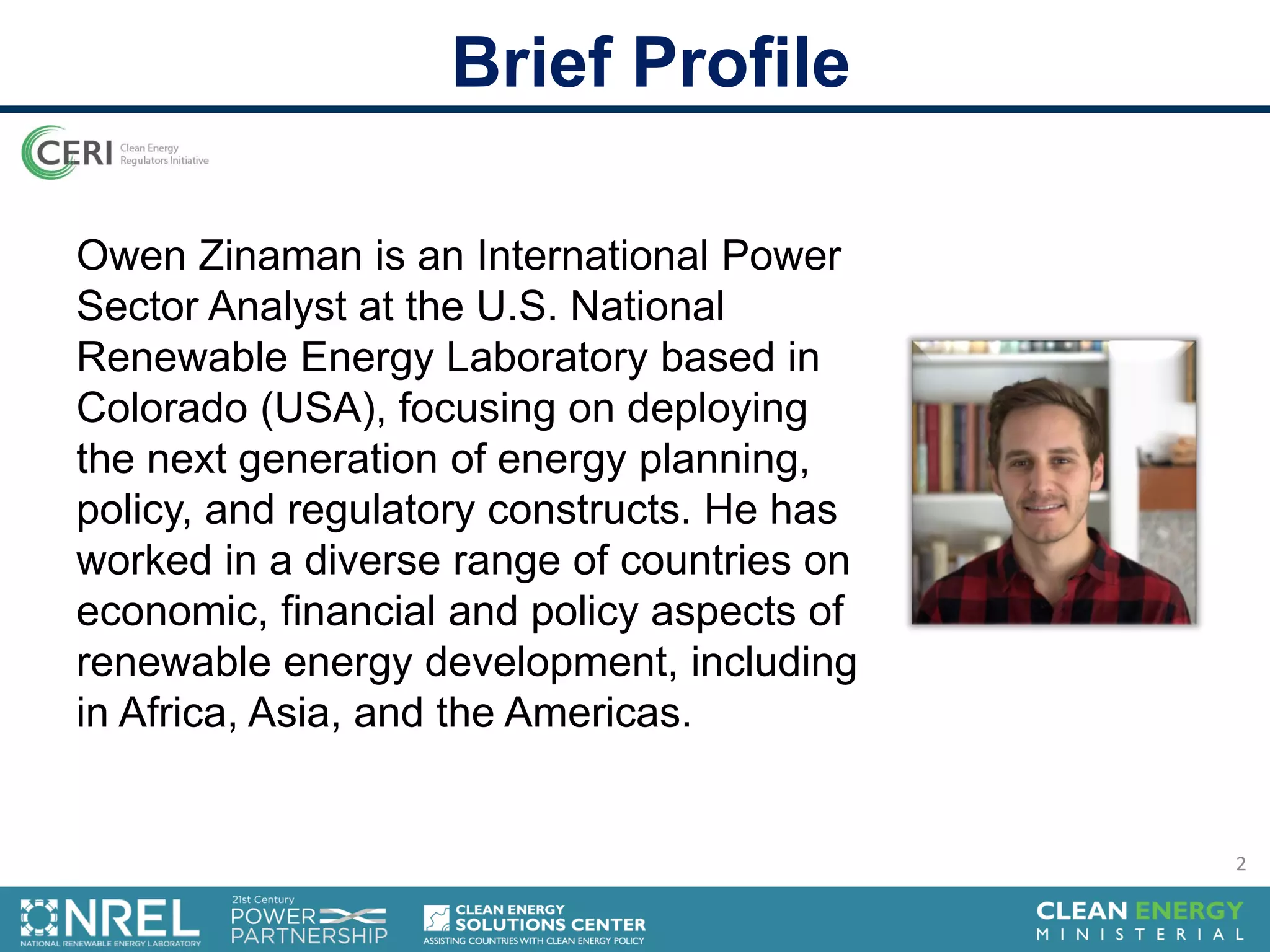
Owen Zinaman is an International Power
Sector Analyst at the U.S. National
Renewable Energy Laboratory based in
Colorado (USA), focusing on deploying
the next generation of energy planning,
policy, and regulatory constructs. He has
worked in a diverse range of countries on
economic, financial and policy aspects of
renewable energy development, including
in Africa, Asia, and the Americas.
2
Outline
Brief Overview of Power Sector Transformation
The Evolving Role of the Power Sector
Regulator
An Overview of Variable Renewable Energy
Regulatory Issues
Moving Forward: CERI Resources
3
Outline
Brief Overview of Power Sector Transformation
The Evolving Role of the Power Sector
Regulator
An Overview of Variable Renewable Energy
Regulatory Issues
Moving Forward: CERI Resources
4
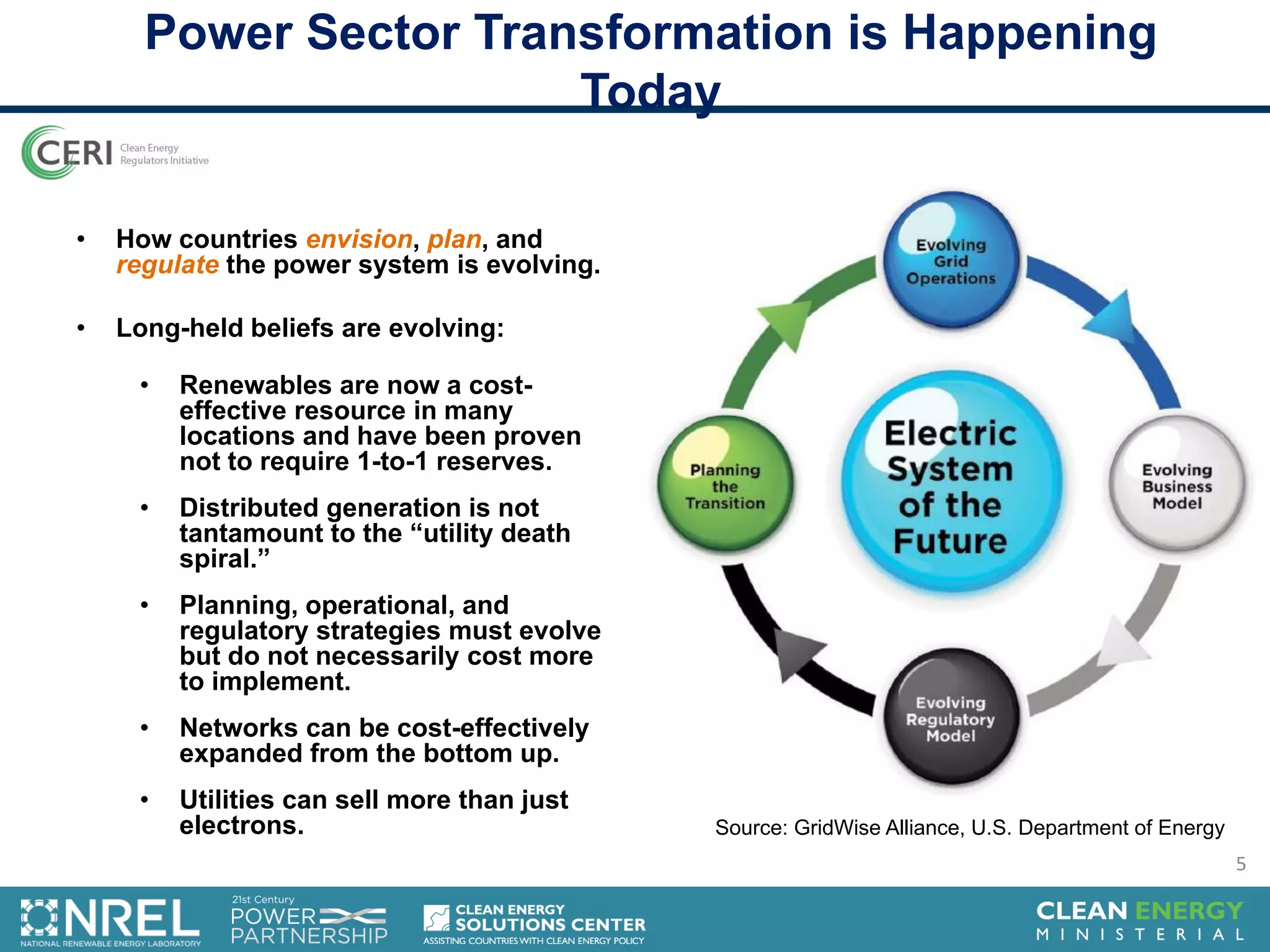
Power Sector Transformation is Happening
Today
• How countries envision, plan, and
regulate the power system is evolving.
• Long-held beliefs are evolving:
• Renewables are now a cost-
effective resource in many
locations and have been proven
not to require 1-to-1 reserves.
• Distributed generation is not
tantamount to the “utility death
spiral.”
• Planning, operational, and
regulatory strategies must evolve
but do not necessarily cost more
to implement.
• Networks can be cost-effectively
expanded from the bottom up.
• Utilities can sell more than just
electrons. Source: GridWise Alliance, U.S. Department of Energy
5
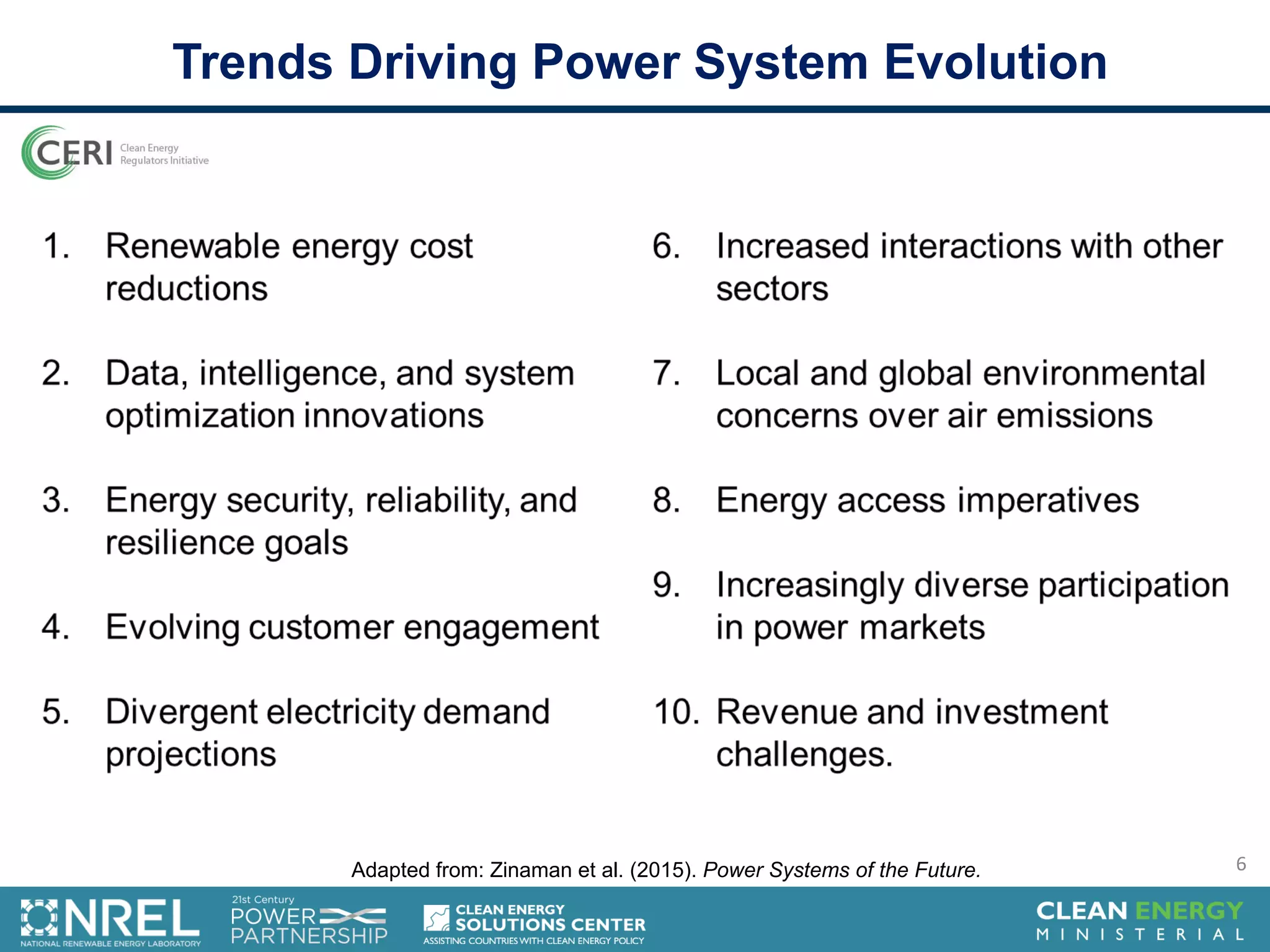
Trends Driving Power System Evolution
Adapted from: Zinaman et al. (2015). Power Systems of the Future. 6
Outline
Brief Overview of Power Sector Transformation
The Evolving Role of the Power Sector
Regulator
An Overview of Variable Renewable Energy
Regulatory Issues
Moving Forward: CERI Resources
7
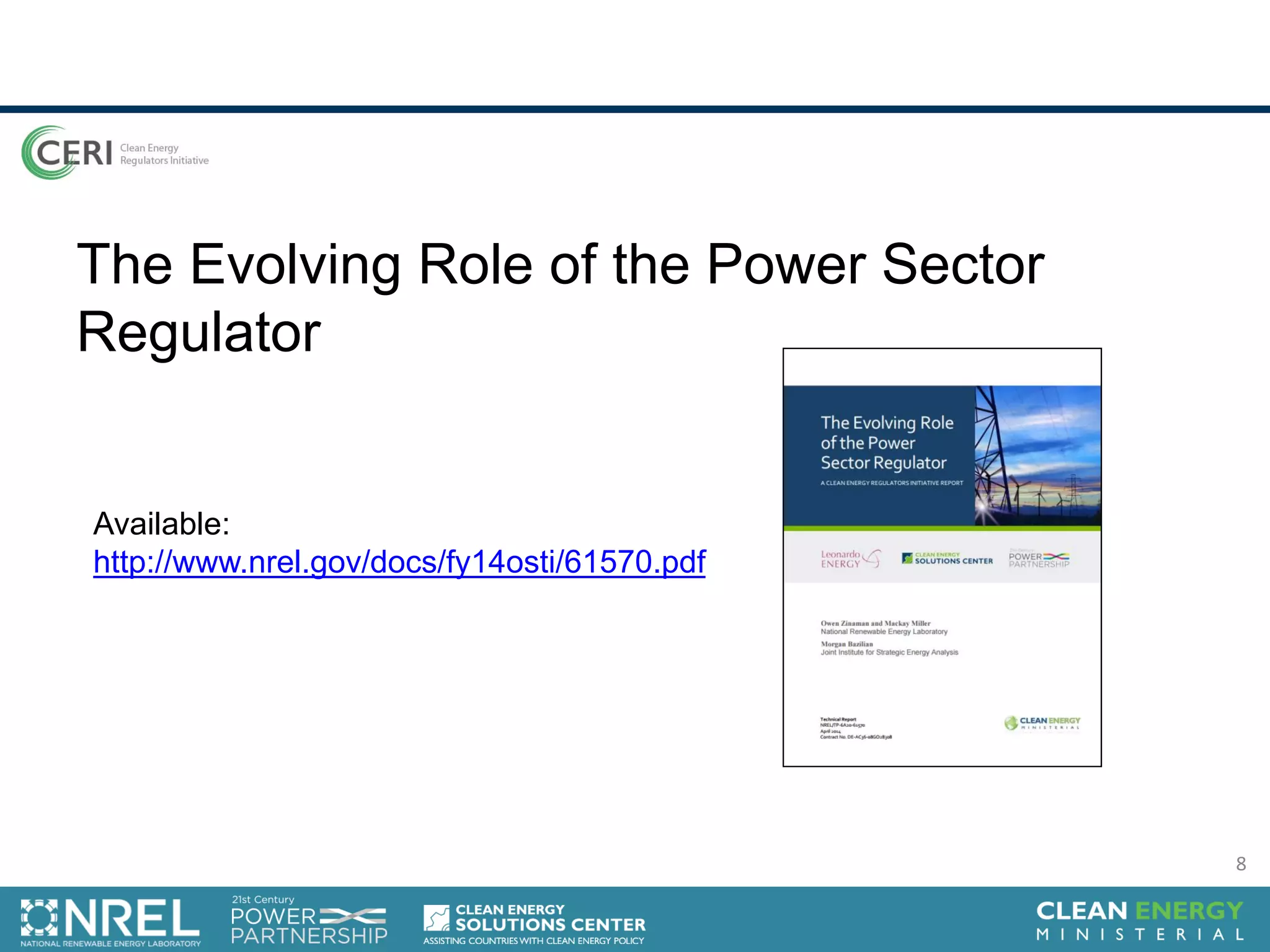
The Evolving Role of the Power Sector
Regulator
Available:
http://www.nrel.gov/docs/fy14osti/61570.pdf
8
• Power sector regulators are frequently “where the rubber hits
the road”
• Regulators seek to:
– understand emerging trends in policy, technology, planning,
operations, and finance
– understand the technology implications of executing a policy
goal
– evaluate new technology solutions and how they impact existing
and emerging objectives
– navigate a multitude of evolving objectives (both legacy and
new)
• The objectives (and therefore the role!) of regulators is
quickly evolving
9
• Evolving regulatory objectives drive a new
role for regulators
– Existing objectives are growing more
complicated
– New suite of emerging objectives poses a
novel set of challenges
10
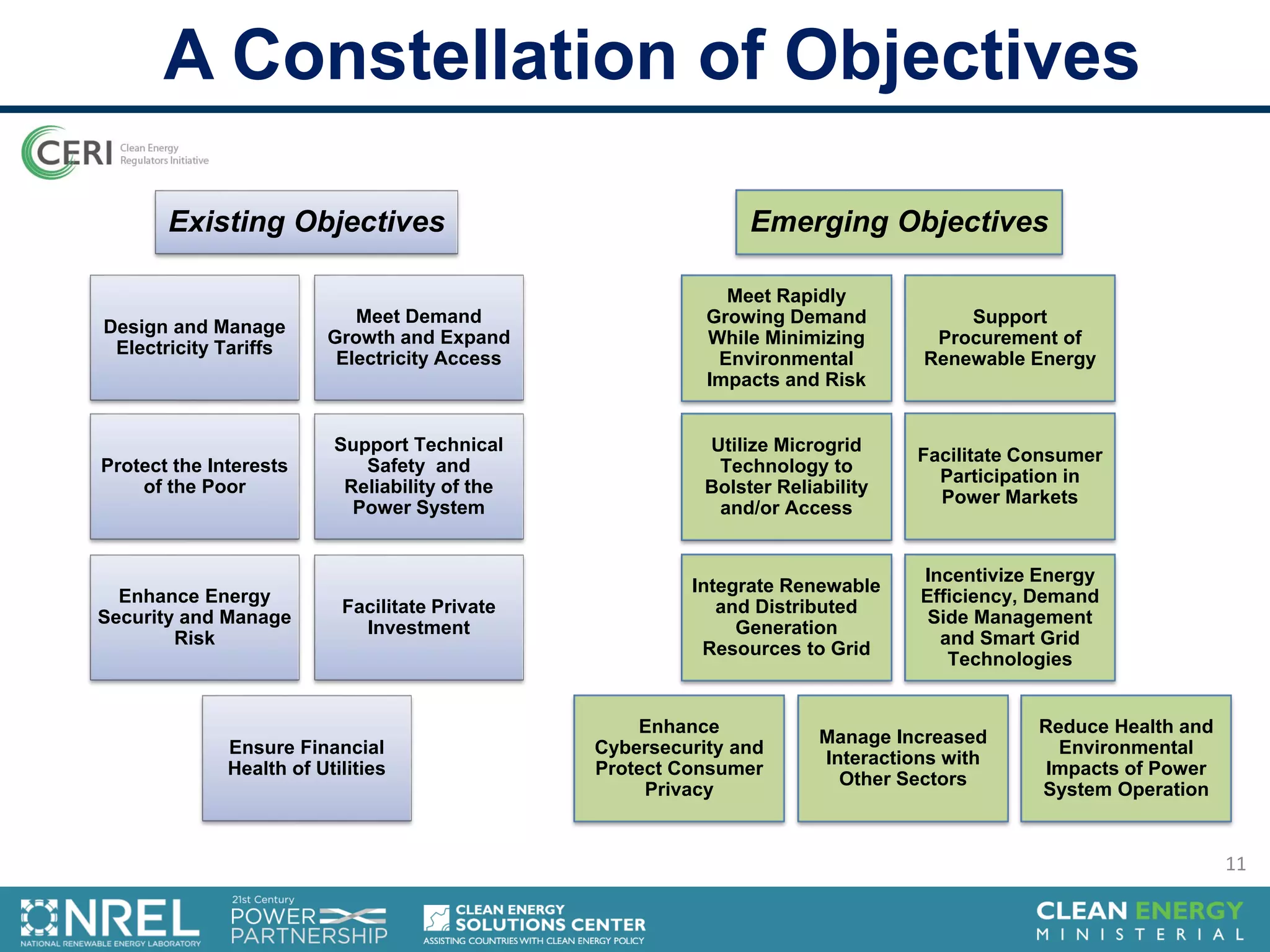
A Constellation of Objectives
Design and Manage
Electricity Tariffs
Meet Demand
Growth and Expand
Electricity Access
Ensure Financial
Health of Utilities
Facilitate Private
Investment
Protect the Interests
of the Poor
Support Technical
Safety and
Reliability of the
Power System
Enhance Energy
Security and Manage
Risk
Reduce Health and
Environmental
Impacts of Power
System Operation
Meet Rapidly
Growing Demand
While Minimizing
Environmental
Impacts and Risk
Support
Procurement of
Renewable Energy
Integrate Renewable
and Distributed
Generation
Resources to Grid
Incentivize Energy
Efficiency, Demand
Side Management
and Smart Grid
Technologies
Utilize Microgrid
Technology to
Bolster Reliability
and/or Access
Facilitate Consumer
Participation in
Power Markets
Enhance
Cybersecurity and
Protect Consumer
Privacy
Manage Increased
Interactions with
Other Sectors
Existing Objectives Emerging Objectives
11
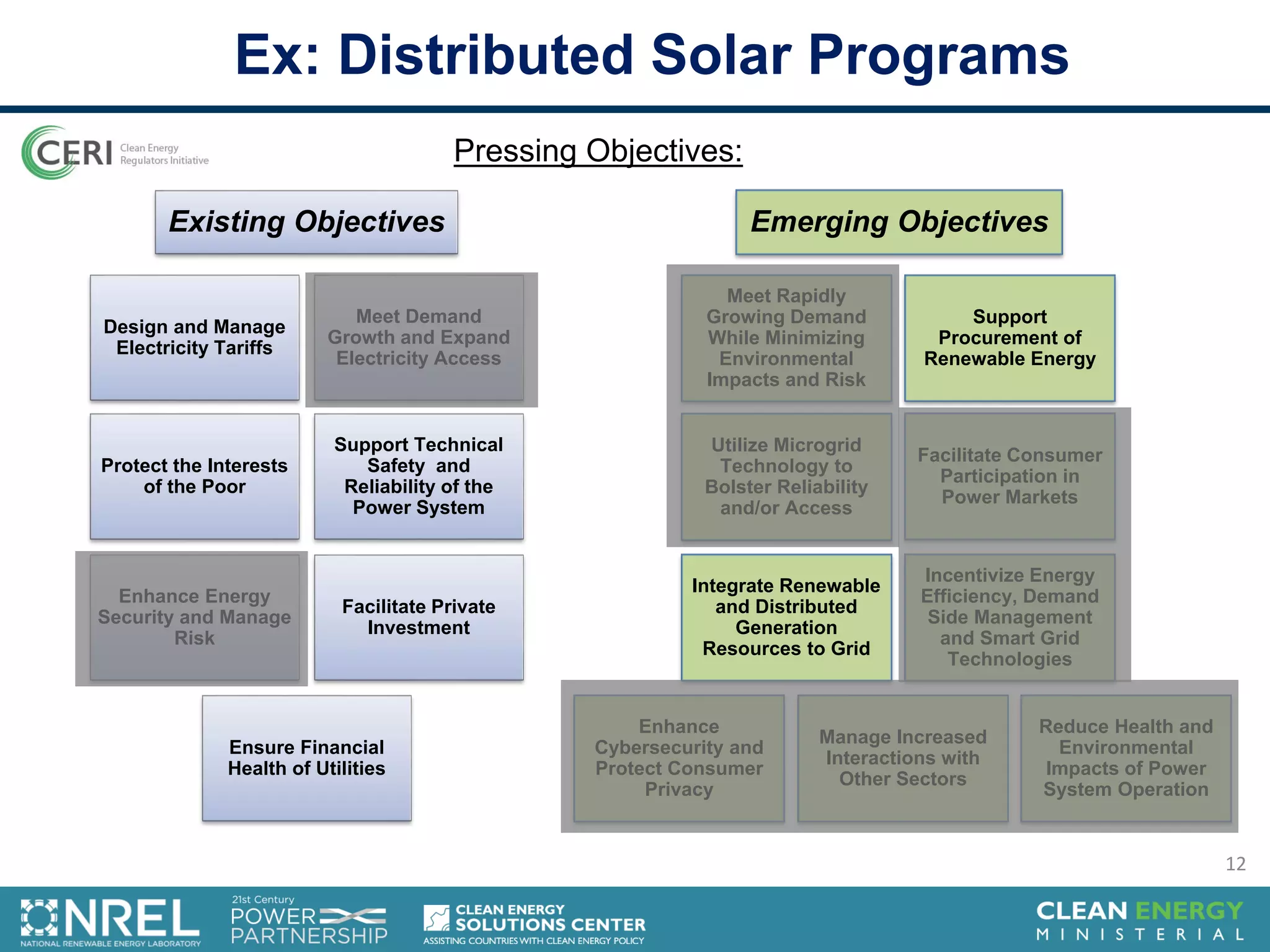
Ex: Distributed Solar Programs
Design and Manage
Electricity Tariffs
Meet Demand
Growth and Expand
Electricity Access
Ensure Financial
Health of Utilities
Facilitate Private
Investment
Protect the Interests
of the Poor
Support Technical
Safety and
Reliability of the
Power System
Enhance Energy
Security and Manage
Risk
Reduce Health and
Environmental
Impacts of Power
System Operation
Meet Rapidly
Growing Demand
While Minimizing
Environmental
Impacts and Risk
Support
Procurement of
Renewable Energy
Integrate Renewable
and Distributed
Generation
Resources to Grid
Incentivize Energy
Efficiency, Demand
Side Management
and Smart Grid
Technologies
Utilize Microgrid
Technology to
Bolster Reliability
and/or Access
Facilitate Consumer
Participation in
Power Markets
Enhance
Cybersecurity and
Protect Consumer
Privacy
Manage Increased
Interactions with
Other Sectors
Existing Objectives Emerging Objectives
Pressing Objectives:
12
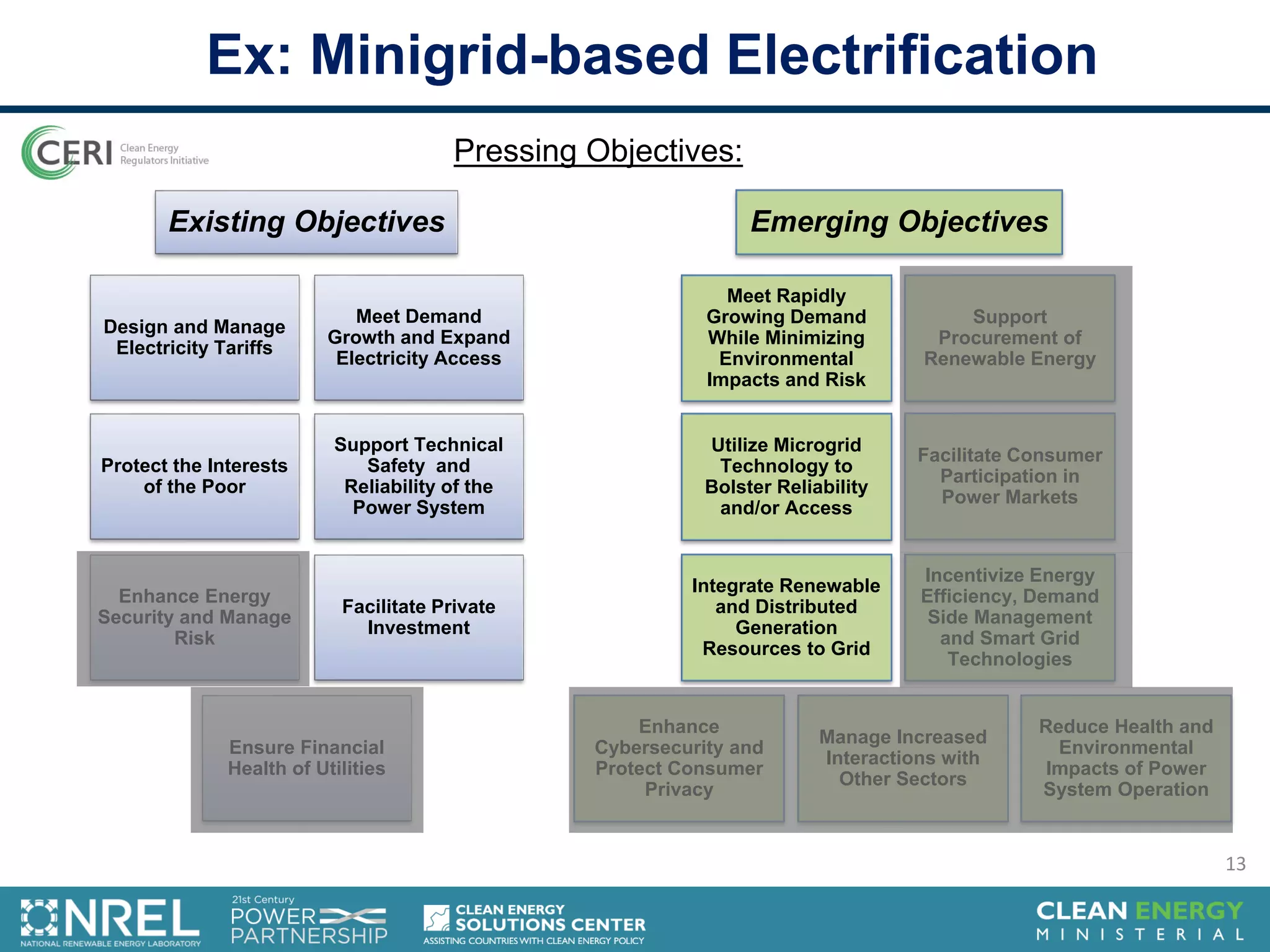
Ex: Minigrid-based Electrification
Design and Manage
Electricity Tariffs
Meet Demand
Growth and Expand
Electricity Access
Ensure Financial
Health of Utilities
Facilitate Private
Investment
Protect the Interests
of the Poor
Support Technical
Safety and
Reliability of the
Power System
Enhance Energy
Security and Manage
Risk
Reduce Health and
Environmental
Impacts of Power
System Operation
Meet Rapidly
Growing Demand
While Minimizing
Environmental
Impacts and Risk
Support
Procurement of
Renewable Energy
Integrate Renewable
and Distributed
Generation
Resources to Grid
Incentivize Energy
Efficiency, Demand
Side Management
and Smart Grid
Technologies
Utilize Microgrid
Technology to
Bolster Reliability
and/or Access
Facilitate Consumer
Participation in
Power Markets
Enhance
Cybersecurity and
Protect Consumer
Privacy
Manage Increased
Interactions with
Other Sectors
Existing Objectives Emerging Objectives
Pressing Objectives:
13
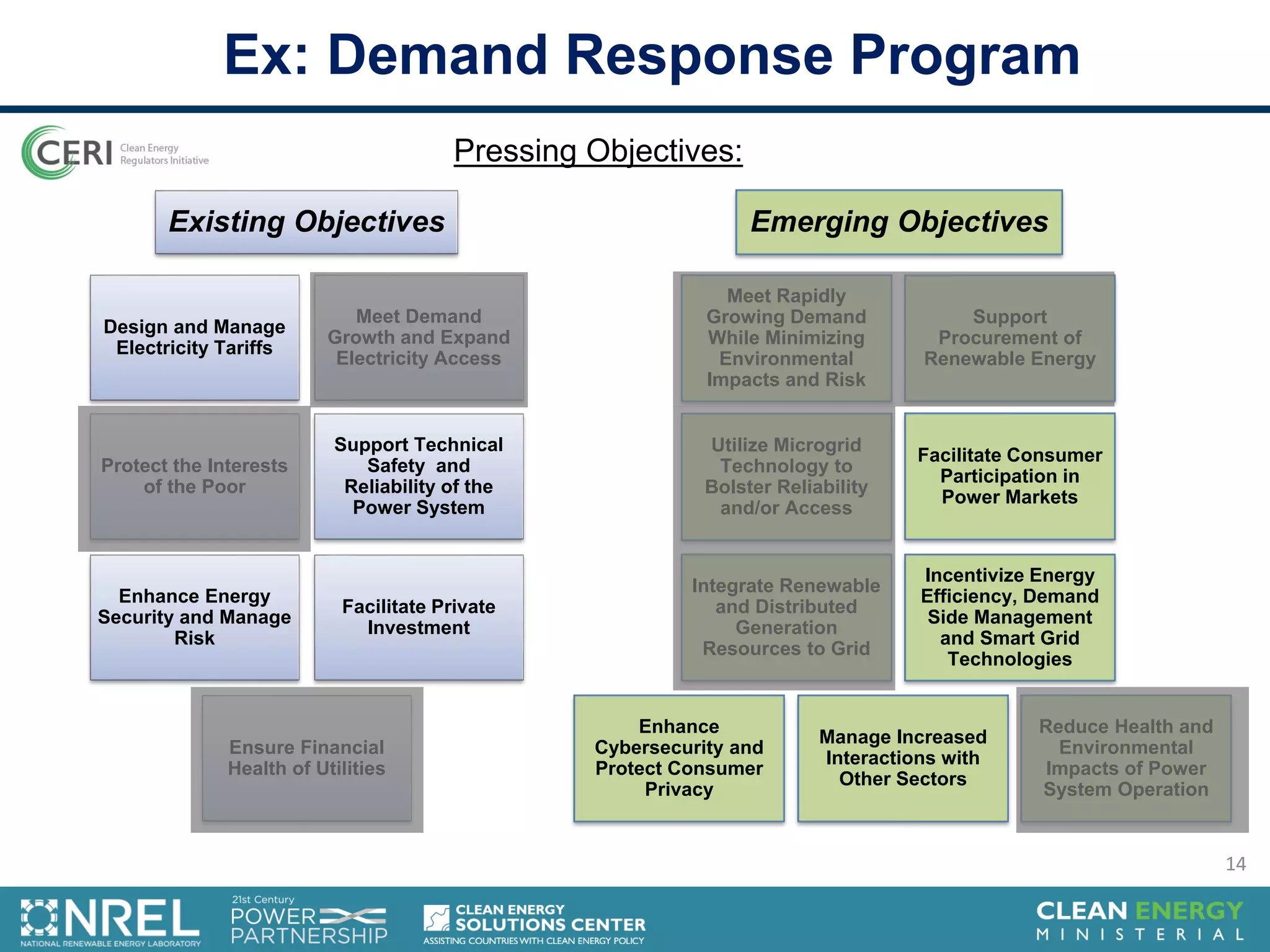
Ex: Demand Response Program
Design and Manage
Electricity Tariffs
Meet Demand
Growth and Expand
Electricity Access
Ensure Financial
Health of Utilities
Facilitate Private
Investment
Protect the Interests
of the Poor
Support Technical
Safety and
Reliability of the
Power System
Enhance Energy
Security and Manage
Risk
Reduce Health and
Environmental
Impacts of Power
System Operation
Meet Rapidly
Growing Demand
While Minimizing
Environmental
Impacts and Risk
Support
Procurement of
Renewable Energy
Integrate Renewable
and Distributed
Generation
Resources to Grid
Incentivize Energy
Efficiency, Demand
Side Management
and Smart Grid
Technologies
Utilize Microgrid
Technology to
Bolster Reliability
and/or Access
Facilitate Consumer
Participation in
Power Markets
Enhance
Cybersecurity and
Protect Consumer
Privacy
Manage Increased
Interactions with
Other Sectors
Existing Objectives Emerging Objectives
Pressing Objectives:
14
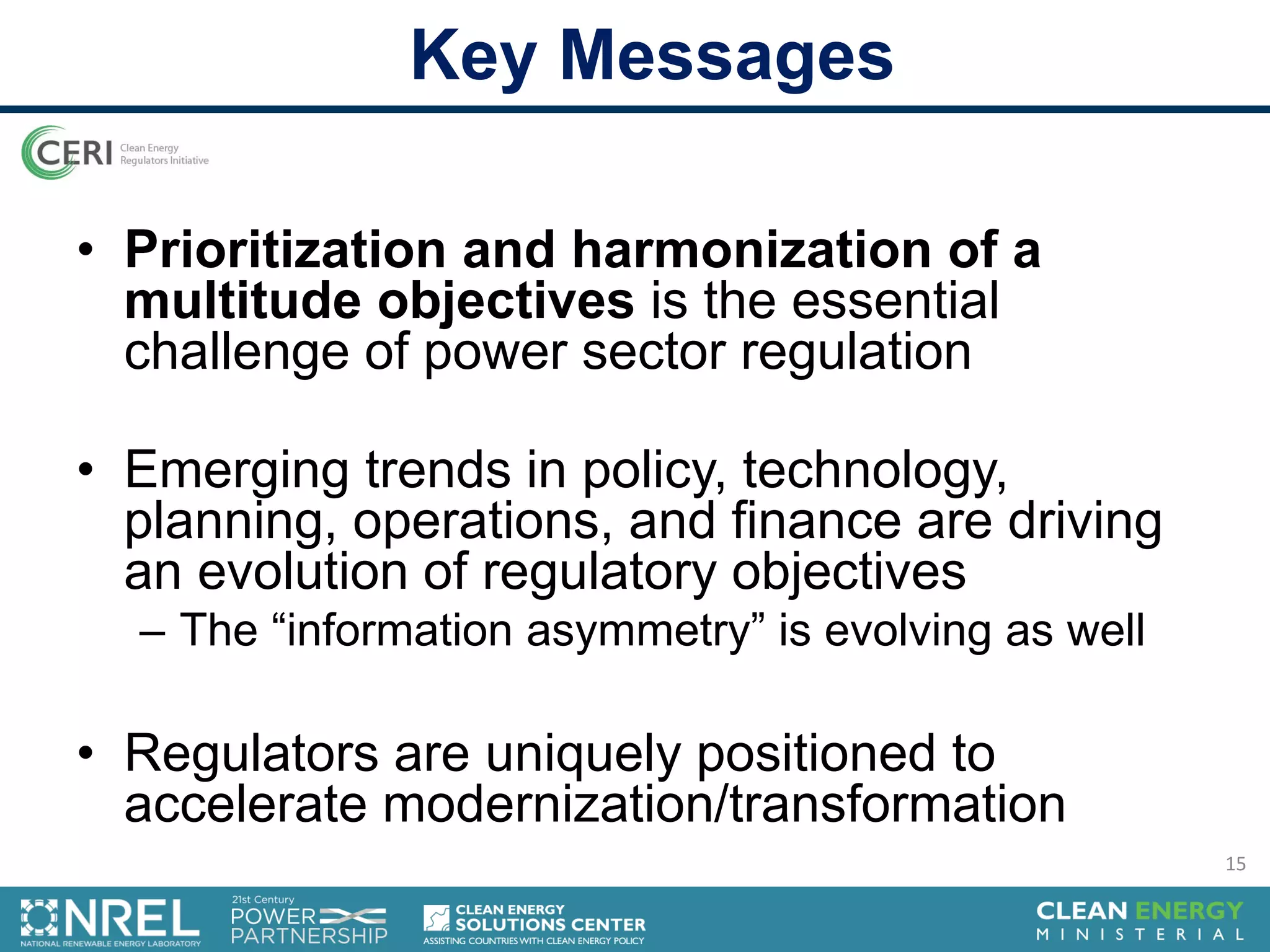
• Prioritization and harmonization of a
multitude objectives is the essential
challenge of power sector regulation
• Emerging trends in policy, technology,
planning, operations, and finance are driving
an evolution of regulatory objectives
– The “information asymmetry” is evolving as well
• Regulators are uniquely positioned to
accelerate modernization/transformation
Key Messages
15
Outline
Brief Overview of Power Sector Transformation
The Evolving Role of the Power Sector
Regulator
An Overview of Variable Renewable Energy
Regulatory Issues
Moving Forward: CERI Resources
16
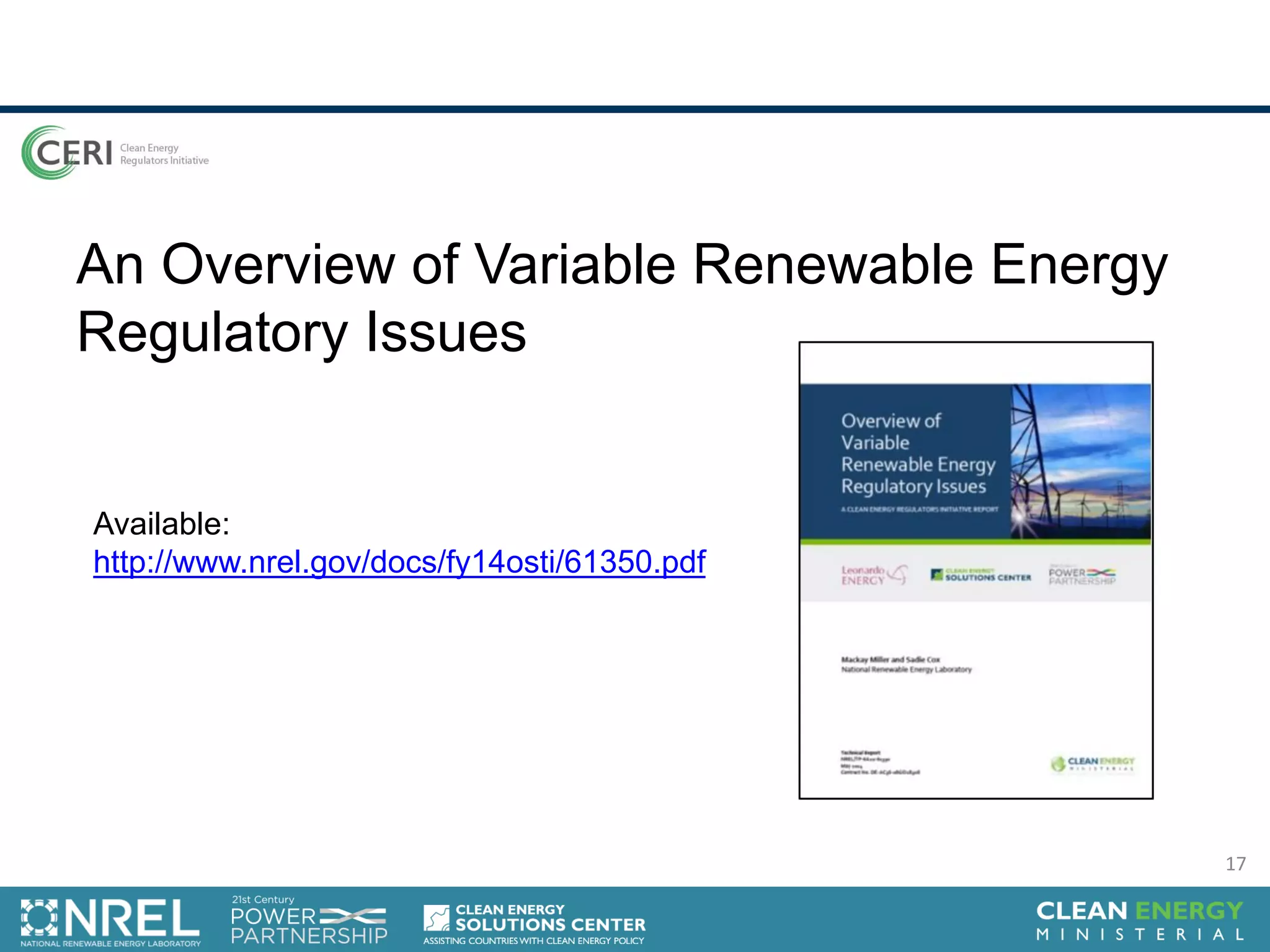
An Overview of Variable Renewable Energy
Regulatory Issues
Available:
http://www.nrel.gov/docs/fy14osti/61350.pdf
17
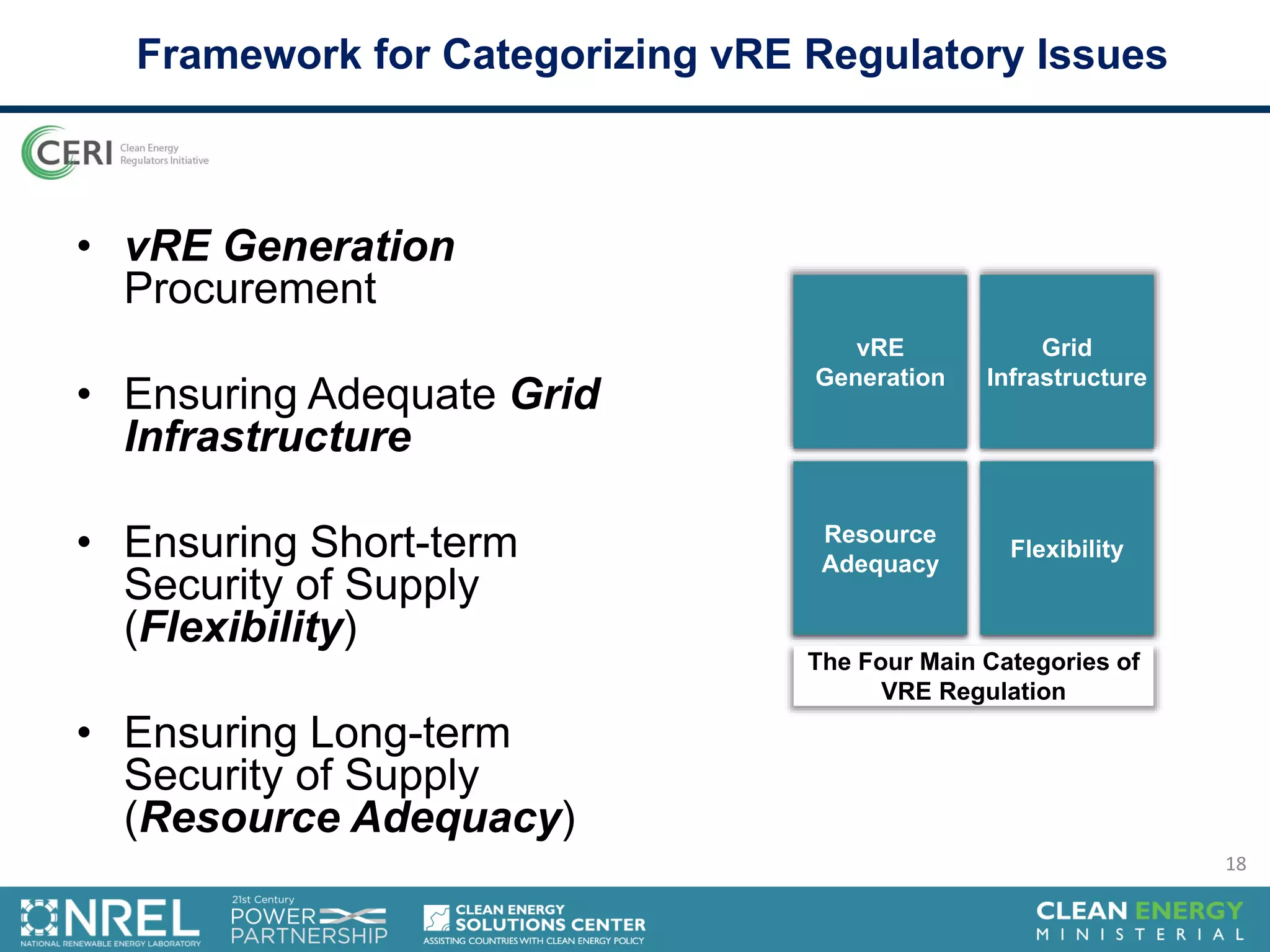
• vRE Generation
Procurement
• Ensuring Adequate Grid
Infrastructure
• Ensuring Short-term
Security of Supply
(Flexibility)
• Ensuring Long-term
Security of Supply
(Resource Adequacy)
Framework for Categorizing vRE Regulatory Issues
vRE
Generation
Grid
Infrastructure
Resource
Adequacy
Flexibility
The Four Main Categories of
VRE Regulation
18
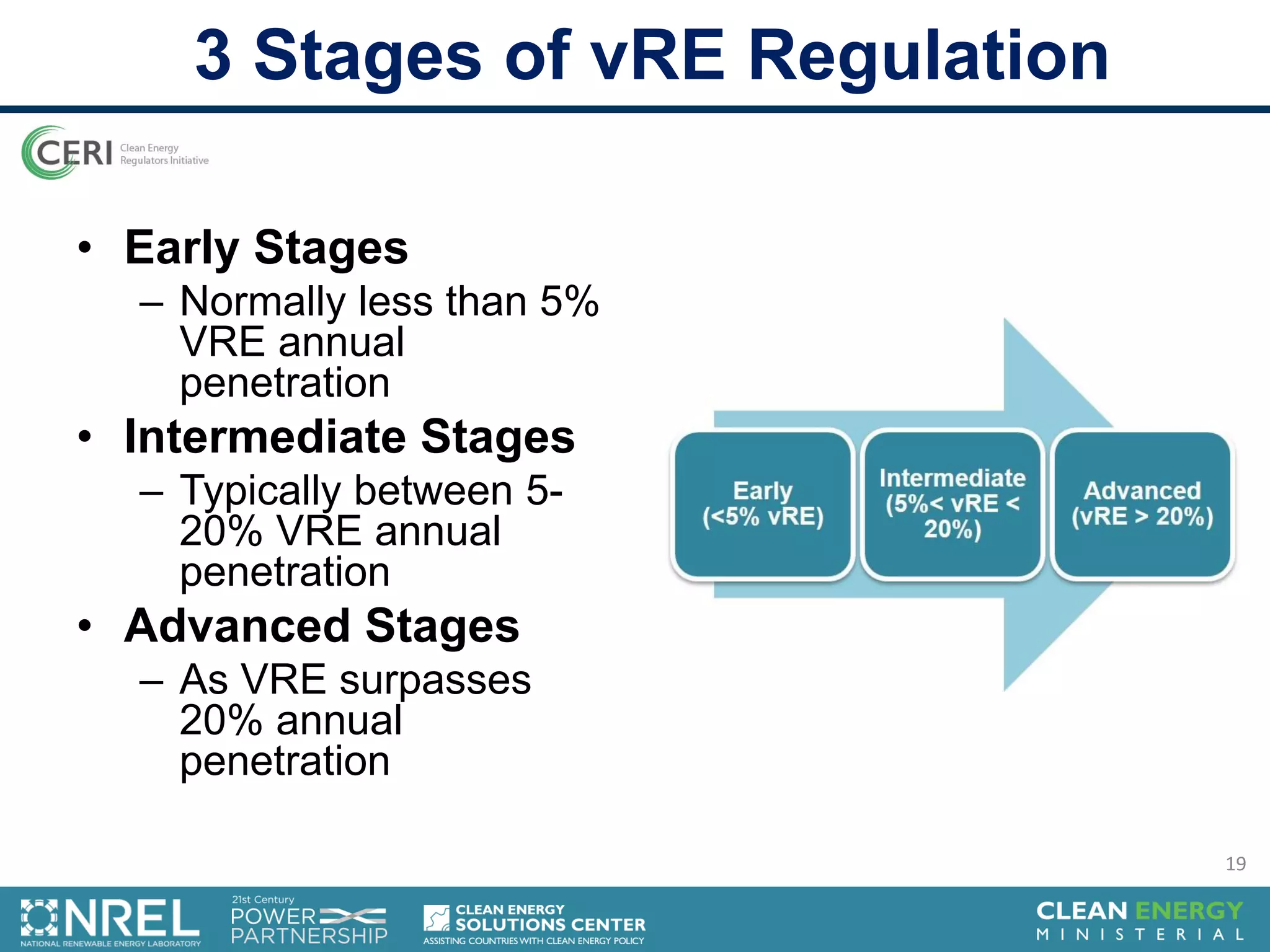
• Early Stages
– Normally less than 5%
VRE annual
penetration
• Intermediate Stages
– Typically between 5-
20% VRE annual
penetration
• Advanced Stages
– As VRE surpasses
20% annual
penetration
3 Stages of vRE Regulation
19
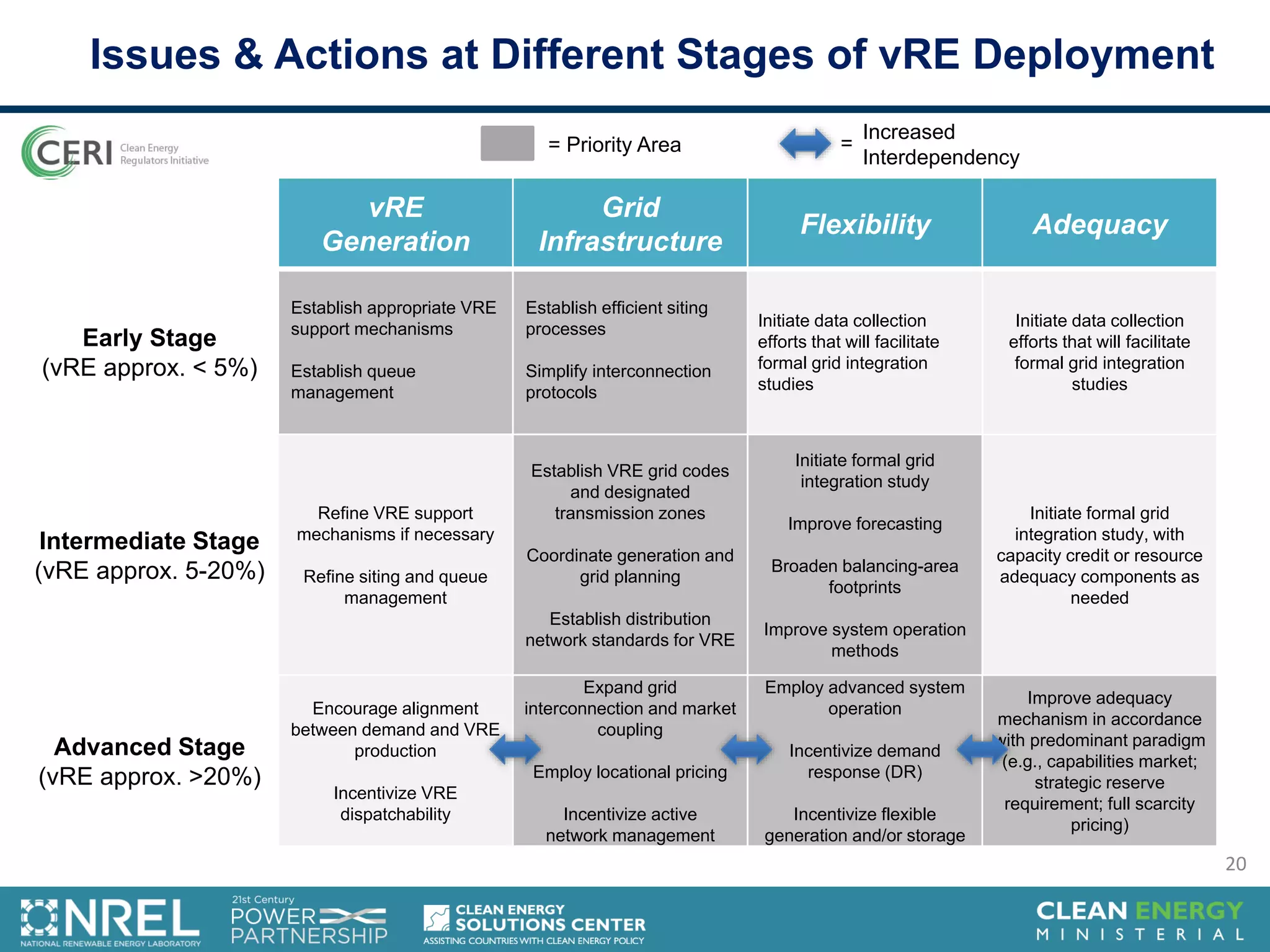
vRE
Generation
Grid
Infrastructure
Flexibility Adequacy
Early Stage
(vRE approx. < 5%)
Establish appropriate VRE
support mechanisms
Establish queue
management
Establish efficient siting
processes
Simplify interconnection
protocols
Initiate data collection
efforts that will facilitate
formal grid integration
studies
Initiate data collection
efforts that will facilitate
formal grid integration
studies
Intermediate Stage
(vRE approx. 5-20%)
Refine VRE support
mechanisms if necessary
Refine siting and queue
management
Establish VRE grid codes
and designated
transmission zones
Coordinate generation and
grid planning
Establish distribution
network standards for VRE
Initiate formal grid
integration study
Improve forecasting
Broaden balancing-area
footprints
Improve system operation
methods
Initiate formal grid
integration study, with
capacity credit or resource
adequacy components as
needed
Advanced Stage
(vRE approx. >20%)
Encourage alignment
between demand and VRE
production
Incentivize VRE
dispatchability
Expand grid
interconnection and market
coupling
Employ locational pricing
Incentivize active
network management
Employ advanced system
operation
Incentivize demand
response (DR)
Incentivize flexible
generation and/or storage
Improve adequacy
mechanism in accordance
with predominant paradigm
(e.g., capabilities market;
strategic reserve
requirement; full scarcity
pricing)
Issues & Actions at Different Stages of vRE Deployment
Increased
Interdependency
= Priority Area =
20
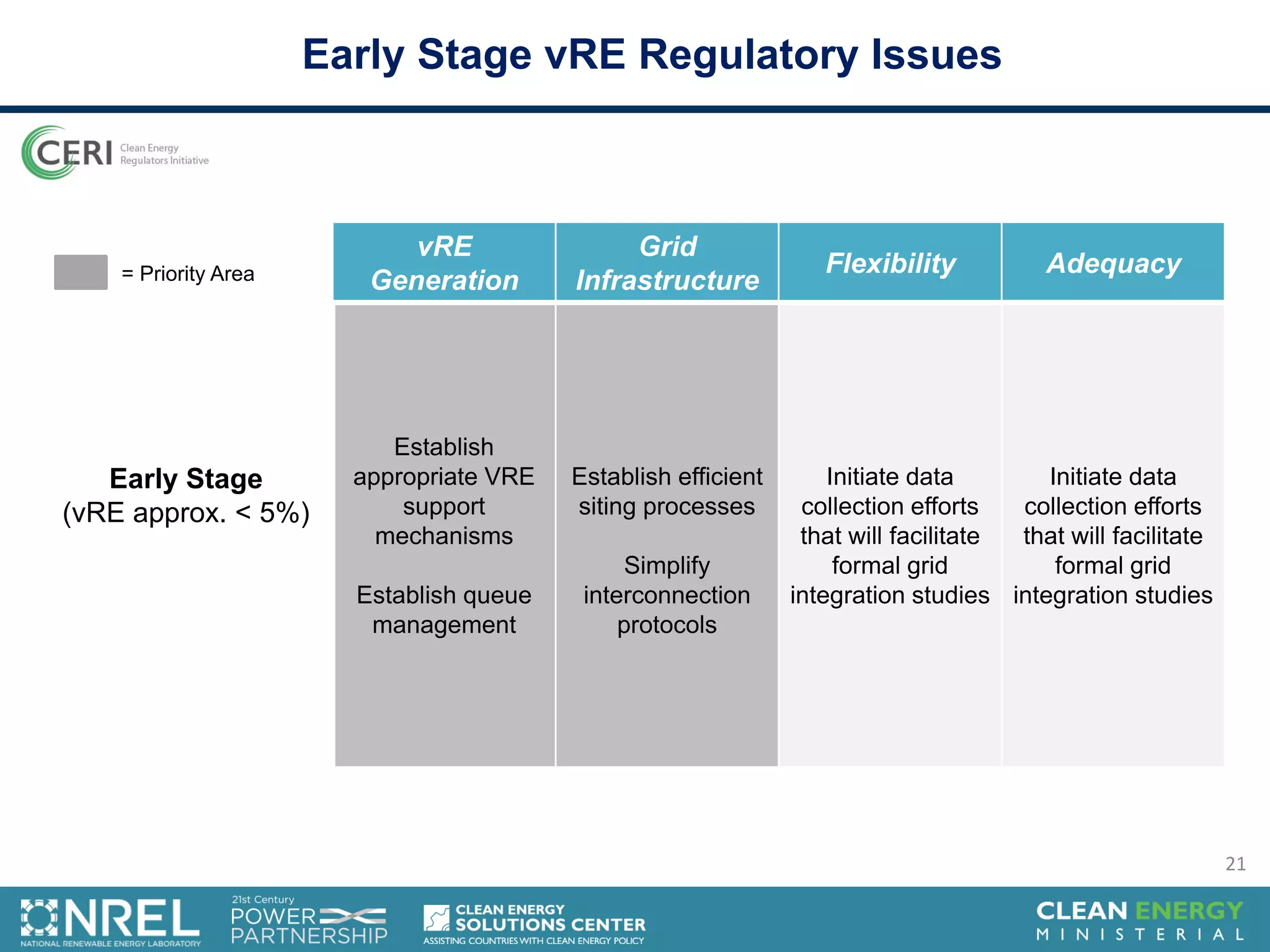
Early Stage vRE Regulatory Issues
Early Stage
(vRE approx. < 5%)
vRE
Generation
Grid
Infrastructure
Flexibility Adequacy
Establish
appropriate VRE
support
mechanisms
Establish queue
management
Establish efficient
siting processes
Simplify
interconnection
protocols
Initiate data
collection efforts
that will facilitate
formal grid
integration studies
Initiate data
collection efforts
that will facilitate
formal grid
integration studies
= Priority Area
21
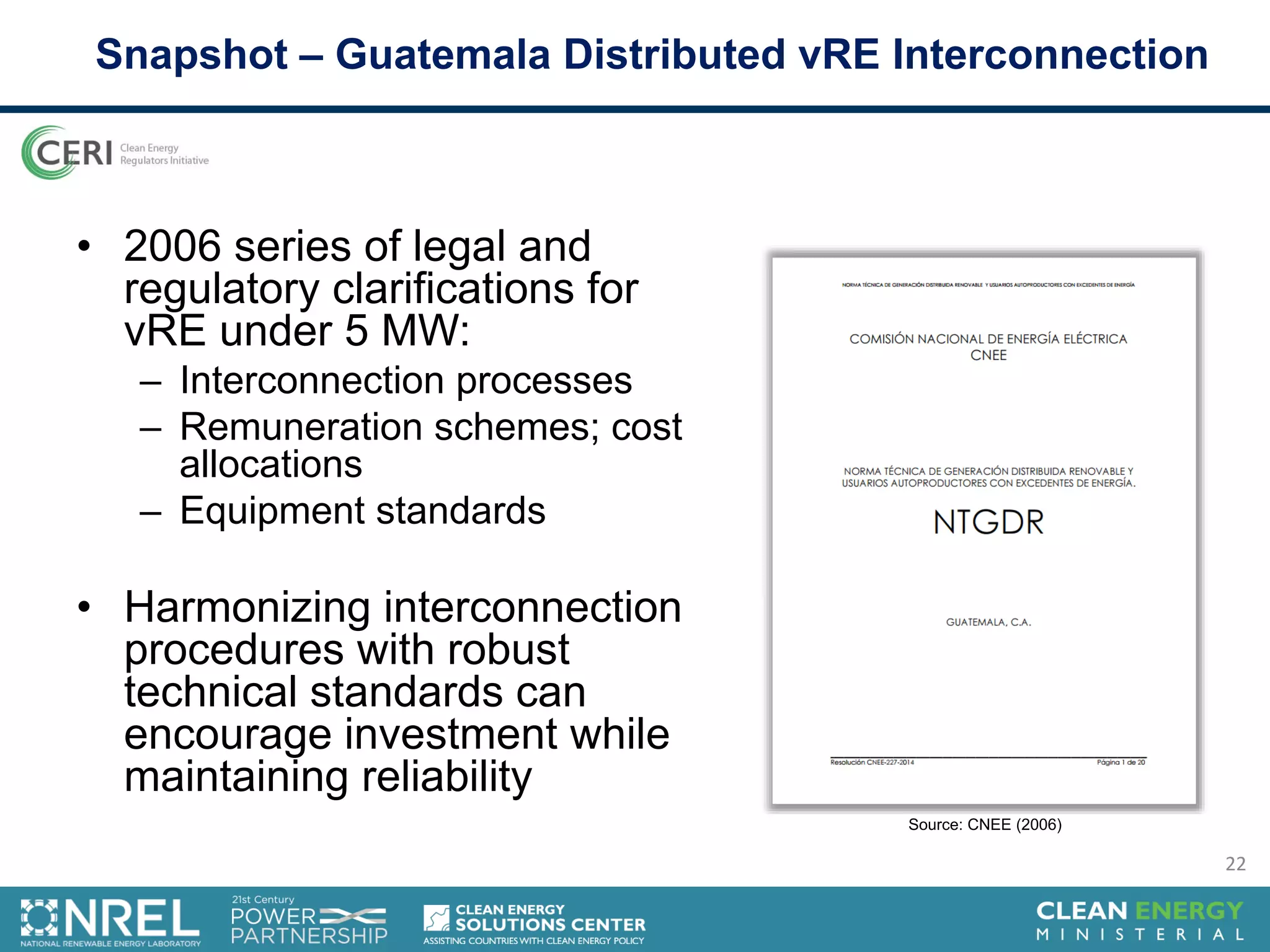
• 2006 series of legal and
regulatory clarifications for
vRE under 5 MW:
– Interconnection processes
– Remuneration schemes; cost
allocations
– Equipment standards
• Harmonizing interconnection
procedures with robust
technical standards can
encourage investment while
maintaining reliability
Snapshot – Guatemala Distributed vRE Interconnection
Source: CNEE (2006)
22
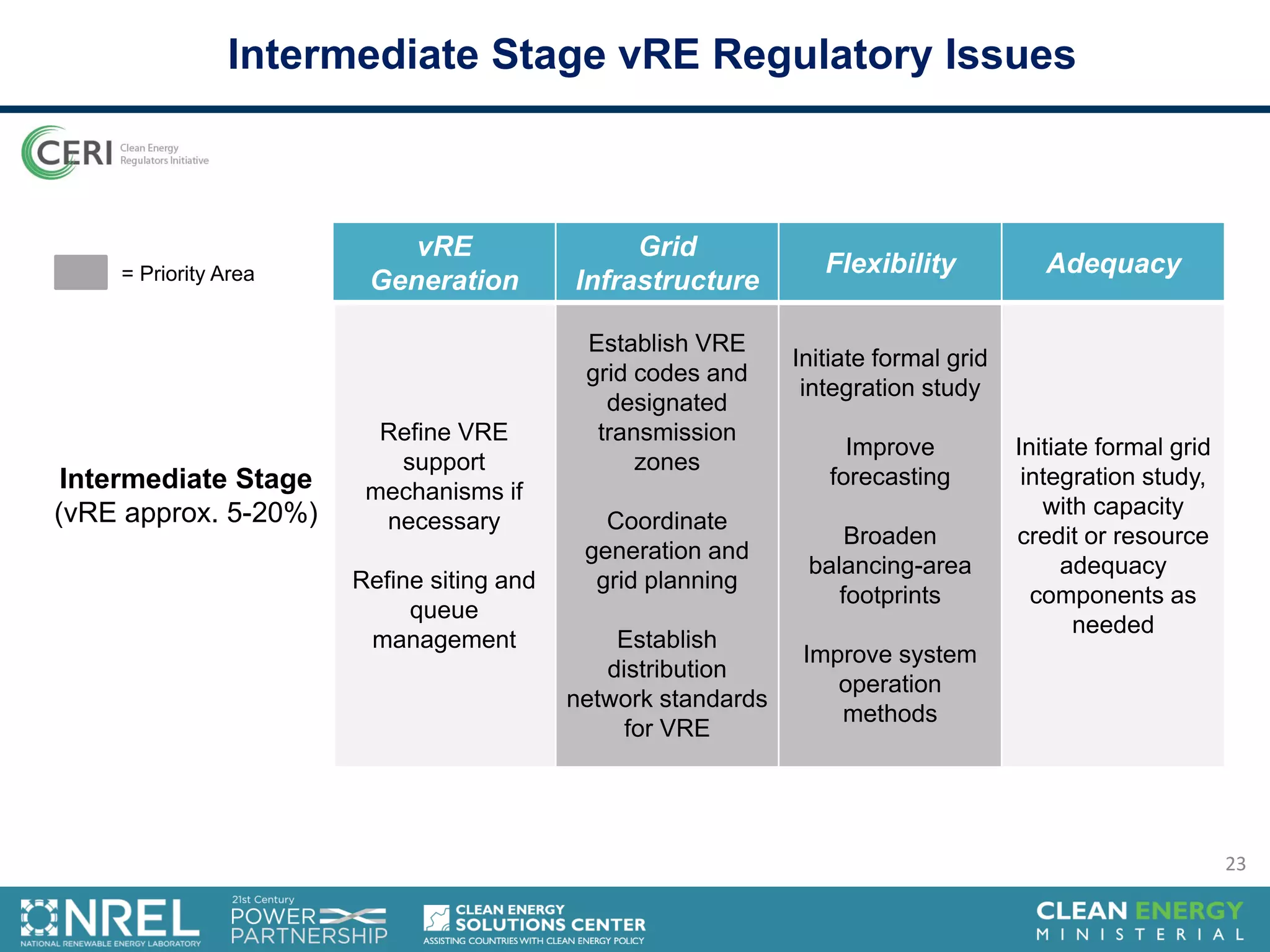
Intermediate Stage vRE Regulatory Issues
Intermediate Stage
(vRE approx. 5-20%)
vRE
Generation
Grid
Infrastructure
Flexibility Adequacy
Refine VRE
support
mechanisms if
necessary
Refine siting and
queue
management
Establish VRE
grid codes and
designated
transmission
zones
Coordinate
generation and
grid planning
Establish
distribution
network standards
for VRE
Initiate formal grid
integration study
Improve
forecasting
Broaden
balancing-area
footprints
Improve system
operation
methods
Initiate formal grid
integration study,
with capacity
credit or resource
adequacy
components as
needed
= Priority Area
23
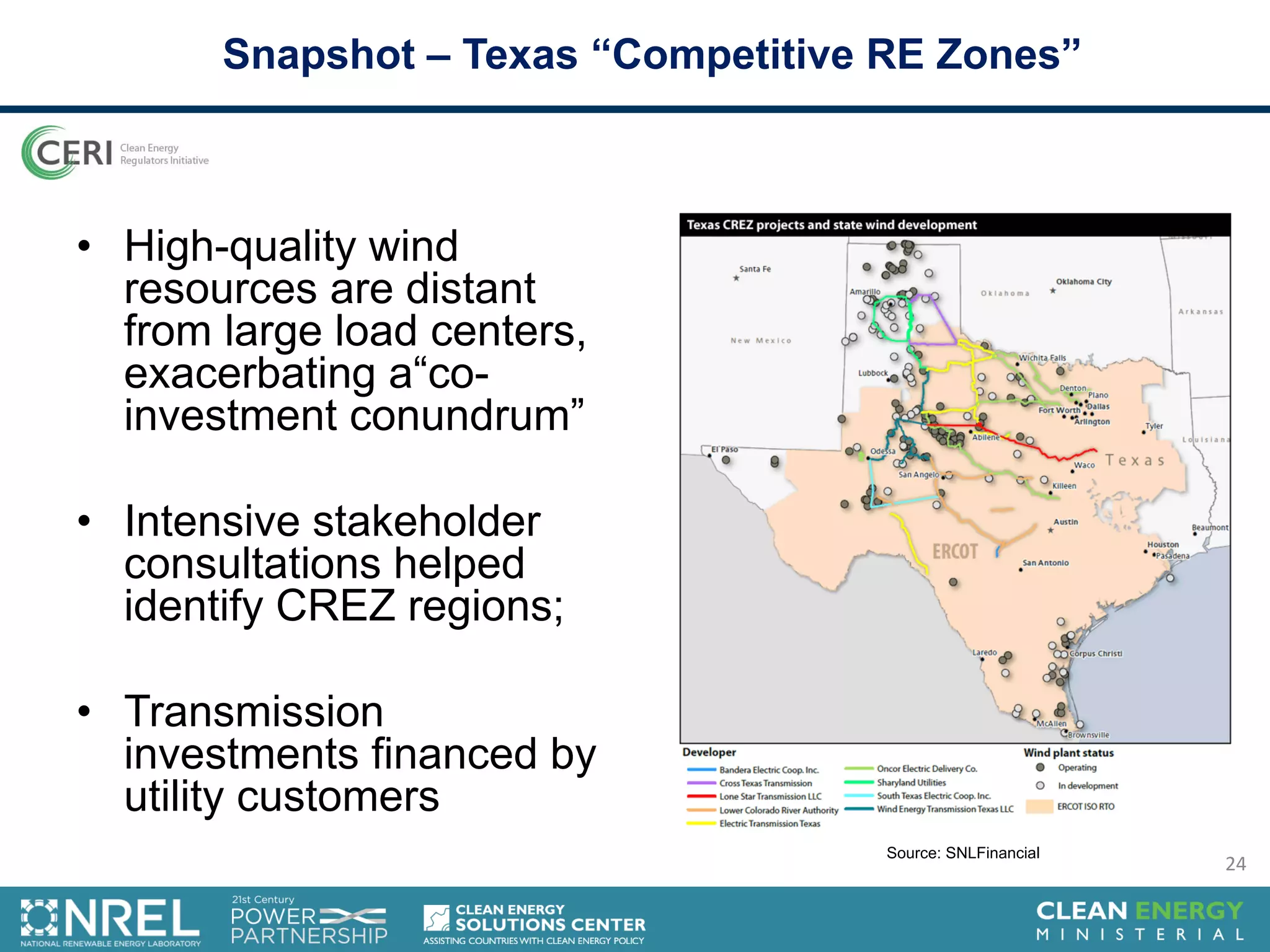
• High-quality wind
resources are distant
from large load centers,
exacerbating a“co-
investment conundrum”
• Intensive stakeholder
consultations helped
identify CREZ regions;
• Transmission
investments financed by
utility customers
Snapshot – Texas “Competitive RE Zones”
Source: SNLFinancial
24
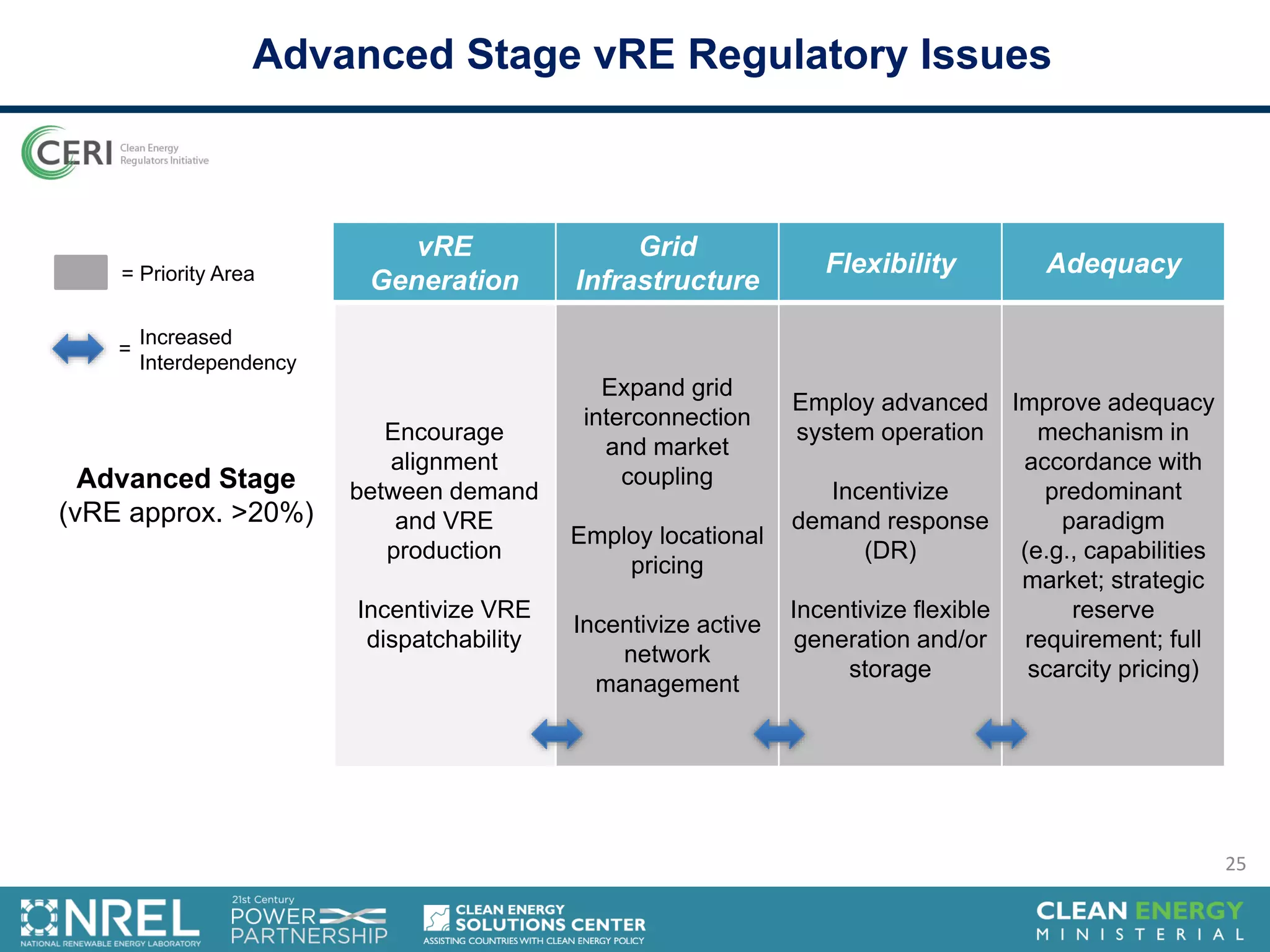
Advanced Stage vRE Regulatory Issues
Advanced Stage
(vRE approx. >20%)
vRE
Generation
Grid
Infrastructure
Flexibility Adequacy
Encourage
alignment
between demand
and VRE
production
Incentivize VRE
dispatchability
Expand grid
interconnection
and market
coupling
Employ locational
pricing
Incentivize active
network
management
Employ advanced
system operation
Incentivize
demand response
(DR)
Incentivize flexible
generation and/or
storage
Improve adequacy
mechanism in
accordance with
predominant
paradigm
(e.g., capabilities
market; strategic
reserve
requirement; full
scarcity pricing)
Increased
Interdependency
= Priority Area
=
25
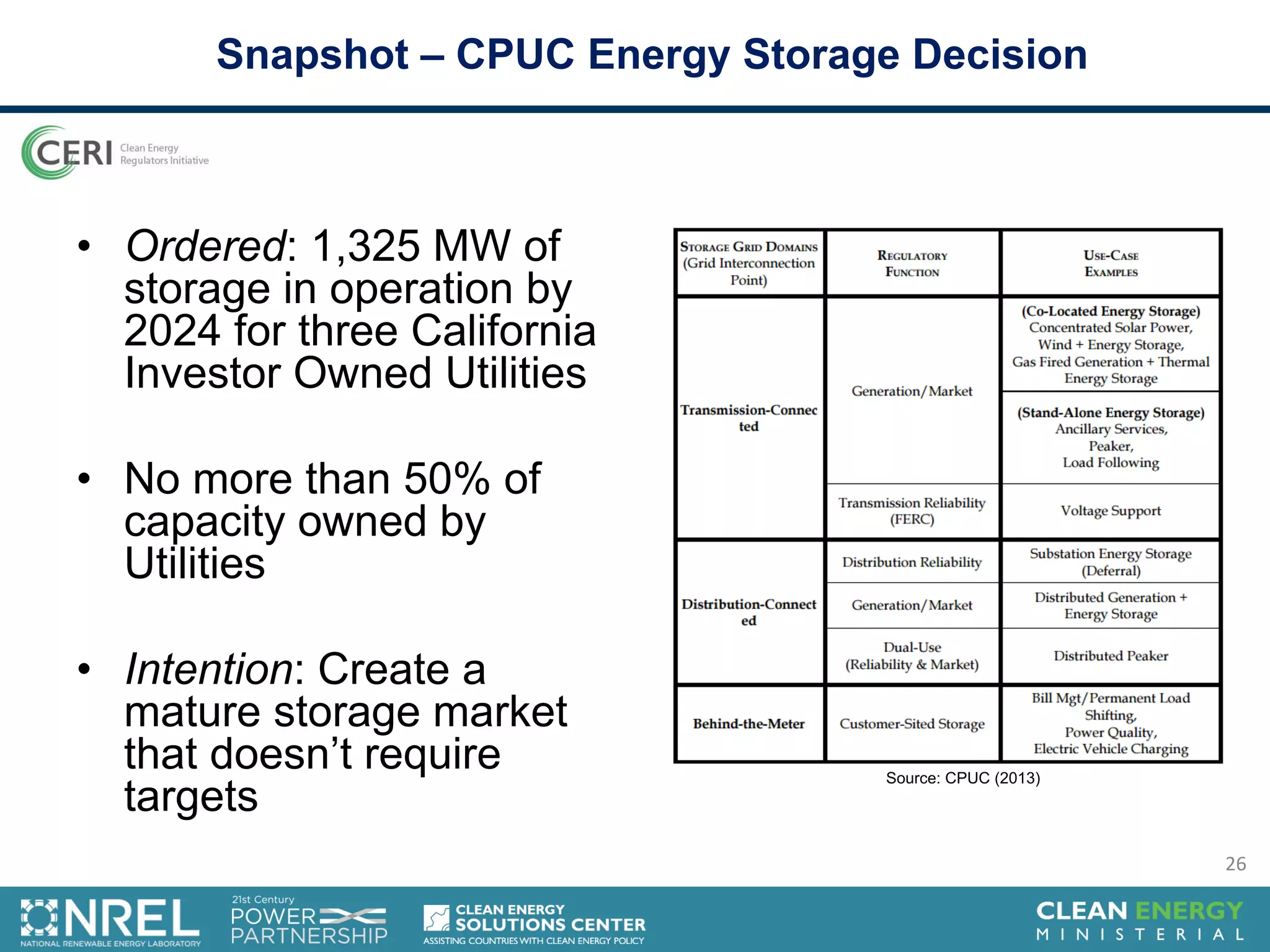
• Ordered: 1,325 MW of
storage in operation by
2024 for three California
Investor Owned Utilities
• No more than 50% of
capacity owned by
Utilities
• Intention: Create a
mature storage market
that doesn’t require
targets
Snapshot – CPUC Energy Storage Decision
Source: CPUC (2013)
26
• Unique forces at play in each regulatory
context
• Common issues and key ideas emerge
across contexts and at each stage of vRE
deployment and integration
• Regulating vRE presents a novel
landscape of challenges and opportunities
Key Takeaways
27
Outline
Brief Overview of Power Sector Transformation
The Evolving Role of the Power Sector
Regulator
An Overview of Variable Renewable Energy
Regulatory Issues
Moving Forward: CERI Resources
28
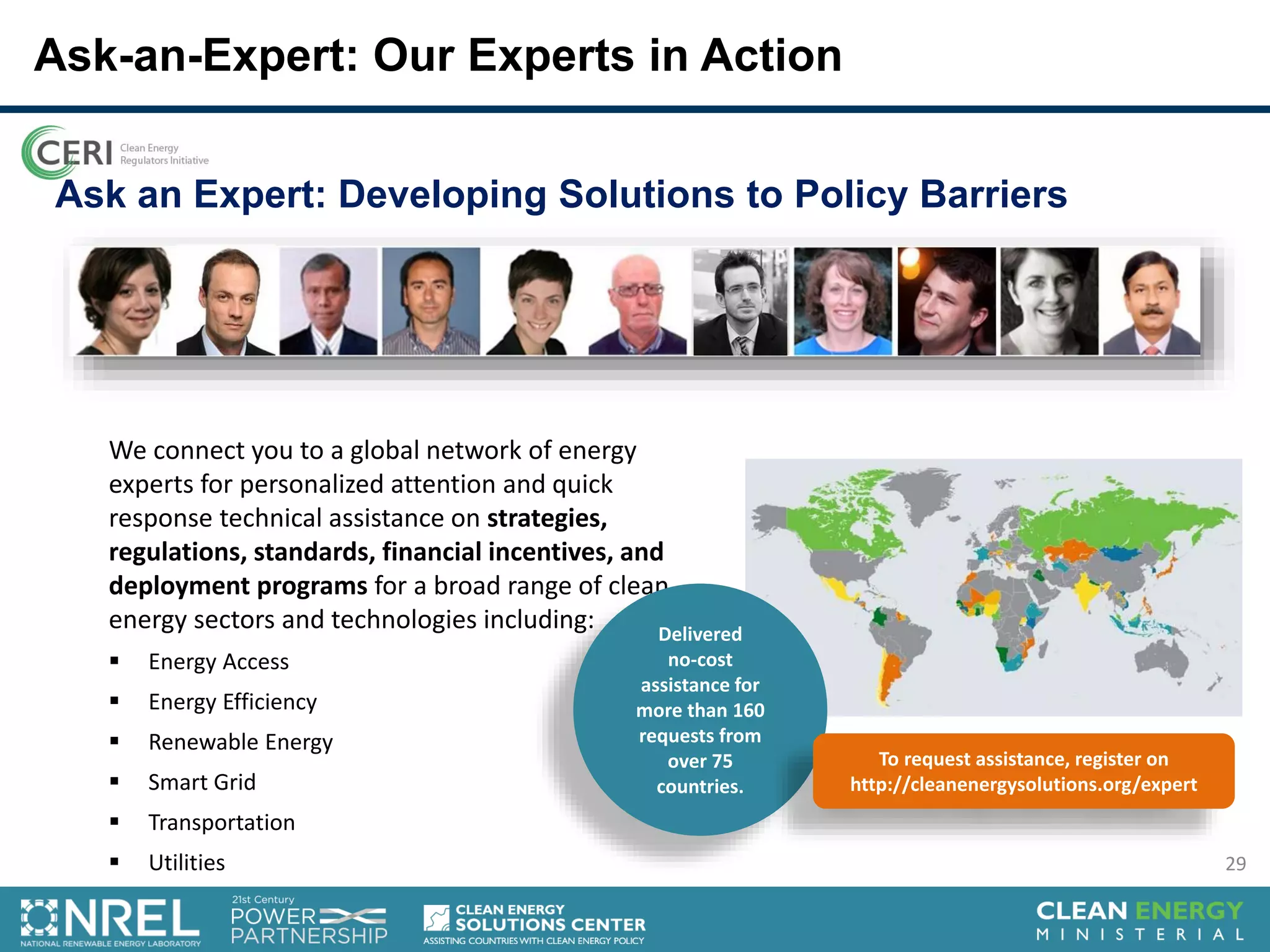
Ask an Expert: Developing Solutions to Policy Barriers
We connect you to a global network of energy
experts for personalized attention and quick
response technical assistance on strategies,
regulations, standards, financial incentives, and
deployment programs for a broad range of clean
energy sectors and technologies including:
 Energy Access
 Energy Efficiency
 Renewable Energy
 Smart Grid
 Transportation
 Utilities
Delivered
no-cost
assistance for
more than 160
requests from
over 75
countries.
To request assistance, register on
http://cleanenergysolutions.org/expert
Ask-an-Expert: Our Experts in Action
29
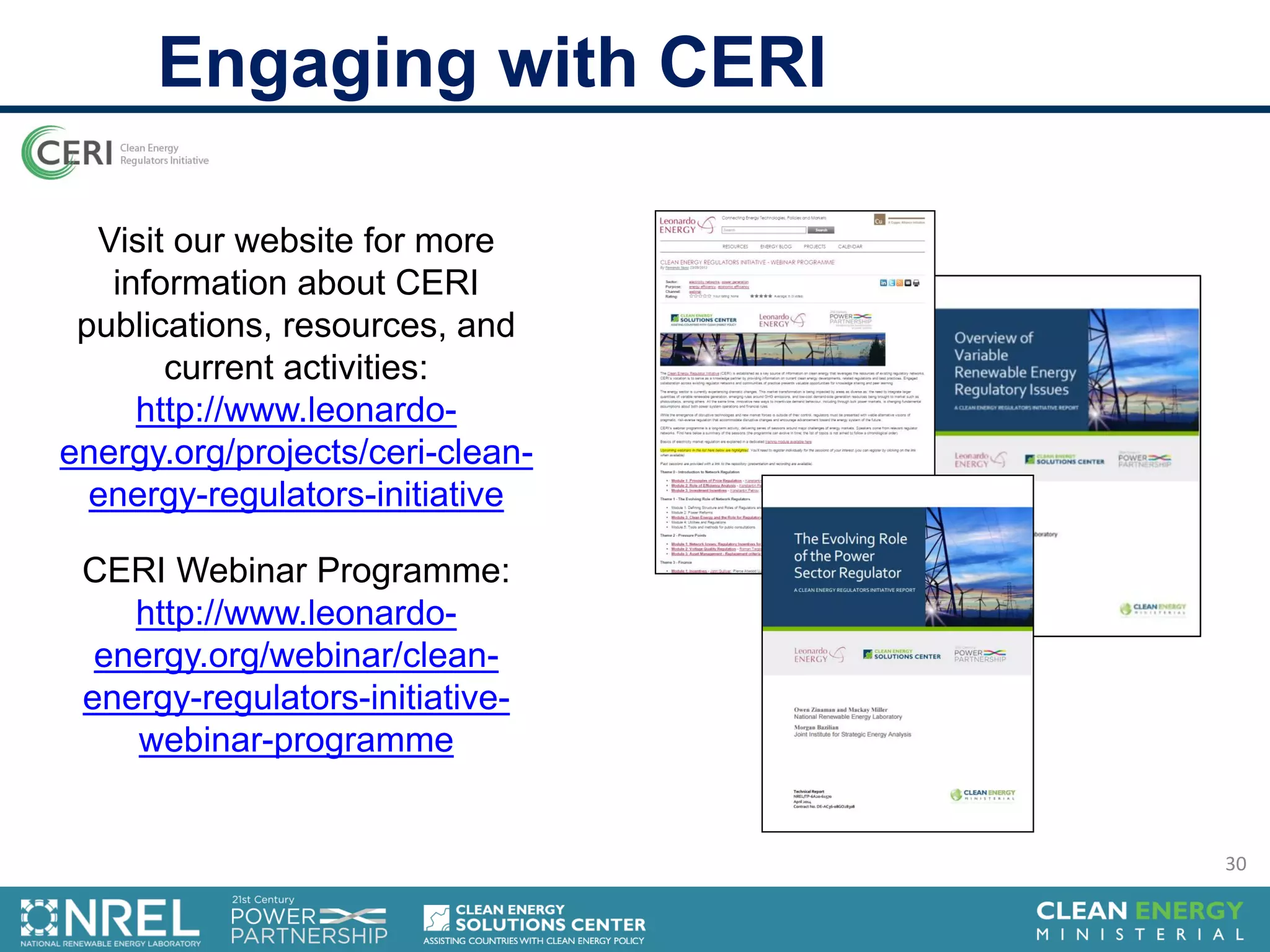
Engaging with CERI
Visit our website for more
information about CERI
publications, resources, and
current activities:
http://www.leonardo-
energy.org/projects/ceri-clean-
energy-regulators-initiative
CERI Webinar Programme:
http://www.leonardo-
energy.org/webinar/clean-
energy-regulators-initiative-
webinar-programme
30
Thank you to the International Copper
Association for your support of this work, as
well as our partners at Leonardo Energy!!
http://copperalliance.org/
http://www.leonardo-energy.org/
Thank You!
31

Clean Energy: Structure and Role of Regulators

  • 1.
    Clean Energy: Structureand Roles of Regulators Owen Zinaman U.S. National Renewable Energy Laboratory 1
  • 2.
    Brief Profile Owen Zinamanis an International Power Sector Analyst at the U.S. National Renewable Energy Laboratory based in Colorado (USA), focusing on deploying the next generation of energy planning, policy, and regulatory constructs. He has worked in a diverse range of countries on economic, financial and policy aspects of renewable energy development, including in Africa, Asia, and the Americas. 2
  • 3.
    Outline Brief Overview ofPower Sector Transformation The Evolving Role of the Power Sector Regulator An Overview of Variable Renewable Energy Regulatory Issues Moving Forward: CERI Resources 3
  • 4.
    Outline Brief Overview ofPower Sector Transformation The Evolving Role of the Power Sector Regulator An Overview of Variable Renewable Energy Regulatory Issues Moving Forward: CERI Resources 4
  • 5.
    Power Sector Transformationis Happening Today • How countries envision, plan, and regulate the power system is evolving. • Long-held beliefs are evolving: • Renewables are now a cost- effective resource in many locations and have been proven not to require 1-to-1 reserves. • Distributed generation is not tantamount to the “utility death spiral.” • Planning, operational, and regulatory strategies must evolve but do not necessarily cost more to implement. • Networks can be cost-effectively expanded from the bottom up. • Utilities can sell more than just electrons. Source: GridWise Alliance, U.S. Department of Energy 5
  • 6.
    Trends Driving PowerSystem Evolution Adapted from: Zinaman et al. (2015). Power Systems of the Future. 6
  • 7.
    Outline Brief Overview ofPower Sector Transformation The Evolving Role of the Power Sector Regulator An Overview of Variable Renewable Energy Regulatory Issues Moving Forward: CERI Resources 7
  • 8.
    The Evolving Roleof the Power Sector Regulator Available: http://www.nrel.gov/docs/fy14osti/61570.pdf 8
  • 9.
    • Power sectorregulators are frequently “where the rubber hits the road” • Regulators seek to: – understand emerging trends in policy, technology, planning, operations, and finance – understand the technology implications of executing a policy goal – evaluate new technology solutions and how they impact existing and emerging objectives – navigate a multitude of evolving objectives (both legacy and new) • The objectives (and therefore the role!) of regulators is quickly evolving 9
  • 10.
    • Evolving regulatoryobjectives drive a new role for regulators – Existing objectives are growing more complicated – New suite of emerging objectives poses a novel set of challenges 10
  • 11.
    A Constellation ofObjectives Design and Manage Electricity Tariffs Meet Demand Growth and Expand Electricity Access Ensure Financial Health of Utilities Facilitate Private Investment Protect the Interests of the Poor Support Technical Safety and Reliability of the Power System Enhance Energy Security and Manage Risk Reduce Health and Environmental Impacts of Power System Operation Meet Rapidly Growing Demand While Minimizing Environmental Impacts and Risk Support Procurement of Renewable Energy Integrate Renewable and Distributed Generation Resources to Grid Incentivize Energy Efficiency, Demand Side Management and Smart Grid Technologies Utilize Microgrid Technology to Bolster Reliability and/or Access Facilitate Consumer Participation in Power Markets Enhance Cybersecurity and Protect Consumer Privacy Manage Increased Interactions with Other Sectors Existing Objectives Emerging Objectives 11
  • 12.
    Ex: Distributed SolarPrograms Design and Manage Electricity Tariffs Meet Demand Growth and Expand Electricity Access Ensure Financial Health of Utilities Facilitate Private Investment Protect the Interests of the Poor Support Technical Safety and Reliability of the Power System Enhance Energy Security and Manage Risk Reduce Health and Environmental Impacts of Power System Operation Meet Rapidly Growing Demand While Minimizing Environmental Impacts and Risk Support Procurement of Renewable Energy Integrate Renewable and Distributed Generation Resources to Grid Incentivize Energy Efficiency, Demand Side Management and Smart Grid Technologies Utilize Microgrid Technology to Bolster Reliability and/or Access Facilitate Consumer Participation in Power Markets Enhance Cybersecurity and Protect Consumer Privacy Manage Increased Interactions with Other Sectors Existing Objectives Emerging Objectives Pressing Objectives: 12
  • 13.
    Ex: Minigrid-based Electrification Designand Manage Electricity Tariffs Meet Demand Growth and Expand Electricity Access Ensure Financial Health of Utilities Facilitate Private Investment Protect the Interests of the Poor Support Technical Safety and Reliability of the Power System Enhance Energy Security and Manage Risk Reduce Health and Environmental Impacts of Power System Operation Meet Rapidly Growing Demand While Minimizing Environmental Impacts and Risk Support Procurement of Renewable Energy Integrate Renewable and Distributed Generation Resources to Grid Incentivize Energy Efficiency, Demand Side Management and Smart Grid Technologies Utilize Microgrid Technology to Bolster Reliability and/or Access Facilitate Consumer Participation in Power Markets Enhance Cybersecurity and Protect Consumer Privacy Manage Increased Interactions with Other Sectors Existing Objectives Emerging Objectives Pressing Objectives: 13
  • 14.
    Ex: Demand ResponseProgram Design and Manage Electricity Tariffs Meet Demand Growth and Expand Electricity Access Ensure Financial Health of Utilities Facilitate Private Investment Protect the Interests of the Poor Support Technical Safety and Reliability of the Power System Enhance Energy Security and Manage Risk Reduce Health and Environmental Impacts of Power System Operation Meet Rapidly Growing Demand While Minimizing Environmental Impacts and Risk Support Procurement of Renewable Energy Integrate Renewable and Distributed Generation Resources to Grid Incentivize Energy Efficiency, Demand Side Management and Smart Grid Technologies Utilize Microgrid Technology to Bolster Reliability and/or Access Facilitate Consumer Participation in Power Markets Enhance Cybersecurity and Protect Consumer Privacy Manage Increased Interactions with Other Sectors Existing Objectives Emerging Objectives Pressing Objectives: 14
  • 15.
    • Prioritization andharmonization of a multitude objectives is the essential challenge of power sector regulation • Emerging trends in policy, technology, planning, operations, and finance are driving an evolution of regulatory objectives – The “information asymmetry” is evolving as well • Regulators are uniquely positioned to accelerate modernization/transformation Key Messages 15
  • 16.
    Outline Brief Overview ofPower Sector Transformation The Evolving Role of the Power Sector Regulator An Overview of Variable Renewable Energy Regulatory Issues Moving Forward: CERI Resources 16
  • 17.
    An Overview ofVariable Renewable Energy Regulatory Issues Available: http://www.nrel.gov/docs/fy14osti/61350.pdf 17
  • 18.
    • vRE Generation Procurement •Ensuring Adequate Grid Infrastructure • Ensuring Short-term Security of Supply (Flexibility) • Ensuring Long-term Security of Supply (Resource Adequacy) Framework for Categorizing vRE Regulatory Issues vRE Generation Grid Infrastructure Resource Adequacy Flexibility The Four Main Categories of VRE Regulation 18
  • 19.
    • Early Stages –Normally less than 5% VRE annual penetration • Intermediate Stages – Typically between 5- 20% VRE annual penetration • Advanced Stages – As VRE surpasses 20% annual penetration 3 Stages of vRE Regulation 19
  • 20.
    vRE Generation Grid Infrastructure Flexibility Adequacy Early Stage (vREapprox. < 5%) Establish appropriate VRE support mechanisms Establish queue management Establish efficient siting processes Simplify interconnection protocols Initiate data collection efforts that will facilitate formal grid integration studies Initiate data collection efforts that will facilitate formal grid integration studies Intermediate Stage (vRE approx. 5-20%) Refine VRE support mechanisms if necessary Refine siting and queue management Establish VRE grid codes and designated transmission zones Coordinate generation and grid planning Establish distribution network standards for VRE Initiate formal grid integration study Improve forecasting Broaden balancing-area footprints Improve system operation methods Initiate formal grid integration study, with capacity credit or resource adequacy components as needed Advanced Stage (vRE approx. >20%) Encourage alignment between demand and VRE production Incentivize VRE dispatchability Expand grid interconnection and market coupling Employ locational pricing Incentivize active network management Employ advanced system operation Incentivize demand response (DR) Incentivize flexible generation and/or storage Improve adequacy mechanism in accordance with predominant paradigm (e.g., capabilities market; strategic reserve requirement; full scarcity pricing) Issues & Actions at Different Stages of vRE Deployment Increased Interdependency = Priority Area = 20
  • 21.
    Early Stage vRERegulatory Issues Early Stage (vRE approx. < 5%) vRE Generation Grid Infrastructure Flexibility Adequacy Establish appropriate VRE support mechanisms Establish queue management Establish efficient siting processes Simplify interconnection protocols Initiate data collection efforts that will facilitate formal grid integration studies Initiate data collection efforts that will facilitate formal grid integration studies = Priority Area 21
  • 22.
    • 2006 seriesof legal and regulatory clarifications for vRE under 5 MW: – Interconnection processes – Remuneration schemes; cost allocations – Equipment standards • Harmonizing interconnection procedures with robust technical standards can encourage investment while maintaining reliability Snapshot – Guatemala Distributed vRE Interconnection Source: CNEE (2006) 22
  • 23.
    Intermediate Stage vRERegulatory Issues Intermediate Stage (vRE approx. 5-20%) vRE Generation Grid Infrastructure Flexibility Adequacy Refine VRE support mechanisms if necessary Refine siting and queue management Establish VRE grid codes and designated transmission zones Coordinate generation and grid planning Establish distribution network standards for VRE Initiate formal grid integration study Improve forecasting Broaden balancing-area footprints Improve system operation methods Initiate formal grid integration study, with capacity credit or resource adequacy components as needed = Priority Area 23
  • 24.
    • High-quality wind resourcesare distant from large load centers, exacerbating a“co- investment conundrum” • Intensive stakeholder consultations helped identify CREZ regions; • Transmission investments financed by utility customers Snapshot – Texas “Competitive RE Zones” Source: SNLFinancial 24
  • 25.
    Advanced Stage vRERegulatory Issues Advanced Stage (vRE approx. >20%) vRE Generation Grid Infrastructure Flexibility Adequacy Encourage alignment between demand and VRE production Incentivize VRE dispatchability Expand grid interconnection and market coupling Employ locational pricing Incentivize active network management Employ advanced system operation Incentivize demand response (DR) Incentivize flexible generation and/or storage Improve adequacy mechanism in accordance with predominant paradigm (e.g., capabilities market; strategic reserve requirement; full scarcity pricing) Increased Interdependency = Priority Area = 25
  • 26.
    • Ordered: 1,325MW of storage in operation by 2024 for three California Investor Owned Utilities • No more than 50% of capacity owned by Utilities • Intention: Create a mature storage market that doesn’t require targets Snapshot – CPUC Energy Storage Decision Source: CPUC (2013) 26
  • 27.
    • Unique forcesat play in each regulatory context • Common issues and key ideas emerge across contexts and at each stage of vRE deployment and integration • Regulating vRE presents a novel landscape of challenges and opportunities Key Takeaways 27
  • 28.
    Outline Brief Overview ofPower Sector Transformation The Evolving Role of the Power Sector Regulator An Overview of Variable Renewable Energy Regulatory Issues Moving Forward: CERI Resources 28
  • 29.
    Ask an Expert:Developing Solutions to Policy Barriers We connect you to a global network of energy experts for personalized attention and quick response technical assistance on strategies, regulations, standards, financial incentives, and deployment programs for a broad range of clean energy sectors and technologies including:  Energy Access  Energy Efficiency  Renewable Energy  Smart Grid  Transportation  Utilities Delivered no-cost assistance for more than 160 requests from over 75 countries. To request assistance, register on http://cleanenergysolutions.org/expert Ask-an-Expert: Our Experts in Action 29
  • 30.
    Engaging with CERI Visitour website for more information about CERI publications, resources, and current activities: http://www.leonardo- energy.org/projects/ceri-clean- energy-regulators-initiative CERI Webinar Programme: http://www.leonardo- energy.org/webinar/clean- energy-regulators-initiative- webinar-programme 30
  • 31.
    Thank you tothe International Copper Association for your support of this work, as well as our partners at Leonardo Energy!! http://copperalliance.org/ http://www.leonardo-energy.org/ Thank You! 31