• Definition: SCADA(Supervisory Control and Data Acquisition) is a system used for
remote monitoring and control of industrial processes.
• Main Purpose: Collects data, processes it, and enables control of devices in real-time.
• Functions: SCADA systems monitor real-time data, control processes, and store
information for analysis and decision-making
• SCADA systems communicate with other devices, such as programmable logic
controllers (PLCs) and PID controllers to interact with industrial process plants and
equipment.
3.
SCADA SYSTEM COMPONENTS
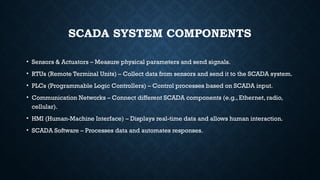
•Sensors & Actuators – Measure physical parameters and send signals.
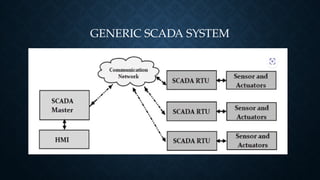
• RTUs (Remote Terminal Units) – Collect data from sensors and send it to the SCADA system.
• PLCs (Programmable Logic Controllers) – Control processes based on SCADA input.
• Communication Networks – Connect different SCADA components (e.g., Ethernet, radio,
cellular).
• HMI (Human-Machine Interface) – Displays real-time data and allows human interaction.
• SCADA Software – Processes data and automates responses.
MASTER TERMINAL UNIT(MTU)
• MTU is the core of the SCADA system. It comprises a
computer, a PLC, and a network server that helps the MTU
communicate with the RTUs.
• MTU begins communication, collects and saves data, helps to
interface with operators, and communicates data to other
systems.
6.
REMOTE TERMINAL UNIT(RTU)
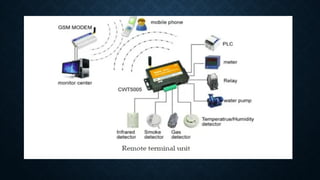
• Being employed in the field sites, each Remote Terminal Unit (RTU) is
connected with sensors and actuators.
• RTU is used to collect information from these sensors and further send the
data to MTU.
• RTUs have a storage capacity facility.
• It stores the data and transmits it when the MTU commands.
• Modern RTUs use PLCs for direct data transfer and control, often without
signals from the MTU.
8.
COMMUNICATION NETWORK
• Ingeneral, network means connection.
• When you describe a communication network, it is defined as a link
between an RTU in the field and an MTU in the central location.
• The bidirectional wired or wireless communication channel is used for
networking purposes.
• Various other communication mediums, like fibre optic cables, twisted
pair cables, etc., are also used.
9.
HOW SCADA WORKS
•Data Collection: Sensors gather data from industrial processes.
• Communication: RTUs/PLCs transmit data to central SCADA servers.
• Data Processing and Display:The system analyzes the data and
presents it to users via an HMI.
• Control Actions: Operators or automation systems send commands to
actuators.
10.
SCADA IN ROBOTICSAND AEROSPACE
ENGINEERING
• Robotics: Used for real-time monitoring and control of robotic systems in
manufacturing.
• Aerospace: Used in aircraft maintenance, air traffic control, and space missions.
• In airline operations, SCADA systems monitor fuel levels, landing gear status, and
engine performance. If fuel levels drop unexpectedly, SCADA can alert pilots and
ground control for corrective action.
• Mars Rover Missions: SCADA helps NASA monitor the rover's battery status,
environmental sensors, and mechanical components, ensuring smooth operations on
Mars.
11.
SCADA ARCHITECTURE TYPES
•Monolithic (Early SCADA) – Standalone systems with no network connectivity.
• The earliest SCADA systems were independent and did not communicate with other
systems. For example 1970s NASA Mission Control Centers used standalone SCADA
systems to monitor spacecraft telemetry without external network connections
• Distributed SCADA – Multiple systems connected for better control.
• Data from sensors is distributed among several stations, improving efficiency.
• Networked SCADA – Modern SCADA using cloud and IoT technology.
• Uses Local Area Networks (LAN) and Wide Area Networks (WAN) for real-time data
sharing
12.
ADVANTAGES OF SCADA
•Real-time monitoring
• Remote control and automation
• Improved efficiency and safety
• Reduced operational costs
13.
CHALLENGES & CYBERSECURITYIN SCADA
• Challenges:
• High initial cost,
• complexity,
• maintenance.
• Cybersecurity Risks:
• Vulnerable to hacking;
• needs strong firewalls and encryption.
14.
CONCLUSION
• SCADA isa crucial technology in industrial automation and
aerospace.Its ability to provide real-time monitoring and control
makes it essential for modern industries.
Editor's Notes
#2 PLCs in SCADA SystemsData Collection: Collects data from field devices and transmits it to the SCADA system.Process Control: Automates processes such as manufacturing, power plants, and water treatment.Remote Monitoring: Allows operators to control industrial systems from a centralized location.
#9 PLCs in SCADA SystemsData Collection: Collects data from field devices and transmits it to the SCADA system.Process Control: Automates processes such as manufacturing, power plants, and water treatment.Remote Monitoring: Allows operators to control industrial systems from a centralized location.