Dr. Noor Islam Bag
2nd year PGT
MD (Community
Medicine)
AIIH & PH
1
2
 Some definitions
 Information System A system that provides information support to
the decision-making process at each level of an organization
 Health Management Information System HMIS is a tool which helps
in gathering, aggregating, analyzing data and using information for
taking actions to improve performance of health systems
3
o A monitoring & evaluation systems
o HMIS 1.0
o HMIS 2.0 and new features
o Data sources
o HMIS generate database
o HMIS captured data items
 Brief Idea about HMIS
1. What is HMIS?
2. Objectives of HMIS
3. Data captured by HMIS
4. Follow of data in HMIS
5. Data quality measures
6. Organization/Person responsible for HMIS
7. Uses of HMIS data
8. Maintenance of HMIS
9. Constrains of old HMIS web portal
10. New HMIS web portal
4
Health Management Information System (HMIS) is a Government
to Government (G2G) web-based Monitoring Information System
has been put in place by Ministry of Health & Family Welfare
(MoHFW), Government of India to monitor the National Health
Mission and other Health programmes and provide key inputs for
policy formulation and appropriate programme interventions.1
HMIS 2.0 (http://hmis.nhp.gov.in)
What is
5
 To Monitor the performance & quality of health care services
under the National Health Mission
 A tool for evidence based health planning
 Used for testing the effectiveness, efficiency of health
programs and schemes
 To improve availability and access of health care to the
population
6
1946 (Bhore committee report) - The necessity of a sound
information system was felt
National Health Policy -1983 - Decision making and program
planning in health and related fields are not possible without
establishing an effective health information system
NHP-2002-focused self to the programme for putting in place a
modern and scientific health statistics database
NRHM-2005 – felt need of strong component of technical support
as an effective health information systems for the success of the
NRHM2
7
8
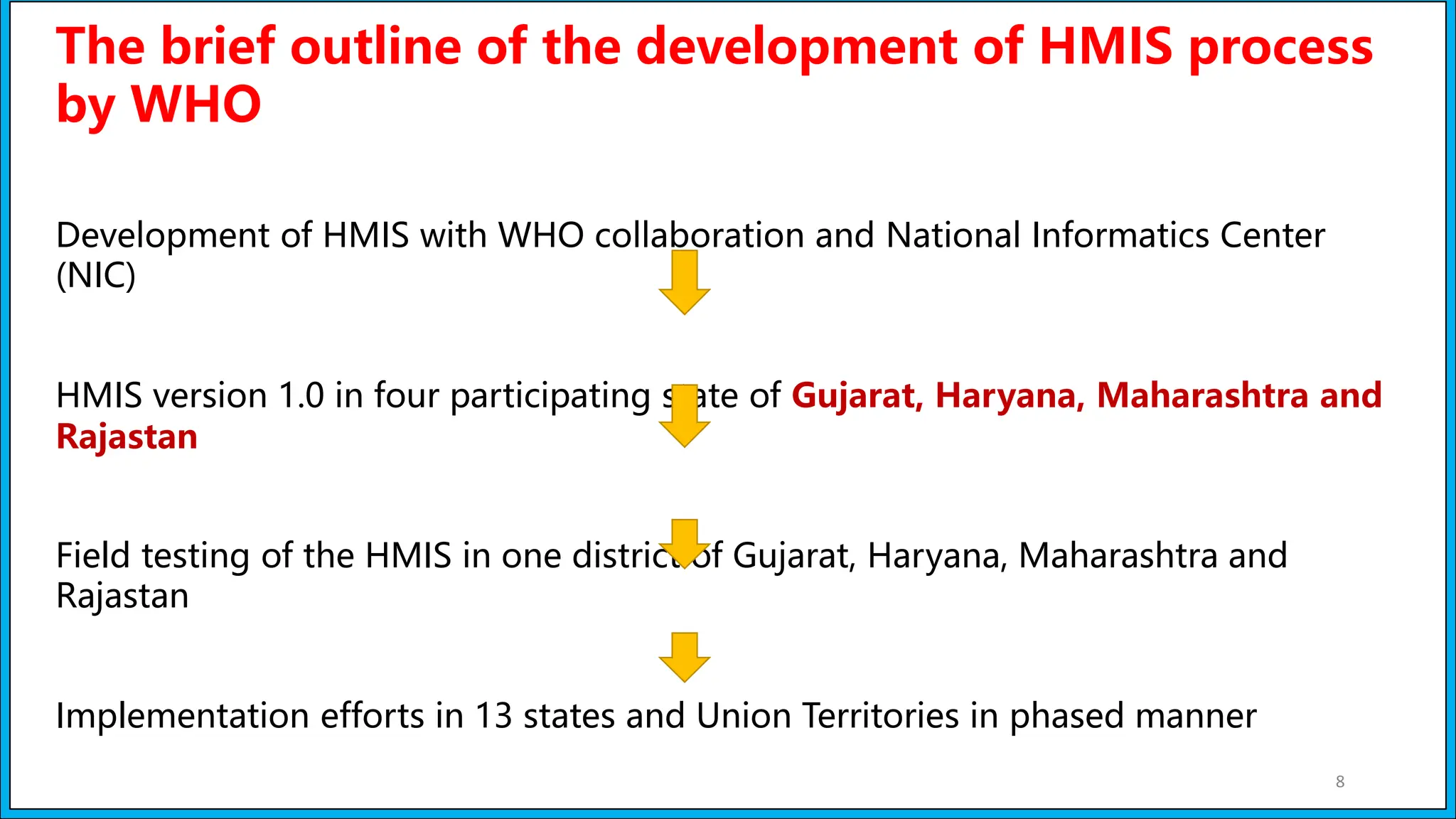
Development of HMIS with WHO collaboration and National Informatics Center
(NIC)
HMIS version 1.0 in four participating state of Gujarat, Haryana, Maharashtra and
Rajastan
Field testing of the HMIS in one district of Gujarat, Haryana, Maharashtra and
Rajastan
Implementation efforts in 13 states and Union Territories in phased manner
The brief outline of the development of HMIS process
by WHO
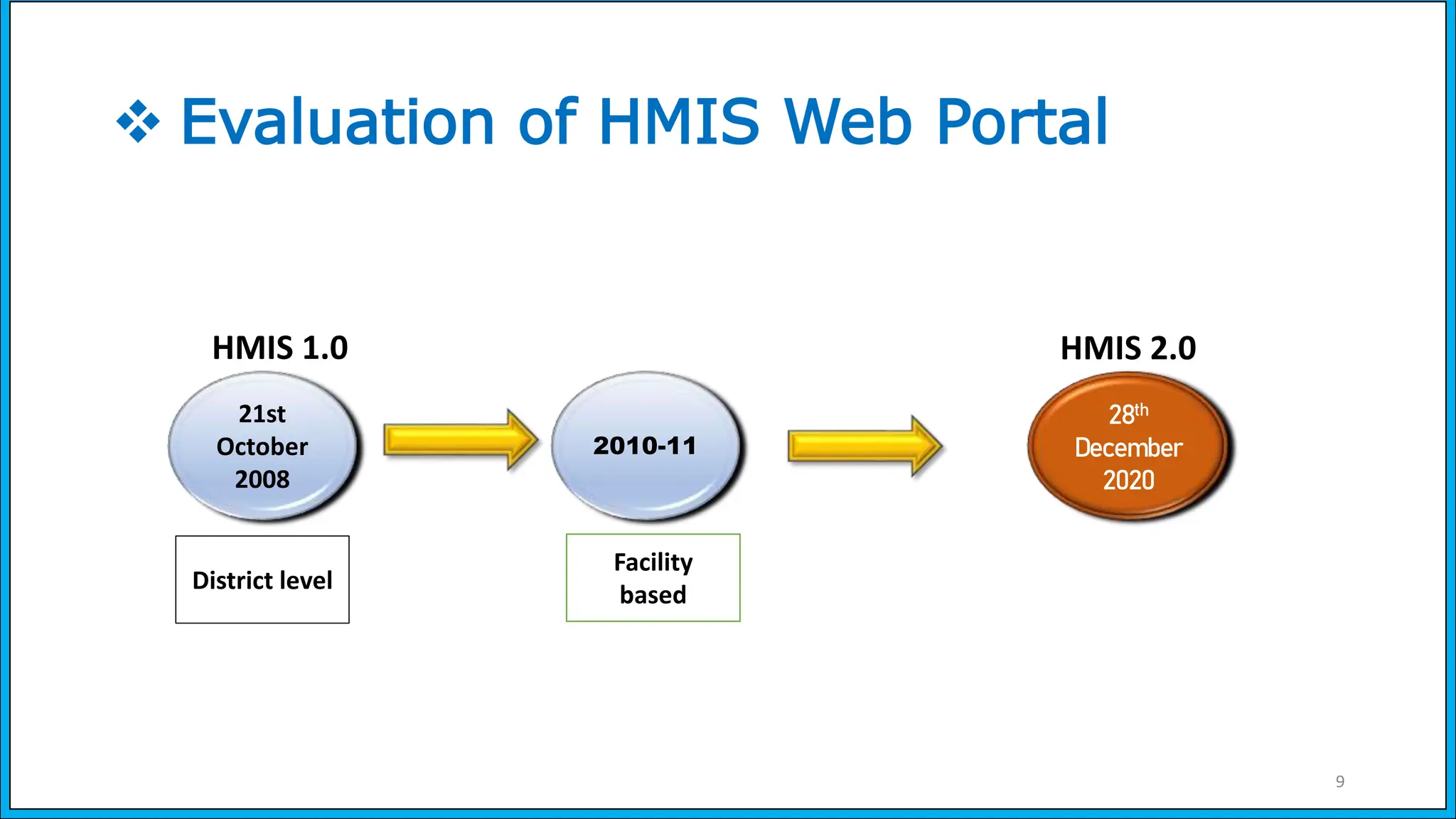
 Evaluation of HMIS Web Portal
21st
October
2008
28th
December
2020
2010-11
District level
Facility
based
HMIS 1.0 HMIS 2.0
9
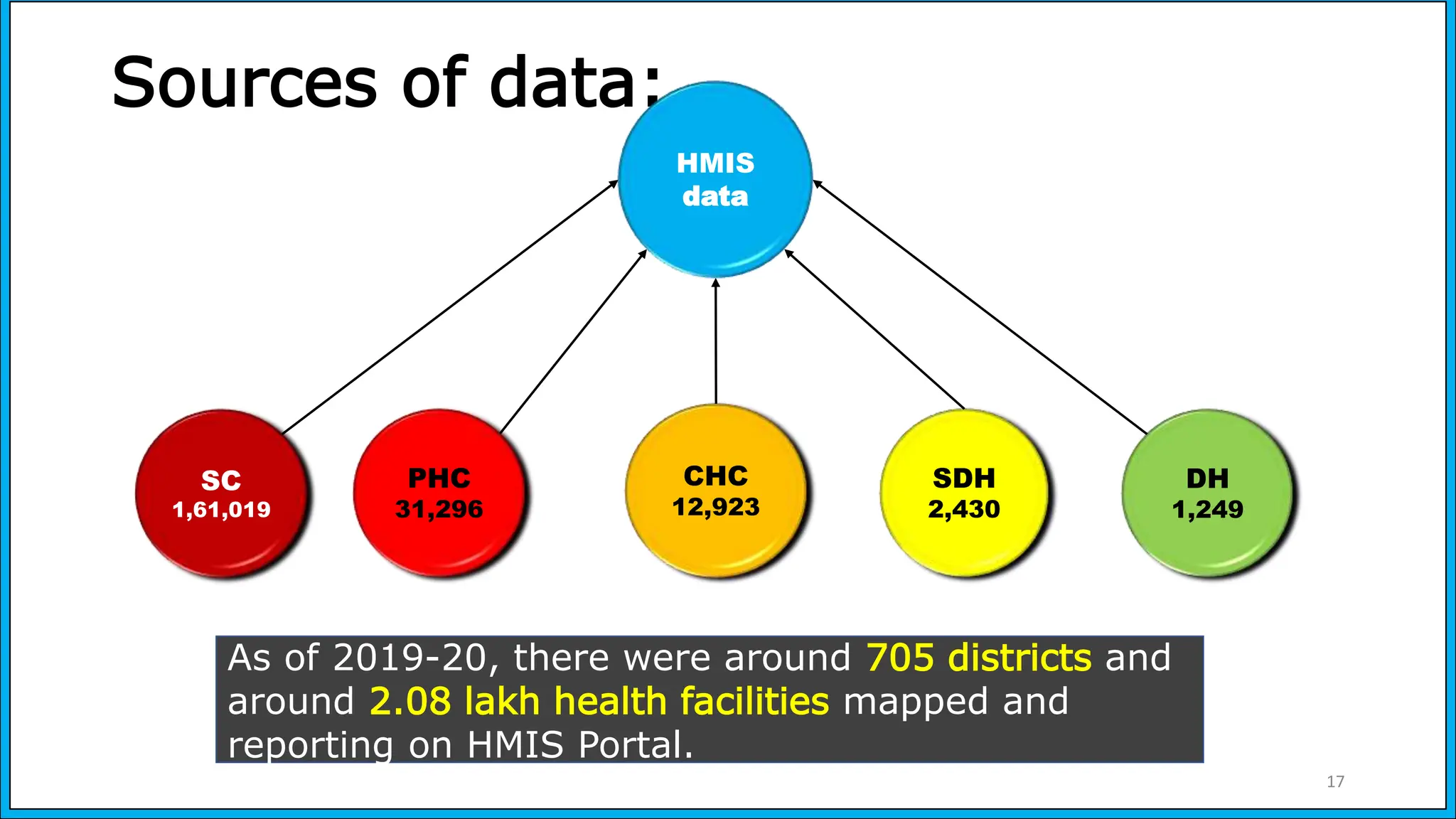
Sources of data:
SC
1,61,019
PHC
31,296
CHC
12,923
SDH
2,430
DH
1,249
HMIS
data
As of 2019-20, there were around 705 districts and
around 2.08 lakh health facilities mapped and
reporting on HMIS Portal.
17
Fig. All India Distribution of Health Facilities by
type(2019-20)
18
Table : All India Distribution of Public and
Private Health Facilities
Data captured under HMIS
Types of Data Frequency of data
uploading
Types of facility
1. Service Delivery Data Monthly District HQ, DH,
CHC, PHC, SC
2. Infrastructure & HR Annually DH, SDH, CHC
PHC, SC
3. Service Delivery data Daily DH, SDH, CHC
PHC, SC
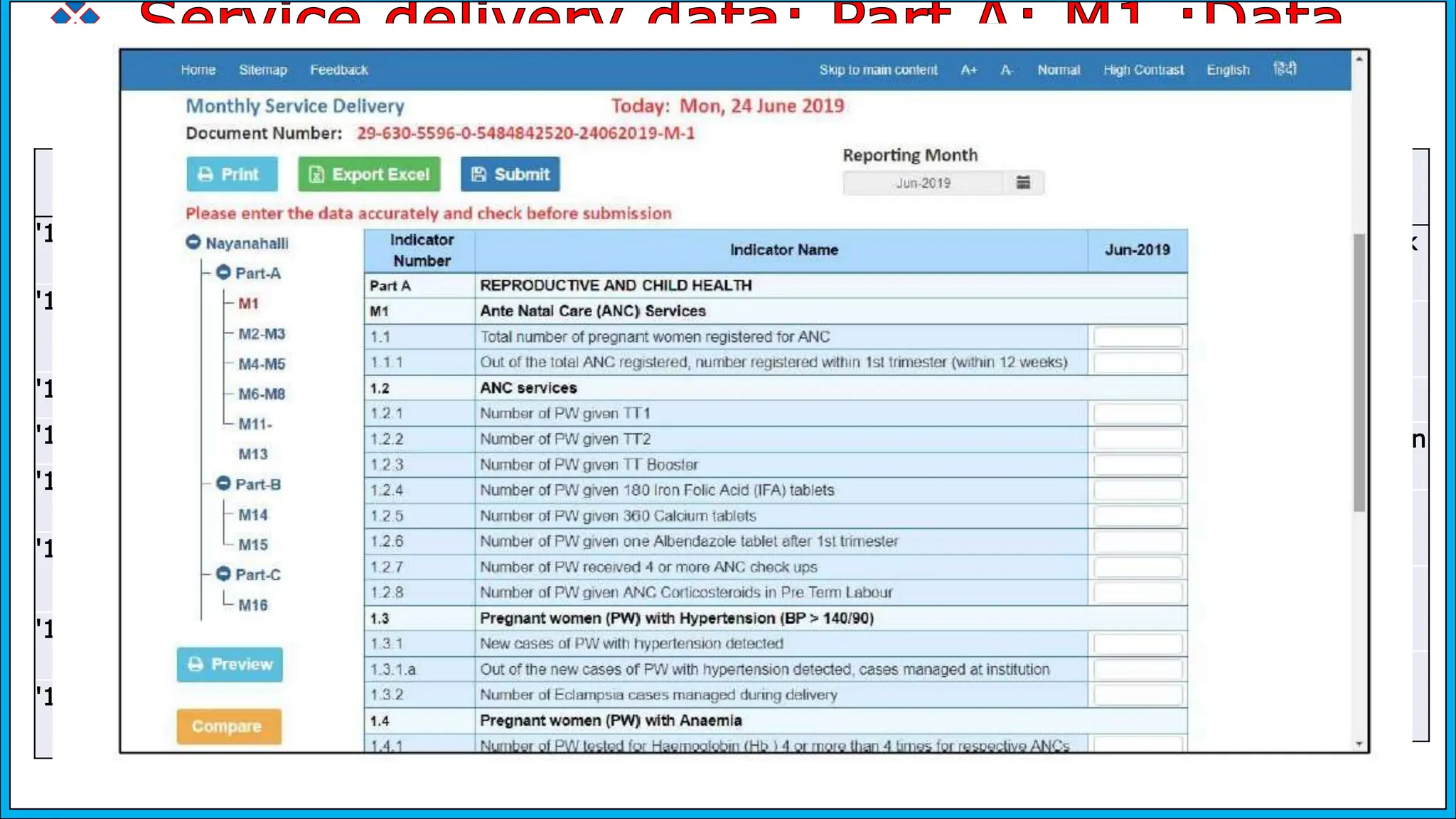
Monthly Service delivery data:-
Reproductive and Child Health
Health Facility Services
Monthly Inventory
20
Service delivery
data
Part C
Stock
related
Part B
Health
Facility
Services
Part A
Reproduct
ive and
Child
Health
Major
Category
Data
element
Major
Category
Major
Category
Data
element
Data
element
M1. Ante Natal Care (ANC)
M2. Deliveries
M3. Number of Caesarean (C-Section)
deliveries
M4. Pregnancy outcome & details of new-
born
M5. Complicated Pregnancies
M6. Post Natal Care (PNC)
M7. Reproductive Tract
Infections/Sexually Transmitted Infections
(RTI/STI) Cases
M8. Family Planning
M9. CHILD IMMUNISATION
M10. Number of cases of Childhood
Diseases (0-5 years)
M11. NVBDCP
M12. Adolescent Health
M13. Directly Observed Treatment, Short-
course (DOTS)
M14. Patient Services
M15. Laboratory Testing
M16. Details of deaths reported with probable
causes:
M17. Vaccines
M18. Contraceptives
M19. Other Items
M20. Syringes
M21. Rashtriya Bal Swasthaya Karyakram
(RBSK)
M22. Adolescent Health
M23. Coverage under WIFS JUNIOR (Weekly
Iron Folic Acid Supplementation Programme
for children 6 – 1
M24. Maternal Death Reviews (MDR) Done
M25. Janani Shishu Suraksha Karyakram
21
22
Data Element
'1.1 Total number of pregnant women registered for
ANC
'1.1.1 Out of the total ANC registered, number
registered within 1st trimester (within 12
weeks)
'1.2.1 Number of PW given TT1/ Td1
'1.2.2 Number of PW given TT2 / Td2
'1.2.3 Number of PW given TT Booster/ Td Booster
'1.2.4 Number of PW provided full Course 180 Iron
Folic Acid (IFA) tablets
'1.2.5 Number of PW provided full Course 360 Calcium
tablets
'1.2.6 Number of PW given one Albendazole tablet
after 1st trimester
M1. Ante Natal Care(ANC)
Data Element
'1.2.7 Number of PW received 4 or more ANC check
ups
'1.2.8 Number of PW given ANC Corticosteroids in
Pre Term Labour
'1.3.1 New cases of PW with hypertension detected
'1.3.1.
a
Out of the new cases of PW with hypertension
detected, cases managed at institution
'1.3.2 Number of Eclampsia cases managed during
delivery
'1.4.1 Number of PW tested for Haemoglobin (Hb )
4 or more than 4 times for respective ANCs
'1.4.2 Number of PW having Hb level<11 (out of
total tested cases)(7.1 to 10.9)
 Manpower
 Equipment
 Cleanliness
 Building
 Availability of Medical Services, Surgery
etc.
 Super Specialties services such as
Cardiology etc.
 Para Medical andClinical Services etc.
23
In new HMIS
Five data items are also collected on daily basis which are mainly
linked to COVID-19
1) Total number of outpatients (OPD)
2) Total number of inpatients (IPD)
3) Total SARI - Severe Acute Respiratory Infection (OPD +IPD)
4) Total ILI - Influenza Like Illness (OPD + IPD)
5) Total fever cases >= 7 Days (OPD + IPD)
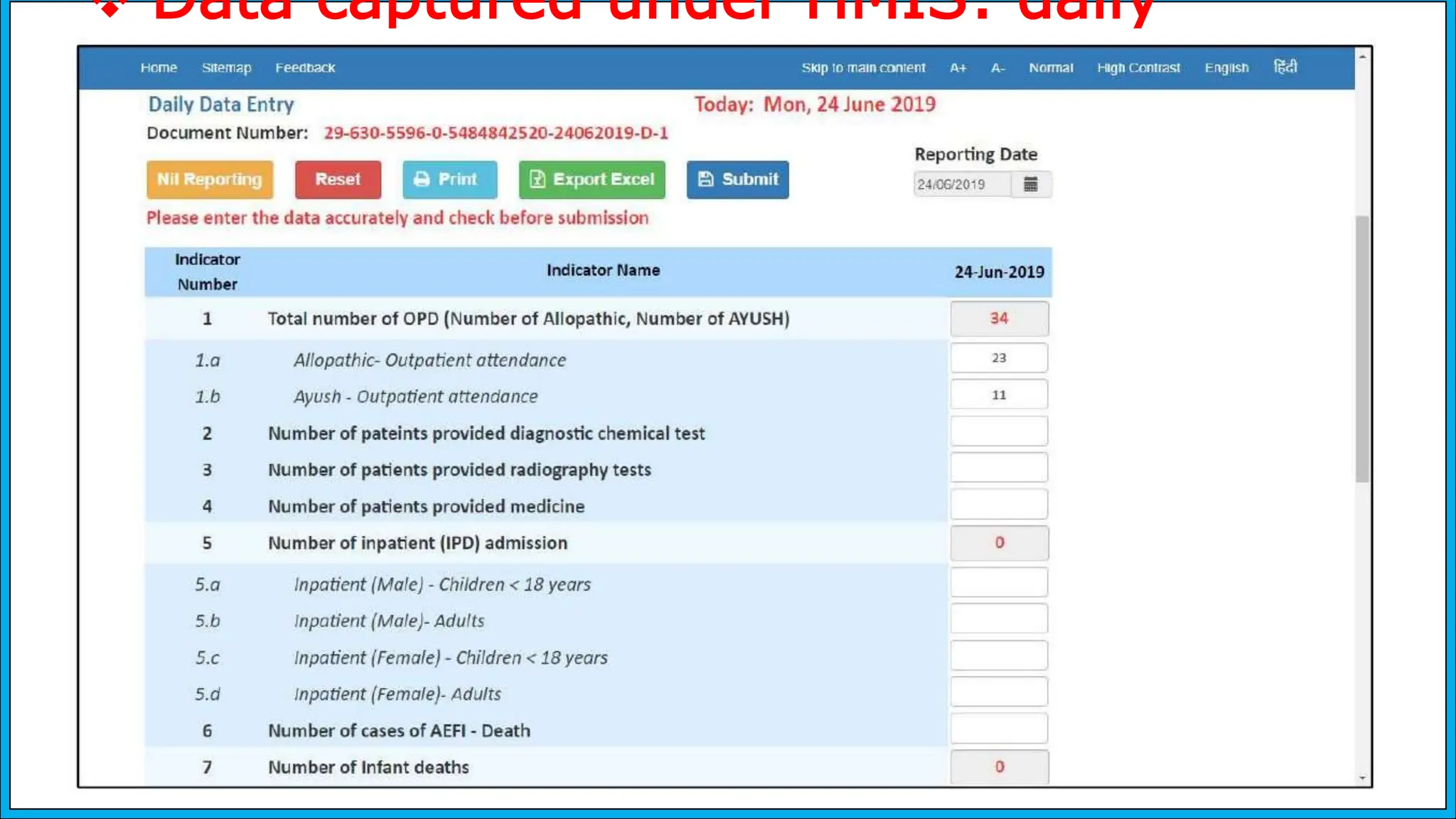
 Data captured under HMIS- Daily
basis
24
In new HMIS
1. Total number of OPD attendance
2. Total number of IPD admission
3. Number of patients provided diagnostic chemical test
4. Number of patients provided diagnostic radiography test
5. Number of patients provided medicine
6. Number of cases of AEFI-deaths
7. Number of infant deaths
8. Number of maternal deaths
 Data captured under HMIS: daily
basis
25
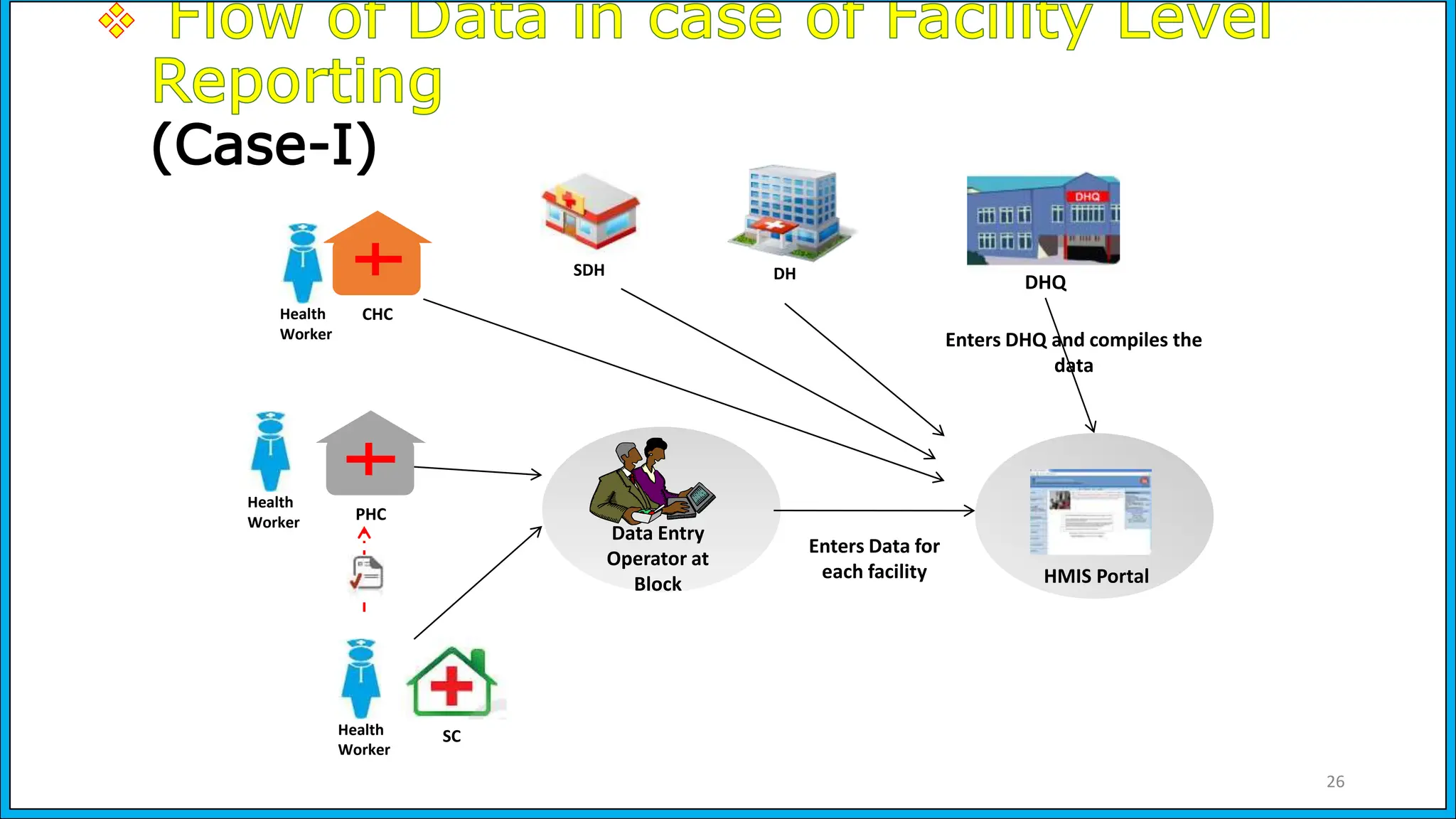
(Case-I)
Data Entry
Operator at
Block
SC
Health
Worker
Health
Worker PHC
CHC
Health
Worker
SDH DH
HMIS Portal
Enters Data for
each facility
DHQ
Enters DHQ and compiles the
data
26
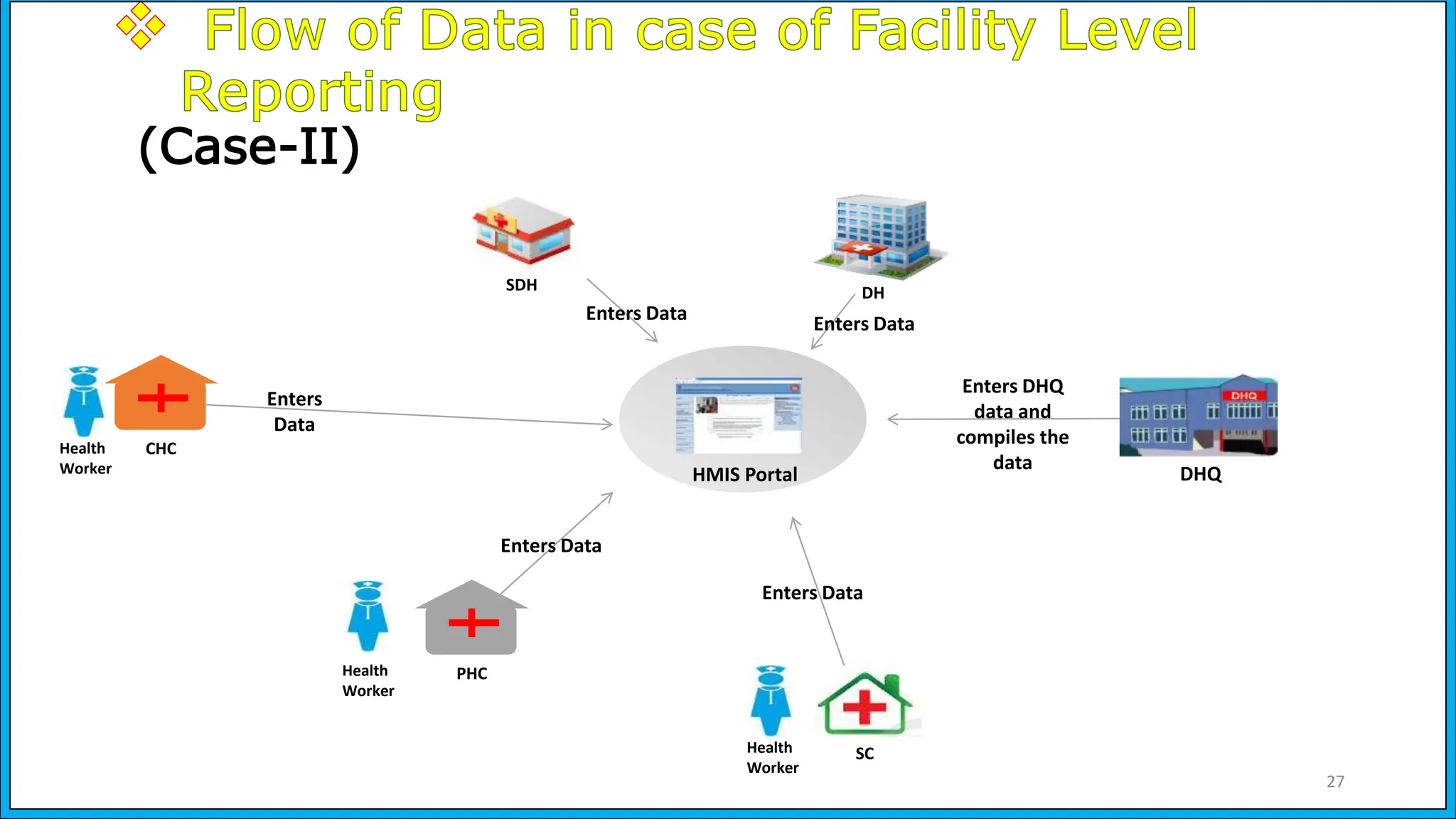
HMIS Portal
SC
Health
Worker
Enters Data
Health
Worker
PHC
Enters Data
CHC
Health
Worker
Enters
Data
SDH
Enters Data
DH
Enters Data
DHQ
Enters DHQ
data and
compiles the
data
(Case-II)
27
Subcentre
SDH
CHC
PHC
 Data Quality Measures in HMIS
a. Completeness
b. Accuracy/correctness
c. Consistency of data reporting
d. The timeliness
30
 Data Quality Measures in HMIS
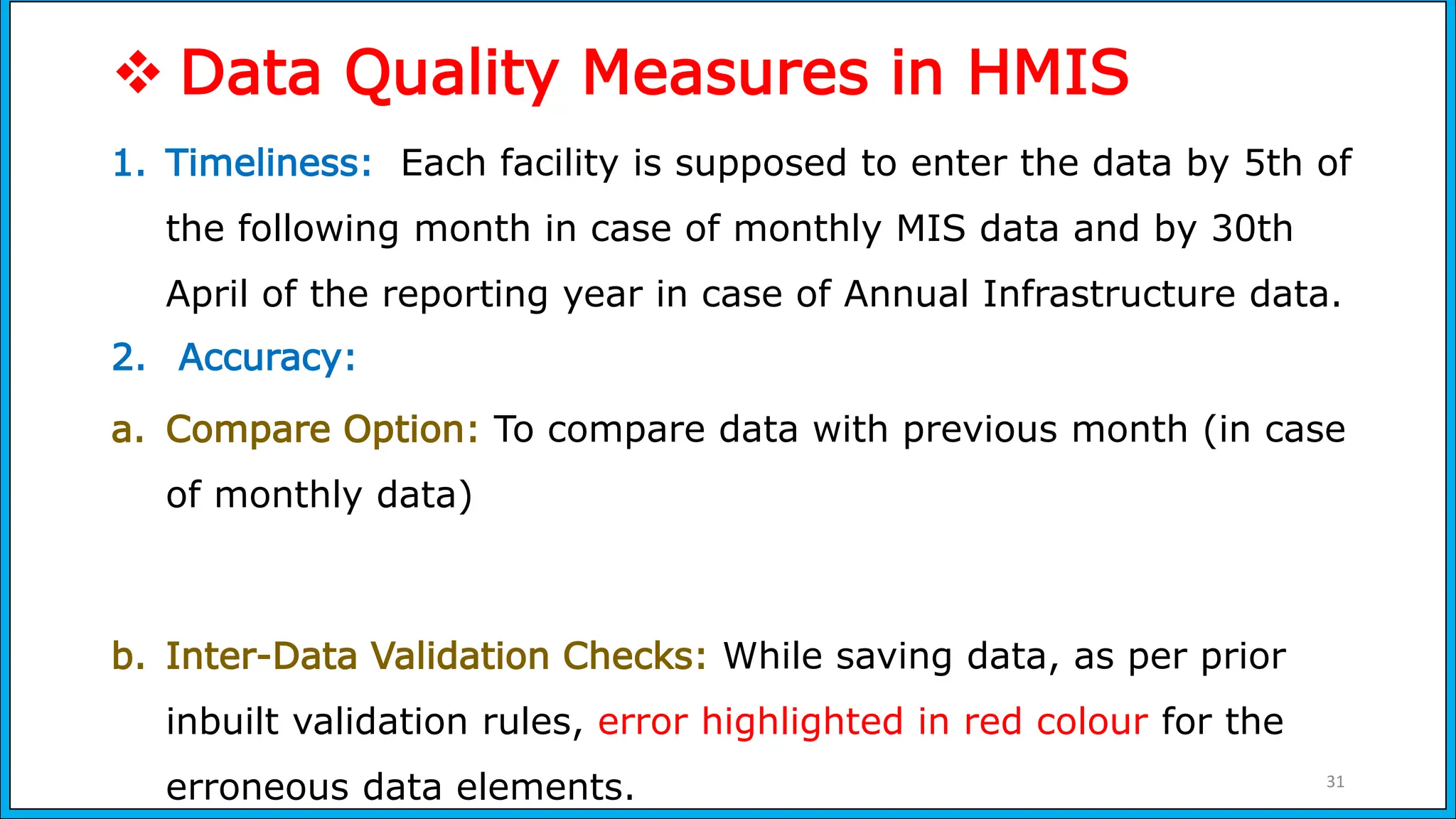
1. Timeliness: Each facility is supposed to enter the data by 5th of
the following month in case of monthly MIS data and by 30th
April of the reporting year in case of Annual Infrastructure data.
2. Accuracy:
a. Compare Option: To compare data with previous month (in case
of monthly data)
b. Inter-Data Validation Checks: While saving data, as per prior
inbuilt validation rules, error highlighted in red colour for the
erroneous data elements. 31
 Data Quality Measures in HMIS
(cont…)
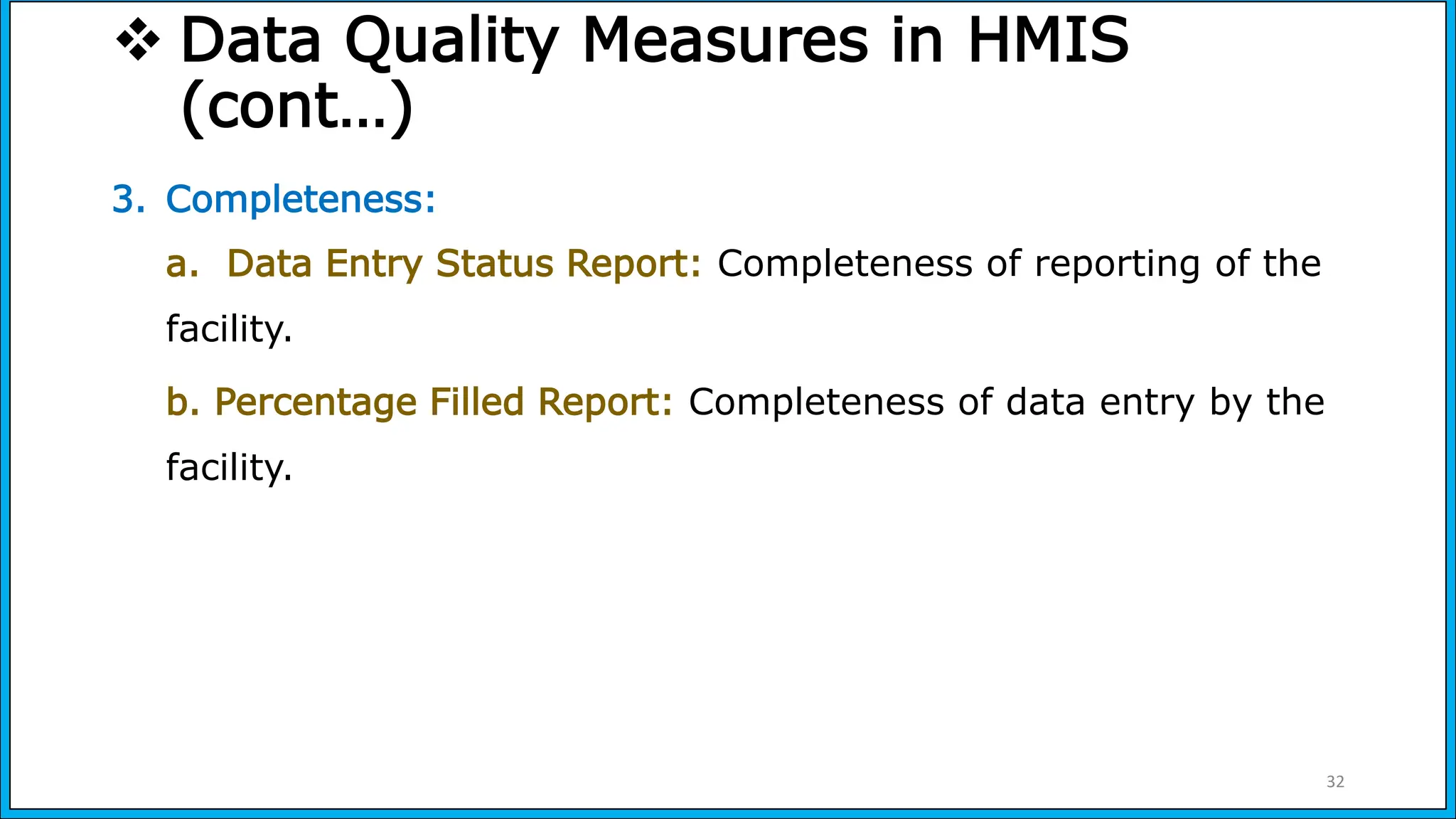
3. Completeness:
a. Data Entry Status Report: Completeness of reporting of the
facility.
b. Percentage Filled Report: Completeness of data entry by the
facility.
32
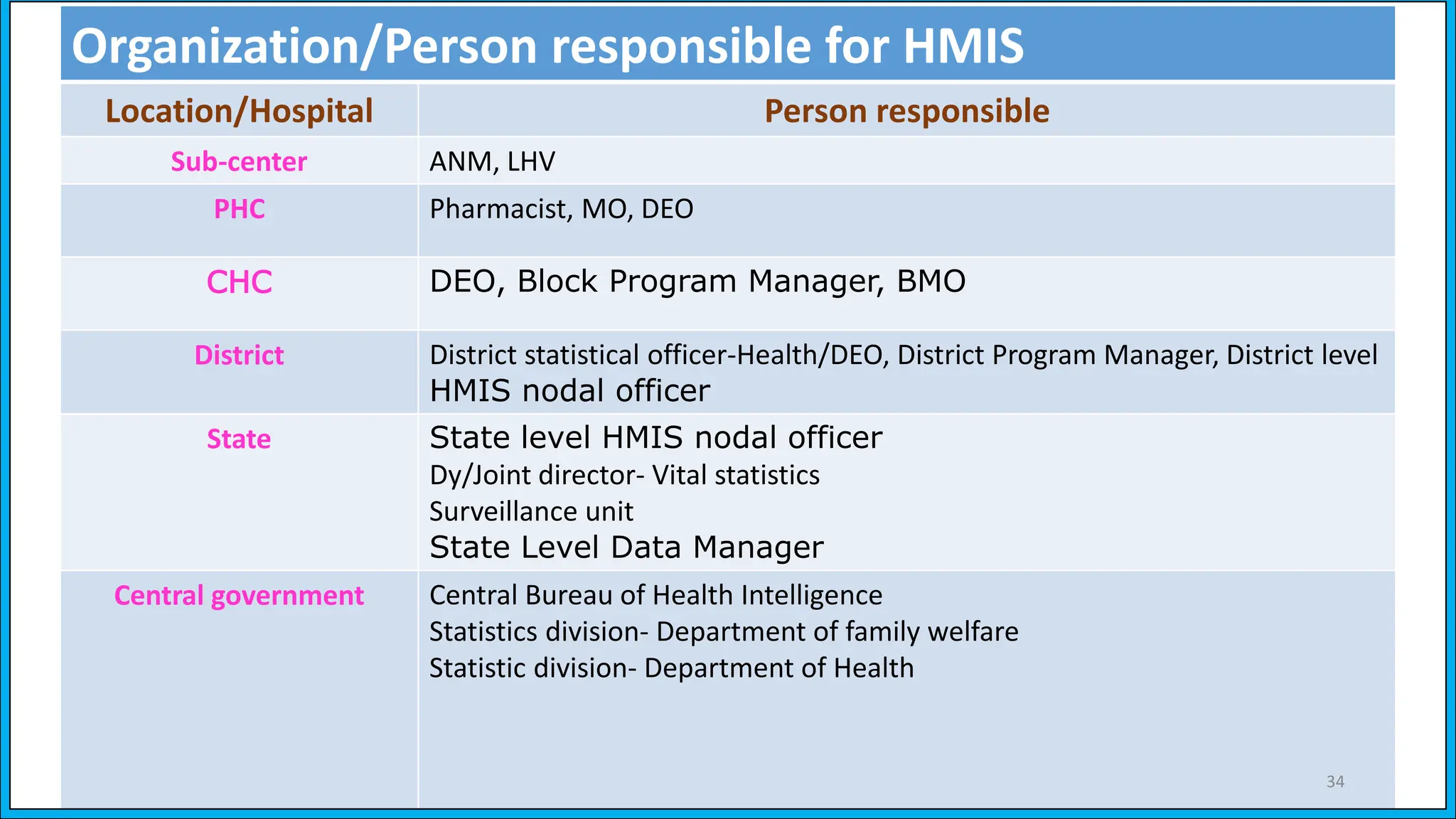
Organization/Person responsible for HMIS
Location/Hospital Person responsible
Sub-center ANM, LHV
PHC Pharmacist, MO, DEO
CHC DEO, Block Program Manager, BMO
District District statistical officer-Health/DEO, District Program Manager, District level
HMIS nodal officer
State State level HMIS nodal officer
Dy/Joint director- Vital statistics
Surveillance unit
State Level Data Manager
Central government Central Bureau of Health Intelligence
Statistics division- Department of family welfare
Statistic division- Department of Health
34
 Uses of HMIS data
 HMIS data is widely used by States in preparing Program
Implementation Plans (PIPs) under NHM.
 Indicators from HMIS (like Institutional Deliveries, C –
Section deliveries, Immunization, IPD, OPD, Surgeries, etc.)
are used to evaluate the States’ performance
35
 Uses of HMIS data(cont..)
 Facility wise data of PHCs is used for grading the facilities
(Grading of PHCs). NHM started grading of PHC in 2018-19
 CHC Grading (started in 2013-14) & DH Ranking is also
being done.
36
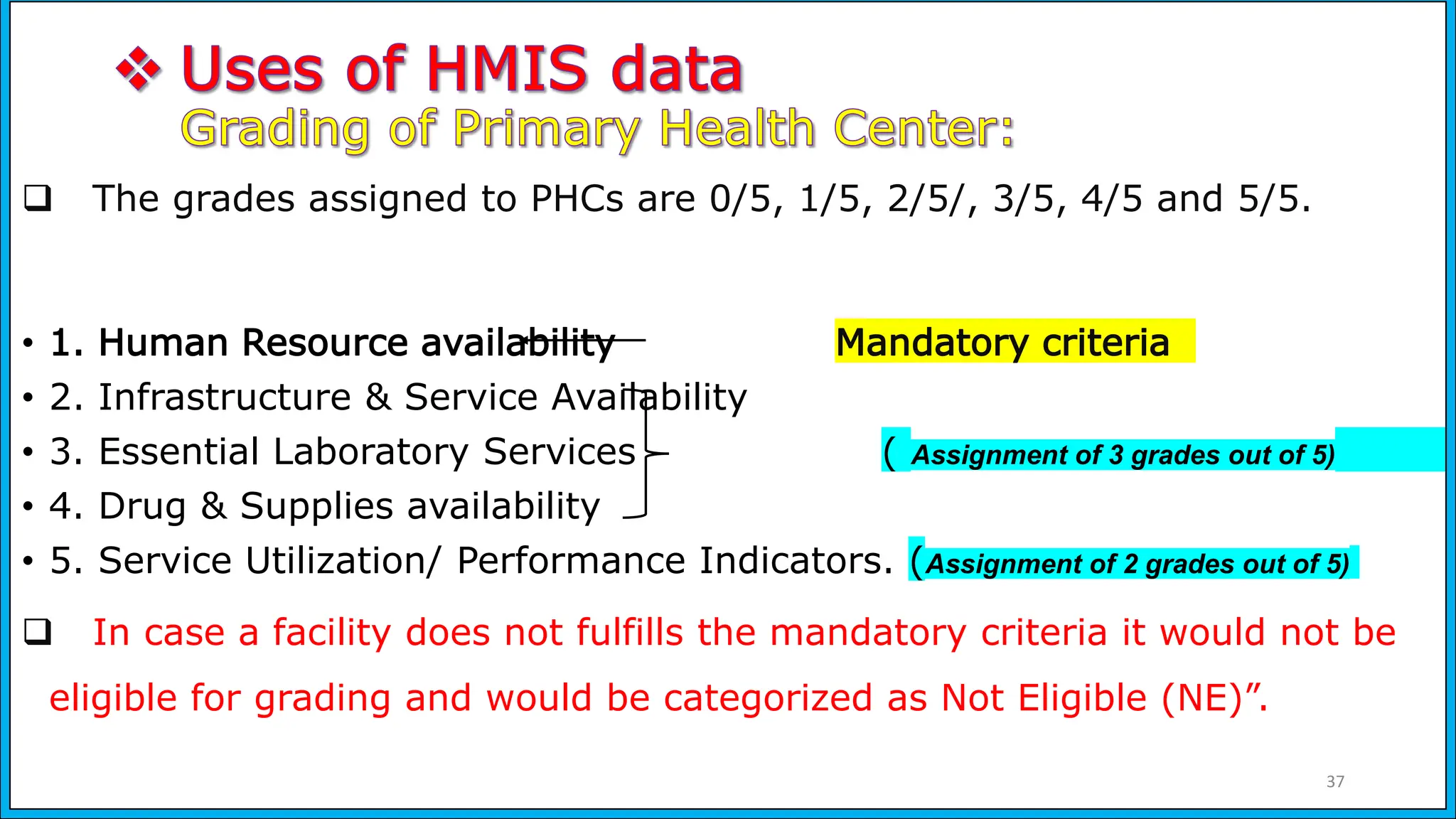
 The grades assigned to PHCs are 0/5, 1/5, 2/5/, 3/5, 4/5 and 5/5.
• 1. Human Resource availability Mandatory criteria
• 2. Infrastructure & Service Availability
• 3. Essential Laboratory Services ( Assignment of 3 grades out of 5)
• 4. Drug & Supplies availability
• 5. Service Utilization/ Performance Indicators. (Assignment of 2 grades out of 5)
 In case a facility does not fulfills the mandatory criteria it would not be
eligible for grading and would be categorized as Not Eligible (NE)”.
37
Fig. Status of PHC Grading across India
2019-20
38
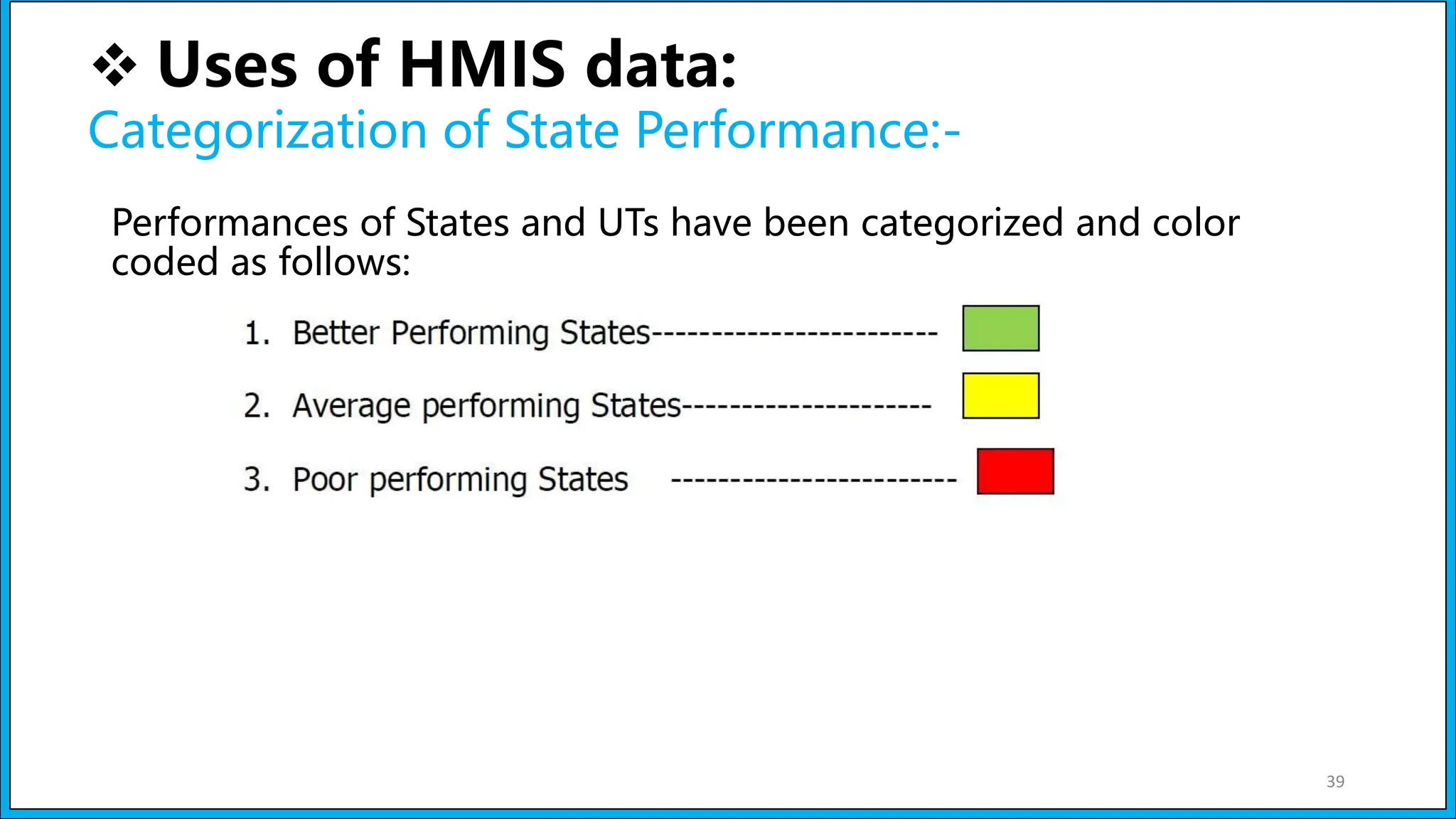
Performances of States and UTs have been categorized and color
coded as follows:
 Uses of HMIS data:
Categorization of State Performance:-
39
Categorization of State Performance:-
Indicators for Performance:
1. % 1st trimester ANC registration to total ANC registrations
2. % Pregnant Woman received 4 ANC checkups to total ANC
Registrations
3. % Institutional delivery to estimated delivery
4. % C-section per Institutional delivery
5. % SBA attended home deliveries to Total Reported Home Deliveries
6. % Pregnant women received TT2 + Booster to total estimated
Number of Annual Pregnancies
7. Sex Ratio at births 40
Indicators for Performance: cont..
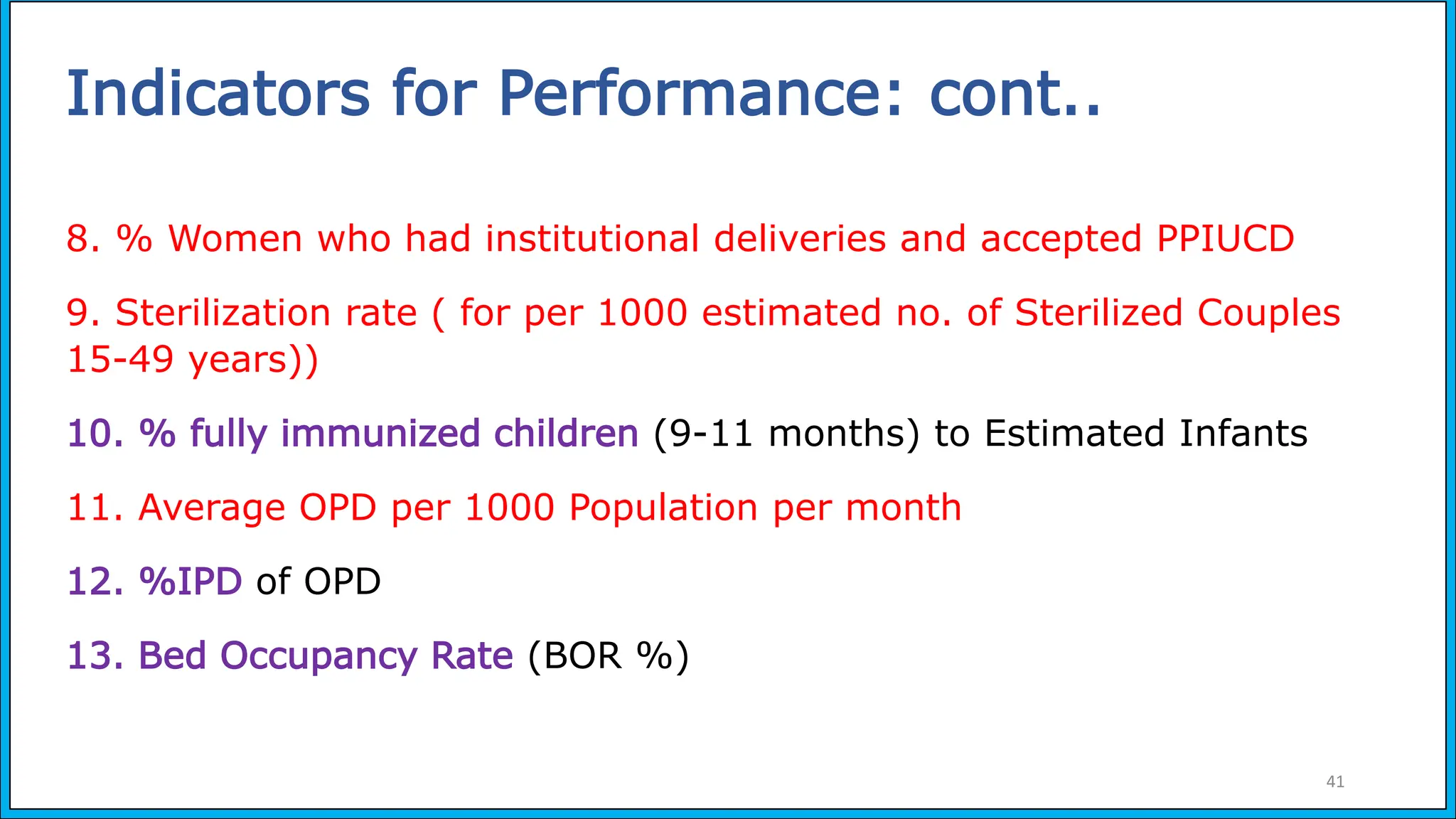
8. % Women who had institutional deliveries and accepted PPIUCD
9. Sterilization rate ( for per 1000 estimated no. of Sterilized Couples
15-49 years))
10. % fully immunized children (9-11 months) to Estimated Infants
11. Average OPD per 1000 Population per month
12. %IPD of OPD
13. Bed Occupancy Rate (BOR %)
41
42
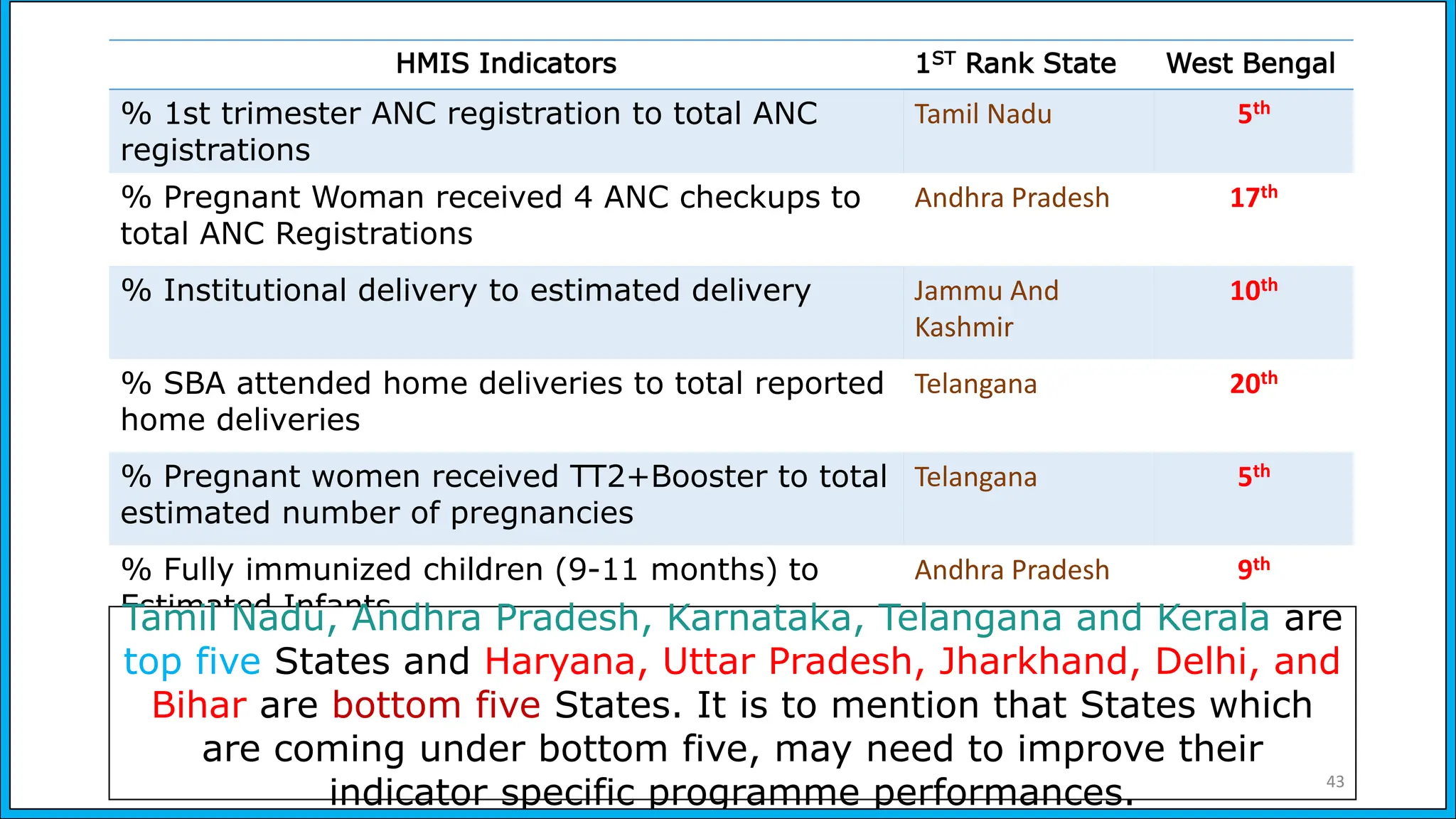
HMIS Indicators 1ST Rank State West Bengal
% 1st trimester ANC registration to total ANC
registrations
Tamil Nadu 5th
% Pregnant Woman received 4 ANC checkups to
total ANC Registrations
Andhra Pradesh 17th
% Institutional delivery to estimated delivery Jammu And
Kashmir
10th
% SBA attended home deliveries to total reported
home deliveries
Telangana 20th
% Pregnant women received TT2+Booster to total
estimated number of pregnancies
Telangana 5th
% Fully immunized children (9-11 months) to
Estimated Infants
Andhra Pradesh 9th
Tamil Nadu, Andhra Pradesh, Karnataka, Telangana and Kerala are
top five States and Haryana, Uttar Pradesh, Jharkhand, Delhi, and
Bihar are bottom five States. It is to mention that States which
are coming under bottom five, may need to improve their
indicator specific programme performances. 43
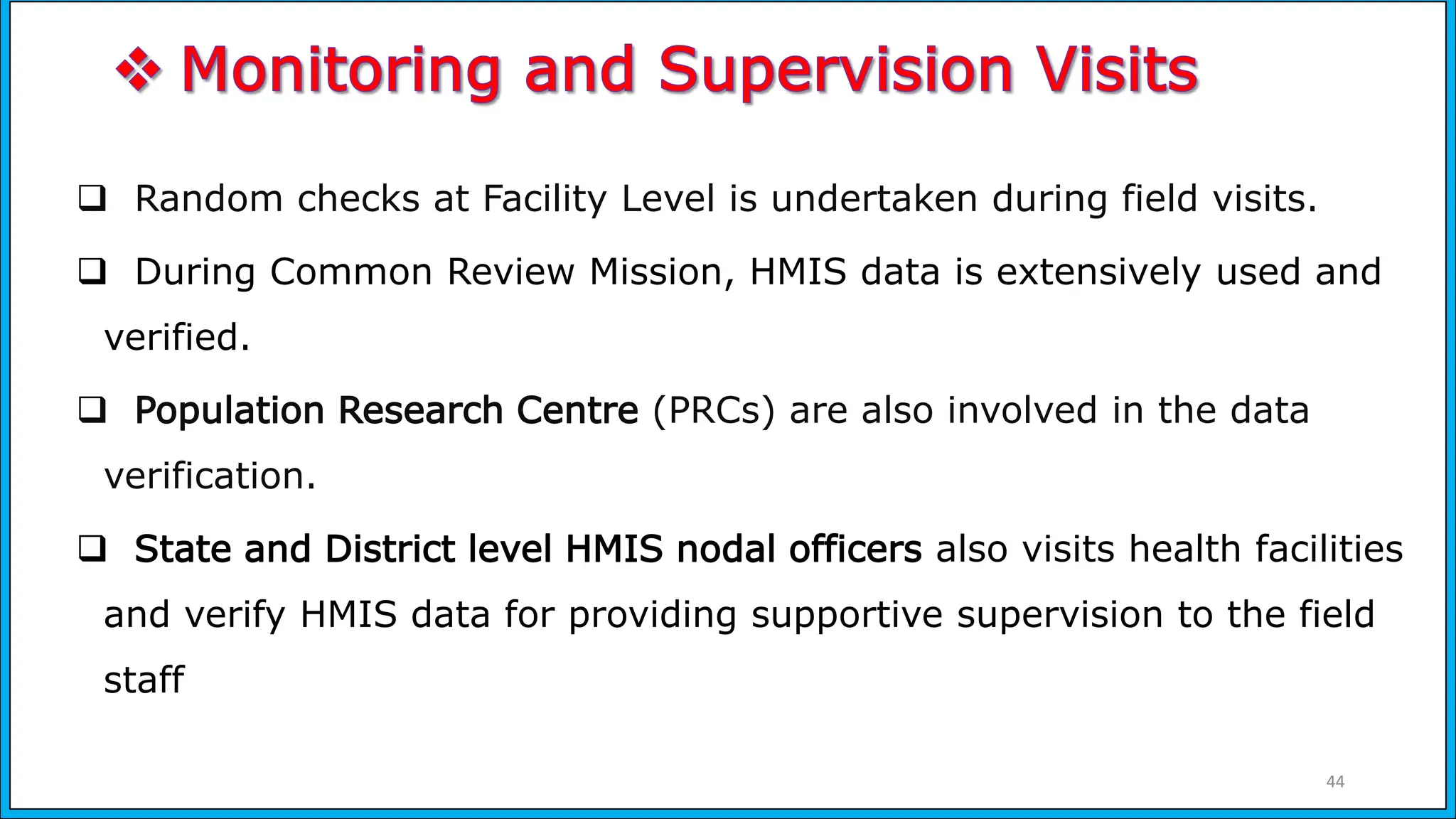
 Random checks at Facility Level is undertaken during field visits.
 During Common Review Mission, HMIS data is extensively used and
verified.
 Population Research Centre (PRCs) are also involved in the data
verification.
 State and District level HMIS nodal officers also visits health facilities
and verify HMIS data for providing supportive supervision to the field
staff
44
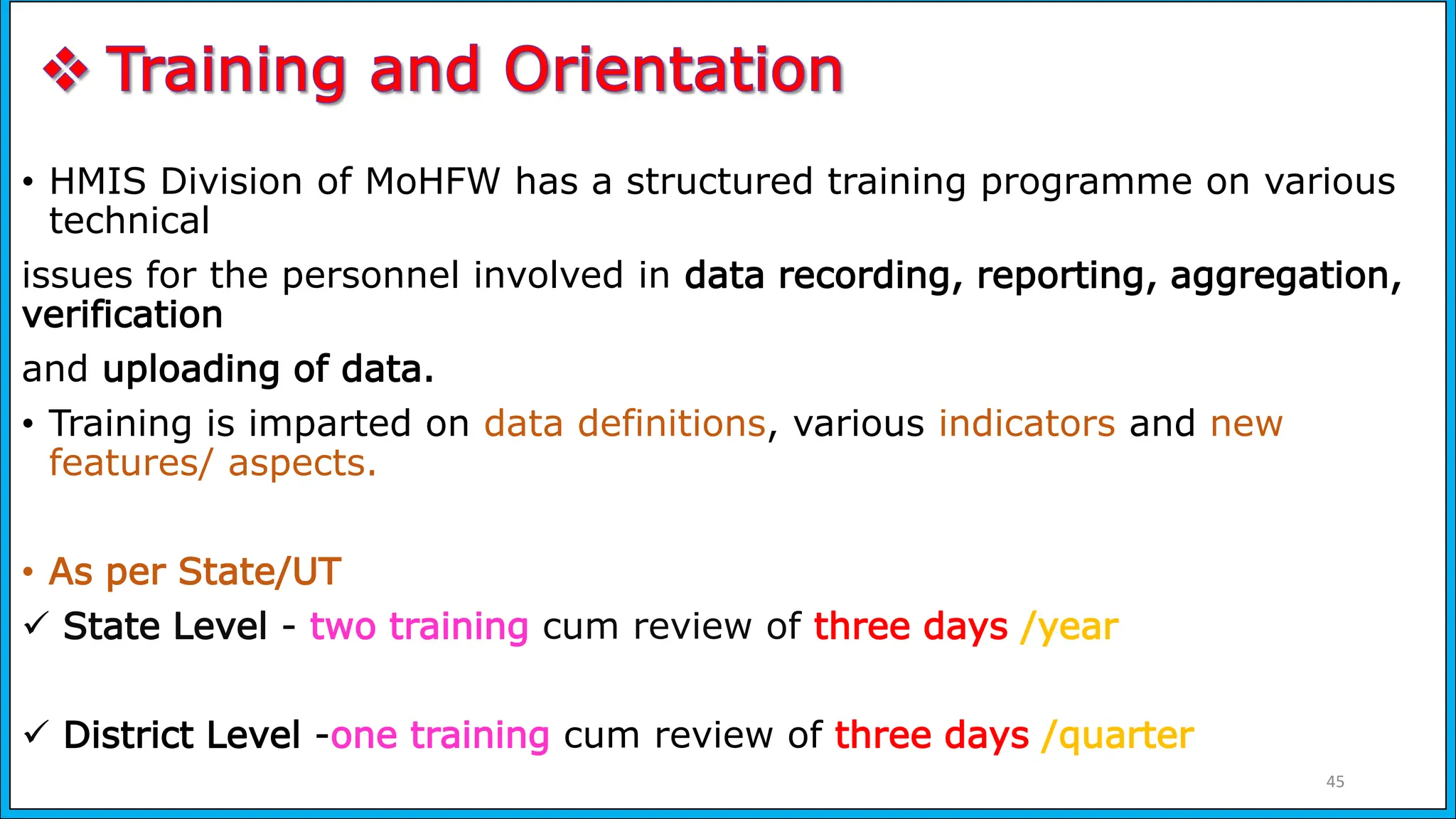
• HMIS Division of MoHFW has a structured training programme on various
technical
issues for the personnel involved in data recording, reporting, aggregation,
verification
and uploading of data.
• Training is imparted on data definitions, various indicators and new
features/ aspects.
• As per State/UT
 State Level - two training cum review of three days /year
 District Level -one training cum review of three days /quarter
45
 The Ministry conducts Annual National level HMIS review
meeting with an objective to discuss the data quality issues with
the State Level Data Manager and HMIS nodal officers and orient
them about new development in HMIS.
 3-4 Regional review meetings for a group of States/districts
are conducted every year.
 The major focus of these review meetings is data quality.
46
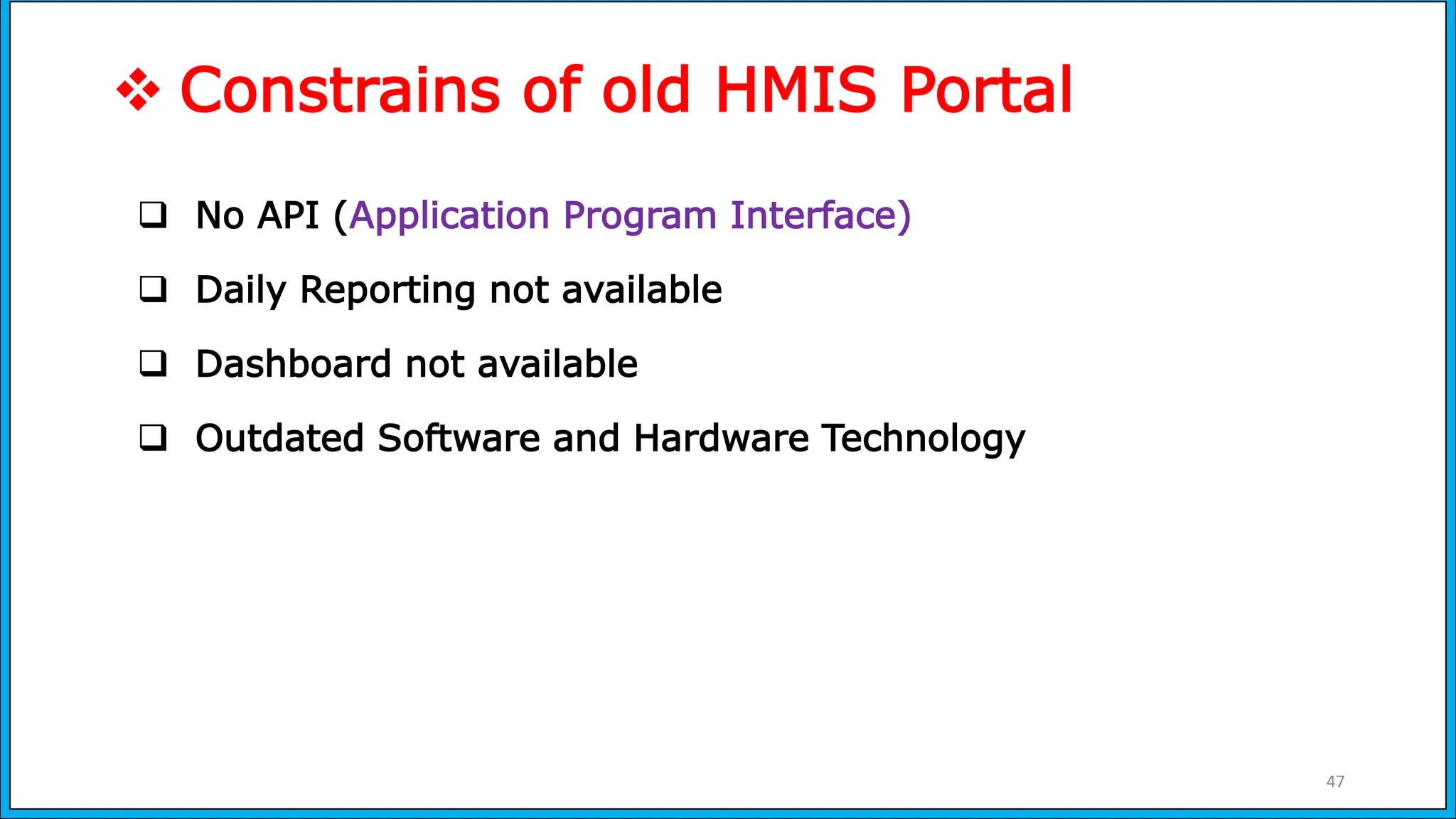
 Constrains of old HMIS Portal
 No API (Application Program Interface)
 Daily Reporting not available
 Dashboard not available
 Outdated Software and Hardware Technology
47
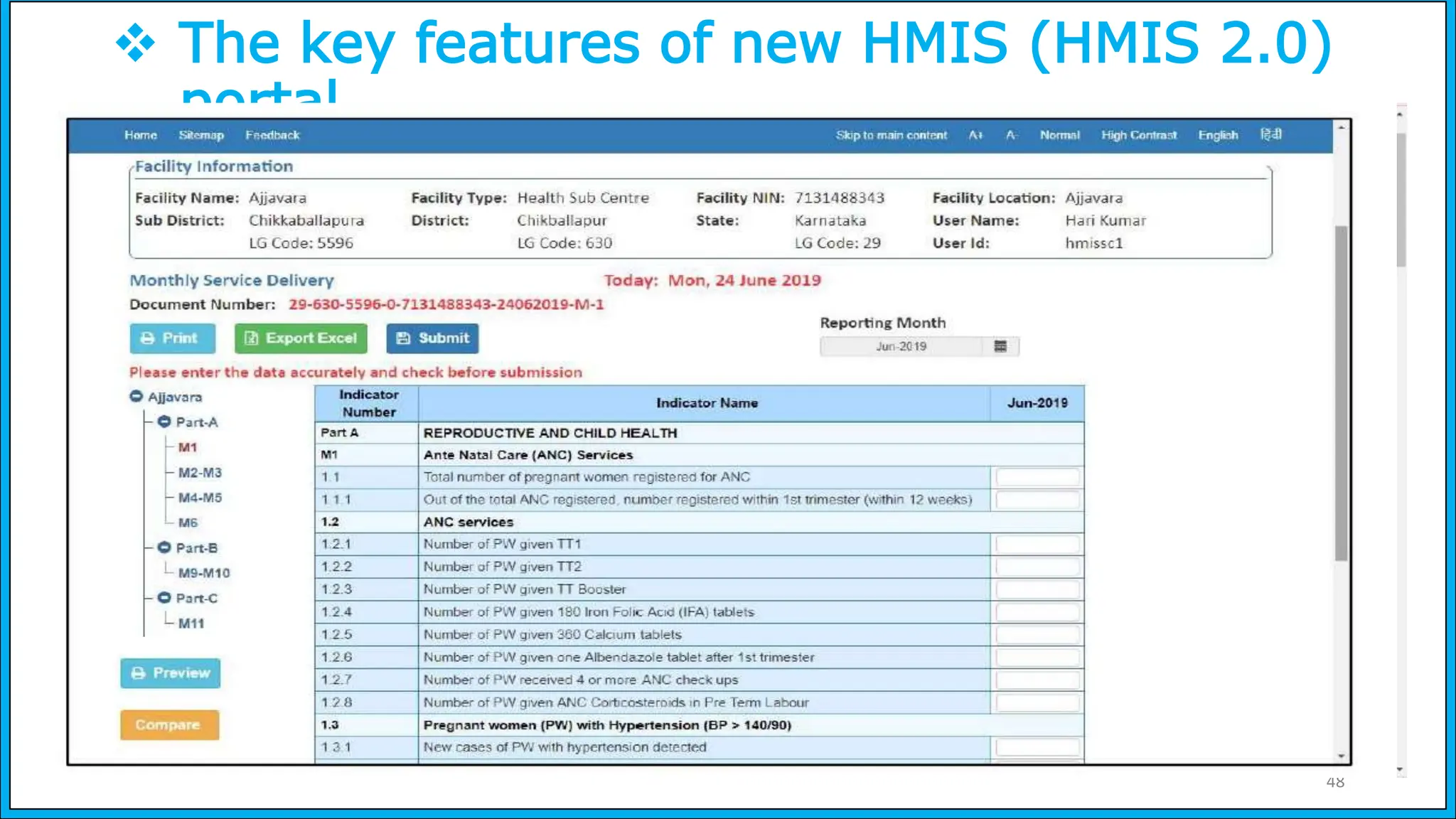
 The key features of new HMIS (HMIS 2.0)
portal
Person Specific User Credentials (mapped to an Individual) for
fixing responsibility to user for entering complete and correct
data in the system.
National Identification Number (NIN) and Local Government
Directory (LGD) have been used for unique identification of
health facilities at village/block.
48
 The key features of new HMIS (HMIS 2.0)
portal
Provision for real time data entry and real time monitoring of the
system
Compatibility with multiple devices such as Mobile, Tab etc.
API (Application Program Interface) developed to ensure direct
linkage of HMIS online portal with other programme/software
application of the ministry.
Advanced data analytics such as GIS Integration with layer of
village boundary is developed.
49
 The key features of new HMIS (HMIS 2.0)
portal
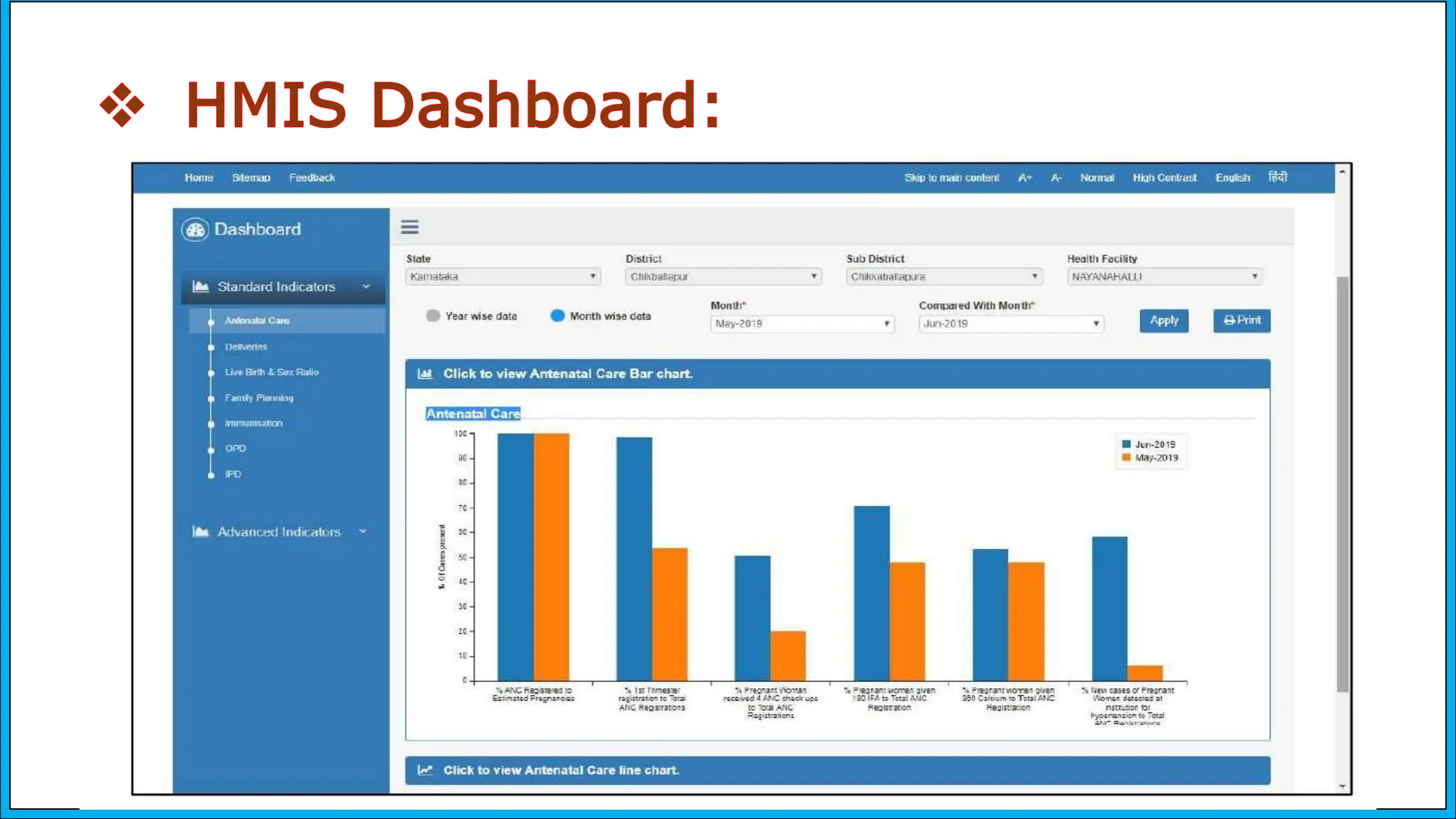
Interactive Dashboards has been developed
 Infrastructure data to be entered only once in the new system,
later to be auto populated and monthly basis updated.
Alerts system is developed which will provide alert to the
programme managers at various level for appropriate and timely
action.
50
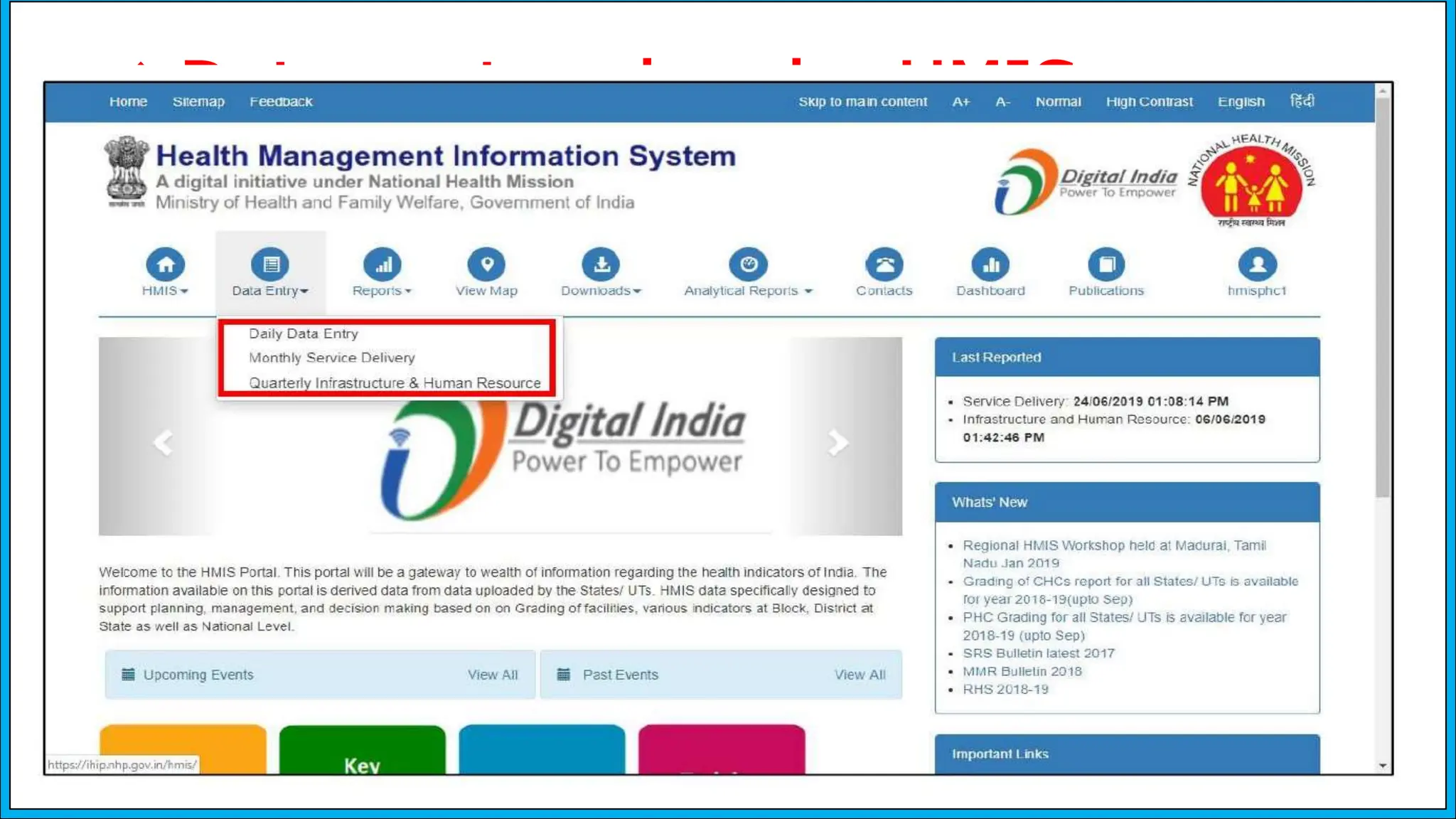
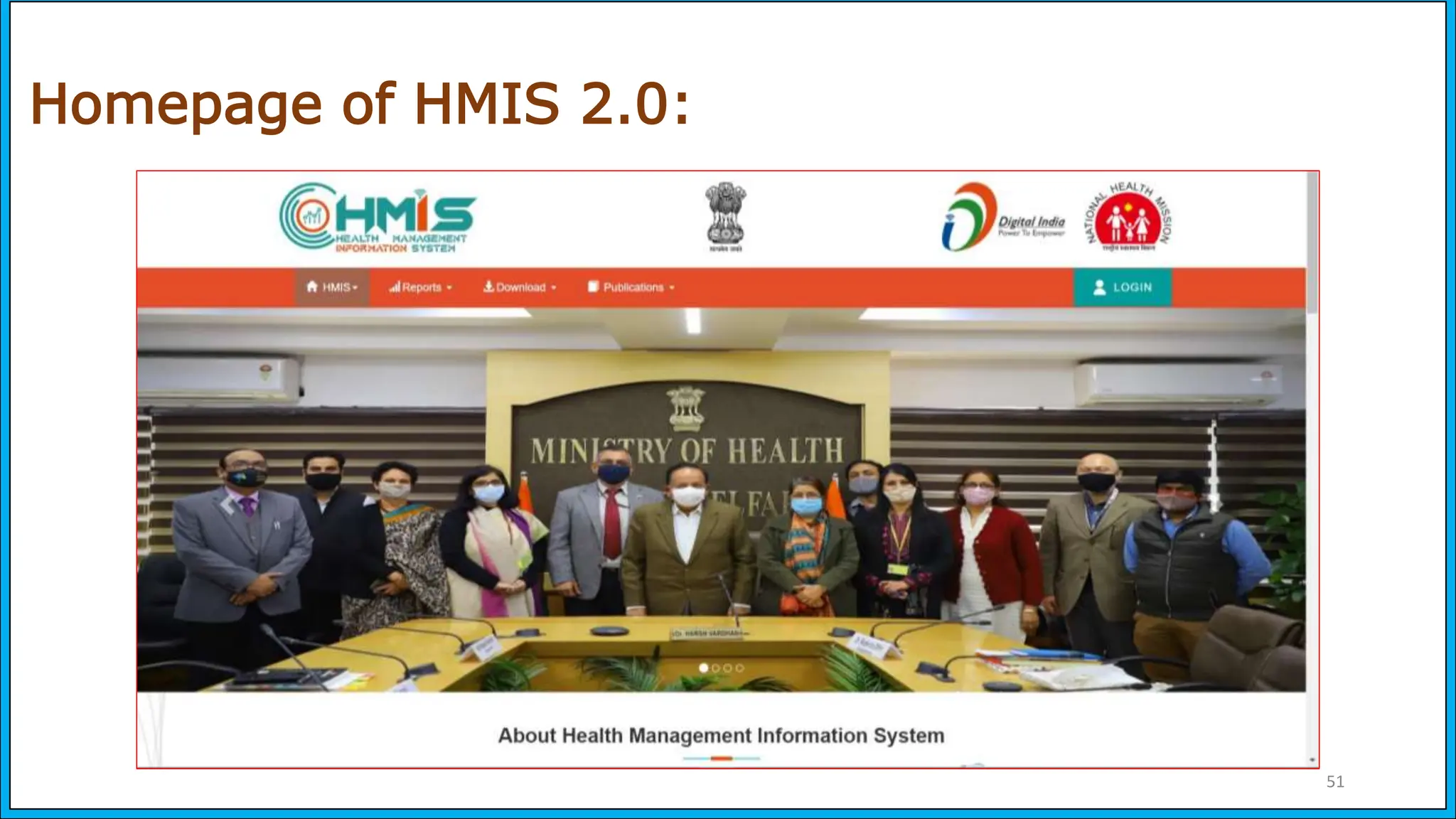
Homepage of HMIS 2.0:
51
HMIS dashboard is an information management tool that
visually tracks, analyzes and displays key performance
indicators (KPI).
53
• Geographical Information System (GIS) in a Health Management
Information System (HMIS) is a powerful tool to manage health
care delivery system
• Currently two reports are available on GIS:
1. Facility reporting Status.
2. Indicator performance
55
Decreased
completeness &
timeliness
Poor internet
connectivity
Lack of hardware
in some facilities
Lack of staff
Lack of
supervision
Poor data reliability
Ambiguity
about data
element
Data entry
errors
Systemic errors
Dishonesty in
reporting
56
1. HMIS-Health Management Information System [Internet]. [cited 2022 Jan 7]. Available from:
https://hmis.nhp.gov.in/#!/aboutus
2. Dehury RK. The progress and impact of Health Management Information System (HMIS) in monitoring and
evaluation of health programs in India. 3(4):7.
3. Pacific WHORO for the W. Developing health management information systems : a practical guide for
developing countries [Internet]. Manila : WHO Regional Office for the Western Pacific; 2004 [cited 2022
Mar 20]. Available from: http://iris.wpro.who.int/handle/10665.1/5498
57

Health Management Information Systems (HMIS).pptx

  • 1.
    Dr. Noor IslamBag 2nd year PGT MD (Community Medicine) AIIH & PH 1
  • 2.
    2  Some definitions Information System A system that provides information support to the decision-making process at each level of an organization  Health Management Information System HMIS is a tool which helps in gathering, aggregating, analyzing data and using information for taking actions to improve performance of health systems
  • 3.
    3 o A monitoring& evaluation systems o HMIS 1.0 o HMIS 2.0 and new features o Data sources o HMIS generate database o HMIS captured data items  Brief Idea about HMIS
  • 4.
    1. What isHMIS? 2. Objectives of HMIS 3. Data captured by HMIS 4. Follow of data in HMIS 5. Data quality measures 6. Organization/Person responsible for HMIS 7. Uses of HMIS data 8. Maintenance of HMIS 9. Constrains of old HMIS web portal 10. New HMIS web portal 4
  • 5.
    Health Management InformationSystem (HMIS) is a Government to Government (G2G) web-based Monitoring Information System has been put in place by Ministry of Health & Family Welfare (MoHFW), Government of India to monitor the National Health Mission and other Health programmes and provide key inputs for policy formulation and appropriate programme interventions.1 HMIS 2.0 (http://hmis.nhp.gov.in) What is 5
  • 6.
     To Monitorthe performance & quality of health care services under the National Health Mission  A tool for evidence based health planning  Used for testing the effectiveness, efficiency of health programs and schemes  To improve availability and access of health care to the population 6
  • 7.
    1946 (Bhore committeereport) - The necessity of a sound information system was felt National Health Policy -1983 - Decision making and program planning in health and related fields are not possible without establishing an effective health information system NHP-2002-focused self to the programme for putting in place a modern and scientific health statistics database NRHM-2005 – felt need of strong component of technical support as an effective health information systems for the success of the NRHM2 7
  • 8.
    8 Development of HMISwith WHO collaboration and National Informatics Center (NIC) HMIS version 1.0 in four participating state of Gujarat, Haryana, Maharashtra and Rajastan Field testing of the HMIS in one district of Gujarat, Haryana, Maharashtra and Rajastan Implementation efforts in 13 states and Union Territories in phased manner The brief outline of the development of HMIS process by WHO
  • 9.
     Evaluation ofHMIS Web Portal 21st October 2008 28th December 2020 2010-11 District level Facility based HMIS 1.0 HMIS 2.0 9
  • 10.
    Sources of data: SC 1,61,019 PHC 31,296 CHC 12,923 SDH 2,430 DH 1,249 HMIS data Asof 2019-20, there were around 705 districts and around 2.08 lakh health facilities mapped and reporting on HMIS Portal. 17
  • 11.
    Fig. All IndiaDistribution of Health Facilities by type(2019-20) 18 Table : All India Distribution of Public and Private Health Facilities
  • 12.
    Data captured underHMIS Types of Data Frequency of data uploading Types of facility 1. Service Delivery Data Monthly District HQ, DH, CHC, PHC, SC 2. Infrastructure & HR Annually DH, SDH, CHC PHC, SC 3. Service Delivery data Daily DH, SDH, CHC PHC, SC
  • 13.
    Monthly Service deliverydata:- Reproductive and Child Health Health Facility Services Monthly Inventory 20 Service delivery data Part C Stock related Part B Health Facility Services Part A Reproduct ive and Child Health Major Category Data element Major Category Major Category Data element Data element
  • 14.
    M1. Ante NatalCare (ANC) M2. Deliveries M3. Number of Caesarean (C-Section) deliveries M4. Pregnancy outcome & details of new- born M5. Complicated Pregnancies M6. Post Natal Care (PNC) M7. Reproductive Tract Infections/Sexually Transmitted Infections (RTI/STI) Cases M8. Family Planning M9. CHILD IMMUNISATION M10. Number of cases of Childhood Diseases (0-5 years) M11. NVBDCP M12. Adolescent Health M13. Directly Observed Treatment, Short- course (DOTS) M14. Patient Services M15. Laboratory Testing M16. Details of deaths reported with probable causes: M17. Vaccines M18. Contraceptives M19. Other Items M20. Syringes M21. Rashtriya Bal Swasthaya Karyakram (RBSK) M22. Adolescent Health M23. Coverage under WIFS JUNIOR (Weekly Iron Folic Acid Supplementation Programme for children 6 – 1 M24. Maternal Death Reviews (MDR) Done M25. Janani Shishu Suraksha Karyakram 21
  • 15.
    22 Data Element '1.1 Totalnumber of pregnant women registered for ANC '1.1.1 Out of the total ANC registered, number registered within 1st trimester (within 12 weeks) '1.2.1 Number of PW given TT1/ Td1 '1.2.2 Number of PW given TT2 / Td2 '1.2.3 Number of PW given TT Booster/ Td Booster '1.2.4 Number of PW provided full Course 180 Iron Folic Acid (IFA) tablets '1.2.5 Number of PW provided full Course 360 Calcium tablets '1.2.6 Number of PW given one Albendazole tablet after 1st trimester M1. Ante Natal Care(ANC) Data Element '1.2.7 Number of PW received 4 or more ANC check ups '1.2.8 Number of PW given ANC Corticosteroids in Pre Term Labour '1.3.1 New cases of PW with hypertension detected '1.3.1. a Out of the new cases of PW with hypertension detected, cases managed at institution '1.3.2 Number of Eclampsia cases managed during delivery '1.4.1 Number of PW tested for Haemoglobin (Hb ) 4 or more than 4 times for respective ANCs '1.4.2 Number of PW having Hb level<11 (out of total tested cases)(7.1 to 10.9)
  • 16.
     Manpower  Equipment Cleanliness  Building  Availability of Medical Services, Surgery etc.  Super Specialties services such as Cardiology etc.  Para Medical andClinical Services etc. 23
  • 17.
    In new HMIS Fivedata items are also collected on daily basis which are mainly linked to COVID-19 1) Total number of outpatients (OPD) 2) Total number of inpatients (IPD) 3) Total SARI - Severe Acute Respiratory Infection (OPD +IPD) 4) Total ILI - Influenza Like Illness (OPD + IPD) 5) Total fever cases >= 7 Days (OPD + IPD)  Data captured under HMIS- Daily basis 24
  • 18.
    In new HMIS 1.Total number of OPD attendance 2. Total number of IPD admission 3. Number of patients provided diagnostic chemical test 4. Number of patients provided diagnostic radiography test 5. Number of patients provided medicine 6. Number of cases of AEFI-deaths 7. Number of infant deaths 8. Number of maternal deaths  Data captured under HMIS: daily basis 25
  • 19.
    (Case-I) Data Entry Operator at Block SC Health Worker Health WorkerPHC CHC Health Worker SDH DH HMIS Portal Enters Data for each facility DHQ Enters DHQ and compiles the data 26
  • 20.
    HMIS Portal SC Health Worker Enters Data Health Worker PHC EntersData CHC Health Worker Enters Data SDH Enters Data DH Enters Data DHQ Enters DHQ data and compiles the data (Case-II) 27
  • 21.
  • 22.
     Data QualityMeasures in HMIS a. Completeness b. Accuracy/correctness c. Consistency of data reporting d. The timeliness 30
  • 23.
     Data QualityMeasures in HMIS 1. Timeliness: Each facility is supposed to enter the data by 5th of the following month in case of monthly MIS data and by 30th April of the reporting year in case of Annual Infrastructure data. 2. Accuracy: a. Compare Option: To compare data with previous month (in case of monthly data) b. Inter-Data Validation Checks: While saving data, as per prior inbuilt validation rules, error highlighted in red colour for the erroneous data elements. 31
  • 24.
     Data QualityMeasures in HMIS (cont…) 3. Completeness: a. Data Entry Status Report: Completeness of reporting of the facility. b. Percentage Filled Report: Completeness of data entry by the facility. 32
  • 25.
    Organization/Person responsible forHMIS Location/Hospital Person responsible Sub-center ANM, LHV PHC Pharmacist, MO, DEO CHC DEO, Block Program Manager, BMO District District statistical officer-Health/DEO, District Program Manager, District level HMIS nodal officer State State level HMIS nodal officer Dy/Joint director- Vital statistics Surveillance unit State Level Data Manager Central government Central Bureau of Health Intelligence Statistics division- Department of family welfare Statistic division- Department of Health 34
  • 26.
     Uses ofHMIS data  HMIS data is widely used by States in preparing Program Implementation Plans (PIPs) under NHM.  Indicators from HMIS (like Institutional Deliveries, C – Section deliveries, Immunization, IPD, OPD, Surgeries, etc.) are used to evaluate the States’ performance 35
  • 27.
     Uses ofHMIS data(cont..)  Facility wise data of PHCs is used for grading the facilities (Grading of PHCs). NHM started grading of PHC in 2018-19  CHC Grading (started in 2013-14) & DH Ranking is also being done. 36
  • 28.
     The gradesassigned to PHCs are 0/5, 1/5, 2/5/, 3/5, 4/5 and 5/5. • 1. Human Resource availability Mandatory criteria • 2. Infrastructure & Service Availability • 3. Essential Laboratory Services ( Assignment of 3 grades out of 5) • 4. Drug & Supplies availability • 5. Service Utilization/ Performance Indicators. (Assignment of 2 grades out of 5)  In case a facility does not fulfills the mandatory criteria it would not be eligible for grading and would be categorized as Not Eligible (NE)”. 37
  • 29.
    Fig. Status ofPHC Grading across India 2019-20 38
  • 30.
    Performances of Statesand UTs have been categorized and color coded as follows:  Uses of HMIS data: Categorization of State Performance:- 39
  • 31.
    Categorization of StatePerformance:- Indicators for Performance: 1. % 1st trimester ANC registration to total ANC registrations 2. % Pregnant Woman received 4 ANC checkups to total ANC Registrations 3. % Institutional delivery to estimated delivery 4. % C-section per Institutional delivery 5. % SBA attended home deliveries to Total Reported Home Deliveries 6. % Pregnant women received TT2 + Booster to total estimated Number of Annual Pregnancies 7. Sex Ratio at births 40
  • 32.
    Indicators for Performance:cont.. 8. % Women who had institutional deliveries and accepted PPIUCD 9. Sterilization rate ( for per 1000 estimated no. of Sterilized Couples 15-49 years)) 10. % fully immunized children (9-11 months) to Estimated Infants 11. Average OPD per 1000 Population per month 12. %IPD of OPD 13. Bed Occupancy Rate (BOR %) 41
  • 33.
  • 34.
    HMIS Indicators 1STRank State West Bengal % 1st trimester ANC registration to total ANC registrations Tamil Nadu 5th % Pregnant Woman received 4 ANC checkups to total ANC Registrations Andhra Pradesh 17th % Institutional delivery to estimated delivery Jammu And Kashmir 10th % SBA attended home deliveries to total reported home deliveries Telangana 20th % Pregnant women received TT2+Booster to total estimated number of pregnancies Telangana 5th % Fully immunized children (9-11 months) to Estimated Infants Andhra Pradesh 9th Tamil Nadu, Andhra Pradesh, Karnataka, Telangana and Kerala are top five States and Haryana, Uttar Pradesh, Jharkhand, Delhi, and Bihar are bottom five States. It is to mention that States which are coming under bottom five, may need to improve their indicator specific programme performances. 43
  • 35.
     Random checksat Facility Level is undertaken during field visits.  During Common Review Mission, HMIS data is extensively used and verified.  Population Research Centre (PRCs) are also involved in the data verification.  State and District level HMIS nodal officers also visits health facilities and verify HMIS data for providing supportive supervision to the field staff 44
  • 36.
    • HMIS Divisionof MoHFW has a structured training programme on various technical issues for the personnel involved in data recording, reporting, aggregation, verification and uploading of data. • Training is imparted on data definitions, various indicators and new features/ aspects. • As per State/UT  State Level - two training cum review of three days /year  District Level -one training cum review of three days /quarter 45
  • 37.
     The Ministryconducts Annual National level HMIS review meeting with an objective to discuss the data quality issues with the State Level Data Manager and HMIS nodal officers and orient them about new development in HMIS.  3-4 Regional review meetings for a group of States/districts are conducted every year.  The major focus of these review meetings is data quality. 46
  • 38.
     Constrains ofold HMIS Portal  No API (Application Program Interface)  Daily Reporting not available  Dashboard not available  Outdated Software and Hardware Technology 47
  • 39.
     The keyfeatures of new HMIS (HMIS 2.0) portal Person Specific User Credentials (mapped to an Individual) for fixing responsibility to user for entering complete and correct data in the system. National Identification Number (NIN) and Local Government Directory (LGD) have been used for unique identification of health facilities at village/block. 48
  • 40.
     The keyfeatures of new HMIS (HMIS 2.0) portal Provision for real time data entry and real time monitoring of the system Compatibility with multiple devices such as Mobile, Tab etc. API (Application Program Interface) developed to ensure direct linkage of HMIS online portal with other programme/software application of the ministry. Advanced data analytics such as GIS Integration with layer of village boundary is developed. 49
  • 41.
     The keyfeatures of new HMIS (HMIS 2.0) portal Interactive Dashboards has been developed  Infrastructure data to be entered only once in the new system, later to be auto populated and monthly basis updated. Alerts system is developed which will provide alert to the programme managers at various level for appropriate and timely action. 50
  • 42.
  • 43.
    HMIS dashboard isan information management tool that visually tracks, analyzes and displays key performance indicators (KPI). 53
  • 44.
    • Geographical InformationSystem (GIS) in a Health Management Information System (HMIS) is a powerful tool to manage health care delivery system • Currently two reports are available on GIS: 1. Facility reporting Status. 2. Indicator performance 55
  • 45.
    Decreased completeness & timeliness Poor internet connectivity Lackof hardware in some facilities Lack of staff Lack of supervision Poor data reliability Ambiguity about data element Data entry errors Systemic errors Dishonesty in reporting 56
  • 46.
    1. HMIS-Health ManagementInformation System [Internet]. [cited 2022 Jan 7]. Available from: https://hmis.nhp.gov.in/#!/aboutus 2. Dehury RK. The progress and impact of Health Management Information System (HMIS) in monitoring and evaluation of health programs in India. 3(4):7. 3. Pacific WHORO for the W. Developing health management information systems : a practical guide for developing countries [Internet]. Manila : WHO Regional Office for the Western Pacific; 2004 [cited 2022 Mar 20]. Available from: http://iris.wpro.who.int/handle/10665.1/5498 57

Editor's Notes

  • #2 A Strong and robust Monitoring and Evaluation system is a key to success of any projects and programme
  • #3 1st we have to know what is Information system
  • #4 Before going further I want to give brief idea about HMIS ..A Strong and robust Monitoring and Evaluation system is a key to success of any projects and programme. HMIS is one type of monitoring evaluation system but web based..so we need a hardware software, network connection, train manpower and data. Ministry of Health & Family Welfare, Government of India has put in place a web-based monitoring information system, Health Management Information System (HMIS) in 2008 to monitor all its health programme. Since then many changes happened. The new HMIS was launched by then Hon’ble Union Minister of Health and Family Welfare, Government of India on 28th December, 2020 with data entry started since April 2020 onwards. The new portal has many new features which were earlier not available in HMIS (1.0). This includes person specific user credentials, real time data entry and real time monitoring, National Identification Number (NIN) and Local Government Directory (LGD) compliance, API (Application Program Interface), etc. Around 2.20 lakh health facilities, across all districts (735 Districts), across all subs-districts (6858 Sub-districts) of India are uploading data every month. HMIS generate huge amount of data (more than 3 Tb database size (Approx.) and captures more than 300 data items under service delivery and over 400 data items under Infrastructure and HR.
  • #5 We will learn what is hmis, what are the different objectives of hmis, sources of data, follow of data, measures taken for quality data, person responsible for hmis, what r the uses of hmis data, how its maintained, constrains of old web portal, and something about new web portal.
  • #6 This definition is given in the hmis web portal
  • #7 1st and most important objective is It’s a tool for evidenced based health planning to evaluate effectiveness efficiency of health programs and health scheme
  • #8 1st hmis web portal was launced in 2008, but if we go far behind in 1946 bhore committee report, national health poicy 1983, and 2002 all they felt the neccecity of a sound information system, in nrhm nrhm mission director felt that for the success of nrhm we need a technical support from a health information system
  • #9 Software development started with the help of who software developer and national informatics center after that it was tested in four state named Gujrat Haryana Maharashtra rajasthan after successful testing it was implemented in 13 states in phased manner , after some modification
  • #10 Hmis 1.0 was launcehed in 2008 for distric level reporting then in 2010 11 it was updated for facility based reporting and latest update occurred in 2020 it has many new features that I will discuss latter
  • #12 We have to know what is data element
  • #13 This is the data entry reporting format
  • #18 Sources of hmis data in 2019-20 across the country 161019 sc 31296
  • #19 Here we can see that major contribution of hmis data is sc that is 77% and PHC 15% and also we can see 8885 private facilities also sharing their data in hmis web portal
  • #25 DAILY DATA ENTRY .IT HAS TWO TYPE DATA ENTRY FORMAT , DURING COVID 19 FIVE DATA ITEMS UPLOADING WAS MANDATORY
  • #26 BEFORE COVID DAILY DATA ENTRY FORMAT WAS DIFFERENT ..IT HAS ITEMS LIKE
  • #36 Program Implementation Plans (PIPs) are the most crucial documents in NHM through which the States/UTs plan, prioritize and propose strategies and activities to address the challenges in public health.
  • #38 PHC are categorized into 6 grade from 0 to 5 based upon 5 criteria
  • #40 Based upon 13 indicators states are categorized and color coded
  • #44 State ranking based upon individual indicator