CHEMISTRY
INVESTIGATORY PROJECT
2015-16
NAME -
DHARMENDER
CLASS-XII
CHEMISTRY
INVESTIGATORY PROJECT
2015-16
NAME-PRAVEEN
CLASS-XII
INDEX
•# AIM
•# OBJECTIVE
•# INTRODUCTION
•#Theory
•# MATERIALS REQUIRED
•# PROCEDURE
•# OBSERVATIONS
•# BIBLIOGRAPHY
AIM OF THE
EXPERIMENT
To compare the rate of fermentation of
givensample of wheat flour gram
flour,rice flour and potato using yeast
OBJECTIVE
The purpose of the experiment is – to
compare the rate of fermentation ofthe given
samples of wheat flour,gram flour, rice flour
and potatoes.I became interested in this idea
when i saw some experiments on
fermentation and wanted to find out some
scientific facts about fermentation.The primary
benefit of fermentation is the conversion of
sugars and
other carbohydrates,e.g., converting juice into
wine, grains into beer, carbohydrates into
carbon dioxide to leaven bread, and sugars in
vegetables into preservative organic acids.
INTRODUCTION
Fermentation typically is the conversion of
carbohydrates to alcohols and carbon dioxide or
organic acids using yeasts, bacteria, or a
combination thereof, under anaerobic conditions.
A more restricted definition of fermentation is the
chemical conversion ofsugars into ethanol. The
science offermentation is known as
zymology.Fermentation usually implies that the
action ofmicroorganisms is desirable, and the
process isused to produce alcoholic beverages such
aswine, beer, and cider. Fermentation is
alsoemployed in preservation techniques to
createlactic acid in sour foods such as
sauerkraut,dry sausages, kimchi and yoghurt, or
vinegar for use in pickling foods.
THEORY
Wheat flour,gram flour,rice flour and potatoes
contains starch as the major
constituent.Starch present in these food
materials is first brought into solution.in the
presence of enzyme diastase,starch undergo
fermentation to give maltose. Starch gives
blue-violet colour with iodine whereas
product of fermentation starch donot give any
characteristic colour. When the fermentation
is complete the reaction mixture stops giving
blue-violet colour with iodine solution. By
comparing the time required for completion
of fermentation of equal amounts of different
substances containing starch the rates of
fermentation can be compared.The enzyme
diastase is obtained by germination of moist
barley seeds in dark at 15 degree
celsius.When the germination is complete the
temperature is raised to 60 degree celsius to
stop further growth.The seeds are crushed
into water and filtered.The filtrate contains
enzyme diastase and is called malt extract.
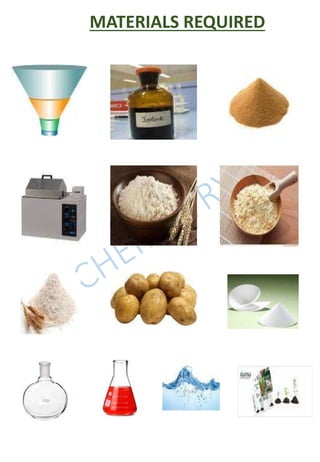
MATERIALS REQUIRED
PROCEDURE
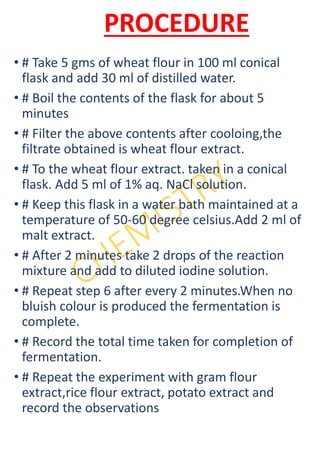
• # Take 5 gms of wheat flour in 100 ml conical
flask and add 30 ml of distilled water.
• # Boil the contents of the flask for about 5
minutes
• # Filter the above contents after cooloing,the
filtrate obtained is wheat flour extract.
• # To the wheat flour extract. taken in a conical
flask. Add 5 ml of 1% aq. NaCl solution.
• # Keep this flask in a water bath maintained at a
temperature of 50-60 degree celsius.Add 2 ml of
malt extract.
• # After 2 minutes take 2 drops of the reaction
mixture and add to diluted iodine solution.
• # Repeat step 6 after every 2 minutes.When no
bluish colour is produced the fermentation is
complete.
• # Record the total time taken for completion of
fermentation.
• # Repeat the experiment with gram flour
extract,rice flour extract, potato extract and
record the observations
OBSERVATIONS
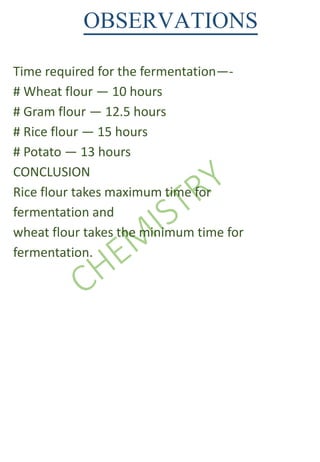
Time required for the fermentation—-
# Wheat flour — 10 hours
# Gram flour — 12.5 hours
# Rice flour — 15 hours
# Potato — 13 hours
CONCLUSION
Rice flour takes maximum time for
fermentation and
wheat flour takes the minimum time for
fermentation.
BIBLIOGRAPHY
Ø Comprehensive Chemistry Practical Class-XII.
Ø http://en.wikipedia.org/wiki/Anise
Ø http://www.essentialoils.co.za/essential-
oils/aniseed.htm
Chemistry

Chemistry

  • 1.
  • 2.
  • 3.
    INDEX •# AIM •# OBJECTIVE •#INTRODUCTION •#Theory •# MATERIALS REQUIRED •# PROCEDURE •# OBSERVATIONS •# BIBLIOGRAPHY
  • 4.
    AIM OF THE EXPERIMENT Tocompare the rate of fermentation of givensample of wheat flour gram flour,rice flour and potato using yeast
  • 5.
    OBJECTIVE The purpose ofthe experiment is – to compare the rate of fermentation ofthe given samples of wheat flour,gram flour, rice flour and potatoes.I became interested in this idea when i saw some experiments on fermentation and wanted to find out some scientific facts about fermentation.The primary benefit of fermentation is the conversion of sugars and other carbohydrates,e.g., converting juice into wine, grains into beer, carbohydrates into carbon dioxide to leaven bread, and sugars in vegetables into preservative organic acids.
  • 6.
    INTRODUCTION Fermentation typically isthe conversion of carbohydrates to alcohols and carbon dioxide or organic acids using yeasts, bacteria, or a combination thereof, under anaerobic conditions. A more restricted definition of fermentation is the chemical conversion ofsugars into ethanol. The science offermentation is known as zymology.Fermentation usually implies that the action ofmicroorganisms is desirable, and the process isused to produce alcoholic beverages such aswine, beer, and cider. Fermentation is alsoemployed in preservation techniques to createlactic acid in sour foods such as sauerkraut,dry sausages, kimchi and yoghurt, or vinegar for use in pickling foods.
  • 7.
    THEORY Wheat flour,gram flour,riceflour and potatoes contains starch as the major constituent.Starch present in these food materials is first brought into solution.in the presence of enzyme diastase,starch undergo fermentation to give maltose. Starch gives blue-violet colour with iodine whereas product of fermentation starch donot give any characteristic colour. When the fermentation is complete the reaction mixture stops giving blue-violet colour with iodine solution. By comparing the time required for completion of fermentation of equal amounts of different substances containing starch the rates of fermentation can be compared.The enzyme diastase is obtained by germination of moist barley seeds in dark at 15 degree celsius.When the germination is complete the temperature is raised to 60 degree celsius to stop further growth.The seeds are crushed into water and filtered.The filtrate contains enzyme diastase and is called malt extract.
  • 8.
  • 9.
    PROCEDURE • # Take5 gms of wheat flour in 100 ml conical flask and add 30 ml of distilled water. • # Boil the contents of the flask for about 5 minutes • # Filter the above contents after cooloing,the filtrate obtained is wheat flour extract. • # To the wheat flour extract. taken in a conical flask. Add 5 ml of 1% aq. NaCl solution. • # Keep this flask in a water bath maintained at a temperature of 50-60 degree celsius.Add 2 ml of malt extract. • # After 2 minutes take 2 drops of the reaction mixture and add to diluted iodine solution. • # Repeat step 6 after every 2 minutes.When no bluish colour is produced the fermentation is complete. • # Record the total time taken for completion of fermentation. • # Repeat the experiment with gram flour extract,rice flour extract, potato extract and record the observations
  • 10.
    OBSERVATIONS Time required forthe fermentation—- # Wheat flour — 10 hours # Gram flour — 12.5 hours # Rice flour — 15 hours # Potato — 13 hours CONCLUSION Rice flour takes maximum time for fermentation and wheat flour takes the minimum time for fermentation.
  • 11.
    BIBLIOGRAPHY Ø Comprehensive ChemistryPractical Class-XII. Ø http://en.wikipedia.org/wiki/Anise Ø http://www.essentialoils.co.za/essential- oils/aniseed.htm