Name - Virat Prasad
Roll No. -
Class - XII
Section - ‘A’
Session – 2016-17
Topic - To study the quantity
of Casein Present in Various
samples of Milk.
INDEx
1. CERTIFICATE OF EXCELLENCE
2. ACKNOWLEDGEMENT
3. AIM OF PROJECT
4. INTRODUCTION
5. THEORY
6. REQUIREMENTS
7. PROCEDURE FOLLOWED
8. OBSERVATION
9. CONCLUSION
10. BIBLIOGRAPHY
CERTIFICATE
This is to certify that VIRAT PRASAD, a
student of class XII-‘A’ has successfully
completed the research on the mentioned
topic under the guidance of Mr. Rajesh
Kumar (PGT Chem.) during the academic
year 2016-17 in partial fulfilment of
chemistry practical examination
conducted by AISSCE, New Delhi.
Signature of External Examiner Signature of Chemistry Teacher
ACKNOWLEDGEMENT
In the accomplishment of this project successfully,
many people have best owned upon me their blessings
and the heart pledged support, this time I am utilizing
to thank all the people who have been concerned with
the project.
Primarily, I would thank God for being able to
complete this project with success. Then I would like
to thank my Chemistry teacher Mr. Rajesh Kumar,
whose valuable guidance has been the ones that
helped me patch this project and make it full proof
success. His suggestions and his instructions have
served as the major contributor towards the
completion of the project.
Then I would like to thank my parents and friends who
have helped me with their valuable suggestions and
guidance that has been helpful in various phase of the
completion of the project.
Last but not least, I would like to thank my classmates
who have helped me a lot.
AIM OF THE PROJECT
To study the quantity of
Casein Present in
Various samples of
Milk.
INTRODUCTION
Milk is a white liquid secreted by the
mammary glands of female cows,
buffaloes, etc. It is a food of exceptional
inters probability. Milk is the most
nutritious food found in nature. That is
why it is widely consumed both in its
natural forms and as diary product like
butter, cheese, etc.
Milk contains Vitamins, Proteins,
Carbohydrates and the major milk protein
casein are found only in milk and nowhere
else in nature. The Composition of casein
in milk is not constant. It depends upon
the Sources of Milk.
THEORY
The Protein, Casein, Existent, Milk as the
calcium salt, calcium casein etc. The salt
has a complex structure and form
micelles. These micelles have negative
charges on the outer surface.
REQUIREMENTS
250ml. beaker, filtrations flask, measuring
cylinder, glass rod, spatula, china dish,
dropper, and weight bore, different
samples of milk, 10% acetic acid.
PROCEDURE
1. Measure 20ml, of a milk sample with the
help of measuring cylinder and transfer
into a clean 250ml. beaker.
2. Make the volume of milk to about 35ml,
by adding water and warm the mixture to
about 40 c.
3. Add to the warm mixture drowse and
with constant stirring 10% acetic acid
until the precipitation is completed.
4. Stir the mixture for another 10 minutes
or till the precipitated casein forms a large
amorphous mass.
5. Filter the casein precipitate.
6. Wash thoroughly with water, dry foils
between folds of filter paper and then in
air
for 1-2 days weight the dry solid so
obtained.
7. Similarly, determine the amount of
casein in other samples of milk.
OBSERVATION
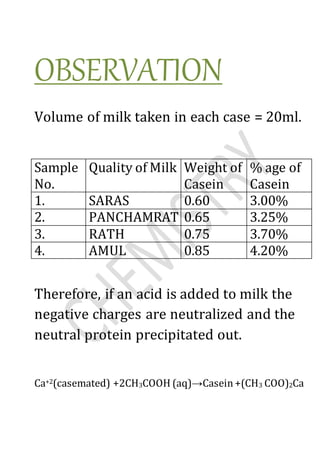
Volume of milk taken in each case = 20ml.
Sample
No.
Quality of Milk Weight of
Casein
% age of
Casein
1. SARAS 0.60 3.00%
2. PANCHAMRAT 0.65 3.25%
3. RATH 0.75 3.70%
4. AMUL 0.85 4.20%
Therefore, if an acid is added to milk the
negative charges are neutralized and the
neutral protein precipitated out.
Ca+2(casemated) +2CH3COOH (aq)→Casein+(CH3 COO)2Ca
CONCLUSION
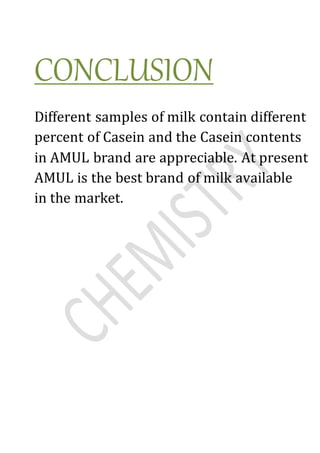
Different samples of milk contain different
percent of Casein and the Casein contents
in AMUL brand are appreciable. At present
AMUL is the best brand of milk available
in the market.
Bibliography
Help from INTERNET
Help from Teacher

Chemistryprojectoncaseininmik 170207030628

  • 1.
    Name - ViratPrasad Roll No. - Class - XII Section - ‘A’ Session – 2016-17 Topic - To study the quantity of Casein Present in Various samples of Milk.
  • 2.
    INDEx 1. CERTIFICATE OFEXCELLENCE 2. ACKNOWLEDGEMENT 3. AIM OF PROJECT 4. INTRODUCTION 5. THEORY 6. REQUIREMENTS 7. PROCEDURE FOLLOWED 8. OBSERVATION 9. CONCLUSION 10. BIBLIOGRAPHY
  • 3.
    CERTIFICATE This is tocertify that VIRAT PRASAD, a student of class XII-‘A’ has successfully completed the research on the mentioned topic under the guidance of Mr. Rajesh Kumar (PGT Chem.) during the academic year 2016-17 in partial fulfilment of chemistry practical examination conducted by AISSCE, New Delhi. Signature of External Examiner Signature of Chemistry Teacher
  • 4.
    ACKNOWLEDGEMENT In the accomplishmentof this project successfully, many people have best owned upon me their blessings and the heart pledged support, this time I am utilizing to thank all the people who have been concerned with the project. Primarily, I would thank God for being able to complete this project with success. Then I would like to thank my Chemistry teacher Mr. Rajesh Kumar, whose valuable guidance has been the ones that helped me patch this project and make it full proof success. His suggestions and his instructions have served as the major contributor towards the completion of the project. Then I would like to thank my parents and friends who have helped me with their valuable suggestions and guidance that has been helpful in various phase of the completion of the project.
  • 5.
    Last but notleast, I would like to thank my classmates who have helped me a lot. AIM OF THE PROJECT To study the quantity of Casein Present in Various samples of Milk.
  • 7.
    INTRODUCTION Milk is awhite liquid secreted by the mammary glands of female cows, buffaloes, etc. It is a food of exceptional inters probability. Milk is the most nutritious food found in nature. That is why it is widely consumed both in its natural forms and as diary product like butter, cheese, etc. Milk contains Vitamins, Proteins, Carbohydrates and the major milk protein casein are found only in milk and nowhere else in nature. The Composition of casein in milk is not constant. It depends upon the Sources of Milk.
  • 8.
    THEORY The Protein, Casein,Existent, Milk as the calcium salt, calcium casein etc. The salt has a complex structure and form micelles. These micelles have negative charges on the outer surface. REQUIREMENTS 250ml. beaker, filtrations flask, measuring cylinder, glass rod, spatula, china dish, dropper, and weight bore, different samples of milk, 10% acetic acid.
  • 10.
    PROCEDURE 1. Measure 20ml,of a milk sample with the help of measuring cylinder and transfer into a clean 250ml. beaker. 2. Make the volume of milk to about 35ml, by adding water and warm the mixture to about 40 c. 3. Add to the warm mixture drowse and with constant stirring 10% acetic acid until the precipitation is completed. 4. Stir the mixture for another 10 minutes or till the precipitated casein forms a large amorphous mass. 5. Filter the casein precipitate.
  • 11.
    6. Wash thoroughlywith water, dry foils between folds of filter paper and then in air for 1-2 days weight the dry solid so obtained. 7. Similarly, determine the amount of casein in other samples of milk.
  • 12.
    OBSERVATION Volume of milktaken in each case = 20ml. Sample No. Quality of Milk Weight of Casein % age of Casein 1. SARAS 0.60 3.00% 2. PANCHAMRAT 0.65 3.25% 3. RATH 0.75 3.70% 4. AMUL 0.85 4.20% Therefore, if an acid is added to milk the negative charges are neutralized and the neutral protein precipitated out. Ca+2(casemated) +2CH3COOH (aq)→Casein+(CH3 COO)2Ca
  • 13.
    CONCLUSION Different samples ofmilk contain different percent of Casein and the Casein contents in AMUL brand are appreciable. At present AMUL is the best brand of milk available in the market.
  • 14.