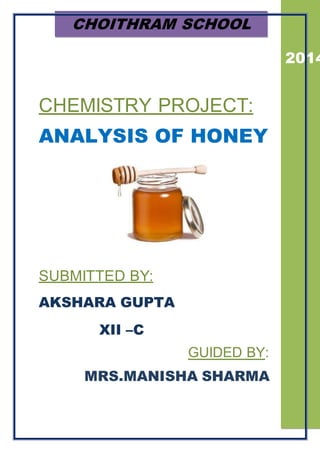
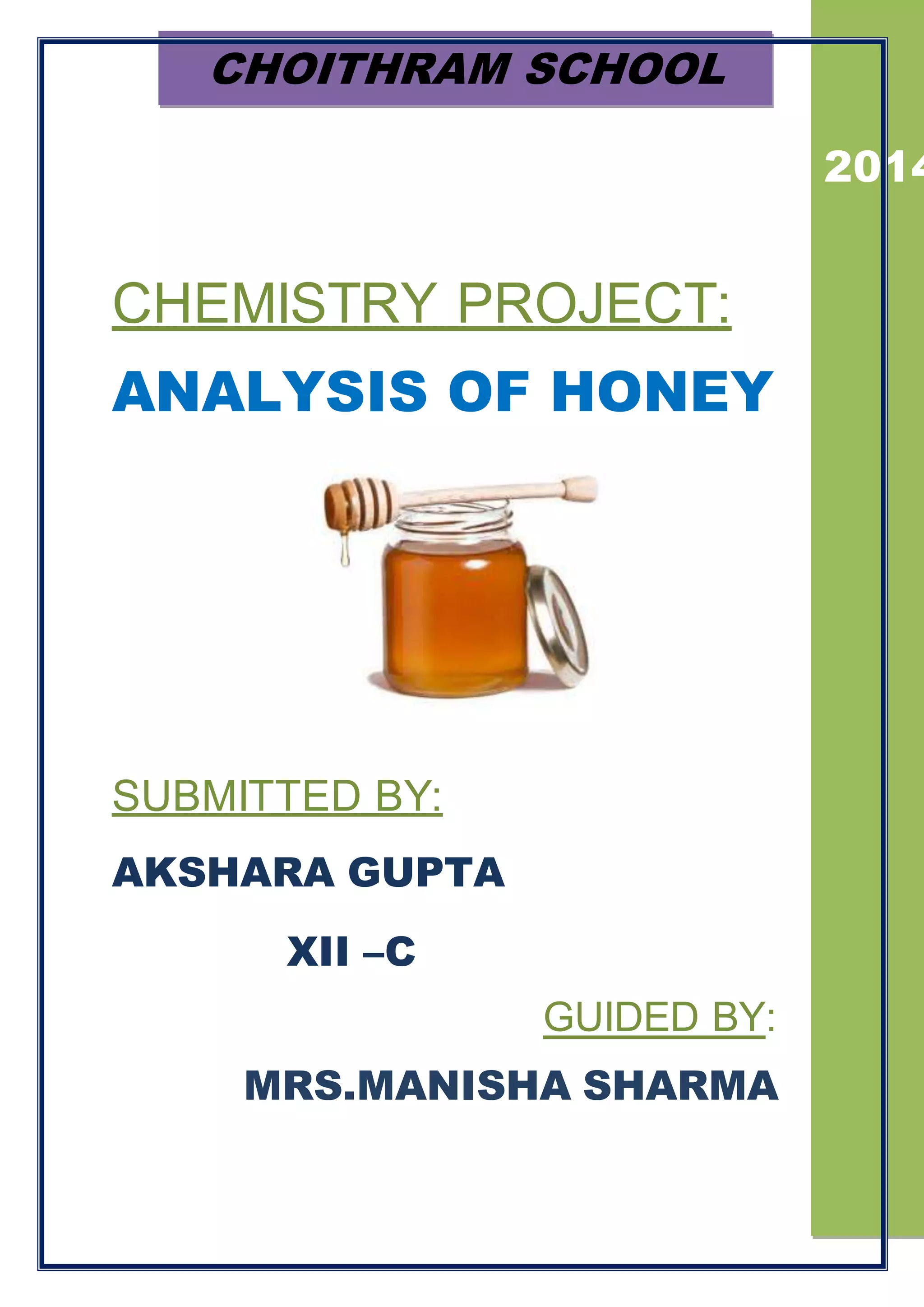
CHOITHRAM SCHOOL 
CHEMISTRY PROJECT: 
ANALYSIS OF HONEY 
SUBMITTED BY: 
AKSHARA GUPTA 
XII –C 
GUIDED BY: 
MRS.MANISHA SHARMA 
2014
This is to certify that AKSHARA GUPTA of class 12th has 
successfully completed the project work on chemistry, titled as 
“ANALYSIS OF HONEY”, for class XII practical examination 
of the Central Board of Secondary Education in the year 2014- 
2015. It is further certified that this project is the individual work 
of the candidate. 
Principal SUBJECT TEACHER 
MR.RAJESH AWASTHI Mrs.MANISHA SHARMA
I hereby declare that the project work entitled “ANALYSIS OF 
HONEY” submitted to the "CHOITHRAM SCHOOL ", is a 
record of original work done by me except of the experiments, 
which are duly acknowledged, under the guidance of my 
subject teacher “Mrs.MANISHA SHARMA” ma’am.
I would like to express my special thanks to our school 
‘CHOITHRAM SCHOOL’, principal sir Mr. ‘RAJESH 
AWASTHI’, to the management team of our school who gave 
me the golden opportunity to do this wonderful project on the 
topic ANALYSIS OF HONEY, which also helped me in doing a 
lot of Research and I came to know about so many new things. 
Secondly I would also like to thank my parents and friends who 
helped me a lot in finishing this project within the limited time. 
THANKS AGAIN TO ALL WHO HELPED ME.
CONTENT 
AIM 
REQUIREMENTS 
THEORY 
PROCEDURE 
OBSERVATION TABLE 
RESULT 
BIBLOGRAPHY
To analyze the 
available honey for 
presence of 
different minerals 
and carbohydrates.
APPARATUS 
TEST TUBE 
TEST TUBE STAND 
BURNER 
WATER BATH 
CHEMICALS 
FEHLING SOLUTION A 
FEHLING SOLUTION B 
AMMONIUM CHLORIDE SOLUTION 
AMMONIUM OXALATE SOLUTION 
AMMONIUM PHOSPHATE 
CONC.NITRIC ACID 
POTASSIUM SULPHOCYANIDE SOLUTION
Honey, thick, sweet, super saturated 
sugar solution manufactured by bees 
to feed their larvae and for the 
subsistence during winter. 
Bee honey is composed of 
fructose, glucose and water, in varying 
proportions. It also contains several 
enzymes and OILS. The color & flavor 
depends on the age of the honey and 
the sources of the nectar .It colored 
honeys are usually of higher quality 
than dark coloured honeys. Other high 
grade honeys are made by bees from 
orange blossoms, clover and Alfalfa. A 
well known, poorer grade honey is 
produced from buckwheat.
Honey has a fuel value of about 3307 
cal/kg [1520 cal/ lbs]. It readily picks up 
moisture from the air and is 
consequently used as a moistioning 
agent for Tobacco and in baking. 
Glucose crystallizes out of honey on 
standing at room temperature, leaving 
on uncrystallized layer of dissolved 
fructose. Honey to be MARKETED is 
usually heated by a special process to 
about 66oC [150.01 F] to dissolve the 
crystals and is sealed to prevent 
crystallization. The fructose in 
crystallized honey ferments readily at 
about 160C.
TEST FOR MINERALS:- 
1. Test for Potassium:- 
2ml of honey is taken in a test tube 
and picric acid solution is added. 
Yellow precipitate indicates the 
presence of K+. 
2. Test for Calcium:- 
2ml of honey is taken in a test tube 
and NH4Cl solution and NH4OH 
solution are added to it. The solution is 
filtered and to the filtrate 2ml of 
ammonium oxalate solution is added. 
White ppt. or milkiness indicates the 
presence of Ca2+ ions.
3. Test for Magnesium:- 
2 ml of honey is taken in a test tube 
and NH4Cl solution is added to it and 
then excess of Ammonium phosphate 
solution is added. The side of the test-tube 
is scratched with a glass rod. 
White precipitate indicates the 
presence of Mg2+ ions. 
4. Test for Iron:- 
2ml of honey is taken in a test tube 
and a drop of conc. HNO3 is added 
and it is heated. It is cooled and 2-3 
drops of Potassium sulphocyanide 
solution is added to it. Blood red colour 
shows the presence of iron.
TEST FOR CARBOHYDRATES 
1. Fehling`s test: 
2ml of honey is taken in a test tube 
and 1ml each of Fehling`s solution A 
and Fehling`s solution B are added to 
it and boiled. Red precipitate indicates 
the presence of reducing sugars. 
2. Tollen`s test: 
2-3 ml of aqueous solution of honey is 
taken in a test tube. 2-3ml of Tollen`s 
reagent is added. The test tube is kept 
in a boiling water bath for about ten 
minutes. A shining silver mirror 
indicates the presence of reducing 
carbohydrates.
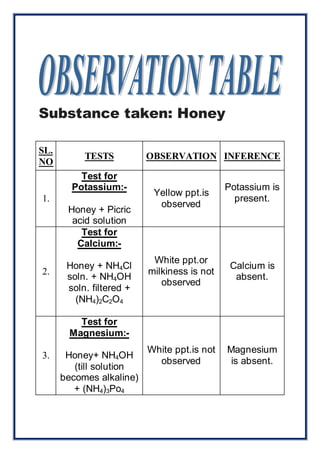
Substance taken: Honey 
SL. 
NO 
TESTS OBSERVATION INFERENCE 
1. 
Test for 
Potassium:- 
Honey + Picric 
acid solution 
Yellow ppt.is 
observed 
Potassium is 
present. 
2. 
Test for 
Calcium:- 
Honey + NH4Cl 
soln. + NH4OH 
soln. filtered + 
(NH4)2C2O4 
White ppt.or 
milkiness is not 
observed 
Calcium is 
absent. 
3. 
Test for 
Magnesium:- 
Honey+ NH4OH 
(till solution 
becomes alkaline) 
+ (NH4)3Po4 
White ppt.is not 
observed 
Magnesium 
is absent.
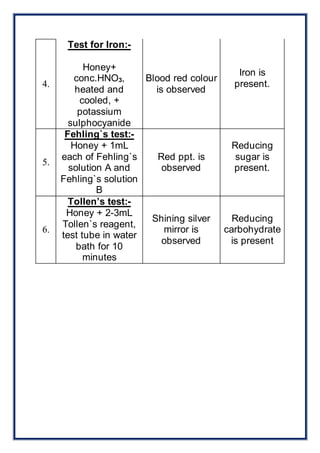
4. 
Test for Iron:- 
Honey+ 
conc.HNO3, 
heated and 
cooled, + 
potassium 
sulphocyanide 
Blood red colour 
is observed 
Iron is 
present. 
5. 
Fehling`s test:- 
Honey + 1mL 
each of Fehling`s 
solution A and 
Fehling`s solution 
B 
Red ppt. is 
observed 
Reducing 
sugar is 
present. 
6. 
Tollen’s test:- 
Honey + 2-3mL 
Tollen`s reagent, 
test tube in water 
bath for 10 
minutes 
Shining silver 
mirror is 
observed 
Reducing 
carbohydrate 
is present
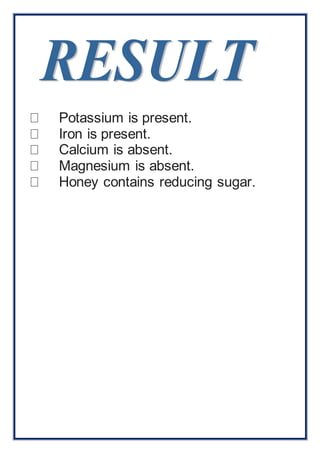
Potassium is present. 
Iron is present. 
Calcium is absent. 
Magnesium is absent. 
Honey contains reducing sugar.
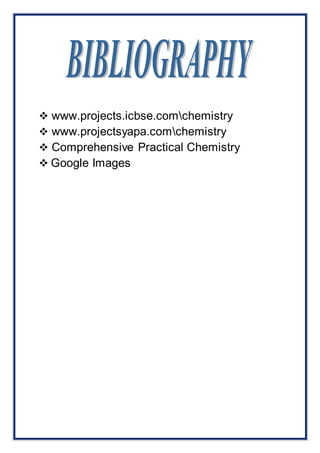
 www.projects.icbse.comchemistry 
 www.projectsyapa.comchemistry 
 Comprehensive Practical Chemistry 
 Google Images

chemistry project for class 12 on analysis of honey

  • 1.
    CHOITHRAM SCHOOL CHEMISTRYPROJECT: ANALYSIS OF HONEY SUBMITTED BY: AKSHARA GUPTA XII –C GUIDED BY: MRS.MANISHA SHARMA 2014
  • 2.
    This is tocertify that AKSHARA GUPTA of class 12th has successfully completed the project work on chemistry, titled as “ANALYSIS OF HONEY”, for class XII practical examination of the Central Board of Secondary Education in the year 2014- 2015. It is further certified that this project is the individual work of the candidate. Principal SUBJECT TEACHER MR.RAJESH AWASTHI Mrs.MANISHA SHARMA
  • 3.
    I hereby declarethat the project work entitled “ANALYSIS OF HONEY” submitted to the "CHOITHRAM SCHOOL ", is a record of original work done by me except of the experiments, which are duly acknowledged, under the guidance of my subject teacher “Mrs.MANISHA SHARMA” ma’am.
  • 4.
    I would liketo express my special thanks to our school ‘CHOITHRAM SCHOOL’, principal sir Mr. ‘RAJESH AWASTHI’, to the management team of our school who gave me the golden opportunity to do this wonderful project on the topic ANALYSIS OF HONEY, which also helped me in doing a lot of Research and I came to know about so many new things. Secondly I would also like to thank my parents and friends who helped me a lot in finishing this project within the limited time. THANKS AGAIN TO ALL WHO HELPED ME.
  • 5.
    CONTENT AIM REQUIREMENTS THEORY PROCEDURE OBSERVATION TABLE RESULT BIBLOGRAPHY
  • 6.
    To analyze the available honey for presence of different minerals and carbohydrates.
  • 7.
    APPARATUS TEST TUBE TEST TUBE STAND BURNER WATER BATH CHEMICALS FEHLING SOLUTION A FEHLING SOLUTION B AMMONIUM CHLORIDE SOLUTION AMMONIUM OXALATE SOLUTION AMMONIUM PHOSPHATE CONC.NITRIC ACID POTASSIUM SULPHOCYANIDE SOLUTION
  • 8.
    Honey, thick, sweet,super saturated sugar solution manufactured by bees to feed their larvae and for the subsistence during winter. Bee honey is composed of fructose, glucose and water, in varying proportions. It also contains several enzymes and OILS. The color & flavor depends on the age of the honey and the sources of the nectar .It colored honeys are usually of higher quality than dark coloured honeys. Other high grade honeys are made by bees from orange blossoms, clover and Alfalfa. A well known, poorer grade honey is produced from buckwheat.
  • 9.
    Honey has afuel value of about 3307 cal/kg [1520 cal/ lbs]. It readily picks up moisture from the air and is consequently used as a moistioning agent for Tobacco and in baking. Glucose crystallizes out of honey on standing at room temperature, leaving on uncrystallized layer of dissolved fructose. Honey to be MARKETED is usually heated by a special process to about 66oC [150.01 F] to dissolve the crystals and is sealed to prevent crystallization. The fructose in crystallized honey ferments readily at about 160C.
  • 10.
    TEST FOR MINERALS:- 1. Test for Potassium:- 2ml of honey is taken in a test tube and picric acid solution is added. Yellow precipitate indicates the presence of K+. 2. Test for Calcium:- 2ml of honey is taken in a test tube and NH4Cl solution and NH4OH solution are added to it. The solution is filtered and to the filtrate 2ml of ammonium oxalate solution is added. White ppt. or milkiness indicates the presence of Ca2+ ions.
  • 11.
    3. Test forMagnesium:- 2 ml of honey is taken in a test tube and NH4Cl solution is added to it and then excess of Ammonium phosphate solution is added. The side of the test-tube is scratched with a glass rod. White precipitate indicates the presence of Mg2+ ions. 4. Test for Iron:- 2ml of honey is taken in a test tube and a drop of conc. HNO3 is added and it is heated. It is cooled and 2-3 drops of Potassium sulphocyanide solution is added to it. Blood red colour shows the presence of iron.
  • 12.
    TEST FOR CARBOHYDRATES 1. Fehling`s test: 2ml of honey is taken in a test tube and 1ml each of Fehling`s solution A and Fehling`s solution B are added to it and boiled. Red precipitate indicates the presence of reducing sugars. 2. Tollen`s test: 2-3 ml of aqueous solution of honey is taken in a test tube. 2-3ml of Tollen`s reagent is added. The test tube is kept in a boiling water bath for about ten minutes. A shining silver mirror indicates the presence of reducing carbohydrates.
  • 13.
    Substance taken: Honey SL. NO TESTS OBSERVATION INFERENCE 1. Test for Potassium:- Honey + Picric acid solution Yellow ppt.is observed Potassium is present. 2. Test for Calcium:- Honey + NH4Cl soln. + NH4OH soln. filtered + (NH4)2C2O4 White ppt.or milkiness is not observed Calcium is absent. 3. Test for Magnesium:- Honey+ NH4OH (till solution becomes alkaline) + (NH4)3Po4 White ppt.is not observed Magnesium is absent.
  • 14.
    4. Test forIron:- Honey+ conc.HNO3, heated and cooled, + potassium sulphocyanide Blood red colour is observed Iron is present. 5. Fehling`s test:- Honey + 1mL each of Fehling`s solution A and Fehling`s solution B Red ppt. is observed Reducing sugar is present. 6. Tollen’s test:- Honey + 2-3mL Tollen`s reagent, test tube in water bath for 10 minutes Shining silver mirror is observed Reducing carbohydrate is present
  • 15.
    Potassium is present. Iron is present. Calcium is absent. Magnesium is absent. Honey contains reducing sugar.
  • 16.
     www.projects.icbse.comchemistry www.projectsyapa.comchemistry  Comprehensive Practical Chemistry  Google Images