ALL INDIA RADIO
VINEETH NARAYAN V
EMBLEM AND
MOTTO
‘Bahujan Hitaya Bahujan Sukhaya’
For the benefit and happiness of
many
ALL INDIA RADIO
 Largest broadcasting organisations in the world
in terms of number of languages of broadcast
and the spectrum of socio-economic and
cultural diversity it serves
 Broadcasts in 23 languages and 146 dialects
ALL INDIA RADIO
 With its 415 stations all over India, AIR covers
92% of the total area and 99.1% of the total
population
 As India’s National Public Broadcaster AIR
serves to
1. Inform
2. Educate
AKASHAVANI
 ‘Akashavani’ is the on-air name of ALL INDIA
RADIO
 The name ‘Akashavani’ was adopted as AIR’s
on-air name after Independence
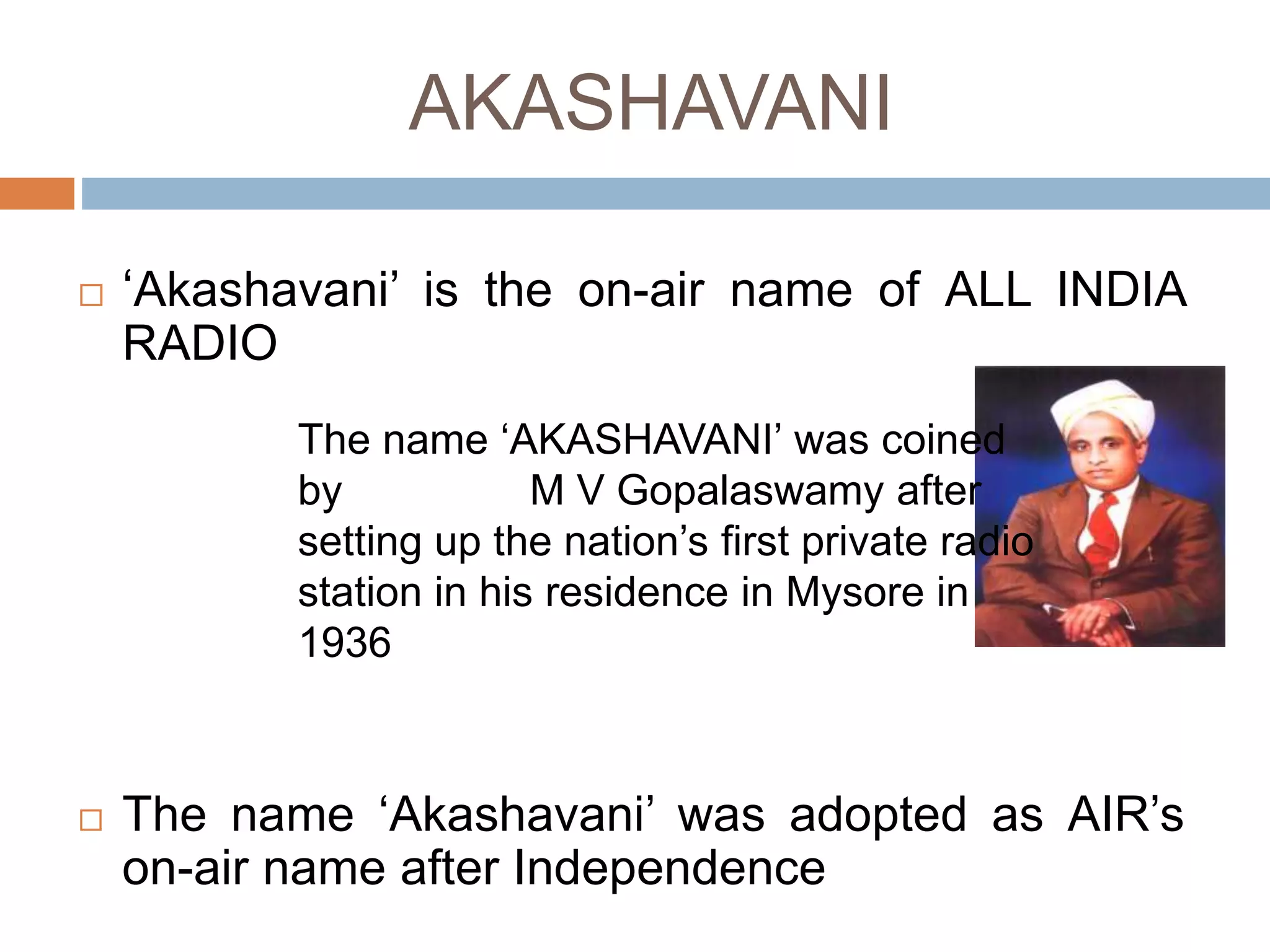
The name ‘AKASHAVANI’ was coined
by M V Gopalaswamy after
setting up the nation’s first private radio
station in his residence in Mysore in
1936
GROWTH AND DEVELOPMENT
OF AIR
 In British India broadcasting began in July 1923
from the Radio Club of Mumbai
 The Indian Broadcasting Company came into
existence on July 23, 1927
 April 1930 – Indian Broadcasting Service
commenced operations on an experimental basis
 Akashvani Mysore, a private radio station was set
up in September 1936
GROWTH AND DEVELOPMENT
OF AIR
 On June 8, 1936, the Indian State Broadcasting
Service became All India Radio
 When India attained independence, there were
six radio stations in India, at Delhi, Bombay,
Calcutta, Madras, Tiruchirapalli and Lucknow.
There were three in Pakistan (Peshawar, Lahore
and Dacca).
 The Vividh Bharati Service was launched in
1957 with popular film music as its main
EXTERNAL SERVICE OF AIR
 AIR started first External Service in Pushtu
language
 External Services Division are broadcasted in16
foreign languages reaching out to more than
100 countries. These external broadcasts aim to
keep the overseas listeners informed about
developments in the country and provide a rich
fare of entertainment as well
FM STEREO CHANNELS OF
AIR
18 FM stereo channels
 AIR FM Rainbow, targeting the urban audience
 AIR FM Gold, broadcast composite news and
entertainment programmes from Delhi, Kolkata,
Chennai and Mumbai.
With the FM wave sweeping the country, AIR is
augmenting its Medium Wave transmission
with additional FM transmitters at Regional
stations.
AIR IN FUTURE
 Switching from analog to digital in a phased
manner.
 The technology adopted is Digital Radio
Mondiale or DRM.
 Complete digitization by 2017
THANK YOU

All india radio and public broadcasting

  • 1.
  • 2.
    EMBLEM AND MOTTO ‘Bahujan HitayaBahujan Sukhaya’ For the benefit and happiness of many
  • 3.
    ALL INDIA RADIO Largest broadcasting organisations in the world in terms of number of languages of broadcast and the spectrum of socio-economic and cultural diversity it serves  Broadcasts in 23 languages and 146 dialects
  • 4.
    ALL INDIA RADIO With its 415 stations all over India, AIR covers 92% of the total area and 99.1% of the total population  As India’s National Public Broadcaster AIR serves to 1. Inform 2. Educate
  • 5.
    AKASHAVANI  ‘Akashavani’ isthe on-air name of ALL INDIA RADIO  The name ‘Akashavani’ was adopted as AIR’s on-air name after Independence The name ‘AKASHAVANI’ was coined by M V Gopalaswamy after setting up the nation’s first private radio station in his residence in Mysore in 1936
  • 6.
    GROWTH AND DEVELOPMENT OFAIR  In British India broadcasting began in July 1923 from the Radio Club of Mumbai  The Indian Broadcasting Company came into existence on July 23, 1927  April 1930 – Indian Broadcasting Service commenced operations on an experimental basis  Akashvani Mysore, a private radio station was set up in September 1936
  • 7.
    GROWTH AND DEVELOPMENT OFAIR  On June 8, 1936, the Indian State Broadcasting Service became All India Radio  When India attained independence, there were six radio stations in India, at Delhi, Bombay, Calcutta, Madras, Tiruchirapalli and Lucknow. There were three in Pakistan (Peshawar, Lahore and Dacca).  The Vividh Bharati Service was launched in 1957 with popular film music as its main
  • 8.
    EXTERNAL SERVICE OFAIR  AIR started first External Service in Pushtu language  External Services Division are broadcasted in16 foreign languages reaching out to more than 100 countries. These external broadcasts aim to keep the overseas listeners informed about developments in the country and provide a rich fare of entertainment as well
  • 9.
    FM STEREO CHANNELSOF AIR 18 FM stereo channels  AIR FM Rainbow, targeting the urban audience  AIR FM Gold, broadcast composite news and entertainment programmes from Delhi, Kolkata, Chennai and Mumbai.
  • 10.
    With the FMwave sweeping the country, AIR is augmenting its Medium Wave transmission with additional FM transmitters at Regional stations.
  • 11.
    AIR IN FUTURE Switching from analog to digital in a phased manner.  The technology adopted is Digital Radio Mondiale or DRM.  Complete digitization by 2017
  • 12.