




   DEFINATION
   HISTORY
   SYSTEM DESIGN
   WORKING
   RADIO Vs SATELLITE RADIO
   MARKET PLAYERS
   PROS AND CONS
   CONCLUSION
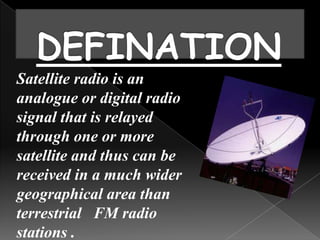
Satellite radio is an
analogue or digital radio
signal that is relayed
through one or more
satellite and thus can be
received in a much wider
geographical area than
terrestrial FM radio
stations .
   World space corporation was founded in 1990 by NOAH. A.
    SAMARA, chairman and ceo.
    He founded the company with a vision to provide digital
    satellite audio, data, and multimedia services primarily to the
    emerging market of africa and asia.
    To implement this vision , world space conceived and built the
    first ever satellite radio infrastructure in the world.
    In the last 12 years the company has built the satellite and
    launched two companies to provide audio, data and multimedia
    broadcasting coverage to africa and asia.
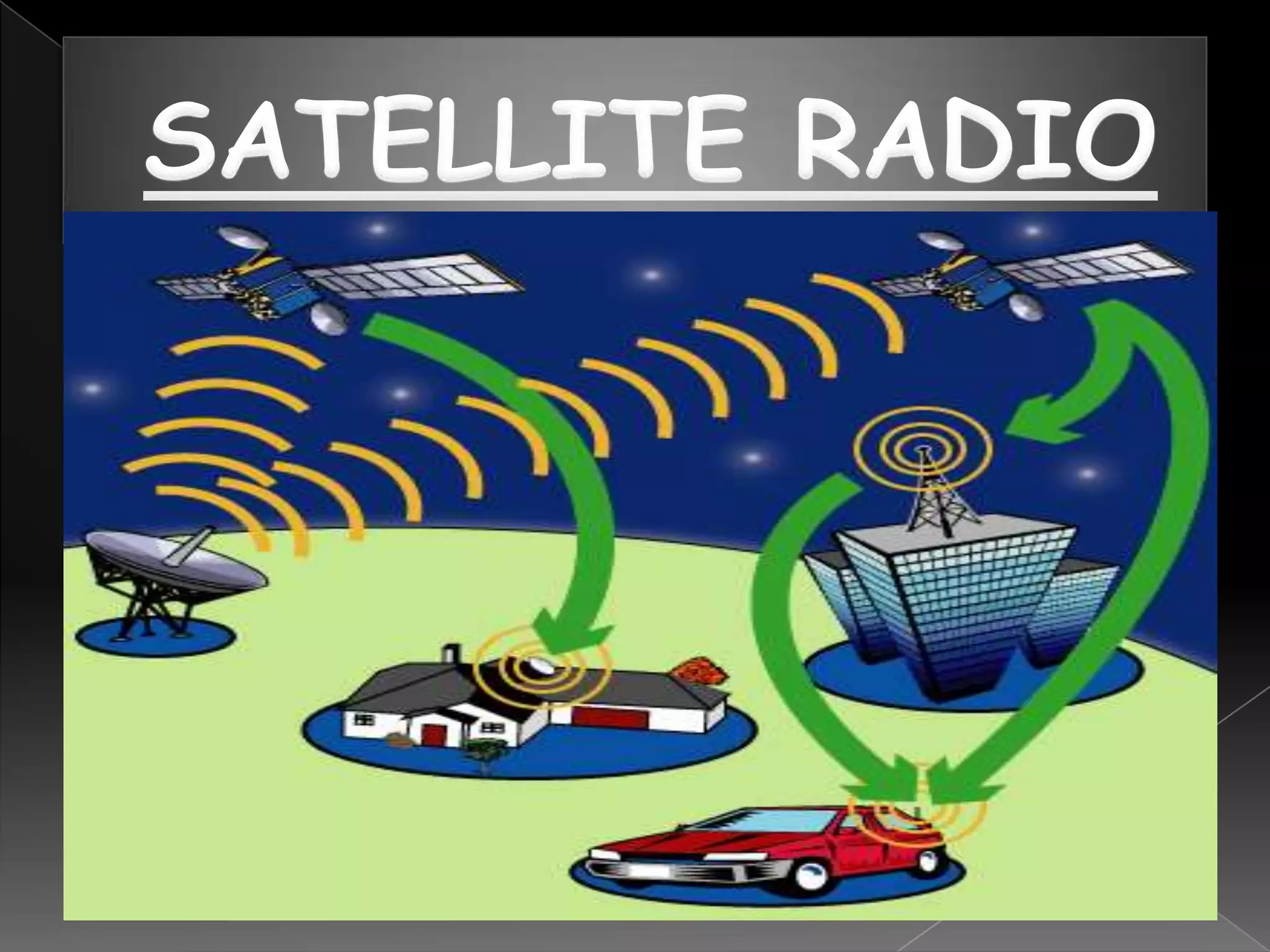
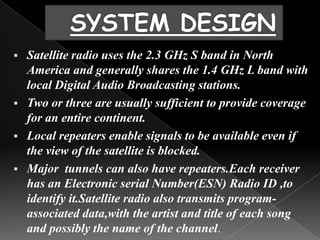
 Satellite radio uses the 2.3 GHz S band in North
  America and generally shares the 1.4 GHz L band with
  local Digital Audio Broadcasting stations.
 Two or three are usually sufficient to provide coverage
  for an entire continent.
 Local repeaters enable signals to be available even if
  the view of the satellite is blocked.
 Major tunnels can also have repeaters.Each receiver
  has an Electronic serial Number(ESN) Radio ID ,to
  identify it.Satellite radio also transmits program-
  associated data,with the artist and title of each song
  and possibly the name of the channel.
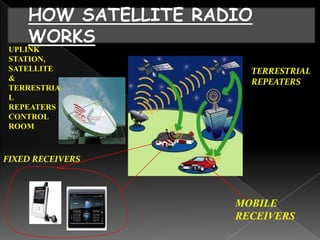
UPLINK
 STATION,
 SATELLITE          TERRESTRIAL
 &                  REPEATERS
 TERRESTRIA
 L
 REPEATERS
 CONTROL
 ROOM


FIXED RECEIVERS


                  MOBILE
                  RECEIVERS
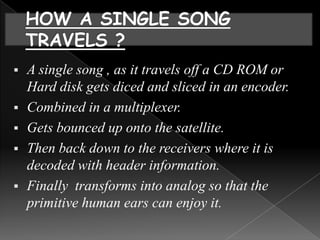
   A single song , as it travels off a CD ROM or
    Hard disk gets diced and sliced in an encoder.
   Combined in a multiplexer.
   Gets bounced up onto the satellite.
   Then back down to the receivers where it is
    decoded with header information.
   Finally transforms into analog so that the
    primitive human ears can enjoy it.
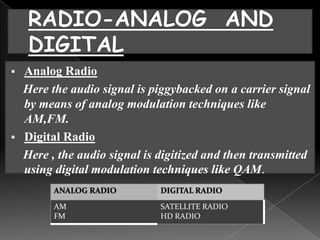
 Analog Radio
  Here the audio signal is piggybacked on a carrier signal
  by means of analog modulation techniques like
  AM,FM.
 Digital Radio
  Here , the audio signal is digitized and then transmitted
  using digital modulation techniques like QAM.

        AM                   SATELLITE RADIO
        FM                   HD RADIO
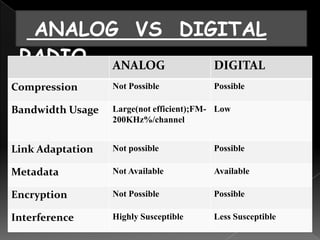
ANALOG VS DIGITAL
 RADIO ANALOG  DIGITAL
Compression       Not Possible            Possible

Bandwidth Usage   Large(not efficient);FM- Low
                  200KHz%/channel


Link Adaptation   Not possible            Possible

Metadata          Not Available           Available

Encryption        Not Possible            Possible

Interference      Highly Susceptible      Less Susceptible
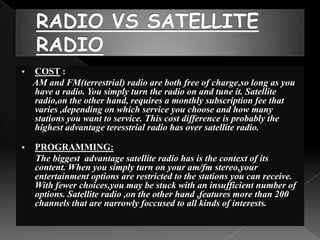
   COST :
    AM and FM(terrestrial) radio are both free of charge,so long as you
    have a radio. You simply turn the radio on and tune it. Satellite
    radio,on the other hand, requires a monthly subscription fee that
    varies ,depending on which service you choose and how many
    stations you want to service. This cost difference is probably the
    highest advantage teresstrial radio has over satellite radio.

   PROGRAMMING:
    The biggest advantage satellite radio has is the context of its
    content. When you simply turn on your am/fm stereo,your
    entertainment options are restricted to the stations you can receive.
    With fewer choices,you may be stuck with an insufficient number of
    options. Satellite radio ,on the other hand ,features more than 200
    channels that are narrowly foccused to all kinds of interests.
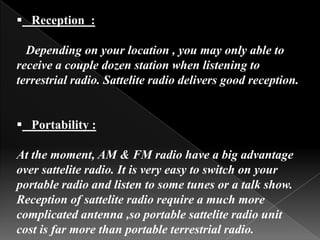
 Reception :

  Depending on your location , you may only able to
receive a couple dozen station when listening to
terrestrial radio. Sattelite radio delivers good reception.


 Portability :

At the moment, AM & FM radio have a big advantage
over sattelite radio. It is very easy to switch on your
portable radio and listen to some tunes or a talk show.
Reception of sattelite radio require a much more
complicated antenna ,so portable sattelite radio unit
cost is far more than portable terrestrial radio.
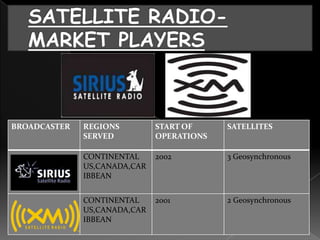
BROADCASTER   REGIONS         START OF     SATELLITES
              SERVED          OPERATIONS

              CONTINENTAL     2002         3 Geosynchronous
              US,CANADA,CAR
              IBBEAN


              CONTINENTAL     2001         2 Geosynchronous
              US,CANADA,CAR
              IBBEAN
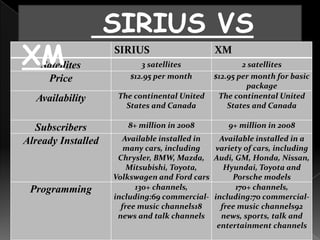
SIRIUS VS
XM  Satellites
                    SIRIUS
                           3 satellites
                                              XM
                                                      2 satellites
     Price              $12.95 per month      $12.95 per month for basic
                                                       package
  Availability       The continental United    The continental United
                       States and Canada          States and Canada

  Subscribers          8+ million in 2008        9+ million in 2008

Already Installed     Available installed in   Available installed in a
                       many cars, including  variety of cars, including
                     Chrysler, BMW, Mazda, Audi, GM, Honda, Nissan,
                        Mitsubishi, Toyota,     Hyundai, Toyota and
                    Volkswagen and Ford cars      Porsche models
 Programming              130+ channels,           170+ channels,
                    including:69 commercial- including:70 commercial-
                      free music channels18    free music channels92
                     news and talk channels    news, sports, talk and
                                              entertainment channels
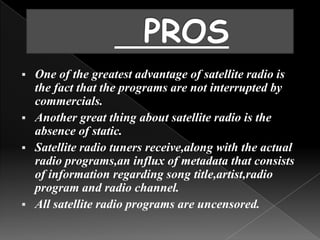
 One of the greatest advantage of satellite radio is
  the fact that the programs are not interrupted by
  commercials.
 Another great thing about satellite radio is the
  absence of static.
 Satellite radio tuners receive,along with the actual
  radio programs,an influx of metadata that consists
  of information regarding song title,artist,radio
  program and radio channel.
 All satellite radio programs are uncensored.
   Subscription fee
   Receiver purchase
   Signal interruptions
   Signal Limitations
   Mature Content
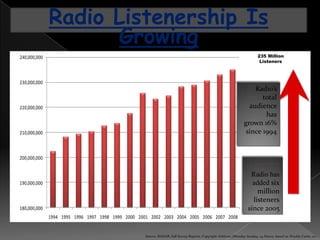
Radio Listenership Is
                    Growing
240,000,000                                                                                                             235 Million
                                                                                                                         Listeners


230,000,000
                                                                                                                   Radio’s
                                                                                                                      total
220,000,000                                                                                                      audience
                                                                                                                       has
                                                                                                               grown 16%
210,000,000                                                                                                     since 1994


200,000,000
                                                                                                                        __________


                                                                                                                   Radio has
190,000,000                                                                                                         added six
                                                                                                                      million
                                                                                                                    listeners
180,000,000                                                                                                       since 2005
              1994 1995 1996 1997 1998 1999 2000 2001 2002 2003 2004 2005 2006 2007 2008


                                                   Source: RADAR, Fall Survey Reports, Copyright Arbitron (Monday-Sunday, 24 Hours, based on Weekly Cume, 12+
Radio Reaches 92 million More People
 Each Week Than Google Reaches In
          An Entire Month


                  Sources: Radar 97, June 2008 (Monday-Sunday, 24hrs, based on daily cume 18+) ; ComScore May 2008
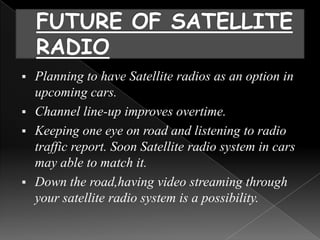
 Planning to have Satellite radios as an option in
  upcoming cars.
 Channel line-up improves overtime.
 Keeping one eye on road and listening to radio
  traffic report. Soon Satellite radio system in cars
  may able to match it.
 Down the road,having video streaming through
  your satellite radio system is a possibility.
You’ll fall in love with the way Radio is
 emerging now a days in terms of music
 , entertainment and knowledge.
The time is here when Radio has become an
 integral part of our lives and there is no bad in
 enhancing the techniques , to get the facilities
 which we need to enjoy and learn something
 new.
Presentation on satellite radio

Presentation on satellite radio

  • 3.
    DEFINATION  HISTORY  SYSTEM DESIGN  WORKING  RADIO Vs SATELLITE RADIO  MARKET PLAYERS  PROS AND CONS  CONCLUSION
  • 4.
    Satellite radio isan analogue or digital radio signal that is relayed through one or more satellite and thus can be received in a much wider geographical area than terrestrial FM radio stations .
  • 5.
    World space corporation was founded in 1990 by NOAH. A. SAMARA, chairman and ceo.  He founded the company with a vision to provide digital satellite audio, data, and multimedia services primarily to the emerging market of africa and asia.  To implement this vision , world space conceived and built the first ever satellite radio infrastructure in the world.  In the last 12 years the company has built the satellite and launched two companies to provide audio, data and multimedia broadcasting coverage to africa and asia.
  • 6.
     Satellite radiouses the 2.3 GHz S band in North America and generally shares the 1.4 GHz L band with local Digital Audio Broadcasting stations.  Two or three are usually sufficient to provide coverage for an entire continent.  Local repeaters enable signals to be available even if the view of the satellite is blocked.  Major tunnels can also have repeaters.Each receiver has an Electronic serial Number(ESN) Radio ID ,to identify it.Satellite radio also transmits program- associated data,with the artist and title of each song and possibly the name of the channel.
  • 7.
    UPLINK STATION, SATELLITE TERRESTRIAL & REPEATERS TERRESTRIA L REPEATERS CONTROL ROOM FIXED RECEIVERS MOBILE RECEIVERS
  • 8.
    A single song , as it travels off a CD ROM or Hard disk gets diced and sliced in an encoder.  Combined in a multiplexer.  Gets bounced up onto the satellite.  Then back down to the receivers where it is decoded with header information.  Finally transforms into analog so that the primitive human ears can enjoy it.
  • 9.
     Analog Radio Here the audio signal is piggybacked on a carrier signal by means of analog modulation techniques like AM,FM.  Digital Radio Here , the audio signal is digitized and then transmitted using digital modulation techniques like QAM. AM SATELLITE RADIO FM HD RADIO
  • 10.
    ANALOG VS DIGITAL RADIO ANALOG DIGITAL Compression Not Possible Possible Bandwidth Usage Large(not efficient);FM- Low 200KHz%/channel Link Adaptation Not possible Possible Metadata Not Available Available Encryption Not Possible Possible Interference Highly Susceptible Less Susceptible
  • 11.
    COST : AM and FM(terrestrial) radio are both free of charge,so long as you have a radio. You simply turn the radio on and tune it. Satellite radio,on the other hand, requires a monthly subscription fee that varies ,depending on which service you choose and how many stations you want to service. This cost difference is probably the highest advantage teresstrial radio has over satellite radio.  PROGRAMMING: The biggest advantage satellite radio has is the context of its content. When you simply turn on your am/fm stereo,your entertainment options are restricted to the stations you can receive. With fewer choices,you may be stuck with an insufficient number of options. Satellite radio ,on the other hand ,features more than 200 channels that are narrowly foccused to all kinds of interests.
  • 12.
     Reception : Depending on your location , you may only able to receive a couple dozen station when listening to terrestrial radio. Sattelite radio delivers good reception.  Portability : At the moment, AM & FM radio have a big advantage over sattelite radio. It is very easy to switch on your portable radio and listen to some tunes or a talk show. Reception of sattelite radio require a much more complicated antenna ,so portable sattelite radio unit cost is far more than portable terrestrial radio.
  • 13.
    BROADCASTER REGIONS START OF SATELLITES SERVED OPERATIONS CONTINENTAL 2002 3 Geosynchronous US,CANADA,CAR IBBEAN CONTINENTAL 2001 2 Geosynchronous US,CANADA,CAR IBBEAN
  • 14.
    SIRIUS VS XM Satellites SIRIUS 3 satellites XM 2 satellites Price $12.95 per month $12.95 per month for basic package Availability The continental United The continental United States and Canada States and Canada Subscribers 8+ million in 2008 9+ million in 2008 Already Installed Available installed in Available installed in a many cars, including variety of cars, including Chrysler, BMW, Mazda, Audi, GM, Honda, Nissan, Mitsubishi, Toyota, Hyundai, Toyota and Volkswagen and Ford cars Porsche models Programming 130+ channels, 170+ channels, including:69 commercial- including:70 commercial- free music channels18 free music channels92 news and talk channels news, sports, talk and entertainment channels
  • 15.
     One ofthe greatest advantage of satellite radio is the fact that the programs are not interrupted by commercials.  Another great thing about satellite radio is the absence of static.  Satellite radio tuners receive,along with the actual radio programs,an influx of metadata that consists of information regarding song title,artist,radio program and radio channel.  All satellite radio programs are uncensored.
  • 16.
    Subscription fee  Receiver purchase  Signal interruptions  Signal Limitations  Mature Content
  • 17.
    Radio Listenership Is Growing 240,000,000 235 Million Listeners 230,000,000 Radio’s total 220,000,000 audience has grown 16% 210,000,000 since 1994 200,000,000 __________ Radio has 190,000,000 added six million listeners 180,000,000 since 2005 1994 1995 1996 1997 1998 1999 2000 2001 2002 2003 2004 2005 2006 2007 2008 Source: RADAR, Fall Survey Reports, Copyright Arbitron (Monday-Sunday, 24 Hours, based on Weekly Cume, 12+
  • 18.
    Radio Reaches 92million More People Each Week Than Google Reaches In An Entire Month Sources: Radar 97, June 2008 (Monday-Sunday, 24hrs, based on daily cume 18+) ; ComScore May 2008
  • 19.
     Planning tohave Satellite radios as an option in upcoming cars.  Channel line-up improves overtime.  Keeping one eye on road and listening to radio traffic report. Soon Satellite radio system in cars may able to match it.  Down the road,having video streaming through your satellite radio system is a possibility.
  • 20.
    You’ll fall inlove with the way Radio is emerging now a days in terms of music , entertainment and knowledge. The time is here when Radio has become an integral part of our lives and there is no bad in enhancing the techniques , to get the facilities which we need to enjoy and learn something new.