2010
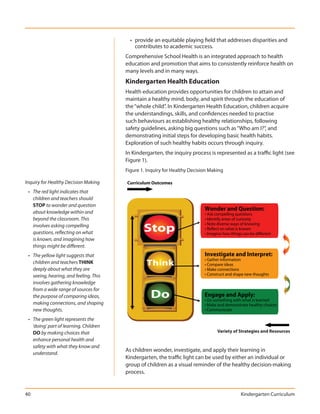
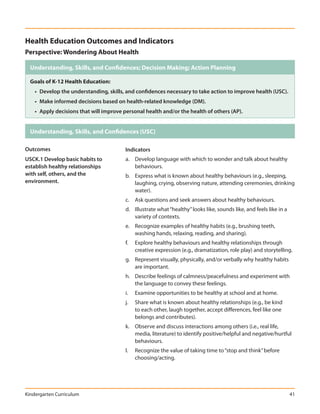
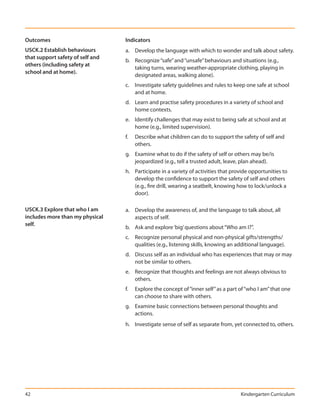
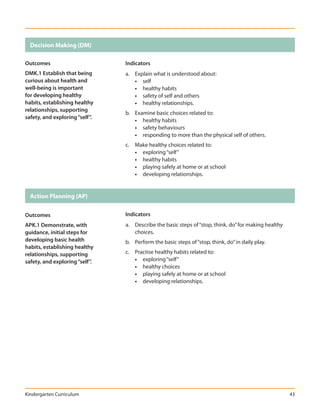
Saskatchewan Curriculum


Kindergarten
Kindergarten
ISBN 978-1-926841-16-8
1. Early childhood education (Kindergarten) - Saskatchewan - Curricula. 2. Competency-based
education - Saskatchewan.
Saskatchewan. Ministry of Education. Curriculum and E-Learning. Humanities Unit.
All rights are reserved by the original copyright owners.
Table of Contents
Acknowledgements . . . . . . . . . . . . . . . . . . . . . . . . . . . . . . . . . . . . . . . . . . . . . . . . . . . . . . . . . . . . . . . . . . . . . . . . . . . . . . . . . . . . . . . . . . v
Introduction . . . . . . . . . . . . . . . . . . . . . . . . . . . . . . . . . . . . . . . . . . . . . . . . . . . . . . . . . . . . . . . . . . . . . . . . . . . . . . . . . . . . . . . . . . . . . . . . . 1
Core Curriculum . . . . . . . . . . . . . . . . . . . . . . . . . . . . . . . . . . . . . . . . . . . . . . . . . . . . . . . . . . . . . . . . . . . . . . . . . . . . . . . . . . . . . . . . . . . . . 1
Broad Areas of Learning . . . . . . . . . . . . . . . . . . . . . . . . . . . . . . . . . . . . . . . . . . . . . . . . . . . . . . . . . . . . . . . . . . . . . . . . . . . . . . . . . . . . . . 2
         Lifelong Learners . . . . . . . . . . . . . . . . . . . . . . . . . . . . . . . . . . . . . . . . . . . . . . . . . . . . . . . . . . . . . . . . . . . . . . . . . . . . . . . . . . . . . . . 2
         Sense of Self, Community, and Place . . . . . . . . . . . . . . . . . . . . . . . . . . . . . . . . . . . . . . . . . . . . . . . . . . . . . . . . . . . . . . . . . . . . . 2
         Engaged Citizens . . . . . . . . . . . . . . . . . . . . . . . . . . . . . . . . . . . . . . . . . . . . . . . . . . . . . . . . . . . . . . . . . . . . . . . . . . . . . . . . . . . . . . . 3
Cross Curricular Competencies . . . . . . . . . . . . . . . . . . . . . . . . . . . . . . . . . . . . . . . . . . . . . . . . . . . . . . . . . . . . . . . . . . . . . . . . . . . . . . . 3
         Developing Thinking. . . . . . . . . . . . . . . . . . . . . . . . . . . . . . . . . . . . . . . . . . . . . . . . . . . . . . . . . . . . . . . . . . . . . . . . . . . . . . . . . . . . 3
         Developing Identity and Interdependence. . . . . . . . . . . . . . . . . . . . . . . . . . . . . . . . . . . . . . . . . . . . . . . . . . . . . . . . . . . . . . . 3
         Developing Literacies . . . . . . . . . . . . . . . . . . . . . . . . . . . . . . . . . . . . . . . . . . . . . . . . . . . . . . . . . . . . . . . . . . . . . . . . . . . . . . . . . . . 3
         Developing Social Responsibility . . . . . . . . . . . . . . . . . . . . . . . . . . . . . . . . . . . . . . . . . . . . . . . . . . . . . . . . . . . . . . . . . . . . . . . . 4
An Effective Kindergarten Program . . . . . . . . . . . . . . . . . . . . . . . . . . . . . . . . . . . . . . . . . . . . . . . . . . . . . . . . . . . . . . . . . . . . . . . . . . . 4
         Incorporates the Principles of Early Learning . . . . . . . . . . . . . . . . . . . . . . . . . . . . . . . . . . . . . . . . . . . . . . . . . . . . . . . . . . . . . 4
         Actualizes the Distinguishing Features of an Early Childhood Education Program . . . . . . . . . . . . . . . . . . . . . . . . . 5
         Uses a Reflective Lens to Support Student Learning . . . . . . . . . . . . . . . . . . . . . . . . . . . . . . . . . . . . . . . . . . . . . . . . . . . . . . 6
         Draws Upon the Processes of Observation, Documentation, and Interpretation . . . . . . . . . . . . . . . . . . . . . . . . . . . 7
         Facilitates Inquiry through Play . . . . . . . . . . . . . . . . . . . . . . . . . . . . . . . . . . . . . . . . . . . . . . . . . . . . . . . . . . . . . . . . . . . . . . . . . . 8
         Reflects the Philosophy of each Subject Area Discipline . . . . . . . . . . . . . . . . . . . . . . . . . . . . . . . . . . . . . . . . . . . . . . . . . . 8
An Effective Kindergarten Program in Action . . . . . . . . . . . . . . . . . . . . . . . . . . . . . . . . . . . . . . . . . . . . . . . . . . . . . . . . . . . . . . . . . 10
         Teacher A . . . . . . . . . . . . . . . . . . . . . . . . . . . . . . . . . . . . . . . . . . . . . . . . . . . . . . . . . . . . . . . . . . . . . . . . . . . . . . . . . . . . . . . . . . . . . . 11
         Teacher B . . . . . . . . . . . . . . . . . . . . . . . . . . . . . . . . . . . . . . . . . . . . . . . . . . . . . . . . . . . . . . . . . . . . . . . . . . . . . . . . . . . . . . . . . . . . . . 15
Outcomes and Indicators . . . . . . . . . . . . . . . . . . . . . . . . . . . . . . . . . . . . . . . . . . . . . . . . . . . . . . . . . . . . . . . . . . . . . . . . . . . . . . . . . . . . 21
Arts Education . . . . . . . . . . . . . . . . . . . . . . . . . . . . . . . . . . . . . . . . . . . . . . . . . . . . . . . . . . . . . . . . . . . . . . . . . . . . . . . . . . . . . . . . . . . . . . 22
         Aim and Goals of K-12 Arts Education . . . . . . . . . . . . . . . . . . . . . . . . . . . . . . . . . . . . . . . . . . . . . . . . . . . . . . . . . . . . . . . . . . 22
         Arts Education Outcomes and Indicators . . . . . . . . . . . . . . . . . . . . . . . . . . . . . . . . . . . . . . . . . . . . . . . . . . . . . . . . . . . . . . . 24
English Language Arts . . . . . . . . . . . . . . . . . . . . . . . . . . . . . . . . . . . . . . . . . . . . . . . . . . . . . . . . . . . . . . . . . . . . . . . . . . . . . . . . . . . . . . 30
         Aim and Goals of K-12 English Language Arts . . . . . . . . . . . . . . . . . . . . . . . . . . . . . . . . . . . . . . . . . . . . . . . . . . . . . . . . . . . 30
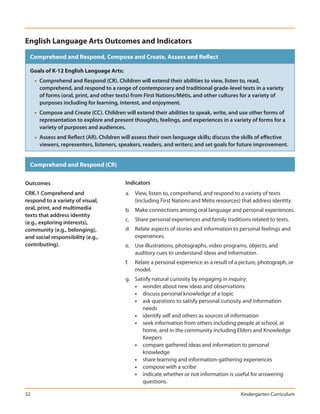
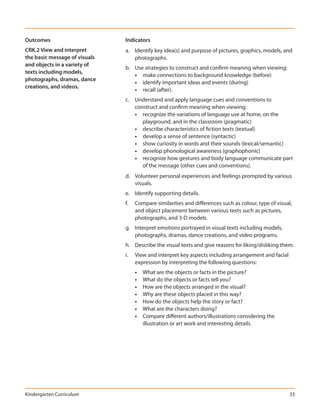
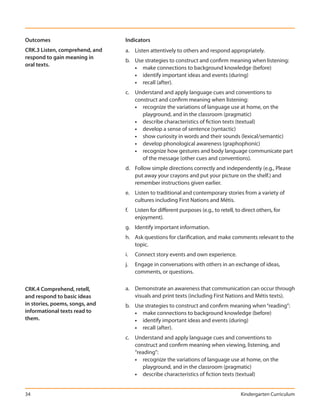
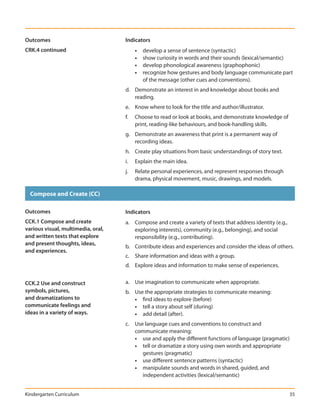
         English Language Arts Outcomes and Indicators . . . . . . . . . . . . . . . . . . . . . . . . . . . . . . . . . . . . . . . . . . . . . . . . . . . . . . . . 32


Kindergarten Curriculum                                                                                                                                                                                        iii
Health Education . . . . . . . . . . . . . . . . . . . . . . . . . . . . . . . . . . . . . . . . . . . . . . . . . . . . . . . . . . . . . . . . . . . . . . . . . . . . . . . . . . . . . . . . . . . 39
         Aim and Goals of K-12 Health Education . . . . . . . . . . . . . . . . . . . . . . . . . . . . . . . . . . . . . . . . . . . . . . . . . . . . . . . . . . . . . . . . 39
         Health Education Outcomes and Indicators . . . . . . . . . . . . . . . . . . . . . . . . . . . . . . . . . . . . . . . . . . . . . . . . . . . . . . . . . . . . . 41
Mathematics . . . . . . . . . . . . . . . . . . . . . . . . . . . . . . . . . . . . . . . . . . . . . . . . . . . . . . . . . . . . . . . . . . . . . . . . . . . . . . . . . . . . . . . . . . . . . . . . 44
         Aim and Goals of K-12 Mathematics Education. . . . . . . . . . . . . . . . . . . . . . . . . . . . . . . . . . . . . . . . . . . . . . . . . . . . . . . . . . 44
         Mathematics Outcomes and Indicators . . . . . . . . . . . . . . . . . . . . . . . . . . . . . . . . . . . . . . . . . . . . . . . . . . . . . . . . . . . . . . . . . 46
Physical Education . . . . . . . . . . . . . . . . . . . . . . . . . . . . . . . . . . . . . . . . . . . . . . . . . . . . . . . . . . . . . . . . . . . . . . . . . . . . . . . . . . . . . . . . . . 49
         Aim and Goals of K-12 Physical Education. . . . . . . . . . . . . . . . . . . . . . . . . . . . . . . . . . . . . . . . . . . . . . . . . . . . . . . . . . . . . . . 49
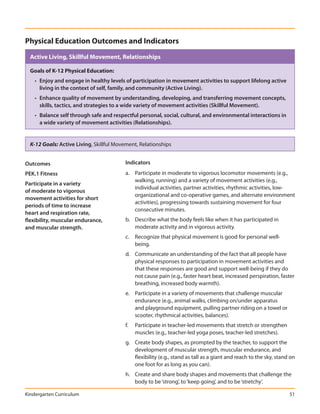
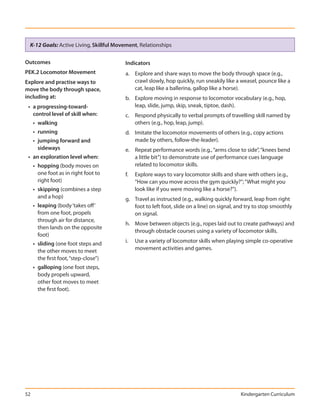
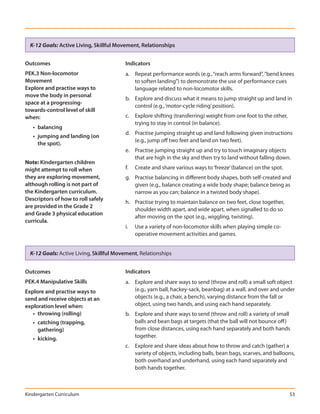
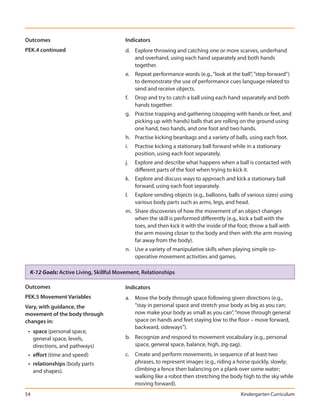
         Physical Education Outcomes and Indicators . . . . . . . . . . . . . . . . . . . . . . . . . . . . . . . . . . . . . . . . . . . . . . . . . . . . . . . . . . . 51
Science . . . . . . . . . . . . . . . . . . . . . . . . . . . . . . . . . . . . . . . . . . . . . . . . . . . . . . . . . . . . . . . . . . . . . . . . . . . . . . . . . . . . . . . . . . . . . . . . . . . . . 57
         Aim and Goals of K-12 Science . . . . . . . . . . . . . . . . . . . . . . . . . . . . . . . . . . . . . . . . . . . . . . . . . . . . . . . . . . . . . . . . . . . . . . . . . 57
         Science Outcomes and Indicators . . . . . . . . . . . . . . . . . . . . . . . . . . . . . . . . . . . . . . . . . . . . . . . . . . . . . . . . . . . . . . . . . . . . . . 59
Social Studies . . . . . . . . . . . . . . . . . . . . . . . . . . . . . . . . . . . . . . . . . . . . . . . . . . . . . . . . . . . . . . . . . . . . . . . . . . . . . . . . . . . . . . . . . . . . . . . 63
         Aim and Goals of K-12 Social Studies . . . . . . . . . . . . . . . . . . . . . . . . . . . . . . . . . . . . . . . . . . . . . . . . . . . . . . . . . . . . . . . . . . . 63
         Social Studies Outcomes and Indicators . . . . . . . . . . . . . . . . . . . . . . . . . . . . . . . . . . . . . . . . . . . . . . . . . . . . . . . . . . . . . . . . 65
Assessment and Evaluation. . . . . . . . . . . . . . . . . . . . . . . . . . . . . . . . . . . . . . . . . . . . . . . . . . . . . . . . . . . . . . . . . . . . . . . . . . . . . . . . . . 69
         Purposes of Assessment . . . . . . . . . . . . . . . . . . . . . . . . . . . . . . . . . . . . . . . . . . . . . . . . . . . . . . . . . . . . . . . . . . . . . . . . . . . . . . . 69
         Purposes of Evaluation . . . . . . . . . . . . . . . . . . . . . . . . . . . . . . . . . . . . . . . . . . . . . . . . . . . . . . . . . . . . . . . . . . . . . . . . . . . . . . . . . 71
Glossary . . . . . . . . . . . . . . . . . . . . . . . . . . . . . . . . . . . . . . . . . . . . . . . . . . . . . . . . . . . . . . . . . . . . . . . . . . . . . . . . . . . . . . . . . . . . . . . . . . . . 72
References . . . . . . . . . . . . . . . . . . . . . . . . . . . . . . . . . . . . . . . . . . . . . . . . . . . . . . . . . . . . . . . . . . . . . . . . . . . . . . . . . . . . . . . . . . . . . . . . . . 74
Feedback Form . . . . . . . . . . . . . . . . . . . . . . . . . . . . . . . . . . . . . . . . . . . . . . . . . . . . . . . . . . . . . . . . . . . . . . . . . . . . . . . . . . . . . . . . . . . . . 77


iv                                                                                                                                                                        Kindergarten Curriculum
Acknowledgements
The Ministry of Education wishes to acknowledge the professional contributions and advice given by:
  • teachers
  • university professors
  • the professional learning community
  • other educators and community members
from various cultural groups (including First Nations and Métis) in the development of the Kindergarten
Curriculum.


Kindergarten Curriculum                                                                                   v
Introduction
This curriculum provides the learning outcomes that Kindergarten
children are expected to know, understand, and be able to do by
the end of the Kindergarten year. The characteristics of an effective
Kindergarten program, included in this curriculum, guide educators in
providing meaningful learning experiences for children. Through these
experiences, children will be engaged learners as they achieve the
learning outcomes in an integrated manner.
This Kindergarten curriculum provides:
  • direction for supporting student achievement of the provincial
    Goals of Education as expressed through the Broad Areas of
    Learning
  • support for student development related to the Common Essential
    Learnings as expressed through the Cross-curricular Competencies
  • the characteristics and examples of an effective Kindergarten
    program
  • the K-12 aim and goals of each Required Area of Study for
    education in Saskatchewan
  • research-based learning outcomes and indicators
  • an explanation of assessment and evaluation in Kindergarten.
For more detailed information about providing a positive Kindergarten
experience for children, please refer to Children First: A Resource for
Kindergarten (2009). It can be found, along with curriculum support
materials, on the Saskatchewan Ministry of Education website.


Core Curriculum
Core Curriculum is intended to provide all Saskatchewan students with
an education that will serve them well regardless of their choices after
leaving school. Through its various components and initiatives, Core
Curriculum supports student achievement of the Goals of Education
for Saskatchewan. For current information regarding Core Curriculum,
please refer to Core Curriculum: Principles, Time Allocations, and Credit
Policy on the Saskatchewan Ministry of Education website.
For additional information related to some of the components and
initiatives of Core Curriculum, please refer to the following policy and
foundation documents (also available on the Ministry website):
  • Understanding the Common Essential Learnings: A Handbook for
    Teachers (1988)
  • Objectives for the Common Essential Learnings (CELs) (1998)


Kindergarten Curriculum                                                     1
• Renewed Objectives for the Common Essential Learnings of Critical
                                          and Creative Thinking (CCT) and Personal and Social Development
                                          (PSD) (2008)
                                        • The Adaptive Dimension in Core Curriculum (1992)
                                        • Policy and Procedures for Locally-developed Courses of Study (2010)
                                        • Connections: Policy and Guidelines for School Libraries in
                                          Saskatchewan (2008)
                                        • Diverse Voices: Selecting Equitable Resources for Indian and Métis
                                          Education (2005)
                                        • Gender Equity: Policies and Guidelines for Implementation (1991)
                                        • Instructional Approaches: A Framework for Professional Practice
                                          (1991)
                                        • Multicultural Education and Heritage Language Education Policies
                                          (1994)
                                        • Classroom Curriculum Connections: A Teacher’s Handbook for
                                          Personal-Professional Growth (2001).


                                      Broad Areas of Learning
                                      There are three Broad Areas of Learning that reflect Saskatchewan’s
                                      Goals of Education. An effective Kindergarten program contributes to
                                      the Goals of Education by helping students achieve knowledge, skills,
                                      and attitudes related to these Broad Areas of Learning.

                                      Lifelong Learners
Related to the following Goals of     In Kindergarten, children naturally wonder, discover, and explore their
Education:                            environments. Within these environments, children are encouraged
    • Basic Skills                    to have a positive disposition towards, and a passion for, learning.
    • Lifelong Learning               This passion can be developed by offering children holistic learning
    • Positive Lifestyle              experiences so they can apply their knowledge and skills in their daily
                                      life. As children engage in meaningful play and inquiry, they become
                                      more knowledgeable, confident, and creative lifelong learners.

                                      Sense of Self, Community, and Place
Related to the following Goals of     In Kindergarten, purposefully designed environments enable children
Education:                            to develop a positive sense of self, while learning to respect their
                                      own and others’ ways of seeing the world. A positive environment
    • Understanding and Relating to
                                      encourages children to interact with each other, explore who they
      Others
                                      might become, and learn to appreciate diverse perspectives. In
    • Self-concept Development
    • Spiritual Development           Kindergarten, children continue to develop self-knowledge, an
                                      understanding of others, and learn to build community.


2                                                                                        Kindergarten Curriculum
Engaged Citizens
Children in Kindergarten develop the courage, confidence, and               Related to the following Goals of
commitment to be actively involved citizens through holistic learning       Education:
opportunities. These learning opportunities enable children to become        • Career and Consumer Decisions
empowered to act as responsible citizens. As children are exposed to         • Membership in Society
natural and constructed environments, they develop an appreciation           • Growing with Change
for sustainable living. Children in Kindergarten seek to discover who
they are, envision who they might become, imagine the possibilities,
and provide new ideas for building a sustainable future.

Cross Curricular Competencies
The Cross-curricular Competencies are four interrelated areas
containing understandings, values, skills, and processes that are
considered important for learning in all areas of study. These
competencies reflect the Common Essential Learnings and are
intended to be addressed in each area of study at each grade level.

Developing Thinking
This competency addresses how people make sense of the world                K-12 Goals for Thinking:
around them. Understanding develops by building on what is already           • thinking and learning
known, and by engaging in contextual thinking, creative thinking, and          contextually
critical reasoning. Play and inquiry in Kindergarten encourage children      • thinking and learning creatively
to explore ideas and possibilities, engage in divergent thinking, and to     • thinking and learning critically
reflect on their learning.

Developing Identity and Interdependence
                                                                            K-12 Goals for Identity and
This competency addresses the ability to reflect upon and know              Interdependence:
oneself, and act autonomously and collaboratively as required in
                                                                             • understanding, valuing, and
an interdependent world. It requires the learner to be aware of the
                                                                               caring for oneself
natural environment, of social and cultural expectations, and of the         • understanding, valuing, and
possibilities for individual and group accomplishments. Achieving this         caring for others
competency requires understanding, valuing, and caring for oneself;          • understanding and valuing
understanding, valuing, and respecting human diversity and human               social, economic, and
rights and responsibilities; and understanding and valuing social and          environmental interdependence
environmental interdependence and sustainability. Kindergarten                 and sustainability
children enjoy being able to make choices as part of their growing
identity.                                                                   K-12 Goals for Literacies:
                                                                             • constructing knowledge related
Developing Literacies                                                          to various literacies
This competency addresses a variety of ways to interpret the world           • exploring and interpreting the
and express understanding through words, numbers, images, sounds,              world through various literacies
                                                                             • expressing understanding and
movements, and technologies in various situations. Being literate
                                                                               communicating meaning using
involves applying interrelated knowledge, skills, and strategies to learn
                                                                               various literacies


Kindergarten Curriculum                                                                                           3
and communicate with others. Communication and meaning making,
                                        therefore, require the use and understanding of multiple modes of
                                        representation. Using various literacies, Kindergarten children will
                                        interpret the world and express these understandings.

                                        Developing Social Responsibility
K-12 Goals for Social Responsibility:   This competency addresses how people contribute positively to their
    • using moral reasoning             physical, social, and cultural environments. It requires the ability to
    • engaging in communitarian         contribute to the well-being of self, others, and the natural world, and
      thinking and dialogue             participate with others in accomplishing shared goals. In Kindergarten,
    • taking action                     children continue to develop the skills needed to participate actively
                                        and responsibly in society. As positive attitudes and values, such as
                                        respect, integrity, responsibility, and commitment develop, children’s
                                        self-efficacy and self-esteem increase, enabling them to make positive
                                        contributions within their physical, social, and cultural environments.


                                        An Effective Kindergarten Program
                                        An effective Kindergarten program builds on the principles of early
                                        learning and pays particular attention to the environment and the
                                        roles of conversation and play in children’s learning experiences. The
                                        teacher facilitates inquiry through the children’s play and is continually
                                        reflecting to ensure opportunities are provided to support and
                                        encourage holistic learning and deeper understanding. The teacher
                                        also has an effective process for observation, documentation, and
                                        interpretation.
                                        A teacher planning for an effective Kindergarten program must be
                                        knowledgeable about what children should know, understand, and
                                        be able to do (the outcomes) by the end of the Kindergarten year.
                                        In planning for learning, the teacher must take into account the
                                        developmental level of each child in order to support achievement of
                                        the learning outcomes. Consideration must be given to the evidence
                                        that needs to be gathered to determine if the curriculum outcomes
                                        have been achieved.

                                        Incorporates the Principles of Early Learning
Principles of Early Learning:            The principles of early learning are generalizations, adapted from
                                        research, of how children learn. It is important that teachers consider
    • Children as Capable and
                                        the principles of competency, holistic development and learning,
      Competent Learners
    • Development and Learning as
                                        relationships, and the influence of environments when implementing
      Holistic                          a Kindergarten program.
    • Relationships as Opportunities    Children are viewed as capable, competent thinkers who have multiple
    • Environments as Stimulating and   ways of knowing, doing, and understanding. Each child has different
      Dynamic                           strengths, interests, and ways of learning. Children come to school


4                                                                                         Kindergarten Curriculum
competent, inventive, and full of ideas that can be expressed in many
ways. Together, children and adults co-learn and explore the interests
of the children as they work towards achieving the outcomes.
When development and learning are viewed as holistic, children
find identity, meaning, and purpose in life. Children are offered
opportunities that support their holistic growth beyond their current
level of knowledge, skills, interests, attitudes, and abilities.
Effective educators develop relationships that respect the dignity,
worth, and uniqueness of each child. Relationships are opportunities
for young children to create a sense of self, identity, and belonging
while learning about the world around them.
Environments are carefully designed to be aesthetically pleasing and
inspire children to wonder, ask questions, and be curious. By reflecting
on and responding to their environments, children construct their own
understanding of the world. Environments that promote the holistic
nature of children’s learning encourage independence, responsibility,
and participation.
For more information related to the principles of early learning, refer to
Children First: A Resource for Kindergarten (2009).

Actualizes the Distinguishing Features of an
Early Childhood Education Program
The distinguishing features of environment, conversation, and play           Distinguishing Features of an Early
provide the foundation for children’s learning. It is through these          Childhood Program:
features that relationships among peers and with the educator can be          • Environment
established and strengthened.                                                 • Conversation
In an effective Kindergarten classroom, a flexible, dynamic                   • Inquiry-based Play
environment stimulates inquiry, facilitates play, and inspires curiosity.
As children interact with their environment, they come to understand
the world in which they live and learn. A well-planned environment
can enrich and expand children’s experiences, and support their
growth and development.
Through meaningful conversations, respect and relationships are
affirmed. As educators provide experiences that increase children’s
understandings through authentic questions about their play, offer
ideas that extend their play, and encourage children to be self-
directed learners, children learn to trust in their own ability to make
decisions and to investigate new projects. When educators respect
and acknowledge the knowledge, skills, and interests children bring
to their play and learning, children are able to develop as confident
learners.
Play provides children with opportunities to construct knowledge
as they create and test theories, practise their skills, and make sense


Kindergarten Curriculum                                                                                            5
of the world around them. Working together, children learn to use
                                             their language and social skills as they co-operate, negotiate, persist
                                             in tasks, and collaborate to sustain their play. Children who are
                                             engaged in play use their imagination, express their thoughts and
                                             feelings, develop large and fine motor skills, solve real problems, and
                                             use flexible and divergent thinking skills while developing language,
                                             literacy skills, and concepts.
                                             For more information related to the distinguishing features of an early
                                             childhood education program, refer to Children First: A Resource for
                                             Kindergarten (2009).

                                             Uses a Reflective Lens to Support Student
                                             Learning
Reflective Lens:                             Children begin exploring and creating from the moment they are
                                             born. As children explore, they better understand what they are
    • Belonging and Contributing
    • Exploring and Creating                 exploring and seek opportunities to share this way of knowing
    • Understanding and Sharing              and understanding. During this sharing, children build a sense of
                                             belonging and contributing. These are their personal experiences. To
                                             continue to provide children with this holistic learning experience, the
                                             effective educator will observe, assess, and plan daily experiences for
                                             children through the lens of exploring and creating, understanding
                                             and sharing, as well as belonging and contributing.
                                             While the reflective lens assists educators in observing, assessing, and
                                             planning in a more holistic way, it is important that both educators
                                             and children learn within meaningful contexts that relate to their lives,
                                             communities, and the world. Educators and children need to identify
                                             big ideas and questions for deeper understanding central to the
                                             children’s interests and the learning outcomes for Kindergarten.
When driven by personally important          Questions for deeper understanding are used to initiate and
questions, learners are persistent.          guide planning and give children direction for developing deep
(Clyde, Miller, Sauer, Liebert, Parker, &    understandings about a topic. It is essential to develop questions
Runyon, 2006, p. 219)                        that are evoked by children’s interests and have potential for rich and
                                             deep learning. The process of asking questions can help children to
                                             grasp the important ideas that are situated at the core of a particular
                                             curricular focus or context. These broad questions will lead to more
                                             specific questions that can provide a framework, purpose, and
                                             direction for the learning activities in an inquiry, and help children
                                             connect what they are learning to their experiences and life beyond
The learning extended far beyond the         school.
study . . . to much larger social and life   Effective questions for deeper understanding in Kindergarten are the
issues - and it happened in ways I did       key to initiating and guiding children’s investigations, critical thinking
not expect.                                  skills, problem solving, and reflection on their own learning. Effective
(Parker, 2007, p. 30)                        questioning is essential for teaching and learning and should be an


6                                                                                               Kindergarten Curriculum
integral part of planning in Kindergarten. Questioning should also be
used to encourage children to reflect on their own learning.
For more information related to the reflective lens, refer to Children
First: A Resource for Kindergarten (2009).

Draws Upon the Processes of Observation,
Documentation, and Interpretation
Teachers in effective Kindergarten classrooms regularly observe,               Through the documentation process,
document, and interpret. Through this process, teachers gather                 teachers learn “how to plan for
information to guide scaffolding and to plan inquiries. This process           possibilities, to hypothesize directions
provides a record of the children’s learning and can be used for               for projects, to express general goals,
                                                                               and to plan ways to provoke and
evaluation purposes.
                                                                               sustain children’s interests”.
Observation of children is important in order to plan, guide, and
                                                                               (Fyfe, 1994, pp. 27-28)
assess. It is critical to “watch” children to determine their intellectual,
socio-emotional, physical, and spiritual knowledge and behaviours.
Through play, children show what they know, understand, and are
able to do. The information gained from these observations indicates
development and scaffolding opportunities for educators. Observation
makes educators more aware of children’s thinking and informs
educators how to support and extend the learning that is taking place.
Observation provides a foundation for understanding what children
are learning and what might be added to the environment to support
further investigations.
Documentation is the process of displaying evidence of the children’s
learning. It involves organizing and displaying the information
collected during observations, enabling the educator to explain the
children’s words, creations, constructions, and ways of sharing ideas.
Documentation can be used to place children’s learning in context,
to affirm children’s competence, and to guide future planning. When
displayed, it also communicates children’s experiences to members of
the school community. Documentation can also be used to encourage
both the children and teacher to develop reflective practices.
Interpretation involves pondering and drawing conclusions based
on recorded evidence of children’s learning in the context of early
childhood education theory. Interpretations with respect to children’s
understandings, abilities, relationships, and self-concept can be
made regarding each of the four dimensions (intellectual, physical,
socio-emotional, and spiritual). As educators analyze the evidence,
they develop theories about the children, teaching, and learning.
It is from these interpretations that the educator will create further
opportunities for children to develop, explore, test their theories,
and effectively communicate to other children, parents, and the
community.
For more information related to observation, documentation, and
interpretation, refer to Children First: A Resource for Kindergarten (2009).

Kindergarten Curriculum                                                                                              7
Facilitates Inquiry through Play
Inquiry-based planning is truly an          Knowing that children, as active learners, solve real problems through
inquiry in itself. By its very nature, it   their play, it is important for educators to be aware of the process of
has to be. Just as an inquiry-based         inquiry learning and how it can be a natural and important part of
curriculum revolves around the              play. Inquiries can take place in a variety of environments, including
questions of students, inquiry-             those in the school setting and within the community.
based planning revolves around the
questions of teachers as they consider      Inquiry learning provides children with opportunities to test theories
their students’ questions.                  and build knowledge, abilities, and inquiring habits of mind that
                                            lead to deeper understanding of the world and human experience.
(Parker, 2007, p. 13)
                                            Thoughtful questioning by the educator and a well-designed
                                            environment can lead children to further inquiry. Building on children’s
                                            inherent sense of curiosity and wonder while drawing on their diverse
                                            backgrounds, interests, and experiences provides children with
                                            meaningful learning opportunities.
                                            The inquiry process provides opportunities for children to become
                                            active participants in a collaborative search for meaning and
                                            understanding. Children who are engaged in inquiry:
                                              • construct knowledge and deep understanding rather than
                                                passively receive information
                                              • are directly involved in the discovery of new knowledge
                                              • encounter differing perspectives and ideas
                                              • transfer new knowledge and skills to new circumstances
                                              • take ownership and responsibility for their ongoing learning.
                                                               (Adapted from Kuhlthau, Maniotes, & Caspari, 2007)

                                            Effective Kindergarten programs can help children become
                                            engaged, confident learners who achieve the outcomes through the
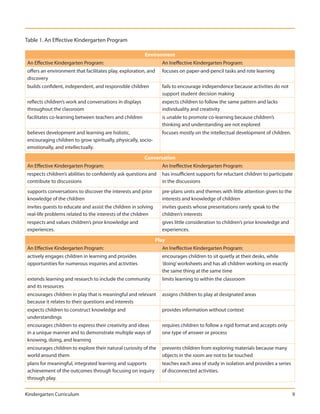
                                            distinguishing features of environment, conversation, and play. Table
                                            1 on the following page uses the three distinguishing features to give
                                            examples of what an effective Kindergarten program is and is not.

                                            Reflects the Philosophy of each Subject Area
                                            Discipline
                                            An effective Kindergarten program brings each subject area discipline
                                            to life. Although, what children should know, understand, and be able
                                            to do by the end of Kindergarten is specified in each of the subject
                                            area outcomes, the teacher needs to have a deeper understanding of
                                            how to plan a program based on what is important in each subject
                                            area discipline. This happens through continual reflection on ‘why
                                            these specific outcomes?’, and coming to know the philosophical
                                            underpinnings of each discipline.


8                                                                                            Kindergarten Curriculum
Table 1. An Effective Kindergarten Program

                                                         Environment
An Effective Kindergarten Program:                                An Ineffective Kindergarten Program:
offers an environment that facilitates play, exploration, and     focuses on paper-and-pencil tasks and rote learning
discovery
builds confident, independent, and responsible children           fails to encourage independence because activities do not
                                                                  support student decision making
reflects children’s work and conversations in displays            expects children to follow the same pattern and lacks
throughout the classroom                                          individuality and creativity
facilitates co-learning between teachers and children             is unable to promote co-learning because children’s
                                                                  thinking and understanding are not explored
believes development and learning are holistic,                   focuses mostly on the intellectual development of children.
encouraging children to grow spiritually, physically, socio-
emotionally, and intellectually.

                                                         Conversation
An Effective Kindergarten Program:                                An Ineffective Kindergarten Program:
respects children’s abilities to confidently ask questions and    has insufficient supports for reluctant children to participate
contribute to discussions                                         in the discussions
supports conversations to discover the interests and prior        pre-plans units and themes with little attention given to the
knowledge of the children                                         interests and knowledge of children
invites guests to educate and assist the children in solving      invites guests whose presentations rarely speak to the
real-life problems related to the interests of the children       children’s interests
respects and values children’s prior knowledge and                gives little consideration to children’s prior knowledge and
experiences.                                                      experiences.

                                                                Play
An Effective Kindergarten Program:                                An Ineffective Kindergarten Program:
actively engages children in learning and provides                encourages children to sit quietly at their desks, while
opportunities for numerous inquiries and activities               ‘doing’ worksheets and has all children working on exactly
                                                                  the same thing at the same time
extends learning and research to include the community            limits learning to within the classroom
and its resources
encourages children in play that is meaningful and relevant       assigns children to play at designated areas
because it relates to their questions and interests
expects children to construct knowledge and                       provides information without context
understandings
encourages children to express their creativity and ideas         requires children to follow a rigid format and accepts only
in a unique manner and to demonstrate multiple ways of            one type of answer or process
knowing, doing, and learning
encourages children to explore their natural curiosity of the     prevents children from exploring materials because many
world around them                                                 objects in the room are not to be touched
plans for meaningful, integrated learning and supports            teaches each area of study in isolation and provides a series
achievement of the outcomes through focusing on inquiry           of disconnected activities.
through play.


Kindergarten Curriculum                                                                                                           9
Just as the characteristics of an effective Kindergarten program are
     provided in the Kindergarten curriculum, each subject area, in Grades
     1-9, has also provided characteristics of developing a school program
     based on their discipline. Arts Education provides students with
     opportunities to explore and express their ideas through the arts and
     to investigate the work of local, national, and international artists.
     English language arts speaks to the focus on language; the importance
     of exploring a range of texts that address identity, community, and
     social responsibility; and the opportunity to create and share ideas
     in a variety of visual, multimedia, oral, and written forms. Health
     education focuses on engaging students in learning and promoting
     the health of self and others. Mathematics emphasizes the importance
     of developing a deep conceptual understanding of mathematics
     and the continuum of understanding from concrete to abstract. In
     science, students explore the natural and constructed worlds in an
     empirical manner. Social studies speaks to controversial issues and
     multiculturalism. Physical education focuses on achieving physical
     literacy.
     All subject area disciplines expect that children will learn through
     meaningful contexts and creative and critical learning strategies.
     Engagement, student voice, inquiry, and deep understanding are
     common to designing programs in every discipline. When teachers
     understand the philosophy of each discipline, they are better able to
     plan and facilitate children’s experiences.


     An Effective Kindergarten Program in
     Action
     In Kindergarten, the inquiry process can be informal such as play, or it
     can be more formal such as a guided inquiry. During informal inquiries,
     children explore, wonder, and investigate the natural or constructed
     environments as the teacher structures, observes, and scaffolds
     learning through making adaptations to the instruction, materials,
     and environment to support student achievement of the curriculum
     outcomes. In a formal inquiry, the children explore the natural and
     constructed environments while the teacher guides the process. These
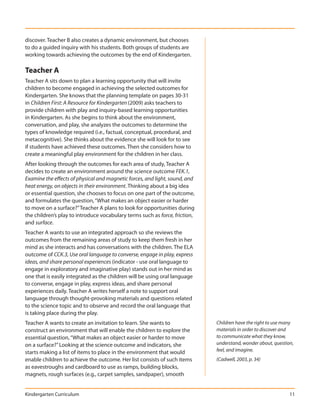
     two approaches are illustrated in the following two stories of Teacher A
     and Teacher B.
     There are many different ways to implement an effective Kindergarten
     program. The following stories describe how two teachers effectively
     plan for experiences that will engage children in learning. Through
     their instructional stances, both Teacher A and Teacher B facilitate
     students’ opportunities to explore the essential question, ‘what makes
     an object easier or harder to move on a surface?’ Teacher A focuses
     on setting up the environment for children to explore, wonder, and


10                                                    Kindergarten Curriculum
discover. Teacher B also creates a dynamic environment, but chooses
to do a guided inquiry with his students. Both groups of students are
working towards achieving the outcomes by the end of Kindergarten.

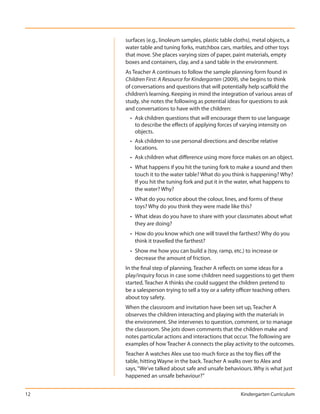
Teacher A
Teacher A sits down to plan a learning opportunity that will invite
children to become engaged in achieving the selected outcomes for
Kindergarten. She knows that the planning template on pages 30-31
in Children First: A Resource for Kindergarten (2009) asks teachers to
provide children with play and inquiry-based learning opportunities
in Kindergarten. As she begins to think about the environment,
conversation, and play, she analyzes the outcomes to determine the
types of knowledge required (i.e., factual, conceptual, procedural, and
metacognitive). She thinks about the evidence she will look for to see
if students have achieved these outcomes. Then she considers how to
create a meaningful play environment for the children in her class.
After looking through the outcomes for each area of study, Teacher A
decides to create an environment around the science outcome FEK.1,
Examine the effects of physical and magnetic forces, and light, sound, and
heat energy, on objects in their environment. Thinking about a big idea
or essential question, she chooses to focus on one part of the outcome,
and formulates the question, “What makes an object easier or harder
to move on a surface?” Teacher A plans to look for opportunities during
the children’s play to introduce vocabulary terms such as force, friction,
and surface.
Teacher A wants to use an integrated approach so she reviews the
outcomes from the remaining areas of study to keep them fresh in her
mind as she interacts and has conversations with the children. The ELA
outcome of CCK.3, Use oral language to converse, engage in play, express
ideas, and share personal experiences (indicator - use oral language to
engage in exploratory and imaginative play) stands out in her mind as
one that is easily integrated as the children will be using oral language
to converse, engage in play, express ideas, and share personal
experiences daily. Teacher A writes herself a note to support oral
language through thought-provoking materials and questions related
to the science topic and to observe and record the oral language that
is taking place during the play.
Teacher A wants to create an invitation to learn. She wants to               Children have the right to use many
construct an environment that will enable the children to explore the        materials in order to discover and
essential question, “What makes an object easier or harder to move           to communicate what they know,
on a surface?” Looking at the science outcome and indicators, she            understand, wonder about, question,
starts making a list of items to place in the environment that would         feel, and imagine.
enable children to achieve the outcome. Her list consists of such items      (Cadwell, 2003, p. 34)
as eavestroughs and cardboard to use as ramps, building blocks,
magnets, rough surfaces (e.g., carpet samples, sandpaper), smooth


Kindergarten Curriculum                                                                                       11
surfaces (e.g., linoleum samples, plastic table cloths), metal objects, a
     water table and tuning forks, matchbox cars, marbles, and other toys
     that move. She places varying sizes of paper, paint materials, empty
     boxes and containers, clay, and a sand table in the environment.
     As Teacher A continues to follow the sample planning form found in
     Children First: A Resource for Kindergarten (2009), she begins to think
     of conversations and questions that will potentially help scaffold the
     children’s learning. Keeping in mind the integration of various areas of
     study, she notes the following as potential ideas for questions to ask
     and conversations to have with the children:
       • Ask children questions that will encourage them to use language
         to describe the effects of applying forces of varying intensity on
         objects.
       • Ask children to use personal directions and describe relative
         locations.
       • Ask children what difference using more force makes on an object.
       • What happens if you hit the tuning fork to make a sound and then
         touch it to the water table? What do you think is happening? Why?
         If you hit the tuning fork and put it in the water, what happens to
         the water? Why?
       • What do you notice about the colour, lines, and forms of these
         toys? Why do you think they were made like this?
       • What ideas do you have to share with your classmates about what
         they are doing?
       • How do you know which one will travel the farthest? Why do you
         think it travelled the farthest?
       • Show me how you can build a (toy, ramp, etc.) to increase or
         decrease the amount of friction.
     In the final step of planning, Teacher A reflects on some ideas for a
     play/inquiry focus in case some children need suggestions to get them
     started. Teacher A thinks she could suggest the children pretend to
     be a salesperson trying to sell a toy or a safety officer teaching others
     about toy safety.
     When the classroom and invitation have been set up, Teacher A
     observes the children interacting and playing with the materials in
     the environment. She intervenes to question, comment, or to manage
     the classroom. She jots down comments that the children make and
     notes particular actions and interactions that occur. The following are
     examples of how Teacher A connects the play activity to the outcomes.
     Teacher A watches Alex use too much force as the toy flies off the
     table, hitting Wayne in the back. Teacher A walks over to Alex and
     says, “We’ve talked about safe and unsafe behaviours. Why is what just
     happened an unsafe behaviour?”


12                                                      Kindergarten Curriculum
“I pushed it too hard and it went off the table and hit Wayne” was the
sheepish reply from Alex.
“What could you do differently to play safely?”
“Don’t push too hard.”
“Anything else?”
“Ummm, play with it on the floor so it won’t fly off the table and hit
Wayne.”
Later, as Teacher A sits down to document and interpret the
observations, she turns to the outcomes to refresh her memory. She
knows that the conversation she had with Alex had direct connections
to the health outcome USCK.2, Establish behaviours that support safety
of self and others (indicators - develop the language with which to
wonder and talk about safety; recognize “safe” and “unsafe” behaviours
and situations; investigate safety guidelines and rules to keep one
safe at school and at home; learn and practise safety procedures in
a variety of school and home contexts; describe what children can
do to support the safety of self and others). The interaction showed
that Alex is developing the language with which to wonder and talk
about safety. He is able to recognize safe and unsafe behaviours and
situations, and is able to describe what children can do to support the
safety of self and others. Teacher A keeps this learning in mind as she
considers what to show in the documentation panel.
As Teacher A reflects further on her conversation with Alex, she realizes
she could have introduced him to the term force. She makes a mental
note to talk to Alex when he is engaged in a future related activity to
introduce force into his expanding vocabulary.
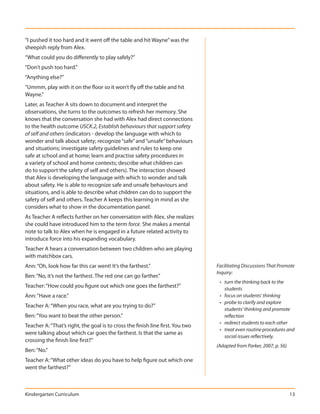
Teacher A hears a conversation between two children who are playing
with matchbox cars.
Ann: “Oh, look how far this car went! It’s the farthest.”                       Facilitating Discussions That Promote
                                                                                Inquiry:
Ben: “No, it’s not the farthest. The red one can go farther.”
                                                                                 • turn the thinking back to the
Teacher: “How could you figure out which one goes the farthest?”                   students
Ann: “Have a race.”                                                              • focus on students’ thinking
                                                                                 • probe to clarify and explore
Teacher A: “When you race, what are you trying to do?”
                                                                                   students’ thinking and promote
Ben: “You want to beat the other person.”                                          reflection
                                                                                 • redirect students to each other
Teacher A: “That’s right, the goal is to cross the finish line first. You two
                                                                                 • treat even routine procedures and
were talking about which car goes the farthest. Is that the same as
                                                                                   social issues reflectively.
crossing the finish line first?”
                                                                                (Adapted from Parker, 2007, p. 56)
Ben: “No.”
Teacher A: “What other ideas do you have to help figure out which one
went the farthest?”


Kindergarten Curriculum                                                                                              13
Ben: “You can do one car then the other and see which one stops
     farther away.”
     Ann: “We can put tape on the floor where they stop. Or we can use a
     measure. My mom used one when she put up the shelf in my room.”
     Teacher A: “Putting tape or string on the floor would let you place the
     two beside each other to compare them (Math SSK.1). I’ll get you a
     tape measure while you go get some string. Let me know which one
     works the best and why.”
     The children wanted to compare which object went the farthest, and
     Teacher A knows that falls under the math outcome of SSK.1, Use direct
     comparison to compare two objects based on a single attribute, such as
     length including height, mass, volume, capacity (indicator - compare the
     length or height of two objects and explain how they compare using
     the words shorter, longer, taller, or almost the same). She decides to add
     tape measures, rulers, tape, and a stopwatch to the environment to
     enable the children to explore this outcome in more detail. She also
     considers inviting the children to each bring to school one toy that
     moves so they can look at the designs of the toys, if interested.
     As Teacher A walks away, she realizes that she could have also
     connected the discussion about the red car going the farthest with
     the arts education outcome of CHK.1, Investigate arts expressions found
     in own homes and school community in relation to own lives (indicator
     - describe arts expressions found in homes and community [e.g.,
     music, heritage dances, puppet theatre, design of functional objects
     such as goalie masks, teapots, and running shoes]) and also posed
     the question, “How many fast things are red?” A discussion about the
     functional design of toys could include colour. She makes a mental
     note to draw the children’s attention to this in the near future.
     As the children’s use of the terms force and friction start to become
     more common, Teacher A decides to expand the environment to the
     outdoors. She wants the children to explore force and friction using
     the swings to see who can swing the highest, and who can get the
     greatest number of swings back and forth from one push (without
     pumping legs). She also plans to take the scooters out as well so the
     children can explore the effects of force and friction as they push each
     other on the swings and use the scooters on a variety of surfaces. By
     taking the children to an outdoor environment, Teacher A is able to
     integrate the physical education outcome of PEK.5, Vary, with guidance,
     the movement of the body through changes in space (personal space,
     general space, levels, directions, and pathways), effort (time and speed),
     relationships (body parts and shapes).
     When Teacher A plans, she typically knows where the learning
     experience will start and continually evolves the plan to address the
     children’s questions and provide scaffolds for those students who


14                                                     Kindergarten Curriculum
require support to benefit from their explorations. While she has an
idea of how to integrate the areas of study, she is always listening to
the children to see where their interests are and planning how she
can help them make connections to the learning required by the
outcomes. When she documents her observations, Teacher A is always
looking for more opportunities to provide new learning experiences
and extend the children’s understandings.
Teacher A observes, documents, and interprets the inquiry and
learning that is taking place through play. As well, she continually
reflects upon the environment, conversation, and play/inquiry that she
has been observing. She reflects upon both her learning and that of
the children, how she provided scaffolds to support student learning,
and possibilities for future inquiries.
Teacher A regularly uses the reflective lens to ensure she is providing       Reflective Lens:
her children with a holistic experience within the context offered.            • Belonging and Contributing
Teacher A knows that daily opportunities for the children to develop           • Exploring and Creating
a sense of belonging and to make contributions in their classroom,             • Understanding and Sharing
school, and communities are a part of providing holistic learning
opportunities for the children. When children are given opportunities
each day to explore and create, they are able to express their
understandings of the world and develop their worldviews. Children
who are provided opportunities to understand and share are able
to develop their own ideas and express them in a variety of ways.
Teacher A consciously uses the reflective lens to ensure the children
are growing and developing holistically in each of the areas of the
reflective lens.

Teacher B
Teacher B is sitting down to plan for Kindergarten. He has read Children
First: A Resource for Kindergarten (2009) and wants to provide children
with play and inquiry-based learning opportunities. As he begins to
think about the environment, conversation, and play, he analyzes
the outcomes to determine the types of knowledge required (i.e.,
factual, conceptual, procedural, and metacognitive). He thinks about
the evidence he will look for to see if students have achieved the
outcomes. Then he considers how he can create a meaningful inquiry
for the children in his class. After looking through the outcomes for
each area of study, Teacher B decides to create an environment around
the science outcome FEK.1, Examine the effects of physical and magnetic
forces, and light, sound, and heat energy, on objects in their environment.
Thinking about a big idea or essential question, he chooses to focus on
one part of the outcome, and formulates the question, “What makes an
object easier or harder to move on a surface?” Teacher B plans to look
for opportunities during the children’s play to introduce vocabulary
terms such as force, friction, and surface.


Kindergarten Curriculum                                                                                       15
Returning to the Kindergarten curriculum, Teacher B begins to
                                          consider ways he can integrate outcomes from the various areas
                                          of study. After some time, he decides to integrate the following
                                          outcomes:
A . . . common misconception is           Arts education CPK.4, Create art works that express own observations
that outlined learner expectations        and ideas about the world (indicator - identify different lines, colours,
[outcomes] set the ceiling, rather than   textures, shapes, forms, and patterns in surroundings and art works,
the floor, for student understanding.     and apply this understanding in own work) and CHK.1, Investigate arts
(Clifford & Marinucci, 2008, p. 684)      expressions found in own homes and school community in relation to
                                          own lives (indicator - describe arts expressions found in homes and
                                          community [e.g., music, heritage dances, puppet theatre, design of
                                          functional objects such as goalie masks, teapots, and running shoes]).
                                          English language arts - CCK.1, Create and compose various visual,
                                          multimedia, oral, and written texts that explore and present thoughts,
                                          ideas, and experiences (indicators - contribute ideas and experiences
                                          and consider the ideas of others; share information and ideas with a
                                          group; explore ideas and information to make sense of experiences)
                                          and CCK.3, Use oral language to converse, engage in play, express ideas,
                                          and share personal experiences (indicator - use oral language to engage
                                          in exploratory and imaginative play).
                                          Health education - USCK.2, Establish behaviours that support safety
                                          of self and others (indicators - develop the language with which to
                                          wonder and talk about safety; recognize “safe” and “unsafe” behaviours
                                          and situations; investigate safety guidelines and rules to keep one
                                          safe at school and at home; learn and practise safety procedures in a
                                          variety of school and home contexts; describe what children can do to
                                          support the safety of self and others).
                                          Mathematics - SSK.1, Use direct comparison to compare two objects
                                          based on a single attribute, such as length including height, mass, volume,
                                          and capacity (indicator - compare the length or height of two objects
                                          and explain how they compare using the words shorter, longer, taller,
                                          or almost the same) and SSK.3, Build and describe 3-D objects (indicator
                                          - create a representation of a 3-D object using materials such as
                                          modelling clay and building blocks, and compare the representation to
                                          the original object; describe a 3-D object using words such as big, little,
                                          round, like a box, and like a can).
                                          Physical education - PEK.5, Vary, with guidance, the movement of the
                                          body through changes in space (personal space, general space, levels,
                                          directions, and pathways), effort (time and speed), and relationships (body
                                          parts and shapes).
                                          Social studies - DRK.1, Describe the spatial relationships among people,
                                          places, and environments (indicator - demonstrate understanding of
                                          personal directions (e.g., left/right, up/down, front/back) and relative
                                          location (e.g, near/far, above/below).


16                                                                                           Kindergarten Curriculum
Now that Teacher B knows the desired results, he begins to consider
the assessment evidence. Knowing he wants the children to do
a guided inquiry, he also wants to capture their imaginations. He
develops a performance task and rubrics that would demonstrate a
child’s level of achievement of the outcomes. He plans on giving the
students the task after they have had sufficient time to explore the
environment, the concepts of force and friction, and the elements of
art.
Teacher B’s performance task is as follows: “You work for the Fun Times
Toy Company. Your job is to create a toy that is able to move by force.
This toy needs to look like a fun toy to play with, as we talked about
earlier when we looked at the design of toys. As part of your job, you
will have to tell your supervisor how you made the toy and why you
made the choices you did. The forces and friction rubric explains
what your supervisor will be looking for. You will have to complete a
self-assessment rubric to decide if you did the best job you could do.“
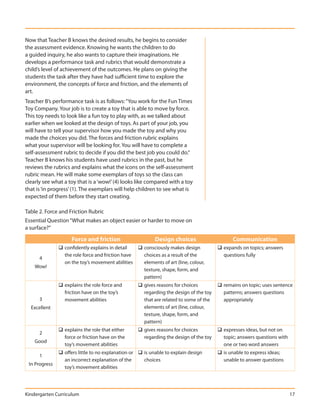
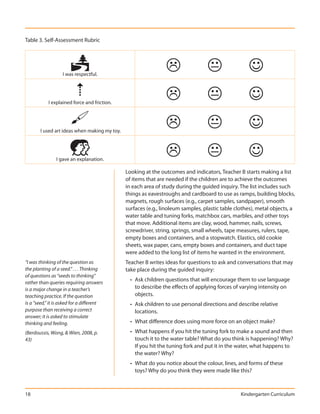
Teacher B knows his students have used rubrics in the past, but he
reviews the rubrics and explains what the icons on the self-assessment
rubric mean. He will make some exemplars of toys so the class can
clearly see what a toy that is a ‘wow!’ (4) looks like compared with a toy
that is ‘in progress’ (1). The exemplars will help children to see what is
expected of them before they start creating.

Table 2. Force and Friction Rubric
Essential Question “What makes an object easier or harder to move on
a surface?”

                     Force and friction                    Design choices                    Communication
               ‰ confidently explains in detail   ‰ consciously makes design           ‰ expands on topics; answers
                 the role force and friction have   choices as a result of the           questions fully
      4
                 on the toy’s movement abilities    elements of art (line, colour,
    Wow!
                                                    texture, shape, form, and
                                                    pattern)
               ‰ explains the role force and       ‰ gives reasons for choices         ‰ remains on topic; uses sentence
                 friction have on the toy’s          regarding the design of the toy     patterns; answers questions
      3          movement abilities                  that are related to some of the     appropriately
  Excellent                                          elements of art (line, colour,
                                                     texture, shape, form, and
                                                     pattern)
               ‰ explains the role that either     ‰ gives reasons for choices         ‰ expresses ideas, but not on
      2
                 force or friction have on the       regarding the design of the toy     topic; answers questions with
    Good
                 toy’s movement abilities                                                one or two word answers
               ‰ offers little to no explanation or ‰ is unable to explain design      ‰ is unable to express ideas;
      1
                 an incorrect explanation of the      choices                            unable to answer questions
 In Progress
                 toy’s movement abilities


Kindergarten Curriculum                                                                                                  17
Table 3. Self-Assessment Rubric


                       P
                   I was respectful.
                                                               L                 K                 J
                         5
            I explained force and friction.
                                                               L                 K                 J
                       
       I used art ideas when making my toy.
                                                               L                 K                 J
                       E
                I gave an explanation.
                                                               L                 K                 J
                                              Looking at the outcomes and indicators, Teacher B starts making a list
                                              of items that are needed if the children are to achieve the outcomes
                                              in each area of study during the guided inquiry. The list includes such
                                              things as eavestroughs and cardboard to use as ramps, building blocks,
                                              magnets, rough surfaces (e.g., carpet samples, sandpaper), smooth
                                              surfaces (e.g., linoleum samples, plastic table clothes), metal objects, a
                                              water table and tuning forks, matchbox cars, marbles, and other toys
                                              that move. Additional items are clay, wood, hammer, nails, screws,
                                              screwdriver, string, springs, small wheels, tape measures, rulers, tape,
                                              empty boxes and containers, and a stopwatch. Elastics, old cookie
                                              sheets, wax paper, cans, empty boxes and containers, and duct tape
                                              were added to the long list of items he wanted in the environment.
“I was thinking of the question as            Teacher B writes ideas for questions to ask and conversations that may
the planting of a seed.” . . . Thinking       take place during the guided inquiry:
of questions as “seeds to thinking”
rather than queries requiring answers
                                                • Ask children questions that will encourage them to use language
is a major change in a teacher’s                  to describe the effects of applying forces of varying intensity on
teaching practice. If the question                objects.
is a “seed,” it is asked for a different        • Ask children to use personal directions and describe relative
purpose than receiving a correct                  locations.
answer; it is asked to stimulate
thinking and feeling.                           • What difference does using more force on an object make?
(Berdoussis, Wong, & Wien, 2008, p.             • What happens if you hit the tuning fork to make a sound and then
43)                                               touch it to the water table? What do you think is happening? Why?
                                                  If you hit the tuning fork and put it in the water, what happens to
                                                  the water? Why?
                                                • What do you notice about the colour, lines, and forms of these
                                                  toys? Why do you think they were made like this?


18                                                                                              Kindergarten Curriculum
• What ideas do you have to share with your classmates about what
    they are doing?
  • How do you know which one will travel the farthest? Why do you
    think it travelled the farthest?
  • Show me how you can build a (toy, ramp, etc.) to increase or
    decrease the amount of friction.
Teacher B turns his planning to play/inquiry. He wants to guide
his students in an inquiry into force and friction by giving them
opportunities to play and explore these concepts. As they explore,
he will introduce concepts and terms through conversation and
questions. Because the performance task involves toy design, Teacher
B wants to create opportunities for his students to inquire and explore
the elements of art and toy design. He believes that a good starting
point would be to have the children bring their favourite toys in and
ask them questions to start them thinking about the design of the
toys.
Teacher B sits down with his children to find out what they have to
say about the essential question, ‘What makes an object easier or
harder to move on a surface?’ As they brainstorm their theories, he
records them on chart paper. The children are then free to explore
and interact with the environment while Teacher B observes their play       Research shows that children who
and inquiries. After the children have had time to interact, inquire, and   engage in complex forms of socio-
explore the environment, Teacher B gathers them together to add,            dramatic play have greater language
change, or delete their theories as he records the responses. Teacher B     skills than nonplayers, better
realizes that the children are ready to have the terms force and friction   social skills, more empathy, more
introduced and explained to them. Once again, the teacher observes          imagination, and more of the subtle
as the children play and inquire in the environment, providing              capacity to know what others mean.
scaffolds as required.                                                      They are less aggressive and show
                                                                            more self-control and higher levels of
Keeping the performance task in mind, Teacher B knows the children          thinking.
also need to explore the elements of art. He wants to draw their
                                                                            (Miller & Almon, 2009, p. 7)
attention to this through the use of toys. He begins by drawing the
children’s attention back to the essential question, ‘What makes an
object easier or harder to move on a surface?’ This time he refers to
his observations and notices that one student said a ball was easier
to move because it rolled. He reviews this conversation with the class
and brings in the art concepts of line, colour, texture, shape, form, and
pattern. He requests that each child bring a toy from home to help the
class look at how art and design make an object easier or harder to
move on a surface. He then gives the children time to explore, inquire,
and interact with the environment and their new knowledge. Teacher
B observes, documents, and interprets throughout this process.
While observing, documenting, and interpreting the children’s play
and inquiries, Teacher B decides it is time to give the children the
performance task. Once again, he calls the class together to review


Kindergarten Curriculum                                                                                        19
what they have learned about the essential question, force, friction,
                                and the role the elements of art play in toy design.
                                He then proceeds to explain the performance task. He knows his
                                children have used rubrics before so he presents them to the class
                                along with the exemplars he created. He has decided to wait to
                                introduce presentation skills until the children are ready to present
                                their toys. Teacher B explains to the children that if they need any
                                additional supplies to build their toys, they should ask him for his
                                assistance.
                                Once again, Teacher B observes, documents, and interprets the
                                inquiry and learning that is taking place in the classroom. As well, he
                                continually reflects upon the environment, conversation, and play/
                                inquiry that he has been observing. He reflects upon both his learning
                                and that of the children, how he provided scaffolds to support student
                                learning, and considered possibilities for future inquiries.
                                Teacher B regularly uses the reflective lens to ensure he is providing
                                the children with a holistic experience. Teacher B knows that daily
Reflective Lens:
                                opportunities for the children to develop a sense of belonging and to
 • Belonging and Contributing   make contributions in their classroom, school, and communities are a
 • Exploring and Creating       part of providing holistic learning opportunities for the children. When
 • Understanding and Sharing    children are given opportunities each day to explore and create, they
                                are able to express their understandings of the world and develop
                                their worldviews. Children who are provided with opportunities to
                                understand and share are able to develop their own ideas and express
                                them in a variety of ways. Teacher B consciously ensures that his
                                students can grow and develop in each area of the reflective lens.
                                The children in both Kindergarten classrooms had dynamic,
                                stimulating environments in which to learn. Conversations were
                                used by both teachers to determine the children’s interests, prior
                                knowledge, and scaffolds required to support learning. Teacher A and
                                Teacher B both used play and inquiry as a key component of their
                                Kindergarten program. The environments, conversations, and play
                                were used in different ways, but children in both classes were able to
                                work towards achieving the same outcomes.


20                                                                                Kindergarten Curriculum
Outcomes and Indicators
Outcomes are statements of what students are expected to know,
understand, and be able to do by the end of a grade in a particular
area of study. The outcomes provide direction for assessment and
evaluation, and for program, unit, and lesson planning.
Critical characteristics of outcomes include the following:
  • focus on what students will learn rather than what teachers will
    teach
  • specify the skills and abilities, understandings, and/or attitudes
    students are expected to demonstrate
  • are observable, assessable, and attainable
  • are written using action-based verbs and clear professional
    language (subject-related)
  • are developed to be achieved in context so that learning is
    purposeful and interconnected
  • are grade and subject specific
  • are supported by indicators which provide the breadth and depth
    of expectations
  • have a developmental flow and connection to other grades, where
    applicable.
Indicators are representative of what students need to know,
understand, and/or be able to do in order to achieve an outcome.
Indicators represent the breadth and the depth of learning related to a
particular outcome. The list of indicators provided in the curriculum
is not an exhaustive list. Teachers may develop additional and/or
alternative indicators but those teacher-developed indicators must
be reflective of, and consistent with, the breadth and depth that is
defined by the given indicators.


Kindergarten Curriculum                                                   21
Arts Education
                                            Aim and Goals of K-12 Arts Education
Arts education provides students            The K-12 aim of the Saskatchewan arts education curricula is to enable
with tremendous benefits including          students to understand and value arts expressions throughout life.
increased cognitive abilities,
                                            The K-12 goals are broad statements identifying what students are
improved conflict resolution and
other social skills, and higher levels of
                                            expected to know and be able to do upon completion of a particular
motivation and student engagement.          area of study, by the end of Grade 12.

(Deasey, 2002 & Gazzaniga, 2008)            The three goals for arts education students from Kindergarten to
                                            Grade 12 are:
                                             • Cultural/Historical (CH) - Children will investigate the content and
                                               aesthetics of the arts within cultural, historical, and contemporary
                                               contexts and understand the connection between the arts and
                                               human experience.
                                               This goal focuses on the role of the arts in various cultures, the
                                               development of the arts throughout history, and factors that
                                               influence contemporary arts and artists. It includes the historical
                                               development of dance, drama, music, and visual art within its
                                               social, cultural, and environmental context. In addition, the goal
                                               includes learning about the arts in contemporary societies, popular
                                               culture, and interdisciplinary forms of expression. The intent is to
                                               develop students’ understanding of the arts as important forms
                                               of aesthetic expression, and as records of individual and collective
                                               experiences, histories, innovations, and visions of the future.

                                             • Critical/Responsive (CR) - Children will respond to artistic
                                               expressions of Saskatchewan, Canadian, and International artists
                                               using critical thinking, research, creativity, and collaborative
                                               inquiry.
                                               This goal enables children to respond critically and imaginatively
                                               to images, sounds, performances, and events in the artistic
                                               environment, including the mass media. Children become
                                               participants in the interactive process between artists and
                                               audience rather than passive consumers of the arts. Several
                                               processes are provided to help teachers guide discussion and
                                               encourage various responses to works of art; for example, visual art
                                               works, musical compositions, or dance and drama performances.
                                               The processes are intended to move students beyond quick
                                               judgement to informed personal interpretation, and can be used
                                               with each of the four strands and interdisciplinary works. These
                                               processes are described in “Responding to Arts Expressions”,
                                               located on the Ministry of Education website. The intent of this
                                               goal is also to ensure that students are actively engaged with
                                               artists in their own communities and recognize that the arts are
                                               integral to the lives and cultures of every community.

22                                                                                          Kindergarten Curriculum
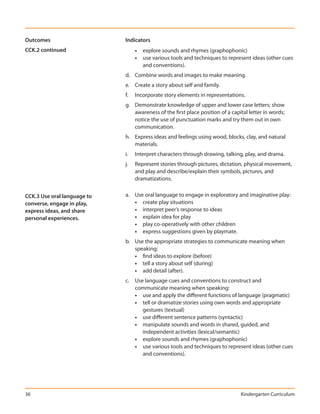
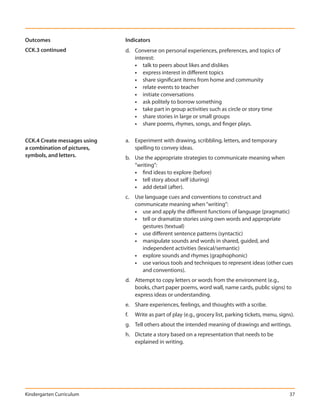
• Creative/Productive (CP) - Children will inquire, create, and
    communicate through dance, drama, music, and visual art.
   This goal includes the exploration, development, and expression
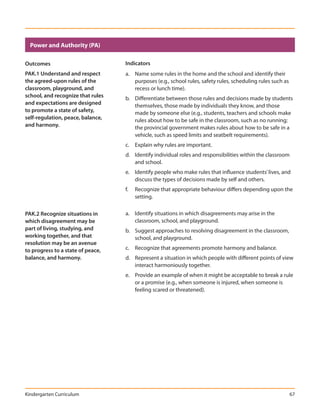
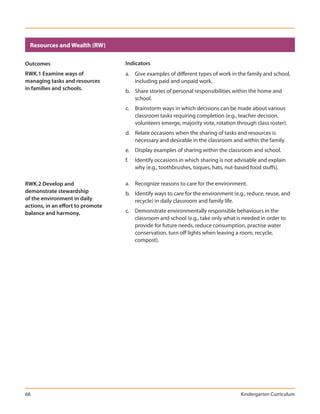
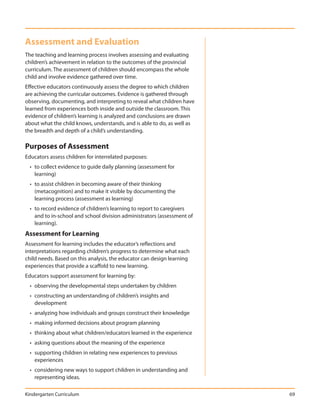
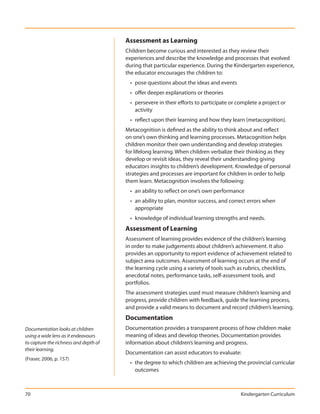
   of ideas in the language of each strand or art form. Each art form
   involves students in different ways of thinking, inquiring, and
   conveying meaning. Each form involves students in creative
   processes and means of inquiry that require students to reflect
   on big ideas, and investigate compelling questions using the
   language, concepts, skills, techniques, and processes of that
   discipline. In order for an activity to be creative, students must
   be engaged in critical thinking, observation, and other forms
   of research, active exploration, and creative problem-solving
   processes. Children learn where ideas come from, and how
   ideas can be developed and transformed in each art form.
   Documentation is also an important part of the creative process,
   and can be used for purposes of idea development and refinement,
   assessment, and sharing learning with others. Reflection, both
   ongoing and summative, is an essential part of every creative
   process, and allows students to assess and evaluate their continued
   growth in their creative endeavours.

Kindergarten Arts Education
Children in Kindergarten need daily opportunities to use their
imagination and observations to express and communicate ideas
through the unique languages of the arts. They learn about themselves
and others through critical reflection on their own work and a range of
arts expressions in their communities.
In arts education, children further develop imagination, multiple
literacies, critical and creative thinking abilities, and innovative
problem-finding and problem-solving processes that can be applied in
a variety of ways in their daily lives.


Kindergarten Curriculum                                                   23
Arts Education Outcomes and Indicators
Focus: Exploring Our World

 Cultural/Historical, Critical/Responsive, Creative/Productive

 Goals of K-12 Arts Education:
     • Cultural/Historical (CH) - Children will investigate the content and aesthetics of the arts within
       cultural, historical, and contemporary contexts and understand the connection between the arts and
       human experience.
     • Critical/Responsive (CR) - Children will respond to artistic expressions of Saskatchewan, Canadian,
       and International artists using critical thinking, research, creativity, and collaborative inquiry.
     • Creative/Productive (CP) - Children will inquire, create, and communicate through dance, drama,
       music, and visual art.


 Creative/Productive (CP): Dance


Outcomes                                  Indicators

CPK.1 Express ideas through               a. Use movement to respond to stimuli from diverse sources such
exploration of the elements of               as stories, poems, observations, visual images, music, sounds, or
dance including:                             objects.

 • action                                 b. Ask questions related to the stimuli to contribute to a dance-
                                             making inquiry process (e.g., How does grass move when the wind
 • body
                                             blows?).
 • dynamics
                                          c. Apply personal experience and imagination to express ideas in
 • relationships
                                             dance.
 • space.
                                          d. Share dance ideas and movement responses with other children.
                                          e. Move to external beats and rhythms (e.g., round dance, jigging).
                                          f.   Describe choices made when creating (e.g., fast or slow, roll or
                                               hop).
                                          g. Investigate what own body can do by exploring a variety of whole
                                             body and body part movements to express ideas.
                                          h. Repeat expressive movements and patterns created by self and
                                             others.
                                          i.   Use different kinds of locomotor (travelling) and non-locomotor
                                               (non-travelling) actions (e.g., roll, jump, hop, turn, and pause) to
                                               express ideas.
                                          j.   Use a variety of dynamic qualities such as quickly and softly in
                                               dance compositions.
                                          k. Recall that the dance space is called general space and that
                                             personal space is each child’s “bubble” or self-space.


24                                                                                            Kindergarten Curriculum
Outcomes                            Indicators
CPK.1 continued                     l.   Move freely and safely in general space while maintaining self-
                                         space (not contacting).
                                    m. Explore different movement relationships (e.g., leading, following,
                                       near, far, over, under, in front, behind) with the teacher and other
                                       dancers.


  Creative/Productive (CP): Drama


Outcomes                            Indicators
CPK.2 Explore a variety of          a. Use sources such as stories, poems, observations, visual images,
drama strategies including:            music, sounds, or objects to initiate drama work.
 • role                             b. Recognize that dramas are fictional situations.
 • imaging                          c. Contribute to the choice of topic ideas for the drama.
 • parallel play                    d. Ask questions to contribute to inquiry on a drama topic (e.g., What
 • journeys                            might happen to animals if winter did not come this year? What
 • meetings.                           if a messenger came to tell us that a giant was seen outside the
                                       town?).
                                    e. Listen to others and work co-operatively in dramatic contexts.
                                    f.   Explore ideas in dramatic contexts and during reflection, drawing
                                         on own life experience.
                                    g. Use imagination during, and when reflecting on, the drama
                                       experience.
                                    h. Assume roles willingly in contextual drama.
                                    i.   Listen quietly during imaging activities and become aware of
                                         thoughts and feelings that cannot be seen.
                                    j.   Focus attention on own work, while respecting others, during
                                         parallel play and imaginary journeys.
                                    k. Contribute ideas during fictional meetings and other dramatic
                                       situations.
                                    l.   Retell events and ideas that arise during the drama process.


Kindergarten Curriculum                                                                                    25
Creative/Productive (CP): Music

Outcomes                           Indicators
CPK.3 Create sound                 a. Use sources such as stories, poems, observations, visual images,
compositions exploring the            music, sounds, or objects to inspire music making.
elements of music including:
                                   b. Observe sounds in a variety of settings, both natural (e.g.,
 • repeating patterns                 birds, animals, insects, wind, trees, water) and constructed (e.g.,
 • beat (e.g., clapping and           machinery, human-made objects in rural, urban, and reserve
   stepping, and counting)            environments), and apply listening skills to own work.
 • response to fast/slow paces     c. Use own words to describe elemental characteristics of sounds
 • high/low sounds                    (e.g., high/low and soft/loud) from a variety of settings and from
                                      own compositions.
 • loud/soft sounds
 • sounds with distinct tone       d. Discuss how musicians and scientists use their senses to observe
   colours/timbres.                   the world (e.g., listening to sound characteristics and patterns) and
                                      apply this understanding to own work.
                                   e. Create and imitate sounds by experimenting with the voice and
                                      instruments.
                                   f.   Experiment with a variety of simple found objects and selected
                                        instruments, both pitched and unpitched.
                                   g. Create sounds to convey particular patterns, images, or expressive
                                      qualities.
                                   h. Describe basic decisions made in creating music expressions (e.g.,
                                      sounds to be used in the piece, loud parts, soft parts, order of
                                      sounds).
                                   i.   Distinguish between own speaking voice and singing voice.
                                   j.   Begin to develop the ability to match pitch.
                                   k. Clap, play, and move to beats and rhythmic patterns (e.g., in
                                      nursery rhymes, music, teaching stories, and legends).
                                   l.   Contribute to inquiry about elements of music (e.g., What sounds
                                        can we combine to make different patterns/rhythms?).
                                   m. Demonstrate awareness of patterns of high/low and loud/soft
                                      sounds in own speech and music.
                                   n. Identify and use sounds and instruments with distinctly different
                                      tone colours/timbres (e.g., triangle versus tambourine).


26                                                                                     Kindergarten Curriculum
Creative/Productive (CP): Visual Art

Outcomes                                 Indicators
CPK.4 Create art works that              a. Identify different lines, colours, textures, shapes, forms,
express own observations and                and patterns in surroundings and art works, and apply this
ideas about the world.                      understanding in own work.
                                         b. Use diverse sources such as stories, poems, observations, visual
                                            images, music, sounds, or objects as inspiration for art making.
                                         c. Discuss how artists and scientists use their senses to observe
                                            and record characteristics of plants, animals, and humans in the
                                            environment (e.g., observing nature, sounds, movement, and
                                            visual details).
                                         d. Recognize the difference between the natural and built
                                            environments.
                                         e. Ask questions about own environment to contribute to inquiry
                                            through visual art (e.g., Why do birds have different coloured
                                            feathers? How can we use these art materials to make interesting
                                            birds? Do some birds have special meaning in some cultures? How
                                            can we use feathers in our art? Are there some feathers that we
                                            cannot use, and why?).
                                         f.   Select from a variety of art materials, tools, and paper size when
                                              creating a visual art expression (e.g., found objects, digital cameras,
                                              household items, wire).
                                         g. Observe and identify details of the physical appearance of plants,
                                            animals, people, and objects, and create visual representations.
                                         h. Demonstrate co-ordination and development of skills in the use of
                                            simple visual art tools and materials.
                                         i.   Discuss choices made in creating art works.
                                         j.   Observe and identify the concepts of big and small.
                                         k. Observe and identify top, bottom, front, back, and sides.
                                         l.   Observe and identify objects from different viewpoints (e.g., near,
                                              far, high, low) and describe what is seen.


Kindergarten Curriculum                                                                                           27
Critical/Responsive (CR): All Strands

Outcomes                                  Indicators
CRK.1 Respond to arts                     a. Ask questions and describe thoughts and feelings evoked by arts
expressions verbally and                     expressions in a variety of ways (e.g., respond through movement,
non-verbally (e.g., through                  drawing, talking, clapping, or sound compositions).
movement or drawing).
                                          b. Tell stories, recall prior experiences, and make personal and
                                             imaginative connections to arts expressions.
                                          c. Demonstrate curiosity when viewing and responding to dances,
                                             dramatic presentations, music, and visual art expressions (e.g.,
                                             contemporary, historical, cultural, and popular).
                                          d. Use senses and discuss observations about the effects of various
                                             arts expressions (e.g., music that is calming, dance that is lively,
                                             drama that shows emotions, visual art that looks peaceful).
                                          e. Show interest in knowing more about arts expressions and artists.
                                          f.   Observe and respond to a range of arts expressions, incorporating
                                               age-appropriate discussion of arts elements and principles (e.g.,
                                               lines and colours in picture book illustrations, rhythm or dynamics
                                               of a song, use of space in a dance, variety of roles in a drama).


  Cultural/Historical (CH): All Strands

Outcomes                                  Indicators
CHK.1 Investigate arts                    a. Describe arts expressions found in homes and community (e.g.,
expressions found in own                     music, heritage dances, puppet theatre, design of functional
homes and school community                   objects such as goalie masks, teapots, and running shoes).
in relation to own lives.
                                          b. Demonstrate awareness that artists use different kinds of materials,
                                             tools, instruments, and technology.
                                          c. Investigate various kinds of artists working in own community
                                             (e.g., musicians, visual artists, filmmakers).
                                          d. Collect, discuss, and document stories, images, ideas, and/or
                                             emotions in response to the work of artists in own community
                                             (e.g., collect photos, music, and objects to create a class display
                                             about local arts and artists).
                                          e. Learn songs, music, and dances of various styles and cultural
                                             groups associated with home and school community.


28                                                                                          Kindergarten Curriculum
Outcomes                           Indicators
CHK.2 Recognize a wide variety     a. Observe and identify differences between First Nations Powwow
of arts expressions as creations      dances and drum groups versus Métis jigging and fiddling.
of First Nations and Métis
                                   b. Observe and describe Powwow regalia, beadwork, and other
peoples.
                                      traditional forms of art.
                                   c. Observe and discuss arts expressions of First Nations and Métis
                                      musicians, actors, and visual artists.
                                   d. Demonstrate awareness that drummers, singers, dancers, and
                                      other artists play important roles in First Nations and Métis
                                      cultures.


Kindergarten Curriculum                                                                                 29
English Language Arts
                                        Aim and Goals of K-12 English Language Arts
                                        The K-12 aim of the Saskatchewan English language arts curricula is
                                        to help students understand and appreciate language and to use it
                                        confidently and competently in a variety of situations for learning,
                                        communication, work, life, and personal satisfaction.
                                        The K-12 goals are broad statements identifying what students are
                                        expected to know and be able to do upon completion of study in a
                                        particular subject (e.g., English language arts) by the end of Grade
                                        12. The three K-12 goals of the Saskatchewan English language arts
                                        curricula are:
                                          • Comprehend and Respond (CR). Children will extend their
                                            abilities to view, listen to, read, comprehend, and respond to
                                            a range of contemporary and traditional grade-level texts in a
                                            variety of forms (oral, print, and other texts) from First Nations/
                                            Métis, and other cultures for a variety of purposes including for
                                            learning, interest, and enjoyment.
                                          • Compose and Create (CC). Children will extend their abilities to
                                            speak, write, and use other forms of representation to explore and
                                            present thoughts, feelings, and experiences in a variety of forms
                                            for a variety of purposes and audiences.
                                          • Assess and Reflect (AR). Children will assess their own language
                                            skills; discuss the skills of effective viewers, representers,
                                            listeners, speakers, readers, and writers; and set goals for future
                                            improvement.
                                        Focus on Language
Good language and literacy skills lay   The study of English language arts (viewing, listening, “reading”,
the foundation for social, academic,    representing, speaking, and “writing”) and the elements and
economic, personal, and national        conventions associated with each language cueing system (i.e.,
success.                                pragmatic, textual, syntactic, semantic/lexical/morphological,
(Jamieson & Tremblay, 2005, p.1)        graphophonic, and other) enables children to understand and
                                        appreciate language and to use it in a variety of situations for
                                        communication, for learning, and for personal satisfaction.
                                        An effective Kindergarten program that develops children’s facility
                                        with language provides children with opportunities to:
                                          • learn to use language in a variety of meaningful ways, considering
                                            and determining their audience, purpose, and situation
                                          • learn about language as a necessary tool for thinking and
                                            communicating effectively, considering the cues and conventions
                                            of language


30                                                                                         Kindergarten Curriculum
• learn through language by applying their knowledge of language
    in their viewing, listening, reading, representing, speaking, and
    writing experiences.
Language conventions are accepted practices or agreed-upon rules
in representational, spoken, or written language. Cueing systems
are sets of cues or clues built into the structure or patterns of texts.
Using language cues and conventions, students construct, confirm,
and communicate meaning. Pragmatic cues and conventions refer
to the style of language that is used in a given context and take into
consideration the purpose, situation, and audience. The pragmatic
cueing system is often considered to be the social aspect of language.
Textual cues and conventions refer to the type or kind of text and
the features that are associated with its organization. Syntactical
cues and conventions refer to the structure (word order) and parts of
sentences, and the rules that govern the sentences (e.g., subject-verb
agreement). Semantic and lexical cues and conventions refer to the
meaning and structure of words. The lexicon of a language includes all
the words or vocabulary of that language that are used or understood
by a particular person or group. Graphophonic cues and conventions
refer to the sounds of speech (phonology) and how these sounds
are organized in patterns, pronounced, and graphically represented
(spelled). Other cues and conventions associated with supporting
understanding and effective communication include printing, font
choices, graphics, illustrations, layout, and additional enhancements
such as colour, sound, and movement.
Kindergarten English Language Arts
Each of the three K-12 goals for English language arts has a set of
outcomes for Kindergarten. The Kindergarten experience should
provide many opportunities for children to develop their language
skills and strategies in all six language arts strands. As children view
and represent, listen and speak, and explore emerging reading and
writing experiences, they will have many opportunities to use and
learn about language in meaningful ways. The Kindergarten program
provides meaningful contexts for children to use and learn about
language as children question and inquire about themselves, others,
and the constructed and natural environments.
 In Kindergarten, children are building the foundations for learning       A “text” is any form of
to “read” and “write”. They are developing basic concepts of print         communication, whether oral,
but are not expected to be proficient “readers” or “writers” of print      written, visual, or multimedia
texts. Kindergarten children are beginning to engage in and                (including digital media) with a
experiment with “reading” (e.g., listening to and discussing books         definable communication function
and understanding that print carries a message) and “writing” (e.g.,       (e.g., to entertain, to inform).
using known letters or approximations of letters to represent written
language such as their name).


Kindergarten Curriculum                                                                                       31
English Language Arts Outcomes and Indicators
  Comprehend and Respond, Compose and Create, Assess and Reflect

  Goals of K-12 English Language Arts:
     • Comprehend and Respond (CR). Children will extend their abilities to view, listen to, read,
       comprehend, and respond to a range of contemporary and traditional grade-level texts in a variety
       of forms (oral, print, and other texts) from First Nations/Métis, and other cultures for a variety of
       purposes including for learning, interest, and enjoyment.
     • Compose and Create (CC). Children will extend their abilities to speak, write, and use other forms of
       representation to explore and present thoughts, feelings, and experiences in a variety of forms for a
       variety of purposes and audiences.
     • Assess and Reflect (AR). Children will assess their own language skills; discuss the skills of effective
       viewers, representers, listeners, speakers, readers, and writers; and set goals for future improvement.


  Comprehend and Respond (CR)

Outcomes                                  Indicators
CRK.1 Comprehend and                      a. View, listen to, comprehend, and respond to a variety of texts
respond to a variety of visual,              (including First Nations and Métis resources) that address identity.
oral, print, and multimedia               b. Make connections among oral language and personal experiences.
texts that address identity
                                          c. Share personal experiences and family traditions related to texts.
(e.g., exploring interests),
community (e.g., belonging),              d. Relate aspects of stories and information to personal feelings and
and social responsibility (e.g.,             experiences.
contributing).                            e. Use illustrations, photographs, video programs, objects, and
                                             auditory cues to understand ideas and information.
                                          f.   Relate a personal experience as a result of a picture, photograph, or
                                               model.
                                          g. Satisfy natural curiosity by engaging in inquiry:
                                             • wonder about new ideas and observations
                                             • discuss personal knowledge of a topic
                                             • ask questions to satisfy personal curiosity and information
                                                needs
                                             • identify self and others as sources of information
                                             • seek information from others including people at school, at
                                                home, and in the community including Elders and Knowledge
                                                Keepers
                                             • compare gathered ideas and information to personal
                                                knowledge
                                             • share learning and information-gathering experiences
                                             • compose with a scribe
                                             • indicate whether or not information is useful for answering
                                                questions.

32                                                                                           Kindergarten Curriculum
Outcomes                       Indicators
CRK.2 View and interpret       a. Identify key idea(s) and purpose of pictures, graphics, models, and
the basic message of visuals      photographs.
and objects in a variety of
                               b. Use strategies to construct and confirm meaning when viewing:
texts including models,
                                  • make connections to background knowledge (before)
photographs, dramas, dance
                                  • identify important ideas and events (during)
creations, and videos.
                                  • recall (after).
                               c. Understand and apply language cues and conventions to
                                  construct and confirm meaning when viewing:
                                  • recognize the variations of language use at home, on the
                                     playground, and in the classroom (pragmatic)
                                  • describe characteristics of fiction texts (textual)
                                  • develop a sense of sentence (syntactic)
                                  • show curiosity in words and their sounds (lexical/semantic)
                                  • develop phonological awareness (graphophonic)
                                  • recognize how gestures and body language communicate part
                                     of the message (other cues and conventions).
                               d. Volunteer personal experiences and feelings prompted by various
                                  visuals.
                               e. Identify supporting details.
                               f.   Compare similarities and differences such as colour, type of visual,
                                    and object placement between various texts such as pictures,
                                    photographs, and 3-D models.
                               g. Interpret emotions portrayed in visual texts including models,
                                  photographs, dramas, dance creations, and video programs.
                               h. Describe the visual texts and give reasons for liking/disliking them.
                               i.   View and interpret key aspects including arrangement and facial
                                    expression by interpreting the following questions:
                                    •   What are the objects or facts in the picture?
                                    •   What do the objects or facts tell you?
                                    •   How are the objects arranged in the visual?
                                    •   Why are these objects placed in this way?
                                    •   How do the objects help the story or fact?
                                    •   What are the characters doing?
                                    •   Compare different authors/illustrations considering the
                                        illustration or art work and interesting details.


Kindergarten Curriculum                                                                               33
Outcomes                        Indicators
CRK.3 Listen, comprehend, and   a. Listen attentively to others and respond appropriately.
respond to gain meaning in
                                b. Use strategies to construct and confirm meaning when listening:
oral texts.
                                   • make connections to background knowledge (before)
                                   • identify important ideas and events (during)
                                   • recall (after).
                                c. Understand and apply language cues and conventions to
                                   construct and confirm meaning when listening:
                                   • recognize the variations of language use at home, on the
                                      playground, and in the classroom (pragmatic)
                                   • describe characteristics of fiction texts (textual)
                                   • develop a sense of sentence (syntactic)
                                   • show curiosity in words and their sounds (lexical/semantic)
                                   • develop phonological awareness (graphophonic)
                                   • recognize how gestures and body language communicate part
                                      of the message (other cues and conventions).
                                d. Follow simple directions correctly and independently (e.g., Please
                                   put away your crayons and put your picture on the shelf.) and
                                   remember instructions given earlier.
                                e. Listen to traditional and contemporary stories from a variety of
                                   cultures including First Nations and Métis.
                                f.   Listen for different purposes (e.g., to retell, to direct others, for
                                     enjoyment).
                                g. Identify important information.
                                h. Ask questions for clarification, and make comments relevant to the
                                   topic.
                                i.   Connect story events and own experience.
                                j.   Engage in conversations with others in an exchange of ideas,
                                     comments, or questions.


CRK.4 Comprehend, retell,       a. Demonstrate an awareness that communication can occur through
and respond to basic ideas         visuals and print texts (including First Nations and Métis texts).
in stories, poems, songs, and   b. Use strategies to construct and confirm meaning when “reading”:
informational texts read to        • make connections to background knowledge (before)
them.                              • identify important ideas and events (during)
                                   • recall (after).
                                c. Understand and apply language cues and conventions to
                                   construct and confirm meaning when viewing, listening, and
                                   “reading”:
                                   • recognize the variations of language use at home, on the
                                      playground, and in the classroom (pragmatic)
                                   • describe characteristics of fiction texts (textual)


34                                                                                     Kindergarten Curriculum
Outcomes                            Indicators
CRK.4 continued                          •   develop a sense of sentence (syntactic)
                                         •   show curiosity in words and their sounds (lexical/semantic)
                                         •   develop phonological awareness (graphophonic)
                                         •   recognize how gestures and body language communicate part
                                             of the message (other cues and conventions).
                                    d. Demonstrate an interest in and knowledge about books and
                                       reading.
                                    e. Know where to look for the title and author/illustrator.
                                    f.   Choose to read or look at books, and demonstrate knowledge of
                                         print, reading-like behaviours, and book-handling skills.
                                    g. Demonstrate an awareness that print is a permanent way of
                                       recording ideas.
                                    h. Create play situations from basic understandings of story text.
                                    i.   Explain the main idea.
                                    j.   Relate personal experiences, and represent responses through
                                         drama, physical movement, music, drawings, and models.

  Compose and Create (CC)

Outcomes                            Indicators
CCK.1 Compose and create            a. Compose and create a variety of texts that address identity (e.g.,
various visual, multimedia, oral,      exploring interests), community (e.g., belonging), and social
and written texts that explore         responsibility (e.g., contributing).
and present thoughts, ideas,
                                    b. Contribute ideas and experiences and consider the ideas of others.
and experiences.
                                    c. Share information and ideas with a group.
                                    d. Explore ideas and information to make sense of experiences.


CCK.2 Use and construct             a. Use imagination to communicate when appropriate.
symbols, pictures,                  b. Use the appropriate strategies to communicate meaning:
and dramatizations to                  • find ideas to explore (before)
communicate feelings and               • tell a story about self (during)
ideas in a variety of ways.            • add detail (after).
                                    c. Use language cues and conventions to construct and
                                       communicate meaning:
                                       • use and apply the different functions of language (pragmatic)
                                       • tell or dramatize a story using own words and appropriate
                                          gestures (pragmatic)
                                       • use different sentence patterns (syntactic)
                                       • manipulate sounds and words in shared, guided, and
                                          independent activities (lexical/semantic)


Kindergarten Curriculum                                                                                     35
Outcomes                     Indicators
CCK.2 continued                   •   explore sounds and rhymes (graphophonic)
                                  •   use various tools and techniques to represent ideas (other cues
                                      and conventions).
                             d. Combine words and images to make meaning.
                             e. Create a story about self and family.
                             f.   Incorporate story elements in representations.
                             g. Demonstrate knowledge of upper and lower case letters; show
                                awareness of the first place position of a capital letter in words;
                                notice the use of punctuation marks and try them out in own
                                communication.
                             h. Express ideas and feelings using wood, blocks, clay, and natural
                                materials.
                             i.   Interpret characters through drawing, talking, play, and drama.
                             j.   Represent stories through pictures, dictation, physical movement,
                                  and play and describe/explain their symbols, pictures, and
                                  dramatizations.


CCK.3 Use oral language to   a. Use oral language to engage in exploratory and imaginative play:
converse, engage in play,       • create play situations
express ideas, and share        • interpret peer’s response to ideas
personal experiences.           • explain idea for play
                                • play co-operatively with other children
                                • express suggestions given by playmate.
                             b. Use the appropriate strategies to communicate meaning when
                                speaking:
                                • find ideas to explore (before)
                                • tell a story about self (during)
                                • add detail (after).
                             c. Use language cues and conventions to construct and
                                communicate meaning when speaking:
                                • use and apply the different functions of language (pragmatic)
                                • tell or dramatize stories using own words and appropriate
                                   gestures (textual)
                                • use different sentence patterns (syntactic)
                                • manipulate sounds and words in shared, guided, and
                                   independent activities (lexical/semantic)
                                • explore sounds and rhymes (graphophonic)
                                • use various tools and techniques to represent ideas (other cues
                                   and conventions).


36                                                                             Kindergarten Curriculum
Outcomes                      Indicators
CCK.3 continued               d. Converse on personal experiences, preferences, and topics of
                                 interest:
                                 • talk to peers about likes and dislikes
                                 • express interest in different topics
                                 • share significant items from home and community
                                 • relate events to teacher
                                 • initiate conversations
                                 • ask politely to borrow something
                                 • take part in group activities such as circle or story time
                                 • share stories in large or small groups
                                 • share poems, rhymes, songs, and finger plays.

CCK.4 Create messages using   a. Experiment with drawing, scribbling, letters, and temporary
a combination of pictures,       spelling to convey ideas.
symbols, and letters.         b. Use the appropriate strategies to communicate meaning when
                                 “writing”:
                                 • find ideas to explore (before)
                                 • tell story about self (during)
                                 • add detail (after).
                              c. Use language cues and conventions to construct and
                                 communicate meaning when “writing”:
                                 • use and apply the different functions of language (pragmatic)
                                 • tell or dramatize stories using own words and appropriate
                                    gestures (textual)
                                 • use different sentence patterns (syntactic)
                                 • manipulate sounds and words in shared, guided, and
                                    independent activities (lexical/semantic)
                                 • explore sounds and rhymes (graphophonic)
                                 • use various tools and techniques to represent ideas (other cues
                                    and conventions).
                              d. Attempt to copy letters or words from the environment (e.g.,
                                 books, chart paper poems, word wall, name cards, public signs) to
                                 express ideas or understanding.
                              e. Share experiences, feelings, and thoughts with a scribe.
                              f.   Write as part of play (e.g., grocery list, parking tickets, menu, signs).
                              g. Tell others about the intended meaning of drawings and writings.
                              h. Dictate a story based on a representation that needs to be
                                 explained in writing.


Kindergarten Curriculum                                                                                  37
Assess and Reflect on Language Abilities (AR)

Outcomes                           Indicators
ARK.1 Reflect on viewing,          a. Identify viewing, listening, emerging “reading”, speaking, emerging
listening, emerging “reading”,        “writing”, and other representing strategies.
representing, speaking, and
                                   b. Explain new strategies to peers and teacher.
emerging “writing” experiences
in the context of teacher-led      c. Attempt new strategies and determine what strategies are
discussions.                          effective.

ARK.2 Reflect and talk about       d. Listen to and consider feedback given.
new learning.


38                                                                                   Kindergarten Curriculum
Health Education
Aim and Goals of K-12 Health Education
The K-12 aim of the Saskatchewan health education curricula is
to develop confident and competent students who understand,
appreciate, and apply health knowledge, skills, and strategies
throughout life.
The K-12 goals are broad statements identifying what students are
expected to know and be able to do upon completion of study in
a particular subject, at the end of Grade 12. The three K-12 goals of
health education are:
  • Develop the understanding, skills, and confidences necessary to
    take action to improve health (USC).
  • Make informed decisions based on health-related knowledge
    (DM).
  • Apply decisions that will improve personal health and/or the
    health of others (AP).
                                                                         Pillars of Comprehensive School
Comprehensive School Health                                              Health
Educators are asked to think about health education in relation to the   Healthy Physical Environment
needs and interests of their children. How can learning about health      • appropriate visuals and audio
education be more purposeful, engaging, and authentic? How can it           illustrations
help children become more competent and confident in making               • proper waste disposal
healthy choices, more knowledgeable about a healthy self, family,         • effective anti-discrimination and
community, and environment, and more engaged in identifying and             anti-harassment policies
addressing health opportunities and challenges?                           • access to extra-curricular
                                                                            activities
Schools can make a substantial contribution to a child’s health
                                                                         Supportive Social Environment
and well-being. This has been increasingly recognized by many
                                                                          • appropriate school discipline
international agencies including World Health Organization (WHO),
                                                                            policies
United Nations Children’s Fund (UNICEF), International Union for
                                                                          • effective school management
Health Promotion and Education (IUHPE), and other international             practices
and national organizations who recognize that all aspects of the life     • active student participation
of the school community are potentially important in the promotion
                                                                         High-quality Teaching and Learning
of health. A comprehensive school health approach includes a wide
                                                                          • holistic development of the body,
range of school personnel and community members collaborating to
                                                                            mind, and spirit
enhance the well-being of all children.                                   • goal setting
The purposes of a comprehensive school health approach are to             • powerful instructional strategies
collaboratively:                                                          • culturally appropriate resources
  • promote health and wellness                                          Community Engagement and
                                                                         Partnerships
  • prevent specific diseases, disorders, and injury
                                                                          • child protection services
  • intervene to assist children and youth who are in need or at risk     • referrals
  • support children and youth who are already experiencing poor          • guidance services
    health                                                                • counselling


Kindergarten Curriculum                                                                                     39
• provide an equitable playing field that addresses disparities and
                                            contributes to academic success.
                                        Comprehensive School Health is an integrated approach to health
                                        education and promotion that aims to consistently reinforce health on
                                        many levels and in many ways.
                                        Kindergarten Health Education
                                        Health education provides opportunities for children to attain and
                                        maintain a healthy mind, body, and spirit through the education of
                                        the “whole child”. In Kindergarten Health Education, children acquire
                                        the understandings, skills, and confidences needed to practise
                                        such behaviours as establishing healthy relationships, following
                                        safety guidelines, asking big questions such as “Who am I?”, and
                                        demonstrating initial steps for developing basic health habits.
                                        Exploration of such healthy habits occurs through inquiry.
                                        In Kindergarten, the inquiry process is represented as a traffic light (see
                                        Figure 1).
                                        Figure 1. Inquiry for Healthy Decision Making

Inquiry for Healthy Decision Making     Curriculum Outcomes
 • The red light indicates that
   children and teachers should
   STOP to wonder and question
   about knowledge within and
                                                                            Wonder and Question:
                                                                            • Ask compelling questions
   beyond the classroom. This                                               • Identify areas of curiosity
   involves asking compelling
   questions, reflecting on what
                                                Stop
                                                Stop
                                                                            • Note diverse ways of knowing
                                                                            • Reflect on what is known
                                                                            • Imagine how things can be different
   is known, and imagining how
   things might be different.
                                                                          Investigate and Interpret
 • The yellow light suggests that                                           Investigate and Interpret:
                                                                            • Gather information
   children and teachers THINK                   Think
                                                 Think                      • Compare ideas
   deeply about what they are                                               • Make connections
   seeing, hearing, and feeling. This                                       • Construct and shape new thoughts
   involves gathering knowledge
   from a wide range of sources for
   the purpose of comparing ideas,                 Do
                                                   Do                       Engage and Apply:
                                                                            • Do something with what is learned
   making connections, and shaping                                          • Make and demonstrate healthy choices
   new thoughts.                                                            • Communicate

 • The green light represents the
   ‘doing’ part of learning. Children
   DO by making choices that                                                      Variety of Strategies and Resources
   enhance personal health and
   safety with what they know and
                                        As children wonder, investigate, and apply their learning in
   understand.
                                        Kindergarten, the traffic light can be used by either an individual or
                                        group of children as a visual reminder of the healthy decision-making
                                        process.


40                                                                                             Kindergarten Curriculum
Health Education Outcomes and Indicators
Perspective: Wondering About Health

  Understanding, Skills, and Confidences; Decision Making; Action Planning

  Goals of K-12 Health Education:
    • Develop the understanding, skills, and confidences necessary to take action to improve health (USC).
    • Make informed decisions based on health-related knowledge (DM).
    • Apply decisions that will improve personal health and/or the health of others (AP).


  Understanding, Skills, and Confidences (USC)

Outcomes                                 Indicators
USCK.1 Develop basic habits to           a. Develop language with which to wonder and talk about healthy
establish healthy relationships             behaviours.
with self, others, and the               b. Express what is known about healthy behaviours (e.g., sleeping,
environment.                                laughing, crying, observing nature, attending ceremonies, drinking
                                            water).
                                         c. Ask questions and seek answers about healthy behaviours.
                                         d. Illustrate what “healthy” looks like, sounds like, and feels like in a
                                            variety of contexts.
                                         e. Recognize examples of healthy habits (e.g., brushing teeth,
                                            washing hands, relaxing, reading, and sharing).
                                         f.   Explore healthy behaviours and healthy relationships through
                                              creative expression (e.g., dramatization, role play) and storytelling.
                                         g. Represent visually, physically, and/or verbally why healthy habits
                                            are important.
                                         h. Describe feelings of calmness/peacefulness and experiment with
                                            the language to convey these feelings.
                                         i.   Examine opportunities to be healthy at school and at home.
                                         j.   Share what is known about healthy relationships (e.g., be kind
                                              to each other, laugh together, accept differences, feel like one
                                              belongs and contributes).
                                         k. Observe and discuss interactions among others (i.e., real life,
                                            media, literature) to identify positive/helpful and negative/hurtful
                                            behaviours.
                                         l.   Recognize the value of taking time to “stop and think” before
                                              choosing/acting.


Kindergarten Curriculum                                                                                              41
Outcomes                          Indicators
USCK.2 Establish behaviours       a. Develop the language with which to wonder and talk about safety.
that support safety of self and
                                  b. Recognize “safe” and “unsafe” behaviours and situations (e.g.,
others (including safety at
                                     taking turns, wearing weather-appropriate clothing, playing in
school and at home).
                                     designated areas, walking alone).
                                  c. Investigate safety guidelines and rules to keep one safe at school
                                     and at home.
                                  d. Learn and practise safety procedures in a variety of school and
                                     home contexts.
                                  e. Identify challenges that may exist to being safe at school and at
                                     home (e.g., limited supervision).
                                  f.   Describe what children can do to support the safety of self and
                                       others.
                                  g. Examine what to do if the safety of self or others may be/is
                                     jeopardized (e.g., tell a trusted adult, leave, plan ahead).
                                  h. Participate in a variety of activities that provide opportunities to
                                     develop the confidence to support the safety of self and others
                                     (e.g., fire drill, wearing a seatbelt, knowing how to lock/unlock a
                                     door).

USCK.3 Explore that who I am      a. Develop the awareness of, and the language to talk about, all
includes more than my physical       aspects of self.
self.
                                  b. Ask and explore ‘big’ questions about “Who am I?”.
                                  c. Recognize personal physical and non-physical gifts/strengths/
                                     qualities (e.g., listening skills, knowing an additional language).
                                  d. Discuss self as an individual who has experiences that may or may
                                     not be similar to others.
                                  e. Recognize that thoughts and feelings are not always obvious to
                                     others.
                                  f.   Explore the concept of “inner self” as a part of “who I am” that one
                                       can choose to share with others.
                                  g. Examine basic connections between personal thoughts and
                                     actions.
                                  h. Investigate sense of self as separate from, yet connected to, others.


42                                                                                   Kindergarten Curriculum
Decision Making (DM)

Outcomes                        Indicators
DMK.1 Establish that being      a. Explain what is understood about:
curious about health and           • self
well-being is important            • healthy habits
for developing healthy             • safety of self and others
habits, establishing healthy       • healthy relationships.
relationships, supporting
                                b. Examine basic choices related to:
safety, and exploring “self”.
                                   • healthy habits
                                   • safety behaviours
                                   • responding to more than the physical self of others.
                                c. Make healthy choices related to:
                                   • exploring “self”
                                   • healthy habits
                                   • playing safely at home or at school
                                   • developing relationships.


  Action Planning (AP)

Outcomes                        Indicators
APK.1 Demonstrate, with         a. Describe the basic steps of “stop, think, do” for making healthy
guidance, initial steps for        choices.
developing basic health         b. Perform the basic steps of “stop, think, do” in daily play.
habits, establishing healthy
relationships, supporting       c. Practise healthy habits related to:
safety, and exploring “self”.      • exploring “self”
                                   • healthy choices
                                   • playing safely at home or at school
                                   • developing relationships.


Kindergarten Curriculum                                                                               43
Mathematics
                                         Aim and Goals of K-12 Mathematics Education
Many of the topics and problems          The K-12 aim of Saskatchewan’s mathematics program is to help
in a mathematics classroom               students develop the understandings and abilities necessary to be
can be initiated by the children         confident and competent in thinking and working mathematically in
themselves. In a classroom focused       their daily activities and ongoing learnings and work experiences. The
on working mathematically, teachers      mathematics program is intended to stimulate the spirit of inquiry
and children work together as a          within the context of mathematical thinking and reasoning.
community of learners; they explore
ideas together and share what            The four K-12 goals for mathematics in Saskatchewan are broad
they find. It is very different to the   statements that identify the characteristics of thinking and working
traditional method of mathematics        mathematically. At every grade level, students’ learning should
teaching, which begins with a            be building towards their attainment of these goals. Within each
demonstration by a teacher and           grade level, outcomes are directly related to the development of
continues with children practicing       one or more of these goals. The goals in boldface font in the list of
what has been demonstrated.              outcomes indicate a stronger connection to the related outcome.
(Skinner, 1999, p. 7)                    The instructional approaches used to promote student achievement
                                         of the grade level outcomes will, therefore, also promote student
                                         achievement with respect to the goals.
                                         Logical Thinking - Through their learning of K-12 mathematics,
                                         children will develop and be able to apply mathematical reasoning
                                         processes, skills, and strategies to new situations and problems. This
                                         goal encompasses the processes and strategies that are foundational
                                         to understanding mathematics as a discipline. These processes and
                                         strategies include:
                                           • inductive and deductive thinking
                                           • abstracting and generalizing
                                           • exploring, identifying, and describing patterns
                                           • verifying and proving
                                           • exploring, identifying, and describing relationships
                                           • modelling and representing (concretely, visually, physically, and
                                             symbolically)
                                           • hypothesizing and asking “what if” (mathematical play).
                                         Number Sense - Through their learning of K-12 mathematics, children
                                         will develop an understanding of the meaning of, relationships
                                         between, properties of, roles of, and representations (including
                                         symbolic) of numbers and apply this understanding to new situations
                                         and problems. Key to developing number sense is students having
                                         ongoing experience with:
                                               • decomposing and composing of numbers
                                               • relating different operations to each other
                                               • modelling and representing numbers and operations
                                                 (concretely, visually, physically, and symbolically)


44                                                                                        Kindergarten Curriculum
• understanding the origins and need for different types of
      numbers
    • recognizing operations on different number types as being the
      same operations
    • understanding equality and inequality
    • recognizing the variety of roles for numbers
    • understanding algebraic representations and manipulations in       Mathematics as a Human Endeavour
      terms of extending numbers                                         Developing an understanding of
    • looking for patterns and ways to describe those patterns           mathematics as a human endeavour
      numerically and algebraically.                                     requires students to engage in
                                                                         experiences that:
Spatial Sense - Through their learning of K-12 mathematics, children
will develop an understanding of 2-D shapes and 3-D objects, and the      • value place-based knowledge
                                                                            and learning
relationships between geometrical shapes and objects and numbers,
                                                                          • value learning from and with
and apply this understanding to new situations and problems.
                                                                            community
Development of a strong spatial sense requires students to experience:    • encourage and value varying
  • construction and deconstruction of 2-D shapes and 3-D objects           perspectives and approaches to
  • investigations into relationships between 2-D shapes and 3-D            mathematics
    objects                                                               • recognize and value one’s
  • explorations of how number (and algebra) can be used to describe        evolving strengths and
    2-D shapes and 3-D objects                                              knowledge in learning and doing
                                                                            mathematics
  • exploration of the movement of 2-D shapes and 3-D objects
                                                                          • recognize and value the strengths
  • exploration of the dimensions of 2-D shapes and 3-D objects
                                                                            and knowledge of others in doing
  • exploration of different forms of measurement and their meaning.        mathematics
Mathematics as a Human Endeavour - Through their learning of K-12         • value and honour reflection and
mathematics, students will develop an understanding of mathematics          sharing in the construction of
as a way of knowing the world that all humans are capable of with           mathematical understanding
respect to their personal experiences and needs.                          • recognize errors as stepping
                                                                            stones towards further learning in
Students should be encouraged to challenge the boundaries of their          mathematics
experiences, and to view mathematics as a set of tools and ways of        • require self-assessment and goal
thinking that every society develops to meet their particular needs.        setting for mathematical learning
This means that mathematics is a dynamic discipline in which logical      • support risk taking
thinking, number sense, and spatial sense form the backbone of              (mathematically and personally)
all developments and those developments are determined by the             • build self-confidence related
contexts and needs of the time, place, and people.                          to mathematical insights and
                                                                            abilities
Kindergarten Mathematics Education                                        • encourage enjoyment, curiosity,
Kindergarten mathematics provides children with an understanding            and perseverance when
of quantity, shape, and space in their environment. Children require        encountering new problems
                                                                          • create appreciation for the many
opportunities for reflection, exploration of both patterns and
                                                                            layers, nuances, perspectives, and
relationships, sharing ideas and problems, and decision making.
                                                                            value of mathematics.
Opportunities for children to communicate through representing will
be part of the learning experiences in Kindergarten. Kindergarten
children will have opportunities to achieve the mathematics outcomes
through play and inquiry.
For additional information, refer to http://www.education.gov.sk.ca/
math-curricula.

Kindergarten Curriculum                                                                                    45
Mathematics Outcomes and Indicators
           Logical Thinking, Number Sense, Spatial Sense, Mathematics as a Human Endeavour

  Goals of K-12 Mathematics:
  • Students will develop and be able to apply mathematical reasoning processes, skills, and strategies to new
    situations and problems (Logical Thinking).
  • Students will develop an understanding of the meaning of, relationships between, properties of, roles of, and
    representations (including symbolic) of numbers and apply this understanding to new situations and problems
    (Number Sense).
  • Students will develop an understanding of 2-D shapes and 3-D objects, and the relationships between
    geometrical shapes and objects and numbers, and apply this understanding to new situations and problems
    (Spatial Sense).
  • Students will develop an understanding of mathematics as a way of knowing the world that all humans are
    capable of with respect to their personal experiences and needs (Mathematics as a Human Endeavour).

  Critical Characteristics of Mathematics Education: Research and experience indicate there is a complex, interrelated
  set of characteristics that teachers need to be aware of in order to provide an effective mathematics program.

     • Communication [C]                                       • Reasoning [R]
     • Connections [CN]                                        • Visualization [V]
     • Mental Mathematics and Estimations [ME]                 • Technology [T]
     • Problem Solving [PS]


  Number Strand

  K-12 Goals: Logical Thinking, Number Sense, Spatial Sense, Mathematics as a Human Endeavour

Outcomes                                    Indicators
NK.1 Say the whole number                   a. State the whole number that comes after a given number, zero to
sequence by 1s starting                        nine.
anywhere from 0 to 10 and                   b. State the whole number that comes before a given number, one to
from 10 to 0.                                  ten.
[C, CN, V]                                  c. Recite the whole number names from a given number to a stated
                                               number (forward - zero to ten, backward - ten to zero) using visual
                                               aids.

  K-12 Goals: Logical Thinking, Number Sense, Spatial Sense, Mathematics as a Human Endeavour

NK.2 Recognize, at a                        a. Look briefly at a given familiar arrangement of 1 to 5 objects or
glance, and name familiar                      dots, and identify the whole number that represents the number
arrangements of 1 to 5 objects,                of objects or dots without counting.
dots, or pictures.                          b. Identify the whole number that represents an arrangement of
[C, CN, ME, V]                                 objects, dots, or pictures on a five frame.


46                                                                                              Kindergarten Curriculum
K-12 Goals: Logical Thinking, Number Sense, Spatial Sense, Mathematics as a Human Endeavour


Outcomes                                  Indicators
NK.3 Relate a numeral, 0 to 10,           a. Construct or draw a set of objects corresponding to a given
to its respective quantity.                  numeral.
[C, R, V]                                 b. Identify the number of objects in a set.
                                          c. Hold up the appropriate number of fingers for a given numeral.
                                          d. Match numerals with pictorial representations.


  K-12 Goals: Logical Thinking, Number Sense, Spatial Sense, Mathematics as a Human Endeavour

NK.4 Represent the                        a. Show a whole number in two parts, using fingers, counters, or
partitioning of whole numbers                other objects and name the number of objects in each part.
(1 to 10) concretely and                  b. Show a whole number in two parts, using pictures, and name the
pictorially.                                 number of objects in each part.
[C, CN, ME, R, V]

  K-12 Goals: Logical Thinking, Number Sense, Spatial Sense, Mathematics as a Human Endeavour

NK.5 Compare quantities,                  a. Construct a set to show more than, fewer than, or as many objects
0 to 10, using one-to-one                    as in a given set of objects.
correspondence.                           b. Compare two sets through direct comparison, and describe the
[C, CN, V]                                   relationship between the sets using words such as: more, fewer, as
                                             many as, or the same number.


  Patterns and Relations Strand

  K-12 Goals: Logical Thinking, Number Sense, Spatial Sense, Mathematics as a Human Endeavour

PK.1 Demonstrate an                       a. Distinguish between repeating patterns and non-repeating
understanding of repeating                   sequences by identifying the part that repeats.
patterns (two or three elements)          b. Copy a repeating pattern (e.g., action, sound, colour, size, shape, or
by:                                          orientation) and describe the pattern.
 • identifying                            c. Extend repeating patterns by two more repetitions.
 • reproducing                            d. Create a repeating pattern, using manipulatives, musical
 • extending                                 instruments, or actions and describe the pattern.
 • creating                               e. Identify and describe a repeating pattern in the classroom, the
patterns using manipulatives,                school, and outdoors (e.g., in a familiar song, in a nursery rhyme, in
sounds, and actions.                         a game, on the street, on the playground).
[C, CN, PS, V]


Kindergarten Curriculum                                                                                          47
Shape and Space Strand

  K-12 Goals: Logical Thinking, Number Sense, Spatial Sense, Mathematics as a Human Endeavour


Outcomes                              Indicators
SSK.1 Use direct comparison to        a. Compare the length or height of two objects and explain how
compare two objects based on             they compare using the words shorter, longer, taller, or almost the
a single attribute, such as:             same.
 • length including height            b. Compare the mass of two objects and explain how they compare
 • mass                                  using the words lighter, heavier, or almost the same.
 • volume                             c. Compare the volume of two objects or capacity of two containers
 • capacity.                             and explain how they compare using the words less, more, bigger,
                                         smaller, or almost the same.
[C, CN, PS, R, V]


  K-12 Goals: Logical Thinking, Number Sense, Spatial Sense, Mathematics as a Human Endeavour

SSK.2 Sort 3-D objects using a        a. Sort a set of familiar 3-D objects using a single attribute, such as
single attribute.                        size or shape, and explain the sorting rule.
[C, CN, PS, R, V]                     b. Determine the difference between two pre-sorted sets by
                                         identifying the sorting rule used to sort each of them.


  K-12 Goals: Logical Thinking, Number Sense, Spatial Sense, Mathematics as a Human Endeavour

SSK.3 Build and describe 3-D          a. Create a representation of a 3-D object using materials such
objects.                                 as modelling clay and building blocks, and compare the
                                         representation to the original 3-D object.
[C, PS, V]
                                      b. Describe a 3-D object using words such as big, little, round, like a
                                         box, and like a can.


48                                                                                      Kindergarten Curriculum
Physical Education
Aim and Goals of K-12 Physical Education
The K-12 aim of the Saskatchewan physical education curricula is to
support students in becoming physically educated individuals who
have the understandings and skills to engage in movement activity,
and the confidence and disposition to live a healthy, active lifestyle.
The K-12 goals are broad statements identifying what students are
expected to know and be able to do upon completion of study in a
particular area of study, by the end of Grade 12. The goals of physical
education are interdependent and are of equal importance.
The three goals for students from Kindergarten to Grade 12 are:                  Our physical movements can directly
                                                                                 influence our ability to learn, think,
  • Active Living - Enjoy and engage in healthy levels of participation          and remember. It has been shown
    in movement activities to support lifelong active living in the              that certain physical activities that
    context of self, family, and community.                                      have a strong mental component,
  • Skillful Movement - Enhance quality of movement by                           such as soccer or tennis, enhance
    understanding, developing, and transferring movement concepts,               social, behavioral, and academic
                                                                                 abilities. Evidence is mounting that
    skills, tactics, and strategies to a wide variety of movement
                                                                                 each person’s capacity to master
    activities.
                                                                                 new and remember old information
  • Relationships - Balance self through safe and respectful personal,           is improved by biological changes
    social, cultural, and environmental interactions in a wide variety of        in the brain brought on by physical
    movement activities.                                                         activity. Our physical movements
                                                                                 call upon some of the same neurons
Kindergarten Physical Education                                                  used for reading, writing, and math.
The outcomes for Kindergarten Physical Education all make direct                 Physically active people report
connection to the three goals of Active Living, Skillful Movement,               an increase in academic abilities,
and Relationships. Not only do children need to move, they need to               memory, retrieval, and cognitive
understand the “hows, whats, wheres, and whys” of movement. All                  abilities.
three goals of physical education are reflected in each outcome, with            What makes us move is also what
the goals in boldface font indicating a stronger connection.                     makes us think. Certain kinds of
                                                                                 exercise can produce chemical
Mainly connected to the Active Living goal, the teacher will lead                alterations that give us stronger,
Kindergarten children to understand and practise the basic habits                healthier, and happier brains. A better
for developing health-related fitness to support personal well-being.            brain is better equipped to think,
The children will be able to recognize beneficial physical movement              remember, and learn.
and the body signals that are a response to this movement. They
                                                                                 (Ratey, 2001, p. 178)
will participate in a variety of movement activities at a moderate
to vigorous level as they begin to establish the habit for a life of
participation in movement activities.
Building towards achieving the Skillful Movement goal, the growth
and development of children is of significant consideration. Specific
movement skills are identified for teachers to focus on when teaching
Kindergarten students. Children should be expected to explore and
practise a variety of skills, with specific attention to the skills identified


Kindergarten Curriculum                                                                                              49
in the outcomes. Kindergarten children are expected to perform
     some skills at a level referred to as Progressing towards Control (the
     additional levels of Control and Utilization are not a performance level
     expected of a Kindergarten student).
     Progressing towards Control: This level of performance “is
     characterized by lack of ability to either consciously control or
     intentionally replicate a movement …. Successful skill performances
     are a surprise!” (Graham, Holt/Hale, and Parker, 2007, p. 107).
     Skillful Movement also includes expanding children’s awareness of
     what the body does, where the body moves, how the body performs
     the movement, and with whom or with what the body moves.
     These understandings are referred to as the movement variables.
     Kindergarten children will begin to explore the variables to support
     them in growing as skillful movers.
     Safe and respectful interactions that reflect a consideration of self,
     others, and the learning environment are essential while learning
     and developing as a physically educated person. In Kindergarten,
     the outcomes that more deeply focus on the Relationships goal
     encourage children to develop a foundation for safe, considerate, and
     responsible behaviour while participating in movement activities.


50                                                    Kindergarten Curriculum
Physical Education Outcomes and Indicators
  Active Living, Skillful Movement, Relationships

  Goals of K-12 Physical Education:
    • Enjoy and engage in healthy levels of participation in movement activities to support lifelong active
      living in the context of self, family, and community (Active Living).
    • Enhance quality of movement by understanding, developing, and transferring movement concepts,
      skills, tactics, and strategies to a wide variety of movement activities (Skillful Movement).
    • Balance self through safe and respectful personal, social, cultural, and environmental interactions in
      a wide variety of movement activities (Relationships).


  K-12 Goals: Active Living, Skillful Movement, Relationships


Outcomes                                 Indicators
PEK.1 Fitness                            a. Participate in moderate to vigorous locomotor movements (e.g.,
                                            walking, running) and a variety of movement activities (e.g.,
Participate in a variety
                                            individual activities, partner activities, rhythmic activities, low-
of moderate to vigorous
                                            organizational and co-operative games, and alternate environment
movement activities for short
                                            activities), progressing towards sustaining movement for four
periods of time to increase
                                            consecutive minutes.
heart and respiration rate,
flexibility, muscular endurance,         b. Describe what the body feels like when it has participated in
and muscular strength.                      moderate activity and in vigorous activity.
                                         c. Recognize that physical movement is good for personal well-
                                            being.
                                         d. Communicate an understanding of the fact that all people have
                                            physical responses to participation in movement activities and
                                            that these responses are good and support well-being if they do
                                            not cause pain (e.g., faster heart beat, increased perspiration, faster
                                            breathing, increased body warmth).
                                         e. Participate in a variety of movements that challenge muscular
                                            endurance (e.g., animal walks, climbing on/under apparatus
                                            and playground equipment, pulling partner riding on a towel or
                                            scooter, rhythmical activities, balances).
                                         f.   Participate in teacher-led movements that stretch or strengthen
                                              muscles (e.g., teacher-led yoga poses, teacher-led stretches).
                                         g. Create body shapes, as prompted by the teacher, to support the
                                            development of muscular strength, muscular endurance, and
                                            flexibility (e.g., stand as tall as a giant and reach to the sky, stand on
                                            one foot for as long as you can).
                                         h. Create and share body shapes and movements that challenge the
                                            body to be ‘strong’, to ‘keep going’, and to be ‘stretchy’.

Kindergarten Curriculum                                                                                            51
K-12 Goals: Active Living, Skillful Movement, Relationships

Outcomes                                Indicators
PEK.2 Locomotor Movement                a. Explore and share ways to move the body through space (e.g.,
Explore and practise ways to               crawl slowly, hop quickly, run sneakily like a weasel, pounce like a
move the body through space,               cat, leap like a ballerina, gallop like a horse).
including at:                           b. Explore moving in response to locomotor vocabulary (e.g., hop,
 • a progressing-toward-                   leap, slide, jump, skip, sneak, tiptoe, dash).
   control level of skill when:         c. Respond physically to verbal prompts of travelling skill named by
     • walking                             others (e.g., hop, leap, jump).
     • running                          d. Imitate the locomotor movements of others (e.g., copy actions
     • jumping forward and                 made by others, follow-the-leader).
       sideways                         e. Repeat performance words (e.g., “arms close to side”, “knees bend
 • an exploration level when:              a little bit”) to demonstrate use of performance cues language
     • hopping (body moves on              related to locomotor skills.
       one foot as in right foot to     f.   Explore ways to vary locomotor skills and share with others (e.g.,
       right foot)                           “How can you move across the gym quickly?”; “What might you
     • skipping (combines a step             look like if you were moving like a horse?”).
       and a hop)                       g. Travel as instructed (e.g., walking quickly forward, leap from right
     • leaping (body ‘takes off’           foot to left foot, slide on a line) on signal, and try to stop smoothly
       from one foot, propels              on signal.
       through air for distance,
                                        h. Move between objects (e.g., ropes laid out to create pathways) and
       then lands on the opposite
                                           through obstacle courses using a variety of locomotor skills.
       foot)
     • sliding (one foot steps and      i.   Use a variety of locomotor skills when playing simple co-operative
       the other moves to meet               movement activities and games.
       the first foot, “step-close”)
     • galloping (one foot steps,
       body propels upward,
       other foot moves to meet
       the first foot).


52                                                                                         Kindergarten Curriculum
K-12 Goals: Active Living, Skillful Movement, Relationships


Outcomes                                 Indicators
PEK.3 Non-locomotor                      a. Repeat performance words (e.g., “reach arms forward”, “bend knees
Movement                                    to soften landing”) to demonstrate the use of performance cues
Explore and practise ways to                language related to non-locomotor skills.
move the body in personal
                                         b. Explore and discuss what it means to jump straight up and land in
space at a progressing-
                                            control (e.g., ‘motor-cycle riding’ position).
towards-control level of skill
when:                                    c. Explore shifting (transferring) weight from one foot to the other,
                                            trying to stay in control (in balance).
   • balancing
                                         d. Practise jumping straight up and land following given instructions
   • jumping and landing (on
                                            (e.g., jump off two feet and land on two feet).
     the spot).
                                         e. Practise jumping straight up and try to touch imaginary objects
                                            that are high in the sky and then try to land without falling down.
Note: Kindergarten children
might attempt to roll when               f.   Create and share various ways to ‘freeze’ (balance) on the spot.
they are exploring movement,             g. Practise balancing in different body shapes, both self-created and
although rolling is not part of             given (e.g., balance creating a wide body shape; balance being as
the Kindergarten curriculum.                narrow as you can; balance in a twisted body shape).
Descriptors of how to roll safely
                                         h. Practise trying to maintain balance on two feet, close together,
are provided in the Grade 2
                                            shoulder width apart, and wide apart, when signalled to do so
and Grade 3 physical education
                                            after moving on the spot (e.g., wiggling, twisting).
curricula.
                                         i.   Use a variety of non-locomotor skills when playing simple co-
                                              operative movement activities and games.


  K-12 Goals: Active Living, Skillful Movement, Relationships


Outcomes                                 Indicators
PEK.4 Manipulative Skills                a. Explore and share ways to send (throw and roll) a small soft object
Explore and practise ways to                (e.g., yarn ball, hackey-sack, beanbag) at a wall, and over and under
send and receive objects at an              objects (e.g., a chair, a bench), varying distance from the fall or
exploration level when:                     object, using two hands, and using each hand separately.
   • throwing (rolling)                  b. Explore and share ways to send (throw and roll) a variety of small
   • catching (trapping,                    balls and bean bags at targets (that the ball will not bounce off )
     gathering)                             from close distances, using each hand separately and both hands
   • kicking.                               together.
                                         c. Explore and share ideas about how to throw and catch (gather) a
                                            variety of objects, including balls, bean bags, scarves, and balloons,
                                            both overhand and underhand, using each hand separately and
                                            both hands together.


Kindergarten Curriculum                                                                                          53
Outcomes                               Indicators
PEK.4 continued                        d. Explore throwing and catching one or more scarves, underhand
                                          and overhand, using each hand separately and both hands
                                          together.
                                       e. Repeat performance words (e.g., “look at the ball”, “step forward”)
                                          to demonstrate the use of performance cues language related to
                                          send and receive objects.
                                       f.   Drop and try to catch a ball using each hand separately and both
                                            hands together.
                                       g. Practise trapping and gathering (stopping with hands or feet, and
                                          picking up with hands) balls that are rolling on the ground using
                                          one hand, two hands, and one foot and two hands.
                                       h. Practise kicking beanbags and a variety of balls, using each foot.
                                       i.   Practise kicking a stationary ball forward while in a stationary
                                            position, using each foot separately.
                                       j.   Explore and describe what happens when a ball is contacted with
                                            different parts of the foot when trying to kick it.
                                       k. Explore and discuss ways to approach and kick a stationary ball
                                          forward, using each foot separately.
                                       l.   Explore sending objects (e.g., balloons, balls of various sizes) using
                                            various body parts such as arms, legs, and head.
                                       m. Share discoveries of how the movement of an object changes
                                          when the skill is performed differently (e.g., kick a ball with the
                                          toes, and then kick it with the inside of the foot; throw a ball with
                                          the arm moving closer to the body and then with the arm moving
                                          far away from the body).
                                       n. Use a variety of manipulative skills when playing simple co-
                                          operative movement activities and games.

 K-12 Goals: Active Living, Skillful Movement, Relationships

Outcomes                               Indicators
PEK.5 Movement Variables               a. Move the body through space following given directions (e.g.,
Vary, with guidance, the                  “stay in personal space and stretch your body as big as you can;
movement of the body through              now make your body as small as you can”, “move through general
changes in:                               space on hands and feet staying low to the floor – move forward,
                                          backward, sideways”).
 • space (personal space,
   general space, levels,              b. Recognize and respond to movement vocabulary (e.g., personal
   directions, and pathways)              space, general space, balance, high, zig-zag).
 • effort (time and speed)             c. Create and perform movements, in sequence of at least two
 • relationships (body parts              phrases, to represent images (e.g., riding a horse quickly, slowly;
   and shapes).                           climbing a fence then balancing on a plank over some water;
                                          walking like a robot then stretching the body high to the sky while
                                          moving forward).
54                                                                                        Kindergarten Curriculum
Outcomes                                Indicators
PEK.5 continued                         d. Move from one point to another, through moving classmates,
                                           trying not to contact anyone else.
                                        e. Respond physically and correctly to instructions that vary the
                                           direction, levels, pathways, and effort of the body movement (e.g.,
                                           walk backward slowly and lightly, move on hands and feet keeping
                                           body as low to the ground as possible).
                                        f.   Move in personal space and general space on various body parts
                                             (e.g., “move body parts as fast as you can while remaining seated
                                             in your personal space”; “move across the floor while remaining
                                             seated”; and “move across the floor on your hands and feet”).
                                        g. Move over, under, around, behind, in front of, on, and off a variety
                                           of objects.
                                        h. Practise freezing any movement when signalled to do so.


  K-12 Goals: Active Living, Skillful Movement, Relationships


Outcomes                                Indicators
PEK.6 Rhythmical Movement               a. Move in personal space and through general space to the beat of
Explore and perform                        a drum and to clapped patterns, using a variety of movement skills
rhythmical movement to                     (e.g., walking, running), movement efforts (e.g., quickly, slowly,
different auditory (e.g., beat             lightly, heavily), and movement relationships (e.g., ‘tall’ body, ‘small’
of a drum, clapping, music)                body, ‘wiggly’ body).
rhythms (e.g., quick, slow)             b. Move to music adjusting the speed of movement in time to the
using a variety of locomotor               rhythm of the music and the intensity of the sound.
movements including walking,            c. Move body in time to the beat of the music while keeping feet in
running, balancing, jumping,               one spot and remaining balanced (e.g., move arms only, move hips
galloping, hopping, and                    only, bend up and down at the knees).
skipping skills.
                                        d. Follow rhythmical movements led by others.
                                        e. Lead others in rhythmical movement, both while remaining in
                                           personal space and while moving through general space.
                                        f.   Create and share simple movement sequences or movement
                                             stories (e.g., the squirrel jumps out of the tree, scurries through the
                                             grass, and shakes while hiding in a big, hollow log).


Kindergarten Curriculum                                                                                            55
K-12 Goals: Active Living, Skillful Movement, Relationships


Outcomes                               Indicators
PEK.7 Relationships                    a. Practise being both the leader and follower in a variety of physical
                                          movement activities.
Use respectful behaviours
and safe practices while               b. Practise sharing an object (e.g., ball) and space with one other
participating in cooperative              person.
games and physical movement            c. Describe what it means to be aware of other people and the
activities.                               environment when moving through space to support safety of self
                                          and others.
                                       d. Discuss and practise ways to solve problems when moving among
                                          other people (e.g., say excuse me, take turns when appropriate).
                                       e. Repeat and practise safety rules related to movement in physical
                                          activity setting (e.g., make sure that balls are not left rolling around
                                          where someone else can step on them, do not throw balls at other
                                          people, keep head up and look around when moving).
                                       f.   Recognize that it is okay to continue participating when tired or to
                                            take a break when feeling pain.
                                       g. Engage in play with a variety of classmates, including those who
                                          are friends or not friends.
                                       h. Persist in trying even when it gets hard to do so (as long as it does
                                          not hurt).
                                       i.   Share thoughts on cheating (e.g., “What does cheating look like
                                            when we play games?”; “Why do you think people cheat when
                                            playing games?”; and “Is it wrong to cheat?”).
                                       j.   Show respect for nature when participating in outdoor physical
                                            movement activities.
                                       k. Practise accepting feelings and demonstrating acceptable
                                          behaviours associated with losing.
                                       l.   Explore movement using various types of equipment safely (e.g.,
                                            scooters, hoops, climbing apparatus).
                                       m. Follow the rules of play while participating in a variety of simple
                                          cooperative movement activities and lead-up games.
                                       n. Create simple rules for play and share these rules with others.
                                       o. Take responsibility for helping to put equipment away and treating
                                          equipment respectfully.


56                                                                                        Kindergarten Curriculum
Science
Aim and Goals of K-12 Science
The K-12 aim of the Saskatchewan science education curricula is
to enable all Saskatchewan students to develop scientific literacy.
Scientific literacy today embraces Euro-Canadian and Indigenous
heritages, both of which have developed an empirical and rational
knowledge of nature. A Euro-Canadian way of knowing about the
natural and constructed world is called science, while First Nations and
Métis ways of knowing nature are often called Indigenous Knowledge.
Diverse learning experiences based on the outcomes in science
will provide students with many opportunities to explore, analyze,
evaluate, synthesize, appreciate, and understand the interrelationships
among science, technology, society, and the environment (STSE) that
will affect their personal lives, their careers, and their future.
The K-12 goals are broad statements identifying what students are
expected to know and be able to do upon completion of the learning
in a particular area of study, by the end of Grade 12. The four goals of
K-12 science education are to:
  • Understand the Nature of Science and STSE Interrelationships:
    Students will develop an understanding of the nature of science
    and technology; their interrelationships; and their social and
    environmental contexts, including interrelationships between the
    natural and constructed world.
  • Construct Scientific Knowledge: Students will construct an
    understanding of concepts, principles, laws, and theories in
    life science, in physical science, in earth and space science,
    and in Indigenous Knowledge of nature; and then apply
    these understandings to interpret, integrate, and extend their
    knowledge.
  • Develop Scientific and Technological Skills: Students will develop      Scientific inquiry refers to the diverse
    the skills required for scientific and technological inquiry, problem   ways in which scientists study
    solving, and communicating; for working collaboratively; and for        the natural world and propose
    making informed decisions.                                              explanations based on the evidence
                                                                            derived from their work.
  • Develop Attitudes that Support Scientific Habits of Mind:
    Students will develop attitudes that support the responsible            (National Research Council, 1996,
                                                                            p. 23)
    acquisition and application of scientific, technological, and
    Indigenous Knowledge to the mutual benefit of self, society, and
    the environment.


Kindergarten Curriculum                                                                                           57
Learning Contexts
     Learning contexts provide entry points into the curriculum that
     engage students in inquiry-based learning to achieve scientific literacy:
       • The scientific inquiry (SI) learning context reflects an emphasis on
         understanding the natural and constructed world using systematic
         empirical processes that lead to the formation of theories that
         explain observed events and that facilitate prediction.
       • The technological problem solving (TPS) learning context
         reflects an emphasis on designing and building to solve practical
         human problems similar to the way an engineer would.
       • The STSE decision making (DM) learning context reflects the
         need to engage citizens in thinking about human and world issues
         through a scientific lens in order to inform and empower decision
         making by individuals, communities, and society.
       • The cultural perspectives (CP) learning context reflects a
         humanistic perspective that views teaching and learning as
         cultural transmission and acquisition (Aikenhead, 2006).
     Kindergarten Science
     To achieve the vision of scientific literacy in Kindergarten, children
     must increasingly become engaged in the planning, development,
     and evaluation of their own learning activities in the areas of the
     environment, energy, objects and materials, and natural surroundings.
     In the process, children should have the opportunity to work
     collaboratively with others, to initiate investigations, to communicate
     findings, and to complete projects that demonstrate learning.
     In Kindergarten, scientific literacy will be achieved through inquiry as
     children explore, using their senses and extending their capabilities
     through the use of technology. Children in Kindergarten should be
     able to explain what they were looking for, how they looked for it,
     what they found, and what the findings mean.


58                                                     Kindergarten Curriculum
Science Outcomes and Indicators

                      Life Science: Needs and Characteristics of Living Things (LT)

  Goals of K-12 Science:
    • Understand the Nature of Science and STSE Interrelationships: Students will develop an
      understanding of the nature of science and technology; their interrelationships; and their social and
      environmental contexts, including interrelationships between the natural and constructed world.
    • Construct Scientific Knowledge: Students will construct an understanding of concepts, principles,
      laws, and theories in life science, in physical science, in earth and space science, and in Indigenous
      Knowledge of nature; and then apply these understandings to interpret, integrate, and extend their
      knowledge.
    • Develop Scientific and Technological Skills: Students will develop the skills required for scientific and
      technological inquiry, problem solving, and communicating; for working collaboratively; and for
      making informed decisions.
    • Develop Attitudes that Support Scientific Habits of Mind: Students will develop attitudes that
      support the responsible acquisition and application of scientific, technological, and Indigenous
      Knowledge to the mutual benefit of self, society, and the environment.


                      Life Science: Needs and Characteristics of Living Things (LT)

  All outcomes in this unit contribute to the development of all K-12 science goals.

Outcomes                                  Indicators

LTK.1 Examine observable                  a. Pose questions about observable characteristics of plants and
characteristics of plants,                   animals such as “Do all animals have four legs?”, “How do fish
animals, and people in their                 breathe?”, “Are all plants green?”, and “Do plants breathe?”
local environment.                        b. Record with assistance, observable characteristics (e.g., colour,
[CP, SI]                                     texture, odour, teeth, number of limbs, method of movement,
                                             method of breathing, number of leaves, shape of leaves, type
                                             of leaves, eye colour, height, and hair colour) of plants, animals,
                                             and people found at school, home, or in the community, using
                                             terminology and language that others understand.
                                          c. Seek out information about the observable characteristics of
                                             plants, animals, and people from a variety of sources, such as
                                             family members, friends, Elders, knowledge keepers, and scientists.
                                          d. Select and safely use appropriate tools such as a hand lens (i.e.,
                                             magnifying glass) and digital camera to observe plants and
                                             animals in the local environment.
                                          e. Show respect for the needs of other people, other living things,
                                             and the environment when observing and interacting with living
                                             things (e.g., show concerns for other students’ feelings, care for
                                             living things that are kept in their classroom, and willingly suggest
                                             how we can protect the environment).

Kindergarten Curriculum                                                                                            59
Outcomes                                 Indicators
LTK.1 continued                          f.   Explore portrayals of plants, animals, and people through stories
                                              and artwork from various cultures, including First Nations and
                                              Métis.
                                         g. Share stories and observations of plants, animals, and people in
                                            the local environment with classmates or others.
                                         h. Identify similarities and differences in observable characteristics
                                            among different plants, among different animals, and among
                                            different people.
                                         i.   Sort and classify pictures and drawings of plants, animals, and
                                              people using student-developed criteria.
                                         j.   Create visual, dramatic, and/or multimedia representations of the
                                              characteristics of a student-selected plant or animal to share with
                                              classmates and others.

                          Physical Science: Observing Forces and Energy (FE)

  All outcomes in this unit contribute to the development of all K-12 science goals.

Outcomes                                 Indicators

FEK.1 Examine the effects                a. Investigate how applying or removing physical and magnetic
of physical forces, magnetic                forces of varying intensity can cause objects (e.g., toy cars, blocks,
forces, light energy, sound                 balls, pencils, and books) in their environment to move, stop
energy, and heat energy, on                 moving, stay at rest, or change direction.
objects in their environment.            b. Predict and test the results of applying physical and magnetic
[SI]                                        forces, including friction, to an object or removing forces from an
                                            object.
                                         c. Describe the effects of applying forces of varying intensity on
                                            various objects using personal language such as “it moved”, “it
                                            stopped”, and “it changed direction”.
                                         d. Observe the effects of magnets on a variety of metallic and non-
                                            metallic objects (e.g., nails, screws, pencils, paper, keys, paper clips,
                                            and clothing) and sort those objects based on their attraction to
                                            magnets.
                                         e. Identify natural and artificial sources of light, sound, and heat in
                                            their environment.
                                         f.   Conduct simple investigations into the effects of light, sound, and
                                              heat on different objects, including self, through free exploration,
                                              focused exploration, and guided activity using inquiry skills (e.g.,
                                              heat melting crayons, sunlight fading paper, and rice on a drum
                                              bouncing).


60                                                                                           Kindergarten Curriculum
Outcomes                                 Indicators
FEK.1 continued                          g. Describe personal observations of the effects of light, sound, and
                                            heat energy on objects, including self, using stems such as I see, I
                                            hear, it feels, it smells, and it tastes (when safe and appropriate to
                                            do so).
                                         h. Predict effects (e.g., plant growth is reduced, danger warnings are
                                            not heard, and objects may freeze) of the removal of light, sound,
                                            and/or heat from their environment.


                              Physical Science: Materials and Objects (MO)

  All outcomes in this unit contribute to the development of all K-12 science goals.

Outcomes                                 Indicators

MOK.1 Investigate observable             a. Pose questions about characteristics of objects and materials that
characteristics of familiar                 lead to exploration and investigation.
objects and materials in their           b. Identify different materials that make up familiar objects found
environment.                                in their learning environment (e.g., classroom, school, and
[SI]                                        playground).
                                         c. Differentiate between objects and the materials used to construct
                                            the object.
                                         d. Identify observable characteristics of materials, such as colour,
                                            texture, and odour, and observable characteristics of objects, such
                                            as shape, size, and weight.
                                         e. Explore how materials may change as a result of processes such
                                            as cutting, gluing together, heating, cooling, folding, and pouring
                                            them into different containers.
                                         f.   Sequence or group objects and materials according to one or more
                                              student-selected criteria (e.g., arrange a set of wooden blocks from
                                              largest to smallest).
                                         g. Discuss how familiar objects are designed to meet human needs.
                                         h. Identify and explore ways to use appropriate tools (e.g., balance,
                                            funnel, stapler, hammer, glue, scissors, and containers) safely to
                                            help carry out a variety of useful tasks such as stapling, measuring,
                                            hammering, gluing, and cooking.
                                         i.   Explain how tools and other objects are designed to meet human
                                              needs.


Kindergarten Curriculum                                                                                          61
Earth and Space Science: Exploring Our Natural Surroundings (NS)

  All outcomes in this unit contribute to the development of all K-12 science goals.

Outcomes                                 Indicators

NSK.1 Explore features of their          a. Pose questions related to features of their local surroundings such
natural surroundings (e.g., soil,           as “Where did the rain water go?”, “Why is some snow harder than
water, landform, and weather                other snow?”, and “Is a grain of sand a rock?”
conditions), including changes           b. Gather and record information about characteristics of their
to those surroundings over                  natural surroundings using all of their senses and technologies
time.                                       such as digital cameras, audio recorders, video recorders, and
[DM, SI]                                    sketchpads.
                                         c. Describe and illustrate features of their local surroundings such as
                                            soil type and texture, weather conditions (e.g., temperature, wind
                                            direction and speed, and humidity), presence of water in various
                                            forms and states, and landform types (e.g., grassy, rocky, forested,
                                            and cultivated).
                                         d. Identify, with guidance, changes in one or more aspects of their
                                            natural surroundings over a given time interval (e.g., changes in
                                            temperature over a day and a week, changes to a tree over a year,
                                            changes in soil in a garden or flower bed over two seasons).
                                         e. Suggest ways in which human activities intentionally or
                                            unintentionally cause changes to natural surroundings (e.g.,
                                            building houses, mowing lawns, cutting down trees, planting
                                            gardens, damming streams, and digging ditches).
                                         f.   Respond to and acknowledge the ideas of classmates and others
                                              such as traditional knowledge keepers and conservation officers
                                              who provide information about our natural surroundings.
                                         g. Communicate ideas, actions, experiences, and understandings of
                                            patterns and cycles in the natural world with others using charts,
                                            displays, videos, stories, or other artistic representations.


62                                                                                        Kindergarten Curriculum
Social Studies
Aim and Goals of K-12 Social Studies
The purpose of Kindergarten to Grade 12 social studies is to help
students know and appreciate the past, understand the present,
influence the future, and make connections between events and issues
of the past, the present, and the future. Further, its purpose is to make
students aware that, just as contemporary events have been shaped
by actions taken by people in the past, they have the opportunity to
shape the future. The ultimate aim is for students to have a sense of
themselves as active participants and citizens in an inclusive, culturally
diverse, interdependent world.
The K-12 goals are broad statements identifying what students are
expected to know and be able to do upon completion of the learning
in a particular area of study, by the end of Grade 12. The four goals of
K-12 social studies and social sciences education are to:
  • Examine the local, indigenous, and global interactions and
    interdependence of individuals, societies, cultures, and nations
    (IN).
  • Analyze the dynamic relationships of people with land,
    environments, events, and ideas as they have affected the past,
    shape the present, and influence the future (DR).
  • Investigate the processes and structures of power and authority,
    and the implications for individuals, communities, and nations
    (PA).
  • Examine various worldviews about the use and distribution of
    resources and wealth in relation to the needs of individuals,
    communities, nations, and the natural environment, and
    contribute to sustainable development (RW).
The Interactions and Interdependence goal (IN) recognizes
and encompasses the disciplines of anthropology, archaeology,
philosophy, psychology, and sociology within the social studies and
social sciences, while the Dynamic Relationships goal (DR) recognizes
and encompasses the disciplines of geography and history. As well,
the Power and Authority goal (PA) recognizes and encompasses
the disciplines of political science and law, while the Resources and
Wealth goal (RW) recognizes and encompasses the disciplines of               Multiculturalism is a recognition of
economics and environmental studies.                                         the diversity of cultural differences
                                                                             which exist in a pluralistic society
Multicultrual Education                                                      and an endorsement of a society in
Multicultural education fosters understanding, acceptance, empathy,          which individuals of all cultures are
and constructive and harmonious relations among people of diverse            accepted and accorded respect.
cultures. It encourages learners of all ages to view cultures different      (Saskatchewan Education, 1994, p. 1)


Kindergarten Curriculum                                                                                              63
from their own as sources of learning and enrichment. The inclusion
     of multicultural content, perspectives, and resources in social studies
     helps students to develop multicultural perspectives that prepare
     students to live more enriched and compassionate lives while
     contributing harmoniously to a pluralistic society.
     Portrayal of People With Disabilities
     Persons with disabilities have often been depicted inaccurately in
     print, media, and other classroom resources. Stereotypical depictions
     have served to give readers, listeners, and viewers inappropriate
     information and have engendered attitudes ranging from feelings of
     pity or revulsion to expectations of superhuman powers of intellect. It
     is critical that social studies teachers use materials that portray persons
     with disabilities realistically and fairly.
     Kindergarten Social Studies Education
     As part of social studies, children explore their relationships with
     people, the land, and their communities. Children will be given
     opportunities to develop their understandings of the diversity and
     uniqueness of individuals, in addition to the connections humans
     have to both their natural and constructed environments. Through
     classroom and community experiences, Kindergarten children will
     learn about interactions, rules, and responsibilities. Teachers are invited
     to include examples beyond the immediate student environment
     when appropriate. Teachers are also reminded that diversity within
     classrooms must be addressed with sensitivity and inclusiveness,
     recognizing that not all cultural traditions are practised by all members
     of a particular cultural group.
     Treaty education is infused throughout Kindergarten social studies,
     with the concepts of sharing, promises, and agreements serving
     as foundations to understanding the Treaty relationship within
     Saskatchewan.


64                                                      Kindergarten Curriculum
Social Studies Outcomes and Indicators
  Interactions and Interdependence (IN)

  Goals of K-12 Social Studies:
    • Examine the local, indigenous, and global interactions and interdependence of individuals, societies,
      cultures, and nations (IN).
    • Analyze the dynamic relationships of people with land, environments, events, and ideas as they have
      affected the past, shape the present, and influence the future (DR).
    • Investigate the processes and structures of power and authority, and the implications for individuals,
      communities, and nations (PA).
    • Examine various worldviews about the use and distribution of resources and wealth in relation to
      the needs of individuals, communities, nations, and the natural environment, and contribute to
      sustainable development (RW).


  Interactions and Interdependence (IN)

Outcomes                                 Indicators
INK.1 Demonstrate an                     a. Identify and categorize the attributes that make an individual
understanding of similarities               unique (e.g., physical features, cultural interests, personality
and differences among                       characteristics).
individuals in the classroom.            b. Identify and categorize factors that individuals have in common,
                                            including basic physical needs of all people (e.g., food, water,
                                            clothing, shelter, love, and belonging).
                                         c. Explore and describe various ways in which people meet their
                                            needs, and describe how these ways are similar and different.


INK.2 Describe the diversity             a. Investigate the diversity of languages and cultural traditions
of groups represented in the                represented in the classroom and school, and recognize the role
classroom.                                  language and culture play in an individual’s unique identity.
                                         b. Describe various cultural traditions, festivals, and celebrations
                                            recognized by children’s families and communities, and discuss the
                                            importance of these cultural traditions, festivals, and celebrations.
                                         c. Identify individuals and groups that are important in children’s
                                            lives, and explain why these individuals and groups are important
                                            to them as individuals (e.g., family, Elders, senior citizens, friends,
                                            storytellers, classmates, members of activity groups to which
                                            children belong).


Kindergarten Curriculum                                                                                           65
Dynamic Relationships (DR)

Outcomes                          Indicators
DRK.1 Describe the spatial        a. Demonstrate understanding of personal directions (e.g., left/right,
relationships among people,          up/down, front/back) and relative location (e.g., near/far, above/
places, and environments.            below).
                                  b. Indicate the relative position of earth below and sky above.
                                  c. Recognize that some cultural groups describe earth and sky
                                     according to traditional spiritual beliefs (e.g., Mother Earth, Creator,
                                     Heaven, God, Odin, The Dagda, Tangaroa).
                                  d. Identify cardinal directions (north, south, east, and west) on a
                                     simple map, when in the classroom, and on the playground.
                                  e. Locate and name places in the school and playground, and
                                     illustrate their functions (e.g., water fountain, washroom, library,
                                     playground equipment).
                                  f.   Describe characteristics of the local physical environment,
                                       including natural (e.g., plains, forests, lakes, rivers) and constructed
                                       elements (e.g., buildings, roads, farms).
                                  g. Explore the world beyond the immediate environment, through
                                     stories of personal travels, recollection of books and other
                                     narratives, and various map representations (including a map of
                                     the local community, the province, the nation, and a globe).

DRK.2 Explore examples            a. Identify situations where a promise has been made in personal
of promises made through             stories, recollection of books, and other narratives.
actions and words, and why it     b. Describe the consequences of when promises are kept and when
is important to keep promises.       they are not (e.g., hurt feelings, misunderstandings).


DRK.3 Analyze ways in which       a. Name, and describe the physical characteristics of, the four
place and physical systems           seasons.
influence daily life, including   b. Give examples of how daily life is influenced by environment (e.g.,
the influence of place on the        work, play, clothing).
daily life of First Nations and
                                  c. Identify how weather affects everyday life, and describe how
Métis people.
                                     adaptation for seasonal change is evident in daily life (e.g.,
                                     clothing, food, home construction, recreational and sporting
                                     activities, transportation).
                                  d. Investigate ways in which place influences identity (e.g., leisure
                                     activities, sports, arts, and culture are all influenced by place).


66                                                                                     Kindergarten Curriculum
Power and Authority (PA)

Outcomes                           Indicators
PAK.1 Understand and respect       a. Name some rules in the home and the school and identify their
the agreed-upon rules of the          purposes (e.g., school rules, safety rules, scheduling rules such as
classroom, playground, and            recess or lunch time).
school, and recognize that rules   b. Differentiate between those rules and decisions made by students
and expectations are designed         themselves, those made by individuals they know, and those
to promote a state of safety,         made by someone else (e.g., students, teachers and schools make
self-regulation, peace, balance,      rules about how to be safe in the classroom, such as no running;
and harmony.                          the provincial government makes rules about how to be safe in a
                                      vehicle, such as speed limits and seatbelt requirements).
                                   c. Explain why rules are important.
                                   d. Identify individual roles and responsibilities within the classroom
                                      and school.
                                   e. Identify people who make rules that influence students’ lives, and
                                      discuss the types of decisions made by self and others.
                                   f.   Recognize that appropriate behaviour differs depending upon the
                                        setting.

PAK.2 Recognize situations in      a. Identify situations in which disagreements may arise in the
which disagreement may be             classroom, school, and playground.
part of living, studying, and      b. Suggest approaches to resolving disagreement in the classroom,
working together, and that            school, and playground.
resolution may be an avenue
to progress to a state of peace,   c. Recognize that agreements promote harmony and balance.
balance, and harmony.              d. Represent a situation in which people with different points of view
                                      interact harmoniously together.
                                   e. Provide an example of when it might be acceptable to break a rule
                                      or a promise (e.g., when someone is injured, when someone is
                                      feeling scared or threatened).


Kindergarten Curriculum                                                                                      67
Resources and Wealth (RW)

Outcomes                           Indicators
RWK.1 Examine ways of              a. Give examples of different types of work in the family and school,
managing tasks and resources          including paid and unpaid work.
in families and schools.           b. Share stories of personal responsibilities within the home and
                                      school.
                                   c. Brainstorm ways in which decisions can be made about various
                                      classroom tasks requiring completion (e.g., teacher decision,
                                      volunteers emerge, majority vote, rotation through class roster).
                                   d. Relate occasions when the sharing of tasks and resources is
                                      necessary and desirable in the classroom and within the family.
                                   e. Display examples of sharing within the classroom and school.
                                   f.   Identify occasions in which sharing is not advisable and explain
                                        why (e.g., toothbrushes, toques, hats, nut-based food stuffs).

RWK.2 Develop and                  a. Recognize reasons to care for the environment.
demonstrate stewardship            b. Identify ways to care for the environment (e.g., reduce, reuse, and
of the environment in daily           recycle) in daily classroom and family life.
actions, in an effort to promote
balance and harmony.               c. Demonstrate environmentally responsible behaviours in the
                                      classroom and school (e.g., take only what is needed in order to
                                      provide for future needs, reduce consumption, practise water
                                      conservation, turn off lights when leaving a room, recycle,
                                      compost).


68                                                                                  Kindergarten Curriculum
Assessment and Evaluation
The teaching and learning process involves assessing and evaluating
children’s achievement in relation to the outcomes of the provincial
curriculum. The assessment of children should encompass the whole
child and involve evidence gathered over time.
Effective educators continuously assess the degree to which children
are achieving the curricular outcomes. Evidence is gathered through
observing, documenting, and interpreting to reveal what children have
learned from experiences both inside and outside the classroom. This
evidence of children’s learning is analyzed and conclusions are drawn
about what the child knows, understands, and is able to do, as well as
the breadth and depth of a child’s understanding.

Purposes of Assessment
Educators assess children for interrelated purposes:
  • to collect evidence to guide daily planning (assessment for
    learning)
  • to assist children in becoming aware of their thinking
    (metacognition) and to make it visible by documenting the
    learning process (assessment as learning)
  • to record evidence of children’s learning to report to caregivers
    and to in-school and school division administrators (assessment of
    learning).
Assessment for Learning
Assessment for learning includes the educator’s reflections and
interpretations regarding children’s progress to determine what each
child needs. Based on this analysis, the educator can design learning
experiences that provide a scaffold to new learning.
Educators support assessment for learning by:
  • observing the developmental steps undertaken by children
  • constructing an understanding of children’s insights and
    development
  • analyzing how individuals and groups construct their knowledge
  • making informed decisions about program planning
  • thinking about what children/educators learned in the experience
  • asking questions about the meaning of the experience
  • supporting children in relating new experiences to previous
    experiences
  • considering new ways to support children in understanding and
    representing ideas.

Kindergarten Curriculum                                                  69
Assessment as Learning
                                       Children become curious and interested as they review their
                                       experiences and describe the knowledge and processes that evolved
                                       during that particular experience. During the Kindergarten experience,
                                       the educator encourages the children to:
                                         • pose questions about the ideas and events
                                         • offer deeper explanations or theories
                                         • persevere in their efforts to participate or complete a project or
                                           activity
                                         • reflect upon their learning and how they learn (metacognition).
                                       Metacognition is defined as the ability to think about and reflect
                                       on one’s own thinking and learning processes. Metacognition helps
                                       children monitor their own understanding and develop strategies
                                       for lifelong learning. When children verbalize their thinking as they
                                       develop or revisit ideas, they reveal their understanding giving
                                       educators insights to children’s development. Knowledge of personal
                                       strategies and processes are important for children in order to help
                                       them learn. Metacognition involves the following:
                                         • an ability to reflect on one’s own performance
                                         • an ability to plan, monitor success, and correct errors when
                                           appropriate
                                         • knowledge of individual learning strengths and needs.
                                       Assessment of Learning
                                       Assessment of learning provides evidence of the children’s learning
                                       in order to make judgements about children’s achievement. It also
                                       provides an opportunity to report evidence of achievement related to
                                       subject area outcomes. Assessment of learning occurs at the end of
                                       the learning cycle using a variety of tools such as rubrics, checklists,
                                       anecdotal notes, performance tasks, self-assessment tools, and
                                       portfolios.
                                       The assessment strategies used must measure children’s learning and
                                       progress, provide children with feedback, guide the learning process,
                                       and provide a valid means to document and record children’s learning.
                                       Documentation
Documentation looks at children        Documentation provides a transparent process of how children make
using a wide lens as it endeavours     meaning of ideas and develop theories. Documentation provides
to capture the richness and depth of   information about children’s learning and progress.
their learning.
                                       Documentation can assist educators to evaluate:
(Fraser, 2006, p. 157)
                                         • the degree to which children are achieving the provincial curricular
                                           outcomes


70                                                                                       Kindergarten Curriculum
• how children are developing holistically
  • the ways that children approach an investigation, solve a problem,
    and interact with each other
  • children’s learning and understandings of concepts and processes
    which inform the next steps in children’s learning.
Documentation can be used to make children’s learning visible. As the
educator prepares the documentation, children may be invited to offer
their ideas about important aspects of the process. Documentation of
the children’s work provides:
  • opportunities to focus on children’s metacognition
  • evidence of children’s strengths and capabilities
  • information for caregivers and colleagues about children’s learning
    and growth in relation to the curricular outcomes
  • a record of children’s learning and growth
  • a direction for conversations about children’s learning and
    development.

Purposes of Evaluation
Evaluation compares assessment information against criteria based on
curriculum outcomes for the purpose of communicating to students,
teachers, parents/caregivers, and others about student progress and
to make informed decisions about the teaching and learning process.
Reporting of student achievement must be based on the achievement
of curriculum outcomes.


Kindergarten Curriculum                                                   71
Glossary
Cardinal directions include north, south, east, and west.
Convention is an accepted practice or agreed-upon rule in representational, spoken, or written language.
Cueing Systems are sets of cues or clues built into the structure or patterns of texts.
General Space is the space within a room or boundaries that the body can travel through, moving away from the
original starting space.
Elders, in First Nations communities, are those who have lead an exceptional life based on traditions, customs,
and culture of First Nations, and have such qualities as knowledge of heritage and history, sites, practices,
ceremonies, protocols, and songs, and are fluent in their language. Elders advocate traditional leadership,
governance, and law; are aware of and supportive of Treaty rights and history; acknowledge the diversity of First
Nations cultures, languages, and traditions; and work to ensure the intergenerational transfer of traditional First
Nations knowledge, history, culture, languages, and practices to youth.
Environment includes the physical, social, and economic environment, including surroundings that are natural
and constructed.
Graphophonic Cues and Conventions refer to the sounds of speech (phonology) and how these sounds are
organized in patterns, pronounced, and graphically represented (spelled).
Indicators are representative of what children need to know and/or be able to do in order to achieve an
outcome. Indicators represent the breadth and the depth of the outcome. The list provided in the curriculum
is not an exhaustive list. Educators may develop additional and/or alternative indicators but those educator-
developed indicators must be reflective of and consistent with the breadth and depth that is defined by the
given indicators.
Indigenous refers to originating in, or native to, a land or region.
Inquiry involves children in some type of exploration, investigation, or experimentation regarding a specific
topic, problem, or issue for play, learning, and action. Inquiry is a way of opening up spaces for children’s interests
and involving them in as many different aspects of a topic, problem, or issue as children can find.
Knowledge Keeper is an individual recognized in the community as learned and displaying great wisdom. In
First Nations communities, this person is often an Elder.
Locomotor Skills are skills where the body is moving (traveling) through space. They include such skills as
walking, running, leaping, and sliding.
Manipulative Skills are skills that allow the body to interact with objects by sending (e.g., throwing, striking),
receiving (e.g., catching, collecting), deflecting, and accompanying (e.g., stick handling).
Metacognition is the ability to think about and reflect on one’s own thinking and learning processes.
Movement Activity is the all-inclusive descriptor that includes any form of physical movement including leisure
activities such as sand/water play, energy expending activities such as running, and skillful movements such as
throwing, aiming, and kicking, used in co-operative and competitive games and sports.
Non-locomotor Skills are skills where the body is moving while remaining in one location (non-traveling). They
include such skills as jumping and landing on one spot, balancing, twisting, and bending.
Other Cues and Conventions associated with effective communication include printing, font choices, graphics,
illustrations, layout, and additional enhancements such as colour, sound, and movement.


72                                                                                             Kindergarten Curriculum
Outcome is a statement of what children are expected to know, understand, and be able to do by the end of a
particular grade.
Performance Cues provide information about specific components of a skill that help the performer move
skillfully by transferring the cognitive understanding of the movement to the motor performance, thus
increasing the potential for skillful movement.
Pragmatic Cues and Conventions refer to the style of language that is used in a given context and take into
consideration the communication purpose, situation, and audience. The pragmatic cueing system is often
considered to be the social aspect of language.
Semantic and Lexical Cues and Conventions refer to the meaning and structure of words.
Stewardship is the practice of responsibly tending to the environment.
Storytelling is both a gift, and a very old custom, sanctioned by Aboriginal people. In Aboriginal storytelling,
there are many stories that are tied to the teachings of culture, ceremony, and spirituality.
Syntactical Cues and Conventions refer to the structure (word order) and parts of sentences, and the rules (e.g.,
subject-verb agreement) that govern the sentences.
Text is any form of communication, whether visual, oral, written, or multimedia (including digital media), that
constitutes a coherent, identifiable unit or artefact (e.g., poem, poster, conversation, model) with a definable
function. It refers to visual forms such as illustrations, videos, and computer displays; oral forms including
conversations, speeches, dramatizations; and printed texts in their varied forms.
Textual Cues and Conventions refer to the type or kind of text and the features that are associated with its
organization.
Treaty Education, at the Kindergarten level, includes developing understanding of promises, sharing, working
together, and beginning to appreciate the relationship of people to each other and to the land.
Work includes paid and unpaid chores, volunteer activities, and labour, and is a matter of meeting responsibility
as a member of a group.


Kindergarten Curriculum                                                                                            73
References
Aikenhead, G. S. (2006). Science education for everyday life: Evidence-based practice. New York, NY: Teachers College
       Press.

Berdoussis, N., Wong, A., & Wien, C. A. (2008). The learner as protagonist in a standardized curriculum: A grade 3
      unit on the city. In C. A. Wien (Ed.), Emergent curriculum in the primary classroom: Interpreting the Reggio
      Emilia approach in schools (pp. 38-51). New York: Teachers College Press.

Cadwell, L. (2003). Bringing learning to life: The Reggio approach to early childhood education. New York: Teachers
      College Press.

Clifford, P. & Marinucci, S. J. (2008). Testing the waters: Three elements of classroom inquiry. Harvard Educational
         Review, 78(4), 675-688.

Clyde, J., Miller, C., Sauer, S., Liebert, K., Parker, S., & Runyon, S. (2006). Teachers and children inquire into Reggio
        Emilia: What happens when teachers confined by curricular mandates explore a learner-centred
        philosophy? Language Arts, 83(3), 215-226.

Deasy, R. (2002). Critical links: Learning in the arts and student academic and social development. Washington,
        DC: Arts Education Partnership.

Fraser, S. (2006). Authentic childhood: Experiencing Reggio Emilia in the classroom (2nd ed.). Toronto, ON: Nelson,
         Thomson Canada.

Fyfe, B. (1994). Images from the United States: Using ideas from the Reggio Emilia experience with American
         educators. In L. Katz & B. Cesarone (Eds.), Reflections on the Reggio Emilia approach (pp. 21-30).

Gazzaniga, M. (2008). Learning, arts, and the brain: The dana consortium report on arts and cognition. Asbury, C.
       & Rich, B. (Eds.). New York: The Dana Foundation. Retrieved March 27, 2009 from http://www.dana.org/
       news/publications/publication.aspx?id=10760.

Graham, G., Holt/Hale, S., & Parker, M. (2007). Children moving: A reflective approach to teaching physical education
      (7th ed.). New York: The McGraw-Hill Companies.

Jamieson, D. G. & Tremblay, R.E. (2005). Newsletter. Ottawa, ON: Canadian Language and Literacy Research
       Network.

Kuhlthau, C. C., Maniotes, L.K., & Caspari, A.K. (2007). Guided inquiry: A framework for learning through school
       libraries in 21st century schools. Westport, CN: Libraries Unlimited.

Miller, E. & Almon, J. (2009). Crisis in the kindergarten: Why children need to play in school. Retrieved April 20,
         2009 from http://www.allianceforchildhood.org/sites/allianceforchildhood.org/files/file/kindergarten_
         report.pdf.

National Research Council. (1996). National science education standards. Washington, DC: National Academy
       Press.

Parker, D. (2007). Planning for inquiry: It’s not an oxymoron. Urbana, IL: National Council of Teachers of English.

Ratey, J. (2001). User’s guide to the brain: Perception, attention, and the four theaters of the brain. Toronto, ON:
         Random House of Canada Limited.


74                                                                                                Kindergarten Curriculum
Saskatchewan Ministry of Education. (2009). Children first: A resource for kindergarten. Regina, SK: Government of
       Saskatchewan.

Saskatchewan Ministry of Education. (2009). Core Curriculum: Principles, time allocations, and credit policy. Regina,
       SK: Government of Saskatchewan.

Saskatchewan Education. (1994). Multicultural education and heritage language education policies. Regina SK:
       Saskatchewan Education, Training and Employment.

Skinner, Penny. (1999). It all adds up! Engaging 8-to-12-year-olds in math investigations. Sausalito CA: Math
       Solutions Publications.


Kindergarten Curriculum                                                                                            75
76   Kindergarten Curriculum
Feedback Form
The Ministry of Education welcomes your response to this curriculum and invites you to complete and return this
feedback form.
Kindergarten Curriculum
1. Please indicate your role in the learning community:

       parent/caregiver                teacher                 resource teacher

       guidance counsellor             school administrator    school board trustee

       teacher-librarian               school community council member

       other ___________________________________________________

    What was your purpose for looking at or using this curriculum?


2. a) Please indicate which format(s) of the curriculum you used:

       print

       online

    b) Please indicate which format(s) of the curriculum you prefer:

       print

       online


4. Please respond to each of the following statements by circling the applicable number.

The curriculum content is:                  Strongly Agree       Agree                Disagree     Strongly
                                                                                                   Disagree
appropriate for its intended purpose              1                    2                 3             4
suitable for your use                             1                    2                 3             4
clear and well organized                          1                    2                 3             4
visually appealing                                1                    2                 3             4
informative                                       1                    2                 3             4

5. Explain which aspects you found to be:

    Most useful:


    Least useful:


Kindergarten Curriculum                                                                                       77
6. Additional comments:


7. Optional:

     Name: ______________________________________

     School: ______________________________________

     Phone: ____________________ Fax: ____________________

     Email: _____________________________________________


Thank you for taking the time to provide this valuable feedback.


Please return the completed feedback form to:


          Executive Director
          Curriculum and E-Learning Branch
          Ministry of Education
          2220 College Avenue
          Regina SK S4P 4V9
          Fax: 306-787-2223


78                                                                 Kindergarten Curriculum

Sask. Kindergarten Curriculum

  • 1.
  • 2.
    Kindergarten ISBN 978-1-926841-16-8 1. Earlychildhood education (Kindergarten) - Saskatchewan - Curricula. 2. Competency-based education - Saskatchewan. Saskatchewan. Ministry of Education. Curriculum and E-Learning. Humanities Unit. All rights are reserved by the original copyright owners.
  • 3.
    Table of Contents Acknowledgements. . . . . . . . . . . . . . . . . . . . . . . . . . . . . . . . . . . . . . . . . . . . . . . . . . . . . . . . . . . . . . . . . . . . . . . . . . . . . . . . . . . . . . . . . . v Introduction . . . . . . . . . . . . . . . . . . . . . . . . . . . . . . . . . . . . . . . . . . . . . . . . . . . . . . . . . . . . . . . . . . . . . . . . . . . . . . . . . . . . . . . . . . . . . . . . . 1 Core Curriculum . . . . . . . . . . . . . . . . . . . . . . . . . . . . . . . . . . . . . . . . . . . . . . . . . . . . . . . . . . . . . . . . . . . . . . . . . . . . . . . . . . . . . . . . . . . . . 1 Broad Areas of Learning . . . . . . . . . . . . . . . . . . . . . . . . . . . . . . . . . . . . . . . . . . . . . . . . . . . . . . . . . . . . . . . . . . . . . . . . . . . . . . . . . . . . . . 2 Lifelong Learners . . . . . . . . . . . . . . . . . . . . . . . . . . . . . . . . . . . . . . . . . . . . . . . . . . . . . . . . . . . . . . . . . . . . . . . . . . . . . . . . . . . . . . . 2 Sense of Self, Community, and Place . . . . . . . . . . . . . . . . . . . . . . . . . . . . . . . . . . . . . . . . . . . . . . . . . . . . . . . . . . . . . . . . . . . . . 2 Engaged Citizens . . . . . . . . . . . . . . . . . . . . . . . . . . . . . . . . . . . . . . . . . . . . . . . . . . . . . . . . . . . . . . . . . . . . . . . . . . . . . . . . . . . . . . . 3 Cross Curricular Competencies . . . . . . . . . . . . . . . . . . . . . . . . . . . . . . . . . . . . . . . . . . . . . . . . . . . . . . . . . . . . . . . . . . . . . . . . . . . . . . . 3 Developing Thinking. . . . . . . . . . . . . . . . . . . . . . . . . . . . . . . . . . . . . . . . . . . . . . . . . . . . . . . . . . . . . . . . . . . . . . . . . . . . . . . . . . . . 3 Developing Identity and Interdependence. . . . . . . . . . . . . . . . . . . . . . . . . . . . . . . . . . . . . . . . . . . . . . . . . . . . . . . . . . . . . . . 3 Developing Literacies . . . . . . . . . . . . . . . . . . . . . . . . . . . . . . . . . . . . . . . . . . . . . . . . . . . . . . . . . . . . . . . . . . . . . . . . . . . . . . . . . . . 3 Developing Social Responsibility . . . . . . . . . . . . . . . . . . . . . . . . . . . . . . . . . . . . . . . . . . . . . . . . . . . . . . . . . . . . . . . . . . . . . . . . 4 An Effective Kindergarten Program . . . . . . . . . . . . . . . . . . . . . . . . . . . . . . . . . . . . . . . . . . . . . . . . . . . . . . . . . . . . . . . . . . . . . . . . . . . 4 Incorporates the Principles of Early Learning . . . . . . . . . . . . . . . . . . . . . . . . . . . . . . . . . . . . . . . . . . . . . . . . . . . . . . . . . . . . . 4 Actualizes the Distinguishing Features of an Early Childhood Education Program . . . . . . . . . . . . . . . . . . . . . . . . . 5 Uses a Reflective Lens to Support Student Learning . . . . . . . . . . . . . . . . . . . . . . . . . . . . . . . . . . . . . . . . . . . . . . . . . . . . . . 6 Draws Upon the Processes of Observation, Documentation, and Interpretation . . . . . . . . . . . . . . . . . . . . . . . . . . . 7 Facilitates Inquiry through Play . . . . . . . . . . . . . . . . . . . . . . . . . . . . . . . . . . . . . . . . . . . . . . . . . . . . . . . . . . . . . . . . . . . . . . . . . . 8 Reflects the Philosophy of each Subject Area Discipline . . . . . . . . . . . . . . . . . . . . . . . . . . . . . . . . . . . . . . . . . . . . . . . . . . 8 An Effective Kindergarten Program in Action . . . . . . . . . . . . . . . . . . . . . . . . . . . . . . . . . . . . . . . . . . . . . . . . . . . . . . . . . . . . . . . . . 10 Teacher A . . . . . . . . . . . . . . . . . . . . . . . . . . . . . . . . . . . . . . . . . . . . . . . . . . . . . . . . . . . . . . . . . . . . . . . . . . . . . . . . . . . . . . . . . . . . . . 11 Teacher B . . . . . . . . . . . . . . . . . . . . . . . . . . . . . . . . . . . . . . . . . . . . . . . . . . . . . . . . . . . . . . . . . . . . . . . . . . . . . . . . . . . . . . . . . . . . . . 15 Outcomes and Indicators . . . . . . . . . . . . . . . . . . . . . . . . . . . . . . . . . . . . . . . . . . . . . . . . . . . . . . . . . . . . . . . . . . . . . . . . . . . . . . . . . . . . 21 Arts Education . . . . . . . . . . . . . . . . . . . . . . . . . . . . . . . . . . . . . . . . . . . . . . . . . . . . . . . . . . . . . . . . . . . . . . . . . . . . . . . . . . . . . . . . . . . . . . 22 Aim and Goals of K-12 Arts Education . . . . . . . . . . . . . . . . . . . . . . . . . . . . . . . . . . . . . . . . . . . . . . . . . . . . . . . . . . . . . . . . . . 22 Arts Education Outcomes and Indicators . . . . . . . . . . . . . . . . . . . . . . . . . . . . . . . . . . . . . . . . . . . . . . . . . . . . . . . . . . . . . . . 24 English Language Arts . . . . . . . . . . . . . . . . . . . . . . . . . . . . . . . . . . . . . . . . . . . . . . . . . . . . . . . . . . . . . . . . . . . . . . . . . . . . . . . . . . . . . . 30 Aim and Goals of K-12 English Language Arts . . . . . . . . . . . . . . . . . . . . . . . . . . . . . . . . . . . . . . . . . . . . . . . . . . . . . . . . . . . 30 English Language Arts Outcomes and Indicators . . . . . . . . . . . . . . . . . . . . . . . . . . . . . . . . . . . . . . . . . . . . . . . . . . . . . . . . 32 Kindergarten Curriculum iii
  • 4.
    Health Education .. . . . . . . . . . . . . . . . . . . . . . . . . . . . . . . . . . . . . . . . . . . . . . . . . . . . . . . . . . . . . . . . . . . . . . . . . . . . . . . . . . . . . . . . . . 39 Aim and Goals of K-12 Health Education . . . . . . . . . . . . . . . . . . . . . . . . . . . . . . . . . . . . . . . . . . . . . . . . . . . . . . . . . . . . . . . . 39 Health Education Outcomes and Indicators . . . . . . . . . . . . . . . . . . . . . . . . . . . . . . . . . . . . . . . . . . . . . . . . . . . . . . . . . . . . . 41 Mathematics . . . . . . . . . . . . . . . . . . . . . . . . . . . . . . . . . . . . . . . . . . . . . . . . . . . . . . . . . . . . . . . . . . . . . . . . . . . . . . . . . . . . . . . . . . . . . . . . 44 Aim and Goals of K-12 Mathematics Education. . . . . . . . . . . . . . . . . . . . . . . . . . . . . . . . . . . . . . . . . . . . . . . . . . . . . . . . . . 44 Mathematics Outcomes and Indicators . . . . . . . . . . . . . . . . . . . . . . . . . . . . . . . . . . . . . . . . . . . . . . . . . . . . . . . . . . . . . . . . . 46 Physical Education . . . . . . . . . . . . . . . . . . . . . . . . . . . . . . . . . . . . . . . . . . . . . . . . . . . . . . . . . . . . . . . . . . . . . . . . . . . . . . . . . . . . . . . . . . 49 Aim and Goals of K-12 Physical Education. . . . . . . . . . . . . . . . . . . . . . . . . . . . . . . . . . . . . . . . . . . . . . . . . . . . . . . . . . . . . . . 49 Physical Education Outcomes and Indicators . . . . . . . . . . . . . . . . . . . . . . . . . . . . . . . . . . . . . . . . . . . . . . . . . . . . . . . . . . . 51 Science . . . . . . . . . . . . . . . . . . . . . . . . . . . . . . . . . . . . . . . . . . . . . . . . . . . . . . . . . . . . . . . . . . . . . . . . . . . . . . . . . . . . . . . . . . . . . . . . . . . . . 57 Aim and Goals of K-12 Science . . . . . . . . . . . . . . . . . . . . . . . . . . . . . . . . . . . . . . . . . . . . . . . . . . . . . . . . . . . . . . . . . . . . . . . . . 57 Science Outcomes and Indicators . . . . . . . . . . . . . . . . . . . . . . . . . . . . . . . . . . . . . . . . . . . . . . . . . . . . . . . . . . . . . . . . . . . . . . 59 Social Studies . . . . . . . . . . . . . . . . . . . . . . . . . . . . . . . . . . . . . . . . . . . . . . . . . . . . . . . . . . . . . . . . . . . . . . . . . . . . . . . . . . . . . . . . . . . . . . . 63 Aim and Goals of K-12 Social Studies . . . . . . . . . . . . . . . . . . . . . . . . . . . . . . . . . . . . . . . . . . . . . . . . . . . . . . . . . . . . . . . . . . . 63 Social Studies Outcomes and Indicators . . . . . . . . . . . . . . . . . . . . . . . . . . . . . . . . . . . . . . . . . . . . . . . . . . . . . . . . . . . . . . . . 65 Assessment and Evaluation. . . . . . . . . . . . . . . . . . . . . . . . . . . . . . . . . . . . . . . . . . . . . . . . . . . . . . . . . . . . . . . . . . . . . . . . . . . . . . . . . . 69 Purposes of Assessment . . . . . . . . . . . . . . . . . . . . . . . . . . . . . . . . . . . . . . . . . . . . . . . . . . . . . . . . . . . . . . . . . . . . . . . . . . . . . . . 69 Purposes of Evaluation . . . . . . . . . . . . . . . . . . . . . . . . . . . . . . . . . . . . . . . . . . . . . . . . . . . . . . . . . . . . . . . . . . . . . . . . . . . . . . . . . 71 Glossary . . . . . . . . . . . . . . . . . . . . . . . . . . . . . . . . . . . . . . . . . . . . . . . . . . . . . . . . . . . . . . . . . . . . . . . . . . . . . . . . . . . . . . . . . . . . . . . . . . . . 72 References . . . . . . . . . . . . . . . . . . . . . . . . . . . . . . . . . . . . . . . . . . . . . . . . . . . . . . . . . . . . . . . . . . . . . . . . . . . . . . . . . . . . . . . . . . . . . . . . . . 74 Feedback Form . . . . . . . . . . . . . . . . . . . . . . . . . . . . . . . . . . . . . . . . . . . . . . . . . . . . . . . . . . . . . . . . . . . . . . . . . . . . . . . . . . . . . . . . . . . . . 77 iv Kindergarten Curriculum
  • 5.
    Acknowledgements The Ministry ofEducation wishes to acknowledge the professional contributions and advice given by: • teachers • university professors • the professional learning community • other educators and community members from various cultural groups (including First Nations and Métis) in the development of the Kindergarten Curriculum. Kindergarten Curriculum v
  • 7.
    Introduction This curriculum providesthe learning outcomes that Kindergarten children are expected to know, understand, and be able to do by the end of the Kindergarten year. The characteristics of an effective Kindergarten program, included in this curriculum, guide educators in providing meaningful learning experiences for children. Through these experiences, children will be engaged learners as they achieve the learning outcomes in an integrated manner. This Kindergarten curriculum provides: • direction for supporting student achievement of the provincial Goals of Education as expressed through the Broad Areas of Learning • support for student development related to the Common Essential Learnings as expressed through the Cross-curricular Competencies • the characteristics and examples of an effective Kindergarten program • the K-12 aim and goals of each Required Area of Study for education in Saskatchewan • research-based learning outcomes and indicators • an explanation of assessment and evaluation in Kindergarten. For more detailed information about providing a positive Kindergarten experience for children, please refer to Children First: A Resource for Kindergarten (2009). It can be found, along with curriculum support materials, on the Saskatchewan Ministry of Education website. Core Curriculum Core Curriculum is intended to provide all Saskatchewan students with an education that will serve them well regardless of their choices after leaving school. Through its various components and initiatives, Core Curriculum supports student achievement of the Goals of Education for Saskatchewan. For current information regarding Core Curriculum, please refer to Core Curriculum: Principles, Time Allocations, and Credit Policy on the Saskatchewan Ministry of Education website. For additional information related to some of the components and initiatives of Core Curriculum, please refer to the following policy and foundation documents (also available on the Ministry website): • Understanding the Common Essential Learnings: A Handbook for Teachers (1988) • Objectives for the Common Essential Learnings (CELs) (1998) Kindergarten Curriculum 1
  • 8.
    • Renewed Objectivesfor the Common Essential Learnings of Critical and Creative Thinking (CCT) and Personal and Social Development (PSD) (2008) • The Adaptive Dimension in Core Curriculum (1992) • Policy and Procedures for Locally-developed Courses of Study (2010) • Connections: Policy and Guidelines for School Libraries in Saskatchewan (2008) • Diverse Voices: Selecting Equitable Resources for Indian and Métis Education (2005) • Gender Equity: Policies and Guidelines for Implementation (1991) • Instructional Approaches: A Framework for Professional Practice (1991) • Multicultural Education and Heritage Language Education Policies (1994) • Classroom Curriculum Connections: A Teacher’s Handbook for Personal-Professional Growth (2001). Broad Areas of Learning There are three Broad Areas of Learning that reflect Saskatchewan’s Goals of Education. An effective Kindergarten program contributes to the Goals of Education by helping students achieve knowledge, skills, and attitudes related to these Broad Areas of Learning. Lifelong Learners Related to the following Goals of In Kindergarten, children naturally wonder, discover, and explore their Education: environments. Within these environments, children are encouraged • Basic Skills to have a positive disposition towards, and a passion for, learning. • Lifelong Learning This passion can be developed by offering children holistic learning • Positive Lifestyle experiences so they can apply their knowledge and skills in their daily life. As children engage in meaningful play and inquiry, they become more knowledgeable, confident, and creative lifelong learners. Sense of Self, Community, and Place Related to the following Goals of In Kindergarten, purposefully designed environments enable children Education: to develop a positive sense of self, while learning to respect their own and others’ ways of seeing the world. A positive environment • Understanding and Relating to encourages children to interact with each other, explore who they Others might become, and learn to appreciate diverse perspectives. In • Self-concept Development • Spiritual Development Kindergarten, children continue to develop self-knowledge, an understanding of others, and learn to build community. 2 Kindergarten Curriculum
  • 9.
    Engaged Citizens Children inKindergarten develop the courage, confidence, and Related to the following Goals of commitment to be actively involved citizens through holistic learning Education: opportunities. These learning opportunities enable children to become • Career and Consumer Decisions empowered to act as responsible citizens. As children are exposed to • Membership in Society natural and constructed environments, they develop an appreciation • Growing with Change for sustainable living. Children in Kindergarten seek to discover who they are, envision who they might become, imagine the possibilities, and provide new ideas for building a sustainable future. Cross Curricular Competencies The Cross-curricular Competencies are four interrelated areas containing understandings, values, skills, and processes that are considered important for learning in all areas of study. These competencies reflect the Common Essential Learnings and are intended to be addressed in each area of study at each grade level. Developing Thinking This competency addresses how people make sense of the world K-12 Goals for Thinking: around them. Understanding develops by building on what is already • thinking and learning known, and by engaging in contextual thinking, creative thinking, and contextually critical reasoning. Play and inquiry in Kindergarten encourage children • thinking and learning creatively to explore ideas and possibilities, engage in divergent thinking, and to • thinking and learning critically reflect on their learning. Developing Identity and Interdependence K-12 Goals for Identity and This competency addresses the ability to reflect upon and know Interdependence: oneself, and act autonomously and collaboratively as required in • understanding, valuing, and an interdependent world. It requires the learner to be aware of the caring for oneself natural environment, of social and cultural expectations, and of the • understanding, valuing, and possibilities for individual and group accomplishments. Achieving this caring for others competency requires understanding, valuing, and caring for oneself; • understanding and valuing understanding, valuing, and respecting human diversity and human social, economic, and rights and responsibilities; and understanding and valuing social and environmental interdependence environmental interdependence and sustainability. Kindergarten and sustainability children enjoy being able to make choices as part of their growing identity. K-12 Goals for Literacies: • constructing knowledge related Developing Literacies to various literacies This competency addresses a variety of ways to interpret the world • exploring and interpreting the and express understanding through words, numbers, images, sounds, world through various literacies • expressing understanding and movements, and technologies in various situations. Being literate communicating meaning using involves applying interrelated knowledge, skills, and strategies to learn various literacies Kindergarten Curriculum 3
  • 10.
    and communicate withothers. Communication and meaning making, therefore, require the use and understanding of multiple modes of representation. Using various literacies, Kindergarten children will interpret the world and express these understandings. Developing Social Responsibility K-12 Goals for Social Responsibility: This competency addresses how people contribute positively to their • using moral reasoning physical, social, and cultural environments. It requires the ability to • engaging in communitarian contribute to the well-being of self, others, and the natural world, and thinking and dialogue participate with others in accomplishing shared goals. In Kindergarten, • taking action children continue to develop the skills needed to participate actively and responsibly in society. As positive attitudes and values, such as respect, integrity, responsibility, and commitment develop, children’s self-efficacy and self-esteem increase, enabling them to make positive contributions within their physical, social, and cultural environments. An Effective Kindergarten Program An effective Kindergarten program builds on the principles of early learning and pays particular attention to the environment and the roles of conversation and play in children’s learning experiences. The teacher facilitates inquiry through the children’s play and is continually reflecting to ensure opportunities are provided to support and encourage holistic learning and deeper understanding. The teacher also has an effective process for observation, documentation, and interpretation. A teacher planning for an effective Kindergarten program must be knowledgeable about what children should know, understand, and be able to do (the outcomes) by the end of the Kindergarten year. In planning for learning, the teacher must take into account the developmental level of each child in order to support achievement of the learning outcomes. Consideration must be given to the evidence that needs to be gathered to determine if the curriculum outcomes have been achieved. Incorporates the Principles of Early Learning Principles of Early Learning: The principles of early learning are generalizations, adapted from research, of how children learn. It is important that teachers consider • Children as Capable and the principles of competency, holistic development and learning, Competent Learners • Development and Learning as relationships, and the influence of environments when implementing Holistic a Kindergarten program. • Relationships as Opportunities Children are viewed as capable, competent thinkers who have multiple • Environments as Stimulating and ways of knowing, doing, and understanding. Each child has different Dynamic strengths, interests, and ways of learning. Children come to school 4 Kindergarten Curriculum
  • 11.
    competent, inventive, andfull of ideas that can be expressed in many ways. Together, children and adults co-learn and explore the interests of the children as they work towards achieving the outcomes. When development and learning are viewed as holistic, children find identity, meaning, and purpose in life. Children are offered opportunities that support their holistic growth beyond their current level of knowledge, skills, interests, attitudes, and abilities. Effective educators develop relationships that respect the dignity, worth, and uniqueness of each child. Relationships are opportunities for young children to create a sense of self, identity, and belonging while learning about the world around them. Environments are carefully designed to be aesthetically pleasing and inspire children to wonder, ask questions, and be curious. By reflecting on and responding to their environments, children construct their own understanding of the world. Environments that promote the holistic nature of children’s learning encourage independence, responsibility, and participation. For more information related to the principles of early learning, refer to Children First: A Resource for Kindergarten (2009). Actualizes the Distinguishing Features of an Early Childhood Education Program The distinguishing features of environment, conversation, and play Distinguishing Features of an Early provide the foundation for children’s learning. It is through these Childhood Program: features that relationships among peers and with the educator can be • Environment established and strengthened. • Conversation In an effective Kindergarten classroom, a flexible, dynamic • Inquiry-based Play environment stimulates inquiry, facilitates play, and inspires curiosity. As children interact with their environment, they come to understand the world in which they live and learn. A well-planned environment can enrich and expand children’s experiences, and support their growth and development. Through meaningful conversations, respect and relationships are affirmed. As educators provide experiences that increase children’s understandings through authentic questions about their play, offer ideas that extend their play, and encourage children to be self- directed learners, children learn to trust in their own ability to make decisions and to investigate new projects. When educators respect and acknowledge the knowledge, skills, and interests children bring to their play and learning, children are able to develop as confident learners. Play provides children with opportunities to construct knowledge as they create and test theories, practise their skills, and make sense Kindergarten Curriculum 5
  • 12.
    of the worldaround them. Working together, children learn to use their language and social skills as they co-operate, negotiate, persist in tasks, and collaborate to sustain their play. Children who are engaged in play use their imagination, express their thoughts and feelings, develop large and fine motor skills, solve real problems, and use flexible and divergent thinking skills while developing language, literacy skills, and concepts. For more information related to the distinguishing features of an early childhood education program, refer to Children First: A Resource for Kindergarten (2009). Uses a Reflective Lens to Support Student Learning Reflective Lens: Children begin exploring and creating from the moment they are born. As children explore, they better understand what they are • Belonging and Contributing • Exploring and Creating exploring and seek opportunities to share this way of knowing • Understanding and Sharing and understanding. During this sharing, children build a sense of belonging and contributing. These are their personal experiences. To continue to provide children with this holistic learning experience, the effective educator will observe, assess, and plan daily experiences for children through the lens of exploring and creating, understanding and sharing, as well as belonging and contributing. While the reflective lens assists educators in observing, assessing, and planning in a more holistic way, it is important that both educators and children learn within meaningful contexts that relate to their lives, communities, and the world. Educators and children need to identify big ideas and questions for deeper understanding central to the children’s interests and the learning outcomes for Kindergarten. When driven by personally important Questions for deeper understanding are used to initiate and questions, learners are persistent. guide planning and give children direction for developing deep (Clyde, Miller, Sauer, Liebert, Parker, & understandings about a topic. It is essential to develop questions Runyon, 2006, p. 219) that are evoked by children’s interests and have potential for rich and deep learning. The process of asking questions can help children to grasp the important ideas that are situated at the core of a particular curricular focus or context. These broad questions will lead to more specific questions that can provide a framework, purpose, and direction for the learning activities in an inquiry, and help children connect what they are learning to their experiences and life beyond The learning extended far beyond the school. study . . . to much larger social and life Effective questions for deeper understanding in Kindergarten are the issues - and it happened in ways I did key to initiating and guiding children’s investigations, critical thinking not expect. skills, problem solving, and reflection on their own learning. Effective (Parker, 2007, p. 30) questioning is essential for teaching and learning and should be an 6 Kindergarten Curriculum
  • 13.
    integral part ofplanning in Kindergarten. Questioning should also be used to encourage children to reflect on their own learning. For more information related to the reflective lens, refer to Children First: A Resource for Kindergarten (2009). Draws Upon the Processes of Observation, Documentation, and Interpretation Teachers in effective Kindergarten classrooms regularly observe, Through the documentation process, document, and interpret. Through this process, teachers gather teachers learn “how to plan for information to guide scaffolding and to plan inquiries. This process possibilities, to hypothesize directions provides a record of the children’s learning and can be used for for projects, to express general goals, and to plan ways to provoke and evaluation purposes. sustain children’s interests”. Observation of children is important in order to plan, guide, and (Fyfe, 1994, pp. 27-28) assess. It is critical to “watch” children to determine their intellectual, socio-emotional, physical, and spiritual knowledge and behaviours. Through play, children show what they know, understand, and are able to do. The information gained from these observations indicates development and scaffolding opportunities for educators. Observation makes educators more aware of children’s thinking and informs educators how to support and extend the learning that is taking place. Observation provides a foundation for understanding what children are learning and what might be added to the environment to support further investigations. Documentation is the process of displaying evidence of the children’s learning. It involves organizing and displaying the information collected during observations, enabling the educator to explain the children’s words, creations, constructions, and ways of sharing ideas. Documentation can be used to place children’s learning in context, to affirm children’s competence, and to guide future planning. When displayed, it also communicates children’s experiences to members of the school community. Documentation can also be used to encourage both the children and teacher to develop reflective practices. Interpretation involves pondering and drawing conclusions based on recorded evidence of children’s learning in the context of early childhood education theory. Interpretations with respect to children’s understandings, abilities, relationships, and self-concept can be made regarding each of the four dimensions (intellectual, physical, socio-emotional, and spiritual). As educators analyze the evidence, they develop theories about the children, teaching, and learning. It is from these interpretations that the educator will create further opportunities for children to develop, explore, test their theories, and effectively communicate to other children, parents, and the community. For more information related to observation, documentation, and interpretation, refer to Children First: A Resource for Kindergarten (2009). Kindergarten Curriculum 7
  • 14.
    Facilitates Inquiry throughPlay Inquiry-based planning is truly an Knowing that children, as active learners, solve real problems through inquiry in itself. By its very nature, it their play, it is important for educators to be aware of the process of has to be. Just as an inquiry-based inquiry learning and how it can be a natural and important part of curriculum revolves around the play. Inquiries can take place in a variety of environments, including questions of students, inquiry- those in the school setting and within the community. based planning revolves around the questions of teachers as they consider Inquiry learning provides children with opportunities to test theories their students’ questions. and build knowledge, abilities, and inquiring habits of mind that lead to deeper understanding of the world and human experience. (Parker, 2007, p. 13) Thoughtful questioning by the educator and a well-designed environment can lead children to further inquiry. Building on children’s inherent sense of curiosity and wonder while drawing on their diverse backgrounds, interests, and experiences provides children with meaningful learning opportunities. The inquiry process provides opportunities for children to become active participants in a collaborative search for meaning and understanding. Children who are engaged in inquiry: • construct knowledge and deep understanding rather than passively receive information • are directly involved in the discovery of new knowledge • encounter differing perspectives and ideas • transfer new knowledge and skills to new circumstances • take ownership and responsibility for their ongoing learning. (Adapted from Kuhlthau, Maniotes, & Caspari, 2007) Effective Kindergarten programs can help children become engaged, confident learners who achieve the outcomes through the distinguishing features of environment, conversation, and play. Table 1 on the following page uses the three distinguishing features to give examples of what an effective Kindergarten program is and is not. Reflects the Philosophy of each Subject Area Discipline An effective Kindergarten program brings each subject area discipline to life. Although, what children should know, understand, and be able to do by the end of Kindergarten is specified in each of the subject area outcomes, the teacher needs to have a deeper understanding of how to plan a program based on what is important in each subject area discipline. This happens through continual reflection on ‘why these specific outcomes?’, and coming to know the philosophical underpinnings of each discipline. 8 Kindergarten Curriculum
  • 15.
    Table 1. AnEffective Kindergarten Program Environment An Effective Kindergarten Program: An Ineffective Kindergarten Program: offers an environment that facilitates play, exploration, and focuses on paper-and-pencil tasks and rote learning discovery builds confident, independent, and responsible children fails to encourage independence because activities do not support student decision making reflects children’s work and conversations in displays expects children to follow the same pattern and lacks throughout the classroom individuality and creativity facilitates co-learning between teachers and children is unable to promote co-learning because children’s thinking and understanding are not explored believes development and learning are holistic, focuses mostly on the intellectual development of children. encouraging children to grow spiritually, physically, socio- emotionally, and intellectually. Conversation An Effective Kindergarten Program: An Ineffective Kindergarten Program: respects children’s abilities to confidently ask questions and has insufficient supports for reluctant children to participate contribute to discussions in the discussions supports conversations to discover the interests and prior pre-plans units and themes with little attention given to the knowledge of the children interests and knowledge of children invites guests to educate and assist the children in solving invites guests whose presentations rarely speak to the real-life problems related to the interests of the children children’s interests respects and values children’s prior knowledge and gives little consideration to children’s prior knowledge and experiences. experiences. Play An Effective Kindergarten Program: An Ineffective Kindergarten Program: actively engages children in learning and provides encourages children to sit quietly at their desks, while opportunities for numerous inquiries and activities ‘doing’ worksheets and has all children working on exactly the same thing at the same time extends learning and research to include the community limits learning to within the classroom and its resources encourages children in play that is meaningful and relevant assigns children to play at designated areas because it relates to their questions and interests expects children to construct knowledge and provides information without context understandings encourages children to express their creativity and ideas requires children to follow a rigid format and accepts only in a unique manner and to demonstrate multiple ways of one type of answer or process knowing, doing, and learning encourages children to explore their natural curiosity of the prevents children from exploring materials because many world around them objects in the room are not to be touched plans for meaningful, integrated learning and supports teaches each area of study in isolation and provides a series achievement of the outcomes through focusing on inquiry of disconnected activities. through play. Kindergarten Curriculum 9
  • 16.
    Just as thecharacteristics of an effective Kindergarten program are provided in the Kindergarten curriculum, each subject area, in Grades 1-9, has also provided characteristics of developing a school program based on their discipline. Arts Education provides students with opportunities to explore and express their ideas through the arts and to investigate the work of local, national, and international artists. English language arts speaks to the focus on language; the importance of exploring a range of texts that address identity, community, and social responsibility; and the opportunity to create and share ideas in a variety of visual, multimedia, oral, and written forms. Health education focuses on engaging students in learning and promoting the health of self and others. Mathematics emphasizes the importance of developing a deep conceptual understanding of mathematics and the continuum of understanding from concrete to abstract. In science, students explore the natural and constructed worlds in an empirical manner. Social studies speaks to controversial issues and multiculturalism. Physical education focuses on achieving physical literacy. All subject area disciplines expect that children will learn through meaningful contexts and creative and critical learning strategies. Engagement, student voice, inquiry, and deep understanding are common to designing programs in every discipline. When teachers understand the philosophy of each discipline, they are better able to plan and facilitate children’s experiences. An Effective Kindergarten Program in Action In Kindergarten, the inquiry process can be informal such as play, or it can be more formal such as a guided inquiry. During informal inquiries, children explore, wonder, and investigate the natural or constructed environments as the teacher structures, observes, and scaffolds learning through making adaptations to the instruction, materials, and environment to support student achievement of the curriculum outcomes. In a formal inquiry, the children explore the natural and constructed environments while the teacher guides the process. These two approaches are illustrated in the following two stories of Teacher A and Teacher B. There are many different ways to implement an effective Kindergarten program. The following stories describe how two teachers effectively plan for experiences that will engage children in learning. Through their instructional stances, both Teacher A and Teacher B facilitate students’ opportunities to explore the essential question, ‘what makes an object easier or harder to move on a surface?’ Teacher A focuses on setting up the environment for children to explore, wonder, and 10 Kindergarten Curriculum
  • 17.
    discover. Teacher Balso creates a dynamic environment, but chooses to do a guided inquiry with his students. Both groups of students are working towards achieving the outcomes by the end of Kindergarten. Teacher A Teacher A sits down to plan a learning opportunity that will invite children to become engaged in achieving the selected outcomes for Kindergarten. She knows that the planning template on pages 30-31 in Children First: A Resource for Kindergarten (2009) asks teachers to provide children with play and inquiry-based learning opportunities in Kindergarten. As she begins to think about the environment, conversation, and play, she analyzes the outcomes to determine the types of knowledge required (i.e., factual, conceptual, procedural, and metacognitive). She thinks about the evidence she will look for to see if students have achieved these outcomes. Then she considers how to create a meaningful play environment for the children in her class. After looking through the outcomes for each area of study, Teacher A decides to create an environment around the science outcome FEK.1, Examine the effects of physical and magnetic forces, and light, sound, and heat energy, on objects in their environment. Thinking about a big idea or essential question, she chooses to focus on one part of the outcome, and formulates the question, “What makes an object easier or harder to move on a surface?” Teacher A plans to look for opportunities during the children’s play to introduce vocabulary terms such as force, friction, and surface. Teacher A wants to use an integrated approach so she reviews the outcomes from the remaining areas of study to keep them fresh in her mind as she interacts and has conversations with the children. The ELA outcome of CCK.3, Use oral language to converse, engage in play, express ideas, and share personal experiences (indicator - use oral language to engage in exploratory and imaginative play) stands out in her mind as one that is easily integrated as the children will be using oral language to converse, engage in play, express ideas, and share personal experiences daily. Teacher A writes herself a note to support oral language through thought-provoking materials and questions related to the science topic and to observe and record the oral language that is taking place during the play. Teacher A wants to create an invitation to learn. She wants to Children have the right to use many construct an environment that will enable the children to explore the materials in order to discover and essential question, “What makes an object easier or harder to move to communicate what they know, on a surface?” Looking at the science outcome and indicators, she understand, wonder about, question, starts making a list of items to place in the environment that would feel, and imagine. enable children to achieve the outcome. Her list consists of such items (Cadwell, 2003, p. 34) as eavestroughs and cardboard to use as ramps, building blocks, magnets, rough surfaces (e.g., carpet samples, sandpaper), smooth Kindergarten Curriculum 11
  • 18.
    surfaces (e.g., linoleumsamples, plastic table cloths), metal objects, a water table and tuning forks, matchbox cars, marbles, and other toys that move. She places varying sizes of paper, paint materials, empty boxes and containers, clay, and a sand table in the environment. As Teacher A continues to follow the sample planning form found in Children First: A Resource for Kindergarten (2009), she begins to think of conversations and questions that will potentially help scaffold the children’s learning. Keeping in mind the integration of various areas of study, she notes the following as potential ideas for questions to ask and conversations to have with the children: • Ask children questions that will encourage them to use language to describe the effects of applying forces of varying intensity on objects. • Ask children to use personal directions and describe relative locations. • Ask children what difference using more force makes on an object. • What happens if you hit the tuning fork to make a sound and then touch it to the water table? What do you think is happening? Why? If you hit the tuning fork and put it in the water, what happens to the water? Why? • What do you notice about the colour, lines, and forms of these toys? Why do you think they were made like this? • What ideas do you have to share with your classmates about what they are doing? • How do you know which one will travel the farthest? Why do you think it travelled the farthest? • Show me how you can build a (toy, ramp, etc.) to increase or decrease the amount of friction. In the final step of planning, Teacher A reflects on some ideas for a play/inquiry focus in case some children need suggestions to get them started. Teacher A thinks she could suggest the children pretend to be a salesperson trying to sell a toy or a safety officer teaching others about toy safety. When the classroom and invitation have been set up, Teacher A observes the children interacting and playing with the materials in the environment. She intervenes to question, comment, or to manage the classroom. She jots down comments that the children make and notes particular actions and interactions that occur. The following are examples of how Teacher A connects the play activity to the outcomes. Teacher A watches Alex use too much force as the toy flies off the table, hitting Wayne in the back. Teacher A walks over to Alex and says, “We’ve talked about safe and unsafe behaviours. Why is what just happened an unsafe behaviour?” 12 Kindergarten Curriculum
  • 19.
    “I pushed ittoo hard and it went off the table and hit Wayne” was the sheepish reply from Alex. “What could you do differently to play safely?” “Don’t push too hard.” “Anything else?” “Ummm, play with it on the floor so it won’t fly off the table and hit Wayne.” Later, as Teacher A sits down to document and interpret the observations, she turns to the outcomes to refresh her memory. She knows that the conversation she had with Alex had direct connections to the health outcome USCK.2, Establish behaviours that support safety of self and others (indicators - develop the language with which to wonder and talk about safety; recognize “safe” and “unsafe” behaviours and situations; investigate safety guidelines and rules to keep one safe at school and at home; learn and practise safety procedures in a variety of school and home contexts; describe what children can do to support the safety of self and others). The interaction showed that Alex is developing the language with which to wonder and talk about safety. He is able to recognize safe and unsafe behaviours and situations, and is able to describe what children can do to support the safety of self and others. Teacher A keeps this learning in mind as she considers what to show in the documentation panel. As Teacher A reflects further on her conversation with Alex, she realizes she could have introduced him to the term force. She makes a mental note to talk to Alex when he is engaged in a future related activity to introduce force into his expanding vocabulary. Teacher A hears a conversation between two children who are playing with matchbox cars. Ann: “Oh, look how far this car went! It’s the farthest.” Facilitating Discussions That Promote Inquiry: Ben: “No, it’s not the farthest. The red one can go farther.” • turn the thinking back to the Teacher: “How could you figure out which one goes the farthest?” students Ann: “Have a race.” • focus on students’ thinking • probe to clarify and explore Teacher A: “When you race, what are you trying to do?” students’ thinking and promote Ben: “You want to beat the other person.” reflection • redirect students to each other Teacher A: “That’s right, the goal is to cross the finish line first. You two • treat even routine procedures and were talking about which car goes the farthest. Is that the same as social issues reflectively. crossing the finish line first?” (Adapted from Parker, 2007, p. 56) Ben: “No.” Teacher A: “What other ideas do you have to help figure out which one went the farthest?” Kindergarten Curriculum 13
  • 20.
    Ben: “You cando one car then the other and see which one stops farther away.” Ann: “We can put tape on the floor where they stop. Or we can use a measure. My mom used one when she put up the shelf in my room.” Teacher A: “Putting tape or string on the floor would let you place the two beside each other to compare them (Math SSK.1). I’ll get you a tape measure while you go get some string. Let me know which one works the best and why.” The children wanted to compare which object went the farthest, and Teacher A knows that falls under the math outcome of SSK.1, Use direct comparison to compare two objects based on a single attribute, such as length including height, mass, volume, capacity (indicator - compare the length or height of two objects and explain how they compare using the words shorter, longer, taller, or almost the same). She decides to add tape measures, rulers, tape, and a stopwatch to the environment to enable the children to explore this outcome in more detail. She also considers inviting the children to each bring to school one toy that moves so they can look at the designs of the toys, if interested. As Teacher A walks away, she realizes that she could have also connected the discussion about the red car going the farthest with the arts education outcome of CHK.1, Investigate arts expressions found in own homes and school community in relation to own lives (indicator - describe arts expressions found in homes and community [e.g., music, heritage dances, puppet theatre, design of functional objects such as goalie masks, teapots, and running shoes]) and also posed the question, “How many fast things are red?” A discussion about the functional design of toys could include colour. She makes a mental note to draw the children’s attention to this in the near future. As the children’s use of the terms force and friction start to become more common, Teacher A decides to expand the environment to the outdoors. She wants the children to explore force and friction using the swings to see who can swing the highest, and who can get the greatest number of swings back and forth from one push (without pumping legs). She also plans to take the scooters out as well so the children can explore the effects of force and friction as they push each other on the swings and use the scooters on a variety of surfaces. By taking the children to an outdoor environment, Teacher A is able to integrate the physical education outcome of PEK.5, Vary, with guidance, the movement of the body through changes in space (personal space, general space, levels, directions, and pathways), effort (time and speed), relationships (body parts and shapes). When Teacher A plans, she typically knows where the learning experience will start and continually evolves the plan to address the children’s questions and provide scaffolds for those students who 14 Kindergarten Curriculum
  • 21.
    require support tobenefit from their explorations. While she has an idea of how to integrate the areas of study, she is always listening to the children to see where their interests are and planning how she can help them make connections to the learning required by the outcomes. When she documents her observations, Teacher A is always looking for more opportunities to provide new learning experiences and extend the children’s understandings. Teacher A observes, documents, and interprets the inquiry and learning that is taking place through play. As well, she continually reflects upon the environment, conversation, and play/inquiry that she has been observing. She reflects upon both her learning and that of the children, how she provided scaffolds to support student learning, and possibilities for future inquiries. Teacher A regularly uses the reflective lens to ensure she is providing Reflective Lens: her children with a holistic experience within the context offered. • Belonging and Contributing Teacher A knows that daily opportunities for the children to develop • Exploring and Creating a sense of belonging and to make contributions in their classroom, • Understanding and Sharing school, and communities are a part of providing holistic learning opportunities for the children. When children are given opportunities each day to explore and create, they are able to express their understandings of the world and develop their worldviews. Children who are provided opportunities to understand and share are able to develop their own ideas and express them in a variety of ways. Teacher A consciously uses the reflective lens to ensure the children are growing and developing holistically in each of the areas of the reflective lens. Teacher B Teacher B is sitting down to plan for Kindergarten. He has read Children First: A Resource for Kindergarten (2009) and wants to provide children with play and inquiry-based learning opportunities. As he begins to think about the environment, conversation, and play, he analyzes the outcomes to determine the types of knowledge required (i.e., factual, conceptual, procedural, and metacognitive). He thinks about the evidence he will look for to see if students have achieved the outcomes. Then he considers how he can create a meaningful inquiry for the children in his class. After looking through the outcomes for each area of study, Teacher B decides to create an environment around the science outcome FEK.1, Examine the effects of physical and magnetic forces, and light, sound, and heat energy, on objects in their environment. Thinking about a big idea or essential question, he chooses to focus on one part of the outcome, and formulates the question, “What makes an object easier or harder to move on a surface?” Teacher B plans to look for opportunities during the children’s play to introduce vocabulary terms such as force, friction, and surface. Kindergarten Curriculum 15
  • 22.
    Returning to theKindergarten curriculum, Teacher B begins to consider ways he can integrate outcomes from the various areas of study. After some time, he decides to integrate the following outcomes: A . . . common misconception is Arts education CPK.4, Create art works that express own observations that outlined learner expectations and ideas about the world (indicator - identify different lines, colours, [outcomes] set the ceiling, rather than textures, shapes, forms, and patterns in surroundings and art works, the floor, for student understanding. and apply this understanding in own work) and CHK.1, Investigate arts (Clifford & Marinucci, 2008, p. 684) expressions found in own homes and school community in relation to own lives (indicator - describe arts expressions found in homes and community [e.g., music, heritage dances, puppet theatre, design of functional objects such as goalie masks, teapots, and running shoes]). English language arts - CCK.1, Create and compose various visual, multimedia, oral, and written texts that explore and present thoughts, ideas, and experiences (indicators - contribute ideas and experiences and consider the ideas of others; share information and ideas with a group; explore ideas and information to make sense of experiences) and CCK.3, Use oral language to converse, engage in play, express ideas, and share personal experiences (indicator - use oral language to engage in exploratory and imaginative play). Health education - USCK.2, Establish behaviours that support safety of self and others (indicators - develop the language with which to wonder and talk about safety; recognize “safe” and “unsafe” behaviours and situations; investigate safety guidelines and rules to keep one safe at school and at home; learn and practise safety procedures in a variety of school and home contexts; describe what children can do to support the safety of self and others). Mathematics - SSK.1, Use direct comparison to compare two objects based on a single attribute, such as length including height, mass, volume, and capacity (indicator - compare the length or height of two objects and explain how they compare using the words shorter, longer, taller, or almost the same) and SSK.3, Build and describe 3-D objects (indicator - create a representation of a 3-D object using materials such as modelling clay and building blocks, and compare the representation to the original object; describe a 3-D object using words such as big, little, round, like a box, and like a can). Physical education - PEK.5, Vary, with guidance, the movement of the body through changes in space (personal space, general space, levels, directions, and pathways), effort (time and speed), and relationships (body parts and shapes). Social studies - DRK.1, Describe the spatial relationships among people, places, and environments (indicator - demonstrate understanding of personal directions (e.g., left/right, up/down, front/back) and relative location (e.g, near/far, above/below). 16 Kindergarten Curriculum
  • 23.
    Now that TeacherB knows the desired results, he begins to consider the assessment evidence. Knowing he wants the children to do a guided inquiry, he also wants to capture their imaginations. He develops a performance task and rubrics that would demonstrate a child’s level of achievement of the outcomes. He plans on giving the students the task after they have had sufficient time to explore the environment, the concepts of force and friction, and the elements of art. Teacher B’s performance task is as follows: “You work for the Fun Times Toy Company. Your job is to create a toy that is able to move by force. This toy needs to look like a fun toy to play with, as we talked about earlier when we looked at the design of toys. As part of your job, you will have to tell your supervisor how you made the toy and why you made the choices you did. The forces and friction rubric explains what your supervisor will be looking for. You will have to complete a self-assessment rubric to decide if you did the best job you could do.“ Teacher B knows his students have used rubrics in the past, but he reviews the rubrics and explains what the icons on the self-assessment rubric mean. He will make some exemplars of toys so the class can clearly see what a toy that is a ‘wow!’ (4) looks like compared with a toy that is ‘in progress’ (1). The exemplars will help children to see what is expected of them before they start creating. Table 2. Force and Friction Rubric Essential Question “What makes an object easier or harder to move on a surface?” Force and friction Design choices Communication ‰ confidently explains in detail ‰ consciously makes design ‰ expands on topics; answers the role force and friction have choices as a result of the questions fully 4 on the toy’s movement abilities elements of art (line, colour, Wow! texture, shape, form, and pattern) ‰ explains the role force and ‰ gives reasons for choices ‰ remains on topic; uses sentence friction have on the toy’s regarding the design of the toy patterns; answers questions 3 movement abilities that are related to some of the appropriately Excellent elements of art (line, colour, texture, shape, form, and pattern) ‰ explains the role that either ‰ gives reasons for choices ‰ expresses ideas, but not on 2 force or friction have on the regarding the design of the toy topic; answers questions with Good toy’s movement abilities one or two word answers ‰ offers little to no explanation or ‰ is unable to explain design ‰ is unable to express ideas; 1 an incorrect explanation of the choices unable to answer questions In Progress toy’s movement abilities Kindergarten Curriculum 17
  • 24.
    Table 3. Self-AssessmentRubric P I was respectful. L K J 5 I explained force and friction. L K J  I used art ideas when making my toy. L K J E I gave an explanation. L K J Looking at the outcomes and indicators, Teacher B starts making a list of items that are needed if the children are to achieve the outcomes in each area of study during the guided inquiry. The list includes such things as eavestroughs and cardboard to use as ramps, building blocks, magnets, rough surfaces (e.g., carpet samples, sandpaper), smooth surfaces (e.g., linoleum samples, plastic table clothes), metal objects, a water table and tuning forks, matchbox cars, marbles, and other toys that move. Additional items are clay, wood, hammer, nails, screws, screwdriver, string, springs, small wheels, tape measures, rulers, tape, empty boxes and containers, and a stopwatch. Elastics, old cookie sheets, wax paper, cans, empty boxes and containers, and duct tape were added to the long list of items he wanted in the environment. “I was thinking of the question as Teacher B writes ideas for questions to ask and conversations that may the planting of a seed.” . . . Thinking take place during the guided inquiry: of questions as “seeds to thinking” rather than queries requiring answers • Ask children questions that will encourage them to use language is a major change in a teacher’s to describe the effects of applying forces of varying intensity on teaching practice. If the question objects. is a “seed,” it is asked for a different • Ask children to use personal directions and describe relative purpose than receiving a correct locations. answer; it is asked to stimulate thinking and feeling. • What difference does using more force on an object make? (Berdoussis, Wong, & Wien, 2008, p. • What happens if you hit the tuning fork to make a sound and then 43) touch it to the water table? What do you think is happening? Why? If you hit the tuning fork and put it in the water, what happens to the water? Why? • What do you notice about the colour, lines, and forms of these toys? Why do you think they were made like this? 18 Kindergarten Curriculum
  • 25.
    • What ideasdo you have to share with your classmates about what they are doing? • How do you know which one will travel the farthest? Why do you think it travelled the farthest? • Show me how you can build a (toy, ramp, etc.) to increase or decrease the amount of friction. Teacher B turns his planning to play/inquiry. He wants to guide his students in an inquiry into force and friction by giving them opportunities to play and explore these concepts. As they explore, he will introduce concepts and terms through conversation and questions. Because the performance task involves toy design, Teacher B wants to create opportunities for his students to inquire and explore the elements of art and toy design. He believes that a good starting point would be to have the children bring their favourite toys in and ask them questions to start them thinking about the design of the toys. Teacher B sits down with his children to find out what they have to say about the essential question, ‘What makes an object easier or harder to move on a surface?’ As they brainstorm their theories, he records them on chart paper. The children are then free to explore and interact with the environment while Teacher B observes their play Research shows that children who and inquiries. After the children have had time to interact, inquire, and engage in complex forms of socio- explore the environment, Teacher B gathers them together to add, dramatic play have greater language change, or delete their theories as he records the responses. Teacher B skills than nonplayers, better realizes that the children are ready to have the terms force and friction social skills, more empathy, more introduced and explained to them. Once again, the teacher observes imagination, and more of the subtle as the children play and inquire in the environment, providing capacity to know what others mean. scaffolds as required. They are less aggressive and show more self-control and higher levels of Keeping the performance task in mind, Teacher B knows the children thinking. also need to explore the elements of art. He wants to draw their (Miller & Almon, 2009, p. 7) attention to this through the use of toys. He begins by drawing the children’s attention back to the essential question, ‘What makes an object easier or harder to move on a surface?’ This time he refers to his observations and notices that one student said a ball was easier to move because it rolled. He reviews this conversation with the class and brings in the art concepts of line, colour, texture, shape, form, and pattern. He requests that each child bring a toy from home to help the class look at how art and design make an object easier or harder to move on a surface. He then gives the children time to explore, inquire, and interact with the environment and their new knowledge. Teacher B observes, documents, and interprets throughout this process. While observing, documenting, and interpreting the children’s play and inquiries, Teacher B decides it is time to give the children the performance task. Once again, he calls the class together to review Kindergarten Curriculum 19
  • 26.
    what they havelearned about the essential question, force, friction, and the role the elements of art play in toy design. He then proceeds to explain the performance task. He knows his children have used rubrics before so he presents them to the class along with the exemplars he created. He has decided to wait to introduce presentation skills until the children are ready to present their toys. Teacher B explains to the children that if they need any additional supplies to build their toys, they should ask him for his assistance. Once again, Teacher B observes, documents, and interprets the inquiry and learning that is taking place in the classroom. As well, he continually reflects upon the environment, conversation, and play/ inquiry that he has been observing. He reflects upon both his learning and that of the children, how he provided scaffolds to support student learning, and considered possibilities for future inquiries. Teacher B regularly uses the reflective lens to ensure he is providing the children with a holistic experience. Teacher B knows that daily Reflective Lens: opportunities for the children to develop a sense of belonging and to • Belonging and Contributing make contributions in their classroom, school, and communities are a • Exploring and Creating part of providing holistic learning opportunities for the children. When • Understanding and Sharing children are given opportunities each day to explore and create, they are able to express their understandings of the world and develop their worldviews. Children who are provided with opportunities to understand and share are able to develop their own ideas and express them in a variety of ways. Teacher B consciously ensures that his students can grow and develop in each area of the reflective lens. The children in both Kindergarten classrooms had dynamic, stimulating environments in which to learn. Conversations were used by both teachers to determine the children’s interests, prior knowledge, and scaffolds required to support learning. Teacher A and Teacher B both used play and inquiry as a key component of their Kindergarten program. The environments, conversations, and play were used in different ways, but children in both classes were able to work towards achieving the same outcomes. 20 Kindergarten Curriculum
  • 27.
    Outcomes and Indicators Outcomesare statements of what students are expected to know, understand, and be able to do by the end of a grade in a particular area of study. The outcomes provide direction for assessment and evaluation, and for program, unit, and lesson planning. Critical characteristics of outcomes include the following: • focus on what students will learn rather than what teachers will teach • specify the skills and abilities, understandings, and/or attitudes students are expected to demonstrate • are observable, assessable, and attainable • are written using action-based verbs and clear professional language (subject-related) • are developed to be achieved in context so that learning is purposeful and interconnected • are grade and subject specific • are supported by indicators which provide the breadth and depth of expectations • have a developmental flow and connection to other grades, where applicable. Indicators are representative of what students need to know, understand, and/or be able to do in order to achieve an outcome. Indicators represent the breadth and the depth of learning related to a particular outcome. The list of indicators provided in the curriculum is not an exhaustive list. Teachers may develop additional and/or alternative indicators but those teacher-developed indicators must be reflective of, and consistent with, the breadth and depth that is defined by the given indicators. Kindergarten Curriculum 21
  • 28.
    Arts Education Aim and Goals of K-12 Arts Education Arts education provides students The K-12 aim of the Saskatchewan arts education curricula is to enable with tremendous benefits including students to understand and value arts expressions throughout life. increased cognitive abilities, The K-12 goals are broad statements identifying what students are improved conflict resolution and other social skills, and higher levels of expected to know and be able to do upon completion of a particular motivation and student engagement. area of study, by the end of Grade 12. (Deasey, 2002 & Gazzaniga, 2008) The three goals for arts education students from Kindergarten to Grade 12 are: • Cultural/Historical (CH) - Children will investigate the content and aesthetics of the arts within cultural, historical, and contemporary contexts and understand the connection between the arts and human experience. This goal focuses on the role of the arts in various cultures, the development of the arts throughout history, and factors that influence contemporary arts and artists. It includes the historical development of dance, drama, music, and visual art within its social, cultural, and environmental context. In addition, the goal includes learning about the arts in contemporary societies, popular culture, and interdisciplinary forms of expression. The intent is to develop students’ understanding of the arts as important forms of aesthetic expression, and as records of individual and collective experiences, histories, innovations, and visions of the future. • Critical/Responsive (CR) - Children will respond to artistic expressions of Saskatchewan, Canadian, and International artists using critical thinking, research, creativity, and collaborative inquiry. This goal enables children to respond critically and imaginatively to images, sounds, performances, and events in the artistic environment, including the mass media. Children become participants in the interactive process between artists and audience rather than passive consumers of the arts. Several processes are provided to help teachers guide discussion and encourage various responses to works of art; for example, visual art works, musical compositions, or dance and drama performances. The processes are intended to move students beyond quick judgement to informed personal interpretation, and can be used with each of the four strands and interdisciplinary works. These processes are described in “Responding to Arts Expressions”, located on the Ministry of Education website. The intent of this goal is also to ensure that students are actively engaged with artists in their own communities and recognize that the arts are integral to the lives and cultures of every community. 22 Kindergarten Curriculum
  • 29.
    • Creative/Productive (CP)- Children will inquire, create, and communicate through dance, drama, music, and visual art. This goal includes the exploration, development, and expression of ideas in the language of each strand or art form. Each art form involves students in different ways of thinking, inquiring, and conveying meaning. Each form involves students in creative processes and means of inquiry that require students to reflect on big ideas, and investigate compelling questions using the language, concepts, skills, techniques, and processes of that discipline. In order for an activity to be creative, students must be engaged in critical thinking, observation, and other forms of research, active exploration, and creative problem-solving processes. Children learn where ideas come from, and how ideas can be developed and transformed in each art form. Documentation is also an important part of the creative process, and can be used for purposes of idea development and refinement, assessment, and sharing learning with others. Reflection, both ongoing and summative, is an essential part of every creative process, and allows students to assess and evaluate their continued growth in their creative endeavours. Kindergarten Arts Education Children in Kindergarten need daily opportunities to use their imagination and observations to express and communicate ideas through the unique languages of the arts. They learn about themselves and others through critical reflection on their own work and a range of arts expressions in their communities. In arts education, children further develop imagination, multiple literacies, critical and creative thinking abilities, and innovative problem-finding and problem-solving processes that can be applied in a variety of ways in their daily lives. Kindergarten Curriculum 23
  • 30.
    Arts Education Outcomesand Indicators Focus: Exploring Our World Cultural/Historical, Critical/Responsive, Creative/Productive Goals of K-12 Arts Education: • Cultural/Historical (CH) - Children will investigate the content and aesthetics of the arts within cultural, historical, and contemporary contexts and understand the connection between the arts and human experience. • Critical/Responsive (CR) - Children will respond to artistic expressions of Saskatchewan, Canadian, and International artists using critical thinking, research, creativity, and collaborative inquiry. • Creative/Productive (CP) - Children will inquire, create, and communicate through dance, drama, music, and visual art. Creative/Productive (CP): Dance Outcomes Indicators CPK.1 Express ideas through a. Use movement to respond to stimuli from diverse sources such exploration of the elements of as stories, poems, observations, visual images, music, sounds, or dance including: objects. • action b. Ask questions related to the stimuli to contribute to a dance- making inquiry process (e.g., How does grass move when the wind • body blows?). • dynamics c. Apply personal experience and imagination to express ideas in • relationships dance. • space. d. Share dance ideas and movement responses with other children. e. Move to external beats and rhythms (e.g., round dance, jigging). f. Describe choices made when creating (e.g., fast or slow, roll or hop). g. Investigate what own body can do by exploring a variety of whole body and body part movements to express ideas. h. Repeat expressive movements and patterns created by self and others. i. Use different kinds of locomotor (travelling) and non-locomotor (non-travelling) actions (e.g., roll, jump, hop, turn, and pause) to express ideas. j. Use a variety of dynamic qualities such as quickly and softly in dance compositions. k. Recall that the dance space is called general space and that personal space is each child’s “bubble” or self-space. 24 Kindergarten Curriculum
  • 31.
    Outcomes Indicators CPK.1 continued l. Move freely and safely in general space while maintaining self- space (not contacting). m. Explore different movement relationships (e.g., leading, following, near, far, over, under, in front, behind) with the teacher and other dancers. Creative/Productive (CP): Drama Outcomes Indicators CPK.2 Explore a variety of a. Use sources such as stories, poems, observations, visual images, drama strategies including: music, sounds, or objects to initiate drama work. • role b. Recognize that dramas are fictional situations. • imaging c. Contribute to the choice of topic ideas for the drama. • parallel play d. Ask questions to contribute to inquiry on a drama topic (e.g., What • journeys might happen to animals if winter did not come this year? What • meetings. if a messenger came to tell us that a giant was seen outside the town?). e. Listen to others and work co-operatively in dramatic contexts. f. Explore ideas in dramatic contexts and during reflection, drawing on own life experience. g. Use imagination during, and when reflecting on, the drama experience. h. Assume roles willingly in contextual drama. i. Listen quietly during imaging activities and become aware of thoughts and feelings that cannot be seen. j. Focus attention on own work, while respecting others, during parallel play and imaginary journeys. k. Contribute ideas during fictional meetings and other dramatic situations. l. Retell events and ideas that arise during the drama process. Kindergarten Curriculum 25
  • 32.
    Creative/Productive (CP): Music Outcomes Indicators CPK.3 Create sound a. Use sources such as stories, poems, observations, visual images, compositions exploring the music, sounds, or objects to inspire music making. elements of music including: b. Observe sounds in a variety of settings, both natural (e.g., • repeating patterns birds, animals, insects, wind, trees, water) and constructed (e.g., • beat (e.g., clapping and machinery, human-made objects in rural, urban, and reserve stepping, and counting) environments), and apply listening skills to own work. • response to fast/slow paces c. Use own words to describe elemental characteristics of sounds • high/low sounds (e.g., high/low and soft/loud) from a variety of settings and from own compositions. • loud/soft sounds • sounds with distinct tone d. Discuss how musicians and scientists use their senses to observe colours/timbres. the world (e.g., listening to sound characteristics and patterns) and apply this understanding to own work. e. Create and imitate sounds by experimenting with the voice and instruments. f. Experiment with a variety of simple found objects and selected instruments, both pitched and unpitched. g. Create sounds to convey particular patterns, images, or expressive qualities. h. Describe basic decisions made in creating music expressions (e.g., sounds to be used in the piece, loud parts, soft parts, order of sounds). i. Distinguish between own speaking voice and singing voice. j. Begin to develop the ability to match pitch. k. Clap, play, and move to beats and rhythmic patterns (e.g., in nursery rhymes, music, teaching stories, and legends). l. Contribute to inquiry about elements of music (e.g., What sounds can we combine to make different patterns/rhythms?). m. Demonstrate awareness of patterns of high/low and loud/soft sounds in own speech and music. n. Identify and use sounds and instruments with distinctly different tone colours/timbres (e.g., triangle versus tambourine). 26 Kindergarten Curriculum
  • 33.
    Creative/Productive (CP): VisualArt Outcomes Indicators CPK.4 Create art works that a. Identify different lines, colours, textures, shapes, forms, express own observations and and patterns in surroundings and art works, and apply this ideas about the world. understanding in own work. b. Use diverse sources such as stories, poems, observations, visual images, music, sounds, or objects as inspiration for art making. c. Discuss how artists and scientists use their senses to observe and record characteristics of plants, animals, and humans in the environment (e.g., observing nature, sounds, movement, and visual details). d. Recognize the difference between the natural and built environments. e. Ask questions about own environment to contribute to inquiry through visual art (e.g., Why do birds have different coloured feathers? How can we use these art materials to make interesting birds? Do some birds have special meaning in some cultures? How can we use feathers in our art? Are there some feathers that we cannot use, and why?). f. Select from a variety of art materials, tools, and paper size when creating a visual art expression (e.g., found objects, digital cameras, household items, wire). g. Observe and identify details of the physical appearance of plants, animals, people, and objects, and create visual representations. h. Demonstrate co-ordination and development of skills in the use of simple visual art tools and materials. i. Discuss choices made in creating art works. j. Observe and identify the concepts of big and small. k. Observe and identify top, bottom, front, back, and sides. l. Observe and identify objects from different viewpoints (e.g., near, far, high, low) and describe what is seen. Kindergarten Curriculum 27
  • 34.
    Critical/Responsive (CR): AllStrands Outcomes Indicators CRK.1 Respond to arts a. Ask questions and describe thoughts and feelings evoked by arts expressions verbally and expressions in a variety of ways (e.g., respond through movement, non-verbally (e.g., through drawing, talking, clapping, or sound compositions). movement or drawing). b. Tell stories, recall prior experiences, and make personal and imaginative connections to arts expressions. c. Demonstrate curiosity when viewing and responding to dances, dramatic presentations, music, and visual art expressions (e.g., contemporary, historical, cultural, and popular). d. Use senses and discuss observations about the effects of various arts expressions (e.g., music that is calming, dance that is lively, drama that shows emotions, visual art that looks peaceful). e. Show interest in knowing more about arts expressions and artists. f. Observe and respond to a range of arts expressions, incorporating age-appropriate discussion of arts elements and principles (e.g., lines and colours in picture book illustrations, rhythm or dynamics of a song, use of space in a dance, variety of roles in a drama). Cultural/Historical (CH): All Strands Outcomes Indicators CHK.1 Investigate arts a. Describe arts expressions found in homes and community (e.g., expressions found in own music, heritage dances, puppet theatre, design of functional homes and school community objects such as goalie masks, teapots, and running shoes). in relation to own lives. b. Demonstrate awareness that artists use different kinds of materials, tools, instruments, and technology. c. Investigate various kinds of artists working in own community (e.g., musicians, visual artists, filmmakers). d. Collect, discuss, and document stories, images, ideas, and/or emotions in response to the work of artists in own community (e.g., collect photos, music, and objects to create a class display about local arts and artists). e. Learn songs, music, and dances of various styles and cultural groups associated with home and school community. 28 Kindergarten Curriculum
  • 35.
    Outcomes Indicators CHK.2 Recognize a wide variety a. Observe and identify differences between First Nations Powwow of arts expressions as creations dances and drum groups versus Métis jigging and fiddling. of First Nations and Métis b. Observe and describe Powwow regalia, beadwork, and other peoples. traditional forms of art. c. Observe and discuss arts expressions of First Nations and Métis musicians, actors, and visual artists. d. Demonstrate awareness that drummers, singers, dancers, and other artists play important roles in First Nations and Métis cultures. Kindergarten Curriculum 29
  • 36.
    English Language Arts Aim and Goals of K-12 English Language Arts The K-12 aim of the Saskatchewan English language arts curricula is to help students understand and appreciate language and to use it confidently and competently in a variety of situations for learning, communication, work, life, and personal satisfaction. The K-12 goals are broad statements identifying what students are expected to know and be able to do upon completion of study in a particular subject (e.g., English language arts) by the end of Grade 12. The three K-12 goals of the Saskatchewan English language arts curricula are: • Comprehend and Respond (CR). Children will extend their abilities to view, listen to, read, comprehend, and respond to a range of contemporary and traditional grade-level texts in a variety of forms (oral, print, and other texts) from First Nations/ Métis, and other cultures for a variety of purposes including for learning, interest, and enjoyment. • Compose and Create (CC). Children will extend their abilities to speak, write, and use other forms of representation to explore and present thoughts, feelings, and experiences in a variety of forms for a variety of purposes and audiences. • Assess and Reflect (AR). Children will assess their own language skills; discuss the skills of effective viewers, representers, listeners, speakers, readers, and writers; and set goals for future improvement. Focus on Language Good language and literacy skills lay The study of English language arts (viewing, listening, “reading”, the foundation for social, academic, representing, speaking, and “writing”) and the elements and economic, personal, and national conventions associated with each language cueing system (i.e., success. pragmatic, textual, syntactic, semantic/lexical/morphological, (Jamieson & Tremblay, 2005, p.1) graphophonic, and other) enables children to understand and appreciate language and to use it in a variety of situations for communication, for learning, and for personal satisfaction. An effective Kindergarten program that develops children’s facility with language provides children with opportunities to: • learn to use language in a variety of meaningful ways, considering and determining their audience, purpose, and situation • learn about language as a necessary tool for thinking and communicating effectively, considering the cues and conventions of language 30 Kindergarten Curriculum
  • 37.
    • learn throughlanguage by applying their knowledge of language in their viewing, listening, reading, representing, speaking, and writing experiences. Language conventions are accepted practices or agreed-upon rules in representational, spoken, or written language. Cueing systems are sets of cues or clues built into the structure or patterns of texts. Using language cues and conventions, students construct, confirm, and communicate meaning. Pragmatic cues and conventions refer to the style of language that is used in a given context and take into consideration the purpose, situation, and audience. The pragmatic cueing system is often considered to be the social aspect of language. Textual cues and conventions refer to the type or kind of text and the features that are associated with its organization. Syntactical cues and conventions refer to the structure (word order) and parts of sentences, and the rules that govern the sentences (e.g., subject-verb agreement). Semantic and lexical cues and conventions refer to the meaning and structure of words. The lexicon of a language includes all the words or vocabulary of that language that are used or understood by a particular person or group. Graphophonic cues and conventions refer to the sounds of speech (phonology) and how these sounds are organized in patterns, pronounced, and graphically represented (spelled). Other cues and conventions associated with supporting understanding and effective communication include printing, font choices, graphics, illustrations, layout, and additional enhancements such as colour, sound, and movement. Kindergarten English Language Arts Each of the three K-12 goals for English language arts has a set of outcomes for Kindergarten. The Kindergarten experience should provide many opportunities for children to develop their language skills and strategies in all six language arts strands. As children view and represent, listen and speak, and explore emerging reading and writing experiences, they will have many opportunities to use and learn about language in meaningful ways. The Kindergarten program provides meaningful contexts for children to use and learn about language as children question and inquire about themselves, others, and the constructed and natural environments. In Kindergarten, children are building the foundations for learning A “text” is any form of to “read” and “write”. They are developing basic concepts of print communication, whether oral, but are not expected to be proficient “readers” or “writers” of print written, visual, or multimedia texts. Kindergarten children are beginning to engage in and (including digital media) with a experiment with “reading” (e.g., listening to and discussing books definable communication function and understanding that print carries a message) and “writing” (e.g., (e.g., to entertain, to inform). using known letters or approximations of letters to represent written language such as their name). Kindergarten Curriculum 31
  • 38.
    English Language ArtsOutcomes and Indicators Comprehend and Respond, Compose and Create, Assess and Reflect Goals of K-12 English Language Arts: • Comprehend and Respond (CR). Children will extend their abilities to view, listen to, read, comprehend, and respond to a range of contemporary and traditional grade-level texts in a variety of forms (oral, print, and other texts) from First Nations/Métis, and other cultures for a variety of purposes including for learning, interest, and enjoyment. • Compose and Create (CC). Children will extend their abilities to speak, write, and use other forms of representation to explore and present thoughts, feelings, and experiences in a variety of forms for a variety of purposes and audiences. • Assess and Reflect (AR). Children will assess their own language skills; discuss the skills of effective viewers, representers, listeners, speakers, readers, and writers; and set goals for future improvement. Comprehend and Respond (CR) Outcomes Indicators CRK.1 Comprehend and a. View, listen to, comprehend, and respond to a variety of texts respond to a variety of visual, (including First Nations and Métis resources) that address identity. oral, print, and multimedia b. Make connections among oral language and personal experiences. texts that address identity c. Share personal experiences and family traditions related to texts. (e.g., exploring interests), community (e.g., belonging), d. Relate aspects of stories and information to personal feelings and and social responsibility (e.g., experiences. contributing). e. Use illustrations, photographs, video programs, objects, and auditory cues to understand ideas and information. f. Relate a personal experience as a result of a picture, photograph, or model. g. Satisfy natural curiosity by engaging in inquiry: • wonder about new ideas and observations • discuss personal knowledge of a topic • ask questions to satisfy personal curiosity and information needs • identify self and others as sources of information • seek information from others including people at school, at home, and in the community including Elders and Knowledge Keepers • compare gathered ideas and information to personal knowledge • share learning and information-gathering experiences • compose with a scribe • indicate whether or not information is useful for answering questions. 32 Kindergarten Curriculum
  • 39.
    Outcomes Indicators CRK.2 View and interpret a. Identify key idea(s) and purpose of pictures, graphics, models, and the basic message of visuals photographs. and objects in a variety of b. Use strategies to construct and confirm meaning when viewing: texts including models, • make connections to background knowledge (before) photographs, dramas, dance • identify important ideas and events (during) creations, and videos. • recall (after). c. Understand and apply language cues and conventions to construct and confirm meaning when viewing: • recognize the variations of language use at home, on the playground, and in the classroom (pragmatic) • describe characteristics of fiction texts (textual) • develop a sense of sentence (syntactic) • show curiosity in words and their sounds (lexical/semantic) • develop phonological awareness (graphophonic) • recognize how gestures and body language communicate part of the message (other cues and conventions). d. Volunteer personal experiences and feelings prompted by various visuals. e. Identify supporting details. f. Compare similarities and differences such as colour, type of visual, and object placement between various texts such as pictures, photographs, and 3-D models. g. Interpret emotions portrayed in visual texts including models, photographs, dramas, dance creations, and video programs. h. Describe the visual texts and give reasons for liking/disliking them. i. View and interpret key aspects including arrangement and facial expression by interpreting the following questions: • What are the objects or facts in the picture? • What do the objects or facts tell you? • How are the objects arranged in the visual? • Why are these objects placed in this way? • How do the objects help the story or fact? • What are the characters doing? • Compare different authors/illustrations considering the illustration or art work and interesting details. Kindergarten Curriculum 33
  • 40.
    Outcomes Indicators CRK.3 Listen, comprehend, and a. Listen attentively to others and respond appropriately. respond to gain meaning in b. Use strategies to construct and confirm meaning when listening: oral texts. • make connections to background knowledge (before) • identify important ideas and events (during) • recall (after). c. Understand and apply language cues and conventions to construct and confirm meaning when listening: • recognize the variations of language use at home, on the playground, and in the classroom (pragmatic) • describe characteristics of fiction texts (textual) • develop a sense of sentence (syntactic) • show curiosity in words and their sounds (lexical/semantic) • develop phonological awareness (graphophonic) • recognize how gestures and body language communicate part of the message (other cues and conventions). d. Follow simple directions correctly and independently (e.g., Please put away your crayons and put your picture on the shelf.) and remember instructions given earlier. e. Listen to traditional and contemporary stories from a variety of cultures including First Nations and Métis. f. Listen for different purposes (e.g., to retell, to direct others, for enjoyment). g. Identify important information. h. Ask questions for clarification, and make comments relevant to the topic. i. Connect story events and own experience. j. Engage in conversations with others in an exchange of ideas, comments, or questions. CRK.4 Comprehend, retell, a. Demonstrate an awareness that communication can occur through and respond to basic ideas visuals and print texts (including First Nations and Métis texts). in stories, poems, songs, and b. Use strategies to construct and confirm meaning when “reading”: informational texts read to • make connections to background knowledge (before) them. • identify important ideas and events (during) • recall (after). c. Understand and apply language cues and conventions to construct and confirm meaning when viewing, listening, and “reading”: • recognize the variations of language use at home, on the playground, and in the classroom (pragmatic) • describe characteristics of fiction texts (textual) 34 Kindergarten Curriculum
  • 41.
    Outcomes Indicators CRK.4 continued • develop a sense of sentence (syntactic) • show curiosity in words and their sounds (lexical/semantic) • develop phonological awareness (graphophonic) • recognize how gestures and body language communicate part of the message (other cues and conventions). d. Demonstrate an interest in and knowledge about books and reading. e. Know where to look for the title and author/illustrator. f. Choose to read or look at books, and demonstrate knowledge of print, reading-like behaviours, and book-handling skills. g. Demonstrate an awareness that print is a permanent way of recording ideas. h. Create play situations from basic understandings of story text. i. Explain the main idea. j. Relate personal experiences, and represent responses through drama, physical movement, music, drawings, and models. Compose and Create (CC) Outcomes Indicators CCK.1 Compose and create a. Compose and create a variety of texts that address identity (e.g., various visual, multimedia, oral, exploring interests), community (e.g., belonging), and social and written texts that explore responsibility (e.g., contributing). and present thoughts, ideas, b. Contribute ideas and experiences and consider the ideas of others. and experiences. c. Share information and ideas with a group. d. Explore ideas and information to make sense of experiences. CCK.2 Use and construct a. Use imagination to communicate when appropriate. symbols, pictures, b. Use the appropriate strategies to communicate meaning: and dramatizations to • find ideas to explore (before) communicate feelings and • tell a story about self (during) ideas in a variety of ways. • add detail (after). c. Use language cues and conventions to construct and communicate meaning: • use and apply the different functions of language (pragmatic) • tell or dramatize a story using own words and appropriate gestures (pragmatic) • use different sentence patterns (syntactic) • manipulate sounds and words in shared, guided, and independent activities (lexical/semantic) Kindergarten Curriculum 35
  • 42.
    Outcomes Indicators CCK.2 continued • explore sounds and rhymes (graphophonic) • use various tools and techniques to represent ideas (other cues and conventions). d. Combine words and images to make meaning. e. Create a story about self and family. f. Incorporate story elements in representations. g. Demonstrate knowledge of upper and lower case letters; show awareness of the first place position of a capital letter in words; notice the use of punctuation marks and try them out in own communication. h. Express ideas and feelings using wood, blocks, clay, and natural materials. i. Interpret characters through drawing, talking, play, and drama. j. Represent stories through pictures, dictation, physical movement, and play and describe/explain their symbols, pictures, and dramatizations. CCK.3 Use oral language to a. Use oral language to engage in exploratory and imaginative play: converse, engage in play, • create play situations express ideas, and share • interpret peer’s response to ideas personal experiences. • explain idea for play • play co-operatively with other children • express suggestions given by playmate. b. Use the appropriate strategies to communicate meaning when speaking: • find ideas to explore (before) • tell a story about self (during) • add detail (after). c. Use language cues and conventions to construct and communicate meaning when speaking: • use and apply the different functions of language (pragmatic) • tell or dramatize stories using own words and appropriate gestures (textual) • use different sentence patterns (syntactic) • manipulate sounds and words in shared, guided, and independent activities (lexical/semantic) • explore sounds and rhymes (graphophonic) • use various tools and techniques to represent ideas (other cues and conventions). 36 Kindergarten Curriculum
  • 43.
    Outcomes Indicators CCK.3 continued d. Converse on personal experiences, preferences, and topics of interest: • talk to peers about likes and dislikes • express interest in different topics • share significant items from home and community • relate events to teacher • initiate conversations • ask politely to borrow something • take part in group activities such as circle or story time • share stories in large or small groups • share poems, rhymes, songs, and finger plays. CCK.4 Create messages using a. Experiment with drawing, scribbling, letters, and temporary a combination of pictures, spelling to convey ideas. symbols, and letters. b. Use the appropriate strategies to communicate meaning when “writing”: • find ideas to explore (before) • tell story about self (during) • add detail (after). c. Use language cues and conventions to construct and communicate meaning when “writing”: • use and apply the different functions of language (pragmatic) • tell or dramatize stories using own words and appropriate gestures (textual) • use different sentence patterns (syntactic) • manipulate sounds and words in shared, guided, and independent activities (lexical/semantic) • explore sounds and rhymes (graphophonic) • use various tools and techniques to represent ideas (other cues and conventions). d. Attempt to copy letters or words from the environment (e.g., books, chart paper poems, word wall, name cards, public signs) to express ideas or understanding. e. Share experiences, feelings, and thoughts with a scribe. f. Write as part of play (e.g., grocery list, parking tickets, menu, signs). g. Tell others about the intended meaning of drawings and writings. h. Dictate a story based on a representation that needs to be explained in writing. Kindergarten Curriculum 37
  • 44.
    Assess and Reflecton Language Abilities (AR) Outcomes Indicators ARK.1 Reflect on viewing, a. Identify viewing, listening, emerging “reading”, speaking, emerging listening, emerging “reading”, “writing”, and other representing strategies. representing, speaking, and b. Explain new strategies to peers and teacher. emerging “writing” experiences in the context of teacher-led c. Attempt new strategies and determine what strategies are discussions. effective. ARK.2 Reflect and talk about d. Listen to and consider feedback given. new learning. 38 Kindergarten Curriculum
  • 45.
    Health Education Aim andGoals of K-12 Health Education The K-12 aim of the Saskatchewan health education curricula is to develop confident and competent students who understand, appreciate, and apply health knowledge, skills, and strategies throughout life. The K-12 goals are broad statements identifying what students are expected to know and be able to do upon completion of study in a particular subject, at the end of Grade 12. The three K-12 goals of health education are: • Develop the understanding, skills, and confidences necessary to take action to improve health (USC). • Make informed decisions based on health-related knowledge (DM). • Apply decisions that will improve personal health and/or the health of others (AP). Pillars of Comprehensive School Comprehensive School Health Health Educators are asked to think about health education in relation to the Healthy Physical Environment needs and interests of their children. How can learning about health • appropriate visuals and audio education be more purposeful, engaging, and authentic? How can it illustrations help children become more competent and confident in making • proper waste disposal healthy choices, more knowledgeable about a healthy self, family, • effective anti-discrimination and community, and environment, and more engaged in identifying and anti-harassment policies addressing health opportunities and challenges? • access to extra-curricular activities Schools can make a substantial contribution to a child’s health Supportive Social Environment and well-being. This has been increasingly recognized by many • appropriate school discipline international agencies including World Health Organization (WHO), policies United Nations Children’s Fund (UNICEF), International Union for • effective school management Health Promotion and Education (IUHPE), and other international practices and national organizations who recognize that all aspects of the life • active student participation of the school community are potentially important in the promotion High-quality Teaching and Learning of health. A comprehensive school health approach includes a wide • holistic development of the body, range of school personnel and community members collaborating to mind, and spirit enhance the well-being of all children. • goal setting The purposes of a comprehensive school health approach are to • powerful instructional strategies collaboratively: • culturally appropriate resources • promote health and wellness Community Engagement and Partnerships • prevent specific diseases, disorders, and injury • child protection services • intervene to assist children and youth who are in need or at risk • referrals • support children and youth who are already experiencing poor • guidance services health • counselling Kindergarten Curriculum 39
  • 46.
    • provide anequitable playing field that addresses disparities and contributes to academic success. Comprehensive School Health is an integrated approach to health education and promotion that aims to consistently reinforce health on many levels and in many ways. Kindergarten Health Education Health education provides opportunities for children to attain and maintain a healthy mind, body, and spirit through the education of the “whole child”. In Kindergarten Health Education, children acquire the understandings, skills, and confidences needed to practise such behaviours as establishing healthy relationships, following safety guidelines, asking big questions such as “Who am I?”, and demonstrating initial steps for developing basic health habits. Exploration of such healthy habits occurs through inquiry. In Kindergarten, the inquiry process is represented as a traffic light (see Figure 1). Figure 1. Inquiry for Healthy Decision Making Inquiry for Healthy Decision Making Curriculum Outcomes • The red light indicates that children and teachers should STOP to wonder and question about knowledge within and Wonder and Question: • Ask compelling questions beyond the classroom. This • Identify areas of curiosity involves asking compelling questions, reflecting on what Stop Stop • Note diverse ways of knowing • Reflect on what is known • Imagine how things can be different is known, and imagining how things might be different. Investigate and Interpret • The yellow light suggests that Investigate and Interpret: • Gather information children and teachers THINK Think Think • Compare ideas deeply about what they are • Make connections seeing, hearing, and feeling. This • Construct and shape new thoughts involves gathering knowledge from a wide range of sources for the purpose of comparing ideas, Do Do Engage and Apply: • Do something with what is learned making connections, and shaping • Make and demonstrate healthy choices new thoughts. • Communicate • The green light represents the ‘doing’ part of learning. Children DO by making choices that Variety of Strategies and Resources enhance personal health and safety with what they know and As children wonder, investigate, and apply their learning in understand. Kindergarten, the traffic light can be used by either an individual or group of children as a visual reminder of the healthy decision-making process. 40 Kindergarten Curriculum
  • 47.
    Health Education Outcomesand Indicators Perspective: Wondering About Health Understanding, Skills, and Confidences; Decision Making; Action Planning Goals of K-12 Health Education: • Develop the understanding, skills, and confidences necessary to take action to improve health (USC). • Make informed decisions based on health-related knowledge (DM). • Apply decisions that will improve personal health and/or the health of others (AP). Understanding, Skills, and Confidences (USC) Outcomes Indicators USCK.1 Develop basic habits to a. Develop language with which to wonder and talk about healthy establish healthy relationships behaviours. with self, others, and the b. Express what is known about healthy behaviours (e.g., sleeping, environment. laughing, crying, observing nature, attending ceremonies, drinking water). c. Ask questions and seek answers about healthy behaviours. d. Illustrate what “healthy” looks like, sounds like, and feels like in a variety of contexts. e. Recognize examples of healthy habits (e.g., brushing teeth, washing hands, relaxing, reading, and sharing). f. Explore healthy behaviours and healthy relationships through creative expression (e.g., dramatization, role play) and storytelling. g. Represent visually, physically, and/or verbally why healthy habits are important. h. Describe feelings of calmness/peacefulness and experiment with the language to convey these feelings. i. Examine opportunities to be healthy at school and at home. j. Share what is known about healthy relationships (e.g., be kind to each other, laugh together, accept differences, feel like one belongs and contributes). k. Observe and discuss interactions among others (i.e., real life, media, literature) to identify positive/helpful and negative/hurtful behaviours. l. Recognize the value of taking time to “stop and think” before choosing/acting. Kindergarten Curriculum 41
  • 48.
    Outcomes Indicators USCK.2 Establish behaviours a. Develop the language with which to wonder and talk about safety. that support safety of self and b. Recognize “safe” and “unsafe” behaviours and situations (e.g., others (including safety at taking turns, wearing weather-appropriate clothing, playing in school and at home). designated areas, walking alone). c. Investigate safety guidelines and rules to keep one safe at school and at home. d. Learn and practise safety procedures in a variety of school and home contexts. e. Identify challenges that may exist to being safe at school and at home (e.g., limited supervision). f. Describe what children can do to support the safety of self and others. g. Examine what to do if the safety of self or others may be/is jeopardized (e.g., tell a trusted adult, leave, plan ahead). h. Participate in a variety of activities that provide opportunities to develop the confidence to support the safety of self and others (e.g., fire drill, wearing a seatbelt, knowing how to lock/unlock a door). USCK.3 Explore that who I am a. Develop the awareness of, and the language to talk about, all includes more than my physical aspects of self. self. b. Ask and explore ‘big’ questions about “Who am I?”. c. Recognize personal physical and non-physical gifts/strengths/ qualities (e.g., listening skills, knowing an additional language). d. Discuss self as an individual who has experiences that may or may not be similar to others. e. Recognize that thoughts and feelings are not always obvious to others. f. Explore the concept of “inner self” as a part of “who I am” that one can choose to share with others. g. Examine basic connections between personal thoughts and actions. h. Investigate sense of self as separate from, yet connected to, others. 42 Kindergarten Curriculum
  • 49.
    Decision Making (DM) Outcomes Indicators DMK.1 Establish that being a. Explain what is understood about: curious about health and • self well-being is important • healthy habits for developing healthy • safety of self and others habits, establishing healthy • healthy relationships. relationships, supporting b. Examine basic choices related to: safety, and exploring “self”. • healthy habits • safety behaviours • responding to more than the physical self of others. c. Make healthy choices related to: • exploring “self” • healthy habits • playing safely at home or at school • developing relationships. Action Planning (AP) Outcomes Indicators APK.1 Demonstrate, with a. Describe the basic steps of “stop, think, do” for making healthy guidance, initial steps for choices. developing basic health b. Perform the basic steps of “stop, think, do” in daily play. habits, establishing healthy relationships, supporting c. Practise healthy habits related to: safety, and exploring “self”. • exploring “self” • healthy choices • playing safely at home or at school • developing relationships. Kindergarten Curriculum 43
  • 50.
    Mathematics Aim and Goals of K-12 Mathematics Education Many of the topics and problems The K-12 aim of Saskatchewan’s mathematics program is to help in a mathematics classroom students develop the understandings and abilities necessary to be can be initiated by the children confident and competent in thinking and working mathematically in themselves. In a classroom focused their daily activities and ongoing learnings and work experiences. The on working mathematically, teachers mathematics program is intended to stimulate the spirit of inquiry and children work together as a within the context of mathematical thinking and reasoning. community of learners; they explore ideas together and share what The four K-12 goals for mathematics in Saskatchewan are broad they find. It is very different to the statements that identify the characteristics of thinking and working traditional method of mathematics mathematically. At every grade level, students’ learning should teaching, which begins with a be building towards their attainment of these goals. Within each demonstration by a teacher and grade level, outcomes are directly related to the development of continues with children practicing one or more of these goals. The goals in boldface font in the list of what has been demonstrated. outcomes indicate a stronger connection to the related outcome. (Skinner, 1999, p. 7) The instructional approaches used to promote student achievement of the grade level outcomes will, therefore, also promote student achievement with respect to the goals. Logical Thinking - Through their learning of K-12 mathematics, children will develop and be able to apply mathematical reasoning processes, skills, and strategies to new situations and problems. This goal encompasses the processes and strategies that are foundational to understanding mathematics as a discipline. These processes and strategies include: • inductive and deductive thinking • abstracting and generalizing • exploring, identifying, and describing patterns • verifying and proving • exploring, identifying, and describing relationships • modelling and representing (concretely, visually, physically, and symbolically) • hypothesizing and asking “what if” (mathematical play). Number Sense - Through their learning of K-12 mathematics, children will develop an understanding of the meaning of, relationships between, properties of, roles of, and representations (including symbolic) of numbers and apply this understanding to new situations and problems. Key to developing number sense is students having ongoing experience with: • decomposing and composing of numbers • relating different operations to each other • modelling and representing numbers and operations (concretely, visually, physically, and symbolically) 44 Kindergarten Curriculum
  • 51.
    • understanding theorigins and need for different types of numbers • recognizing operations on different number types as being the same operations • understanding equality and inequality • recognizing the variety of roles for numbers • understanding algebraic representations and manipulations in Mathematics as a Human Endeavour terms of extending numbers Developing an understanding of • looking for patterns and ways to describe those patterns mathematics as a human endeavour numerically and algebraically. requires students to engage in experiences that: Spatial Sense - Through their learning of K-12 mathematics, children will develop an understanding of 2-D shapes and 3-D objects, and the • value place-based knowledge and learning relationships between geometrical shapes and objects and numbers, • value learning from and with and apply this understanding to new situations and problems. community Development of a strong spatial sense requires students to experience: • encourage and value varying • construction and deconstruction of 2-D shapes and 3-D objects perspectives and approaches to • investigations into relationships between 2-D shapes and 3-D mathematics objects • recognize and value one’s • explorations of how number (and algebra) can be used to describe evolving strengths and 2-D shapes and 3-D objects knowledge in learning and doing mathematics • exploration of the movement of 2-D shapes and 3-D objects • recognize and value the strengths • exploration of the dimensions of 2-D shapes and 3-D objects and knowledge of others in doing • exploration of different forms of measurement and their meaning. mathematics Mathematics as a Human Endeavour - Through their learning of K-12 • value and honour reflection and mathematics, students will develop an understanding of mathematics sharing in the construction of as a way of knowing the world that all humans are capable of with mathematical understanding respect to their personal experiences and needs. • recognize errors as stepping stones towards further learning in Students should be encouraged to challenge the boundaries of their mathematics experiences, and to view mathematics as a set of tools and ways of • require self-assessment and goal thinking that every society develops to meet their particular needs. setting for mathematical learning This means that mathematics is a dynamic discipline in which logical • support risk taking thinking, number sense, and spatial sense form the backbone of (mathematically and personally) all developments and those developments are determined by the • build self-confidence related contexts and needs of the time, place, and people. to mathematical insights and abilities Kindergarten Mathematics Education • encourage enjoyment, curiosity, Kindergarten mathematics provides children with an understanding and perseverance when of quantity, shape, and space in their environment. Children require encountering new problems • create appreciation for the many opportunities for reflection, exploration of both patterns and layers, nuances, perspectives, and relationships, sharing ideas and problems, and decision making. value of mathematics. Opportunities for children to communicate through representing will be part of the learning experiences in Kindergarten. Kindergarten children will have opportunities to achieve the mathematics outcomes through play and inquiry. For additional information, refer to http://www.education.gov.sk.ca/ math-curricula. Kindergarten Curriculum 45
  • 52.
    Mathematics Outcomes andIndicators Logical Thinking, Number Sense, Spatial Sense, Mathematics as a Human Endeavour Goals of K-12 Mathematics: • Students will develop and be able to apply mathematical reasoning processes, skills, and strategies to new situations and problems (Logical Thinking). • Students will develop an understanding of the meaning of, relationships between, properties of, roles of, and representations (including symbolic) of numbers and apply this understanding to new situations and problems (Number Sense). • Students will develop an understanding of 2-D shapes and 3-D objects, and the relationships between geometrical shapes and objects and numbers, and apply this understanding to new situations and problems (Spatial Sense). • Students will develop an understanding of mathematics as a way of knowing the world that all humans are capable of with respect to their personal experiences and needs (Mathematics as a Human Endeavour). Critical Characteristics of Mathematics Education: Research and experience indicate there is a complex, interrelated set of characteristics that teachers need to be aware of in order to provide an effective mathematics program. • Communication [C] • Reasoning [R] • Connections [CN] • Visualization [V] • Mental Mathematics and Estimations [ME] • Technology [T] • Problem Solving [PS] Number Strand K-12 Goals: Logical Thinking, Number Sense, Spatial Sense, Mathematics as a Human Endeavour Outcomes Indicators NK.1 Say the whole number a. State the whole number that comes after a given number, zero to sequence by 1s starting nine. anywhere from 0 to 10 and b. State the whole number that comes before a given number, one to from 10 to 0. ten. [C, CN, V] c. Recite the whole number names from a given number to a stated number (forward - zero to ten, backward - ten to zero) using visual aids. K-12 Goals: Logical Thinking, Number Sense, Spatial Sense, Mathematics as a Human Endeavour NK.2 Recognize, at a a. Look briefly at a given familiar arrangement of 1 to 5 objects or glance, and name familiar dots, and identify the whole number that represents the number arrangements of 1 to 5 objects, of objects or dots without counting. dots, or pictures. b. Identify the whole number that represents an arrangement of [C, CN, ME, V] objects, dots, or pictures on a five frame. 46 Kindergarten Curriculum
  • 53.
    K-12 Goals: LogicalThinking, Number Sense, Spatial Sense, Mathematics as a Human Endeavour Outcomes Indicators NK.3 Relate a numeral, 0 to 10, a. Construct or draw a set of objects corresponding to a given to its respective quantity. numeral. [C, R, V] b. Identify the number of objects in a set. c. Hold up the appropriate number of fingers for a given numeral. d. Match numerals with pictorial representations. K-12 Goals: Logical Thinking, Number Sense, Spatial Sense, Mathematics as a Human Endeavour NK.4 Represent the a. Show a whole number in two parts, using fingers, counters, or partitioning of whole numbers other objects and name the number of objects in each part. (1 to 10) concretely and b. Show a whole number in two parts, using pictures, and name the pictorially. number of objects in each part. [C, CN, ME, R, V] K-12 Goals: Logical Thinking, Number Sense, Spatial Sense, Mathematics as a Human Endeavour NK.5 Compare quantities, a. Construct a set to show more than, fewer than, or as many objects 0 to 10, using one-to-one as in a given set of objects. correspondence. b. Compare two sets through direct comparison, and describe the [C, CN, V] relationship between the sets using words such as: more, fewer, as many as, or the same number. Patterns and Relations Strand K-12 Goals: Logical Thinking, Number Sense, Spatial Sense, Mathematics as a Human Endeavour PK.1 Demonstrate an a. Distinguish between repeating patterns and non-repeating understanding of repeating sequences by identifying the part that repeats. patterns (two or three elements) b. Copy a repeating pattern (e.g., action, sound, colour, size, shape, or by: orientation) and describe the pattern. • identifying c. Extend repeating patterns by two more repetitions. • reproducing d. Create a repeating pattern, using manipulatives, musical • extending instruments, or actions and describe the pattern. • creating e. Identify and describe a repeating pattern in the classroom, the patterns using manipulatives, school, and outdoors (e.g., in a familiar song, in a nursery rhyme, in sounds, and actions. a game, on the street, on the playground). [C, CN, PS, V] Kindergarten Curriculum 47
  • 54.
    Shape and SpaceStrand K-12 Goals: Logical Thinking, Number Sense, Spatial Sense, Mathematics as a Human Endeavour Outcomes Indicators SSK.1 Use direct comparison to a. Compare the length or height of two objects and explain how compare two objects based on they compare using the words shorter, longer, taller, or almost the a single attribute, such as: same. • length including height b. Compare the mass of two objects and explain how they compare • mass using the words lighter, heavier, or almost the same. • volume c. Compare the volume of two objects or capacity of two containers • capacity. and explain how they compare using the words less, more, bigger, smaller, or almost the same. [C, CN, PS, R, V] K-12 Goals: Logical Thinking, Number Sense, Spatial Sense, Mathematics as a Human Endeavour SSK.2 Sort 3-D objects using a a. Sort a set of familiar 3-D objects using a single attribute, such as single attribute. size or shape, and explain the sorting rule. [C, CN, PS, R, V] b. Determine the difference between two pre-sorted sets by identifying the sorting rule used to sort each of them. K-12 Goals: Logical Thinking, Number Sense, Spatial Sense, Mathematics as a Human Endeavour SSK.3 Build and describe 3-D a. Create a representation of a 3-D object using materials such objects. as modelling clay and building blocks, and compare the representation to the original 3-D object. [C, PS, V] b. Describe a 3-D object using words such as big, little, round, like a box, and like a can. 48 Kindergarten Curriculum
  • 55.
    Physical Education Aim andGoals of K-12 Physical Education The K-12 aim of the Saskatchewan physical education curricula is to support students in becoming physically educated individuals who have the understandings and skills to engage in movement activity, and the confidence and disposition to live a healthy, active lifestyle. The K-12 goals are broad statements identifying what students are expected to know and be able to do upon completion of study in a particular area of study, by the end of Grade 12. The goals of physical education are interdependent and are of equal importance. The three goals for students from Kindergarten to Grade 12 are: Our physical movements can directly influence our ability to learn, think, • Active Living - Enjoy and engage in healthy levels of participation and remember. It has been shown in movement activities to support lifelong active living in the that certain physical activities that context of self, family, and community. have a strong mental component, • Skillful Movement - Enhance quality of movement by such as soccer or tennis, enhance understanding, developing, and transferring movement concepts, social, behavioral, and academic abilities. Evidence is mounting that skills, tactics, and strategies to a wide variety of movement each person’s capacity to master activities. new and remember old information • Relationships - Balance self through safe and respectful personal, is improved by biological changes social, cultural, and environmental interactions in a wide variety of in the brain brought on by physical movement activities. activity. Our physical movements call upon some of the same neurons Kindergarten Physical Education used for reading, writing, and math. The outcomes for Kindergarten Physical Education all make direct Physically active people report connection to the three goals of Active Living, Skillful Movement, an increase in academic abilities, and Relationships. Not only do children need to move, they need to memory, retrieval, and cognitive understand the “hows, whats, wheres, and whys” of movement. All abilities. three goals of physical education are reflected in each outcome, with What makes us move is also what the goals in boldface font indicating a stronger connection. makes us think. Certain kinds of exercise can produce chemical Mainly connected to the Active Living goal, the teacher will lead alterations that give us stronger, Kindergarten children to understand and practise the basic habits healthier, and happier brains. A better for developing health-related fitness to support personal well-being. brain is better equipped to think, The children will be able to recognize beneficial physical movement remember, and learn. and the body signals that are a response to this movement. They (Ratey, 2001, p. 178) will participate in a variety of movement activities at a moderate to vigorous level as they begin to establish the habit for a life of participation in movement activities. Building towards achieving the Skillful Movement goal, the growth and development of children is of significant consideration. Specific movement skills are identified for teachers to focus on when teaching Kindergarten students. Children should be expected to explore and practise a variety of skills, with specific attention to the skills identified Kindergarten Curriculum 49
  • 56.
    in the outcomes.Kindergarten children are expected to perform some skills at a level referred to as Progressing towards Control (the additional levels of Control and Utilization are not a performance level expected of a Kindergarten student). Progressing towards Control: This level of performance “is characterized by lack of ability to either consciously control or intentionally replicate a movement …. Successful skill performances are a surprise!” (Graham, Holt/Hale, and Parker, 2007, p. 107). Skillful Movement also includes expanding children’s awareness of what the body does, where the body moves, how the body performs the movement, and with whom or with what the body moves. These understandings are referred to as the movement variables. Kindergarten children will begin to explore the variables to support them in growing as skillful movers. Safe and respectful interactions that reflect a consideration of self, others, and the learning environment are essential while learning and developing as a physically educated person. In Kindergarten, the outcomes that more deeply focus on the Relationships goal encourage children to develop a foundation for safe, considerate, and responsible behaviour while participating in movement activities. 50 Kindergarten Curriculum
  • 57.
    Physical Education Outcomesand Indicators Active Living, Skillful Movement, Relationships Goals of K-12 Physical Education: • Enjoy and engage in healthy levels of participation in movement activities to support lifelong active living in the context of self, family, and community (Active Living). • Enhance quality of movement by understanding, developing, and transferring movement concepts, skills, tactics, and strategies to a wide variety of movement activities (Skillful Movement). • Balance self through safe and respectful personal, social, cultural, and environmental interactions in a wide variety of movement activities (Relationships). K-12 Goals: Active Living, Skillful Movement, Relationships Outcomes Indicators PEK.1 Fitness a. Participate in moderate to vigorous locomotor movements (e.g., walking, running) and a variety of movement activities (e.g., Participate in a variety individual activities, partner activities, rhythmic activities, low- of moderate to vigorous organizational and co-operative games, and alternate environment movement activities for short activities), progressing towards sustaining movement for four periods of time to increase consecutive minutes. heart and respiration rate, flexibility, muscular endurance, b. Describe what the body feels like when it has participated in and muscular strength. moderate activity and in vigorous activity. c. Recognize that physical movement is good for personal well- being. d. Communicate an understanding of the fact that all people have physical responses to participation in movement activities and that these responses are good and support well-being if they do not cause pain (e.g., faster heart beat, increased perspiration, faster breathing, increased body warmth). e. Participate in a variety of movements that challenge muscular endurance (e.g., animal walks, climbing on/under apparatus and playground equipment, pulling partner riding on a towel or scooter, rhythmical activities, balances). f. Participate in teacher-led movements that stretch or strengthen muscles (e.g., teacher-led yoga poses, teacher-led stretches). g. Create body shapes, as prompted by the teacher, to support the development of muscular strength, muscular endurance, and flexibility (e.g., stand as tall as a giant and reach to the sky, stand on one foot for as long as you can). h. Create and share body shapes and movements that challenge the body to be ‘strong’, to ‘keep going’, and to be ‘stretchy’. Kindergarten Curriculum 51
  • 58.
    K-12 Goals: ActiveLiving, Skillful Movement, Relationships Outcomes Indicators PEK.2 Locomotor Movement a. Explore and share ways to move the body through space (e.g., Explore and practise ways to crawl slowly, hop quickly, run sneakily like a weasel, pounce like a move the body through space, cat, leap like a ballerina, gallop like a horse). including at: b. Explore moving in response to locomotor vocabulary (e.g., hop, • a progressing-toward- leap, slide, jump, skip, sneak, tiptoe, dash). control level of skill when: c. Respond physically to verbal prompts of travelling skill named by • walking others (e.g., hop, leap, jump). • running d. Imitate the locomotor movements of others (e.g., copy actions • jumping forward and made by others, follow-the-leader). sideways e. Repeat performance words (e.g., “arms close to side”, “knees bend • an exploration level when: a little bit”) to demonstrate use of performance cues language • hopping (body moves on related to locomotor skills. one foot as in right foot to f. Explore ways to vary locomotor skills and share with others (e.g., right foot) “How can you move across the gym quickly?”; “What might you • skipping (combines a step look like if you were moving like a horse?”). and a hop) g. Travel as instructed (e.g., walking quickly forward, leap from right • leaping (body ‘takes off’ foot to left foot, slide on a line) on signal, and try to stop smoothly from one foot, propels on signal. through air for distance, h. Move between objects (e.g., ropes laid out to create pathways) and then lands on the opposite through obstacle courses using a variety of locomotor skills. foot) • sliding (one foot steps and i. Use a variety of locomotor skills when playing simple co-operative the other moves to meet movement activities and games. the first foot, “step-close”) • galloping (one foot steps, body propels upward, other foot moves to meet the first foot). 52 Kindergarten Curriculum
  • 59.
    K-12 Goals: ActiveLiving, Skillful Movement, Relationships Outcomes Indicators PEK.3 Non-locomotor a. Repeat performance words (e.g., “reach arms forward”, “bend knees Movement to soften landing”) to demonstrate the use of performance cues Explore and practise ways to language related to non-locomotor skills. move the body in personal b. Explore and discuss what it means to jump straight up and land in space at a progressing- control (e.g., ‘motor-cycle riding’ position). towards-control level of skill when: c. Explore shifting (transferring) weight from one foot to the other, trying to stay in control (in balance). • balancing d. Practise jumping straight up and land following given instructions • jumping and landing (on (e.g., jump off two feet and land on two feet). the spot). e. Practise jumping straight up and try to touch imaginary objects that are high in the sky and then try to land without falling down. Note: Kindergarten children might attempt to roll when f. Create and share various ways to ‘freeze’ (balance) on the spot. they are exploring movement, g. Practise balancing in different body shapes, both self-created and although rolling is not part of given (e.g., balance creating a wide body shape; balance being as the Kindergarten curriculum. narrow as you can; balance in a twisted body shape). Descriptors of how to roll safely h. Practise trying to maintain balance on two feet, close together, are provided in the Grade 2 shoulder width apart, and wide apart, when signalled to do so and Grade 3 physical education after moving on the spot (e.g., wiggling, twisting). curricula. i. Use a variety of non-locomotor skills when playing simple co- operative movement activities and games. K-12 Goals: Active Living, Skillful Movement, Relationships Outcomes Indicators PEK.4 Manipulative Skills a. Explore and share ways to send (throw and roll) a small soft object Explore and practise ways to (e.g., yarn ball, hackey-sack, beanbag) at a wall, and over and under send and receive objects at an objects (e.g., a chair, a bench), varying distance from the fall or exploration level when: object, using two hands, and using each hand separately. • throwing (rolling) b. Explore and share ways to send (throw and roll) a variety of small • catching (trapping, balls and bean bags at targets (that the ball will not bounce off ) gathering) from close distances, using each hand separately and both hands • kicking. together. c. Explore and share ideas about how to throw and catch (gather) a variety of objects, including balls, bean bags, scarves, and balloons, both overhand and underhand, using each hand separately and both hands together. Kindergarten Curriculum 53
  • 60.
    Outcomes Indicators PEK.4 continued d. Explore throwing and catching one or more scarves, underhand and overhand, using each hand separately and both hands together. e. Repeat performance words (e.g., “look at the ball”, “step forward”) to demonstrate the use of performance cues language related to send and receive objects. f. Drop and try to catch a ball using each hand separately and both hands together. g. Practise trapping and gathering (stopping with hands or feet, and picking up with hands) balls that are rolling on the ground using one hand, two hands, and one foot and two hands. h. Practise kicking beanbags and a variety of balls, using each foot. i. Practise kicking a stationary ball forward while in a stationary position, using each foot separately. j. Explore and describe what happens when a ball is contacted with different parts of the foot when trying to kick it. k. Explore and discuss ways to approach and kick a stationary ball forward, using each foot separately. l. Explore sending objects (e.g., balloons, balls of various sizes) using various body parts such as arms, legs, and head. m. Share discoveries of how the movement of an object changes when the skill is performed differently (e.g., kick a ball with the toes, and then kick it with the inside of the foot; throw a ball with the arm moving closer to the body and then with the arm moving far away from the body). n. Use a variety of manipulative skills when playing simple co- operative movement activities and games. K-12 Goals: Active Living, Skillful Movement, Relationships Outcomes Indicators PEK.5 Movement Variables a. Move the body through space following given directions (e.g., Vary, with guidance, the “stay in personal space and stretch your body as big as you can; movement of the body through now make your body as small as you can”, “move through general changes in: space on hands and feet staying low to the floor – move forward, backward, sideways”). • space (personal space, general space, levels, b. Recognize and respond to movement vocabulary (e.g., personal directions, and pathways) space, general space, balance, high, zig-zag). • effort (time and speed) c. Create and perform movements, in sequence of at least two • relationships (body parts phrases, to represent images (e.g., riding a horse quickly, slowly; and shapes). climbing a fence then balancing on a plank over some water; walking like a robot then stretching the body high to the sky while moving forward). 54 Kindergarten Curriculum
  • 61.
    Outcomes Indicators PEK.5 continued d. Move from one point to another, through moving classmates, trying not to contact anyone else. e. Respond physically and correctly to instructions that vary the direction, levels, pathways, and effort of the body movement (e.g., walk backward slowly and lightly, move on hands and feet keeping body as low to the ground as possible). f. Move in personal space and general space on various body parts (e.g., “move body parts as fast as you can while remaining seated in your personal space”; “move across the floor while remaining seated”; and “move across the floor on your hands and feet”). g. Move over, under, around, behind, in front of, on, and off a variety of objects. h. Practise freezing any movement when signalled to do so. K-12 Goals: Active Living, Skillful Movement, Relationships Outcomes Indicators PEK.6 Rhythmical Movement a. Move in personal space and through general space to the beat of Explore and perform a drum and to clapped patterns, using a variety of movement skills rhythmical movement to (e.g., walking, running), movement efforts (e.g., quickly, slowly, different auditory (e.g., beat lightly, heavily), and movement relationships (e.g., ‘tall’ body, ‘small’ of a drum, clapping, music) body, ‘wiggly’ body). rhythms (e.g., quick, slow) b. Move to music adjusting the speed of movement in time to the using a variety of locomotor rhythm of the music and the intensity of the sound. movements including walking, c. Move body in time to the beat of the music while keeping feet in running, balancing, jumping, one spot and remaining balanced (e.g., move arms only, move hips galloping, hopping, and only, bend up and down at the knees). skipping skills. d. Follow rhythmical movements led by others. e. Lead others in rhythmical movement, both while remaining in personal space and while moving through general space. f. Create and share simple movement sequences or movement stories (e.g., the squirrel jumps out of the tree, scurries through the grass, and shakes while hiding in a big, hollow log). Kindergarten Curriculum 55
  • 62.
    K-12 Goals: ActiveLiving, Skillful Movement, Relationships Outcomes Indicators PEK.7 Relationships a. Practise being both the leader and follower in a variety of physical movement activities. Use respectful behaviours and safe practices while b. Practise sharing an object (e.g., ball) and space with one other participating in cooperative person. games and physical movement c. Describe what it means to be aware of other people and the activities. environment when moving through space to support safety of self and others. d. Discuss and practise ways to solve problems when moving among other people (e.g., say excuse me, take turns when appropriate). e. Repeat and practise safety rules related to movement in physical activity setting (e.g., make sure that balls are not left rolling around where someone else can step on them, do not throw balls at other people, keep head up and look around when moving). f. Recognize that it is okay to continue participating when tired or to take a break when feeling pain. g. Engage in play with a variety of classmates, including those who are friends or not friends. h. Persist in trying even when it gets hard to do so (as long as it does not hurt). i. Share thoughts on cheating (e.g., “What does cheating look like when we play games?”; “Why do you think people cheat when playing games?”; and “Is it wrong to cheat?”). j. Show respect for nature when participating in outdoor physical movement activities. k. Practise accepting feelings and demonstrating acceptable behaviours associated with losing. l. Explore movement using various types of equipment safely (e.g., scooters, hoops, climbing apparatus). m. Follow the rules of play while participating in a variety of simple cooperative movement activities and lead-up games. n. Create simple rules for play and share these rules with others. o. Take responsibility for helping to put equipment away and treating equipment respectfully. 56 Kindergarten Curriculum
  • 63.
    Science Aim and Goalsof K-12 Science The K-12 aim of the Saskatchewan science education curricula is to enable all Saskatchewan students to develop scientific literacy. Scientific literacy today embraces Euro-Canadian and Indigenous heritages, both of which have developed an empirical and rational knowledge of nature. A Euro-Canadian way of knowing about the natural and constructed world is called science, while First Nations and Métis ways of knowing nature are often called Indigenous Knowledge. Diverse learning experiences based on the outcomes in science will provide students with many opportunities to explore, analyze, evaluate, synthesize, appreciate, and understand the interrelationships among science, technology, society, and the environment (STSE) that will affect their personal lives, their careers, and their future. The K-12 goals are broad statements identifying what students are expected to know and be able to do upon completion of the learning in a particular area of study, by the end of Grade 12. The four goals of K-12 science education are to: • Understand the Nature of Science and STSE Interrelationships: Students will develop an understanding of the nature of science and technology; their interrelationships; and their social and environmental contexts, including interrelationships between the natural and constructed world. • Construct Scientific Knowledge: Students will construct an understanding of concepts, principles, laws, and theories in life science, in physical science, in earth and space science, and in Indigenous Knowledge of nature; and then apply these understandings to interpret, integrate, and extend their knowledge. • Develop Scientific and Technological Skills: Students will develop Scientific inquiry refers to the diverse the skills required for scientific and technological inquiry, problem ways in which scientists study solving, and communicating; for working collaboratively; and for the natural world and propose making informed decisions. explanations based on the evidence derived from their work. • Develop Attitudes that Support Scientific Habits of Mind: Students will develop attitudes that support the responsible (National Research Council, 1996, p. 23) acquisition and application of scientific, technological, and Indigenous Knowledge to the mutual benefit of self, society, and the environment. Kindergarten Curriculum 57
  • 64.
    Learning Contexts Learning contexts provide entry points into the curriculum that engage students in inquiry-based learning to achieve scientific literacy: • The scientific inquiry (SI) learning context reflects an emphasis on understanding the natural and constructed world using systematic empirical processes that lead to the formation of theories that explain observed events and that facilitate prediction. • The technological problem solving (TPS) learning context reflects an emphasis on designing and building to solve practical human problems similar to the way an engineer would. • The STSE decision making (DM) learning context reflects the need to engage citizens in thinking about human and world issues through a scientific lens in order to inform and empower decision making by individuals, communities, and society. • The cultural perspectives (CP) learning context reflects a humanistic perspective that views teaching and learning as cultural transmission and acquisition (Aikenhead, 2006). Kindergarten Science To achieve the vision of scientific literacy in Kindergarten, children must increasingly become engaged in the planning, development, and evaluation of their own learning activities in the areas of the environment, energy, objects and materials, and natural surroundings. In the process, children should have the opportunity to work collaboratively with others, to initiate investigations, to communicate findings, and to complete projects that demonstrate learning. In Kindergarten, scientific literacy will be achieved through inquiry as children explore, using their senses and extending their capabilities through the use of technology. Children in Kindergarten should be able to explain what they were looking for, how they looked for it, what they found, and what the findings mean. 58 Kindergarten Curriculum
  • 65.
    Science Outcomes andIndicators Life Science: Needs and Characteristics of Living Things (LT) Goals of K-12 Science: • Understand the Nature of Science and STSE Interrelationships: Students will develop an understanding of the nature of science and technology; their interrelationships; and their social and environmental contexts, including interrelationships between the natural and constructed world. • Construct Scientific Knowledge: Students will construct an understanding of concepts, principles, laws, and theories in life science, in physical science, in earth and space science, and in Indigenous Knowledge of nature; and then apply these understandings to interpret, integrate, and extend their knowledge. • Develop Scientific and Technological Skills: Students will develop the skills required for scientific and technological inquiry, problem solving, and communicating; for working collaboratively; and for making informed decisions. • Develop Attitudes that Support Scientific Habits of Mind: Students will develop attitudes that support the responsible acquisition and application of scientific, technological, and Indigenous Knowledge to the mutual benefit of self, society, and the environment. Life Science: Needs and Characteristics of Living Things (LT) All outcomes in this unit contribute to the development of all K-12 science goals. Outcomes Indicators LTK.1 Examine observable a. Pose questions about observable characteristics of plants and characteristics of plants, animals such as “Do all animals have four legs?”, “How do fish animals, and people in their breathe?”, “Are all plants green?”, and “Do plants breathe?” local environment. b. Record with assistance, observable characteristics (e.g., colour, [CP, SI] texture, odour, teeth, number of limbs, method of movement, method of breathing, number of leaves, shape of leaves, type of leaves, eye colour, height, and hair colour) of plants, animals, and people found at school, home, or in the community, using terminology and language that others understand. c. Seek out information about the observable characteristics of plants, animals, and people from a variety of sources, such as family members, friends, Elders, knowledge keepers, and scientists. d. Select and safely use appropriate tools such as a hand lens (i.e., magnifying glass) and digital camera to observe plants and animals in the local environment. e. Show respect for the needs of other people, other living things, and the environment when observing and interacting with living things (e.g., show concerns for other students’ feelings, care for living things that are kept in their classroom, and willingly suggest how we can protect the environment). Kindergarten Curriculum 59
  • 66.
    Outcomes Indicators LTK.1 continued f. Explore portrayals of plants, animals, and people through stories and artwork from various cultures, including First Nations and Métis. g. Share stories and observations of plants, animals, and people in the local environment with classmates or others. h. Identify similarities and differences in observable characteristics among different plants, among different animals, and among different people. i. Sort and classify pictures and drawings of plants, animals, and people using student-developed criteria. j. Create visual, dramatic, and/or multimedia representations of the characteristics of a student-selected plant or animal to share with classmates and others. Physical Science: Observing Forces and Energy (FE) All outcomes in this unit contribute to the development of all K-12 science goals. Outcomes Indicators FEK.1 Examine the effects a. Investigate how applying or removing physical and magnetic of physical forces, magnetic forces of varying intensity can cause objects (e.g., toy cars, blocks, forces, light energy, sound balls, pencils, and books) in their environment to move, stop energy, and heat energy, on moving, stay at rest, or change direction. objects in their environment. b. Predict and test the results of applying physical and magnetic [SI] forces, including friction, to an object or removing forces from an object. c. Describe the effects of applying forces of varying intensity on various objects using personal language such as “it moved”, “it stopped”, and “it changed direction”. d. Observe the effects of magnets on a variety of metallic and non- metallic objects (e.g., nails, screws, pencils, paper, keys, paper clips, and clothing) and sort those objects based on their attraction to magnets. e. Identify natural and artificial sources of light, sound, and heat in their environment. f. Conduct simple investigations into the effects of light, sound, and heat on different objects, including self, through free exploration, focused exploration, and guided activity using inquiry skills (e.g., heat melting crayons, sunlight fading paper, and rice on a drum bouncing). 60 Kindergarten Curriculum
  • 67.
    Outcomes Indicators FEK.1 continued g. Describe personal observations of the effects of light, sound, and heat energy on objects, including self, using stems such as I see, I hear, it feels, it smells, and it tastes (when safe and appropriate to do so). h. Predict effects (e.g., plant growth is reduced, danger warnings are not heard, and objects may freeze) of the removal of light, sound, and/or heat from their environment. Physical Science: Materials and Objects (MO) All outcomes in this unit contribute to the development of all K-12 science goals. Outcomes Indicators MOK.1 Investigate observable a. Pose questions about characteristics of objects and materials that characteristics of familiar lead to exploration and investigation. objects and materials in their b. Identify different materials that make up familiar objects found environment. in their learning environment (e.g., classroom, school, and [SI] playground). c. Differentiate between objects and the materials used to construct the object. d. Identify observable characteristics of materials, such as colour, texture, and odour, and observable characteristics of objects, such as shape, size, and weight. e. Explore how materials may change as a result of processes such as cutting, gluing together, heating, cooling, folding, and pouring them into different containers. f. Sequence or group objects and materials according to one or more student-selected criteria (e.g., arrange a set of wooden blocks from largest to smallest). g. Discuss how familiar objects are designed to meet human needs. h. Identify and explore ways to use appropriate tools (e.g., balance, funnel, stapler, hammer, glue, scissors, and containers) safely to help carry out a variety of useful tasks such as stapling, measuring, hammering, gluing, and cooking. i. Explain how tools and other objects are designed to meet human needs. Kindergarten Curriculum 61
  • 68.
    Earth and SpaceScience: Exploring Our Natural Surroundings (NS) All outcomes in this unit contribute to the development of all K-12 science goals. Outcomes Indicators NSK.1 Explore features of their a. Pose questions related to features of their local surroundings such natural surroundings (e.g., soil, as “Where did the rain water go?”, “Why is some snow harder than water, landform, and weather other snow?”, and “Is a grain of sand a rock?” conditions), including changes b. Gather and record information about characteristics of their to those surroundings over natural surroundings using all of their senses and technologies time. such as digital cameras, audio recorders, video recorders, and [DM, SI] sketchpads. c. Describe and illustrate features of their local surroundings such as soil type and texture, weather conditions (e.g., temperature, wind direction and speed, and humidity), presence of water in various forms and states, and landform types (e.g., grassy, rocky, forested, and cultivated). d. Identify, with guidance, changes in one or more aspects of their natural surroundings over a given time interval (e.g., changes in temperature over a day and a week, changes to a tree over a year, changes in soil in a garden or flower bed over two seasons). e. Suggest ways in which human activities intentionally or unintentionally cause changes to natural surroundings (e.g., building houses, mowing lawns, cutting down trees, planting gardens, damming streams, and digging ditches). f. Respond to and acknowledge the ideas of classmates and others such as traditional knowledge keepers and conservation officers who provide information about our natural surroundings. g. Communicate ideas, actions, experiences, and understandings of patterns and cycles in the natural world with others using charts, displays, videos, stories, or other artistic representations. 62 Kindergarten Curriculum
  • 69.
    Social Studies Aim andGoals of K-12 Social Studies The purpose of Kindergarten to Grade 12 social studies is to help students know and appreciate the past, understand the present, influence the future, and make connections between events and issues of the past, the present, and the future. Further, its purpose is to make students aware that, just as contemporary events have been shaped by actions taken by people in the past, they have the opportunity to shape the future. The ultimate aim is for students to have a sense of themselves as active participants and citizens in an inclusive, culturally diverse, interdependent world. The K-12 goals are broad statements identifying what students are expected to know and be able to do upon completion of the learning in a particular area of study, by the end of Grade 12. The four goals of K-12 social studies and social sciences education are to: • Examine the local, indigenous, and global interactions and interdependence of individuals, societies, cultures, and nations (IN). • Analyze the dynamic relationships of people with land, environments, events, and ideas as they have affected the past, shape the present, and influence the future (DR). • Investigate the processes and structures of power and authority, and the implications for individuals, communities, and nations (PA). • Examine various worldviews about the use and distribution of resources and wealth in relation to the needs of individuals, communities, nations, and the natural environment, and contribute to sustainable development (RW). The Interactions and Interdependence goal (IN) recognizes and encompasses the disciplines of anthropology, archaeology, philosophy, psychology, and sociology within the social studies and social sciences, while the Dynamic Relationships goal (DR) recognizes and encompasses the disciplines of geography and history. As well, the Power and Authority goal (PA) recognizes and encompasses the disciplines of political science and law, while the Resources and Wealth goal (RW) recognizes and encompasses the disciplines of Multiculturalism is a recognition of economics and environmental studies. the diversity of cultural differences which exist in a pluralistic society Multicultrual Education and an endorsement of a society in Multicultural education fosters understanding, acceptance, empathy, which individuals of all cultures are and constructive and harmonious relations among people of diverse accepted and accorded respect. cultures. It encourages learners of all ages to view cultures different (Saskatchewan Education, 1994, p. 1) Kindergarten Curriculum 63
  • 70.
    from their ownas sources of learning and enrichment. The inclusion of multicultural content, perspectives, and resources in social studies helps students to develop multicultural perspectives that prepare students to live more enriched and compassionate lives while contributing harmoniously to a pluralistic society. Portrayal of People With Disabilities Persons with disabilities have often been depicted inaccurately in print, media, and other classroom resources. Stereotypical depictions have served to give readers, listeners, and viewers inappropriate information and have engendered attitudes ranging from feelings of pity or revulsion to expectations of superhuman powers of intellect. It is critical that social studies teachers use materials that portray persons with disabilities realistically and fairly. Kindergarten Social Studies Education As part of social studies, children explore their relationships with people, the land, and their communities. Children will be given opportunities to develop their understandings of the diversity and uniqueness of individuals, in addition to the connections humans have to both their natural and constructed environments. Through classroom and community experiences, Kindergarten children will learn about interactions, rules, and responsibilities. Teachers are invited to include examples beyond the immediate student environment when appropriate. Teachers are also reminded that diversity within classrooms must be addressed with sensitivity and inclusiveness, recognizing that not all cultural traditions are practised by all members of a particular cultural group. Treaty education is infused throughout Kindergarten social studies, with the concepts of sharing, promises, and agreements serving as foundations to understanding the Treaty relationship within Saskatchewan. 64 Kindergarten Curriculum
  • 71.
    Social Studies Outcomesand Indicators Interactions and Interdependence (IN) Goals of K-12 Social Studies: • Examine the local, indigenous, and global interactions and interdependence of individuals, societies, cultures, and nations (IN). • Analyze the dynamic relationships of people with land, environments, events, and ideas as they have affected the past, shape the present, and influence the future (DR). • Investigate the processes and structures of power and authority, and the implications for individuals, communities, and nations (PA). • Examine various worldviews about the use and distribution of resources and wealth in relation to the needs of individuals, communities, nations, and the natural environment, and contribute to sustainable development (RW). Interactions and Interdependence (IN) Outcomes Indicators INK.1 Demonstrate an a. Identify and categorize the attributes that make an individual understanding of similarities unique (e.g., physical features, cultural interests, personality and differences among characteristics). individuals in the classroom. b. Identify and categorize factors that individuals have in common, including basic physical needs of all people (e.g., food, water, clothing, shelter, love, and belonging). c. Explore and describe various ways in which people meet their needs, and describe how these ways are similar and different. INK.2 Describe the diversity a. Investigate the diversity of languages and cultural traditions of groups represented in the represented in the classroom and school, and recognize the role classroom. language and culture play in an individual’s unique identity. b. Describe various cultural traditions, festivals, and celebrations recognized by children’s families and communities, and discuss the importance of these cultural traditions, festivals, and celebrations. c. Identify individuals and groups that are important in children’s lives, and explain why these individuals and groups are important to them as individuals (e.g., family, Elders, senior citizens, friends, storytellers, classmates, members of activity groups to which children belong). Kindergarten Curriculum 65
  • 72.
    Dynamic Relationships (DR) Outcomes Indicators DRK.1 Describe the spatial a. Demonstrate understanding of personal directions (e.g., left/right, relationships among people, up/down, front/back) and relative location (e.g., near/far, above/ places, and environments. below). b. Indicate the relative position of earth below and sky above. c. Recognize that some cultural groups describe earth and sky according to traditional spiritual beliefs (e.g., Mother Earth, Creator, Heaven, God, Odin, The Dagda, Tangaroa). d. Identify cardinal directions (north, south, east, and west) on a simple map, when in the classroom, and on the playground. e. Locate and name places in the school and playground, and illustrate their functions (e.g., water fountain, washroom, library, playground equipment). f. Describe characteristics of the local physical environment, including natural (e.g., plains, forests, lakes, rivers) and constructed elements (e.g., buildings, roads, farms). g. Explore the world beyond the immediate environment, through stories of personal travels, recollection of books and other narratives, and various map representations (including a map of the local community, the province, the nation, and a globe). DRK.2 Explore examples a. Identify situations where a promise has been made in personal of promises made through stories, recollection of books, and other narratives. actions and words, and why it b. Describe the consequences of when promises are kept and when is important to keep promises. they are not (e.g., hurt feelings, misunderstandings). DRK.3 Analyze ways in which a. Name, and describe the physical characteristics of, the four place and physical systems seasons. influence daily life, including b. Give examples of how daily life is influenced by environment (e.g., the influence of place on the work, play, clothing). daily life of First Nations and c. Identify how weather affects everyday life, and describe how Métis people. adaptation for seasonal change is evident in daily life (e.g., clothing, food, home construction, recreational and sporting activities, transportation). d. Investigate ways in which place influences identity (e.g., leisure activities, sports, arts, and culture are all influenced by place). 66 Kindergarten Curriculum
  • 73.
    Power and Authority(PA) Outcomes Indicators PAK.1 Understand and respect a. Name some rules in the home and the school and identify their the agreed-upon rules of the purposes (e.g., school rules, safety rules, scheduling rules such as classroom, playground, and recess or lunch time). school, and recognize that rules b. Differentiate between those rules and decisions made by students and expectations are designed themselves, those made by individuals they know, and those to promote a state of safety, made by someone else (e.g., students, teachers and schools make self-regulation, peace, balance, rules about how to be safe in the classroom, such as no running; and harmony. the provincial government makes rules about how to be safe in a vehicle, such as speed limits and seatbelt requirements). c. Explain why rules are important. d. Identify individual roles and responsibilities within the classroom and school. e. Identify people who make rules that influence students’ lives, and discuss the types of decisions made by self and others. f. Recognize that appropriate behaviour differs depending upon the setting. PAK.2 Recognize situations in a. Identify situations in which disagreements may arise in the which disagreement may be classroom, school, and playground. part of living, studying, and b. Suggest approaches to resolving disagreement in the classroom, working together, and that school, and playground. resolution may be an avenue to progress to a state of peace, c. Recognize that agreements promote harmony and balance. balance, and harmony. d. Represent a situation in which people with different points of view interact harmoniously together. e. Provide an example of when it might be acceptable to break a rule or a promise (e.g., when someone is injured, when someone is feeling scared or threatened). Kindergarten Curriculum 67
  • 74.
    Resources and Wealth(RW) Outcomes Indicators RWK.1 Examine ways of a. Give examples of different types of work in the family and school, managing tasks and resources including paid and unpaid work. in families and schools. b. Share stories of personal responsibilities within the home and school. c. Brainstorm ways in which decisions can be made about various classroom tasks requiring completion (e.g., teacher decision, volunteers emerge, majority vote, rotation through class roster). d. Relate occasions when the sharing of tasks and resources is necessary and desirable in the classroom and within the family. e. Display examples of sharing within the classroom and school. f. Identify occasions in which sharing is not advisable and explain why (e.g., toothbrushes, toques, hats, nut-based food stuffs). RWK.2 Develop and a. Recognize reasons to care for the environment. demonstrate stewardship b. Identify ways to care for the environment (e.g., reduce, reuse, and of the environment in daily recycle) in daily classroom and family life. actions, in an effort to promote balance and harmony. c. Demonstrate environmentally responsible behaviours in the classroom and school (e.g., take only what is needed in order to provide for future needs, reduce consumption, practise water conservation, turn off lights when leaving a room, recycle, compost). 68 Kindergarten Curriculum
  • 75.
    Assessment and Evaluation Theteaching and learning process involves assessing and evaluating children’s achievement in relation to the outcomes of the provincial curriculum. The assessment of children should encompass the whole child and involve evidence gathered over time. Effective educators continuously assess the degree to which children are achieving the curricular outcomes. Evidence is gathered through observing, documenting, and interpreting to reveal what children have learned from experiences both inside and outside the classroom. This evidence of children’s learning is analyzed and conclusions are drawn about what the child knows, understands, and is able to do, as well as the breadth and depth of a child’s understanding. Purposes of Assessment Educators assess children for interrelated purposes: • to collect evidence to guide daily planning (assessment for learning) • to assist children in becoming aware of their thinking (metacognition) and to make it visible by documenting the learning process (assessment as learning) • to record evidence of children’s learning to report to caregivers and to in-school and school division administrators (assessment of learning). Assessment for Learning Assessment for learning includes the educator’s reflections and interpretations regarding children’s progress to determine what each child needs. Based on this analysis, the educator can design learning experiences that provide a scaffold to new learning. Educators support assessment for learning by: • observing the developmental steps undertaken by children • constructing an understanding of children’s insights and development • analyzing how individuals and groups construct their knowledge • making informed decisions about program planning • thinking about what children/educators learned in the experience • asking questions about the meaning of the experience • supporting children in relating new experiences to previous experiences • considering new ways to support children in understanding and representing ideas. Kindergarten Curriculum 69
  • 76.
    Assessment as Learning Children become curious and interested as they review their experiences and describe the knowledge and processes that evolved during that particular experience. During the Kindergarten experience, the educator encourages the children to: • pose questions about the ideas and events • offer deeper explanations or theories • persevere in their efforts to participate or complete a project or activity • reflect upon their learning and how they learn (metacognition). Metacognition is defined as the ability to think about and reflect on one’s own thinking and learning processes. Metacognition helps children monitor their own understanding and develop strategies for lifelong learning. When children verbalize their thinking as they develop or revisit ideas, they reveal their understanding giving educators insights to children’s development. Knowledge of personal strategies and processes are important for children in order to help them learn. Metacognition involves the following: • an ability to reflect on one’s own performance • an ability to plan, monitor success, and correct errors when appropriate • knowledge of individual learning strengths and needs. Assessment of Learning Assessment of learning provides evidence of the children’s learning in order to make judgements about children’s achievement. It also provides an opportunity to report evidence of achievement related to subject area outcomes. Assessment of learning occurs at the end of the learning cycle using a variety of tools such as rubrics, checklists, anecdotal notes, performance tasks, self-assessment tools, and portfolios. The assessment strategies used must measure children’s learning and progress, provide children with feedback, guide the learning process, and provide a valid means to document and record children’s learning. Documentation Documentation looks at children Documentation provides a transparent process of how children make using a wide lens as it endeavours meaning of ideas and develop theories. Documentation provides to capture the richness and depth of information about children’s learning and progress. their learning. Documentation can assist educators to evaluate: (Fraser, 2006, p. 157) • the degree to which children are achieving the provincial curricular outcomes 70 Kindergarten Curriculum
  • 77.
    • how childrenare developing holistically • the ways that children approach an investigation, solve a problem, and interact with each other • children’s learning and understandings of concepts and processes which inform the next steps in children’s learning. Documentation can be used to make children’s learning visible. As the educator prepares the documentation, children may be invited to offer their ideas about important aspects of the process. Documentation of the children’s work provides: • opportunities to focus on children’s metacognition • evidence of children’s strengths and capabilities • information for caregivers and colleagues about children’s learning and growth in relation to the curricular outcomes • a record of children’s learning and growth • a direction for conversations about children’s learning and development. Purposes of Evaluation Evaluation compares assessment information against criteria based on curriculum outcomes for the purpose of communicating to students, teachers, parents/caregivers, and others about student progress and to make informed decisions about the teaching and learning process. Reporting of student achievement must be based on the achievement of curriculum outcomes. Kindergarten Curriculum 71
  • 78.
    Glossary Cardinal directions includenorth, south, east, and west. Convention is an accepted practice or agreed-upon rule in representational, spoken, or written language. Cueing Systems are sets of cues or clues built into the structure or patterns of texts. General Space is the space within a room or boundaries that the body can travel through, moving away from the original starting space. Elders, in First Nations communities, are those who have lead an exceptional life based on traditions, customs, and culture of First Nations, and have such qualities as knowledge of heritage and history, sites, practices, ceremonies, protocols, and songs, and are fluent in their language. Elders advocate traditional leadership, governance, and law; are aware of and supportive of Treaty rights and history; acknowledge the diversity of First Nations cultures, languages, and traditions; and work to ensure the intergenerational transfer of traditional First Nations knowledge, history, culture, languages, and practices to youth. Environment includes the physical, social, and economic environment, including surroundings that are natural and constructed. Graphophonic Cues and Conventions refer to the sounds of speech (phonology) and how these sounds are organized in patterns, pronounced, and graphically represented (spelled). Indicators are representative of what children need to know and/or be able to do in order to achieve an outcome. Indicators represent the breadth and the depth of the outcome. The list provided in the curriculum is not an exhaustive list. Educators may develop additional and/or alternative indicators but those educator- developed indicators must be reflective of and consistent with the breadth and depth that is defined by the given indicators. Indigenous refers to originating in, or native to, a land or region. Inquiry involves children in some type of exploration, investigation, or experimentation regarding a specific topic, problem, or issue for play, learning, and action. Inquiry is a way of opening up spaces for children’s interests and involving them in as many different aspects of a topic, problem, or issue as children can find. Knowledge Keeper is an individual recognized in the community as learned and displaying great wisdom. In First Nations communities, this person is often an Elder. Locomotor Skills are skills where the body is moving (traveling) through space. They include such skills as walking, running, leaping, and sliding. Manipulative Skills are skills that allow the body to interact with objects by sending (e.g., throwing, striking), receiving (e.g., catching, collecting), deflecting, and accompanying (e.g., stick handling). Metacognition is the ability to think about and reflect on one’s own thinking and learning processes. Movement Activity is the all-inclusive descriptor that includes any form of physical movement including leisure activities such as sand/water play, energy expending activities such as running, and skillful movements such as throwing, aiming, and kicking, used in co-operative and competitive games and sports. Non-locomotor Skills are skills where the body is moving while remaining in one location (non-traveling). They include such skills as jumping and landing on one spot, balancing, twisting, and bending. Other Cues and Conventions associated with effective communication include printing, font choices, graphics, illustrations, layout, and additional enhancements such as colour, sound, and movement. 72 Kindergarten Curriculum
  • 79.
    Outcome is astatement of what children are expected to know, understand, and be able to do by the end of a particular grade. Performance Cues provide information about specific components of a skill that help the performer move skillfully by transferring the cognitive understanding of the movement to the motor performance, thus increasing the potential for skillful movement. Pragmatic Cues and Conventions refer to the style of language that is used in a given context and take into consideration the communication purpose, situation, and audience. The pragmatic cueing system is often considered to be the social aspect of language. Semantic and Lexical Cues and Conventions refer to the meaning and structure of words. Stewardship is the practice of responsibly tending to the environment. Storytelling is both a gift, and a very old custom, sanctioned by Aboriginal people. In Aboriginal storytelling, there are many stories that are tied to the teachings of culture, ceremony, and spirituality. Syntactical Cues and Conventions refer to the structure (word order) and parts of sentences, and the rules (e.g., subject-verb agreement) that govern the sentences. Text is any form of communication, whether visual, oral, written, or multimedia (including digital media), that constitutes a coherent, identifiable unit or artefact (e.g., poem, poster, conversation, model) with a definable function. It refers to visual forms such as illustrations, videos, and computer displays; oral forms including conversations, speeches, dramatizations; and printed texts in their varied forms. Textual Cues and Conventions refer to the type or kind of text and the features that are associated with its organization. Treaty Education, at the Kindergarten level, includes developing understanding of promises, sharing, working together, and beginning to appreciate the relationship of people to each other and to the land. Work includes paid and unpaid chores, volunteer activities, and labour, and is a matter of meeting responsibility as a member of a group. Kindergarten Curriculum 73
  • 80.
    References Aikenhead, G. S.(2006). Science education for everyday life: Evidence-based practice. New York, NY: Teachers College Press. Berdoussis, N., Wong, A., & Wien, C. A. (2008). The learner as protagonist in a standardized curriculum: A grade 3 unit on the city. In C. A. Wien (Ed.), Emergent curriculum in the primary classroom: Interpreting the Reggio Emilia approach in schools (pp. 38-51). New York: Teachers College Press. Cadwell, L. (2003). Bringing learning to life: The Reggio approach to early childhood education. New York: Teachers College Press. Clifford, P. & Marinucci, S. J. (2008). Testing the waters: Three elements of classroom inquiry. Harvard Educational Review, 78(4), 675-688. Clyde, J., Miller, C., Sauer, S., Liebert, K., Parker, S., & Runyon, S. (2006). Teachers and children inquire into Reggio Emilia: What happens when teachers confined by curricular mandates explore a learner-centred philosophy? Language Arts, 83(3), 215-226. Deasy, R. (2002). Critical links: Learning in the arts and student academic and social development. Washington, DC: Arts Education Partnership. Fraser, S. (2006). Authentic childhood: Experiencing Reggio Emilia in the classroom (2nd ed.). Toronto, ON: Nelson, Thomson Canada. Fyfe, B. (1994). Images from the United States: Using ideas from the Reggio Emilia experience with American educators. In L. Katz & B. Cesarone (Eds.), Reflections on the Reggio Emilia approach (pp. 21-30). Gazzaniga, M. (2008). Learning, arts, and the brain: The dana consortium report on arts and cognition. Asbury, C. & Rich, B. (Eds.). New York: The Dana Foundation. Retrieved March 27, 2009 from http://www.dana.org/ news/publications/publication.aspx?id=10760. Graham, G., Holt/Hale, S., & Parker, M. (2007). Children moving: A reflective approach to teaching physical education (7th ed.). New York: The McGraw-Hill Companies. Jamieson, D. G. & Tremblay, R.E. (2005). Newsletter. Ottawa, ON: Canadian Language and Literacy Research Network. Kuhlthau, C. C., Maniotes, L.K., & Caspari, A.K. (2007). Guided inquiry: A framework for learning through school libraries in 21st century schools. Westport, CN: Libraries Unlimited. Miller, E. & Almon, J. (2009). Crisis in the kindergarten: Why children need to play in school. Retrieved April 20, 2009 from http://www.allianceforchildhood.org/sites/allianceforchildhood.org/files/file/kindergarten_ report.pdf. National Research Council. (1996). National science education standards. Washington, DC: National Academy Press. Parker, D. (2007). Planning for inquiry: It’s not an oxymoron. Urbana, IL: National Council of Teachers of English. Ratey, J. (2001). User’s guide to the brain: Perception, attention, and the four theaters of the brain. Toronto, ON: Random House of Canada Limited. 74 Kindergarten Curriculum
  • 81.
    Saskatchewan Ministry ofEducation. (2009). Children first: A resource for kindergarten. Regina, SK: Government of Saskatchewan. Saskatchewan Ministry of Education. (2009). Core Curriculum: Principles, time allocations, and credit policy. Regina, SK: Government of Saskatchewan. Saskatchewan Education. (1994). Multicultural education and heritage language education policies. Regina SK: Saskatchewan Education, Training and Employment. Skinner, Penny. (1999). It all adds up! Engaging 8-to-12-year-olds in math investigations. Sausalito CA: Math Solutions Publications. Kindergarten Curriculum 75
  • 82.
    76 Kindergarten Curriculum
  • 83.
    Feedback Form The Ministryof Education welcomes your response to this curriculum and invites you to complete and return this feedback form. Kindergarten Curriculum 1. Please indicate your role in the learning community: parent/caregiver teacher resource teacher guidance counsellor school administrator school board trustee teacher-librarian school community council member other ___________________________________________________ What was your purpose for looking at or using this curriculum? 2. a) Please indicate which format(s) of the curriculum you used: print online b) Please indicate which format(s) of the curriculum you prefer: print online 4. Please respond to each of the following statements by circling the applicable number. The curriculum content is: Strongly Agree Agree Disagree Strongly Disagree appropriate for its intended purpose 1 2 3 4 suitable for your use 1 2 3 4 clear and well organized 1 2 3 4 visually appealing 1 2 3 4 informative 1 2 3 4 5. Explain which aspects you found to be: Most useful: Least useful: Kindergarten Curriculum 77
  • 84.
    6. Additional comments: 7.Optional: Name: ______________________________________ School: ______________________________________ Phone: ____________________ Fax: ____________________ Email: _____________________________________________ Thank you for taking the time to provide this valuable feedback. Please return the completed feedback form to: Executive Director Curriculum and E-Learning Branch Ministry of Education 2220 College Avenue Regina SK S4P 4V9 Fax: 306-787-2223 78 Kindergarten Curriculum