Ministry of Education


The Ontario Curriculum
Grades 11 and 12               REVISED


                        Mathematics


2007
CONTENTS
         INTRODUCTION                                                                                                                                                                                    3
            Secondary Schools for the Twenty-first Century . . . . . . . . . . . . . . . . . . . . . . . . . . . . . . . . . . . . . . . . . . . . 3
            The Importance of Mathematics in the Curriculum . . . . . . . . . . . . . . . . . . . . . . . . . . . . . . . . . . . . . . . . 3
            Roles and Responsibilities in Mathematics Programs . . . . . . . . . . . . . . . . . . . . . . . . . . . . . . . . . . . . . . 5

         THE PROGRAM IN MATHEMATICS                                                                                                                                                                      7
            Overview of the Program . . . . . . . . . . . . . . . . . . . . . . . . . . . . . . . . . . . . . . . . . . . . . . . . . . . . . . . . . . . . . . . . . . . . . . . . 7
            Curriculum Expectations . . . . . . . . . . . . . . . . . . . . . . . . . . . . . . . . . . . . . . . . . . . . . . . . . . . . . . . . . . . . . . . . . . . . . . . 11
            Courses and Strands . . . . . . . . . . . . . . . . . . . . . . . . . . . . . . . . . . . . . . . . . . . . . . . . . . . . . . . . . . . . . . . . . . . . . . . . . . . . . 12

         THE MATHEMATICAL PROCESSES                                                                                                                                                                   17
            Problem Solving . . . . . . . . . . . . . . . . . . . . . . . . . . . . . . . . . . . . . . . . . . . . . . . . . . . . . . . . . . . . . . . . . . . . . . . . . . . . . . . . . . 18
            Reasoning and Proving . . . . . . . . . . . . . . . . . . . . . . . . . . . . . . . . . . . . . . . . . . . . . . . . . . . . . . . . . . . . . . . . . . . . . . . . . 19
            Reflecting . . . . . . . . . . . . . . . . . . . . . . . . . . . . . . . . . . . . . . . . . . . . . . . . . . . . . . . . . . . . . . . . . . . . . . . . . . . . . . . . . . . . . . . . . . 19
            Selecting Tools and Computational Strategies . . . . . . . . . . . . . . . . . . . . . . . . . . . . . . . . . . . . . . . . . . . . 19
            Connecting . . . . . . . . . . . . . . . . . . . . . . . . . . . . . . . . . . . . . . . . . . . . . . . . . . . . . . . . . . . . . . . . . . . . . . . . . . . . . . . . . . . . . . . . 21
            Representing . . . . . . . . . . . . . . . . . . . . . . . . . . . . . . . . . . . . . . . . . . . . . . . . . . . . . . . . . . . . . . . . . . . . . . . . . . . . . . . . . . . . . . 21
            Communicating . . . . . . . . . . . . . . . . . . . . . . . . . . . . . . . . . . . . . . . . . . . . . . . . . . . . . . . . . . . . . . . . . . . . . . . . . . . . . . . . . . 22

         ASSESSMENT AND EVALUATION OF
         STUDENT ACHIEVEMENT                                                                                                                                                                          23
            Basic Considerations . . . . . . . . . . . . . . . . . . . . . . . . . . . . . . . . . . . . . . . . . . . . . . . . . . . . . . . . . . . . . . . . . . . . . . . . . . . . 23
            The Achievement Chart for Mathematics . . . . . . . . . . . . . . . . . . . . . . . . . . . . . . . . . . . . . . . . . . . . . . . . . . . 25
            Evaluation and Reporting of Student Achievement . . . . . . . . . . . . . . . . . . . . . . . . . . . . . . . . . . . . . . 26
            Reporting on Demonstrated Learning Skills . . . . . . . . . . . . . . . . . . . . . . . . . . . . . . . . . . . . . . . . . . . . . . . 27

         SOME CONSIDERATIONS FOR
         PROGRAM PLANNING IN MATHEMATICS                                                                                                                                                              30
            Instructional Approaches . . . . . . . . . . . . . . . . . . . . . . . . . . . . . . . . . . . . . . . . . . . . . . . . . . . . . . . . . . . . . . . . . . . . . . . 30
            Planning Mathematics Programs for Students With
               Special Education Needs . . . . . . . . . . . . . . . . . . . . . . . . . . . . . . . . . . . . . . . . . . . . . . . . . . . . . . . . . . . . . . . . . . . . 32
            Program Considerations for English Language Learners . . . . . . . . . . . . . . . . . . . . . . . . . . . . . . . . 34


Une publication équivalente est disponible en français sous le titre suivant :
Le curriculum de l’Ontario, 11e et 12e année – Mathématiques, 2007.
This publication is available on the Ministry of Education’s
website, at www.edu.gov.on.ca.
Antidiscrimination Education in Mathematics . . . . . . . . . . . . . . . . . . . . . . . . . . . . . . . . . . . . . . . . . . . . . 35
  Literacy and Inquiry/Research Skills . . . . . . . . . . . . . . . . . . . . . . . . . . . . . . . . . . . . . . . . . . . . . . . . . . . . . . . . . 36
  The Role of Information and Communication Technology
     in Mathematics . . . . . . . . . . . . . . . . . . . . . . . . . . . . . . . . . . . . . . . . . . . . . . . . . . . . . . . . . . . . . . . . . . . . . . . . . . . . . . . . 37
  Career Education in Mathematics . . . . . . . . . . . . . . . . . . . . . . . . . . . . . . . . . . . . . . . . . . . . . . . . . . . . . . . . . . . 37
  The Ontario Skills Passport and Essential Skills . . . . . . . . . . . . . . . . . . . . . . . . . . . . . . . . . . . . . . . . . . . 38
  Cooperative Education and Other Forms of Experiential Learning . . . . . . . . . . . . . . . . . . . 38
  Planning Program Pathways and Programs Leading to a
     Specialist High-Skills Major . . . . . . . . . . . . . . . . . . . . . . . . . . . . . . . . . . . . . . . . . . . . . . . . . . . . . . . . . . . . . . . . 39
  Health and Safety in Mathematics . . . . . . . . . . . . . . . . . . . . . . . . . . . . . . . . . . . . . . . . . . . . . . . . . . . . . . . . . . . .39

COURSES                                                                                                                                                                        41
  Grade 11
  Functions, University Preparation (MCR3U) . . . . . . . . . . . . . . . . . . . . . . . . . . . . . . . . . . . . . . . . . . . . . . . . 43
  Functions and Applications, University/College Preparation (MCF3M) . . . . . . . . . . . . . . 57
  Foundations for College Mathematics, College Preparation (MBF3C) . . . . . . . . . . . . . . . 67
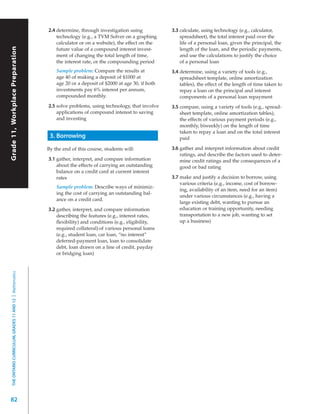
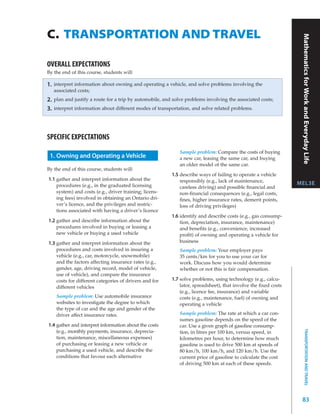
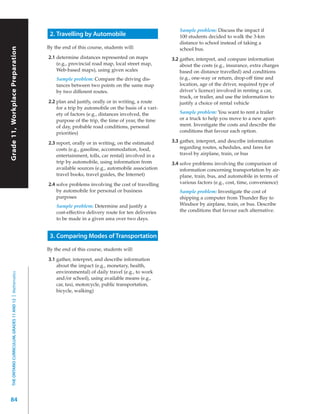
  Mathematics for Work and Everyday Life, Workplace Preparation (MEL3E) . . . . . . . . . 77
  Grade 12
  Advanced Functions, University Preparation (MHF4U) . . . . . . . . . . . . . . . . . . . . . . . . . . . . . . . . . . 85
  Calculus and Vectors, University Preparation (MCV4U) . . . . . . . . . . . . . . . . . . . . . . . . . . . . . . . . . . 99
  Mathematics of Data Management, University Preparation (MDM4U) . . . . . . . . . . . . 111
  Mathematics for College Technology, College Preparation (MCT4C) . . . . . . . . . . . . . . . 123
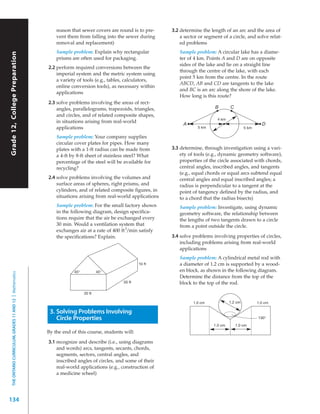
  Foundations for College Mathematics, College Preparation (MAP4C) . . . . . . . . . . . . . . 135
  Mathematics for Work and Everyday Life, Workplace Preparation (MEL4E) . . . . . . . 147
INTRODUCTION
 This document replaces The Ontario Curriculum, Grade 11: Mathematics, 2006, and the
 Grade 12 courses in The Ontario Curriculum, Grades 11 and 12: Mathematics, 2000.
 Beginning in September 2007, all Grade 11 and Grade 12 mathematics courses will be
 based on the expectations outlined in this document.


 SECONDARY SCHOOLS FOR THE TWENTY-FIRST CENTURY
 The goal of Ontario secondary schools is to support high-quality learning while giving
 individual students the opportunity to choose programs that suit their skills and interests.
 The updated Ontario curriculum, in combination with a broader range of learning
 options outside traditional classroom instruction, will enable students to better customize
 their high school education and improve their prospects for success in school and in life.


 THE IMPORTANCE OF MATHEMATICS IN THE CURRICULUM
 This document provides a framework outlining what students are expected to know and
 be able to do by the end of each of the courses in the Grade 11–12 mathematics curriculum.
 The required knowledge and skills include not only important mathematical facts and
 procedures but also the mathematical concepts students need to understand and the
 mathematical processes they must learn to apply.

 The principles underlying this curriculum are shared by educators dedicated to the success
 of all students in learning mathematics. Those principles can be stated as follows:1
         Curriculum expectations must be coherent, focused, and well-articulated across
         the grades.
         Learning mathematics involves the meaningful acquisition of concepts, skills, and
         processes and the active involvement of students in building new knowledge from
         prior knowledge and experience.
         Learning tools such as manipulatives and technologies are important supports for
         teaching and learning mathematics.
         Effective teaching of mathematics requires that the teacher understand the mathe-
         matical concepts, procedures, and processes that students need to learn, and use a
         variety of instructional strategies to support meaningful learning.
         Assessment and evaluation must support learning, recognizing that students learn
         and demonstrate learning in various ways.


 1. Adapted from Principles and Standards for School Mathematics, developed by the National Council of Teachers of
    Mathematics (Reston, VA: NCTM, 2000).
Equity of opportunity for student success in mathematics involves meeting the
                                                               diverse learning needs of students and promoting excellence for all students.
                                                               Equity is achieved when curriculum expectations are grade- and destination-
                                                               appropriate, when teaching and learning strategies meet a broad range of student
                                                               needs, and when a variety of pathways through the mathematics curriculum are
                                                               made available to students.

                                                         The Ontario mathematics curriculum must serve a number of purposes. It must engage
                                                         all students in mathematics and equip them to thrive in a society where mathematics is
                                                         increasingly relevant in the workplace. It must engage and motivate as broad a group of
                                                         students as possible, because early abandonment of the study of mathematics cuts
                                                         students off from many career paths and postsecondary options.

                                                         The unprecedented changes that are taking place in today’s world will profoundly affect
                                                         the future of today’s students. To meet the demands of the world in which they live, stu-
                                                         dents will need to adapt to changing conditions and to learn independently. They will
                                                         require the ability to use technology effectively and the skills for processing large amounts
                                                         of quantitative information. Today’s mathematics curriculum must prepare students for
                                                         their future roles in society. It must equip them with an understanding of important
                                                         mathematical ideas; essential mathematical knowledge and skills; skills of reasoning,
                                                         problem solving, and communication; and, most importantly, the ability and the incen-
                                                         tive to continue learning on their own. This curriculum provides a framework for
                                                         accomplishing these goals.

                                                         The development of mathematical knowledge is a gradual process. A coherent and con-
                                                         tinuous program is necessary to help students see the “big pictures”, or underlying prin-
                                                         ciples, of mathematics. The fundamentals of important skills, concepts, processes, and
                                                         attitudes are initiated in the primary grades and fostered throughout elementary school.
                                                         The links between Grade 8 and Grade 9 and the transition from elementary school mathe-
                                                         matics to secondary school mathematics are very important in developing the student’s
                                                         confidence and competence.

                                                         The secondary courses are based on principles that are consistent with those that under-
                                                         pin the elementary program, facilitating the transition from elementary school. These
                                                         courses reflect the belief that students learn mathematics effectively when they are given
THE ONTARIO CURRICULUM, GRADES 11 AND 12 | Mathematics


                                                         opportunities to investigate new ideas and concepts, make connections between new
                                                         learning and prior knowledge, and develop an understanding of the abstract mathematics
                                                         involved. Skill acquisition is an important part of the learning; skills are embedded
                                                         in the contexts offered by various topics in the mathematics program and should be
                                                         introduced as they are needed. The mathematics courses in this curriculum recognize the
                                                         importance of not only focusing on content, but also of developing the thinking processes
                                                         that underlie mathematics. By studying mathematics, students learn how to reason logi-
                                                         cally, think critically, and solve problems – key skills for success in today’s workplaces.

                                                         Mathematical knowledge becomes meaningful and powerful in application. This curri-
                                                         culum embeds the learning of mathematics in the solving of problems based on real-life
                                                         situations. Other disciplines are a ready source of effective contexts for the study of mathe-
                                                         matics. Rich problem-solving situations can be drawn from related disciplines, such as
                                                         computer science, business, recreation, tourism, biology, physics, and technology, as well
                                                         as from subjects historically thought of as distant from mathematics, such as geography


         4
and art. It is important that these links between disciplines be carefully explored, analysed,
and discussed to emphasize for students the pervasiveness of mathematical concepts and
mathematical thinking in all subject areas.

The choice of specific concepts and skills to be taught must take into consideration new
applications and new ways of doing mathematics. The development of sophisticated yet
easy-to-use calculators and computers is changing the role of procedure and technique in
mathematics. Operations that were an essential part of a procedures-focused curriculum
for decades can now be accomplished quickly and effectively using technology, so that
students can now solve problems that were previously too time-consuming to attempt,
and can focus on underlying concepts. “In an effective mathematics program, students
learn in the presence of technology. Technology should influence the mathematics content
taught and how it is taught. Powerful assistive and enabling computer and handheld
technologies should be used seamlessly in teaching, learning, and assessment.”2 This
curriculum integrates appropriate technologies into the learning and doing of mathe-
matics, while recognizing the continuing importance of students’ mastering essential
numeric and algebraic skills.


ROLES AND RESPONSIBILITIES IN MATHEMATICS PROGRAMS
Students
Students have many responsibilities with regard to their learning. Students who make
the effort required to succeed in school and who are able to apply themselves will soon
discover that there is a direct relationship between this effort and their achievement, and
will therefore be more motivated to work. There will be some students, however, who
will find it more difficult to take responsibility for their learning because of special chal-
lenges they face. The attention, patience, and encouragement of teachers and family can
be extremely important to these students’ success. However, taking responsibility for
their own progress and learning is an important part of education for all students,
regardless of their circumstances.

Mastery of concepts and skills in mathematics requires a sincere commitment to work
and study. Students are expected to develop strategies and processes that facilitate learn-
ing and understanding in mathematics. Students should also be encouraged to actively
pursue opportunities to apply their problem-solving skills outside the classroom and to
extend and enrich their understanding of mathematics.

Parents
Parents3 have an important role to play in supporting student learning. Studies show that
students perform better in school if their parents are involved in their education. By
becoming familiar with the curriculum, parents can find out what is being taught in the
courses their children are taking and what their children are expected to learn. This
awareness will enhance parents’ ability to discuss their children’s work with them, to
communicate with teachers, and to ask relevant questions about their children’s progress.
                                                                                                                              INTRODUCTION


2. Expert Panel on Student Success in Ontario, Leading Math Success: Mathematical Literacy, Grades 7–12 – The Report of
   the Expert Panel on Student Success in Ontario, 2004 (Toronto: Ontario Ministry of Education, 2004), p. 47. (Referred to
   hereafter as Leading Math Success.)
3. The word parents is used throughout this document to stand for parent(s) and guardian(s).

                                                                                                                              5
Knowledge of the expectations in the various courses also helps parents to interpret
                                                         teachers’ comments on student progress and to work with them to improve student
                                                         learning.
                                                         Effective ways for parents to support their children’s learning include attending parent-
                                                         teacher interviews, participating in parent workshops, becoming involved in school council
                                                         activities (including becoming a school council member), and encouraging their children
                                                         to complete their assignments at home.

                                                         The mathematics curriculum promotes lifelong learning. In addition to supporting regu-
                                                         lar school activities, parents can encourage their children to apply their problem-solving
                                                         skills to other disciplines and to real-world situations.

                                                         Teachers
                                                         Teachers and students have complementary responsibilities. Teachers are responsible for
                                                         developing appropriate instructional strategies to help students achieve the curriculum
                                                         expectations for their courses, as well as for developing appropriate methods for assess-
                                                         ing and evaluating student learning. Teachers also support students in developing the
                                                         reading, writing, and oral communication skills needed for success in their mathematics
                                                         courses. Teachers bring enthusiasm and varied teaching and assessment approaches to
                                                         the classroom, addressing different student needs and ensuring sound learning opportu-
                                                         nities for every student.

                                                         Recognizing that students need a solid conceptual foundation in mathematics in order to
                                                         further develop and apply their knowledge effectively, teachers endeavour to create a
                                                         classroom environment that engages students’ interest and helps them arrive at the
                                                         understanding of mathematics that is critical to further learning.

                                                         Using a variety of instructional, assessment, and evaluation strategies, teachers provide
                                                         numerous opportunities for students to develop skills of inquiry, problem solving, and
                                                         communication as they investigate and learn fundamental concepts. The activities offered
                                                         should enable students not only to make connections among these concepts throughout
                                                         the course but also to relate and apply them to relevant societal, environmental, and
                                                         economic contexts. Opportunities to relate knowledge and skills to these wider contexts –
                                                         to the goals and concerns of the world in which they live – will motivate students to learn
THE ONTARIO CURRICULUM, GRADES 11 AND 12 | Mathematics


                                                         and to become lifelong learners.

                                                         Principals
                                                         The principal works in partnership with teachers and parents to ensure that each student
                                                         has access to the best possible educational experience. To support student learning, prin-
                                                         cipals ensure that the Ontario curriculum is being properly implemented in all classrooms
                                                         through the use of a variety of instructional approaches. They also ensure that appropriate
                                                         resources are made available for teachers and students. To enhance teaching and learning
                                                         in all subjects, including mathematics, principals promote learning teams and work with
                                                         teachers to facilitate participation in professional-development activities.

                                                         Principals are also responsible for ensuring that every student who has an Individual
                                                         Education Plan (IEP) is receiving the modifications and/or accommodations described
                                                         in his or her plan – in other words, for ensuring that the IEP is properly developed,
                                                         implemented, and monitored.


         6
THE PROGRAM IN
MATHEMATICS
 OVERVIEW OF THE PROGRAM
 The senior mathematics courses build on the Grade 9 and 10 program, relying on the
 same fundamental principles on which that program was based. Both are founded on the
 premise that students learn mathematics most effectively when they build a thorough
 understanding of mathematical concepts and procedures. Such understanding is achieved
 when mathematical concepts and procedures are introduced through an investigative
 approach and connected to students’ prior knowledge in meaningful ways. This curri-
 culum is designed to help students prepare for university, college, or the workplace by
 building a solid conceptual foundation in mathematics that will enable them to apply
 their knowledge and skills in a variety of ways and further their learning successfully.

 An important part of every course in the mathematics program is the process of inquiry,
 in which students develop methods for exploring new problems or unfamiliar situations.
 Knowing how to learn mathematics is the underlying expectation that every student in
 every course needs to achieve. An important part of the inquiry process is that of taking
 the conditions of a real-world situation and representing them in mathematical form. A
 mathematical representation can take many different forms – for example, it can be a
 physical model, a diagram, a graph, a table of values, an equation, or a computer simula-
 tion. It is important that students recognize various mathematical representations of
 given relationships and that they become familiar with increasingly sophisticated repre-
 sentations as they progress through secondary school.

 The prevalence in today’s society and classrooms of sophisticated yet easy-to-use calcu-
 lators and computer software accounts in part for the inclusion of certain concepts and
 skills in this curriculum. The curriculum has been designed to integrate appropriate
 technologies into the learning and doing of mathematics, while equipping students with
 the manipulation skills necessary to understand other aspects of the mathematics that
 they are learning, to solve meaningful problems, and to continue to learn mathematics
 with success in the future. Technology is not used to replace skill acquisition; rather, it
 is treated as a learning tool that helps students explore concepts. Technology is required
 when its use represents either the only way or the most effective way to achieve an
 expectation.

 Like the earlier curriculum experienced by students, the senior secondary curriculum
 adopts a strong focus on the processes that best enable students to understand mathe-
 matical concepts and learn related skills. Attention to the mathematical processes is
considered to be essential to a balanced mathematics program. The seven mathematical
                                                         processes identified in this curriculum are problem solving, reasoning and proving, reflecting,
                                                         selecting tools and computational strategies, connecting, representing, and communicating.
                                                         Each of the senior mathematics courses includes a set of expectations – referred to in this
                                                         document as the “mathematical process expectations” – that outline the knowledge and
                                                         skills involved in these essential processes. The mathematical processes apply to student
                                                         learning in all areas of a mathematics course.

                                                         A balanced mathematics program at the secondary level also includes the development of
                                                         algebraic skills. This curriculum has been designed to equip students with the algebraic
                                                         skills needed to solve meaningful problems, to understand the mathematical concepts
                                                         they are learning, and to successfully continue their study of mathematics in the future.
                                                         The algebraic skills required in each course have been carefully chosen to support the
                                                         topics included in the course. Calculators and other appropriate technologies will be used
                                                         when the primary purpose of a given activity is the development of concepts or the solv-
                                                         ing of problems, or when situations arise in which computation or symbolic manipulation
                                                         is of secondary importance.

                                                         Courses in Grade 11 and Grade 12
                                                         Four types of courses are offered in the senior mathematics program: university prepara-
                                                         tion, university/college preparation, college preparation, and workplace preparation. Students
                                                         choose course types on the basis of their interests, achievement, and postsecondary goals.
                                                         The course types are defined as follows:
                                                               University preparation courses are designed to equip students with the knowledge and
                                                               skills they need to meet the entrance requirements for university programs.
                                                               University/college preparation courses are designed to equip students with the knowledge
                                                               and skills they need to meet the entrance requirements for specific programs offered at
                                                               universities and colleges.
                                                               College preparation courses are designed to equip students with the knowledge and
                                                               skills they need to meet the requirements for entrance to most college programs or for
                                                               admission to specific apprenticeship or other training programs.
                                                               Workplace preparation courses are designed to equip students with the knowledge and
                                                               skills they need to meet the expectations of employers, if they plan to enter the workplace
THE ONTARIO CURRICULUM, GRADES 11 AND 12 | Mathematics


                                                               directly after graduation, or the requirements for admission to many apprenticeship or
                                                               other training programs.


         8
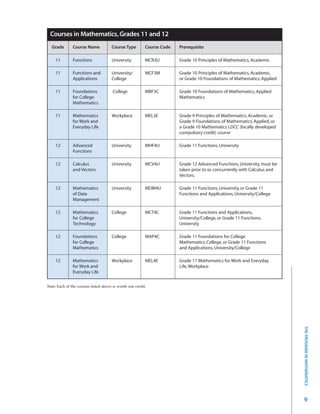
Courses in Mathematics, Grades 11 and 12
  Grade        Course Name            Course Type         Course Code   Prerequisite

     11        Functions              University          MCR3U         Grade 10 Principles of Mathematics, Academic

     11        Functions and          University/         MCF3M         Grade 10 Principles of Mathematics, Academic,
               Applications           College                           or Grade 10 Foundations of Mathematics, Applied

     11        Foundations             College            MBF3C         Grade 10 Foundations of Mathematics, Applied
               for College                                              Mathematics
               Mathematics

     11        Mathematics            Workplace           MEL3E         Grade 9 Principles of Mathematics, Academic, or
               for Work and                                             Grade 9 Foundations of Mathematics, Applied, or
               Everyday Life                                            a Grade 10 Mathematics LDCC (locally developed
                                                                        compulsory credit) course

     12        Advanced               University          MHF4U         Grade 11 Functions, University
               Functions

     12        Calculus               University          MCV4U         Grade 12 Advanced Functions, University, must be
               and Vectors                                              taken prior to or concurrently with Calculus and
                                                                        Vectors.

     12        Mathematics            University          MDM4U         Grade 11 Functions, University, or Grade 11
               of Data                                                  Functions and Applications, University/College
               Management

     12        Mathematics            College             MCT4C         Grade 11 Functions and Applications,
               for College                                              University/College, or Grade 11 Functions,
               Technology                                               University

     12        Foundations            College             MAP4C         Grade 11 Foundations for College
               for College                                              Mathematics, College, or Grade 11 Functions
               Mathematics                                              and Applications, University/College

     12        Mathematics            Workplace           MEL4E         Grade 11 Mathematics for Work and Everyday
               for Work and                                             Life, Workplace
               Everyday Life


Note: Each of the courses listed above is worth one credit.


                                                                                                                           THE PROGRAM IN MATHEMATICS


                                                                                                                            9
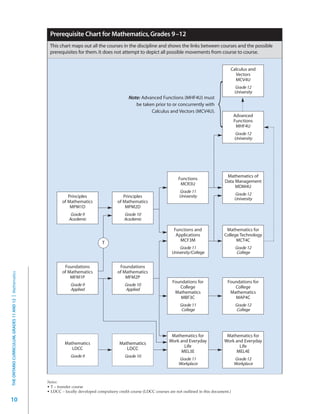
Prerequisite Chart for Mathematics, Grades 9–12
                                                          This chart maps out all the courses in the discipline and shows the links between courses and the possible
                                                          prerequisites for them. It does not attempt to depict all possible movements from course to course.


                                                                                                                                                             Calculus and
                                                                                                                                                               Vectors
                                                                                                                                                               MCV4U
                                                                                                                                                                 Grade 12
                                                                                                                                                                 University
                                                                                                     Note: Advanced Functions (MHF4U) must
                                                                                                        be taken prior to or concurrently with
                                                                                                               Calculus and Vectors (MCV4U).
                                                                                                                                                                 Advanced
                                                                                                                                                                 Functions
                                                                                                                                                                  MHF4U
                                                                                                                                                                 Grade 12
                                                                                                                                                                 University


                                                                                                                                                           Mathematics of
                                                                                                                                 Functions
                                                                                                                                                          Data Management
                                                                                                                                  MCR3U
                                                                                                                                                               MDM4U
                                                                                                                                 Grade 11
                                                                                                                                 University                      Grade 12
                                                                    Principles                    Principles
                                                                                                                                                                 University
                                                                 of Mathematics                of Mathematics
                                                                     MPM1D                         MPM2D
                                                                     Grade 9                       Grade 10
                                                                    Academic                       Academic

                                                                                                                              Functions and                Mathematics for
                                                                                                                               Applications               College Technology
                                                                                                                                 MCF3M                          MCT4C
                                                                                       T
                                                                                                                                 Grade 11                        Grade 12
                                                                                                                             University/College                   College


                                                                  Foundations                   Foundations
                                                                 of Mathematics                of Mathematics
THE ONTARIO CURRICULUM, GRADES 11 AND 12 | Mathematics


                                                                     MFM1P                         MFM2P
                                                                                                                             Foundations for                Foundations for
                                                                     Grade 9                       Grade 10
                                                                                                                                College                        College
                                                                     Applied                       Applied
                                                                                                                              Mathematics                    Mathematics
                                                                                                                                 MBF3C                         MAP4C
                                                                                                                                 Grade 11                        Grade 12
                                                                                                                                  College                         College


                                                                                                                             Mathematics for               Mathematics for
                                                                                                                            Work and Everyday             Work and Everyday
                                                                  Mathematics                   Mathematics
                                                                                                                                   Life                          Life
                                                                     LDCC                           LDCC
                                                                                                                                 MEL3E                         MEL4E
                                                                     Grade 9                       Grade 10
                                                                                                                                 Grade 11                        Grade 12
                                                                                                                                 Workplace                       Workplace


                                                         Notes:
                                                         • T – transfer course
                                                         • LDCC – locally developed compulsory credit course (LDCC courses are not outlined in this document.)

10
Half-Credit Courses
The courses outlined in this document are designed to be offered as full-credit courses.
However, with the exception of the Grade 12 university preparation courses, they may also be
delivered as half-credit courses.

Half-credit courses, which require a minimum of fifty-five hours of scheduled instruct-
ional time, must adhere to the following conditions:
      The two half-credit courses created from a full course must together contain all
      of the expectations of the full course. The expectations for each half-credit course
      must be divided in a manner that best enables students to achieve the required
      knowledge and skills in the allotted time.
      A course that is a prerequisite for another course in the secondary curriculum may
      be offered as two half-credit courses, but students must successfully complete both
      parts of the course to fulfil the prerequisite. (Students are not required to complete
      both parts unless the course is a prerequisite for another course they wish to take.)
      The title of each half-credit course must include the designation Part 1 or Part 2.
      A half credit (0.5) will be recorded in the credit-value column of both the report
      card and the Ontario Student Transcript.

Boards will ensure that all half-credit courses comply with the conditions described above,
and will report all half-credit courses to the ministry annually in the School October
Report.


CURRICULUM EXPECTATIONS
The expectations identified for each course describe the knowledge and skills that stu-
dents are expected to acquire, demonstrate, and apply in their class work, on tests, and in
various other activities on which their achievement is assessed and evaluated.

Two sets of expectations are listed for each strand, or broad curriculum area, of each course.
      The overall expectations describe in general terms the knowledge and skills that stu-
      dents are expected to demonstrate by the end of each course.
      The specific expectations describe the expected knowledge and skills in greater
      detail. The specific expectations are arranged under numbered subheadings that
      relate to the overall expectations and that may serve as a guide for teachers as they
      plan learning activities for their students. The specific expectations are also num-
      bered to indicate the overall expectation to which they relate (e.g., specific expecta-
      tion 3.2 is related to overall expectation 3 in a given strand). The organization of
      expectations in subgroupings is not meant to imply that the expectations in any
      subgroup are achieved independently of the expectations in the other subgroups.
                                                                                                 THE PROGRAM IN MATHEMATICS


      The subheadings are used merely to help teachers focus on particular aspects of
      knowledge and skills as they develop and use various lessons and learning acti-
      vities with their students.

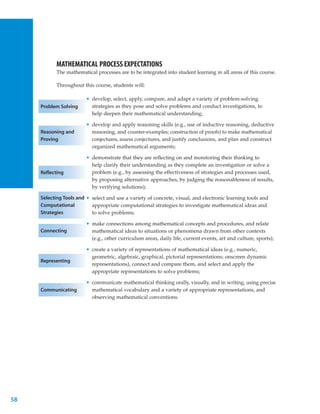
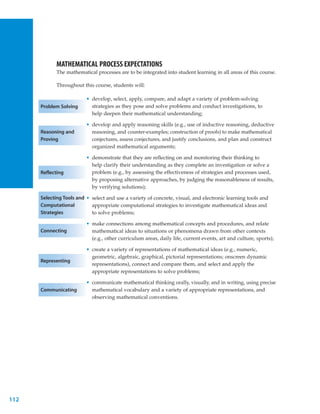
In addition to the expectations outlined within each strand, a list of seven “mathematical
process expectations” precedes the strands in all mathematics courses. These specific
expectations describe the knowledge and skills that constitute processes essential to the
effective study of mathematics. These processes apply to all areas of course content, and


                                                                                                 11
students’ proficiency in applying them must be developed in all strands of a mathematics
                                                         course. Teachers should ensure that students develop their ability to apply these processes
                                                         in appropriate ways as they work towards meeting the expectations outlined in the
                                                         strands.

                                                         When developing detailed courses of study from this document, teachers are expected to
                                                         weave together related expectations from different strands, as well as the relevant process
                                                         expectations, in order to create an overall program that integrates and balances concept
                                                         development, skill acquisition, the use of processes, and applications.

                                                         Many of the specific expectations are accompanied by examples and/or sample problems.
                                                         These examples and sample problems are meant to illustrate the kind of skill, the specific
                                                         area of learning, the depth of learning, and/or the level of complexity that the expectation
                                                         entails. Some examples and sample problems may also be used to emphasize the impor-
                                                         tance of diversity or multiple perspectives. The examples and sample problems are
                                                         intended only as suggestions for teachers. Teachers may incorporate the examples and
                                                         sample problems into their lessons, or they may choose other topics, approaches, or
                                                         problems that are relevant to the expectation.


                                                         COURSES AND STRANDS
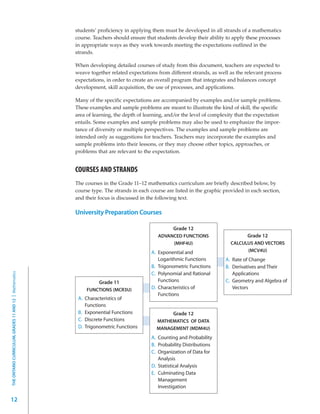
                                                         The courses in the Grade 11–12 mathematics curriculum are briefly described below, by
                                                         course type. The strands in each course are listed in the graphic provided in each section,
                                                         and their focus is discussed in the following text.

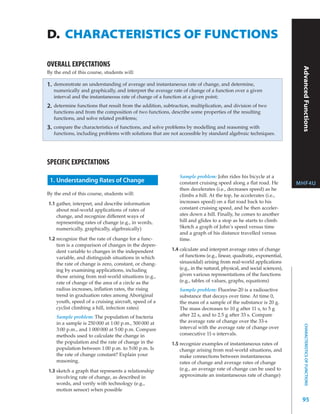
                                                         University Preparation Courses

                                                                                                    Grade 12
                                                                                             ADVANCED FUNCTIONS                     Grade 12
                                                                                                  (MHF4U)                     CALCULUS AND VECTORS
                                                                                          A. Exponential and                        (MCV4U)
                                                                                             Logarithmic Functions          A. Rate of Change
                                                                                          B. Trigonometric Functions        B. Derivatives and Their
THE ONTARIO CURRICULUM, GRADES 11 AND 12 | Mathematics


                                                                                          C. Polynomial and Rational           Applications
                                                                  Grade 11                   Functions                      C. Geometry and Algebra of
                                                              FUNCTIONS (MCR3U)           D. Characteristics of                Vectors
                                                                                             Functions
                                                          A. Characteristics of
                                                             Functions
                                                          B. Exponential Functions                Grade 12
                                                          C. Discrete Functions              MATHEMATICS OF DATA
                                                          D. Trigonometric Functions         MANAGEMENT (MDM4U)
                                                                                          A. Counting and Probability
                                                                                          B. Probability Distributions
                                                                                          C. Organization of Data for
                                                                                             Analysis
                                                                                          D. Statistical Analysis
                                                                                          E. Culminating Data
                                                                                             Management
                                                                                             Investigation

12
The Grade 11 university preparation course, Functions, builds on the concepts and skills
developed in the Grade 9 and 10 academic mathematics courses. The course is designed
to prepare students for Grade 12 mathematics courses that lead to one of many university
programs, including science, engineering, social sciences, liberal arts, and education.
The concept of functions is introduced in the Characteristics of Functions strand of this
course and extended through the investigation of two new types of relationships in the
Exponential Functions and Trigonometric Functions strands. The Discrete Functions
strand allows students, through the study of different representations of sequences and
series, to revisit patterning and algebra concepts introduced in elementary school and
make connections to financial applications involving compound interest and ordinary
simple annuities.

The Grade 12 university preparation course Advanced Functions satisfies the mathe-
matical prerequisite for some universities in areas that include business, social science,
and health science programs. The strands in this course help students deepen their
understanding of functions by revisiting the exponential and trigonometric functions
introduced in Grade 11 to address related concepts such as radian measure and logarith-
mic functions and by extending prior knowledge of quadratic functions to explore poly-
nomial and rational functions. The Characteristics of Functions strand addresses some
of the general features of functions through the examination of rates of change and
methods of combining functions.

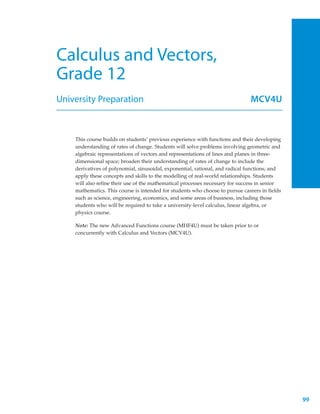
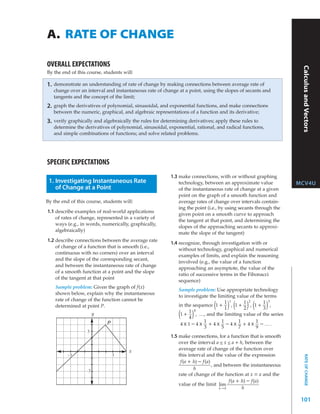
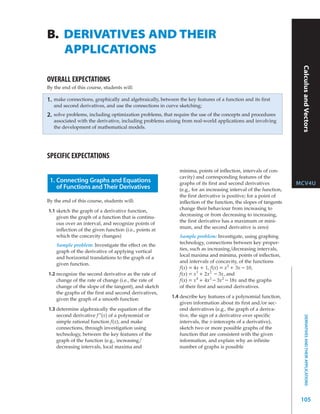
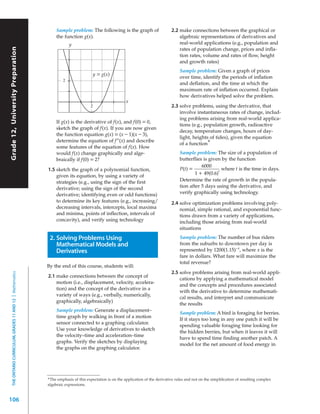
The Grade 12 university preparation course Calculus and Vectors is designed to prepare
students for university programs, such as science, engineering, and economics, that
include a calculus or linear algebra course in the first year. Calculus is introduced in the
Rate of Change strand by extending the numeric and graphical representation of rates of
change introduced in the Advanced Functions course to include more abstract algebraic
representations. The Derivatives and Their Applications strand provides students with
the opportunity to develop the algebraic and problem-solving skills needed to solve
problems associated with rates of change. Prior knowledge of geometry and trigonometry
is used in the Geometry and Algebra of Vectors strand to develop vector concepts that
can be used to solve interesting problems, including those arising from real-world
applications.

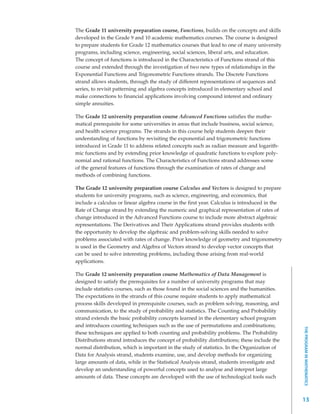
The Grade 12 university preparation course Mathematics of Data Management is
designed to satisfy the prerequisites for a number of university programs that may
include statistics courses, such as those found in the social sciences and the humanities.
The expectations in the strands of this course require students to apply mathematical
process skills developed in prerequisite courses, such as problem solving, reasoning, and
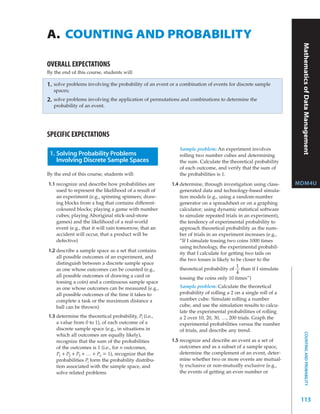
communication, to the study of probability and statistics. The Counting and Probability
strand extends the basic probability concepts learned in the elementary school program
and introduces counting techniques such as the use of permutations and combinations;
                                                                                               THE PROGRAM IN MATHEMATICS


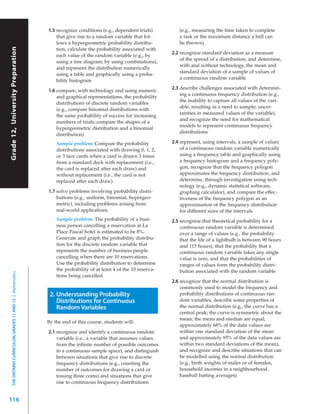
these techniques are applied to both counting and probability problems. The Probability
Distributions strand introduces the concept of probability distributions; these include the
normal distribution, which is important in the study of statistics. In the Organization of
Data for Analysis strand, students examine, use, and develop methods for organizing
large amounts of data, while in the Statistical Analysis strand, students investigate and
develop an understanding of powerful concepts used to analyse and interpret large
amounts of data. These concepts are developed with the use of technological tools such


                                                                                               13
as spreadsheets and Fathom, a ministry-licensed dynamic statistical program. The
                                                         Culminating Data Management Investigation strand requires students to undertake
                                                         a culminating investigation dealing with a significant issue that will require the
                                                         application of the skills from the other strands of the course.

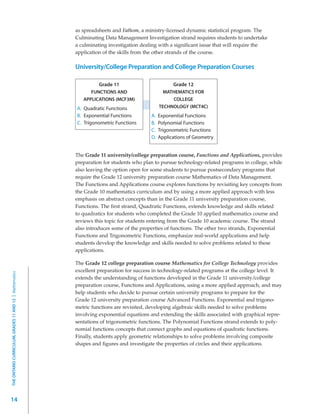
                                                         University/College Preparation and College Preparation Courses

                                                                   Grade 11                         Grade 12
                                                               FUNCTIONS AND                    MATHEMATICS FOR
                                                            APPLICATIONS (MCF3M)                   COLLEGE
                                                         A. Quadratic Functions               TECHNOLOGY (MCT4C)
                                                         B. Exponential Functions        A.   Exponential Functions
                                                         C. Trigonometric Functions      B.   Polynomial Functions
                                                                                         C.   Trigonometric Functions
                                                                                         D.   Applications of Geometry


                                                         The Grade 11 university/college preparation course, Functions and Applications, provides
                                                         preparation for students who plan to pursue technology-related programs in college, while
                                                         also leaving the option open for some students to pursue postsecondary programs that
                                                         require the Grade 12 university preparation course Mathematics of Data Management.
                                                         The Functions and Applications course explores functions by revisiting key concepts from
                                                         the Grade 10 mathematics curriculum and by using a more applied approach with less
                                                         emphasis on abstract concepts than in the Grade 11 university preparation course,
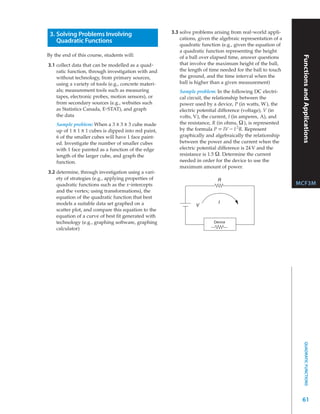
                                                         Functions. The first strand, Quadratic Functions, extends knowledge and skills related
                                                         to quadratics for students who completed the Grade 10 applied mathematics course and
                                                         reviews this topic for students entering from the Grade 10 academic course. The strand
                                                         also introduces some of the properties of functions. The other two strands, Exponential
                                                         Functions and Trigonometric Functions, emphasize real-world applications and help
                                                         students develop the knowledge and skills needed to solve problems related to these
                                                         applications.

                                                         The Grade 12 college preparation course Mathematics for College Technology provides
                                                         excellent preparation for success in technology-related programs at the college level. It
THE ONTARIO CURRICULUM, GRADES 11 AND 12 | Mathematics


                                                         extends the understanding of functions developed in the Grade 11 university/college
                                                         preparation course, Functions and Applications, using a more applied approach, and may
                                                         help students who decide to pursue certain university programs to prepare for the
                                                         Grade 12 university preparation course Advanced Functions. Exponential and trigono-
                                                         metric functions are revisited, developing algebraic skills needed to solve problems
                                                         involving exponential equations and extending the skills associated with graphical repre-
                                                         sentations of trigonometric functions. The Polynomial Functions strand extends to poly-
                                                         nomial functions concepts that connect graphs and equations of quadratic functions.
                                                         Finally, students apply geometric relationships to solve problems involving composite
                                                         shapes and figures and investigate the properties of circles and their applications.


14
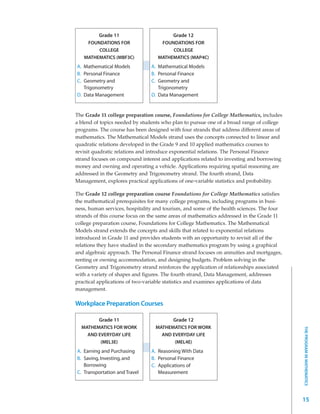
Grade 11                        Grade 12
    FOUNDATIONS FOR                 FOUNDATIONS FOR
        COLLEGE                         COLLEGE
   MATHEMATICS (MBF3C)             MATHEMATICS (MAP4C)
A. Mathematical Models          A. Mathematical Models
B. Personal Finance             B. Personal Finance
C. Geometry and                 C. Geometry and
   Trigonometry                    Trigonometry
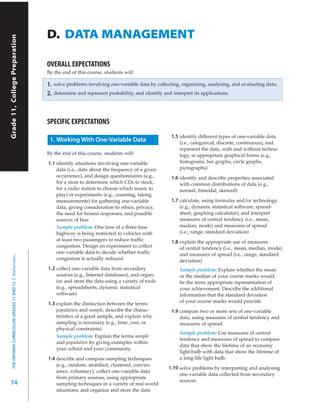
D. Data Management              D. Data Management


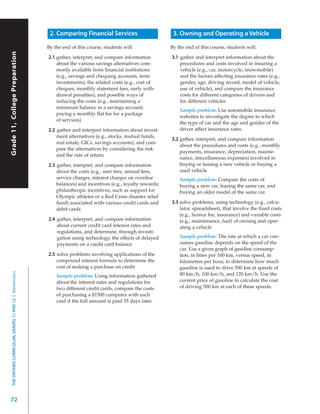
The Grade 11 college preparation course, Foundations for College Mathematics, includes
a blend of topics needed by students who plan to pursue one of a broad range of college
programs. The course has been designed with four strands that address different areas of
mathematics. The Mathematical Models strand uses the concepts connected to linear and
quadratic relations developed in the Grade 9 and 10 applied mathematics courses to
revisit quadratic relations and introduce exponential relations. The Personal Finance
strand focuses on compound interest and applications related to investing and borrowing
money and owning and operating a vehicle. Applications requiring spatial reasoning are
addressed in the Geometry and Trigonometry strand. The fourth strand, Data
Management, explores practical applications of one-variable statistics and probability.

The Grade 12 college preparation course Foundations for College Mathematics satisfies
the mathematical prerequisites for many college programs, including programs in busi-
ness, human services, hospitality and tourism, and some of the health sciences. The four
strands of this course focus on the same areas of mathematics addressed in the Grade 11
college preparation course, Foundations for College Mathematics. The Mathematical
Models strand extends the concepts and skills that related to exponential relations
introduced in Grade 11 and provides students with an opportunity to revisit all of the
relations they have studied in the secondary mathematics program by using a graphical
and algebraic approach. The Personal Finance strand focuses on annuities and mortgages,
renting or owning accommodation, and designing budgets. Problem solving in the
Geometry and Trigonometry strand reinforces the application of relationships associated
with a variety of shapes and figures. The fourth strand, Data Management, addresses
practical applications of two-variable statistics and examines applications of data
management.

Workplace Preparation Courses

        Grade 11                        Grade 12
  MATHEMATICS FOR WORK            MATHEMATICS FOR WORK
                                                                                           THE PROGRAM IN MATHEMATICS


    AND EVERYDAY LIFE               AND EVERYDAY LIFE
         (MEL3E)                         (MEL4E)
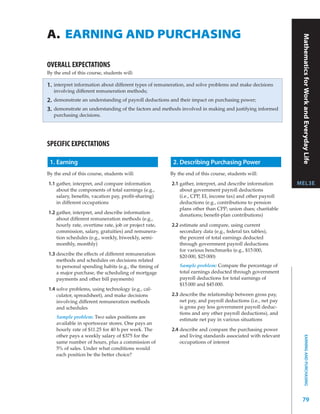
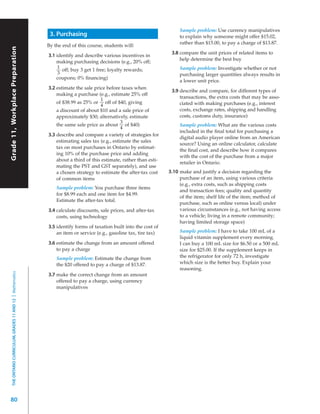
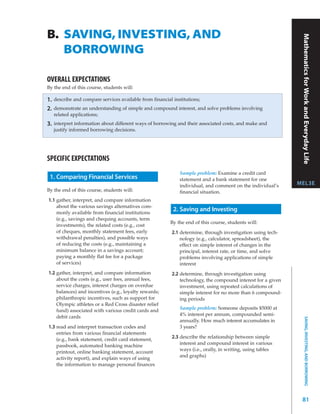
A. Earning and Purchasing       A. Reasoning With Data
B. Saving, Investing, and       B. Personal Finance
   Borrowing                    C. Applications of
C. Transportation and Travel       Measurement


                                                                                           15
The Grade 11 workplace preparation course, Mathematics for Work and Everyday Life, is
                                                         designed to help students consolidate the basic knowledge and skills of mathematics used
                                                         in the workplace and in everyday life. This course is ideal for students who would like to
                                                         take the Grade 12 workplace preparation course before graduating from high school and
                                                         entering the workplace. The course also meets the needs of students who wish to fulfill
                                                         the senior mathematics graduation requirement but do not plan to take any further
                                                         courses in mathematics. All three strands, Earning and Purchasing; Saving, Investing,
                                                         and Borrowing; and Transportation and Travel, provide students with the opportunity
                                                         to use proportional reasoning to solve a variety of problems.

                                                         The Grade 12 workplace preparation course, Mathematics for Work and Everyday Life,
                                                         extends the knowledge and skills developed in Grade 11. The gathering, interpretation,
                                                         and display of one-variable data and the investigation of probability concepts are the main
                                                         components of the Reasoning With Data strand. Topics in the Personal Finance strand
                                                         address owning or renting accommodation, designing a budget, and filing an income tax
                                                         return. A variety of problems involving metric and imperial measurement are presented
                                                         in the Applications of Measurement strand. The expectations support the use of hands-on
                                                         projects and other experiences that make the mathematics more meaningful for students.
THE ONTARIO CURRICULUM, GRADES 11 AND 12 | Mathematics


16
THE MATHEMATICAL
PROCESSES
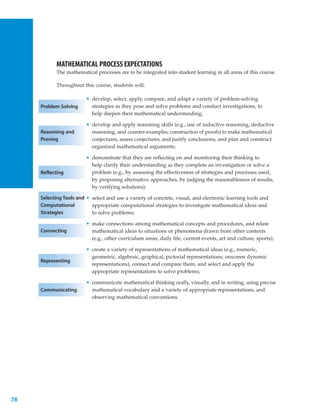
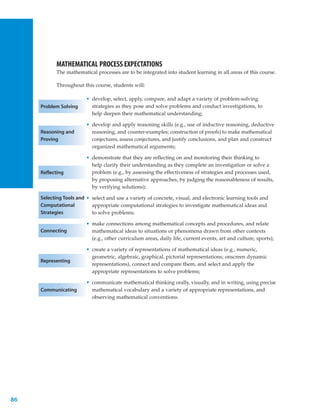
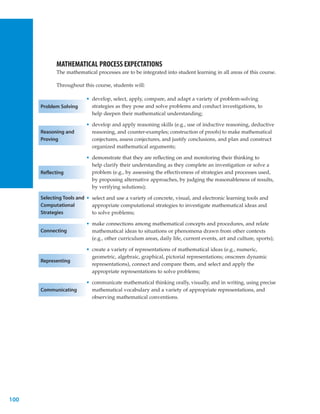
 Presented at the start of every course in this curriculum document are seven mathematical
 process expectations that describe a set of skills that support lifelong learning in mathe-
 matics and that students need to develop on an ongoing basis, as they work to achieve
 the expectations outlined within each course. In the 2000 mathematics curriculum, expec-
 tations that addressed the mathematical processes were present within individual strands
 to varying degrees. Here, the mathematical processes are highlighted in each course to
 ensure that students are actively engaged in developing their skills to apply them
 throughout the course, rather than only in specific strands.

 The mathematical processes are as follows:
       problem solving
       reasoning and proving
       reflecting
       selecting tools and computational strategies
       connecting
       representing
       communicating

 Each course presents students with rich problem-solving experiences through a variety of
 approaches, including investigation. These experiences provide students with opportuni-
 ties to develop and apply the mathematical processes.

 The mathematical processes are interconnected. Problem solving and communicating
 have strong links to all the other processes. The problem-solving process can be thought
 of as the motor that drives the development of the other processes. It allows students to
 make conjectures and to reason as they pursue a solution or a new understanding.
 Problem solving provides students with the opportunity to make connections to their
 prior learning and to make decisions about the representations, tools, and computational
 strategies needed to solve the problem. Teachers should encourage students to justify their
 solutions, communicate them orally and in writing, and reflect on alternative solutions.
 By seeing how others solve a problem, students can begin to think about their own
 thinking (metacognition) and the thinking of others, and to consciously adjust their own
 strategies in order to make their solutions as efficient and accurate as possible.
The mathematical processes cannot be separated from the knowledge and skills that stu-
                                                         dents acquire throughout the course. Students who problem solve, communicate, reason,
                                                         reflect, and so on, as they learn mathematics, will develop the knowledge, the under-
                                                         standing of concepts, and the skills required in the course in a more meaningful way.


                                                         PROBLEM SOLVING
                                                         Problem solving is central to learning mathematics. It forms the basis of effective mathe-
                                                         matics programs and should be the mainstay of mathematical instruction. It is considered
                                                         an essential process through which students are able to achieve the expectations in mathe-
                                                         matics, and is an integral part of the mathematics curriculum in Ontario, for the following
                                                         reasons. Problem solving:
                                                               helps students become more confident mathematicians;
                                                               allows students to use the knowledge they bring to school and helps them connect
                                                               mathematics with situations outside the classroom;
                                                               helps students develop mathematical understanding and gives meaning to skills
                                                               and concepts in all strands;
                                                               allows students to reason, communicate ideas, make connections, and apply
                                                               knowledge and skills;
                                                               offers excellent opportunities for assessing students’ understanding of concepts,
                                                               ability to solve problems, ability to apply concepts and procedures, and ability to
                                                               communicate ideas;
                                                               promotes collaborative sharing of ideas and strategies, and promotes talking about
                                                               mathematics;
                                                               helps students find enjoyment in mathematics;
                                                               increases opportunities for the use of critical-thinking skills (e.g., estimating,
                                                               classifying, assuming, recognizing relationships, hypothesizing, offering opinions
                                                               with reasons, evaluating results, and making judgements).

                                                         Not all mathematics instruction, however, can take place in a problem-solving context.
                                                         Certain aspects of mathematics must be explicitly taught. Conventions, including the use
                                                         of mathematical symbols and terms, are one such aspect, and they should be introduced
THE ONTARIO CURRICULUM, GRADES 11 AND 12 | Mathematics


                                                         to students as needed, to enable them to use the symbolic language of mathematics.

                                                         Selecting Problem-Solving Strategies
                                                         Problem-solving strategies are methods that can be used to solve various types of problems.
                                                         Common problem-solving strategies include: making a model, picture, or diagram; look-
                                                         ing for a pattern; guessing and checking; making assumptions; creating an organized list;
                                                         making a table or chart; solving a simpler problem; working backwards; and using logical
                                                         reasoning.

                                                         Teachers who use problem solving as a focus of their mathematics teaching help students
                                                         develop and extend a repertoire of strategies and methods that they can apply when
                                                         solving various kinds of problems – instructional problems, routine problems, and non-
                                                         routine problems. Students develop this repertoire over time, as their problem-solving
                                                         skills mature. By secondary school, students will have learned many problem-solving
                                                         strategies that they can flexibly use to investigate mathematical concepts or can apply
                                                         when faced with unfamiliar problem-solving situations.

18
REASONING AND PROVING
Reasoning helps students make sense of mathematics. Classroom instruction in mathe-
matics should foster critical thinking – that is, an organized, analytical, well-reasoned
approach to learning mathematical concepts and processes and to solving problems.

As students investigate and make conjectures about mathematical concepts and relation-
ships, they learn to employ inductive reasoning, making generalizations based on specific
findings from their investigations. Students also learn to use counter-examples to disprove
conjectures. Students can use deductive reasoning to assess the validity of conjectures and
to formulate proofs.


REFLECTING
Good problem-solvers regularly and consciously reflect on and monitor their own thought
processes. By doing so, they are able to recognize when the technique they are using is
not fruitful, and to make a conscious decision to switch to a different strategy, rethink the
problem, search for related content knowledge that may be helpful, and so forth. Students’
problem-solving skills are enhanced when they reflect on alternative ways to perform a
task even if they have successfully completed it. Reflecting on the reasonableness of an
answer by considering the original question or problem is another way in which students
can improve their ability to make sense of problems.


SELECTING TOOLS AND COMPUTATIONAL STRATEGIES
The primary role of learning tools such as calculators, manipulatives, graphing technolo-
gies, computer algebra systems, dynamic geometry software, and dynamic statistical soft-
ware is to help students develop a deeper understanding of mathematics through the
use of a variety of tools and strategies. Students need to develop the ability to select the
appropriate learning tools and computational strategies to perform particular mathe-
matical tasks, to investigate mathematical ideas, and to solve problems.

Calculators, Computers, Communications Technology
Various types of technology are useful in learning and doing mathematics. Students can
use calculators and computers to extend their capacity to investigate and analyse mathe-
matical concepts and to reduce the time they might otherwise spend on purely mechani-
cal activities.

Technology helps students perform operations, make graphs, manipulate algebraic
expressions, and organize and display data that are lengthier or more complex than those
addressed in curriculum expectations suited to a paper-and-pencil approach. It can be
                                                                                                THE MATHEMATICAL PROCESSES


used to investigate number and graphing patterns, geometric relationships, and different
representations; to simulate situations; and to extend problem solving. Students also need
to recognize when it is appropriate to apply their mental computation, reasoning, and
estimation skills to predict results and check answers.


                                                                                                19
Technologies must be seen as important problem-solving tools. Computers and calculators
                                                         are tools of mathematicians, and students should be given opportunities to select and
                                                         use the learning tools that may be helpful to them as they search for their own solutions
                                                         to problems.

                                                         It is important that teachers introduce the use of technology in ways that build students’
                                                         confidence and contribute to their understanding of the concepts being investigated,
                                                         especially when students may not be familiar with the use of some of the technologies
                                                         suggested in the curriculum. Students’ use of technology should not be laborious or
                                                         restricted to inputting and learning algorithmic steps. For example, when using spread-
                                                         sheets and statistical software (e.g., Fathom), teachers could supply students with prepared
                                                         data sets, and when using dynamic geometry software (e.g., The Geometer’s Sketchpad),
                                                         pre-made sketches could be used to ensure that students focus on the important mathe-
                                                         matical relationships, and not just on the inputting of data or on the construction of the
                                                         sketch.

                                                         Whenever appropriate, students should be encouraged to select and use the communica-
                                                         tions technology that would best support and communicate their learning. Computer
                                                         software programs can help students collect, organize, and sort the data they gather, and
                                                         write, edit, and present reports on their findings. Students, working individually or in
                                                         groups, can use Internet websites to gain access to Statistics Canada, mathematics organ-
                                                         izations, and other valuable sources of mathematical information around the world.

                                                         Manipulatives
                                                         Although technologies are the most common learning tools used by students studying
                                                         senior level mathematics, students should still be encouraged, when appropriate, to select
                                                         and use concrete learning tools to make models of mathematical ideas. Students need to
                                                         understand that making their own models is a powerful means of building understand-
                                                         ing and explaining their thinking to others.

                                                         Representation of mathematical ideas using manipulatives 4 helps students to:
                                                                 see patterns and relationships;
                                                                 make connections between the concrete and the abstract;
                                                                 test, revise, and confirm their reasoning;
THE ONTARIO CURRICULUM, GRADES 11 AND 12 | Mathematics


                                                                 remember how they solved a problem;
                                                                 communicate their reasoning to others.

                                                         Computational Strategies
                                                         Problem solving often requires students to select an appropriate computational strategy
                                                         such as applying a standard algorithm, using technology, or applying strategies related to
                                                         mental computation and estimation. Developing the ability to perform mental computa-
                                                         tion and to estimate is an important aspect of student learning in mathematics. Knowing
                                                         when to apply such skills is equally important.


                                                         4. See the Instructional Approaches section, on page 30 of this document, for additional information about the use of
                                                            manipulatives in mathematics instruction.

20
Mental computation involves calculations done in the mind, with little or no use of paper
and pencil. Students who have developed the ability to calculate mentally can select from
and use a variety of procedures that take advantage of their knowledge and understanding
of numbers, the operations, and their properties. Using knowledge of the distributive
property, for example, students can mentally compute 70% of 22 by first considering 70%
of 20 and then adding 70% of 2. Used effectively, mental computation can encourage
students to think more deeply about numbers and number relationships.

Knowing how to estimate and recognizing when it is useful to estimate and when it is
necessary to have an exact answer are important mathematical skills. Estimation is a
useful tool for judging the reasonableness of a solution and for guiding students in their
use of calculators. The ability to estimate depends on a well-developed sense of number
and an understanding of place value. It can be a complex skill that requires decomposing
numbers, compensating for errors, and perhaps even restructuring the problem. Estima-
tion should not be taught as an isolated skill or a set of isolated rules and techniques.
Recognizing calculations that are easy to perform and developing fluency in performing
basic operations contribute to successful estimation.


CONNECTING
Experiences that allow students to make more connections – to see, for example, how
concepts and skills from one strand of mathematics are related to those from another or
how a mathematical concept can be applied in the real world – will help them develop
deeper mathematical understanding. As they continue to make such connections, stu-
dents begin to see mathematics more as a study of relationships rather than a series of
isolated skills and concepts. Making connections not only deepens understanding, but
also helps students develop the ability to use learning from one area of mathematics to
understand another.

Making connections between the mathematics being studied and its applications in the
real world helps convince students of the usefulness and relevance of mathematics
beyond the classroom.


REPRESENTING
In the senior mathematics curriculum, representing mathematical ideas and modelling
situations generally involve concrete, numeric, graphical, and algebraic representations.
Pictorial, geometric representations as well as representations using dynamic software
can also be very helpful. Students should be able to recognize the connections between
representations, translate one representation into another, and use the different represen-
tations appropriately and as needed to solve problems. Knowing the different ways in
                                                                                               THE MATHEMATICAL PROCESSES


which a mathematical idea can be represented helps students develop a better under-
standing of mathematical concepts and relationships; communicate their thinking and
understanding; recognize connections among related mathematical concepts; and model
and interpret mathematical, physical, and social phenomena. When students are able to
represent concepts in various ways, they develop flexibility in their thinking about those
concepts. They are not inclined to perceive any single representation as “the math”; rather,
they understand that it is just one of many representations that help them understand
a concept.


                                                                                               21
COMMUNICATING
                                                         Communication is the process of expressing mathematical ideas and understandings
                                                         orally, visually, and in writing, using numbers, symbols, pictures, graphs, diagrams, and
                                                         words. Providing effective explanations and using correct mathematical notation when
                                                         developing and presenting mathematical ideas and solutions are key aspects of effective
                                                         communication in mathematics. Students communicate for various purposes and for
                                                         different audiences, such as the teacher, a peer, a group of students, or the whole class.
                                                         Communication is an essential process in learning mathematics. Through communication,
                                                         students are able to reflect upon and clarify ideas, relationships, and mathematical
                                                         arguments.

                                                         Many opportunities exist for teachers to help students develop their ability to communi-
                                                         cate mathematically. For example, teachers can:
                                                               model proper use of symbols, vocabulary, and notations in oral and written form;
                                                               expect correct use of mathematical symbols and conventions in student work;
                                                               ensure that students are exposed to and use new mathematical vocabulary as it is
                                                               introduced (e.g., as they gather and interpret information; by providing opportuni-
                                                               ties to read, question, and discuss);
                                                               provide feedback to students on their use of terminology and conventions;
                                                               ask clarifying and extending questions and encourage students to ask themselves
                                                               similar kinds of questions;
                                                               ask students open-ended questions relating to specific topics or information;
                                                               model ways in which various kinds of questions can be answered.

                                                         Effective classroom communication requires a supportive and respectful environment
                                                         that makes all members of the class comfortable when they speak and when they ques-
                                                         tion, react to, and elaborate on the statements of their classmates and the teacher.
THE ONTARIO CURRICULUM, GRADES 11 AND 12 | Mathematics


22
ASSESSMENT
AND EVALUATION
OF STUDENT
ACHIEVEMENT
 BASIC CONSIDERATIONS
 The primary purpose of assessment and evaluation is to improve student learning.
 Information gathered through assessment helps teachers to determine students’ strengths
 and weaknesses in their achievement of the curriculum expectations in each course. This
 information also serves to guide teachers in adapting curriculum and instructional
 approaches to students’ needs and in assessing the overall effectiveness of programs
 and classroom practices.

 Assessment is the process of gathering information from a variety of sources (including
 assignments, demonstrations, projects, performances, and tests) that accurately reflects
 how well a student is achieving the curriculum expectations in a course. As part of
 assessment, teachers provide students with descriptive feedback that guides their efforts
 towards improvement. Evaluation refers to the process of judging the quality of student
 work on the basis of established criteria, and assigning a value to represent that quality.

 Assessment and evaluation will be based on the provincial curriculum expectations and
 the achievement levels outlined in this document.

 In order to ensure that assessment and evaluation are valid and reliable, and that they
 lead to the improvement of student learning, teachers must use assessment and evalua-
 tion strategies that:
       address both what students learn and how well they learn;
       are based both on the categories of knowledge and skills and on the achievement
       level descriptions given in the achievement chart on pages 28–29;
       are varied in nature, administered over a period of time, and designed to provide
       opportunities for students to demonstrate the full range of their learning;
       are appropriate for the learning activities used, the purposes of instruction, and
       the needs and experiences of the students;
are fair to all students;
                                                               accommodate students with special education needs, consistent with the strategies
                                                               outlined in their Individual Education Plan;
                                                               accommodate the needs of students who are learning the language of instruction
                                                               (English or French);
                                                               ensure that each student is given clear directions for improvement;
                                                               promote students’ ability to assess their own learning and to set specific goals;
                                                               include the use of samples that provide evidence of their achievement;
                                                               are communicated clearly to students and parents at the beginning of the course or
                                                               the school term and at other appropriate points throughout the school year.

                                                         All curriculum expectations must be accounted for in instruction, but evaluation focuses
                                                         on students’ achievement of the overall expectations. A student’s achievement of the
                                                         overall expectations is evaluated on the basis of his or her achievement of related specific
                                                         expectations (including the process expectations). The overall expectations are broad in
                                                         nature, and the specific expectations define the particular content or scope of the knowl-
                                                         edge and skills referred to in the overall expectations. Teachers will use their professional
                                                         judgement to determine which specific expectations should be used to evaluate achieve-
                                                         ment of the overall expectations, and which ones will be covered in instruction and
                                                         assessment (e.g., through direct observation) but not necessarily evaluated.

                                                         The characteristics given in the achievement chart (pages 28–29) for level 3 represent the
                                                         “provincial standard” for achievement of the expectations in a course. A complete picture
                                                         of overall achievement at level 3 in a course in mathematics can be constructed by read-
                                                         ing from top to bottom in the shaded column of the achievement chart, headed “70–79%
                                                         (Level 3)”. Parents of students achieving at level 3 can be confident that their children will
                                                         be prepared for work in subsequent courses.

                                                         Level 1 identifies achievement that falls much below the provincial standard, while still
                                                         reflecting a passing grade. Level 2 identifies achievement that approaches the standard.
                                                         Level 4 identifies achievement that surpasses the standard. It should be noted that
                                                         achievement at level 4 does not mean that the student has achieved expectations beyond
                                                         those specified for a particular course. It indicates that the student has achieved all or
THE ONTARIO CURRICULUM, GRADES 11 AND 12 | Mathematics


                                                         almost all of the expectations for that course, and that he or she demonstrates the ability
                                                         to use the specified knowledge and skills in more sophisticated ways than a student
                                                         achieving at level 3.


24
THE ACHIEVEMENT CHART FOR MATHEMATICS
The achievement chart for mathematics (see pages 28−29) identifies four categories of
knowledge and skills. The achievement chart is a standard province-wide guide to be
used by teachers. It enables teachers to make judgements about student work that are
based on clear performance standards and on a body of evidence collected over time.

The purpose of the achievement chart is to:
        provide a common framework that encompasses the curriculum expectations for all
        courses outlined in this document;
        guide the development of quality assessment tasks and tools (including rubrics);
        help teachers to plan instruction for learning;
        assist teachers in providing meaningful feedback to students;
        provide various categories and criteria with which to assess and evaluate student
        learning.
Categories of Knowledge and Skills
The categories, defined by clear criteria, represent four broad areas of knowledge and
skills within which the expectations for any given mathematics course are organized. The
four categories should be considered as interrelated, reflecting the wholeness and inter-
connectedness of learning.
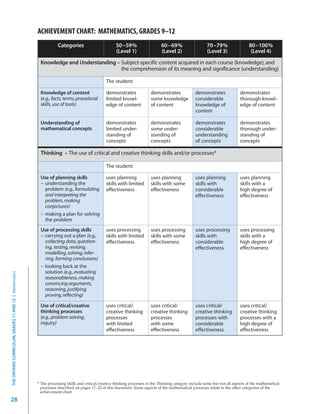
The categories of knowledge and skills are described as follows:

Knowledge and Understanding. Subject-specific content acquired in each course (knowl-
edge), and the comprehension of its meaning and significance (understanding).

Thinking. The use of critical and creative thinking skills and/or processes,5 as follows:
        planning skills (e.g., understanding the problem, making a plan for solving the
        problem)
        processing skills (e.g., carrying out a plan, looking back at the solution)
        critical/creative thinking processes (e.g., inquiry, problem solving)

Communication. The conveying of meaning through various oral, written, and visual


                                                                                              ASSESSMENT AND EVALUATION OF STUDENT ACHIEVEMENT
forms (e.g., providing explanations of reasoning or justification of results orally or in
writing; communicating mathematical ideas and solutions in writing, using numbers
and algebraic symbols, and visually, using pictures, diagrams, charts, tables, graphs,
and concrete materials).

Application. The use of knowledge and skills to make connections within and between
various contexts.

Teachers will ensure that student work is assessed and/or evaluated in a balanced man-
ner with respect to the four categories, and that achievement of particular expectations is
considered within the appropriate categories.


5. See the footnote on page 28, pertaining to the mathematical processes.


                                                                                              25
Criteria
                                                         Within each category in the achievement chart, criteria are provided that are subsets of
                                                         the knowledge and skills that define each category. For example, in Knowledge and
                                                         Understanding, the criteria are “knowledge of content (e.g., facts, terms, procedural skills,
                                                         use of tools)” and “understanding of mathematical concepts”. The criteria identify the
                                                         aspects of student performance that are assessed and/or evaluated, and serve as guides
                                                         to what to look for.

                                                         Descriptors
                                                         A “descriptor” indicates the characteristic of the student’s performance, with respect to a
                                                         particular criterion, on which assessment or evaluation is focused. In the achievement
                                                         chart, effectiveness is the descriptor used for each criterion in the Thinking, Communica-
                                                         tion, and Application categories. What constitutes effectiveness in any given performance
                                                         task will vary with the particular criterion being considered. Assessment of effectiveness
                                                         may therefore focus on a quality such as appropriateness, clarity, accuracy, precision, logic,
                                                         relevance, significance, fluency, flexibility, depth, or breadth, as appropriate for the parti-
                                                         cular criterion. For example, in the Thinking category, assessment of effectiveness might
                                                         focus on the degree of relevance or depth apparent in an analysis; in the Communication
                                                         category, on clarity of expression or logical organization of information and ideas; or in the
                                                         Application category, on appropriateness or breadth in the making of connections. Similarly,
                                                         in the Knowledge and Understanding category, assessment of knowledge might focus on
                                                         accuracy, and assessment of understanding might focus on the depth of an explanation.
                                                         Descriptors help teachers to focus their assessment and evaluation on specific knowledge
                                                         and skills for each category and criterion, and help students to better understand exactly
                                                         what is being assessed and evaluated.

                                                         Qualifiers
                                                         A specific “qualifier” is used to define each of the four levels of achievement – that is,
                                                         limited for level 1, some for level 2, considerable for level 3, and a high degree or thorough
                                                         for level 4. A qualifier is used along with a descriptor to produce a description of perform-
                                                         ance at a particular level. For example, the description of a student’s performance at
                                                         level 3 with respect to the first criterion in the Thinking category would be: “the student
                                                         uses planning skills with considerable effectiveness”.
THE ONTARIO CURRICULUM, GRADES 11 AND 12 | Mathematics


                                                         The descriptions of the levels of achievement given in the chart should be used to identify
                                                         the level at which the student has achieved the expectations. In all of their courses, students
                                                         should be provided with numerous and varied opportunities to demonstrate the full
                                                         extent of their achievement of the curriculum expectations, across all four categories of
                                                         knowledge and skills.


                                                         EVALUATION AND REPORTING OF STUDENT ACHIEVEMENT
                                                         Student achievement must be communicated formally to students and parents by means
                                                         of the Provincial Report Card, Grades 9–12. The report card provides a record of the
                                                         student’s achievement of the curriculum expectations in every course, at particular points
                                                         in the school year or semester, in the form of a percentage grade. The percentage grade
                                                         represents the quality of the student’s overall achievement of the expectations for the


26
course and reflects the corresponding level of achievement as described in the achieve-
ment chart for the discipline.

A final grade is recorded for every course, and a credit is granted and recorded for every
course in which the student’s grade is 50% or higher. The final grade for each course in
Grades 9–12 will be determined as follows:
      Seventy per cent of the grade will be based on evaluations conducted throughout
      the course. This portion of the grade should reflect the student’s most consistent
      level of achievement throughout the course, although special consideration should
      be given to more recent evidence of achievement.
      Thirty per cent of the grade will be based on a final evaluation in the form of an
      examination, performance, essay, and/or other method of evaluation suitable to the
      course content and administered towards the end of the course.


REPORTING ON DEMONSTRATED LEARNING SKILLS
The report card provides a record of the learning skills demonstrated by the student in
every course, in the following five categories: Works Independently, Teamwork, Organiza-
tion, Work Habits, and Initiative. The learning skills are evaluated using a four-point scale
(E-Excellent, G-Good, S-Satisfactory, N-Needs Improvement). The separate evaluation
and reporting of the learning skills in these five areas reflect their critical role in students’
achievement of the curriculum expectations. To the extent possible, the evaluation of
learning skills, apart from any that may be included as part of a curriculum expectation
in a course, should not be considered in the determination of percentage grades.


                                                                                                    ASSESSMENT AND EVALUATION OF STUDENT ACHIEVEMENT


                                                                                                    27
ACHIEVEMENT CHART: MATHEMATICS, GRADES 9–12
                                                                    Categories                         50−59%                    60−69%                     70−79%                   80−100%
                                                                                                       (Level 1)                 (Level 2)                  (Level 3)                 (Level 4)
                                                          Knowledge and Understanding – Subject-specific content acquired in each course (knowledge), and
                                                                                        the comprehension of its meaning and significance (understanding)

                                                                                                 The student:

                                                          Knowledge of content                   demonstrates              demonstrates              demonstrates              demonstrates
                                                          (e.g., facts, terms, procedural        limited knowl-            some knowledge            considerable              thorough knowl-
                                                          skills, use of tools)                  edge of content           of content                knowledge of              edge of content
                                                                                                                                                     content

                                                          Understanding of                       demonstrates              demonstrates              demonstrates              demonstrates
                                                          mathematical concepts                  limited under-            some under-               considerable              thorough under-
                                                                                                 standing of               standing of               understanding             standing of
                                                                                                 concepts                  concepts                  of concepts               concepts

                                                          Thinking – The use of critical and creative thinking skills and/or processes*

                                                                                                 The student:

                                                          Use of planning skills                 uses planning             uses planning             uses planning             uses planning
                                                          − understanding the                    skills with limited       skills with some          skills with               skills with a
                                                            problem (e.g., formulating           effectiveness             effectiveness             considerable              high degree of
                                                            and interpreting the                                                                     effectiveness             effectiveness
                                                            problem, making
                                                            conjectures)
                                                          − making a plan for solving
                                                            the problem
                                                          Use of processing skills               uses processing           uses processing           uses processing           uses processing
                                                          − carrying out a plan (e.g.,           skills with limited       skills with some          skills with               skills with a
                                                            collecting data, question-           effectiveness             effectiveness             considerable              high degree of
                                                            ing, testing, revising,                                                                  effectiveness             effectiveness
                                                            modelling, solving, infer-
                                                            ring, forming conclusions)
                                                          − looking back at the
                                                            solution (e.g., evaluating
THE ONTARIO CURRICULUM, GRADES 11 AND 12 | Mathematics


                                                            reasonableness, making
                                                            convincing arguments,
                                                            reasoning, justifying,
                                                            proving, reflecting)

                                                          Use of critical/creative               uses critical/            uses critical/            uses critical/            uses critical/
                                                          thinking processes                     creative thinking         creative thinking         creative thinking         creative thinking
                                                          (e.g., problem solving,                processes                 processes                 processes with            processes with a
                                                          inquiry)                               with limited              with some                 considerable              high degree of
                                                                                                 effectiveness             effectiveness             effectiveness             effectiveness


                                                         * The processing skills and critical/creative thinking processes in the Thinking category include some but not all aspects of the mathematical
                                                          processes described on pages 17−22 of this document. Some aspects of the mathematical processes relate to the other categories of the
                                                          achievement chart.

28
Categories                         50−59%                    60−69%                     70−79%                 80−100%
                                              (Level 1)                 (Level 2)                  (Level 3)               (Level 4)
 Communication – The conveying of meaning through various forms

                                      The student:
 Expression and organiza-             expresses and              expresses and              expresses and            expresses and
 tion of ideas and mathe-             organizes mathe-           organizes mathe-           organizes mathe-         organizes mathe-
 matical thinking (e.g.,              matical thinking           matical thinking           matical thinking         matical thinking
 clarity of expression, logical       with limited               with some                  with considerable        with a high
 organization), using oral,           effectiveness              effectiveness              effectiveness            degree of effec-
 visual, and written forms                                                                                           tiveness
 (e.g., pictorial, graphic,
 dynamic, numeric, algebraic
 forms; concrete materials)
 Communication for                    communicates for           communicates for           communicates for         communicates for
 different audiences                  different audiences        different audiences        different audiences      different audiences
 (e.g., peers, teachers) and          and purposes               and purposes               and purposes             and purposes
 purposes (e.g., to present           with limited effec-        with some                  with considerable        with a high
 data, justify a solution,            tiveness                   effectiveness              effectiveness            degree of
 express a mathematical                                                                                              effectiveness
 argument) in oral, visual,
 and written forms
 Use of conventions,                  uses conventions,          uses conventions,          uses conventions,        uses conventions,
 vocabulary, and termino-             vocabulary, and            vocabulary, and            vocabulary, and          vocabulary, and
 logy of the discipline (e.g.,        terminology of             terminology of             terminology of           terminology of
 terms, symbols) in oral,             the discipline             the discipline             the discipline           the discipline with
 visual, and written forms            with limited               with some                  with considerable        a high degree of
                                      effectiveness              effectiveness              effectiveness            effectiveness

 Application – The use of knowledge and skills to make connections within and between various contexts

                                      The student:

 Application of knowledge             applies knowledge          applies knowledge          applies knowledge        applies knowledge
 and skills in familiar con-          and skills in familiar     and skills in familiar     and skills in familiar   and skills in familiar
 texts                                contexts with lim-         contexts with some         contexts with            contexts with a
                                      ited effectiveness         effectiveness              considerable             high degree of


                                                                                                                                              ASSESSMENT AND EVALUATION OF STUDENT ACHIEVEMENT
                                                                                            effectiveness            effectiveness
 Transfer of knowledge                transfers knowl-           transfers knowl-           transfers knowl-         transfers knowl-
 and skills to new contexts           edge and skills            edge and skills            edge and skills          edge and skills
                                      to new contexts            to new contexts            to new contexts          to new contexts
                                      with limited               with some                  with considerable        with a high degree
                                      effectiveness              effectiveness              effectiveness            of effectiveness
 Making connections within            makes connections          makes connections          makes connections        makes connections
 and between various con-             within and between         within and between         within and between       within and between
 texts (e.g., connections             various contexts           various contexts           various contexts         various contexts
 between concepts, represen-          with limited               with some                  with considerable        with a high degree
 tations, and forms within            effectiveness              effectiveness              effectiveness            of effectiveness
 mathematics; connections
 involving use of prior knowl-
 edge and experience; con-
 nections between mathe-
 matics, other disciplines,
 and the real world)

Note: A student whose achievement is below 50% at the end of a course will not obtain a credit for the course.
                                                                                                                                              29
SOME
CONSIDERATIONS FOR
PROGRAM PLANNING
IN MATHEMATICS
  Teachers who are planning a program in mathematics must take into account considera-
  tions in a number of important areas, including those discussed below.


  INSTRUCTIONAL APPROACHES
  To make new learning more accessible to students, teachers build new learning upon the
  knowledge and skills students have acquired in previous years – in other words, they
  help activate prior knowledge. It is important to assess where students are in their mathe-
  matical growth and to bring them forward in their learning.
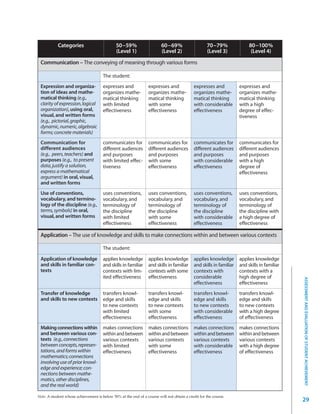
  In order to apply their knowledge effectively and to continue to learn, students must have
  a solid conceptual foundation in mathematics. Successful classroom practices engage
  students in activities that require higher-order thinking, with an emphasis on problem
  solving.6 Learning experienced in the primary, junior, and intermediate divisions should
  have provided students with a good grounding in the investigative approach to learning
  new mathematical concepts, including inquiry models of problem solving, and this
  approach continues to be important in the senior mathematics program.

  Students in a mathematics class typically demonstrate diversity in the ways they learn
  best. It is important, therefore, that students have opportunities to learn in a variety of
  ways – individually, cooperatively, independently, with teacher direction, through invest-
  igation involving hands-on experience, and through examples followed by practice. In
  mathematics, students are required to learn concepts, acquire procedures and skills, and
  apply processes with the aid of the instructional and learning strategies best suited to the
  particular type of learning.


  6. See the resource document Targeted Implementation & Planning Supports for Revised Mathematics (TIPS4RM):
     Grade 7, 8, 9 Applied and 10 Applied (Toronto: Queen’s Printer for Ontario, 2005) for helpful information
     about problem solving.
The approaches and strategies used in the classroom to help students meet the expecta-
tions of this curriculum will vary according to the object of the learning and the needs of
the students. For example, even at the secondary level, manipulatives can be important
tools for supporting the effective learning of mathematics. These concrete learning tools,
such as connecting cubes, measurement tools, algebra tiles, and number cubes, invite stu-
dents to explore and represent abstract mathematical ideas in varied, concrete, tactile, and
visually rich ways.7 Other representations, including graphical and algebraic representa-
tions, are also a valuable aid to teachers. By analysing students’ representations of mathe-
matical concepts and listening carefully to their reasoning, teachers can gain useful
insights into students’ thinking and provide supports to help enhance their thinking.

All learning, especially new learning, should be embedded in well-chosen contexts for
learning – that is, contexts that are broad enough to allow students to investigate initial
understandings, identify and develop relevant supporting skills, and gain experience
with varied and interesting applications of the new knowledge. Such rich contexts for
learning open the door for students to see the “big ideas” of mathematics – that is, the
major underlying principles or relationships that will enable and encourage students to
reason mathematically throughout their lives.

Promoting Positive Attitudes Towards Learning Mathematics
Students’ attitudes have a significant effect on how students approach problem solving
and how well they succeed in mathematics. Students who enjoy mathematics tend to
perform well in their mathematics course work and are more likely to enrol in the more
advanced mathematics courses.

Students develop positive attitudes when they are engaged in making mathematical
conjectures, when they experience breakthroughs as they solve problems, when they see
connections between important ideas, and when they observe an enthusiasm for mathe-
matics on the part of their teachers.8 With a positive attitude towards mathematics, stu-
dents are able to make more sense of the mathematics they are working on, and to view
themselves as effective learners of mathematics. They are also more likely to perceive
mathematics as both useful and worthwhile, and to develop the belief that steady effort
in learning mathematics pays off.


                                                                                                                  SOME CONSIDERATIONS FOR PROGRAM PLANNING IN MATHEMATICS
It is common for people to feel inadequate or anxious when they cannot solve problems
quickly and easily, or in the right way. To gain confidence, students need to recognize
that, for some mathematics problems, there may be several ways to arrive at a solution.
They also need to understand that problem solving of almost any kind often requires a
considerable expenditure of time and energy and a good deal of perseverance. To counter-
act the frustration they may feel when they are not making progress towards solving
a problem, they need to believe that they are capable of finding solutions. Teachers can
encourage students to develop a willingness to persist, to investigate, to reason, to explore
alternative solutions, to view challenges as opportunities to extend their learning, and to
take the risks necessary to become successful problem solvers. They can help students
develop confidence and reduce anxiety and frustration by providing them with problems
that are challenging but not beyond their ability to solve. Problems at a developmentally
appropriate level help students to learn while establishing a norm of perseverance for
successful problem solving.

7. A list of manipulatives appropriate for use in intermediate and senior mathematics classrooms is provided in
   Leading Math Success, pp. 48–49.
8. Leading Math Success, p. 42
                                                                                                                  31
Collaborative learning enhances students’ understanding of mathematics. Working co-
                                                         operatively in groups reduces isolation and provides students with opportunities to share
                                                         ideas and communicate their thinking in a supportive environment as they work together
                                                         towards a common goal. Communication and the connections among ideas that emerge
                                                         as students interact with one another enhance the quality of student learning.9


                                                         PLANNING MATHEMATICS PROGRAMS FOR STUDENTS WITH SPECIAL
                                                         EDUCATION NEEDS
                                                         Classroom teachers are the key educators of students who have special education needs.
                                                         They have a responsibility to help all students learn, and they work collaboratively with
                                                         special education teachers, where appropriate, to achieve this goal. Special Education
                                                         Transformation: The Report of the Co-Chairs with the Recommendations of the Working Table
                                                         on Special Education, 2006 endorses a set of beliefs that should guide program planning
                                                         for students with special education needs in all disciplines. Those beliefs are as follows:
                                                                  All students can succeed.
                                                                  Universal design and differentiated instruction are effective and interconnected
                                                                  means of meeting the learning or productivity needs of any group of students.
                                                                  Successful instructional practices are founded on evidence-based research,
                                                                  tempered by experience.
                                                                  Classroom teachers are key educators for a student’s literacy and numeracy
                                                                  development.
                                                                  Each student has his or her own unique patterns of learning.
                                                                  Classroom teachers need the support of the larger community to create a learning
                                                                  environment that supports students with special education needs.
                                                                  Fairness is not sameness.

                                                         In any given classroom, students may demonstrate a wide range of learning styles and
                                                         needs. Teachers plan programs that recognize this diversity and give students perform-
                                                         ance tasks that respect their particular abilities so that all students can derive the greatest
                                                         possible benefit from the teaching and learning process. The use of flexible groupings for
THE ONTARIO CURRICULUM, GRADES 11 AND 12 | Mathematics


                                                         instruction and the provision of ongoing assessment are important elements of programs
                                                         that accommodate a diversity of learning needs.

                                                         In planning mathematics courses for students with special education needs, teachers
                                                         should begin by examining the current achievement level of the individual student, the
                                                         strengths and learning needs of the student, and the knowledge and skills that all stu-
                                                         dents are expected to demonstrate at the end of the course in order to determine which of
                                                         the following options is appropriate for the student:
                                                                  no accommodations10 or modifications; or
                                                                  accommodations only; or
                                                                  modified expectations, with the possibility of accommodations; or
                                                                  alternative expectations, which are not derived from the curriculum expectations
                                                                  for a course and which constitute alternative programs and/or courses.


                                                          9. Leading Math Success, p. 42
                                                         10. “Accommodations” refers to individualized teaching and assessment strategies, human supports, and/or
32                                                           individualized equipment.
If the student requires either accommodations or modified expectations, or both, the rel-
evant information, as described in the following paragraphs, must be recorded in his or
her Individual Education Plan (IEP). More detailed information about planning programs
for students with special education needs, including students who require alternative
programs and/or courses, can be found in The Individual Education Plan (IEP): A Resource
Guide, 2004 (referred to hereafter as the IEP Resource Guide, 2004). For a detailed discus-
sion of the ministry’s requirements for IEPs, see Individual Education Plans: Standards for
Development, Program Planning, and Implementation, 2000 (referred to hereafter as IEP
Standards, 2000). (Both documents are available at http:/ /www.edu.gov.on.ca.)

Students Requiring Accommodations Only
Some students are able, with certain accommodations, to participate in the regular course
curriculum and to demonstrate learning independently. Accommodations allow access to
the course without any changes to the knowledge and skills the student is expected to
demonstrate. The accommodations required to facilitate the student’s learning must be
identified in his or her IEP (see IEP Standards, 2000, page 11). A student’s IEP is likely to
reflect the same accommodations for many, or all, subjects or courses.

Providing accommodations to students with special education needs should be the first
option considered in program planning. Instruction based on principles of universal
design and differentiated instruction focuses on the provision of accommodations to meet
the diverse needs of learners.

There are three types of accommodations:
      Instructional accommodations are changes in teaching strategies, including styles of
      presentation, methods of organization, or use of technology and multimedia.
      Environmental accommodations are changes that the student may require in the class-
      room and/or school environment, such as preferential seating or special lighting.
      Assessment accommodations are changes in assessment procedures that enable the
      student to demonstrate his or her learning, such as allowing additional time to
      complete tests or assignments or permitting oral responses to test questions (see
      page 29 of the IEP Resource Guide, 2004, for more examples).


                                                                                                SOME CONSIDERATIONS FOR PROGRAM PLANNING IN MATHEMATICS
If a student requires “accommodations only” in mathematics courses, assessment and
evaluation of his or her achievement will be based on the appropriate course curriculum
expectations and the achievement levels outlined in this document. The IEP box on the
student’s Provincial Report Card will not be checked, and no information on the provi-
sion of accommodations will be included.

Students Requiring Modified Expectations
Some students will require modified expectations, which differ from the regular course
expectations. For most students, modified expectations will be based on the regular
course curriculum, with changes in the number and/or complexity of the expectations.
Modified expectations represent specific, realistic, observable, and measurable achieve-
ments and describe specific knowledge and/or skills that the student can demonstrate
independently, given the appropriate assessment accommodations.


                                                                                                33
It is important to monitor, and to reflect clearly in the student’s IEP, the extent to which
                                                         expectations have been modified. As noted in Section 7.12 of the ministry’s policy docu-
                                                         ment Ontario Secondary Schools, Grades 9 to 12: Program and Diploma Requirements, 1999,
                                                         the principal will determine whether achievement of the modified expectations consti-
                                                         tutes successful completion of the course, and will decide whether the student is eligible
                                                         to receive a credit for the course. This decision must be communicated to the parents and
                                                         the student.

                                                         When a student is expected to achieve most of the curriculum expectations for the course,
                                                         the modified expectations should identify how the required knowledge and skills differ from
                                                         those identified in the course expectations. When modifications are so extensive that achieve-
                                                         ment of the learning expectations (knowledge, skills, and performance tasks) is not likely
                                                         to result in a credit, the expectations should specify the precise requirements or tasks on
                                                         which the student’s performance will be evaluated and which will be used to generate the
                                                         course mark recorded on the Provincial Report Card.

                                                         Modified expectations indicate the knowledge and/or skills the student is expected to
                                                         demonstrate and have assessed in each reporting period (IEP Standards, 2000, pages 10
                                                         and 11). The student’s learning expectations must be reviewed in relation to the student’s
                                                         progress at least once every reporting period, and must be updated as necessary (IEP
                                                         Standards, 2000, page 11).

                                                         If a student requires modified expectations in mathematics courses, assessment and eval-
                                                         uation of his or her achievement will be based on the learning expectations identified in
                                                         the IEP and on the achievement levels outlined in this document. If some of the student’s
                                                         learning expectations for a course are modified but the student is working towards a
                                                         credit for the course, it is sufficient simply to check the IEP box on the Provincial Report
                                                         Card. If, however, the student’s learning expectations are modified to such an extent that
                                                         the principal deems that a credit will not be granted for the course, the IEP box must be
                                                         checked and the appropriate statement from the Guide to the Provincial Report Card,
                                                         Grades 9–12, 1999 (page 8) must be inserted. The teacher’s comments should include rel-
                                                         evant information on the student’s demonstrated learning of the modified expectations,
                                                         as well as next steps for the student’s learning in the course.
THE ONTARIO CURRICULUM, GRADES 11 AND 12 | Mathematics


                                                         PROGRAM CONSIDERATIONS FOR ENGLISH LANGUAGE LEARNERS
                                                         Young people whose first language is not English enter Ontario secondary schools with
                                                         diverse linguistic and cultural backgrounds. Some English language learners may have
                                                         experience of highly sophisticated educational systems, while others may have come
                                                         from regions where access to formal schooling was limited. All of these students bring a
                                                         rich array of background knowledge and experience to the classroom, and all teachers
                                                         must share in the responsibility for their English-language development.

                                                         Teachers of mathematics must incorporate appropriate adaptations and strategies for
                                                         instruction and assessment to facilitate the success of the English language learners in
                                                         their classrooms. These adaptations and strategies include:
                                                               modification of some or all of the course expectations so that they are challenging
                                                               but attainable for the learner at his or her present level of English proficiency, given
                                                               the necessary support from the teacher;


34
use of a variety of instructional strategies (e.g., extensive use of visual cues, scaf-
      folding, manipulatives, pictures, diagrams, graphic organizers; attention to clarity
      of instructions);
      modelling of preferred ways of working in mathematics; previewing of textbooks;
      pre-teaching of key vocabulary; peer tutoring; strategic use of students’ first lan-
      guages);
      use of a variety of learning resources (e.g., visual material, simplified text, bilingual
      dictionaries, materials that reflect cultural diversity);
      use of assessment accommodations (e.g., granting of extra time; simplification of
      language used in problems and instructions; use of oral interviews, learning logs,
      portfolios, demonstrations, visual representations, and tasks requiring completion
      of graphic organizers or cloze sentences instead of tasks that depend heavily on
      proficiency in English).

When learning expectations in any course are modified for English language learners
(whether or not the students are enrolled in an ESL or ELD course), this must be clearly
indicated on the student’s report card.

Although the degree of program adaptation required will decrease over time, students
who are no longer receiving ESL or ELD support may still need some program adapta-
tions to be successful.

For further information on supporting English language learners, refer to The Ontario
Curriculum, Grades 9 to 12: English As a Second Language and English Literacy Development,
2007 and the resource guide Many Roots Many Voices: Supporting English Language
Learners in Every Classroom (Ministry of Education, 2005).


ANTIDISCRIMINATION EDUCATION IN MATHEMATICS
To ensure that all students in the province have an equal opportunity to achieve their full
potential, the curriculum must be free from bias, and all students must be provided with
a safe and secure environment, characterized by respect for others, that allows them to


                                                                                                  SOME CONSIDERATIONS FOR PROGRAM PLANNING IN MATHEMATICS
participate fully and responsibly in the educational experience.

Learning activities and resources used to implement the curriculum should be inclusive
in nature, reflecting the range of experiences of students with varying backgrounds, abili-
ties, interests, and learning styles. They should enable students to become more sensitive
to the diverse cultures and perceptions of others, including Aboriginal peoples. By dis-
cussing aspects of the history of mathematics, teachers can help make students aware of
the various cultural groups that have contributed to the evolution of mathematics over
the centuries. Finally, students need to recognize that ordinary people use mathematics in
a variety of everyday contexts, both at work and in their daily lives.

Connecting mathematical ideas to real-world situations through learning activities can
enhance students’ appreciation of the role of mathematics in human affairs, in areas
including health, science, and the environment. Students can be made aware of the use of
mathematics in contexts such as sampling and surveying and the use of statistics to
analyse trends. Recognizing the importance of mathematics in such areas helps motivate
students to learn and also provides a foundation for informed, responsible citizenship.


                                                                                                  35
Teachers should have high expectations for all students. To achieve their mathematical
                                                         potential, however, different students may need different kinds of support. Some boys,
                                                         for example, may need additional support in developing their literacy skills in order to
                                                         complete mathematical tasks effectively. For some girls, additional encouragement to
                                                         envision themselves in careers involving mathematics may be beneficial. For example,
                                                         teachers might consider providing strong role models in the form of female guest speak-
                                                         ers who are mathematicians or who use mathematics in their careers.


                                                         LITERACY AND INQUIRY/RESEARCH SKILLS
                                                         Literacy skills can play an important role in student success in mathematics courses. Many
                                                         of the activities and tasks students undertake in mathematics courses involve the use of
                                                         written, oral, and visual communication skills. For example, students use language to
                                                         record their observations, to explain their reasoning when solving problems, to describe
                                                         their inquiries in both informal and formal contexts, and to justify their results in small-
                                                         group conversations, oral presentations, and written reports. The language of mathematics
                                                         includes special terminology. The study of mathematics consequently encourages students
                                                         to use language with greater care and precision and enhances their ability to communicate
                                                         effectively.

                                                         The Ministry of Education has facilitated the development of materials to support literacy
                                                         instruction across the curriculum. Helpful advice for integrating literacy instruction in
                                                         mathematics courses may be found in the following resource documents:

                                                               Think Literacy: Cross-Curricular Approaches, Grades 7–12, 2003
                                                               Think Literacy: Cross-Curricular Approaches, Grades 7–12 – Mathematics: Subject-
                                                               Specific Examples, Grades 10–12, 2005

                                                         In all courses in mathematics, students will develop their ability to ask questions and to
                                                         plan investigations to answer those questions and to solve related problems. Students
                                                         need to learn a variety of research methods and inquiry approaches in order to carry out
                                                         these investigations and to solve problems, and they need to be able to select the methods
                                                         that are most appropriate for a particular inquiry. Students learn how to locate relevant
                                                         information from a variety of sources, such as statistical databases, newspapers, and
THE ONTARIO CURRICULUM, GRADES 11 AND 12 | Mathematics


                                                         reports. As they advance through the grades, students will be expected to use such
                                                         sources with increasing sophistication. They will also be expected to distinguish between
                                                         primary and secondary sources, to determine their validity and relevance, and to use
                                                         them in appropriate ways.


36
THE ROLE OF INFORMATION AND COMMUNICATION TECHNOLOGY
IN MATHEMATICS
Information and communication technologies (ICT) provide a range of tools that can
significantly extend and enrich teachers’ instructional strategies and support students’
learning in mathematics. Teachers can use ICT tools and resources both for whole-class
instruction and to design programs that meet diverse student needs. Technology can help
to reduce the time spent on routine mathematical tasks, allowing students to devote
more of their efforts to thinking and concept development. Useful ICT tools include
simulations, multimedia resources, databases, sites that give access to large amounts of
statistical data, and computer-assisted learning modules.

Applications such as databases, spreadsheets, dynamic geometry software, dynamic sta-
tistical software, graphing software, computer algebra systems (CAS), word-processing
software, and presentation software can be used to support various methods of inquiry
in mathematics. Technology also makes possible simulations of complex systems that
can be useful for problem-solving purposes or when field studies on a particular topic
are not feasible.

Information and communications technologies can be used in the classroom to connect
students to other schools, at home and abroad, and to bring the global community into
the local classroom.

Although the Internet is a powerful electronic learning tool, there are potential risks
attached to its use. All students must be made aware of issues of Internet privacy, safety,
and responsible use, as well as of the ways in which this technology is being abused –
for example, when it is used to promote hatred.

Teachers, too, will find the various ICT tools useful in their teaching practice, both for
whole class instruction and for the design of curriculum units that contain varied
approaches to learning to meet diverse student needs.


CAREER EDUCATION IN MATHEMATICS


                                                                                              SOME CONSIDERATIONS FOR PROGRAM PLANNING IN MATHEMATICS
Teachers can promote students’ awareness of careers involving mathematics by exploring
applications of concepts and providing opportunities for career-related project work. Such
activities allow students the opportunity to investigate mathematics-related careers com-
patible with their interests, aspirations, and abilities.

Students should be made aware that mathematical literacy and problem solving are valu-
able assets in an ever-widening range of jobs and careers in today’s society. The knowledge
and skills students acquire in mathematics courses are useful in fields such as science,
business, engineering, and computer studies; in the hospitality, recreation, and tourism
industries; and in the technical trades.


                                                                                              37
THE ONTARIO SKILLS PASSPORT AND ESSENTIAL SKILLS
                                                         Teachers planning programs in mathematics need to be aware of the purpose and benefits
                                                         of the Ontario Skills Passport (OSP).The OSP is a bilingual web-based resource that enhances
                                                         the relevancy of classroom learning for students and strengthens school-work connections.
                                                         The OSP provides clear descriptions of Essential Skills such as Reading Text, Writing,
                                                         Computer Use, Measurement and Calculation, and Problem Solving and includes an
                                                         extensive database of occupation-specific workplace tasks that illustrate how workers
                                                         use these skills on the job. The Essential Skills are transferable, in that they are used in
                                                         virtually all occupations. The OSP also includes descriptions of important work habits,
                                                         such as working safely, being reliable, and providing excellent customer service. The OSP
                                                         is designed to help employers assess and record students’ demonstration of these skills
                                                         and work habits during their cooperative education placements. Students can use the
                                                         OSP to identify the skills and work habits they already have, plan further skill develop-
                                                         ment, and show employers what they can do.

                                                         The skills described in the OSP are the Essential Skills that the Government of Canada
                                                         and other national and international agencies have identified and validated, through
                                                         extensive research, as the skills needed for work, learning, and life. These Essential Skills
                                                         provide the foundation for learning all other skills and enable people to evolve with their
                                                         jobs and adapt to workplace change. For further information on the OSP and the Essential
                                                         Skills, visit: http://skills.edu.gov.on.ca.


                                                         COOPERATIVE EDUCATION AND OTHER FORMS OF EXPERIENTIAL LEARNING
                                                         Cooperative education and other workplace experiences, such as job shadowing, field
                                                         trips, and work experience, enable students to apply the skills they have developed in the
                                                         classroom to real-life activities. Cooperative education and other workplace experiences
                                                         also help to broaden students’ knowledge of employment opportunities in a wide range
                                                         of fields, including science and technology, research in the social sciences and humanities,
                                                         and many forms of business administration. In addition, students develop their under-
                                                         standing of workplace practices, certifications, and the nature of employer-employee
                                                         relationships.
THE ONTARIO CURRICULUM, GRADES 11 AND 12 | Mathematics


                                                         Cooperative education teachers can support students taking mathematics courses by
                                                         maintaining links with community-based businesses and organizations, and with colleges
                                                         and universities, to ensure students studying mathematics have access to hands-on experi-
                                                         ences that will reinforce the knowledge and skills they have gained in school. Teachers of
                                                         mathematics can support their students’ learning by providing opportunities for experi-
                                                         ential learning that will reinforce the knowledge and skills they have gained in school.

                                                         Health and safety issues must be addressed when learning involves cooperative educa-
                                                         tion and other workplace experiences. Teachers who provide support for students in
                                                         workplace learning placements need to assess placements for safety and ensure students
                                                         understand the importance of issues relating to health and safety in the workplace. Before
                                                         taking part in workplace learning experiences, students must acquire the knowledge and
                                                         skills needed for safe participation. Students must understand their rights to privacy and
                                                         confidentiality as outlined in the Freedom of Information and Protection of Privacy Act.
                                                         They have the right to function in an environment free from abuse and harassment, and


38
they need to be aware of harassment and abuse issues in establishing boundaries for their
own personal safety. They should be informed about school and community resources
and school policies and reporting procedures with regard to all forms of abuse and
harassment.

Policy/Program Memorandum No. 76A, “Workplace Safety and Insurance Coverage for
Students in Work Education Programs” (September 2000), outlines procedures for ensur-
ing the provision of Health and Safety Insurance Board coverage for students who are
at least 14 years of age and are on placements of more than one day. (A one-day job-
shadowing or job-twinning experience is treated as a field trip.) Teachers should also be
aware of the minimum age requirements outlined in the Occupational Health and Safety
Act for persons to be in or to be working in specific workplace settings.

All cooperative education and other workplace experiences will be provided in accordance
with the ministry’s policy document entitled Cooperative Education and Other Forms of
Experiential Learning: Policies and Procedures for Ontario Secondary Schools, 2000.


PLANNING PROGRAM PATHWAYS AND PROGRAMS LEADING TO A SPECIALIST
HIGH-SKILLS MAJOR
Mathematics courses are well suited for inclusion in programs leading to a Specialist
High-Skills Major (SHSM) or in programs designed to provide pathways to particular
apprenticeship or workplace destinations. In an SHSM program, mathematics courses can
be bundled with other courses to provide the academic knowledge and skills important to
particular industry sectors and required for success in the workplace and postsecondary
education, including apprenticeship. Mathematics courses may also be combined with
cooperative education credits to provide the workplace experience required for SHSM
programs and for various program pathways to apprenticeship and workplace destina-
tions. (SHSM programs would also include sector-specific learning opportunities offered
by employers, skills-training centres, colleges, and community organizations.)


HEALTH AND SAFETY IN MATHEMATICS


                                                                                                SOME CONSIDERATIONS FOR PROGRAM PLANNING IN MATHEMATICS
Although health and safety issues are not normally associated with mathematics, they
may be important when learning involves fieldwork or investigations based on experi-
mentation. Out-of-school fieldwork can provide an exciting and authentic dimension to
students’ learning experiences. It also takes the teacher and students out of the predictable
classroom environment and into unfamiliar settings. Teachers must preview and plan
activities and expeditions carefully to protect students’ health and safety.


                                                                                                39
COURSES
Functions, Grade 11

University Preparation                                                             MCR3U


    This course introduces the mathematical concept of the function by extending students’
    experiences with linear and quadratic relations. Students will investigate properties of
    discrete and continuous functions, including trigonometric and exponential functions;
    represent functions numerically, algebraically, and graphically; solve problems involving
    applications of functions; investigate inverse functions; and develop facility in determining
    equivalent algebraic expressions. Students will reason mathematically and communicate
    their thinking as they solve multi-step problems.

    Prerequisite: Principles of Mathematics, Grade 10, Academic


                                                                                                    43
MATHEMATICAL PROCESS EXPECTATIONS
            The mathematical processes are to be integrated into student learning in all areas of this course.

            Throughout this course, students will:

                         • develop, select, apply, compare, and adapt a variety of problem-solving
     Problem Solving       strategies as they pose and solve problems and conduct investigations, to
                           help deepen their mathematical understanding;

                         • develop and apply reasoning skills (e.g., use of inductive reasoning, deductive
     Reasoning and         reasoning, and counter-examples; construction of proofs) to make mathematical
     Proving               conjectures, assess conjectures, and justify conclusions, and plan and construct
                           organized mathematical arguments;

                         • demonstrate that they are reflecting on and monitoring their thinking to
                           help clarify their understanding as they complete an investigation or solve a
     Reflecting            problem (e.g., by assessing the effectiveness of strategies and processes used,
                           by proposing alternative approaches, by judging the reasonableness of results,
                           by verifying solutions);

     Selecting Tools and • select and use a variety of concrete, visual, and electronic learning tools and
     Computational         appropriate computational strategies to investigate mathematical ideas and
     Strategies            to solve problems;

                         • make connections among mathematical concepts and procedures, and relate
     Connecting            mathematical ideas to situations or phenomena drawn from other contexts
                           (e.g., other curriculum areas, daily life, current events, art and culture, sports);

                         • create a variety of representations of mathematical ideas (e.g., numeric,
                           geometric, algebraic, graphical, pictorial representations; onscreen dynamic
     Representing
                           representations), connect and compare them, and select and apply the
                           appropriate representations to solve problems;

                         • communicate mathematical thinking orally, visually, and in writing, using precise
     Communicating         mathematical vocabulary and a variety of appropriate representations, and
                           observing mathematical conventions.


44
A. CHARACTERISTICS OF FUNCTIONS

OVERALL EXPECTATIONS
By the end of this course, students will:

1.


                                                                                                                 Functions
     demonstrate an understanding of functions, their representations, and their inverses, and make
     connections between the algebraic and graphical representations of functions using transformations;
2.   determine the zeros and the maximum or minimum of a quadratic function, and solve problems
     involving quadratic functions, including problems arising from real-world applications;
3.   demonstrate an understanding of equivalence as it relates to simplifying polynomial, radical, and
     rational expressions.


SPECIFIC EXPECTATIONS
                                                             Sample problem: A quadratic function repre-
 1. Representing Functions                                   sents the relationship between the height
                                                             of a ball and the time elapsed since the ball
By the end of this course, students will:                    was thrown. What physical factors will             MCR3U
1.1 explain the meaning of the term function, and            restrict the domain and range of the quad-
    distinguish a function from a relation that is           ratic function?
    not a function, through investigation of linear       1.4 relate the process of determining the inverse
    and quadratic relations using a variety of repre-         of a function to their understanding of
    sentations (i.e., tables of values, mapping dia-          reverse processes (e.g., applying inverse
    grams, graphs, function machines, equations)              operations)
    and strategies (e.g., identifying a one-to-one
    or many-to-one mapping; using the vertical-           1.5 determine the numeric or graphical represen-
    line test)                                                tation of the inverse of a linear or quadratic
                                                              function, given the numeric, graphical, or
     Sample problem: Investigate, using numeric
                                                              algebraic representation of the function, and
     and graphical representations, whether the
                                                              make connections, through investigation
     relation x = y 2 is a function, and justify your
                                                              using a variety of tools (e.g., graphing tech-
     reasoning.
                                                              nology, Mira, tracing paper), between the
1.2 represent linear and quadratic functions using            graph of a function and the graph of its
    function notation, given their equations, tables          inverse (e.g., the graph of the inverse is the
    of values, or graphs, and substitute into and             reflection of the graph of the function in the
    evaluate functions [e.g., evaluate f 1 , given            line y = x)
                                         2()
    f(x) = 2x 2 + 3x – 1]                                    Sample problem: Given a graph and a table of
                                                             values representing population over time,
1.3 explain the meanings of the terms domain
                                                             produce a table of values for the inverse and
    and range, through investigation using numer-
                                                             graph the inverse on a new set of axes.
                                                                                                                  CHARACTERISTICS OF FUNCTIONS


    ic, graphical, and algebraic representations of
    the functions f(x) = x, f(x) = x 2, f(x) = √ x,       1.6 determine, through investigation, the relation-
                1                                             ship between the domain and range of a func-
    and f(x) = ; describe the domain and range of
                x                                             tion and the domain and range of the inverse
    a function appropriately (e.g., for y = x 2 + 1,
                                                              relation, and determine whether or not the
    the domain is the set of real numbers, and the
    Sample problem: A quadratic function repre-               inverse relation is a function
    range is y ≥ 1); and explain any restrictions on
    sents the relationship between the height
    the domain and range in contexts arising from            Sample problem: Given the graph of f(x) = x 2,
    of a ball and the time elapsed since the ball
    real-world applications                                  graph the inverse relation. Compare the domain
    was thrown. What physical factors will
                                                             and range of the function with the domain


                                                                                                                 45
and range of the inverse relation, and investi-
                                                                 gate connections to the domain and range of            2. Solving Problems Involving
                                                                                                                           Quadratic Functions
                                                                 the functions g(x) = √ x and h(x) = – √ x.
 Grade 11, University Preparation
Grade 11, University Preparation


                                                             1.7 determine, using function notation when               By the end of this course, students will:
                                                                 appropriate, the algebraic representation of
                                                                 the inverse of a linear or quadratic function,        2.1 determine the number of zeros (i.e.,
                                                                 given the algebraic representation of the                 x-intercepts) of a quadratic function, using
                                                                 function [e.g., f(x) = (x – 2)2 – 5], and make            a variety of strategies (e.g., inspecting graphs;
                                                                 connections, through investigation using a                factoring; calculating the discriminant)
                                                                 variety of tools (e.g., graphing technology,              Sample problem: Investigate, using graphing
                                                                 Mira, tracing paper), between the algebraic               technology and algebraic techniques, the
                                                                 representations of a function and its inverse             transformations that affect the number of
                                                                 (e.g., the inverse of a linear function involves          zeros for a given quadratic function.
                                                                 applying the inverse operations in the reverse
                                                                 order)                                                2.2 determine the maximum or minimum value
                                                                                                                           of a quadratic function whose equation is
                                                                 Sample problem: Given the equations of                    given in the form f(x) = ax 2 + bx + c, using
                                                                 several linear functions, graph the functions             an algebraic method (e.g., completing the
                                                                 and their inverses, determine the equations               square; factoring to determine the zeros and
                                                                 of the inverses, and look for patterns that               averaging the zeros)
                                                                 connect the equation of each linear function
                                                                                                                           Sample problem: Explain how partially
                                                                 with the equation of the inverse.
                                                                                                                           factoring f(x) = 3x 2 – 6x + 5 into the form
                                                             1.8 determine, through investigation using                    f(x) = 3x(x – 2) + 5 helps you determine the
                                                                 technology, the roles of the parameters                   minimum of the function.
                                                                 a, k, d, and c in functions of the form
                                                                                                                       2.3 solve problems involving quadratic functions
                                                                 y = af (k(x – d)) + c, and describe these roles
                                                                                                                           arising from real-world applications and
                                                                 in terms of transformations on the graphs
                                                                                                                           represented using function notation
                                                                 of f(x) = x, f(x) = x 2 , f(x) = √ x, and
                                                                          1                                                Sample problem: The profit, P(x), of a video
                                                                 f(x) = (i.e., translations; reflections in the
                                                                          x                                                company, in thousands of dollars, is given by
                                                                 axes; vertical and horizontal stretches and               P(x) = – 5x 2 + 550x – 5000, where x is the
                                                                 compressions to and from the x- and y-axes)               amount spent on advertising, in thousands
                                                                                                                           of dollars. Determine the maximum profit
                                                                 Sample problem: Investigate the graph
                                                                                                                           that the company can make, and the amounts
                                                                 f(x) = 3(x – d)2 + 5 for various values of d,
                                                                                                                           spent on advertising that will result in a
                                                                 using technology, and describe the effects of
                                                                                                                           profit and that will result in a profit of at
                                                                 changing d in terms of a transformation.
                                                                                                                           least $4 000 000.
                                                             1.9 sketch graphs of y = af (k(x – d)) + c
                                                                                                                       2.4 determine, through investigation, the trans-
    THE ONTARIO CURRICULUM, GRADES 11 AND 12 | Mathematics


                                                                 by applying one or more transformations
                                                                                                                           formational relationship among the family of
                                                                 to the graphs of f(x) = x, f(x) = x 2 , f(x) = √ x,       quadratic functions that have the same zeros,
                                                                            1
                                                                 and f(x) = , and state the domain and                     and determine the algebraic representation of
                                                                            x
                                                                 range of the transformed functions                        a quadratic function, given the real roots of
                                                                                                                           the corresponding quadratic equation and a
                                                                 Sample problem: Transform the graph of f(x)
                                                                                                                           point on the function
                                                                 to sketch g(x), and state the domain and
                                                                 range of each function, for the following:                Sample problem: Determine the equation of
                                                                                                   1                       the quadratic function that passes through
                                                                 f(x) = √ x, g(x) = √ x – 4; f(x) = ,
                                                                                                   x                       (2, 5) if the roots of the corresponding
                                                                             1
                                                                 g(x) = –        .                                         quadratic equation are 1 + √ 5 and 1 – √ 5.
                                                                           x+1


46
2.5 solve problems involving the intersection of                      3.2 verify, through investigation with and
    a linear function and a quadratic function                            without technology, that √ ab = √ a x √ b,
    graphically and algebraically (e.g., determine                        a ≥ 0, b ≥ 0, and use this relationship to
    the time when two identical cylindrical water                         simplify radicals (e.g., √ 24) and radical
    tanks contain equal volumes of water, if one                          expressions obtained by adding, subtracting,
    tank is being filled at a constant rate and the
                                                                          and multiplying [e.g., (2 + √ 6)(3 – √ 12)]
    other is being emptied through a hole in the
    bottom)                                                           3.3 simplify rational expressions by adding,
     Sample problem: Determine, through investi-                          subtracting, multiplying, and dividing, and


                                                                                                                           Functions
     gation, the equations of the lines that have a                       state the restrictions on the variable values
     slope of 2 and that intersect the quadratic                           Sample problem: Simplify
     function f(x) = x(6 – x) once; twice; never.                              2x         3
                                                                              2
                                                                                     –         , and state the
                                                                           4x + 6x      2x + 3
                                                                           restrictions on the variable.
 3. Determining Equivalent Algebraic
    Expressions*                                                      3.4 determine if two given algebraic expressions
                                                                          are equivalent (i.e., by simplifying; by
By the end of this course, students will:                                 substituting values)
                                                                           Sample problem: Determine if the expressions
3.1 simplify polynomial expressions by adding,
                                                                           2x 2 – 4x – 6
    subtracting, and multiplying                                                         and 8x2 – 2x(4x – 1) – 6 are
                                                                               x+1
     Sample problem: Write and simplify an                                 equivalent.
     expression for the volume of a cube with
     edge length 2x + 1.
                                                                                                                          MCR3U


                                                                                                                            CHARACTERISTICS OF FUNCTIONS


*The knowledge and skills described in the expectations in this section are to be introduced as needed, and applied and
consolidated, as appropriate, in solving problems throughout the course.


                                                                                                                           47
B. EXPONENTIAL FUNCTIONS
 Grade 11, University Preparation
Grade 11, University Preparation


                                                             OVERALL EXPECTATIONS
                                                             By the end of this course, students will:

                                                             1.   evaluate powers with rational exponents, simplify expressions containing exponents, and describe
                                                                  properties of exponential functions represented in a variety of ways;
                                                             2.   make connections between the numeric, graphical, and algebraic representations of exponential
                                                                  functions;
                                                             3.   identify and represent exponential functions, and solve problems involving exponential functions,
                                                                  including problems arising from real-world applications.


                                                             SPECIFIC EXPECTATIONS
                                                                                                                                1.4 determine, through investigation, and
                                                              1. Representing Exponential Functions                                 describe key properties relating to domain
                                                                                                                                    and range, intercepts, increasing/decreasing
                                                             By the end of this course, students will:                              intervals, and asymptotes (e.g., the domain
                                                             1.1 graph, with and without technology, an expo-                       is the set of real numbers; the range is the
                                                                 nential relation, given its equation in the form                   set of positive real numbers; the function
                                                                 y = a x (a > 0, a ≠ 1), define this relation as the                 either increases or decreases throughout its
                                                                 function f(x) = ax , and explain why it is a                       domain) for exponential functions represented
                                                                 function                                                           in a variety of ways [e.g., tables of values,
                                                                                                                                    mapping diagrams, graphs, equations of the
                                                             1.2 determine, through investigation using a                           form f(x) = a x (a > 0, a ≠ 1), function
                                                                 variety of tools (e.g., calculator, paper and                      machines]
                                                                 pencil, graphing technology) and strategies
                                                                                                                                    Sample problem: Graph f(x) = 2 x, g(x) = 3 x,
                                                                 (e.g., patterning; finding values from a graph;
                                                                                                                                    and h(x) = 0.5 x on the same set of axes. Make
                                                                 interpreting the exponent laws), the value of
                                                                                                            m                       comparisons between the graphs, and explain
                                                                 a power with a rational exponent (i.e., x n ,                      the relationship between the y-intercepts.
                                                                 where x > 0 and m and n are integers)
    THE ONTARIO CURRICULUM, GRADES 11 AND 12 | Mathematics


                                                                   Sample problem: The exponent laws suggest
                                                                           1        1                                            2. Connecting Graphs and Equations
                                                                   that 4 2 x 4 2       = 41. What value would you                  of Exponential Functions
                                                                                    1
                                                                   assign to       42   ? What value would you assign
                                                                          1
                                                                          3
                                                                   to 27 ? Explain your reasoning. Extend your                  By the end of this course, students will:
                                                                   reasoning to make a generalization about the                 2.1 distinguish exponential functions from linear
                                                                                         1
                                                                   meaning of           x n,   where x > 0 and n is a natural       and quadratic functions by making compar-
                                                                   number.                                                          isons in a variety of ways (e.g., comparing
                                                                                                                                    rates of change using finite differences in
                                                             1.3 simplify algebraic expressions containing                          tables of values; identifying a constant ratio in
                                                                 integer and rational exponents [e.g.,                              a table of values; inspecting graphs; compar-
                                                                               1                    1
                                                                              ( )
                                                                   (x 3 ) ÷ x 2 , (x 6 y 3 ) 3 ], and evaluate numeric              ing equations)

                                                                   expressions containing integer and rational                      Sample problem: Explain in a variety of ways
                                                                   exponents and rational bases                                     how you can distinguish the exponential
                                                                                                1                                   function f(x) = 2 x from the quadratic function
                                                                   [e.g., 2 – 3 , (– 6)3 , 4 2 , 1.01120 ]                          f(x) = x 2 and the linear function f(x) = 2x.


48
2.2 determine, through investigation using tech-                Sample problem: Collect data and graph the
    nology, the roles of the parameters a, k, d, and            cooling curve representing the relationship
    c in functions of the form y = af (k(x – d)) + c,           between temperature and time for hot water
    and describe these roles in terms of transfor-              cooling in a porcelain mug. Predict the shape
    mations on the graph of f(x) = ax (a > 0, a ≠ 1)            of the cooling curve when hot water cools in
    (i.e., translations; reflections in the axes; verti-         an insulated mug. Test your prediction.
    cal and horizontal stretches and compressions
    to and from the x- and y-axes)
                                                             3.2 identify exponential functions, including
                                                                 those that arise from real-world applications
    Sample problem: Investigate the graph of


                                                                                                                     Functions
                                                                 involving growth and decay (e.g., radioactive
    f(x) = 3 x – d – 5 for various values of d,                  decay, population growth, cooling rates,
    using technology, and describe the effects                   pressure in a leaking tire), given various
    of changing d in terms of a transformation.                  representations (i.e., tables of values, graphs,
2.3 sketch graphs of y = af (k(x – d)) + c by                    equations), and explain any restrictions that
    applying one or more transformations                         the context places on the domain and range
    to the graph of f(x) = ax (a > 0, a ≠ 1),                    (e.g., ambient temperature limits the range
    and state the domain and range of the                        for a cooling curve)
    transformed functions                                       Sample problem: Using data from Statistics
    Sample problem: Transform the graph of                      Canada, investigate to determine if there was
                                                                a period of time over which the increase in
    f(x) = 3 x to sketch g(x) = 3 – (x + 1) – 2, and state
                                                                Canada’s national debt could be modelled
    the domain and range of each function.
                                                                using an exponential function.
2.4 determine, through investigation using techno-
                                                             3.3 solve problems using given graphs or
    logy, that the equation of a given exponential
                                                                 equations of exponential functions arising
    function can be expressed using different bases                                                                 MCR3U
                                                                 from a variety of real-world applications
    [e.g., f(x) = 9 x can be expressed as f(x) = 32x ],
                                                                 (e.g., radioactive decay, population growth,
    and explain the connections between the
                                                                 height of a bouncing ball, compound interest)
    equivalent forms in a variety of ways (e.g.,
                                                                 by interpreting the graphs or by substituting
    comparing graphs; using transformations;
                                                                 values for the exponent into the equations
    using the exponent laws)
                                                                Sample problem: The temperature of a
2.5 represent an exponential function with an                   cooling liquid over time can be modelled
    equation, given its graph or its properties                 by the exponential function
                                                                              x
    Sample problem: Write two equations to rep-                            1 30
    resent the same exponential function with a
                                                                T(x) = 60 ( )
                                                                           2
                                                                                + 20, where T(x) is the
    y-intercept of 5 and an asymptote at y = 3.                 temperature, in degrees Celsius, and x is the
    Investigate whether other exponential func-                 elapsed time, in minutes. Graph the function
    tions have the same properties. Use transfor-               and determine how long it takes for the tem-
    mations to explain your observations.                       perature to reach 28ºC.


 3. Solving Problems Involving
    Exponential Functions

By the end of this course, students will:

3.1 collect data that can be modelled as an expo-
    nential function, through investigation with
    and without technology, from primary sources,
    using a variety of tools (e.g., concrete materials
                                                                                                                      EXPONENTIAL FUNCTIONS


    such as number cubes, coins; measurement
    tools such as electronic probes), or from
    secondary sources (e.g., websites such as
    Statistics Canada, E-STAT), and graph
    the data


                                                                                                                     49
C. DISCRETE FUNCTIONS
 Grade 11, University Preparation
Grade 11, University Preparation


                                                             OVERALL EXPECTATIONS
                                                             By the end of this course, students will:

                                                             1.   demonstrate an understanding of recursive sequences, represent recursive sequences in a variety of
                                                                  ways, and make connections to Pascal’s triangle;
                                                             2.   demonstrate an understanding of the relationships involved in arithmetic and geometric sequences
                                                                  and series, and solve related problems;
                                                             3.   make connections between sequences, series, and financial applications, and solve problems involving
                                                                  compound interest and ordinary annuities.


                                                             SPECIFIC EXPECTATIONS
                                                                                                                                                                     1 2 3
                                                              1. Representing Sequences                                    f(n) = 2 n , or as tn = 2 n , or represent  , , ,
                                                                                                                                                                     2 3 4
                                                                                                                           4 5 6                1                       1
                                                             By the end of this course, students will:                        , , , … as t1 = ; tn = t n – 1      +          ,
                                                                                                                           5 6 7                2                   n(n + 1)
                                                                                                                                       n                n
                                                             1.1 make connections between sequences and                    as f(n) =      , or as tn =       , where n
                                                                                                                                     n+1               n+1
                                                                 discrete functions, represent sequences using
                                                                                                                           is a natural number], and describe the infor-
                                                                 function notation, and distinguish between a
                                                                                                                           mation that can be obtained by inspecting
                                                                 discrete function and a continuous function
                                                                                                                           each representation (e.g., function notation
                                                                 [e.g., f(x) = 2x, where the domain is the set of
                                                                                                                           or the formula for the nth term may show
                                                                 natural numbers, is a discrete linear function
                                                                                                                           the type of function; a recursion formula
                                                                 and its graph is a set of equally spaced points;
                                                                                                                           shows the relationship between terms)
                                                                 f(x) = 2x, where the domain is the set of real
                                                                 numbers, is a continuous linear function and              Sample problem: Represent the sequence
                                                                 its graph is a straight line]                             0, 3, 8, 15, 24, 35, … using a recursion
                                                                                                                           formula, function notation, and the formula
                                                             1.2 determine and describe (e.g., in words; using             for the nth term. Explain why this sequence
                                                                 flow charts) a recursive procedure for gen-                can be described as a discrete quadratic
                                                                 erating a sequence, given the initial terms               function. Explore how to identify a sequence
    THE ONTARIO CURRICULUM, GRADES 11 AND 12 | Mathematics


                                                                 (e.g., 1, 3, 6, 10, 15, 21, …), and represent             as a discrete quadratic function by inspecting
                                                                 sequences as discrete functions in a variety              the recursion formula.
                                                                 of ways (e.g., tables of values, graphs)
                                                                                                                       1.5 determine, through investigation, recursive
                                                             1.3 connect the formula for the nth term of a                 patterns in the Fibonacci sequence, in related
                                                                 sequence to the representation in function                sequences, and in Pascal’s triangle, and
                                                                 notation, and write terms of a sequence given             represent the patterns in a variety of ways
                                                                 one of these representations or a recursion               (e.g., tables of values, algebraic notation)
                                                                 formula
                                                                                                                       1.6 determine, through investigation, and
                                                             1.4 represent a sequence algebraically using a                describe the relationship between Pascal’s
                                                                 recursion formula, function notation, or the              triangle and the expansion of binomials,
                                                                 formula for the nth term [e.g., represent 2, 4,           and apply the relationship to expand bino-
                                                                 8, 16, 32, 64, … as t1 = 2; tn = 2t n – 1 , as            mials raised to whole-number exponents
                                                                                                                           [e.g., (1 + x)4 , (2x – 1)5 , (2x – y)6 , (x2 + 1)5 ]


50
2. Investigating Arithmetic and                        3. Solving Problems Involving
    Geometric Sequences and Series                         Financial Applications

By the end of this course, students will:              By the end of this course, students will:
2.1 identify sequences as arithmetic, geometric,       3.1 make and describe connections between
    or neither, given a numeric or algebraic               simple interest, arithmetic sequences, and
    representation                                         linear growth, through investigation with


                                                                                                             Functions
                                                           technology (e.g., use a spreadsheet or
2.2 determine the formula for the general
                                                           graphing calculator to make simple interest
    term of an arithmetic sequence [i.e.,
                                                           calculations, determine first differences in
    tn = a + (n – 1)d ] or geometric sequence
                                                           the amounts over time, and graph amount
    (i.e., tn = ar n – 1), through investigation
                                                           versus time)
    using a variety of tools (e.g., linking cubes,
    algebra tiles, diagrams, calculators) and              Sample problem: Describe an investment
    strategies (e.g., patterning; connecting the           that could be represented by the function
    steps in a numerical example to the steps in           f(x) = 500(1 + 0.05x).
    the algebraic development), and apply the          3.2 make and describe connections between
    formula to calculate any term in a sequence            compound interest, geometric sequences,
2.3 determine the formula for the sum of an                and exponential growth, through investiga-
    arithmetic or geometric series, through inves-         tion with technology (e.g., use a spreadsheet
    tigation using a variety of tools (e.g., linking       to make compound interest calculations,
    cubes, algebra tiles, diagrams, calculators)           determine finite differences in the amounts
    and strategies (e.g., patterning; connecting           over time, and graph amount versus time)
    the steps in a numerical example to the steps                                                           MCR3U
                                                           Sample problem: Describe an investment
    in the algebraic development), and apply               that could be represented by the function
    the formula to calculate the sum of a given            f(x) = 500(1.05)x .
    number of consecutive terms
                                                       3.3 solve problems, using a scientific calculator,
    Sample problem: Given the following array
                                                           that involve the calculation of the amount,
    built with grey and white connecting cubes,
                                                           A (also referred to as future value, FV ),
    investigate how different ways of determin-
                                                           the principal, P (also referred to as
    ing the total number of grey cubes can be
                                                           present value, PV ), or the interest rate
    used to evaluate the sum of the arithmetic
                                                           per compounding period, i, using the
    series 1 + 2 + 3 + 4 + 5. Extend the series,
                                                           compound interest formula in the form
    use patterning to make generalizations for
                                                           A = P(1 + i) n [or FV = PV(1 + i) n ]
    finding the sum, and test the generalizations
    for other arithmetic series.                           Sample problem: Two investments are
                                                           available, one at 6% compounded annually
                                                           and the other at 6% compounded monthly.
                                                           Investigate graphically the growth of each
                                                           investment, and determine the interest
                                                           earned from depositing $1000 in each
                                                           investment for 10 years.

                                                       3.4 determine, through investigation using
                                                           technology (e.g., scientific calculator, the
                                                           TVM Solver on a graphing calculator, online
                                                           tools), the number of compounding periods, n,
                                                           using the compound interest formula in the
                                                           form A = P(1 + i) n [or FV = PV(1 + i) n ];
                                                           describe strategies (e.g., guessing and check-
                                                                                                              DISCRETE FUNCTIONS


2.4 solve problems involving arithmetic and geo-
    metric sequences and series, including those           ing; using the power of a power rule for
    arising from real-world applications                   exponents; using graphs) for calculating this
                                                           number; and solve related problems


                                                                                                             51
3.5 explain the meaning of the term annuity, and         Sample problem: Compare the amounts at
                                                                 determine the relationships between ordinary         age 65 that would result from making an
                                                                 simple annuities (i.e., annuities in which pay-      annual deposit of $1000 starting at age 20,
 Grade 11, University Preparation
Grade 11, University Preparation


                                                                 ments are made at the end of each period, and        or from making an annual deposit of $3000
                                                                 compounding and payment periods are the              starting at age 50, to an RRSP that earns 6%
                                                                 same), geometric series, and exponential             interest per annum, compounded annually.
                                                                 growth, through investigation with techno-           What is the total of the deposits in each
                                                                 logy (e.g., use a spreadsheet to determine and       situation?
                                                                 graph the future value of an ordinary simple
                                                                 annuity for varying numbers of compounding
                                                                                                                   3.7 solve problems, using technology (e.g., scien-
                                                                                                                       tific calculator, spreadsheet, graphing calcula-
                                                                 periods; investigate how the contributions of
                                                                                                                       tor), that involve the amount, the present
                                                                 each payment to the future value of an ordi-
                                                                                                                       value, and the regular payment of an ordinary
                                                                 nary simple annuity are related to the terms
                                                                                                                       simple annuity (e.g., calculate the total
                                                                 of a geometric series)
                                                                                                                       interest paid over the life of a loan, using a
                                                             3.6 determine, through investigation using                spreadsheet, and compare the total interest
                                                                 technology (e.g., the TVM Solver on a graph-          with the original principal of the loan)
                                                                 ing calculator, online tools), the effects of
                                                                 changing the conditions (i.e., the payments,
                                                                 the frequency of the payments, the interest
                                                                 rate, the compounding period) of ordinary
                                                                 simple annuities (e.g., long-term savings
                                                                 plans, loans)
    THE ONTARIO CURRICULUM, GRADES 11 AND 12 | Mathematics


52
D. TRIGONOMETRIC FUNCTIONS


                                                                                                                   Mathematics for Work and Everyday Life
OVERALL EXPECTATIONS
By the end of this course, students will:

1.


                                                                                                                                 Functions
     determine the values of the trigonometric ratios for angles less than 360º; prove simple trigonometric
     identities; and solve problems using the primary trigonometric ratios, the sine law, and the cosine law;
2.   demonstrate an understanding of periodic relationships and sinusoidal functions, and make
     connections between the numeric, graphical, and algebraic representations of sinusoidal functions;
3.   identify and represent sinusoidal functions, and solve problems involving sinusoidal functions,
     including problems arising from real-world applications.


SPECIFIC EXPECTATIONS

                                                                Sample problem: Prove that
 1. Determining and Applying
                                                                1 – cos 2 x = sinxcos xtanx.
    Trigonometric Ratios
                                                           1.6 pose problems involving right                      MCR3U
By the end of this course, students will:                      triangles and oblique triangles in two-
1.1 determine the exact values of the sine, cosine,            dimensional settings, and solve these and
    and tangent of the special angles: 0º, 30º, 45º,           other such problems using the primary
    60º, and 90º                                               trigonometric ratios, the cosine law, and
                                                               the sine law (including the ambiguous case)
1.2 determine the values of the sine, cosine, and
    tangent of angles from 0º to 360º, through             1.7 pose problems involving right triangles and
    investigation using a variety of tools (e.g.,              oblique triangles in three-dimensional set-
    dynamic geometry software, graphing tools)                 tings, and solve these and other such pro-
    and strategies (e.g., applying the unit circle;            blems using the primary trigonometric ratios,
    examining angles related to special angles)                the cosine law, and the sine law
                                                               Sample problem: Explain how a surveyor
1.3 determine the measures of two angles from
                                                               could find the height of a vertical cliff that
    0º to 360º for which the value of a given
                                                               is on the other side of a raging river, using
    trigonometric ratio is the same
                                                               a measuring tape, a theodolite, and some
1.4 define the secant, cosecant, and cotangent                  trigonometry. Determine what the surveyor
    ratios for angles in a right triangle in                   might measure, and use hypothetical values
    terms of the sides of the triangle (e.g.,                  for these data to calculate the height of the
             hypotenuse                                        cliff.
    sec A =               ), and relate these ratios
               adjacent
    to the cosine, sine, and tangent ratios (e.g.,
               1                                            2. Connecting Graphs and Equations
    sec A =         )                                          of Sinusoidal Functions
             cos A
                                                                                                                          TRIGONOMETRIC FUNCTIONS


1.5 prove simple trigonometric identities, using
    the Pythagorean identity sin 2 x + cos 2 x = 1;        By the end of this course, students will:
                                   sin x
    the quotient identity tanx = cos x ; and               2.1 describe key properties (e.g., cycle, amplitude,
                                         1                     period) of periodic functions arising from
    the reciprocal identities sec x =       ,                  real-world applications (e.g., natural gas
                                      cosx
              1                 1                              consumption in Ontario, tides in the Bay
    cscx =       , and cotx =
            sinx              tanx                             of Fundy), given a numeric or graphical
                                                               representation


                                                                                                                   53
2.2 predict, by extrapolating, the future behaviour     2.8 represent a sinusoidal function with an
                                                                 of a relationship modelled using a numeric or           equation, given its graph or its properties
                                                                 graphical representation of a periodic function
 Grade 11, University Preparation


                                                                                                                         Sample problem: A sinusoidal function has an
Grade 11, University Preparation


                                                                 (e.g., predicting hours of daylight on a particu-
                                                                                                                         amplitude of 2 units, a period of 180º, and a
                                                                 lar date from previous measurements; predict-
                                                                                                                         maximum at (0, 3). Represent the function with
                                                                 ing natural gas consumption in Ontario from
                                                                                                                         an equation in two different ways.
                                                                 previous consumption)

                                                             2.3 make connections between the sine ratio and
                                                                 the sine function and between the cosine ratio       3. Solving Problems Involving
                                                                 and the cosine function by graphing the                 Sinusoidal Functions
                                                                 relationship between angles from 0º to 360º
                                                                 and the corresponding sine ratios or cosine         By the end of this course, students will:
                                                                 ratios, with or without technology (e.g., by
                                                                                                                     3.1 collect data that can be modelled as a sinu-
                                                                 generating a table of values using a calculator;
                                                                                                                         soidal function (e.g., voltage in an AC circuit,
                                                                 by unwrapping the unit circle), defining this
                                                                                                                         sound waves), through investigation with
                                                                 relationship as the function f(x) = sinx or
                                                                                                                         and without technology, from primary
                                                                 f(x) = cosx, and explaining why the relation-
                                                                                                                         sources, using a variety of tools (e.g., concrete
                                                                 ship is a function
                                                                                                                         materials, measurement tools such as motion
                                                             2.4 sketch the graphs of f(x) = sinx and                    sensors), or from secondary sources (e.g.,
                                                                 f(x) = cosx for angle measures expressed                websites such as Statistics Canada, E-STAT),
                                                                 in degrees, and determine and describe                  and graph the data
                                                                 their key properties (i.e., cycle, domain, range,
                                                                                                                         Sample problem: Measure and record
                                                                 intercepts, amplitude, period, maximum
                                                                                                                         distance−time data for a swinging pendulum,
                                                                 and minimum values, increasing/decreasing
                                                                                                                         using a motion sensor or other measurement
                                                                 intervals)
                                                                                                                         tools, and graph the data.
                                                             2.5 determine, through investigation using tech-        3.2 identify periodic and sinusoidal functions,
                                                                 nology, the roles of the parameters a, k, d, and
                                                                                                                         including those that arise from real-world
                                                                 c in functions of the form y = af(k(x – d)) + c,
                                                                                                                         applications involving periodic phenomena,
                                                                 where f(x) = sinx or f(x) = cosx with angles
                                                                                                                         given various representations (i.e., tables of
                                                                 expressed in degrees, and describe these roles
                                                                                                                         values, graphs, equations), and explain any
                                                                 in terms of transformations on the graphs of
                                                                                                                         restrictions that the context places on the
                                                                 f(x) = sinx and f(x) = cosx (i.e., translations;
                                                                                                                         domain and range
                                                                 reflections in the axes; vertical and horizontal
                                                                 stretches and compressions to and from the              Sample problem: Using data from Statistics
                                                                 x- and y-axes)                                          Canada, investigate to determine if there was
                                                                                                                         a period of time over which changes in the
                                                                Sample problem: Investigate the graph
                                                                                                                         population of Canadians aged 20–24 could be
                                                                f(x) = 2sin(x – d) + 10 for various values of d,
                                                                                                                         modelled using a sinusoidal function.
    THE ONTARIO CURRICULUM, GRADES 11 AND 12 | Mathematics


                                                                using technology, and describe the effects of
                                                                changing d in terms of a transformation.             3.3 determine, through investigation, how sinu-
                                                                                                                         soidal functions can be used to model periodic
                                                             2.6 determine the amplitude, period, phase                  phenomena that do not involve angles
                                                                 shift, domain, and range of sinusoidal
                                                                 functions whose equations are given in                  Sample problem: Investigate, using graphing
                                                                 the form f(x) = asin(k(x – d)) + c or                   technology in degree mode, and explain how
                                                                 f(x) = acos(k(x – d)) + c                               the function h(t) = 5sin(30(t + 3)) approxi-
                                                                                                                         mately models the relationship between the
                                                             2.7 sketch graphs of y = af(k(x – d)) + c by                height and the time of day for a tide with an
                                                                 applying one or more transformations to the             amplitude of 5 m, if high tide is at midnight.
                                                                 graphs of f(x) = sinx and f(x) = cosx, and state
                                                                 the domain and range of the transformed             3.4 predict the effects on a mathematical model
                                                                 functions                                               (i.e., graph, equation) of an application
                                                                                                                         involving periodic phenomena when the
                                                                Sample problem: Transform the graph of
                                                                                                                         conditions in the application are varied
                                                                f(x) = cos x to sketch g(x) = 3cos2x – 1, and
                                                                                                                         (e.g., varying the conditions, such as speed
                                                                state the domain and range of each function.
                                                                                                                         and direction, when walking in a circle in
                                                                                                                         front of a motion sensor)


54
Sample problem: The relationship between           Sample problem: The height above the


                                                                                                      Mathematics for Work and Everyday Life
   the height above the ground of a person rid-       ground of a rider on a Ferris wheel can be
   ing a Ferris wheel and time can be modelled        modelled by the sinusoidal function
   using a sinusoidal function. Describe the          h(t) = 25 sin(3(t – 30)) + 27, where h(t) is
   effect on this function if the platform from       the height, in metres, and t is the time, in
   which the person enters the ride is raised by      seconds. Graph the function, using graphing
   1 m and if the Ferris wheel turns twice as fast.   technology in degree mode, and determine
                                                      the maximum and minimum heights of the
3.5 pose problems based on applications involving     rider, the height after 30 s, and the time


                                                                                                                    Functions
    a sinusoidal function, and solve these and
                                                      required to complete one revolution.
    other such problems by using a given graph
    or a graph generated with technology from
    a table of values or from its equation


                                                                                                     MCR3U


                                                                                                             TRIGONOMETRIC FUNCTIONS


                                                                                                      55
Functions and Applications,
Grade 11
University/College Preparation                                                   MCF3M


    This course introduces basic features of the function by extending students’ experiences
    with quadratic relations. It focuses on quadratic, trigonometric, and exponential functions
    and their use in modelling real-world situations. Students will represent functions
    numerically, graphically, and algebraically; simplify expressions; solve equations; and
    solve problems relating to applications. Students will reason mathematically and
    communicate their thinking as they solve multi-step problems.

    Prerequisite: Principles of Mathematics, Grade 10, Academic, or Foundations of
    Mathematics, Grade 10, Applied


                                                                                                  57
MATHEMATICAL PROCESS EXPECTATIONS
            The mathematical processes are to be integrated into student learning in all areas of this course.

            Throughout this course, students will:

                         • develop, select, apply, compare, and adapt a variety of problem-solving
     Problem Solving       strategies as they pose and solve problems and conduct investigations, to
                           help deepen their mathematical understanding;

                         • develop and apply reasoning skills (e.g., use of inductive reasoning, deductive
     Reasoning and         reasoning, and counter-examples; construction of proofs) to make mathematical
     Proving               conjectures, assess conjectures, and justify conclusions, and plan and construct
                           organized mathematical arguments;

                         • demonstrate that they are reflecting on and monitoring their thinking to
                           help clarify their understanding as they complete an investigation or solve a
     Reflecting            problem (e.g., by assessing the effectiveness of strategies and processes used,
                           by proposing alternative approaches, by judging the reasonableness of results,
                           by verifying solutions);

     Selecting Tools and • select and use a variety of concrete, visual, and electronic learning tools and
     Computational         appropriate computational strategies to investigate mathematical ideas and
     Strategies            to solve problems;

                         • make connections among mathematical concepts and procedures, and relate
     Connecting            mathematical ideas to situations or phenomena drawn from other contexts
                           (e.g., other curriculum areas, daily life, current events, art and culture, sports);

                         • create a variety of representations of mathematical ideas (e.g., numeric,
                           geometric, algebraic, graphical, pictorial representations; onscreen dynamic
     Representing
                           representations), connect and compare them, and select and apply the
                           appropriate representations to solve problems;

                         • communicate mathematical thinking orally, visually, and in writing, using precise
     Communicating         mathematical vocabulary and a variety of appropriate representations, and
                           observing mathematical conventions.


58
A. QUADRATIC FUNCTIONS


                                                                                                                                        Functions and Applications
OVERALL EXPECTATIONS
By the end of this course, students will:

1.   expand and simplify quadratic expressions, solve quadratic equations, and relate the roots of a
     quadratic equation to the corresponding graph;

2.   demonstrate an understanding of functions, and make connections between the numeric, graphical,
     and algebraic representations of quadratic functions;

3.   solve problems involving quadratic functions, including problems arising from real-world applications.


SPECIFIC EXPECTATIONS
                                                                             Sample problem: The profit, P, of a video
 1. Solving Quadratic Equations                                              company, in thousands of dollars, is given
                                                                             by P = – 5x 2 + 550x – 5000, where x is the
By the end of this course, students will:                                    amount spent on advertising, in thousands of
                                                                             dollars. Determine, by factoring and by
                                                                                                                                       MCF3M
1.1 pose problems involving quadratic relations
    arising from real-world applications and                                 graphing, the amount spent on advertising
    represented by tables of values and graphs,                              that will result in a profit of $0. Describe the
    and solve these and other such problems (e.g.,                           connection between the two strategies.
    “From the graph of the height of a ball versus                      1.6 explore the algebraic development of the
    time, can you tell me how high the ball was                             quadratic formula (e.g., given the algebraic
    thrown and the time when it hit the ground?”)                           development, connect the steps to a numeric
1.2 represent situations (e.g., the area of a picture                       example; follow a demonstration of the
    frame of variable width) using quadratic                                algebraic development, with technology,
    expressions in one variable, and expand                                 such as computer algebra systems, or without
    and simplify quadratic expressions in one                               technology [student reproduction of the
    variable [e.g., 2x(x + 4) – (x + 3)2 ]*                                 development of the general case is not
                                                                            required]), and apply the formula to solve
1.3 factor quadratic expressions in one variable,                           quadratic equations, using technology
    including those for which a ≠ 1 (e.g.,
    3x 2 + 13x – 10), differences of squares                            1.7 relate the real roots of a quadratic equation to
    (e.g., 4x 2 – 25), and perfect square trinomials                        the x-intercepts of the corresponding graph,
    (e.g., 9x 2 + 24x + 16), by selecting and                               and connect the number of real roots to the
    applying an appropriate strategy*                                       value of the discriminant (e.g., there are no
                                                                            real roots and no x-intercepts if b2 – 4ac < 0)
      Sample problem: Factor 2x2 – 12x + 10.
                                                                        1.8 determine the real roots of a variety of quad-
1.4 solve quadratic equations by selecting and                              ratic equations (e.g., 100x 2 = 115x + 35), and
    applying a factoring strategy                                           describe the advantages and disadvantages of
1.5 determine, through investigation, and describe                          each strategy (i.e., graphing; factoring; using
                                                                            the quadratic formula)
                                                                                                                                             QUADRATIC FUNCTIONS


    the connection between the factors used
    in solving a quadratic equation and the                                  Sample problem: Generate 10 quadratic equa-
    x-intercepts of the graph of the corresponding                           tions by randomly selecting integer values
    quadratic relation                                                       for a, b, and c in ax 2 + bx + c = 0. Solve the

*The knowledge and skills described in this expectation may initially require the use of a variety of learning tools (e.g., computer
algebra systems, algebra tiles, grid paper).


                                                                                                                                        59
Grade 11, University/College Preparation

                                                                  equations using the quadratic formula. How                   reflections in the x-axis; vertical stretches and
Grade 11, University/CollegePreparation

                                                                  many of the equations could you solve by                     compressions to and from the x-axis)
                                                                  factoring?
                                                                                                                               Sample problem: Investigate the graph
                                                                                                                               f(x) = 3(x – h)2 + 5 for various values
                                                                                                                               of h, using technology, and describe the
                                                               2. Connecting Graphs and Equations
                                                                                                                               effects of changing h in terms of a
                                                                  of Quadratic Functions
                                                                                                                               transformation.

                                                              By the end of this course, students will:                    2.6 sketch graphs of g(x) = a(x – h)2 + k by
                                                                                                                               applying one or more transformations to
                                                              2.1 explain the meaning of the term function, and                the graph of f(x) = x 2
                                                                  distinguish a function from a relation that is
                                                                  not a function, through investigation of linear              Sample problem: Transform the graph of
                                                                  and quadratic relations using a variety of                   f(x) = x 2 to sketch the graphs of g(x) = x 2 – 4
                                                                  representations (i.e., tables of values, mapping             and h(x) = – 2(x + 1)2 .
                                                                  diagrams, graphs, function machines, equa-
                                                                  tions) and strategies (e.g., using the vertical-
                                                                                                                           2.7 express the equation of a quadratic function
                                                                                                                               in the standard form f(x) = ax 2 + bx + c, given
                                                                  line test)
                                                                                                                               the vertex form f(x) = a(x – h)2 + k, and verify,
                                                                  Sample problem: Investigate, using numeric                   using graphing technology, that these forms
                                                                  and graphical representations, whether the                   are equivalent representations
                                                                  relation x = y 2 is a function, and justify
                                                                                                                               Sample problem: Given the vertex form
                                                                  your reasoning.
                                                                                                                               f(x) = 3(x – 1)2 + 4, express the equation in
                                                              2.2 substitute into and evaluate linear and                      standard form. Use technology to compare
                                                                  quadratic functions represented using                        the graphs of these two forms of the equation.
                                                                                                       1
                                                                  function notation [e.g., evaluate f
                                                                                                       2()
                                                                                                         , given           2.8 express the equation of a quadratic function
                                                                  f(x) = 2x 2 + 3x – 1], including functions                   in the vertex form f(x) = a(x – h)2 + k, given
                                                                  arising from real-world applications                         the standard form f(x) = ax 2 + bx + c, by
                                                                  Sample problem: The relationship between                     completing the square (e.g., using algebra
                                                                  the selling price of a sleeping bag, s dollars,              tiles or diagrams; algebraically), including
                                                                  and the revenue at that selling price,                                       b
                                                                                                                               cases where is a simple rational number
                                                                                                                                               a
                                                                  r(s) dollars, is represented by the function
                                                                                                                               (e.g., 1 , 0.75), and verify, using graphing
                                                                  r (s) = –10s 2 + 1500s. Evaluate, interpret, and                    2
                                                                  compare r (29.95), r (60.00), r (75.00), r(90.00),           technology, that these forms are equivalent
                                                                  and r (130.00).                                              representations

                                                              2.3 explain the meanings of the terms domain and             2.9 sketch graphs of quadratic functions in the
                                                                  range, through investigation using numeric,                  factored form f(x) = a(x – r )(x – s) by using
                                                                  graphical, and algebraic representations of lin-             the x-intercepts to determine the vertex
     THE ONTARIO CURRICULUM, GRADES 11 AND 12 | Mathematics


                                                                  ear and quadratic functions, and describe the           2.10 describe the information (e.g., maximum,
                                                                  domain and range of a function appropriately                 intercepts) that can be obtained by inspecting
                                                                  (e.g., for y = x 2 + 1, the domain is the set of             the standard form f(x) = ax 2 + bx + c, the
                                                                  real numbers, and the range is y ≥ 1)                        vertex form f(x) = a(x – h)2 + k, and the
                                                              2.4 explain any restrictions on the domain and                   factored form f(x) = a(x – r)(x – s) of a
                                                                  the range of a quadratic function in contexts                quadratic function
                                                                  arising from real-world applications                    2.11 sketch the graph of a quadratic function
                                                                  Sample problem: A quadratic function repre-                  whose equation is given in the standard
                                                                  sents the relationship between the height of a               form f(x) = ax 2 + bx + c by using a suitable
                                                                  ball and the time elapsed since the ball was                 strategy (e.g., completing the square and
                                                                  thrown. What physical factors will restrict the              finding the vertex; factoring, if possible, to
                                                                  domain and range of the quadratic function?                  locate the x-intercepts), and identify the key
                                                                                                                               features of the graph (e.g., the vertex, the
                                                              2.5 determine, through investigation using                       x- and y-intercepts, the equation of the axis
                                                                  technology, the roles of a, h, and k in quadratic            of symmetry, the intervals where the function
                                                                  functions of the form f(x) = a(x – h)2 + k, and              is positive or negative, the intervals where
                                                                  describe these roles in terms of transforma-                 the function is increasing or decreasing)
                                                                  tions on the graph of f(x) = x 2 (i.e., translations;

60
3. Solving Problems Involving                         3.3 solve problems arising from real-world appli-
                                                           cations, given the algebraic representation of a
    Quadratic Functions
                                                           quadratic function (e.g., given the equation of
                                                           a quadratic function representing the height
By the end of this course, students will:


                                                                                                               Functions and Applications
                                                           of a ball over elapsed time, answer questions
3.1 collect data that can be modelled as a quad-           that involve the maximum height of the ball,
    ratic function, through investigation with and         the length of time needed for the ball to touch
    without technology, from primary sources,              the ground, and the time interval when the
    using a variety of tools (e.g., concrete materi-       ball is higher than a given measurement)
    als; measurement tools such as measuring              Sample problem: In the following DC electri-
    tapes, electronic probes, motion sensors), or         cal circuit, the relationship between the
    from secondary sources (e.g., websites such           power used by a device, P (in watts, W), the
    as Statistics Canada, E-STAT), and graph              electric potential difference (voltage), V (in
    the data                                              volts, V), the current, I (in amperes, A), and
    Sample problem: When a 3 x 3 x 3 cube made            the resistance, R (in ohms, Ω ), is represented
    up of 1 x 1 x 1 cubes is dipped into red paint,       by the formula P = IV – I 2 R. Represent
    6 of the smaller cubes will have 1 face paint-        graphically and algebraically the relationship
    ed. Investigate the number of smaller cubes           between the power and the current when the
    with 1 face painted as a function of the edge         electric potential difference is 24 V and the
    length of the larger cube, and graph the              resistance is 1.5 Ω. Determine the current
    function.                                             needed in order for the device to use the
                                                          maximum amount of power.
3.2 determine, through investigation using a vari-
    ety of strategies (e.g., applying properties of                          R
    quadratic functions such as the x-intercepts                                                              MCF3M
    and the vertex; using transformations), the
    equation of the quadratic function that best
    models a suitable data set graphed on a                                  I
                                                                  V
    scatter plot, and compare this equation to the
    equation of a curve of best fit generated with
    technology (e.g., graphing software, graphing                          Device
    calculator)


                                                                                                                    QUADRATIC FUNCTIONS


                                                                                                               61
B. EXPONENTIAL FUNCTIONS
 Grade 11, University/College Preparation
Grade 11, University/CollegePreparation


                                                              OVERALL EXPECTATIONS
                                                              By the end of this course, students will:

                                                              1.   simplify and evaluate numerical expressions involving exponents, and make connections between
                                                                   the numeric, graphical, and algebraic representations of exponential functions;
                                                              2.   identify and represent exponential functions, and solve problems involving exponential functions,
                                                                   including problems arising from real-world applications;
                                                              3.   demonstrate an understanding of compound interest and annuities, and solve related problems.


                                                              SPECIFIC EXPECTATIONS
                                                                                                                           and asymptotes (e.g., the domain is the set of
                                                               1. Connecting Graphs and Equations                          real numbers; the range is the set of positive
                                                                  of Exponential Functions                                 real numbers; the function either increases
                                                                                                                           or decreases throughout its domain) for
                                                              By the end of this course, students will:                    exponential functions represented in a
                                                                                                                           variety of ways [e.g., tables of values, mapping
                                                              1.1 determine, through investigation using a
                                                                                                                           diagrams, graphs, equations of the form
                                                                  variety of tools (e.g., calculator, paper and
                                                                                                                           f(x) = a x (a > 0, a ≠ 1), function machines]
                                                                  pencil, graphing technology) and strategies
                                                                  (e.g., patterning; finding values from a graph;           Sample problem: Graph f(x) = 2 x , g(x) = 3 x ,
                                                                  interpreting the exponent laws), the value               and h(x) = 0.5 x on the same set of axes.
                                                                                                                m
                                                                  of a power with a rational exponent (i.e., x n ,         Make comparisons between the graphs,
                                                                  where x > 0 and m and n are integers)                    and explain the relationship between the
                                                                                                                           y-intercepts.
                                                                    Sample problem: The exponent laws suggest
                                                                            1      1
                                                                                                                       1.5 determine, through investigation (e.g., by
                                                                    that 4 2 x 4 2     = 41. What value would you          patterning with and without a calculator),
                                                                                  1
                                                                    assign to    42    ? What value would you assign       the exponent rules for multiplying and
                                                                           1
                                                                           3
                                                                    to 27 ? Explain your reasoning. Extend your            dividing numeric expressions involving
                                                                                                                                               3    2
                                                                                                                           exponents [e.g., 1 x 1 ], and the
                                                                                                                                            () ()
     THE ONTARIO CURRICULUM, GRADES 11 AND 12 | Mathematics


                                                                    reasoning to make a generalization about the
                                                                                        1                                                   2     2
                                                                    meaning of x n , where x > 0 and n is a natural        exponent rule for simplifying numerical
                                                                    number.                                                expressions involving a power of a power
                                                                                                                                    2
                                                              1.2 evaluate, with and without technology,
                                                                  numerical expressions containing integer
                                                                                                                                ( )
                                                                                                                           [e.g., 53 ], and use the rules to simplify
                                                                                                                           numerical expressions containing integer
                                                                  and rational exponents and rational bases                exponents [e.g., (23 )(25 ) = 28 ]
                                                                                            1
                                                                    [e.g., 2 – 3 , (– 6)3 , 4 2 , 1.01120 ]            1.6 distinguish exponential functions from
                                                              1.3 graph, with and without technology, an expo-             linear and quadratic functions by making
                                                                  nential relation, given its equation in the form         comparisons in a variety of ways (e.g.,
                                                                  y = a x (a > 0, a ≠ 1), define this relation as the       comparing rates of change using finite
                                                                  function f(x) = a x , and explain why it is a            differences in tables of values; identifying a
                                                                  function                                                 constant ratio in a table of values; inspecting
                                                                                                                           graphs; comparing equations), within the
                                                              1.4 determine, through investigation, and describe           same context when possible (e.g., simple
                                                                  key properties relating to domain and range,             interest and compound interest, population
                                                                  intercepts, increasing/decreasing intervals,             growth)


62
Sample problem: Explain in a variety of
    ways how you can distinguish the exponen-            3. Solving Financial Problems
    tial function f(x) = 2x from the quadratic              Involving Exponential Functions
    function f(x) = x 2 and the linear function
    f (x) = 2x.                                         By the end of this course, students will:


                                                                                                                Functions and Applications
                                                        3.1 compare, using a table of values and graphs,
 2. Solving Problems Involving                              the simple and compound interest earned for
    Exponential Functions                                   a given principal (i.e., investment) and a fixed
                                                            interest rate over time

By the end of this course, students will:                   Sample problem: Compare, using tables of
                                                            values and graphs, the amounts after each of
2.1 collect data that can be modelled as an                 the first five years for a $1000 investment at
    exponential function, through investigation             5% simple interest per annum and a $1000
    with and without technology, from primary               investment at 5% interest per annum, com-
    sources, using a variety of tools (e.g., concrete       pounded annually.
    materials such as number cubes, coins; meas-
    urement tools such as electronic probes), or        3.2 solve problems, using a scientific calculator,
    from secondary sources (e.g., websites such             that involve the calculation of the amount, A
    as Statistics Canada, E-STAT), and graph                (also referred to as future value, FV ), and the
    the data                                                principal, P (also referred to as present value,
                                                            PV ), using the compound interest formula in
    Sample problem: Collect data and graph the              the form A = P(1 + i) n [or FV = PV (1 + i) n ]
    cooling curve representing the relationship
    between temperature and time for hot water              Sample problem: Calculate the amount if
    cooling in a porcelain mug. Predict the shape           $1000 is invested for three years at 6% per        MCF3M
    of the cooling curve when hot water cools in            annum, compounded quarterly.
    an insulated mug. Test your prediction.
                                                        3.3 determine, through investigation (e.g., using
2.2 identify exponential functions, including               spreadsheets and graphs), that compound
    those that arise from real-world applications           interest is an example of exponential
    involving growth and decay (e.g., radioactive           growth [e.g., the formulas for compound
    decay, population growth, cooling rates,                interest, A = P(1 + i) n , and present value,
    pressure in a leaking tire), given various              PV = A(1 + i) – n , are exponential functions,
    representations (i.e., tables of values, graphs,        where the number of compounding periods,
    equations), and explain any restrictions that           n, varies]
    the context places on the domain and range              Sample problem: Describe an investment
    (e.g., ambient temperature limits the range             that could be represented by the function
    for a cooling curve)                                    f(x) = 500(1.01) x .
2.3 solve problems using given graphs or                3.4 solve problems, using a TVM Solver on a
    equations of exponential functions arising              graphing calculator or on a website, that
    from a variety of real-world applications               involve the calculation of the interest rate
    (e.g., radioactive decay, population growth,            per compounding period, i, or the number
    height of a bouncing ball, compound interest)           of compounding periods, n, in the
    by interpreting the graphs or by substituting           compound interest formula A = P(1 + i) n
    values for the exponent into the equations              [or FV = PV(1 + i) n ]
    Sample problem: The temperature of a                    Sample problem: Use the TVM Solver in a
    cooling liquid over time can be modelled by             graphing calculator to determine the time it
                                             x
                                          1 30
    the exponential function T(x) = 60  ( )
                                          2
                                               + 20,        takes to double an investment in an account
                                                            that pays interest of 4% per annum, com-
                                                                                                                     EXPONENTIAL FUNCTIONS


    where T(x) is the temperature, in degrees               pounded semi-annually.
    Celsius, and x is the elapsed time, in minutes.
    Graph the function and determine how long it        3.5 explain the meaning of the term annuity,
    takes for the temperature to reach 28ºC.                through investigation of numeric and
                                                            graphical representations using technology


                                                                                                                63
Grade 11, University/College Preparation

                                                              3.6 determine, through investigation using            3.7 solve problems, using technology (e.g., scien-
Grade 11, University/College Preparation
Grade 11, University/CollegePreparation

                                                                  technology (e.g., the TVM Solver on a graph-          tific calculator, spreadsheet, graphing calcula-
                                                                  ing calculator, online tools), the effects of         tor), that involve the amount, the present
                                                                  changing the conditions (i.e., the payments,          value, and the regular payment of an ordinary
                                                                  the frequency of the payments, the interest           simple annuity (e.g., calculate the total
                                                                  rate, the compounding period) of ordinary             interest paid over the life of a loan, using a
                                                                  simple annuities (i.e., annuities in which pay-       spreadsheet, and compare the total interest
                                                                  ments are made at the end of each period, and         with the original principal of the loan)
                                                                  the compounding period and the payment
                                                                  period are the same) (e.g., long-term savings
                                                                  plans, loans)
                                                                 Sample problem: Compare the amounts at
                                                                 age 65 that would result from making an
                                                                 annual deposit of $1000 starting at age 20,
                                                                 or from making an annual deposit of $3000
                                                                 starting at age 50, to an RRSP that earns
                                                                 6% interest per annum, compounded
                                                                 annually. What is the total of the deposits
                                                                 in each situation?
     THE ONTARIO CURRICULUM, GRADES 11 AND 12 | Mathematics


64
C. TRIGONOMETRIC FUNCTIONS


                                                                                                                  Functions and Applications
OVERALL EXPECTATIONS
By the end of this course, students will:

1.   solve problems involving trigonometry in acute triangles using the sine law and the cosine law,
     including problems arising from real-world applications;
2.   demonstrate an understanding of periodic relationships and the sine function, and make connections
     between the numeric, graphical, and algebraic representations of sine functions;
3.   identify and represent sine functions, and solve problems involving sine functions, including
     problems arising from real-world applications.


SPECIFIC EXPECTATIONS
                                                          1.5 solve problems that require the use of the
 1. Applying the Sine Law and the                             sine law or the cosine law in acute triangles,
    Cosine Law in Acute Triangles                             including problems arising from real-world
                                                              applications (e.g., surveying, navigation,         MCF3M
By the end of this course, students will:                     building construction)
1.1 solve problems, including those that arise
    from real-world applications (e.g., surveying,         2. Connecting Graphs and Equations
    navigation), by determining the measures of               of Sine Functions
    the sides and angles of right triangles using
    the primary trigonometric ratios
                                                         By the end of this course, students will:
1.2 solve problems involving two right triangles
                                                          2.1 describe key properties (e.g., cycle, amplitude,
    in two dimensions
                                                              period) of periodic functions arising from
      Sample problem: A helicopter hovers 500 m               real-world applications (e.g., natural gas
      above a long straight road. Ahead of the heli-          consumption in Ontario, tides in the Bay
      copter on the road are two trucks. The angles           of Fundy), given a numeric or graphical
      of depression of the two trucks from the                representation
      helicopter are 60° and 20°. How far apart are
      the two trucks?                                     2.2 predict, by extrapolating, the future behaviour
                                                              of a relationship modelled using a numeric
1.3 verify, through investigation using technol-              or graphical representation of a periodic
    ogy (e.g., dynamic geometry software,                     function (e.g., predicting hours of daylight
    spreadsheet), the sine law and the cosine law             on a particular date from previous measure-
    (e.g., compare, using dynamic geometry                    ments; predicting natural gas consumption
                            a     b            c              in Ontario from previous consumption)
    software, the ratios       ,      , and
                         sin A sin B        sinC
    in triangle ABC while dragging one of the             2.3 make connections between the sine ratio and
                                                              the sine function by graphing the relationship
                                                                                                                       TRIGONOMETRIC FUNCTIONS


    vertices)
                                                              between angles from 0º to 360º and the
1.4 describe conditions that guide when it is                 corresponding sine ratios, with or without
    appropriate to use the sine law or the cosine             technology (e.g., by generating a table of
    law, and use these laws to calculate sides and            values using a calculator; by unwrapping
    angles in acute triangles                                 the unit circle), defining this relationship
                                                              as the function f(x) = sinx, and explaining
                                                              why the relationship is a function


                                                                                                                  65
Grade 11, University/College Preparation

                                                              2.4 sketch the graph of f(x) = sinx for angle             3. Solving Problems Involving Sine
Grade 11, University/CollegePreparation


                                                                  measures expressed in degrees, and determine             Functions
                                                                  and describe its key properties (i.e., cycle,
                                                                  domain, range, intercepts, amplitude, period,
                                                                                                                       By the end of this course, students will:
                                                                  maximum and minimum values, increasing/
                                                                  decreasing intervals)                                3.1 collect data that can be modelled as a sine
                                                                                                                           function (e.g., voltage in an AC circuit, sound
                                                              2.5 make connections, through investigation with
                                                                                                                           waves), through investigation with and
                                                                  technology, between changes in a real-world
                                                                                                                           without technology, from primary sources,
                                                                  situation that can be modelled using a periodic
                                                                                                                           using a variety of tools (e.g., concrete
                                                                  function and transformations of the correspon-
                                                                                                                           materials, measurement tools such as motion
                                                                  ding graph (e.g., investigate the connection
                                                                                                                           sensors), or from secondary sources (e.g.,
                                                                  between variables for a swimmer swimming
                                                                                                                           websites such as Statistics Canada, E-STAT),
                                                                  lengths of a pool and transformations of the
                                                                                                                           and graph the data
                                                                  graph of distance from the starting point
                                                                  versus time)                                             Sample problem: Measure and record distance−
                                                                                                                           time data for a swinging pendulum, using a
                                                                 Sample problem: Generate the graph of a
                                                                                                                           motion sensor or other measurement tools,
                                                                 periodic function by walking a circle of
                                                                                                                           and graph the data.
                                                                 2-m diameter in front of a motion sensor.
                                                                 Describe how the following changes in the             3.2 identify periodic and sinusoidal functions,
                                                                 motion change the graph: starting at a differ-            including those that arise from real-world
                                                                 ent point on the circle; starting a greater               applications involving periodic phenomena,
                                                                 distance from the motion sensor; changing                 given various representations (i.e., tables of
                                                                 direction; increasing the radius of the circle.           values, graphs, equations), and explain any
                                                                                                                           restrictions that the context places on the
                                                              2.6 determine, through investigation using
                                                                                                                           domain and range
                                                                  technology, the roles of the parameters a, c,
                                                                  and d in functions in the form f(x) = a sin x,       3.3 pose problems based on applications involving
                                                                  f(x) = sin x + c, and f(x) = sin(x – d), and             a sine function, and solve these and other
                                                                  describe these roles in terms of transformations         such problems by using a given graph or a
                                                                  on the graph of f(x) = sin x with angles                 graph generated with technology from a table
                                                                  expressed in degrees (i.e., translations;                of values or from its equation
                                                                  reflections in the x-axis; vertical stretches and
                                                                  compressions to and from the x-axis)                     Sample problem: The height above the ground
                                                                                                                           of a rider on a Ferris wheel can be modelled by
                                                              2.7 sketch graphs of f(x) = a sin x, f(x) = sin x + c,       the sine function h(x) = 25 sin(x – 90˚) + 27,
                                                                  and f(x) = sin(x – d) by applying transforma-            where h(x) is the height, in metres, and x is
                                                                  tions to the graph of f(x) = sinx, and state             the angle, in degrees, that the radius from the
                                                                  the domain and range of the transformed                  centre of the ferris wheel to the rider makes
                                                                  functions                                                with the horizontal. Graph the function,
     THE ONTARIO CURRICULUM, GRADES 11 AND 12 | Mathematics


                                                                                                                           using graphing technology in degree mode,
                                                                 Sample problem: Transform the graph
                                                                                                                           and determine the maximum and minimum
                                                                 of f(x) = sinx to sketch the graphs of
                                                                                                                           heights of the rider and the measures of the
                                                                 g(x) = – 2sin x and h(x) = sin(x – 180°),
                                                                                                                           angle when the height of the rider is 40 m.
                                                                 and state the domain and range of each
                                                                 function.


66
Foundations for College
Mathematics, Grade 11
College Preparation                                                                MBF3C


    This course enables students to broaden their understanding of mathematics as a problem-
    solving tool in the real world. Students will extend their understanding of quadratic
    relations; investigate situations involving exponential growth; solve problems involving
    compound interest; solve financial problems connected with vehicle ownership; develop
    their ability to reason by collecting, analysing, and evaluating data involving one variable;
    connect probability and statistics; and solve problems in geometry and trigonometry.
    Students will consolidate their mathematical skills as they solve problems and
    communicate their thinking.

    Prerequisite: Foundations of Mathematics, Grade 10, Applied


                                                                                                    67
MATHEMATICAL PROCESS EXPECTATIONS
            The mathematical processes are to be integrated into student learning in all areas of this course.

            Throughout this course, students will:

                         • develop, select, apply, compare, and adapt a variety of problem-solving
     Problem Solving       strategies as they pose and solve problems and conduct investigations, to
                           help deepen their mathematical understanding;

                         • develop and apply reasoning skills (e.g., use of inductive reasoning, deductive
     Reasoning and         reasoning, and counter-examples; construction of proofs) to make mathematical
     Proving               conjectures, assess conjectures, and justify conclusions, and plan and construct
                           organized mathematical arguments;

                         • demonstrate that they are reflecting on and monitoring their thinking to
                           help clarify their understanding as they complete an investigation or solve a
     Reflecting            problem (e.g., by assessing the effectiveness of strategies and processes used,
                           by proposing alternative approaches, by judging the reasonableness of results,
                           by verifying solutions);

     Selecting Tools and • select and use a variety of concrete, visual, and electronic learning tools and
     Computational         appropriate computational strategies to investigate mathematical ideas and
     Strategies            to solve problems;

                         • make connections among mathematical concepts and procedures, and relate
     Connecting            mathematical ideas to situations or phenomena drawn from other contexts
                           (e.g., other curriculum areas, daily life, current events, art and culture, sports);

                         • create a variety of representations of mathematical ideas (e.g., numeric,
                           geometric, algebraic, graphical, pictorial representations; onscreen dynamic
     Representing
                           representations), connect and compare them, and select and apply the
                           appropriate representations to solve problems;

                         • communicate mathematical thinking orally, visually, and in writing, using precise
     Communicating         mathematical vocabulary and a variety of appropriate representations, and
                           observing mathematical conventions.


68
A. MATHEMATICAL MODELS


                                                                                                                      Foundations for College Mathematics
OVERALL EXPECTATIONS
By the end of this course, students will:

1.   make connections between the numeric, graphical, and algebraic representations of quadratic
     relations, and use the connections to solve problems;
2.   demonstrate an understanding of exponents, and make connections between the numeric, graphical,
     and algebraic representations of exponential relations;
3.   describe and represent exponential relations, and solve problems involving exponential relations
     arising from real-world applications.


SPECIFIC EXPECTATIONS
                                                          1.4 sketch graphs of quadratic relations repre-
 1. Connecting Graphs and Equations                           sented by the equation y = a(x – h)2 + k (e.g.,
    of Quadratic Relations                                    using the vertex and at least one point on
                                                              each side of the vertex; applying one or more          MBF3C
By the end of this course, students will:                     transformations to the graph of y = x 2 )
1.1 construct tables of values and graph quadra-          1.5 expand and simplify quadratic expressions in
    tic relations arising from real-world applica-            one variable involving multiplying binomials
    tions (e.g., dropping a ball from a given                         1
    height; varying the edge length of a cube
                                                              [e.g.,( 2      )
                                                                        x + 1 (3x – 2)] or squaring a binomial
    and observing the effect on the surface area              [e.g., 5(3x – 1)2 ], using a variety of tools (e.g.,
    of the cube)                                              paper and pencil, algebra tiles, computer
                                                              algebra systems)
1.2 determine and interpret meaningful values
    of the variables, given a graph of a quadratic        1.6 express the equation of a quadratic relation in
    relation arising from a real-world application            the standard form y = ax 2 + bx + c, given the
                                                              vertex form y = a(x – h)2 + k, and verify, using
      Sample problem: Under certain conditions,
                                                              graphing technology, that these forms are
      there is a quadratic relation between the
                                                              equivalent representations
      profit of a manufacturing company and the
      number of items it produces. Explain how                Sample problem: Given the vertex form
      you could interpret a graph of the relation             y = 3(x – 1)2 + 4, express the equation in
      to determine the numbers of items produced              standard form. Use technology to compare
      for which the company makes a profit and to              the graphs of these two forms of the
      determine the maximum profit the company                 equation.
      can make.
                                                          1.7 factor trinomials of the form ax 2 + bx + c,
1.3 determine, through investigation using                    where a = 1 or where a is the common factor,
    technology, the roles of a, h, and k in quadratic         by various methods
    relations of the form y = a(x – h)2 + k, and
                                                          1.8 determine, through investigation, and
    describe these roles in terms of transforma-
                                                                                                                            MATHEMATICAL MODELS


                                                              describe the connection between the factors
    tions on the graph of y = x 2 (i.e., translations;
                                                              of a quadratic expression and the x-intercepts
    reflections in the x-axis; vertical stretches and
                                                              of the graph of the corresponding quadratic
    compressions to and from the x-axis)
                                                              relation
      Sample problem: Investigate the graph
                                                              Sample problem: Investigate the relationship
      y = 3(x – h)2 + 5 for various values of h,
                                                              between the factored form of 3x 2 + 15x + 12
      using technology, and describe the effects of
                                                              and the x-intercepts of y = 3x 2 + 15x + 12.
      changing h in terms of a transformation.

                                                                                                                      69
1.9 solve problems, using an appropriate strategy          Sample problem: Explain in a variety of ways
                                                                (i.e., factoring, graphing), given equations of        how you can distinguish exponential growth
                                                                quadratic relations, including those that arise        represented by y = 2 x from quadratic growth
                                                                from real-world applications (e.g., break-even         represented by y = x 2 and linear growth rep-
 Grade 11, College Preparation
Grade 11, College Preparation


                                                                point)                                                 resented by y = 2x.
                                                                Sample problem: On planet X, the height,
                                                                h metres, of an object fired upward from the
                                                                                                                    3. Solving Problems Involving
                                                                ground at 48 m/s is described by the equation
                                                                h = 48t – 16t 2 , where t seconds is the time
                                                                                                                       Exponential Relations
                                                                since the object was fired upward. Deter-
                                                                mine the maximum height of the object, the         By the end of this course, students will:
                                                                times at which the object is 32 m above the        3.1 collect data that can be modelled as an
                                                                ground, and the time at which the object hits          exponential relation, through investigation
                                                                the ground.                                            with and without technology, from primary
                                                                                                                       sources, using a variety of tools (e.g., concrete
                                                                                                                       materials such as number cubes, coins; meas-
                                                             2. Connecting Graphs and Equations                        urement tools such as electronic probes), or
                                                                of Exponential Relations                               from secondary sources (e.g., websites such
                                                                                                                       as Statistics Canada, E-STAT), and graph
                                                            By the end of this course, students will:                  the data
                                                            2.1 determine, through investigation using a               Sample problem: Collect data and graph the
                                                                variety of tools and strategies (e.g., graphing        cooling curve representing the relationship
                                                                with technology; looking for patterns in tables        between temperature and time for hot water
                                                                of values), and describe the meaning of nega-          cooling in a porcelain mug. Predict the shape
                                                                tive exponents and of zero as an exponent              of the cooling curve when hot water cools in
                                                                                                                       an insulated mug. Test your prediction.
                                                            2.2 evaluate, with and without technology,
                                                                numeric expressions containing integer             3.2 describe some characteristics of exponential
                                                                exponents and rational bases (e.g., 2 –3 , 6 3 ,       relations arising from real-world applications
                                                                3456 0 , 1.0310 )                                      (e.g., bacterial growth, drug absorption) by
                                                                                                                       using tables of values (e.g., to show a constant
                                                            2.3 determine, through investigation (e.g., by             ratio, or multiplicative growth or decay) and
                                                                patterning with and without a calculator),             graphs (e.g., to show, with technology, that
                                                                the exponent rules for multiplying and                 there is no maximum or minimum value)
                                                                dividing numerical expressions involving
                                                                                 1 3 1 2                           3.3 pose problems involving exponential relations
                                                                exponents [e.g.,
                                                                                 2( ) ( )
                                                                                     x
                                                                                        2
                                                                                           ], and the                  arising from a variety of real-world applica-
                                                                exponent rule for simplifying numerical                tions (e.g., population growth, radioactive
                                                                expressions involving a power of a power               decay, compound interest), and solve these
   THE ONTARIO CURRICULUM, GRADES 11 AND 12 | Mathematics


                                                                          2                                            and other such problems by using a given
                                                                      ( )
                                                                [e.g., 53 ]                                            graph or a graph generated with technology
                                                            2.4 graph simple exponential relations, using              from a given table of values or a given equation
                                                                paper and pencil, given their equations                Sample problem: Given a graph of the
                                                                                                1 x
                                                                                            ( )
                                                                [e.g., y = 2 x , y = 10 x , y =
                                                                                                2
                                                                                                    ]                  population of a bacterial colony versus
                                                                                                                       time, determine the change in population
                                                            2.5 make and describe connections between                  in the first hour.
                                                                representations of an exponential relation
                                                                (i.e., numeric in a table of values; graphical;    3.4 solve problems using given equations of
                                                                algebraic)                                             exponential relations arising from a variety
                                                                                                                       of real-world applications (e.g., radioactive
                                                            2.6 distinguish exponential relations from linear          decay, population growth, height of a bounc-
                                                                and quadratic relations by making compar-              ing ball, compound interest) by substituting
                                                                isons in a variety of ways (e.g., comparing            values for the exponent into the equations
                                                                rates of change using finite differences in
                                                                                                                       Sample problem: The height, h metres, of a
                                                                tables of values; inspecting graphs; comparing
                                                                                                                       ball after n bounces is given by the equation
                                                                equations), within the same context when                          n
                                                                                                                       h = 2(0.6) . Determine the height of the ball
                                                                possible (e.g., simple interest and compound
                                                                                                                       after 3 bounces.
                                                                interest, population growth)
70
B. PERSONAL FINANCE


                                                                                                                    Foundations for College Mathematics
OVERALL EXPECTATIONS
By the end of this course, students will:

1.   compare simple and compound interest, relate compound interest to exponential growth, and solve
     problems involving compound interest;
2.   compare services available from financial institutions, and solve problems involving the cost of making
     purchases on credit;
3.   interpret information about owning and operating a vehicle, and solve problems involving the
     associated costs.


SPECIFIC EXPECTATIONS
                                                               Sample problem: Calculate the amount
 1. Solving Problems Involving                                 if $1000 is invested for 3 years at 6% per
    Compound Interest                                          annum, compounded quarterly.
                                                                                                                   MBF3C
By the end of this course, students will:                  1.4 calculate the total interest earned on an invest-
                                                               ment or paid on a loan by determining the
1.1 determine, through investigation using technol-            difference between the amount and the princi-
    ogy, the compound interest for a given invest-             pal [e.g., using I = A – P (or I = FV – PV )]
    ment, using repeated calculations of simple
    interest, and compare, using a table of values         1.5 solve problems, using a TVM Solver on a
    and graphs, the simple and compound interest               graphing calculator or on a website, that
    earned for a given principal (i.e., investment)            involve the calculation of the interest rate per
    and a fixed interest rate over time                         compounding period, i, or the number of com-
                                                               pounding periods, n, in the compound interest
      Sample problem: Compare, using tables of                                       n
                                                               formula A = P(1 + i ) [or FV = PV (1 + i ) n ]
      values and graphs, the amounts after each of
      the first five years for a $1000 investment at             Sample problem: Use the TVM Solver on a
      5% simple interest per annum and a $1000                 graphing calculator to determine the time it
      investment at 5% interest per annum,                     takes to double an investment in an account
      compounded annually.                                     that pays interest of 4% per annum, com-
                                                               pounded semi-annually.
1.2 determine, through investigation (e.g., using
    spreadsheets and graphs), and describe the             1.6 determine, through investigation using
    relationship between compound interest and                 technology (e.g., a TVM Solver on a graphing
    exponential growth                                         calculator or on a website), the effect on the
                                                               future value of a compound interest invest-
1.3 solve problems, using a scientific calculator,              ment or loan of changing the total length of
    that involve the calculation of the amount, A              time, the interest rate, or the compounding
    (also referred to as future value, FV ), and the           period
    principal, P (also referred to as present value,
                                                               Sample problem: Investigate whether dou-
    PV ), using the compound interest formula in
                                                               bling the interest rate will halve the time it
    the form A = P(1 + i ) n [or FV = PV (1 + i ) n ]
                                                               takes for an investment to double.
                                                                                                                          PERSONAL FINANCE


                                                                                                                    71
2. Comparing Financial Services                        3. Owning and Operating a Vehicle

                                                            By the end of this course, students will:              By the end of this course, students will:
 Grade 11, College Preparation
Grade 11, College Preparation


                                                            2.1 gather, interpret, and compare information         3.1 gather and interpret information about the
                                                                about the various savings alternatives com-            procedures and costs involved in insuring a
                                                                monly available from financial institutions             vehicle (e.g., car, motorcycle, snowmobile)
                                                                (e.g., savings and chequing accounts, term             and the factors affecting insurance rates (e.g.,
                                                                investments), the related costs (e.g., cost of         gender, age, driving record, model of vehicle,
                                                                cheques, monthly statement fees, early with-           use of vehicle), and compare the insurance
                                                                drawal penalties), and possible ways of                costs for different categories of drivers and
                                                                reducing the costs (e.g., maintaining a                for different vehicles
                                                                minimum balance in a savings account;
                                                                                                                       Sample problem: Use automobile insurance
                                                                paying a monthly flat fee for a package
                                                                                                                       websites to investigate the degree to which
                                                                of services)
                                                                                                                       the type of car and the age and gender of the
                                                            2.2 gather and interpret information about invest-         driver affect insurance rates.
                                                                ment alternatives (e.g., stocks, mutual funds,
                                                                                                                   3.2 gather, interpret, and compare information
                                                                real estate, GICs, savings accounts), and com-
                                                                                                                       about the procedures and costs (e.g., monthly
                                                                pare the alternatives by considering the risk
                                                                                                                       payments, insurance, depreciation, mainte-
                                                                and the rate of return
                                                                                                                       nance, miscellaneous expenses) involved in
                                                            2.3 gather, interpret, and compare information             buying or leasing a new vehicle or buying a
                                                                about the costs (e.g., user fees, annual fees,         used vehicle
                                                                service charges, interest charges on overdue           Sample problem: Compare the costs of
                                                                balances) and incentives (e.g., loyalty rewards;       buying a new car, leasing the same car, and
                                                                philanthropic incentives, such as support for          buying an older model of the same car.
                                                                Olympic athletes or a Red Cross disaster relief
                                                                fund) associated with various credit cards and     3.3 solve problems, using technology (e.g., calcu-
                                                                debit cards                                            lator, spreadsheet), that involve the fixed costs
                                                                                                                       (e.g., licence fee, insurance) and variable costs
                                                            2.4 gather, interpret, and compare information             (e.g., maintenance, fuel) of owning and oper-
                                                                about current credit card interest rates and           ating a vehicle
                                                                regulations, and determine, through investi-
                                                                gation using technology, the effects of delayed        Sample problem: The rate at which a car con-
                                                                payments on a credit card balance                      sumes gasoline depends on the speed of the
                                                                                                                       car. Use a given graph of gasoline consump-
                                                            2.5 solve problems involving applications of the           tion, in litres per 100 km, versus speed, in
                                                                compound interest formula to determine the             kilometres per hour, to determine how much
                                                                cost of making a purchase on credit                    gasoline is used to drive 500 km at speeds of
   THE ONTARIO CURRICULUM, GRADES 11 AND 12 | Mathematics


                                                                Sample problem: Using information gathered             80 km/h, 100 km/h, and 120 km/h. Use the
                                                                about the interest rates and regulations for           current price of gasoline to calculate the cost
                                                                two different credit cards, compare the costs          of driving 500 km at each of these speeds.
                                                                of purchasing a $1500 computer with each
                                                                card if the full amount is paid 55 days later.


72
C. GEOMETRY AND TRIGONOMETRY


                                                                                                                 Foundations for College Mathematics
OVERALL EXPECTATIONS
By the end of this course, students will:

1.   represent, in a variety of ways, two-dimensional shapes and three-dimensional figures arising from
     real-world applications, and solve design problems;
2.   solve problems involving trigonometry in acute triangles using the sine law and the cosine law,
     including problems arising from real-world applications.


SPECIFIC EXPECTATIONS
                                                             drawings (e.g., made using design or drawing
 1. Representing Two-Dimensional                             software), and state any assumptions made
    Shapes and Three-Dimensional
                                                             Sample problem: Design and construct a
    Figures
                                                             model boat that can carry the most pennies,
                                                             using one sheet of 8.5 in. x 11 in. card stock,
By the end of this course, students will:                    no more than five popsicle sticks, and some         MBF3C
1.1 recognize and describe real-world applications           adhesive tape or glue.
    of geometric shapes and figures, through
    investigation (e.g., by importing digital photos
    into dynamic geometry software), in a variety
                                                          2. Applying the Sine Law and the
    of contexts (e.g., product design, architecture,
                                                             Cosine Law in Acute Triangles
    fashion), and explain these applications (e.g.,
    one reason that sewer covers are round is to         By the end of this course, students will:
    prevent them from falling into the sewer
                                                          2.1 solve problems, including those that arise
    during removal and replacement)
                                                              from real-world applications (e.g., surveying,
      Sample problem: Explain why rectangular                 navigation), by determining the measures of the
      prisms are often used for packaging.                    sides and angles of right triangles using the
                                                              primary trigonometric ratios
1.2 represent three-dimensional objects, using
    concrete materials and design or drawing              2.2 verify, through investigation using technology
    software, in a variety of ways (e.g., ortho-              (e.g., dynamic geometry software, spread-
    graphic projections [i.e., front, side, and top           sheet), the sine law and the cosine law (e.g.,
    views], perspective isometric drawings, scale             compare, using dynamic geometry software,
    models)                                                                  a       b           c
                                                              the ratios         ,       , and        in
                                                                           sin A sin B         sin C
1.3 create nets, plans, and patterns from physical
    models arising from a variety of real-world              triangle ABC while dragging one of the
    applications (e.g., fashion design, interior dec-        vertices);
    orating, building construction), by applying
                                                                                                                       GEOMETRY AND TRIGONOMETRY


    the metric and imperial systems and using             2.3 describe conditions that guide when it is
    design or drawing software                                appropriate to use the sine law or the cosine
                                                              law, and use these laws to calculate sides and
1.4 solve design problems that satisfy given con-             angles in acute triangles
    straints (e.g., design a rectangular berm that
    would contain all the oil that could leak from        2.4 solve problems that arise from real-world
    a cylindrical storage tank of a given height              applications involving metric and imperial
    and radius), using physical models (e.g., built           measurements and that require the use of the
    from popsicle sticks, cardboard, duct tape) or            sine law or the cosine law in acute triangles


                                                                                                                 73
Grade 11, University/College Preparation

                                                              D. DATA MANAGEMENT
      Grade 11, College Preparation


                                                              OVERALL EXPECTATIONS
                                                              By the end of this course, students will:

                                                              1.   solve problems involving one-variable data by collecting, organizing, analysing, and evaluating data;
                                                              2.   determine and represent probability, and identify and interpret its applications.


                                                              SPECIFIC EXPECTATIONS
                                                                                                                         1.5 identify different types of one-variable data
                                                               1. Working With One-Variable Data                             (i.e., categorical, discrete, continuous), and
                                                                                                                             represent the data, with and without techno-
                                                              By the end of this course, students will:                      logy, in appropriate graphical forms (e.g.,
                                                              1.1 identify situations involving one-variable                 histograms, bar graphs, circle graphs,
                                                                  data (i.e., data about the frequency of a given            pictographs)
                                                                  occurrence), and design questionnaires (e.g.,          1.6 identify and describe properties associated
                                                                  for a store to determine which CDs to stock,               with common distributions of data (e.g.,
                                                                  for a radio station to choose which music to               normal, bimodal, skewed)
                                                                  play) or experiments (e.g., counting, taking
                                                                  measurements) for gathering one-variable               1.7 calculate, using formulas and/or technology
                                                                  data, giving consideration to ethics, privacy,             (e.g., dynamic statistical software, spread-
                                                                  the need for honest responses, and possible                sheet, graphing calculator), and interpret
                                                                  sources of bias                                            measures of central tendency (i.e., mean,
                                                                  Sample problem: One lane of a three-lane                   median, mode) and measures of spread
                                                                  highway is being restricted to vehicles with               (i.e., range, standard deviation)
                                                                  at least two passengers to reduce traffic               1.8 explain the appropriate use of measures
                                                                  congestion. Design an experiment to collect                of central tendency (i.e., mean, median, mode)
                                                                  one-variable data to decide whether traffic                 and measures of spread (i.e., range, standard
     THE ONTARIO CURRICULUM, GRADES 11 AND 12 | Mathematics


                                                                  congestion is actually reduced.                            deviation)
                                                              1.2 collect one-variable data from secondary                   Sample problem: Explain whether the mean
                                                                  sources (e.g., Internet databases), and organ-             or the median of your course marks would
                                                                  ize and store the data using a variety of tools            be the more appropriate representation of
                                                                  (e.g., spreadsheets, dynamic statistical                   your achievement. Describe the additional
                                                                  software)                                                  information that the standard deviation
                                                              1.3 explain the distinction between the terms                  of your course marks would provide.
                                                                  population and sample, describe the charac-            1.9 compare two or more sets of one-variable
                                                                  teristics of a good sample, and explain why                data, using measures of central tendency and
                                                                  sampling is necessary (e.g., time, cost, or                measures of spread
                                                                  physical constraints)
                                                                                                                             Sample problem: Use measures of central
                                                                  Sample problem: Explain the terms sample
                                                                                                                             tendency and measures of spread to compare
                                                                  and population by giving examples within
                                                                                                                             data that show the lifetime of an economy
                                                                  your school and your community.
                                                                                                                             light bulb with data that show the lifetime of
                                                              1.4 describe and compare sampling techniques                   a long-life light bulb.
                                                                  (e.g., random, stratified, clustered, conven-
                                                                                                                        1.10 solve problems by interpreting and analysing
                                                                  ience, voluntary); collect one-variable data
                                                                                                                             one-variable data collected from secondary
                                                                  from primary sources, using appropriate
74                                                                                                                           sources
                                                                  sampling techniques in a variety of real-world
                                                                  situations; and organize and store the data
2.5 determine, through investigation using class-
 2. Applying Probability                                   generated data and technology-based simula-


                                                                                                                 Foundations for College Mathematics
                                                           tion models (e.g., using a random-number
By the end of this course, students will:
                                                           generator on a spreadsheet or on a graphing
2.1 identify examples of the use of probability in         calculator), the tendency of experimental
    the media and various ways in which proba-             probability to approach theoretical probability
    bility is represented (e.g., as a fraction, as a       as the number of trials in an experiment
    percent, as a decimal in the range 0 to 1)             increases (e.g., “If I simulate tossing a coin
                                                           1000 times using technology, the experimental
2.2 determine the theoretical probability of               probability that I calculate for tossing tails is
    an event (i.e., the ratio of the number of             likely to be closer to the theoretical probability
    favourable outcomes to the total number of             than if I simulate tossing the coin only
    possible outcomes, where all outcomes are              10 times”)
    equally likely), and represent the probability
    in a variety of ways (e.g., as a fraction, as a       Sample problem: Calculate the theoretical
    percent, as a decimal in the range 0 to 1)            probability of rolling a 2 on a number cube.
                                                          Simulate rolling a number cube, and use the
2.3 perform a probability experiment (e.g., toss-         simulation to calculate the experimental
    ing a coin several times), represent the results      probability of rolling a 2 over 10, 20, 30, …,
    using a frequency distribution, and use the           200 trials. Graph the experimental probability
    distribution to determine the experimental            versus the number of trials, and describe any
    probability of an event                               trend.
2.4 compare, through investigation, the theoreti-      2.6 interpret information involving the use of
    cal probability of an event with the experi-           probability and statistics in the media, and
    mental probability, and explain why they               make connections between probability and
    might differ
                                                                                                                MBF3C
                                                           statistics (e.g., statistics can be used to
    Sample problem: If you toss 10 coins repeat-           generate probabilities)
    edly, explain why 5 heads are unlikely to
    result from every toss.


                                                                                                                       DATA MANAGEMENT


                                                                                                                 75
Mathematics for Work and
Everyday Life, Grade 11
Workplace Preparation                                                          MEL3E


    This course enables students to broaden their understanding of mathematics as it is
    applied in the workplace and daily life. Students will solve problems associated with
    earning money, paying taxes, and making purchases; apply calculations of simple and
    compound interest in saving, investing, and borrowing; and calculate the costs of
    transportation and travel in a variety of situations. Students will consolidate their
    mathematical skills as they solve problems and communicate their thinking.

    Prerequisite: Principles of Mathematics, Grade 9, Academic, or Foundations of
    Mathematics, Grade 9, Applied, or a ministry-approved locally developed
    Grade 10 mathematics course


                                                                                            77
MATHEMATICAL PROCESS EXPECTATIONS
            The mathematical processes are to be integrated into student learning in all areas of this course.

            Throughout this course, students will:

                         • develop, select, apply, compare, and adapt a variety of problem-solving
     Problem Solving       strategies as they pose and solve problems and conduct investigations, to
                           help deepen their mathematical understanding;

                         • develop and apply reasoning skills (e.g., use of inductive reasoning, deductive
     Reasoning and         reasoning, and counter-examples; construction of proofs) to make mathematical
     Proving               conjectures, assess conjectures, and justify conclusions, and plan and construct
                           organized mathematical arguments;

                         • demonstrate that they are reflecting on and monitoring their thinking to
                           help clarify their understanding as they complete an investigation or solve a
     Reflecting            problem (e.g., by assessing the effectiveness of strategies and processes used,
                           by proposing alternative approaches, by judging the reasonableness of results,
                           by verifying solutions);

     Selecting Tools and • select and use a variety of concrete, visual, and electronic learning tools and
     Computational         appropriate computational strategies to investigate mathematical ideas and
     Strategies            to solve problems;

                         • make connections among mathematical concepts and procedures, and relate
     Connecting            mathematical ideas to situations or phenomena drawn from other contexts
                           (e.g., other curriculum areas, daily life, current events, art and culture, sports);

                         • create a variety of representations of mathematical ideas (e.g., numeric,
                           geometric, algebraic, graphical, pictorial representations; onscreen dynamic
     Representing
                           representations), connect and compare them, and select and apply the
                           appropriate representations to solve problems;

                         • communicate mathematical thinking orally, visually, and in writing, using precise
     Communicating         mathematical vocabulary and a variety of appropriate representations, and
                           observing mathematical conventions.


78
A. EARNING AND PURCHASING


                                                                                                               Mathematics for Work and Everyday Life
OVERALL EXPECTATIONS
By the end of this course, students will:

1.   interpret information about different types of remuneration, and solve problems and make decisions
     involving different remuneration methods;
2.   demonstrate an understanding of payroll deductions and their impact on purchasing power;
3.   demonstrate an understanding of the factors and methods involved in making and justifying informed
     purchasing decisions.


SPECIFIC EXPECTATIONS

 1. Earning                                               2. Describing Purchasing Power
By the end of this course, students will:                By the end of this course, students will:

1.1 gather, interpret, and compare information           2.1 gather, interpret, and describe information      MEL3E
    about the components of total earnings (e.g.,            about government payroll deductions
    salary, benefits, vacation pay, profit-sharing)            (i.e., CPP, EI, income tax) and other payroll
    in different occupations                                 deductions (e.g., contributions to pension
                                                             plans other than CPP; union dues; charitable
1.2 gather, interpret, and describe information              donations; benefit-plan contributions)
    about different remuneration methods (e.g.,
    hourly rate, overtime rate, job or project rate,     2.2 estimate and compare, using current
    commission, salary, gratuities) and remunera-            secondary data (e.g., federal tax tables),
    tion schedules (e.g., weekly, biweekly, semi-            the percent of total earnings deducted
    monthly, monthly)                                        through government payroll deductions
                                                             for various benchmarks (e.g., $15 000,
1.3 describe the effects of different remuneration           $20 000, $25 000)
    methods and schedules on decisions related
    to personal spending habits (e.g., the timing of         Sample problem: Compare the percentage of
    a major purchase, the scheduling of mortgage             total earnings deducted through government
    payments and other bill payments)                        payroll deductions for total earnings of
                                                             $15 000 and $45 000.
1.4 solve problems, using technology (e.g., cal-
    culator, spreadsheet), and make decisions            2.3 describe the relationship between gross pay,
    involving different remuneration methods                 net pay, and payroll deductions (i.e., net pay
    and schedules                                            is gross pay less government payroll deduc-
                                                             tions and any other payroll deductions), and
      Sample problem: Two sales positions are
                                                             estimate net pay in various situations
      available in sportswear stores. One pays an
      hourly rate of $11.25 for 40 h per week. The       2.4 describe and compare the purchasing power
      other pays a weekly salary of $375 for the             and living standards associated with relevant
                                                                                                                      EARNING AND PURCHASING


      same number of hours, plus a commission of             occupations of interest
      5% of sales. Under what conditions would
      each position be the better choice?


                                                                                                               79
Sample problem: Use currency manipulatives
                                                             3. Purchasing                                               to explain why someone might offer $15.02,
                                                                                                                         rather than $15.00, to pay a charge of $13.87.
 Grade 11, Workplace Preparation


                                                            By the end of this course, students will:
Grade 11, Workplace Preparation


                                                            3.1 identify and describe various incentives in          3.8 compare the unit prices of related items to
                                                                                                                         help determine the best buy
                                                                making purchasing decisions (e.g., 20% off;
                                                                 1                                                       Sample problem: Investigate whether or not
                                                                   off; buy 3 get 1 free; loyalty rewards;
                                                                 3                                                       purchasing larger quantities always results in
                                                                coupons; 0% financing)
                                                                                                                         a lower unit price.
                                                            3.2 estimate the sale price before taxes when
                                                                                                                     3.9 describe and compare, for different types of
                                                                making a purchase (e.g., estimate 25% off
                                                                                     1                                   transactions, the extra costs that may be asso-
                                                                of $38.99 as 25% or off of $40, giving                   ciated with making purchases (e.g., interest
                                                                                     4
                                                                a discount of about $10 and a sale price of              costs, exchange rates, shipping and handling
                                                                approximately $30; alternatively, estimate               costs, customs duty, insurance)
                                                                                                3
                                                                the same sale price as about of $40)                     Sample problem: What are the various costs
                                                                                                4
                                                                                                                         included in the final total for purchasing a
                                                            3.3 describe and compare a variety of strategies for
                                                                                                                         digital audio player online from an American
                                                                estimating sales tax (e.g., estimate the sales
                                                                                                                         source? Using an online calculator, calculate
                                                                tax on most purchases in Ontario by estimat-
                                                                                                                         the final cost, and describe how it compares
                                                                ing 10% of the purchase price and adding
                                                                                                                         with the cost of the purchase from a major
                                                                about a third of this estimate, rather than esti-
                                                                                                                         retailer in Ontario.
                                                                mating the PST and GST separately), and use
                                                                a chosen strategy to estimate the after-tax cost    3.10 make and justify a decision regarding the
                                                                of common items                                          purchase of an item, using various criteria
                                                                                                                         (e.g., extra costs, such as shipping costs
                                                                Sample problem: You purchase three items
                                                                                                                         and transaction fees; quality and quantity
                                                                for $8.99 each and one item for $4.99.
                                                                                                                         of the item; shelf life of the item; method of
                                                                Estimate the after-tax total.
                                                                                                                         purchase, such as online versus local) under
                                                            3.4 calculate discounts, sale prices, and after-tax          various circumstances (e.g., not having access
                                                                costs, using technology                                  to a vehicle; living in a remote community;
                                                                                                                         having limited storage space)
                                                            3.5 identify forms of taxation built into the cost of
                                                                an item or service (e.g., gasoline tax, tire tax)        Sample problem: I have to take 100 mL of a
                                                                                                                         liquid vitamin supplement every morning.
                                                            3.6 estimate the change from an amount offered               I can buy a 100 mL size for $6.50 or a 500 mL
                                                                to pay a charge                                          size for $25.00. If the supplement keeps in
                                                                Sample problem: Estimate the change from                 the refrigerator for only 72 h, investigate
                                                                the $20 offered to pay a charge of $13.87.               which size is the better buy. Explain your
                                                                                                                         reasoning.
   THE ONTARIO CURRICULUM, GRADES 11 AND 12 | Mathematics


                                                            3.7 make the correct change from an amount
                                                                offered to pay a charge, using currency
                                                                manipulatives


80
B. SAVING, INVESTING, AND


                                                                                                                Mathematics for Work and Everyday Life
   BORROWING

OVERALL EXPECTATIONS
By the end of this course, students will:

1.   describe and compare services available from financial institutions;
2.   demonstrate an understanding of simple and compound interest, and solve problems involving
     related applications;
3.   interpret information about different ways of borrowing and their associated costs, and make and
     justify informed borrowing decisions.


SPECIFIC EXPECTATIONS
                                                               Sample problem: Examine a credit card
 1. Comparing Financial Services                               statement and a bank statement for one
                                                               individual, and comment on the individual’s     MEL3E
By the end of this course, students will:                      financial situation.
1.1 gather, interpret, and compare information
    about the various savings alternatives com-
    monly available from financial institutions
                                                            2. Saving and Investing
    (e.g., savings and chequing accounts, term
                                                           By the end of this course, students will:
    investments), the related costs (e.g., cost
    of cheques, monthly statement fees, early              2.1 determine, through investigation using tech-
    withdrawal penalties), and possible ways                   nology (e.g., calculator, spreadsheet), the
    of reducing the costs (e.g., maintaining a                 effect on simple interest of changes in the
    minimum balance in a savings account;                      principal, interest rate, or time, and solve
    paying a monthly flat fee for a package                     problems involving applications of simple
    of services)                                               interest
1.2 gather, interpret, and compare information             2.2 determine, through investigation using
    about the costs (e.g., user fees, annual fees,             technology, the compound interest for a given
    service charges, interest charges on overdue               investment, using repeated calculations of
    balances) and incentives (e.g., loyalty rewards;           simple interest for no more than 6 compound-
    philanthropic incentives, such as support for              ing periods
    Olympic athletes or a Red Cross disaster relief
                                                               Sample problem: Someone deposits $5000 at
    fund) associated with various credit cards and
                                                               4% interest per annum, compounded semi-
    debit cards
                                                                                                                       SAVING, INVESTING, AND BORROWING


                                                               annually. How much interest accumulates in
1.3 read and interpret transaction codes and                   3 years?
    entries from various financial statements
    (e.g., bank statement, credit card statement,
                                                           2.3 describe the relationship between simple
                                                               interest and compound interest in various
    passbook, automated banking machine
                                                               ways (i.e., orally, in writing, using tables
    printout, online banking statement, account
                                                               and graphs)
    activity report), and explain ways of using
    the information to manage personal finances


                                                                                                                81
2.4 determine, through investigation using            3.3 calculate, using technology (e.g., calculator,
                                                                technology (e.g., a TVM Solver on a graphing          spreadsheet), the total interest paid over the
                                                                calculator or on a website), the effect on the        life of a personal loan, given the principal, the
 Grade 11, Workplace Preparation
Grade 11, Workplace Preparation


                                                                future value of a compound interest invest-           length of the loan, and the periodic payments,
                                                                ment of changing the total length of time,            and use the calculations to justify the choice
                                                                the interest rate, or the compounding period          of a personal loan
                                                                Sample problem: Compare the results at            3.4 determine, using a variety of tools (e.g.,
                                                                age 40 of making a deposit of $1000 at                spreadsheet template, online amortization
                                                                age 20 or a deposit of $2000 at age 30, if both       tables), the effect of the length of time taken to
                                                                investments pay 6% interest per annum,                repay a loan on the principal and interest
                                                                compounded monthly.                                   components of a personal loan repayment
                                                            2.5 solve problems, using technology, that involve    3.5 compare, using a variety of tools (e.g., spread-
                                                                applications of compound interest to saving           sheet template, online amortization tables),
                                                                and investing                                         the effects of various payment periods (e.g.,
                                                                                                                      monthly, biweekly) on the length of time
                                                                                                                      taken to repay a loan and on the total interest
                                                             3. Borrowing                                             paid

                                                            By the end of this course, students will:             3.6 gather and interpret information about credit
                                                                                                                      ratings, and describe the factors used to deter-
                                                            3.1 gather, interpret, and compare information            mine credit ratings and the consequences of a
                                                                about the effects of carrying an outstanding          good or bad rating
                                                                balance on a credit card at current interest
                                                                rates                                             3.7 make and justify a decision to borrow, using
                                                                                                                      various criteria (e.g., income, cost of borrow-
                                                                Sample problem: Describe ways of minimiz-
                                                                                                                      ing, availability of an item, need for an item)
                                                                ing the cost of carrying an outstanding bal-
                                                                                                                      under various circumstances (e.g., having a
                                                                ance on a credit card.
                                                                                                                      large existing debt, wanting to pursue an
                                                            3.2 gather, interpret, and compare information            education or training opportunity, needing
                                                                describing the features (e.g., interest rates,        transportation to a new job, wanting to set
                                                                flexibility) and conditions (e.g., eligibility,        up a business)
                                                                required collateral) of various personal loans
                                                                (e.g., student loan, car loan, “no interest”
                                                                deferred-payment loan, loan to consolidate
                                                                debt, loan drawn on a line of credit, payday
                                                                or bridging loan)
   THE ONTARIO CURRICULUM, GRADES 11 AND 12 | Mathematics


82
C. TRANSPORTATION AND TRAVEL


                                                                                                                   Mathematics for Work and Everyday Life
OVERALL EXPECTATIONS
By the end of this course, students will:

1.   interpret information about owning and operating a vehicle, and solve problems involving the
     associated costs;
2.   plan and justify a route for a trip by automobile, and solve problems involving the associated costs;
3.   interpret information about different modes of transportation, and solve related problems.


SPECIFIC EXPECTATIONS
                                                              Sample problem: Compare the costs of buying
 1. Owning and Operating a Vehicle                            a new car, leasing the same car, and buying
                                                              an older model of the same car.
By the end of this course, students will:
                                                           1.5 describe ways of failing to operate a vehicle
1.1 gather and interpret information about the                 responsibly (e.g., lack of maintenance,
    procedures (e.g., in the graduated licensing                                                                  MEL3E
                                                               careless driving) and possible financial and
    system) and costs (e.g., driver training; licens-          non-financial consequences (e.g., legal costs,
    ing fees) involved in obtaining an Ontario dri-            fines, higher insurance rates, demerit points,
    ver’s licence, and the privileges and restric-             loss of driving privileges)
    tions associated with having a driver’s licence
                                                           1.6 identify and describe costs (e.g., gas consump-
1.2 gather and describe information about the                  tion, depreciation, insurance, maintenance)
    procedures involved in buying or leasing a                 and benefits (e.g., convenience, increased
    new vehicle or buying a used vehicle                       profit) of owning and operating a vehicle for
1.3 gather and interpret information about the                 business
    procedures and costs involved in insuring a               Sample problem: Your employer pays
    vehicle (e.g., car, motorcycle, snowmobile)               35 cents/km for you to use your car for
    and the factors affecting insurance rates (e.g.,          work. Discuss how you would determine
    gender, age, driving record, model of vehicle,            whether or not this is fair compensation.
    use of vehicle), and compare the insurance
    costs for different categories of drivers and for      1.7 solve problems, using technology (e.g., calcu-
    different vehicles                                         lator, spreadsheet), that involve the fixed costs
                                                               (e.g., licence fee, insurance) and variable
      Sample problem: Use automobile insurance                 costs (e.g., maintenance, fuel) of owning and
      websites to investigate the degree to which              operating a vehicle
      the type of car and the age and gender of the
      driver affect insurance rates.                          Sample problem: The rate at which a car con-
                                                              sumes gasoline depends on the speed of the
1.4 gather and interpret information about the costs          car. Use a given graph of gasoline consump-
                                                                                                                          TRANSPORTATION AND TRAVEL


    (e.g., monthly payments, insurance, deprecia-             tion, in litres per 100 km, versus speed, in
    tion, maintenance, miscellaneous expenses)                kilometres per hour, to determine how much
    of purchasing or leasing a new vehicle or                 gasoline is used to drive 500 km at speeds of
    purchasing a used vehicle, and describe the               80 km/h, 100 km/h, and 120 km/h. Use the
    conditions that favour each alternative                   current price of gasoline to calculate the cost
                                                              of driving 500 km at each of these speeds.


                                                                                                                   83
Sample problem: Discuss the impact if
                                                             2. Travelling by Automobile                              100 students decided to walk the 3-km
                                                                                                                      distance to school instead of taking a
 Grade 11, Workplace Preparation


                                                            By the end of this course, students will:
Grade 11, Workplace Preparation


                                                                                                                      school bus.
                                                            2.1 determine distances represented on maps            3.2 gather, interpret, and compare information
                                                                (e.g., provincial road map, local street map,          about the costs (e.g., insurance, extra charges
                                                                Web-based maps), using given scales                    based on distance travelled) and conditions
                                                                Sample problem: Compare the driving dis-               (e.g., one-way or return, drop-off time and
                                                                tances between two points on the same map              location, age of the driver, required type of
                                                                by two different routes.                               driver’s licence) involved in renting a car,
                                                                                                                       truck, or trailer, and use the information to
                                                            2.2 plan and justify, orally or in writing, a route        justify a choice of rental vehicle
                                                                for a trip by automobile on the basis of a vari-
                                                                ety of factors (e.g., distances involved, the         Sample problem: You want to rent a trailer
                                                                purpose of the trip, the time of year, the time       or a truck to help you move to a new apart-
                                                                of day, probable road conditions, personal            ment. Investigate the costs and describe the
                                                                priorities)                                           conditions that favour each option.

                                                            2.3 report, orally or in writing, on the estimated     3.3 gather, interpret, and describe information
                                                                costs (e.g., gasoline, accommodation, food,            regarding routes, schedules, and fares for
                                                                entertainment, tolls, car rental) involved in a        travel by airplane, train, or bus
                                                                trip by automobile, using information from         3.4 solve problems involving the comparison of
                                                                available sources (e.g., automobile association        information concerning transportation by air-
                                                                travel books, travel guides, the Internet)             plane, train, bus, and automobile in terms of
                                                            2.4 solve problems involving the cost of travelling        various factors (e.g., cost, time, convenience)
                                                                by automobile for personal or business                Sample problem: Investigate the cost of
                                                                purposes                                              shipping a computer from Thunder Bay to
                                                                Sample problem: Determine and justify a               Windsor by airplane, train, or bus. Describe
                                                                cost-effective delivery route for ten deliveries      the conditions that favour each alternative.
                                                                to be made in a given area over two days.


                                                             3. Comparing Modes of Transportation
                                                            By the end of this course, students will:

                                                            3.1 gather, interpret, and describe information
                                                                about the impact (e.g., monetary, health,
                                                                environmental) of daily travel (e.g., to work
   THE ONTARIO CURRICULUM, GRADES 11 AND 12 | Mathematics


                                                                and/or school), using available means (e.g.,
                                                                car, taxi, motorcycle, public transportation,
                                                                bicycle, walking)


84
Advanced Functions,
Grade 12
University Preparation                                                           MHF4U


    This course extends students’ experience with functions. Students will investigate the
    properties of polynomial, rational, logarithmic, and trigonometric functions; develop
    techniques for combining functions; broaden their understanding of rates of change; and
    develop facility in applying these concepts and skills. Students will also refine their use
    of the mathematical processes necessary for success in senior mathematics. This course
    is intended both for students taking the Calculus and Vectors course as a prerequisite
    for a university program and for those wishing to consolidate their understanding of
    mathematics before proceeding to any one of a variety of university programs.

    Prerequisite: Functions, Grade 11, University Preparation, or Mathematics for College
    Technology, Grade 12, College Preparation


                                                                                                  85
MATHEMATICAL PROCESS EXPECTATIONS
            The mathematical processes are to be integrated into student learning in all areas of this course.

            Throughout this course, students will:

                         • develop, select, apply, compare, and adapt a variety of problem-solving
     Problem Solving       strategies as they pose and solve problems and conduct investigations, to
                           help deepen their mathematical understanding;

                         • develop and apply reasoning skills (e.g., use of inductive reasoning, deductive
     Reasoning and         reasoning, and counter-examples; construction of proofs) to make mathematical
     Proving               conjectures, assess conjectures, and justify conclusions, and plan and construct
                           organized mathematical arguments;

                         • demonstrate that they are reflecting on and monitoring their thinking to
                           help clarify their understanding as they complete an investigation or solve a
     Reflecting            problem (e.g., by assessing the effectiveness of strategies and processes used,
                           by proposing alternative approaches, by judging the reasonableness of results,
                           by verifying solutions);

     Selecting Tools and • select and use a variety of concrete, visual, and electronic learning tools and
     Computational         appropriate computational strategies to investigate mathematical ideas and
     Strategies            to solve problems;

                         • make connections among mathematical concepts and procedures, and relate
     Connecting            mathematical ideas to situations or phenomena drawn from other contexts
                           (e.g., other curriculum areas, daily life, current events, art and culture, sports);

                         • create a variety of representations of mathematical ideas (e.g., numeric,
                           geometric, algebraic, graphical, pictorial representations; onscreen dynamic
     Representing
                           representations), connect and compare them, and select and apply the
                           appropriate representations to solve problems;

                         • communicate mathematical thinking orally, visually, and in writing, using precise
     Communicating         mathematical vocabulary and a variety of appropriate representations, and
                           observing mathematical conventions.


86
A. EXPONENTIAL AND LOGARITHMIC
   FUNCTIONS


                                                                                                                  Advanced Functions
OVERALL EXPECTATIONS
By the end of this course, students will:

1.   demonstrate an understanding of the relationship between exponential expressions and logarithmic
     expressions, evaluate logarithms, and apply the laws of logarithms to simplify numeric expressions;
2.   identify and describe some key features of the graphs of logarithmic functions, make connections
     among the numeric, graphical, and algebraic representations of logarithmic functions, and solve
     related problems graphically;
3.   solve exponential and simple logarithmic equations in one variable algebraically, including those
     in problems arising from real-world applications.


SPECIFIC EXPECTATIONS
                                                              logarithms by evaluating expressions such as       MHF4U
 1. Evaluating Logarithmic Expressions                        log10 1000 – log10 100 and then rewriting the
                                                              answer as a logarithmic term to the same
By the end of this course, students will:                     base), and use the laws of logarithms to
1.1 recognize the logarithm of a number to a                  simplify and evaluate numerical expressions
    given base as the exponent to which the base
    must be raised to get the number, recognize
    the operation of finding the logarithm to be            2. Connecting Graphs and Equations
    the inverse operation (i.e., the undoing or               of Logarithmic Functions
    reversing) of exponentiation, and evaluate
    simple logarithmic expressions                        By the end of this course, students will:

      Sample problem: Why is it not possible to           2.1 determine, through investigation with tech-
      determine log10(– 3) or log 2 0? Explain your           nology (e.g., graphing calculator, spreadsheet)
      reasoning.                                              and without technology, key features (i.e.,
                                                              vertical and horizontal asymptotes, domain
1.2 determine, with technology, the approximate               and range, intercepts, increasing/decreasing
    logarithm of a number to any base, including              behaviour) of the graphs of logarithmic func-
    base 10 (e.g., by reasoning that log 3 29 is              tions of the form f(x) = log b x, and make con-
    between 3 and 4 and using systematic trial to             nections between the algebraic and graphical           EXPONENTIAL AND LOGARITHMIC FUNCTIONS
    determine that log 3 29 is approximately 3.07)            representations of these logarithmic functions
1.3 make connections between related logarithmic              Sample problem: Compare the key features
    and exponential equations (e.g., log 5 125 = 3            of the graphs of f(x) = log 2 x, g(x) = log 4 x,
    can also be expressed as 5 3 = 125), and solve            and h(x) = log 8 x using graphing technology.
    simple exponential equations by rewriting
    them in logarithmic form (e.g., solving 3x = 10       2.2 recognize the relationship between an expo-
    by rewriting the equation as log 3 10 = x)                nential function and the corresponding loga-
                                                              rithmic function to be that of a function and
1.4 make connections between the laws of expo-                its inverse, deduce that the graph of a loga-
    nents and the laws of logarithms [e.g., use               rithmic function is the reflection of the graph
                       a+b
    the statement 10       = 10 a 10b to deduce that          of the corresponding exponential function in
    log10 x + log10 y = log10 (xy)], verify the laws of       the line y = x, and verify the deduction using
    logarithms with or without technology (e.g.,              technology
    use patterning to verify the quotient law for
                                                                                                                  87
Sample problem: Give examples to show that
                                                              the inverse of a function is not necessarily a        3. Solving Exponential and
                                                              function. Use the key features of the graphs of          Logarithmic Equations
Grade 12, University Preparation


                                                              logarithmic and exponential functions to give
                                                              reasons why the inverse of an exponential            By the end of this course, students will:
                                                              function is a function.
                                                                                                                   3.1 recognize equivalent algebraic expressions
                                                           2.3 determine, through investigation using technol-         involving logarithms and exponents, and
                                                               ogy, the roles of the parameters d and c in             simplify expressions of these types
                                                               functions of the form y = log10(x – d) + c and
                                                                                                                       Sample problem: Sketch the graphs of
                                                               the roles of the parameters a and k in func-
                                                                                                                       f(x) = log10(100x) and g(x) = 2 + log10x,
                                                               tions of the form y = alog10(kx), and describe
                                                                                                                       compare the graphs, and explain your
                                                               these roles in terms of transformations on the
                                                                                                                       findings algebraically.
                                                               graph of f(x) = log10 x (i.e., vertical and
                                                               horizontal translations; reflections in the axes;   3.2 solve exponential equations in one variable
                                                               vertical and horizontal stretches and                   by determining a common base (e.g., solve
                                                                                                                              x+ 3
                                                               compressions to and from the x- and y-axes)             4x = 8      by expressing each side as a power
                                                                                                                       of 2) and by using logarithms (e.g., solve
                                                              Sample problem: Investigate the graphs of                       x+ 3
                                                                                                                       4x = 8      by taking the logarithm base 2
                                                              f(x) = log10(x) + c, f(x) = log10(x – d),
                                                                                                                       of both sides), recognizing that logarithms
                                                              f(x) = alog10 x, and f(x) = log10(kx) for                base 10 are commonly used (e.g., solving
                                                                                                                        x
                                                              various values of c, d, a, and k, using technol-         3 = 7 by taking the logarithm base 10 of
                                                              ogy, describe the effects of changing these              both sides)
                                                              parameters in terms of transformations, and                                                  n
                                                                                                                       Sample problem: Solve 300(1.05) = 600 and
                                                              make connections to the transformations of
                                                              other functions such as polynomial functions,
                                                                                                                       2
                                                                                                                         x+ 2
                                                                                                                              – 2x = 12 either by finding a common
                                                                                                                       base or by taking logarithms, and explain
                                                              exponential functions, and trigonometric
                                                                                                                       your choice of method in each case.
                                                              functions.
                                                                                                                   3.3 solve simple logarithmic equations in one
                                                           2.4 pose problems based on real-world applica-
                                                                                                                       variable algebraically [e.g., log 3 (5x + 6) = 2,
                                                               tions of exponential and logarithmic functions
                                                                                                                       log10(x + 1) = 1]
                                                               (e.g., exponential growth and decay, the
                                                               Richter scale, the pH scale, the decibel scale),    3.4 solve problems involving exponential and
                                                               and solve these and other such problems by              logarithmic equations algebraically, includ-
                                                               using a given graph or a graph generated                ing problems arising from real-world
                                                               with technology from a table of values or               applications
                                                               from its equation
                                                                                                                       Sample problem: The pH or acidity of a solu-
                                                              Sample problem: The pH or acidity of a solu-             tion is given by the equation pH = – logC,
                                                              tion is given by the equation pH = – logC,               where C is the concentration of [H +] ions in
                                                              where C is the concentration of [H +] ions in            multiples of M = 1 mol/L. You are given a
  THE ONTARIO CURRICULUM, GRADES 11 AND 12 | Mathematics


                                                              multiples of M = 1 mol/L. Use graphing                   solution of hydrochloric acid with a pH of 1.7
                                                              software to graph this function. What is the             and asked to increase the pH of the solution
                                                              change in pH if the solution is diluted from a           by 1.4. Determine how much you must dilute
                                                              concentration of 0.1M to a concentration of              the solution. Does your answer differ if you
                                                              0.01M? From 0.001M to 0.0001M? Describe                  start with a pH of 2.2?
                                                              the change in pH when the concentration of
                                                                                                 1
                                                              any acidic solution is reduced to     of its
                                                                                                10
                                                              original concentration. Rearrange the given
                                                              equation to determine concentration as a
                                                              function of pH.


88
B. TRIGONOMETRIC FUNCTIONS

OVERALL EXPECTATIONS


                                                                                                                     Advanced Functions
By the end of this course, students will:

1.   demonstrate an understanding of the meaning and application of radian measure;
2.   make connections between trigonometric ratios and the graphical and algebraic representations of
     the corresponding trigonometric functions and between trigonometric functions and their reciprocals,
     and use these connections to solve problems;
3.   solve problems involving trigonometric equations and prove trigonometric identities.


SPECIFIC EXPECTATIONS


 1. Understanding and Applying                            2. Connecting Graphs and Equations
    Radian Measure                                           of Trigonometric Functions

By the end of this course, students will:                By the end of this course, students will:                  MHF4U
1.1 recognize the radian as an alternative unit to       2.1 sketch the graphs of f(x) = sin x and f(x) = cos x
    the degree for angle measurement, define the             for angle measures expressed in radians, and
    radian measure of an angle as the length of              determine and describe some key properties
    the arc that subtends this angle at the centre           (e.g., period of 2π, amplitude of 1) in terms of
    of a unit circle, and develop and apply the              radians
    relationship between radian and degree
                                                         2.2 make connections between the tangent ratio
    measure
                                                             and the tangent function by using technology
1.2 represent radian measure in terms of π (e.g.,            to graph the relationship between angles in
    π                                                        radians and their tangent ratios and defining
       radians, 2π radians) and as a rational number
     3                                                       this relationship as the function f(x) = tan x,
    (e.g., 1.05 radians, 6.28 radians)                       and describe key properties of the tangent
                                                             function
1.3 determine, with technology, the primary
    trigonometric ratios (i.e., sine, cosine, tangent)   2.3 graph, with technology and using the primary
    and the reciprocal trigonometric ratios (i.e.,           trigonometric functions, the reciprocal
    cosecant, secant, cotangent) of angles                   trigonometric functions (i.e., cosecant, secant,
    expressed in radian measure                              cotangent) for angle measures expressed in
                                                             radians, determine and describe key proper-
1.4 determine, without technology, the exact                 ties of the reciprocal functions (e.g., state the
    values of the primary trigonometric ratios
                                                             domain, range, and period, and identify and
    and the reciprocal trigonometric ratios for
                                                             explain the occurrence of asymptotes), and
                          π π π π                            recognize notations used to represent the
    the special angles 0, , , , , and their
                          6 4 3 2
                                                             reciprocal functions [e.g., the reciprocal of
                                                                                                                        TRIGONOMETRIC FUNCTIONS


    multiples less than or equal to 2π
                                                             f(x) = sin x can be represented using csc x,
                                                               1          1
                                                                   , or       , but not using f –1(x) or sin–1 x,
                                                              f(x)      sin x
                                                             which represent the inverse function]


                                                                                                                     89
2.4 determine the amplitude, period, and phase
                                                               shift of sinusoidal functions whose equations        3. Solving Trigonometric Equations
                                                               are given in the form f(x) = a sin (k(x – d)) + c
                                                               or f(x) = a cos(k(x – d)) + c, with angles          By the end of this course, students will:
Grade 12, University Preparation


                                                               expressed in radians                                3.1 recognize equivalent trigonometric expressions
                                                           2.5 sketch graphs of y = a sin (k(x – d)) + c and           [e.g., by using the angles in a right triangle
                                                                                                                                                         π
                                                               y = a cos(k(x – d)) + c by applying trans-
                                                               formations to the graphs of f(x) = sin x and
                                                                                                                       to recognize that sin x and cos ( 2     )
                                                                                                                                                            – x are

                                                               f(x) = cos x with angles expressed in radians,          equivalent; by using transformations to
                                                                                                                                                π
                                                               and state the period, amplitude, and phase
                                                               shift of the transformed functions
                                                                                                                                          (
                                                                                                                       recognize that cos x +
                                                                                                                                                2)  and – sin x are

                                                                                                                       equivalent], and verify equivalence using
                                                              Sample problem: Transform the graph of                   graphing technology
                                                              f(x) = cos x to sketch g(x) = 3 cos (2x) – 1,
                                                              and state the period, amplitude, and phase           3.2 explore the algebraic development of the
                                                              shift of each function.                                  compound angle formulas (e.g., verify the
                                                                                                                       formulas in numerical examples, using tech-
                                                           2.6 represent a sinusoidal function with an                 nology; follow a demonstration of the alge-
                                                               equation, given its graph or its properties,            braic development [student reproduction of
                                                               with angles expressed in radians                        the development of the general case is not
                                                              Sample problem: A sinusoidal function has                required]), and use the formulas to determine
                                                              an amplitude of 2 units, a period of π, and a            exact values of trigonometric ratios [e.g.,
                                                              maximum at (0, 3). Represent the function                                                        π
                                                              with an equation in two different ways.
                                                                                                                       determining the exact value of sin  ( )12
                                                                                                                                                                 by
                                                                                                                       first rewriting it in terms of special angles
                                                           2.7 pose problems based on applications involv-                     π     π
                                                               ing a trigonometric function with domain                as sin( 4
                                                                                                                                  – ]
                                                                                                                                     6)
                                                               expressed in radians (e.g., seasonal changes in
                                                               temperature, heights of tides, hours of day-        3.3 recognize that trigonometric identities are
                                                               light, displacements for oscillating springs),          equations that are true for every value in the
                                                               and solve these and other such problems by              domain (i.e., a counter-example can be used
                                                               using a given graph or a graph generated                to show that an equation is not an identity),
                                                               with or without technology from a table of              prove trigonometric identities through the
                                                               values or from its equation                             application of reasoning skills, using a variety
                                                                                                                                                         sin x
                                                              Sample problem: The population size, P,                  of relationships (e.g., tan x = cos x ;
                                                              of owls (predators) in a certain region can              sin 2 x + cos 2 x = 1; the reciprocal identities;
                                                              be modelled by the function                              the compound angle formulas), and verify
                                                                                     πt
                                                              P(t) = 1000 + 100 sin  ( )
                                                                                     12
                                                                                        , where t represents           identities using technology
  THE ONTARIO CURRICULUM, GRADES 11 AND 12 | Mathematics


                                                              the time in months. The population size, p,              Sample problem: Use the compound angle
                                                              of mice (prey) in the same region is given by            formulas to prove the double angle formulas.
                                                                                        πt
                                                              p(t) = 20 000 + 4000 cos  ( )
                                                                                        12
                                                                                            . Sketch the           3.4 solve linear and quadratic trigonometric equa-
                                                                                                                       tions, with and without graphing technology,
                                                              graphs of these functions, and pose and
                                                                                                                       for the domain of real values from 0 to 2π,
                                                              solve problems involving the relationships
                                                                                                                       and solve related problems
                                                              between the two populations over time.
                                                                                                                       Sample problem: Solve the following trigono-
                                                                                                                       metric equations for 0 ≤ x ≤ 2π, and verify by
                                                                                                                       graphing with technology: 2 sin x + 1 = 0;
                                                                                                                       2 sin 2 x + sin x – 1 = 0; sin x = cos 2x;
                                                                                                                                   1
                                                                                                                       cos 2x = .
                                                                                                                                   2


90
C. POLYNOMIAL AND RATIONAL
   FUNCTIONS


                                                                                                                     Advanced Functions
OVERALL EXPECTATIONS
By the end of this course, students will:

1.   identify and describe some key features of polynomial functions, and make connections between the
     numeric, graphical, and algebraic representations of polynomial functions;
2.   identify and describe some key features of the graphs of rational functions, and represent rational
     functions graphically;
3.   solve problems involving polynomial and simple rational equations graphically and algebraically;
4.   demonstrate an understanding of solving polynomial and simple rational inequalities.


SPECIFIC EXPECTATIONS
                                                           1.3 describe key features of the graphs of poly-         MHF4U
 1. Connecting Graphs and Equations                            nomial functions (e.g., the domain and range,
    of Polynomial Functions                                    the shape of the graphs, the end behaviour of
                                                               the functions for very large positive or nega-
By the end of this course, students will:                      tive x-values)
1.1 recognize a polynomial expression (i.e., a                Sample problem: Describe and compare the
    series of terms where each term is the product            key features of the graphs of the functions
    of a constant and a power of x with a non-                f(x) = x, f(x) = x 2, f(x) = x 3, f(x) = x 3 + x 2,
    negative integral exponent, such as                       and f(x) = x 3 + x.
    x3 – 5x 2 + 2x – 1); recognize the equation of
                                                           1.4 distinguish polynomial functions from
    a polynomial function, give reasons why it
                                                               sinusoidal and exponential functions [e.g.,
    is a function, and identify linear and quad-                                     x
                                                               f(x) = sin x, g(x) = 2 ], and compare and
    ratic functions as examples of polynomial
                                                               contrast the graphs of various polynomial
    functions
                                                               functions with the graphs of other types of
1.2 compare, through investigation using graph-                functions
    ing technology, the numeric, graphical, and
                                                           1.5 make connections, through investigation
    algebraic representations of polynomial (i.e.,
                                                               using graphing technology (e.g., dynamic
    linear, quadratic, cubic, quartic) functions
                                                               geometry software), between a polynomial
    (e.g., compare finite differences in tables of
                                                               function given in factored form [e.g.,
    values; investigate the effect of the degree of a
                                                               f(x) = 2(x – 3)(x + 2)(x – 1)] and the
                                                                                                                        POLYNOMIAL AND RATIONAL FUNCTIONS

    polynomial function on the shape of its graph
                                                               x-intercepts of its graph, and sketch the
    and the maximum number of x-intercepts;
                                                               graph of a polynomial function given in
    investigate the effect of varying the sign of the
                                                               factored form using its key features (e.g.,
    leading coefficient on the end behaviour of
                                                               by determining intercepts and end beha-
    the function for very large positive or nega-
                                                               viour; by locating positive and negative
    tive x-values)
                                                               regions using test values between and on
      Sample problem: Investigate the maximum                  either side of the x-intercepts)
      number of x-intercepts for linear, quadratic,
                                                              Sample problem: Investigate, using graphing
      cubic, and quartic functions using graphing
                                                              technology, the x-intercepts and the shapes
      technology.
                                                              of the graphs of polynomial functions with


                                                                                                                     91
one or more repeated factors, for example,             1.9 determine, through investigation, and compare
                                                               f(x) = (x – 2)(x – 3), f(x) = (x – 2)(x – 2)(x – 3),       the properties of even and odd polynomial
                                                               f(x) = (x – 2)(x – 2)(x – 2)(x – 3), and                   functions [e.g., symmetry about the y-axis
                                                               f(x) = (x + 2)(x + 2)(x – 2)(x – 2)(x – 3),
Grade 12, University Preparation


                                                                                                                          or the origin; the power of each term; the
                                                               by considering whether the factor is                       number of x-intercepts; f(x) = f(– x) or
                                                               repeated an even or an odd number of                       f(– x) = – f(x)], and determine whether a given
                                                               times. Use your conclusions to sketch                      polynomial function is even, odd, or neither
                                                               f(x) = (x + 1)(x + 1)(x – 3)(x – 3), and verify
                                                                                                                          Sample problem: Investigate numerically,
                                                               using technology.
                                                                                                                          graphically, and algebraically, with and with-
                                                           1.6 determine, through investigation using tech-               out technology, the conditions under which
                                                               nology, the roles of the parameters a, k, d, and           an even function has an even number of
                                                               c in functions of the form y = af (k(x – d)) + c,          x-intercepts.
                                                               and describe these roles in terms of transforma-
                                                               tions on the graphs of f(x) = x 3 and f(x) = x 4
                                                               (i.e., vertical and horizontal translations;            2. Connecting Graphs and Equations
                                                               reflections in the axes; vertical and horizontal           of Rational Functions
                                                               stretches and compressions to and from the
                                                               x- and y-axes)                                         By the end of this course, students will:
                                                               Sample problem: Investigate, using technol-            2.1 determine, through investigation with and
                                                               ogy, the graph of f(x) = 2(x – d) 3 + c for                without technology, key features (i.e., vertical
                                                               various values of d and c, and describe                    and horizontal asymptotes, domain and
                                                               the effects of changing d and c in terms of                range, intercepts, positive/negative intervals,
                                                               transformations.                                           increasing/decreasing intervals) of the graphs
                                                                                                                          of rational functions that are the reciprocals of
                                                           1.7 determine an equation of a polynomial func-
                                                                                                                          linear and quadratic functions, and make con-
                                                               tion that satisfies a given set of conditions (e.g.,
                                                                                                                          nections between the algebraic and graphical
                                                               degree of the polynomial, intercepts, points
                                                                                                                          representations of these rational functions [e.g.,
                                                               on the function), using methods appropriate
                                                               to the situation (e.g., using the x-intercepts of                                                 1
                                                                                                                          make connections between f(x) = 2
                                                               the function; using a trial-and-error process                                                  x – 4
                                                               with a graphing calculator or graphing soft-               and its graph by using graphing technology
                                                               ware; using finite differences), and recognize             and by reasoning that there are vertical
                                                               that there may be more than one polynomial                 asymptotes at x = 2 and x = – 2 and a hori-
                                                               function that can satisfy a given set of condi-            zontal asymptote at y = 0 and that the func-
                                                               tions (e.g., an infinite number of polynomial              tion maintains the same sign as f(x) = x 2 – 4]
                                                               functions satisfy the condition that they have             Sample problem: Investigate, with technology,
                                                               three given x-intercepts)                                  the key features of the graphs of families of
                                                               Sample problem: Determine an equation for                  rational functions of the form
  THE ONTARIO CURRICULUM, GRADES 11 AND 12 | Mathematics


                                                               a fifth-degree polynomial function that inter-                       1                  1
                                                                                                                          f(x) =        and f(x) = 2      ,
                                                               sects the x-axis at only 5, 1, and – 5, and                       x+n                x +n
                                                               sketch the graph of the function.                          where n is an integer, and make connections
                                                                                                                          between the equations and key features of
                                                           1.8 determine the equation of the family of poly-              the graphs.
                                                               nomial functions with a given set of zeros
                                                               and of the member of the family that passes            2.2 determine, through investigation with and
                                                               through another given point [e.g., a family                without technology, key features (i.e., vertical
                                                               of polynomial functions of degree 3 with                   and horizontal asymptotes, domain and
                                                               zeros 5, – 3, and – 2 is defined by the equation           range, intercepts, positive/negative intervals,
                                                               f(x) = k(x – 5)(x + 3)(x + 2), where k is a real           increasing/decreasing intervals) of the graphs
                                                               number, k ≠ 0; the member of the family                    of rational functions that have linear expres-
                                                               that passes through (– 1, 24) is                           sions in the numerator and denominator
                                                               f(x) = – 2(x – 5)(x + 3)(x + 2)]                                          2x           x–2
                                                                                                                          [e.g., f(x) =     , h(x) =        ], and
                                                                                                                                        x–3          3x + 4
                                                               Sample problem: Investigate, using graphing
                                                                                                                          make connections between the algebraic and
                                                               technology, and determine a polynomial
                                                                                                                          graphical representations of these rational
                                                               function that can be used to model the func-
                                                                                                                          functions
                                                               tion f(x) = sin x over the interval 0 ≤ x ≤ 2π.


92
Sample problem: Investigate, using graphing        3.4 solve polynomial equations in one variable,
    technology, key features of the graphs of the          of degree no higher than four (e.g.,
    family of rational functions of the form               2x3 – 3x2 + 8x – 12 = 0), by selecting and
             8x                                            applying strategies (i.e., common factoring,
    f(x) =        for n = 1, 2, 4, and 8, and make
           nx + 1                                          difference of squares, trinomial factoring,
    connections between the equations and the              factoring by grouping, remainder theorem,
    asymptotes.


                                                                                                              Advanced Functions
                                                           factor theorem), and verify solutions using
                                                           technology (e.g., using computer algebra
2.3 sketch the graph of a simple rational function
                                                           systems to determine the roots; using graph-
    using its key features, given the algebraic rep-
                                                           ing technology to determine the x-intercepts
    resentation of the function
                                                           of the graph of the corresponding polynomial
                                                           function)
 3. Solving Polynomial and Rational                    3.5 determine, through investigation using tech-
    Equations                                              nology (e.g., graphing calculator, computer
                                                           algebra systems), the connection between
By the end of this course, students will:                  the real roots of a rational equation and the
                                                           x-intercepts of the graph of the corresponding
3.1 make connections, through investigation using          rational function, and describe this connection
    technology (e.g., computer algebra systems),
                                                                                                x–2
    between the polynomial function f(x), the              [e.g., the real root of the equation      =0
                                                                                                x–3
    divisor x – a, the remainder from the division
                                                           is 2, which is the x-intercept of the function
     f(x)                                                          x–2                    1
          , and f(a) to verify the remainder theorem       f(x) =        ; the equation       = 0 has no
    x–a                                                            x–3                   x–3
    and the factor theorem                                                                        1
                                                           real roots, and the function f(x) =       does
                                                                                                x–3          MHF4U
    Sample problem: Divide                                 not intersect the x-axis]
    f(x) = x4 + 4x3 – x2 – 16x – 14 by x – a for
                                                       3.6 solve simple rational equations in one variable
    various integral values of a using a computer
                                                           algebraically, and verify solutions using tech-
    algebra system. Compare the remainder from
                                                           nology (e.g., using computer algebra systems
    each division with f(a).
                                                           to determine the roots; using graphing tech-
3.2 factor polynomial expressions in one variable,         nology to determine the x-intercepts of the
    of degree no higher than four, by selecting            graph of the corresponding rational function)
    and applying strategies (i.e., common factor-
                                                       3.7 solve problems involving applications of
    ing, difference of squares, trinomial factoring,
                                                           polynomial and simple rational functions and
    factoring by grouping, remainder theorem,
                                                           equations [e.g., problems involving the factor
    factor theorem)
                                                           theorem or remainder theorem, such as deter-
    Sample problem: Factor: x3 + 2x2 – x – 2;              mining the values of k for which the function
    x4 – 6x3 + 4x2 + 6x – 5.                               f(x) = x3 + 6x2 + kx – 4 gives the same remain-
                                                           der when divided by x – 1 and x + 2]
3.3 determine, through investigation using tech-
    nology (e.g., graphing calculator, computer           Sample problem: Use long division to express
    algebra systems), the connection between the                                    x 2 + 3x – 5
                                                          the given function f(x) =              as the
    real roots of a polynomial equation and the                                         x–1
    x-intercepts of the graph of the corresponding        sum of a polynomial function and a rational
    polynomial function, and describe this con-                                  A
                                                                                                                 POLYNOMIAL AND RATIONAL FUNCTIONS

                                                          function of the form        (where A is a
    nection [e.g., the real roots of the equation                              x–1
    x4 – 13x2 + 36 = 0 are the x-intercepts of the        constant), make a conjecture about the rela-
    graph of f(x) = x4 – 13x2 + 36]                       tionship between the given function and the
                                                          polynomial function for very large positive
    Sample problem: Describe the relationship
                                                          and negative x-values, and verify your con-
    between the x-intercepts of the graphs of
                                                          jecture using graphing technology.
    linear and quadratic functions and the real
    roots of the corresponding equations.
    Investigate, using technology, whether this
    relationship exists for polynomial functions
    of higher degree.


                                                                                                              93
4. Solving Inequalities

                                                           By the end of this course, students will:
Grade 12, University Preparation


                                                           4.1 explain, for polynomial and simple rational
                                                               functions, the difference between the solution
                                                               to an equation in one variable and the solu-
                                                               tion to an inequality in one variable, and
                                                               demonstrate that given solutions satisfy an
                                                               inequality (e.g., demonstrate numerically
                                                               and graphically that the solution to
                                                                  1                             4
                                                                       < 5 is x < – 1 or x > – );
                                                                x +1                            5
                                                           4.2 determine solutions to polynomial inequali-
                                                               ties in one variable [e.g., solve f(x) ≥ 0, where
                                                               f(x) = x 3 – x 2 + 3x – 9] and to simple rational
                                                               inequalities in one variable by graphing the
                                                               corresponding functions, using graphing tech-
                                                               nology, and identifying intervals for which x
                                                               satisfies the inequalities

                                                           4.3 solve linear inequalities and factorable poly-
                                                               nomial inequalities in one variable (e.g.,
                                                               x 3 + x 2 > 0) in a variety of ways (e.g., by deter-
                                                               mining intervals using x-intercepts and evalu-
                                                               ating the corresponding function for a single
                                                               x-value within each interval; by factoring the
                                                               polynomial and identifying the conditions for
                                                               which the product satisfies the inequality),
                                                               and represent the solutions on a number line
                                                               or algebraically (e.g., for the inequality
                                                               x4 – 5x 2 + 4 < 0, the solution represented
                                                               algebraically is – 2 < x < – 1 or 1 < x < 2)
  THE ONTARIO CURRICULUM, GRADES 11 AND 12 | Mathematics


94
D. CHARACTERISTICS OF FUNCTIONS
Grade 12, University Preparation


                                   OVERALL EXPECTATIONS


                                                                                                                                                            Advanced Functions
                                   By the end of this course, students will:

                                   1.   demonstrate an understanding of average and instantaneous rate of change, and determine,
                                        numerically and graphically, and interpret the average rate of change of a function over a given
                                        interval and the instantaneous rate of change of a function at a given point;
                                   2.   determine functions that result from the addition, subtraction, multiplication, and division of two
                                        functions and from the composition of two functions, describe some properties of the resulting
                                        functions, and solve related problems;
                                   3.   compare the characteristics of functions, and solve problems by modelling and reasoning with
                                        functions, including problems with solutions that are not accessible by standard algebraic techniques.


                                   SPECIFIC EXPECTATIONS
                                                                                                  Sample problem: John rides his bicycle at a
                                    1. Understanding Rates of Change                              constant cruising speed along a flat road. He            MHF4U
                                                                                                  then decelerates (i.e., decreases speed) as he
                                   By the end of this course, students will:                      climbs a hill. At the top, he accelerates (i.e.,
                                   1.1 gather, interpret, and describe information                increases speed) on a flat road back to his
                                       about real-world applications of rates of                  constant cruising speed, and he then acceler-
                                       change, and recognize different ways of                    ates down a hill. Finally, he comes to another
                                       representing rates of change (e.g., in words,              hill and glides to a stop as he starts to climb.
                                       numerically, graphically, algebraically)                   Sketch a graph of John’s speed versus time
                                                                                                  and a graph of his distance travelled versus
                                   1.2 recognize that the rate of change for a func-              time.
                                       tion is a comparison of changes in the depen-
                                       dent variable to changes in the independent            1.4 calculate and interpret average rates of change
                                       variable, and distinguish situations in which              of functions (e.g., linear, quadratic, exponential,
                                       the rate of change is zero, constant, or chang-            sinusoidal) arising from real-world applications
                                       ing by examining applications, including                   (e.g., in the natural, physical, and social sciences),
                                       those arising from real-world situations (e.g.,            given various representations of the functions
                                       rate of change of the area of a circle as the              (e.g., tables of values, graphs, equations)
                                       radius increases, inflation rates, the rising              Sample problem: Fluorine-20 is a radioactive
                                       trend in graduation rates among Aboriginal                 substance that decays over time. At time 0,
                                       youth, speed of a cruising aircraft, speed of a            the mass of a sample of the substance is 20 g.
                                       cyclist climbing a hill, infection rates)                  The mass decreases to 10 g after 11 s, to 5 g
                                         Sample problem: The population of bacteria               after 22 s, and to 2.5 g after 33 s. Compare
                                         in a sample is 250 000 at 1:00 p.m., 500 000 at          the average rate of change over the 33-s
                                                                                                                                                               CHARACTERISTICS OF FUNCTIONS


                                         3:00 p.m., and 1 000 000 at 5:00 p.m. Compare            interval with the average rate of change over
                                         methods used to calculate the change in                  consecutive 11-s intervals.
                                         the population and the rate of change in the         1.5 recognize examples of instantaneous rates of
                                         population between 1:00 p.m. to 5:00 p.m. Is             change arising from real-world situations, and
                                         the rate of change constant? Explain your                make connections between instantaneous
                                         reasoning.                                               rates of change and average rates of change
                                   1.3 sketch a graph that represents a relationship              (e.g., an average rate of change can be used to
                                       involving rate of change, as described in                  approximate an instantaneous rate of change)
                                       words, and verify with technology (e.g.,
                                       motion sensor) when possible

                                                                                                                                                            95
Sample problem: In general, does the speedo-             arising from real-world applications, by using
                                                              meter of a car measure instantaneous rate of             numerical and graphical methods (e.g., by
                                                              change (i.e., instantaneous speed) or average            using graphing technology to graph a tangent
Grade 12, University Preparation


                                                              rate of change (i.e., average speed)? Describe           and measure its slope)
                                                              situations in which the instantaneous speed
                                                                                                                       Sample problem: The height, h metres, of a
                                                              and the average speed would be the same.
                                                                                                                       ball above the ground can be modelled by
                                                           1.6 determine, through investigation using various          the function h(t) = – 5t 2 + 20t, where t is
                                                               representations of relationships (e.g., tables of       the time in seconds. Use average speeds to
                                                               values, graphs, equations), approximate instan-         determine the approximate instantaneous
                                                               taneous rates of change arising from real-world         speed at t = 3.
                                                               applications (e.g., in the natural, physical, and
                                                               social sciences) by using average rates of
                                                               change and reducing the interval over which          2. Combining Functions
                                                               the average rate of change is determined
                                                                                                                   By the end of this course, students will:
                                                              Sample problem: The distance, d metres,
                                                              travelled by a falling object in t seconds is        2.1 determine, through investigation using graph-
                                                              represented by d = 5t 2. When t = 3, the                 ing technology, key features (e.g., domain,
                                                              instantaneous speed of the object is 30 m/s.             range, maximum/minimum points, number
                                                              Compare the average speeds over different                of zeros) of the graphs of functions created by
                                                              time intervals starting at t = 3 with the                adding, subtracting, multiplying, or dividing
                                                              instantaneous speed when t = 3. Use your                 functions [e.g., f(x) = 2 –x sin 4x, g(x) = x 2 + 2 x,
                                                              observations to select an interval that can be                  sin x
                                                                                                                       h(x) =       ], and describe factors that affect
                                                              used to provide a good approximation of the                     cos x
                                                              instantaneous speed at t = 3.                            these properties

                                                           1.7 make connections, through investigation,                Sample problem: Investigate the effect of
                                                               between the slope of a secant on the graph              the behaviours of f(x) = sin x, f(x) = sin 2x,
                                                               of a function (e.g., quadratic, exponential,            and f(x) = sin 4x on the shape of
                                                               sinusoidal) and the average rate of change              f(x) = sin x + sin 2x + sin 4x.
                                                               of the function over an interval, and between
                                                                                                                   2.2 recognize real-world applications of combi-
                                                               the slope of the tangent to a point on the
                                                                                                                       nations of functions (e.g., the motion of a
                                                               graph of a function and the instantaneous
                                                                                                                       damped pendulum can be represented by a
                                                               rate of change of the function at that point
                                                                                                                       function that is the product of a trigonometric
                                                              Sample problem: Use tangents to investigate              function and an exponential function; the fre-
                                                              the behaviour of a function when the instan-             quencies of tones associated with the numbers
                                                              taneous rate of change is zero, positive, or             on a telephone involve the addition of two
                                                              negative.                                                trigonometric functions), and solve related
                                                                                                                       problems graphically
                                                           1.8 determine, through investigation using a vari-
  THE ONTARIO CURRICULUM, GRADES 11 AND 12 | Mathematics


                                                               ety of tools and strategies (e.g., using a table        Sample problem: The rate at which a conta-
                                                               of values to calculate slopes of secants or             minant leaves a storm sewer and enters a
                                                               graphing secants and measuring their slopes             lake depends on two factors: the concentra-
                                                               with technology), the approximate slope of              tion of the contaminant in the water from the
                                                               the tangent to a given point on the graph of            sewer and the rate at which the water leaves
                                                               a function (e.g., quadratic, exponential, sinu-         the sewer. Both of these factors vary with
                                                               soidal) by using the slopes of secants through          time. The concentration of the contaminant,
                                                               the given point (e.g., investigating the slopes         in kilograms per cubic metre of water, is
                                                               of secants that approach the tangent at that            given by c(t) = t 2, where t is in seconds. The
                                                               point more and more closely), and make con-             rate at which water leaves the sewer, in cubic
                                                               nections to average and instantaneous rates                                                         1
                                                                                                                       metres per second, is given by w(t) = 4         .
                                                               of change                                                                                        t + 10
                                                                                                                       Determine the time at which the contaminant
                                                           1.9 solve problems involving average and instan-            leaves the sewer and enters the lake at the
                                                               taneous rates of change, including problems             maximum rate.


96
2.3 determine, through investigation, and explain             Determine algebraically c(v(t)), the rate of
    some properties (i.e., odd, even, or neither;             gasoline consumption as a function of time.
    increasing/decreasing behaviours) of functions            Determine, using technology, the time when
    formed by adding, subtracting, multiplying,               the car is running most economically during
    and dividing general functions [e.g.,                     a four-hour trip.
    f(x) + g(x), f(x)g(x)]
                                                          2.7 demonstrate, by giving examples for func-


                                                                                                                    Advanced Functions
    Sample problem: Investigate algebraically,                tions represented in a variety of ways (e.g.,
    and verify numerically and graphically,                   function machines, graphs, equations), the
    whether the product of two functions is even              property that the composition of a function
    or odd if the two functions are both even or              and its inverse function maps a number onto
    both odd, or if one function is even and the              itself [i.e., f –1( f(x)) = x and f( f –1(x)) = x
    other is odd.                                             demonstrate that the inverse function is the
                                                              reverse process of the original function and
2.4 determine the composition of two functions
                                                              that it undoes what the function does]
    [i.e., f(g(x))] numerically (i.e., by using a table
    of values) and graphically, with technology,          2.8 make connections, through investigation
    for functions represented in a variety of ways            using technology, between transformations
    (e.g., function machines, graphs, equations),             (i.e., vertical and horizontal translations;
    and interpret the composition of two func-                reflections in the axes; vertical and horizontal
    tions in real-world applications                          stretches and compressions to and from the
    Sample problem: For a car travelling at a con-            x- and y-axes) of simple functions f(x) [e.g.,
    stant speed, the distance driven, d kilometres,           f(x) = x 3 + 20, f(x) = sin x, f(x) = log x] and
    is represented by d(t) = 80t, where t is the              the composition of these functions with a
    time in hours. The cost of gasoline, in dollars,          linear function of the form g(x) = A(x + B)
    for the drive is represented by C(d) = 0.09d.             Sample problem: Compare the graph of                 MHF4U
    Determine numerically and interpret C(d(5)),              f(x) = x2 with the graphs of f(g(x)) and
    and describe the relationship represented by              g( f(x)), where g(x) = 2(x – d), for various
    C(d(t)).                                                  values of d. Describe the effects of d in
                                                              terms of transformations of f(x).
2.5 determine algebraically the composition of
    two functions [i.e., f(g(x))], verify that f(g(x))
    is not always equal to g( f(x)) [e.g., by deter-       3. Using Function Models to Solve
    mining f(g(x)) and g( f(x)), given f(x) = x + 1
                                                              Problems
    and g(x) = 2x], and state the domain [i.e., by
    defining f(g(x)) for those x-values for which
    g(x) is defined and for which it is included in       By the end of this course, students will:
    the domain of f(x)] and the range of the com-         3.1 compare, through investigation using a vari-
    position of two functions                                 ety of tools and strategies (e.g., graphing with
    Sample problem: Determine f(g(x)) and g( f(x))            technology; comparing algebraic representa-
    given f(x) = cos x and g(x) = 2x + 1, state the           tions; comparing finite differences in tables of
    domain and range of f(g(x)) and g( f(x)), com-            values) the characteristics (e.g., key features of
    pare f(g(x)) with g( f(x)) algebraically, and             the graphs, forms of the equations) of various
    verify numerically and graphically with                   functions (i.e., polynomial, rational, trigono-
    technology.                                               metric, exponential, logarithmic)

2.6 solve problems involving the composition of           3.2 solve graphically and numerically equations
    two functions, including problems arising                 and inequalities whose solutions are not
                                                              accessible by standard algebraic techniques
                                                                                                                       CHARACTERISTICS OF FUNCTIONS


    from real-world applications
                                                                                               x
    Sample problem: The speed of a car, v kilo-               Sample problem: Solve: 2x2 < 2 ; cos x = x,
    metres per hour, at a time of t hours is repre-           with x in radians.
    sented by v(t) = 40 + 3t + t 2. The rate of
                                                          3.3 solve problems, using a variety of tools and
    gasoline consumption of the car, c litres per
                                                              strategies, including problems arising from
    kilometre, at a speed of v kilometres per hour
                                                              real-world applications, by reasoning with
                                v         2
    is represented by c(v) =  (
                              500         )
                                     – 0.1 + 0.15.            functions and by applying concepts and
                                                              procedures involving functions (e.g., by


                                                                                                                    97
constructing a function model from data,
                                                           using the model to determine mathematical
                                                           results, and interpreting and communicating
Grade 12, University Preparation


                                                           the results within the context of the problem)
                                                           Sample problem: The pressure of a car tire
                                                           with a slow leak is given in the following
                                                           table of values:

                                                               Time, t (min)         Pressure, P (kPa)
                                                                     0                     400
                                                                     5                     335
                                                                    10                     295
                                                                    15                     255
                                                                    20                     225
                                                                    25                     195
                                                                    30                     170

                                                           Use technology to investigate linear, quad-
                                                           ratic, and exponential models for the relation-
                                                           ship of the tire pressure and time, and describe
                                                           how well each model fits the data. Use each
                                                           model to predict the pressure after 60 min.
                                                           Which model gives the most realistic
                                                           answer?
  THE ONTARIO CURRICULUM, GRADES 11 AND 12 | Mathematics


98
Calculus and Vectors,
Grade 12
University Preparation                                                         MCV4U


    This course builds on students’ previous experience with functions and their developing
    understanding of rates of change. Students will solve problems involving geometric and
    algebraic representations of vectors and representations of lines and planes in three-
    dimensional space; broaden their understanding of rates of change to include the
    derivatives of polynomial, sinusoidal, exponential, rational, and radical functions; and
    apply these concepts and skills to the modelling of real-world relationships. Students
    will also refine their use of the mathematical processes necessary for success in senior
    mathematics. This course is intended for students who choose to pursue careers in fields
    such as science, engineering, economics, and some areas of business, including those
    students who will be required to take a university-level calculus, linear algebra, or
    physics course.

    Note: The new Advanced Functions course (MHF4U) must be taken prior to or
    concurrently with Calculus and Vectors (MCV4U).


                                                                                               99
MATHEMATICAL PROCESS EXPECTATIONS
             The mathematical processes are to be integrated into student learning in all areas of this course.

             Throughout this course, students will:

                          • develop, select, apply, compare, and adapt a variety of problem-solving
      Problem Solving       strategies as they pose and solve problems and conduct investigations, to
                            help deepen their mathematical understanding;

                          • develop and apply reasoning skills (e.g., use of inductive reasoning, deductive
      Reasoning and         reasoning, and counter-examples; construction of proofs) to make mathematical
      Proving               conjectures, assess conjectures, and justify conclusions, and plan and construct
                            organized mathematical arguments;

                          • demonstrate that they are reflecting on and monitoring their thinking to
                            help clarify their understanding as they complete an investigation or solve a
      Reflecting            problem (e.g., by assessing the effectiveness of strategies and processes used,
                            by proposing alternative approaches, by judging the reasonableness of results,
                            by verifying solutions);

      Selecting Tools and • select and use a variety of concrete, visual, and electronic learning tools and
      Computational         appropriate computational strategies to investigate mathematical ideas and
      Strategies            to solve problems;

                          • make connections among mathematical concepts and procedures, and relate
      Connecting            mathematical ideas to situations or phenomena drawn from other contexts
                            (e.g., other curriculum areas, daily life, current events, art and culture, sports);

                          • create a variety of representations of mathematical ideas (e.g., numeric,
                            geometric, algebraic, graphical, pictorial representations; onscreen dynamic
      Representing
                            representations), connect and compare them, and select and apply the
                            appropriate representations to solve problems;

                          • communicate mathematical thinking orally, visually, and in writing, using precise
      Communicating         mathematical vocabulary and a variety of appropriate representations, and
                            observing mathematical conventions.


100
A. RATE OF CHANGE

OVERALL EXPECTATIONS


                                                                                                                    Calculus and Vectors
By the end of this course, students will:

1.   demonstrate an understanding of rate of change by making connections between average rate of
     change over an interval and instantaneous rate of change at a point, using the slopes of secants and
     tangents and the concept of the limit;
2.   graph the derivatives of polynomial, sinusoidal, and exponential functions, and make connections
     between the numeric, graphical, and algebraic representations of a function and its derivative;
3.   verify graphically and algebraically the rules for determining derivatives; apply these rules to
     determine the derivatives of polynomial, sinusoidal, exponential, rational, and radical functions,
     and simple combinations of functions; and solve related problems.


SPECIFIC EXPECTATIONS
                                                           1.3 make connections, with or without graphing
 1. Investigating Instantaneous Rate                           technology, between an approximate value            MCV4U
    of Change at a Point                                       of the instantaneous rate of change at a given
                                                               point on the graph of a smooth function and
By the end of this course, students will:                      average rates of change over intervals contain-
                                                               ing the point (i.e., by using secants through the
1.1 describe examples of real-world applications
                                                               given point on a smooth curve to approach
    of rates of change, represented in a variety of
                                                               the tangent at that point, and determining the
    ways (e.g., in words, numerically, graphically,
                                                               slopes of the approaching secants to approxi-
    algebraically)
                                                               mate the slope of the tangent)
1.2 describe connections between the average rate
                                                           1.4 recognize, through investigation with or
    of change of a function that is smooth (i.e.,
                                                               without technology, graphical and numerical
    continuous with no corners) over an interval
                                                               examples of limits, and explain the reasoning
    and the slope of the corresponding secant,
                                                               involved (e.g., the value of a function
    and between the instantaneous rate of change
                                                               approaching an asymptote, the value of the
    of a smooth function at a point and the slope
                                                               ratio of successive terms in the Fibonacci
    of the tangent at that point
                                                               sequence)
     Sample problem: Given the graph of f(x)
                                                               Sample problem: Use appropriate technology
     shown below, explain why the instantaneous
                                                               to investigate the limiting value of the terms
     rate of change of the function cannot be
                                                                                      1 1     1 2      1 3
     determined at point P.
                                                                    1 4
                                                                                (
                                                               in the sequence 1 +    ) (
                                                                                      1
                                                                                         , 1+
                                                                                              2) (
                                                                                                 , 1+
                                                                                                       3  ),
                         y                                     (1+
                                                                    4) , …, and the limiting value of the series
                              P                                            1        1       1       1
                                                                4x1 – 4x + 4x – 4x + 4x – ….
                                                                           3        5       7       9
                    3
                                                           1.5 make connections, for a function that is smooth
                                                               over the interval a ≤ x ≤ a + h, between the
                                        x                      average rate of change of the function over
           −3                     3                            this interval and the value of the expression
                                                                                                                       RATE OF CHANGE


                                                                f(a + h) – f(a)
                                                                                , and between the instantaneous
                    −3
                                                                       h
                                                               rate of change of the function at x = a and the
                                                                                        f(a + h) – f(a)
                                                               value of the limit lim
                                                                                    h→0       h

                                                                                                                    101
dy
                                                               Sample problem: What does the limit                        the graphs of f(x) and f ’(x) or y and
                                                                                                                                                                    dx
                                                                   f(4 + h) – f(4)
                                                               lim                 = 8 indicate about the                 [e.g., when f(x) is linear, f ’(x) is constant;
                                                               h→0        h                                               when f(x) is quadratic, f ’(x) is linear; when
Grade 12, University Preparation


                                                               graph of the function f(x) = x 2 ? The graph of            f(x) is cubic, f ’(x) is quadratic]
                                                               a general function y = f(x)?
                                                                                                                          Sample problem: Investigate, using patterning
                                                           1.6 compare, through investigation, the calcula-               strategies and graphing technology, relation-
                                                               tion of instantaneous rates of change at a                 ships between the equation of a polynomial
                                                               point (a, f(a)) for polynomial functions                   function of degree no higher than 3 and the
                                                               [e.g., f(x) = x 2, f(x) = x 3 ], with and without          equation of its derivative.
                                                                                                   f(a + h) – f(a)
                                                               simplifying the expression                             2.3 determine the derivatives of polynomial func-
                                                                                                         h
                                                                                                                          tions by simplifying the algebraic expression
                                                               before substituting values of h that approach
                                                                                                                           f(x + h) – f(x)
                                                               zero [e.g., for f(x) = x 2 at x = 3, by determining                         and then taking the limit of the
                                                                                                                                  h
                                                                f(3 + 1) – f(3)          f(3 + 0.1) – f(3)                simplified expression as h approaches zero
                                                                                  = 7,                       = 6.1,
                                                                        1                         0.1
                                                                                                                                             lim f(x + h) – f(x)
                                                                f(3 + 0.01) – f(3)                                        [i.e., determining hlim
                                                                                                                                              →0                 ]
                                                                                      = 6.01, and                                             h→0      h
                                                                        0.01
                                                                f(3 + 0.001) – f(3)
                                                                                                                      2.4 determine, through investigation using tech-
                                                                                       = 6.001, and                       nology, the graph of the derivative f ’(x) or
                                                                        0.001
                                                                                        f(3 + h) – f(3)                   dy
                                                               by first simplifying                       as                  of a given sinusoidal function [i.e.,
                                                                                                 h                        dx
                                                                        2    2
                                                               (3 + h) – 3                                                f(x) = sin x, f(x) = cos x] (e.g., by generating
                                                                               = 6 + h and then substituting
                                                                      h                                                   a table of values showing the instantaneous
                                                               the same values of h to give the same results]             rate of change of the function for various values
                                                                                                                          of x and graphing the ordered pairs; by using
                                                                                                                          dynamic geometry software to verify graphi-
                                                            2. Investigating the Concept of the                           cally that when f(x) = sin x, f ’(x) = cos x, and
                                                               Derivative Function                                        when f(x) = cos x, f ’(x) = – sin x; by using
                                                                                                                          a motion sensor to compare the displacement
                                                           By the end of this course, students will:                      and velocity of a pendulum)
                                                           2.1 determine numerically and graphically the              2.5 determine, through investigation using tech-
                                                               intervals over which the instantaneous rate                nology, the graph of the derivative f ’(x) or
                                                               of change is positive, negative, or zero for a             dy
                                                               function that is smooth over these intervals                    of a given exponential function [i.e.,
                                                                                                                          dx
                                                               (e.g., by using graphing technology to exam-
                                                                                                                          f(x) = a x (a > 0, a ≠ 1)] [e.g., by generating a
                                                               ine the table of values and the slopes of tan-
                                                               gents for a function whose equation is given;              table of values showing the instantaneous rate
                                                               by examining a given graph), and describe the              of change of the function for various values
  THE ONTARIO CURRICULUM, GRADES 11 AND 12 | Mathematics


                                                               behaviour of the instantaneous rate of change              of x and graphing the ordered pairs; by using
                                                               at and between local maxima and minima                     dynamic geometry software to verify that
                                                                                                                                           x
                                                                                                                          when f(x) = a , f ’(x) = kf(x)], and make con-
                                                               Sample problem: Given a smooth function                    nections between the graphs of f(x) and f ’(x)
                                                               for which the slope of the tangent is always                          dy
                                                               positive, explain how you know that the                    or y and       [e.g., f(x) and f ’(x) are both
                                                                                                                                     dx
                                                               function is increasing. Give an example of                                             f ’(x)
                                                                                                                          exponential; the ratio             is constant, or
                                                               such a function.                                                                        f(x)
                                                                                                                          f ’(x) = kf(x); f ’(x) is a vertical stretch from
                                                           2.2 generate, through investigation using tech-
                                                                                                                          the x-axis of f(x)]
                                                               nology, a table of values showing the instan-
                                                               taneous rate of change of a polynomial                     Sample problem: Graph, with technology,
                                                               function, f(x), for various values of x (e.g.,             f(x) = a x (a > 0, a ≠ 1) and f ’(x) on the same
                                                               construct a tangent to the function, measure               set of axes for various values of a (e.g., 1.7,
                                                               its slope, and create a slider or animation to             2.0, 2.3, 3.0, 3.5). For each value of a,
                                                               move the point of tangency), graph the                                              f ’(x)
                                                                                                                          investigate the ratio           for various values
                                                               ordered pairs, recognize that the graph                                              f(x)
                                                               represents a function called the derivative,               of x, and explain how you can use this ratio
                                                                         dy                                               to determine the slopes of tangents to f(x).
                                                               f ’(x) or    , and make connections between
                                                                         dx

102
2.6 determine, through investigation using tech-
    nology, the exponential function f(x) = a
                                                      x        3. Investigating the Properties of
    (a > 0, a ≠ 1) for which f ’(x) = f(x) (e.g., by              Derivatives
    using graphing technology to create a slider
    that varies the value of a in order to deter-             By the end of this course, students will:
    mine the exponential function whose graph is
                                                              3.1 verify the power rule for functions of the form


                                                                                                                         Calculus and Vectors
    the same as the graph of its derivative), iden-                        n
                                                                  f(x) = x , where n is a natural number [e.g., by
    tify the number e to be the value of a for which
                                       x            x             determining the equations of the derivatives
    f ’(x) = f(x) [i.e., given f(x) = e , f ’(x) = e ], and
                                                                  of the functions f(x) = x, f(x) = x 2, f(x) = x 3 ,
    recognize that for the exponential function
             x                                                    and f(x) = x 4 algebraically using
    f(x) = e the slope of the tangent at any point
    on the function is equal to the value of the                       f(x + h) – f(x)
                                                                  lim                  and graphically using slopes
    function at that point                                        h→0        h
                                                                  of tangents]
    Sample problem: Use graphing technology to
    determine an approximate value of e by graph-             3.2 verify the constant, constant multiple, sum,
                x                                                 and difference rules graphically and numeri-
    ing f(x) = a (a > 0, a ≠ 1) for various values
    of a, comparing the slope of the tangent at a                 cally [e.g., by using the function g(x) = kf(x)
    point with the value of the function at that                  and comparing the graphs of g’(x) and kf’(x);
    point, and identifying the value of a for which               by using a table of values to verify that
    they are equal.                                               f ’(x) + g’(x) = ( f + g)’(x), given f(x) = x and
                                                                  g(x) = 3x], and read and interpret proofs
2.7 recognize that the natural logarithmic func-                                   f(x + h) – f(x)
    tion f(x) = log e x, also written as f(x) = ln x,             involving lim                     of the constant,
                                                                               h→0        h
    is the inverse of the exponential function                    constant multiple, sum, and difference rules
             x
    f(x) = e , and make connections between                       (student reproduction of the development of           MCV4U
                              x
    f(x) = ln x and f(x) = e [e.g., f(x) = ln x                   the general case is not required)
                             x
    reverses what f(x) = e does; their graphs are
    reflections of each other in the line y = x; the              Sample problem: The amounts of water flow-
                                            lnx       x           ing into two barrels are represented by the
    composition of the two functions, e or ln e ,
                                   lnx                            functions f (t) and g(t). Explain what f ’(t),
    maps x onto itself, that is, e = x and
        x                                                         g’(t), f ’(t) + g’(t), and ( f + g)’(t) represent.
    ln e = x]
                                                                  Explain how you can use this context to veri-
2.8 verify, using technology (e.g., calculator,                   fy the sum rule, f ’(t) + g’(t) = ( f + g)’(t).
    graphing technology), that the derivative
                                             x                3.3 determine algebraically the derivatives of
    of the exponential function f(x) = a is
               x                                                  polynomial functions, and use these deriva-
    f ’(x) = a ln a for various values of a [e.g.,
                                           x                      tives to determine the instantaneous rate of
    verifying numerically for f(x) = 2 that
               x                                                  change at a point and to determine point(s)
    f ’(x) = 2 ln 2 by using a calculator to show
                 h                                                at which a given rate of change occurs
               (2 – 1)                                x
    that lim           is ln 2 or by graphing f(x) = 2 ,          Sample problem: Determine algebraically the
           h→0     h
    determining the value of the slope and the                    derivative of f(x) = 2x 3 + 3x 2 and the point(s)
    value of the function for specific x-values, and              at which the slope of the tangent is 36.
                             f ’(x)
    comparing the ratio             with ln 2]                3.4 verify that the power rule applies to functions
                              f(x)                                of the form f(x) = x n, where n is a rational
                                         x
    Sample problem: Given f(x) = e , verify                       number [e.g., by comparing values of the
                                                                                                                1
    numerically with technology using                             slopes of tangents to the function f(x) = x 2
           x+h
        (e     – e x)                                             with values of the derivative function deter-
    lim               that f ’(x) = f(x) ln e.
    h→0      h                                                    mined using the power rule], and verify
                                                                                                                            RATE OF CHANGE


                                                                                                                         103
algebraically the chain rule using monomial
                                                                functions [e.g., by determining the same
                                                                                                1
                                                                derivative for f(x) = (5x 3) 3 by using the chain
Grade 12, University Preparation


                                                                rule and by differentiating the simplified
                                                                                    1
                                                                form, f(x) = 5 3 x] and the product rule using
                                                                polynomial functions [e.g., by determining the
                                                                same derivative for f(x) = (3x + 2)(2x 2 – 1) by
                                                                using the product rule and by differentiating
                                                                the expanded form f(x) = 6x 3 + 4x 2 – 3x – 2]
                                                                Sample problem: Verify the chain rule by
                                                                using the product rule to look for patterns in
                                                                the derivatives of f(x) = x 2 + 1, f(x) = (x 2 + 1)2,
                                                                f(x) = (x 2 + 1)3, and f(x) = (x 2 + 1)4.

                                                           3.5 solve problems, using the product and chain
                                                               rules, involving the derivatives of polynomial
                                                               functions, sinusoidal functions, exponential
                                                               functions, rational functions [e.g., by
                                                                                     x2 + 1
                                                               expressing f(x) =              as the product
                                                                                     x–1
                                                               f(x) = (x 2 + 1)(x – 1)– 1], radical functions [e.g.,
                                                                by expressing f(x) = √ x 2 + 5 as the power
                                                                                    1
                                                                f(x) = (x 2 + 5) 2 ], and other simple combinations
                                                                                                           sin x
                                                                of functions [e.g., f(x) = x sin x, f(x) = cos x ]*
  THE ONTARIO CURRICULUM, GRADES 11 AND 12 | Mathematics


                                                           *The emphasis of this expectation is on the application of the derivative rules and not on the simplification of resulting complex
                                                           algebraic expressions.


104
B. DERIVATIVES AND THEIR
   APPLICATIONS


                                                                                                                     Calculus and Vectors
OVERALL EXPECTATIONS
By the end of this course, students will:

1.   make connections, graphically and algebraically, between the key features of a function and its first
     and second derivatives, and use the connections in curve sketching;
2.   solve problems, including optimization problems, that require the use of the concepts and procedures
     associated with the derivative, including problems arising from real-world applications and involving
     the development of mathematical models.


SPECIFIC EXPECTATIONS
                                                               minima, points of inflection, intervals of con-
                                                               cavity) and corresponding features of the
 1. Connecting Graphs and Equations                            graphs of its first and second derivatives           MCV4U
    of Functions and Their Derivatives                         (e.g., for an increasing interval of the function,
                                                               the first derivative is positive; for a point of
By the end of this course, students will:                      inflection of the function, the slopes of tangents
                                                               change their behaviour from increasing to
1.1 sketch the graph of a derivative function,
                                                               decreasing or from decreasing to increasing,
    given the graph of a function that is continu-
                                                               the first derivative has a maximum or mini-
    ous over an interval, and recognize points of
                                                               mum, and the second derivative is zero)
    inflection of the given function (i.e., points at
    which the concavity changes)                               Sample problem: Investigate, using graphing
                                                               technology, connections between key proper-
      Sample problem: Investigate the effect on the
                                                               ties, such as increasing/decreasing intervals,
      graph of the derivative of applying vertical
                                                               local maxima and minima, points of inflection,
      and horizontal translations to the graph of a
                                                               and intervals of concavity, of the functions
      given function.
                                                               f(x) = 4x + 1, f(x) = x 2 + 3x – 10,
1.2 recognize the second derivative as the rate of             f(x) = x 3 + 2x 2 – 3x, and
    change of the rate of change (i.e., the rate of            f(x) = x 4 + 4x 3 – 3x 2 – 18x and the graphs
    change of the slope of the tangent), and sketch            of their first and second derivatives.
    the graphs of the first and second derivatives,
    given the graph of a smooth function
                                                            1.4 describe key features of a polynomial function,
                                                                given information about its first and/or sec-
1.3 determine algebraically the equation of the                 ond derivatives (e.g., the graph of a deriva-
    second derivative f ”(x) of a polynomial or                 tive, the sign of a derivative over specific
                                                                                                                        DERIVATIVES AND THEIR APPLICATIONS


    simple rational function f(x), and make                     intervals, the x-intercepts of a derivative),
    connections, through investigation using                    sketch two or more possible graphs of the
    technology, between the key features of the                 function that are consistent with the given
    graph of the function (e.g., increasing/                    information, and explain why an infinite
    decreasing intervals, local maxima and                      number of graphs is possible


                                                                                                                     105
Sample problem: The following is the graph of                     2.2 make connections between the graphical or
                                                                the function g(x).                                                    algebraic representations of derivatives and
                                                                       y                                                              real-world applications (e.g., population and
Grade 12, University Preparation


                                                                                                                                      rates of population change, prices and infla-
                                                                                                                                      tion rates, volume and rates of flow, height
                                                                                                                                      and growth rates)
                                                                                                                                       Sample problem: Given a graph of prices
                                                                                        y = g(x)
                                                                                                                                       over time, identify the periods of inflation
                                                                   2
                                                                                                                                       and deflation, and the time at which the
                                                                                                                                       maximum rate of inflation occurred. Explain
                                                                                                                                       how derivatives helped solve the problem.
                                                                                                        x
                                                                                    2                                             2.3 solve problems, using the derivative, that
                                                                                                                                      involve instantaneous rates of change, includ-
                                                                                                                                      ing problems arising from real-world applica-
                                                                If g(x) is the derivative of f(x), and f(0) = 0,
                                                                                                                                      tions (e.g., population growth, radioactive
                                                                sketch the graph of f(x). If you are now given
                                                                                                                                      decay, temperature changes, hours of day-
                                                                the function equation g(x) = (x – 1)(x – 3),
                                                                                                                                      light, heights of tides), given the equation
                                                                determine the equation of f”(x) and describe
                                                                                                                                      of a function*
                                                                some features of the equation of f(x). How
                                                                would f(x) change graphically and alge-                                Sample problem: The size of a population of
                                                                braically if f(0) = 2?                                                 butterflies is given by the function
                                                                                                                                                  6000
                                                           1.5 sketch the graph of a polynomial function,                              P(t) =               where t is the time in days.
                                                                                                                                               1 + 49(0.6)t
                                                               given its equation, by using a variety of
                                                               strategies (e.g., using the sign of the first                           Determine the rate of growth in the popula-
                                                               derivative; using the sign of the second                                tion after 5 days using the derivative, and
                                                               derivative; identifying even or odd functions)                          verify graphically using technology.
                                                               to determine its key features (e.g., increasing/                   2.4 solve optimization problems involving poly-
                                                               decreasing intervals, intercepts, local maxima                         nomial, simple rational, and exponential func-
                                                               and minima, points of inflection, intervals of                         tions drawn from a variety of applications,
                                                               concavity), and verify using technology                                including those arising from real-world
                                                                                                                                      situations

                                                            2. Solving Problems Using                                                  Sample problem: The number of bus riders
                                                               Mathematical Models and                                                 from the suburbs to downtown per day is
                                                               Derivatives                                                             represented by 1200(1.15)–x, where x is the
                                                                                                                                       fare in dollars. What fare will maximize the
                                                                                                                                       total revenue?
                                                           By the end of this course, students will:
                                                                                                                                  2.5 solve problems arising from real-world appli-
  THE ONTARIO CURRICULUM, GRADES 11 AND 12 | Mathematics


                                                           2.1 make connections between the concept of
                                                                                                                                      cations by applying a mathematical model
                                                               motion (i.e., displacement, velocity, accelera-
                                                                                                                                      and the concepts and procedures associated
                                                               tion) and the concept of the derivative in a
                                                                                                                                      with the derivative to determine mathemati-
                                                               variety of ways (e.g., verbally, numerically,
                                                                                                                                      cal results, and interpret and communicate
                                                               graphically, algebraically)
                                                                                                                                      the results
                                                                Sample problem: Generate a displacement–
                                                                                                                                       Sample problem: A bird is foraging for berries.
                                                                time graph by walking in front of a motion
                                                                                                                                       If it stays too long in any one patch it will be
                                                                sensor connected to a graphing calculator.
                                                                                                                                       spending valuable foraging time looking for
                                                                Use your knowledge of derivatives to sketch
                                                                                                                                       the hidden berries, but when it leaves it will
                                                                the velocity–time and acceleration–time
                                                                                                                                       have to spend time finding another patch. A
                                                                graphs. Verify the sketches by displaying
                                                                                                                                       model for the net amount of food energy in
                                                                the graphs on the graphing calculator.


                                                           *The emphasis of this expectation is on the application of the derivative rules and not on the simplification of resulting complex
                                                           algebraic expressions.


106
joules the bird gets if it spends t minutes in a
              3000t
patch is E =         . Suppose the bird takes
              t+4
2 min on average to find each new patch, and
spends negligible energy doing so. How long
should the bird spend in a patch to maximize


                                                    Calculus and Vectors
its average rate of energy gain over the time
spent flying to a patch and foraging in it?
Use and compare numeric, graphical, and
algebraic strategies to solve this problem.


                                                   MCV4U


                                                       DERIVATIVES AND THEIR APPLICATIONS


                                                    107
C. GEOMETRY AND ALGEBRA
                                                              OF VECTORS
Grade 12, University Preparation


                                                           OVERALL EXPECTATIONS
                                                           By the end of this course, students will:

                                                           1.   demonstrate an understanding of vectors in two-space and three-space by representing them
                                                                algebraically and geometrically and by recognizing their applications;
                                                           2.   perform operations on vectors in two-space and three-space, and use the properties of these
                                                                operations to solve problems, including those arising from real-world applications;
                                                           3.   distinguish between the geometric representations of a single linear equation or a system of two
                                                                linear equations in two-space and three-space, and determine different geometric configurations
                                                                of lines and planes in three-space;
                                                           4.   represent lines and planes using scalar, vector, and parametric equations, and solve problems
                                                                involving distances and intersections.


                                                           SPECIFIC EXPECTATIONS
                                                                                                                         the representation as a directed line segment
                                                            1. Representing Vectors Geometrically                        of a vector in two-space given in Cartesian
                                                               and Algebraically                                         form [e.g., representing the vector (8, 6) as a
                                                                                                                         directed line segment]
                                                           By the end of this course, students will:
                                                                                                                         Sample problem: Represent the vector with a
                                                           1.1 recognize a vector as a quantity with both                magnitude of 8 and a direction of 30º anti-
                                                               magnitude and direction, and identify, gather,            clockwise to the positive x-axis in Cartesian
                                                               and interpret information about real-world                form.
                                                               applications of vectors (e.g., displacement,
                                                                                                                     1.4 recognize that points and vectors in three-space
                                                               forces involved in structural design, simple
                                                                                                                         can both be represented using Cartesian coor-
                                                               animation of computer graphics, velocity
                                                                                                                         dinates, and determine the distance between
                                                               determined using GPS)
  THE ONTARIO CURRICULUM, GRADES 11 AND 12 | Mathematics


                                                                                                                         two points and the magnitude of a vector
                                                                 Sample problem: Position is represented                 using their Cartesian representations
                                                                 using vectors. Explain why knowing that
                                                                 someone is 69 km from Lindsay, Ontario, is
                                                                 not sufficient to identify their exact position.     2. Operating With Vectors
                                                           1.2 represent a vector in two-space geometrically         By the end of this course, students will:
                                                               as a directed line segment, with directions ex-
                                                               pressed in different ways (e.g., 320º; N 40º W),      2.1 perform the operations of addition, subtrac-
                                                               and algebraically (e.g., using Cartesian coordi-          tion, and scalar multiplication on vectors
                                                               nates; using polar coordinates), and recognize            represented as directed line segments in two-
                                                               vectors with the same magnitude and direc-                space, and on vectors represented in Cartesian
                                                               tion but different positions as equal vectors             form in two-space and three-space

                                                           1.3 determine, using trigonometric relationships          2.2 determine, through investigation with and
                                                                                                     –1 y                without technology, some properties (e.g.,
                                                               [e.g., x = rcos θ, y = rsin θ, θ = tan
                                                                   –1 y
                                                                                                       ( )
                                                                                                        x
                                                                                                          or             commutative, associative, and distributive
                                                               tan    ( )
                                                                       x
                                                                          + 180º, r = √ x + y ],
                                                                                          2     2
                                                                                                                         properties) of the operations of addition,
                                                                                                                         subtraction, and scalar multiplication of
                                                               the Cartesian representation of a vector in
                                                               two-space given as a directed line segment, or            vectors

108
2.3 solve problems involving the addition, sub-            2.7 determine, through investigation, properties
    traction, and scalar multiplication of vectors,            of the cross product (e.g., investigate whether
    including problems arising from real-world                 it is commutative, distributive, or associative;
    applications                                               investigate the cross product of collinear
                                                               vectors)
    Sample problem: A plane on a heading of
    N 27° E has an air speed of 375 km/h. The                  Sample problem: Investigate algebraically the


                                                                                                                    Calculus and Vectors
    wind is blowing from the south at 62 km/h.                 relationship between the cross product of
                                                                           →                 →
    Determine the actual direction of travel of the            the vectors a = (1, 0, 1) and b = (0, 1, – 1)
    plane and its ground speed.
                                                               and the cross product of scalar multiples
                                                                  →     →
2.4 perform the operation of dot product on two                of a and b. Does this relationship apply to
    vectors represented as directed line segments              any two vectors?
                 →   →   →  →
    (i.e., using a • b =|a||b|cos θ ) and in
                                   →  →                    2.8 solve problems involving dot product and
    Cartesian form (i.e., using a • b = a1b1 + a2b2 or
    →   →                                                      cross product (e.g., determining projections,
    a • b = a1b1 + a2b2 + a3b3 ) in two-space and              the area of a parallelogram, the volume of a
    three-space, and describe applications of                  parallelepiped), including problems arising
    the dot product (e.g., determining the angle               from real-world applications (e.g., determin-
    between two vectors; determining the projec-               ing work, torque, ground speed, velocity,
    tion of one vector onto another)                           force)
    Sample problem: Describe how the dot pro-                  Sample problem: Investigate the dot products
    duct can be used to compare the work done                  →    →   →      →    →   →                      →
                                                               a • (a x b) and b • (a x b) for any two vectors a
    in pulling a wagon over a given distance in                      →

    a specific direction using a given force for               and b in three-space. What property of the
                                                                                →    →

    different positions of the handle.                         cross product a x b does this verify?
                                                                                                                   MCV4U
2.5 determine, through investigation, properties
    of the dot product (e.g., investigate whether           3. Describing Lines and Planes Using
    it is commutative, distributive, or associative;           Linear Equations
    investigate the dot product of a vector with
    itself and the dot product of orthogonal               By the end of this course, students will:
    vectors)
                                                           3.1 recognize that the solution points (x, y) in
    Sample problem: Investigate geometrically                  two-space of a single linear equation in two
    and algebraically the relationship between                 variables form a line and that the solution
    the dot product of the vectors (1, 0, 1) and               points (x, y) in two-space of a system of two
    (0, 1, – 1) and the dot product of scalar multi-           linear equations in two variables determine
    ples of these vectors. Does this relationship              the point of intersection of two lines, if the
    apply to any two vectors? Find a vector that               lines are not coincident or parallel
    is orthogonal to both the given vectors.
                                                               Sample problem: Describe algebraically the
2.6 perform the operation of cross product                     situations in two-space in which the solution
    on two vectors represented in Cartesian                    points (x, y) of a system of two linear equa-
    form in three-space [i.e., using                           tions in two variables do not determine a
     →   →
     a x b = (a2b3 – a3b2 , a3b1 – a1b3 , a1b2 – a2b1)],       point.
    determine the magnitude of the cross product
                 →   →     →   →                           3.2 determine, through investigation with technol-
    (i.e., using|a x b| =|a||b|sin θ ), and describe
                                                               ogy (i.e., 3-D graphing software) and without
                                                                                                                       GEOMETRY AND ALGEBRA OF VECTORS


    applications of the cross product (e.g., deter-
                                                               technology, that the solution points (x, y, z) in
    mining a vector orthogonal to two given vec-
                                                               three-space of a single linear equation in three
    tors; determining the turning effect [or torque]
                                                               variables form a plane and that the solution
    when a force is applied to a wrench at differ-
                                                               points (x, y, z) in three-space of a system of
    ent angles)
                                                               two linear equations in three variables form
    Sample problem: Explain how you maximize                   the line of intersection of two planes, if the
    the torque when you use a wrench and how                   planes are not coincident or parallel
    the inclusion of a ratchet in the design of a
                                                               Sample problem: Use spatial reasoning to
    wrench helps you to maximize the torque.
                                                               compare the shapes of the solutions in three-
                                                               space with the shapes of the solutions in two-
                                                               space for each of the linear equations x = 0,

                                                                                                                    109
y = 0, and y = x. For each of the equations               Sample problem: How does the relationship
                                                                                                                         →   →   →
                                                               z = 5, y – z = 3, and x + z = 1, describe the             a • (b x c) = 0 help you determine whether
                                                               shape of the solution points (x, y, z) in three-          three non-parallel planes intersect in a point, if
Grade 12, University Preparation


                                                                                                                         → →         →
                                                               space. Verify the shapes of the solutions in              a, b, and c represent normals to the three
                                                               three-space using technology.                             planes?
                                                           3.3 determine, through investigation using a              4.4 recognize a scalar equation for a plane in
                                                               variety of tools and strategies (e.g., modelling          three-space to be an equation of the form
                                                               with cardboard sheets and drinking straws;                Ax + By + Cz + D = 0 whose solution points
                                                               sketching on isometric graph paper), different            make up the plane, determine the intersection
                                                               geometric configurations of combinations of               of three planes represented using scalar
                                                               up to three lines and/or planes in three-space            equations by solving a system of three linear
                                                               (e.g., two skew lines, three parallel planes,             equations in three unknowns algebraically
                                                               two intersecting planes, an intersecting line             (e.g., by using elimination or substitution),
                                                               and plane); organize the configurations based             and make connections between the algebraic
                                                               on whether they intersect and, if so, how they            solution and the geometric configuration of
                                                               intersect (i.e., in a point, in a line, in a plane)       the three planes
                                                                                                                         Sample problem: Determine the equation
                                                                                                                         of a plane P3 that intersects the planes
                                                            4. Describing Lines and Planes Using                         P1 , x + y + z = 1, and P2 , x – y + z = 0, in
                                                               Scalar, Vector, and Parametric                            a single point. Determine the equation of a
                                                               Equations                                                 plane P4 that intersects P1 and P2 in more
                                                                                                                         than one point.
                                                           By the end of this course, students will:
                                                                                                                     4.5 determine, using properties of a plane, the
                                                           4.1 recognize a scalar equation for a line in                 scalar, vector, and parametric equations of
                                                               two-space to be an equation of the form                   a plane
                                                               Ax + By + C = 0, represent a line in
                                                                                                                         Sample problem: Determine the scalar, vector,
                                                               two-space using a vector equation (i.e.,
                                                               →   →      →                                              and parametric equations of the plane that
                                                               r = r0 + tm) and parametric equations, and                passes through the points (3, 2, 5), (0, – 2, 2),
                                                               make connections between a scalar equation,               and (1, 3, 1).
                                                               a vector equation, and parametric equations
                                                               of a line in two-space                                4.6 determine the equation of a plane in its scalar,
                                                                                                                         vector, or parametric form, given another of
                                                           4.2 recognize that a line in three-space cannot               these forms
                                                               be represented by a scalar equation, and rep-
                                                               resent a line in three-space using the scalar             Sample problem: Represent the plane
                                                                                                                         →
                                                               equations of two intersecting planes and                  r = (2, 1, 0) + s(1, – 1, 3) + t(2, 0, – 5), where
                                                               using vector and parametric equations (e.g.,              s and t are real numbers, with a scalar
                                                               given a direction vector and a point on the               equation.
  THE ONTARIO CURRICULUM, GRADES 11 AND 12 | Mathematics


                                                               line, or given two points on the line)
                                                                                                                     4.7 solve problems relating to lines and planes in
                                                               Sample problem: Represent the line passing                three-space that are represented in a variety
                                                               through (3, 2, – 1) and (0, 2, 1) with the scalar         of ways (e.g., scalar, vector, parametric equa-
                                                               equations of two intersecting planes, with                tions) and involving distances (e.g., between a
                                                               a vector equation, and with parametric                    point and a plane; between two skew lines) or
                                                               equations.                                                intersections (e.g., of two lines, of a line and a
                                                                                                                         plane), and interpret the result geometrically
                                                           4.3 recognize a normal to a plane geometrically
                                                               (i.e., as a vector perpendicular to the plane)            Sample problem: Determine the intersection
                                                               and algebraically [e.g., one normal to the                of the perpendicular line drawn from the
                                                               plane 3x + 5y – 2z = 6 is (3, 5, – 2)], and deter-        point A(– 5, 3, 7) to the plane
                                                                                                                         →
                                                               mine, through investigation, some geometric               v = (0, 0, 2) + t(– 1, 1, 3) + s(2, 0, – 3),
                                                               properties of the plane (e.g., the direction of           and determine the distance from
                                                               any normal to a plane is constant; all scalar             point A to the plane.
                                                               multiples of a normal to a plane are also nor-
                                                               mals to that plane; three non-collinear points
                                                               determine a plane; the resultant, or sum, of
                                                               any two vectors in a plane also lies in the
                                                               plane)
110
Mathematics of Data
Management, Grade 12
University Preparation                                                         MDM4U


    This course broadens students’ understanding of mathematics as it relates to managing
    data. Students will apply methods for organizing and analysing large amounts of
    information; solve problems involving probability and statistics; and carry out a
    culminating investigation that integrates statistical concepts and skills. Students will
    also refine their use of the mathematical processes necessary for success in senior
    mathematics. Students planning to enter university programs in business, the social
    sciences, and the humanities will find this course of particular interest.

    Prerequisite: Functions, Grade 11, University Preparation, or Functions and Applications,
    Grade 11, University/College Preparation


                                                                                                111
MATHEMATICAL PROCESS EXPECTATIONS
             The mathematical processes are to be integrated into student learning in all areas of this course.

             Throughout this course, students will:

                          • develop, select, apply, compare, and adapt a variety of problem-solving
      Problem Solving       strategies as they pose and solve problems and conduct investigations, to
                            help deepen their mathematical understanding;

                          • develop and apply reasoning skills (e.g., use of inductive reasoning, deductive
      Reasoning and         reasoning, and counter-examples; construction of proofs) to make mathematical
      Proving               conjectures, assess conjectures, and justify conclusions, and plan and construct
                            organized mathematical arguments;

                          • demonstrate that they are reflecting on and monitoring their thinking to
                            help clarify their understanding as they complete an investigation or solve a
      Reflecting            problem (e.g., by assessing the effectiveness of strategies and processes used,
                            by proposing alternative approaches, by judging the reasonableness of results,
                            by verifying solutions);

      Selecting Tools and • select and use a variety of concrete, visual, and electronic learning tools and
      Computational         appropriate computational strategies to investigate mathematical ideas and
      Strategies            to solve problems;

                          • make connections among mathematical concepts and procedures, and relate
      Connecting            mathematical ideas to situations or phenomena drawn from other contexts
                            (e.g., other curriculum areas, daily life, current events, art and culture, sports);

                          • create a variety of representations of mathematical ideas (e.g., numeric,
                            geometric, algebraic, graphical, pictorial representations; onscreen dynamic
      Representing
                            representations), connect and compare them, and select and apply the
                            appropriate representations to solve problems;

                          • communicate mathematical thinking orally, visually, and in writing, using precise
      Communicating         mathematical vocabulary and a variety of appropriate representations, and
                            observing mathematical conventions.


112
A. COUNTING AND PROBABILITY


                                                                                                                  Mathematics of Data Management
OVERALL EXPECTATIONS
By the end of this course, students will:

1.   solve problems involving the probability of an event or a combination of events for discrete sample
     spaces;
2.   solve problems involving the application of permutations and combinations to determine the
     probability of an event.


SPECIFIC EXPECTATIONS
                                                              Sample problem: An experiment involves
 1. Solving Probability Problems                              rolling two number cubes and determining
    Involving Discrete Sample Spaces                          the sum. Calculate the theoretical probability
                                                              of each outcome, and verify that the sum of
By the end of this course, students will:                     the probabilities is 1.
1.1 recognize and describe how probabilities are          1.4 determine, through investigation using class-      MDM4U
    used to represent the likelihood of a result of           generated data and technology-based simula-
    an experiment (e.g., spinning spinners; draw-             tion models (e.g., using a random-number
    ing blocks from a bag that contains different-            generator on a spreadsheet or on a graphing
    coloured blocks; playing a game with number               calculator; using dynamic statistical software
    cubes; playing Aboriginal stick-and-stone                 to simulate repeated trials in an experiment),
    games) and the likelihood of a real-world                 the tendency of experimental probability to
    event (e.g., that it will rain tomorrow, that an          approach theoretical probability as the num-
    accident will occur, that a product will be               ber of trials in an experiment increases (e.g.,
    defective)                                                “If I simulate tossing two coins 1000 times
                                                              using technology, the experimental probabil-
1.2 describe a sample space as a set that contains
                                                              ity that I calculate for getting two tails on
    all possible outcomes of an experiment, and
                                                              the two tosses is likely to be closer to the
    distinguish between a discrete sample space
                                                                                           1
    as one whose outcomes can be counted (e.g.,               theoretical probability of than if I simulate
                                                                                           4
    all possible outcomes of drawing a card or                tossing the coins only 10 times”)
    tossing a coin) and a continuous sample space
    as one whose outcomes can be measured (e.g.,              Sample problem: Calculate the theoretical
    all possible outcomes of the time it takes to             probability of rolling a 2 on a single roll of a
    complete a task or the maximum distance a                 number cube. Simulate rolling a number
    ball can be thrown)                                       cube, and use the simulation results to calcu-
                                                              late the experimental probabilities of rolling
1.3 determine the theoretical probability, Pi (i.e.,          a 2 over 10, 20, 30, …, 200 trials. Graph the
    a value from 0 to 1), of each outcome of a                experimental probabilities versus the number
    discrete sample space (e.g., in situations in             of trials, and describe any trend.
                                                                                                                       COUNTING AND PROBABILITY


    which all outcomes are equally likely),
    recognize that the sum of the probabilities           1.5 recognize and describe an event as a set of
    of the outcomes is 1 (i.e., for n outcomes,               outcomes and as a subset of a sample space,
    P1 + P2 + P3 + … + Pn = 1), recognize that the            determine the complement of an event, deter-
    probabilities Pi form the probability distribu-           mine whether two or more events are mutual-
    tion associated with the sample space, and                ly exclusive or non-mutually exclusive (e.g.,
    solve related problems                                    the events of getting an even number or


                                                                                                                  113
getting an odd number of heads from tossing          2.2 solve simple problems using techniques for
                                                               a coin 5 times are mutually exclusive), and              counting permutations and combinations,
                                                               solve related probability problems [e.g., cal-           where all objects are distinct, and express
Grade 12, University Preparation


                                                               culate P(~A), P(A and B), P(A or B)] using a             the solutions using standard combinatorial
                                                               variety of strategies (e.g., Venn diagrams,                                           n
                                                               lists, formulas)                                                                  ()
                                                                                                                        notation [e.g., n!, P(n, r),
                                                                                                                                                     r
                                                                                                                                                       ]
                                                                                                                        Sample problem: In many Aboriginal com-
                                                           1.6 determine whether two events are indepen-
                                                                                                                        munities, it is common practice for people to
                                                               dent or dependent and whether one event is
                                                                                                                        shake hands when they gather. Use combina-
                                                               conditional on another event, and solve
                                                                                                                        tions to determine the total number of hand-
                                                               related probability problems [e.g., calculate
                                                                                                                        shakes when 7 people gather, and verify
                                                               P(A and B), P(A or B), P(A given B)] using a
                                                                                                                        using a different strategy.
                                                               variety of strategies (e.g., tree diagrams, lists,
                                                               formulas)                                            2.3 solve introductory counting problems involv-
                                                                                                                        ing the additive counting principle (e.g.,
                                                                                                                        determining the number of ways of selecting
                                                            2. Solving Problems Using Counting                          2 boys or 2 girls from a group of 4 boys and
                                                               Principles                                               5 girls) and the multiplicative counting princi-
                                                                                                                        ple (e.g., determining the number of ways of
                                                           By the end of this course, students will:                    selecting 2 boys and 2 girls from a group of
                                                                                                                        4 boys and 5 girls)
                                                           2.1 recognize the use of permutations and combi-
                                                               nations as counting techniques with advan-           2.4 make connections, through investigation,
                                                               tages over other counting techniques (e.g.,              between combinations (i.e., n choose r) and
                                                               making a list; using a tree diagram; making a                                             2
                                                               chart; drawing a Venn diagram), distinguish
                                                                                                                        Pascal’s triangle [e.g., between()
                                                                                                                                                         r
                                                                                                                                                            and
                                                                                                                                                             n
                                                               between situations that involve the use of per-
                                                               mutations and those that involve the use of
                                                                                                                        row 3 of Pascal’s triangle, between  ()
                                                                                                                                                             2
                                                                                                                                                                and
                                                                                                                        diagonal 3 of Pascal’s triangle]
                                                               combinations (e.g., by considering whether or
                                                                                                                       Sample problem: A school is 5 blocks west
                                                               not order matters), and make connections
                                                                                                                       and 3 blocks south of a student’s home.
                                                               between, and calculate, permutations and
                                                                                                                       Determine, in a variety of ways (e.g., by
                                                               combinations
                                                                                                                       drawing the routes, by using Pascal’s triangle,
                                                               Sample problem: An organization with                    by using combinations), how many different
                                                               10 members is considering two leadership                routes the student can take from home to the
                                                               models. One involves a steering committee               school by going west or south at each corner.
                                                               with 4 members of equal standing. The other
                                                               is an executive committee consisting of a            2.5 solve probability problems using counting
                                                               president, vice-president, secretary, and                principles for situations involving equally
                                                               treasurer. Determine the number of ways of               likely outcomes
                                                               selecting the executive committee from the              Sample problem: Two marbles are drawn
  THE ONTARIO CURRICULUM, GRADES 11 AND 12 | Mathematics


                                                               10 members and, using this number, the                  randomly from a bag containing 12 green
                                                               number of ways of selecting the steering                marbles and 16 red marbles. What is the
                                                               committee from the 10 members. How are                  probability that the two marbles are both
                                                               the calculations related? Use the calculations          green if the first marble is replaced? If the
                                                               to explain the relationship between permuta-            first marble is not replaced?
                                                               tions and combinations.


114
B. PROBABILITY DISTRIBUTIONS


                                                                                                                   Mathematics Functions
OVERALL EXPECTATIONS
By the end of this course, students will:

1.   demonstrate an understanding of discrete probability distributions, represent them numerically,


                                                                                                                               of Data Management
     graphically, and algebraically, determine expected values, and solve related problems from a variety
     of applications;
2.   demonstrate an understanding of continuous probability distributions, make connections to discrete
     probability distributions, determine standard deviations, describe key features of the normal
     distribution, and solve related problems from a variety of applications.


SPECIFIC EXPECTATIONS

                                                           1.3 represent a probability distribution graphical-
 1. Understanding Probability                                  ly using a probability histogram (i.e., a histo-
    Distributions for Discrete Random                          gram on which each rectangle has a base of
    Variables                                                  width 1, centred on the value of the discrete      MDM4U
                                                               random variable, and a height equal to the
By the end of this course, students will:                      probability associated with the value of the
                                                               random variable), and make connections
1.1 recognize and identify a discrete random vari-             between the frequency histogram and the
    able X (i.e., a variable that assumes a unique             probability histogram (e.g., by comparing
    value for each outcome of a discrete sample                their shapes)
    space, such as the value x for the outcome of
    getting x heads in 10 tosses of a coin), gener-           Sample problem: For the situation involving
    ate a probability distribution [i.e., a function          the rolling of two number cubes and deter-
    that maps each value x of a random variable               mining the sum, identify the discrete random
    X to a corresponding probability, P(X = x)] by            variable and generate the related probability
    calculating the probabilities associated with             histogram. Determine the total area of the
    all values of a random variable, with and                 bars in the histogram and explain your
    without technology, and represent a probabil-             result.
    ity distribution numerically using a table             1.4 recognize conditions (e.g., independent trials)
1.2 calculate the expected value for a given                   that give rise to a random variable that follows
    probability distribution [i.e., using                      a binomial probability distribution, calculate
    E(X) = ∑ xP(X = x)], interpret the expected                the probability associated with each value of
    value in applications, and make connections                the random variable, represent the distribu-
    between the expected value and the weighted                tion numerically using a table and graphically
    mean of the values of the discrete random                  using a probability histogram, and make con-
    variable                                                   nections to the algebraic representation
                                                                            n x
      Sample problem: Of six cases, three each                 P(X = x) = ()   p (1 – p)n – x
                                                                                                                          PROBABILITY DISTRIBUTIONS


                                                                            x
      hold $1, two each hold $1000, and one holds
                                                               Sample problem: A light-bulb manufacturer
      $100 000. Calculate the expected value and
                                                               estimates that 0.5% of the bulbs manufac-
      interpret its meaning. Make a conjecture
                                                               tured are defective. Generate and graph the
      about what happens to the expected value if
                                                               probability distribution for the random vari-
      you add $10 000 to each case or if you multi-
                                                               able that represents the number of defective
      ply the amount in each case by 10. Verify
                                                               bulbs in a set of 4 bulbs.
      your conjectures.


                                                                                                                   115
1.5 recognize conditions (e.g., dependent trials)         (e.g., measuring the time taken to complete
                                                               that give rise to a random variable that fol-         a task or the maximum distance a ball can
                                                               lows a hypergeometric probability distribu-           be thrown)
Grade 12, University Preparation


                                                               tion, calculate the probability associated with
                                                               each value of the random variable (e.g., by
                                                                                                                  2.2 recognize standard deviation as a measure
                                                                                                                      of the spread of a distribution, and determine,
                                                               using a tree diagram; by using combinations),
                                                                                                                      with and without technology, the mean and
                                                               and represent the distribution numerically
                                                                                                                      standard deviation of a sample of values of
                                                               using a table and graphically using a proba-
                                                                                                                      a continuous random variable
                                                               bility histogram

                                                           1.6 compare, with technology and using numeric         2.3 describe challenges associated with determin-
                                                                                                                      ing a continuous frequency distribution (e.g.,
                                                               and graphical representations, the probability
                                                                                                                      the inability to capture all values of the vari-
                                                               distributions of discrete random variables
                                                                                                                      able, resulting in a need to sample; uncer-
                                                               (e.g., compare binomial distributions with
                                                                                                                      tainties in measured values of the variable),
                                                               the same probability of success for increasing
                                                                                                                      and recognize the need for mathematical
                                                               numbers of trials; compare the shapes of a
                                                                                                                      models to represent continuous frequency
                                                               hypergeometric distribution and a binomial
                                                                                                                      distributions
                                                               distribution)
                                                               Sample problem: Compare the probability            2.4 represent, using intervals, a sample of values
                                                               distributions associated with drawing 0, 1, 2,         of a continuous random variable numerically
                                                               or 3 face cards when a card is drawn 3 times           using a frequency table and graphically using
                                                               from a standard deck with replacement (i.e.,           a frequency histogram and a frequency poly-
                                                               the card is replaced after each draw) and              gon, recognize that the frequency polygon
                                                               without replacement (i.e., the card is not             approximates the frequency distribution, and
                                                               replaced after each draw).                             determine, through investigation using tech-
                                                                                                                      nology (e.g., dynamic statistical software,
                                                           1.7 solve problems involving probability distri-           graphing calculator), and compare the effec-
                                                               butions (e.g., uniform, binomial, hypergeo-            tiveness of the frequency polygon as an
                                                               metric), including problems arising from               approximation of the frequency distribution
                                                               real-world applications                                for different sizes of the intervals
                                                               Sample problem: The probability of a busi-         2.5 recognize that theoretical probability for a
                                                               ness person cancelling a reservation at La             continuous random variable is determined
                                                               Place Pascal hotel is estimated to be 8%.              over a range of values (e.g., the probability
                                                               Generate and graph the probability distribu-           that the life of a lightbulb is between 90 hours
                                                               tion for the discrete random variable that             and 115 hours), that the probability that a
                                                               represents the number of business people               continuous random variable takes any single
                                                               cancelling when there are 10 reservations.             value is zero, and that the probabilities of
                                                               Use the probability distribution to determine          ranges of values form the probability distri-
                                                               the probability of at least 4 of the 10 reserva-       bution associated with the random variable
  THE ONTARIO CURRICULUM, GRADES 11 AND 12 | Mathematics


                                                               tions being cancelled.
                                                                                                                  2.6 recognize that the normal distribution is
                                                                                                                      commonly used to model the frequency and
                                                            2. Understanding Probability                              probability distributions of continuous ran-
                                                               Distributions for Continuous                           dom variables, describe some properties of
                                                               Random Variables                                       the normal distribution (e.g., the curve has a
                                                                                                                      central peak; the curve is symmetric about the
                                                                                                                      mean; the mean and median are equal;
                                                           By the end of this course, students will:
                                                                                                                      approximately 68% of the data values are
                                                           2.1 recognize and identify a continuous random             within one standard deviation of the mean
                                                               variable (i.e., a variable that assumes values         and approximately 95% of the data values are
                                                               from the infinite number of possible outcomes          within two standard deviations of the mean),
                                                               in a continuous sample space), and distinguish         and recognize and describe situations that can
                                                               between situations that give rise to discrete          be modelled using the normal distribution
                                                               frequency distributions (e.g., counting the            (e.g., birth weights of males or of females,
                                                               number of outcomes for drawing a card or               household incomes in a neighbourhood,
                                                               tossing three coins) and situations that give          baseball batting averages)
                                                               rise to continuous frequency distributions


116
2.7 make connections, through investigation           2.8 recognize a z-score as the positive or negative
    using dynamic statistical software, between           number of standard deviations from the mean
    the normal distribution and the binomial and          to a value of the continuous random variable,


                                                                                                             Mathematics Functions
    hypergeometric distributions for increasing           and solve probability problems involving
    numbers of trials of the discrete distributions       normal distributions using a variety of tools
    (e.g., recognizing that the shape of the hyper-       and strategies (e.g., calculating a z-score and
    geometric distribution of the number of males         reading a probability from a table; using tech-
    on a 4-person committee selected from a               nology to determine a probability), including
    group of people more closely resembles the            problems arising from real-world applications
    shape of a normal distribution as the size


                                                                                                                         of Data Management
                                                         Sample problem: The heights of 16-month-old
    of the group from which the committee was
                                                         maple seedlings are normally distributed
    drawn increases)
                                                         with a mean of 32 cm and a standard devia-
   Sample problem: Explain how the total area            tion of 10.2 cm. What is the probability that
   of a probability histogram for a binomial             the height of a randomly selected seedling
   distribution allows you to predict the area           will be between 24.0 cm and 38.0 cm?
   under a normal probability distribution
   curve.


                                                                                                            MDM4U


                                                                                                                    PROBABILITY DISTRIBUTIONS


                                                                                                             117
C. ORGANIZATION OF DATA FOR
                                                              ANALYSIS
Grade 12, University Preparation


                                                           OVERALL EXPECTATIONS
                                                           By the end of this course, students will:

                                                           1.   demonstrate an understanding of the role of data in statistical studies and the variability inherent in
                                                                data, and distinguish different types of data;
                                                           2.   describe the characteristics of a good sample, some sampling techniques, and principles of primary
                                                                data collection, and collect and organize data to solve a problem.


                                                           SPECIFIC EXPECTATIONS
                                                                                                                       1.3 distinguish different types of statistical data
                                                            1. Understanding Data Concepts                                 (i.e., discrete from continuous, qualitative
                                                                                                                           from quantitative, categorical from numerical,
                                                           By the end of this course, students will:                       nominal from ordinal, primary from secondary,
                                                           1.1 recognize and describe the role of data in                  experimental from observational, microdata
                                                               statistical studies (e.g., the use of statistical           from aggregate data) and give examples
                                                               techniques to extract or mine knowledge of                  (e.g., distinguish experimental data used to
                                                               relationships from data), describe examples                 compare the effectiveness of medical treat-
                                                               of applications of statistical studies (e.g., in            ments from observational data used to exam-
                                                               medical research, political decision making,                ine the relationship between obesity and
                                                               market research), and recognize that conclu-                type 2 diabetes or between ethnicity and type 2
                                                               sions drawn from statistical studies of the                 diabetes)
                                                               same relationship may differ (e.g., conclusions
                                                               about the effect of increasing jail sentences on
                                                               crime rates)                                             2. Collecting and Organizing Data
                                                           1.2 recognize and explain reasons why variability           By the end of this course, students will:
                                                               is inherent in data (e.g., arising from limited
                                                               accuracy in measurement or from variations              2.1 determine and describe principles of primary
  THE ONTARIO CURRICULUM, GRADES 11 AND 12 | Mathematics


                                                               in the conditions of an experiment; arising                 data collection (e.g., the need for randomiza-
                                                               from differences in samples in a survey), and               tion, replication, and control in experimental
                                                               distinguish between situations that involve                 studies; the need for randomization in sample
                                                               one variable and situations that involve more               surveys) and criteria that should be consid-
                                                               than one variable                                           ered in order to collect reliable primary data
                                                                                                                           (e.g., the appropriateness of survey questions;
                                                                 Sample problem: Use the Census at School
                                                                                                                           potential sources of bias; sample size)
                                                                 database to investigate variability in the
                                                                 median and mean of, or a proportion esti-             2.2 explain the distinction between the terms
                                                                 mated from, equal-sized random samples                    population and sample, describe the character-
                                                                 of data on a topic such as the percentage of              istics of a good sample, explain why sampling
                                                                 students who do not smoke or who walk to                  is necessary (e.g., time, cost, or physical con-
                                                                 school, or the average height of people of a              straints), and describe and compare some
                                                                 particular age. Compare the median and                    sampling techniques (e.g., simple random,
                                                                 mean of, or a proportion estimated from,                  systematic, stratified, convenience, voluntary)
                                                                 samples of increasing size with the median
                                                                                                                           Sample problem: What are some factors that
                                                                 and mean of the population or the popula-
                                                                                                                           a manufacturer should consider when deter-
                                                                 tion proportion.
                                                                                                                           mining whether to test a sample or the entire
                                                                                                                           population to ensure the quality of a product?
118
2.3 describe how the use of random samples with            Sample problem: Give examples of concerns
    a bias (e.g., response bias, measurement bias,         that could arise from an ethical review of
    non-response bias, sampling bias) or the use           surveys generated by students in your


                                                                                                               Mathematics Functions
    of non-random samples can affect the results           school.
    of a study
                                                        2.5 collect data from primary sources, through
2.4 describe characteristics of an effective survey         experimentation, or from secondary sources
    (e.g., by giving consideration to ethics, priva-        (e.g., by using the Internet to access reliable
    cy, the need for honest responses, and possi-           data from a well-organized database such as
    ble sources of bias, including cultural bias),          E-STAT; by using print sources such as news-


                                                                                                                           of Data Management
    and design questionnaires (e.g., for determin-          papers and magazines), and organize data
    ing if there is a relationship between a person’s       with one or more attributes (e.g., organize
    age and their hours per week of Internet use,           data about a music collection classified by
    between marks and hours of study, or between            artist, date of recording, and type of music
    income and years of education) or experiments           using dynamic statistical software or a
    (e.g., growth of plants under different condi-          spreadsheet) to answer a question or solve a
    tions) for gathering data                               problem


                                                                                                              MDM4U


                                                                                                                      ORGANIZATION OF DATA FOR ANALYSIS


                                                                                                               119
D. STATISTICAL ANALYSIS
Grade 12, University Preparation


                                                           OVERALL EXPECTATIONS
                                                           By the end of this course, students will:

                                                           1.   analyse, interpret, and draw conclusions from one-variable data using numerical and graphical
                                                                summaries;
                                                           2.   analyse, interpret, and draw conclusions from two-variable data using numerical, graphical, and
                                                                algebraic summaries;
                                                           3.   demonstrate an understanding of the applications of data management used by the media and the
                                                                advertising industry and in various occupations.


                                                           SPECIFIC EXPECTATIONS
                                                                                                                        confidence level (e.g., larger sample sizes
                                                            1. Analysing One-Variable Data                              create higher confidence levels for a given
                                                                                                                        margin of error)
                                                           By the end of this course, students will:
                                                                                                                        Sample problem: Use census data from
                                                           1.1 recognize that the analysis of one-variable              Statistics Canada to investigate, using
                                                               data involves the frequencies associated with            dynamic statistical software, the minimum
                                                               one attribute, and determine, using technol-             sample size such that the proportion of the
                                                               ogy, the relevant numerical summaries (i.e.,             sample opting for a particular consumer or
                                                               mean, median, mode, range, interquartile                 voting choice is within 3 percentage points of
                                                               range, variance, and standard deviation)                 the proportion of the population, 95% of the
                                                                                                                        time (i.e., 19 times out of 20).
                                                           1.2 determine the positions of individual data
                                                               points within a one-variable data set using           1.5 interpret statistical summaries (e.g., graphical,
                                                               quartiles, percentiles, and z-scores, use the             numerical) to describe the characteristics of a
                                                               normal distribution to model suitable one-                one-variable data set and to compare two
                                                               variable data sets, and recognize these                   related one-variable data sets (e.g., compare
                                                               processes as strategies for one-variable                  the lengths of different species of trout;
                                                               data analysis                                             compare annual incomes in Canada and in a
  THE ONTARIO CURRICULUM, GRADES 11 AND 12 | Mathematics


                                                                                                                         third-world country; compare Aboriginal and
                                                           1.3 generate, using technology, the relevant
                                                                                                                         non-Aboriginal incomes); describe how statis-
                                                               graphical summaries of one-variable data
                                                                                                                         tical summaries (e.g., graphs, measures of
                                                               (e.g., circle graphs, bar graphs, histograms,
                                                                                                                         central tendency) can be used to misrepresent
                                                               stem-and-leaf plots, boxplots) based on the
                                                                                                                         one-variable data; and make inferences, and
                                                               type of data provided (e.g., categorical,
                                                                                                                         make and justify conclusions, from statistical
                                                               ordinal, quantitative)
                                                                                                                         summaries of one-variable data orally and in
                                                           1.4 interpret, for a normally distributed popula-             writing, using convincing arguments
                                                               tion, the meaning of a statistic qualified by a
                                                               statement describing the margin of error and
                                                               the confidence level (e.g., the meaning of a          2. Analysing Two-Variable Data
                                                               statistic that is accurate to within 3 percentage
                                                               points, 19 times out of 20), and make connec-        By the end of this course, students will:
                                                               tions, through investigation using technology
                                                                                                                     2.1 recognize that the analysis of two-variable
                                                               (e.g., dynamic statistical software), between
                                                                                                                         data involves the relationship between two
                                                               the sample size, the margin of error, and the
                                                                                                                         attributes, recognize the correlation coefficient


120
as a measure of the fit of the data to a linear
   model, and determine, using technology, the           3. Evaluating Validity
   relevant numerical summaries (e.g., summary


                                                                                                                                          Mathematics Functions
   tables such as contingency tables; correlation       By the end of this course, students will:
   coefficients)                                        3.1 interpret statistics presented in the media
   Sample problem: Organize data from Statistics            (e.g., the UN’s finding that 2% of the world’s
   Canada to analyse gender differences (e.g.,              population has more than half the world’s
   using contingency tables; using correlation              wealth, whereas half the world’s population
   coefficients) related to a specific set of charac-       has only 1% of the world’s wealth), and


                                                                                                                                                      of Data Management
   teristics (e.g., average income, hours of                explain how the media, the advertising indus-
   unpaid housework).                                       try, and others (e.g., marketers, pollsters) use
                                                            and misuse statistics (e.g., as represented in
2.2 recognize and distinguish different types of            graphs) to promote a certain point of view
    relationships between two variables that have           (e.g., by making a general statement based on
    a mathematical correlation (e.g., the cause-            a weak correlation or an assumed cause-and-
    and-effect relationship between the age of a            effect relationship; by starting the vertical
    tree and its diameter; the common-cause rela-           scale at a value other than zero; by making
    tionship between ice cream sales and forest             statements using general population statistics
    fires over the course of a year; the accidental         without reference to data specific to minority
    relationship between the consumer price                 groups)
    index and the number of known planets in
    the universe)                                       3.2 assess the validity of conclusions presented
                                                            in the media by examining sources of data,
2.3 generate, using technology, the relevant                including Internet sources (i.e., to determine
    graphical summaries of two-variable data                whether they are authoritative, reliable,
    (e.g., scatter plots, side-by-side boxplots)                                                                                         MDM4U
                                                            unbiased, and current), methods of data
    based on the type of data provided (e.g.,               collection, and possible sources of bias (e.g.,
    categorical, ordinal, quantitative)                     sampling bias, non-response bias, cultural bias
2.4 determine, by performing a linear regression            in a survey question), and by questioning the
    using technology, the equation of a line that           analysis of the data (e.g., whether there is any
    models a suitable two-variable data set, deter-         indication of the sample size in the analysis)
    mine the fit of an individual data point to the         and conclusions drawn from the data (e.g.,
    linear model (e.g., by using residuals to iden-         whether any assumptions are made about
    tify outliers), and recognize these processes           cause and effect)
    as strategies for two-variable data analysis              Sample problem: The headline that accompa-
                                                              nies the following graph says “Big Increase
2.5 interpret statistical summaries (e.g., scatter
                                                              in Profits”. Suggest reasons why this head-
    plot, equation representing a relationship)
                                                              line may or may not be true.
    to describe the characteristics of a two-
    variable data set and to compare two related                                   23

    two-variable data sets (e.g., compare the                                      22
                                                            Profits ($ billions)


    relationship between Grade 12 English and                                      21
    mathematics marks with the relationship
                                                                                   20
    between Grade 12 science and mathematics
                                                                                   19
    marks); describe how statistical summaries
    (e.g., graphs, linear models) can be used to                                   18

    misrepresent two-variable data; and make                                       17
                                                                                        2001   2002   2003   2004   2005   2006   2007
    inferences, and make and justify conclusions,                                                            Year
    from statistical summaries of two-variable
    data orally and in writing, using convincing        3.3 gather, interpret, and describe information
    arguments                                               about applications of data management in
                                                                                                                                                 STATISTICAL ANALYSIS


                                                            occupations (e.g., actuary, statistician, busi-
                                                            ness analyst, sociologist, medical doctor,
                                                            psychologist, teacher, community planner),
                                                            and about university programs that explore
                                                            these applications


                                                                                                                                          121
E. CULMINATING DATA MANAGEMENT
                                                              INVESTIGATION
Grade 12, University Preparation


                                                           OVERALL EXPECTATIONS
                                                           By the end of this course, students will:

                                                           1.   design and carry out a culminating investigation* that requires the integration and application of the
                                                                knowledge and skills related to the expectations of this course;
                                                           2.   communicate the findings of a culminating investigation and provide constructive critiques of the
                                                                investigations of others.


                                                           SPECIFIC EXPECTATIONS
                                                                                                                                 1.5 draw conclusions from the analysis of the
                                                            1. Designing and Carrying Out a                                          data (e.g., determine whether the analysis
                                                               Culminating Investigation                                             solves the problem), evaluate the strength of
                                                                                                                                     the evidence (e.g., by considering factors such
                                                           By the end of this course, students will:                                 as sample size or bias, or the number of times
                                                                                                                                     a game is played), specify any limitations of
                                                           1.1 pose a significant problem of interest that
                                                                                                                                     the conclusions, and suggest follow-up pro-
                                                               requires the organization and analysis of a
                                                                                                                                     blems or investigations
                                                               suitable set of primary or secondary quantita-
                                                               tive data (e.g., primary data collected from a
                                                               student-designed game of chance, secondary
                                                                                                                                  2. Presenting and Critiquing the
                                                               data from a reliable source such as E-STAT),
                                                                                                                                     Culminating Investigation
                                                               and conduct appropriate background research
                                                               related to the topic being studied
                                                                                                                                By the end of this course, students will:
                                                           1.2 design a plan to study the problem (e.g., iden-
                                                                                                                                 2.1 compile a clear, well-organized, and detailed
                                                               tify the variables and the population; develop
                                                                                                                                     report of the investigation
                                                               an ethical survey; establish the procedures for
                                                               gathering, summarizing, and analysing the                         2.2 present a summary of the culminating investi-
  THE ONTARIO CURRICULUM, GRADES 11 AND 12 | Mathematics


                                                               primary or secondary data; consider the sam-                          gation to an audience of their peers within a
                                                               ple size and possible sources of bias)                                specified length of time, with technology (e.g.
                                                                                                                                     presentation software) or without technology
                                                           1.3 gather data related to the study of the problem
                                                               (e.g., by using a survey; by using the Internet;                  2.3 answer questions about the culminating inves-
                                                               by using a simulation) and organize the data                          tigation and respond to critiques (e.g., by
                                                               (e.g., by setting up a database; by establishing                      elaborating on the procedures; by justifying
                                                               intervals), with or without technology                                mathematical reasoning)
                                                           1.4 interpret, analyse, and summarize data related                    2.4 critique the mathematical work of others in a
                                                               to the study of the problem (e.g., generate and                       constructive manner
                                                               interpret numerical and graphical statistical
                                                               summaries; recognize and apply a probability
                                                               distribution model; calculate the expected
                                                               value of a probability distribution), with or
                                                               without technology


                                                           *This culminating investigation allows students to demonstrate their knowledge and skills from this course by addressing a single
                                                           problem on probability and statistics or by addressing two smaller problems, one on probability and the other on statistics.

122
Mathematics for College
Technology, Grade 12
College Preparation                                                              MCT4C


    This course enables students to extend their knowledge of functions. Students will
    investigate and apply properties of polynomial, exponential, and trigonometric
    functions; continue to represent functions numerically, graphically, and algebraically;
    develop facility in simplifying expressions and solving equations; and solve problems
    that address applications of algebra, trigonometry, vectors, and geometry. Students
    will reason mathematically and communicate their thinking as they solve multi-step
    problems. This course prepares students for a variety of college technology programs.

    Prerequisite: Functions and Applications, Grade 11, University/College Preparation, or
    Functions, Grade 11, University Preparation


                                                                                              123
MATHEMATICAL PROCESS EXPECTATIONS
             The mathematical processes are to be integrated into student learning in all areas of this course.

             Throughout this course, students will:

                          • develop, select, apply, compare, and adapt a variety of problem-solving
      Problem Solving       strategies as they pose and solve problems and conduct investigations, to
                            help deepen their mathematical understanding;

                          • develop and apply reasoning skills (e.g., use of inductive reasoning, deductive
      Reasoning and         reasoning, and counter-examples; construction of proofs) to make mathematical
      Proving               conjectures, assess conjectures, and justify conclusions, and plan and construct
                            organized mathematical arguments;

                          • demonstrate that they are reflecting on and monitoring their thinking to
                            help clarify their understanding as they complete an investigation or solve a
      Reflecting            problem (e.g., by assessing the effectiveness of strategies and processes used,
                            by proposing alternative approaches, by judging the reasonableness of results,
                            by verifying solutions);

      Selecting Tools and • select and use a variety of concrete, visual, and electronic learning tools and
      Computational         appropriate computational strategies to investigate mathematical ideas and
      Strategies            to solve problems;

                          • make connections among mathematical concepts and procedures, and relate
      Connecting            mathematical ideas to situations or phenomena drawn from other contexts
                            (e.g., other curriculum areas, daily life, current events, art and culture, sports);

                          • create a variety of representations of mathematical ideas (e.g., numeric,
                            geometric, algebraic, graphical, pictorial representations; onscreen dynamic
      Representing
                            representations), connect and compare them, and select and apply the
                            appropriate representations to solve problems;

                          • communicate mathematical thinking orally, visually, and in writing, using precise
      Communicating         mathematical vocabulary and a variety of appropriate representations, and
                            observing mathematical conventions.


124
A. EXPONENTIAL FUNCTIONS


                                                                                                                    Mathematics for College Technology
OVERALL EXPECTATIONS
By the end of this course, students will:

1.   solve problems involving exponential equations graphically, including problems arising from
     real-world applications;
2.   solve problems involving exponential equations algebraically using common bases and logarithms,
     including problems arising from real-world applications.


SPECIFIC EXPECTATIONS
                                                            Sample problem: A tire with a slow puncture
 1. Solving Exponential Equations                           loses pressure at the rate of 4%/min. If the
    Graphically                                             tire’s pressure is 300 kPa to begin with, what
                                                            is its pressure after 1 min? After 2 min? After
By the end of this course, students will:                   10 min? Use graphing technology to determine
                                                            when the tire’s pressure will be 200 kPa.
1.1 determine, through investigation with tech-                                                                    MCT4C
    nology, and describe the impact of changing
    the base and changing the sign of the expo-          2. Solving Exponential Equations
    nent on the graph of an exponential function
                                                            Algebraically
1.2 solve simple exponential equations numeric-
    ally and graphically, with technology (e.g.,        By the end of this course, students will:
    use systematic trial with a scientific calculator
                                                        2.1 simplify algebraic expressions containing
    to determine the solution to the equation
                                                            integer and rational exponents using the laws
    1.05 x = 1,276), and recognize that the solu-                                        1
    tions may not be exact                                  of exponents (e.g., x 3 ÷ x 2 , √x 6y12 )
      Sample problem: Use the graph of y = 3x to                                             a3b2c3
                                                            Sample problem: Simplify                    and then
      solve the equation 3x = 5.                                                             √a 2 b 4
                                                            evaluate for a = 4, b = 9, and c = – 3. Verify
1.3 determine, through investigation using graph-
                                                            your answer by evaluating the expression with-
    ing technology, the point of intersection of
                                                            out simplifying first. Which method for eval-
    the graphs of two exponential functions
                                                            uating the expression do you prefer? Explain.
    (e.g., y = 4 − x and y = 8 x + 3 ), recognize the
    x-coordinate of this point to be the solution       2.2 solve exponential equations in one variable
    to the corresponding exponential equation               by determining a common base (e.g., 2 x = 32,
    (e.g., 4 − x = 8 x + 3 ), and solve exponential         4 5x − 1 = 2 2 (x + 11), 3 5x + 8 = 27 x )
    equations graphically (e.g., solve
    2 x + 2 = 2 x + 12 by using the intersection            Sample problem: Solve 3 5x + 8 = 27 x by
    of the graphs of y = 2 x + 2 and y = 2 x + 12)          determining a common base, verify by sub-
                                                            stitution, and investigate connections to the
      Sample problem: Solve 0.5 x   = 3x + 3                intersection of y = 3 5x + 8 and y = 27 x using
                                                                                                                          EXPONENTIAL FUNCTIONS


      graphically.                                          graphing technology.
1.4 pose problems based on real-world applica-             2.3 recognize the logarithm of a number to a
    tions (e.g., compound interest, population              given base as the exponent to which the base
    growth) that can be modelled with exponen-              must be raised to get the number, recognize
    tial equations, and solve these and other such          the operation of finding the logarithm to be
    problems by using a given graph or a graph              the inverse operation (i.e., the undoing or
    generated with technology from a table of               reversing) of exponentiation, and evaluate
    values or from its equation                             simple logarithmic expressions
                                                                                                                    125
Sample problem: Why is it possible to              2.6 pose problems based on real-world applica-
                                                              determine log10(100) but not log10(0) or               tions that can be modelled with given expo-
                                                              log10 (– 100)? Explain your reasoning.                 nential equations, and solve these and other
                                                                                                                     such problems algebraically by rewriting
                                                           2.4 determine, with technology, the approximate
Grade 12, College Preparation


                                                                                                                     them in logarithmic form
                                                               logarithm of a number to any base, including
                                                               base 10 [e.g., by recognizing that log10(0.372)      Sample problem: When a potato whose tem-
                                                               can be determined using the LOG key on               perature is 20°C is placed in an oven main-
                                                               a calculator; by reasoning that log 3 29 is          tained at 200°C, the relationship between the
                                                               between 3 and 4 and using systematic trial to        core temperature of the potato T, in degrees
                                                               determine that log 329 is approximately 3.07]        Celsius, and the cooking time t, in minutes, is
                                                                                                                    modelled by the equation 200 – T = 180(0.96)t .
                                                           2.5 make connections between related logarithmic         Use logarithms to determine the time when
                                                               and exponential equations (e.g., log 5 125 = 3       the potato’s core temperature reaches 160°C.
                                                               can also be expressed as 5 3 = 125), and solve
                                                               simple exponential equations by rewriting
                                                               them in logarithmic form (e.g., solving 3x = 10
                                                               by rewriting the equation as log 3 10 = x)
  THE ONTARIO CURRICULUM, GRADES 11 AND 12 | Mathematics


126
B. POLYNOMIAL FUNCTIONS


                                                                                                                   Mathematics for College Technology
OVERALL EXPECTATIONS
By the end of this course, students will:

1.   recognize and evaluate polynomial functions, describe key features of their graphs, and solve
     problems using graphs of polynomial functions;
2.   make connections between the numeric, graphical, and algebraic representations of polynomial
     functions;
3.   solve polynomial equations by factoring, make connections between functions and formulas, and
     solve problems involving polynomial expressions arising from a variety of applications.


SPECIFIC EXPECTATIONS
                                                             Sample problem: Describe and compare the
 1. Investigating Graphs of Polynomial                       key features of the graphs of the functions
    Functions                                                f(x) = x, f(x) = x2 , f(x) = x3 , and f(x) = x 4 .
                                                                                                                  MCT4C
By the end of this course, students will:                 1.4 distinguish polynomial functions from
                                                              sinusoidal and exponential functions [e.g.,
1.1 recognize a polynomial expression (i.e., a                f(x) = sin x, f(x) = 2x )], and compare and
    series of terms where each term is the product            contrast the graphs of various polynomial
    of a constant and a power of x with a non-                functions with the graphs of other types
    negative integral exponent, such as                       of functions
    x3 – 5x2 + 2x – 1); recognize the equation of
    a polynomial function and give reasons why            1.5 substitute into and evaluate polynomial func-
    it is a function, and identify linear and quad-           tions expressed in function notation, including
    ratic functions as examples of polynomial                 functions arising from real-world applications
    functions                                                Sample problem: A box with no top is being
                                                             made out of a 20-cm by 30-cm piece of
1.2 compare, through investigation using graph-
                                                             cardboard by cutting equal squares of
    ing technology, the graphical and algebraic
                                                             side length x from the corners and folding
    representations of polynomial (i.e., linear,
                                                             up the sides. The volume of the box is
    quadratic, cubic, quartic) functions (e.g., inves-
                                                             V = x(20 – 2x)(30 – 2x). Determine the volume
    tigate the effect of the degree of a polynomial
                                                             if the side length of each square is 6 cm. Use
    function on the shape of its graph and the
                                                             the graph of the polynomial function V(x) to
    maximum number of x-intercepts; investigate
                                                             determine the size of square that should be
    the effect of varying the sign of the leading
                                                             cut from the corners if the required volume
    coefficient on the end behaviour of the
                                                             of the box is 1000 cm3 .
    function for very large positive or negative
    x-values)                                             1.6 pose problems based on real-world applica-
      Sample problem: Investigate the maximum                 tions that can be modelled with polynomial
      number of x-intercepts for linear, quadratic,           functions, and solve these and other such
                                                                                                                         POLYNOMIAL FUNCTIONS


      cubic, and quartic functions using graphing             problems by using a given graph or a graph
      technology.                                             generated with technology from a table of
                                                              values or from its equation
1.3 describe key features of the graphs of poly-
    nomial functions (e.g., the domain and range,         1.7 recognize, using graphs, the limitations of
    the shape of the graphs, the end behaviour                modelling a real-world relationship using a
    of the functions for very large positive or               polynomial function, and identify and explain
    negative x-values)                                        any restrictions on the domain and range
                                                              (e.g., restrictions on the height and time for a

                                                                                                                   127
polynomial function that models the relation-          roots of the corresponding equations. Inves-
                                                               ship between height above the ground and               tigate, using technology, whether this rela-
                                                               time for a falling object)                             tionship exists for polynomial functions of
                                                                                                                      higher degree.
                                                               Sample problem: The forces acting on a hori-
Grade 12, College Preparation


                                                               zontal support beam in a house cause it to sag
                                                               by d centimetres, x metres from one end of the
                                                               beam. The relationship between d and x can
                                                                                                                   3. Solving Problems Involving
                                                               be represented by the polynomial function
                                                                                                                      Polynomial Equations
                                                                         1
                                                               d(x) =       x(1000 – 20x 2 + x 3 ). Graph the     By the end of this course, students will:
                                                                       1850
                                                               function, using technology, and determine          3.1 solve polynomial equations in one variable, of
                                                               the domain over which the function models              degree no higher than four (e.g., x2 – 4x = 0,
                                                               the relationship between d and x. Determine            x4 – 16 = 0, 3x 2 + 5x + 2 = 0), by selecting and
                                                               the length of the beam using the graph, and            applying strategies (i.e., common factoring;
                                                               explain your reasoning.                                difference of squares; trinomial factoring), and
                                                                                                                      verify solutions using technology (e.g., using
                                                                                                                      computer algebra systems to determine the
                                                            2. Connecting Graphs and Equations                        roots of the equation; using graphing technol-
                                                               of Polynomial Functions                                ogy to determine the x-intercepts of the
                                                                                                                      corresponding polynomial function)
                                                           By the end of this course, students will:
                                                                                                                      Sample problem: Solve x3 – 2x2 – 8x = 0.
                                                           2.1 factor polynomial expressions in one variable,     3.2 solve problems algebraically that involve
                                                               of degree no higher than four, by selecting
                                                                                                                      polynomial functions and equations of degree
                                                               and applying strategies (i.e., common factor-
                                                                                                                      no higher than four, including those arising
                                                               ing, difference of squares, trinomial factoring)
                                                                                                                      from real-world applications
                                                               Sample problem: Factor: x4 – 16; x3 – 2x2 – 8x.
                                                                                                                  3.3 identify and explain the roles of constants and
                                                           2.2 make connections, through investigation                variables in a given formula (e.g., a constant
                                                               using graphing technology (e.g., dynamic               can refer to a known initial value or a known
                                                               geometry software), between a polynomial               fixed rate; a variable changes with varying
                                                               function given in factored form [e.g.,                 conditions)
                                                               f(x) = x(x – 1)(x + 1)] and the x-intercepts of
                                                                                                                      Sample problem: The formula P = P0 + kh is
                                                               its graph, and sketch the graph of a polyno-
                                                                                                                      used to determine the pressure, P kilopascals,
                                                               mial function given in factored form using its
                                                                                                                      at a depth of h metres under water, where
                                                               key features (e.g., by determining intercepts
                                                                                                                      k kilopascals per metre is the rate of change
                                                               and end behaviour; by locating positive and
                                                                                                                      of the pressure as the depth increases, and
                                                               negative regions using test values between
                                                                                                                      P0 kilopascals is the pressure at the surface.
                                                               and on either side of the x-intercepts)
  THE ONTARIO CURRICULUM, GRADES 11 AND 12 | Mathematics


                                                                                                                      Identify and describe the roles of P, P0 , k,
                                                               Sample problem: Sketch the graphs of                   and h in this relationship, and explain your
                                                               f(x) = – (x – 1)(x + 2)(x – 4) and                     reasoning.
                                                               g(x) = – (x – 1)(x + 2)(x + 2) and compare
                                                                                                                  3.4 expand and simplify polynomial expressions
                                                               their shapes and the number of x-intercepts.
                                                                                                                      involving more than one variable [e.g., sim-
                                                           2.3 determine, through investigation using tech-           plify – 2xy(3x 2 y3 – 5x 3 y2 )], including expres-
                                                               nology (e.g., graphing calculator, computer            sions arising from real-world applications
                                                               algebra systems), and describe the connection
                                                                                                                      Sample problem: Expand and simplify the
                                                               between the real roots of a polynomial equa-
                                                                                                                      expression π(R + r)(R – r) to explain why it
                                                               tion and the x-intercepts of the graph of the
                                                                                                                      represents the area of a ring. Draw a diagram
                                                               corresponding polynomial function [e.g., the
                                                                                                                      of the ring and identify R and r.
                                                               real roots of the equation x4 – 13x2 + 36 = 0
                                                               are the x-intercepts of the graph of               3.5 solve equations of the form x n = a using
                                                               f(x) = x4 – 13x2 + 36]                                 rational exponents (e.g., solve x 3 = 7 by
                                                                                                                                                            1
                                                               Sample problem: Describe the relationship              raising both sides to the exponent )
                                                                                                                                                            3
                                                               between the x-intercepts of the graphs of
                                                               linear and quadratic functions and the real


128
3.6 determine the value of a variable of degree               of a linear function A(P) when i and n are
    no higher than three, using a formula drawn               constant], using a variety of tools and strat-


                                                                                                                Mathematics for College Technology
    from an application, by first substituting                 egies (e.g., comparing the graphs generated
    known values and then solving for the vari-               with technology when different variables in
    able, and by first isolating the variable and              a formula are set as constants)
    then substituting known values                            Sample problem: Which variable(s) in the
    Sample problem: The formula s = ut + 1 at 2               formula V = π r 2 h would you need to set as
                                                  2           a constant to generate a linear equation?
    relates the distance, s, travelled by an object
                                                              A quadratic equation?
    to its initial velocity, u, acceleration, a, and the
    elapsed time, t. Determine the acceleration            3.8 solve multi-step problems requiring formulas
    of a dragster that travels 500 m from rest in              arising from real-world applications (e.g.,
    15 s, by first isolating a, and then by first                determining the cost of two coats of paint
    substituting known values. Compare and                     for a large cylindrical tank)
    evaluate the two methods.
                                                           3.9 gather, interpret, and describe information
3.7 make connections between formulas and lin-                 about applications of mathematical modelling
    ear, quadratic, and exponential functions [e.g.,           in occupations, and about college programs
    recognize that the compound interest formula,              that explore these applications
    A = P(1 + i) n , is an example of an exponential
    function A(n) when P and i are constant, and


                                                                                                               MCT4C


                                                                                                                      POLYNOMIAL FUNCTIONS


                                                                                                                129
C. TRIGONOMETRIC FUNCTIONS
Grade 12, College Preparation


                                                           OVERALL EXPECTATIONS
                                                           By the end of this course, students will:

                                                           1.   determine the values of the trigonometric ratios for angles less than 360º, and solve problems using
                                                                the primary trigonometric ratios, the sine law, and the cosine law;
                                                           2.   make connections between the numeric, graphical, and algebraic representations of sinusoidal
                                                                functions;
                                                           3.   demonstrate an understanding that sinusoidal functions can be used to model some periodic
                                                                phenomena, and solve related problems, including those arising from real-world applications.


                                                           SPECIFIC EXPECTATIONS
                                                                                                                     1.5 solve problems involving oblique triangles,
                                                            1. Applying Trigonometric Ratios                             including those that arise from real-world
                                                                                                                         applications, using the sine law (including
                                                           By the end of this course, students will:                     the ambiguous case) and the cosine law
                                                           1.1 determine the exact values of the sine, cosine,           Sample problem: The following diagram
                                                               and tangent of the special angles 0°, 30°, 45°,           represents a mechanism in which point B is
                                                               60°, 90°, and their multiples                             fixed, point C is a pivot, and a slider A can
                                                                                                                         move horizontally as angle B changes. The
                                                           1.2 determine the values of the sine, cosine, and
                                                                                                                         minimum value of angle B is 35º. How far
                                                               tangent of angles from 0º to 360º, through
                                                                                                                         is it from the extreme left position to the
                                                               investigation using a variety of tools (e.g.,
                                                                                                                         extreme right position of slider A?
                                                               dynamic geometry software, graphing tools)
                                                               and strategies (e.g., applying the unit circle;
                                                                                                                                                    C
                                                               examining angles related to the special angles)
                                                                                                                                    28 cm
                                                           1.3 determine the measures of two angles from 0º                                              20 cm
                                                               to 360º for which the value of a given trigono-
                                                               metric ratio is the same (e.g., determine one
                                                               angle using a calculator and infer the other
  THE ONTARIO CURRICULUM, GRADES 11 AND 12 | Mathematics


                                                                                                                                B                         A
                                                               angle)
                                                                 Sample problem: Determine the approximate
                                                                 measures of the angles from 0º to 360º for           2. Connecting Graphs and Equations
                                                                 which the sine is 0.3423.                               of Sinusoidal Functions
                                                           1.4 solve multi-step problems in two and three
                                                                                                                     By the end of this course, students will:
                                                               dimensions, including those that arise from
                                                               real-world applications (e.g., surveying, navi-       2.1 make connections between the sine ratio and
                                                               gation), by determining the measures of the               the sine function and between the cosine ratio
                                                               sides and angles of right triangles using the             and the cosine function by graphing the rela-
                                                               primary trigonometric ratios                              tionship between angles from 0º to 360º and
                                                                 Sample problem: Explain how you could find              the corresponding sine ratios or cosine ratios,
                                                                 the height of an inaccessible antenna on top            with or without technology (e.g., by genera-
                                                                 of a tall building, using a measuring tape, a           ting a table of values using a calculator;
                                                                 clinometer, and trigonometry. What would                by unwrapping the unit circle), defining
                                                                 you measure, and how would you use the                  this relationship as the function f(x) = sin x
                                                                 data to calculate the height of the antenna?            or f(x) = cos x, and explaining why the rela-
                                                                                                                         tionship is a function

130
2.2 sketch the graphs of f(x) = sin x and f(x) = cos x   2.6 represent a sinusoidal function with an
    for angle measures expressed in degrees, and             equation, given its graph or its properties


                                                                                                                 Mathematics for College Technology
    determine and describe their key properties
                                                             Sample problem: A sinusoidal function has
    (i.e., cycle, domain, range, intercepts, ampli-
                                                             an amplitude of 2 units, a period of 180º, and
    tude, period, maximum and minimum values,
                                                             a maximum at (0, 3). Represent the function
    increasing/decreasing intervals)
                                                             with an equation in two different ways,
   Sample problem: Describe and compare the                  using first the sine function and then the
   key properties of the graphs of f(x) = sin x              cosine function.
   and f(x) = cos x. Make some connections
   between the key properties of the graphs
   and your understanding of the sine and                 3. Solving Problems Involving
   cosine ratios.                                            Sinusoidal Functions
2.3 determine, through investigation using
                                                         By the end of this course, students will:
    technology, the roles of the parameters d and c
    in functions of the form y = sin (x – d) + c and     3.1 collect data that can be modelled as a sinu-
    y = cos (x – d) + c, and describe these roles in         soidal function (e.g., voltage in an AC circuit,
    terms of transformations on the graphs of                pressure in sound waves, the height of a tack
    f(x) = sin x and f(x) = cos x with angles                on a bicycle wheel that is rotating at a fixed
    expressed in degrees (i.e., vertical and                 speed), through investigation with and with-
    horizontal translations)                                 out technology, from primary sources, using
   Sample problem: Investigate the graph                     a variety of tools (e.g., concrete materials,
   f(x) = 2 sin (x – d) + 10 for various values of           measurement tools such as motion sensors),
   d, using technology, and describe the effects             or from secondary sources (e.g., websites
   of changing d in terms of a transformation.               such as Statistics Canada, E-STAT), and            MCT4C
                                                             graph the data
2.4 determine, through investigation using technol-
    ogy, the roles of the parameters a and k in              Sample problem: Measure and record distance−
    functions of the form y = a sin kx and                   time data for a swinging pendulum, using a
    y = a cos kx, and describe these roles in                motion sensor or other measurement tools,
    terms of transformations on the graphs of                and graph the data. Describe how the graph
    f(x) = sin x and f(x) = cos x with angles                would change if you moved the pendulum
    expressed in degrees (i.e., reflections in the            further away from the motion sensor. What
    axes; vertical and horizontal stretches and              would you do to generate a graph with a
    compressions to and from the x- and y-axes)              smaller amplitude?

   Sample problem: Investigate the graph                 3.2 identify periodic and sinusoidal functions,
   f(x) = 2 sin kx for various values of k, using            including those that arise from real-world
   technology, and describe the effects of chang-            applications involving periodic phenomena,
   ing k in terms of transformations.                        given various representations (i.e., tables of
                                                             values, graphs, equations), and explain any
2.5 determine the amplitude, period, and phase               restrictions that the context places on the
    shift of sinusoidal functions whose equations            domain and range
    are given in the form f(x) = a sin (k(x – d)) + c
    or f(x) = a cos (k(x – d)) + c, and sketch               Sample problem: The depth, w metres, of
    graphs of y = a sin (k(x – d)) + c and                   water in a lake can be modelled by the func-
    y = a cos (k(x – d)) + c by applying transfor-           tion w = 5 sin (31.5n + 63) + 12, where n is
    mations to the graphs of f(x) = sin x and                the number of months since January 1, 1995.
    f(x) = cos x                                             Identify and explain the restrictions on the
                                                             domain and range of this function.
   Sample problem: Transform the graph of
                                                                                                                       TRIGONOMETRIC FUNCTIONS


   f(x) = cos x to sketch g(x) = 3 cos (x + 90°)         3.3 pose problems based on applications involv-
   and h(x) = cos (2x) – 1, and state the ampli-             ing a sinusoidal function, and solve these and
   tude, period, and phase shift of each function.           other such problems by using a given graph or
                                                             a graph generated with technology, in degree
                                                             mode, from a table of values or from its
                                                             equation


                                                                                                                 131
Sample problem: The height above the
                                                           ground of a rider on a Ferris wheel can be
                                                           modelled by the sinusoidal function
                                                           h(t) = 25 cos (3 (t – 60)) + 27, where h(t) is the
Grade 12, College Preparation


                                                           height in metres and t is the time in seconds.
                                                           Graph the function, using graphing technol-
                                                           ogy in degree mode, and determine the
                                                           maximum and minimum heights of the rider,
                                                           the height after 30 s, and the time required
                                                           to complete one revolution.
  THE ONTARIO CURRICULUM, GRADES 11 AND 12 | Mathematics


132
D. APPLICATIONS OF GEOMETRY


                                                                                                                   Mathematics for College Technology
OVERALL EXPECTATIONS
By the end of this course, students will:

1.   represent vectors, add and subtract vectors, and solve problems using vector models, including those
     arising from real-world applications;
2.   solve problems involving two-dimensional shapes and three-dimensional figures and arising from
     real-world applications;
3.   determine circle properties and solve related problems, including those arising from real-world
     applications.


SPECIFIC EXPECTATIONS
                                                          1.4 represent a vector as a directed line segment,
 1. Modelling With Vectors                                    given its vertical and horizontal components
                                                              (e.g., the displacement of a ship that travels
By the end of this course, students will:                     3 km east and 4 km north can be represented         MCT4C
1.1 recognize a vector as a quantity with both                by the vector with a magnitude of 5 km and
    magnitude and direction, and identify, gather,            a direction of N 36.9° E)
    and interpret information about real-world            1.5 determine, through investigation using a va-
    applications of vectors (e.g., displacement;              riety of tools (e.g., graph paper, technology)
    forces involved in structural design; simple              and strategies (i.e., head-to-tail method; paral-
    animation of computer graphics; velocity                  lelogram method; resolving vectors into their
    determined using GPS)                                     vertical and horizontal components), the sum
      Sample problem: Position is represented using           (i.e., resultant) or difference of two vectors
      vectors. Explain why knowing that someone
                                                          1.6 solve problems involving the addition and
      is 69 km from Lindsay, Ontario, is not suffi-
                                                              subtraction of vectors, including problems
      cient to identify their exact position.
                                                              arising from real-world applications (e.g.,
1.2 represent a vector as a directed line segment,            surveying, statics, orienteering)
    with directions expressed in different ways
                                                             Sample problem: Two people pull on ropes
    (e.g., 320°; N 40° W), and recognize vectors
                                                             to haul a truck out of some mud. The first
    with the same magnitude and direction but
                                                             person pulls directly forward with a force
    different positions as equal vectors
                                                             of 400 N, while the other person pulls with
1.3 resolve a vector represented as a directed               a force of 600 N at a 50° angle to the first
    line segment into its vertical and horizontal            person along the horizontal plane. What is
    components                                               the resultant force used on the truck?

      Sample problem: A cable exerts a force of
      558 N at an angle of 37.2° with the horizon-        2. Solving Problems Involving
                                                                                                                         APPLICATIONS OF GEOMETRY


      tal. Resolve this force into its vertical and          Geometry
      horizontal components.
                                                         By the end of this course, students will:
                         558 N
                                                          2.1 gather and interpret information about real-
                                                              world applications of geometric shapes and
             37.2°                                            figures in a variety of contexts in technology-
                                                              related fields (e.g., product design, architec-
                                                              ture), and explain these applications (e.g., one

                                                                                                                   133
reason that sewer covers are round is to pre-     3.2 determine the length of an arc and the area of
                                                               vent them from falling into the sewer during          a sector or segment of a circle, and solve relat-
                                                               removal and replacement)                              ed problems
                                                               Sample problem: Explain why rectangular              Sample problem: A circular lake has a diame-
Grade 12, College Preparation


                                                               prisms are often used for packaging.                 ter of 4 km. Points A and D are on opposite
                                                                                                                    sides of the lake and lie on a straight line
                                                           2.2 perform required conversions between the
                                                                                                                    through the centre of the lake, with each
                                                               imperial system and the metric system using
                                                                                                                    point 5 km from the centre. In the route
                                                               a variety of tools (e.g., tables, calculators,
                                                                                                                    ABCD, AB and CD are tangents to the lake
                                                               online conversion tools), as necessary within
                                                                                                                    and BC is an arc along the shore of the lake.
                                                               applications
                                                                                                                    How long is this route?
                                                           2.3 solve problems involving the areas of rect-
                                                               angles, parallelograms, trapezoids, triangles,                         B       C
                                                               and circles, and of related composite shapes,
                                                                                                                                       4 km
                                                               in situations arising from real-world
                                                                                                                      A                                         D
                                                               applications                                                  5 km                      5 km

                                                               Sample problem: Your company supplies
                                                               circular cover plates for pipes. How many
                                                               plates with a 1-ft radius can be made from        3.3 determine, through investigation using a vari-
                                                               a 4-ft by 8-ft sheet of stainless steel? What         ety of tools (e.g., dynamic geometry software),
                                                               percentage of the steel will be available for         properties of the circle associated with chords,
                                                               recycling?                                            central angles, inscribed angles, and tangents
                                                                                                                     (e.g., equal chords or equal arcs subtend equal
                                                           2.4 solve problems involving the volumes and              central angles and equal inscribed angles; a
                                                               surface areas of spheres, right prisms, and           radius is perpendicular to a tangent at the
                                                               cylinders, and of related composite figures, in       point of tangency defined by the radius, and
                                                               situations arising from real-world applications       to a chord that the radius bisects)
                                                               Sample problem: For the small factory shown          Sample problem: Investigate, using dynamic
                                                               in the following diagram, design specifica-          geometry software, the relationship between
                                                               tions require that the air be exchanged every        the lengths of two tangents drawn to a circle
                                                               30 min. Would a ventilation system that              from a point outside the circle.
                                                               exchanges air at a rate of 400 ft 3/min satisfy
                                                               the specifications? Explain.                      3.4 solve problems involving properties of circles,
                                                                                                                     including problems arising from real-world
                                                                                                                     applications
                                                                                                                    Sample problem: A cylindrical metal rod with
                                                                                                       10 ft        a diameter of 1.2 cm is supported by a wood-
                                                                       45°           45°                            en block, as shown in the following diagram.
  THE ONTARIO CURRICULUM, GRADES 11 AND 12 | Mathematics


                                                                                                                    Determine the distance from the top of the
                                                                                               50 ft                block to the top of the rod.

                                                                             20 ft

                                                                                                                           1.0 cm             1.2 cm          1.0 cm

                                                            3. Solving Problems Involving
                                                               Circle Properties                                                                              130°

                                                                                                                                     1.0 cm       1.0 cm
                                                           By the end of this course, students will:

                                                           3.1 recognize and describe (i.e., using diagrams
                                                               and words) arcs, tangents, secants, chords,
                                                               segments, sectors, central angles, and
                                                               inscribed angles of circles, and some of their
                                                               real-world applications (e.g., construction of
                                                               a medicine wheel)


134
Foundations for College
Mathematics, Grade 12
College Preparation                                                            MAP4C


    This course enables students to broaden their understanding of real-world applications
    of mathematics. Students will analyse data using statistical methods; solve problems
    involving applications of geometry and trigonometry; solve financial problems
    connected with annuities, budgets, and renting or owning accommodation; simplify
    expressions; and solve equations. Students will reason mathematically and communicate
    their thinking as they solve multi-step problems. This course prepares students for
    college programs in areas such as business, health sciences, and human services, and
    for certain skilled trades.

    Prerequisite: Foundations for College Mathematics, Grade 11, College Preparation, or
    Functions and Applications, Grade 11, University/College Preparation


                                                                                             135
MATHEMATICAL PROCESS EXPECTATIONS
             The mathematical processes are to be integrated into student learning in all areas of this course.

             Throughout this course, students will:

                          • develop, select, apply, compare, and adapt a variety of problem-solving
      Problem Solving       strategies as they pose and solve problems and conduct investigations, to
                            help deepen their mathematical understanding;

                          • develop and apply reasoning skills (e.g., use of inductive reasoning, deductive
      Reasoning and         reasoning, and counter-examples; construction of proofs) to make mathematical
      Proving               conjectures, assess conjectures, and justify conclusions, and plan and construct
                            organized mathematical arguments;

                          • demonstrate that they are reflecting on and monitoring their thinking to
                            help clarify their understanding as they complete an investigation or solve a
      Reflecting            problem (e.g., by assessing the effectiveness of strategies and processes used,
                            by proposing alternative approaches, by judging the reasonableness of results,
                            by verifying solutions);

      Selecting Tools and • select and use a variety of concrete, visual, and electronic learning tools and
      Computational         appropriate computational strategies to investigate mathematical ideas and
      Strategies            to solve problems;

                          • make connections among mathematical concepts and procedures, and relate
      Connecting            mathematical ideas to situations or phenomena drawn from other contexts
                            (e.g., other curriculum areas, daily life, current events, art and culture, sports);

                          • create a variety of representations of mathematical ideas (e.g., numeric,
                            geometric, algebraic, graphical, pictorial representations; onscreen dynamic
      Representing
                            representations), connect and compare them, and select and apply the
                            appropriate representations to solve problems;

                          • communicate mathematical thinking orally, visually, and in writing, using precise
      Communicating         mathematical vocabulary and a variety of appropriate representations, and
                            observing mathematical conventions.


136
A. MATHEMATICAL MODELS


                                                                                                                                       Foundations for College Mathematics
OVERALL EXPECTATIONS
By the end of this course, students will:

1.   evaluate powers with rational exponents, simplify algebraic expressions involving exponents, and
     solve problems involving exponential equations graphically and using common bases;
2.   describe trends based on the interpretation of graphs, compare graphs using initial conditions and
     rates of change, and solve problems by modelling relationships graphically and algebraically;
3.   make connections between formulas and linear, quadratic, and exponential relations, solve problems
     using formulas arising from real-world applications, and describe applications of mathematical
     modelling in various occupations.


SPECIFIC EXPECTATIONS
                                                                     1.4 evaluate, with or without technology, numeri-
 1. Solving Exponential Equations                                        cal expressions involving rational exponents
                                                                                                                      1
                                                                                                                                      MAP4C
By the end of this course, students will:                                 and rational bases [e.g., 2 –3 , (–6)3 , 4 2 , 1.01120 ]*

1.1 determine, through investigation (e.g., by                       1.5 solve simple exponential equations numeri-
    expanding terms and patterning), the exponent                        cally and graphically, with technology (e.g.,
    laws for multiplying and dividing algebraic                          use systematic trial with a scientific calculator
    expressions involving exponents [e.g., (x 3 )(x 2 ),                 to determine the solution to the equation
    x 3 ÷ x 5 ] and the exponent law for simplifying                     1.05x = 1.276), and recognize that the solu-
    algebraic expressions involving a power of a                         tions may not be exact
    power [e.g. (x 6 y 3 )2 ]                                             Sample problem: Use the graph of y = 3 x to
1.2 simplify algebraic expressions containing inte-                       solve the equation 3 x = 5.
    ger exponents using the laws of exponents                        1.6 solve problems involving exponential equa-
                                 a2b5c5                                  tions arising from real-world applications by
    Sample problem: Simplify                and
                                 ab – 3 c 4                              using a graph or table of values generated
    evaluate for a = 8, b = 2, and c = – 30.                             with technology from a given equation [e.g.,
1.3 determine, through investigation using a                             h = 2(0.6) n, where h represents the height of
    variety of tools (e.g., calculator, paper and                        a bouncing ball and n represents the number
    pencil, graphing technology) and strategies                          of bounces]
    (e.g., patterning; finding values from a graph;                        Sample problem: Dye is injected to test pan-
    interpreting the exponent laws), the value of                         creas function. The mass, R grams, of dye re-
                                                m
    a power with a rational exponent (i.e., x n ,                         maining in a healthy pancreas after t minutes
    where x > 0 and m and n are integers)                                 is given by the equation R = I(0.96) t , where
                                                                          I grams is the mass of dye initially injected.
      Sample problem: The exponent laws suggest
             1     1                                                      If 0.50 g of dye is initially injected into a
      that 4 2 x 4 2   = 41. What value would you                         healthy pancreas, determine how much time
                                                                                                                                             MATHEMATICAL MODELS


                   1
      assign to   42   ? What value would you assign                      elapses until 0.35 g remains by using a graph
            1                                                             and/or table of values generated with
            3
      to 27 ? Explain your reasoning. Extend your                         technology.
      reasoning to make a generalization about the
                        1
      meaning of x n , where x > 0 and n is a natural
      number.

*The knowledge and skills described in this expectation are to be introduced as needed, and applied and consolidated, where
appropriate, throughout the course.
                                                                                                                                       137
1.7 solve exponential equations in one variable               2.3 recognize that graphs and tables of values
                                                               by determining a common base (e.g., 2 x = 32,                 communicate information about rate of change,
                                                               4 5x − 1 = 2 2(x + 11), 3 5x + 8 = 27 x )                     and use a given graph or table of values for a
                                                                                                                             relation to identify the units used to measure
                                                               Sample problem: Solve 3 5x + 8 = 27 x by
Grade 12, College Preparation


                                                                                                                             rate of change (e.g., for a distance–time graph,
                                                               determining a common base, verify by
                                                                                                                             the units of rate of change are kilometres per
                                                               substitution, and make connections to the
                                                                                                                             hour; for a table showing earnings over time,
                                                               intersection of y = 3 5x + 8 and y = 27 x using
                                                                                                                             the units of rate of change are dollars per hour)
                                                               graphing technology.
                                                                                                                         2.4 identify when the rate of change is zero,
                                                                                                                             constant, or changing, given a table of values
                                                            2. Modelling Graphically                                         or a graph of a relation, and compare two
                                                                                                                             graphs by describing rate of change (e.g.,
                                                           By the end of this course, students will:                         compare distance–time graphs for a car that
                                                                                                                             is moving at constant speed and a car that is
                                                           2.1 interpret graphs to describe a relationship
                                                                                                                             accelerating)
                                                               (e.g., distance travelled depends on driving
                                                               time, pollution increases with traffic volume,             2.5 compare, through investigation with techno-
                                                               maximum profit occurs at a certain sales vol-                  logy, the graphs of pairs of relations (i.e.,
                                                               ume), using language and units appropriate                    linear, quadratic, exponential) by describing
                                                               to the context                                                the initial conditions and the behaviour of
                                                                                                                             the rates of change (e.g., compare the graphs
                                                           2.2 describe trends based on given graphs, and
                                                                                                                             of amount versus time for equal initial
                                                               use the trends to make predictions or justify
                                                                                                                             deposits in simple interest and compound
                                                               decisions (e.g., given a graph of the men’s
                                                                                                                             interest accounts)
                                                               100-m world record versus the year, predict
                                                               the world record in the year 2050 and state                  Sample problem: In two colonies of bacteria,
                                                               your assumptions; given a graph showing                      the population doubles every hour. The ini-
                                                               the rising trend in graduation rates among                   tial population of one colony is twice the
                                                               Aboriginal youth, make predictions about                     initial population of the other. How do the
                                                               future rates)                                                graphs of population versus time compare
                                                                                                                            for the two colonies? How would the graphs
                                                               Sample problem: Given the following graph,
                                                                                                                            change if the population tripled every hour,
                                                               describe the trend in Canadian greenhouse
                                                                                                                            instead of doubling?
                                                               gas emissions over the time period shown.
                                                               Describe some factors that may have influ-                 2.6 recognize that a linear model corresponds
                                                               enced these emissions over time. Predict the                  to a constant increase or decrease over equal
                                                               emissions today, explain your prediction                      intervals and that an exponential model
                                                               using the graph and possible factors, and                     corresponds to a constant percentage increase
                                                               verify using current data.                                    or decrease over equal intervals, select a
                                                                                                                             model (i.e., linear, quadratic, exponential) to
                                                               Canadian Greenhouse Gas Emissions
  THE ONTARIO CURRICULUM, GRADES 11 AND 12 | Mathematics


                                                                                                                             represent the relationship between numerical
                                                                     Gigatons of CO2 equivalent
                                                               0.8                                                           data graphically and algebraically, using a
                                                                                                                             variety of tools (e.g., graphing technology)
                                                               0.7                                                           and strategies (e.g., finite differences, regres-
                                                                                                                             sion), and solve related problems
                                                               0.6
                                                                                           Kyoto benchmark                  Sample problem: Given the data table at the
                                                               0.5                                                          top of page 139, determine an algebraic
                                                               0.4                                                          model to represent the relationship between
                                                                                                                            population and time, using technology. Use
                                                               0.3                                                          the algebraic model to predict the population
                                                                                                                            in 2015, and describe any assumptions made.
                                                               0.2

                                                               0.1

                                                               0.0
                                                                 1980      1984     1988      1992      1996      2000
                                                               Source: Environment Canada, Greenhouse Gas Inventory
                                                               1990-2001, 2003


138
Years after 1955      Population of Geese   3.3 make connections between formulas and lin-
                                                       ear, quadratic, and exponential functions [e.g.,


                                                                                                           Foundations for College Mathematics
               0                    5 000
                                                       recognize that the compound interest formula,
              10                   12 000              A = P(1 + i) n , is an example of an exponential
              20                   26 000              function A(n) when P and i are constant, and
              30                   62 000              of a linear function A(P) when i and n are con-
              40                  142 000              stant], using a variety of tools and strategies
                                                       (e.g., comparing the graphs generated with
              50                  260 000              technology when different variables in a
                                                       formula are set as constants)
 3. Modelling Algebraically                           Sample problem: Which variable(s) in the
                                                      formula V = π r 2 h would you need to set as
By the end of this course, students will:             a constant to generate a linear equation?
                                                      A quadratic equation? Explain why you can
3.1 solve equations of the form x n = a using         expect the relationship between the volume
    rational exponents (e.g., solve x3 = 7 by         and the height to be linear when the radius
                                         1
    raising both sides to the exponent )              is constant.
                                         3
3.2 determine the value of a variable of degree    3.4 solve multi-step problems requiring formulas
    no higher than three, using a formula drawn        arising from real-world applications (e.g.,
    from an application, by first substituting          determining the cost of two coats of paint for
    known values and then solving for the vari-        a large cylindrical tank)
    able, and by first isolating the variable and
    then substituting known values                 3.5 gather, interpret, and describe information
                                             4         about applications of mathematical modelling
    Sample problem: Use the formula V = π r 3          in occupations, and about college programs         MAP4C
                                             3
    to determine the radius of a sphere with a         that explore these applications
    volume of 1000 cm3 .


                                                                                                                 MATHEMATICAL MODELS


                                                                                                           139
B. PERSONAL FINANCE
Grade 12, College Preparation


                                                           OVERALL EXPECTATIONS
                                                           By the end of this course, students will:

                                                           1.   demonstrate an understanding of annuities, including mortgages, and solve related problems using
                                                                technology;
                                                           2.   gather, interpret, and compare information about owning or renting accommodation, and solve
                                                                problems involving the associated costs;
                                                           3.   design, justify, and adjust budgets for individuals and families described in case studies, and describe
                                                                applications of the mathematics of personal finance.


                                                           SPECIFIC EXPECTATIONS
                                                                                                                           Sample problem: Using a spreadsheet, calcu-
                                                            1. Understanding Annuities                                     late the total interest paid over the life of a
                                                                                                                           $10 000 loan with monthly repayments over
                                                           By the end of this course, students will:                       2 years at 8% per year compounded monthly,
                                                           1.1 gather and interpret information about annu-                and compare the total interest with the origi-
                                                               ities, describe the key features of an annuity,             nal principal of the loan.
                                                               and identify real-world applications (e.g.,             1.4 demonstrate, through investigation using
                                                               RRSP, mortgage, RRIF, RESP)                                 technology (e.g., a TVM Solver), the advan-
                                                           1.2 determine, through investigation using tech-                tages of starting deposits earlier when invest-
                                                               nology (e.g., the TVM Solver on a graphing                  ing in annuities used as long-term savings
                                                               calculator; online tools), the effects of chang-            plans
                                                               ing the conditions (i.e., the payments, the                 Sample problem: If you want to have a mil-
                                                               frequency of the payments, the interest rate,               lion dollars at age 65, how much would you
                                                               the compounding period) of an ordinary                      have to contribute monthly into an invest-
                                                               simple annuity (i.e., an annuity in which                   ment that pays 7% per annum, compounded
                                                               payments are made at the end of each period,                monthly, beginning at age 20? At age 35?
                                                               and compounding and payment periods are                     At age 50?
  THE ONTARIO CURRICULUM, GRADES 11 AND 12 | Mathematics


                                                               the same) (e.g., long-term savings plans,
                                                               loans)                                                  1.5 gather and interpret information about mort-
                                                                                                                           gages, describe features associated with
                                                                 Sample problem: Given an ordinary simple                  mortgages (e.g., mortgages are annuities for
                                                                 annuity with semi-annual deposits of $1000,               which the present value is the amount bor-
                                                                 earning 6% interest per year compounded                   rowed to purchase a home; the interest on a
                                                                 semi-annually, over a 20-year term, which of              mortgage is compounded semi-annually but
                                                                 the following results in the greatest return:             often paid monthly), and compare different
                                                                 doubling the payments, doubling the interest              types of mortgages (e.g., open mortgage,
                                                                 rate, doubling the frequency of the payments              closed mortgage, variable-rate mortgage)
                                                                 and the compounding, or doubling the pay-
                                                                 ment and compounding period?                          1.6 read and interpret an amortization table for
                                                                                                                           a mortgage
                                                           1.3 solve problems, using technology (e.g., scien-
                                                               tific calculator, spreadsheet, graphing calcula-             Sample problem: You purchase a $200 000
                                                               tor), that involve the amount, the present                  condominium with a $25 000 down payment,
                                                               value, and the regular payment of an ordinary               and you mortgage the balance at 6.5% per year
                                                               simple annuity                                              compounded semi-annually over 25 years,


140
payable monthly. Use a given amortization
    table to compare the interest paid in the first      3. Designing Budgets


                                                                                                               Foundations for College Mathematics
    year of the mortgage with the interest paid in
    the 25th year.                                     By the end of this course, students will::

1.7 generate an amortization table for a mortgage,     3.1 gather, interpret, and describe information
    using a variety of tools and strategies (e.g.,         about living costs, and estimate the living
    input data into an online mortgage calculator;         costs of different households (e.g., a family of
    determine the payments using the TVM                   four, including two young children; a single
    Solver on a graphing calculator and generate           young person; a single parent with one child)
    the amortization table using a spreadsheet),           in the local community
    calculate the total interest paid over the life    3.2 design and present a savings plan to facilitate
    of a mortgage, and compare the total interest          the achievement of a long-term goal (e.g.,
    with the original principal of the mortgage            attending college, purchasing a car, renting
1.8 determine, through investigation using tech-           or purchasing a house)
    nology (e.g., TVM Solver, online tools, finan-      3.3 design, explain, and justify a monthly budget
    cial software), the effects of varying payment         suitable for an individual or family described
    periods, regular payments, and interest rates          in a given case study that provides the spe-
    on the length of time needed to pay off a              cifics of the situation (e.g., income; personal
    mortgage and on the total interest paid                responsibilities; costs such as utilities, food,
    Sample problem: Calculate the interest saved           rent/mortgage, entertainment, transportation,
    on a $100 000 mortgage with monthly pay-               charitable contributions; long-term savings
    ments, at 6% per annum compounded semi-                goals), with technology (e.g., using spread-
    annually, when it is amortized over 20 years           sheets, budgeting software, online tools)
    instead of 25 years.                                   and without technology (e.g., using budget         MAP4C
                                                           templates)

 2. Renting or Owning Accommodation                    3.4 identify and describe the factors to be consi-
                                                           dered in determining the affordability of
                                                           accommodation in the local community (e.g.,
By the end of this course, students will:
                                                           income, long-term savings, number of depen-
2.1 gather and interpret information about the             dants, non-discretionary expenses), and con-
    procedures and costs involved in owning and            sider the affordability of accommodation
    in renting accommodation (e.g., apartment,             under given circumstances
    condominium, townhouse, detached home)
                                                           Sample problem: Determine, through investi-
    in the local community
                                                           gation, if it is possible to change from renting
2.2 compare renting accommodation with owning              to owning accommodation in your communi-
    accommodation by describing the advantages             ty in five years if you currently earn $30 000
    and disadvantages of each                              per year, pay $900 per month in rent, and
                                                           have savings of $20 000.
2.3 solve problems, using technology (e.g., calcu-
    lator, spreadsheet), that involve the fixed costs   3.5 make adjustments to a budget to accommo-
    (e.g., mortgage, insurance, property tax) and          date changes in circumstances (e.g., loss of
    variable costs (e.g., maintenance, utilities) of       hours at work, change of job, change in per-
    owning or renting accommodation                        sonal responsibilities, move to new accom-
                                                           modation, achievement of a long-term goal,
    Sample problem: Calculate the total of the             major purchase), with technology (e.g.,
    fixed and variable monthly costs that are               spreadsheet template, budgeting software)
    associated with owning a detached house
    but that are usually included in the rent for      3.6 gather, interpret, and describe information
    rental accommodation.                                  about applications of the mathematics of per-
                                                           sonal finance in occupations (e.g., selling real
                                                                                                                     PERSONAL FINANCE


                                                           estate, bookkeeping, managing a restaurant,
                                                           financial planning, mortgage brokering), and
                                                           about college programs that explore these
                                                           applications


                                                                                                               141
C. GEOMETRY AND TRIGONOMETRY
Grade 12, College Preparation


                                                           OVERALL EXPECTATIONS
                                                           By the end of this course, students will:

                                                           1.   solve problems involving measurement and geometry and arising from real-world applications;
                                                           2.   explain the significance of optimal dimensions in real-world applications, and determine optimal
                                                                dimensions of two-dimensional shapes and three-dimensional figures;
                                                           3.   solve problems using primary trigonometric ratios of acute and obtuse angles, the sine law, and the
                                                                cosine law, including problems arising from real-world applications, and describe applications of
                                                                trigonometry in various occupations.


                                                           SPECIFIC EXPECTATIONS

                                                            1. Solving Problems Involving                             2. Investigating Optimal Dimensions
                                                               Measurement and Geometry
                                                                                                                     By the end of this course, students will:
                                                           By the end of this course, students will:                 2.1 recognize, through investigation using a variety
                                                           1.1 perform required conversions between the                  of tools (e.g., calculators; dynamic geometry
                                                               imperial system and the metric system using               software; manipulatives such as tiles, geoboards,
                                                               a variety of tools (e.g., tables, calculators,            toothpicks) and strategies (e.g., modelling;
                                                               online conversion tools), as necessary within             making a table of values; graphing), and
                                                               applications                                              explain the significance of optimal perimeter,
                                                                                                                         area, surface area, and volume in various
                                                           1.2 solve problems involving the areas of rectan-             applications (e.g., the minimum amount of
                                                               gles, triangles, and circles, and of related              packaging material, the relationship between
                                                               composite shapes, in situations arising from              surface area and heat loss)
                                                               real-world applications
                                                                                                                         Sample problem: You are building a deck
                                                                 Sample problem: A car manufacturer wants to             attached to the second floor of a cottage, as
                                                                 display three of its compact models in a triangu-       shown below. Investigate how perimeter
  THE ONTARIO CURRICULUM, GRADES 11 AND 12 | Mathematics


                                                                 lar arrangement on a rotating circular platform.        varies with different dimensions if you build
                                                                 Calculate a reasonable area for this platform,          the deck using exactly 48 1-m x 1-m decking
                                                                 and explain your assumptions and reasoning.             sections, and how area varies if you use
                                                                                                                         exactly 30 m of deck railing. Note: the entire
                                                           1.3 solve problems involving the volumes and
                                                                                                                         outside edge of the deck will be railed.
                                                               surface areas of rectangular prisms, triangular
                                                               prisms, and cylinders, and of related compo-
                                                               site figures, in situations arising from real-
                                                                                                                           Deck
                                                               world applications
                                                                 Sample problem: Compare the volumes of
                                                                 concrete needed to build three steps that are
                                                                 4 ft wide and that have the cross-sections                                Cottage
                                                                 shown below. Explain your assumptions and
                                                                 reasoning.


142
2.2 determine, through investigation using a            3.2 make connections between primary trigono-
    variety of tools (e.g., calculators, dynamic            metric ratios (i.e., sine, cosine, tangent) of


                                                                                                                Foundations for College Mathematics
    geometry software, manipulatives) and strat-            obtuse angles and of acute angles, through
    egies (e.g., modelling; making a table of values;       investigation using a variety of tools and
    graphing), the optimal dimensions of a two-             strategies (e.g., using dynamic geometry
    dimensional shape in metric or imperial units           software to identify an obtuse angle with
    for a given constraint (e.g., the dimensions            the same sine as a given acute angle; using
    that give the minimum perimeter for a given             a circular geoboard to compare congruent
    area)                                                   triangles; using a scientific calculator to com-
                                                            pare trigonometric ratios for supplementary
    Sample problem: You are constructing a rec-
                                                            angles)
    tangular deck against your house. You will
    use 32 ft of railing and will leave a 4-ft gap      3.3 determine the values of the sine, cosine, and
    in the railing for access to stairs. Determine          tangent of obtuse angles
    the dimensions that will maximize the area
    of the deck.                                        3.4 solve problems involving oblique triangles,
                                                            including those that arise from real-world
2.3 determine, through investigation using a vari-          applications, using the sine law (in non-
    ety of tools and strategies (e.g., modelling with       ambiguous cases only) and the cosine law,
    manipulatives; making a table of values;                and using metric or imperial units
    graphing), the optimal dimensions of a right
                                                           Sample problem: A plumber must cut a piece
    rectangular prism, a right triangular prism,
                                                           of pipe to fit from A to B. Determine the
    and a right cylinder in metric or imperial units
                                                           length of the pipe.
    for a given constraint (e.g., the dimensions
    that give the maximum volume for a given                                                              B
    surface area)                                                                                              MAP4C
                                                                              Pipe
    Sample problem: Use a table of values and a
    graph to investigate the dimensions of a rec-                                                 5
                                                                                     115°
    tangular prism, a triangular prism, and a
    cylinder that each have a volume of 64 cm3             A
                                                                         8
    and the minimum surface area

                                                        3.5 gather, interpret, and describe information
 3. Solving Problems Involving                              about applications of trigonometry in occupa-
    Trigonometry                                            tions, and about college programs that explore
                                                            these applications
By the end of this course, students will:                  Sample problem: Prepare a presentation to
                                                           showcase an occupation that makes use of
3.1 solve problems in two dimensions using
                                                           trigonometry, to describe the education and
    metric or imperial measurements, including
                                                           training needed for the occupation, and to
    problems that arise from real-world applica-
                                                           highlight a particular use of trigonometry
    tions (e.g., surveying, navigation, building
                                                           in the occupation.
    construction), by determining the measures
    of the sides and angles of right triangles using
    the primary trigonometric ratios, and of acute
    triangles using the sine law and the cosine law
                                                                                                                      GEOMETRY AND TRIGONOMETRY


                                                                                                                143
D. DATA MANAGEMENT
Grade 12, College Preparation


                                                           OVERALL EXPECTATIONS
                                                           By the end of this course, students will:

                                                           1.   collect, analyse, and summarize two-variable data using a variety of tools and strategies, and
                                                                interpret and draw conclusions from the data;
                                                           2.   demonstrate an understanding of the applications of data management used by the media and the
                                                                advertising industry and in various occupations.


                                                           SPECIFIC EXPECTATIONS
                                                                                                                          using a variety of tools (e.g., spreadsheets,
                                                            1. Working With Two-Variable Data                             dynamic statistical software)

                                                           By the end of this course, students will:                      Sample problem: Download census data from
                                                                                                                          Statistics Canada on age and average income,
                                                           1.1 distinguish situations requiring one-variable              store the data using dynamic statistics soft-
                                                               and two-variable data analysis, describe the               ware, and organize the data in a summary
                                                               associated numerical summaries (e.g., tally                table.
                                                               charts, summary tables) and graphical sum-
                                                               maries (e.g., bar graphs, scatter plots), and          1.4 create a graphical summary of two-variable
                                                               recognize questions that each type of analysis             data using a scatter plot (e.g., by identifying
                                                               addresses (e.g., What is the frequency of a                and justifying the dependent and indepen-
                                                               particular trait in a population? What is the              dent variables; by drawing the line of best
                                                               mathematical relationship between two                      fit, when appropriate), with and without
                                                               variables?)                                                technology

                                                                 Sample problem: Given a table showing shoe           1.5 determine an algebraic summary of the rela-
                                                                 size and height for several people, pose a               tionship between two variables that appear
                                                                 question that would require one-variable                 to be linearly related (i.e., the equation of the
                                                                 analysis and a question that would require               line of best fit of the scatter plot), using a
                                                                 two-variable analysis of the data.                       variety of tools (e.g., graphing calculators,
                                                                                                                          graphing software) and strategies (e.g., using
  THE ONTARIO CURRICULUM, GRADES 11 AND 12 | Mathematics


                                                           1.2 describe characteristics of an effective survey            systematic trials to determine the slope and
                                                               (e.g., by giving consideration to ethics, priva-           y-intercept of the line of best fit; using the
                                                               cy, the need for honest responses, and possi-              regression capabilities of a graphing calcula-
                                                               ble sources of bias, including cultural bias),             tor), and solve related problems (e.g., use the
                                                               and design questionnaires (e.g., for determin-             equation of the line of best fit to interpolate
                                                               ing if there is a relationship between age and             or extrapolate from the given data set)
                                                               hours per week of Internet use, between
                                                               marks and hours of study, or between income            1.6 describe possible interpretations of the line of
                                                               and years of education) or experiments (e.g.,              best fit of a scatter plot (e.g., the variables are
                                                               growth of plants under different conditions)               linearly related) and reasons for misinterpre-
                                                               for gathering two-variable data                            tations (e.g., using too small a sample; failing
                                                                                                                          to consider the effect of outliers; interpolating
                                                           1.3 collect two-variable data from primary sources,            from a weak correlation; extrapolating non-
                                                               through experimentation involving observa-                 linearly related data)
                                                               tion or measurement, or from secondary
                                                               sources (e.g., Internet databases, newspapers,         1.7 determine whether a linear model (i.e., a line
                                                               magazines), and organize and store the data                of best fit) is appropriate given a set of two-
                                                                                                                          variable data, by assessing the correlation


144
between the two variables (i.e., by describing           explain how the media, the advertising indus-
    the type of correlation as positive, negative, or        try, and others (e.g., marketers, pollsters) use


                                                                                                                                         Foundations for College Mathematics
    none; by describing the strength as strong or            and misuse statistics (e.g., as represented in
    weak; by examining the context to determine              graphs) to promote a certain point of view
    whether a linear relationship is reasonable)             (e.g., by making a general statement based
                                                             on a weak correlation or an assumed cause-
1.8 make conclusions from the analysis of two-               and-effect relationship; by starting the vertical
    variable data (e.g., by using a correlation to
                                                             scale on a graph at a value other than zero; by
    suggest a possible cause-and-effect relation-
                                                             making statements using general population
    ship), and judge the reasonableness of the
                                                             statistics without reference to data specific to
    conclusions (e.g., by assessing the strength of
                                                             minority groups)
    the correlation; by considering if there are
    enough data)                                        2.4 assess the validity of conclusions presented
                                                            in the media by examining sources of data,
                                                            including Internet sources (i.e., to determine
 2. Applying Data Management                                whether they are authoritative, reliable,
                                                            unbiased, and current), methods of data
By the end of this course, students will:                   collection, and possible sources of bias (e.g.,
                                                            sampling bias, non-response bias, a bias in a
2.1 recognize and interpret common statistical
                                                            survey question), and by questioning the
    terms (e.g., percentile, quartile) and expres-
                                                            analysis of the data (e.g., whether there is any
    sions (e.g., accurate 19 times out of 20) used
                                                            indication of the sample size in the analysis)
    in the media (e.g., television, Internet, radio,
                                                            and conclusions drawn from the data (e.g.,
    newspapers)
                                                            whether any assumptions are made about
2.2 describe examples of indices used by the                cause and effect)
    media (e.g., consumer price index, S&P/TSX                                                                                          MAP4C
                                                             Sample problem: The headline that accompa-
    composite index, new housing price index)                nies the following graph says “Big Increase
    and solve problems by interpreting and using             in Profits”. Suggest reasons why this head-
    indices (e.g., by using the consumer price               line may or may not be true.
    index to calculate the annual inflation rate)
                                                                                  23
    Sample problem: Use the new housing price
                                                                                  22
                                                           Profits ($ billions)


    index on E-STAT to track the cost of purchas-
    ing a new home over the past 10 years in the                                  21

    Toronto area, and compare with the cost in                                    20

    Calgary, Charlottetown, and Vancouver over                                    19
    the same period. Predict how much a new                                       18
    home that today costs $200 000 in each of
                                                                                  17
    these cities will cost in 5 years.                                                 2001   2002   2003   2004   2005   2006   2007
                                                                                                            Year
2.3 interpret statistics presented in the media
    (e.g., the UN’s finding that 2% of the world’s       2.5 gather, interpret, and describe information
    population has more than half the world’s               about applications of data management in
    wealth, whereas half the world’s population             occupations, and about college programs that
    has only 1% of the world’s wealth), and                 explore these applications
                                                                                                                                               DATA MANAGEMENT


                                                                                                                                         145
Mathematics for Work and
Everyday Life, Grade 12
Workplace Preparation                                                              MEL4E


    This course enables students to broaden their understanding of mathematics as it is
    applied in the workplace and daily life. Students will investigate questions involving
    the use of statistics; apply the concept of probability to solve problems involving familiar
    situations; investigate accommodation costs, create household budgets, and prepare a
    personal income tax return; use proportional reasoning; estimate and measure; and
    apply geometric concepts to create designs. Students will consolidate their mathematical
    skills as they solve problems and communicate their thinking.

    Prerequisite: Mathematics for Work and Everyday Life, Grade 11, Workplace Preparation


                                                                                                   147
MATHEMATICAL PROCESS EXPECTATIONS
             The mathematical processes are to be integrated into student learning in all areas of this course.

             Throughout this course, students will:

                          • develop, select, apply, compare, and adapt a variety of problem-solving
      Problem Solving       strategies as they pose and solve problems and conduct investigations, to
                            help deepen their mathematical understanding;

                          • develop and apply reasoning skills (e.g., use of inductive reasoning, deductive
      Reasoning and         reasoning, and counter-examples; construction of proofs) to make mathematical
      Proving               conjectures, assess conjectures, and justify conclusions, and plan and construct
                            organized mathematical arguments;

                          • demonstrate that they are reflecting on and monitoring their thinking to
                            help clarify their understanding as they complete an investigation or solve a
      Reflecting            problem (e.g., by assessing the effectiveness of strategies and processes used,
                            by proposing alternative approaches, by judging the reasonableness of results,
                            by verifying solutions);

      Selecting Tools and • select and use a variety of concrete, visual, and electronic learning tools and
      Computational         appropriate computational strategies to investigate mathematical ideas and
      Strategies            to solve problems;

                          • make connections among mathematical concepts and procedures, and relate
      Connecting            mathematical ideas to situations or phenomena drawn from other contexts
                            (e.g., other curriculum areas, daily life, current events, art and culture, sports);

                          • create a variety of representations of mathematical ideas (e.g., numeric,
                            geometric, algebraic, graphical, pictorial representations; onscreen dynamic
      Representing
                            representations), connect and compare them, and select and apply the
                            appropriate representations to solve problems;

                          • communicate mathematical thinking orally, visually, and in writing, using precise
      Communicating         mathematical vocabulary and a variety of appropriate representations, and
                            observing mathematical conventions.


148
A. REASONING WITH DATA


                                                                                                                                              Mathematics for Work and Everyday Life
OVERALL EXPECTATIONS
By the end of this course, students will:

1.   collect, organize, represent, and make inferences from data using a variety of tools and strategies,
     and describe related applications;
2.   determine and represent probability, and identify and interpret its applications.


SPECIFIC EXPECTATIONS
                                                            1.5 make inferences based on the graphical repre-
 1. Interpreting and Displaying Data                            sentation of data (e.g., an inference about a
                                                                sample from the graphical representation of
By the end of this course, students will:                       a population), and justify conclusions orally
1.1 read and interpret graphs (e.g., bar graph,                 or in writing using convincing arguments
    broken-line graph, histogram) obtained from                 (e.g., by showing that it is reasonable to
    various sources (e.g., newspapers, magazines,               assume that a sample is representative of                                    MEL4E
    Statistics Canada website)                                  a population)

1.2 explain the distinction between the terms               1.6 make and justify conclusions about a topic
    population and sample, describe the character-              of personal interest by collecting, organizing
    istics of a good sample, and explain why                    (e.g., using spreadsheets), representing (e.g.,
    sampling is necessary (e.g., time, cost, or                 using graphs), and making inferences from
    physical constraints)                                       categorical data from primary sources (i.e.,
                                                                collected through measurement or observa-
      Sample problem: What are some factors that                tion) or secondary sources (e.g., electronic
      a manufacturer should consider when deter-                data from databases such as E-STAT, data
      mining whether to test a sample or the entire             from newspapers or magazines)
      population to ensure the quality of a product?
                                                            1.7 explain how the media, the advertising indus-
1.3 collect categorical data from primary sources,              try, and others (e.g., marketers, pollsters) use
    through experimentation involving observation               and misuse statistics (e.g., as represented in
    (e.g., by tracking food orders in restaurants               graphs) to promote a certain point of view
    offering healthy food options) or measurement,              (e.g., by making general statements based on
    or from secondary sources (e.g., Internet data-             small samples; by making statements using
    bases, newspapers, magazines), and organize                 general population statistics without reference
    and store the data using a variety of tools (e.g.,          to data specific to minority groups)
    spreadsheets, dynamic statistical software)
                                                                Sample problem: The headline that accompa-
      Sample problem: Observe cars that pass                    nies the following graph says “Big Increase
      through a nearby intersection. Collect data on            in Profits”. Suggest reasons why this head-
      seatbelt usage or the number of passengers                line may or may not be true.
      per car.
                                                                                       23
1.4 represent categorical data by constructing
                                                                                                                                                     REASONING WITH DATA


                                                                                       22
                                                                Profits ($ billions)


    graphs (e.g., bar graph, broken-line graph,
                                                                                       21
    circle graph) using a variety of tools (e.g.,
                                                                                       20
    dynamic statistical software, graphing
                                                                                       19
    calculator, spreadsheet)
                                                                                       18

                                                                                       17
                                                                                            2001   2002   2003   2004   2005   2006   2007
                                                                                                                 Year

                                                                                                                                              149
1.8 gather, interpret, and describe information         2.5 determine, through investigation using class-
                                                               about applications of data management in the            generated data and technology-based simula-
                                                               workplace and in everyday life                          tion models (e.g., using a random-number
Grade 12, Workplace Preparation


                                                                                                                       generator on a spreadsheet or on a graphing
                                                                                                                       calculator), the tendency of experimental
                                                            2. Investigating Probability                               probability to approach theoretical probability
                                                                                                                       as the number of trials in an experiment
                                                           By the end of this course, students will:                   increases (e.g., “If I simulate tossing a coin
                                                                                                                       1000 times using technology, the experimental
                                                           2.1 determine the theoretical probability of an
                                                                                                                       probability that I calculate for getting tails in
                                                               event (i.e., the ratio of the number of
                                                                                                                       any one toss is likely to be closer to the theo-
                                                               favourable outcomes to the total number of
                                                                                                                       retical probability than if I simulate tossing
                                                               possible outcomes, where all outcomes are
                                                                                                                       the coin only 10 times”)
                                                               equally likely), and represent the probability
                                                               in a variety of ways (e.g., as a fraction, as a        Sample problem: Calculate the theoretical
                                                               percent, as a decimal in the range 0 to 1)             probability of rolling a 2 on a number cube.
                                                                                                                      Simulate rolling a number cube, and use the
                                                           2.2 identify examples of the use of probability            simulation to calculate the experimental
                                                               in the media (e.g., the probability of rain, of        probability of rolling a 2 after 10, 20, 30, …,
                                                               winning a lottery, of wait times for a service         200 trials. Graph the experimental probability
                                                               exceeding specified amounts) and various               versus the number of trials, and describe any
                                                               ways in which probability is represented               trend.
                                                               (e.g., as a fraction, as a percent, as a decimal
                                                               in the range 0 to 1)                                2.6 interpret information involving the use of
                                                                                                                       probability and statistics in the media, and
                                                           2.3 perform simple probability experiments (e.g.,           describe how probability and statistics can
                                                               rolling number cubes, spinning spinners, flip-          help in making informed decisions in a
                                                               ping coins, playing Aboriginal stick-and-stone          variety of situations (e.g., weighing the risk
                                                               games), record the results, and determine the           of injury when considering different occu-
                                                               experimental probability of an event                    pations; using a weather forecast to plan
                                                           2.4 compare, through investigation, the theoretical         outdoor activities; using sales data to stock
                                                               probability of an event with the experimental           a clothing store with appropriate styles
                                                               probability, and describe how uncertainty               and sizes)
                                                               explains why they might differ (e.g., “I know          Sample problem: A recent study on youth
                                                               that the theoretical probability of getting tails      gambling suggests that approximately 30%
                                                               is 0.5, but that does not mean that I will             of adolescents gamble on a weekly basis.
                                                               always obtain 3 tails when I toss the coin             Investigate and describe the assumptions
                                                               6 times”; “If a lottery has a 1 in 9 chance            that people make about the probability of
                                                               of winning, am I certain to win if I buy               winning when they gamble. Describe other
                                                               9 tickets?”)                                           factors that encourage gambling and prob-
  THE ONTARIO CURRICULUM, GRADES 11 AND 12 | Mathematics


                                                                                                                      lems experienced by people with a gambling
                                                                                                                      addiction.


150
B. PERSONAL FINANCE


                                                                                                                    Mathematics for Work and Everyday Life
OVERALL EXPECTATIONS
By the end of this course, students will:

1.   gather, interpret, and compare information about owning or renting accommodation and about
     the associated costs;
2.   interpret, design, and adjust budgets for individuals and families described in case studies;
3.   demonstrate an understanding of the process of filing a personal income tax return, and describe
     applications of the mathematics of personal finance.


SPECIFIC EXPECTATIONS
                                                            1.5 gather, interpret, and describe information
 1. Renting or Owning Accommodation                             about the rights and responsibilities of tenants
                                                                and landlords
By the end of this course, students will:
                                                            1.6 generate a checklist of necessary tasks asso-
1.1 identify the financial implications (e.g., res-                                                                MEL4E
                                                                ciated with moving (e.g., change of address,
    ponsibility for paying the cost of accommoda-               set-up of utilities and services, truck rental),
    tion and furnishings; greater responsibility                and estimate the total cost involved under
    for financial decision making) and the non-                 various conditions (e.g., moving out of
    financial implications (e.g., greater freedom               province; hiring a moving company)
    to make decisions; the demands of time
    management or of adapting to a new environ-
    ment; the possibility of loneliness or of the           2. Designing Budgets
    need to share responsibilities) associated
    with living independently                              By the end of this course, students will:
1.2 gather and compare, through investigation,              2.1 categorize personal expenses as non-
    information about the costs and the advan-                  discretionary (e.g., rent, groceries, utilities,
    tages and disadvantages of different types of               loan payments) or discretionary (e.g., enter-
    rental accommodation in the local community                 tainment, vacations)
    (e.g., renting a room in someone’s house;
    renting a hotel room; renting or leasing an             2.2 categorize personal non-discretionary ex-
    apartment)                                                  penses as fixed (e.g., rent, cable, car insur-
                                                                ance) or variable (e.g., groceries, clothing,
1.3 gather and compare, through investigation,                  vehicle maintenance)
    information about purchase prices of different
    types of owned accommodation in the local               2.3 read and interpret prepared individual or
    community (e.g., trailer, condominium, town-                family budgets, identify and describe the key
    house, detached home)                                       components of a budget, and describe how
                                                                budgets can reflect personal values (e.g., as
1.4 gather, interpret, and compare information                  they relate to shopping, saving for a long-
    about the different types of ongoing living                 term goal, recreational activities, family,
    expenses associated with renting and owning                 community)
                                                                                                                           PERSONAL FINANCE


    accommodation (e.g., hydro, cable, telephone,
    Internet, heating, parking, laundry, groceries,         2.4 design, with technology (e.g., using spread-
    cleaning supplies, transportation) and related              sheet templates, budgeting software, online
    costs                                                       tools) and without technology (e.g., using
                                                                budget templates), explain, and justify a


                                                                                                                    151
monthly budget suitable for an individual or        3.3 gather, interpret, and compare information
                                                               family described in a given case study that             about common tax credits (e.g., tuition fees,
                                                               provides the specifics of the situation (e.g.,          medical expenses, charitable donations) and
Grade 12, Workplace Preparation


                                                               income; personal responsibilities; expenses             tax deductions (e.g., moving expenses, child
                                                               such as utilities, food, rent/mortgage, enter-          care expenses, union dues)
                                                               tainment, transportation, charitable contribu-
                                                               tions; long-term savings goals)                     3.4 complete a simple personal income tax return
                                                                                                                       (i.e., forms and schedules), with or without
                                                           2.5 identify and describe factors to be considered          tax preparation software
                                                               in determining the affordability of accommo-
                                                               dation in the local community (e.g., income,        3.5 gather, interpret, and describe some addition-
                                                               long-term savings, number of dependants,                al information that a self-employed individual
                                                               non-discretionary expenses)                             should provide when filing a personal income
                                                                                                                       tax return (e.g., a statement of business activi-
                                                           2.6 make adjustments to a budget to accommo-                ties that includes business expenses such as
                                                               date changes in circumstances (e.g., loss of            insurance, advertising, and motor-vehicle
                                                               hours at work, change of job, change in per-            expenses)
                                                               sonal responsibilities, move to new accommo-
                                                               dation, achievement of a long-term goal,            3.6 gather, interpret, and describe information
                                                               major purchase), with technology (e.g.,                 about services that will complete a personal
                                                               spreadsheet template, budgeting software)               income tax return (e.g., tax preparation serv-
                                                                                                                       ice, chartered accountant, voluntary service in
                                                                                                                       the community) and resources that will help
                                                            3. Filing Income Tax                                       with completing a personal income tax return
                                                                                                                       (e.g., forms and publications available on the
                                                           By the end of this course, students will:                   Canada Revenue Agency website, tax prepa-
                                                                                                                       ration software for which rebates are avail-
                                                           3.1 explain why most Canadians are expected to              able), and compare the services and resources
                                                               file a personal income tax return each year,            on the basis of the assistance they provide and
                                                               and identify and describe the major parts of a          their cost
                                                               personal income tax return (i.e., identification,
                                                               total income, net income, taxable income,           3.7 gather, interpret, and describe information
                                                               refund or balance owing)                                about applications of the mathematics of
                                                                                                                       personal finance in the workplace (e.g.,
                                                           3.2 gather, interpret, and describe the information         selling real estate, bookkeeping, managing
                                                               and documents required for filing a personal            a restaurant)
                                                               income tax return (e.g., CRA guides, forms,
                                                               and schedules; T4 slips; receipts for charitable
                                                               donations), and explain why they are required
  THE ONTARIO CURRICULUM, GRADES 11 AND 12 | Mathematics


152
C. APPLICATIONS OF MEASUREMENT


                                                                                                                 Mathematics for Work and Everyday Life
OVERALL EXPECTATIONS
By the end of this course, students will:

1.   determine and estimate measurements using the metric and imperial systems, and convert measures
     within and between systems;
2.   apply measurement concepts and skills to solve problems in measurement and design, to construct
     scale drawings and scale models, and to budget for a household improvement;
3.   identify and describe situations that involve proportional relationships and the possible consequences
     of errors in proportional reasoning, and solve problems involving proportional reasoning, arising in
     applications from work and everyday life.


SPECIFIC EXPECTATIONS
                                                              and pounds), as required within applications
 1. Measuring and Estimating                                  that arise from familiar contexts
                                                                                                                MEL4E
By the end of this course, students will:                  1.5 convert measures between systems (e.g., cen-
                                                               timetres and inches, pounds and kilograms,
1.1 measure, using a variety of tools (e.g., meas-             square feet and square metres, litres and U.S.
    uring tape, metre or yard stick, measuring                 gallons, kilometres and miles, cups and milli-
    cups, graduated cylinders), the lengths of                 litres, millilitres and teaspoons, degrees
    common objects and the capacities of com-                  Celsius and degrees Fahrenheit), as required
    mon containers, using the metric system and                within applications that arise from familiar
    the imperial system                                        contexts
1.2 estimate lengths, distances, and capacities in            Sample problem: Compare the price of gaso-
    metric units and in imperial units by applying            line in your community with the price of
    personal referents (e.g., the width of a finger           gasoline in a community in the United States.
    is approximately 1 cm; the length of a piece of
    standard loose-leaf paper is about 1 ft; the
    capacity of a pop bottle is 2 L)                       2. Applying Measurement and Design
      Sample problem: Based on an estimate of the
                                                          By the end of this course, students will:
      length of your stride, estimate how far it is to
      the nearest fire exit from your math class-          2.1 construct accurate right angles in practical
      room, and compare your estimate with the                 contexts (e.g., by using the 3-4-5 triplet to
      measurement you get using a pedometer.                   construct a region with right-angled corners
                                                               on a floor), and explain connections to the
1.3 estimate quantities (e.g., bricks in a pile, time
                                                               Pythagorean theorem
    to complete a job, people in a crowd), and
                                                                                                                        APPLICATIONS OF MEASUREMENT


    describe the strategies used                           2.2 apply the concept of perimeter in familiar
      Sample problem: Look at digital photos that              contexts (e.g., baseboard, fencing, door and
      show large quantities of items, and estimate             window trim)
      the numbers of items in the photos.                     Sample problem: Which room in your home
                                                              required the greatest, and which required
1.4 convert measures within systems (e.g., cen-
                                                              the least, amount of baseboard? What is the
    timetres and metres, kilograms and grams,
                                                              difference in the two amounts?
    litres and millilitres, feet and inches, ounces


                                                                                                                 153
2.3 estimate the areas and volumes of irregular            Sample problem: Design an innovative combi-
                                                               shapes and figures, using a variety of strat-          nation of two appliances or two other consu-
                                                               egies (e.g., counting grid squares; displacing         mer products (e.g., a camera and a cellphone,
Grade 12, Workplace Preparation


                                                               water)                                                 a refrigerator and a television), and construct
                                                                                                                      a three-dimensional scale model.
                                                              Sample problem: Draw an outline of your
                                                              hand and estimate the area.                         2.8 investigate, plan, design, and prepare a budg-
                                                                                                                      et for a household improvement (e.g., land-
                                                           2.4 solve problems involving the areas of rectan-
                                                                                                                      scaping a property; renovating a room), using
                                                               gles, triangles, and circles, and of related
                                                                                                                      appropriate technologies (e.g., design or deco-
                                                               composite shapes, in situations arising from
                                                                                                                      rating websites, design or drawing software,
                                                               real-world applications
                                                                                                                      spreadsheet)
                                                              Sample problem: A car manufacturer wants
                                                                                                                      Sample problem: Plan, design, and prepare a
                                                              to display three of its compact models in a
                                                                                                                      budget for the renovation of a 12-ft by 12-ft
                                                              triangular arrangement on a rotating circular
                                                                                                                      bedroom for under $2000. The renovations
                                                              platform. Calculate a reasonable area for this
                                                                                                                      could include repainting the walls, replacing
                                                              platform, and explain your assumptions and
                                                                                                                      the carpet with hardwood flooring, and
                                                              reasoning.
                                                                                                                      refurnishing the room.
                                                           2.5 solve problems involving the volumes and
                                                               surface areas of rectangular prisms, triangular
                                                               prisms, and cylinders, and of related compo-        3. Solving Measurement Problems
                                                               site figures, in situations arising from real-         Using Proportional Reasoning
                                                               world applications
                                                              Sample problem: Compare the volumes of              By the end of this course, students will:
                                                              concrete needed to build three steps that are       3.1 identify and describe applications of ratio and
                                                              4 ft wide and that have the cross-sections              rate, and recognize and represent equivalent
                                                              shown below. Explain your assumptions and               ratios (e.g., show that 4:6 represents the same
                                                              reasoning.                                              ratio as 2:3 by showing that a ramp with a
                                                                                                                      height of 4 m and a base of 6 m and a ramp
                                                                                                                      with a height of 2 m and a base of 3 m are
                                                                                                                      equally steep) and equivalent rates (e.g., rec-
                                                                                                                      ognize that paying $1.25 for 250 mL of tomato
                                                                                                                      sauce is equivalent to paying $3.75 for 750 mL
                                                                                                                      of the same sauce), using a variety of tools
                                                                                                                      (e.g., concrete materials, diagrams, dynamic
                                                           2.6 construct a two-dimensional scale drawing of           geometry software)
                                                               a familiar setting (e.g., classroom, flower bed,   3.2 identify situations in which it is useful to
                                                               playground) on grid paper or using design or           make comparisons using unit rates, and solve
  THE ONTARIO CURRICULUM, GRADES 11 AND 12 | Mathematics


                                                               drawing software                                       problems that involve comparisons of unit
                                                              Sample problem: Your family is moving to a              rates
                                                              new house with a living room that is 16 ft by           Sample problem: If 500 mL of juice costs
                                                              10 ft. Cut out and label simple geometric               $2.29 and 750 mL of the same juice costs
                                                              shapes, drawn to scale, to represent every              $3.59, which size is the better buy? Explain
                                                              piece of furniture in your present living               your reasoning.
                                                              room. Place all of your cut-outs on a scale
                                                              drawing of the new living room to find out          3.3 identify and describe real-world applications
                                                              if the furniture will fit appropriately (e.g.,          of proportional reasoning (e.g., mixing con-
                                                              allowing adequate space to move around).                crete; calculating dosages; converting units;
                                                                                                                      painting walls; calculating fuel consumption;
                                                           2.7 construct, with reasonable accuracy, a three-          calculating pay; enlarging patterns), distinguish
                                                               dimensional scale model of an object or envi-          between a situation involving a proportional
                                                               ronment of personal interest (e.g., appliance,         relationship (e.g., recipes, where doubling the
                                                               room, building, garden, bridge)                        quantity of each ingredient doubles the num-
                                                                                                                      ber of servings; long-distance phone calls


154
billed at a fixed cost per minute, where talking   3.5 solve problems involving proportional reason-


                                                                                                               Mathematics for Work and Everyday Life
   for half as many minutes costs half as much)           ing in everyday life (e.g., applying fertilizers;
   and a situation involving a non-proportional           mixing gasoline and oil for use in small
   relationship (e.g., cellular phone packages,           engines; mixing cement; buying plants for
   where doubling the minutes purchased does              flower beds; using pool or laundry chemicals;
   not double the cost of the package; food pur-          doubling recipes; estimating cooking time
   chases, where it can be less expensive to buy          from the time needed per pound; determining
   the same quantity of a product in one large            the fibre content of different sizes of food
   package than in two or more small packages;            servings)
   hydro bills, where doubling consumption does
                                                         Sample problem: Bring the label from a large
   not double the cost) in a personal and/or
                                                         can of stew to class. Use the information on
   workplace context, and explain their reasoning
                                                         the label to calculate how many calories and
3.4 identify and describe the possible consequences      how much fat you would consume if you ate
    (e.g., overdoses of medication; seized engines;      the whole can for dinner. Then search out
    ruined clothing; cracked or crumbling concrete)      information on a form of exercise you could
    of errors in proportional reasoning (e.g., not       choose for burning all those calories. For
    recognizing the importance of maintaining            what length of time would you need to
    proportionality; not correctly calculating the       exercise?
    amount of each component in a mixture)
                                                      3.6 solve problems involving proportional reason-
   Sample problem: Age, gender, body mass,                ing in work-related situations (e.g., calculating
   body chemistry, and habits such as smoking             overtime pay; calculating pay for piecework;
   are some factors that can influence the effec-         mixing concrete for small or large jobs)
   tiveness of a medication. For which of these
                                                         Sample problem: Coiled pipe from the
   factors might doctors use proportional rea-                                                                MEL4E
                                                         United States is delivered in 200-ft lengths.
   soning to adjust the dosage of medication?
                                                         Your company needs pipe in 3.7-m sections.
   What are some possible consequences of
                                                         How many sections can you make from each
   making the adjustments incorrectly?
                                                         200-ft length?


                                                                                                                      APPLICATIONS OF MEASUREMENT


                                                                                                               155
The Ministry of Education wishes to acknowledge
the contribution of the many individuals, groups, and
organizations that participated in the development
and refinement of this curriculum policy document.
Printed on recycled paper
            06-256
 ISBN 978-1-4249-4699-0 (Print)
 ISBN 978-1-4249-4700-3 (PDF)
  ISBN 978-1-4249-4701-0 (TXT)
© Queen’s Printer for Ontario, 2007

Math1112currb

  • 1.
    Ministry of Education TheOntario Curriculum Grades 11 and 12 REVISED Mathematics 2007
  • 3.
    CONTENTS INTRODUCTION 3 Secondary Schools for the Twenty-first Century . . . . . . . . . . . . . . . . . . . . . . . . . . . . . . . . . . . . . . . . . . . . 3 The Importance of Mathematics in the Curriculum . . . . . . . . . . . . . . . . . . . . . . . . . . . . . . . . . . . . . . . . 3 Roles and Responsibilities in Mathematics Programs . . . . . . . . . . . . . . . . . . . . . . . . . . . . . . . . . . . . . . 5 THE PROGRAM IN MATHEMATICS 7 Overview of the Program . . . . . . . . . . . . . . . . . . . . . . . . . . . . . . . . . . . . . . . . . . . . . . . . . . . . . . . . . . . . . . . . . . . . . . . . 7 Curriculum Expectations . . . . . . . . . . . . . . . . . . . . . . . . . . . . . . . . . . . . . . . . . . . . . . . . . . . . . . . . . . . . . . . . . . . . . . . 11 Courses and Strands . . . . . . . . . . . . . . . . . . . . . . . . . . . . . . . . . . . . . . . . . . . . . . . . . . . . . . . . . . . . . . . . . . . . . . . . . . . . . 12 THE MATHEMATICAL PROCESSES 17 Problem Solving . . . . . . . . . . . . . . . . . . . . . . . . . . . . . . . . . . . . . . . . . . . . . . . . . . . . . . . . . . . . . . . . . . . . . . . . . . . . . . . . . . 18 Reasoning and Proving . . . . . . . . . . . . . . . . . . . . . . . . . . . . . . . . . . . . . . . . . . . . . . . . . . . . . . . . . . . . . . . . . . . . . . . . . 19 Reflecting . . . . . . . . . . . . . . . . . . . . . . . . . . . . . . . . . . . . . . . . . . . . . . . . . . . . . . . . . . . . . . . . . . . . . . . . . . . . . . . . . . . . . . . . . . 19 Selecting Tools and Computational Strategies . . . . . . . . . . . . . . . . . . . . . . . . . . . . . . . . . . . . . . . . . . . . 19 Connecting . . . . . . . . . . . . . . . . . . . . . . . . . . . . . . . . . . . . . . . . . . . . . . . . . . . . . . . . . . . . . . . . . . . . . . . . . . . . . . . . . . . . . . . . 21 Representing . . . . . . . . . . . . . . . . . . . . . . . . . . . . . . . . . . . . . . . . . . . . . . . . . . . . . . . . . . . . . . . . . . . . . . . . . . . . . . . . . . . . . . 21 Communicating . . . . . . . . . . . . . . . . . . . . . . . . . . . . . . . . . . . . . . . . . . . . . . . . . . . . . . . . . . . . . . . . . . . . . . . . . . . . . . . . . . 22 ASSESSMENT AND EVALUATION OF STUDENT ACHIEVEMENT 23 Basic Considerations . . . . . . . . . . . . . . . . . . . . . . . . . . . . . . . . . . . . . . . . . . . . . . . . . . . . . . . . . . . . . . . . . . . . . . . . . . . . 23 The Achievement Chart for Mathematics . . . . . . . . . . . . . . . . . . . . . . . . . . . . . . . . . . . . . . . . . . . . . . . . . . . 25 Evaluation and Reporting of Student Achievement . . . . . . . . . . . . . . . . . . . . . . . . . . . . . . . . . . . . . . 26 Reporting on Demonstrated Learning Skills . . . . . . . . . . . . . . . . . . . . . . . . . . . . . . . . . . . . . . . . . . . . . . . 27 SOME CONSIDERATIONS FOR PROGRAM PLANNING IN MATHEMATICS 30 Instructional Approaches . . . . . . . . . . . . . . . . . . . . . . . . . . . . . . . . . . . . . . . . . . . . . . . . . . . . . . . . . . . . . . . . . . . . . . . 30 Planning Mathematics Programs for Students With Special Education Needs . . . . . . . . . . . . . . . . . . . . . . . . . . . . . . . . . . . . . . . . . . . . . . . . . . . . . . . . . . . . . . . . . . . . 32 Program Considerations for English Language Learners . . . . . . . . . . . . . . . . . . . . . . . . . . . . . . . . 34 Une publication équivalente est disponible en français sous le titre suivant : Le curriculum de l’Ontario, 11e et 12e année – Mathématiques, 2007. This publication is available on the Ministry of Education’s website, at www.edu.gov.on.ca.
  • 4.
    Antidiscrimination Education inMathematics . . . . . . . . . . . . . . . . . . . . . . . . . . . . . . . . . . . . . . . . . . . . . 35 Literacy and Inquiry/Research Skills . . . . . . . . . . . . . . . . . . . . . . . . . . . . . . . . . . . . . . . . . . . . . . . . . . . . . . . . . 36 The Role of Information and Communication Technology in Mathematics . . . . . . . . . . . . . . . . . . . . . . . . . . . . . . . . . . . . . . . . . . . . . . . . . . . . . . . . . . . . . . . . . . . . . . . . . . . . . . . . 37 Career Education in Mathematics . . . . . . . . . . . . . . . . . . . . . . . . . . . . . . . . . . . . . . . . . . . . . . . . . . . . . . . . . . . 37 The Ontario Skills Passport and Essential Skills . . . . . . . . . . . . . . . . . . . . . . . . . . . . . . . . . . . . . . . . . . . 38 Cooperative Education and Other Forms of Experiential Learning . . . . . . . . . . . . . . . . . . . 38 Planning Program Pathways and Programs Leading to a Specialist High-Skills Major . . . . . . . . . . . . . . . . . . . . . . . . . . . . . . . . . . . . . . . . . . . . . . . . . . . . . . . . . . . . . . . . 39 Health and Safety in Mathematics . . . . . . . . . . . . . . . . . . . . . . . . . . . . . . . . . . . . . . . . . . . . . . . . . . . . . . . . . . . .39 COURSES 41 Grade 11 Functions, University Preparation (MCR3U) . . . . . . . . . . . . . . . . . . . . . . . . . . . . . . . . . . . . . . . . . . . . . . . . 43 Functions and Applications, University/College Preparation (MCF3M) . . . . . . . . . . . . . . 57 Foundations for College Mathematics, College Preparation (MBF3C) . . . . . . . . . . . . . . . 67 Mathematics for Work and Everyday Life, Workplace Preparation (MEL3E) . . . . . . . . . 77 Grade 12 Advanced Functions, University Preparation (MHF4U) . . . . . . . . . . . . . . . . . . . . . . . . . . . . . . . . . . 85 Calculus and Vectors, University Preparation (MCV4U) . . . . . . . . . . . . . . . . . . . . . . . . . . . . . . . . . . 99 Mathematics of Data Management, University Preparation (MDM4U) . . . . . . . . . . . . 111 Mathematics for College Technology, College Preparation (MCT4C) . . . . . . . . . . . . . . . 123 Foundations for College Mathematics, College Preparation (MAP4C) . . . . . . . . . . . . . . 135 Mathematics for Work and Everyday Life, Workplace Preparation (MEL4E) . . . . . . . 147
  • 5.
    INTRODUCTION This documentreplaces The Ontario Curriculum, Grade 11: Mathematics, 2006, and the Grade 12 courses in The Ontario Curriculum, Grades 11 and 12: Mathematics, 2000. Beginning in September 2007, all Grade 11 and Grade 12 mathematics courses will be based on the expectations outlined in this document. SECONDARY SCHOOLS FOR THE TWENTY-FIRST CENTURY The goal of Ontario secondary schools is to support high-quality learning while giving individual students the opportunity to choose programs that suit their skills and interests. The updated Ontario curriculum, in combination with a broader range of learning options outside traditional classroom instruction, will enable students to better customize their high school education and improve their prospects for success in school and in life. THE IMPORTANCE OF MATHEMATICS IN THE CURRICULUM This document provides a framework outlining what students are expected to know and be able to do by the end of each of the courses in the Grade 11–12 mathematics curriculum. The required knowledge and skills include not only important mathematical facts and procedures but also the mathematical concepts students need to understand and the mathematical processes they must learn to apply. The principles underlying this curriculum are shared by educators dedicated to the success of all students in learning mathematics. Those principles can be stated as follows:1 Curriculum expectations must be coherent, focused, and well-articulated across the grades. Learning mathematics involves the meaningful acquisition of concepts, skills, and processes and the active involvement of students in building new knowledge from prior knowledge and experience. Learning tools such as manipulatives and technologies are important supports for teaching and learning mathematics. Effective teaching of mathematics requires that the teacher understand the mathe- matical concepts, procedures, and processes that students need to learn, and use a variety of instructional strategies to support meaningful learning. Assessment and evaluation must support learning, recognizing that students learn and demonstrate learning in various ways. 1. Adapted from Principles and Standards for School Mathematics, developed by the National Council of Teachers of Mathematics (Reston, VA: NCTM, 2000).
  • 6.
    Equity of opportunityfor student success in mathematics involves meeting the diverse learning needs of students and promoting excellence for all students. Equity is achieved when curriculum expectations are grade- and destination- appropriate, when teaching and learning strategies meet a broad range of student needs, and when a variety of pathways through the mathematics curriculum are made available to students. The Ontario mathematics curriculum must serve a number of purposes. It must engage all students in mathematics and equip them to thrive in a society where mathematics is increasingly relevant in the workplace. It must engage and motivate as broad a group of students as possible, because early abandonment of the study of mathematics cuts students off from many career paths and postsecondary options. The unprecedented changes that are taking place in today’s world will profoundly affect the future of today’s students. To meet the demands of the world in which they live, stu- dents will need to adapt to changing conditions and to learn independently. They will require the ability to use technology effectively and the skills for processing large amounts of quantitative information. Today’s mathematics curriculum must prepare students for their future roles in society. It must equip them with an understanding of important mathematical ideas; essential mathematical knowledge and skills; skills of reasoning, problem solving, and communication; and, most importantly, the ability and the incen- tive to continue learning on their own. This curriculum provides a framework for accomplishing these goals. The development of mathematical knowledge is a gradual process. A coherent and con- tinuous program is necessary to help students see the “big pictures”, or underlying prin- ciples, of mathematics. The fundamentals of important skills, concepts, processes, and attitudes are initiated in the primary grades and fostered throughout elementary school. The links between Grade 8 and Grade 9 and the transition from elementary school mathe- matics to secondary school mathematics are very important in developing the student’s confidence and competence. The secondary courses are based on principles that are consistent with those that under- pin the elementary program, facilitating the transition from elementary school. These courses reflect the belief that students learn mathematics effectively when they are given THE ONTARIO CURRICULUM, GRADES 11 AND 12 | Mathematics opportunities to investigate new ideas and concepts, make connections between new learning and prior knowledge, and develop an understanding of the abstract mathematics involved. Skill acquisition is an important part of the learning; skills are embedded in the contexts offered by various topics in the mathematics program and should be introduced as they are needed. The mathematics courses in this curriculum recognize the importance of not only focusing on content, but also of developing the thinking processes that underlie mathematics. By studying mathematics, students learn how to reason logi- cally, think critically, and solve problems – key skills for success in today’s workplaces. Mathematical knowledge becomes meaningful and powerful in application. This curri- culum embeds the learning of mathematics in the solving of problems based on real-life situations. Other disciplines are a ready source of effective contexts for the study of mathe- matics. Rich problem-solving situations can be drawn from related disciplines, such as computer science, business, recreation, tourism, biology, physics, and technology, as well as from subjects historically thought of as distant from mathematics, such as geography 4
  • 7.
    and art. Itis important that these links between disciplines be carefully explored, analysed, and discussed to emphasize for students the pervasiveness of mathematical concepts and mathematical thinking in all subject areas. The choice of specific concepts and skills to be taught must take into consideration new applications and new ways of doing mathematics. The development of sophisticated yet easy-to-use calculators and computers is changing the role of procedure and technique in mathematics. Operations that were an essential part of a procedures-focused curriculum for decades can now be accomplished quickly and effectively using technology, so that students can now solve problems that were previously too time-consuming to attempt, and can focus on underlying concepts. “In an effective mathematics program, students learn in the presence of technology. Technology should influence the mathematics content taught and how it is taught. Powerful assistive and enabling computer and handheld technologies should be used seamlessly in teaching, learning, and assessment.”2 This curriculum integrates appropriate technologies into the learning and doing of mathe- matics, while recognizing the continuing importance of students’ mastering essential numeric and algebraic skills. ROLES AND RESPONSIBILITIES IN MATHEMATICS PROGRAMS Students Students have many responsibilities with regard to their learning. Students who make the effort required to succeed in school and who are able to apply themselves will soon discover that there is a direct relationship between this effort and their achievement, and will therefore be more motivated to work. There will be some students, however, who will find it more difficult to take responsibility for their learning because of special chal- lenges they face. The attention, patience, and encouragement of teachers and family can be extremely important to these students’ success. However, taking responsibility for their own progress and learning is an important part of education for all students, regardless of their circumstances. Mastery of concepts and skills in mathematics requires a sincere commitment to work and study. Students are expected to develop strategies and processes that facilitate learn- ing and understanding in mathematics. Students should also be encouraged to actively pursue opportunities to apply their problem-solving skills outside the classroom and to extend and enrich their understanding of mathematics. Parents Parents3 have an important role to play in supporting student learning. Studies show that students perform better in school if their parents are involved in their education. By becoming familiar with the curriculum, parents can find out what is being taught in the courses their children are taking and what their children are expected to learn. This awareness will enhance parents’ ability to discuss their children’s work with them, to communicate with teachers, and to ask relevant questions about their children’s progress. INTRODUCTION 2. Expert Panel on Student Success in Ontario, Leading Math Success: Mathematical Literacy, Grades 7–12 – The Report of the Expert Panel on Student Success in Ontario, 2004 (Toronto: Ontario Ministry of Education, 2004), p. 47. (Referred to hereafter as Leading Math Success.) 3. The word parents is used throughout this document to stand for parent(s) and guardian(s). 5
  • 8.
    Knowledge of theexpectations in the various courses also helps parents to interpret teachers’ comments on student progress and to work with them to improve student learning. Effective ways for parents to support their children’s learning include attending parent- teacher interviews, participating in parent workshops, becoming involved in school council activities (including becoming a school council member), and encouraging their children to complete their assignments at home. The mathematics curriculum promotes lifelong learning. In addition to supporting regu- lar school activities, parents can encourage their children to apply their problem-solving skills to other disciplines and to real-world situations. Teachers Teachers and students have complementary responsibilities. Teachers are responsible for developing appropriate instructional strategies to help students achieve the curriculum expectations for their courses, as well as for developing appropriate methods for assess- ing and evaluating student learning. Teachers also support students in developing the reading, writing, and oral communication skills needed for success in their mathematics courses. Teachers bring enthusiasm and varied teaching and assessment approaches to the classroom, addressing different student needs and ensuring sound learning opportu- nities for every student. Recognizing that students need a solid conceptual foundation in mathematics in order to further develop and apply their knowledge effectively, teachers endeavour to create a classroom environment that engages students’ interest and helps them arrive at the understanding of mathematics that is critical to further learning. Using a variety of instructional, assessment, and evaluation strategies, teachers provide numerous opportunities for students to develop skills of inquiry, problem solving, and communication as they investigate and learn fundamental concepts. The activities offered should enable students not only to make connections among these concepts throughout the course but also to relate and apply them to relevant societal, environmental, and economic contexts. Opportunities to relate knowledge and skills to these wider contexts – to the goals and concerns of the world in which they live – will motivate students to learn THE ONTARIO CURRICULUM, GRADES 11 AND 12 | Mathematics and to become lifelong learners. Principals The principal works in partnership with teachers and parents to ensure that each student has access to the best possible educational experience. To support student learning, prin- cipals ensure that the Ontario curriculum is being properly implemented in all classrooms through the use of a variety of instructional approaches. They also ensure that appropriate resources are made available for teachers and students. To enhance teaching and learning in all subjects, including mathematics, principals promote learning teams and work with teachers to facilitate participation in professional-development activities. Principals are also responsible for ensuring that every student who has an Individual Education Plan (IEP) is receiving the modifications and/or accommodations described in his or her plan – in other words, for ensuring that the IEP is properly developed, implemented, and monitored. 6
  • 9.
    THE PROGRAM IN MATHEMATICS OVERVIEW OF THE PROGRAM The senior mathematics courses build on the Grade 9 and 10 program, relying on the same fundamental principles on which that program was based. Both are founded on the premise that students learn mathematics most effectively when they build a thorough understanding of mathematical concepts and procedures. Such understanding is achieved when mathematical concepts and procedures are introduced through an investigative approach and connected to students’ prior knowledge in meaningful ways. This curri- culum is designed to help students prepare for university, college, or the workplace by building a solid conceptual foundation in mathematics that will enable them to apply their knowledge and skills in a variety of ways and further their learning successfully. An important part of every course in the mathematics program is the process of inquiry, in which students develop methods for exploring new problems or unfamiliar situations. Knowing how to learn mathematics is the underlying expectation that every student in every course needs to achieve. An important part of the inquiry process is that of taking the conditions of a real-world situation and representing them in mathematical form. A mathematical representation can take many different forms – for example, it can be a physical model, a diagram, a graph, a table of values, an equation, or a computer simula- tion. It is important that students recognize various mathematical representations of given relationships and that they become familiar with increasingly sophisticated repre- sentations as they progress through secondary school. The prevalence in today’s society and classrooms of sophisticated yet easy-to-use calcu- lators and computer software accounts in part for the inclusion of certain concepts and skills in this curriculum. The curriculum has been designed to integrate appropriate technologies into the learning and doing of mathematics, while equipping students with the manipulation skills necessary to understand other aspects of the mathematics that they are learning, to solve meaningful problems, and to continue to learn mathematics with success in the future. Technology is not used to replace skill acquisition; rather, it is treated as a learning tool that helps students explore concepts. Technology is required when its use represents either the only way or the most effective way to achieve an expectation. Like the earlier curriculum experienced by students, the senior secondary curriculum adopts a strong focus on the processes that best enable students to understand mathe- matical concepts and learn related skills. Attention to the mathematical processes is
  • 10.
    considered to beessential to a balanced mathematics program. The seven mathematical processes identified in this curriculum are problem solving, reasoning and proving, reflecting, selecting tools and computational strategies, connecting, representing, and communicating. Each of the senior mathematics courses includes a set of expectations – referred to in this document as the “mathematical process expectations” – that outline the knowledge and skills involved in these essential processes. The mathematical processes apply to student learning in all areas of a mathematics course. A balanced mathematics program at the secondary level also includes the development of algebraic skills. This curriculum has been designed to equip students with the algebraic skills needed to solve meaningful problems, to understand the mathematical concepts they are learning, and to successfully continue their study of mathematics in the future. The algebraic skills required in each course have been carefully chosen to support the topics included in the course. Calculators and other appropriate technologies will be used when the primary purpose of a given activity is the development of concepts or the solv- ing of problems, or when situations arise in which computation or symbolic manipulation is of secondary importance. Courses in Grade 11 and Grade 12 Four types of courses are offered in the senior mathematics program: university prepara- tion, university/college preparation, college preparation, and workplace preparation. Students choose course types on the basis of their interests, achievement, and postsecondary goals. The course types are defined as follows: University preparation courses are designed to equip students with the knowledge and skills they need to meet the entrance requirements for university programs. University/college preparation courses are designed to equip students with the knowledge and skills they need to meet the entrance requirements for specific programs offered at universities and colleges. College preparation courses are designed to equip students with the knowledge and skills they need to meet the requirements for entrance to most college programs or for admission to specific apprenticeship or other training programs. Workplace preparation courses are designed to equip students with the knowledge and skills they need to meet the expectations of employers, if they plan to enter the workplace THE ONTARIO CURRICULUM, GRADES 11 AND 12 | Mathematics directly after graduation, or the requirements for admission to many apprenticeship or other training programs. 8
  • 11.
    Courses in Mathematics,Grades 11 and 12 Grade Course Name Course Type Course Code Prerequisite 11 Functions University MCR3U Grade 10 Principles of Mathematics, Academic 11 Functions and University/ MCF3M Grade 10 Principles of Mathematics, Academic, Applications College or Grade 10 Foundations of Mathematics, Applied 11 Foundations College MBF3C Grade 10 Foundations of Mathematics, Applied for College Mathematics Mathematics 11 Mathematics Workplace MEL3E Grade 9 Principles of Mathematics, Academic, or for Work and Grade 9 Foundations of Mathematics, Applied, or Everyday Life a Grade 10 Mathematics LDCC (locally developed compulsory credit) course 12 Advanced University MHF4U Grade 11 Functions, University Functions 12 Calculus University MCV4U Grade 12 Advanced Functions, University, must be and Vectors taken prior to or concurrently with Calculus and Vectors. 12 Mathematics University MDM4U Grade 11 Functions, University, or Grade 11 of Data Functions and Applications, University/College Management 12 Mathematics College MCT4C Grade 11 Functions and Applications, for College University/College, or Grade 11 Functions, Technology University 12 Foundations College MAP4C Grade 11 Foundations for College for College Mathematics, College, or Grade 11 Functions Mathematics and Applications, University/College 12 Mathematics Workplace MEL4E Grade 11 Mathematics for Work and Everyday for Work and Life, Workplace Everyday Life Note: Each of the courses listed above is worth one credit. THE PROGRAM IN MATHEMATICS 9
  • 12.
    Prerequisite Chart forMathematics, Grades 9–12 This chart maps out all the courses in the discipline and shows the links between courses and the possible prerequisites for them. It does not attempt to depict all possible movements from course to course. Calculus and Vectors MCV4U Grade 12 University Note: Advanced Functions (MHF4U) must be taken prior to or concurrently with Calculus and Vectors (MCV4U). Advanced Functions MHF4U Grade 12 University Mathematics of Functions Data Management MCR3U MDM4U Grade 11 University Grade 12 Principles Principles University of Mathematics of Mathematics MPM1D MPM2D Grade 9 Grade 10 Academic Academic Functions and Mathematics for Applications College Technology MCF3M MCT4C T Grade 11 Grade 12 University/College College Foundations Foundations of Mathematics of Mathematics THE ONTARIO CURRICULUM, GRADES 11 AND 12 | Mathematics MFM1P MFM2P Foundations for Foundations for Grade 9 Grade 10 College College Applied Applied Mathematics Mathematics MBF3C MAP4C Grade 11 Grade 12 College College Mathematics for Mathematics for Work and Everyday Work and Everyday Mathematics Mathematics Life Life LDCC LDCC MEL3E MEL4E Grade 9 Grade 10 Grade 11 Grade 12 Workplace Workplace Notes: • T – transfer course • LDCC – locally developed compulsory credit course (LDCC courses are not outlined in this document.) 10
  • 13.
    Half-Credit Courses The coursesoutlined in this document are designed to be offered as full-credit courses. However, with the exception of the Grade 12 university preparation courses, they may also be delivered as half-credit courses. Half-credit courses, which require a minimum of fifty-five hours of scheduled instruct- ional time, must adhere to the following conditions: The two half-credit courses created from a full course must together contain all of the expectations of the full course. The expectations for each half-credit course must be divided in a manner that best enables students to achieve the required knowledge and skills in the allotted time. A course that is a prerequisite for another course in the secondary curriculum may be offered as two half-credit courses, but students must successfully complete both parts of the course to fulfil the prerequisite. (Students are not required to complete both parts unless the course is a prerequisite for another course they wish to take.) The title of each half-credit course must include the designation Part 1 or Part 2. A half credit (0.5) will be recorded in the credit-value column of both the report card and the Ontario Student Transcript. Boards will ensure that all half-credit courses comply with the conditions described above, and will report all half-credit courses to the ministry annually in the School October Report. CURRICULUM EXPECTATIONS The expectations identified for each course describe the knowledge and skills that stu- dents are expected to acquire, demonstrate, and apply in their class work, on tests, and in various other activities on which their achievement is assessed and evaluated. Two sets of expectations are listed for each strand, or broad curriculum area, of each course. The overall expectations describe in general terms the knowledge and skills that stu- dents are expected to demonstrate by the end of each course. The specific expectations describe the expected knowledge and skills in greater detail. The specific expectations are arranged under numbered subheadings that relate to the overall expectations and that may serve as a guide for teachers as they plan learning activities for their students. The specific expectations are also num- bered to indicate the overall expectation to which they relate (e.g., specific expecta- tion 3.2 is related to overall expectation 3 in a given strand). The organization of expectations in subgroupings is not meant to imply that the expectations in any subgroup are achieved independently of the expectations in the other subgroups. THE PROGRAM IN MATHEMATICS The subheadings are used merely to help teachers focus on particular aspects of knowledge and skills as they develop and use various lessons and learning acti- vities with their students. In addition to the expectations outlined within each strand, a list of seven “mathematical process expectations” precedes the strands in all mathematics courses. These specific expectations describe the knowledge and skills that constitute processes essential to the effective study of mathematics. These processes apply to all areas of course content, and 11
  • 14.
    students’ proficiency inapplying them must be developed in all strands of a mathematics course. Teachers should ensure that students develop their ability to apply these processes in appropriate ways as they work towards meeting the expectations outlined in the strands. When developing detailed courses of study from this document, teachers are expected to weave together related expectations from different strands, as well as the relevant process expectations, in order to create an overall program that integrates and balances concept development, skill acquisition, the use of processes, and applications. Many of the specific expectations are accompanied by examples and/or sample problems. These examples and sample problems are meant to illustrate the kind of skill, the specific area of learning, the depth of learning, and/or the level of complexity that the expectation entails. Some examples and sample problems may also be used to emphasize the impor- tance of diversity or multiple perspectives. The examples and sample problems are intended only as suggestions for teachers. Teachers may incorporate the examples and sample problems into their lessons, or they may choose other topics, approaches, or problems that are relevant to the expectation. COURSES AND STRANDS The courses in the Grade 11–12 mathematics curriculum are briefly described below, by course type. The strands in each course are listed in the graphic provided in each section, and their focus is discussed in the following text. University Preparation Courses Grade 12 ADVANCED FUNCTIONS Grade 12 (MHF4U) CALCULUS AND VECTORS A. Exponential and (MCV4U) Logarithmic Functions A. Rate of Change B. Trigonometric Functions B. Derivatives and Their THE ONTARIO CURRICULUM, GRADES 11 AND 12 | Mathematics C. Polynomial and Rational Applications Grade 11 Functions C. Geometry and Algebra of FUNCTIONS (MCR3U) D. Characteristics of Vectors Functions A. Characteristics of Functions B. Exponential Functions Grade 12 C. Discrete Functions MATHEMATICS OF DATA D. Trigonometric Functions MANAGEMENT (MDM4U) A. Counting and Probability B. Probability Distributions C. Organization of Data for Analysis D. Statistical Analysis E. Culminating Data Management Investigation 12
  • 15.
    The Grade 11university preparation course, Functions, builds on the concepts and skills developed in the Grade 9 and 10 academic mathematics courses. The course is designed to prepare students for Grade 12 mathematics courses that lead to one of many university programs, including science, engineering, social sciences, liberal arts, and education. The concept of functions is introduced in the Characteristics of Functions strand of this course and extended through the investigation of two new types of relationships in the Exponential Functions and Trigonometric Functions strands. The Discrete Functions strand allows students, through the study of different representations of sequences and series, to revisit patterning and algebra concepts introduced in elementary school and make connections to financial applications involving compound interest and ordinary simple annuities. The Grade 12 university preparation course Advanced Functions satisfies the mathe- matical prerequisite for some universities in areas that include business, social science, and health science programs. The strands in this course help students deepen their understanding of functions by revisiting the exponential and trigonometric functions introduced in Grade 11 to address related concepts such as radian measure and logarith- mic functions and by extending prior knowledge of quadratic functions to explore poly- nomial and rational functions. The Characteristics of Functions strand addresses some of the general features of functions through the examination of rates of change and methods of combining functions. The Grade 12 university preparation course Calculus and Vectors is designed to prepare students for university programs, such as science, engineering, and economics, that include a calculus or linear algebra course in the first year. Calculus is introduced in the Rate of Change strand by extending the numeric and graphical representation of rates of change introduced in the Advanced Functions course to include more abstract algebraic representations. The Derivatives and Their Applications strand provides students with the opportunity to develop the algebraic and problem-solving skills needed to solve problems associated with rates of change. Prior knowledge of geometry and trigonometry is used in the Geometry and Algebra of Vectors strand to develop vector concepts that can be used to solve interesting problems, including those arising from real-world applications. The Grade 12 university preparation course Mathematics of Data Management is designed to satisfy the prerequisites for a number of university programs that may include statistics courses, such as those found in the social sciences and the humanities. The expectations in the strands of this course require students to apply mathematical process skills developed in prerequisite courses, such as problem solving, reasoning, and communication, to the study of probability and statistics. The Counting and Probability strand extends the basic probability concepts learned in the elementary school program and introduces counting techniques such as the use of permutations and combinations; THE PROGRAM IN MATHEMATICS these techniques are applied to both counting and probability problems. The Probability Distributions strand introduces the concept of probability distributions; these include the normal distribution, which is important in the study of statistics. In the Organization of Data for Analysis strand, students examine, use, and develop methods for organizing large amounts of data, while in the Statistical Analysis strand, students investigate and develop an understanding of powerful concepts used to analyse and interpret large amounts of data. These concepts are developed with the use of technological tools such 13
  • 16.
    as spreadsheets andFathom, a ministry-licensed dynamic statistical program. The Culminating Data Management Investigation strand requires students to undertake a culminating investigation dealing with a significant issue that will require the application of the skills from the other strands of the course. University/College Preparation and College Preparation Courses Grade 11 Grade 12 FUNCTIONS AND MATHEMATICS FOR APPLICATIONS (MCF3M) COLLEGE A. Quadratic Functions TECHNOLOGY (MCT4C) B. Exponential Functions A. Exponential Functions C. Trigonometric Functions B. Polynomial Functions C. Trigonometric Functions D. Applications of Geometry The Grade 11 university/college preparation course, Functions and Applications, provides preparation for students who plan to pursue technology-related programs in college, while also leaving the option open for some students to pursue postsecondary programs that require the Grade 12 university preparation course Mathematics of Data Management. The Functions and Applications course explores functions by revisiting key concepts from the Grade 10 mathematics curriculum and by using a more applied approach with less emphasis on abstract concepts than in the Grade 11 university preparation course, Functions. The first strand, Quadratic Functions, extends knowledge and skills related to quadratics for students who completed the Grade 10 applied mathematics course and reviews this topic for students entering from the Grade 10 academic course. The strand also introduces some of the properties of functions. The other two strands, Exponential Functions and Trigonometric Functions, emphasize real-world applications and help students develop the knowledge and skills needed to solve problems related to these applications. The Grade 12 college preparation course Mathematics for College Technology provides excellent preparation for success in technology-related programs at the college level. It THE ONTARIO CURRICULUM, GRADES 11 AND 12 | Mathematics extends the understanding of functions developed in the Grade 11 university/college preparation course, Functions and Applications, using a more applied approach, and may help students who decide to pursue certain university programs to prepare for the Grade 12 university preparation course Advanced Functions. Exponential and trigono- metric functions are revisited, developing algebraic skills needed to solve problems involving exponential equations and extending the skills associated with graphical repre- sentations of trigonometric functions. The Polynomial Functions strand extends to poly- nomial functions concepts that connect graphs and equations of quadratic functions. Finally, students apply geometric relationships to solve problems involving composite shapes and figures and investigate the properties of circles and their applications. 14
  • 17.
    Grade 11 Grade 12 FOUNDATIONS FOR FOUNDATIONS FOR COLLEGE COLLEGE MATHEMATICS (MBF3C) MATHEMATICS (MAP4C) A. Mathematical Models A. Mathematical Models B. Personal Finance B. Personal Finance C. Geometry and C. Geometry and Trigonometry Trigonometry D. Data Management D. Data Management The Grade 11 college preparation course, Foundations for College Mathematics, includes a blend of topics needed by students who plan to pursue one of a broad range of college programs. The course has been designed with four strands that address different areas of mathematics. The Mathematical Models strand uses the concepts connected to linear and quadratic relations developed in the Grade 9 and 10 applied mathematics courses to revisit quadratic relations and introduce exponential relations. The Personal Finance strand focuses on compound interest and applications related to investing and borrowing money and owning and operating a vehicle. Applications requiring spatial reasoning are addressed in the Geometry and Trigonometry strand. The fourth strand, Data Management, explores practical applications of one-variable statistics and probability. The Grade 12 college preparation course Foundations for College Mathematics satisfies the mathematical prerequisites for many college programs, including programs in busi- ness, human services, hospitality and tourism, and some of the health sciences. The four strands of this course focus on the same areas of mathematics addressed in the Grade 11 college preparation course, Foundations for College Mathematics. The Mathematical Models strand extends the concepts and skills that related to exponential relations introduced in Grade 11 and provides students with an opportunity to revisit all of the relations they have studied in the secondary mathematics program by using a graphical and algebraic approach. The Personal Finance strand focuses on annuities and mortgages, renting or owning accommodation, and designing budgets. Problem solving in the Geometry and Trigonometry strand reinforces the application of relationships associated with a variety of shapes and figures. The fourth strand, Data Management, addresses practical applications of two-variable statistics and examines applications of data management. Workplace Preparation Courses Grade 11 Grade 12 MATHEMATICS FOR WORK MATHEMATICS FOR WORK THE PROGRAM IN MATHEMATICS AND EVERYDAY LIFE AND EVERYDAY LIFE (MEL3E) (MEL4E) A. Earning and Purchasing A. Reasoning With Data B. Saving, Investing, and B. Personal Finance Borrowing C. Applications of C. Transportation and Travel Measurement 15
  • 18.
    The Grade 11workplace preparation course, Mathematics for Work and Everyday Life, is designed to help students consolidate the basic knowledge and skills of mathematics used in the workplace and in everyday life. This course is ideal for students who would like to take the Grade 12 workplace preparation course before graduating from high school and entering the workplace. The course also meets the needs of students who wish to fulfill the senior mathematics graduation requirement but do not plan to take any further courses in mathematics. All three strands, Earning and Purchasing; Saving, Investing, and Borrowing; and Transportation and Travel, provide students with the opportunity to use proportional reasoning to solve a variety of problems. The Grade 12 workplace preparation course, Mathematics for Work and Everyday Life, extends the knowledge and skills developed in Grade 11. The gathering, interpretation, and display of one-variable data and the investigation of probability concepts are the main components of the Reasoning With Data strand. Topics in the Personal Finance strand address owning or renting accommodation, designing a budget, and filing an income tax return. A variety of problems involving metric and imperial measurement are presented in the Applications of Measurement strand. The expectations support the use of hands-on projects and other experiences that make the mathematics more meaningful for students. THE ONTARIO CURRICULUM, GRADES 11 AND 12 | Mathematics 16
  • 19.
    THE MATHEMATICAL PROCESSES Presentedat the start of every course in this curriculum document are seven mathematical process expectations that describe a set of skills that support lifelong learning in mathe- matics and that students need to develop on an ongoing basis, as they work to achieve the expectations outlined within each course. In the 2000 mathematics curriculum, expec- tations that addressed the mathematical processes were present within individual strands to varying degrees. Here, the mathematical processes are highlighted in each course to ensure that students are actively engaged in developing their skills to apply them throughout the course, rather than only in specific strands. The mathematical processes are as follows: problem solving reasoning and proving reflecting selecting tools and computational strategies connecting representing communicating Each course presents students with rich problem-solving experiences through a variety of approaches, including investigation. These experiences provide students with opportuni- ties to develop and apply the mathematical processes. The mathematical processes are interconnected. Problem solving and communicating have strong links to all the other processes. The problem-solving process can be thought of as the motor that drives the development of the other processes. It allows students to make conjectures and to reason as they pursue a solution or a new understanding. Problem solving provides students with the opportunity to make connections to their prior learning and to make decisions about the representations, tools, and computational strategies needed to solve the problem. Teachers should encourage students to justify their solutions, communicate them orally and in writing, and reflect on alternative solutions. By seeing how others solve a problem, students can begin to think about their own thinking (metacognition) and the thinking of others, and to consciously adjust their own strategies in order to make their solutions as efficient and accurate as possible.
  • 20.
    The mathematical processescannot be separated from the knowledge and skills that stu- dents acquire throughout the course. Students who problem solve, communicate, reason, reflect, and so on, as they learn mathematics, will develop the knowledge, the under- standing of concepts, and the skills required in the course in a more meaningful way. PROBLEM SOLVING Problem solving is central to learning mathematics. It forms the basis of effective mathe- matics programs and should be the mainstay of mathematical instruction. It is considered an essential process through which students are able to achieve the expectations in mathe- matics, and is an integral part of the mathematics curriculum in Ontario, for the following reasons. Problem solving: helps students become more confident mathematicians; allows students to use the knowledge they bring to school and helps them connect mathematics with situations outside the classroom; helps students develop mathematical understanding and gives meaning to skills and concepts in all strands; allows students to reason, communicate ideas, make connections, and apply knowledge and skills; offers excellent opportunities for assessing students’ understanding of concepts, ability to solve problems, ability to apply concepts and procedures, and ability to communicate ideas; promotes collaborative sharing of ideas and strategies, and promotes talking about mathematics; helps students find enjoyment in mathematics; increases opportunities for the use of critical-thinking skills (e.g., estimating, classifying, assuming, recognizing relationships, hypothesizing, offering opinions with reasons, evaluating results, and making judgements). Not all mathematics instruction, however, can take place in a problem-solving context. Certain aspects of mathematics must be explicitly taught. Conventions, including the use of mathematical symbols and terms, are one such aspect, and they should be introduced THE ONTARIO CURRICULUM, GRADES 11 AND 12 | Mathematics to students as needed, to enable them to use the symbolic language of mathematics. Selecting Problem-Solving Strategies Problem-solving strategies are methods that can be used to solve various types of problems. Common problem-solving strategies include: making a model, picture, or diagram; look- ing for a pattern; guessing and checking; making assumptions; creating an organized list; making a table or chart; solving a simpler problem; working backwards; and using logical reasoning. Teachers who use problem solving as a focus of their mathematics teaching help students develop and extend a repertoire of strategies and methods that they can apply when solving various kinds of problems – instructional problems, routine problems, and non- routine problems. Students develop this repertoire over time, as their problem-solving skills mature. By secondary school, students will have learned many problem-solving strategies that they can flexibly use to investigate mathematical concepts or can apply when faced with unfamiliar problem-solving situations. 18
  • 21.
    REASONING AND PROVING Reasoninghelps students make sense of mathematics. Classroom instruction in mathe- matics should foster critical thinking – that is, an organized, analytical, well-reasoned approach to learning mathematical concepts and processes and to solving problems. As students investigate and make conjectures about mathematical concepts and relation- ships, they learn to employ inductive reasoning, making generalizations based on specific findings from their investigations. Students also learn to use counter-examples to disprove conjectures. Students can use deductive reasoning to assess the validity of conjectures and to formulate proofs. REFLECTING Good problem-solvers regularly and consciously reflect on and monitor their own thought processes. By doing so, they are able to recognize when the technique they are using is not fruitful, and to make a conscious decision to switch to a different strategy, rethink the problem, search for related content knowledge that may be helpful, and so forth. Students’ problem-solving skills are enhanced when they reflect on alternative ways to perform a task even if they have successfully completed it. Reflecting on the reasonableness of an answer by considering the original question or problem is another way in which students can improve their ability to make sense of problems. SELECTING TOOLS AND COMPUTATIONAL STRATEGIES The primary role of learning tools such as calculators, manipulatives, graphing technolo- gies, computer algebra systems, dynamic geometry software, and dynamic statistical soft- ware is to help students develop a deeper understanding of mathematics through the use of a variety of tools and strategies. Students need to develop the ability to select the appropriate learning tools and computational strategies to perform particular mathe- matical tasks, to investigate mathematical ideas, and to solve problems. Calculators, Computers, Communications Technology Various types of technology are useful in learning and doing mathematics. Students can use calculators and computers to extend their capacity to investigate and analyse mathe- matical concepts and to reduce the time they might otherwise spend on purely mechani- cal activities. Technology helps students perform operations, make graphs, manipulate algebraic expressions, and organize and display data that are lengthier or more complex than those addressed in curriculum expectations suited to a paper-and-pencil approach. It can be THE MATHEMATICAL PROCESSES used to investigate number and graphing patterns, geometric relationships, and different representations; to simulate situations; and to extend problem solving. Students also need to recognize when it is appropriate to apply their mental computation, reasoning, and estimation skills to predict results and check answers. 19
  • 22.
    Technologies must beseen as important problem-solving tools. Computers and calculators are tools of mathematicians, and students should be given opportunities to select and use the learning tools that may be helpful to them as they search for their own solutions to problems. It is important that teachers introduce the use of technology in ways that build students’ confidence and contribute to their understanding of the concepts being investigated, especially when students may not be familiar with the use of some of the technologies suggested in the curriculum. Students’ use of technology should not be laborious or restricted to inputting and learning algorithmic steps. For example, when using spread- sheets and statistical software (e.g., Fathom), teachers could supply students with prepared data sets, and when using dynamic geometry software (e.g., The Geometer’s Sketchpad), pre-made sketches could be used to ensure that students focus on the important mathe- matical relationships, and not just on the inputting of data or on the construction of the sketch. Whenever appropriate, students should be encouraged to select and use the communica- tions technology that would best support and communicate their learning. Computer software programs can help students collect, organize, and sort the data they gather, and write, edit, and present reports on their findings. Students, working individually or in groups, can use Internet websites to gain access to Statistics Canada, mathematics organ- izations, and other valuable sources of mathematical information around the world. Manipulatives Although technologies are the most common learning tools used by students studying senior level mathematics, students should still be encouraged, when appropriate, to select and use concrete learning tools to make models of mathematical ideas. Students need to understand that making their own models is a powerful means of building understand- ing and explaining their thinking to others. Representation of mathematical ideas using manipulatives 4 helps students to: see patterns and relationships; make connections between the concrete and the abstract; test, revise, and confirm their reasoning; THE ONTARIO CURRICULUM, GRADES 11 AND 12 | Mathematics remember how they solved a problem; communicate their reasoning to others. Computational Strategies Problem solving often requires students to select an appropriate computational strategy such as applying a standard algorithm, using technology, or applying strategies related to mental computation and estimation. Developing the ability to perform mental computa- tion and to estimate is an important aspect of student learning in mathematics. Knowing when to apply such skills is equally important. 4. See the Instructional Approaches section, on page 30 of this document, for additional information about the use of manipulatives in mathematics instruction. 20
  • 23.
    Mental computation involvescalculations done in the mind, with little or no use of paper and pencil. Students who have developed the ability to calculate mentally can select from and use a variety of procedures that take advantage of their knowledge and understanding of numbers, the operations, and their properties. Using knowledge of the distributive property, for example, students can mentally compute 70% of 22 by first considering 70% of 20 and then adding 70% of 2. Used effectively, mental computation can encourage students to think more deeply about numbers and number relationships. Knowing how to estimate and recognizing when it is useful to estimate and when it is necessary to have an exact answer are important mathematical skills. Estimation is a useful tool for judging the reasonableness of a solution and for guiding students in their use of calculators. The ability to estimate depends on a well-developed sense of number and an understanding of place value. It can be a complex skill that requires decomposing numbers, compensating for errors, and perhaps even restructuring the problem. Estima- tion should not be taught as an isolated skill or a set of isolated rules and techniques. Recognizing calculations that are easy to perform and developing fluency in performing basic operations contribute to successful estimation. CONNECTING Experiences that allow students to make more connections – to see, for example, how concepts and skills from one strand of mathematics are related to those from another or how a mathematical concept can be applied in the real world – will help them develop deeper mathematical understanding. As they continue to make such connections, stu- dents begin to see mathematics more as a study of relationships rather than a series of isolated skills and concepts. Making connections not only deepens understanding, but also helps students develop the ability to use learning from one area of mathematics to understand another. Making connections between the mathematics being studied and its applications in the real world helps convince students of the usefulness and relevance of mathematics beyond the classroom. REPRESENTING In the senior mathematics curriculum, representing mathematical ideas and modelling situations generally involve concrete, numeric, graphical, and algebraic representations. Pictorial, geometric representations as well as representations using dynamic software can also be very helpful. Students should be able to recognize the connections between representations, translate one representation into another, and use the different represen- tations appropriately and as needed to solve problems. Knowing the different ways in THE MATHEMATICAL PROCESSES which a mathematical idea can be represented helps students develop a better under- standing of mathematical concepts and relationships; communicate their thinking and understanding; recognize connections among related mathematical concepts; and model and interpret mathematical, physical, and social phenomena. When students are able to represent concepts in various ways, they develop flexibility in their thinking about those concepts. They are not inclined to perceive any single representation as “the math”; rather, they understand that it is just one of many representations that help them understand a concept. 21
  • 24.
    COMMUNICATING Communication is the process of expressing mathematical ideas and understandings orally, visually, and in writing, using numbers, symbols, pictures, graphs, diagrams, and words. Providing effective explanations and using correct mathematical notation when developing and presenting mathematical ideas and solutions are key aspects of effective communication in mathematics. Students communicate for various purposes and for different audiences, such as the teacher, a peer, a group of students, or the whole class. Communication is an essential process in learning mathematics. Through communication, students are able to reflect upon and clarify ideas, relationships, and mathematical arguments. Many opportunities exist for teachers to help students develop their ability to communi- cate mathematically. For example, teachers can: model proper use of symbols, vocabulary, and notations in oral and written form; expect correct use of mathematical symbols and conventions in student work; ensure that students are exposed to and use new mathematical vocabulary as it is introduced (e.g., as they gather and interpret information; by providing opportuni- ties to read, question, and discuss); provide feedback to students on their use of terminology and conventions; ask clarifying and extending questions and encourage students to ask themselves similar kinds of questions; ask students open-ended questions relating to specific topics or information; model ways in which various kinds of questions can be answered. Effective classroom communication requires a supportive and respectful environment that makes all members of the class comfortable when they speak and when they ques- tion, react to, and elaborate on the statements of their classmates and the teacher. THE ONTARIO CURRICULUM, GRADES 11 AND 12 | Mathematics 22
  • 25.
    ASSESSMENT AND EVALUATION OF STUDENT ACHIEVEMENT BASIC CONSIDERATIONS The primary purpose of assessment and evaluation is to improve student learning. Information gathered through assessment helps teachers to determine students’ strengths and weaknesses in their achievement of the curriculum expectations in each course. This information also serves to guide teachers in adapting curriculum and instructional approaches to students’ needs and in assessing the overall effectiveness of programs and classroom practices. Assessment is the process of gathering information from a variety of sources (including assignments, demonstrations, projects, performances, and tests) that accurately reflects how well a student is achieving the curriculum expectations in a course. As part of assessment, teachers provide students with descriptive feedback that guides their efforts towards improvement. Evaluation refers to the process of judging the quality of student work on the basis of established criteria, and assigning a value to represent that quality. Assessment and evaluation will be based on the provincial curriculum expectations and the achievement levels outlined in this document. In order to ensure that assessment and evaluation are valid and reliable, and that they lead to the improvement of student learning, teachers must use assessment and evalua- tion strategies that: address both what students learn and how well they learn; are based both on the categories of knowledge and skills and on the achievement level descriptions given in the achievement chart on pages 28–29; are varied in nature, administered over a period of time, and designed to provide opportunities for students to demonstrate the full range of their learning; are appropriate for the learning activities used, the purposes of instruction, and the needs and experiences of the students;
  • 26.
    are fair toall students; accommodate students with special education needs, consistent with the strategies outlined in their Individual Education Plan; accommodate the needs of students who are learning the language of instruction (English or French); ensure that each student is given clear directions for improvement; promote students’ ability to assess their own learning and to set specific goals; include the use of samples that provide evidence of their achievement; are communicated clearly to students and parents at the beginning of the course or the school term and at other appropriate points throughout the school year. All curriculum expectations must be accounted for in instruction, but evaluation focuses on students’ achievement of the overall expectations. A student’s achievement of the overall expectations is evaluated on the basis of his or her achievement of related specific expectations (including the process expectations). The overall expectations are broad in nature, and the specific expectations define the particular content or scope of the knowl- edge and skills referred to in the overall expectations. Teachers will use their professional judgement to determine which specific expectations should be used to evaluate achieve- ment of the overall expectations, and which ones will be covered in instruction and assessment (e.g., through direct observation) but not necessarily evaluated. The characteristics given in the achievement chart (pages 28–29) for level 3 represent the “provincial standard” for achievement of the expectations in a course. A complete picture of overall achievement at level 3 in a course in mathematics can be constructed by read- ing from top to bottom in the shaded column of the achievement chart, headed “70–79% (Level 3)”. Parents of students achieving at level 3 can be confident that their children will be prepared for work in subsequent courses. Level 1 identifies achievement that falls much below the provincial standard, while still reflecting a passing grade. Level 2 identifies achievement that approaches the standard. Level 4 identifies achievement that surpasses the standard. It should be noted that achievement at level 4 does not mean that the student has achieved expectations beyond those specified for a particular course. It indicates that the student has achieved all or THE ONTARIO CURRICULUM, GRADES 11 AND 12 | Mathematics almost all of the expectations for that course, and that he or she demonstrates the ability to use the specified knowledge and skills in more sophisticated ways than a student achieving at level 3. 24
  • 27.
    THE ACHIEVEMENT CHARTFOR MATHEMATICS The achievement chart for mathematics (see pages 28−29) identifies four categories of knowledge and skills. The achievement chart is a standard province-wide guide to be used by teachers. It enables teachers to make judgements about student work that are based on clear performance standards and on a body of evidence collected over time. The purpose of the achievement chart is to: provide a common framework that encompasses the curriculum expectations for all courses outlined in this document; guide the development of quality assessment tasks and tools (including rubrics); help teachers to plan instruction for learning; assist teachers in providing meaningful feedback to students; provide various categories and criteria with which to assess and evaluate student learning. Categories of Knowledge and Skills The categories, defined by clear criteria, represent four broad areas of knowledge and skills within which the expectations for any given mathematics course are organized. The four categories should be considered as interrelated, reflecting the wholeness and inter- connectedness of learning. The categories of knowledge and skills are described as follows: Knowledge and Understanding. Subject-specific content acquired in each course (knowl- edge), and the comprehension of its meaning and significance (understanding). Thinking. The use of critical and creative thinking skills and/or processes,5 as follows: planning skills (e.g., understanding the problem, making a plan for solving the problem) processing skills (e.g., carrying out a plan, looking back at the solution) critical/creative thinking processes (e.g., inquiry, problem solving) Communication. The conveying of meaning through various oral, written, and visual ASSESSMENT AND EVALUATION OF STUDENT ACHIEVEMENT forms (e.g., providing explanations of reasoning or justification of results orally or in writing; communicating mathematical ideas and solutions in writing, using numbers and algebraic symbols, and visually, using pictures, diagrams, charts, tables, graphs, and concrete materials). Application. The use of knowledge and skills to make connections within and between various contexts. Teachers will ensure that student work is assessed and/or evaluated in a balanced man- ner with respect to the four categories, and that achievement of particular expectations is considered within the appropriate categories. 5. See the footnote on page 28, pertaining to the mathematical processes. 25
  • 28.
    Criteria Within each category in the achievement chart, criteria are provided that are subsets of the knowledge and skills that define each category. For example, in Knowledge and Understanding, the criteria are “knowledge of content (e.g., facts, terms, procedural skills, use of tools)” and “understanding of mathematical concepts”. The criteria identify the aspects of student performance that are assessed and/or evaluated, and serve as guides to what to look for. Descriptors A “descriptor” indicates the characteristic of the student’s performance, with respect to a particular criterion, on which assessment or evaluation is focused. In the achievement chart, effectiveness is the descriptor used for each criterion in the Thinking, Communica- tion, and Application categories. What constitutes effectiveness in any given performance task will vary with the particular criterion being considered. Assessment of effectiveness may therefore focus on a quality such as appropriateness, clarity, accuracy, precision, logic, relevance, significance, fluency, flexibility, depth, or breadth, as appropriate for the parti- cular criterion. For example, in the Thinking category, assessment of effectiveness might focus on the degree of relevance or depth apparent in an analysis; in the Communication category, on clarity of expression or logical organization of information and ideas; or in the Application category, on appropriateness or breadth in the making of connections. Similarly, in the Knowledge and Understanding category, assessment of knowledge might focus on accuracy, and assessment of understanding might focus on the depth of an explanation. Descriptors help teachers to focus their assessment and evaluation on specific knowledge and skills for each category and criterion, and help students to better understand exactly what is being assessed and evaluated. Qualifiers A specific “qualifier” is used to define each of the four levels of achievement – that is, limited for level 1, some for level 2, considerable for level 3, and a high degree or thorough for level 4. A qualifier is used along with a descriptor to produce a description of perform- ance at a particular level. For example, the description of a student’s performance at level 3 with respect to the first criterion in the Thinking category would be: “the student uses planning skills with considerable effectiveness”. THE ONTARIO CURRICULUM, GRADES 11 AND 12 | Mathematics The descriptions of the levels of achievement given in the chart should be used to identify the level at which the student has achieved the expectations. In all of their courses, students should be provided with numerous and varied opportunities to demonstrate the full extent of their achievement of the curriculum expectations, across all four categories of knowledge and skills. EVALUATION AND REPORTING OF STUDENT ACHIEVEMENT Student achievement must be communicated formally to students and parents by means of the Provincial Report Card, Grades 9–12. The report card provides a record of the student’s achievement of the curriculum expectations in every course, at particular points in the school year or semester, in the form of a percentage grade. The percentage grade represents the quality of the student’s overall achievement of the expectations for the 26
  • 29.
    course and reflectsthe corresponding level of achievement as described in the achieve- ment chart for the discipline. A final grade is recorded for every course, and a credit is granted and recorded for every course in which the student’s grade is 50% or higher. The final grade for each course in Grades 9–12 will be determined as follows: Seventy per cent of the grade will be based on evaluations conducted throughout the course. This portion of the grade should reflect the student’s most consistent level of achievement throughout the course, although special consideration should be given to more recent evidence of achievement. Thirty per cent of the grade will be based on a final evaluation in the form of an examination, performance, essay, and/or other method of evaluation suitable to the course content and administered towards the end of the course. REPORTING ON DEMONSTRATED LEARNING SKILLS The report card provides a record of the learning skills demonstrated by the student in every course, in the following five categories: Works Independently, Teamwork, Organiza- tion, Work Habits, and Initiative. The learning skills are evaluated using a four-point scale (E-Excellent, G-Good, S-Satisfactory, N-Needs Improvement). The separate evaluation and reporting of the learning skills in these five areas reflect their critical role in students’ achievement of the curriculum expectations. To the extent possible, the evaluation of learning skills, apart from any that may be included as part of a curriculum expectation in a course, should not be considered in the determination of percentage grades. ASSESSMENT AND EVALUATION OF STUDENT ACHIEVEMENT 27
  • 30.
    ACHIEVEMENT CHART: MATHEMATICS,GRADES 9–12 Categories 50−59% 60−69% 70−79% 80−100% (Level 1) (Level 2) (Level 3) (Level 4) Knowledge and Understanding – Subject-specific content acquired in each course (knowledge), and the comprehension of its meaning and significance (understanding) The student: Knowledge of content demonstrates demonstrates demonstrates demonstrates (e.g., facts, terms, procedural limited knowl- some knowledge considerable thorough knowl- skills, use of tools) edge of content of content knowledge of edge of content content Understanding of demonstrates demonstrates demonstrates demonstrates mathematical concepts limited under- some under- considerable thorough under- standing of standing of understanding standing of concepts concepts of concepts concepts Thinking – The use of critical and creative thinking skills and/or processes* The student: Use of planning skills uses planning uses planning uses planning uses planning − understanding the skills with limited skills with some skills with skills with a problem (e.g., formulating effectiveness effectiveness considerable high degree of and interpreting the effectiveness effectiveness problem, making conjectures) − making a plan for solving the problem Use of processing skills uses processing uses processing uses processing uses processing − carrying out a plan (e.g., skills with limited skills with some skills with skills with a collecting data, question- effectiveness effectiveness considerable high degree of ing, testing, revising, effectiveness effectiveness modelling, solving, infer- ring, forming conclusions) − looking back at the solution (e.g., evaluating THE ONTARIO CURRICULUM, GRADES 11 AND 12 | Mathematics reasonableness, making convincing arguments, reasoning, justifying, proving, reflecting) Use of critical/creative uses critical/ uses critical/ uses critical/ uses critical/ thinking processes creative thinking creative thinking creative thinking creative thinking (e.g., problem solving, processes processes processes with processes with a inquiry) with limited with some considerable high degree of effectiveness effectiveness effectiveness effectiveness * The processing skills and critical/creative thinking processes in the Thinking category include some but not all aspects of the mathematical processes described on pages 17−22 of this document. Some aspects of the mathematical processes relate to the other categories of the achievement chart. 28
  • 31.
    Categories 50−59% 60−69% 70−79% 80−100% (Level 1) (Level 2) (Level 3) (Level 4) Communication – The conveying of meaning through various forms The student: Expression and organiza- expresses and expresses and expresses and expresses and tion of ideas and mathe- organizes mathe- organizes mathe- organizes mathe- organizes mathe- matical thinking (e.g., matical thinking matical thinking matical thinking matical thinking clarity of expression, logical with limited with some with considerable with a high organization), using oral, effectiveness effectiveness effectiveness degree of effec- visual, and written forms tiveness (e.g., pictorial, graphic, dynamic, numeric, algebraic forms; concrete materials) Communication for communicates for communicates for communicates for communicates for different audiences different audiences different audiences different audiences different audiences (e.g., peers, teachers) and and purposes and purposes and purposes and purposes purposes (e.g., to present with limited effec- with some with considerable with a high data, justify a solution, tiveness effectiveness effectiveness degree of express a mathematical effectiveness argument) in oral, visual, and written forms Use of conventions, uses conventions, uses conventions, uses conventions, uses conventions, vocabulary, and termino- vocabulary, and vocabulary, and vocabulary, and vocabulary, and logy of the discipline (e.g., terminology of terminology of terminology of terminology of terms, symbols) in oral, the discipline the discipline the discipline the discipline with visual, and written forms with limited with some with considerable a high degree of effectiveness effectiveness effectiveness effectiveness Application – The use of knowledge and skills to make connections within and between various contexts The student: Application of knowledge applies knowledge applies knowledge applies knowledge applies knowledge and skills in familiar con- and skills in familiar and skills in familiar and skills in familiar and skills in familiar texts contexts with lim- contexts with some contexts with contexts with a ited effectiveness effectiveness considerable high degree of ASSESSMENT AND EVALUATION OF STUDENT ACHIEVEMENT effectiveness effectiveness Transfer of knowledge transfers knowl- transfers knowl- transfers knowl- transfers knowl- and skills to new contexts edge and skills edge and skills edge and skills edge and skills to new contexts to new contexts to new contexts to new contexts with limited with some with considerable with a high degree effectiveness effectiveness effectiveness of effectiveness Making connections within makes connections makes connections makes connections makes connections and between various con- within and between within and between within and between within and between texts (e.g., connections various contexts various contexts various contexts various contexts between concepts, represen- with limited with some with considerable with a high degree tations, and forms within effectiveness effectiveness effectiveness of effectiveness mathematics; connections involving use of prior knowl- edge and experience; con- nections between mathe- matics, other disciplines, and the real world) Note: A student whose achievement is below 50% at the end of a course will not obtain a credit for the course. 29
  • 32.
    SOME CONSIDERATIONS FOR PROGRAM PLANNING INMATHEMATICS Teachers who are planning a program in mathematics must take into account considera- tions in a number of important areas, including those discussed below. INSTRUCTIONAL APPROACHES To make new learning more accessible to students, teachers build new learning upon the knowledge and skills students have acquired in previous years – in other words, they help activate prior knowledge. It is important to assess where students are in their mathe- matical growth and to bring them forward in their learning. In order to apply their knowledge effectively and to continue to learn, students must have a solid conceptual foundation in mathematics. Successful classroom practices engage students in activities that require higher-order thinking, with an emphasis on problem solving.6 Learning experienced in the primary, junior, and intermediate divisions should have provided students with a good grounding in the investigative approach to learning new mathematical concepts, including inquiry models of problem solving, and this approach continues to be important in the senior mathematics program. Students in a mathematics class typically demonstrate diversity in the ways they learn best. It is important, therefore, that students have opportunities to learn in a variety of ways – individually, cooperatively, independently, with teacher direction, through invest- igation involving hands-on experience, and through examples followed by practice. In mathematics, students are required to learn concepts, acquire procedures and skills, and apply processes with the aid of the instructional and learning strategies best suited to the particular type of learning. 6. See the resource document Targeted Implementation & Planning Supports for Revised Mathematics (TIPS4RM): Grade 7, 8, 9 Applied and 10 Applied (Toronto: Queen’s Printer for Ontario, 2005) for helpful information about problem solving.
  • 33.
    The approaches andstrategies used in the classroom to help students meet the expecta- tions of this curriculum will vary according to the object of the learning and the needs of the students. For example, even at the secondary level, manipulatives can be important tools for supporting the effective learning of mathematics. These concrete learning tools, such as connecting cubes, measurement tools, algebra tiles, and number cubes, invite stu- dents to explore and represent abstract mathematical ideas in varied, concrete, tactile, and visually rich ways.7 Other representations, including graphical and algebraic representa- tions, are also a valuable aid to teachers. By analysing students’ representations of mathe- matical concepts and listening carefully to their reasoning, teachers can gain useful insights into students’ thinking and provide supports to help enhance their thinking. All learning, especially new learning, should be embedded in well-chosen contexts for learning – that is, contexts that are broad enough to allow students to investigate initial understandings, identify and develop relevant supporting skills, and gain experience with varied and interesting applications of the new knowledge. Such rich contexts for learning open the door for students to see the “big ideas” of mathematics – that is, the major underlying principles or relationships that will enable and encourage students to reason mathematically throughout their lives. Promoting Positive Attitudes Towards Learning Mathematics Students’ attitudes have a significant effect on how students approach problem solving and how well they succeed in mathematics. Students who enjoy mathematics tend to perform well in their mathematics course work and are more likely to enrol in the more advanced mathematics courses. Students develop positive attitudes when they are engaged in making mathematical conjectures, when they experience breakthroughs as they solve problems, when they see connections between important ideas, and when they observe an enthusiasm for mathe- matics on the part of their teachers.8 With a positive attitude towards mathematics, stu- dents are able to make more sense of the mathematics they are working on, and to view themselves as effective learners of mathematics. They are also more likely to perceive mathematics as both useful and worthwhile, and to develop the belief that steady effort in learning mathematics pays off. SOME CONSIDERATIONS FOR PROGRAM PLANNING IN MATHEMATICS It is common for people to feel inadequate or anxious when they cannot solve problems quickly and easily, or in the right way. To gain confidence, students need to recognize that, for some mathematics problems, there may be several ways to arrive at a solution. They also need to understand that problem solving of almost any kind often requires a considerable expenditure of time and energy and a good deal of perseverance. To counter- act the frustration they may feel when they are not making progress towards solving a problem, they need to believe that they are capable of finding solutions. Teachers can encourage students to develop a willingness to persist, to investigate, to reason, to explore alternative solutions, to view challenges as opportunities to extend their learning, and to take the risks necessary to become successful problem solvers. They can help students develop confidence and reduce anxiety and frustration by providing them with problems that are challenging but not beyond their ability to solve. Problems at a developmentally appropriate level help students to learn while establishing a norm of perseverance for successful problem solving. 7. A list of manipulatives appropriate for use in intermediate and senior mathematics classrooms is provided in Leading Math Success, pp. 48–49. 8. Leading Math Success, p. 42 31
  • 34.
    Collaborative learning enhancesstudents’ understanding of mathematics. Working co- operatively in groups reduces isolation and provides students with opportunities to share ideas and communicate their thinking in a supportive environment as they work together towards a common goal. Communication and the connections among ideas that emerge as students interact with one another enhance the quality of student learning.9 PLANNING MATHEMATICS PROGRAMS FOR STUDENTS WITH SPECIAL EDUCATION NEEDS Classroom teachers are the key educators of students who have special education needs. They have a responsibility to help all students learn, and they work collaboratively with special education teachers, where appropriate, to achieve this goal. Special Education Transformation: The Report of the Co-Chairs with the Recommendations of the Working Table on Special Education, 2006 endorses a set of beliefs that should guide program planning for students with special education needs in all disciplines. Those beliefs are as follows: All students can succeed. Universal design and differentiated instruction are effective and interconnected means of meeting the learning or productivity needs of any group of students. Successful instructional practices are founded on evidence-based research, tempered by experience. Classroom teachers are key educators for a student’s literacy and numeracy development. Each student has his or her own unique patterns of learning. Classroom teachers need the support of the larger community to create a learning environment that supports students with special education needs. Fairness is not sameness. In any given classroom, students may demonstrate a wide range of learning styles and needs. Teachers plan programs that recognize this diversity and give students perform- ance tasks that respect their particular abilities so that all students can derive the greatest possible benefit from the teaching and learning process. The use of flexible groupings for THE ONTARIO CURRICULUM, GRADES 11 AND 12 | Mathematics instruction and the provision of ongoing assessment are important elements of programs that accommodate a diversity of learning needs. In planning mathematics courses for students with special education needs, teachers should begin by examining the current achievement level of the individual student, the strengths and learning needs of the student, and the knowledge and skills that all stu- dents are expected to demonstrate at the end of the course in order to determine which of the following options is appropriate for the student: no accommodations10 or modifications; or accommodations only; or modified expectations, with the possibility of accommodations; or alternative expectations, which are not derived from the curriculum expectations for a course and which constitute alternative programs and/or courses. 9. Leading Math Success, p. 42 10. “Accommodations” refers to individualized teaching and assessment strategies, human supports, and/or 32 individualized equipment.
  • 35.
    If the studentrequires either accommodations or modified expectations, or both, the rel- evant information, as described in the following paragraphs, must be recorded in his or her Individual Education Plan (IEP). More detailed information about planning programs for students with special education needs, including students who require alternative programs and/or courses, can be found in The Individual Education Plan (IEP): A Resource Guide, 2004 (referred to hereafter as the IEP Resource Guide, 2004). For a detailed discus- sion of the ministry’s requirements for IEPs, see Individual Education Plans: Standards for Development, Program Planning, and Implementation, 2000 (referred to hereafter as IEP Standards, 2000). (Both documents are available at http:/ /www.edu.gov.on.ca.) Students Requiring Accommodations Only Some students are able, with certain accommodations, to participate in the regular course curriculum and to demonstrate learning independently. Accommodations allow access to the course without any changes to the knowledge and skills the student is expected to demonstrate. The accommodations required to facilitate the student’s learning must be identified in his or her IEP (see IEP Standards, 2000, page 11). A student’s IEP is likely to reflect the same accommodations for many, or all, subjects or courses. Providing accommodations to students with special education needs should be the first option considered in program planning. Instruction based on principles of universal design and differentiated instruction focuses on the provision of accommodations to meet the diverse needs of learners. There are three types of accommodations: Instructional accommodations are changes in teaching strategies, including styles of presentation, methods of organization, or use of technology and multimedia. Environmental accommodations are changes that the student may require in the class- room and/or school environment, such as preferential seating or special lighting. Assessment accommodations are changes in assessment procedures that enable the student to demonstrate his or her learning, such as allowing additional time to complete tests or assignments or permitting oral responses to test questions (see page 29 of the IEP Resource Guide, 2004, for more examples). SOME CONSIDERATIONS FOR PROGRAM PLANNING IN MATHEMATICS If a student requires “accommodations only” in mathematics courses, assessment and evaluation of his or her achievement will be based on the appropriate course curriculum expectations and the achievement levels outlined in this document. The IEP box on the student’s Provincial Report Card will not be checked, and no information on the provi- sion of accommodations will be included. Students Requiring Modified Expectations Some students will require modified expectations, which differ from the regular course expectations. For most students, modified expectations will be based on the regular course curriculum, with changes in the number and/or complexity of the expectations. Modified expectations represent specific, realistic, observable, and measurable achieve- ments and describe specific knowledge and/or skills that the student can demonstrate independently, given the appropriate assessment accommodations. 33
  • 36.
    It is importantto monitor, and to reflect clearly in the student’s IEP, the extent to which expectations have been modified. As noted in Section 7.12 of the ministry’s policy docu- ment Ontario Secondary Schools, Grades 9 to 12: Program and Diploma Requirements, 1999, the principal will determine whether achievement of the modified expectations consti- tutes successful completion of the course, and will decide whether the student is eligible to receive a credit for the course. This decision must be communicated to the parents and the student. When a student is expected to achieve most of the curriculum expectations for the course, the modified expectations should identify how the required knowledge and skills differ from those identified in the course expectations. When modifications are so extensive that achieve- ment of the learning expectations (knowledge, skills, and performance tasks) is not likely to result in a credit, the expectations should specify the precise requirements or tasks on which the student’s performance will be evaluated and which will be used to generate the course mark recorded on the Provincial Report Card. Modified expectations indicate the knowledge and/or skills the student is expected to demonstrate and have assessed in each reporting period (IEP Standards, 2000, pages 10 and 11). The student’s learning expectations must be reviewed in relation to the student’s progress at least once every reporting period, and must be updated as necessary (IEP Standards, 2000, page 11). If a student requires modified expectations in mathematics courses, assessment and eval- uation of his or her achievement will be based on the learning expectations identified in the IEP and on the achievement levels outlined in this document. If some of the student’s learning expectations for a course are modified but the student is working towards a credit for the course, it is sufficient simply to check the IEP box on the Provincial Report Card. If, however, the student’s learning expectations are modified to such an extent that the principal deems that a credit will not be granted for the course, the IEP box must be checked and the appropriate statement from the Guide to the Provincial Report Card, Grades 9–12, 1999 (page 8) must be inserted. The teacher’s comments should include rel- evant information on the student’s demonstrated learning of the modified expectations, as well as next steps for the student’s learning in the course. THE ONTARIO CURRICULUM, GRADES 11 AND 12 | Mathematics PROGRAM CONSIDERATIONS FOR ENGLISH LANGUAGE LEARNERS Young people whose first language is not English enter Ontario secondary schools with diverse linguistic and cultural backgrounds. Some English language learners may have experience of highly sophisticated educational systems, while others may have come from regions where access to formal schooling was limited. All of these students bring a rich array of background knowledge and experience to the classroom, and all teachers must share in the responsibility for their English-language development. Teachers of mathematics must incorporate appropriate adaptations and strategies for instruction and assessment to facilitate the success of the English language learners in their classrooms. These adaptations and strategies include: modification of some or all of the course expectations so that they are challenging but attainable for the learner at his or her present level of English proficiency, given the necessary support from the teacher; 34
  • 37.
    use of avariety of instructional strategies (e.g., extensive use of visual cues, scaf- folding, manipulatives, pictures, diagrams, graphic organizers; attention to clarity of instructions); modelling of preferred ways of working in mathematics; previewing of textbooks; pre-teaching of key vocabulary; peer tutoring; strategic use of students’ first lan- guages); use of a variety of learning resources (e.g., visual material, simplified text, bilingual dictionaries, materials that reflect cultural diversity); use of assessment accommodations (e.g., granting of extra time; simplification of language used in problems and instructions; use of oral interviews, learning logs, portfolios, demonstrations, visual representations, and tasks requiring completion of graphic organizers or cloze sentences instead of tasks that depend heavily on proficiency in English). When learning expectations in any course are modified for English language learners (whether or not the students are enrolled in an ESL or ELD course), this must be clearly indicated on the student’s report card. Although the degree of program adaptation required will decrease over time, students who are no longer receiving ESL or ELD support may still need some program adapta- tions to be successful. For further information on supporting English language learners, refer to The Ontario Curriculum, Grades 9 to 12: English As a Second Language and English Literacy Development, 2007 and the resource guide Many Roots Many Voices: Supporting English Language Learners in Every Classroom (Ministry of Education, 2005). ANTIDISCRIMINATION EDUCATION IN MATHEMATICS To ensure that all students in the province have an equal opportunity to achieve their full potential, the curriculum must be free from bias, and all students must be provided with a safe and secure environment, characterized by respect for others, that allows them to SOME CONSIDERATIONS FOR PROGRAM PLANNING IN MATHEMATICS participate fully and responsibly in the educational experience. Learning activities and resources used to implement the curriculum should be inclusive in nature, reflecting the range of experiences of students with varying backgrounds, abili- ties, interests, and learning styles. They should enable students to become more sensitive to the diverse cultures and perceptions of others, including Aboriginal peoples. By dis- cussing aspects of the history of mathematics, teachers can help make students aware of the various cultural groups that have contributed to the evolution of mathematics over the centuries. Finally, students need to recognize that ordinary people use mathematics in a variety of everyday contexts, both at work and in their daily lives. Connecting mathematical ideas to real-world situations through learning activities can enhance students’ appreciation of the role of mathematics in human affairs, in areas including health, science, and the environment. Students can be made aware of the use of mathematics in contexts such as sampling and surveying and the use of statistics to analyse trends. Recognizing the importance of mathematics in such areas helps motivate students to learn and also provides a foundation for informed, responsible citizenship. 35
  • 38.
    Teachers should havehigh expectations for all students. To achieve their mathematical potential, however, different students may need different kinds of support. Some boys, for example, may need additional support in developing their literacy skills in order to complete mathematical tasks effectively. For some girls, additional encouragement to envision themselves in careers involving mathematics may be beneficial. For example, teachers might consider providing strong role models in the form of female guest speak- ers who are mathematicians or who use mathematics in their careers. LITERACY AND INQUIRY/RESEARCH SKILLS Literacy skills can play an important role in student success in mathematics courses. Many of the activities and tasks students undertake in mathematics courses involve the use of written, oral, and visual communication skills. For example, students use language to record their observations, to explain their reasoning when solving problems, to describe their inquiries in both informal and formal contexts, and to justify their results in small- group conversations, oral presentations, and written reports. The language of mathematics includes special terminology. The study of mathematics consequently encourages students to use language with greater care and precision and enhances their ability to communicate effectively. The Ministry of Education has facilitated the development of materials to support literacy instruction across the curriculum. Helpful advice for integrating literacy instruction in mathematics courses may be found in the following resource documents: Think Literacy: Cross-Curricular Approaches, Grades 7–12, 2003 Think Literacy: Cross-Curricular Approaches, Grades 7–12 – Mathematics: Subject- Specific Examples, Grades 10–12, 2005 In all courses in mathematics, students will develop their ability to ask questions and to plan investigations to answer those questions and to solve related problems. Students need to learn a variety of research methods and inquiry approaches in order to carry out these investigations and to solve problems, and they need to be able to select the methods that are most appropriate for a particular inquiry. Students learn how to locate relevant information from a variety of sources, such as statistical databases, newspapers, and THE ONTARIO CURRICULUM, GRADES 11 AND 12 | Mathematics reports. As they advance through the grades, students will be expected to use such sources with increasing sophistication. They will also be expected to distinguish between primary and secondary sources, to determine their validity and relevance, and to use them in appropriate ways. 36
  • 39.
    THE ROLE OFINFORMATION AND COMMUNICATION TECHNOLOGY IN MATHEMATICS Information and communication technologies (ICT) provide a range of tools that can significantly extend and enrich teachers’ instructional strategies and support students’ learning in mathematics. Teachers can use ICT tools and resources both for whole-class instruction and to design programs that meet diverse student needs. Technology can help to reduce the time spent on routine mathematical tasks, allowing students to devote more of their efforts to thinking and concept development. Useful ICT tools include simulations, multimedia resources, databases, sites that give access to large amounts of statistical data, and computer-assisted learning modules. Applications such as databases, spreadsheets, dynamic geometry software, dynamic sta- tistical software, graphing software, computer algebra systems (CAS), word-processing software, and presentation software can be used to support various methods of inquiry in mathematics. Technology also makes possible simulations of complex systems that can be useful for problem-solving purposes or when field studies on a particular topic are not feasible. Information and communications technologies can be used in the classroom to connect students to other schools, at home and abroad, and to bring the global community into the local classroom. Although the Internet is a powerful electronic learning tool, there are potential risks attached to its use. All students must be made aware of issues of Internet privacy, safety, and responsible use, as well as of the ways in which this technology is being abused – for example, when it is used to promote hatred. Teachers, too, will find the various ICT tools useful in their teaching practice, both for whole class instruction and for the design of curriculum units that contain varied approaches to learning to meet diverse student needs. CAREER EDUCATION IN MATHEMATICS SOME CONSIDERATIONS FOR PROGRAM PLANNING IN MATHEMATICS Teachers can promote students’ awareness of careers involving mathematics by exploring applications of concepts and providing opportunities for career-related project work. Such activities allow students the opportunity to investigate mathematics-related careers com- patible with their interests, aspirations, and abilities. Students should be made aware that mathematical literacy and problem solving are valu- able assets in an ever-widening range of jobs and careers in today’s society. The knowledge and skills students acquire in mathematics courses are useful in fields such as science, business, engineering, and computer studies; in the hospitality, recreation, and tourism industries; and in the technical trades. 37
  • 40.
    THE ONTARIO SKILLSPASSPORT AND ESSENTIAL SKILLS Teachers planning programs in mathematics need to be aware of the purpose and benefits of the Ontario Skills Passport (OSP).The OSP is a bilingual web-based resource that enhances the relevancy of classroom learning for students and strengthens school-work connections. The OSP provides clear descriptions of Essential Skills such as Reading Text, Writing, Computer Use, Measurement and Calculation, and Problem Solving and includes an extensive database of occupation-specific workplace tasks that illustrate how workers use these skills on the job. The Essential Skills are transferable, in that they are used in virtually all occupations. The OSP also includes descriptions of important work habits, such as working safely, being reliable, and providing excellent customer service. The OSP is designed to help employers assess and record students’ demonstration of these skills and work habits during their cooperative education placements. Students can use the OSP to identify the skills and work habits they already have, plan further skill develop- ment, and show employers what they can do. The skills described in the OSP are the Essential Skills that the Government of Canada and other national and international agencies have identified and validated, through extensive research, as the skills needed for work, learning, and life. These Essential Skills provide the foundation for learning all other skills and enable people to evolve with their jobs and adapt to workplace change. For further information on the OSP and the Essential Skills, visit: http://skills.edu.gov.on.ca. COOPERATIVE EDUCATION AND OTHER FORMS OF EXPERIENTIAL LEARNING Cooperative education and other workplace experiences, such as job shadowing, field trips, and work experience, enable students to apply the skills they have developed in the classroom to real-life activities. Cooperative education and other workplace experiences also help to broaden students’ knowledge of employment opportunities in a wide range of fields, including science and technology, research in the social sciences and humanities, and many forms of business administration. In addition, students develop their under- standing of workplace practices, certifications, and the nature of employer-employee relationships. THE ONTARIO CURRICULUM, GRADES 11 AND 12 | Mathematics Cooperative education teachers can support students taking mathematics courses by maintaining links with community-based businesses and organizations, and with colleges and universities, to ensure students studying mathematics have access to hands-on experi- ences that will reinforce the knowledge and skills they have gained in school. Teachers of mathematics can support their students’ learning by providing opportunities for experi- ential learning that will reinforce the knowledge and skills they have gained in school. Health and safety issues must be addressed when learning involves cooperative educa- tion and other workplace experiences. Teachers who provide support for students in workplace learning placements need to assess placements for safety and ensure students understand the importance of issues relating to health and safety in the workplace. Before taking part in workplace learning experiences, students must acquire the knowledge and skills needed for safe participation. Students must understand their rights to privacy and confidentiality as outlined in the Freedom of Information and Protection of Privacy Act. They have the right to function in an environment free from abuse and harassment, and 38
  • 41.
    they need tobe aware of harassment and abuse issues in establishing boundaries for their own personal safety. They should be informed about school and community resources and school policies and reporting procedures with regard to all forms of abuse and harassment. Policy/Program Memorandum No. 76A, “Workplace Safety and Insurance Coverage for Students in Work Education Programs” (September 2000), outlines procedures for ensur- ing the provision of Health and Safety Insurance Board coverage for students who are at least 14 years of age and are on placements of more than one day. (A one-day job- shadowing or job-twinning experience is treated as a field trip.) Teachers should also be aware of the minimum age requirements outlined in the Occupational Health and Safety Act for persons to be in or to be working in specific workplace settings. All cooperative education and other workplace experiences will be provided in accordance with the ministry’s policy document entitled Cooperative Education and Other Forms of Experiential Learning: Policies and Procedures for Ontario Secondary Schools, 2000. PLANNING PROGRAM PATHWAYS AND PROGRAMS LEADING TO A SPECIALIST HIGH-SKILLS MAJOR Mathematics courses are well suited for inclusion in programs leading to a Specialist High-Skills Major (SHSM) or in programs designed to provide pathways to particular apprenticeship or workplace destinations. In an SHSM program, mathematics courses can be bundled with other courses to provide the academic knowledge and skills important to particular industry sectors and required for success in the workplace and postsecondary education, including apprenticeship. Mathematics courses may also be combined with cooperative education credits to provide the workplace experience required for SHSM programs and for various program pathways to apprenticeship and workplace destina- tions. (SHSM programs would also include sector-specific learning opportunities offered by employers, skills-training centres, colleges, and community organizations.) HEALTH AND SAFETY IN MATHEMATICS SOME CONSIDERATIONS FOR PROGRAM PLANNING IN MATHEMATICS Although health and safety issues are not normally associated with mathematics, they may be important when learning involves fieldwork or investigations based on experi- mentation. Out-of-school fieldwork can provide an exciting and authentic dimension to students’ learning experiences. It also takes the teacher and students out of the predictable classroom environment and into unfamiliar settings. Teachers must preview and plan activities and expeditions carefully to protect students’ health and safety. 39
  • 43.
  • 45.
    Functions, Grade 11 UniversityPreparation MCR3U This course introduces the mathematical concept of the function by extending students’ experiences with linear and quadratic relations. Students will investigate properties of discrete and continuous functions, including trigonometric and exponential functions; represent functions numerically, algebraically, and graphically; solve problems involving applications of functions; investigate inverse functions; and develop facility in determining equivalent algebraic expressions. Students will reason mathematically and communicate their thinking as they solve multi-step problems. Prerequisite: Principles of Mathematics, Grade 10, Academic 43
  • 46.
    MATHEMATICAL PROCESS EXPECTATIONS The mathematical processes are to be integrated into student learning in all areas of this course. Throughout this course, students will: • develop, select, apply, compare, and adapt a variety of problem-solving Problem Solving strategies as they pose and solve problems and conduct investigations, to help deepen their mathematical understanding; • develop and apply reasoning skills (e.g., use of inductive reasoning, deductive Reasoning and reasoning, and counter-examples; construction of proofs) to make mathematical Proving conjectures, assess conjectures, and justify conclusions, and plan and construct organized mathematical arguments; • demonstrate that they are reflecting on and monitoring their thinking to help clarify their understanding as they complete an investigation or solve a Reflecting problem (e.g., by assessing the effectiveness of strategies and processes used, by proposing alternative approaches, by judging the reasonableness of results, by verifying solutions); Selecting Tools and • select and use a variety of concrete, visual, and electronic learning tools and Computational appropriate computational strategies to investigate mathematical ideas and Strategies to solve problems; • make connections among mathematical concepts and procedures, and relate Connecting mathematical ideas to situations or phenomena drawn from other contexts (e.g., other curriculum areas, daily life, current events, art and culture, sports); • create a variety of representations of mathematical ideas (e.g., numeric, geometric, algebraic, graphical, pictorial representations; onscreen dynamic Representing representations), connect and compare them, and select and apply the appropriate representations to solve problems; • communicate mathematical thinking orally, visually, and in writing, using precise Communicating mathematical vocabulary and a variety of appropriate representations, and observing mathematical conventions. 44
  • 47.
    A. CHARACTERISTICS OFFUNCTIONS OVERALL EXPECTATIONS By the end of this course, students will: 1. Functions demonstrate an understanding of functions, their representations, and their inverses, and make connections between the algebraic and graphical representations of functions using transformations; 2. determine the zeros and the maximum or minimum of a quadratic function, and solve problems involving quadratic functions, including problems arising from real-world applications; 3. demonstrate an understanding of equivalence as it relates to simplifying polynomial, radical, and rational expressions. SPECIFIC EXPECTATIONS Sample problem: A quadratic function repre- 1. Representing Functions sents the relationship between the height of a ball and the time elapsed since the ball By the end of this course, students will: was thrown. What physical factors will MCR3U 1.1 explain the meaning of the term function, and restrict the domain and range of the quad- distinguish a function from a relation that is ratic function? not a function, through investigation of linear 1.4 relate the process of determining the inverse and quadratic relations using a variety of repre- of a function to their understanding of sentations (i.e., tables of values, mapping dia- reverse processes (e.g., applying inverse grams, graphs, function machines, equations) operations) and strategies (e.g., identifying a one-to-one or many-to-one mapping; using the vertical- 1.5 determine the numeric or graphical represen- line test) tation of the inverse of a linear or quadratic function, given the numeric, graphical, or Sample problem: Investigate, using numeric algebraic representation of the function, and and graphical representations, whether the make connections, through investigation relation x = y 2 is a function, and justify your using a variety of tools (e.g., graphing tech- reasoning. nology, Mira, tracing paper), between the 1.2 represent linear and quadratic functions using graph of a function and the graph of its function notation, given their equations, tables inverse (e.g., the graph of the inverse is the of values, or graphs, and substitute into and reflection of the graph of the function in the evaluate functions [e.g., evaluate f 1 , given line y = x) 2() f(x) = 2x 2 + 3x – 1] Sample problem: Given a graph and a table of values representing population over time, 1.3 explain the meanings of the terms domain produce a table of values for the inverse and and range, through investigation using numer- graph the inverse on a new set of axes. CHARACTERISTICS OF FUNCTIONS ic, graphical, and algebraic representations of the functions f(x) = x, f(x) = x 2, f(x) = √ x, 1.6 determine, through investigation, the relation- 1 ship between the domain and range of a func- and f(x) = ; describe the domain and range of x tion and the domain and range of the inverse a function appropriately (e.g., for y = x 2 + 1, relation, and determine whether or not the the domain is the set of real numbers, and the Sample problem: A quadratic function repre- inverse relation is a function range is y ≥ 1); and explain any restrictions on sents the relationship between the height the domain and range in contexts arising from Sample problem: Given the graph of f(x) = x 2, of a ball and the time elapsed since the ball real-world applications graph the inverse relation. Compare the domain was thrown. What physical factors will and range of the function with the domain 45
  • 48.
    and range ofthe inverse relation, and investi- gate connections to the domain and range of 2. Solving Problems Involving Quadratic Functions the functions g(x) = √ x and h(x) = – √ x. Grade 11, University Preparation Grade 11, University Preparation 1.7 determine, using function notation when By the end of this course, students will: appropriate, the algebraic representation of the inverse of a linear or quadratic function, 2.1 determine the number of zeros (i.e., given the algebraic representation of the x-intercepts) of a quadratic function, using function [e.g., f(x) = (x – 2)2 – 5], and make a variety of strategies (e.g., inspecting graphs; connections, through investigation using a factoring; calculating the discriminant) variety of tools (e.g., graphing technology, Sample problem: Investigate, using graphing Mira, tracing paper), between the algebraic technology and algebraic techniques, the representations of a function and its inverse transformations that affect the number of (e.g., the inverse of a linear function involves zeros for a given quadratic function. applying the inverse operations in the reverse order) 2.2 determine the maximum or minimum value of a quadratic function whose equation is Sample problem: Given the equations of given in the form f(x) = ax 2 + bx + c, using several linear functions, graph the functions an algebraic method (e.g., completing the and their inverses, determine the equations square; factoring to determine the zeros and of the inverses, and look for patterns that averaging the zeros) connect the equation of each linear function Sample problem: Explain how partially with the equation of the inverse. factoring f(x) = 3x 2 – 6x + 5 into the form 1.8 determine, through investigation using f(x) = 3x(x – 2) + 5 helps you determine the technology, the roles of the parameters minimum of the function. a, k, d, and c in functions of the form 2.3 solve problems involving quadratic functions y = af (k(x – d)) + c, and describe these roles arising from real-world applications and in terms of transformations on the graphs represented using function notation of f(x) = x, f(x) = x 2 , f(x) = √ x, and 1 Sample problem: The profit, P(x), of a video f(x) = (i.e., translations; reflections in the x company, in thousands of dollars, is given by axes; vertical and horizontal stretches and P(x) = – 5x 2 + 550x – 5000, where x is the compressions to and from the x- and y-axes) amount spent on advertising, in thousands of dollars. Determine the maximum profit Sample problem: Investigate the graph that the company can make, and the amounts f(x) = 3(x – d)2 + 5 for various values of d, spent on advertising that will result in a using technology, and describe the effects of profit and that will result in a profit of at changing d in terms of a transformation. least $4 000 000. 1.9 sketch graphs of y = af (k(x – d)) + c 2.4 determine, through investigation, the trans- THE ONTARIO CURRICULUM, GRADES 11 AND 12 | Mathematics by applying one or more transformations formational relationship among the family of to the graphs of f(x) = x, f(x) = x 2 , f(x) = √ x, quadratic functions that have the same zeros, 1 and f(x) = , and state the domain and and determine the algebraic representation of x range of the transformed functions a quadratic function, given the real roots of the corresponding quadratic equation and a Sample problem: Transform the graph of f(x) point on the function to sketch g(x), and state the domain and range of each function, for the following: Sample problem: Determine the equation of 1 the quadratic function that passes through f(x) = √ x, g(x) = √ x – 4; f(x) = , x (2, 5) if the roots of the corresponding 1 g(x) = – . quadratic equation are 1 + √ 5 and 1 – √ 5. x+1 46
  • 49.
    2.5 solve problemsinvolving the intersection of 3.2 verify, through investigation with and a linear function and a quadratic function without technology, that √ ab = √ a x √ b, graphically and algebraically (e.g., determine a ≥ 0, b ≥ 0, and use this relationship to the time when two identical cylindrical water simplify radicals (e.g., √ 24) and radical tanks contain equal volumes of water, if one expressions obtained by adding, subtracting, tank is being filled at a constant rate and the and multiplying [e.g., (2 + √ 6)(3 – √ 12)] other is being emptied through a hole in the bottom) 3.3 simplify rational expressions by adding, Sample problem: Determine, through investi- subtracting, multiplying, and dividing, and Functions gation, the equations of the lines that have a state the restrictions on the variable values slope of 2 and that intersect the quadratic Sample problem: Simplify function f(x) = x(6 – x) once; twice; never. 2x 3 2 – , and state the 4x + 6x 2x + 3 restrictions on the variable. 3. Determining Equivalent Algebraic Expressions* 3.4 determine if two given algebraic expressions are equivalent (i.e., by simplifying; by By the end of this course, students will: substituting values) Sample problem: Determine if the expressions 3.1 simplify polynomial expressions by adding, 2x 2 – 4x – 6 subtracting, and multiplying and 8x2 – 2x(4x – 1) – 6 are x+1 Sample problem: Write and simplify an equivalent. expression for the volume of a cube with edge length 2x + 1. MCR3U CHARACTERISTICS OF FUNCTIONS *The knowledge and skills described in the expectations in this section are to be introduced as needed, and applied and consolidated, as appropriate, in solving problems throughout the course. 47
  • 50.
    B. EXPONENTIAL FUNCTIONS Grade 11, University Preparation Grade 11, University Preparation OVERALL EXPECTATIONS By the end of this course, students will: 1. evaluate powers with rational exponents, simplify expressions containing exponents, and describe properties of exponential functions represented in a variety of ways; 2. make connections between the numeric, graphical, and algebraic representations of exponential functions; 3. identify and represent exponential functions, and solve problems involving exponential functions, including problems arising from real-world applications. SPECIFIC EXPECTATIONS 1.4 determine, through investigation, and 1. Representing Exponential Functions describe key properties relating to domain and range, intercepts, increasing/decreasing By the end of this course, students will: intervals, and asymptotes (e.g., the domain 1.1 graph, with and without technology, an expo- is the set of real numbers; the range is the nential relation, given its equation in the form set of positive real numbers; the function y = a x (a > 0, a ≠ 1), define this relation as the either increases or decreases throughout its function f(x) = ax , and explain why it is a domain) for exponential functions represented function in a variety of ways [e.g., tables of values, mapping diagrams, graphs, equations of the 1.2 determine, through investigation using a form f(x) = a x (a > 0, a ≠ 1), function variety of tools (e.g., calculator, paper and machines] pencil, graphing technology) and strategies Sample problem: Graph f(x) = 2 x, g(x) = 3 x, (e.g., patterning; finding values from a graph; and h(x) = 0.5 x on the same set of axes. Make interpreting the exponent laws), the value of m comparisons between the graphs, and explain a power with a rational exponent (i.e., x n , the relationship between the y-intercepts. where x > 0 and m and n are integers) THE ONTARIO CURRICULUM, GRADES 11 AND 12 | Mathematics Sample problem: The exponent laws suggest 1 1 2. Connecting Graphs and Equations that 4 2 x 4 2 = 41. What value would you of Exponential Functions 1 assign to 42 ? What value would you assign 1 3 to 27 ? Explain your reasoning. Extend your By the end of this course, students will: reasoning to make a generalization about the 2.1 distinguish exponential functions from linear 1 meaning of x n, where x > 0 and n is a natural and quadratic functions by making compar- number. isons in a variety of ways (e.g., comparing rates of change using finite differences in 1.3 simplify algebraic expressions containing tables of values; identifying a constant ratio in integer and rational exponents [e.g., a table of values; inspecting graphs; compar- 1 1 ( ) (x 3 ) ÷ x 2 , (x 6 y 3 ) 3 ], and evaluate numeric ing equations) expressions containing integer and rational Sample problem: Explain in a variety of ways exponents and rational bases how you can distinguish the exponential 1 function f(x) = 2 x from the quadratic function [e.g., 2 – 3 , (– 6)3 , 4 2 , 1.01120 ] f(x) = x 2 and the linear function f(x) = 2x. 48
  • 51.
    2.2 determine, throughinvestigation using tech- Sample problem: Collect data and graph the nology, the roles of the parameters a, k, d, and cooling curve representing the relationship c in functions of the form y = af (k(x – d)) + c, between temperature and time for hot water and describe these roles in terms of transfor- cooling in a porcelain mug. Predict the shape mations on the graph of f(x) = ax (a > 0, a ≠ 1) of the cooling curve when hot water cools in (i.e., translations; reflections in the axes; verti- an insulated mug. Test your prediction. cal and horizontal stretches and compressions to and from the x- and y-axes) 3.2 identify exponential functions, including those that arise from real-world applications Sample problem: Investigate the graph of Functions involving growth and decay (e.g., radioactive f(x) = 3 x – d – 5 for various values of d, decay, population growth, cooling rates, using technology, and describe the effects pressure in a leaking tire), given various of changing d in terms of a transformation. representations (i.e., tables of values, graphs, 2.3 sketch graphs of y = af (k(x – d)) + c by equations), and explain any restrictions that applying one or more transformations the context places on the domain and range to the graph of f(x) = ax (a > 0, a ≠ 1), (e.g., ambient temperature limits the range and state the domain and range of the for a cooling curve) transformed functions Sample problem: Using data from Statistics Sample problem: Transform the graph of Canada, investigate to determine if there was a period of time over which the increase in f(x) = 3 x to sketch g(x) = 3 – (x + 1) – 2, and state Canada’s national debt could be modelled the domain and range of each function. using an exponential function. 2.4 determine, through investigation using techno- 3.3 solve problems using given graphs or logy, that the equation of a given exponential equations of exponential functions arising function can be expressed using different bases MCR3U from a variety of real-world applications [e.g., f(x) = 9 x can be expressed as f(x) = 32x ], (e.g., radioactive decay, population growth, and explain the connections between the height of a bouncing ball, compound interest) equivalent forms in a variety of ways (e.g., by interpreting the graphs or by substituting comparing graphs; using transformations; values for the exponent into the equations using the exponent laws) Sample problem: The temperature of a 2.5 represent an exponential function with an cooling liquid over time can be modelled equation, given its graph or its properties by the exponential function x Sample problem: Write two equations to rep- 1 30 resent the same exponential function with a T(x) = 60 ( ) 2 + 20, where T(x) is the y-intercept of 5 and an asymptote at y = 3. temperature, in degrees Celsius, and x is the Investigate whether other exponential func- elapsed time, in minutes. Graph the function tions have the same properties. Use transfor- and determine how long it takes for the tem- mations to explain your observations. perature to reach 28ºC. 3. Solving Problems Involving Exponential Functions By the end of this course, students will: 3.1 collect data that can be modelled as an expo- nential function, through investigation with and without technology, from primary sources, using a variety of tools (e.g., concrete materials EXPONENTIAL FUNCTIONS such as number cubes, coins; measurement tools such as electronic probes), or from secondary sources (e.g., websites such as Statistics Canada, E-STAT), and graph the data 49
  • 52.
    C. DISCRETE FUNCTIONS Grade 11, University Preparation Grade 11, University Preparation OVERALL EXPECTATIONS By the end of this course, students will: 1. demonstrate an understanding of recursive sequences, represent recursive sequences in a variety of ways, and make connections to Pascal’s triangle; 2. demonstrate an understanding of the relationships involved in arithmetic and geometric sequences and series, and solve related problems; 3. make connections between sequences, series, and financial applications, and solve problems involving compound interest and ordinary annuities. SPECIFIC EXPECTATIONS 1 2 3 1. Representing Sequences f(n) = 2 n , or as tn = 2 n , or represent , , , 2 3 4 4 5 6 1 1 By the end of this course, students will: , , , … as t1 = ; tn = t n – 1 + , 5 6 7 2 n(n + 1) n n 1.1 make connections between sequences and as f(n) = , or as tn = , where n n+1 n+1 discrete functions, represent sequences using is a natural number], and describe the infor- function notation, and distinguish between a mation that can be obtained by inspecting discrete function and a continuous function each representation (e.g., function notation [e.g., f(x) = 2x, where the domain is the set of or the formula for the nth term may show natural numbers, is a discrete linear function the type of function; a recursion formula and its graph is a set of equally spaced points; shows the relationship between terms) f(x) = 2x, where the domain is the set of real numbers, is a continuous linear function and Sample problem: Represent the sequence its graph is a straight line] 0, 3, 8, 15, 24, 35, … using a recursion formula, function notation, and the formula 1.2 determine and describe (e.g., in words; using for the nth term. Explain why this sequence flow charts) a recursive procedure for gen- can be described as a discrete quadratic erating a sequence, given the initial terms function. Explore how to identify a sequence THE ONTARIO CURRICULUM, GRADES 11 AND 12 | Mathematics (e.g., 1, 3, 6, 10, 15, 21, …), and represent as a discrete quadratic function by inspecting sequences as discrete functions in a variety the recursion formula. of ways (e.g., tables of values, graphs) 1.5 determine, through investigation, recursive 1.3 connect the formula for the nth term of a patterns in the Fibonacci sequence, in related sequence to the representation in function sequences, and in Pascal’s triangle, and notation, and write terms of a sequence given represent the patterns in a variety of ways one of these representations or a recursion (e.g., tables of values, algebraic notation) formula 1.6 determine, through investigation, and 1.4 represent a sequence algebraically using a describe the relationship between Pascal’s recursion formula, function notation, or the triangle and the expansion of binomials, formula for the nth term [e.g., represent 2, 4, and apply the relationship to expand bino- 8, 16, 32, 64, … as t1 = 2; tn = 2t n – 1 , as mials raised to whole-number exponents [e.g., (1 + x)4 , (2x – 1)5 , (2x – y)6 , (x2 + 1)5 ] 50
  • 53.
    2. Investigating Arithmeticand 3. Solving Problems Involving Geometric Sequences and Series Financial Applications By the end of this course, students will: By the end of this course, students will: 2.1 identify sequences as arithmetic, geometric, 3.1 make and describe connections between or neither, given a numeric or algebraic simple interest, arithmetic sequences, and representation linear growth, through investigation with Functions technology (e.g., use a spreadsheet or 2.2 determine the formula for the general graphing calculator to make simple interest term of an arithmetic sequence [i.e., calculations, determine first differences in tn = a + (n – 1)d ] or geometric sequence the amounts over time, and graph amount (i.e., tn = ar n – 1), through investigation versus time) using a variety of tools (e.g., linking cubes, algebra tiles, diagrams, calculators) and Sample problem: Describe an investment strategies (e.g., patterning; connecting the that could be represented by the function steps in a numerical example to the steps in f(x) = 500(1 + 0.05x). the algebraic development), and apply the 3.2 make and describe connections between formula to calculate any term in a sequence compound interest, geometric sequences, 2.3 determine the formula for the sum of an and exponential growth, through investiga- arithmetic or geometric series, through inves- tion with technology (e.g., use a spreadsheet tigation using a variety of tools (e.g., linking to make compound interest calculations, cubes, algebra tiles, diagrams, calculators) determine finite differences in the amounts and strategies (e.g., patterning; connecting over time, and graph amount versus time) the steps in a numerical example to the steps MCR3U Sample problem: Describe an investment in the algebraic development), and apply that could be represented by the function the formula to calculate the sum of a given f(x) = 500(1.05)x . number of consecutive terms 3.3 solve problems, using a scientific calculator, Sample problem: Given the following array that involve the calculation of the amount, built with grey and white connecting cubes, A (also referred to as future value, FV ), investigate how different ways of determin- the principal, P (also referred to as ing the total number of grey cubes can be present value, PV ), or the interest rate used to evaluate the sum of the arithmetic per compounding period, i, using the series 1 + 2 + 3 + 4 + 5. Extend the series, compound interest formula in the form use patterning to make generalizations for A = P(1 + i) n [or FV = PV(1 + i) n ] finding the sum, and test the generalizations for other arithmetic series. Sample problem: Two investments are available, one at 6% compounded annually and the other at 6% compounded monthly. Investigate graphically the growth of each investment, and determine the interest earned from depositing $1000 in each investment for 10 years. 3.4 determine, through investigation using technology (e.g., scientific calculator, the TVM Solver on a graphing calculator, online tools), the number of compounding periods, n, using the compound interest formula in the form A = P(1 + i) n [or FV = PV(1 + i) n ]; describe strategies (e.g., guessing and check- DISCRETE FUNCTIONS 2.4 solve problems involving arithmetic and geo- metric sequences and series, including those ing; using the power of a power rule for arising from real-world applications exponents; using graphs) for calculating this number; and solve related problems 51
  • 54.
    3.5 explain themeaning of the term annuity, and Sample problem: Compare the amounts at determine the relationships between ordinary age 65 that would result from making an simple annuities (i.e., annuities in which pay- annual deposit of $1000 starting at age 20, Grade 11, University Preparation Grade 11, University Preparation ments are made at the end of each period, and or from making an annual deposit of $3000 compounding and payment periods are the starting at age 50, to an RRSP that earns 6% same), geometric series, and exponential interest per annum, compounded annually. growth, through investigation with techno- What is the total of the deposits in each logy (e.g., use a spreadsheet to determine and situation? graph the future value of an ordinary simple annuity for varying numbers of compounding 3.7 solve problems, using technology (e.g., scien- tific calculator, spreadsheet, graphing calcula- periods; investigate how the contributions of tor), that involve the amount, the present each payment to the future value of an ordi- value, and the regular payment of an ordinary nary simple annuity are related to the terms simple annuity (e.g., calculate the total of a geometric series) interest paid over the life of a loan, using a 3.6 determine, through investigation using spreadsheet, and compare the total interest technology (e.g., the TVM Solver on a graph- with the original principal of the loan) ing calculator, online tools), the effects of changing the conditions (i.e., the payments, the frequency of the payments, the interest rate, the compounding period) of ordinary simple annuities (e.g., long-term savings plans, loans) THE ONTARIO CURRICULUM, GRADES 11 AND 12 | Mathematics 52
  • 55.
    D. TRIGONOMETRIC FUNCTIONS Mathematics for Work and Everyday Life OVERALL EXPECTATIONS By the end of this course, students will: 1. Functions determine the values of the trigonometric ratios for angles less than 360º; prove simple trigonometric identities; and solve problems using the primary trigonometric ratios, the sine law, and the cosine law; 2. demonstrate an understanding of periodic relationships and sinusoidal functions, and make connections between the numeric, graphical, and algebraic representations of sinusoidal functions; 3. identify and represent sinusoidal functions, and solve problems involving sinusoidal functions, including problems arising from real-world applications. SPECIFIC EXPECTATIONS Sample problem: Prove that 1. Determining and Applying 1 – cos 2 x = sinxcos xtanx. Trigonometric Ratios 1.6 pose problems involving right MCR3U By the end of this course, students will: triangles and oblique triangles in two- 1.1 determine the exact values of the sine, cosine, dimensional settings, and solve these and and tangent of the special angles: 0º, 30º, 45º, other such problems using the primary 60º, and 90º trigonometric ratios, the cosine law, and the sine law (including the ambiguous case) 1.2 determine the values of the sine, cosine, and tangent of angles from 0º to 360º, through 1.7 pose problems involving right triangles and investigation using a variety of tools (e.g., oblique triangles in three-dimensional set- dynamic geometry software, graphing tools) tings, and solve these and other such pro- and strategies (e.g., applying the unit circle; blems using the primary trigonometric ratios, examining angles related to special angles) the cosine law, and the sine law Sample problem: Explain how a surveyor 1.3 determine the measures of two angles from could find the height of a vertical cliff that 0º to 360º for which the value of a given is on the other side of a raging river, using trigonometric ratio is the same a measuring tape, a theodolite, and some 1.4 define the secant, cosecant, and cotangent trigonometry. Determine what the surveyor ratios for angles in a right triangle in might measure, and use hypothetical values terms of the sides of the triangle (e.g., for these data to calculate the height of the hypotenuse cliff. sec A = ), and relate these ratios adjacent to the cosine, sine, and tangent ratios (e.g., 1 2. Connecting Graphs and Equations sec A = ) of Sinusoidal Functions cos A TRIGONOMETRIC FUNCTIONS 1.5 prove simple trigonometric identities, using the Pythagorean identity sin 2 x + cos 2 x = 1; By the end of this course, students will: sin x the quotient identity tanx = cos x ; and 2.1 describe key properties (e.g., cycle, amplitude, 1 period) of periodic functions arising from the reciprocal identities sec x = , real-world applications (e.g., natural gas cosx 1 1 consumption in Ontario, tides in the Bay cscx = , and cotx = sinx tanx of Fundy), given a numeric or graphical representation 53
  • 56.
    2.2 predict, byextrapolating, the future behaviour 2.8 represent a sinusoidal function with an of a relationship modelled using a numeric or equation, given its graph or its properties graphical representation of a periodic function Grade 11, University Preparation Sample problem: A sinusoidal function has an Grade 11, University Preparation (e.g., predicting hours of daylight on a particu- amplitude of 2 units, a period of 180º, and a lar date from previous measurements; predict- maximum at (0, 3). Represent the function with ing natural gas consumption in Ontario from an equation in two different ways. previous consumption) 2.3 make connections between the sine ratio and the sine function and between the cosine ratio 3. Solving Problems Involving and the cosine function by graphing the Sinusoidal Functions relationship between angles from 0º to 360º and the corresponding sine ratios or cosine By the end of this course, students will: ratios, with or without technology (e.g., by 3.1 collect data that can be modelled as a sinu- generating a table of values using a calculator; soidal function (e.g., voltage in an AC circuit, by unwrapping the unit circle), defining this sound waves), through investigation with relationship as the function f(x) = sinx or and without technology, from primary f(x) = cosx, and explaining why the relation- sources, using a variety of tools (e.g., concrete ship is a function materials, measurement tools such as motion 2.4 sketch the graphs of f(x) = sinx and sensors), or from secondary sources (e.g., f(x) = cosx for angle measures expressed websites such as Statistics Canada, E-STAT), in degrees, and determine and describe and graph the data their key properties (i.e., cycle, domain, range, Sample problem: Measure and record intercepts, amplitude, period, maximum distance−time data for a swinging pendulum, and minimum values, increasing/decreasing using a motion sensor or other measurement intervals) tools, and graph the data. 2.5 determine, through investigation using tech- 3.2 identify periodic and sinusoidal functions, nology, the roles of the parameters a, k, d, and including those that arise from real-world c in functions of the form y = af(k(x – d)) + c, applications involving periodic phenomena, where f(x) = sinx or f(x) = cosx with angles given various representations (i.e., tables of expressed in degrees, and describe these roles values, graphs, equations), and explain any in terms of transformations on the graphs of restrictions that the context places on the f(x) = sinx and f(x) = cosx (i.e., translations; domain and range reflections in the axes; vertical and horizontal stretches and compressions to and from the Sample problem: Using data from Statistics x- and y-axes) Canada, investigate to determine if there was a period of time over which changes in the Sample problem: Investigate the graph population of Canadians aged 20–24 could be f(x) = 2sin(x – d) + 10 for various values of d, modelled using a sinusoidal function. THE ONTARIO CURRICULUM, GRADES 11 AND 12 | Mathematics using technology, and describe the effects of changing d in terms of a transformation. 3.3 determine, through investigation, how sinu- soidal functions can be used to model periodic 2.6 determine the amplitude, period, phase phenomena that do not involve angles shift, domain, and range of sinusoidal functions whose equations are given in Sample problem: Investigate, using graphing the form f(x) = asin(k(x – d)) + c or technology in degree mode, and explain how f(x) = acos(k(x – d)) + c the function h(t) = 5sin(30(t + 3)) approxi- mately models the relationship between the 2.7 sketch graphs of y = af(k(x – d)) + c by height and the time of day for a tide with an applying one or more transformations to the amplitude of 5 m, if high tide is at midnight. graphs of f(x) = sinx and f(x) = cosx, and state the domain and range of the transformed 3.4 predict the effects on a mathematical model functions (i.e., graph, equation) of an application involving periodic phenomena when the Sample problem: Transform the graph of conditions in the application are varied f(x) = cos x to sketch g(x) = 3cos2x – 1, and (e.g., varying the conditions, such as speed state the domain and range of each function. and direction, when walking in a circle in front of a motion sensor) 54
  • 57.
    Sample problem: Therelationship between Sample problem: The height above the Mathematics for Work and Everyday Life the height above the ground of a person rid- ground of a rider on a Ferris wheel can be ing a Ferris wheel and time can be modelled modelled by the sinusoidal function using a sinusoidal function. Describe the h(t) = 25 sin(3(t – 30)) + 27, where h(t) is effect on this function if the platform from the height, in metres, and t is the time, in which the person enters the ride is raised by seconds. Graph the function, using graphing 1 m and if the Ferris wheel turns twice as fast. technology in degree mode, and determine the maximum and minimum heights of the 3.5 pose problems based on applications involving rider, the height after 30 s, and the time Functions a sinusoidal function, and solve these and required to complete one revolution. other such problems by using a given graph or a graph generated with technology from a table of values or from its equation MCR3U TRIGONOMETRIC FUNCTIONS 55
  • 59.
    Functions and Applications, Grade11 University/College Preparation MCF3M This course introduces basic features of the function by extending students’ experiences with quadratic relations. It focuses on quadratic, trigonometric, and exponential functions and their use in modelling real-world situations. Students will represent functions numerically, graphically, and algebraically; simplify expressions; solve equations; and solve problems relating to applications. Students will reason mathematically and communicate their thinking as they solve multi-step problems. Prerequisite: Principles of Mathematics, Grade 10, Academic, or Foundations of Mathematics, Grade 10, Applied 57
  • 60.
    MATHEMATICAL PROCESS EXPECTATIONS The mathematical processes are to be integrated into student learning in all areas of this course. Throughout this course, students will: • develop, select, apply, compare, and adapt a variety of problem-solving Problem Solving strategies as they pose and solve problems and conduct investigations, to help deepen their mathematical understanding; • develop and apply reasoning skills (e.g., use of inductive reasoning, deductive Reasoning and reasoning, and counter-examples; construction of proofs) to make mathematical Proving conjectures, assess conjectures, and justify conclusions, and plan and construct organized mathematical arguments; • demonstrate that they are reflecting on and monitoring their thinking to help clarify their understanding as they complete an investigation or solve a Reflecting problem (e.g., by assessing the effectiveness of strategies and processes used, by proposing alternative approaches, by judging the reasonableness of results, by verifying solutions); Selecting Tools and • select and use a variety of concrete, visual, and electronic learning tools and Computational appropriate computational strategies to investigate mathematical ideas and Strategies to solve problems; • make connections among mathematical concepts and procedures, and relate Connecting mathematical ideas to situations or phenomena drawn from other contexts (e.g., other curriculum areas, daily life, current events, art and culture, sports); • create a variety of representations of mathematical ideas (e.g., numeric, geometric, algebraic, graphical, pictorial representations; onscreen dynamic Representing representations), connect and compare them, and select and apply the appropriate representations to solve problems; • communicate mathematical thinking orally, visually, and in writing, using precise Communicating mathematical vocabulary and a variety of appropriate representations, and observing mathematical conventions. 58
  • 61.
    A. QUADRATIC FUNCTIONS Functions and Applications OVERALL EXPECTATIONS By the end of this course, students will: 1. expand and simplify quadratic expressions, solve quadratic equations, and relate the roots of a quadratic equation to the corresponding graph; 2. demonstrate an understanding of functions, and make connections between the numeric, graphical, and algebraic representations of quadratic functions; 3. solve problems involving quadratic functions, including problems arising from real-world applications. SPECIFIC EXPECTATIONS Sample problem: The profit, P, of a video 1. Solving Quadratic Equations company, in thousands of dollars, is given by P = – 5x 2 + 550x – 5000, where x is the By the end of this course, students will: amount spent on advertising, in thousands of dollars. Determine, by factoring and by MCF3M 1.1 pose problems involving quadratic relations arising from real-world applications and graphing, the amount spent on advertising represented by tables of values and graphs, that will result in a profit of $0. Describe the and solve these and other such problems (e.g., connection between the two strategies. “From the graph of the height of a ball versus 1.6 explore the algebraic development of the time, can you tell me how high the ball was quadratic formula (e.g., given the algebraic thrown and the time when it hit the ground?”) development, connect the steps to a numeric 1.2 represent situations (e.g., the area of a picture example; follow a demonstration of the frame of variable width) using quadratic algebraic development, with technology, expressions in one variable, and expand such as computer algebra systems, or without and simplify quadratic expressions in one technology [student reproduction of the variable [e.g., 2x(x + 4) – (x + 3)2 ]* development of the general case is not required]), and apply the formula to solve 1.3 factor quadratic expressions in one variable, quadratic equations, using technology including those for which a ≠ 1 (e.g., 3x 2 + 13x – 10), differences of squares 1.7 relate the real roots of a quadratic equation to (e.g., 4x 2 – 25), and perfect square trinomials the x-intercepts of the corresponding graph, (e.g., 9x 2 + 24x + 16), by selecting and and connect the number of real roots to the applying an appropriate strategy* value of the discriminant (e.g., there are no real roots and no x-intercepts if b2 – 4ac < 0) Sample problem: Factor 2x2 – 12x + 10. 1.8 determine the real roots of a variety of quad- 1.4 solve quadratic equations by selecting and ratic equations (e.g., 100x 2 = 115x + 35), and applying a factoring strategy describe the advantages and disadvantages of 1.5 determine, through investigation, and describe each strategy (i.e., graphing; factoring; using the quadratic formula) QUADRATIC FUNCTIONS the connection between the factors used in solving a quadratic equation and the Sample problem: Generate 10 quadratic equa- x-intercepts of the graph of the corresponding tions by randomly selecting integer values quadratic relation for a, b, and c in ax 2 + bx + c = 0. Solve the *The knowledge and skills described in this expectation may initially require the use of a variety of learning tools (e.g., computer algebra systems, algebra tiles, grid paper). 59
  • 62.
    Grade 11, University/CollegePreparation equations using the quadratic formula. How reflections in the x-axis; vertical stretches and Grade 11, University/CollegePreparation many of the equations could you solve by compressions to and from the x-axis) factoring? Sample problem: Investigate the graph f(x) = 3(x – h)2 + 5 for various values of h, using technology, and describe the 2. Connecting Graphs and Equations effects of changing h in terms of a of Quadratic Functions transformation. By the end of this course, students will: 2.6 sketch graphs of g(x) = a(x – h)2 + k by applying one or more transformations to 2.1 explain the meaning of the term function, and the graph of f(x) = x 2 distinguish a function from a relation that is not a function, through investigation of linear Sample problem: Transform the graph of and quadratic relations using a variety of f(x) = x 2 to sketch the graphs of g(x) = x 2 – 4 representations (i.e., tables of values, mapping and h(x) = – 2(x + 1)2 . diagrams, graphs, function machines, equa- tions) and strategies (e.g., using the vertical- 2.7 express the equation of a quadratic function in the standard form f(x) = ax 2 + bx + c, given line test) the vertex form f(x) = a(x – h)2 + k, and verify, Sample problem: Investigate, using numeric using graphing technology, that these forms and graphical representations, whether the are equivalent representations relation x = y 2 is a function, and justify Sample problem: Given the vertex form your reasoning. f(x) = 3(x – 1)2 + 4, express the equation in 2.2 substitute into and evaluate linear and standard form. Use technology to compare quadratic functions represented using the graphs of these two forms of the equation. 1 function notation [e.g., evaluate f 2() , given 2.8 express the equation of a quadratic function f(x) = 2x 2 + 3x – 1], including functions in the vertex form f(x) = a(x – h)2 + k, given arising from real-world applications the standard form f(x) = ax 2 + bx + c, by Sample problem: The relationship between completing the square (e.g., using algebra the selling price of a sleeping bag, s dollars, tiles or diagrams; algebraically), including and the revenue at that selling price, b cases where is a simple rational number a r(s) dollars, is represented by the function (e.g., 1 , 0.75), and verify, using graphing r (s) = –10s 2 + 1500s. Evaluate, interpret, and 2 compare r (29.95), r (60.00), r (75.00), r(90.00), technology, that these forms are equivalent and r (130.00). representations 2.3 explain the meanings of the terms domain and 2.9 sketch graphs of quadratic functions in the range, through investigation using numeric, factored form f(x) = a(x – r )(x – s) by using graphical, and algebraic representations of lin- the x-intercepts to determine the vertex THE ONTARIO CURRICULUM, GRADES 11 AND 12 | Mathematics ear and quadratic functions, and describe the 2.10 describe the information (e.g., maximum, domain and range of a function appropriately intercepts) that can be obtained by inspecting (e.g., for y = x 2 + 1, the domain is the set of the standard form f(x) = ax 2 + bx + c, the real numbers, and the range is y ≥ 1) vertex form f(x) = a(x – h)2 + k, and the 2.4 explain any restrictions on the domain and factored form f(x) = a(x – r)(x – s) of a the range of a quadratic function in contexts quadratic function arising from real-world applications 2.11 sketch the graph of a quadratic function Sample problem: A quadratic function repre- whose equation is given in the standard sents the relationship between the height of a form f(x) = ax 2 + bx + c by using a suitable ball and the time elapsed since the ball was strategy (e.g., completing the square and thrown. What physical factors will restrict the finding the vertex; factoring, if possible, to domain and range of the quadratic function? locate the x-intercepts), and identify the key features of the graph (e.g., the vertex, the 2.5 determine, through investigation using x- and y-intercepts, the equation of the axis technology, the roles of a, h, and k in quadratic of symmetry, the intervals where the function functions of the form f(x) = a(x – h)2 + k, and is positive or negative, the intervals where describe these roles in terms of transforma- the function is increasing or decreasing) tions on the graph of f(x) = x 2 (i.e., translations; 60
  • 63.
    3. Solving ProblemsInvolving 3.3 solve problems arising from real-world appli- cations, given the algebraic representation of a Quadratic Functions quadratic function (e.g., given the equation of a quadratic function representing the height By the end of this course, students will: Functions and Applications of a ball over elapsed time, answer questions 3.1 collect data that can be modelled as a quad- that involve the maximum height of the ball, ratic function, through investigation with and the length of time needed for the ball to touch without technology, from primary sources, the ground, and the time interval when the using a variety of tools (e.g., concrete materi- ball is higher than a given measurement) als; measurement tools such as measuring Sample problem: In the following DC electri- tapes, electronic probes, motion sensors), or cal circuit, the relationship between the from secondary sources (e.g., websites such power used by a device, P (in watts, W), the as Statistics Canada, E-STAT), and graph electric potential difference (voltage), V (in the data volts, V), the current, I (in amperes, A), and Sample problem: When a 3 x 3 x 3 cube made the resistance, R (in ohms, Ω ), is represented up of 1 x 1 x 1 cubes is dipped into red paint, by the formula P = IV – I 2 R. Represent 6 of the smaller cubes will have 1 face paint- graphically and algebraically the relationship ed. Investigate the number of smaller cubes between the power and the current when the with 1 face painted as a function of the edge electric potential difference is 24 V and the length of the larger cube, and graph the resistance is 1.5 Ω. Determine the current function. needed in order for the device to use the maximum amount of power. 3.2 determine, through investigation using a vari- ety of strategies (e.g., applying properties of R quadratic functions such as the x-intercepts MCF3M and the vertex; using transformations), the equation of the quadratic function that best models a suitable data set graphed on a I V scatter plot, and compare this equation to the equation of a curve of best fit generated with technology (e.g., graphing software, graphing Device calculator) QUADRATIC FUNCTIONS 61
  • 64.
    B. EXPONENTIAL FUNCTIONS Grade 11, University/College Preparation Grade 11, University/CollegePreparation OVERALL EXPECTATIONS By the end of this course, students will: 1. simplify and evaluate numerical expressions involving exponents, and make connections between the numeric, graphical, and algebraic representations of exponential functions; 2. identify and represent exponential functions, and solve problems involving exponential functions, including problems arising from real-world applications; 3. demonstrate an understanding of compound interest and annuities, and solve related problems. SPECIFIC EXPECTATIONS and asymptotes (e.g., the domain is the set of 1. Connecting Graphs and Equations real numbers; the range is the set of positive of Exponential Functions real numbers; the function either increases or decreases throughout its domain) for By the end of this course, students will: exponential functions represented in a variety of ways [e.g., tables of values, mapping 1.1 determine, through investigation using a diagrams, graphs, equations of the form variety of tools (e.g., calculator, paper and f(x) = a x (a > 0, a ≠ 1), function machines] pencil, graphing technology) and strategies (e.g., patterning; finding values from a graph; Sample problem: Graph f(x) = 2 x , g(x) = 3 x , interpreting the exponent laws), the value and h(x) = 0.5 x on the same set of axes. m of a power with a rational exponent (i.e., x n , Make comparisons between the graphs, where x > 0 and m and n are integers) and explain the relationship between the y-intercepts. Sample problem: The exponent laws suggest 1 1 1.5 determine, through investigation (e.g., by that 4 2 x 4 2 = 41. What value would you patterning with and without a calculator), 1 assign to 42 ? What value would you assign the exponent rules for multiplying and 1 3 to 27 ? Explain your reasoning. Extend your dividing numeric expressions involving 3 2 exponents [e.g., 1 x 1 ], and the () () THE ONTARIO CURRICULUM, GRADES 11 AND 12 | Mathematics reasoning to make a generalization about the 1 2 2 meaning of x n , where x > 0 and n is a natural exponent rule for simplifying numerical number. expressions involving a power of a power 2 1.2 evaluate, with and without technology, numerical expressions containing integer ( ) [e.g., 53 ], and use the rules to simplify numerical expressions containing integer and rational exponents and rational bases exponents [e.g., (23 )(25 ) = 28 ] 1 [e.g., 2 – 3 , (– 6)3 , 4 2 , 1.01120 ] 1.6 distinguish exponential functions from 1.3 graph, with and without technology, an expo- linear and quadratic functions by making nential relation, given its equation in the form comparisons in a variety of ways (e.g., y = a x (a > 0, a ≠ 1), define this relation as the comparing rates of change using finite function f(x) = a x , and explain why it is a differences in tables of values; identifying a function constant ratio in a table of values; inspecting graphs; comparing equations), within the 1.4 determine, through investigation, and describe same context when possible (e.g., simple key properties relating to domain and range, interest and compound interest, population intercepts, increasing/decreasing intervals, growth) 62
  • 65.
    Sample problem: Explainin a variety of ways how you can distinguish the exponen- 3. Solving Financial Problems tial function f(x) = 2x from the quadratic Involving Exponential Functions function f(x) = x 2 and the linear function f (x) = 2x. By the end of this course, students will: Functions and Applications 3.1 compare, using a table of values and graphs, 2. Solving Problems Involving the simple and compound interest earned for Exponential Functions a given principal (i.e., investment) and a fixed interest rate over time By the end of this course, students will: Sample problem: Compare, using tables of values and graphs, the amounts after each of 2.1 collect data that can be modelled as an the first five years for a $1000 investment at exponential function, through investigation 5% simple interest per annum and a $1000 with and without technology, from primary investment at 5% interest per annum, com- sources, using a variety of tools (e.g., concrete pounded annually. materials such as number cubes, coins; meas- urement tools such as electronic probes), or 3.2 solve problems, using a scientific calculator, from secondary sources (e.g., websites such that involve the calculation of the amount, A as Statistics Canada, E-STAT), and graph (also referred to as future value, FV ), and the the data principal, P (also referred to as present value, PV ), using the compound interest formula in Sample problem: Collect data and graph the the form A = P(1 + i) n [or FV = PV (1 + i) n ] cooling curve representing the relationship between temperature and time for hot water Sample problem: Calculate the amount if cooling in a porcelain mug. Predict the shape $1000 is invested for three years at 6% per MCF3M of the cooling curve when hot water cools in annum, compounded quarterly. an insulated mug. Test your prediction. 3.3 determine, through investigation (e.g., using 2.2 identify exponential functions, including spreadsheets and graphs), that compound those that arise from real-world applications interest is an example of exponential involving growth and decay (e.g., radioactive growth [e.g., the formulas for compound decay, population growth, cooling rates, interest, A = P(1 + i) n , and present value, pressure in a leaking tire), given various PV = A(1 + i) – n , are exponential functions, representations (i.e., tables of values, graphs, where the number of compounding periods, equations), and explain any restrictions that n, varies] the context places on the domain and range Sample problem: Describe an investment (e.g., ambient temperature limits the range that could be represented by the function for a cooling curve) f(x) = 500(1.01) x . 2.3 solve problems using given graphs or 3.4 solve problems, using a TVM Solver on a equations of exponential functions arising graphing calculator or on a website, that from a variety of real-world applications involve the calculation of the interest rate (e.g., radioactive decay, population growth, per compounding period, i, or the number height of a bouncing ball, compound interest) of compounding periods, n, in the by interpreting the graphs or by substituting compound interest formula A = P(1 + i) n values for the exponent into the equations [or FV = PV(1 + i) n ] Sample problem: The temperature of a Sample problem: Use the TVM Solver in a cooling liquid over time can be modelled by graphing calculator to determine the time it x 1 30 the exponential function T(x) = 60 ( ) 2 + 20, takes to double an investment in an account that pays interest of 4% per annum, com- EXPONENTIAL FUNCTIONS where T(x) is the temperature, in degrees pounded semi-annually. Celsius, and x is the elapsed time, in minutes. Graph the function and determine how long it 3.5 explain the meaning of the term annuity, takes for the temperature to reach 28ºC. through investigation of numeric and graphical representations using technology 63
  • 66.
    Grade 11, University/CollegePreparation 3.6 determine, through investigation using 3.7 solve problems, using technology (e.g., scien- Grade 11, University/College Preparation Grade 11, University/CollegePreparation technology (e.g., the TVM Solver on a graph- tific calculator, spreadsheet, graphing calcula- ing calculator, online tools), the effects of tor), that involve the amount, the present changing the conditions (i.e., the payments, value, and the regular payment of an ordinary the frequency of the payments, the interest simple annuity (e.g., calculate the total rate, the compounding period) of ordinary interest paid over the life of a loan, using a simple annuities (i.e., annuities in which pay- spreadsheet, and compare the total interest ments are made at the end of each period, and with the original principal of the loan) the compounding period and the payment period are the same) (e.g., long-term savings plans, loans) Sample problem: Compare the amounts at age 65 that would result from making an annual deposit of $1000 starting at age 20, or from making an annual deposit of $3000 starting at age 50, to an RRSP that earns 6% interest per annum, compounded annually. What is the total of the deposits in each situation? THE ONTARIO CURRICULUM, GRADES 11 AND 12 | Mathematics 64
  • 67.
    C. TRIGONOMETRIC FUNCTIONS Functions and Applications OVERALL EXPECTATIONS By the end of this course, students will: 1. solve problems involving trigonometry in acute triangles using the sine law and the cosine law, including problems arising from real-world applications; 2. demonstrate an understanding of periodic relationships and the sine function, and make connections between the numeric, graphical, and algebraic representations of sine functions; 3. identify and represent sine functions, and solve problems involving sine functions, including problems arising from real-world applications. SPECIFIC EXPECTATIONS 1.5 solve problems that require the use of the 1. Applying the Sine Law and the sine law or the cosine law in acute triangles, Cosine Law in Acute Triangles including problems arising from real-world applications (e.g., surveying, navigation, MCF3M By the end of this course, students will: building construction) 1.1 solve problems, including those that arise from real-world applications (e.g., surveying, 2. Connecting Graphs and Equations navigation), by determining the measures of of Sine Functions the sides and angles of right triangles using the primary trigonometric ratios By the end of this course, students will: 1.2 solve problems involving two right triangles 2.1 describe key properties (e.g., cycle, amplitude, in two dimensions period) of periodic functions arising from Sample problem: A helicopter hovers 500 m real-world applications (e.g., natural gas above a long straight road. Ahead of the heli- consumption in Ontario, tides in the Bay copter on the road are two trucks. The angles of Fundy), given a numeric or graphical of depression of the two trucks from the representation helicopter are 60° and 20°. How far apart are the two trucks? 2.2 predict, by extrapolating, the future behaviour of a relationship modelled using a numeric 1.3 verify, through investigation using technol- or graphical representation of a periodic ogy (e.g., dynamic geometry software, function (e.g., predicting hours of daylight spreadsheet), the sine law and the cosine law on a particular date from previous measure- (e.g., compare, using dynamic geometry ments; predicting natural gas consumption a b c in Ontario from previous consumption) software, the ratios , , and sin A sin B sinC in triangle ABC while dragging one of the 2.3 make connections between the sine ratio and the sine function by graphing the relationship TRIGONOMETRIC FUNCTIONS vertices) between angles from 0º to 360º and the 1.4 describe conditions that guide when it is corresponding sine ratios, with or without appropriate to use the sine law or the cosine technology (e.g., by generating a table of law, and use these laws to calculate sides and values using a calculator; by unwrapping angles in acute triangles the unit circle), defining this relationship as the function f(x) = sinx, and explaining why the relationship is a function 65
  • 68.
    Grade 11, University/CollegePreparation 2.4 sketch the graph of f(x) = sinx for angle 3. Solving Problems Involving Sine Grade 11, University/CollegePreparation measures expressed in degrees, and determine Functions and describe its key properties (i.e., cycle, domain, range, intercepts, amplitude, period, By the end of this course, students will: maximum and minimum values, increasing/ decreasing intervals) 3.1 collect data that can be modelled as a sine function (e.g., voltage in an AC circuit, sound 2.5 make connections, through investigation with waves), through investigation with and technology, between changes in a real-world without technology, from primary sources, situation that can be modelled using a periodic using a variety of tools (e.g., concrete function and transformations of the correspon- materials, measurement tools such as motion ding graph (e.g., investigate the connection sensors), or from secondary sources (e.g., between variables for a swimmer swimming websites such as Statistics Canada, E-STAT), lengths of a pool and transformations of the and graph the data graph of distance from the starting point versus time) Sample problem: Measure and record distance− time data for a swinging pendulum, using a Sample problem: Generate the graph of a motion sensor or other measurement tools, periodic function by walking a circle of and graph the data. 2-m diameter in front of a motion sensor. Describe how the following changes in the 3.2 identify periodic and sinusoidal functions, motion change the graph: starting at a differ- including those that arise from real-world ent point on the circle; starting a greater applications involving periodic phenomena, distance from the motion sensor; changing given various representations (i.e., tables of direction; increasing the radius of the circle. values, graphs, equations), and explain any restrictions that the context places on the 2.6 determine, through investigation using domain and range technology, the roles of the parameters a, c, and d in functions in the form f(x) = a sin x, 3.3 pose problems based on applications involving f(x) = sin x + c, and f(x) = sin(x – d), and a sine function, and solve these and other describe these roles in terms of transformations such problems by using a given graph or a on the graph of f(x) = sin x with angles graph generated with technology from a table expressed in degrees (i.e., translations; of values or from its equation reflections in the x-axis; vertical stretches and compressions to and from the x-axis) Sample problem: The height above the ground of a rider on a Ferris wheel can be modelled by 2.7 sketch graphs of f(x) = a sin x, f(x) = sin x + c, the sine function h(x) = 25 sin(x – 90˚) + 27, and f(x) = sin(x – d) by applying transforma- where h(x) is the height, in metres, and x is tions to the graph of f(x) = sinx, and state the angle, in degrees, that the radius from the the domain and range of the transformed centre of the ferris wheel to the rider makes functions with the horizontal. Graph the function, THE ONTARIO CURRICULUM, GRADES 11 AND 12 | Mathematics using graphing technology in degree mode, Sample problem: Transform the graph and determine the maximum and minimum of f(x) = sinx to sketch the graphs of heights of the rider and the measures of the g(x) = – 2sin x and h(x) = sin(x – 180°), angle when the height of the rider is 40 m. and state the domain and range of each function. 66
  • 69.
    Foundations for College Mathematics,Grade 11 College Preparation MBF3C This course enables students to broaden their understanding of mathematics as a problem- solving tool in the real world. Students will extend their understanding of quadratic relations; investigate situations involving exponential growth; solve problems involving compound interest; solve financial problems connected with vehicle ownership; develop their ability to reason by collecting, analysing, and evaluating data involving one variable; connect probability and statistics; and solve problems in geometry and trigonometry. Students will consolidate their mathematical skills as they solve problems and communicate their thinking. Prerequisite: Foundations of Mathematics, Grade 10, Applied 67
  • 70.
    MATHEMATICAL PROCESS EXPECTATIONS The mathematical processes are to be integrated into student learning in all areas of this course. Throughout this course, students will: • develop, select, apply, compare, and adapt a variety of problem-solving Problem Solving strategies as they pose and solve problems and conduct investigations, to help deepen their mathematical understanding; • develop and apply reasoning skills (e.g., use of inductive reasoning, deductive Reasoning and reasoning, and counter-examples; construction of proofs) to make mathematical Proving conjectures, assess conjectures, and justify conclusions, and plan and construct organized mathematical arguments; • demonstrate that they are reflecting on and monitoring their thinking to help clarify their understanding as they complete an investigation or solve a Reflecting problem (e.g., by assessing the effectiveness of strategies and processes used, by proposing alternative approaches, by judging the reasonableness of results, by verifying solutions); Selecting Tools and • select and use a variety of concrete, visual, and electronic learning tools and Computational appropriate computational strategies to investigate mathematical ideas and Strategies to solve problems; • make connections among mathematical concepts and procedures, and relate Connecting mathematical ideas to situations or phenomena drawn from other contexts (e.g., other curriculum areas, daily life, current events, art and culture, sports); • create a variety of representations of mathematical ideas (e.g., numeric, geometric, algebraic, graphical, pictorial representations; onscreen dynamic Representing representations), connect and compare them, and select and apply the appropriate representations to solve problems; • communicate mathematical thinking orally, visually, and in writing, using precise Communicating mathematical vocabulary and a variety of appropriate representations, and observing mathematical conventions. 68
  • 71.
    A. MATHEMATICAL MODELS Foundations for College Mathematics OVERALL EXPECTATIONS By the end of this course, students will: 1. make connections between the numeric, graphical, and algebraic representations of quadratic relations, and use the connections to solve problems; 2. demonstrate an understanding of exponents, and make connections between the numeric, graphical, and algebraic representations of exponential relations; 3. describe and represent exponential relations, and solve problems involving exponential relations arising from real-world applications. SPECIFIC EXPECTATIONS 1.4 sketch graphs of quadratic relations repre- 1. Connecting Graphs and Equations sented by the equation y = a(x – h)2 + k (e.g., of Quadratic Relations using the vertex and at least one point on each side of the vertex; applying one or more MBF3C By the end of this course, students will: transformations to the graph of y = x 2 ) 1.1 construct tables of values and graph quadra- 1.5 expand and simplify quadratic expressions in tic relations arising from real-world applica- one variable involving multiplying binomials tions (e.g., dropping a ball from a given 1 height; varying the edge length of a cube [e.g.,( 2 ) x + 1 (3x – 2)] or squaring a binomial and observing the effect on the surface area [e.g., 5(3x – 1)2 ], using a variety of tools (e.g., of the cube) paper and pencil, algebra tiles, computer algebra systems) 1.2 determine and interpret meaningful values of the variables, given a graph of a quadratic 1.6 express the equation of a quadratic relation in relation arising from a real-world application the standard form y = ax 2 + bx + c, given the vertex form y = a(x – h)2 + k, and verify, using Sample problem: Under certain conditions, graphing technology, that these forms are there is a quadratic relation between the equivalent representations profit of a manufacturing company and the number of items it produces. Explain how Sample problem: Given the vertex form you could interpret a graph of the relation y = 3(x – 1)2 + 4, express the equation in to determine the numbers of items produced standard form. Use technology to compare for which the company makes a profit and to the graphs of these two forms of the determine the maximum profit the company equation. can make. 1.7 factor trinomials of the form ax 2 + bx + c, 1.3 determine, through investigation using where a = 1 or where a is the common factor, technology, the roles of a, h, and k in quadratic by various methods relations of the form y = a(x – h)2 + k, and 1.8 determine, through investigation, and describe these roles in terms of transforma- MATHEMATICAL MODELS describe the connection between the factors tions on the graph of y = x 2 (i.e., translations; of a quadratic expression and the x-intercepts reflections in the x-axis; vertical stretches and of the graph of the corresponding quadratic compressions to and from the x-axis) relation Sample problem: Investigate the graph Sample problem: Investigate the relationship y = 3(x – h)2 + 5 for various values of h, between the factored form of 3x 2 + 15x + 12 using technology, and describe the effects of and the x-intercepts of y = 3x 2 + 15x + 12. changing h in terms of a transformation. 69
  • 72.
    1.9 solve problems,using an appropriate strategy Sample problem: Explain in a variety of ways (i.e., factoring, graphing), given equations of how you can distinguish exponential growth quadratic relations, including those that arise represented by y = 2 x from quadratic growth from real-world applications (e.g., break-even represented by y = x 2 and linear growth rep- Grade 11, College Preparation Grade 11, College Preparation point) resented by y = 2x. Sample problem: On planet X, the height, h metres, of an object fired upward from the 3. Solving Problems Involving ground at 48 m/s is described by the equation h = 48t – 16t 2 , where t seconds is the time Exponential Relations since the object was fired upward. Deter- mine the maximum height of the object, the By the end of this course, students will: times at which the object is 32 m above the 3.1 collect data that can be modelled as an ground, and the time at which the object hits exponential relation, through investigation the ground. with and without technology, from primary sources, using a variety of tools (e.g., concrete materials such as number cubes, coins; meas- 2. Connecting Graphs and Equations urement tools such as electronic probes), or of Exponential Relations from secondary sources (e.g., websites such as Statistics Canada, E-STAT), and graph By the end of this course, students will: the data 2.1 determine, through investigation using a Sample problem: Collect data and graph the variety of tools and strategies (e.g., graphing cooling curve representing the relationship with technology; looking for patterns in tables between temperature and time for hot water of values), and describe the meaning of nega- cooling in a porcelain mug. Predict the shape tive exponents and of zero as an exponent of the cooling curve when hot water cools in an insulated mug. Test your prediction. 2.2 evaluate, with and without technology, numeric expressions containing integer 3.2 describe some characteristics of exponential exponents and rational bases (e.g., 2 –3 , 6 3 , relations arising from real-world applications 3456 0 , 1.0310 ) (e.g., bacterial growth, drug absorption) by using tables of values (e.g., to show a constant 2.3 determine, through investigation (e.g., by ratio, or multiplicative growth or decay) and patterning with and without a calculator), graphs (e.g., to show, with technology, that the exponent rules for multiplying and there is no maximum or minimum value) dividing numerical expressions involving 1 3 1 2 3.3 pose problems involving exponential relations exponents [e.g., 2( ) ( ) x 2 ], and the arising from a variety of real-world applica- exponent rule for simplifying numerical tions (e.g., population growth, radioactive expressions involving a power of a power decay, compound interest), and solve these THE ONTARIO CURRICULUM, GRADES 11 AND 12 | Mathematics 2 and other such problems by using a given ( ) [e.g., 53 ] graph or a graph generated with technology 2.4 graph simple exponential relations, using from a given table of values or a given equation paper and pencil, given their equations Sample problem: Given a graph of the 1 x ( ) [e.g., y = 2 x , y = 10 x , y = 2 ] population of a bacterial colony versus time, determine the change in population 2.5 make and describe connections between in the first hour. representations of an exponential relation (i.e., numeric in a table of values; graphical; 3.4 solve problems using given equations of algebraic) exponential relations arising from a variety of real-world applications (e.g., radioactive 2.6 distinguish exponential relations from linear decay, population growth, height of a bounc- and quadratic relations by making compar- ing ball, compound interest) by substituting isons in a variety of ways (e.g., comparing values for the exponent into the equations rates of change using finite differences in Sample problem: The height, h metres, of a tables of values; inspecting graphs; comparing ball after n bounces is given by the equation equations), within the same context when n h = 2(0.6) . Determine the height of the ball possible (e.g., simple interest and compound after 3 bounces. interest, population growth) 70
  • 73.
    B. PERSONAL FINANCE Foundations for College Mathematics OVERALL EXPECTATIONS By the end of this course, students will: 1. compare simple and compound interest, relate compound interest to exponential growth, and solve problems involving compound interest; 2. compare services available from financial institutions, and solve problems involving the cost of making purchases on credit; 3. interpret information about owning and operating a vehicle, and solve problems involving the associated costs. SPECIFIC EXPECTATIONS Sample problem: Calculate the amount 1. Solving Problems Involving if $1000 is invested for 3 years at 6% per Compound Interest annum, compounded quarterly. MBF3C By the end of this course, students will: 1.4 calculate the total interest earned on an invest- ment or paid on a loan by determining the 1.1 determine, through investigation using technol- difference between the amount and the princi- ogy, the compound interest for a given invest- pal [e.g., using I = A – P (or I = FV – PV )] ment, using repeated calculations of simple interest, and compare, using a table of values 1.5 solve problems, using a TVM Solver on a and graphs, the simple and compound interest graphing calculator or on a website, that earned for a given principal (i.e., investment) involve the calculation of the interest rate per and a fixed interest rate over time compounding period, i, or the number of com- pounding periods, n, in the compound interest Sample problem: Compare, using tables of n formula A = P(1 + i ) [or FV = PV (1 + i ) n ] values and graphs, the amounts after each of the first five years for a $1000 investment at Sample problem: Use the TVM Solver on a 5% simple interest per annum and a $1000 graphing calculator to determine the time it investment at 5% interest per annum, takes to double an investment in an account compounded annually. that pays interest of 4% per annum, com- pounded semi-annually. 1.2 determine, through investigation (e.g., using spreadsheets and graphs), and describe the 1.6 determine, through investigation using relationship between compound interest and technology (e.g., a TVM Solver on a graphing exponential growth calculator or on a website), the effect on the future value of a compound interest invest- 1.3 solve problems, using a scientific calculator, ment or loan of changing the total length of that involve the calculation of the amount, A time, the interest rate, or the compounding (also referred to as future value, FV ), and the period principal, P (also referred to as present value, Sample problem: Investigate whether dou- PV ), using the compound interest formula in bling the interest rate will halve the time it the form A = P(1 + i ) n [or FV = PV (1 + i ) n ] takes for an investment to double. PERSONAL FINANCE 71
  • 74.
    2. Comparing FinancialServices 3. Owning and Operating a Vehicle By the end of this course, students will: By the end of this course, students will: Grade 11, College Preparation Grade 11, College Preparation 2.1 gather, interpret, and compare information 3.1 gather and interpret information about the about the various savings alternatives com- procedures and costs involved in insuring a monly available from financial institutions vehicle (e.g., car, motorcycle, snowmobile) (e.g., savings and chequing accounts, term and the factors affecting insurance rates (e.g., investments), the related costs (e.g., cost of gender, age, driving record, model of vehicle, cheques, monthly statement fees, early with- use of vehicle), and compare the insurance drawal penalties), and possible ways of costs for different categories of drivers and reducing the costs (e.g., maintaining a for different vehicles minimum balance in a savings account; Sample problem: Use automobile insurance paying a monthly flat fee for a package websites to investigate the degree to which of services) the type of car and the age and gender of the 2.2 gather and interpret information about invest- driver affect insurance rates. ment alternatives (e.g., stocks, mutual funds, 3.2 gather, interpret, and compare information real estate, GICs, savings accounts), and com- about the procedures and costs (e.g., monthly pare the alternatives by considering the risk payments, insurance, depreciation, mainte- and the rate of return nance, miscellaneous expenses) involved in 2.3 gather, interpret, and compare information buying or leasing a new vehicle or buying a about the costs (e.g., user fees, annual fees, used vehicle service charges, interest charges on overdue Sample problem: Compare the costs of balances) and incentives (e.g., loyalty rewards; buying a new car, leasing the same car, and philanthropic incentives, such as support for buying an older model of the same car. Olympic athletes or a Red Cross disaster relief fund) associated with various credit cards and 3.3 solve problems, using technology (e.g., calcu- debit cards lator, spreadsheet), that involve the fixed costs (e.g., licence fee, insurance) and variable costs 2.4 gather, interpret, and compare information (e.g., maintenance, fuel) of owning and oper- about current credit card interest rates and ating a vehicle regulations, and determine, through investi- gation using technology, the effects of delayed Sample problem: The rate at which a car con- payments on a credit card balance sumes gasoline depends on the speed of the car. Use a given graph of gasoline consump- 2.5 solve problems involving applications of the tion, in litres per 100 km, versus speed, in compound interest formula to determine the kilometres per hour, to determine how much cost of making a purchase on credit gasoline is used to drive 500 km at speeds of THE ONTARIO CURRICULUM, GRADES 11 AND 12 | Mathematics Sample problem: Using information gathered 80 km/h, 100 km/h, and 120 km/h. Use the about the interest rates and regulations for current price of gasoline to calculate the cost two different credit cards, compare the costs of driving 500 km at each of these speeds. of purchasing a $1500 computer with each card if the full amount is paid 55 days later. 72
  • 75.
    C. GEOMETRY ANDTRIGONOMETRY Foundations for College Mathematics OVERALL EXPECTATIONS By the end of this course, students will: 1. represent, in a variety of ways, two-dimensional shapes and three-dimensional figures arising from real-world applications, and solve design problems; 2. solve problems involving trigonometry in acute triangles using the sine law and the cosine law, including problems arising from real-world applications. SPECIFIC EXPECTATIONS drawings (e.g., made using design or drawing 1. Representing Two-Dimensional software), and state any assumptions made Shapes and Three-Dimensional Sample problem: Design and construct a Figures model boat that can carry the most pennies, using one sheet of 8.5 in. x 11 in. card stock, By the end of this course, students will: no more than five popsicle sticks, and some MBF3C 1.1 recognize and describe real-world applications adhesive tape or glue. of geometric shapes and figures, through investigation (e.g., by importing digital photos into dynamic geometry software), in a variety 2. Applying the Sine Law and the of contexts (e.g., product design, architecture, Cosine Law in Acute Triangles fashion), and explain these applications (e.g., one reason that sewer covers are round is to By the end of this course, students will: prevent them from falling into the sewer 2.1 solve problems, including those that arise during removal and replacement) from real-world applications (e.g., surveying, Sample problem: Explain why rectangular navigation), by determining the measures of the prisms are often used for packaging. sides and angles of right triangles using the primary trigonometric ratios 1.2 represent three-dimensional objects, using concrete materials and design or drawing 2.2 verify, through investigation using technology software, in a variety of ways (e.g., ortho- (e.g., dynamic geometry software, spread- graphic projections [i.e., front, side, and top sheet), the sine law and the cosine law (e.g., views], perspective isometric drawings, scale compare, using dynamic geometry software, models) a b c the ratios , , and in sin A sin B sin C 1.3 create nets, plans, and patterns from physical models arising from a variety of real-world triangle ABC while dragging one of the applications (e.g., fashion design, interior dec- vertices); orating, building construction), by applying GEOMETRY AND TRIGONOMETRY the metric and imperial systems and using 2.3 describe conditions that guide when it is design or drawing software appropriate to use the sine law or the cosine law, and use these laws to calculate sides and 1.4 solve design problems that satisfy given con- angles in acute triangles straints (e.g., design a rectangular berm that would contain all the oil that could leak from 2.4 solve problems that arise from real-world a cylindrical storage tank of a given height applications involving metric and imperial and radius), using physical models (e.g., built measurements and that require the use of the from popsicle sticks, cardboard, duct tape) or sine law or the cosine law in acute triangles 73
  • 76.
    Grade 11, University/CollegePreparation D. DATA MANAGEMENT Grade 11, College Preparation OVERALL EXPECTATIONS By the end of this course, students will: 1. solve problems involving one-variable data by collecting, organizing, analysing, and evaluating data; 2. determine and represent probability, and identify and interpret its applications. SPECIFIC EXPECTATIONS 1.5 identify different types of one-variable data 1. Working With One-Variable Data (i.e., categorical, discrete, continuous), and represent the data, with and without techno- By the end of this course, students will: logy, in appropriate graphical forms (e.g., 1.1 identify situations involving one-variable histograms, bar graphs, circle graphs, data (i.e., data about the frequency of a given pictographs) occurrence), and design questionnaires (e.g., 1.6 identify and describe properties associated for a store to determine which CDs to stock, with common distributions of data (e.g., for a radio station to choose which music to normal, bimodal, skewed) play) or experiments (e.g., counting, taking measurements) for gathering one-variable 1.7 calculate, using formulas and/or technology data, giving consideration to ethics, privacy, (e.g., dynamic statistical software, spread- the need for honest responses, and possible sheet, graphing calculator), and interpret sources of bias measures of central tendency (i.e., mean, Sample problem: One lane of a three-lane median, mode) and measures of spread highway is being restricted to vehicles with (i.e., range, standard deviation) at least two passengers to reduce traffic 1.8 explain the appropriate use of measures congestion. Design an experiment to collect of central tendency (i.e., mean, median, mode) one-variable data to decide whether traffic and measures of spread (i.e., range, standard THE ONTARIO CURRICULUM, GRADES 11 AND 12 | Mathematics congestion is actually reduced. deviation) 1.2 collect one-variable data from secondary Sample problem: Explain whether the mean sources (e.g., Internet databases), and organ- or the median of your course marks would ize and store the data using a variety of tools be the more appropriate representation of (e.g., spreadsheets, dynamic statistical your achievement. Describe the additional software) information that the standard deviation 1.3 explain the distinction between the terms of your course marks would provide. population and sample, describe the charac- 1.9 compare two or more sets of one-variable teristics of a good sample, and explain why data, using measures of central tendency and sampling is necessary (e.g., time, cost, or measures of spread physical constraints) Sample problem: Use measures of central Sample problem: Explain the terms sample tendency and measures of spread to compare and population by giving examples within data that show the lifetime of an economy your school and your community. light bulb with data that show the lifetime of 1.4 describe and compare sampling techniques a long-life light bulb. (e.g., random, stratified, clustered, conven- 1.10 solve problems by interpreting and analysing ience, voluntary); collect one-variable data one-variable data collected from secondary from primary sources, using appropriate 74 sources sampling techniques in a variety of real-world situations; and organize and store the data
  • 77.
    2.5 determine, throughinvestigation using class- 2. Applying Probability generated data and technology-based simula- Foundations for College Mathematics tion models (e.g., using a random-number By the end of this course, students will: generator on a spreadsheet or on a graphing 2.1 identify examples of the use of probability in calculator), the tendency of experimental the media and various ways in which proba- probability to approach theoretical probability bility is represented (e.g., as a fraction, as a as the number of trials in an experiment percent, as a decimal in the range 0 to 1) increases (e.g., “If I simulate tossing a coin 1000 times using technology, the experimental 2.2 determine the theoretical probability of probability that I calculate for tossing tails is an event (i.e., the ratio of the number of likely to be closer to the theoretical probability favourable outcomes to the total number of than if I simulate tossing the coin only possible outcomes, where all outcomes are 10 times”) equally likely), and represent the probability in a variety of ways (e.g., as a fraction, as a Sample problem: Calculate the theoretical percent, as a decimal in the range 0 to 1) probability of rolling a 2 on a number cube. Simulate rolling a number cube, and use the 2.3 perform a probability experiment (e.g., toss- simulation to calculate the experimental ing a coin several times), represent the results probability of rolling a 2 over 10, 20, 30, …, using a frequency distribution, and use the 200 trials. Graph the experimental probability distribution to determine the experimental versus the number of trials, and describe any probability of an event trend. 2.4 compare, through investigation, the theoreti- 2.6 interpret information involving the use of cal probability of an event with the experi- probability and statistics in the media, and mental probability, and explain why they make connections between probability and might differ MBF3C statistics (e.g., statistics can be used to Sample problem: If you toss 10 coins repeat- generate probabilities) edly, explain why 5 heads are unlikely to result from every toss. DATA MANAGEMENT 75
  • 79.
    Mathematics for Workand Everyday Life, Grade 11 Workplace Preparation MEL3E This course enables students to broaden their understanding of mathematics as it is applied in the workplace and daily life. Students will solve problems associated with earning money, paying taxes, and making purchases; apply calculations of simple and compound interest in saving, investing, and borrowing; and calculate the costs of transportation and travel in a variety of situations. Students will consolidate their mathematical skills as they solve problems and communicate their thinking. Prerequisite: Principles of Mathematics, Grade 9, Academic, or Foundations of Mathematics, Grade 9, Applied, or a ministry-approved locally developed Grade 10 mathematics course 77
  • 80.
    MATHEMATICAL PROCESS EXPECTATIONS The mathematical processes are to be integrated into student learning in all areas of this course. Throughout this course, students will: • develop, select, apply, compare, and adapt a variety of problem-solving Problem Solving strategies as they pose and solve problems and conduct investigations, to help deepen their mathematical understanding; • develop and apply reasoning skills (e.g., use of inductive reasoning, deductive Reasoning and reasoning, and counter-examples; construction of proofs) to make mathematical Proving conjectures, assess conjectures, and justify conclusions, and plan and construct organized mathematical arguments; • demonstrate that they are reflecting on and monitoring their thinking to help clarify their understanding as they complete an investigation or solve a Reflecting problem (e.g., by assessing the effectiveness of strategies and processes used, by proposing alternative approaches, by judging the reasonableness of results, by verifying solutions); Selecting Tools and • select and use a variety of concrete, visual, and electronic learning tools and Computational appropriate computational strategies to investigate mathematical ideas and Strategies to solve problems; • make connections among mathematical concepts and procedures, and relate Connecting mathematical ideas to situations or phenomena drawn from other contexts (e.g., other curriculum areas, daily life, current events, art and culture, sports); • create a variety of representations of mathematical ideas (e.g., numeric, geometric, algebraic, graphical, pictorial representations; onscreen dynamic Representing representations), connect and compare them, and select and apply the appropriate representations to solve problems; • communicate mathematical thinking orally, visually, and in writing, using precise Communicating mathematical vocabulary and a variety of appropriate representations, and observing mathematical conventions. 78
  • 81.
    A. EARNING ANDPURCHASING Mathematics for Work and Everyday Life OVERALL EXPECTATIONS By the end of this course, students will: 1. interpret information about different types of remuneration, and solve problems and make decisions involving different remuneration methods; 2. demonstrate an understanding of payroll deductions and their impact on purchasing power; 3. demonstrate an understanding of the factors and methods involved in making and justifying informed purchasing decisions. SPECIFIC EXPECTATIONS 1. Earning 2. Describing Purchasing Power By the end of this course, students will: By the end of this course, students will: 1.1 gather, interpret, and compare information 2.1 gather, interpret, and describe information MEL3E about the components of total earnings (e.g., about government payroll deductions salary, benefits, vacation pay, profit-sharing) (i.e., CPP, EI, income tax) and other payroll in different occupations deductions (e.g., contributions to pension plans other than CPP; union dues; charitable 1.2 gather, interpret, and describe information donations; benefit-plan contributions) about different remuneration methods (e.g., hourly rate, overtime rate, job or project rate, 2.2 estimate and compare, using current commission, salary, gratuities) and remunera- secondary data (e.g., federal tax tables), tion schedules (e.g., weekly, biweekly, semi- the percent of total earnings deducted monthly, monthly) through government payroll deductions for various benchmarks (e.g., $15 000, 1.3 describe the effects of different remuneration $20 000, $25 000) methods and schedules on decisions related to personal spending habits (e.g., the timing of Sample problem: Compare the percentage of a major purchase, the scheduling of mortgage total earnings deducted through government payments and other bill payments) payroll deductions for total earnings of $15 000 and $45 000. 1.4 solve problems, using technology (e.g., cal- culator, spreadsheet), and make decisions 2.3 describe the relationship between gross pay, involving different remuneration methods net pay, and payroll deductions (i.e., net pay and schedules is gross pay less government payroll deduc- tions and any other payroll deductions), and Sample problem: Two sales positions are estimate net pay in various situations available in sportswear stores. One pays an hourly rate of $11.25 for 40 h per week. The 2.4 describe and compare the purchasing power other pays a weekly salary of $375 for the and living standards associated with relevant EARNING AND PURCHASING same number of hours, plus a commission of occupations of interest 5% of sales. Under what conditions would each position be the better choice? 79
  • 82.
    Sample problem: Usecurrency manipulatives 3. Purchasing to explain why someone might offer $15.02, rather than $15.00, to pay a charge of $13.87. Grade 11, Workplace Preparation By the end of this course, students will: Grade 11, Workplace Preparation 3.1 identify and describe various incentives in 3.8 compare the unit prices of related items to help determine the best buy making purchasing decisions (e.g., 20% off; 1 Sample problem: Investigate whether or not off; buy 3 get 1 free; loyalty rewards; 3 purchasing larger quantities always results in coupons; 0% financing) a lower unit price. 3.2 estimate the sale price before taxes when 3.9 describe and compare, for different types of making a purchase (e.g., estimate 25% off 1 transactions, the extra costs that may be asso- of $38.99 as 25% or off of $40, giving ciated with making purchases (e.g., interest 4 a discount of about $10 and a sale price of costs, exchange rates, shipping and handling approximately $30; alternatively, estimate costs, customs duty, insurance) 3 the same sale price as about of $40) Sample problem: What are the various costs 4 included in the final total for purchasing a 3.3 describe and compare a variety of strategies for digital audio player online from an American estimating sales tax (e.g., estimate the sales source? Using an online calculator, calculate tax on most purchases in Ontario by estimat- the final cost, and describe how it compares ing 10% of the purchase price and adding with the cost of the purchase from a major about a third of this estimate, rather than esti- retailer in Ontario. mating the PST and GST separately), and use a chosen strategy to estimate the after-tax cost 3.10 make and justify a decision regarding the of common items purchase of an item, using various criteria (e.g., extra costs, such as shipping costs Sample problem: You purchase three items and transaction fees; quality and quantity for $8.99 each and one item for $4.99. of the item; shelf life of the item; method of Estimate the after-tax total. purchase, such as online versus local) under 3.4 calculate discounts, sale prices, and after-tax various circumstances (e.g., not having access costs, using technology to a vehicle; living in a remote community; having limited storage space) 3.5 identify forms of taxation built into the cost of an item or service (e.g., gasoline tax, tire tax) Sample problem: I have to take 100 mL of a liquid vitamin supplement every morning. 3.6 estimate the change from an amount offered I can buy a 100 mL size for $6.50 or a 500 mL to pay a charge size for $25.00. If the supplement keeps in Sample problem: Estimate the change from the refrigerator for only 72 h, investigate the $20 offered to pay a charge of $13.87. which size is the better buy. Explain your reasoning. THE ONTARIO CURRICULUM, GRADES 11 AND 12 | Mathematics 3.7 make the correct change from an amount offered to pay a charge, using currency manipulatives 80
  • 83.
    B. SAVING, INVESTING,AND Mathematics for Work and Everyday Life BORROWING OVERALL EXPECTATIONS By the end of this course, students will: 1. describe and compare services available from financial institutions; 2. demonstrate an understanding of simple and compound interest, and solve problems involving related applications; 3. interpret information about different ways of borrowing and their associated costs, and make and justify informed borrowing decisions. SPECIFIC EXPECTATIONS Sample problem: Examine a credit card 1. Comparing Financial Services statement and a bank statement for one individual, and comment on the individual’s MEL3E By the end of this course, students will: financial situation. 1.1 gather, interpret, and compare information about the various savings alternatives com- monly available from financial institutions 2. Saving and Investing (e.g., savings and chequing accounts, term By the end of this course, students will: investments), the related costs (e.g., cost of cheques, monthly statement fees, early 2.1 determine, through investigation using tech- withdrawal penalties), and possible ways nology (e.g., calculator, spreadsheet), the of reducing the costs (e.g., maintaining a effect on simple interest of changes in the minimum balance in a savings account; principal, interest rate, or time, and solve paying a monthly flat fee for a package problems involving applications of simple of services) interest 1.2 gather, interpret, and compare information 2.2 determine, through investigation using about the costs (e.g., user fees, annual fees, technology, the compound interest for a given service charges, interest charges on overdue investment, using repeated calculations of balances) and incentives (e.g., loyalty rewards; simple interest for no more than 6 compound- philanthropic incentives, such as support for ing periods Olympic athletes or a Red Cross disaster relief Sample problem: Someone deposits $5000 at fund) associated with various credit cards and 4% interest per annum, compounded semi- debit cards SAVING, INVESTING, AND BORROWING annually. How much interest accumulates in 1.3 read and interpret transaction codes and 3 years? entries from various financial statements (e.g., bank statement, credit card statement, 2.3 describe the relationship between simple interest and compound interest in various passbook, automated banking machine ways (i.e., orally, in writing, using tables printout, online banking statement, account and graphs) activity report), and explain ways of using the information to manage personal finances 81
  • 84.
    2.4 determine, throughinvestigation using 3.3 calculate, using technology (e.g., calculator, technology (e.g., a TVM Solver on a graphing spreadsheet), the total interest paid over the calculator or on a website), the effect on the life of a personal loan, given the principal, the Grade 11, Workplace Preparation Grade 11, Workplace Preparation future value of a compound interest invest- length of the loan, and the periodic payments, ment of changing the total length of time, and use the calculations to justify the choice the interest rate, or the compounding period of a personal loan Sample problem: Compare the results at 3.4 determine, using a variety of tools (e.g., age 40 of making a deposit of $1000 at spreadsheet template, online amortization age 20 or a deposit of $2000 at age 30, if both tables), the effect of the length of time taken to investments pay 6% interest per annum, repay a loan on the principal and interest compounded monthly. components of a personal loan repayment 2.5 solve problems, using technology, that involve 3.5 compare, using a variety of tools (e.g., spread- applications of compound interest to saving sheet template, online amortization tables), and investing the effects of various payment periods (e.g., monthly, biweekly) on the length of time taken to repay a loan and on the total interest 3. Borrowing paid By the end of this course, students will: 3.6 gather and interpret information about credit ratings, and describe the factors used to deter- 3.1 gather, interpret, and compare information mine credit ratings and the consequences of a about the effects of carrying an outstanding good or bad rating balance on a credit card at current interest rates 3.7 make and justify a decision to borrow, using various criteria (e.g., income, cost of borrow- Sample problem: Describe ways of minimiz- ing, availability of an item, need for an item) ing the cost of carrying an outstanding bal- under various circumstances (e.g., having a ance on a credit card. large existing debt, wanting to pursue an 3.2 gather, interpret, and compare information education or training opportunity, needing describing the features (e.g., interest rates, transportation to a new job, wanting to set flexibility) and conditions (e.g., eligibility, up a business) required collateral) of various personal loans (e.g., student loan, car loan, “no interest” deferred-payment loan, loan to consolidate debt, loan drawn on a line of credit, payday or bridging loan) THE ONTARIO CURRICULUM, GRADES 11 AND 12 | Mathematics 82
  • 85.
    C. TRANSPORTATION ANDTRAVEL Mathematics for Work and Everyday Life OVERALL EXPECTATIONS By the end of this course, students will: 1. interpret information about owning and operating a vehicle, and solve problems involving the associated costs; 2. plan and justify a route for a trip by automobile, and solve problems involving the associated costs; 3. interpret information about different modes of transportation, and solve related problems. SPECIFIC EXPECTATIONS Sample problem: Compare the costs of buying 1. Owning and Operating a Vehicle a new car, leasing the same car, and buying an older model of the same car. By the end of this course, students will: 1.5 describe ways of failing to operate a vehicle 1.1 gather and interpret information about the responsibly (e.g., lack of maintenance, procedures (e.g., in the graduated licensing MEL3E careless driving) and possible financial and system) and costs (e.g., driver training; licens- non-financial consequences (e.g., legal costs, ing fees) involved in obtaining an Ontario dri- fines, higher insurance rates, demerit points, ver’s licence, and the privileges and restric- loss of driving privileges) tions associated with having a driver’s licence 1.6 identify and describe costs (e.g., gas consump- 1.2 gather and describe information about the tion, depreciation, insurance, maintenance) procedures involved in buying or leasing a and benefits (e.g., convenience, increased new vehicle or buying a used vehicle profit) of owning and operating a vehicle for 1.3 gather and interpret information about the business procedures and costs involved in insuring a Sample problem: Your employer pays vehicle (e.g., car, motorcycle, snowmobile) 35 cents/km for you to use your car for and the factors affecting insurance rates (e.g., work. Discuss how you would determine gender, age, driving record, model of vehicle, whether or not this is fair compensation. use of vehicle), and compare the insurance costs for different categories of drivers and for 1.7 solve problems, using technology (e.g., calcu- different vehicles lator, spreadsheet), that involve the fixed costs (e.g., licence fee, insurance) and variable Sample problem: Use automobile insurance costs (e.g., maintenance, fuel) of owning and websites to investigate the degree to which operating a vehicle the type of car and the age and gender of the driver affect insurance rates. Sample problem: The rate at which a car con- sumes gasoline depends on the speed of the 1.4 gather and interpret information about the costs car. Use a given graph of gasoline consump- TRANSPORTATION AND TRAVEL (e.g., monthly payments, insurance, deprecia- tion, in litres per 100 km, versus speed, in tion, maintenance, miscellaneous expenses) kilometres per hour, to determine how much of purchasing or leasing a new vehicle or gasoline is used to drive 500 km at speeds of purchasing a used vehicle, and describe the 80 km/h, 100 km/h, and 120 km/h. Use the conditions that favour each alternative current price of gasoline to calculate the cost of driving 500 km at each of these speeds. 83
  • 86.
    Sample problem: Discussthe impact if 2. Travelling by Automobile 100 students decided to walk the 3-km distance to school instead of taking a Grade 11, Workplace Preparation By the end of this course, students will: Grade 11, Workplace Preparation school bus. 2.1 determine distances represented on maps 3.2 gather, interpret, and compare information (e.g., provincial road map, local street map, about the costs (e.g., insurance, extra charges Web-based maps), using given scales based on distance travelled) and conditions Sample problem: Compare the driving dis- (e.g., one-way or return, drop-off time and tances between two points on the same map location, age of the driver, required type of by two different routes. driver’s licence) involved in renting a car, truck, or trailer, and use the information to 2.2 plan and justify, orally or in writing, a route justify a choice of rental vehicle for a trip by automobile on the basis of a vari- ety of factors (e.g., distances involved, the Sample problem: You want to rent a trailer purpose of the trip, the time of year, the time or a truck to help you move to a new apart- of day, probable road conditions, personal ment. Investigate the costs and describe the priorities) conditions that favour each option. 2.3 report, orally or in writing, on the estimated 3.3 gather, interpret, and describe information costs (e.g., gasoline, accommodation, food, regarding routes, schedules, and fares for entertainment, tolls, car rental) involved in a travel by airplane, train, or bus trip by automobile, using information from 3.4 solve problems involving the comparison of available sources (e.g., automobile association information concerning transportation by air- travel books, travel guides, the Internet) plane, train, bus, and automobile in terms of 2.4 solve problems involving the cost of travelling various factors (e.g., cost, time, convenience) by automobile for personal or business Sample problem: Investigate the cost of purposes shipping a computer from Thunder Bay to Sample problem: Determine and justify a Windsor by airplane, train, or bus. Describe cost-effective delivery route for ten deliveries the conditions that favour each alternative. to be made in a given area over two days. 3. Comparing Modes of Transportation By the end of this course, students will: 3.1 gather, interpret, and describe information about the impact (e.g., monetary, health, environmental) of daily travel (e.g., to work THE ONTARIO CURRICULUM, GRADES 11 AND 12 | Mathematics and/or school), using available means (e.g., car, taxi, motorcycle, public transportation, bicycle, walking) 84
  • 87.
    Advanced Functions, Grade 12 UniversityPreparation MHF4U This course extends students’ experience with functions. Students will investigate the properties of polynomial, rational, logarithmic, and trigonometric functions; develop techniques for combining functions; broaden their understanding of rates of change; and develop facility in applying these concepts and skills. Students will also refine their use of the mathematical processes necessary for success in senior mathematics. This course is intended both for students taking the Calculus and Vectors course as a prerequisite for a university program and for those wishing to consolidate their understanding of mathematics before proceeding to any one of a variety of university programs. Prerequisite: Functions, Grade 11, University Preparation, or Mathematics for College Technology, Grade 12, College Preparation 85
  • 88.
    MATHEMATICAL PROCESS EXPECTATIONS The mathematical processes are to be integrated into student learning in all areas of this course. Throughout this course, students will: • develop, select, apply, compare, and adapt a variety of problem-solving Problem Solving strategies as they pose and solve problems and conduct investigations, to help deepen their mathematical understanding; • develop and apply reasoning skills (e.g., use of inductive reasoning, deductive Reasoning and reasoning, and counter-examples; construction of proofs) to make mathematical Proving conjectures, assess conjectures, and justify conclusions, and plan and construct organized mathematical arguments; • demonstrate that they are reflecting on and monitoring their thinking to help clarify their understanding as they complete an investigation or solve a Reflecting problem (e.g., by assessing the effectiveness of strategies and processes used, by proposing alternative approaches, by judging the reasonableness of results, by verifying solutions); Selecting Tools and • select and use a variety of concrete, visual, and electronic learning tools and Computational appropriate computational strategies to investigate mathematical ideas and Strategies to solve problems; • make connections among mathematical concepts and procedures, and relate Connecting mathematical ideas to situations or phenomena drawn from other contexts (e.g., other curriculum areas, daily life, current events, art and culture, sports); • create a variety of representations of mathematical ideas (e.g., numeric, geometric, algebraic, graphical, pictorial representations; onscreen dynamic Representing representations), connect and compare them, and select and apply the appropriate representations to solve problems; • communicate mathematical thinking orally, visually, and in writing, using precise Communicating mathematical vocabulary and a variety of appropriate representations, and observing mathematical conventions. 86
  • 89.
    A. EXPONENTIAL ANDLOGARITHMIC FUNCTIONS Advanced Functions OVERALL EXPECTATIONS By the end of this course, students will: 1. demonstrate an understanding of the relationship between exponential expressions and logarithmic expressions, evaluate logarithms, and apply the laws of logarithms to simplify numeric expressions; 2. identify and describe some key features of the graphs of logarithmic functions, make connections among the numeric, graphical, and algebraic representations of logarithmic functions, and solve related problems graphically; 3. solve exponential and simple logarithmic equations in one variable algebraically, including those in problems arising from real-world applications. SPECIFIC EXPECTATIONS logarithms by evaluating expressions such as MHF4U 1. Evaluating Logarithmic Expressions log10 1000 – log10 100 and then rewriting the answer as a logarithmic term to the same By the end of this course, students will: base), and use the laws of logarithms to 1.1 recognize the logarithm of a number to a simplify and evaluate numerical expressions given base as the exponent to which the base must be raised to get the number, recognize the operation of finding the logarithm to be 2. Connecting Graphs and Equations the inverse operation (i.e., the undoing or of Logarithmic Functions reversing) of exponentiation, and evaluate simple logarithmic expressions By the end of this course, students will: Sample problem: Why is it not possible to 2.1 determine, through investigation with tech- determine log10(– 3) or log 2 0? Explain your nology (e.g., graphing calculator, spreadsheet) reasoning. and without technology, key features (i.e., vertical and horizontal asymptotes, domain 1.2 determine, with technology, the approximate and range, intercepts, increasing/decreasing logarithm of a number to any base, including behaviour) of the graphs of logarithmic func- base 10 (e.g., by reasoning that log 3 29 is tions of the form f(x) = log b x, and make con- between 3 and 4 and using systematic trial to nections between the algebraic and graphical EXPONENTIAL AND LOGARITHMIC FUNCTIONS determine that log 3 29 is approximately 3.07) representations of these logarithmic functions 1.3 make connections between related logarithmic Sample problem: Compare the key features and exponential equations (e.g., log 5 125 = 3 of the graphs of f(x) = log 2 x, g(x) = log 4 x, can also be expressed as 5 3 = 125), and solve and h(x) = log 8 x using graphing technology. simple exponential equations by rewriting them in logarithmic form (e.g., solving 3x = 10 2.2 recognize the relationship between an expo- by rewriting the equation as log 3 10 = x) nential function and the corresponding loga- rithmic function to be that of a function and 1.4 make connections between the laws of expo- its inverse, deduce that the graph of a loga- nents and the laws of logarithms [e.g., use rithmic function is the reflection of the graph a+b the statement 10 = 10 a 10b to deduce that of the corresponding exponential function in log10 x + log10 y = log10 (xy)], verify the laws of the line y = x, and verify the deduction using logarithms with or without technology (e.g., technology use patterning to verify the quotient law for 87
  • 90.
    Sample problem: Giveexamples to show that the inverse of a function is not necessarily a 3. Solving Exponential and function. Use the key features of the graphs of Logarithmic Equations Grade 12, University Preparation logarithmic and exponential functions to give reasons why the inverse of an exponential By the end of this course, students will: function is a function. 3.1 recognize equivalent algebraic expressions 2.3 determine, through investigation using technol- involving logarithms and exponents, and ogy, the roles of the parameters d and c in simplify expressions of these types functions of the form y = log10(x – d) + c and Sample problem: Sketch the graphs of the roles of the parameters a and k in func- f(x) = log10(100x) and g(x) = 2 + log10x, tions of the form y = alog10(kx), and describe compare the graphs, and explain your these roles in terms of transformations on the findings algebraically. graph of f(x) = log10 x (i.e., vertical and horizontal translations; reflections in the axes; 3.2 solve exponential equations in one variable vertical and horizontal stretches and by determining a common base (e.g., solve x+ 3 compressions to and from the x- and y-axes) 4x = 8 by expressing each side as a power of 2) and by using logarithms (e.g., solve Sample problem: Investigate the graphs of x+ 3 4x = 8 by taking the logarithm base 2 f(x) = log10(x) + c, f(x) = log10(x – d), of both sides), recognizing that logarithms f(x) = alog10 x, and f(x) = log10(kx) for base 10 are commonly used (e.g., solving x various values of c, d, a, and k, using technol- 3 = 7 by taking the logarithm base 10 of ogy, describe the effects of changing these both sides) parameters in terms of transformations, and n Sample problem: Solve 300(1.05) = 600 and make connections to the transformations of other functions such as polynomial functions, 2 x+ 2 – 2x = 12 either by finding a common base or by taking logarithms, and explain exponential functions, and trigonometric your choice of method in each case. functions. 3.3 solve simple logarithmic equations in one 2.4 pose problems based on real-world applica- variable algebraically [e.g., log 3 (5x + 6) = 2, tions of exponential and logarithmic functions log10(x + 1) = 1] (e.g., exponential growth and decay, the Richter scale, the pH scale, the decibel scale), 3.4 solve problems involving exponential and and solve these and other such problems by logarithmic equations algebraically, includ- using a given graph or a graph generated ing problems arising from real-world with technology from a table of values or applications from its equation Sample problem: The pH or acidity of a solu- Sample problem: The pH or acidity of a solu- tion is given by the equation pH = – logC, tion is given by the equation pH = – logC, where C is the concentration of [H +] ions in where C is the concentration of [H +] ions in multiples of M = 1 mol/L. You are given a THE ONTARIO CURRICULUM, GRADES 11 AND 12 | Mathematics multiples of M = 1 mol/L. Use graphing solution of hydrochloric acid with a pH of 1.7 software to graph this function. What is the and asked to increase the pH of the solution change in pH if the solution is diluted from a by 1.4. Determine how much you must dilute concentration of 0.1M to a concentration of the solution. Does your answer differ if you 0.01M? From 0.001M to 0.0001M? Describe start with a pH of 2.2? the change in pH when the concentration of 1 any acidic solution is reduced to of its 10 original concentration. Rearrange the given equation to determine concentration as a function of pH. 88
  • 91.
    B. TRIGONOMETRIC FUNCTIONS OVERALLEXPECTATIONS Advanced Functions By the end of this course, students will: 1. demonstrate an understanding of the meaning and application of radian measure; 2. make connections between trigonometric ratios and the graphical and algebraic representations of the corresponding trigonometric functions and between trigonometric functions and their reciprocals, and use these connections to solve problems; 3. solve problems involving trigonometric equations and prove trigonometric identities. SPECIFIC EXPECTATIONS 1. Understanding and Applying 2. Connecting Graphs and Equations Radian Measure of Trigonometric Functions By the end of this course, students will: By the end of this course, students will: MHF4U 1.1 recognize the radian as an alternative unit to 2.1 sketch the graphs of f(x) = sin x and f(x) = cos x the degree for angle measurement, define the for angle measures expressed in radians, and radian measure of an angle as the length of determine and describe some key properties the arc that subtends this angle at the centre (e.g., period of 2π, amplitude of 1) in terms of of a unit circle, and develop and apply the radians relationship between radian and degree 2.2 make connections between the tangent ratio measure and the tangent function by using technology 1.2 represent radian measure in terms of π (e.g., to graph the relationship between angles in π radians and their tangent ratios and defining radians, 2π radians) and as a rational number 3 this relationship as the function f(x) = tan x, (e.g., 1.05 radians, 6.28 radians) and describe key properties of the tangent function 1.3 determine, with technology, the primary trigonometric ratios (i.e., sine, cosine, tangent) 2.3 graph, with technology and using the primary and the reciprocal trigonometric ratios (i.e., trigonometric functions, the reciprocal cosecant, secant, cotangent) of angles trigonometric functions (i.e., cosecant, secant, expressed in radian measure cotangent) for angle measures expressed in radians, determine and describe key proper- 1.4 determine, without technology, the exact ties of the reciprocal functions (e.g., state the values of the primary trigonometric ratios domain, range, and period, and identify and and the reciprocal trigonometric ratios for explain the occurrence of asymptotes), and π π π π recognize notations used to represent the the special angles 0, , , , , and their 6 4 3 2 reciprocal functions [e.g., the reciprocal of TRIGONOMETRIC FUNCTIONS multiples less than or equal to 2π f(x) = sin x can be represented using csc x, 1 1 , or , but not using f –1(x) or sin–1 x, f(x) sin x which represent the inverse function] 89
  • 92.
    2.4 determine theamplitude, period, and phase shift of sinusoidal functions whose equations 3. Solving Trigonometric Equations are given in the form f(x) = a sin (k(x – d)) + c or f(x) = a cos(k(x – d)) + c, with angles By the end of this course, students will: Grade 12, University Preparation expressed in radians 3.1 recognize equivalent trigonometric expressions 2.5 sketch graphs of y = a sin (k(x – d)) + c and [e.g., by using the angles in a right triangle π y = a cos(k(x – d)) + c by applying trans- formations to the graphs of f(x) = sin x and to recognize that sin x and cos ( 2 ) – x are f(x) = cos x with angles expressed in radians, equivalent; by using transformations to π and state the period, amplitude, and phase shift of the transformed functions ( recognize that cos x + 2) and – sin x are equivalent], and verify equivalence using Sample problem: Transform the graph of graphing technology f(x) = cos x to sketch g(x) = 3 cos (2x) – 1, and state the period, amplitude, and phase 3.2 explore the algebraic development of the shift of each function. compound angle formulas (e.g., verify the formulas in numerical examples, using tech- 2.6 represent a sinusoidal function with an nology; follow a demonstration of the alge- equation, given its graph or its properties, braic development [student reproduction of with angles expressed in radians the development of the general case is not Sample problem: A sinusoidal function has required]), and use the formulas to determine an amplitude of 2 units, a period of π, and a exact values of trigonometric ratios [e.g., maximum at (0, 3). Represent the function π with an equation in two different ways. determining the exact value of sin ( )12 by first rewriting it in terms of special angles 2.7 pose problems based on applications involv- π π ing a trigonometric function with domain as sin( 4 – ] 6) expressed in radians (e.g., seasonal changes in temperature, heights of tides, hours of day- 3.3 recognize that trigonometric identities are light, displacements for oscillating springs), equations that are true for every value in the and solve these and other such problems by domain (i.e., a counter-example can be used using a given graph or a graph generated to show that an equation is not an identity), with or without technology from a table of prove trigonometric identities through the values or from its equation application of reasoning skills, using a variety sin x Sample problem: The population size, P, of relationships (e.g., tan x = cos x ; of owls (predators) in a certain region can sin 2 x + cos 2 x = 1; the reciprocal identities; be modelled by the function the compound angle formulas), and verify πt P(t) = 1000 + 100 sin ( ) 12 , where t represents identities using technology THE ONTARIO CURRICULUM, GRADES 11 AND 12 | Mathematics the time in months. The population size, p, Sample problem: Use the compound angle of mice (prey) in the same region is given by formulas to prove the double angle formulas. πt p(t) = 20 000 + 4000 cos ( ) 12 . Sketch the 3.4 solve linear and quadratic trigonometric equa- tions, with and without graphing technology, graphs of these functions, and pose and for the domain of real values from 0 to 2π, solve problems involving the relationships and solve related problems between the two populations over time. Sample problem: Solve the following trigono- metric equations for 0 ≤ x ≤ 2π, and verify by graphing with technology: 2 sin x + 1 = 0; 2 sin 2 x + sin x – 1 = 0; sin x = cos 2x; 1 cos 2x = . 2 90
  • 93.
    C. POLYNOMIAL ANDRATIONAL FUNCTIONS Advanced Functions OVERALL EXPECTATIONS By the end of this course, students will: 1. identify and describe some key features of polynomial functions, and make connections between the numeric, graphical, and algebraic representations of polynomial functions; 2. identify and describe some key features of the graphs of rational functions, and represent rational functions graphically; 3. solve problems involving polynomial and simple rational equations graphically and algebraically; 4. demonstrate an understanding of solving polynomial and simple rational inequalities. SPECIFIC EXPECTATIONS 1.3 describe key features of the graphs of poly- MHF4U 1. Connecting Graphs and Equations nomial functions (e.g., the domain and range, of Polynomial Functions the shape of the graphs, the end behaviour of the functions for very large positive or nega- By the end of this course, students will: tive x-values) 1.1 recognize a polynomial expression (i.e., a Sample problem: Describe and compare the series of terms where each term is the product key features of the graphs of the functions of a constant and a power of x with a non- f(x) = x, f(x) = x 2, f(x) = x 3, f(x) = x 3 + x 2, negative integral exponent, such as and f(x) = x 3 + x. x3 – 5x 2 + 2x – 1); recognize the equation of 1.4 distinguish polynomial functions from a polynomial function, give reasons why it sinusoidal and exponential functions [e.g., is a function, and identify linear and quad- x f(x) = sin x, g(x) = 2 ], and compare and ratic functions as examples of polynomial contrast the graphs of various polynomial functions functions with the graphs of other types of 1.2 compare, through investigation using graph- functions ing technology, the numeric, graphical, and 1.5 make connections, through investigation algebraic representations of polynomial (i.e., using graphing technology (e.g., dynamic linear, quadratic, cubic, quartic) functions geometry software), between a polynomial (e.g., compare finite differences in tables of function given in factored form [e.g., values; investigate the effect of the degree of a f(x) = 2(x – 3)(x + 2)(x – 1)] and the POLYNOMIAL AND RATIONAL FUNCTIONS polynomial function on the shape of its graph x-intercepts of its graph, and sketch the and the maximum number of x-intercepts; graph of a polynomial function given in investigate the effect of varying the sign of the factored form using its key features (e.g., leading coefficient on the end behaviour of by determining intercepts and end beha- the function for very large positive or nega- viour; by locating positive and negative tive x-values) regions using test values between and on Sample problem: Investigate the maximum either side of the x-intercepts) number of x-intercepts for linear, quadratic, Sample problem: Investigate, using graphing cubic, and quartic functions using graphing technology, the x-intercepts and the shapes technology. of the graphs of polynomial functions with 91
  • 94.
    one or morerepeated factors, for example, 1.9 determine, through investigation, and compare f(x) = (x – 2)(x – 3), f(x) = (x – 2)(x – 2)(x – 3), the properties of even and odd polynomial f(x) = (x – 2)(x – 2)(x – 2)(x – 3), and functions [e.g., symmetry about the y-axis f(x) = (x + 2)(x + 2)(x – 2)(x – 2)(x – 3), Grade 12, University Preparation or the origin; the power of each term; the by considering whether the factor is number of x-intercepts; f(x) = f(– x) or repeated an even or an odd number of f(– x) = – f(x)], and determine whether a given times. Use your conclusions to sketch polynomial function is even, odd, or neither f(x) = (x + 1)(x + 1)(x – 3)(x – 3), and verify Sample problem: Investigate numerically, using technology. graphically, and algebraically, with and with- 1.6 determine, through investigation using tech- out technology, the conditions under which nology, the roles of the parameters a, k, d, and an even function has an even number of c in functions of the form y = af (k(x – d)) + c, x-intercepts. and describe these roles in terms of transforma- tions on the graphs of f(x) = x 3 and f(x) = x 4 (i.e., vertical and horizontal translations; 2. Connecting Graphs and Equations reflections in the axes; vertical and horizontal of Rational Functions stretches and compressions to and from the x- and y-axes) By the end of this course, students will: Sample problem: Investigate, using technol- 2.1 determine, through investigation with and ogy, the graph of f(x) = 2(x – d) 3 + c for without technology, key features (i.e., vertical various values of d and c, and describe and horizontal asymptotes, domain and the effects of changing d and c in terms of range, intercepts, positive/negative intervals, transformations. increasing/decreasing intervals) of the graphs of rational functions that are the reciprocals of 1.7 determine an equation of a polynomial func- linear and quadratic functions, and make con- tion that satisfies a given set of conditions (e.g., nections between the algebraic and graphical degree of the polynomial, intercepts, points representations of these rational functions [e.g., on the function), using methods appropriate to the situation (e.g., using the x-intercepts of 1 make connections between f(x) = 2 the function; using a trial-and-error process x – 4 with a graphing calculator or graphing soft- and its graph by using graphing technology ware; using finite differences), and recognize and by reasoning that there are vertical that there may be more than one polynomial asymptotes at x = 2 and x = – 2 and a hori- function that can satisfy a given set of condi- zontal asymptote at y = 0 and that the func- tions (e.g., an infinite number of polynomial tion maintains the same sign as f(x) = x 2 – 4] functions satisfy the condition that they have Sample problem: Investigate, with technology, three given x-intercepts) the key features of the graphs of families of Sample problem: Determine an equation for rational functions of the form THE ONTARIO CURRICULUM, GRADES 11 AND 12 | Mathematics a fifth-degree polynomial function that inter- 1 1 f(x) = and f(x) = 2 , sects the x-axis at only 5, 1, and – 5, and x+n x +n sketch the graph of the function. where n is an integer, and make connections between the equations and key features of 1.8 determine the equation of the family of poly- the graphs. nomial functions with a given set of zeros and of the member of the family that passes 2.2 determine, through investigation with and through another given point [e.g., a family without technology, key features (i.e., vertical of polynomial functions of degree 3 with and horizontal asymptotes, domain and zeros 5, – 3, and – 2 is defined by the equation range, intercepts, positive/negative intervals, f(x) = k(x – 5)(x + 3)(x + 2), where k is a real increasing/decreasing intervals) of the graphs number, k ≠ 0; the member of the family of rational functions that have linear expres- that passes through (– 1, 24) is sions in the numerator and denominator f(x) = – 2(x – 5)(x + 3)(x + 2)] 2x x–2 [e.g., f(x) = , h(x) = ], and x–3 3x + 4 Sample problem: Investigate, using graphing make connections between the algebraic and technology, and determine a polynomial graphical representations of these rational function that can be used to model the func- functions tion f(x) = sin x over the interval 0 ≤ x ≤ 2π. 92
  • 95.
    Sample problem: Investigate,using graphing 3.4 solve polynomial equations in one variable, technology, key features of the graphs of the of degree no higher than four (e.g., family of rational functions of the form 2x3 – 3x2 + 8x – 12 = 0), by selecting and 8x applying strategies (i.e., common factoring, f(x) = for n = 1, 2, 4, and 8, and make nx + 1 difference of squares, trinomial factoring, connections between the equations and the factoring by grouping, remainder theorem, asymptotes. Advanced Functions factor theorem), and verify solutions using technology (e.g., using computer algebra 2.3 sketch the graph of a simple rational function systems to determine the roots; using graph- using its key features, given the algebraic rep- ing technology to determine the x-intercepts resentation of the function of the graph of the corresponding polynomial function) 3. Solving Polynomial and Rational 3.5 determine, through investigation using tech- Equations nology (e.g., graphing calculator, computer algebra systems), the connection between By the end of this course, students will: the real roots of a rational equation and the x-intercepts of the graph of the corresponding 3.1 make connections, through investigation using rational function, and describe this connection technology (e.g., computer algebra systems), x–2 between the polynomial function f(x), the [e.g., the real root of the equation =0 x–3 divisor x – a, the remainder from the division is 2, which is the x-intercept of the function f(x) x–2 1 , and f(a) to verify the remainder theorem f(x) = ; the equation = 0 has no x–a x–3 x–3 and the factor theorem 1 real roots, and the function f(x) = does x–3 MHF4U Sample problem: Divide not intersect the x-axis] f(x) = x4 + 4x3 – x2 – 16x – 14 by x – a for 3.6 solve simple rational equations in one variable various integral values of a using a computer algebraically, and verify solutions using tech- algebra system. Compare the remainder from nology (e.g., using computer algebra systems each division with f(a). to determine the roots; using graphing tech- 3.2 factor polynomial expressions in one variable, nology to determine the x-intercepts of the of degree no higher than four, by selecting graph of the corresponding rational function) and applying strategies (i.e., common factor- 3.7 solve problems involving applications of ing, difference of squares, trinomial factoring, polynomial and simple rational functions and factoring by grouping, remainder theorem, equations [e.g., problems involving the factor factor theorem) theorem or remainder theorem, such as deter- Sample problem: Factor: x3 + 2x2 – x – 2; mining the values of k for which the function x4 – 6x3 + 4x2 + 6x – 5. f(x) = x3 + 6x2 + kx – 4 gives the same remain- der when divided by x – 1 and x + 2] 3.3 determine, through investigation using tech- nology (e.g., graphing calculator, computer Sample problem: Use long division to express algebra systems), the connection between the x 2 + 3x – 5 the given function f(x) = as the real roots of a polynomial equation and the x–1 x-intercepts of the graph of the corresponding sum of a polynomial function and a rational polynomial function, and describe this con- A POLYNOMIAL AND RATIONAL FUNCTIONS function of the form (where A is a nection [e.g., the real roots of the equation x–1 x4 – 13x2 + 36 = 0 are the x-intercepts of the constant), make a conjecture about the rela- graph of f(x) = x4 – 13x2 + 36] tionship between the given function and the polynomial function for very large positive Sample problem: Describe the relationship and negative x-values, and verify your con- between the x-intercepts of the graphs of jecture using graphing technology. linear and quadratic functions and the real roots of the corresponding equations. Investigate, using technology, whether this relationship exists for polynomial functions of higher degree. 93
  • 96.
    4. Solving Inequalities By the end of this course, students will: Grade 12, University Preparation 4.1 explain, for polynomial and simple rational functions, the difference between the solution to an equation in one variable and the solu- tion to an inequality in one variable, and demonstrate that given solutions satisfy an inequality (e.g., demonstrate numerically and graphically that the solution to 1 4 < 5 is x < – 1 or x > – ); x +1 5 4.2 determine solutions to polynomial inequali- ties in one variable [e.g., solve f(x) ≥ 0, where f(x) = x 3 – x 2 + 3x – 9] and to simple rational inequalities in one variable by graphing the corresponding functions, using graphing tech- nology, and identifying intervals for which x satisfies the inequalities 4.3 solve linear inequalities and factorable poly- nomial inequalities in one variable (e.g., x 3 + x 2 > 0) in a variety of ways (e.g., by deter- mining intervals using x-intercepts and evalu- ating the corresponding function for a single x-value within each interval; by factoring the polynomial and identifying the conditions for which the product satisfies the inequality), and represent the solutions on a number line or algebraically (e.g., for the inequality x4 – 5x 2 + 4 < 0, the solution represented algebraically is – 2 < x < – 1 or 1 < x < 2) THE ONTARIO CURRICULUM, GRADES 11 AND 12 | Mathematics 94
  • 97.
    D. CHARACTERISTICS OFFUNCTIONS Grade 12, University Preparation OVERALL EXPECTATIONS Advanced Functions By the end of this course, students will: 1. demonstrate an understanding of average and instantaneous rate of change, and determine, numerically and graphically, and interpret the average rate of change of a function over a given interval and the instantaneous rate of change of a function at a given point; 2. determine functions that result from the addition, subtraction, multiplication, and division of two functions and from the composition of two functions, describe some properties of the resulting functions, and solve related problems; 3. compare the characteristics of functions, and solve problems by modelling and reasoning with functions, including problems with solutions that are not accessible by standard algebraic techniques. SPECIFIC EXPECTATIONS Sample problem: John rides his bicycle at a 1. Understanding Rates of Change constant cruising speed along a flat road. He MHF4U then decelerates (i.e., decreases speed) as he By the end of this course, students will: climbs a hill. At the top, he accelerates (i.e., 1.1 gather, interpret, and describe information increases speed) on a flat road back to his about real-world applications of rates of constant cruising speed, and he then acceler- change, and recognize different ways of ates down a hill. Finally, he comes to another representing rates of change (e.g., in words, hill and glides to a stop as he starts to climb. numerically, graphically, algebraically) Sketch a graph of John’s speed versus time and a graph of his distance travelled versus 1.2 recognize that the rate of change for a func- time. tion is a comparison of changes in the depen- dent variable to changes in the independent 1.4 calculate and interpret average rates of change variable, and distinguish situations in which of functions (e.g., linear, quadratic, exponential, the rate of change is zero, constant, or chang- sinusoidal) arising from real-world applications ing by examining applications, including (e.g., in the natural, physical, and social sciences), those arising from real-world situations (e.g., given various representations of the functions rate of change of the area of a circle as the (e.g., tables of values, graphs, equations) radius increases, inflation rates, the rising Sample problem: Fluorine-20 is a radioactive trend in graduation rates among Aboriginal substance that decays over time. At time 0, youth, speed of a cruising aircraft, speed of a the mass of a sample of the substance is 20 g. cyclist climbing a hill, infection rates) The mass decreases to 10 g after 11 s, to 5 g Sample problem: The population of bacteria after 22 s, and to 2.5 g after 33 s. Compare in a sample is 250 000 at 1:00 p.m., 500 000 at the average rate of change over the 33-s CHARACTERISTICS OF FUNCTIONS 3:00 p.m., and 1 000 000 at 5:00 p.m. Compare interval with the average rate of change over methods used to calculate the change in consecutive 11-s intervals. the population and the rate of change in the 1.5 recognize examples of instantaneous rates of population between 1:00 p.m. to 5:00 p.m. Is change arising from real-world situations, and the rate of change constant? Explain your make connections between instantaneous reasoning. rates of change and average rates of change 1.3 sketch a graph that represents a relationship (e.g., an average rate of change can be used to involving rate of change, as described in approximate an instantaneous rate of change) words, and verify with technology (e.g., motion sensor) when possible 95
  • 98.
    Sample problem: Ingeneral, does the speedo- arising from real-world applications, by using meter of a car measure instantaneous rate of numerical and graphical methods (e.g., by change (i.e., instantaneous speed) or average using graphing technology to graph a tangent Grade 12, University Preparation rate of change (i.e., average speed)? Describe and measure its slope) situations in which the instantaneous speed Sample problem: The height, h metres, of a and the average speed would be the same. ball above the ground can be modelled by 1.6 determine, through investigation using various the function h(t) = – 5t 2 + 20t, where t is representations of relationships (e.g., tables of the time in seconds. Use average speeds to values, graphs, equations), approximate instan- determine the approximate instantaneous taneous rates of change arising from real-world speed at t = 3. applications (e.g., in the natural, physical, and social sciences) by using average rates of change and reducing the interval over which 2. Combining Functions the average rate of change is determined By the end of this course, students will: Sample problem: The distance, d metres, travelled by a falling object in t seconds is 2.1 determine, through investigation using graph- represented by d = 5t 2. When t = 3, the ing technology, key features (e.g., domain, instantaneous speed of the object is 30 m/s. range, maximum/minimum points, number Compare the average speeds over different of zeros) of the graphs of functions created by time intervals starting at t = 3 with the adding, subtracting, multiplying, or dividing instantaneous speed when t = 3. Use your functions [e.g., f(x) = 2 –x sin 4x, g(x) = x 2 + 2 x, observations to select an interval that can be sin x h(x) = ], and describe factors that affect used to provide a good approximation of the cos x instantaneous speed at t = 3. these properties 1.7 make connections, through investigation, Sample problem: Investigate the effect of between the slope of a secant on the graph the behaviours of f(x) = sin x, f(x) = sin 2x, of a function (e.g., quadratic, exponential, and f(x) = sin 4x on the shape of sinusoidal) and the average rate of change f(x) = sin x + sin 2x + sin 4x. of the function over an interval, and between 2.2 recognize real-world applications of combi- the slope of the tangent to a point on the nations of functions (e.g., the motion of a graph of a function and the instantaneous damped pendulum can be represented by a rate of change of the function at that point function that is the product of a trigonometric Sample problem: Use tangents to investigate function and an exponential function; the fre- the behaviour of a function when the instan- quencies of tones associated with the numbers taneous rate of change is zero, positive, or on a telephone involve the addition of two negative. trigonometric functions), and solve related problems graphically 1.8 determine, through investigation using a vari- THE ONTARIO CURRICULUM, GRADES 11 AND 12 | Mathematics ety of tools and strategies (e.g., using a table Sample problem: The rate at which a conta- of values to calculate slopes of secants or minant leaves a storm sewer and enters a graphing secants and measuring their slopes lake depends on two factors: the concentra- with technology), the approximate slope of tion of the contaminant in the water from the the tangent to a given point on the graph of sewer and the rate at which the water leaves a function (e.g., quadratic, exponential, sinu- the sewer. Both of these factors vary with soidal) by using the slopes of secants through time. The concentration of the contaminant, the given point (e.g., investigating the slopes in kilograms per cubic metre of water, is of secants that approach the tangent at that given by c(t) = t 2, where t is in seconds. The point more and more closely), and make con- rate at which water leaves the sewer, in cubic nections to average and instantaneous rates 1 metres per second, is given by w(t) = 4 . of change t + 10 Determine the time at which the contaminant 1.9 solve problems involving average and instan- leaves the sewer and enters the lake at the taneous rates of change, including problems maximum rate. 96
  • 99.
    2.3 determine, throughinvestigation, and explain Determine algebraically c(v(t)), the rate of some properties (i.e., odd, even, or neither; gasoline consumption as a function of time. increasing/decreasing behaviours) of functions Determine, using technology, the time when formed by adding, subtracting, multiplying, the car is running most economically during and dividing general functions [e.g., a four-hour trip. f(x) + g(x), f(x)g(x)] 2.7 demonstrate, by giving examples for func- Advanced Functions Sample problem: Investigate algebraically, tions represented in a variety of ways (e.g., and verify numerically and graphically, function machines, graphs, equations), the whether the product of two functions is even property that the composition of a function or odd if the two functions are both even or and its inverse function maps a number onto both odd, or if one function is even and the itself [i.e., f –1( f(x)) = x and f( f –1(x)) = x other is odd. demonstrate that the inverse function is the reverse process of the original function and 2.4 determine the composition of two functions that it undoes what the function does] [i.e., f(g(x))] numerically (i.e., by using a table of values) and graphically, with technology, 2.8 make connections, through investigation for functions represented in a variety of ways using technology, between transformations (e.g., function machines, graphs, equations), (i.e., vertical and horizontal translations; and interpret the composition of two func- reflections in the axes; vertical and horizontal tions in real-world applications stretches and compressions to and from the Sample problem: For a car travelling at a con- x- and y-axes) of simple functions f(x) [e.g., stant speed, the distance driven, d kilometres, f(x) = x 3 + 20, f(x) = sin x, f(x) = log x] and is represented by d(t) = 80t, where t is the the composition of these functions with a time in hours. The cost of gasoline, in dollars, linear function of the form g(x) = A(x + B) for the drive is represented by C(d) = 0.09d. Sample problem: Compare the graph of MHF4U Determine numerically and interpret C(d(5)), f(x) = x2 with the graphs of f(g(x)) and and describe the relationship represented by g( f(x)), where g(x) = 2(x – d), for various C(d(t)). values of d. Describe the effects of d in terms of transformations of f(x). 2.5 determine algebraically the composition of two functions [i.e., f(g(x))], verify that f(g(x)) is not always equal to g( f(x)) [e.g., by deter- 3. Using Function Models to Solve mining f(g(x)) and g( f(x)), given f(x) = x + 1 Problems and g(x) = 2x], and state the domain [i.e., by defining f(g(x)) for those x-values for which g(x) is defined and for which it is included in By the end of this course, students will: the domain of f(x)] and the range of the com- 3.1 compare, through investigation using a vari- position of two functions ety of tools and strategies (e.g., graphing with Sample problem: Determine f(g(x)) and g( f(x)) technology; comparing algebraic representa- given f(x) = cos x and g(x) = 2x + 1, state the tions; comparing finite differences in tables of domain and range of f(g(x)) and g( f(x)), com- values) the characteristics (e.g., key features of pare f(g(x)) with g( f(x)) algebraically, and the graphs, forms of the equations) of various verify numerically and graphically with functions (i.e., polynomial, rational, trigono- technology. metric, exponential, logarithmic) 2.6 solve problems involving the composition of 3.2 solve graphically and numerically equations two functions, including problems arising and inequalities whose solutions are not accessible by standard algebraic techniques CHARACTERISTICS OF FUNCTIONS from real-world applications x Sample problem: The speed of a car, v kilo- Sample problem: Solve: 2x2 < 2 ; cos x = x, metres per hour, at a time of t hours is repre- with x in radians. sented by v(t) = 40 + 3t + t 2. The rate of 3.3 solve problems, using a variety of tools and gasoline consumption of the car, c litres per strategies, including problems arising from kilometre, at a speed of v kilometres per hour real-world applications, by reasoning with v 2 is represented by c(v) = ( 500 ) – 0.1 + 0.15. functions and by applying concepts and procedures involving functions (e.g., by 97
  • 100.
    constructing a functionmodel from data, using the model to determine mathematical results, and interpreting and communicating Grade 12, University Preparation the results within the context of the problem) Sample problem: The pressure of a car tire with a slow leak is given in the following table of values: Time, t (min) Pressure, P (kPa) 0 400 5 335 10 295 15 255 20 225 25 195 30 170 Use technology to investigate linear, quad- ratic, and exponential models for the relation- ship of the tire pressure and time, and describe how well each model fits the data. Use each model to predict the pressure after 60 min. Which model gives the most realistic answer? THE ONTARIO CURRICULUM, GRADES 11 AND 12 | Mathematics 98
  • 101.
    Calculus and Vectors, Grade12 University Preparation MCV4U This course builds on students’ previous experience with functions and their developing understanding of rates of change. Students will solve problems involving geometric and algebraic representations of vectors and representations of lines and planes in three- dimensional space; broaden their understanding of rates of change to include the derivatives of polynomial, sinusoidal, exponential, rational, and radical functions; and apply these concepts and skills to the modelling of real-world relationships. Students will also refine their use of the mathematical processes necessary for success in senior mathematics. This course is intended for students who choose to pursue careers in fields such as science, engineering, economics, and some areas of business, including those students who will be required to take a university-level calculus, linear algebra, or physics course. Note: The new Advanced Functions course (MHF4U) must be taken prior to or concurrently with Calculus and Vectors (MCV4U). 99
  • 102.
    MATHEMATICAL PROCESS EXPECTATIONS The mathematical processes are to be integrated into student learning in all areas of this course. Throughout this course, students will: • develop, select, apply, compare, and adapt a variety of problem-solving Problem Solving strategies as they pose and solve problems and conduct investigations, to help deepen their mathematical understanding; • develop and apply reasoning skills (e.g., use of inductive reasoning, deductive Reasoning and reasoning, and counter-examples; construction of proofs) to make mathematical Proving conjectures, assess conjectures, and justify conclusions, and plan and construct organized mathematical arguments; • demonstrate that they are reflecting on and monitoring their thinking to help clarify their understanding as they complete an investigation or solve a Reflecting problem (e.g., by assessing the effectiveness of strategies and processes used, by proposing alternative approaches, by judging the reasonableness of results, by verifying solutions); Selecting Tools and • select and use a variety of concrete, visual, and electronic learning tools and Computational appropriate computational strategies to investigate mathematical ideas and Strategies to solve problems; • make connections among mathematical concepts and procedures, and relate Connecting mathematical ideas to situations or phenomena drawn from other contexts (e.g., other curriculum areas, daily life, current events, art and culture, sports); • create a variety of representations of mathematical ideas (e.g., numeric, geometric, algebraic, graphical, pictorial representations; onscreen dynamic Representing representations), connect and compare them, and select and apply the appropriate representations to solve problems; • communicate mathematical thinking orally, visually, and in writing, using precise Communicating mathematical vocabulary and a variety of appropriate representations, and observing mathematical conventions. 100
  • 103.
    A. RATE OFCHANGE OVERALL EXPECTATIONS Calculus and Vectors By the end of this course, students will: 1. demonstrate an understanding of rate of change by making connections between average rate of change over an interval and instantaneous rate of change at a point, using the slopes of secants and tangents and the concept of the limit; 2. graph the derivatives of polynomial, sinusoidal, and exponential functions, and make connections between the numeric, graphical, and algebraic representations of a function and its derivative; 3. verify graphically and algebraically the rules for determining derivatives; apply these rules to determine the derivatives of polynomial, sinusoidal, exponential, rational, and radical functions, and simple combinations of functions; and solve related problems. SPECIFIC EXPECTATIONS 1.3 make connections, with or without graphing 1. Investigating Instantaneous Rate technology, between an approximate value MCV4U of Change at a Point of the instantaneous rate of change at a given point on the graph of a smooth function and By the end of this course, students will: average rates of change over intervals contain- ing the point (i.e., by using secants through the 1.1 describe examples of real-world applications given point on a smooth curve to approach of rates of change, represented in a variety of the tangent at that point, and determining the ways (e.g., in words, numerically, graphically, slopes of the approaching secants to approxi- algebraically) mate the slope of the tangent) 1.2 describe connections between the average rate 1.4 recognize, through investigation with or of change of a function that is smooth (i.e., without technology, graphical and numerical continuous with no corners) over an interval examples of limits, and explain the reasoning and the slope of the corresponding secant, involved (e.g., the value of a function and between the instantaneous rate of change approaching an asymptote, the value of the of a smooth function at a point and the slope ratio of successive terms in the Fibonacci of the tangent at that point sequence) Sample problem: Given the graph of f(x) Sample problem: Use appropriate technology shown below, explain why the instantaneous to investigate the limiting value of the terms rate of change of the function cannot be 1 1 1 2 1 3 determined at point P. 1 4 ( in the sequence 1 + ) ( 1 , 1+ 2) ( , 1+ 3 ), y (1+ 4) , …, and the limiting value of the series P 1 1 1 1 4x1 – 4x + 4x – 4x + 4x – …. 3 5 7 9 3 1.5 make connections, for a function that is smooth over the interval a ≤ x ≤ a + h, between the x average rate of change of the function over −3 3 this interval and the value of the expression RATE OF CHANGE f(a + h) – f(a) , and between the instantaneous −3 h rate of change of the function at x = a and the f(a + h) – f(a) value of the limit lim h→0 h 101
  • 104.
    dy Sample problem: What does the limit the graphs of f(x) and f ’(x) or y and dx f(4 + h) – f(4) lim = 8 indicate about the [e.g., when f(x) is linear, f ’(x) is constant; h→0 h when f(x) is quadratic, f ’(x) is linear; when Grade 12, University Preparation graph of the function f(x) = x 2 ? The graph of f(x) is cubic, f ’(x) is quadratic] a general function y = f(x)? Sample problem: Investigate, using patterning 1.6 compare, through investigation, the calcula- strategies and graphing technology, relation- tion of instantaneous rates of change at a ships between the equation of a polynomial point (a, f(a)) for polynomial functions function of degree no higher than 3 and the [e.g., f(x) = x 2, f(x) = x 3 ], with and without equation of its derivative. f(a + h) – f(a) simplifying the expression 2.3 determine the derivatives of polynomial func- h tions by simplifying the algebraic expression before substituting values of h that approach f(x + h) – f(x) zero [e.g., for f(x) = x 2 at x = 3, by determining and then taking the limit of the h f(3 + 1) – f(3) f(3 + 0.1) – f(3) simplified expression as h approaches zero = 7, = 6.1, 1 0.1 lim f(x + h) – f(x) f(3 + 0.01) – f(3) [i.e., determining hlim →0 ] = 6.01, and h→0 h 0.01 f(3 + 0.001) – f(3) 2.4 determine, through investigation using tech- = 6.001, and nology, the graph of the derivative f ’(x) or 0.001 f(3 + h) – f(3) dy by first simplifying as of a given sinusoidal function [i.e., h dx 2 2 (3 + h) – 3 f(x) = sin x, f(x) = cos x] (e.g., by generating = 6 + h and then substituting h a table of values showing the instantaneous the same values of h to give the same results] rate of change of the function for various values of x and graphing the ordered pairs; by using dynamic geometry software to verify graphi- 2. Investigating the Concept of the cally that when f(x) = sin x, f ’(x) = cos x, and Derivative Function when f(x) = cos x, f ’(x) = – sin x; by using a motion sensor to compare the displacement By the end of this course, students will: and velocity of a pendulum) 2.1 determine numerically and graphically the 2.5 determine, through investigation using tech- intervals over which the instantaneous rate nology, the graph of the derivative f ’(x) or of change is positive, negative, or zero for a dy function that is smooth over these intervals of a given exponential function [i.e., dx (e.g., by using graphing technology to exam- f(x) = a x (a > 0, a ≠ 1)] [e.g., by generating a ine the table of values and the slopes of tan- gents for a function whose equation is given; table of values showing the instantaneous rate by examining a given graph), and describe the of change of the function for various values THE ONTARIO CURRICULUM, GRADES 11 AND 12 | Mathematics behaviour of the instantaneous rate of change of x and graphing the ordered pairs; by using at and between local maxima and minima dynamic geometry software to verify that x when f(x) = a , f ’(x) = kf(x)], and make con- Sample problem: Given a smooth function nections between the graphs of f(x) and f ’(x) for which the slope of the tangent is always dy positive, explain how you know that the or y and [e.g., f(x) and f ’(x) are both dx function is increasing. Give an example of f ’(x) exponential; the ratio is constant, or such a function. f(x) f ’(x) = kf(x); f ’(x) is a vertical stretch from 2.2 generate, through investigation using tech- the x-axis of f(x)] nology, a table of values showing the instan- taneous rate of change of a polynomial Sample problem: Graph, with technology, function, f(x), for various values of x (e.g., f(x) = a x (a > 0, a ≠ 1) and f ’(x) on the same construct a tangent to the function, measure set of axes for various values of a (e.g., 1.7, its slope, and create a slider or animation to 2.0, 2.3, 3.0, 3.5). For each value of a, move the point of tangency), graph the f ’(x) investigate the ratio for various values ordered pairs, recognize that the graph f(x) represents a function called the derivative, of x, and explain how you can use this ratio dy to determine the slopes of tangents to f(x). f ’(x) or , and make connections between dx 102
  • 105.
    2.6 determine, throughinvestigation using tech- nology, the exponential function f(x) = a x 3. Investigating the Properties of (a > 0, a ≠ 1) for which f ’(x) = f(x) (e.g., by Derivatives using graphing technology to create a slider that varies the value of a in order to deter- By the end of this course, students will: mine the exponential function whose graph is 3.1 verify the power rule for functions of the form Calculus and Vectors the same as the graph of its derivative), iden- n f(x) = x , where n is a natural number [e.g., by tify the number e to be the value of a for which x x determining the equations of the derivatives f ’(x) = f(x) [i.e., given f(x) = e , f ’(x) = e ], and of the functions f(x) = x, f(x) = x 2, f(x) = x 3 , recognize that for the exponential function x and f(x) = x 4 algebraically using f(x) = e the slope of the tangent at any point on the function is equal to the value of the f(x + h) – f(x) lim and graphically using slopes function at that point h→0 h of tangents] Sample problem: Use graphing technology to determine an approximate value of e by graph- 3.2 verify the constant, constant multiple, sum, x and difference rules graphically and numeri- ing f(x) = a (a > 0, a ≠ 1) for various values of a, comparing the slope of the tangent at a cally [e.g., by using the function g(x) = kf(x) point with the value of the function at that and comparing the graphs of g’(x) and kf’(x); point, and identifying the value of a for which by using a table of values to verify that they are equal. f ’(x) + g’(x) = ( f + g)’(x), given f(x) = x and g(x) = 3x], and read and interpret proofs 2.7 recognize that the natural logarithmic func- f(x + h) – f(x) tion f(x) = log e x, also written as f(x) = ln x, involving lim of the constant, h→0 h is the inverse of the exponential function constant multiple, sum, and difference rules x f(x) = e , and make connections between (student reproduction of the development of MCV4U x f(x) = ln x and f(x) = e [e.g., f(x) = ln x the general case is not required) x reverses what f(x) = e does; their graphs are reflections of each other in the line y = x; the Sample problem: The amounts of water flow- lnx x ing into two barrels are represented by the composition of the two functions, e or ln e , lnx functions f (t) and g(t). Explain what f ’(t), maps x onto itself, that is, e = x and x g’(t), f ’(t) + g’(t), and ( f + g)’(t) represent. ln e = x] Explain how you can use this context to veri- 2.8 verify, using technology (e.g., calculator, fy the sum rule, f ’(t) + g’(t) = ( f + g)’(t). graphing technology), that the derivative x 3.3 determine algebraically the derivatives of of the exponential function f(x) = a is x polynomial functions, and use these deriva- f ’(x) = a ln a for various values of a [e.g., x tives to determine the instantaneous rate of verifying numerically for f(x) = 2 that x change at a point and to determine point(s) f ’(x) = 2 ln 2 by using a calculator to show h at which a given rate of change occurs (2 – 1) x that lim is ln 2 or by graphing f(x) = 2 , Sample problem: Determine algebraically the h→0 h determining the value of the slope and the derivative of f(x) = 2x 3 + 3x 2 and the point(s) value of the function for specific x-values, and at which the slope of the tangent is 36. f ’(x) comparing the ratio with ln 2] 3.4 verify that the power rule applies to functions f(x) of the form f(x) = x n, where n is a rational x Sample problem: Given f(x) = e , verify number [e.g., by comparing values of the 1 numerically with technology using slopes of tangents to the function f(x) = x 2 x+h (e – e x) with values of the derivative function deter- lim that f ’(x) = f(x) ln e. h→0 h mined using the power rule], and verify RATE OF CHANGE 103
  • 106.
    algebraically the chainrule using monomial functions [e.g., by determining the same 1 derivative for f(x) = (5x 3) 3 by using the chain Grade 12, University Preparation rule and by differentiating the simplified 1 form, f(x) = 5 3 x] and the product rule using polynomial functions [e.g., by determining the same derivative for f(x) = (3x + 2)(2x 2 – 1) by using the product rule and by differentiating the expanded form f(x) = 6x 3 + 4x 2 – 3x – 2] Sample problem: Verify the chain rule by using the product rule to look for patterns in the derivatives of f(x) = x 2 + 1, f(x) = (x 2 + 1)2, f(x) = (x 2 + 1)3, and f(x) = (x 2 + 1)4. 3.5 solve problems, using the product and chain rules, involving the derivatives of polynomial functions, sinusoidal functions, exponential functions, rational functions [e.g., by x2 + 1 expressing f(x) = as the product x–1 f(x) = (x 2 + 1)(x – 1)– 1], radical functions [e.g., by expressing f(x) = √ x 2 + 5 as the power 1 f(x) = (x 2 + 5) 2 ], and other simple combinations sin x of functions [e.g., f(x) = x sin x, f(x) = cos x ]* THE ONTARIO CURRICULUM, GRADES 11 AND 12 | Mathematics *The emphasis of this expectation is on the application of the derivative rules and not on the simplification of resulting complex algebraic expressions. 104
  • 107.
    B. DERIVATIVES ANDTHEIR APPLICATIONS Calculus and Vectors OVERALL EXPECTATIONS By the end of this course, students will: 1. make connections, graphically and algebraically, between the key features of a function and its first and second derivatives, and use the connections in curve sketching; 2. solve problems, including optimization problems, that require the use of the concepts and procedures associated with the derivative, including problems arising from real-world applications and involving the development of mathematical models. SPECIFIC EXPECTATIONS minima, points of inflection, intervals of con- cavity) and corresponding features of the 1. Connecting Graphs and Equations graphs of its first and second derivatives MCV4U of Functions and Their Derivatives (e.g., for an increasing interval of the function, the first derivative is positive; for a point of By the end of this course, students will: inflection of the function, the slopes of tangents change their behaviour from increasing to 1.1 sketch the graph of a derivative function, decreasing or from decreasing to increasing, given the graph of a function that is continu- the first derivative has a maximum or mini- ous over an interval, and recognize points of mum, and the second derivative is zero) inflection of the given function (i.e., points at which the concavity changes) Sample problem: Investigate, using graphing technology, connections between key proper- Sample problem: Investigate the effect on the ties, such as increasing/decreasing intervals, graph of the derivative of applying vertical local maxima and minima, points of inflection, and horizontal translations to the graph of a and intervals of concavity, of the functions given function. f(x) = 4x + 1, f(x) = x 2 + 3x – 10, 1.2 recognize the second derivative as the rate of f(x) = x 3 + 2x 2 – 3x, and change of the rate of change (i.e., the rate of f(x) = x 4 + 4x 3 – 3x 2 – 18x and the graphs change of the slope of the tangent), and sketch of their first and second derivatives. the graphs of the first and second derivatives, given the graph of a smooth function 1.4 describe key features of a polynomial function, given information about its first and/or sec- 1.3 determine algebraically the equation of the ond derivatives (e.g., the graph of a deriva- second derivative f ”(x) of a polynomial or tive, the sign of a derivative over specific DERIVATIVES AND THEIR APPLICATIONS simple rational function f(x), and make intervals, the x-intercepts of a derivative), connections, through investigation using sketch two or more possible graphs of the technology, between the key features of the function that are consistent with the given graph of the function (e.g., increasing/ information, and explain why an infinite decreasing intervals, local maxima and number of graphs is possible 105
  • 108.
    Sample problem: Thefollowing is the graph of 2.2 make connections between the graphical or the function g(x). algebraic representations of derivatives and y real-world applications (e.g., population and Grade 12, University Preparation rates of population change, prices and infla- tion rates, volume and rates of flow, height and growth rates) Sample problem: Given a graph of prices y = g(x) over time, identify the periods of inflation 2 and deflation, and the time at which the maximum rate of inflation occurred. Explain how derivatives helped solve the problem. x 2 2.3 solve problems, using the derivative, that involve instantaneous rates of change, includ- ing problems arising from real-world applica- If g(x) is the derivative of f(x), and f(0) = 0, tions (e.g., population growth, radioactive sketch the graph of f(x). If you are now given decay, temperature changes, hours of day- the function equation g(x) = (x – 1)(x – 3), light, heights of tides), given the equation determine the equation of f”(x) and describe of a function* some features of the equation of f(x). How would f(x) change graphically and alge- Sample problem: The size of a population of braically if f(0) = 2? butterflies is given by the function 6000 1.5 sketch the graph of a polynomial function, P(t) = where t is the time in days. 1 + 49(0.6)t given its equation, by using a variety of strategies (e.g., using the sign of the first Determine the rate of growth in the popula- derivative; using the sign of the second tion after 5 days using the derivative, and derivative; identifying even or odd functions) verify graphically using technology. to determine its key features (e.g., increasing/ 2.4 solve optimization problems involving poly- decreasing intervals, intercepts, local maxima nomial, simple rational, and exponential func- and minima, points of inflection, intervals of tions drawn from a variety of applications, concavity), and verify using technology including those arising from real-world situations 2. Solving Problems Using Sample problem: The number of bus riders Mathematical Models and from the suburbs to downtown per day is Derivatives represented by 1200(1.15)–x, where x is the fare in dollars. What fare will maximize the total revenue? By the end of this course, students will: 2.5 solve problems arising from real-world appli- THE ONTARIO CURRICULUM, GRADES 11 AND 12 | Mathematics 2.1 make connections between the concept of cations by applying a mathematical model motion (i.e., displacement, velocity, accelera- and the concepts and procedures associated tion) and the concept of the derivative in a with the derivative to determine mathemati- variety of ways (e.g., verbally, numerically, cal results, and interpret and communicate graphically, algebraically) the results Sample problem: Generate a displacement– Sample problem: A bird is foraging for berries. time graph by walking in front of a motion If it stays too long in any one patch it will be sensor connected to a graphing calculator. spending valuable foraging time looking for Use your knowledge of derivatives to sketch the hidden berries, but when it leaves it will the velocity–time and acceleration–time have to spend time finding another patch. A graphs. Verify the sketches by displaying model for the net amount of food energy in the graphs on the graphing calculator. *The emphasis of this expectation is on the application of the derivative rules and not on the simplification of resulting complex algebraic expressions. 106
  • 109.
    joules the birdgets if it spends t minutes in a 3000t patch is E = . Suppose the bird takes t+4 2 min on average to find each new patch, and spends negligible energy doing so. How long should the bird spend in a patch to maximize Calculus and Vectors its average rate of energy gain over the time spent flying to a patch and foraging in it? Use and compare numeric, graphical, and algebraic strategies to solve this problem. MCV4U DERIVATIVES AND THEIR APPLICATIONS 107
  • 110.
    C. GEOMETRY ANDALGEBRA OF VECTORS Grade 12, University Preparation OVERALL EXPECTATIONS By the end of this course, students will: 1. demonstrate an understanding of vectors in two-space and three-space by representing them algebraically and geometrically and by recognizing their applications; 2. perform operations on vectors in two-space and three-space, and use the properties of these operations to solve problems, including those arising from real-world applications; 3. distinguish between the geometric representations of a single linear equation or a system of two linear equations in two-space and three-space, and determine different geometric configurations of lines and planes in three-space; 4. represent lines and planes using scalar, vector, and parametric equations, and solve problems involving distances and intersections. SPECIFIC EXPECTATIONS the representation as a directed line segment 1. Representing Vectors Geometrically of a vector in two-space given in Cartesian and Algebraically form [e.g., representing the vector (8, 6) as a directed line segment] By the end of this course, students will: Sample problem: Represent the vector with a 1.1 recognize a vector as a quantity with both magnitude of 8 and a direction of 30º anti- magnitude and direction, and identify, gather, clockwise to the positive x-axis in Cartesian and interpret information about real-world form. applications of vectors (e.g., displacement, 1.4 recognize that points and vectors in three-space forces involved in structural design, simple can both be represented using Cartesian coor- animation of computer graphics, velocity dinates, and determine the distance between determined using GPS) THE ONTARIO CURRICULUM, GRADES 11 AND 12 | Mathematics two points and the magnitude of a vector Sample problem: Position is represented using their Cartesian representations using vectors. Explain why knowing that someone is 69 km from Lindsay, Ontario, is not sufficient to identify their exact position. 2. Operating With Vectors 1.2 represent a vector in two-space geometrically By the end of this course, students will: as a directed line segment, with directions ex- pressed in different ways (e.g., 320º; N 40º W), 2.1 perform the operations of addition, subtrac- and algebraically (e.g., using Cartesian coordi- tion, and scalar multiplication on vectors nates; using polar coordinates), and recognize represented as directed line segments in two- vectors with the same magnitude and direc- space, and on vectors represented in Cartesian tion but different positions as equal vectors form in two-space and three-space 1.3 determine, using trigonometric relationships 2.2 determine, through investigation with and –1 y without technology, some properties (e.g., [e.g., x = rcos θ, y = rsin θ, θ = tan –1 y ( ) x or commutative, associative, and distributive tan ( ) x + 180º, r = √ x + y ], 2 2 properties) of the operations of addition, subtraction, and scalar multiplication of the Cartesian representation of a vector in two-space given as a directed line segment, or vectors 108
  • 111.
    2.3 solve problemsinvolving the addition, sub- 2.7 determine, through investigation, properties traction, and scalar multiplication of vectors, of the cross product (e.g., investigate whether including problems arising from real-world it is commutative, distributive, or associative; applications investigate the cross product of collinear vectors) Sample problem: A plane on a heading of N 27° E has an air speed of 375 km/h. The Sample problem: Investigate algebraically the Calculus and Vectors wind is blowing from the south at 62 km/h. relationship between the cross product of → → Determine the actual direction of travel of the the vectors a = (1, 0, 1) and b = (0, 1, – 1) plane and its ground speed. and the cross product of scalar multiples → → 2.4 perform the operation of dot product on two of a and b. Does this relationship apply to vectors represented as directed line segments any two vectors? → → → → (i.e., using a • b =|a||b|cos θ ) and in → → 2.8 solve problems involving dot product and Cartesian form (i.e., using a • b = a1b1 + a2b2 or → → cross product (e.g., determining projections, a • b = a1b1 + a2b2 + a3b3 ) in two-space and the area of a parallelogram, the volume of a three-space, and describe applications of parallelepiped), including problems arising the dot product (e.g., determining the angle from real-world applications (e.g., determin- between two vectors; determining the projec- ing work, torque, ground speed, velocity, tion of one vector onto another) force) Sample problem: Describe how the dot pro- Sample problem: Investigate the dot products duct can be used to compare the work done → → → → → → → a • (a x b) and b • (a x b) for any two vectors a in pulling a wagon over a given distance in → a specific direction using a given force for and b in three-space. What property of the → → different positions of the handle. cross product a x b does this verify? MCV4U 2.5 determine, through investigation, properties of the dot product (e.g., investigate whether 3. Describing Lines and Planes Using it is commutative, distributive, or associative; Linear Equations investigate the dot product of a vector with itself and the dot product of orthogonal By the end of this course, students will: vectors) 3.1 recognize that the solution points (x, y) in Sample problem: Investigate geometrically two-space of a single linear equation in two and algebraically the relationship between variables form a line and that the solution the dot product of the vectors (1, 0, 1) and points (x, y) in two-space of a system of two (0, 1, – 1) and the dot product of scalar multi- linear equations in two variables determine ples of these vectors. Does this relationship the point of intersection of two lines, if the apply to any two vectors? Find a vector that lines are not coincident or parallel is orthogonal to both the given vectors. Sample problem: Describe algebraically the 2.6 perform the operation of cross product situations in two-space in which the solution on two vectors represented in Cartesian points (x, y) of a system of two linear equa- form in three-space [i.e., using tions in two variables do not determine a → → a x b = (a2b3 – a3b2 , a3b1 – a1b3 , a1b2 – a2b1)], point. determine the magnitude of the cross product → → → → 3.2 determine, through investigation with technol- (i.e., using|a x b| =|a||b|sin θ ), and describe ogy (i.e., 3-D graphing software) and without GEOMETRY AND ALGEBRA OF VECTORS applications of the cross product (e.g., deter- technology, that the solution points (x, y, z) in mining a vector orthogonal to two given vec- three-space of a single linear equation in three tors; determining the turning effect [or torque] variables form a plane and that the solution when a force is applied to a wrench at differ- points (x, y, z) in three-space of a system of ent angles) two linear equations in three variables form Sample problem: Explain how you maximize the line of intersection of two planes, if the the torque when you use a wrench and how planes are not coincident or parallel the inclusion of a ratchet in the design of a Sample problem: Use spatial reasoning to wrench helps you to maximize the torque. compare the shapes of the solutions in three- space with the shapes of the solutions in two- space for each of the linear equations x = 0, 109
  • 112.
    y = 0,and y = x. For each of the equations Sample problem: How does the relationship → → → z = 5, y – z = 3, and x + z = 1, describe the a • (b x c) = 0 help you determine whether shape of the solution points (x, y, z) in three- three non-parallel planes intersect in a point, if Grade 12, University Preparation → → → space. Verify the shapes of the solutions in a, b, and c represent normals to the three three-space using technology. planes? 3.3 determine, through investigation using a 4.4 recognize a scalar equation for a plane in variety of tools and strategies (e.g., modelling three-space to be an equation of the form with cardboard sheets and drinking straws; Ax + By + Cz + D = 0 whose solution points sketching on isometric graph paper), different make up the plane, determine the intersection geometric configurations of combinations of of three planes represented using scalar up to three lines and/or planes in three-space equations by solving a system of three linear (e.g., two skew lines, three parallel planes, equations in three unknowns algebraically two intersecting planes, an intersecting line (e.g., by using elimination or substitution), and plane); organize the configurations based and make connections between the algebraic on whether they intersect and, if so, how they solution and the geometric configuration of intersect (i.e., in a point, in a line, in a plane) the three planes Sample problem: Determine the equation of a plane P3 that intersects the planes 4. Describing Lines and Planes Using P1 , x + y + z = 1, and P2 , x – y + z = 0, in Scalar, Vector, and Parametric a single point. Determine the equation of a Equations plane P4 that intersects P1 and P2 in more than one point. By the end of this course, students will: 4.5 determine, using properties of a plane, the 4.1 recognize a scalar equation for a line in scalar, vector, and parametric equations of two-space to be an equation of the form a plane Ax + By + C = 0, represent a line in Sample problem: Determine the scalar, vector, two-space using a vector equation (i.e., → → → and parametric equations of the plane that r = r0 + tm) and parametric equations, and passes through the points (3, 2, 5), (0, – 2, 2), make connections between a scalar equation, and (1, 3, 1). a vector equation, and parametric equations of a line in two-space 4.6 determine the equation of a plane in its scalar, vector, or parametric form, given another of 4.2 recognize that a line in three-space cannot these forms be represented by a scalar equation, and rep- resent a line in three-space using the scalar Sample problem: Represent the plane → equations of two intersecting planes and r = (2, 1, 0) + s(1, – 1, 3) + t(2, 0, – 5), where using vector and parametric equations (e.g., s and t are real numbers, with a scalar given a direction vector and a point on the equation. THE ONTARIO CURRICULUM, GRADES 11 AND 12 | Mathematics line, or given two points on the line) 4.7 solve problems relating to lines and planes in Sample problem: Represent the line passing three-space that are represented in a variety through (3, 2, – 1) and (0, 2, 1) with the scalar of ways (e.g., scalar, vector, parametric equa- equations of two intersecting planes, with tions) and involving distances (e.g., between a a vector equation, and with parametric point and a plane; between two skew lines) or equations. intersections (e.g., of two lines, of a line and a plane), and interpret the result geometrically 4.3 recognize a normal to a plane geometrically (i.e., as a vector perpendicular to the plane) Sample problem: Determine the intersection and algebraically [e.g., one normal to the of the perpendicular line drawn from the plane 3x + 5y – 2z = 6 is (3, 5, – 2)], and deter- point A(– 5, 3, 7) to the plane → mine, through investigation, some geometric v = (0, 0, 2) + t(– 1, 1, 3) + s(2, 0, – 3), properties of the plane (e.g., the direction of and determine the distance from any normal to a plane is constant; all scalar point A to the plane. multiples of a normal to a plane are also nor- mals to that plane; three non-collinear points determine a plane; the resultant, or sum, of any two vectors in a plane also lies in the plane) 110
  • 113.
    Mathematics of Data Management,Grade 12 University Preparation MDM4U This course broadens students’ understanding of mathematics as it relates to managing data. Students will apply methods for organizing and analysing large amounts of information; solve problems involving probability and statistics; and carry out a culminating investigation that integrates statistical concepts and skills. Students will also refine their use of the mathematical processes necessary for success in senior mathematics. Students planning to enter university programs in business, the social sciences, and the humanities will find this course of particular interest. Prerequisite: Functions, Grade 11, University Preparation, or Functions and Applications, Grade 11, University/College Preparation 111
  • 114.
    MATHEMATICAL PROCESS EXPECTATIONS The mathematical processes are to be integrated into student learning in all areas of this course. Throughout this course, students will: • develop, select, apply, compare, and adapt a variety of problem-solving Problem Solving strategies as they pose and solve problems and conduct investigations, to help deepen their mathematical understanding; • develop and apply reasoning skills (e.g., use of inductive reasoning, deductive Reasoning and reasoning, and counter-examples; construction of proofs) to make mathematical Proving conjectures, assess conjectures, and justify conclusions, and plan and construct organized mathematical arguments; • demonstrate that they are reflecting on and monitoring their thinking to help clarify their understanding as they complete an investigation or solve a Reflecting problem (e.g., by assessing the effectiveness of strategies and processes used, by proposing alternative approaches, by judging the reasonableness of results, by verifying solutions); Selecting Tools and • select and use a variety of concrete, visual, and electronic learning tools and Computational appropriate computational strategies to investigate mathematical ideas and Strategies to solve problems; • make connections among mathematical concepts and procedures, and relate Connecting mathematical ideas to situations or phenomena drawn from other contexts (e.g., other curriculum areas, daily life, current events, art and culture, sports); • create a variety of representations of mathematical ideas (e.g., numeric, geometric, algebraic, graphical, pictorial representations; onscreen dynamic Representing representations), connect and compare them, and select and apply the appropriate representations to solve problems; • communicate mathematical thinking orally, visually, and in writing, using precise Communicating mathematical vocabulary and a variety of appropriate representations, and observing mathematical conventions. 112
  • 115.
    A. COUNTING ANDPROBABILITY Mathematics of Data Management OVERALL EXPECTATIONS By the end of this course, students will: 1. solve problems involving the probability of an event or a combination of events for discrete sample spaces; 2. solve problems involving the application of permutations and combinations to determine the probability of an event. SPECIFIC EXPECTATIONS Sample problem: An experiment involves 1. Solving Probability Problems rolling two number cubes and determining Involving Discrete Sample Spaces the sum. Calculate the theoretical probability of each outcome, and verify that the sum of By the end of this course, students will: the probabilities is 1. 1.1 recognize and describe how probabilities are 1.4 determine, through investigation using class- MDM4U used to represent the likelihood of a result of generated data and technology-based simula- an experiment (e.g., spinning spinners; draw- tion models (e.g., using a random-number ing blocks from a bag that contains different- generator on a spreadsheet or on a graphing coloured blocks; playing a game with number calculator; using dynamic statistical software cubes; playing Aboriginal stick-and-stone to simulate repeated trials in an experiment), games) and the likelihood of a real-world the tendency of experimental probability to event (e.g., that it will rain tomorrow, that an approach theoretical probability as the num- accident will occur, that a product will be ber of trials in an experiment increases (e.g., defective) “If I simulate tossing two coins 1000 times using technology, the experimental probabil- 1.2 describe a sample space as a set that contains ity that I calculate for getting two tails on all possible outcomes of an experiment, and the two tosses is likely to be closer to the distinguish between a discrete sample space 1 as one whose outcomes can be counted (e.g., theoretical probability of than if I simulate 4 all possible outcomes of drawing a card or tossing the coins only 10 times”) tossing a coin) and a continuous sample space as one whose outcomes can be measured (e.g., Sample problem: Calculate the theoretical all possible outcomes of the time it takes to probability of rolling a 2 on a single roll of a complete a task or the maximum distance a number cube. Simulate rolling a number ball can be thrown) cube, and use the simulation results to calcu- late the experimental probabilities of rolling 1.3 determine the theoretical probability, Pi (i.e., a 2 over 10, 20, 30, …, 200 trials. Graph the a value from 0 to 1), of each outcome of a experimental probabilities versus the number discrete sample space (e.g., in situations in of trials, and describe any trend. COUNTING AND PROBABILITY which all outcomes are equally likely), recognize that the sum of the probabilities 1.5 recognize and describe an event as a set of of the outcomes is 1 (i.e., for n outcomes, outcomes and as a subset of a sample space, P1 + P2 + P3 + … + Pn = 1), recognize that the determine the complement of an event, deter- probabilities Pi form the probability distribu- mine whether two or more events are mutual- tion associated with the sample space, and ly exclusive or non-mutually exclusive (e.g., solve related problems the events of getting an even number or 113
  • 116.
    getting an oddnumber of heads from tossing 2.2 solve simple problems using techniques for a coin 5 times are mutually exclusive), and counting permutations and combinations, solve related probability problems [e.g., cal- where all objects are distinct, and express Grade 12, University Preparation culate P(~A), P(A and B), P(A or B)] using a the solutions using standard combinatorial variety of strategies (e.g., Venn diagrams, n lists, formulas) () notation [e.g., n!, P(n, r), r ] Sample problem: In many Aboriginal com- 1.6 determine whether two events are indepen- munities, it is common practice for people to dent or dependent and whether one event is shake hands when they gather. Use combina- conditional on another event, and solve tions to determine the total number of hand- related probability problems [e.g., calculate shakes when 7 people gather, and verify P(A and B), P(A or B), P(A given B)] using a using a different strategy. variety of strategies (e.g., tree diagrams, lists, formulas) 2.3 solve introductory counting problems involv- ing the additive counting principle (e.g., determining the number of ways of selecting 2. Solving Problems Using Counting 2 boys or 2 girls from a group of 4 boys and Principles 5 girls) and the multiplicative counting princi- ple (e.g., determining the number of ways of By the end of this course, students will: selecting 2 boys and 2 girls from a group of 4 boys and 5 girls) 2.1 recognize the use of permutations and combi- nations as counting techniques with advan- 2.4 make connections, through investigation, tages over other counting techniques (e.g., between combinations (i.e., n choose r) and making a list; using a tree diagram; making a 2 chart; drawing a Venn diagram), distinguish Pascal’s triangle [e.g., between() r and n between situations that involve the use of per- mutations and those that involve the use of row 3 of Pascal’s triangle, between () 2 and diagonal 3 of Pascal’s triangle] combinations (e.g., by considering whether or Sample problem: A school is 5 blocks west not order matters), and make connections and 3 blocks south of a student’s home. between, and calculate, permutations and Determine, in a variety of ways (e.g., by combinations drawing the routes, by using Pascal’s triangle, Sample problem: An organization with by using combinations), how many different 10 members is considering two leadership routes the student can take from home to the models. One involves a steering committee school by going west or south at each corner. with 4 members of equal standing. The other is an executive committee consisting of a 2.5 solve probability problems using counting president, vice-president, secretary, and principles for situations involving equally treasurer. Determine the number of ways of likely outcomes selecting the executive committee from the Sample problem: Two marbles are drawn THE ONTARIO CURRICULUM, GRADES 11 AND 12 | Mathematics 10 members and, using this number, the randomly from a bag containing 12 green number of ways of selecting the steering marbles and 16 red marbles. What is the committee from the 10 members. How are probability that the two marbles are both the calculations related? Use the calculations green if the first marble is replaced? If the to explain the relationship between permuta- first marble is not replaced? tions and combinations. 114
  • 117.
    B. PROBABILITY DISTRIBUTIONS Mathematics Functions OVERALL EXPECTATIONS By the end of this course, students will: 1. demonstrate an understanding of discrete probability distributions, represent them numerically, of Data Management graphically, and algebraically, determine expected values, and solve related problems from a variety of applications; 2. demonstrate an understanding of continuous probability distributions, make connections to discrete probability distributions, determine standard deviations, describe key features of the normal distribution, and solve related problems from a variety of applications. SPECIFIC EXPECTATIONS 1.3 represent a probability distribution graphical- 1. Understanding Probability ly using a probability histogram (i.e., a histo- Distributions for Discrete Random gram on which each rectangle has a base of Variables width 1, centred on the value of the discrete MDM4U random variable, and a height equal to the By the end of this course, students will: probability associated with the value of the random variable), and make connections 1.1 recognize and identify a discrete random vari- between the frequency histogram and the able X (i.e., a variable that assumes a unique probability histogram (e.g., by comparing value for each outcome of a discrete sample their shapes) space, such as the value x for the outcome of getting x heads in 10 tosses of a coin), gener- Sample problem: For the situation involving ate a probability distribution [i.e., a function the rolling of two number cubes and deter- that maps each value x of a random variable mining the sum, identify the discrete random X to a corresponding probability, P(X = x)] by variable and generate the related probability calculating the probabilities associated with histogram. Determine the total area of the all values of a random variable, with and bars in the histogram and explain your without technology, and represent a probabil- result. ity distribution numerically using a table 1.4 recognize conditions (e.g., independent trials) 1.2 calculate the expected value for a given that give rise to a random variable that follows probability distribution [i.e., using a binomial probability distribution, calculate E(X) = ∑ xP(X = x)], interpret the expected the probability associated with each value of value in applications, and make connections the random variable, represent the distribu- between the expected value and the weighted tion numerically using a table and graphically mean of the values of the discrete random using a probability histogram, and make con- variable nections to the algebraic representation n x Sample problem: Of six cases, three each P(X = x) = () p (1 – p)n – x PROBABILITY DISTRIBUTIONS x hold $1, two each hold $1000, and one holds Sample problem: A light-bulb manufacturer $100 000. Calculate the expected value and estimates that 0.5% of the bulbs manufac- interpret its meaning. Make a conjecture tured are defective. Generate and graph the about what happens to the expected value if probability distribution for the random vari- you add $10 000 to each case or if you multi- able that represents the number of defective ply the amount in each case by 10. Verify bulbs in a set of 4 bulbs. your conjectures. 115
  • 118.
    1.5 recognize conditions(e.g., dependent trials) (e.g., measuring the time taken to complete that give rise to a random variable that fol- a task or the maximum distance a ball can lows a hypergeometric probability distribu- be thrown) Grade 12, University Preparation tion, calculate the probability associated with each value of the random variable (e.g., by 2.2 recognize standard deviation as a measure of the spread of a distribution, and determine, using a tree diagram; by using combinations), with and without technology, the mean and and represent the distribution numerically standard deviation of a sample of values of using a table and graphically using a proba- a continuous random variable bility histogram 1.6 compare, with technology and using numeric 2.3 describe challenges associated with determin- ing a continuous frequency distribution (e.g., and graphical representations, the probability the inability to capture all values of the vari- distributions of discrete random variables able, resulting in a need to sample; uncer- (e.g., compare binomial distributions with tainties in measured values of the variable), the same probability of success for increasing and recognize the need for mathematical numbers of trials; compare the shapes of a models to represent continuous frequency hypergeometric distribution and a binomial distributions distribution) Sample problem: Compare the probability 2.4 represent, using intervals, a sample of values distributions associated with drawing 0, 1, 2, of a continuous random variable numerically or 3 face cards when a card is drawn 3 times using a frequency table and graphically using from a standard deck with replacement (i.e., a frequency histogram and a frequency poly- the card is replaced after each draw) and gon, recognize that the frequency polygon without replacement (i.e., the card is not approximates the frequency distribution, and replaced after each draw). determine, through investigation using tech- nology (e.g., dynamic statistical software, 1.7 solve problems involving probability distri- graphing calculator), and compare the effec- butions (e.g., uniform, binomial, hypergeo- tiveness of the frequency polygon as an metric), including problems arising from approximation of the frequency distribution real-world applications for different sizes of the intervals Sample problem: The probability of a busi- 2.5 recognize that theoretical probability for a ness person cancelling a reservation at La continuous random variable is determined Place Pascal hotel is estimated to be 8%. over a range of values (e.g., the probability Generate and graph the probability distribu- that the life of a lightbulb is between 90 hours tion for the discrete random variable that and 115 hours), that the probability that a represents the number of business people continuous random variable takes any single cancelling when there are 10 reservations. value is zero, and that the probabilities of Use the probability distribution to determine ranges of values form the probability distri- the probability of at least 4 of the 10 reserva- bution associated with the random variable THE ONTARIO CURRICULUM, GRADES 11 AND 12 | Mathematics tions being cancelled. 2.6 recognize that the normal distribution is commonly used to model the frequency and 2. Understanding Probability probability distributions of continuous ran- Distributions for Continuous dom variables, describe some properties of Random Variables the normal distribution (e.g., the curve has a central peak; the curve is symmetric about the mean; the mean and median are equal; By the end of this course, students will: approximately 68% of the data values are 2.1 recognize and identify a continuous random within one standard deviation of the mean variable (i.e., a variable that assumes values and approximately 95% of the data values are from the infinite number of possible outcomes within two standard deviations of the mean), in a continuous sample space), and distinguish and recognize and describe situations that can between situations that give rise to discrete be modelled using the normal distribution frequency distributions (e.g., counting the (e.g., birth weights of males or of females, number of outcomes for drawing a card or household incomes in a neighbourhood, tossing three coins) and situations that give baseball batting averages) rise to continuous frequency distributions 116
  • 119.
    2.7 make connections,through investigation 2.8 recognize a z-score as the positive or negative using dynamic statistical software, between number of standard deviations from the mean the normal distribution and the binomial and to a value of the continuous random variable, Mathematics Functions hypergeometric distributions for increasing and solve probability problems involving numbers of trials of the discrete distributions normal distributions using a variety of tools (e.g., recognizing that the shape of the hyper- and strategies (e.g., calculating a z-score and geometric distribution of the number of males reading a probability from a table; using tech- on a 4-person committee selected from a nology to determine a probability), including group of people more closely resembles the problems arising from real-world applications shape of a normal distribution as the size of Data Management Sample problem: The heights of 16-month-old of the group from which the committee was maple seedlings are normally distributed drawn increases) with a mean of 32 cm and a standard devia- Sample problem: Explain how the total area tion of 10.2 cm. What is the probability that of a probability histogram for a binomial the height of a randomly selected seedling distribution allows you to predict the area will be between 24.0 cm and 38.0 cm? under a normal probability distribution curve. MDM4U PROBABILITY DISTRIBUTIONS 117
  • 120.
    C. ORGANIZATION OFDATA FOR ANALYSIS Grade 12, University Preparation OVERALL EXPECTATIONS By the end of this course, students will: 1. demonstrate an understanding of the role of data in statistical studies and the variability inherent in data, and distinguish different types of data; 2. describe the characteristics of a good sample, some sampling techniques, and principles of primary data collection, and collect and organize data to solve a problem. SPECIFIC EXPECTATIONS 1.3 distinguish different types of statistical data 1. Understanding Data Concepts (i.e., discrete from continuous, qualitative from quantitative, categorical from numerical, By the end of this course, students will: nominal from ordinal, primary from secondary, 1.1 recognize and describe the role of data in experimental from observational, microdata statistical studies (e.g., the use of statistical from aggregate data) and give examples techniques to extract or mine knowledge of (e.g., distinguish experimental data used to relationships from data), describe examples compare the effectiveness of medical treat- of applications of statistical studies (e.g., in ments from observational data used to exam- medical research, political decision making, ine the relationship between obesity and market research), and recognize that conclu- type 2 diabetes or between ethnicity and type 2 sions drawn from statistical studies of the diabetes) same relationship may differ (e.g., conclusions about the effect of increasing jail sentences on crime rates) 2. Collecting and Organizing Data 1.2 recognize and explain reasons why variability By the end of this course, students will: is inherent in data (e.g., arising from limited accuracy in measurement or from variations 2.1 determine and describe principles of primary THE ONTARIO CURRICULUM, GRADES 11 AND 12 | Mathematics in the conditions of an experiment; arising data collection (e.g., the need for randomiza- from differences in samples in a survey), and tion, replication, and control in experimental distinguish between situations that involve studies; the need for randomization in sample one variable and situations that involve more surveys) and criteria that should be consid- than one variable ered in order to collect reliable primary data (e.g., the appropriateness of survey questions; Sample problem: Use the Census at School potential sources of bias; sample size) database to investigate variability in the median and mean of, or a proportion esti- 2.2 explain the distinction between the terms mated from, equal-sized random samples population and sample, describe the character- of data on a topic such as the percentage of istics of a good sample, explain why sampling students who do not smoke or who walk to is necessary (e.g., time, cost, or physical con- school, or the average height of people of a straints), and describe and compare some particular age. Compare the median and sampling techniques (e.g., simple random, mean of, or a proportion estimated from, systematic, stratified, convenience, voluntary) samples of increasing size with the median Sample problem: What are some factors that and mean of the population or the popula- a manufacturer should consider when deter- tion proportion. mining whether to test a sample or the entire population to ensure the quality of a product? 118
  • 121.
    2.3 describe howthe use of random samples with Sample problem: Give examples of concerns a bias (e.g., response bias, measurement bias, that could arise from an ethical review of non-response bias, sampling bias) or the use surveys generated by students in your Mathematics Functions of non-random samples can affect the results school. of a study 2.5 collect data from primary sources, through 2.4 describe characteristics of an effective survey experimentation, or from secondary sources (e.g., by giving consideration to ethics, priva- (e.g., by using the Internet to access reliable cy, the need for honest responses, and possi- data from a well-organized database such as ble sources of bias, including cultural bias), E-STAT; by using print sources such as news- of Data Management and design questionnaires (e.g., for determin- papers and magazines), and organize data ing if there is a relationship between a person’s with one or more attributes (e.g., organize age and their hours per week of Internet use, data about a music collection classified by between marks and hours of study, or between artist, date of recording, and type of music income and years of education) or experiments using dynamic statistical software or a (e.g., growth of plants under different condi- spreadsheet) to answer a question or solve a tions) for gathering data problem MDM4U ORGANIZATION OF DATA FOR ANALYSIS 119
  • 122.
    D. STATISTICAL ANALYSIS Grade12, University Preparation OVERALL EXPECTATIONS By the end of this course, students will: 1. analyse, interpret, and draw conclusions from one-variable data using numerical and graphical summaries; 2. analyse, interpret, and draw conclusions from two-variable data using numerical, graphical, and algebraic summaries; 3. demonstrate an understanding of the applications of data management used by the media and the advertising industry and in various occupations. SPECIFIC EXPECTATIONS confidence level (e.g., larger sample sizes 1. Analysing One-Variable Data create higher confidence levels for a given margin of error) By the end of this course, students will: Sample problem: Use census data from 1.1 recognize that the analysis of one-variable Statistics Canada to investigate, using data involves the frequencies associated with dynamic statistical software, the minimum one attribute, and determine, using technol- sample size such that the proportion of the ogy, the relevant numerical summaries (i.e., sample opting for a particular consumer or mean, median, mode, range, interquartile voting choice is within 3 percentage points of range, variance, and standard deviation) the proportion of the population, 95% of the time (i.e., 19 times out of 20). 1.2 determine the positions of individual data points within a one-variable data set using 1.5 interpret statistical summaries (e.g., graphical, quartiles, percentiles, and z-scores, use the numerical) to describe the characteristics of a normal distribution to model suitable one- one-variable data set and to compare two variable data sets, and recognize these related one-variable data sets (e.g., compare processes as strategies for one-variable the lengths of different species of trout; data analysis compare annual incomes in Canada and in a THE ONTARIO CURRICULUM, GRADES 11 AND 12 | Mathematics third-world country; compare Aboriginal and 1.3 generate, using technology, the relevant non-Aboriginal incomes); describe how statis- graphical summaries of one-variable data tical summaries (e.g., graphs, measures of (e.g., circle graphs, bar graphs, histograms, central tendency) can be used to misrepresent stem-and-leaf plots, boxplots) based on the one-variable data; and make inferences, and type of data provided (e.g., categorical, make and justify conclusions, from statistical ordinal, quantitative) summaries of one-variable data orally and in 1.4 interpret, for a normally distributed popula- writing, using convincing arguments tion, the meaning of a statistic qualified by a statement describing the margin of error and the confidence level (e.g., the meaning of a 2. Analysing Two-Variable Data statistic that is accurate to within 3 percentage points, 19 times out of 20), and make connec- By the end of this course, students will: tions, through investigation using technology 2.1 recognize that the analysis of two-variable (e.g., dynamic statistical software), between data involves the relationship between two the sample size, the margin of error, and the attributes, recognize the correlation coefficient 120
  • 123.
    as a measureof the fit of the data to a linear model, and determine, using technology, the 3. Evaluating Validity relevant numerical summaries (e.g., summary Mathematics Functions tables such as contingency tables; correlation By the end of this course, students will: coefficients) 3.1 interpret statistics presented in the media Sample problem: Organize data from Statistics (e.g., the UN’s finding that 2% of the world’s Canada to analyse gender differences (e.g., population has more than half the world’s using contingency tables; using correlation wealth, whereas half the world’s population coefficients) related to a specific set of charac- has only 1% of the world’s wealth), and of Data Management teristics (e.g., average income, hours of explain how the media, the advertising indus- unpaid housework). try, and others (e.g., marketers, pollsters) use and misuse statistics (e.g., as represented in 2.2 recognize and distinguish different types of graphs) to promote a certain point of view relationships between two variables that have (e.g., by making a general statement based on a mathematical correlation (e.g., the cause- a weak correlation or an assumed cause-and- and-effect relationship between the age of a effect relationship; by starting the vertical tree and its diameter; the common-cause rela- scale at a value other than zero; by making tionship between ice cream sales and forest statements using general population statistics fires over the course of a year; the accidental without reference to data specific to minority relationship between the consumer price groups) index and the number of known planets in the universe) 3.2 assess the validity of conclusions presented in the media by examining sources of data, 2.3 generate, using technology, the relevant including Internet sources (i.e., to determine graphical summaries of two-variable data whether they are authoritative, reliable, (e.g., scatter plots, side-by-side boxplots) MDM4U unbiased, and current), methods of data based on the type of data provided (e.g., collection, and possible sources of bias (e.g., categorical, ordinal, quantitative) sampling bias, non-response bias, cultural bias 2.4 determine, by performing a linear regression in a survey question), and by questioning the using technology, the equation of a line that analysis of the data (e.g., whether there is any models a suitable two-variable data set, deter- indication of the sample size in the analysis) mine the fit of an individual data point to the and conclusions drawn from the data (e.g., linear model (e.g., by using residuals to iden- whether any assumptions are made about tify outliers), and recognize these processes cause and effect) as strategies for two-variable data analysis Sample problem: The headline that accompa- nies the following graph says “Big Increase 2.5 interpret statistical summaries (e.g., scatter in Profits”. Suggest reasons why this head- plot, equation representing a relationship) line may or may not be true. to describe the characteristics of a two- variable data set and to compare two related 23 two-variable data sets (e.g., compare the 22 Profits ($ billions) relationship between Grade 12 English and 21 mathematics marks with the relationship 20 between Grade 12 science and mathematics 19 marks); describe how statistical summaries (e.g., graphs, linear models) can be used to 18 misrepresent two-variable data; and make 17 2001 2002 2003 2004 2005 2006 2007 inferences, and make and justify conclusions, Year from statistical summaries of two-variable data orally and in writing, using convincing 3.3 gather, interpret, and describe information arguments about applications of data management in STATISTICAL ANALYSIS occupations (e.g., actuary, statistician, busi- ness analyst, sociologist, medical doctor, psychologist, teacher, community planner), and about university programs that explore these applications 121
  • 124.
    E. CULMINATING DATAMANAGEMENT INVESTIGATION Grade 12, University Preparation OVERALL EXPECTATIONS By the end of this course, students will: 1. design and carry out a culminating investigation* that requires the integration and application of the knowledge and skills related to the expectations of this course; 2. communicate the findings of a culminating investigation and provide constructive critiques of the investigations of others. SPECIFIC EXPECTATIONS 1.5 draw conclusions from the analysis of the 1. Designing and Carrying Out a data (e.g., determine whether the analysis Culminating Investigation solves the problem), evaluate the strength of the evidence (e.g., by considering factors such By the end of this course, students will: as sample size or bias, or the number of times a game is played), specify any limitations of 1.1 pose a significant problem of interest that the conclusions, and suggest follow-up pro- requires the organization and analysis of a blems or investigations suitable set of primary or secondary quantita- tive data (e.g., primary data collected from a student-designed game of chance, secondary 2. Presenting and Critiquing the data from a reliable source such as E-STAT), Culminating Investigation and conduct appropriate background research related to the topic being studied By the end of this course, students will: 1.2 design a plan to study the problem (e.g., iden- 2.1 compile a clear, well-organized, and detailed tify the variables and the population; develop report of the investigation an ethical survey; establish the procedures for gathering, summarizing, and analysing the 2.2 present a summary of the culminating investi- THE ONTARIO CURRICULUM, GRADES 11 AND 12 | Mathematics primary or secondary data; consider the sam- gation to an audience of their peers within a ple size and possible sources of bias) specified length of time, with technology (e.g. presentation software) or without technology 1.3 gather data related to the study of the problem (e.g., by using a survey; by using the Internet; 2.3 answer questions about the culminating inves- by using a simulation) and organize the data tigation and respond to critiques (e.g., by (e.g., by setting up a database; by establishing elaborating on the procedures; by justifying intervals), with or without technology mathematical reasoning) 1.4 interpret, analyse, and summarize data related 2.4 critique the mathematical work of others in a to the study of the problem (e.g., generate and constructive manner interpret numerical and graphical statistical summaries; recognize and apply a probability distribution model; calculate the expected value of a probability distribution), with or without technology *This culminating investigation allows students to demonstrate their knowledge and skills from this course by addressing a single problem on probability and statistics or by addressing two smaller problems, one on probability and the other on statistics. 122
  • 125.
    Mathematics for College Technology,Grade 12 College Preparation MCT4C This course enables students to extend their knowledge of functions. Students will investigate and apply properties of polynomial, exponential, and trigonometric functions; continue to represent functions numerically, graphically, and algebraically; develop facility in simplifying expressions and solving equations; and solve problems that address applications of algebra, trigonometry, vectors, and geometry. Students will reason mathematically and communicate their thinking as they solve multi-step problems. This course prepares students for a variety of college technology programs. Prerequisite: Functions and Applications, Grade 11, University/College Preparation, or Functions, Grade 11, University Preparation 123
  • 126.
    MATHEMATICAL PROCESS EXPECTATIONS The mathematical processes are to be integrated into student learning in all areas of this course. Throughout this course, students will: • develop, select, apply, compare, and adapt a variety of problem-solving Problem Solving strategies as they pose and solve problems and conduct investigations, to help deepen their mathematical understanding; • develop and apply reasoning skills (e.g., use of inductive reasoning, deductive Reasoning and reasoning, and counter-examples; construction of proofs) to make mathematical Proving conjectures, assess conjectures, and justify conclusions, and plan and construct organized mathematical arguments; • demonstrate that they are reflecting on and monitoring their thinking to help clarify their understanding as they complete an investigation or solve a Reflecting problem (e.g., by assessing the effectiveness of strategies and processes used, by proposing alternative approaches, by judging the reasonableness of results, by verifying solutions); Selecting Tools and • select and use a variety of concrete, visual, and electronic learning tools and Computational appropriate computational strategies to investigate mathematical ideas and Strategies to solve problems; • make connections among mathematical concepts and procedures, and relate Connecting mathematical ideas to situations or phenomena drawn from other contexts (e.g., other curriculum areas, daily life, current events, art and culture, sports); • create a variety of representations of mathematical ideas (e.g., numeric, geometric, algebraic, graphical, pictorial representations; onscreen dynamic Representing representations), connect and compare them, and select and apply the appropriate representations to solve problems; • communicate mathematical thinking orally, visually, and in writing, using precise Communicating mathematical vocabulary and a variety of appropriate representations, and observing mathematical conventions. 124
  • 127.
    A. EXPONENTIAL FUNCTIONS Mathematics for College Technology OVERALL EXPECTATIONS By the end of this course, students will: 1. solve problems involving exponential equations graphically, including problems arising from real-world applications; 2. solve problems involving exponential equations algebraically using common bases and logarithms, including problems arising from real-world applications. SPECIFIC EXPECTATIONS Sample problem: A tire with a slow puncture 1. Solving Exponential Equations loses pressure at the rate of 4%/min. If the Graphically tire’s pressure is 300 kPa to begin with, what is its pressure after 1 min? After 2 min? After By the end of this course, students will: 10 min? Use graphing technology to determine when the tire’s pressure will be 200 kPa. 1.1 determine, through investigation with tech- MCT4C nology, and describe the impact of changing the base and changing the sign of the expo- 2. Solving Exponential Equations nent on the graph of an exponential function Algebraically 1.2 solve simple exponential equations numeric- ally and graphically, with technology (e.g., By the end of this course, students will: use systematic trial with a scientific calculator 2.1 simplify algebraic expressions containing to determine the solution to the equation integer and rational exponents using the laws 1.05 x = 1,276), and recognize that the solu- 1 tions may not be exact of exponents (e.g., x 3 ÷ x 2 , √x 6y12 ) Sample problem: Use the graph of y = 3x to a3b2c3 Sample problem: Simplify and then solve the equation 3x = 5. √a 2 b 4 evaluate for a = 4, b = 9, and c = – 3. Verify 1.3 determine, through investigation using graph- your answer by evaluating the expression with- ing technology, the point of intersection of out simplifying first. Which method for eval- the graphs of two exponential functions uating the expression do you prefer? Explain. (e.g., y = 4 − x and y = 8 x + 3 ), recognize the x-coordinate of this point to be the solution 2.2 solve exponential equations in one variable to the corresponding exponential equation by determining a common base (e.g., 2 x = 32, (e.g., 4 − x = 8 x + 3 ), and solve exponential 4 5x − 1 = 2 2 (x + 11), 3 5x + 8 = 27 x ) equations graphically (e.g., solve 2 x + 2 = 2 x + 12 by using the intersection Sample problem: Solve 3 5x + 8 = 27 x by of the graphs of y = 2 x + 2 and y = 2 x + 12) determining a common base, verify by sub- stitution, and investigate connections to the Sample problem: Solve 0.5 x = 3x + 3 intersection of y = 3 5x + 8 and y = 27 x using EXPONENTIAL FUNCTIONS graphically. graphing technology. 1.4 pose problems based on real-world applica- 2.3 recognize the logarithm of a number to a tions (e.g., compound interest, population given base as the exponent to which the base growth) that can be modelled with exponen- must be raised to get the number, recognize tial equations, and solve these and other such the operation of finding the logarithm to be problems by using a given graph or a graph the inverse operation (i.e., the undoing or generated with technology from a table of reversing) of exponentiation, and evaluate values or from its equation simple logarithmic expressions 125
  • 128.
    Sample problem: Whyis it possible to 2.6 pose problems based on real-world applica- determine log10(100) but not log10(0) or tions that can be modelled with given expo- log10 (– 100)? Explain your reasoning. nential equations, and solve these and other such problems algebraically by rewriting 2.4 determine, with technology, the approximate Grade 12, College Preparation them in logarithmic form logarithm of a number to any base, including base 10 [e.g., by recognizing that log10(0.372) Sample problem: When a potato whose tem- can be determined using the LOG key on perature is 20°C is placed in an oven main- a calculator; by reasoning that log 3 29 is tained at 200°C, the relationship between the between 3 and 4 and using systematic trial to core temperature of the potato T, in degrees determine that log 329 is approximately 3.07] Celsius, and the cooking time t, in minutes, is modelled by the equation 200 – T = 180(0.96)t . 2.5 make connections between related logarithmic Use logarithms to determine the time when and exponential equations (e.g., log 5 125 = 3 the potato’s core temperature reaches 160°C. can also be expressed as 5 3 = 125), and solve simple exponential equations by rewriting them in logarithmic form (e.g., solving 3x = 10 by rewriting the equation as log 3 10 = x) THE ONTARIO CURRICULUM, GRADES 11 AND 12 | Mathematics 126
  • 129.
    B. POLYNOMIAL FUNCTIONS Mathematics for College Technology OVERALL EXPECTATIONS By the end of this course, students will: 1. recognize and evaluate polynomial functions, describe key features of their graphs, and solve problems using graphs of polynomial functions; 2. make connections between the numeric, graphical, and algebraic representations of polynomial functions; 3. solve polynomial equations by factoring, make connections between functions and formulas, and solve problems involving polynomial expressions arising from a variety of applications. SPECIFIC EXPECTATIONS Sample problem: Describe and compare the 1. Investigating Graphs of Polynomial key features of the graphs of the functions Functions f(x) = x, f(x) = x2 , f(x) = x3 , and f(x) = x 4 . MCT4C By the end of this course, students will: 1.4 distinguish polynomial functions from sinusoidal and exponential functions [e.g., 1.1 recognize a polynomial expression (i.e., a f(x) = sin x, f(x) = 2x )], and compare and series of terms where each term is the product contrast the graphs of various polynomial of a constant and a power of x with a non- functions with the graphs of other types negative integral exponent, such as of functions x3 – 5x2 + 2x – 1); recognize the equation of a polynomial function and give reasons why 1.5 substitute into and evaluate polynomial func- it is a function, and identify linear and quad- tions expressed in function notation, including ratic functions as examples of polynomial functions arising from real-world applications functions Sample problem: A box with no top is being made out of a 20-cm by 30-cm piece of 1.2 compare, through investigation using graph- cardboard by cutting equal squares of ing technology, the graphical and algebraic side length x from the corners and folding representations of polynomial (i.e., linear, up the sides. The volume of the box is quadratic, cubic, quartic) functions (e.g., inves- V = x(20 – 2x)(30 – 2x). Determine the volume tigate the effect of the degree of a polynomial if the side length of each square is 6 cm. Use function on the shape of its graph and the the graph of the polynomial function V(x) to maximum number of x-intercepts; investigate determine the size of square that should be the effect of varying the sign of the leading cut from the corners if the required volume coefficient on the end behaviour of the of the box is 1000 cm3 . function for very large positive or negative x-values) 1.6 pose problems based on real-world applica- Sample problem: Investigate the maximum tions that can be modelled with polynomial number of x-intercepts for linear, quadratic, functions, and solve these and other such POLYNOMIAL FUNCTIONS cubic, and quartic functions using graphing problems by using a given graph or a graph technology. generated with technology from a table of values or from its equation 1.3 describe key features of the graphs of poly- nomial functions (e.g., the domain and range, 1.7 recognize, using graphs, the limitations of the shape of the graphs, the end behaviour modelling a real-world relationship using a of the functions for very large positive or polynomial function, and identify and explain negative x-values) any restrictions on the domain and range (e.g., restrictions on the height and time for a 127
  • 130.
    polynomial function thatmodels the relation- roots of the corresponding equations. Inves- ship between height above the ground and tigate, using technology, whether this rela- time for a falling object) tionship exists for polynomial functions of higher degree. Sample problem: The forces acting on a hori- Grade 12, College Preparation zontal support beam in a house cause it to sag by d centimetres, x metres from one end of the beam. The relationship between d and x can 3. Solving Problems Involving be represented by the polynomial function Polynomial Equations 1 d(x) = x(1000 – 20x 2 + x 3 ). Graph the By the end of this course, students will: 1850 function, using technology, and determine 3.1 solve polynomial equations in one variable, of the domain over which the function models degree no higher than four (e.g., x2 – 4x = 0, the relationship between d and x. Determine x4 – 16 = 0, 3x 2 + 5x + 2 = 0), by selecting and the length of the beam using the graph, and applying strategies (i.e., common factoring; explain your reasoning. difference of squares; trinomial factoring), and verify solutions using technology (e.g., using computer algebra systems to determine the 2. Connecting Graphs and Equations roots of the equation; using graphing technol- of Polynomial Functions ogy to determine the x-intercepts of the corresponding polynomial function) By the end of this course, students will: Sample problem: Solve x3 – 2x2 – 8x = 0. 2.1 factor polynomial expressions in one variable, 3.2 solve problems algebraically that involve of degree no higher than four, by selecting polynomial functions and equations of degree and applying strategies (i.e., common factor- no higher than four, including those arising ing, difference of squares, trinomial factoring) from real-world applications Sample problem: Factor: x4 – 16; x3 – 2x2 – 8x. 3.3 identify and explain the roles of constants and 2.2 make connections, through investigation variables in a given formula (e.g., a constant using graphing technology (e.g., dynamic can refer to a known initial value or a known geometry software), between a polynomial fixed rate; a variable changes with varying function given in factored form [e.g., conditions) f(x) = x(x – 1)(x + 1)] and the x-intercepts of Sample problem: The formula P = P0 + kh is its graph, and sketch the graph of a polyno- used to determine the pressure, P kilopascals, mial function given in factored form using its at a depth of h metres under water, where key features (e.g., by determining intercepts k kilopascals per metre is the rate of change and end behaviour; by locating positive and of the pressure as the depth increases, and negative regions using test values between P0 kilopascals is the pressure at the surface. and on either side of the x-intercepts) THE ONTARIO CURRICULUM, GRADES 11 AND 12 | Mathematics Identify and describe the roles of P, P0 , k, Sample problem: Sketch the graphs of and h in this relationship, and explain your f(x) = – (x – 1)(x + 2)(x – 4) and reasoning. g(x) = – (x – 1)(x + 2)(x + 2) and compare 3.4 expand and simplify polynomial expressions their shapes and the number of x-intercepts. involving more than one variable [e.g., sim- 2.3 determine, through investigation using tech- plify – 2xy(3x 2 y3 – 5x 3 y2 )], including expres- nology (e.g., graphing calculator, computer sions arising from real-world applications algebra systems), and describe the connection Sample problem: Expand and simplify the between the real roots of a polynomial equa- expression π(R + r)(R – r) to explain why it tion and the x-intercepts of the graph of the represents the area of a ring. Draw a diagram corresponding polynomial function [e.g., the of the ring and identify R and r. real roots of the equation x4 – 13x2 + 36 = 0 are the x-intercepts of the graph of 3.5 solve equations of the form x n = a using f(x) = x4 – 13x2 + 36] rational exponents (e.g., solve x 3 = 7 by 1 Sample problem: Describe the relationship raising both sides to the exponent ) 3 between the x-intercepts of the graphs of linear and quadratic functions and the real 128
  • 131.
    3.6 determine thevalue of a variable of degree of a linear function A(P) when i and n are no higher than three, using a formula drawn constant], using a variety of tools and strat- Mathematics for College Technology from an application, by first substituting egies (e.g., comparing the graphs generated known values and then solving for the vari- with technology when different variables in able, and by first isolating the variable and a formula are set as constants) then substituting known values Sample problem: Which variable(s) in the Sample problem: The formula s = ut + 1 at 2 formula V = π r 2 h would you need to set as 2 a constant to generate a linear equation? relates the distance, s, travelled by an object A quadratic equation? to its initial velocity, u, acceleration, a, and the elapsed time, t. Determine the acceleration 3.8 solve multi-step problems requiring formulas of a dragster that travels 500 m from rest in arising from real-world applications (e.g., 15 s, by first isolating a, and then by first determining the cost of two coats of paint substituting known values. Compare and for a large cylindrical tank) evaluate the two methods. 3.9 gather, interpret, and describe information 3.7 make connections between formulas and lin- about applications of mathematical modelling ear, quadratic, and exponential functions [e.g., in occupations, and about college programs recognize that the compound interest formula, that explore these applications A = P(1 + i) n , is an example of an exponential function A(n) when P and i are constant, and MCT4C POLYNOMIAL FUNCTIONS 129
  • 132.
    C. TRIGONOMETRIC FUNCTIONS Grade12, College Preparation OVERALL EXPECTATIONS By the end of this course, students will: 1. determine the values of the trigonometric ratios for angles less than 360º, and solve problems using the primary trigonometric ratios, the sine law, and the cosine law; 2. make connections between the numeric, graphical, and algebraic representations of sinusoidal functions; 3. demonstrate an understanding that sinusoidal functions can be used to model some periodic phenomena, and solve related problems, including those arising from real-world applications. SPECIFIC EXPECTATIONS 1.5 solve problems involving oblique triangles, 1. Applying Trigonometric Ratios including those that arise from real-world applications, using the sine law (including By the end of this course, students will: the ambiguous case) and the cosine law 1.1 determine the exact values of the sine, cosine, Sample problem: The following diagram and tangent of the special angles 0°, 30°, 45°, represents a mechanism in which point B is 60°, 90°, and their multiples fixed, point C is a pivot, and a slider A can move horizontally as angle B changes. The 1.2 determine the values of the sine, cosine, and minimum value of angle B is 35º. How far tangent of angles from 0º to 360º, through is it from the extreme left position to the investigation using a variety of tools (e.g., extreme right position of slider A? dynamic geometry software, graphing tools) and strategies (e.g., applying the unit circle; C examining angles related to the special angles) 28 cm 1.3 determine the measures of two angles from 0º 20 cm to 360º for which the value of a given trigono- metric ratio is the same (e.g., determine one angle using a calculator and infer the other THE ONTARIO CURRICULUM, GRADES 11 AND 12 | Mathematics B A angle) Sample problem: Determine the approximate measures of the angles from 0º to 360º for 2. Connecting Graphs and Equations which the sine is 0.3423. of Sinusoidal Functions 1.4 solve multi-step problems in two and three By the end of this course, students will: dimensions, including those that arise from real-world applications (e.g., surveying, navi- 2.1 make connections between the sine ratio and gation), by determining the measures of the the sine function and between the cosine ratio sides and angles of right triangles using the and the cosine function by graphing the rela- primary trigonometric ratios tionship between angles from 0º to 360º and Sample problem: Explain how you could find the corresponding sine ratios or cosine ratios, the height of an inaccessible antenna on top with or without technology (e.g., by genera- of a tall building, using a measuring tape, a ting a table of values using a calculator; clinometer, and trigonometry. What would by unwrapping the unit circle), defining you measure, and how would you use the this relationship as the function f(x) = sin x data to calculate the height of the antenna? or f(x) = cos x, and explaining why the rela- tionship is a function 130
  • 133.
    2.2 sketch thegraphs of f(x) = sin x and f(x) = cos x 2.6 represent a sinusoidal function with an for angle measures expressed in degrees, and equation, given its graph or its properties Mathematics for College Technology determine and describe their key properties Sample problem: A sinusoidal function has (i.e., cycle, domain, range, intercepts, ampli- an amplitude of 2 units, a period of 180º, and tude, period, maximum and minimum values, a maximum at (0, 3). Represent the function increasing/decreasing intervals) with an equation in two different ways, Sample problem: Describe and compare the using first the sine function and then the key properties of the graphs of f(x) = sin x cosine function. and f(x) = cos x. Make some connections between the key properties of the graphs and your understanding of the sine and 3. Solving Problems Involving cosine ratios. Sinusoidal Functions 2.3 determine, through investigation using By the end of this course, students will: technology, the roles of the parameters d and c in functions of the form y = sin (x – d) + c and 3.1 collect data that can be modelled as a sinu- y = cos (x – d) + c, and describe these roles in soidal function (e.g., voltage in an AC circuit, terms of transformations on the graphs of pressure in sound waves, the height of a tack f(x) = sin x and f(x) = cos x with angles on a bicycle wheel that is rotating at a fixed expressed in degrees (i.e., vertical and speed), through investigation with and with- horizontal translations) out technology, from primary sources, using Sample problem: Investigate the graph a variety of tools (e.g., concrete materials, f(x) = 2 sin (x – d) + 10 for various values of measurement tools such as motion sensors), d, using technology, and describe the effects or from secondary sources (e.g., websites of changing d in terms of a transformation. such as Statistics Canada, E-STAT), and MCT4C graph the data 2.4 determine, through investigation using technol- ogy, the roles of the parameters a and k in Sample problem: Measure and record distance− functions of the form y = a sin kx and time data for a swinging pendulum, using a y = a cos kx, and describe these roles in motion sensor or other measurement tools, terms of transformations on the graphs of and graph the data. Describe how the graph f(x) = sin x and f(x) = cos x with angles would change if you moved the pendulum expressed in degrees (i.e., reflections in the further away from the motion sensor. What axes; vertical and horizontal stretches and would you do to generate a graph with a compressions to and from the x- and y-axes) smaller amplitude? Sample problem: Investigate the graph 3.2 identify periodic and sinusoidal functions, f(x) = 2 sin kx for various values of k, using including those that arise from real-world technology, and describe the effects of chang- applications involving periodic phenomena, ing k in terms of transformations. given various representations (i.e., tables of values, graphs, equations), and explain any 2.5 determine the amplitude, period, and phase restrictions that the context places on the shift of sinusoidal functions whose equations domain and range are given in the form f(x) = a sin (k(x – d)) + c or f(x) = a cos (k(x – d)) + c, and sketch Sample problem: The depth, w metres, of graphs of y = a sin (k(x – d)) + c and water in a lake can be modelled by the func- y = a cos (k(x – d)) + c by applying transfor- tion w = 5 sin (31.5n + 63) + 12, where n is mations to the graphs of f(x) = sin x and the number of months since January 1, 1995. f(x) = cos x Identify and explain the restrictions on the domain and range of this function. Sample problem: Transform the graph of TRIGONOMETRIC FUNCTIONS f(x) = cos x to sketch g(x) = 3 cos (x + 90°) 3.3 pose problems based on applications involv- and h(x) = cos (2x) – 1, and state the ampli- ing a sinusoidal function, and solve these and tude, period, and phase shift of each function. other such problems by using a given graph or a graph generated with technology, in degree mode, from a table of values or from its equation 131
  • 134.
    Sample problem: Theheight above the ground of a rider on a Ferris wheel can be modelled by the sinusoidal function h(t) = 25 cos (3 (t – 60)) + 27, where h(t) is the Grade 12, College Preparation height in metres and t is the time in seconds. Graph the function, using graphing technol- ogy in degree mode, and determine the maximum and minimum heights of the rider, the height after 30 s, and the time required to complete one revolution. THE ONTARIO CURRICULUM, GRADES 11 AND 12 | Mathematics 132
  • 135.
    D. APPLICATIONS OFGEOMETRY Mathematics for College Technology OVERALL EXPECTATIONS By the end of this course, students will: 1. represent vectors, add and subtract vectors, and solve problems using vector models, including those arising from real-world applications; 2. solve problems involving two-dimensional shapes and three-dimensional figures and arising from real-world applications; 3. determine circle properties and solve related problems, including those arising from real-world applications. SPECIFIC EXPECTATIONS 1.4 represent a vector as a directed line segment, 1. Modelling With Vectors given its vertical and horizontal components (e.g., the displacement of a ship that travels By the end of this course, students will: 3 km east and 4 km north can be represented MCT4C 1.1 recognize a vector as a quantity with both by the vector with a magnitude of 5 km and magnitude and direction, and identify, gather, a direction of N 36.9° E) and interpret information about real-world 1.5 determine, through investigation using a va- applications of vectors (e.g., displacement; riety of tools (e.g., graph paper, technology) forces involved in structural design; simple and strategies (i.e., head-to-tail method; paral- animation of computer graphics; velocity lelogram method; resolving vectors into their determined using GPS) vertical and horizontal components), the sum Sample problem: Position is represented using (i.e., resultant) or difference of two vectors vectors. Explain why knowing that someone 1.6 solve problems involving the addition and is 69 km from Lindsay, Ontario, is not suffi- subtraction of vectors, including problems cient to identify their exact position. arising from real-world applications (e.g., 1.2 represent a vector as a directed line segment, surveying, statics, orienteering) with directions expressed in different ways Sample problem: Two people pull on ropes (e.g., 320°; N 40° W), and recognize vectors to haul a truck out of some mud. The first with the same magnitude and direction but person pulls directly forward with a force different positions as equal vectors of 400 N, while the other person pulls with 1.3 resolve a vector represented as a directed a force of 600 N at a 50° angle to the first line segment into its vertical and horizontal person along the horizontal plane. What is components the resultant force used on the truck? Sample problem: A cable exerts a force of 558 N at an angle of 37.2° with the horizon- 2. Solving Problems Involving APPLICATIONS OF GEOMETRY tal. Resolve this force into its vertical and Geometry horizontal components. By the end of this course, students will: 558 N 2.1 gather and interpret information about real- world applications of geometric shapes and 37.2° figures in a variety of contexts in technology- related fields (e.g., product design, architec- ture), and explain these applications (e.g., one 133
  • 136.
    reason that sewercovers are round is to pre- 3.2 determine the length of an arc and the area of vent them from falling into the sewer during a sector or segment of a circle, and solve relat- removal and replacement) ed problems Sample problem: Explain why rectangular Sample problem: A circular lake has a diame- Grade 12, College Preparation prisms are often used for packaging. ter of 4 km. Points A and D are on opposite sides of the lake and lie on a straight line 2.2 perform required conversions between the through the centre of the lake, with each imperial system and the metric system using point 5 km from the centre. In the route a variety of tools (e.g., tables, calculators, ABCD, AB and CD are tangents to the lake online conversion tools), as necessary within and BC is an arc along the shore of the lake. applications How long is this route? 2.3 solve problems involving the areas of rect- angles, parallelograms, trapezoids, triangles, B C and circles, and of related composite shapes, 4 km in situations arising from real-world A D applications 5 km 5 km Sample problem: Your company supplies circular cover plates for pipes. How many plates with a 1-ft radius can be made from 3.3 determine, through investigation using a vari- a 4-ft by 8-ft sheet of stainless steel? What ety of tools (e.g., dynamic geometry software), percentage of the steel will be available for properties of the circle associated with chords, recycling? central angles, inscribed angles, and tangents (e.g., equal chords or equal arcs subtend equal 2.4 solve problems involving the volumes and central angles and equal inscribed angles; a surface areas of spheres, right prisms, and radius is perpendicular to a tangent at the cylinders, and of related composite figures, in point of tangency defined by the radius, and situations arising from real-world applications to a chord that the radius bisects) Sample problem: For the small factory shown Sample problem: Investigate, using dynamic in the following diagram, design specifica- geometry software, the relationship between tions require that the air be exchanged every the lengths of two tangents drawn to a circle 30 min. Would a ventilation system that from a point outside the circle. exchanges air at a rate of 400 ft 3/min satisfy the specifications? Explain. 3.4 solve problems involving properties of circles, including problems arising from real-world applications Sample problem: A cylindrical metal rod with 10 ft a diameter of 1.2 cm is supported by a wood- 45° 45° en block, as shown in the following diagram. THE ONTARIO CURRICULUM, GRADES 11 AND 12 | Mathematics Determine the distance from the top of the 50 ft block to the top of the rod. 20 ft 1.0 cm 1.2 cm 1.0 cm 3. Solving Problems Involving Circle Properties 130° 1.0 cm 1.0 cm By the end of this course, students will: 3.1 recognize and describe (i.e., using diagrams and words) arcs, tangents, secants, chords, segments, sectors, central angles, and inscribed angles of circles, and some of their real-world applications (e.g., construction of a medicine wheel) 134
  • 137.
    Foundations for College Mathematics,Grade 12 College Preparation MAP4C This course enables students to broaden their understanding of real-world applications of mathematics. Students will analyse data using statistical methods; solve problems involving applications of geometry and trigonometry; solve financial problems connected with annuities, budgets, and renting or owning accommodation; simplify expressions; and solve equations. Students will reason mathematically and communicate their thinking as they solve multi-step problems. This course prepares students for college programs in areas such as business, health sciences, and human services, and for certain skilled trades. Prerequisite: Foundations for College Mathematics, Grade 11, College Preparation, or Functions and Applications, Grade 11, University/College Preparation 135
  • 138.
    MATHEMATICAL PROCESS EXPECTATIONS The mathematical processes are to be integrated into student learning in all areas of this course. Throughout this course, students will: • develop, select, apply, compare, and adapt a variety of problem-solving Problem Solving strategies as they pose and solve problems and conduct investigations, to help deepen their mathematical understanding; • develop and apply reasoning skills (e.g., use of inductive reasoning, deductive Reasoning and reasoning, and counter-examples; construction of proofs) to make mathematical Proving conjectures, assess conjectures, and justify conclusions, and plan and construct organized mathematical arguments; • demonstrate that they are reflecting on and monitoring their thinking to help clarify their understanding as they complete an investigation or solve a Reflecting problem (e.g., by assessing the effectiveness of strategies and processes used, by proposing alternative approaches, by judging the reasonableness of results, by verifying solutions); Selecting Tools and • select and use a variety of concrete, visual, and electronic learning tools and Computational appropriate computational strategies to investigate mathematical ideas and Strategies to solve problems; • make connections among mathematical concepts and procedures, and relate Connecting mathematical ideas to situations or phenomena drawn from other contexts (e.g., other curriculum areas, daily life, current events, art and culture, sports); • create a variety of representations of mathematical ideas (e.g., numeric, geometric, algebraic, graphical, pictorial representations; onscreen dynamic Representing representations), connect and compare them, and select and apply the appropriate representations to solve problems; • communicate mathematical thinking orally, visually, and in writing, using precise Communicating mathematical vocabulary and a variety of appropriate representations, and observing mathematical conventions. 136
  • 139.
    A. MATHEMATICAL MODELS Foundations for College Mathematics OVERALL EXPECTATIONS By the end of this course, students will: 1. evaluate powers with rational exponents, simplify algebraic expressions involving exponents, and solve problems involving exponential equations graphically and using common bases; 2. describe trends based on the interpretation of graphs, compare graphs using initial conditions and rates of change, and solve problems by modelling relationships graphically and algebraically; 3. make connections between formulas and linear, quadratic, and exponential relations, solve problems using formulas arising from real-world applications, and describe applications of mathematical modelling in various occupations. SPECIFIC EXPECTATIONS 1.4 evaluate, with or without technology, numeri- 1. Solving Exponential Equations cal expressions involving rational exponents 1 MAP4C By the end of this course, students will: and rational bases [e.g., 2 –3 , (–6)3 , 4 2 , 1.01120 ]* 1.1 determine, through investigation (e.g., by 1.5 solve simple exponential equations numeri- expanding terms and patterning), the exponent cally and graphically, with technology (e.g., laws for multiplying and dividing algebraic use systematic trial with a scientific calculator expressions involving exponents [e.g., (x 3 )(x 2 ), to determine the solution to the equation x 3 ÷ x 5 ] and the exponent law for simplifying 1.05x = 1.276), and recognize that the solu- algebraic expressions involving a power of a tions may not be exact power [e.g. (x 6 y 3 )2 ] Sample problem: Use the graph of y = 3 x to 1.2 simplify algebraic expressions containing inte- solve the equation 3 x = 5. ger exponents using the laws of exponents 1.6 solve problems involving exponential equa- a2b5c5 tions arising from real-world applications by Sample problem: Simplify and ab – 3 c 4 using a graph or table of values generated evaluate for a = 8, b = 2, and c = – 30. with technology from a given equation [e.g., 1.3 determine, through investigation using a h = 2(0.6) n, where h represents the height of variety of tools (e.g., calculator, paper and a bouncing ball and n represents the number pencil, graphing technology) and strategies of bounces] (e.g., patterning; finding values from a graph; Sample problem: Dye is injected to test pan- interpreting the exponent laws), the value of creas function. The mass, R grams, of dye re- m a power with a rational exponent (i.e., x n , maining in a healthy pancreas after t minutes where x > 0 and m and n are integers) is given by the equation R = I(0.96) t , where I grams is the mass of dye initially injected. Sample problem: The exponent laws suggest 1 1 If 0.50 g of dye is initially injected into a that 4 2 x 4 2 = 41. What value would you healthy pancreas, determine how much time MATHEMATICAL MODELS 1 assign to 42 ? What value would you assign elapses until 0.35 g remains by using a graph 1 and/or table of values generated with 3 to 27 ? Explain your reasoning. Extend your technology. reasoning to make a generalization about the 1 meaning of x n , where x > 0 and n is a natural number. *The knowledge and skills described in this expectation are to be introduced as needed, and applied and consolidated, where appropriate, throughout the course. 137
  • 140.
    1.7 solve exponentialequations in one variable 2.3 recognize that graphs and tables of values by determining a common base (e.g., 2 x = 32, communicate information about rate of change, 4 5x − 1 = 2 2(x + 11), 3 5x + 8 = 27 x ) and use a given graph or table of values for a relation to identify the units used to measure Sample problem: Solve 3 5x + 8 = 27 x by Grade 12, College Preparation rate of change (e.g., for a distance–time graph, determining a common base, verify by the units of rate of change are kilometres per substitution, and make connections to the hour; for a table showing earnings over time, intersection of y = 3 5x + 8 and y = 27 x using the units of rate of change are dollars per hour) graphing technology. 2.4 identify when the rate of change is zero, constant, or changing, given a table of values 2. Modelling Graphically or a graph of a relation, and compare two graphs by describing rate of change (e.g., By the end of this course, students will: compare distance–time graphs for a car that is moving at constant speed and a car that is 2.1 interpret graphs to describe a relationship accelerating) (e.g., distance travelled depends on driving time, pollution increases with traffic volume, 2.5 compare, through investigation with techno- maximum profit occurs at a certain sales vol- logy, the graphs of pairs of relations (i.e., ume), using language and units appropriate linear, quadratic, exponential) by describing to the context the initial conditions and the behaviour of the rates of change (e.g., compare the graphs 2.2 describe trends based on given graphs, and of amount versus time for equal initial use the trends to make predictions or justify deposits in simple interest and compound decisions (e.g., given a graph of the men’s interest accounts) 100-m world record versus the year, predict the world record in the year 2050 and state Sample problem: In two colonies of bacteria, your assumptions; given a graph showing the population doubles every hour. The ini- the rising trend in graduation rates among tial population of one colony is twice the Aboriginal youth, make predictions about initial population of the other. How do the future rates) graphs of population versus time compare for the two colonies? How would the graphs Sample problem: Given the following graph, change if the population tripled every hour, describe the trend in Canadian greenhouse instead of doubling? gas emissions over the time period shown. Describe some factors that may have influ- 2.6 recognize that a linear model corresponds enced these emissions over time. Predict the to a constant increase or decrease over equal emissions today, explain your prediction intervals and that an exponential model using the graph and possible factors, and corresponds to a constant percentage increase verify using current data. or decrease over equal intervals, select a model (i.e., linear, quadratic, exponential) to Canadian Greenhouse Gas Emissions THE ONTARIO CURRICULUM, GRADES 11 AND 12 | Mathematics represent the relationship between numerical Gigatons of CO2 equivalent 0.8 data graphically and algebraically, using a variety of tools (e.g., graphing technology) 0.7 and strategies (e.g., finite differences, regres- sion), and solve related problems 0.6 Kyoto benchmark Sample problem: Given the data table at the 0.5 top of page 139, determine an algebraic 0.4 model to represent the relationship between population and time, using technology. Use 0.3 the algebraic model to predict the population in 2015, and describe any assumptions made. 0.2 0.1 0.0 1980 1984 1988 1992 1996 2000 Source: Environment Canada, Greenhouse Gas Inventory 1990-2001, 2003 138
  • 141.
    Years after 1955 Population of Geese 3.3 make connections between formulas and lin- ear, quadratic, and exponential functions [e.g., Foundations for College Mathematics 0 5 000 recognize that the compound interest formula, 10 12 000 A = P(1 + i) n , is an example of an exponential 20 26 000 function A(n) when P and i are constant, and 30 62 000 of a linear function A(P) when i and n are con- 40 142 000 stant], using a variety of tools and strategies (e.g., comparing the graphs generated with 50 260 000 technology when different variables in a formula are set as constants) 3. Modelling Algebraically Sample problem: Which variable(s) in the formula V = π r 2 h would you need to set as By the end of this course, students will: a constant to generate a linear equation? A quadratic equation? Explain why you can 3.1 solve equations of the form x n = a using expect the relationship between the volume rational exponents (e.g., solve x3 = 7 by and the height to be linear when the radius 1 raising both sides to the exponent ) is constant. 3 3.2 determine the value of a variable of degree 3.4 solve multi-step problems requiring formulas no higher than three, using a formula drawn arising from real-world applications (e.g., from an application, by first substituting determining the cost of two coats of paint for known values and then solving for the vari- a large cylindrical tank) able, and by first isolating the variable and then substituting known values 3.5 gather, interpret, and describe information 4 about applications of mathematical modelling Sample problem: Use the formula V = π r 3 in occupations, and about college programs MAP4C 3 to determine the radius of a sphere with a that explore these applications volume of 1000 cm3 . MATHEMATICAL MODELS 139
  • 142.
    B. PERSONAL FINANCE Grade12, College Preparation OVERALL EXPECTATIONS By the end of this course, students will: 1. demonstrate an understanding of annuities, including mortgages, and solve related problems using technology; 2. gather, interpret, and compare information about owning or renting accommodation, and solve problems involving the associated costs; 3. design, justify, and adjust budgets for individuals and families described in case studies, and describe applications of the mathematics of personal finance. SPECIFIC EXPECTATIONS Sample problem: Using a spreadsheet, calcu- 1. Understanding Annuities late the total interest paid over the life of a $10 000 loan with monthly repayments over By the end of this course, students will: 2 years at 8% per year compounded monthly, 1.1 gather and interpret information about annu- and compare the total interest with the origi- ities, describe the key features of an annuity, nal principal of the loan. and identify real-world applications (e.g., 1.4 demonstrate, through investigation using RRSP, mortgage, RRIF, RESP) technology (e.g., a TVM Solver), the advan- 1.2 determine, through investigation using tech- tages of starting deposits earlier when invest- nology (e.g., the TVM Solver on a graphing ing in annuities used as long-term savings calculator; online tools), the effects of chang- plans ing the conditions (i.e., the payments, the Sample problem: If you want to have a mil- frequency of the payments, the interest rate, lion dollars at age 65, how much would you the compounding period) of an ordinary have to contribute monthly into an invest- simple annuity (i.e., an annuity in which ment that pays 7% per annum, compounded payments are made at the end of each period, monthly, beginning at age 20? At age 35? and compounding and payment periods are At age 50? THE ONTARIO CURRICULUM, GRADES 11 AND 12 | Mathematics the same) (e.g., long-term savings plans, loans) 1.5 gather and interpret information about mort- gages, describe features associated with Sample problem: Given an ordinary simple mortgages (e.g., mortgages are annuities for annuity with semi-annual deposits of $1000, which the present value is the amount bor- earning 6% interest per year compounded rowed to purchase a home; the interest on a semi-annually, over a 20-year term, which of mortgage is compounded semi-annually but the following results in the greatest return: often paid monthly), and compare different doubling the payments, doubling the interest types of mortgages (e.g., open mortgage, rate, doubling the frequency of the payments closed mortgage, variable-rate mortgage) and the compounding, or doubling the pay- ment and compounding period? 1.6 read and interpret an amortization table for a mortgage 1.3 solve problems, using technology (e.g., scien- tific calculator, spreadsheet, graphing calcula- Sample problem: You purchase a $200 000 tor), that involve the amount, the present condominium with a $25 000 down payment, value, and the regular payment of an ordinary and you mortgage the balance at 6.5% per year simple annuity compounded semi-annually over 25 years, 140
  • 143.
    payable monthly. Usea given amortization table to compare the interest paid in the first 3. Designing Budgets Foundations for College Mathematics year of the mortgage with the interest paid in the 25th year. By the end of this course, students will:: 1.7 generate an amortization table for a mortgage, 3.1 gather, interpret, and describe information using a variety of tools and strategies (e.g., about living costs, and estimate the living input data into an online mortgage calculator; costs of different households (e.g., a family of determine the payments using the TVM four, including two young children; a single Solver on a graphing calculator and generate young person; a single parent with one child) the amortization table using a spreadsheet), in the local community calculate the total interest paid over the life 3.2 design and present a savings plan to facilitate of a mortgage, and compare the total interest the achievement of a long-term goal (e.g., with the original principal of the mortgage attending college, purchasing a car, renting 1.8 determine, through investigation using tech- or purchasing a house) nology (e.g., TVM Solver, online tools, finan- 3.3 design, explain, and justify a monthly budget cial software), the effects of varying payment suitable for an individual or family described periods, regular payments, and interest rates in a given case study that provides the spe- on the length of time needed to pay off a cifics of the situation (e.g., income; personal mortgage and on the total interest paid responsibilities; costs such as utilities, food, Sample problem: Calculate the interest saved rent/mortgage, entertainment, transportation, on a $100 000 mortgage with monthly pay- charitable contributions; long-term savings ments, at 6% per annum compounded semi- goals), with technology (e.g., using spread- annually, when it is amortized over 20 years sheets, budgeting software, online tools) instead of 25 years. and without technology (e.g., using budget MAP4C templates) 2. Renting or Owning Accommodation 3.4 identify and describe the factors to be consi- dered in determining the affordability of accommodation in the local community (e.g., By the end of this course, students will: income, long-term savings, number of depen- 2.1 gather and interpret information about the dants, non-discretionary expenses), and con- procedures and costs involved in owning and sider the affordability of accommodation in renting accommodation (e.g., apartment, under given circumstances condominium, townhouse, detached home) Sample problem: Determine, through investi- in the local community gation, if it is possible to change from renting 2.2 compare renting accommodation with owning to owning accommodation in your communi- accommodation by describing the advantages ty in five years if you currently earn $30 000 and disadvantages of each per year, pay $900 per month in rent, and have savings of $20 000. 2.3 solve problems, using technology (e.g., calcu- lator, spreadsheet), that involve the fixed costs 3.5 make adjustments to a budget to accommo- (e.g., mortgage, insurance, property tax) and date changes in circumstances (e.g., loss of variable costs (e.g., maintenance, utilities) of hours at work, change of job, change in per- owning or renting accommodation sonal responsibilities, move to new accom- modation, achievement of a long-term goal, Sample problem: Calculate the total of the major purchase), with technology (e.g., fixed and variable monthly costs that are spreadsheet template, budgeting software) associated with owning a detached house but that are usually included in the rent for 3.6 gather, interpret, and describe information rental accommodation. about applications of the mathematics of per- sonal finance in occupations (e.g., selling real PERSONAL FINANCE estate, bookkeeping, managing a restaurant, financial planning, mortgage brokering), and about college programs that explore these applications 141
  • 144.
    C. GEOMETRY ANDTRIGONOMETRY Grade 12, College Preparation OVERALL EXPECTATIONS By the end of this course, students will: 1. solve problems involving measurement and geometry and arising from real-world applications; 2. explain the significance of optimal dimensions in real-world applications, and determine optimal dimensions of two-dimensional shapes and three-dimensional figures; 3. solve problems using primary trigonometric ratios of acute and obtuse angles, the sine law, and the cosine law, including problems arising from real-world applications, and describe applications of trigonometry in various occupations. SPECIFIC EXPECTATIONS 1. Solving Problems Involving 2. Investigating Optimal Dimensions Measurement and Geometry By the end of this course, students will: By the end of this course, students will: 2.1 recognize, through investigation using a variety 1.1 perform required conversions between the of tools (e.g., calculators; dynamic geometry imperial system and the metric system using software; manipulatives such as tiles, geoboards, a variety of tools (e.g., tables, calculators, toothpicks) and strategies (e.g., modelling; online conversion tools), as necessary within making a table of values; graphing), and applications explain the significance of optimal perimeter, area, surface area, and volume in various 1.2 solve problems involving the areas of rectan- applications (e.g., the minimum amount of gles, triangles, and circles, and of related packaging material, the relationship between composite shapes, in situations arising from surface area and heat loss) real-world applications Sample problem: You are building a deck Sample problem: A car manufacturer wants to attached to the second floor of a cottage, as display three of its compact models in a triangu- shown below. Investigate how perimeter THE ONTARIO CURRICULUM, GRADES 11 AND 12 | Mathematics lar arrangement on a rotating circular platform. varies with different dimensions if you build Calculate a reasonable area for this platform, the deck using exactly 48 1-m x 1-m decking and explain your assumptions and reasoning. sections, and how area varies if you use exactly 30 m of deck railing. Note: the entire 1.3 solve problems involving the volumes and outside edge of the deck will be railed. surface areas of rectangular prisms, triangular prisms, and cylinders, and of related compo- site figures, in situations arising from real- Deck world applications Sample problem: Compare the volumes of concrete needed to build three steps that are 4 ft wide and that have the cross-sections Cottage shown below. Explain your assumptions and reasoning. 142
  • 145.
    2.2 determine, throughinvestigation using a 3.2 make connections between primary trigono- variety of tools (e.g., calculators, dynamic metric ratios (i.e., sine, cosine, tangent) of Foundations for College Mathematics geometry software, manipulatives) and strat- obtuse angles and of acute angles, through egies (e.g., modelling; making a table of values; investigation using a variety of tools and graphing), the optimal dimensions of a two- strategies (e.g., using dynamic geometry dimensional shape in metric or imperial units software to identify an obtuse angle with for a given constraint (e.g., the dimensions the same sine as a given acute angle; using that give the minimum perimeter for a given a circular geoboard to compare congruent area) triangles; using a scientific calculator to com- pare trigonometric ratios for supplementary Sample problem: You are constructing a rec- angles) tangular deck against your house. You will use 32 ft of railing and will leave a 4-ft gap 3.3 determine the values of the sine, cosine, and in the railing for access to stairs. Determine tangent of obtuse angles the dimensions that will maximize the area of the deck. 3.4 solve problems involving oblique triangles, including those that arise from real-world 2.3 determine, through investigation using a vari- applications, using the sine law (in non- ety of tools and strategies (e.g., modelling with ambiguous cases only) and the cosine law, manipulatives; making a table of values; and using metric or imperial units graphing), the optimal dimensions of a right Sample problem: A plumber must cut a piece rectangular prism, a right triangular prism, of pipe to fit from A to B. Determine the and a right cylinder in metric or imperial units length of the pipe. for a given constraint (e.g., the dimensions that give the maximum volume for a given B surface area) MAP4C Pipe Sample problem: Use a table of values and a graph to investigate the dimensions of a rec- 5 115° tangular prism, a triangular prism, and a cylinder that each have a volume of 64 cm3 A 8 and the minimum surface area 3.5 gather, interpret, and describe information 3. Solving Problems Involving about applications of trigonometry in occupa- Trigonometry tions, and about college programs that explore these applications By the end of this course, students will: Sample problem: Prepare a presentation to showcase an occupation that makes use of 3.1 solve problems in two dimensions using trigonometry, to describe the education and metric or imperial measurements, including training needed for the occupation, and to problems that arise from real-world applica- highlight a particular use of trigonometry tions (e.g., surveying, navigation, building in the occupation. construction), by determining the measures of the sides and angles of right triangles using the primary trigonometric ratios, and of acute triangles using the sine law and the cosine law GEOMETRY AND TRIGONOMETRY 143
  • 146.
    D. DATA MANAGEMENT Grade12, College Preparation OVERALL EXPECTATIONS By the end of this course, students will: 1. collect, analyse, and summarize two-variable data using a variety of tools and strategies, and interpret and draw conclusions from the data; 2. demonstrate an understanding of the applications of data management used by the media and the advertising industry and in various occupations. SPECIFIC EXPECTATIONS using a variety of tools (e.g., spreadsheets, 1. Working With Two-Variable Data dynamic statistical software) By the end of this course, students will: Sample problem: Download census data from Statistics Canada on age and average income, 1.1 distinguish situations requiring one-variable store the data using dynamic statistics soft- and two-variable data analysis, describe the ware, and organize the data in a summary associated numerical summaries (e.g., tally table. charts, summary tables) and graphical sum- maries (e.g., bar graphs, scatter plots), and 1.4 create a graphical summary of two-variable recognize questions that each type of analysis data using a scatter plot (e.g., by identifying addresses (e.g., What is the frequency of a and justifying the dependent and indepen- particular trait in a population? What is the dent variables; by drawing the line of best mathematical relationship between two fit, when appropriate), with and without variables?) technology Sample problem: Given a table showing shoe 1.5 determine an algebraic summary of the rela- size and height for several people, pose a tionship between two variables that appear question that would require one-variable to be linearly related (i.e., the equation of the analysis and a question that would require line of best fit of the scatter plot), using a two-variable analysis of the data. variety of tools (e.g., graphing calculators, graphing software) and strategies (e.g., using THE ONTARIO CURRICULUM, GRADES 11 AND 12 | Mathematics 1.2 describe characteristics of an effective survey systematic trials to determine the slope and (e.g., by giving consideration to ethics, priva- y-intercept of the line of best fit; using the cy, the need for honest responses, and possi- regression capabilities of a graphing calcula- ble sources of bias, including cultural bias), tor), and solve related problems (e.g., use the and design questionnaires (e.g., for determin- equation of the line of best fit to interpolate ing if there is a relationship between age and or extrapolate from the given data set) hours per week of Internet use, between marks and hours of study, or between income 1.6 describe possible interpretations of the line of and years of education) or experiments (e.g., best fit of a scatter plot (e.g., the variables are growth of plants under different conditions) linearly related) and reasons for misinterpre- for gathering two-variable data tations (e.g., using too small a sample; failing to consider the effect of outliers; interpolating 1.3 collect two-variable data from primary sources, from a weak correlation; extrapolating non- through experimentation involving observa- linearly related data) tion or measurement, or from secondary sources (e.g., Internet databases, newspapers, 1.7 determine whether a linear model (i.e., a line magazines), and organize and store the data of best fit) is appropriate given a set of two- variable data, by assessing the correlation 144
  • 147.
    between the twovariables (i.e., by describing explain how the media, the advertising indus- the type of correlation as positive, negative, or try, and others (e.g., marketers, pollsters) use Foundations for College Mathematics none; by describing the strength as strong or and misuse statistics (e.g., as represented in weak; by examining the context to determine graphs) to promote a certain point of view whether a linear relationship is reasonable) (e.g., by making a general statement based on a weak correlation or an assumed cause- 1.8 make conclusions from the analysis of two- and-effect relationship; by starting the vertical variable data (e.g., by using a correlation to scale on a graph at a value other than zero; by suggest a possible cause-and-effect relation- making statements using general population ship), and judge the reasonableness of the statistics without reference to data specific to conclusions (e.g., by assessing the strength of minority groups) the correlation; by considering if there are enough data) 2.4 assess the validity of conclusions presented in the media by examining sources of data, including Internet sources (i.e., to determine 2. Applying Data Management whether they are authoritative, reliable, unbiased, and current), methods of data By the end of this course, students will: collection, and possible sources of bias (e.g., sampling bias, non-response bias, a bias in a 2.1 recognize and interpret common statistical survey question), and by questioning the terms (e.g., percentile, quartile) and expres- analysis of the data (e.g., whether there is any sions (e.g., accurate 19 times out of 20) used indication of the sample size in the analysis) in the media (e.g., television, Internet, radio, and conclusions drawn from the data (e.g., newspapers) whether any assumptions are made about 2.2 describe examples of indices used by the cause and effect) media (e.g., consumer price index, S&P/TSX MAP4C Sample problem: The headline that accompa- composite index, new housing price index) nies the following graph says “Big Increase and solve problems by interpreting and using in Profits”. Suggest reasons why this head- indices (e.g., by using the consumer price line may or may not be true. index to calculate the annual inflation rate) 23 Sample problem: Use the new housing price 22 Profits ($ billions) index on E-STAT to track the cost of purchas- ing a new home over the past 10 years in the 21 Toronto area, and compare with the cost in 20 Calgary, Charlottetown, and Vancouver over 19 the same period. Predict how much a new 18 home that today costs $200 000 in each of 17 these cities will cost in 5 years. 2001 2002 2003 2004 2005 2006 2007 Year 2.3 interpret statistics presented in the media (e.g., the UN’s finding that 2% of the world’s 2.5 gather, interpret, and describe information population has more than half the world’s about applications of data management in wealth, whereas half the world’s population occupations, and about college programs that has only 1% of the world’s wealth), and explore these applications DATA MANAGEMENT 145
  • 149.
    Mathematics for Workand Everyday Life, Grade 12 Workplace Preparation MEL4E This course enables students to broaden their understanding of mathematics as it is applied in the workplace and daily life. Students will investigate questions involving the use of statistics; apply the concept of probability to solve problems involving familiar situations; investigate accommodation costs, create household budgets, and prepare a personal income tax return; use proportional reasoning; estimate and measure; and apply geometric concepts to create designs. Students will consolidate their mathematical skills as they solve problems and communicate their thinking. Prerequisite: Mathematics for Work and Everyday Life, Grade 11, Workplace Preparation 147
  • 150.
    MATHEMATICAL PROCESS EXPECTATIONS The mathematical processes are to be integrated into student learning in all areas of this course. Throughout this course, students will: • develop, select, apply, compare, and adapt a variety of problem-solving Problem Solving strategies as they pose and solve problems and conduct investigations, to help deepen their mathematical understanding; • develop and apply reasoning skills (e.g., use of inductive reasoning, deductive Reasoning and reasoning, and counter-examples; construction of proofs) to make mathematical Proving conjectures, assess conjectures, and justify conclusions, and plan and construct organized mathematical arguments; • demonstrate that they are reflecting on and monitoring their thinking to help clarify their understanding as they complete an investigation or solve a Reflecting problem (e.g., by assessing the effectiveness of strategies and processes used, by proposing alternative approaches, by judging the reasonableness of results, by verifying solutions); Selecting Tools and • select and use a variety of concrete, visual, and electronic learning tools and Computational appropriate computational strategies to investigate mathematical ideas and Strategies to solve problems; • make connections among mathematical concepts and procedures, and relate Connecting mathematical ideas to situations or phenomena drawn from other contexts (e.g., other curriculum areas, daily life, current events, art and culture, sports); • create a variety of representations of mathematical ideas (e.g., numeric, geometric, algebraic, graphical, pictorial representations; onscreen dynamic Representing representations), connect and compare them, and select and apply the appropriate representations to solve problems; • communicate mathematical thinking orally, visually, and in writing, using precise Communicating mathematical vocabulary and a variety of appropriate representations, and observing mathematical conventions. 148
  • 151.
    A. REASONING WITHDATA Mathematics for Work and Everyday Life OVERALL EXPECTATIONS By the end of this course, students will: 1. collect, organize, represent, and make inferences from data using a variety of tools and strategies, and describe related applications; 2. determine and represent probability, and identify and interpret its applications. SPECIFIC EXPECTATIONS 1.5 make inferences based on the graphical repre- 1. Interpreting and Displaying Data sentation of data (e.g., an inference about a sample from the graphical representation of By the end of this course, students will: a population), and justify conclusions orally 1.1 read and interpret graphs (e.g., bar graph, or in writing using convincing arguments broken-line graph, histogram) obtained from (e.g., by showing that it is reasonable to various sources (e.g., newspapers, magazines, assume that a sample is representative of MEL4E Statistics Canada website) a population) 1.2 explain the distinction between the terms 1.6 make and justify conclusions about a topic population and sample, describe the character- of personal interest by collecting, organizing istics of a good sample, and explain why (e.g., using spreadsheets), representing (e.g., sampling is necessary (e.g., time, cost, or using graphs), and making inferences from physical constraints) categorical data from primary sources (i.e., collected through measurement or observa- Sample problem: What are some factors that tion) or secondary sources (e.g., electronic a manufacturer should consider when deter- data from databases such as E-STAT, data mining whether to test a sample or the entire from newspapers or magazines) population to ensure the quality of a product? 1.7 explain how the media, the advertising indus- 1.3 collect categorical data from primary sources, try, and others (e.g., marketers, pollsters) use through experimentation involving observation and misuse statistics (e.g., as represented in (e.g., by tracking food orders in restaurants graphs) to promote a certain point of view offering healthy food options) or measurement, (e.g., by making general statements based on or from secondary sources (e.g., Internet data- small samples; by making statements using bases, newspapers, magazines), and organize general population statistics without reference and store the data using a variety of tools (e.g., to data specific to minority groups) spreadsheets, dynamic statistical software) Sample problem: The headline that accompa- Sample problem: Observe cars that pass nies the following graph says “Big Increase through a nearby intersection. Collect data on in Profits”. Suggest reasons why this head- seatbelt usage or the number of passengers line may or may not be true. per car. 23 1.4 represent categorical data by constructing REASONING WITH DATA 22 Profits ($ billions) graphs (e.g., bar graph, broken-line graph, 21 circle graph) using a variety of tools (e.g., 20 dynamic statistical software, graphing 19 calculator, spreadsheet) 18 17 2001 2002 2003 2004 2005 2006 2007 Year 149
  • 152.
    1.8 gather, interpret,and describe information 2.5 determine, through investigation using class- about applications of data management in the generated data and technology-based simula- workplace and in everyday life tion models (e.g., using a random-number Grade 12, Workplace Preparation generator on a spreadsheet or on a graphing calculator), the tendency of experimental 2. Investigating Probability probability to approach theoretical probability as the number of trials in an experiment By the end of this course, students will: increases (e.g., “If I simulate tossing a coin 1000 times using technology, the experimental 2.1 determine the theoretical probability of an probability that I calculate for getting tails in event (i.e., the ratio of the number of any one toss is likely to be closer to the theo- favourable outcomes to the total number of retical probability than if I simulate tossing possible outcomes, where all outcomes are the coin only 10 times”) equally likely), and represent the probability in a variety of ways (e.g., as a fraction, as a Sample problem: Calculate the theoretical percent, as a decimal in the range 0 to 1) probability of rolling a 2 on a number cube. Simulate rolling a number cube, and use the 2.2 identify examples of the use of probability simulation to calculate the experimental in the media (e.g., the probability of rain, of probability of rolling a 2 after 10, 20, 30, …, winning a lottery, of wait times for a service 200 trials. Graph the experimental probability exceeding specified amounts) and various versus the number of trials, and describe any ways in which probability is represented trend. (e.g., as a fraction, as a percent, as a decimal in the range 0 to 1) 2.6 interpret information involving the use of probability and statistics in the media, and 2.3 perform simple probability experiments (e.g., describe how probability and statistics can rolling number cubes, spinning spinners, flip- help in making informed decisions in a ping coins, playing Aboriginal stick-and-stone variety of situations (e.g., weighing the risk games), record the results, and determine the of injury when considering different occu- experimental probability of an event pations; using a weather forecast to plan 2.4 compare, through investigation, the theoretical outdoor activities; using sales data to stock probability of an event with the experimental a clothing store with appropriate styles probability, and describe how uncertainty and sizes) explains why they might differ (e.g., “I know Sample problem: A recent study on youth that the theoretical probability of getting tails gambling suggests that approximately 30% is 0.5, but that does not mean that I will of adolescents gamble on a weekly basis. always obtain 3 tails when I toss the coin Investigate and describe the assumptions 6 times”; “If a lottery has a 1 in 9 chance that people make about the probability of of winning, am I certain to win if I buy winning when they gamble. Describe other 9 tickets?”) factors that encourage gambling and prob- THE ONTARIO CURRICULUM, GRADES 11 AND 12 | Mathematics lems experienced by people with a gambling addiction. 150
  • 153.
    B. PERSONAL FINANCE Mathematics for Work and Everyday Life OVERALL EXPECTATIONS By the end of this course, students will: 1. gather, interpret, and compare information about owning or renting accommodation and about the associated costs; 2. interpret, design, and adjust budgets for individuals and families described in case studies; 3. demonstrate an understanding of the process of filing a personal income tax return, and describe applications of the mathematics of personal finance. SPECIFIC EXPECTATIONS 1.5 gather, interpret, and describe information 1. Renting or Owning Accommodation about the rights and responsibilities of tenants and landlords By the end of this course, students will: 1.6 generate a checklist of necessary tasks asso- 1.1 identify the financial implications (e.g., res- MEL4E ciated with moving (e.g., change of address, ponsibility for paying the cost of accommoda- set-up of utilities and services, truck rental), tion and furnishings; greater responsibility and estimate the total cost involved under for financial decision making) and the non- various conditions (e.g., moving out of financial implications (e.g., greater freedom province; hiring a moving company) to make decisions; the demands of time management or of adapting to a new environ- ment; the possibility of loneliness or of the 2. Designing Budgets need to share responsibilities) associated with living independently By the end of this course, students will: 1.2 gather and compare, through investigation, 2.1 categorize personal expenses as non- information about the costs and the advan- discretionary (e.g., rent, groceries, utilities, tages and disadvantages of different types of loan payments) or discretionary (e.g., enter- rental accommodation in the local community tainment, vacations) (e.g., renting a room in someone’s house; renting a hotel room; renting or leasing an 2.2 categorize personal non-discretionary ex- apartment) penses as fixed (e.g., rent, cable, car insur- ance) or variable (e.g., groceries, clothing, 1.3 gather and compare, through investigation, vehicle maintenance) information about purchase prices of different types of owned accommodation in the local 2.3 read and interpret prepared individual or community (e.g., trailer, condominium, town- family budgets, identify and describe the key house, detached home) components of a budget, and describe how budgets can reflect personal values (e.g., as 1.4 gather, interpret, and compare information they relate to shopping, saving for a long- about the different types of ongoing living term goal, recreational activities, family, expenses associated with renting and owning community) PERSONAL FINANCE accommodation (e.g., hydro, cable, telephone, Internet, heating, parking, laundry, groceries, 2.4 design, with technology (e.g., using spread- cleaning supplies, transportation) and related sheet templates, budgeting software, online costs tools) and without technology (e.g., using budget templates), explain, and justify a 151
  • 154.
    monthly budget suitablefor an individual or 3.3 gather, interpret, and compare information family described in a given case study that about common tax credits (e.g., tuition fees, provides the specifics of the situation (e.g., medical expenses, charitable donations) and Grade 12, Workplace Preparation income; personal responsibilities; expenses tax deductions (e.g., moving expenses, child such as utilities, food, rent/mortgage, enter- care expenses, union dues) tainment, transportation, charitable contribu- tions; long-term savings goals) 3.4 complete a simple personal income tax return (i.e., forms and schedules), with or without 2.5 identify and describe factors to be considered tax preparation software in determining the affordability of accommo- dation in the local community (e.g., income, 3.5 gather, interpret, and describe some addition- long-term savings, number of dependants, al information that a self-employed individual non-discretionary expenses) should provide when filing a personal income tax return (e.g., a statement of business activi- 2.6 make adjustments to a budget to accommo- ties that includes business expenses such as date changes in circumstances (e.g., loss of insurance, advertising, and motor-vehicle hours at work, change of job, change in per- expenses) sonal responsibilities, move to new accommo- dation, achievement of a long-term goal, 3.6 gather, interpret, and describe information major purchase), with technology (e.g., about services that will complete a personal spreadsheet template, budgeting software) income tax return (e.g., tax preparation serv- ice, chartered accountant, voluntary service in the community) and resources that will help 3. Filing Income Tax with completing a personal income tax return (e.g., forms and publications available on the By the end of this course, students will: Canada Revenue Agency website, tax prepa- ration software for which rebates are avail- 3.1 explain why most Canadians are expected to able), and compare the services and resources file a personal income tax return each year, on the basis of the assistance they provide and and identify and describe the major parts of a their cost personal income tax return (i.e., identification, total income, net income, taxable income, 3.7 gather, interpret, and describe information refund or balance owing) about applications of the mathematics of personal finance in the workplace (e.g., 3.2 gather, interpret, and describe the information selling real estate, bookkeeping, managing and documents required for filing a personal a restaurant) income tax return (e.g., CRA guides, forms, and schedules; T4 slips; receipts for charitable donations), and explain why they are required THE ONTARIO CURRICULUM, GRADES 11 AND 12 | Mathematics 152
  • 155.
    C. APPLICATIONS OFMEASUREMENT Mathematics for Work and Everyday Life OVERALL EXPECTATIONS By the end of this course, students will: 1. determine and estimate measurements using the metric and imperial systems, and convert measures within and between systems; 2. apply measurement concepts and skills to solve problems in measurement and design, to construct scale drawings and scale models, and to budget for a household improvement; 3. identify and describe situations that involve proportional relationships and the possible consequences of errors in proportional reasoning, and solve problems involving proportional reasoning, arising in applications from work and everyday life. SPECIFIC EXPECTATIONS and pounds), as required within applications 1. Measuring and Estimating that arise from familiar contexts MEL4E By the end of this course, students will: 1.5 convert measures between systems (e.g., cen- timetres and inches, pounds and kilograms, 1.1 measure, using a variety of tools (e.g., meas- square feet and square metres, litres and U.S. uring tape, metre or yard stick, measuring gallons, kilometres and miles, cups and milli- cups, graduated cylinders), the lengths of litres, millilitres and teaspoons, degrees common objects and the capacities of com- Celsius and degrees Fahrenheit), as required mon containers, using the metric system and within applications that arise from familiar the imperial system contexts 1.2 estimate lengths, distances, and capacities in Sample problem: Compare the price of gaso- metric units and in imperial units by applying line in your community with the price of personal referents (e.g., the width of a finger gasoline in a community in the United States. is approximately 1 cm; the length of a piece of standard loose-leaf paper is about 1 ft; the capacity of a pop bottle is 2 L) 2. Applying Measurement and Design Sample problem: Based on an estimate of the By the end of this course, students will: length of your stride, estimate how far it is to the nearest fire exit from your math class- 2.1 construct accurate right angles in practical room, and compare your estimate with the contexts (e.g., by using the 3-4-5 triplet to measurement you get using a pedometer. construct a region with right-angled corners on a floor), and explain connections to the 1.3 estimate quantities (e.g., bricks in a pile, time Pythagorean theorem to complete a job, people in a crowd), and APPLICATIONS OF MEASUREMENT describe the strategies used 2.2 apply the concept of perimeter in familiar Sample problem: Look at digital photos that contexts (e.g., baseboard, fencing, door and show large quantities of items, and estimate window trim) the numbers of items in the photos. Sample problem: Which room in your home required the greatest, and which required 1.4 convert measures within systems (e.g., cen- the least, amount of baseboard? What is the timetres and metres, kilograms and grams, difference in the two amounts? litres and millilitres, feet and inches, ounces 153
  • 156.
    2.3 estimate theareas and volumes of irregular Sample problem: Design an innovative combi- shapes and figures, using a variety of strat- nation of two appliances or two other consu- egies (e.g., counting grid squares; displacing mer products (e.g., a camera and a cellphone, Grade 12, Workplace Preparation water) a refrigerator and a television), and construct a three-dimensional scale model. Sample problem: Draw an outline of your hand and estimate the area. 2.8 investigate, plan, design, and prepare a budg- et for a household improvement (e.g., land- 2.4 solve problems involving the areas of rectan- scaping a property; renovating a room), using gles, triangles, and circles, and of related appropriate technologies (e.g., design or deco- composite shapes, in situations arising from rating websites, design or drawing software, real-world applications spreadsheet) Sample problem: A car manufacturer wants Sample problem: Plan, design, and prepare a to display three of its compact models in a budget for the renovation of a 12-ft by 12-ft triangular arrangement on a rotating circular bedroom for under $2000. The renovations platform. Calculate a reasonable area for this could include repainting the walls, replacing platform, and explain your assumptions and the carpet with hardwood flooring, and reasoning. refurnishing the room. 2.5 solve problems involving the volumes and surface areas of rectangular prisms, triangular prisms, and cylinders, and of related compo- 3. Solving Measurement Problems site figures, in situations arising from real- Using Proportional Reasoning world applications Sample problem: Compare the volumes of By the end of this course, students will: concrete needed to build three steps that are 3.1 identify and describe applications of ratio and 4 ft wide and that have the cross-sections rate, and recognize and represent equivalent shown below. Explain your assumptions and ratios (e.g., show that 4:6 represents the same reasoning. ratio as 2:3 by showing that a ramp with a height of 4 m and a base of 6 m and a ramp with a height of 2 m and a base of 3 m are equally steep) and equivalent rates (e.g., rec- ognize that paying $1.25 for 250 mL of tomato sauce is equivalent to paying $3.75 for 750 mL of the same sauce), using a variety of tools (e.g., concrete materials, diagrams, dynamic 2.6 construct a two-dimensional scale drawing of geometry software) a familiar setting (e.g., classroom, flower bed, 3.2 identify situations in which it is useful to playground) on grid paper or using design or make comparisons using unit rates, and solve THE ONTARIO CURRICULUM, GRADES 11 AND 12 | Mathematics drawing software problems that involve comparisons of unit Sample problem: Your family is moving to a rates new house with a living room that is 16 ft by Sample problem: If 500 mL of juice costs 10 ft. Cut out and label simple geometric $2.29 and 750 mL of the same juice costs shapes, drawn to scale, to represent every $3.59, which size is the better buy? Explain piece of furniture in your present living your reasoning. room. Place all of your cut-outs on a scale drawing of the new living room to find out 3.3 identify and describe real-world applications if the furniture will fit appropriately (e.g., of proportional reasoning (e.g., mixing con- allowing adequate space to move around). crete; calculating dosages; converting units; painting walls; calculating fuel consumption; 2.7 construct, with reasonable accuracy, a three- calculating pay; enlarging patterns), distinguish dimensional scale model of an object or envi- between a situation involving a proportional ronment of personal interest (e.g., appliance, relationship (e.g., recipes, where doubling the room, building, garden, bridge) quantity of each ingredient doubles the num- ber of servings; long-distance phone calls 154
  • 157.
    billed at afixed cost per minute, where talking 3.5 solve problems involving proportional reason- Mathematics for Work and Everyday Life for half as many minutes costs half as much) ing in everyday life (e.g., applying fertilizers; and a situation involving a non-proportional mixing gasoline and oil for use in small relationship (e.g., cellular phone packages, engines; mixing cement; buying plants for where doubling the minutes purchased does flower beds; using pool or laundry chemicals; not double the cost of the package; food pur- doubling recipes; estimating cooking time chases, where it can be less expensive to buy from the time needed per pound; determining the same quantity of a product in one large the fibre content of different sizes of food package than in two or more small packages; servings) hydro bills, where doubling consumption does Sample problem: Bring the label from a large not double the cost) in a personal and/or can of stew to class. Use the information on workplace context, and explain their reasoning the label to calculate how many calories and 3.4 identify and describe the possible consequences how much fat you would consume if you ate (e.g., overdoses of medication; seized engines; the whole can for dinner. Then search out ruined clothing; cracked or crumbling concrete) information on a form of exercise you could of errors in proportional reasoning (e.g., not choose for burning all those calories. For recognizing the importance of maintaining what length of time would you need to proportionality; not correctly calculating the exercise? amount of each component in a mixture) 3.6 solve problems involving proportional reason- Sample problem: Age, gender, body mass, ing in work-related situations (e.g., calculating body chemistry, and habits such as smoking overtime pay; calculating pay for piecework; are some factors that can influence the effec- mixing concrete for small or large jobs) tiveness of a medication. For which of these Sample problem: Coiled pipe from the factors might doctors use proportional rea- MEL4E United States is delivered in 200-ft lengths. soning to adjust the dosage of medication? Your company needs pipe in 3.7-m sections. What are some possible consequences of How many sections can you make from each making the adjustments incorrectly? 200-ft length? APPLICATIONS OF MEASUREMENT 155
  • 159.
    The Ministry ofEducation wishes to acknowledge the contribution of the many individuals, groups, and organizations that participated in the development and refinement of this curriculum policy document.
  • 160.
    Printed on recycledpaper 06-256 ISBN 978-1-4249-4699-0 (Print) ISBN 978-1-4249-4700-3 (PDF) ISBN 978-1-4249-4701-0 (TXT) © Queen’s Printer for Ontario, 2007