sarsaparilla
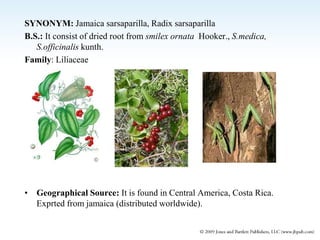
SYNONYM: Jamaica sarsaparilla, Radix sarsaparilla
B.S.: It consist of dried root from smilex ornata Hooker., S.medica,
S.officinalis kunth.
Family: Liliaceae
• Geographical Source: It is found in Central America, Costa Rica.
Exprted from jamaica (distributed worldwide).
• Cultivation & Collection:
• Hot & Humid climate and on light well drained sandy loam soil rich in
humus.
• Propagated by seed or suckers.
• Plant have short thin rhizome & very long thick root.
• Root harvested 2 nd year after cultivation.
• From rhizomes slender cylindrical roots are coming out and they are
upto 3 m in length.
• Roots are laid bare & then cut off near rhizome. Root are dried & made
into bundles.
• Morphology:
• Color: dark reddish brown color
• Taste: slightly bitter & muciligenous.
• Size: bindles half meter long & 12 cm diameter. Each bundle contains
root with 3 mm di. In thickness & doubled up.
• Other feature:
• Much shrunken & furrowed longitudinally & containing numerous
branching rootlets.
• They are tough & flexible.
• They bend but not break easily.
• CHEMICAL CONSTITUENT:
• Main sarsasaponin (aglcon- sarsasapogenin (reduced form of
yamogrnin), glycon-sugar)
• Sarsapic acid, fatty acid, dextrose, sitosterol, resins etc. smilagenin
(reduced form of diosgenin)
Uses:
1) Sarsasapogenin used as a starting material of steroids
2) Used to treat syphilis, gonorrhoea, wounds, fever, cough, gout,
hypertension, digestive disorder, anticancer, chronic skin disease,
rheumatisum
3) Alcoholic extract used as anticancer activity.
Substituents & adultrants:
S.Officinalis (jamica)
Rhizomes of species of pteris and rooys of Phelodendron (climbing plant)
Comercial variety:
1) Lima
2) Honduras
3) Guayaquil
4) Mexican
5) jamaica

Sarsaparila

  • 1.
  • 2.
    SYNONYM: Jamaica sarsaparilla,Radix sarsaparilla B.S.: It consist of dried root from smilex ornata Hooker., S.medica, S.officinalis kunth. Family: Liliaceae • Geographical Source: It is found in Central America, Costa Rica. Exprted from jamaica (distributed worldwide).
  • 3.
    • Cultivation &Collection: • Hot & Humid climate and on light well drained sandy loam soil rich in humus. • Propagated by seed or suckers. • Plant have short thin rhizome & very long thick root. • Root harvested 2 nd year after cultivation. • From rhizomes slender cylindrical roots are coming out and they are upto 3 m in length. • Roots are laid bare & then cut off near rhizome. Root are dried & made into bundles.
  • 4.
    • Morphology: • Color:dark reddish brown color • Taste: slightly bitter & muciligenous. • Size: bindles half meter long & 12 cm diameter. Each bundle contains root with 3 mm di. In thickness & doubled up. • Other feature: • Much shrunken & furrowed longitudinally & containing numerous branching rootlets. • They are tough & flexible. • They bend but not break easily. • CHEMICAL CONSTITUENT: • Main sarsasaponin (aglcon- sarsasapogenin (reduced form of yamogrnin), glycon-sugar) • Sarsapic acid, fatty acid, dextrose, sitosterol, resins etc. smilagenin (reduced form of diosgenin)
  • 5.
    Uses: 1) Sarsasapogenin usedas a starting material of steroids 2) Used to treat syphilis, gonorrhoea, wounds, fever, cough, gout, hypertension, digestive disorder, anticancer, chronic skin disease, rheumatisum 3) Alcoholic extract used as anticancer activity. Substituents & adultrants: S.Officinalis (jamica) Rhizomes of species of pteris and rooys of Phelodendron (climbing plant) Comercial variety: 1) Lima 2) Honduras 3) Guayaquil 4) Mexican 5) jamaica