By Sarah
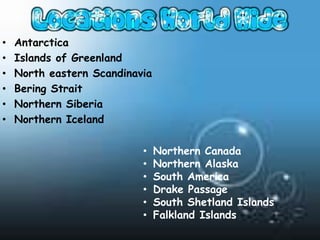
•   Antarctica
•   Islands of Greenland
•   North eastern Scandinavia
•   Bering Strait
•   Northern Siberia
•   Northern Iceland

                           •    Northern Canada
                           •    Northern Alaska
                           •    South America
                           •    Drake Passage
                           •    South Shetland Islands
                           •    Falkland Islands
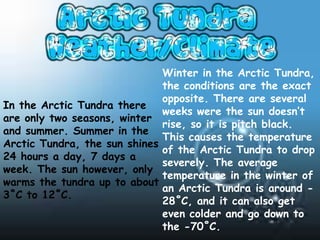
Winter in the Arctic Tundra,
                                the conditions are the exact
                                opposite. There are several
In the Arctic Tundra there
                                weeks were the sun doesn’t
are only two seasons, winter
                                rise, so it is pitch black.
and summer. Summer in the
                                This causes the temperature
Arctic Tundra, the sun shines
                                of the Arctic Tundra to drop
24 hours a day, 7 days a
                                severely. The average
week. The sun however, only
                                temperature in the winter of
warms the tundra up to about
                                an Arctic Tundra is around -
3˚C to 12˚C.
                                28˚C, and it can also get
                                even colder and go down to
                                the -70˚C.
There are 2 types of polar     The Polar Tundra is a part
climates: tundra climate and   of the World Climate
ice cap climate. A tundra      Regions which is marked
climate is characterised by    with cold climate
having at least 1 month        conditions. Regions with
whose average temperature      Polar Climate cover over
is above 0˚C, while an ice     20% of the Earth. The
cap climate has no months      sun shines 24 hours a day
above 0˚C. In tundra           in summer and barely ever
climate trees cannot grow in   shines at all in winter.
that climate.                  Polar Climate results in
                               treeless tundra, glaciers
                               or a permanent or semi-
                               permanent layer of ice.
The ground is permanently
frozen 25 to 100
centimetres down so no type
of plant or tree would be
able to in these extreme        Summer
conditions. The tundra is one   temperatures in
of the driest and coldest       the Alpine Climate
biome so any of the animals     ranges between -
there would have to have a      12˚C to 10˚C. The
pretty big fur coat.            average annual
                                temperature are -
                                56˚C.
• Tundra means tree less plain
• There are only six weeks of summer in the tundra
• 3 types of tundras: tundra, polar tundra and arctic
  tundra
• At least 25 to 90 centimetres of water is frozen
• In summer it stays light for 24 hours each day
• The only tree that grows on land in the Arctic
  Tundra is the Dwarf Willow that grows only 100
  millimetres every year
• Only experiences summer between May, June and
  July
• Tundra plays an important role in keeping global
  temperatures stable, by absorbing all the carbon
  dioxide in the atmosphere
• Tundra is known as the second most deadliest place
  in the world
• It is the coldest biome out of all 5
• It is considered not suitable for human habitation
• Some insects and reptiles live in the cold of
  the tundra.
• The North American Arctic tundra gets
  more rain than a desert.
• It is the harshest biome.
• 400 different types of flowers in the Arctic
  Tundra.
• There is always light in summer
• It is pitch black in winter
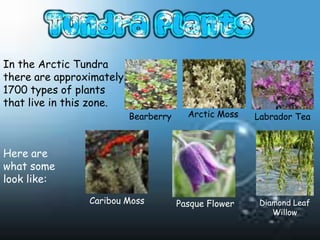
•   Bearberry
•   Arctic Moss
•   Caribou Moss
•   Diamond Leaf
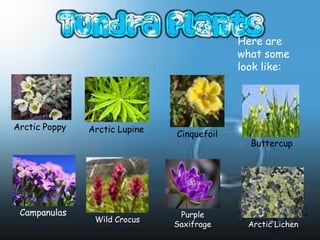
    Willow             •   Cinquefoil
•   Labrador Tea       •   Arctic Lichen
•   Pasque Flower      •   Buttercups
•   Tufted Saxifrage   •   Wild Crocus
•   Arctic Lupine      •   Campanulas
•   Arctic Poppy       •   Purple Saxifrage
In the Arctic Tundra
there are approximately
1700 types of plants
that live in this zone.
                          Bearberry     Arctic Moss   Labrador Tea


Here are
what some
look like:
                Caribou Moss          Pasque Flower    Diamond Leaf
                                                          Willow
Here are
                                            what some
                                            look like:


Arctic Poppy   Arctic Lupine
                               Cinquefoil
                                              Buttercup


 Campanulas                     Purple
                Wild Crocus
                               Saxifrage      Arctic Lichen
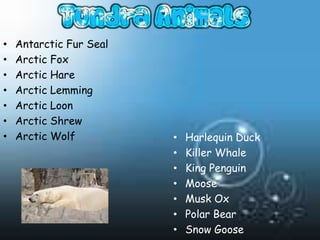
•   Antarctic Fur Seal
•   Arctic Fox
•   Arctic Hare
•   Arctic Lemming
•   Arctic Loon
•   Arctic Shrew
•   Arctic Wolf          •   Harlequin Duck
                         •   Killer Whale
                         •   King Penguin
                         •   Moose
                         •   Musk Ox
                         •   Polar Bear
                         •   Snow Goose
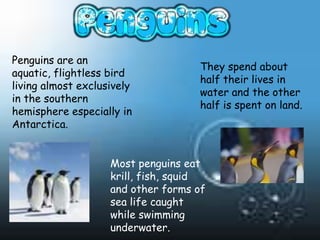
Penguins are an
                                    They spend about
aquatic, flightless bird
                                    half their lives in
living almost exclusively
                                    water and the other
in the southern
                                    half is spent on land.
hemisphere especially in
Antarctica.


                    Most penguins eat
                    krill, fish, squid
                    and other forms of
                    sea life caught
                    while swimming
                    underwater.
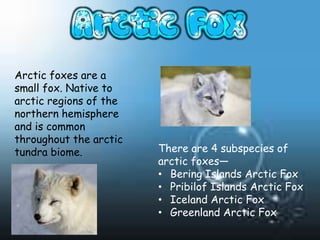
Arctic foxes are a
small fox. Native to
arctic regions of the
northern hemisphere
and is common
throughout the arctic
tundra biome.           There are 4 subspecies of
                        arctic foxes—
                        • Bering Islands Arctic Fox
                        • Pribilof Islands Arctic Fox
                        • Iceland Arctic Fox
                        • Greenland Arctic Fox
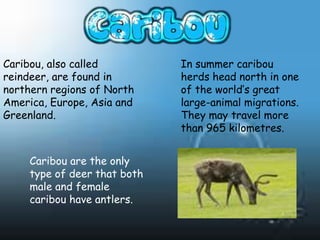
Caribou, also called          In summer caribou
reindeer, are found in        herds head north in one
northern regions of North     of the world’s great
America, Europe, Asia and     large-animal migrations.
Greenland.                    They may travel more
                              than 965 kilometres.


     Caribou are the only
     type of deer that both
     male and female
     caribou have antlers.
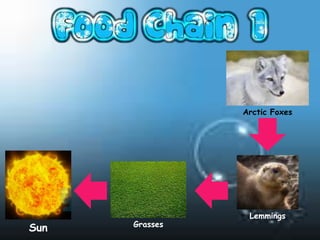
Arctic Foxes


                 Lemmings
      Grasses
Sun
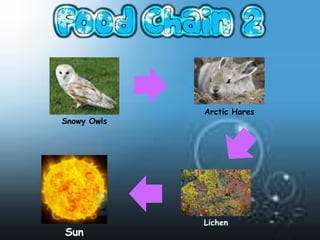
Arctic Hares
Snowy Owls


             Lichen
Sun
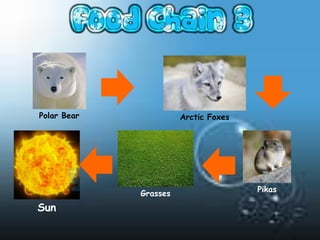
Polar Bear             Arctic Foxes


                                      Pikas
             Grasses
Sun
All my headings came from—
 www.glowtxt.com

Photos from—
 www.freedigitalimages.net
 www.freeimages.co.uk

Information from—
  www.wikipedia.com
  www.animal.nationalgeographic.com
  I used their information and put it into my own
information.
Sarah R8

Sarah R8

  • 1.
  • 2.
    Antarctica • Islands of Greenland • North eastern Scandinavia • Bering Strait • Northern Siberia • Northern Iceland • Northern Canada • Northern Alaska • South America • Drake Passage • South Shetland Islands • Falkland Islands
  • 3.
    Winter in theArctic Tundra, the conditions are the exact opposite. There are several In the Arctic Tundra there weeks were the sun doesn’t are only two seasons, winter rise, so it is pitch black. and summer. Summer in the This causes the temperature Arctic Tundra, the sun shines of the Arctic Tundra to drop 24 hours a day, 7 days a severely. The average week. The sun however, only temperature in the winter of warms the tundra up to about an Arctic Tundra is around - 3˚C to 12˚C. 28˚C, and it can also get even colder and go down to the -70˚C.
  • 4.
    There are 2types of polar The Polar Tundra is a part climates: tundra climate and of the World Climate ice cap climate. A tundra Regions which is marked climate is characterised by with cold climate having at least 1 month conditions. Regions with whose average temperature Polar Climate cover over is above 0˚C, while an ice 20% of the Earth. The cap climate has no months sun shines 24 hours a day above 0˚C. In tundra in summer and barely ever climate trees cannot grow in shines at all in winter. that climate. Polar Climate results in treeless tundra, glaciers or a permanent or semi- permanent layer of ice.
  • 5.
    The ground ispermanently frozen 25 to 100 centimetres down so no type of plant or tree would be able to in these extreme Summer conditions. The tundra is one temperatures in of the driest and coldest the Alpine Climate biome so any of the animals ranges between - there would have to have a 12˚C to 10˚C. The pretty big fur coat. average annual temperature are - 56˚C.
  • 6.
    • Tundra meanstree less plain • There are only six weeks of summer in the tundra • 3 types of tundras: tundra, polar tundra and arctic tundra • At least 25 to 90 centimetres of water is frozen • In summer it stays light for 24 hours each day • The only tree that grows on land in the Arctic Tundra is the Dwarf Willow that grows only 100 millimetres every year
  • 7.
    • Only experiencessummer between May, June and July • Tundra plays an important role in keeping global temperatures stable, by absorbing all the carbon dioxide in the atmosphere • Tundra is known as the second most deadliest place in the world • It is the coldest biome out of all 5 • It is considered not suitable for human habitation
  • 8.
    • Some insectsand reptiles live in the cold of the tundra. • The North American Arctic tundra gets more rain than a desert. • It is the harshest biome. • 400 different types of flowers in the Arctic Tundra. • There is always light in summer • It is pitch black in winter
  • 9.
    Bearberry • Arctic Moss • Caribou Moss • Diamond Leaf Willow • Cinquefoil • Labrador Tea • Arctic Lichen • Pasque Flower • Buttercups • Tufted Saxifrage • Wild Crocus • Arctic Lupine • Campanulas • Arctic Poppy • Purple Saxifrage
  • 10.
    In the ArcticTundra there are approximately 1700 types of plants that live in this zone. Bearberry Arctic Moss Labrador Tea Here are what some look like: Caribou Moss Pasque Flower Diamond Leaf Willow
  • 11.
    Here are what some look like: Arctic Poppy Arctic Lupine Cinquefoil Buttercup Campanulas Purple Wild Crocus Saxifrage Arctic Lichen
  • 12.
    Antarctic Fur Seal • Arctic Fox • Arctic Hare • Arctic Lemming • Arctic Loon • Arctic Shrew • Arctic Wolf • Harlequin Duck • Killer Whale • King Penguin • Moose • Musk Ox • Polar Bear • Snow Goose
  • 13.
    Penguins are an They spend about aquatic, flightless bird half their lives in living almost exclusively water and the other in the southern half is spent on land. hemisphere especially in Antarctica. Most penguins eat krill, fish, squid and other forms of sea life caught while swimming underwater.
  • 14.
    Arctic foxes area small fox. Native to arctic regions of the northern hemisphere and is common throughout the arctic tundra biome. There are 4 subspecies of arctic foxes— • Bering Islands Arctic Fox • Pribilof Islands Arctic Fox • Iceland Arctic Fox • Greenland Arctic Fox
  • 15.
    Caribou, also called In summer caribou reindeer, are found in herds head north in one northern regions of North of the world’s great America, Europe, Asia and large-animal migrations. Greenland. They may travel more than 965 kilometres. Caribou are the only type of deer that both male and female caribou have antlers.
  • 16.
    Arctic Foxes Lemmings Grasses Sun
  • 17.
  • 18.
    Polar Bear Arctic Foxes Pikas Grasses Sun
  • 19.
    All my headingscame from— www.glowtxt.com Photos from— www.freedigitalimages.net www.freeimages.co.uk Information from— www.wikipedia.com www.animal.nationalgeographic.com I used their information and put it into my own information.