LIFE IN DESERTS
(CLASS 7-GEOGRAPHY)
PREPARED BY-DEEPIKA THAKUR
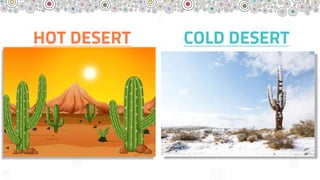
HOT DESERT COLD DESERT
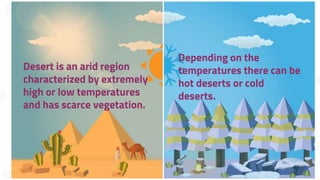
Desert is an arid region
characterized by extremely
high or low temperatures
and has scarce vegetation.
Depending on the
temperatures there can be
hot deserts or cold
deserts.
TYPES OF DESERTS-
HOT DESERT
• Climate
• Flora & fauna
• people
COLD DESERT
• Climate
• Flora & fauna
• people
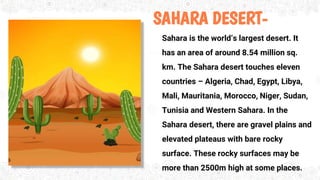
SAHARA DESERT-
Sahara is the world’s largest desert. It
has an area of around 8.54 million sq.
km. The Sahara desert touches eleven
countries – Algeria, Chad, Egypt, Libya,
Mali, Mauritania, Morocco, Niger, Sudan,
Tunisia and Western Sahara. In the
Sahara desert, there are gravel plains and
elevated plateaus with bare rocky
surface. These rocky surfaces may be
more than 2500m high at some places.
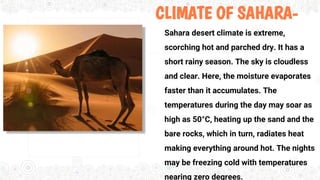
CLIMATE OF SAHARA-
Sahara desert climate is extreme,
scorching hot and parched dry. It has a
short rainy season. The sky is cloudless
and clear. Here, the moisture evaporates
faster than it accumulates. The
temperatures during the day may soar as
high as 50°C, heating up the sand and the
bare rocks, which in turn, radiates heat
making everything around hot. The nights
may be freezing cold with temperatures
nearing zero degrees.
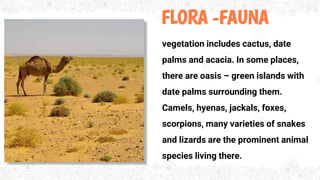
FLORA -FAUNA
vegetation includes cactus, date
palms and acacia. In some places,
there are oasis – green islands with
date palms surrounding them.
Camels, hyenas, jackals, foxes,
scorpions, many varieties of snakes
and lizards are the prominent animal
species living there.
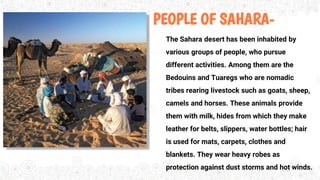
PEOPLE OF SAHARA-
The Sahara desert has been inhabited by
various groups of people, who pursue
different activities. Among them are the
Bedouins and Tuaregs who are nomadic
tribes rearing livestock such as goats, sheep,
camels and horses. These animals provide
them with milk, hides from which they make
leather for belts, slippers, water bottles; hair
is used for mats, carpets, clothes and
blankets. They wear heavy robes as
protection against dust storms and hot winds.
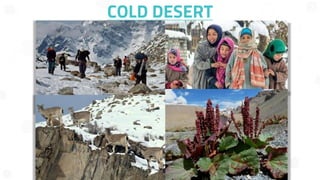
COLD DESERT
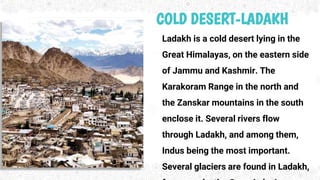
COLD DESERT-LADAKH
Ladakh is a cold desert lying in the
Great Himalayas, on the eastern side
of Jammu and Kashmir. The
Karakoram Range in the north and
the Zanskar mountains in the south
enclose it. Several rivers flow
through Ladakh, and among them,
Indus being the most important.
Several glaciers are found in Ladakh,
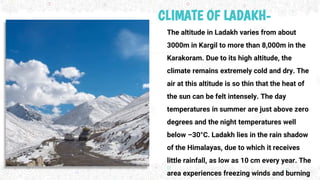
CLIMATE OF LADAKH-
The altitude in Ladakh varies from about
3000m in Kargil to more than 8,000m in the
Karakoram. Due to its high altitude, the
climate remains extremely cold and dry. The
air at this altitude is so thin that the heat of
the sun can be felt intensely. The day
temperatures in summer are just above zero
degrees and the night temperatures well
below –30°C. Ladakh lies in the rain shadow
of the Himalayas, due to which it receives
little rainfall, as low as 10 cm every year. The
area experiences freezing winds and burning
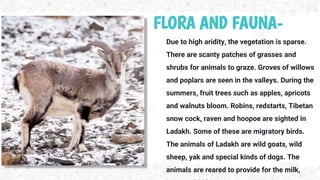
FLORA AND FAUNA-
Due to high aridity, the vegetation is sparse.
There are scanty patches of grasses and
shrubs for animals to graze. Groves of willows
and poplars are seen in the valleys. During the
summers, fruit trees such as apples, apricots
and walnuts bloom. Robins, redstarts, Tibetan
snow cock, raven and hoopoe are sighted in
Ladakh. Some of these are migratory birds.
The animals of Ladakh are wild goats, wild
sheep, yak and special kinds of dogs. The
animals are reared to provide for the milk,
PEOPLE OF LADAKH-
People of Ladakh are either Muslims or
Buddhists. In fact, several Buddhists
monasteries dot the Ladakhi landscape with
their traditional ‘gompas’. Some famous
monasteries are Hemis, Thiksey, Shey and
Lamayuru.
The women work not only in the house and
fields, but also manage small business and
shops.
Tourism is a major activity with several
tourists streaming in from within India and
abroad.
THANK YOU

Life in deserts (class 7 geography)

  • 1.
    LIFE IN DESERTS (CLASS7-GEOGRAPHY) PREPARED BY-DEEPIKA THAKUR
  • 2.
  • 3.
    Desert is anarid region characterized by extremely high or low temperatures and has scarce vegetation. Depending on the temperatures there can be hot deserts or cold deserts.
  • 4.
    TYPES OF DESERTS- HOTDESERT • Climate • Flora & fauna • people COLD DESERT • Climate • Flora & fauna • people
  • 5.
    SAHARA DESERT- Sahara isthe world’s largest desert. It has an area of around 8.54 million sq. km. The Sahara desert touches eleven countries – Algeria, Chad, Egypt, Libya, Mali, Mauritania, Morocco, Niger, Sudan, Tunisia and Western Sahara. In the Sahara desert, there are gravel plains and elevated plateaus with bare rocky surface. These rocky surfaces may be more than 2500m high at some places.
  • 6.
    CLIMATE OF SAHARA- Saharadesert climate is extreme, scorching hot and parched dry. It has a short rainy season. The sky is cloudless and clear. Here, the moisture evaporates faster than it accumulates. The temperatures during the day may soar as high as 50°C, heating up the sand and the bare rocks, which in turn, radiates heat making everything around hot. The nights may be freezing cold with temperatures nearing zero degrees.
  • 7.
    FLORA -FAUNA vegetation includescactus, date palms and acacia. In some places, there are oasis – green islands with date palms surrounding them. Camels, hyenas, jackals, foxes, scorpions, many varieties of snakes and lizards are the prominent animal species living there.
  • 8.
    PEOPLE OF SAHARA- TheSahara desert has been inhabited by various groups of people, who pursue different activities. Among them are the Bedouins and Tuaregs who are nomadic tribes rearing livestock such as goats, sheep, camels and horses. These animals provide them with milk, hides from which they make leather for belts, slippers, water bottles; hair is used for mats, carpets, clothes and blankets. They wear heavy robes as protection against dust storms and hot winds.
  • 9.
  • 10.
    COLD DESERT-LADAKH Ladakh isa cold desert lying in the Great Himalayas, on the eastern side of Jammu and Kashmir. The Karakoram Range in the north and the Zanskar mountains in the south enclose it. Several rivers flow through Ladakh, and among them, Indus being the most important. Several glaciers are found in Ladakh,
  • 11.
    CLIMATE OF LADAKH- Thealtitude in Ladakh varies from about 3000m in Kargil to more than 8,000m in the Karakoram. Due to its high altitude, the climate remains extremely cold and dry. The air at this altitude is so thin that the heat of the sun can be felt intensely. The day temperatures in summer are just above zero degrees and the night temperatures well below –30°C. Ladakh lies in the rain shadow of the Himalayas, due to which it receives little rainfall, as low as 10 cm every year. The area experiences freezing winds and burning
  • 12.
    FLORA AND FAUNA- Dueto high aridity, the vegetation is sparse. There are scanty patches of grasses and shrubs for animals to graze. Groves of willows and poplars are seen in the valleys. During the summers, fruit trees such as apples, apricots and walnuts bloom. Robins, redstarts, Tibetan snow cock, raven and hoopoe are sighted in Ladakh. Some of these are migratory birds. The animals of Ladakh are wild goats, wild sheep, yak and special kinds of dogs. The animals are reared to provide for the milk,
  • 13.
    PEOPLE OF LADAKH- Peopleof Ladakh are either Muslims or Buddhists. In fact, several Buddhists monasteries dot the Ladakhi landscape with their traditional ‘gompas’. Some famous monasteries are Hemis, Thiksey, Shey and Lamayuru. The women work not only in the house and fields, but also manage small business and shops. Tourism is a major activity with several tourists streaming in from within India and abroad.
  • 14.