The Tundra Biome by Benjamin Hanon
What is a Tundra? The tundra biome is at the top of the world around the North Pole. It is the coldest of all the biomes It has permafrost which is a permanently frozen layer of ground below a thin layer of tundra soil. It covers 1/5 of the Earths surface Tundra comes from the Finnish word Tunturi which means treeless plain
Two Types of Tundra Arctic (and Antarctic) Tundra: Located in the Far Northern Hemisphere which includes North Alaska, Canada, Greenland, Northern Europe, and Northern Asia.  Alpine Tundra is at a high altitude in the mountains all over the world and does not have permafrost which makes for a better soil.
Climate The Arctic Tundra has a dark and frigid winter. During the short summer months the sun shines 24/7  The average inter temperature is -30 degrees Fahrenheit.  When the seas freezes the salt rises making ice flowers Winds can blow 30-60 miles per hour White outs are common due to strong winds blowing the snow The average summer temperature is  37-54 degrees Fahrenheit Precipitation is 6-10 inches
Animals
Adaptations  Thick fur which turns white in the winter (camouflage) Hibernation Short legs Short tails Large furry feet Fat used for insulation Breed and raise young quickly during summer
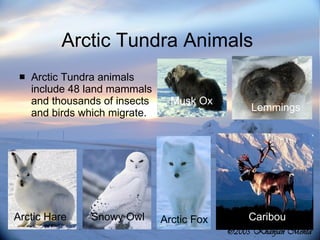
Arctic Tundra Animals  Arctic Tundra animals include 48 land mammals and thousands of insects and birds which migrate.  Musk Ox Lemmings Arctic Hare Snowy Owl Arctic Fox Caribou
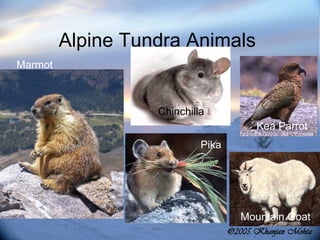
Alpine Tundra Animals  Pika Marmot Kea Parrot Chinchilla Mountain Goat
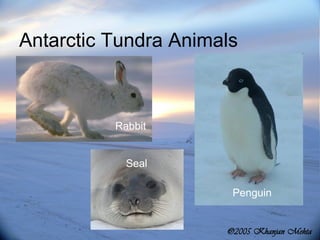
Antarctic Tundra Animals  Penguin Seal Rabbit
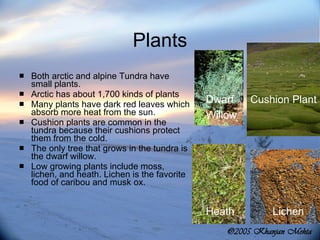
Plants Both arctic and alpine Tundra have small plants.  Arctic has about 1,700 kinds of plants Many plants have dark red leaves which absorb more heat from the sun. Cushion plants are common in the tundra because their cushions protect them from the cold. The only tree that grows in the tundra is the dwarf willow. Low growing plants include moss, lichen, and heath. Lichen is the favorite food of caribou and musk ox. Cushion Plant Lichen Heath Dwarf Willow
Thanks for Watching Now enjoy this picture of a snowy owl questioning if your for real

l18 Tundra Project

  • 1.
    The Tundra Biomeby Benjamin Hanon
  • 2.
    What is aTundra? The tundra biome is at the top of the world around the North Pole. It is the coldest of all the biomes It has permafrost which is a permanently frozen layer of ground below a thin layer of tundra soil. It covers 1/5 of the Earths surface Tundra comes from the Finnish word Tunturi which means treeless plain
  • 3.
    Two Types ofTundra Arctic (and Antarctic) Tundra: Located in the Far Northern Hemisphere which includes North Alaska, Canada, Greenland, Northern Europe, and Northern Asia. Alpine Tundra is at a high altitude in the mountains all over the world and does not have permafrost which makes for a better soil.
  • 4.
    Climate The ArcticTundra has a dark and frigid winter. During the short summer months the sun shines 24/7 The average inter temperature is -30 degrees Fahrenheit. When the seas freezes the salt rises making ice flowers Winds can blow 30-60 miles per hour White outs are common due to strong winds blowing the snow The average summer temperature is 37-54 degrees Fahrenheit Precipitation is 6-10 inches
  • 5.
  • 6.
    Adaptations Thickfur which turns white in the winter (camouflage) Hibernation Short legs Short tails Large furry feet Fat used for insulation Breed and raise young quickly during summer
  • 7.
    Arctic Tundra Animals Arctic Tundra animals include 48 land mammals and thousands of insects and birds which migrate. Musk Ox Lemmings Arctic Hare Snowy Owl Arctic Fox Caribou
  • 8.
    Alpine Tundra Animals Pika Marmot Kea Parrot Chinchilla Mountain Goat
  • 9.
    Antarctic Tundra Animals Penguin Seal Rabbit
  • 10.
    Plants Both arcticand alpine Tundra have small plants. Arctic has about 1,700 kinds of plants Many plants have dark red leaves which absorb more heat from the sun. Cushion plants are common in the tundra because their cushions protect them from the cold. The only tree that grows in the tundra is the dwarf willow. Low growing plants include moss, lichen, and heath. Lichen is the favorite food of caribou and musk ox. Cushion Plant Lichen Heath Dwarf Willow
  • 11.
    Thanks for WatchingNow enjoy this picture of a snowy owl questioning if your for real