SAP Project ManagementSAP Implementation and Strategies
Contents..

Contents



Role of project manager
SAP Implementation Methodologies and Strategies
- Step by step
- Roll-out
- Big Bang
Contents..
Role of project

manager

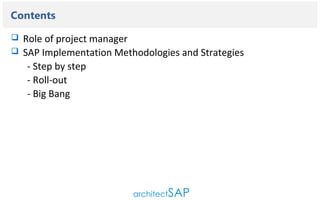
Project Manager has to 






Lead the project as a friendly leader
and also a process manager.
Manage and communicate a clear
vision of the project.
Motivate the project Team to achieve goal.
Need to be experienced negotiator and
a nice leader.

Track the project activities continously.
Contents..

SAP Implementation Methodologies and Strategies -Step by step
A step-by-step implementation is nothing but:
 Implementation of the software in small steps, and
 Generally concentrates on the implementation of a few related modules at one time.
(e.g. Materials Management, Sales and Distribution, Logistics Execution) and build
interfaces between R/3 and the legacy systems.
Advantages:
 Normally not complex.
 Easy for coordinating, controlling, and organizing the project.
 A team of internal consultants can be established over time, reducing the cost of the project.
 Costs are spread over a longer period of time.
 Less organizational changes can be considered during the implementation.
Disadvantages :
 Interfaces must be developed to maintain existing systems.
 Integration advantages of the project can only be used step by step.
 Return on investment is generally delayed.
Contents..

SAP Implementation Methodologies and Strategies -Roll-Out
Roll-out refers to business specific extensions of an implementation after a model is created at
one site which is then used to implement to the other sites or business units.
For example, a company operating in USA and Europe might choose to create a
model for most of its.
Advantages:

There is valuable experience gained by project members.
 Expertise is available for a fast implementation.
 Costs are kept low because only limited resources are needed.
 Standard business processes can be achieved by using a model implementation .


Disadvantages:

Site-specific requirements can be overlooked.
 New legal requirements such as the recent Euro migration.
 A current re-engineering effort within the company.

Contents..

SAP Implementation Methodologies and Strategies-Big Bang
A big bang deployment of R/3 replaces all or most critical existing systems in a single operation
with the new software.
Advantages:
 Few or even no interfaces between legacy systems and the new application are needed
because all modules go live at the same time.
 The project members’ motivation is high.
 It is highly efficient, because redundant customizing is avoided.
 There is optimal integration of all components under consideration.
Disadvantages:
 The implementation is complex due to the increased need for coordination and integration.
 It is resource intensive over a short period of time.
 All employees are subject to higher stress levels at the same time.
 A high degree of consulting support is required.
Questions ?

Email Us @ support@architectsap.com
7
Worldwide Offices:
                USA (Dallas)
                India (Pune)
Partner Offices:
                Monterrey (Mexico)
                Frankfurt (Germany)
                Stockholm (Sweden)
                Cape Town (South Africa)

Email:
support@architectsap.com
Corporate URL: www.architectsap.com

SAP Implementation And Strategies- Basic Guidelines For Project Manager

  • 1.
    SAP Project ManagementSAPImplementation and Strategies
  • 2.
    Contents.. Contents   Role of projectmanager SAP Implementation Methodologies and Strategies - Step by step - Roll-out - Big Bang
  • 3.
    Contents.. Role of project manager ProjectManager has to      Lead the project as a friendly leader and also a process manager. Manage and communicate a clear vision of the project. Motivate the project Team to achieve goal. Need to be experienced negotiator and a nice leader. Track the project activities continously.
  • 4.
    Contents.. SAP Implementation Methodologiesand Strategies -Step by step A step-by-step implementation is nothing but:  Implementation of the software in small steps, and  Generally concentrates on the implementation of a few related modules at one time. (e.g. Materials Management, Sales and Distribution, Logistics Execution) and build interfaces between R/3 and the legacy systems. Advantages:  Normally not complex.  Easy for coordinating, controlling, and organizing the project.  A team of internal consultants can be established over time, reducing the cost of the project.  Costs are spread over a longer period of time.  Less organizational changes can be considered during the implementation. Disadvantages :  Interfaces must be developed to maintain existing systems.  Integration advantages of the project can only be used step by step.  Return on investment is generally delayed.
  • 5.
    Contents.. SAP Implementation Methodologiesand Strategies -Roll-Out Roll-out refers to business specific extensions of an implementation after a model is created at one site which is then used to implement to the other sites or business units. For example, a company operating in USA and Europe might choose to create a model for most of its. Advantages: There is valuable experience gained by project members.  Expertise is available for a fast implementation.  Costs are kept low because only limited resources are needed.  Standard business processes can be achieved by using a model implementation .  Disadvantages: Site-specific requirements can be overlooked.  New legal requirements such as the recent Euro migration.  A current re-engineering effort within the company. 
  • 6.
    Contents.. SAP Implementation Methodologiesand Strategies-Big Bang A big bang deployment of R/3 replaces all or most critical existing systems in a single operation with the new software. Advantages:  Few or even no interfaces between legacy systems and the new application are needed because all modules go live at the same time.  The project members’ motivation is high.  It is highly efficient, because redundant customizing is avoided.  There is optimal integration of all components under consideration. Disadvantages:  The implementation is complex due to the increased need for coordination and integration.  It is resource intensive over a short period of time.  All employees are subject to higher stress levels at the same time.  A high degree of consulting support is required.
  • 7.
    Questions ? Email Us@ support@architectsap.com 7
  • 8.
    Worldwide Offices:                 USA(Dallas)                 India (Pune) Partner Offices:                 Monterrey (Mexico)                 Frankfurt (Germany)                 Stockholm (Sweden)                 Cape Town (South Africa) Email: support@architectsap.com Corporate URL: www.architectsap.com