An Introduction and Best Practices
INTRODUCTION 
Roll out term is normally used when an implemented solution at one place is 
further implemented at different location of the company group , usually on the 
same instance . 
For example, for one client if we first develop a global 
template solution and went live with few countries in 
the first go live. Subsequently, if we include some 
additional local process in the solution of another site 
and went live on that site then it is a roll out. 
It is expected that the global template will have usually more than 70% processes 
common across all sites and 15-30% local variation will be there for different sites. 
In SAP, Roll out it nothing but an extension in the existing system. 
The process and steps are same as we are using for a normal implementation cycle. 
There is not much difference. 
For the roll out, we need to do the some basic settings according to location of the 
implementation.
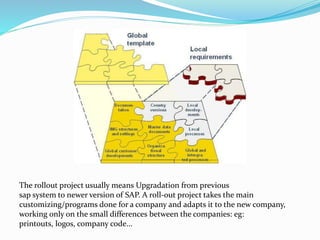
The rollout project usually means Upgradation from previous 
sap system to newer version of SAP. A roll-out project takes the main 
customizing/programs done for a company and adapts it to the new company, 
working only on the small differences between the companies: eg: 
printouts, logos, company code...
How It Works??? 
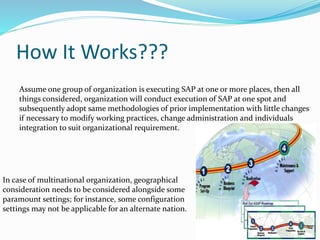
Assume one group of organization is executing SAP at one or more places, then all 
things considered, organization will conduct execution of SAP at one spot and 
subsequently adopt same methodologies of prior implementation with little changes 
if necessary to modify working practices, change administration and individuals 
integration to suit organizational requirement. 
In case of multinational organization, geographical 
consideration needs to be considered alongside some 
paramount settings; for instance, some configuration 
settings may not be applicable for an alternate nation.
If there should be an occurrence of contrasts in processes in both nations, then we 
have to be careful. Since the configuration settings are implemented for one nation 
may not be valuable for other nation. 
So simply need check all the business procedure and after that do the fundamental 
setup. In full life cycle venture, we have to analyze client prerequisites from scratch 
but in roll out project only local requirements are considered. 
A roll-out (RO) project differs from a full life cycle (FLC) project as it is an 
extension of existing FLC project. 
Now, Sap Support Companies like ArchitectSAP Solution help organizations 
in successful implementation of Roll Out projects.
Advantages 
 Increase speed for new implementation. 
 Definite timeline and results in roll out. 
 Unnecessary requirements and processes are avoided. 
 Controlled Budget.

SAP Roll Out - An Introduction and Advantages

  • 1.
    An Introduction andBest Practices
  • 2.
    INTRODUCTION Roll outterm is normally used when an implemented solution at one place is further implemented at different location of the company group , usually on the same instance . For example, for one client if we first develop a global template solution and went live with few countries in the first go live. Subsequently, if we include some additional local process in the solution of another site and went live on that site then it is a roll out. It is expected that the global template will have usually more than 70% processes common across all sites and 15-30% local variation will be there for different sites. In SAP, Roll out it nothing but an extension in the existing system. The process and steps are same as we are using for a normal implementation cycle. There is not much difference. For the roll out, we need to do the some basic settings according to location of the implementation.
  • 3.
    The rollout projectusually means Upgradation from previous sap system to newer version of SAP. A roll-out project takes the main customizing/programs done for a company and adapts it to the new company, working only on the small differences between the companies: eg: printouts, logos, company code...
  • 4.
    How It Works??? Assume one group of organization is executing SAP at one or more places, then all things considered, organization will conduct execution of SAP at one spot and subsequently adopt same methodologies of prior implementation with little changes if necessary to modify working practices, change administration and individuals integration to suit organizational requirement. In case of multinational organization, geographical consideration needs to be considered alongside some paramount settings; for instance, some configuration settings may not be applicable for an alternate nation.
  • 5.
    If there shouldbe an occurrence of contrasts in processes in both nations, then we have to be careful. Since the configuration settings are implemented for one nation may not be valuable for other nation. So simply need check all the business procedure and after that do the fundamental setup. In full life cycle venture, we have to analyze client prerequisites from scratch but in roll out project only local requirements are considered. A roll-out (RO) project differs from a full life cycle (FLC) project as it is an extension of existing FLC project. Now, Sap Support Companies like ArchitectSAP Solution help organizations in successful implementation of Roll Out projects.
  • 6.
    Advantages  Increasespeed for new implementation.  Definite timeline and results in roll out.  Unnecessary requirements and processes are avoided.  Controlled Budget.