SAP Implementation
Basic aspect of the implementation
SAP implementations are not easy though
    they are not difficult!
   SAP products are around for many years and most popular for quite some
    time with more than 100,000 installations worldwide in almost every business
    and industry.
   SAP as product has evolved over years adding a large variety of solutions and
    processes addressing almost every process in every business and have
    enormous experience in successfully implementing the solutions in various
    business domains.
   Similarly most businesses have evolved and reengineered adapting best
    practices and practices apart from having globally experienced talent.
   However, even after proven performance and collective experience, many new
    clients initiating the implementation of the product experiences the similar
    difficulties and complexities that were faced by the early implementations.
    Of course ever increasing product and business complexities have fuelled it
    further. In any case a planned approach is essential for a successful
    implementation.
   Different organizations follow different approaches thought the basic project
    management remains same and thus the end results vary, sometimes turning
                                                                                    2
    unfavorable. Individual organization’s culture, processes and users are
    important factors that make a difference here.
The modular design allows clients to select the
components as per business requirement and budget
   Started as solution to manage the core business requirements, SAP now has a
    wide suit of sub solutions catering to different business requirements. It has
    components to address different parts of business like core manufacturing to
    complex supply chain management to deep customer relations management.
    There are also Industry solutions that cater to specific industry requirement
    like Oil & Gas, Utility, etc
   However every business may not need all the solutions due to nature and size
    of the business. The modular design allows clients to select the required
    solution as per business need helping manage the complexity and cost.
   Clients also can first implement one components which in most cases will be
    core ERP first followed by the extension solutions like SCM and BI. It helps
    easier change management, incremental user acceptance and staggered
    investment.
   All different solutions can easily communicate with each other even if
    implemented in phases due to what is called as “seamless integration” thus
    avoiding necessity of complex middleware or interfaces.
   The solutions can also communicate with other / non SAP solutions but may
                                                                                     3
    require middleware and interfaces.
Use the standard functionality to best
    possible extend.
   The solution processes in the product are result of basic design which is
    evolved over years, input from experts from different domains across the
    world and SAP’s experience with large number of customers.
   Unless you are in a very different and new type of business, most of the
    requirements can be mapped in the many options of standard processes
    offered by the solution.
   Try your best to utilize the standard functionality offered as it helps you with
    proven process and reduces the risk of failure and enables easier maintenance
    in future.
   Align business process to the solution process than customizing the solution to
    meet business process which was designed in other environment. (refer slide 3)
   In fact it is advisable to (re) design the business processes before designing the
    solution processes. One time effort during implementation helps easier user
    training and transaction operations in addition to easier application
    maintenance and lower maintenance cost. It can also help improve the
    business as the solution processes are claimed as “Best Practices”.
                                                                                         4
Build logic and automation in system so as to
    improve the Speed, Productivity and Cost.
   Business processes are often created considering the existing or planned
    system support. Adapting the same processes in new ERP environment will
    unnecessarily complicate the solution and probably perform some non value
    added processes. Recreate or redesign the business processes knowing the new
    solution capabilities to make it leaner and fully value added.
E.g.
An organization had General Manager approval as mandatory step in the
business process. It was necessary as management and budget control in the
traditional environment with un-integrated legacy systems and lack of business
logic driven system processes.
In SAP (or possibly in other ERP) environment the budget limits and levels can
be set up in the system which automatically runs the checks as desired by the
logic, every time the transaction is performed. You have to build them while
designing the solution, once. In live operations, the physical signature or system
intervention from the respective General Manager is not required as system is
now managing it on behalf of the business.
Thus a manual and expensive activity can be eliminated not only reducing the
                                                                                     5
cost but speeding up the process and improving the organizational
productivity.
Fine balance the customized developments and
    implementation of additional components
   In most implementation, clients find that the solution being implemented is
    not meeting some key business requirement either as complete gap or a
    partial one. Its possible that another solution from the product suite like SCM
    is capable of managing the requirement but is not in scope or planned in later
    phase.
   First option should be check if business can manage the respective
    requirement either in legacy system or manually.
   Next option is to implement the solution component that is capable of
    managing the requirement. E.g. Capacity driven scheduling is possible in
    SCM solution. But the challenge comes if it is not in scope or planned in later
    phase.
   In such case the process can be created with customized development and
    make it run in collaboration with the standard process. This not addresses
    key business requirement but keeps the cost under control. The solution can
    deactivated once the new solution component is implemented in future or one
    may run it as it is.
   Please note that this is possible only where the gap is limited to a part of
                                                                                      6
    process or a simple complete process. It will very expensive option otherwise.
Everyone in the team need not know
    everything
   It is common to expect that every project team member must be expert in
    various aspect of the implementation journey like Project management,
    Domain knowledge and Solution expertise.
   Like any other project team, the respective member must be expert in her
    area. It may be good to know more in other area and will surely help the
    project, they cant be expert in everything.
E.g.
 Many times a project manager is expected to be expert in the domain or know
 the solution. Project manager must be expert in handling the project task and
 know how to steer the project till end without com promising solution and
 budgets. Similarly, domain experts must know the practices and processes in
 the given domain and how best they can be designed.
 Expecting project manager to all solution components or expecting domain
 expert to know how to create risk plan will stress the team unnecessary and
 probably increase the cost.
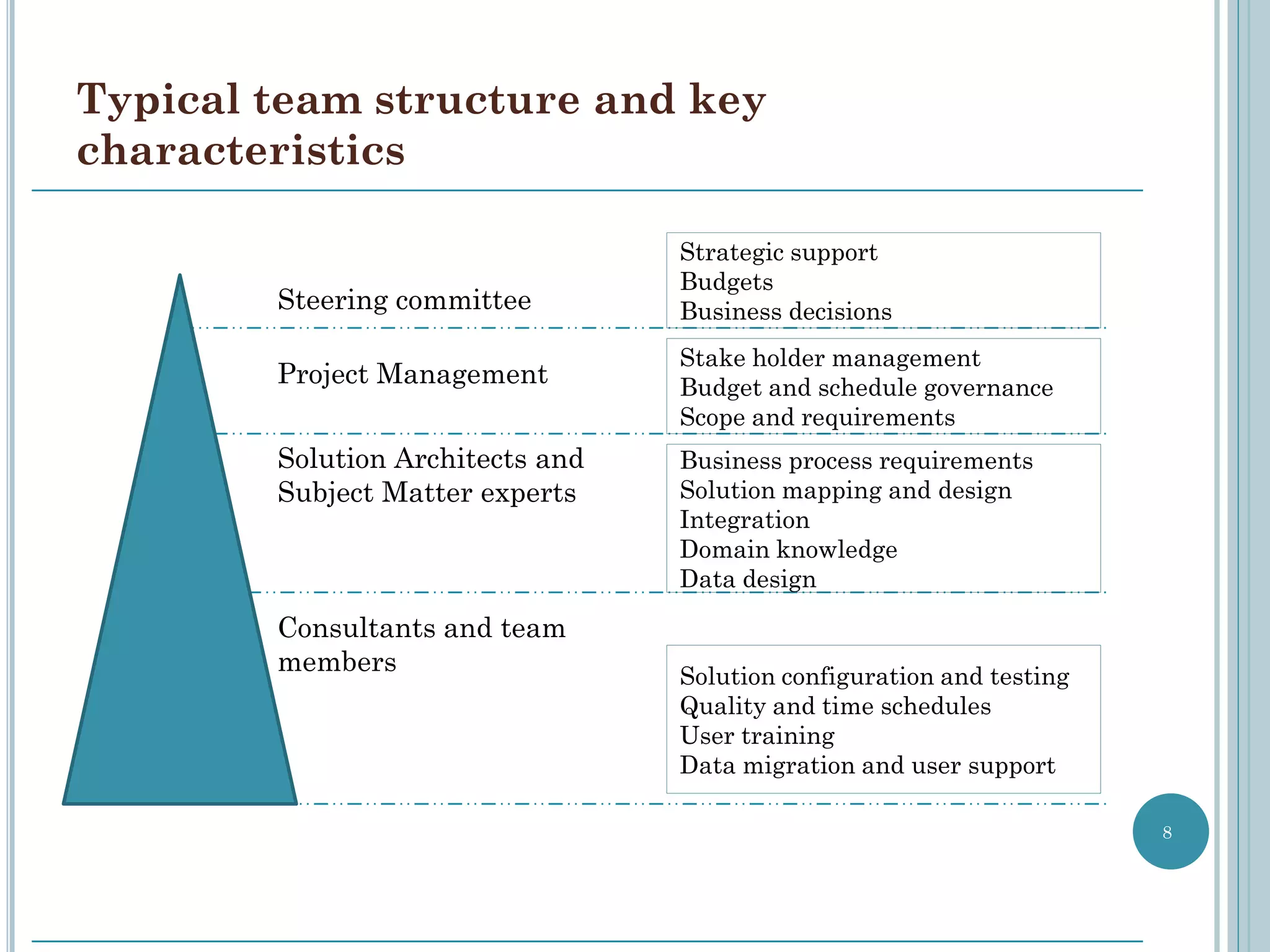
 See next slide describing typical team structure and characteristics.
                                                                                 7
Typical team structure and key
characteristics

                                  Strategic support
                                  Budgets
        Steering committee        Business decisions
                                  Stake holder management
        Project Management        Budget and schedule governance
                                  Scope and requirements
        Solution Architects and   Business process requirements
        Subject Matter experts    Solution mapping and design
                                  Integration
                                  Domain knowledge
                                  Data design

        Consultants and team
        members                   Solution configuration and testing
                                  Quality and time schedules
                                  User training
                                  Data migration and user support

                                                                       8
Change management is key success factor
   SAP implementation is not a “software installation” where respective experts
    design, develop and run the application. It is a business tool that will be used
    by everyone in the business process chain.
   It is different than customized development where the solution (software) is
    developed as per the processes leaving the process as it is. It does not enforce
    any change to user except getting familiar with a new tool operation.
   It not only impacts the transaction users but also the managers who may not
    operate the system themselves but are impacted as the application now runs
    as per the decisions and business logics given by them which are “woven” in
    the solution.
   It is tightly integrated solution where each process drives or impacts many
    other processes in the application. Everyone must work with discipline like
    what is required by each member of an excellent performing band.
   The implementation thus requires parallel and planned effort to
    communicate, train and guide every stakeholder and not just limit the activity
    to the implementation team members.
                                                                                       9
Summary
   Redesign the business processes to take full advantage of the
    solution.
   Try best to utilize the standard functionality before deciding on
    customized developments.
   Keep it simple. Start simple and then grow.
   Select best resources to work on the project. They are key to a
    rewarding implementation.
   Make the team capable and responsible to meet the process decisions
    and time schedules requirements.
   Everyone doesn’t need to be expert in project management and
    domain knowledge. Different team members have different roles and
    hence differ in the expertise required.
   Change management is important and necessary.

                                                                          10
Thank you.

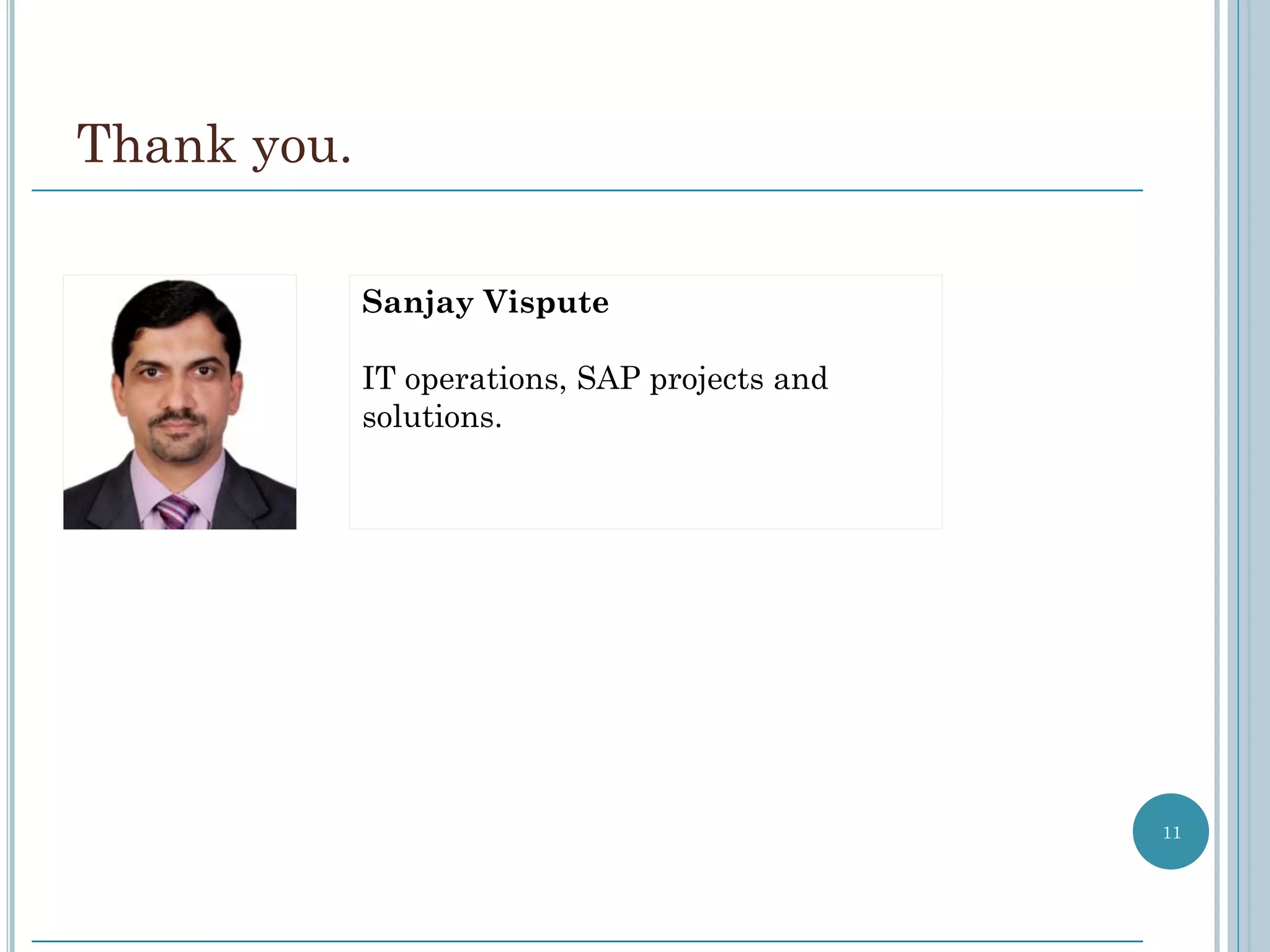
             Sanjay Vispute

             IT operations, SAP projects and
             solutions.


                                               11

Sap implementation

  • 1.
    SAP Implementation Basic aspectof the implementation
  • 2.
    SAP implementations arenot easy though they are not difficult!  SAP products are around for many years and most popular for quite some time with more than 100,000 installations worldwide in almost every business and industry.  SAP as product has evolved over years adding a large variety of solutions and processes addressing almost every process in every business and have enormous experience in successfully implementing the solutions in various business domains.  Similarly most businesses have evolved and reengineered adapting best practices and practices apart from having globally experienced talent.  However, even after proven performance and collective experience, many new clients initiating the implementation of the product experiences the similar difficulties and complexities that were faced by the early implementations. Of course ever increasing product and business complexities have fuelled it further. In any case a planned approach is essential for a successful implementation.  Different organizations follow different approaches thought the basic project management remains same and thus the end results vary, sometimes turning 2 unfavorable. Individual organization’s culture, processes and users are important factors that make a difference here.
  • 3.
    The modular designallows clients to select the components as per business requirement and budget  Started as solution to manage the core business requirements, SAP now has a wide suit of sub solutions catering to different business requirements. It has components to address different parts of business like core manufacturing to complex supply chain management to deep customer relations management. There are also Industry solutions that cater to specific industry requirement like Oil & Gas, Utility, etc  However every business may not need all the solutions due to nature and size of the business. The modular design allows clients to select the required solution as per business need helping manage the complexity and cost.  Clients also can first implement one components which in most cases will be core ERP first followed by the extension solutions like SCM and BI. It helps easier change management, incremental user acceptance and staggered investment.  All different solutions can easily communicate with each other even if implemented in phases due to what is called as “seamless integration” thus avoiding necessity of complex middleware or interfaces.  The solutions can also communicate with other / non SAP solutions but may 3 require middleware and interfaces.
  • 4.
    Use the standardfunctionality to best possible extend.  The solution processes in the product are result of basic design which is evolved over years, input from experts from different domains across the world and SAP’s experience with large number of customers.  Unless you are in a very different and new type of business, most of the requirements can be mapped in the many options of standard processes offered by the solution.  Try your best to utilize the standard functionality offered as it helps you with proven process and reduces the risk of failure and enables easier maintenance in future.  Align business process to the solution process than customizing the solution to meet business process which was designed in other environment. (refer slide 3)  In fact it is advisable to (re) design the business processes before designing the solution processes. One time effort during implementation helps easier user training and transaction operations in addition to easier application maintenance and lower maintenance cost. It can also help improve the business as the solution processes are claimed as “Best Practices”. 4
  • 5.
    Build logic andautomation in system so as to improve the Speed, Productivity and Cost.  Business processes are often created considering the existing or planned system support. Adapting the same processes in new ERP environment will unnecessarily complicate the solution and probably perform some non value added processes. Recreate or redesign the business processes knowing the new solution capabilities to make it leaner and fully value added. E.g. An organization had General Manager approval as mandatory step in the business process. It was necessary as management and budget control in the traditional environment with un-integrated legacy systems and lack of business logic driven system processes. In SAP (or possibly in other ERP) environment the budget limits and levels can be set up in the system which automatically runs the checks as desired by the logic, every time the transaction is performed. You have to build them while designing the solution, once. In live operations, the physical signature or system intervention from the respective General Manager is not required as system is now managing it on behalf of the business. Thus a manual and expensive activity can be eliminated not only reducing the 5 cost but speeding up the process and improving the organizational productivity.
  • 6.
    Fine balance thecustomized developments and implementation of additional components  In most implementation, clients find that the solution being implemented is not meeting some key business requirement either as complete gap or a partial one. Its possible that another solution from the product suite like SCM is capable of managing the requirement but is not in scope or planned in later phase.  First option should be check if business can manage the respective requirement either in legacy system or manually.  Next option is to implement the solution component that is capable of managing the requirement. E.g. Capacity driven scheduling is possible in SCM solution. But the challenge comes if it is not in scope or planned in later phase.  In such case the process can be created with customized development and make it run in collaboration with the standard process. This not addresses key business requirement but keeps the cost under control. The solution can deactivated once the new solution component is implemented in future or one may run it as it is.  Please note that this is possible only where the gap is limited to a part of 6 process or a simple complete process. It will very expensive option otherwise.
  • 7.
    Everyone in theteam need not know everything  It is common to expect that every project team member must be expert in various aspect of the implementation journey like Project management, Domain knowledge and Solution expertise.  Like any other project team, the respective member must be expert in her area. It may be good to know more in other area and will surely help the project, they cant be expert in everything. E.g. Many times a project manager is expected to be expert in the domain or know the solution. Project manager must be expert in handling the project task and know how to steer the project till end without com promising solution and budgets. Similarly, domain experts must know the practices and processes in the given domain and how best they can be designed. Expecting project manager to all solution components or expecting domain expert to know how to create risk plan will stress the team unnecessary and probably increase the cost. See next slide describing typical team structure and characteristics. 7
  • 8.
    Typical team structureand key characteristics Strategic support Budgets Steering committee Business decisions Stake holder management Project Management Budget and schedule governance Scope and requirements Solution Architects and Business process requirements Subject Matter experts Solution mapping and design Integration Domain knowledge Data design Consultants and team members Solution configuration and testing Quality and time schedules User training Data migration and user support 8
  • 9.
    Change management iskey success factor  SAP implementation is not a “software installation” where respective experts design, develop and run the application. It is a business tool that will be used by everyone in the business process chain.  It is different than customized development where the solution (software) is developed as per the processes leaving the process as it is. It does not enforce any change to user except getting familiar with a new tool operation.  It not only impacts the transaction users but also the managers who may not operate the system themselves but are impacted as the application now runs as per the decisions and business logics given by them which are “woven” in the solution.  It is tightly integrated solution where each process drives or impacts many other processes in the application. Everyone must work with discipline like what is required by each member of an excellent performing band.  The implementation thus requires parallel and planned effort to communicate, train and guide every stakeholder and not just limit the activity to the implementation team members. 9
  • 10.
    Summary  Redesign the business processes to take full advantage of the solution.  Try best to utilize the standard functionality before deciding on customized developments.  Keep it simple. Start simple and then grow.  Select best resources to work on the project. They are key to a rewarding implementation.  Make the team capable and responsible to meet the process decisions and time schedules requirements.  Everyone doesn’t need to be expert in project management and domain knowledge. Different team members have different roles and hence differ in the expertise required.  Change management is important and necessary. 10
  • 11.
    Thank you. Sanjay Vispute IT operations, SAP projects and solutions. 11