SAP is an ERP software that offers a centralized system for businesses to manage processes. It has evolved over time from a one-tier architecture to a multi-tier system with presentation, application, and database layers. The application layer is where processing occurs and includes work processes that are distributed to by dispatchers. Key SAP modules include SRM for procurement, ARIBA which SAP acquired, SOLMAN for application management, and S/4HANA which is SAP's next generation ERP that leverages new technologies.
SECTION I
- NeilArmstrong
• What is SAP
• Why do
organizations use
SAP?
• History of SAP
architecture
3.
WHAT IS SAP
SAP(System, Application, and Products) is an ERP (Enterprise
Resource Planning) system that offers a centralized system for
businesses to manage their everyday processes.
The software was designed by 5 ex-IBM employees
4.
WHY DO ORGANIZATIONSUSE SAP
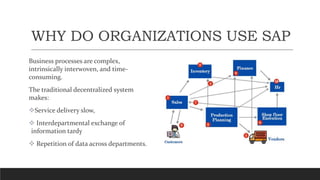
Business processes are complex,
intrinsically interwoven, and time-
consuming.
The traditional decentralized system
makes:
Service delivery slow,
Interdepartmental exchange of
information tardy
Repetition of data across departments.
5.
WHY DO ORGANIZATIONSUSE SAP(cont.)
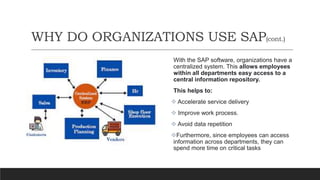
With the SAP software, organizations have a
centralized system. This allows employees
within all departments easy access to a
central information repository.
This helps to:
Accelerate service delivery
Improve work process.
Avoid data repetition
Furthermore, since employees can access
information across departments, they can
spend more time on critical tasks
6.
HISTORY OF SAPARCHITECTURE
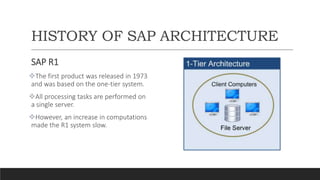
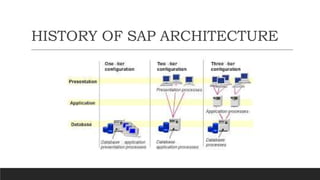
SAP R1
The first product was released in 1973
and was based on the one-tier system.
All processing tasks are performed on
a single server.
However, an increase in computations
made the R1 system slow.
7.
HISTORY OF SAPARCHITECTURE
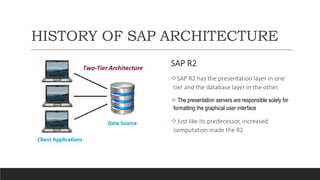
SAP R2
SAP R2 has the presentation layer in one
tier and the database layer in the other.
The presentation servers are responsible solely for
formatting the graphical user interface
Just like its predecessor, increased
computation made the R2
8.
HISTORY OF SAPSYSTEM
ARCHITECTURE
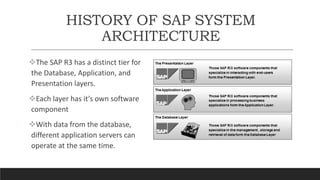
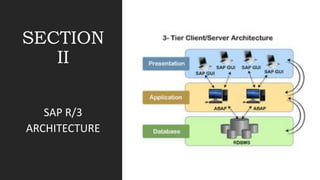
The SAP R3 has a distinct tier for
the Database, Application, and
Presentation layers.
Each layer has it’s own software
component
With data from the database,
different application servers can
operate at the same time.
Relationship between SapR/3 and ECC
In 1992, The R/3 was released to support various
operating systems and databases.
In 2004, SAP renamed it to SAP ECC (SAP ERP Central
Component).
SAP ERP and ECC are now used interchangeably.
12.
PRESENTATION LAYER
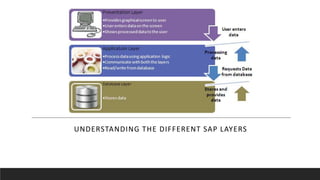
Thisis the view you see when you login SAP from your computer
This layer ensures that the SAP system user interface displays
information for users
This layer pass the user’s action to the application layer for further
processing
The presentation layer components are installed across various
PCs.
13.
APPLICATION LAYER
Thislayer is where all the processing gets done.
An organization can have more than one application layer, depending on the
processing needs.
The Application layer is also known as the Kernel and Basic Layer.
It serves as a communicator between the Presentation and Database layers.
The application layer components are installed across one or more high-end
servers.
14.
APPLICATION LAYER(contd)
The applicationserver carries out a range of services called work processes.
It is where the dispatcher distributes the workload to each work process
Work processes are components that are able to execute an application.
Each Work process is registered as a user in the database system for the entire runtime of the
SAP system.
15.
DATABASE LAYER
Thislayer contain specialized systems with fast and large hard drives.
The Database layer stores and retrieve data via queries generated by ABAP and Java applications
The Database and Application layers can exist in the same or different physical locations
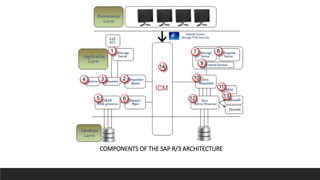
The concepts ofthe SAP R/3
architecture.
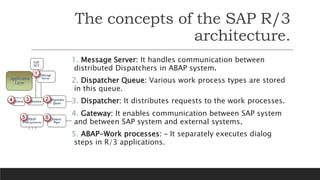
1. Message Server: It handles communication between
distributed Dispatchers in ABAP system.
2. Dispatcher Queue: Various work process types are stored
in this queue.
3. Dispatcher: It distributes requests to the work processes.
4. Gateway: It enables communication between SAP system
and between SAP system and external systems.
5. ABAP-Work processes: – It separately executes dialog
steps in R/3 applications.
19.
The concepts ofthe SAP R/3
architecture.(contd..)
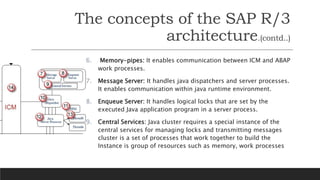
6. Memory-pipes: It enables communication between ICM and ABAP
work processes.
7. Message Server: It handles java dispatchers and server processes.
It enables communication within java runtime environment.
8. Enqueue Server: It handles logical locks that are set by the
executed Java application program in a server process.
9. Central Services: Java cluster requires a special instance of the
central services for managing locks and transmitting messages
cluster is a set of processes that work together to build the
Instance is group of resources such as memory, work processes
20.
10. Java Dispatcher:It receives the client requests and forwards to the server process
11. SDM: Software Deployment Manager is used to install J2EE components.
12. Java Server Processes: It can processes a large number of requests
simultaneously.
13. Threading: Multiple Processes executes separately in the background, this
concept is called threading.
14. ICM: The Internet Communication Manager enables communication between SAP
system and HTTP, HTTPS, SMTP protocol. It means by entering system URL in the
can access SAP from browser also.
SRM
The SUPPLIER RESOURCEMANAGEMENT is an SAP product that
enhances the procurement of goods via a web-based platform.
Its key benefits include:
Catalog management, Procure to Pay Optimization, Self-Service
Procurement, Contract Management, SAP NetWeaver BI, and Easy
transactions.
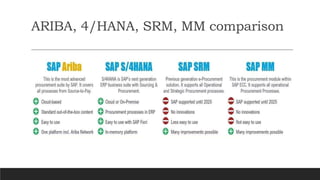
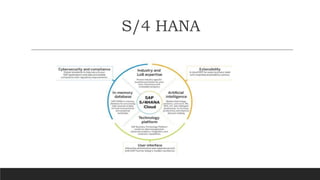
However, the future of SAP SRM is SAP ARIBA and 4/HANA
23.
SAP ARIBA
ARIBA wasfounded in 1992 but acquired by SAP in 2015.
SAP ARIBA is a procurement software that helps organizations collaborate more
effectively on contract management, financial supply chain management, etc.
The key differentiation is that SAP SRM is an on-premise solution that can
integrate well with other SAP products such as MDM (for Catalogs), ECC
(follow-on documents), and HCM (for the Org. Structure).
On the other hand, SAP Ariba is an On-demand solution that has an excellent
Supplier Network base
SOLMAN, BW
SAP SolutionManager is an ALM (Application Lifecycle, Management)
platform used to implement, maintain and integrate SAP systems;
troubleshoot issues, and keep things running securely, smoothly, and
cleanly.
SAP Business Warehouse integrates data from different sources,
transforms and consolidates the data, does data cleansing, and storing of
data as well. It also includes data modeling, administration, and staging
areas.
26.
BPC
The SAP BusinessPlanning and Consolidation application
that delivers planning, budgeting, forecasting, and financial
consolidation capabilities.
It is used to support all operational and financial activities in an
organization.
In simple terms, it helps you to easily adjust plans and
forecasts, and speed up budgets, and closing cycles.
27.
GRC and HCM
SAPGovernance, Risk, and Compliance is a set of solutions and products that can help
you manage enterprise resources in a way that minimizes risk, build trust, and lowers
compliance cost.
SAP Human Capital Management is the successor to SAP HR. It’s functions include
personnel administration, payroll, applicant management and personnel development.
However, HCM is an on-premise solution, SuccessFactors is the cloud based solution.
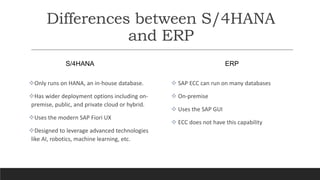
Differences between S/4HANA
andERP
S/4HANA
Only runs on HANA, an in-house database.
Has wider deployment options including on-
premise, public, and private cloud or hybrid.
Uses the modern SAP Fiori UX
Designed to leverage advanced technologies
like AI, robotics, machine learning, etc.
ERP
SAP ECC can run on many databases
On-premise
Uses the SAP GUI
ECC does not have this capability