SAP S/4 HANA LOGISTICS
1809
Rajesh Sharma
SAP Certified Application Associate
SAP Activate Manager
SAP ERP 6.0, SAP S/4 HANA 1709
SAP EWM 9.5
Common Challenges & Solutions
Slower reporting/ closing due complex data model
 Thanks to SAP HANA’s in memory capability for providing columnar data base and
simplified Data Model which helps in instant insight
High Cost Operations
 Reduction in cost of operations due to great user experience provided by SAP Fiori
and that too it can work on any device which mean faster approvals.
High Cost Infrastructure
 Lower Cost of hardware and software licenses using SAP’s cloud services and
leasing the applications
SAP S/4 HANA 1809 Features
S/4 HANA 1809 On-Premise & Cloud version New Release Innovative Features
are
• Simplification Lists
• Innovation Discovery
Key Innovations delivered in
SAP S/4 HANA 18
Embedded Transport Management
• Carrier Invoicing
• Load Optimization
Supply Chain
• Advance Available to Promise (AATP)
• Product Allocation
Industry to Core Utilities
• Analytical insight in billing and invoicing
• Meter Reading Analysis
Customer Management
• Harmonized data model with embedded service management
Digital Manufacturing
• Capacity evaluation and adjustment Material Requirement Planning Controller
• Demand Driven Planning concept
Finance
• Provide a finance data hub for real-time consolidation
• Inter company reconciliation reporting
Sourcing & Procurement
• Centralized Purchase Requisition with utilization of central contract hub
• Integration with SAP Ariba buying with SAP S/4 HANA
Asset Management
• Planner Overview Page
• Damage Analysis
• Task list and Operations
Sales & Distribution
• Simplification Sales Order
• Sales Billing and Invoicing Split analysis
• Approval for Credit memo with new concept of credit management
Inventory Management
• Predictive analysis machine learning for decision making
• Posting Goods Receipt for Production Order
Quality Management
• Maintain Quality Inspection Records
• Complaints Records management and monitoring
• Analyze Key Performance Indicator from Quality Management Data
Extended Warehouse Management
• Unique Identification of item
• By using ABC calculation new reporting system to classify products based on
warehouse history
R&D/ Engineering
• Variant Configuration multilevel. CPQ, Classification
• Product marketability and chemical compliance
Migration Cockpit
• Transfer data using staging tables
• Adjust the migration objects that are used with the Object Modeler
• These are the Features of SAP S/4 HANA 1809
Road Map Next 12 Month Releases
The 12 Month release strategies are:
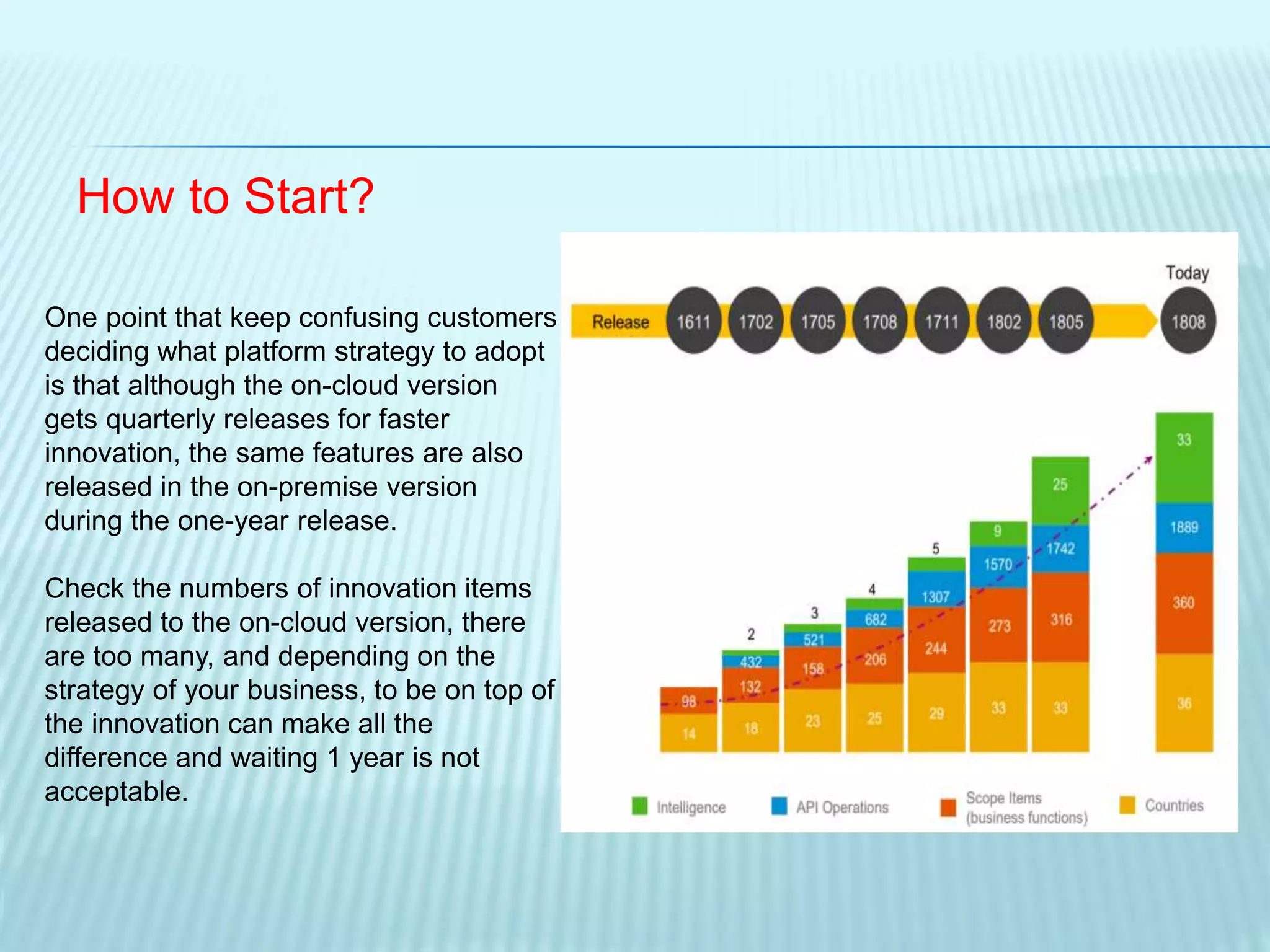
How to Start?
One point that keep confusing customers
deciding what platform strategy to adopt
is that although the on-cloud version
gets quarterly releases for faster
innovation, the same features are also
released in the on-premise version
during the one-year release.
Check the numbers of innovation items
released to the on-cloud version, there
are too many, and depending on the
strategy of your business, to be on top of
the innovation can make all the
difference and waiting 1 year is not
acceptable.
While the innovation discovery and roadmaps portal are the source for what is there? What is
coming?, and navigating on those portal filtering to the items that you think it might be relevant
to you is recommended, SAP also recommends companies to running some tools such as:
•S/4HANA Business Scenario Recommendations – This is a customized report about how
SAP S/4HANA can enhance your company’s current performance and competitiveness based
on your system’s current production usage data. You should use this tool to identify the
business process that can be improved and discover new capabilities. Using this tool, SAP will
issue a report with recommendations based on what you have in your ECC today, so instead
going to look on a much more comprehensive list of innovation, you can look on the report that
is more direct to your company.
All it takes is about 5 minutes to upload the information and in approximately 5 business days
to receive a report back.
•SAP Transformation Navigator – With this tool, it is possible to see the S/4HANA roadmap to
each component you have in your current landscape. This tool assesses your current IT
landscape, business strategy, and industry trends, and delivers one comprehensive report
containing custom recommendations of the SAP products and solutions required to realize
your digital strategy.
SAP Readiness Check
Use this tool to learn the technical requirements and actions for a system conversion to
S/4HANA. This tool you help to answer questions like:
How big should my SAP HANA database be?
Are my add-ons compatible with SAP S/4HANA?
What SAP Fiori applications are relevant to my users?
Which business functions I run are affected by SAP S/4HANA?
Which transactions I run are affected by SAP S/4HANA?
Will my custom code objects work with SAP S/4HANA?
If you have been following this subject for the past months or years, you may know that
there are different strategies to take to move to the S/4HANA, but when to take one option
or other it depends on your business objective of moving to the S/4HANA:
•New Implementation: That’s the Greenfield project (either on-cloud or on-premise) and
using the Migration Cockpit to load the data from ECC to S/4HANA. This is the best strategy
to companies that want to take this chance to review their processes and re-organize the
system, get rid of customizations and push for simplification.
•System Conversion: If the goal is to move to the S/4HANA faster, and the company is not
worried about reviewing the existing processes and to get rid of developments, system
conversion might be more suitable to your company.
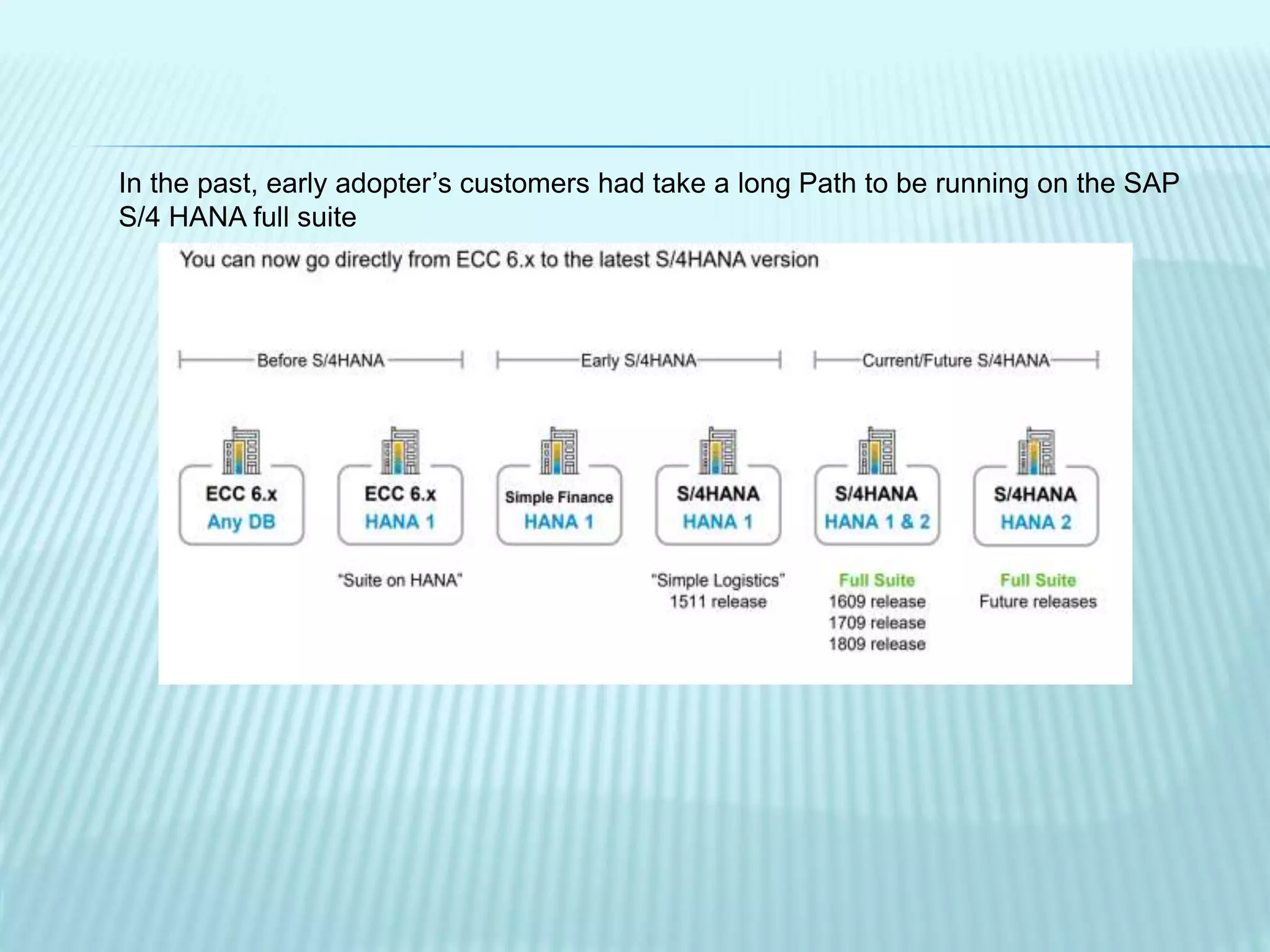
In the past, early adopter’s customers had take a long Path to be running on the SAP
S/4 HANA full suite
But now, it is possible, in a system conversion, to go from ECC 6.x directly to 1809 on
HANA 2 DB without having to go to Suite on HANA first. Now, the process is one-step
to move to the Full Suite S/4HANA on HANA 2 DB without having to go through the
middle steps, regardless if it is on-cloud or on-premise:
Whether your company must go to the On-premise, public cloud or private cloud, it
depends on so many factors, such as: IT strategy, innovation cycles, adoption and
upgrade efforts, TCO, Commercial Models, Business functionality, Regulator
requirements, etc., here are some of the differences between the platforms:
SAP S/4HANA simplified the data model and introduced a modern user-experience. They are
consistent for both on-cloud and on-premise versions and either on-cloud or on-premise were
designed for in-memory database and IT landscape simplification.
REPORT THIS AD
SAP claims to have more than 2,100 live customers on S/4HANA, more than 8,900 licensed
customers where few thousands are already working on their projects. The solution is now
available to 25 different industries, in 160 countries and translated to 38 languages.
Every live customer has a success story to tell that involves cost reduction and performance
improvement. Here is one example:
SAP CoPilot
SAP CoPilot is the (not new) digital assistant that allows users to organize their day, organize
tasks in one central spot, and now, in the 1809 release, incorporate Natural Language. Think
on Amazon Alexa or Apple Siri assistants, now you can have the same experience on SAP,
asking questions for example, searching for results of sales report in a given region for
example, scheduling meetings to talk about a specific item on your SAP dashboard. The
CoPilot uses Machine Learning capabilities to improve the results and perform better as it
is trained by the user.
• Humanized Next-Gen UX with a Conversational UI using Natural Language Processing
Functionality
• Business Context Awareness understanding the business situation and pro-actively
suggestion solutions
• Self-learning system using machine learning functionality to gain knowledge based on
historic data and experience
• Cross Applications with One Personality and One Memory across all SAP
• Open and Extensible for Integration to SAP and Non-SAP Solutions Enabling our
customers and partners to extend CoPilot Skills through bots, agents and APIs
Machine Learning
We all should agree that SAP S/4HANA is the start to get your company to the next level of
Enterprise Resourcing Planning. Modernizing your ERP provides the foundation to connect
your data, automate key functions, and constantly improve your products & services. With
Machine Learning capabilities embedded, the ERP becomes intelligent and job becomes more
dynamic and predictive, routine tasks are automated. SAP started introducing ML capabilities in
the S/4HANA in the 1709 release, here is what is coming to the 1809:
Sourcing & Procurement
• Exception handling
• Increased invoice automation with machine learning and efficient invoice monitoring
for exception handling
• Reduce free-text items using Machine Learning that automatically proposes to create
a new catalog item,
• Propose material group for free-text items in purchase requisitions
• Provide options for materials without source of supply using Machine Learning
Product Safety and Stewardship
Product compliance
o Services for dangerous goods determination and classification as well as substance
group assignment based on machine learning models
o Models that will be trained with product data and chemical composition respectively
substance data from SAP and our customers
o Integration of the services into SAP S/4HANA for Product Compliance
Inventory Management
Goods Receipt Process
o Automatic detection of patterns for determining recurrent behaviors based on historical
data and application of the patterns to new data –using predictive analytics in SAP
S/4HANA
oEnhancements to the existing app with additions, such as the predicted delivery date
o Inclusion of the predicted delivery date into creation of stock transport orders
Sales & Distribution
Analytics
o Determine the quotation-conversion probability using predictive analytics and machine
learning
o Monitor your delivery performance using predictive analytics in SAP S/4HANA – in-time
supply of procurement processes to the creation of outbound deliveries
Merchandise Management
Global data synchronization
o Machine learning global data synchronization integration: Enable access from global
data synchronization (GDS) inbound processes to SAP Leonardo Machine Learning. SAP
continue pushing hard to implement more machine learning elements and make the ERP
more intelligent every release.
Mass Maintenance
• Scope and process enhancements in mass maintenance of master data, increased data
coverage. Support for:
o Multiple vendor and customer assignments in mass maintenance of business partner
data
o Classification data in mass maintenance of material, customer, and vendor data
The Export Master Data app enables you to export a selection of master data to an Office
Open XML file. This file can be used for Mass Maintenance and for Mass Processing of Master
Data.
The following business objects are supported:
• Business Partner
• Business Partner Relationship
• Product
• Mass Maintenance enables you to update multiple master data records at a time
The function is available for the material master and business partner (including customer and
vendor). You can access this function through the Start Mass
• Maintenance and Manage Mass Maintenance tiles in the SAP Fiori Launchpad.
To update records, you select the fields and records you want to change. The system then
displays a list of fields to change based on your selection. Once you enter your changes, the
system provides statistics on the changed fields and validates the data. You check the
validated data and then activate it. Activation copies the data from the staging area to active
memory, enabling the system to use it in business transactions.
New feature:
• Support of multiple assignments for business partner
• Support of classification data for business partner (customer, supplier) and product
Central Governance
•Central governance for internal order master data –continued improvements to data quality
Enable central governance for internal order master data including:
•Initial loading of internal orders
•Searching statistical internal orders
•Changing or creating statistical internal orders
•Replicating internal orders with IDOC and service-oriented architecture (SOA)
Enable central governance for internal order master data including:
• Make initial load of internal orders
• Search statistical internal orders
• Change or create statistical internal orders
• Replicate internal orders with IDOC and service-oriented architecture (SOA)
•Enhanced SAP Fiori user experience in process analytics –summary dashboard and
analytical list pages
• One-stop information on prevailing process quality in central governance,
consolidation, and mass processing
• Intuitive navigation and drill down for detailed analysis of process-quality issues
• Summary dashboard and analytical list pages displaying relevant process
information at a glance and enabling users to drill down and start completing the
processes
Central governance – scope enhancements and simplifications across master data
domains
Functional enhancements in central governance for business partner (supplier,
customer), material, and financial master data:
• Use of newly added customers and vendors as references for partner functions
within the same change request
• Enhanced pre-delivered data model for SAP Master Data Governance, Customers,
via general data of the SAP Credit Management application (FSCM-CM)
• Adoption of simplifications and enhancements for SAP S/4HANA for the SAP
• Master Data Governance application and user interface enhancements for material
searches
• Adoption of the universal journal for SAP S/4HANA with general ledger accounts as
the basis for cost-element data
DATA QUALITY
• Managing data quality rules for products
• Repository to catalog and define data-quality rules for product master data
• Comprehensive description of rules, including business aspects, ownership, and
rule implementations
• Collaboration and status handling during the life-cycle of rules, from creation to
sunset
• Measuring and analyzing data quality –continuous evaluation
• Evaluation of product master data using data-quality rules
• Analysis of incorrect product data
• Correction of identified issues in product data
• Definition of data-quality scores as key-performance indicators (KPIs) for master
data management
• Reporting and analysis of data-quality scores
MIGRATION COCKPIT
SAP Migration Cockpit counts with universal applicability. SAP delivered with the 1809
release, some changes connecting to SAP system as a data source as well to legacy
systems:
The next-generation data migration software embedded in SAP S/4HANA
Highly simplified for SAP applications as data sources
Guided procedure takes users through the migration process: Easy and safe
No programming by the customer required
Flexible for integration of custom business data including data transformations
Included in S/4HANA license and shipment
Made for migrating data from SAP and non-SAP sources into SAP S/4HANA (on-
premise) and SAP S/4HANA Cloud
Predefined SAP S/4HANA specific Migration Content
• Facilitates and accelerates your data migration.
Preconfigured content and mapping for available migration objects, e.g. customers
Predefined templates for each object
Automated mapping between template and target structure
Migration programs are generated automatically
• Customer-Specific Migration Content can be flexibly included
Integration of customer-built objects
Customer-specific enhancements to SAP standard objects (e.g. add new fields)
Key Finance Innovations
Financial Planning
• Connectivity of SAP Analytics Cloud to a on-premise planning environment
• Send plan data that has been treated or modified in the SAP Analytics Cloud
solution to an ACDOCP planning table without using XLS export or import functionality
• Plan data allocations reworked to update new universal planning persistence
• Allocation of planned costs for first scenarios
• Enhancement of data structures to better support reporting of allocation results
• Simplify rule definition for plan allocations
• Improve traceability of allocations
Central Finance
• Improvements and simplifications for on-boarding and operations
• Tools for correcting errors more efficiently (reversal and repost function)
• Increased flexibility and speed for initial loading
• Provide a finance data hub for real-time consolidation
• Replication of trading partner and profit center information within replicated postings
(including initial load)
•Consolidation
• Plan data consolidation
• Ability to create versions for planning / restatement purpose
• Data copy functionality
• Multiperiod processing
• Read access to universal journal plan items
• CDS views for comparison reporting
• External system integration
Provide additional integration capabilities for external systems:
• Inbound interfaces and APIs for reported data and manual journals
Better support for integration scenarios, such as:
• Connecting on-premise SAP accounting software systems
• Connecting on-premise 3rd-party systems
• Providing APIs for SAP, partner, or customer developments based on SAP Cloud
platform
• Intercompany reconciliation report
• Provide report that helps identify intercompany differences
• Display the translated reported data of related parties, including a calculation of the
difference –based on the definition of intercompany elimination
• Display certain accounting information, such as operational account number or
reference document number for companies that use SAP S/4HANA for accounting
purposes, and display data at the provided level of data granularity otherwise
• Increased level of detail in consolidation data
• Increased level of detail available in consolidated data
• Direct integration of operational accounting type dimensions in group reports
• Built-in ability to drill down from embedded analytics reports through to the
operational accounting journal
• Blending of operational reporting dimensions into group reports, enabling users to
answer ad hoc questions that require highly detailed data using corporate group
reports as a starting point
• Statutory group reporting (group accounting) and management reporting (group
controlling) from a single source.
• SAP S/4HANA consolidation –legal consolidation
• Consolidation of the actuals data of legal entities
• Integrated “read data” access from universal journal actuals for SAP S/4HANA
Cloud
• Flat file upload for reported data
• Flat file upload for manual journals
• Data validation
• Manual adjustment postings
• Currency translation into common group currency
• Automated intercompany eliminations
• Rule-based generation of draft cash flow reports and consolidation of investments
• Embedded analytics through the SAP Fiori user experience and the integration
option for the SAP Analytics Cloud solution
Reporting
• Business reporting content –enhancements for flexible hierarchies
• Generation of profit center hierarchies, cost center hierarchies, and company code
hierarchies using attributes in the master data
• Structuring of hierarchy nodes based on sequences of attributes (such as region,
country, or product)
• Creation of parallel hierarchies for the same master data
• Mass change functions to update attributes
Cash Management
• Enhance the liquidity forecast through integration of real estate data
• Provide the cash manager with an enhanced, more comprehensive forecast of cash
data by including cash flow information from contract and leasing management
• Tap into business operations to provide an indication of future cash flow to the
customer who uses contract and leasing management, even before it is booked in
accounting
• Integrate the cash report with future flows
• Correspondence for bank account management
• Generation of correspondence to banks based on opening, changing, and closing
activities in bank account management
• Bank fee importing and reporting
• Import the ISO 20022 camt.086 format bank fee file into the system and provide the
cash manager with a comprehensive view of the services provided by banks and the
charges paid to banks
• Provide cash managers with transparency into the share of the wallet
• Enable the cash manager to answer the questions:
• How is my business distributed into different partners?
• How is the cost distributed?
• Snapshot of historic cash position
• Cash manager to retain a historic snapshot of the cash position report for
comparison with the current view
• Ability to compare yesterday’s historic cash position with today’s view to reveal the
differences in actual and to optimize the future cash disposition for investment or
financing
Integration / Connectivity
• Financial Planning: Connectivity of SAP Analytics Cloud to an on-premise planning
environment
• Send plan data that has been treated or modified in the SAP Analytics Cloud
solution to an ACDOCP planning table without using XLS export or import functionality
• Integration with business networks –cost center integration with SAP
• SuccessFactors Employee Central and SAP SuccessFactors Employee Central
Payroll
• Cost center integration to SAP SuccessFactors solutions with the SAP
SuccessFactors Employee Central and SAP SuccessFactors Employee Central
Payroll solutions
• Integration with business networks –purchase order accruals
• Third-party accruals for purchase orders
• Provisions, deferrals, and other accruals, such as bonus accruals and vacation
accruals
• Smooth integration with SAP Fieldglass and SAP Ariba solutions
Parallel Valuation and Revenue
Accounting
• Parallel valuation –multiple currencies in follow-on processes
• Ability to handle multiple currencies from journal entries in follow-on processes:
• Allocations (distribution and assessment)
• Asset capitalization and depreciation
• Adoption of legal changes in revenue accounting –improved support for disclosures
• The SAP Revenue Accounting and Reporting application enables users to:
Utilize posting data that results from events related to revenue recognition, such as
fulfillments and invoices, for analytical reporting and for meeting disclosure
requirements
• Use the Revenue Accounting data sources with the Operational Data Provisioning
Framework (ODP)
Treasury & Risk Management
• Basic coverage of legislations in foreign currency hedge management and
accounting with US GAAP
• Treasury applications from SAP –designed to help our customers manage the
complete spectrum of activities associated with payments, cash, liquidity, financial
risk, and compliance management
• Foreign currency risk management and accounting:
• Comprehensive process support for managing foreign currency risks
Management of foreign currency risks arising from different exposures, such as
forecasted transactions or firm commitments
• Accounting support for U.S. GAAP
Foreign exchange (FX) hedge accounting solution with U.S. Generally
• Accepted Accounting Principles (GAAP) –which includes functionality for:
• Process automation –designation of hedging relationships
• U.S. GAAP accounting support for FX forwards and the FX option types “plain
vanilla,” “zero-cost collar,” and “swaps”
• Assessment
• Recycling of other comprehensive income (OCI) values
• Removal of designation and reclassification at contract close
Leveraging Soft Close and Prediction
• Leveraging soft close and prediction –first commitment scenarios
Commitments:
• Are stored in the same basic structure as in the universal journal
• Include cost assignments to work breakdown structure (WBS) element, order, cost
center, and so on but also link to the supplier
• Can be shown for derived characteristics, such as profit center and functional area
• Leveraging soft close and prediction –accounting for incoming sales orders
• New concept for handling of predictive data
• Financial line item details for incoming orders reporting
• Review incoming sales order report
• Provides a comprehensive overview of all orders and their values for the time
period regardless of billing status
SAP Cloud Platform
• Leverage SAP Cloud Platform for use in finance –application for goods receipt and
invoice receipt monitor
• Machine learning service extension to include status proposals for the invoice and
goods receipt monitor
• Reduced effort in manual checks as the monitor will make status proposals
according to the particular circumstances of a purchase-order item
• Leverage SAP Cloud Platform for use in finance –SAP Real Spend for developing
additional expense management scenarios
• Definition of further use cases to deepen the functionality of the SAP Real
• Spend solution in expense management scenarios
• Leverage SAP Cloud Platform for finance –Credit Management Cockpit
• Provide a cockpit that shows all relevant credit events for the credit controller
• Leverage SAP Cloud Platform for use in finance -smart alerting in SAP
Financial Statement Insights
• Get automatic, system-generated alerts of any irregularities
• Autonomously detect unusual business situations in revenue and cost accounts
• Analyze revenue and cost data, proactively inform the group controller of potential
issues, and provide explanations for unusual business situations
• Leverage insights for finance in SAP Cloud Platform with SAP S/4HANA Cloud for
finance –integration of additional credit agencies
• Support for interfaces to additional credit agencies
• Leverage SAP Cloud Platform for consolidation –enhanced data collection for non-
financial measures and non-integrated subsidiaries
• Dedicated application in SAP Cloud Platform for collecting data from subsidiaries
not running their local accounting on
• Leverage SAP Cloud Platform for treasury -integration of trading platform 360T for
inbound and outbound services
Goals:
• Complete service offering for the integration of 360T as one treasury trading
platform with minimal configuration effort and without the need to update the current
system
• Availability of additional value-added services to complement our on-premise and
cloud offerings in SAP Treasury and Risk Management
• Out of the box service after an initial onboarding
• Reduced TCI and TCO as IT support for the integration of an FX marketplace is
outsourced to SAP Cloud Platform
• Business standard for most FX transactions to be made on an FX marketplace such
as 360T (subsidiary of Deutsche Börse Group) or FX all(a part of Thomson Reuters)
• Need for uploading the externally placed trades back to the SAP software system
(inbound service)
• Planned scope:
• Uploading onto the app and storage of deals done on 360T
• In-app storage of the competitive bids
• Upon completion of all necessary fields, writing of the deal to the SAP
• Treasury and Risk Management application and return of the deal number back to
the app
• In case the deal is not complete (necessary data is not provided), notification made
and e-mail sent
• Product types in scope: FX spot, FX forward, FX swap, FX plain vanilla options, and
non deliverable forward (NDF)
• Existing need to get a deal request into the marketplace directly from the report
where you have the “to be traded amount” (outbound service)
• Planned scope:
• Outbound service for FX deal requests arising from the hedge management cockpit
• Possibility to split deal requests from the hedge management cockpit into several
deal requests inside the app
• Deal request to be sent to the trading platform (360T)
• Deal request to be mapped to incoming deals for completeness
Revenue Recognition
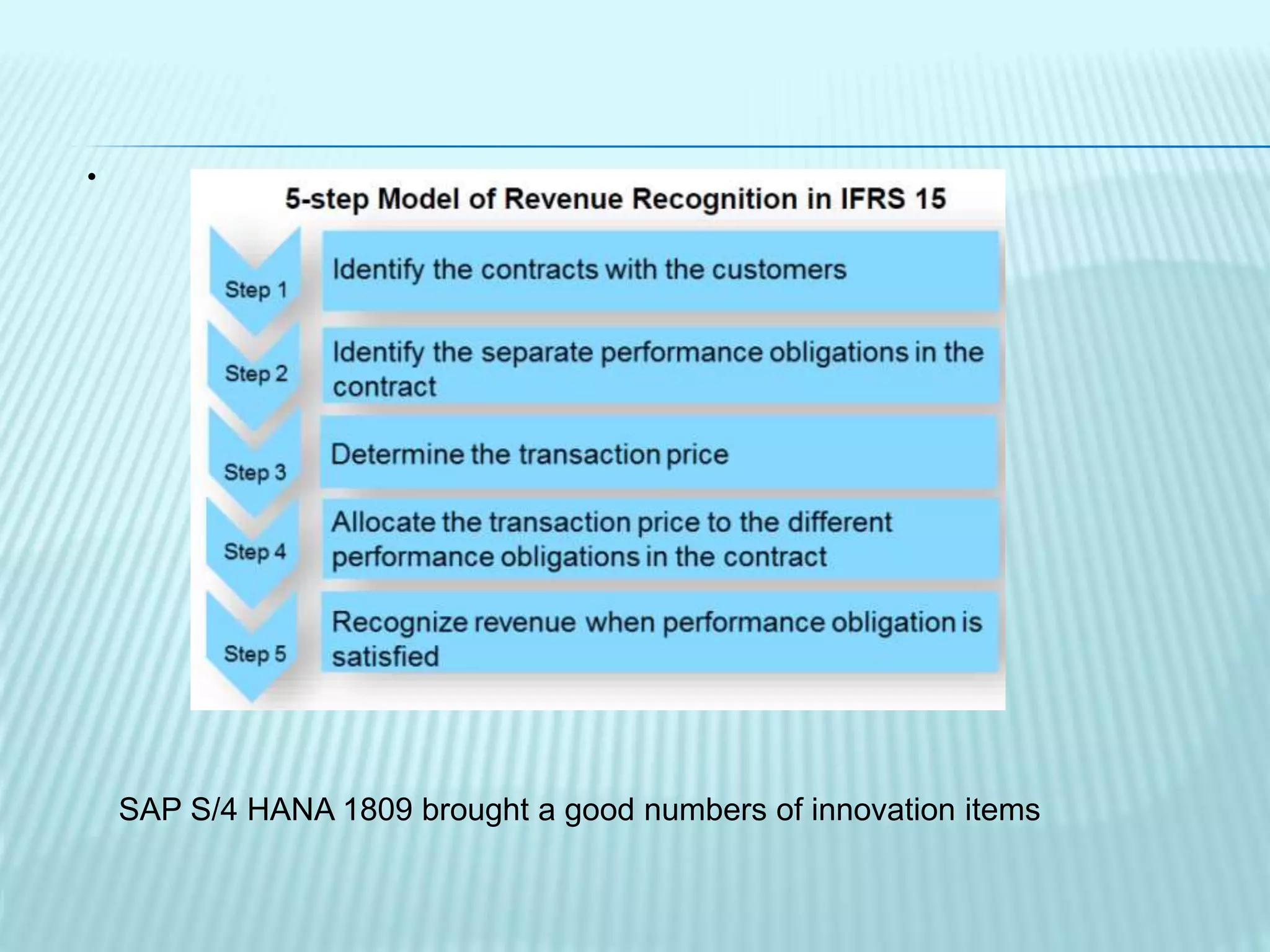
• Adoption of legal changes in revenue accounting –functional round offs for IFRS 15
and ASC 606
• Provide further features based on customer feedback to support the 5-step model
outlined by IFRS 15 and ASC 606:
• Define rules for deriving values of fields for revenue contracts and performance
obligations (POBs)
• Define customized logic to calculate contract liabilities and contract assets
• Calculate the remaining fulfillment percentage for a time-based performance
obligation
• Clean up and reverse productive data coming from external sender components
• Perform an extended check before saving contracts to database
• Enable change of transactional currency in the sales order
• Deliver enhancements to POB cancellations for linked POBs
• General performance improvements
• Reprocess contracts in batch
• Reprocess account determination in batch
• Performance improvements for archiving of contracts and revenue accounting items
• Calculate and post rounding differences in batch for fixed foreign currency method
• Enhanced validation checks and in-flight checks
Improved reconciliation between sender components and inbound processing
• Navigate from the Financials documents to the original documents in Revenue
Accounting
• Change the revenue spreading using an API
• Improved price allocation default BAdI implementation
• Calculate the remaining stand-alone selling price (SSP) for value-relevant
performance obligations (POB)fulfilled by event type customer invoice
• Apply the remaining fulfillment percentage to the stand-alone selling price tolerance
• Re-run the cumulative catch-up program during transition to a new accounting
standard
• End the usage of an accounting principle in Revenue Accounting
• Use batch split processes in SD with Revenue Accounting
•
SAP S/4 HANA 1809 brought a good numbers of innovation items
•
More details about simplification list, official roadmap and other details available on
SAP official release document.
•
Thank You…….

Sap s4 hana (2)

  • 1.
    SAP S/4 HANALOGISTICS 1809 Rajesh Sharma SAP Certified Application Associate SAP Activate Manager SAP ERP 6.0, SAP S/4 HANA 1709 SAP EWM 9.5
  • 2.
    Common Challenges &Solutions Slower reporting/ closing due complex data model  Thanks to SAP HANA’s in memory capability for providing columnar data base and simplified Data Model which helps in instant insight High Cost Operations  Reduction in cost of operations due to great user experience provided by SAP Fiori and that too it can work on any device which mean faster approvals. High Cost Infrastructure  Lower Cost of hardware and software licenses using SAP’s cloud services and leasing the applications
  • 3.
    SAP S/4 HANA1809 Features S/4 HANA 1809 On-Premise & Cloud version New Release Innovative Features are • Simplification Lists • Innovation Discovery
  • 4.
    Key Innovations deliveredin SAP S/4 HANA 18 Embedded Transport Management • Carrier Invoicing • Load Optimization Supply Chain • Advance Available to Promise (AATP) • Product Allocation Industry to Core Utilities • Analytical insight in billing and invoicing • Meter Reading Analysis
  • 5.
    Customer Management • Harmonizeddata model with embedded service management Digital Manufacturing • Capacity evaluation and adjustment Material Requirement Planning Controller • Demand Driven Planning concept Finance • Provide a finance data hub for real-time consolidation • Inter company reconciliation reporting
  • 6.
    Sourcing & Procurement •Centralized Purchase Requisition with utilization of central contract hub • Integration with SAP Ariba buying with SAP S/4 HANA Asset Management • Planner Overview Page • Damage Analysis • Task list and Operations Sales & Distribution • Simplification Sales Order • Sales Billing and Invoicing Split analysis • Approval for Credit memo with new concept of credit management
  • 7.
    Inventory Management • Predictiveanalysis machine learning for decision making • Posting Goods Receipt for Production Order Quality Management • Maintain Quality Inspection Records • Complaints Records management and monitoring • Analyze Key Performance Indicator from Quality Management Data Extended Warehouse Management • Unique Identification of item • By using ABC calculation new reporting system to classify products based on warehouse history
  • 8.
    R&D/ Engineering • VariantConfiguration multilevel. CPQ, Classification • Product marketability and chemical compliance Migration Cockpit • Transfer data using staging tables • Adjust the migration objects that are used with the Object Modeler • These are the Features of SAP S/4 HANA 1809
  • 9.
    Road Map Next12 Month Releases The 12 Month release strategies are:
  • 10.
    How to Start? Onepoint that keep confusing customers deciding what platform strategy to adopt is that although the on-cloud version gets quarterly releases for faster innovation, the same features are also released in the on-premise version during the one-year release. Check the numbers of innovation items released to the on-cloud version, there are too many, and depending on the strategy of your business, to be on top of the innovation can make all the difference and waiting 1 year is not acceptable.
  • 11.
    While the innovationdiscovery and roadmaps portal are the source for what is there? What is coming?, and navigating on those portal filtering to the items that you think it might be relevant to you is recommended, SAP also recommends companies to running some tools such as: •S/4HANA Business Scenario Recommendations – This is a customized report about how SAP S/4HANA can enhance your company’s current performance and competitiveness based on your system’s current production usage data. You should use this tool to identify the business process that can be improved and discover new capabilities. Using this tool, SAP will issue a report with recommendations based on what you have in your ECC today, so instead going to look on a much more comprehensive list of innovation, you can look on the report that is more direct to your company. All it takes is about 5 minutes to upload the information and in approximately 5 business days to receive a report back. •SAP Transformation Navigator – With this tool, it is possible to see the S/4HANA roadmap to each component you have in your current landscape. This tool assesses your current IT landscape, business strategy, and industry trends, and delivers one comprehensive report containing custom recommendations of the SAP products and solutions required to realize your digital strategy.
  • 12.
    SAP Readiness Check Usethis tool to learn the technical requirements and actions for a system conversion to S/4HANA. This tool you help to answer questions like: How big should my SAP HANA database be? Are my add-ons compatible with SAP S/4HANA? What SAP Fiori applications are relevant to my users? Which business functions I run are affected by SAP S/4HANA? Which transactions I run are affected by SAP S/4HANA? Will my custom code objects work with SAP S/4HANA?
  • 13.
    If you havebeen following this subject for the past months or years, you may know that there are different strategies to take to move to the S/4HANA, but when to take one option or other it depends on your business objective of moving to the S/4HANA: •New Implementation: That’s the Greenfield project (either on-cloud or on-premise) and using the Migration Cockpit to load the data from ECC to S/4HANA. This is the best strategy to companies that want to take this chance to review their processes and re-organize the system, get rid of customizations and push for simplification. •System Conversion: If the goal is to move to the S/4HANA faster, and the company is not worried about reviewing the existing processes and to get rid of developments, system conversion might be more suitable to your company.
  • 14.
    In the past,early adopter’s customers had take a long Path to be running on the SAP S/4 HANA full suite
  • 15.
    But now, itis possible, in a system conversion, to go from ECC 6.x directly to 1809 on HANA 2 DB without having to go to Suite on HANA first. Now, the process is one-step to move to the Full Suite S/4HANA on HANA 2 DB without having to go through the middle steps, regardless if it is on-cloud or on-premise:
  • 16.
    Whether your companymust go to the On-premise, public cloud or private cloud, it depends on so many factors, such as: IT strategy, innovation cycles, adoption and upgrade efforts, TCO, Commercial Models, Business functionality, Regulator requirements, etc., here are some of the differences between the platforms:
  • 17.
    SAP S/4HANA simplifiedthe data model and introduced a modern user-experience. They are consistent for both on-cloud and on-premise versions and either on-cloud or on-premise were designed for in-memory database and IT landscape simplification. REPORT THIS AD SAP claims to have more than 2,100 live customers on S/4HANA, more than 8,900 licensed customers where few thousands are already working on their projects. The solution is now available to 25 different industries, in 160 countries and translated to 38 languages. Every live customer has a success story to tell that involves cost reduction and performance improvement. Here is one example:
  • 18.
    SAP CoPilot SAP CoPilotis the (not new) digital assistant that allows users to organize their day, organize tasks in one central spot, and now, in the 1809 release, incorporate Natural Language. Think on Amazon Alexa or Apple Siri assistants, now you can have the same experience on SAP, asking questions for example, searching for results of sales report in a given region for example, scheduling meetings to talk about a specific item on your SAP dashboard. The CoPilot uses Machine Learning capabilities to improve the results and perform better as it is trained by the user. • Humanized Next-Gen UX with a Conversational UI using Natural Language Processing Functionality • Business Context Awareness understanding the business situation and pro-actively suggestion solutions • Self-learning system using machine learning functionality to gain knowledge based on historic data and experience • Cross Applications with One Personality and One Memory across all SAP • Open and Extensible for Integration to SAP and Non-SAP Solutions Enabling our customers and partners to extend CoPilot Skills through bots, agents and APIs
  • 19.
    Machine Learning We allshould agree that SAP S/4HANA is the start to get your company to the next level of Enterprise Resourcing Planning. Modernizing your ERP provides the foundation to connect your data, automate key functions, and constantly improve your products & services. With Machine Learning capabilities embedded, the ERP becomes intelligent and job becomes more dynamic and predictive, routine tasks are automated. SAP started introducing ML capabilities in the S/4HANA in the 1709 release, here is what is coming to the 1809: Sourcing & Procurement • Exception handling • Increased invoice automation with machine learning and efficient invoice monitoring for exception handling • Reduce free-text items using Machine Learning that automatically proposes to create a new catalog item, • Propose material group for free-text items in purchase requisitions • Provide options for materials without source of supply using Machine Learning
  • 20.
    Product Safety andStewardship Product compliance o Services for dangerous goods determination and classification as well as substance group assignment based on machine learning models o Models that will be trained with product data and chemical composition respectively substance data from SAP and our customers o Integration of the services into SAP S/4HANA for Product Compliance Inventory Management Goods Receipt Process o Automatic detection of patterns for determining recurrent behaviors based on historical data and application of the patterns to new data –using predictive analytics in SAP S/4HANA oEnhancements to the existing app with additions, such as the predicted delivery date o Inclusion of the predicted delivery date into creation of stock transport orders
  • 21.
    Sales & Distribution Analytics oDetermine the quotation-conversion probability using predictive analytics and machine learning o Monitor your delivery performance using predictive analytics in SAP S/4HANA – in-time supply of procurement processes to the creation of outbound deliveries Merchandise Management Global data synchronization o Machine learning global data synchronization integration: Enable access from global data synchronization (GDS) inbound processes to SAP Leonardo Machine Learning. SAP continue pushing hard to implement more machine learning elements and make the ERP more intelligent every release.
  • 22.
    Mass Maintenance • Scopeand process enhancements in mass maintenance of master data, increased data coverage. Support for: o Multiple vendor and customer assignments in mass maintenance of business partner data o Classification data in mass maintenance of material, customer, and vendor data The Export Master Data app enables you to export a selection of master data to an Office Open XML file. This file can be used for Mass Maintenance and for Mass Processing of Master Data. The following business objects are supported: • Business Partner • Business Partner Relationship • Product
  • 23.
    • Mass Maintenanceenables you to update multiple master data records at a time The function is available for the material master and business partner (including customer and vendor). You can access this function through the Start Mass • Maintenance and Manage Mass Maintenance tiles in the SAP Fiori Launchpad. To update records, you select the fields and records you want to change. The system then displays a list of fields to change based on your selection. Once you enter your changes, the system provides statistics on the changed fields and validates the data. You check the validated data and then activate it. Activation copies the data from the staging area to active memory, enabling the system to use it in business transactions. New feature: • Support of multiple assignments for business partner • Support of classification data for business partner (customer, supplier) and product
  • 24.
    Central Governance •Central governancefor internal order master data –continued improvements to data quality Enable central governance for internal order master data including: •Initial loading of internal orders •Searching statistical internal orders •Changing or creating statistical internal orders •Replicating internal orders with IDOC and service-oriented architecture (SOA) Enable central governance for internal order master data including: • Make initial load of internal orders • Search statistical internal orders • Change or create statistical internal orders • Replicate internal orders with IDOC and service-oriented architecture (SOA)
  • 25.
    •Enhanced SAP Fioriuser experience in process analytics –summary dashboard and analytical list pages • One-stop information on prevailing process quality in central governance, consolidation, and mass processing • Intuitive navigation and drill down for detailed analysis of process-quality issues • Summary dashboard and analytical list pages displaying relevant process information at a glance and enabling users to drill down and start completing the processes Central governance – scope enhancements and simplifications across master data domains Functional enhancements in central governance for business partner (supplier, customer), material, and financial master data:
  • 26.
    • Use ofnewly added customers and vendors as references for partner functions within the same change request • Enhanced pre-delivered data model for SAP Master Data Governance, Customers, via general data of the SAP Credit Management application (FSCM-CM) • Adoption of simplifications and enhancements for SAP S/4HANA for the SAP • Master Data Governance application and user interface enhancements for material searches • Adoption of the universal journal for SAP S/4HANA with general ledger accounts as the basis for cost-element data
  • 27.
    DATA QUALITY • Managingdata quality rules for products • Repository to catalog and define data-quality rules for product master data • Comprehensive description of rules, including business aspects, ownership, and rule implementations • Collaboration and status handling during the life-cycle of rules, from creation to sunset • Measuring and analyzing data quality –continuous evaluation • Evaluation of product master data using data-quality rules • Analysis of incorrect product data • Correction of identified issues in product data
  • 28.
    • Definition ofdata-quality scores as key-performance indicators (KPIs) for master data management • Reporting and analysis of data-quality scores
  • 29.
    MIGRATION COCKPIT SAP MigrationCockpit counts with universal applicability. SAP delivered with the 1809 release, some changes connecting to SAP system as a data source as well to legacy systems: The next-generation data migration software embedded in SAP S/4HANA Highly simplified for SAP applications as data sources Guided procedure takes users through the migration process: Easy and safe No programming by the customer required Flexible for integration of custom business data including data transformations Included in S/4HANA license and shipment Made for migrating data from SAP and non-SAP sources into SAP S/4HANA (on- premise) and SAP S/4HANA Cloud
  • 30.
    Predefined SAP S/4HANAspecific Migration Content • Facilitates and accelerates your data migration. Preconfigured content and mapping for available migration objects, e.g. customers Predefined templates for each object Automated mapping between template and target structure Migration programs are generated automatically • Customer-Specific Migration Content can be flexibly included Integration of customer-built objects Customer-specific enhancements to SAP standard objects (e.g. add new fields)
  • 31.
    Key Finance Innovations FinancialPlanning • Connectivity of SAP Analytics Cloud to a on-premise planning environment • Send plan data that has been treated or modified in the SAP Analytics Cloud solution to an ACDOCP planning table without using XLS export or import functionality • Plan data allocations reworked to update new universal planning persistence • Allocation of planned costs for first scenarios • Enhancement of data structures to better support reporting of allocation results • Simplify rule definition for plan allocations • Improve traceability of allocations
  • 32.
    Central Finance • Improvementsand simplifications for on-boarding and operations • Tools for correcting errors more efficiently (reversal and repost function) • Increased flexibility and speed for initial loading • Provide a finance data hub for real-time consolidation • Replication of trading partner and profit center information within replicated postings (including initial load)
  • 33.
    •Consolidation • Plan dataconsolidation • Ability to create versions for planning / restatement purpose • Data copy functionality • Multiperiod processing • Read access to universal journal plan items • CDS views for comparison reporting • External system integration Provide additional integration capabilities for external systems: • Inbound interfaces and APIs for reported data and manual journals
  • 34.
    Better support forintegration scenarios, such as: • Connecting on-premise SAP accounting software systems • Connecting on-premise 3rd-party systems • Providing APIs for SAP, partner, or customer developments based on SAP Cloud platform • Intercompany reconciliation report • Provide report that helps identify intercompany differences • Display the translated reported data of related parties, including a calculation of the difference –based on the definition of intercompany elimination • Display certain accounting information, such as operational account number or reference document number for companies that use SAP S/4HANA for accounting purposes, and display data at the provided level of data granularity otherwise
  • 35.
    • Increased levelof detail in consolidation data • Increased level of detail available in consolidated data • Direct integration of operational accounting type dimensions in group reports • Built-in ability to drill down from embedded analytics reports through to the operational accounting journal • Blending of operational reporting dimensions into group reports, enabling users to answer ad hoc questions that require highly detailed data using corporate group reports as a starting point • Statutory group reporting (group accounting) and management reporting (group controlling) from a single source. • SAP S/4HANA consolidation –legal consolidation • Consolidation of the actuals data of legal entities • Integrated “read data” access from universal journal actuals for SAP S/4HANA Cloud
  • 36.
    • Flat fileupload for reported data • Flat file upload for manual journals • Data validation • Manual adjustment postings • Currency translation into common group currency • Automated intercompany eliminations • Rule-based generation of draft cash flow reports and consolidation of investments • Embedded analytics through the SAP Fiori user experience and the integration option for the SAP Analytics Cloud solution
  • 37.
    Reporting • Business reportingcontent –enhancements for flexible hierarchies • Generation of profit center hierarchies, cost center hierarchies, and company code hierarchies using attributes in the master data • Structuring of hierarchy nodes based on sequences of attributes (such as region, country, or product) • Creation of parallel hierarchies for the same master data • Mass change functions to update attributes
  • 38.
    Cash Management • Enhancethe liquidity forecast through integration of real estate data • Provide the cash manager with an enhanced, more comprehensive forecast of cash data by including cash flow information from contract and leasing management • Tap into business operations to provide an indication of future cash flow to the customer who uses contract and leasing management, even before it is booked in accounting • Integrate the cash report with future flows • Correspondence for bank account management • Generation of correspondence to banks based on opening, changing, and closing activities in bank account management
  • 39.
    • Bank feeimporting and reporting • Import the ISO 20022 camt.086 format bank fee file into the system and provide the cash manager with a comprehensive view of the services provided by banks and the charges paid to banks • Provide cash managers with transparency into the share of the wallet • Enable the cash manager to answer the questions: • How is my business distributed into different partners? • How is the cost distributed? • Snapshot of historic cash position • Cash manager to retain a historic snapshot of the cash position report for comparison with the current view • Ability to compare yesterday’s historic cash position with today’s view to reveal the differences in actual and to optimize the future cash disposition for investment or financing
  • 40.
    Integration / Connectivity •Financial Planning: Connectivity of SAP Analytics Cloud to an on-premise planning environment • Send plan data that has been treated or modified in the SAP Analytics Cloud solution to an ACDOCP planning table without using XLS export or import functionality • Integration with business networks –cost center integration with SAP • SuccessFactors Employee Central and SAP SuccessFactors Employee Central Payroll • Cost center integration to SAP SuccessFactors solutions with the SAP SuccessFactors Employee Central and SAP SuccessFactors Employee Central Payroll solutions
  • 41.
    • Integration withbusiness networks –purchase order accruals • Third-party accruals for purchase orders • Provisions, deferrals, and other accruals, such as bonus accruals and vacation accruals • Smooth integration with SAP Fieldglass and SAP Ariba solutions
  • 42.
    Parallel Valuation andRevenue Accounting • Parallel valuation –multiple currencies in follow-on processes • Ability to handle multiple currencies from journal entries in follow-on processes: • Allocations (distribution and assessment) • Asset capitalization and depreciation • Adoption of legal changes in revenue accounting –improved support for disclosures • The SAP Revenue Accounting and Reporting application enables users to: Utilize posting data that results from events related to revenue recognition, such as fulfillments and invoices, for analytical reporting and for meeting disclosure requirements • Use the Revenue Accounting data sources with the Operational Data Provisioning Framework (ODP)
  • 43.
    Treasury & RiskManagement • Basic coverage of legislations in foreign currency hedge management and accounting with US GAAP • Treasury applications from SAP –designed to help our customers manage the complete spectrum of activities associated with payments, cash, liquidity, financial risk, and compliance management • Foreign currency risk management and accounting: • Comprehensive process support for managing foreign currency risks Management of foreign currency risks arising from different exposures, such as forecasted transactions or firm commitments • Accounting support for U.S. GAAP
  • 44.
    Foreign exchange (FX)hedge accounting solution with U.S. Generally • Accepted Accounting Principles (GAAP) –which includes functionality for: • Process automation –designation of hedging relationships • U.S. GAAP accounting support for FX forwards and the FX option types “plain vanilla,” “zero-cost collar,” and “swaps” • Assessment • Recycling of other comprehensive income (OCI) values • Removal of designation and reclassification at contract close
  • 45.
    Leveraging Soft Closeand Prediction • Leveraging soft close and prediction –first commitment scenarios Commitments: • Are stored in the same basic structure as in the universal journal • Include cost assignments to work breakdown structure (WBS) element, order, cost center, and so on but also link to the supplier • Can be shown for derived characteristics, such as profit center and functional area • Leveraging soft close and prediction –accounting for incoming sales orders • New concept for handling of predictive data • Financial line item details for incoming orders reporting • Review incoming sales order report • Provides a comprehensive overview of all orders and their values for the time period regardless of billing status
  • 46.
    SAP Cloud Platform •Leverage SAP Cloud Platform for use in finance –application for goods receipt and invoice receipt monitor • Machine learning service extension to include status proposals for the invoice and goods receipt monitor • Reduced effort in manual checks as the monitor will make status proposals according to the particular circumstances of a purchase-order item • Leverage SAP Cloud Platform for use in finance –SAP Real Spend for developing additional expense management scenarios • Definition of further use cases to deepen the functionality of the SAP Real • Spend solution in expense management scenarios • Leverage SAP Cloud Platform for finance –Credit Management Cockpit • Provide a cockpit that shows all relevant credit events for the credit controller
  • 47.
    • Leverage SAPCloud Platform for use in finance -smart alerting in SAP Financial Statement Insights • Get automatic, system-generated alerts of any irregularities • Autonomously detect unusual business situations in revenue and cost accounts • Analyze revenue and cost data, proactively inform the group controller of potential issues, and provide explanations for unusual business situations • Leverage insights for finance in SAP Cloud Platform with SAP S/4HANA Cloud for finance –integration of additional credit agencies • Support for interfaces to additional credit agencies • Leverage SAP Cloud Platform for consolidation –enhanced data collection for non- financial measures and non-integrated subsidiaries • Dedicated application in SAP Cloud Platform for collecting data from subsidiaries not running their local accounting on
  • 48.
    • Leverage SAPCloud Platform for treasury -integration of trading platform 360T for inbound and outbound services Goals: • Complete service offering for the integration of 360T as one treasury trading platform with minimal configuration effort and without the need to update the current system • Availability of additional value-added services to complement our on-premise and cloud offerings in SAP Treasury and Risk Management • Out of the box service after an initial onboarding • Reduced TCI and TCO as IT support for the integration of an FX marketplace is outsourced to SAP Cloud Platform • Business standard for most FX transactions to be made on an FX marketplace such as 360T (subsidiary of Deutsche Börse Group) or FX all(a part of Thomson Reuters)
  • 49.
    • Need foruploading the externally placed trades back to the SAP software system (inbound service) • Planned scope: • Uploading onto the app and storage of deals done on 360T • In-app storage of the competitive bids • Upon completion of all necessary fields, writing of the deal to the SAP • Treasury and Risk Management application and return of the deal number back to the app • In case the deal is not complete (necessary data is not provided), notification made and e-mail sent • Product types in scope: FX spot, FX forward, FX swap, FX plain vanilla options, and non deliverable forward (NDF)
  • 50.
    • Existing needto get a deal request into the marketplace directly from the report where you have the “to be traded amount” (outbound service) • Planned scope: • Outbound service for FX deal requests arising from the hedge management cockpit • Possibility to split deal requests from the hedge management cockpit into several deal requests inside the app • Deal request to be sent to the trading platform (360T) • Deal request to be mapped to incoming deals for completeness
  • 51.
    Revenue Recognition • Adoptionof legal changes in revenue accounting –functional round offs for IFRS 15 and ASC 606 • Provide further features based on customer feedback to support the 5-step model outlined by IFRS 15 and ASC 606: • Define rules for deriving values of fields for revenue contracts and performance obligations (POBs) • Define customized logic to calculate contract liabilities and contract assets • Calculate the remaining fulfillment percentage for a time-based performance obligation • Clean up and reverse productive data coming from external sender components • Perform an extended check before saving contracts to database
  • 52.
    • Enable changeof transactional currency in the sales order • Deliver enhancements to POB cancellations for linked POBs • General performance improvements • Reprocess contracts in batch • Reprocess account determination in batch • Performance improvements for archiving of contracts and revenue accounting items • Calculate and post rounding differences in batch for fixed foreign currency method • Enhanced validation checks and in-flight checks Improved reconciliation between sender components and inbound processing • Navigate from the Financials documents to the original documents in Revenue Accounting
  • 53.
    • Change therevenue spreading using an API • Improved price allocation default BAdI implementation • Calculate the remaining stand-alone selling price (SSP) for value-relevant performance obligations (POB)fulfilled by event type customer invoice • Apply the remaining fulfillment percentage to the stand-alone selling price tolerance • Re-run the cumulative catch-up program during transition to a new accounting standard • End the usage of an accounting principle in Revenue Accounting • Use batch split processes in SD with Revenue Accounting
  • 54.
    • SAP S/4 HANA1809 brought a good numbers of innovation items
  • 55.
    • More details aboutsimplification list, official roadmap and other details available on SAP official release document.
  • 56.