SAP
Systems, Applications, Products in data
processing
Objectives:
• To explain:
The Concept, History and
Scope of Enterprise
system
Why it is important.
• To explore:
Various SAP Modules.
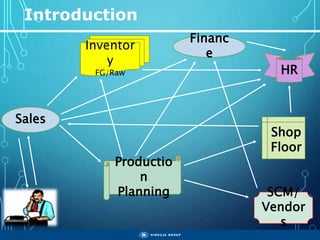
Introduction
Sales
SCM/
Vendor
s
Financ
e
Inventor
y
FG/Raw HR
Productio
n
Planning
Shop
Floor
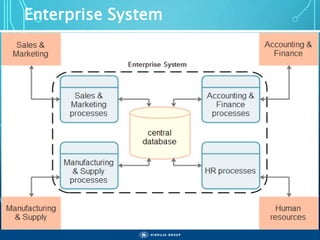
Enterprise System
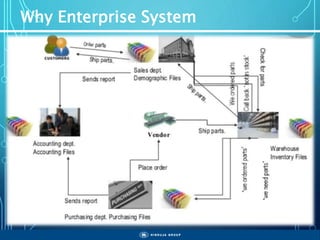
Why Enterprise System
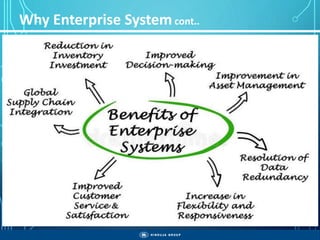
Why Enterprise Systemcont..
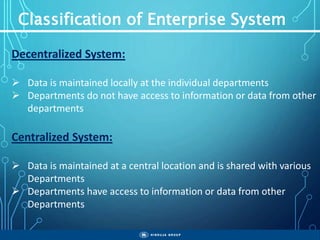
Classification of Enterprise System
Decentralized System:
 Data is maintained locally at the individual departments
 Departments do not have access to information or data from other
departments
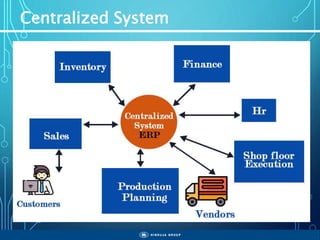
Centralized System:
 Data is maintained at a central location and is shared with various
Departments
 Departments have access to information or data from other
Departments
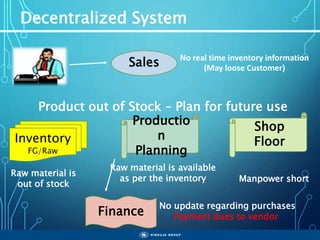
Sales
Decentralized System
Inventory
FG/Raw
Productio
n
Planning
Product out of Stock – Plan for future use
No real time inventory information
(May loose Customer)
Raw material is available
as per the inventory
Raw material is
out of stock
Shop
Floor
Manpower short
Finance
No update regarding purchases
Payment dues to vendor
Decentralized System Cont...
Major Problems:
 Numerous disparate information systems created individually over
time which are difficult to maintain
 Integrating the data is time and money consuming
 Inconsistencies and duplication of data
 Lack of timely information leads to customer dissatisfaction, loss
of revenue and reputation
 High Inventory, Material, and Human resource cost.
Centralized System
Centralized System Cont....
Key benefits:
 It eliminates the duplication, discontinuity, and redundancy in data
 Provides information across departments in real time
 Better inventory & effective human resources management
 Improves customer service
SAP Software is a centralized enterprise management system
SAP
 SAP Software is a centralized enterprise management system
 SAP stands for Systems Applications and Products in Data Processing
 Since it is an acronym, it is pronounced as individual letters (S-A-P)
 Software solutions for managing business operations & relationships
 Consists of fully integrated modules, which covers virtually every aspect of
business management.
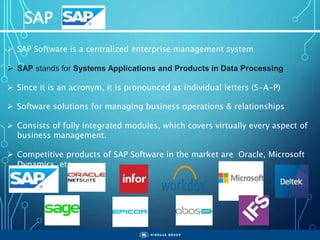
 Competitive products of SAP Software in the market are Oracle, Microsoft
Dynamics, etc.
History of SAP
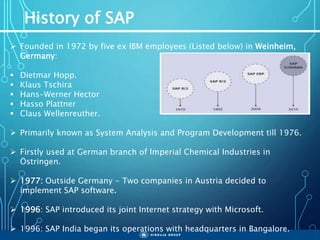
 Founded in 1972 by five ex IBM employees (Listed below) in Weinheim,
Germany:
 Dietmar Hopp.
 Klaus Tschira
 Hans-Werner Hector
 Hasso Plattner
 Claus Wellenreuther.
 Primarily known as System Analysis and Program Development till 1976.
 Firstly used at German branch of Imperial Chemical Industries in
Östringen.
 1977: Outside Germany - Two companies in Austria decided to
implement SAP software.
 1996: SAP introduced its joint Internet strategy with Microsoft.
 1996: SAP India began its operations with headquarters in Bangalore.
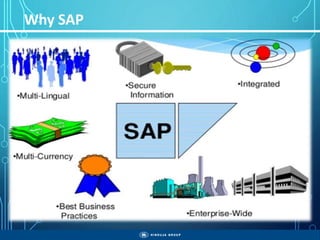
Why SAP
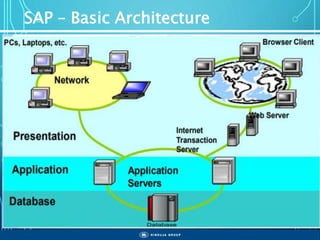
SAP – Basic Architecture
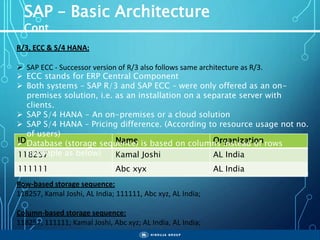
Cont..
ID Name Organization
118257 Kamal Joshi AL India
111111 Abc xyx AL India
Row-based storage sequence:
118257, Kamal Joshi, AL India; 111111, Abc xyz, AL India;
Column-based storage sequence:
118257, 111111; Kamal Joshi, Abc xyz; AL India, AL India;
R/3, ECC & S/4 HANA:
 SAP ECC - Successor version of R/3 also follows same architecture as R/3.
 ECC stands for ERP Central Component
 Both systems – SAP R/3 and SAP ECC – were only offered as an on-
premises solution, i.e. as an installation on a separate server with
clients.
 SAP S/4 HANA - An on-premises or a cloud solution
 SAP S/4 HANA – Pricing difference. (According to resource usage not no.
of users)
 Database (storage sequence) is based on columns instead of rows
(Example as below)
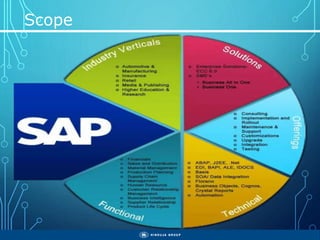
Scope
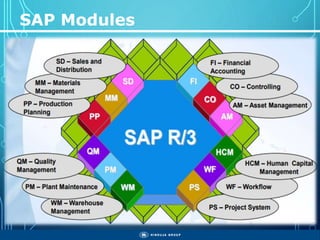
SAP Modules
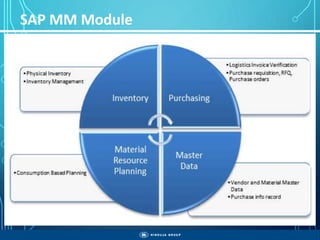
SAP MM Module
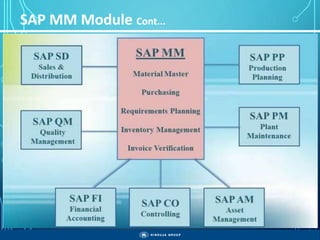
SAP MM Module Cont...
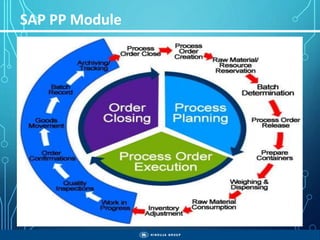
SAP PP Module
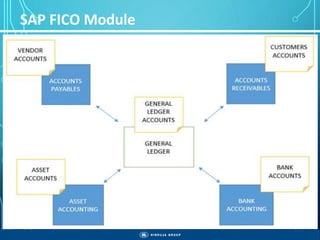
SAP FICO Module
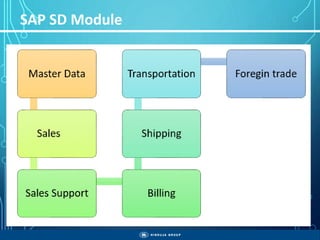
SAP SD Module
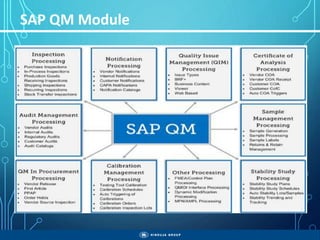
SAP QM Module
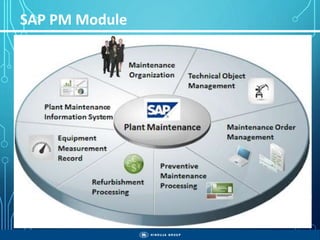
SAP PM Module
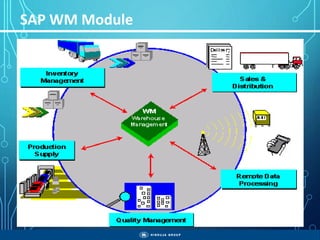
SAP WM Module
SAP HRM Module
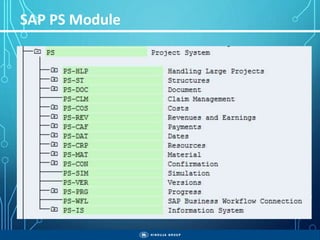
SAP PS Module
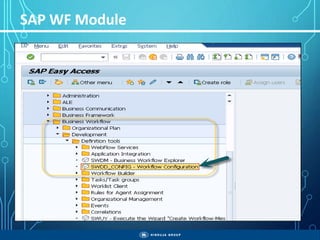
SAP WF Module
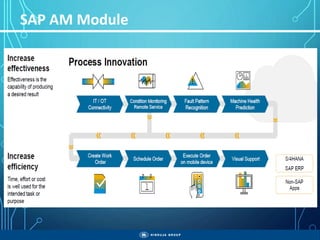
SAP AM Module
Sap basics (SAP Modules)

Sap basics (SAP Modules)

  • 1.
  • 2.
    Objectives: • To explain: TheConcept, History and Scope of Enterprise system Why it is important. • To explore: Various SAP Modules.
  • 3.
  • 4.
  • 5.
  • 6.
  • 7.
    Classification of EnterpriseSystem Decentralized System:  Data is maintained locally at the individual departments  Departments do not have access to information or data from other departments Centralized System:  Data is maintained at a central location and is shared with various Departments  Departments have access to information or data from other Departments
  • 8.
    Sales Decentralized System Inventory FG/Raw Productio n Planning Product outof Stock – Plan for future use No real time inventory information (May loose Customer) Raw material is available as per the inventory Raw material is out of stock Shop Floor Manpower short Finance No update regarding purchases Payment dues to vendor
  • 9.
    Decentralized System Cont... MajorProblems:  Numerous disparate information systems created individually over time which are difficult to maintain  Integrating the data is time and money consuming  Inconsistencies and duplication of data  Lack of timely information leads to customer dissatisfaction, loss of revenue and reputation  High Inventory, Material, and Human resource cost.
  • 10.
  • 11.
    Centralized System Cont.... Keybenefits:  It eliminates the duplication, discontinuity, and redundancy in data  Provides information across departments in real time  Better inventory & effective human resources management  Improves customer service SAP Software is a centralized enterprise management system
  • 12.
    SAP  SAP Softwareis a centralized enterprise management system  SAP stands for Systems Applications and Products in Data Processing  Since it is an acronym, it is pronounced as individual letters (S-A-P)  Software solutions for managing business operations & relationships  Consists of fully integrated modules, which covers virtually every aspect of business management.  Competitive products of SAP Software in the market are Oracle, Microsoft Dynamics, etc.
  • 13.
    History of SAP Founded in 1972 by five ex IBM employees (Listed below) in Weinheim, Germany:  Dietmar Hopp.  Klaus Tschira  Hans-Werner Hector  Hasso Plattner  Claus Wellenreuther.  Primarily known as System Analysis and Program Development till 1976.  Firstly used at German branch of Imperial Chemical Industries in Östringen.  1977: Outside Germany - Two companies in Austria decided to implement SAP software.  1996: SAP introduced its joint Internet strategy with Microsoft.  1996: SAP India began its operations with headquarters in Bangalore.
  • 14.
  • 15.
    SAP – BasicArchitecture
  • 16.
    SAP – BasicArchitecture Cont.. ID Name Organization 118257 Kamal Joshi AL India 111111 Abc xyx AL India Row-based storage sequence: 118257, Kamal Joshi, AL India; 111111, Abc xyz, AL India; Column-based storage sequence: 118257, 111111; Kamal Joshi, Abc xyz; AL India, AL India; R/3, ECC & S/4 HANA:  SAP ECC - Successor version of R/3 also follows same architecture as R/3.  ECC stands for ERP Central Component  Both systems – SAP R/3 and SAP ECC – were only offered as an on- premises solution, i.e. as an installation on a separate server with clients.  SAP S/4 HANA - An on-premises or a cloud solution  SAP S/4 HANA – Pricing difference. (According to resource usage not no. of users)  Database (storage sequence) is based on columns instead of rows (Example as below)
  • 17.
  • 18.
  • 19.
  • 20.
  • 21.
  • 22.
  • 23.
  • 24.
  • 25.
  • 26.
  • 27.
  • 28.
  • 29.
  • 30.

Editor's Notes

  • #4 Typical Business Process