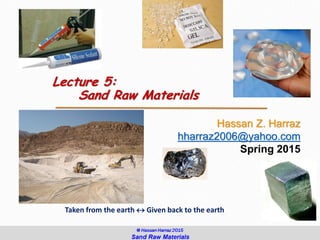
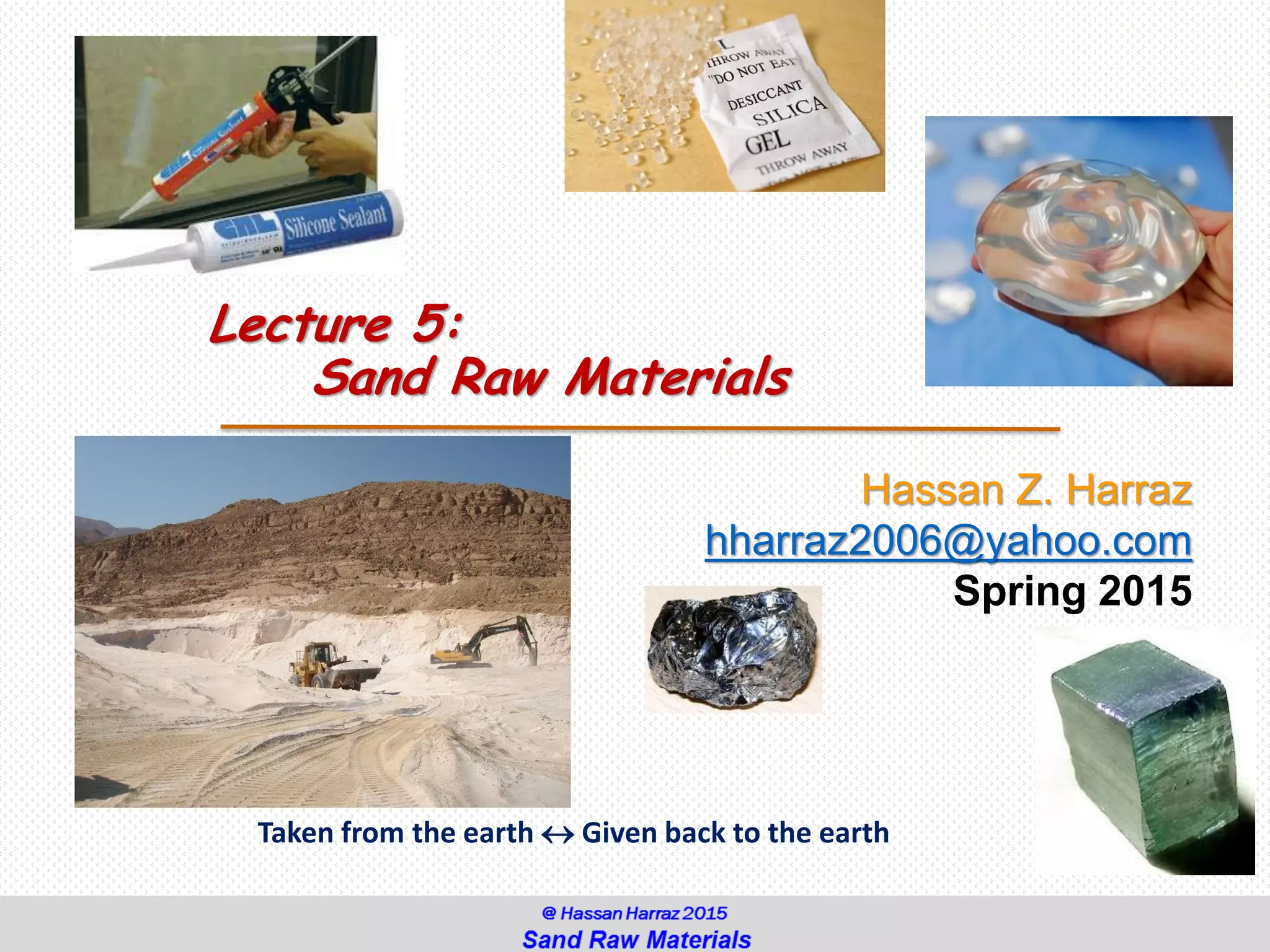
Lecture 5:
Sand Raw Materials
Hassan Z. Harraz
hharraz2006@yahoo.com
Spring 2015
Taken from the earth  Given back to the earth
1
MINERAL SANDS
Silicon (Si) is the 2nd most abundant element in earth’s crust.
Commonly found in its oxidized form (SiO2).
Sand is a naturally occurring granular material comprised of
finely divided rock and mineral particles.
Sand is transported by wind and water and deposited in the
form of beaches, dunes, sand spits, sand bars (placer
deposits) ….etc.
Sand constituents of sands are silica (SiO2), usually in the
form of quartz, and iron oxides.
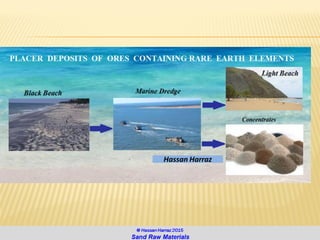
The term "Mineral Sands" normally refers to concentrations of
Heavy Minerals (HM) in an alluvial (old beach or river system)
environment. Occasionally these deposits are referred to as
"Beach sands". However mineral sands are also found in large
Aeolian sand systems or “Dunal sands”.
Mineral sands orebodies essentially fall into two categories based
on the mode of deposition: alluvial or aeolian. Alluvial deposits
are further split into marine beach placers and lacustrine heavy
mineral (HM) accumulations.
The principal Valuable Heavy Minerals (VHM) include ilmenite,
leucoxene, rutile and zircon.
Variations of other titanium minerals occur between the end
members of ilmenite and rutile, including pseudo rutile and
anatase.
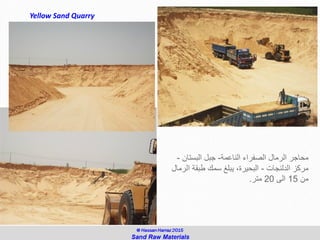
‫الناعمة‬ ‫الصفراء‬ ‫الرمال‬ ‫محاجر‬-‫البستان‬ ‫جبل‬-
‫الدلنجات‬ ‫مركز‬-‫ا‬ ‫طبقة‬ ‫سمك‬ ‫يبلغ‬ ،‫البحيرة‬‫لرمال‬
‫من‬15‫الى‬20‫متر‬.
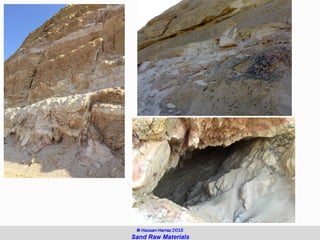
Yellow Sand Quarry
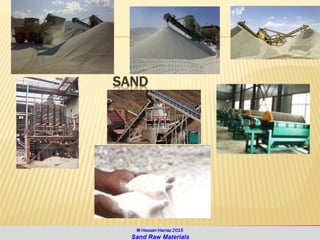
SAND
5
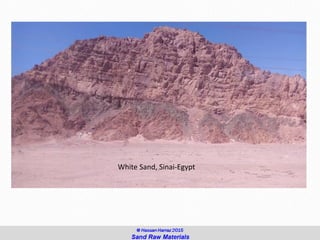
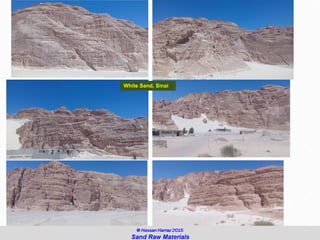
White Sand, Sinai-Egypt
7
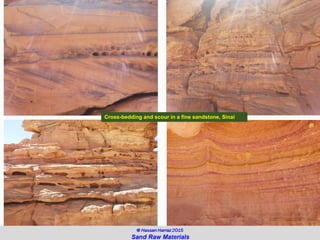
Cross-bedding and scour in a fine sandstone, Sinai
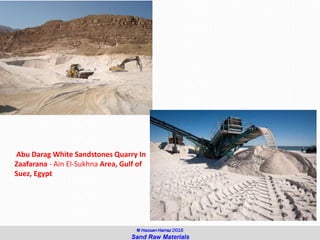
Abu Darag White Sandstones Quarry In
Zaafarana - Ain El-Sukhna Area, Gulf of
Suez, Egypt
White Sand, Sinai
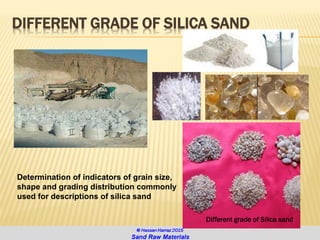
DIFFERENT GRADE OF SILICA SAND
Different grade of Silica sand
Determination of indicators of grain size,
shape and grading distribution commonly
used for descriptions of silica sand
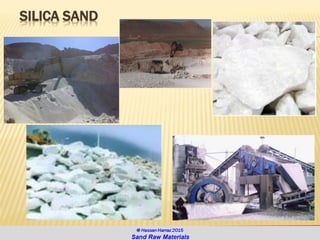
SILICA SAND
12
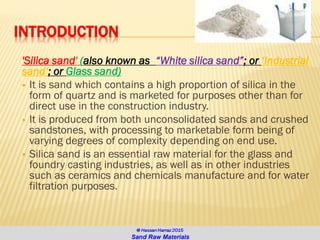
INTRODUCTION
'Silica sand' (also known as “White silica sand”; or ‘Industrial
sand‘; or Glass sand)
▪ It is sand which contains a high proportion of silica in the
form of quartz and is marketed for purposes other than for
direct use in the construction industry.
▪ It is produced from both unconsolidated sands and crushed
sandstones, with processing to marketable form being of
varying degrees of complexity depending on end use.
▪ Silica sand is an essential raw material for the glass and
foundry casting industries, as well as in other industries
such as ceramics and chemicals manufacture and for water
filtration purposes.
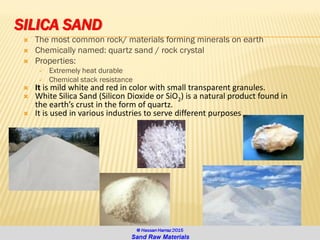
SILICA SAND
 The most common rock/ materials forming minerals on earth
 Chemically named: quartz sand / rock crystal
 Properties:
✓ Extremely heat durable
✓ Chemical stack resistance
 It is mild white and red in color with small transparent granules.
 White Silica Sand (Silicon Dioxide or SiO2) is a natural product found in
the earth’s crust in the form of quartz.
 It is used in various industries to serve different purposes
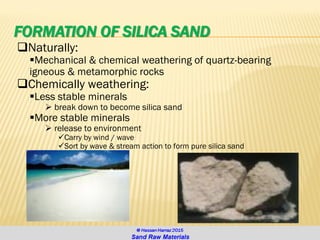
FORMATION OF SILICA SAND
Naturally:
▪Mechanical & chemical weathering of quartz-bearing
igneous & metamorphic rocks
Chemically weathering:
▪Less stable minerals
➢ break down to become silica sand
▪More stable minerals
➢ release to environment
✓Carry by wind / wave
✓Sort by wave & stream action to form pure silica sand
EXTRACTION OF SILICON SAND
1) Stripping of overburden (topsoil & vegetation) by
bulldozers & scraper
2) Wet separation by washing the sand, passing
through screens to remove roots & other organic
matter
3) Gravity separation to separate silica sand from
regular sand
4) Finished silica sand is transported by trucks to plants
for processing
5) Oversized materials & residual clay are returned to
mined pits
Silica sands(or glass sand) requires processing as follows:
1)Screening
2)Washing and sizing, using hydrocyclones, attrition
scrubbing,……etc.
3)Flotation and/or chemical/acid leaching to remove Fe
minerals and stained quartz.
4)Spiralling and/or tabling to remove heavy minerals.
5)Hydrosizing.
6)Dewatering
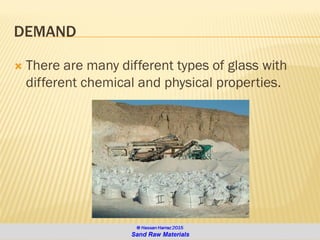
DEMAND
 There are many different types of glass with
different chemical and physical properties.
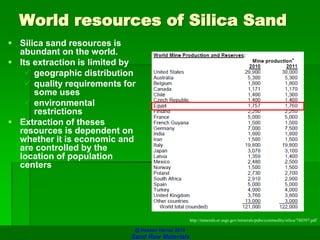
World resources of Silica Sand
▪ Silica sand resources is
abundant on the world.
▪ Its extraction is limited by
✓ geographic distribution
✓ quality requirements for
some uses
✓ environmental
restrictions
▪ Extraction of theses
resources is dependent on
whether it is economic and
are controlled by the
location of population
centers
http://minerals.er.usgs.gov/minerals/pubs/commodity/silica/780397.pdf
@ Hassan Harraz 2015
Sand Raw Materials
 History:
 Glass making & metallurgical activities few
thousands years BC ago
 Key raw material in ceramics, foundry & glass
industrial revolution
 Today:
 Glass making, foundry casting, ceramics,
filtration, specialist building applications,
leisure ( e.g. golf course), filters in numerous
products, plastics, the manufacture of
chemicals, metal & refractory, as addictives in
horticultural & agricultural products &
simulating oil production
 Important for today’s information
technology:
 Raw material for silicon chips
 Plastics of computer mouses
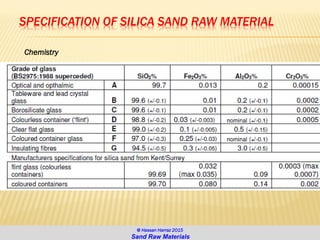
SPECIFICATION OF SILICA SAND RAW MATERIAL
Chemistry
@ Hassan Harraz 2015
Sand Raw Materials
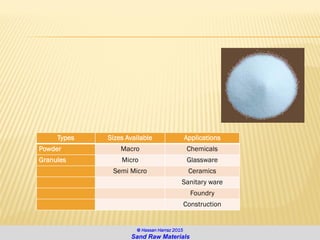
Types Sizes Available Applications
Powder Macro Chemicals
Granules Micro Glassware
Semi Micro Ceramics
Sanitary ware
Foundry
Construction
@ Hassan Harraz 2015
Sand Raw Materials
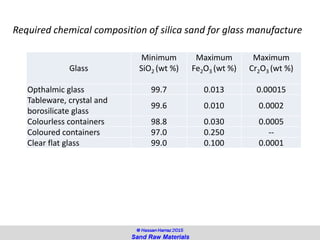
Required chemical composition of silica sand for glass manufacture
Maximum
Cr2O3 (wt %)
Maximum
Fe2O3 (wt %)
Minimum
SiO2 (wt %)Glass
0.000150.01399.7Opthalmic glass
0.00020.01099.6
Tableware, crystal and
borosilicate glass
0.00050.03098.8Colourless containers
--0.25097.0Coloured containers
0.00010.10099.0Clear flat glass
@ Hassan Harraz 2015
Sand Raw Materials
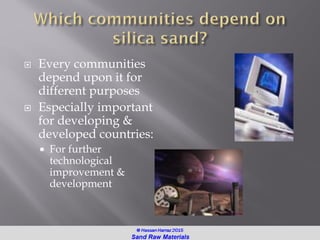
 Every communities
depend upon it for
different purposes
 Especially important
for developing &
developed countries:
 For further
technological
improvement &
development
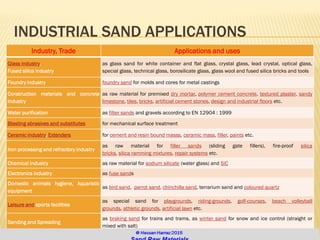
INDUSTRIAL SAND APPLICATIONS
Industry, Trade Applications and uses
Glass industry,
Fused silica industry
as glass sand for white container and flat glass, crystal glass, lead crystal, optical glass,
special glass, technical glass, borosilicate glass, glass wool and fused silica bricks and tools
Foundry industry foundry sand for molds and cores for metal castings
Construction materials and concrete
industry
as raw material for premixed dry mortar, polymer cement concrete, textured plaster, sandy
limestone, tiles, bricks, artificial cement stones, design and industrial floors etc.
Water purification as filter sands and gravels according to EN 12904 : 1999
Blasting abrasives and substitutes for mechanical surface treatment
Ceramic industry, Extenders for cement and resin bound masss, ceramic mass, filler, paints etc.
Iron processing and refractory industry
as raw material for filler sands (sliding gate fillers), fire-proof silica
bricks, silica ramming mixtures, repair systems etc.
Chemical industry as raw material for sodium silicate (water glass) and SiC
Electronics industry as fuse sands
Domestic animals hygiene, Aquaristic
equipment
as bird sand, parrot sand, chinchilla sand, terrarium sand and coloured quartz
Leisure and sports facilities
as special sand for playgrounds, riding-grounds, golf-courses, beach volleyball
grounds, athletic grounds, artificial lawn etc.
Sanding and Spreading
as braking sand for trains and trams, as winter sand for snow and ice control (straight or
mixed with salt)
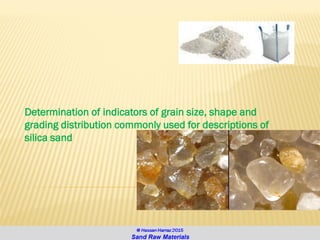
Determination of indicators of grain size, shape and
grading distribution commonly used for descriptions of
silica sand
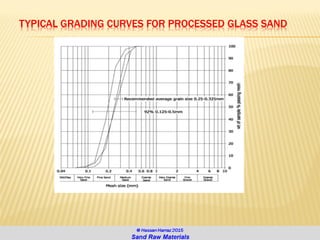
TYPICAL GRADING CURVES FOR PROCESSED GLASS SAND
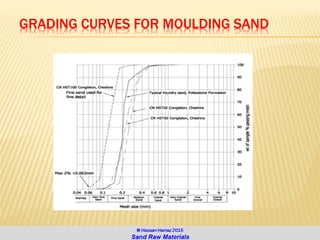
GRADING CURVES FOR MOULDING SAND
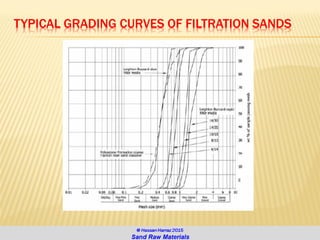
TYPICAL GRADING CURVES OF FILTRATION SANDS
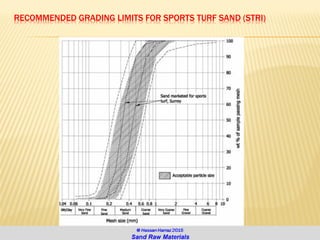
RECOMMENDED GRADING LIMITS FOR SPORTS TURF SAND (STRI)
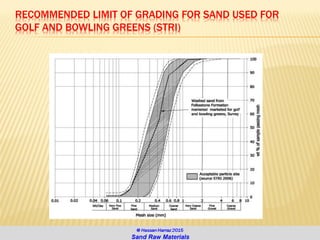
RECOMMENDED LIMIT OF GRADING FOR SAND USED FOR
GOLF AND BOWLING GREENS (STRI)
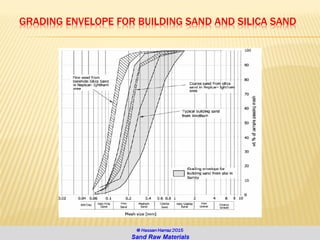
GRADING ENVELOPE FOR BUILDING SAND AND SILICA SAND

Sand raw materials

  • 1.
    Lecture 5: Sand RawMaterials Hassan Z. Harraz hharraz2006@yahoo.com Spring 2015 Taken from the earth  Given back to the earth 1
  • 2.
    MINERAL SANDS Silicon (Si)is the 2nd most abundant element in earth’s crust. Commonly found in its oxidized form (SiO2). Sand is a naturally occurring granular material comprised of finely divided rock and mineral particles. Sand is transported by wind and water and deposited in the form of beaches, dunes, sand spits, sand bars (placer deposits) ….etc. Sand constituents of sands are silica (SiO2), usually in the form of quartz, and iron oxides. The term "Mineral Sands" normally refers to concentrations of Heavy Minerals (HM) in an alluvial (old beach or river system) environment. Occasionally these deposits are referred to as "Beach sands". However mineral sands are also found in large Aeolian sand systems or “Dunal sands”. Mineral sands orebodies essentially fall into two categories based on the mode of deposition: alluvial or aeolian. Alluvial deposits are further split into marine beach placers and lacustrine heavy mineral (HM) accumulations. The principal Valuable Heavy Minerals (VHM) include ilmenite, leucoxene, rutile and zircon. Variations of other titanium minerals occur between the end members of ilmenite and rutile, including pseudo rutile and anatase.
  • 4.
    ‫الناعمة‬ ‫الصفراء‬ ‫الرمال‬‫محاجر‬-‫البستان‬ ‫جبل‬- ‫الدلنجات‬ ‫مركز‬-‫ا‬ ‫طبقة‬ ‫سمك‬ ‫يبلغ‬ ،‫البحيرة‬‫لرمال‬ ‫من‬15‫الى‬20‫متر‬. Yellow Sand Quarry
  • 5.
  • 6.
  • 7.
    7 Cross-bedding and scourin a fine sandstone, Sinai
  • 9.
    Abu Darag WhiteSandstones Quarry In Zaafarana - Ain El-Sukhna Area, Gulf of Suez, Egypt
  • 10.
  • 11.
    DIFFERENT GRADE OFSILICA SAND Different grade of Silica sand Determination of indicators of grain size, shape and grading distribution commonly used for descriptions of silica sand
  • 12.
  • 13.
    INTRODUCTION 'Silica sand' (alsoknown as “White silica sand”; or ‘Industrial sand‘; or Glass sand) ▪ It is sand which contains a high proportion of silica in the form of quartz and is marketed for purposes other than for direct use in the construction industry. ▪ It is produced from both unconsolidated sands and crushed sandstones, with processing to marketable form being of varying degrees of complexity depending on end use. ▪ Silica sand is an essential raw material for the glass and foundry casting industries, as well as in other industries such as ceramics and chemicals manufacture and for water filtration purposes.
  • 14.
    SILICA SAND  Themost common rock/ materials forming minerals on earth  Chemically named: quartz sand / rock crystal  Properties: ✓ Extremely heat durable ✓ Chemical stack resistance  It is mild white and red in color with small transparent granules.  White Silica Sand (Silicon Dioxide or SiO2) is a natural product found in the earth’s crust in the form of quartz.  It is used in various industries to serve different purposes
  • 15.
    FORMATION OF SILICASAND Naturally: ▪Mechanical & chemical weathering of quartz-bearing igneous & metamorphic rocks Chemically weathering: ▪Less stable minerals ➢ break down to become silica sand ▪More stable minerals ➢ release to environment ✓Carry by wind / wave ✓Sort by wave & stream action to form pure silica sand
  • 16.
    EXTRACTION OF SILICONSAND 1) Stripping of overburden (topsoil & vegetation) by bulldozers & scraper 2) Wet separation by washing the sand, passing through screens to remove roots & other organic matter 3) Gravity separation to separate silica sand from regular sand 4) Finished silica sand is transported by trucks to plants for processing 5) Oversized materials & residual clay are returned to mined pits
  • 17.
    Silica sands(or glasssand) requires processing as follows: 1)Screening 2)Washing and sizing, using hydrocyclones, attrition scrubbing,……etc. 3)Flotation and/or chemical/acid leaching to remove Fe minerals and stained quartz. 4)Spiralling and/or tabling to remove heavy minerals. 5)Hydrosizing. 6)Dewatering
  • 18.
    DEMAND  There aremany different types of glass with different chemical and physical properties.
  • 19.
    World resources ofSilica Sand ▪ Silica sand resources is abundant on the world. ▪ Its extraction is limited by ✓ geographic distribution ✓ quality requirements for some uses ✓ environmental restrictions ▪ Extraction of theses resources is dependent on whether it is economic and are controlled by the location of population centers http://minerals.er.usgs.gov/minerals/pubs/commodity/silica/780397.pdf @ Hassan Harraz 2015 Sand Raw Materials
  • 20.
     History:  Glassmaking & metallurgical activities few thousands years BC ago  Key raw material in ceramics, foundry & glass industrial revolution  Today:  Glass making, foundry casting, ceramics, filtration, specialist building applications, leisure ( e.g. golf course), filters in numerous products, plastics, the manufacture of chemicals, metal & refractory, as addictives in horticultural & agricultural products & simulating oil production  Important for today’s information technology:  Raw material for silicon chips  Plastics of computer mouses
  • 21.
    SPECIFICATION OF SILICASAND RAW MATERIAL Chemistry @ Hassan Harraz 2015 Sand Raw Materials
  • 22.
    Types Sizes AvailableApplications Powder Macro Chemicals Granules Micro Glassware Semi Micro Ceramics Sanitary ware Foundry Construction @ Hassan Harraz 2015 Sand Raw Materials
  • 23.
    Required chemical compositionof silica sand for glass manufacture Maximum Cr2O3 (wt %) Maximum Fe2O3 (wt %) Minimum SiO2 (wt %)Glass 0.000150.01399.7Opthalmic glass 0.00020.01099.6 Tableware, crystal and borosilicate glass 0.00050.03098.8Colourless containers --0.25097.0Coloured containers 0.00010.10099.0Clear flat glass @ Hassan Harraz 2015 Sand Raw Materials
  • 24.
     Every communities dependupon it for different purposes  Especially important for developing & developed countries:  For further technological improvement & development
  • 25.
    INDUSTRIAL SAND APPLICATIONS Industry,Trade Applications and uses Glass industry, Fused silica industry as glass sand for white container and flat glass, crystal glass, lead crystal, optical glass, special glass, technical glass, borosilicate glass, glass wool and fused silica bricks and tools Foundry industry foundry sand for molds and cores for metal castings Construction materials and concrete industry as raw material for premixed dry mortar, polymer cement concrete, textured plaster, sandy limestone, tiles, bricks, artificial cement stones, design and industrial floors etc. Water purification as filter sands and gravels according to EN 12904 : 1999 Blasting abrasives and substitutes for mechanical surface treatment Ceramic industry, Extenders for cement and resin bound masss, ceramic mass, filler, paints etc. Iron processing and refractory industry as raw material for filler sands (sliding gate fillers), fire-proof silica bricks, silica ramming mixtures, repair systems etc. Chemical industry as raw material for sodium silicate (water glass) and SiC Electronics industry as fuse sands Domestic animals hygiene, Aquaristic equipment as bird sand, parrot sand, chinchilla sand, terrarium sand and coloured quartz Leisure and sports facilities as special sand for playgrounds, riding-grounds, golf-courses, beach volleyball grounds, athletic grounds, artificial lawn etc. Sanding and Spreading as braking sand for trains and trams, as winter sand for snow and ice control (straight or mixed with salt)
  • 26.
    Determination of indicatorsof grain size, shape and grading distribution commonly used for descriptions of silica sand
  • 27.
    TYPICAL GRADING CURVESFOR PROCESSED GLASS SAND
  • 28.
    GRADING CURVES FORMOULDING SAND
  • 29.
    TYPICAL GRADING CURVESOF FILTRATION SANDS
  • 30.
    RECOMMENDED GRADING LIMITSFOR SPORTS TURF SAND (STRI)
  • 31.
    RECOMMENDED LIMIT OFGRADING FOR SAND USED FOR GOLF AND BOWLING GREENS (STRI)
  • 32.
    GRADING ENVELOPE FORBUILDING SAND AND SILICA SAND