SAMPLING-1
DR Ratti Ram Meena
MBBS, MD(PSM)
Sardar Patel Medical College, Bikaner
(Rajasthan)
9/29/2020 1Dr Rattiram Meena 9460995741
• Population or Universe: It refers to the group of
people, items or units under investigation and
includes every individual.
• Sample: a collection consisting of a part or subset of
the objects or individuals of population which is
selected for the purpose, representing the population
• Sampling: It is the process of selecting a sample
from the population. For this population is divided
into a number of parts called Sampling Units.
9/29/2020 2Dr Rattiram Meena 9460995741
• A sampling unit -is an individual member of a
sample.
• A sampling frame- is a list of all members of a
population.
• A parameter- is a characteristic of the
population.
Examples are population mean, population
variance and population proportion.
• A statistic- is a characteristic of the sample.
Examples are sample mean, sample variance
and sample proportion9/29/2020 3Dr Rattiram Meena 9460995741
Definition of Sampling
• Measuring a small portion of something and
then making a general statement about the
whole thing.
• Process of selecting a number of units for a
study in such a way that the units represent
the larger group from which they are selected.
9/29/2020 4Dr Rattiram Meena 9460995741
• Three elements in process of sampling:
o Selecting the sample
o Collecting the information
o Making inference about population
• Statistics: values obtained from study of a
sample.
• Parameters: such values from study of
population
9/29/2020 5Dr Rattiram Meena 9460995741
Need of sampling
• Large population can be conveniently covered.
• Time, money and energy is saved.
• Helpful when units of area are homogenous.
• Used when percent accuracy is not acquired.
• Used when the data is unlimited
9/29/2020 6Dr Rattiram Meena 9460995741
• Sampling makes possible the study of a large,
heterogeneous (different characteristics)
population. -
The universe or population to be studied
maybe too large or unlimited that it is almost
impossible to reach all of them. Sampling
makes possible this kind of study because in
sampling only a small portion of the
population maybe involved in the study,
enabling the researcher to reach all through
this small portion of the population.9/29/2020 7Dr Rattiram Meena 9460995741
Advantages of sampling
• Economical: Reduce the cost compare to
entire population.
• Increased speed: Collection of data, analysis
and Interpretation of data etc take less time
than the population.
• Accuracy: Due to limited area of coverage,
completeness and accuracy is possible.
• Rapport: Better rapport is established with
the respondents, which helps in validity and
reliability of the results9/29/2020 8Dr Rattiram Meena 9460995741
Disadvantages of sampling
• Biasedness: Chances of biased selection leading to
incorrect conclusion
• Selection of true representative sample: Sometimes
it is difficult to select the right representative sample
• Need for specialized knowledge: The researcher
needs knowledge, training and experience in
sampling technique, statistical analysis and
calculation of probable error
• Impossibility of sampling: Sometimes population is
too small or too heterogeneous to select a
representative sample.
9/29/2020 9Dr Rattiram Meena 9460995741
WHAT IS A GOOD SAMPLE?
• The sample must be valid.
Validity depends on 2 considerations:
1. Accuracy – bias is absent from the sample
(ex. A company is thinking of lowering its price for its soap bar
product. After making a survey in the sales of their product in
a known mall they concluded that they will not cut down the
price of the soap bar since there was an increased in sales
compared to last year. Bias is present in this study since the
company based its decision for the sales of a known mall
which have consumers who can afford high price products.
They did not consider the sales of their products in other area
wherein they have middle class or low class consumers.)
9/29/2020 10Dr Rattiram Meena 9460995741
2. Precision – sample represents the population
(ex. Customers who visited a particular dress shop
are requested to log in their phone numbers so that
they will receive information for discounts and new
arrivals. Management wish to study customers
satisfaction for that shop. By means of interviewing
through phone they get comments and reactions of
their client. Samples used are not an exact
representative of the population since it is limited
only to those customers who log in their phone
numbers and they did not consider customers
without phone numbers indicated.9/29/2020 11Dr Rattiram Meena 9460995741
SAMPLING DESIGN
• What is the target population?
- Target population is the aggregation of
elements (members of the population) from
which the sample is actually selected.
• What are the parameters of interest?
- Parameters are summary description of a
given variable in a population.
9/29/2020 12Dr Rattiram Meena 9460995741
• What is the sampling frame?
- Sampling frame is the list of elements from
which the sample is actually drawn. Complete
and correct list of population members only.
• What is the appropriate sampling method?
- Probability or Non-Probability sampling
method
9/29/2020 13Dr Rattiram Meena 9460995741
• What size sample is needed?
There are no fixed rules in determining the size
of a sample needed. There are guidelines that
should be observed in determining the size of
a sample.
9/29/2020 14Dr Rattiram Meena 9460995741
• When the population is more or less homogeneous
and only the typical, normal, or average is desired to
be known, a smaller sample is enough. However, if
differences are desired to be known, a larger sample
is needed.
• When the population is more or less heterogeneous
and only the typical, normal or average is desired to
be known a larger sample is needed. However, if only
their differences are desired to be known, a smaller
sample is sufficient.
9/29/2020 15Dr Rattiram Meena 9460995741
• The size of a sample varies inversely as the size of the
population. A larger proportion is required of a smaller
population and a smaller proportion may do for a bigger
population.
• For a greater accuracy and reliability of results, a greater
sample is desirable.
• In biological and chemical experiments, the use of few
persons is more desirable to determine the reactions of
humans.
• When subjects are likely to be destroyed during experiment, it
is more feasible to use non-humans.
9/29/2020 16Dr Rattiram Meena 9460995741
Sample Size Formula
• The formula requires that we
(i)specify the amount of confidence we wish to
have,
(ii) estimate the variance in the population,
and
(iii) specify the level of desired accuracy we
want.
• When we specify the above, the formula tells
us what sample size we need to use….n
9/29/2020 17Dr Rattiram Meena 9460995741
• There are 3 procedures that could be used for
calculating sample size:
1. Use of formulae
2. Ready made tables
3. Computer softwares (Epi-info, SPSS etc)
9/29/2020 18Dr Rattiram Meena 9460995741
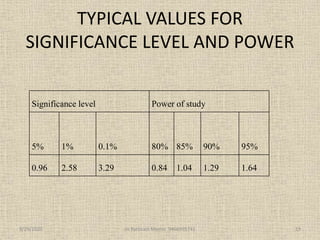
TYPICAL VALUES FOR
SIGNIFICANCE LEVEL AND POWER
Significance level Power of study
5% 1% 0.1% 80% 85% 90% 95%
0.96 2.58 3.29 0.84 1.04 1.29 1.64
9/29/2020 19Dr Rattiram Meena 9460995741
Sample size for The Mean
• n= Z² (var)²/ (e)²
• Where
• Z=confidence level at 95% (standard
value of 1.96)
• var = Variance of population
• e=Allowable error
9/29/2020 20Dr Rattiram Meena 9460995741
Example
• A medical officer wishes to estimate the mean
hemoglobin in a defined community.
Preliminary information is that this mean is
about 150mg/l with a SD of 32mg/l. If a
sampling error of up to 5mg/l in the estimate
is to be tolerated, how many subjects should
be included in the study?
9/29/2020 21Dr Rattiram Meena 9460995741
Solution
• SD=32mg/l
• e=5mg/l
• Z=1.96
n= Z² (var)²/ (e)²
n=1.96*1.96*35/5*5
n=1762
9/29/2020 22Dr Rattiram Meena 9460995741
Sample Size for Proportions &
Prevalence
• n= Z² p(1-p)/ (e)²
• Where
• Z=confidence level at 95% (standard value of
1.96)
• P=Estimated prevalence or proportions of
project area
• e=range of CI
9/29/2020 23Dr Rattiram Meena 9460995741
Example
• Suppose the prevalence of COVID-19 infection
is 2% and the absolute difference to be
detected is 0.25% with a 95% confidence,
what is the sample size required?
9/29/2020 24Dr Rattiram Meena 9460995741
Solution
• P=0.02 , q=1-p, = 1-0.02
• q=0.98
• Z=1.96
• e=0.0025
n= Z² p(1-p)/ (e)²
n=1.96*1.96*0.02*0.98/0.0025*0.0025
n=12047
9/29/2020 25Dr Rattiram Meena 9460995741
SAMPLE SIZE FOR TWO MEANS
• (u+v)²(σ² 1+ σ² 2)/(µ1-µ2) ²
• µ1-µ2- Difference between means
• σ 1+ σ 2- Standard deviation
• u- one –sided percentage point of normal
distribution corresponding to 100%-power.
• v- two-sided percentage point of normal
distribution corresponding to required
significance level.
9/29/2020 26Dr Rattiram Meena 9460995741
Example
• A study was planned to find out whether food
supplementation during pregnancy increases birth
weight of child. Pregnant women were randomly
assigned to cases and control . To calculate sample
size ,we need:
• Size of difference between mean birth weight that
was considered appreciable: =(µ1-µ2) : decided as
0.25 kg by investigators.
• Standard deviation of distributions in each group :
ROL suggested it to be 0.4kg
• Assuming σ 1, σ 2 = 0.4kg
9/29/2020 27Dr Rattiram Meena 9460995741
• Power required : decided to be kept at 95%
• 1-power= 5%,
u=1.64
• Significance level desired : decided to be kept at 1%
v=2.58
=(u+v)²(σ² 1+ σ² 2)/(µ1-µ2)²
=(1.64+2.58) ²(1+0.4²+0.4²)/0.25²
N-91.2
Therefore 92 subjects are needed in both the groups.
9/29/2020 28Dr Rattiram Meena 9460995741
COMPARISON OF TWO
PROPORTION
• 2x(u+v) ² ]px(1-p)]/(p1-p2)
• p= p2+p1/2
• p1,p2 - Proportions
• u -one –sided percentage point of normal
distribution corresponding to 100%-power.
• v- two-sided percentage point of normal
distribution corresponding to required
significance level
9/29/2020 29Dr Rattiram Meena 9460995741
Example
• A study was planned to record difference in mortality among
cases of road traffic injuries graded AIS score 4 and 5 in the
month of July. Results from previous study shows 18 deaths
among 72 patients graded AIS score 4. To calculate sample
size, we need:
• Proportion mortality in previous study: p1 =18/72=0.25 or
25%
• Size of difference between proportion mortalities that would
be considered appreciable:
• =( p1-p2) : decided as 3% by investigators.
• Thus expected proportion mortality in grade 5 cases:
• p2=28%=28/100=0.28
9/29/2020 30Dr Rattiram Meena 9460995741
Sample
• p=(0.25+0.28)/2= 0.265
• Power required : decided to be kept at 95%
1-power= 5%
u=1.64
• Significance level desired : decided to be kept
at 1%
v=2.58
9/29/2020 31Dr Rattiram Meena 9460995741
• 2x(u+v) ² ]px(1-p)]/(p1-p2)
• N = 2x (1.64+2.58)²x(0.265)(1-0.265)/(0.28-
0.25)
• =7707 Therefore 7707 subjects are needed to
be studied in each group.
9/29/2020 32Dr Rattiram Meena 9460995741
FORMULAE USED WITH RATE
• Estimation of single rate µ v²/d²
µ - Rate
d – Range of CI
v - two-sided percentage point of normal distribution
corresponding to required significance level.
• Comparison of two rates (u+v) ² (µ1+µo) / (µ1-µo) ²
µ1,µo - Rates
u - one –sided percentage point of normal distribution
corresponding to 100%-power.
v - two-sided percentage point of normal distribution
corresponding to required significance level
9/29/2020 33Dr Rattiram Meena 9460995741
Example
• A study was planned to find out mean number of
viral diarrhea incidence per child per annum in 0-5
year old children in Rajasthan , India. To calculate
sample size , we need:
• Average number of influenza incidence expected in
0-5year olds per annum . Review of existing literature
states it to be 4 approximately.
• 95% confidence interval we would like to have for
our desired average : Decided to be ± 0.2 by
investigators . i.e. 95% CI = 3.8-4.2
9/29/2020 34Dr Rattiram Meena 9460995741
• Two-sided percentage point of normal
distribution corresponding to required
significance level: v for 95% CI = 1.96(˜2)
• n=µ v²/d²
• = 4(2) ²/(0.2) ²
• =400
• Thus, at least 400 subjects need to be studied
to obtain mean influenza of 4 per child per
annum with 95% CI of ± 0.2
9/29/2020 35Dr Rattiram Meena 9460995741
• A study was planned to find out whether KAP improvement
tools for driving skills decrease injuries per annum in school
going children . School children were randomly assigned to
cases who received special education and controls who didn’t
. To calculate sample size , we need:
• Size of difference between mean road traffic accident rates
that was considered appreciable: =(µ1-µo) : decided as 2
injuries per child per annum by investigators
• Rate of injuries per child per annum among controls: suggest
it to be 4 injuries per child per annum . Therefore µo=4 , µ1 =2
9/29/2020 36Dr Rattiram Meena 9460995741
• Power required : decided to be kept at 95%
1-power = 5%
u = 1.64
Significance level desired : decided to be kept
at 1% v = 2.58
=(u+v) ² (µ1+µo) / (µ1-µo) ²
= n= (1.64+2.58) ²x(2+4)/(2-4) ²
=17.8084x6/4 = 26.71 Therefore 27 subjects are
needed in both the groups.9/29/2020 37Dr Rattiram Meena 9460995741
USE OF COMPUTER SOFTWARE
FOR SAMPLE SIZE CALCULATION
• The following softwares can be used for
calculating sample size .
• Epi-info (epiinfo.codeplex.com)
• SPSS (www.spss.co.in)
9/29/2020 38Dr Rattiram Meena 9460995741
• Sample size determination is one of the most
essential components of every research Study.
• The larger the sample size, the higher will be
the degree of accuracy, but this is limited by
the availability of resources.
• It can be determined using formulae,
readymade tables and computer softwares.
9/29/2020 39Dr Rattiram Meena 9460995741

Sampling techniques

  • 1.
    SAMPLING-1 DR Ratti RamMeena MBBS, MD(PSM) Sardar Patel Medical College, Bikaner (Rajasthan) 9/29/2020 1Dr Rattiram Meena 9460995741
  • 2.
    • Population orUniverse: It refers to the group of people, items or units under investigation and includes every individual. • Sample: a collection consisting of a part or subset of the objects or individuals of population which is selected for the purpose, representing the population • Sampling: It is the process of selecting a sample from the population. For this population is divided into a number of parts called Sampling Units. 9/29/2020 2Dr Rattiram Meena 9460995741
  • 3.
    • A samplingunit -is an individual member of a sample. • A sampling frame- is a list of all members of a population. • A parameter- is a characteristic of the population. Examples are population mean, population variance and population proportion. • A statistic- is a characteristic of the sample. Examples are sample mean, sample variance and sample proportion9/29/2020 3Dr Rattiram Meena 9460995741
  • 4.
    Definition of Sampling •Measuring a small portion of something and then making a general statement about the whole thing. • Process of selecting a number of units for a study in such a way that the units represent the larger group from which they are selected. 9/29/2020 4Dr Rattiram Meena 9460995741
  • 5.
    • Three elementsin process of sampling: o Selecting the sample o Collecting the information o Making inference about population • Statistics: values obtained from study of a sample. • Parameters: such values from study of population 9/29/2020 5Dr Rattiram Meena 9460995741
  • 6.
    Need of sampling •Large population can be conveniently covered. • Time, money and energy is saved. • Helpful when units of area are homogenous. • Used when percent accuracy is not acquired. • Used when the data is unlimited 9/29/2020 6Dr Rattiram Meena 9460995741
  • 7.
    • Sampling makespossible the study of a large, heterogeneous (different characteristics) population. - The universe or population to be studied maybe too large or unlimited that it is almost impossible to reach all of them. Sampling makes possible this kind of study because in sampling only a small portion of the population maybe involved in the study, enabling the researcher to reach all through this small portion of the population.9/29/2020 7Dr Rattiram Meena 9460995741
  • 8.
    Advantages of sampling •Economical: Reduce the cost compare to entire population. • Increased speed: Collection of data, analysis and Interpretation of data etc take less time than the population. • Accuracy: Due to limited area of coverage, completeness and accuracy is possible. • Rapport: Better rapport is established with the respondents, which helps in validity and reliability of the results9/29/2020 8Dr Rattiram Meena 9460995741
  • 9.
    Disadvantages of sampling •Biasedness: Chances of biased selection leading to incorrect conclusion • Selection of true representative sample: Sometimes it is difficult to select the right representative sample • Need for specialized knowledge: The researcher needs knowledge, training and experience in sampling technique, statistical analysis and calculation of probable error • Impossibility of sampling: Sometimes population is too small or too heterogeneous to select a representative sample. 9/29/2020 9Dr Rattiram Meena 9460995741
  • 10.
    WHAT IS AGOOD SAMPLE? • The sample must be valid. Validity depends on 2 considerations: 1. Accuracy – bias is absent from the sample (ex. A company is thinking of lowering its price for its soap bar product. After making a survey in the sales of their product in a known mall they concluded that they will not cut down the price of the soap bar since there was an increased in sales compared to last year. Bias is present in this study since the company based its decision for the sales of a known mall which have consumers who can afford high price products. They did not consider the sales of their products in other area wherein they have middle class or low class consumers.) 9/29/2020 10Dr Rattiram Meena 9460995741
  • 11.
    2. Precision –sample represents the population (ex. Customers who visited a particular dress shop are requested to log in their phone numbers so that they will receive information for discounts and new arrivals. Management wish to study customers satisfaction for that shop. By means of interviewing through phone they get comments and reactions of their client. Samples used are not an exact representative of the population since it is limited only to those customers who log in their phone numbers and they did not consider customers without phone numbers indicated.9/29/2020 11Dr Rattiram Meena 9460995741
  • 12.
    SAMPLING DESIGN • Whatis the target population? - Target population is the aggregation of elements (members of the population) from which the sample is actually selected. • What are the parameters of interest? - Parameters are summary description of a given variable in a population. 9/29/2020 12Dr Rattiram Meena 9460995741
  • 13.
    • What isthe sampling frame? - Sampling frame is the list of elements from which the sample is actually drawn. Complete and correct list of population members only. • What is the appropriate sampling method? - Probability or Non-Probability sampling method 9/29/2020 13Dr Rattiram Meena 9460995741
  • 14.
    • What sizesample is needed? There are no fixed rules in determining the size of a sample needed. There are guidelines that should be observed in determining the size of a sample. 9/29/2020 14Dr Rattiram Meena 9460995741
  • 15.
    • When thepopulation is more or less homogeneous and only the typical, normal, or average is desired to be known, a smaller sample is enough. However, if differences are desired to be known, a larger sample is needed. • When the population is more or less heterogeneous and only the typical, normal or average is desired to be known a larger sample is needed. However, if only their differences are desired to be known, a smaller sample is sufficient. 9/29/2020 15Dr Rattiram Meena 9460995741
  • 16.
    • The sizeof a sample varies inversely as the size of the population. A larger proportion is required of a smaller population and a smaller proportion may do for a bigger population. • For a greater accuracy and reliability of results, a greater sample is desirable. • In biological and chemical experiments, the use of few persons is more desirable to determine the reactions of humans. • When subjects are likely to be destroyed during experiment, it is more feasible to use non-humans. 9/29/2020 16Dr Rattiram Meena 9460995741
  • 17.
    Sample Size Formula •The formula requires that we (i)specify the amount of confidence we wish to have, (ii) estimate the variance in the population, and (iii) specify the level of desired accuracy we want. • When we specify the above, the formula tells us what sample size we need to use….n 9/29/2020 17Dr Rattiram Meena 9460995741
  • 18.
    • There are3 procedures that could be used for calculating sample size: 1. Use of formulae 2. Ready made tables 3. Computer softwares (Epi-info, SPSS etc) 9/29/2020 18Dr Rattiram Meena 9460995741
  • 19.
    TYPICAL VALUES FOR SIGNIFICANCELEVEL AND POWER Significance level Power of study 5% 1% 0.1% 80% 85% 90% 95% 0.96 2.58 3.29 0.84 1.04 1.29 1.64 9/29/2020 19Dr Rattiram Meena 9460995741
  • 20.
    Sample size forThe Mean • n= Z² (var)²/ (e)² • Where • Z=confidence level at 95% (standard value of 1.96) • var = Variance of population • e=Allowable error 9/29/2020 20Dr Rattiram Meena 9460995741
  • 21.
    Example • A medicalofficer wishes to estimate the mean hemoglobin in a defined community. Preliminary information is that this mean is about 150mg/l with a SD of 32mg/l. If a sampling error of up to 5mg/l in the estimate is to be tolerated, how many subjects should be included in the study? 9/29/2020 21Dr Rattiram Meena 9460995741
  • 22.
    Solution • SD=32mg/l • e=5mg/l •Z=1.96 n= Z² (var)²/ (e)² n=1.96*1.96*35/5*5 n=1762 9/29/2020 22Dr Rattiram Meena 9460995741
  • 23.
    Sample Size forProportions & Prevalence • n= Z² p(1-p)/ (e)² • Where • Z=confidence level at 95% (standard value of 1.96) • P=Estimated prevalence or proportions of project area • e=range of CI 9/29/2020 23Dr Rattiram Meena 9460995741
  • 24.
    Example • Suppose theprevalence of COVID-19 infection is 2% and the absolute difference to be detected is 0.25% with a 95% confidence, what is the sample size required? 9/29/2020 24Dr Rattiram Meena 9460995741
  • 25.
    Solution • P=0.02 ,q=1-p, = 1-0.02 • q=0.98 • Z=1.96 • e=0.0025 n= Z² p(1-p)/ (e)² n=1.96*1.96*0.02*0.98/0.0025*0.0025 n=12047 9/29/2020 25Dr Rattiram Meena 9460995741
  • 26.
    SAMPLE SIZE FORTWO MEANS • (u+v)²(σ² 1+ σ² 2)/(µ1-µ2) ² • µ1-µ2- Difference between means • σ 1+ σ 2- Standard deviation • u- one –sided percentage point of normal distribution corresponding to 100%-power. • v- two-sided percentage point of normal distribution corresponding to required significance level. 9/29/2020 26Dr Rattiram Meena 9460995741
  • 27.
    Example • A studywas planned to find out whether food supplementation during pregnancy increases birth weight of child. Pregnant women were randomly assigned to cases and control . To calculate sample size ,we need: • Size of difference between mean birth weight that was considered appreciable: =(µ1-µ2) : decided as 0.25 kg by investigators. • Standard deviation of distributions in each group : ROL suggested it to be 0.4kg • Assuming σ 1, σ 2 = 0.4kg 9/29/2020 27Dr Rattiram Meena 9460995741
  • 28.
    • Power required: decided to be kept at 95% • 1-power= 5%, u=1.64 • Significance level desired : decided to be kept at 1% v=2.58 =(u+v)²(σ² 1+ σ² 2)/(µ1-µ2)² =(1.64+2.58) ²(1+0.4²+0.4²)/0.25² N-91.2 Therefore 92 subjects are needed in both the groups. 9/29/2020 28Dr Rattiram Meena 9460995741
  • 29.
    COMPARISON OF TWO PROPORTION •2x(u+v) ² ]px(1-p)]/(p1-p2) • p= p2+p1/2 • p1,p2 - Proportions • u -one –sided percentage point of normal distribution corresponding to 100%-power. • v- two-sided percentage point of normal distribution corresponding to required significance level 9/29/2020 29Dr Rattiram Meena 9460995741
  • 30.
    Example • A studywas planned to record difference in mortality among cases of road traffic injuries graded AIS score 4 and 5 in the month of July. Results from previous study shows 18 deaths among 72 patients graded AIS score 4. To calculate sample size, we need: • Proportion mortality in previous study: p1 =18/72=0.25 or 25% • Size of difference between proportion mortalities that would be considered appreciable: • =( p1-p2) : decided as 3% by investigators. • Thus expected proportion mortality in grade 5 cases: • p2=28%=28/100=0.28 9/29/2020 30Dr Rattiram Meena 9460995741
  • 31.
    Sample • p=(0.25+0.28)/2= 0.265 •Power required : decided to be kept at 95% 1-power= 5% u=1.64 • Significance level desired : decided to be kept at 1% v=2.58 9/29/2020 31Dr Rattiram Meena 9460995741
  • 32.
    • 2x(u+v) ²]px(1-p)]/(p1-p2) • N = 2x (1.64+2.58)²x(0.265)(1-0.265)/(0.28- 0.25) • =7707 Therefore 7707 subjects are needed to be studied in each group. 9/29/2020 32Dr Rattiram Meena 9460995741
  • 33.
    FORMULAE USED WITHRATE • Estimation of single rate µ v²/d² µ - Rate d – Range of CI v - two-sided percentage point of normal distribution corresponding to required significance level. • Comparison of two rates (u+v) ² (µ1+µo) / (µ1-µo) ² µ1,µo - Rates u - one –sided percentage point of normal distribution corresponding to 100%-power. v - two-sided percentage point of normal distribution corresponding to required significance level 9/29/2020 33Dr Rattiram Meena 9460995741
  • 34.
    Example • A studywas planned to find out mean number of viral diarrhea incidence per child per annum in 0-5 year old children in Rajasthan , India. To calculate sample size , we need: • Average number of influenza incidence expected in 0-5year olds per annum . Review of existing literature states it to be 4 approximately. • 95% confidence interval we would like to have for our desired average : Decided to be ± 0.2 by investigators . i.e. 95% CI = 3.8-4.2 9/29/2020 34Dr Rattiram Meena 9460995741
  • 35.
    • Two-sided percentagepoint of normal distribution corresponding to required significance level: v for 95% CI = 1.96(˜2) • n=µ v²/d² • = 4(2) ²/(0.2) ² • =400 • Thus, at least 400 subjects need to be studied to obtain mean influenza of 4 per child per annum with 95% CI of ± 0.2 9/29/2020 35Dr Rattiram Meena 9460995741
  • 36.
    • A studywas planned to find out whether KAP improvement tools for driving skills decrease injuries per annum in school going children . School children were randomly assigned to cases who received special education and controls who didn’t . To calculate sample size , we need: • Size of difference between mean road traffic accident rates that was considered appreciable: =(µ1-µo) : decided as 2 injuries per child per annum by investigators • Rate of injuries per child per annum among controls: suggest it to be 4 injuries per child per annum . Therefore µo=4 , µ1 =2 9/29/2020 36Dr Rattiram Meena 9460995741
  • 37.
    • Power required: decided to be kept at 95% 1-power = 5% u = 1.64 Significance level desired : decided to be kept at 1% v = 2.58 =(u+v) ² (µ1+µo) / (µ1-µo) ² = n= (1.64+2.58) ²x(2+4)/(2-4) ² =17.8084x6/4 = 26.71 Therefore 27 subjects are needed in both the groups.9/29/2020 37Dr Rattiram Meena 9460995741
  • 38.
    USE OF COMPUTERSOFTWARE FOR SAMPLE SIZE CALCULATION • The following softwares can be used for calculating sample size . • Epi-info (epiinfo.codeplex.com) • SPSS (www.spss.co.in) 9/29/2020 38Dr Rattiram Meena 9460995741
  • 39.
    • Sample sizedetermination is one of the most essential components of every research Study. • The larger the sample size, the higher will be the degree of accuracy, but this is limited by the availability of resources. • It can be determined using formulae, readymade tables and computer softwares. 9/29/2020 39Dr Rattiram Meena 9460995741